NATO Sabre Strike Exercise: Scaring Russia with Multiple War Games of Unparalleled Scale
By Alex GORKA | Strategic Culture Foundation | 06.06.2018
This year, NATO has already organized about 100 exercises, 20 percent more compared to the same period in 2017. Saber Strike-2018, a large-scale US-led exercise involving 18,000 soldiers from 19 NATO members and partner nations, kicked off on June 3 to last till June 15. The scope of the exercise has been steadily expanding with every year. It was 11,000 troops in 2017, 9,000 in 2016, 6,000 in 2015, 4,700 in 2014 and 2,000 in 2013 – that’s how a relatively small drill turned into the regular deployment of substantial force in the proximity of Russia’s borders. Moscow expressed its concern about it at the NATO-Russia Council’s session held on May 31.
The annual multination training event organized every year since 2010 is being held across the training areas in Poland, Latvia, Lithuania and Estonia. Non-NATO countries taking part are Finland and Macedonia. Air assault landings are part of the scenario to hone the skills for launching offensive operations.
Sabre Strike is timed with Swift Response airborne drill in Latvia to culminate on June 8. It involves 800 paratroopers from US, Latvia, Lithuania, Israel and Poland.
There will be more exercises held in 2018 near Russia’s borders, including Trident Juncture, a really big one to take place in late October-early November to involve 35,000 troops from 30 nations along with 70 ships and about 130 aircraft and Anakonda organized by Poland in November. The latter will involve 100,000 servicemen, 5,000 vehicles, 150 aircraft and 45 warships. The scale is mind-boggling. One can imagine how much it costs! The Anakonda scenario includes preemptive strikes. If it’s not an open preparation for war then what is? US Army Chief of Staff Gen. Mark Milley believes it is. According to him, “Having large-scale NATO forces in the Baltic States and Poland, as well as the lack of transparency – we see serious preparation for a great war.” He knows what is talking about.
In May, NATO held a large Siil (Hedgehog) exercise in Estonia and northern Latvia involving more than 15 thousand troops. The series of training events are conducted against the background of the proposal put forward by Poland to deploy US troops on its soil with Warsaw shouldering the financial burden of base construction. A NATO annual summit in July will consider the issues related to further reinforcement of forces in Europe, including the eastern flank.
It has been revealed recently that the alliance plans to create an addition to the NATO Response Force (NRF) increasing its strength from 20,000 to about 50,000 by creating a pool of 30,000 troops with organic aviation and ships ready to be operationally deployed within 30 days. The initiative belongs to the US with Germany to take the lead. The bloc’s defense chiefs will discuss the issue at their upcoming meeting on June 8-9 before putting it on the agenda of NATO summit to be held on July 11-12. NATO war preparations against Russia include the new crisis response command center in Ulm, southern Germany, and another one in the US state of Virginia.
This force as well as other units will become part of training events and the soldiers will be deployed on temporary basis but holding regular exercises presupposes the creation of infrastructure to be used by troops upon arrival for launching offensive actions. Correspondingly, logistics are being beefed up.
There is fresh news to hit headlines before the July summit. Discussions are underway to deploy US THAAD air defense system in Germany. The move would plug a radar gap that emerged as a result of postponing the deployment of a second Aegis Ashore system in Poland. The Polish government has announced plans to purchase US Patriot PAC-3 MSE air defense systems.
Both the THAAD and Patriot have rather limited capability against sophisticated ICBMs but Aegis Ashore is more effective.
Modernization will take place, advanced missiles and systems will be moved to the already existing sites. The main thing is that the infrastructure, the foundation to build ballistic missile defense and surface targets strike capability on, will be in place. And the only target is Russia. The Aegis Ashore can launch intermediate range surface-to-surface missiles against Russian territory in violation of the INF Treaty. In a couple of years, Poland will host it. The THAAD’s radar can greatly enhance the Aegis Ashore capabilities by relaying data to them. The AN/TPY-2 has an estimated range from 1,500km (932mi) to 3,000km (1,864mi). The maximum instrumented range is 2,000km (1242mi) to enable it to monitor large chunks of Russia’s territory.
The INF Treaty is teetering on the brink of collapse. If torn up, the infrastructure in question would be just the thing the US would need to station intermediate range forces in Europe with the means to protect them already in place. F-35s incorporating B61-12 nuclear precision guided munitions would also be under the umbrella of air defense systems in place formally deployed to counter the non-existent threat coming from Iran.
The NATO summit in July is to focus on the “Russia threat”. The extraordinary scale of military exercises conducted so intensively with scenarios that include bringing in reinforcements to advance, not take defensive positions, the creation of infrastructure at Russia’s door and preparing the logistical base to provide for offensive operations will be described as the least the bloc can do while facing the superior enemy. Provoking Russia to take steps it would not take otherwise is the sure way to return Europe to the Cold War days.
NATO could have chosen a different approach of solving the problems at the round table but it did not. The European Security Treaty (2009) and the Agreement on Basic Principles Governing Among NATO-Russia Council Member States in the Security Sphere (2009) proposed by Russia were rejected off the cuff without any attempts to seriously negotiate the proposals. The 2016 German initiative to launch talks on a new European security agreement was greeted to be swept under the rug afterwards. The May 31 NRC meeting was devoted more to the Skripal case than European security and arms control issues. Actually, NATO has not lifted a finger to dissipate tensions. Instead, it is rapidly increasing the tempo of military activities near Russia on an unprecedented scale, undermining whatever is left of European security. The alliance has made its choice, giving preference to the policy of provocations.
Israel intelligence minister proposes ‘military coalition’ against Iran
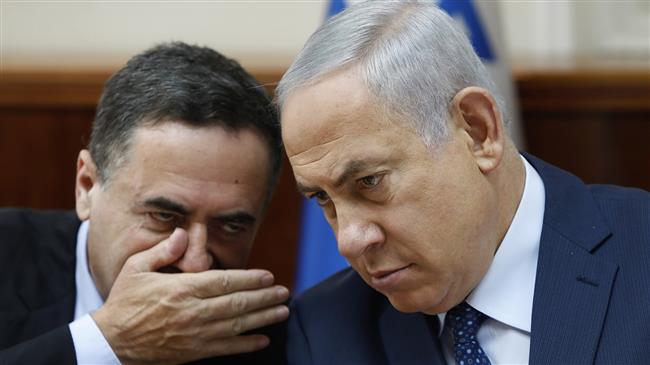
Israeli Intelligence Minister Yisrael Katz (L) and Israeli Prime Minister Benjamin Netanyahu
Press TV – June 5, 2018
Israel has proposed that “a military coalition” be formed against Iran in case Tehran pursues “military-grade” uranium enrichment, suggesting that the military force would comprise of the Israeli regime, the US, the Western states and their Arab allies.
Speaking to media on Tuesday, Israeli Intelligence Minister Yisrael Katz claimed that Iran had once been running an “unsupervised” enrichment scheme with the potential of arming the country with nuclear weapons.
The allies will need to issue a statement against the Islamic Republic “if the Iranians don’t surrender now, and try to return,” he said, adding that the statement would be threatening Iranians that “a military coalition will be formed against them.”
“There should be a clear statement by the president of the United States and all of the Western coalition” if Iran returns to enriching “military-grade” uranium, the minister said. “The Arabs and Israel surely would be there too,” he added.
Washington and Tel Aviv, and to a lesser extent their Western and Arab partners, have claimed that Tehran’s nuclear energy program harbors military aspects.
Iran has strictly and in all circumstances denied pursuing any military ambitions through its nuclear work.
The country asserts that under a fatwa (religious decree) issued by Leader of the Islamic Revolution Ayatollah Seyyed Ali Khamenei, its long-established policy is to oppose the acquisition, production, stockpiling, and use of nuclear weapons.
In December 2015, the International Atomic Energy Agency’s governing board voted overwhelmingly in favor of a draft resolution, which closed the so-called possible military dimensions (PMD) case in Iran’s nuclear program.
The vote brought an end to a 12-year investigation into the “past and present issues” regarding Iran’s nuclear activities, which the United Nations nuclear watchdog had been probing under pressure from the Israeli regime, the US and their allies.
The vote came after Iran and the P5+1 group of countries signed a nuclear agreement in 2015.
The US, however, withdrew from the accord last month, emboldening Israel in its efforts to try to kill the deal and rally more support for its anti-Iran campaign.
Despite Tel Aviv and Washington’s hostile endeavors, European states have vowed to keep respecting the deal and try their utmost to preserve it.
The Israeli minister’s comments come as Prime Minister Benjamin Netanyahu has embarked on a tour of Europe to persuade European leaders to follow the US and ditch the Iran deal.
This is while Iran is currently in talks with the other signatories on the future of the deal. Tehran has said it will stay in the JCPOA if the Europeans give guarantees that a deal without the US would still protect the Iranian interests.
Senate Democrats threaten to block Trump-North Korea deal
Press TV – June 5, 2018
US Democrats have warned President Donald Trump that they will block any deal with North Korea that does not guarantee a “verifiable” dismantlement of the country’s nuclear weapons and ballistic missile programs.
In a letter to Trump on Monday, Senate Minority Leader Chuck Schumer and Senator Bob Menendez said their party was not going to support a deal to ease sanctions on North Korea if the White House failed to meet their conditions.
“Sanctions relief by the US and our allies should be dependent on dismantlement and removal of North Korea’s nuclear weapons and ballistic missile programs,” the two Democrats wrote. “Any deal that explicitly or implicitly gives North Korea sanctions relief for anything other than the verifiable performance of its obligations to dismantle its nuclear and missile arsenal is a bad deal.”
An acceptable deal in Schumer and Menendez’s view had to ensure a “complete and verifiable denuclearization of North Korea,” an end to Pyongyang’s ballistic missile tests, and “robust compliance inspections.”
Pointing to the important role that Congress had in enacting a sanctions relief, the opposition leaders warned that they would opt for “tougher sanctions and oversight” if they thought the Republican head of state was moving in the wrong direction.
“If we think the president is veering off course, we won’t hesitate to move, but let’s see where he’s headed,” Schumer told reporters later in the day.
The letter came days ahead of a highly-anticipated summit between Trump and North Korean leader Kim Jong-un in Singapore on June 12.
Trump called of the meeting a short while back, after a brief war of words broke out between the two countries over the terms of a possible deal.
“Now that the meeting will proceed as planned, we want to make sure the president’s desire for a deal with North Korea doesn’t saddle us… with a bad deal,” Schumer said. “The president needs to be willing to walk away from the table if there isn’t a good deal to be had.”
Israel joins NATO drill in Europe for the first time
RT | June 4, 2018
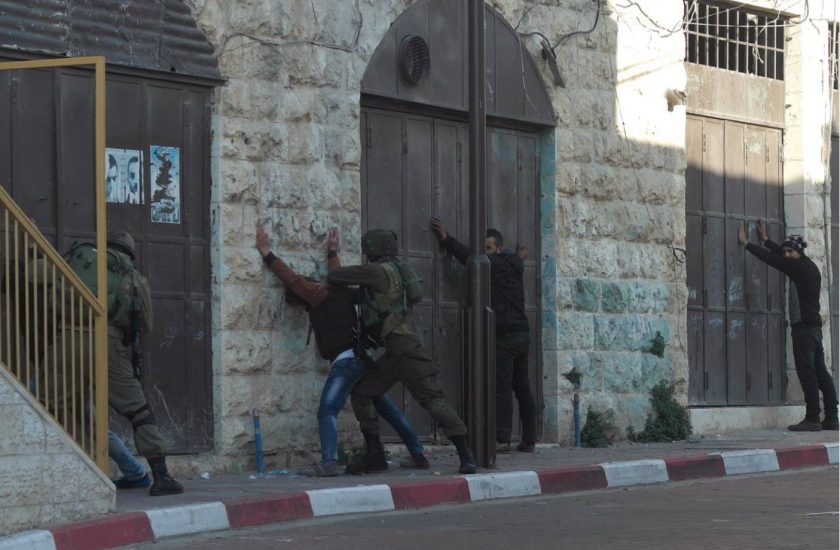
Israeli troops have joined NATO war games in Eastern Europe for the first time. One of the scenarios includes crushing an armed rebellion.
Soldiers from a paratrooper brigade are participating in the NATO exercise ‘Swift Response’, which “simulates combating military uprisings in Europe,” the Israeli spokesperson said on Monday.
The annual drill led by the US European Command takes place across Germany, Poland, Lithuania and Latvia, with 10 nations involved in the maneuvers. Troops from non-NATO member Israel will train alongside the US 173rd Airborne Brigade and the Texas National Guard. According to the Pentagon, the maneuvers include “rapid response infiltration”, air assault operations and the evacuation of non-combatants.
The exercise takes place simultaneously with two other NATO drills in Europe. The two-week war game ‘Saber Strike’ amasses 18,000 soldiers from 19 countries, with troops deployed in Poland and the Baltic States. They will master the deployment of military convoys to defend NATO’s eastern flank, as well as operations across rivers and bridges.
Additionally, 37 warships are docked at the Lithuanian port city of Klaipeda for an ongoing naval drill ‘BALTOPS’. All in all the exercise led by US 6th Fleet Vice Admiral Lisa Franchetti will involve 60 aircraft and 42 ships from 22 nations.
All three drills are taking place close to the Russian border, and Moscow has been regularly warning that NATO military buildup at its doorstep undermines the stability and security climate on the European continent.
Russia is “closely observing” the war games and undertaking all “necessary measures” to ensure Russia’s own security during the maneuvers, the president’s spokesman Dmitry Peskov said Monday. Commenting on the largest of its exercises in the region, US Army Europe has claimed that ‘Saber Strike’ “is not a provocation of Russia.”
Israel had been an active NATO partner since the 90s, and the cooperation with the Bloc intensified in recent years, particularly in the field of combating terror threats. Israeli diplomatic mission at NATO HQ in Brussels was opened in 2016, with several cooperation agreements following. However, as NATO General Secretary Jens Stoltenberg confirmed last week, the Bloc’s security guarantees “do not apply” to Israel since it is not a member of the alliance.
Read more:
US mulls expanding military intervention in Yemen: Report
Press TV – June 4, 2018
The United States is considering a request from the UAE to provide direct support for an attack to seize the Houthi-held port of Hudaydah, a major lifeline for Yemen, officials say.
US officials said Secretary of State Mike Pompeo has asked for a prompt assessment of the UAE’s appeal for assistance such as surveillance drone flights to help a Saudi-led coalition capture Hudaydah.
The debate over increasing US support to the UAE and Saudi Arabia comes amid escalating military operations around the Yemeni port despite UN warnings of catastrophic effects on the impoverished country.
Eighty percent of commercial and humanitarian supplies flow through Hudaydah, a central gateway. Since May 27, forces supported by Saudi Arabia have been closing in on the port, claiming that Yemen’s Ansarullah movement uses it for weapons delivery.
American officials say the UAE and Saudi Arabia have assured Washington that they won’t attempt to take the Red Sea port until they get support from the US.
“We continue to have a lot of concerns about a Hudaydah operation,” said one senior US official, quoted by The Wall Street Journal.
“We are not 100% comfortable that, even if the coalition did launch an attack, that they would be able to do it cleanly and avoid a catastrophic incident,” the official added.
Senior Yemen specialists in the US administration were expected to meet on Monday to discuss what to do, the newspaper said.
According to the Journal, Riyadh and Abu Dhabi have long sought to get backing from the US.
Last year, the Saudi-led coalition unsuccessfully sought to secure American intelligence, surveillance and direct support from elite US military forces for an attack on Hudaydah, former US administration officials said.
For now, prominent administration officials involved in the debate harbor reservations about expanding the American military role in Yemen, but some back providing assistance to the UAE, officials said.
“We have folks who are frustrated and ready to say: ‘Let’s do this. We’ve been flirting with this for a long time. Something needs to change the dynamic, and if we help the Emiratis do it better, this could be good,’” the senior US official said.
Some administration officials are also increasingly disappointed that both military and diplomatic efforts have bogged down, which is fueling efforts to cut US support for the fighting, the report said.
The US has been lavishing sophisticated weaponry upon Saudi Arabia since March 2015, when the latter attacked Yemen to restore its Riyadh-allied former government. Washington also helps to refuel Saudi and UAE warplanes that conduct airstrikes on Yemen.
According to figures released by the Yemeni Ministry of Human Rights, more than 600,000 people have been killed or injured in the Saudi war since 2015. Yemen has also turned into the scene of the world’s worst humanitarian crisis.
The Red Cross and the United Nations have warned against the dangers of the Saudi-led operations in Hudaydah.
“The push for Hudaydah is likely to exacerbate an already catastrophic security situation in Yemen,” said François Moreillon, head of the International Committee of the Red Cross delegation in Yemen.
United Nations’ new special envoy on Yemen, Martin Griffiths, is to present his proposal for reviving peace talks to the UN Security Council in the next two weeks. He has publicly warned that an assault on Hudaydah “would take peace off the table.”
“We are all very concerned about the possible humanitarian consequences of a battle for Hudaydah,” he said.
Italy: The Center Cannot Hold
By Diana Johnstone | Consortium News | June 3, 2018
The traditional governing parties, center “left” and center “right” all follow the same neoliberal policies and constitute the self-designated “center.” Mainstream media enforce center right claims to authority on the base of orthodox economic expertise, while the center left derives its authority from its “values,” centered on an identity politics version of human rights. “Center” sounds so reasonable, so safe from dangerous “extremes” and unpredictable populism. Against such threats, the Center presents itself as the champion and safeguard of “democracy.”
How true is this?
World Values Survey results indicate that in Europe and the United States, people who describe themselves as “centrist” on the average have less attachment to democracy (e.g. free and fair elections) that those on the left, and even those on the far right. This is not as surprising as it may seem at first, since “centrists” are by definition attached to the status quo. In European countries, the authoritarian neoliberal “center” is institutionalized in the European Union, which imposes economic policy over the heads of the parliaments of the member countries, dictating measures which conform to the choices of Germany and northern Europe, but are increasingly disastrous for the Southern EU members.
The Centrist fear of democracy was resoundingly confirmed by March 4 legislative elections in Italy. The Center was relegated to the margins and outsiders burst in. The winner, with 32 percent of the votes, was the Five Star Movement (M5S) whose campaign “against corruption” won popular support in the impoverished South. In second place, with 17 percent, was “the League”, formerly the Northern League – that is, a party of rich north Italy chauvinists ready to secede from the “lazy good-for-nothing” south. It took almost three months for this extremely odd couple to agree to a coalition government.
The mystique of the European Union is anti-nationalist, based on the theory that “nations” are bad because they caused the devastating wars of the twentieth century, while European unification is the sole guarantee of “peace.” Convinced of their mission, the Eurocentrists have had no qualms in throwing out the baby of democratic choice along with the nationalist bathwater.
The notion that “peace” depends on “Europe” persists despite the NATO bombing of Serbia and European participation in U.S. wars in Afghanistan, Iraq, Libya and Syria, not to mention EU participation in the current major military buildup in the Baltic States against “the Russian enemy.” Indeed, thanks to NATO, the EU is gearing for a war even worse than the previous ones.
Since the “nation-state” is blamed for evil in the world, the Eurocentrists react with horror at growing demands in Member States for a return to “national sovereignty.” This, however, is a natural reaction to the economic and social disasters resulting from policies dictated by EU institutions in Brussels. The 1992 Maastricht Treaty legally bound member countries to centralized neoliberal monetarist policies; not only “socialism” became illegal – even Keynesianism was ruled out. Promised endless peace and prosperity, citizens of European countries were cajoled into giving up their sovereignty to EU institutions, and many now want it back.
Disillusioned Italy
Italian disillusion is particularly significant. Italy was an exceptionally enthusiastic founding member of the unification begun with the 1957 Treaty of Rome. And yet, Italy’s own history illustrates what can go wrong with such unification, since the 19th century political creation of a unified Italy centered in Turin led to the enrichment of the industrial north at the expense of southern Italy, where the splendor of Naples declined into chronic poverty, crime and corruption. Now Italy itself is “the south” in the periphery of a European Union centered around Germany.
Antagonism between northern and southern Italy has given way to a much stronger antagonism between Italy and Germany – each blaming the other for the crisis.
It is only fair to recall that Germans were very attached to their Deutsche Mark and to their own austere financial policies. Germany could only be lured into the common currency by agreeing to let the euro follow German rules. France eagerly supported this concession based on the notion that the common currency would unify Europe. It is doing quite the opposite.
Germany is a major exporting nation. Its trade with the rest of the EU is secondary. It uses the EU as its hinterland as it competes and trades globally with China, the United States and the rest of the world. The proceeds of Germany’s favorable EU trade balance is less and less invested in those countries but in Germany itself or outside the EU. In the official German view, the main function of the Southern EU members is to pay back their debts to Germany.
Meanwhile, Italy’s once flourishing industrial network has lost its competitive edge due to the euro. It cannot save its exports by devaluation, as it was accustomed to doing. Italy’s debt is now 132 percent of its GNP, whereas the Maastricht Treaty governing the monetary union puts a ceiling of 60 percent on national debt. And to continue paying the debt, public services are cut back, the middle class is impoverished, the domestic market declines and the economy gets even weaker.
This is precisely the situation that has plunged Greece into ever deepening poverty.
But Italy is not Greece. Greece is a small peripheral country, which can be pounded to death by creditors as a warning of what can happen to others. Italy, on the contrary, is too big to fail. Its collapse could bring the whole EU crashing down.
Italy’s Potential Strength Through Weakness
The traditional Italian parties had no solution beyond those that have ruined Greece: cut back social spending, impoverish workers and pensioners, and pay back the foreign banks, with interest.
The odd coalition of the League and the M5S was obliged to try something different: basically, to invest in the economy rather than abandon it to its creditors. Their program combines lower taxes with Keynesian stimulation of investment. Since the leader of the League, Matteo Salvini, and Luigi Di Maio of M5S do not like each other, they selected law professor Giuseppe Conte to be Prime Minister in their coalition cabinet. The interesting choice was that of Paolo Savona for the key post of Minister of Economy and Finance. Savona, whose long career has taken him across the summits of Italian and international finance, was certainly the most qualified choice imaginable. Savona knows everything there is to know about the Italian economy and international currency creation.
And yet, it was the appointment of this 81-year-old expert that created outrage in the Eurocenter.
The uproar was spurred by the fact that in one of his books Savona had described the euro as “a German prison.” Savona had also said it was necessary to prepare a Plan B, to leave the euro if there is no other choice. “The alternative is to end up like Greece.”
This hint of disloyalty to the euro was totally unacceptable to the European establishment.
The Center struck back in the person of the largely figurehead President of Italy, Sergio Mattarella, who used, or misused, his unique constitutional power by refusing to approve the government. On May 28, he designated as prime minister Carlo Cottarelli of the International Monetary Fund – a man who represented everything the Italians had just voted against. Known in Italy as “Mr. Scissors” for his advocacy of drastic government spending cuts, Cottarelli was supposed to run an apolitical “technical” government until new elections could be held in the fall.
This coup against the Italian voters caused momentary rejoicing in the Authoritarian Center. The European Budget Commissioner (a German of course), Günther Oettinger, was reported to be gloating over the prospect that “the markets” (meaning the financial markets) would soon teach Italians how to vote. Italy’s economy “could be so drastically impacted,” he said, as to send a signal to voters “not to vote for populists on the right and left.”
This simply intensified Italian indignation against “German arrogance.”
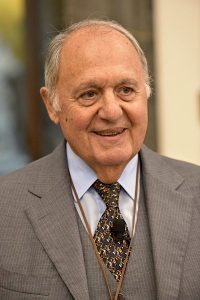
Savona: Plan B just a negotiating tactic
Meanwhile Savona wrote a letter to President Mattarella which introduced a bit of cold reason into an increasingly hysterical situation. He reminded the president that an important meeting of EU heads of state was to be held at the end of June; without a political government, Italy would be absent from negotiations which could seal the fate of the EU. Italy’s plea for economic change could expect French support. Savona denied having called for leaving the euro; in the spirit of game strategy, he had mentioned the need for Plan B in order to strengthen one’s position before negotiations. He made it clear that his strategy was not to leave the euro but to transform it into a genuine rival to the dollar.
“Germany prevents the euro from becoming ‘an essential part of foreign policy’, as the dollar is for the United States”, wrote Savona. But change becomes necessary, as the dollar is less and less suitable for its role as world currency.
Indeed, the Italian crisis merges with a mounting trans-Atlantic crisis, as the U.S. uses sanctions as a weapon in competition with its European “partners.” The paradox is that Italy could use its very weakness to oblige Germany to reconsider its monetary policy in a moment when the German economy is also facing problems due to U.S. sanctions on deals with Russia and Iran, as well as protectionist measures. Savona’s message was that clever diplomacy could work to Italy’s advantage. In its own interest, Germany may need to accept transformation of the euro into a more proactive currency, able to defend European economies from U.S. manipulation.
It was a matter of hours before Cottarella stepped back and a new M5S-League government was formed, with Savona himself back as Minister of Relations with the European Union.
Italy’s Double Jeopardy
The new Italian cabinet sworn in on June 1 is riven with contradictions. Despite all the released anti-EU sentiment, it is definitely not an “anti-EU” government. Conte is back as prime minister. The new foreign minister, Enzo Moavero Milnesi, is a staunch pro-European. As interior minister, the northern Italy chauvinist Salvini – who doesn’t particularly care for southern Italians – will get tough with migrants. As minister of economic development M5S’ Di Maio will try to find ways to improve conditions in the southern regions that elected him. Since Salvini is the more experienced of the two, the League is likely to profit from the experiment more than the M5S.
Some Italians warn that by leaving the “German prison” Italy would simply find itself even more dependent on the United States.
One should never forget that ever since the end of World War II, Italy is an occupied country, with dozens of U.S. military bases on its territory, including air bases with nuclear weapons poised to strike the Middle East, Africa or even Russia. The Italian Constitution outlaws participation in aggressive war, and yet Italian bases are freely used by the United States to bomb whichever country it pleases, regardless of how Italians feel about it.
Worst of all, the U.S. used its Italian “NATO bases” to destroy Libya, a disaster for Italy which thereby lost a valuable trade partner and found itself inundated with African refugees and migrants. While international financial experts exhort Italy to cut government expenses, the country is obliged by NATO to spend around 13 billion euros to buy 90 U.S. F-35 fighters and to increase its military spending to around 100 million euros per day.
Italy’s economic prospects have also been badly hit by U.S.-enforced sanctions against trade with Russia and Iran, important potential energy sources.
U.S. economic aggression, in particular Trump’s rejection of the Iranian nuclear deal, is the issue with the potential to bring European leaders together at a time when they were drifting apart. But at present, the Europeans are unable to defy U.S. sanctions in punishment for trade with those countries because their international dealings are in dollars.
This has already led to the U.S. exacting billions of dollars in fines from the biggest French and German banks, the BNP and Deutsche Bank, for trading that was perfectly legal under their own laws. The French petroleum giant has been obliged to abandon contracts with Iran because 90% of its trade is in dollars, and thus vulnerable to U.S. sanctions. And that is why the idea is growing of building financial instruments around the euro that can protect European companies from U.S. retaliation.
The Disappearance of the Left
The disappearance of left political forces has been almost total in Italy. There are many reasons for this, but a curable part of the problem has been the inability of what remains of the left to face up to the two main current issues: Europe and immigration.
The left has so thoroughly transformed its traditional internationalism into Europism that it has been unable to recognize EU institutions and regulations as a major source of its problems. The stigmatization of “the nation” as aggressively nationalistic has held back the left’s ability to envisage and advocate progressive policies at the national level, instead putting its hopes forever in a future hypothetical “social Europe.” Such a transformation would require unanimity under EU rules – politically impossible with 28 widely differing Member States.
Without such inhibitions, the far right capitalizes on growing discontent.
Another related handicap of the left is its inability to recognize that mass immigration is indeed “a problem” – especially in a country like Italy, with a flagging economy and 20 percent official unemployment (although this figure is probably too high, considering undeclared labor). There is resentment that prosperous Germany issued a general invitation to refugees, which for geographic reasons pile in Mediterranean countries unable to cope. The mass influx of economic migrants from Africa is not even “taking jobs away from” Italians – the jobs are not there to take. These migrants fled war and misery to come to Europe in order to earn money to send back to their families, but how can they possibly meet these expectations?
It is all very well to extol the glorious hospitality of America entreating the world to “Give me your tired, your poor, Your huddled masses yearning to breathe free, The wretched refuse of your teeming shore. Send these, the homeless, tempest-tossed to me…”. Such generosity was suited to a new nation with huge empty spaces and rapidly growing industry in need of a work force. The situation of a “full” nation in a time of economic downturn is quite different. What is to become of the tens of thousands of vigorous young men arriving on Italian shores where there is nothing for them to do except sell African trinkets on the sidewalks of tourist centers? To make matters worse, the great contemporary thrust of technical innovation aims at replacing more and more workers with robots. Leftist denial of the problem leaves its exploitation and resolution to the extreme right.
Some leftist politicians in Italy, such as Stefano Fassina of the Sinistra Italiana are waking up to this need. A left that dogmatically ignores the real concerns of the people is doomed. A bold, honest, imaginative left is needed to champion Italians’ independence from both German-imposed austerity and the expensive military adventurism demanded by the United States. But the interlaced problems created by unregulated globalization do not lend themselves to easy solutions.
Diana Johnstone is a political writer, focusing primarily on European politics and Western foreign policy. She received a Ph.D. at the University of Minnesota and was active in the movement against the Vietnam War. Johnstone was European editor of the U.S. weekly In These Times from 1979 to 1990, and continues to be a correspondent for the publication. She was press officer of the Green group in the European Parliament from 1990 to 1996. Her books include Queen of Chaos: The Misadventures of Hillary Clinton, CounterPunch Books (2016) and Fools’ Crusade: Yugoslavia, NATO and Western Delusions, Pluto Press (2002).
Is Duterte really threatening war with China? The opposite may be true…
By Darius Shahtahmasebi | RT | May 31, 2018
The media wants you to believe that the Philippines is headed towards war with China. The truth may in fact be the opposite.
If you followed international headlines this week, you may have been alarmed to see the shocking revelation that, despite wanting a closer relationship with China, Philippines’ President Rodrigo Duterte was now ready to risk war with Beijing to ‘protect the territorial integrity of his country’.
“Philippines’ Duterte threatens war in South China sea if troops are harmed,” Newsweek warns. “Philippines draw three hard lines on China,” Asia Times outlines. “Philippine President Rodrigo Duterte will go to war with China if it crosses ‘red lines’ and claims disputed resources, foreign ministry warns,” the South China Morning Post (SCMP ) explains. “Duterte will ‘go to war’ over South China Sea resources, minister says,” according to CNN.
Those are indeed some shocking headlines as the last thing anyone in their right mind wants is a regional conflict, not least one that involves a rising nuclear power with the capabilities that China has.
So what did President Duterte actually say, and how close to a regional standoff are we at this current juncture?
Well, according to the reports, Duterte didn’t actually say anything. The majority of these warnings came directly from Foreign Secretary Alan Peter Cayetano, the country’s top diplomat. While claiming to speak for Duterte, Cayetano drew up three major red lines that could allegedly lead the Philippines’ President to war with China. The first red line that supposedly won’t be tolerated is any Chinese move to reclaim or build on the Philippine-claimed Scarborough Shoal, which lies just over 100 nautical miles from Philippine shores. The second red line is any coercive Chinese move against the Philippine marine detachment guarding the Second Thomas Shoal. The third red line is any unilateral Chinese drilling for natural resources, mostly oil and gas, within the Philippines’ exclusive economic zone.
“Another red line is that nobody will get natural resources there on their own,” Cayetano said. “The President has said that: If anyone gets the natural resources in the West Philippine Sea, he will go to war.”
“If we lost a single island during Duterte’s time, I will pack my bags, go home,” he also added.
Hmmm. It is starting to sound a bit like Cayetano’s red lines; more so than the President’s red lines.
Then not long after, another headline which read “Philippines could go to war over South China Sea: Duterte aide” may have also caught your eye. Again, this involved National Security Adviser Hermogenes Esperon making the stunning revelation that “just the other night, the president said if my troops are hurt there, that could be my red line.”
Note that in none of these instances is Duterte himself doing any of the talking. When one digs a little bit deeper, this is when it becomes all the more interesting. In actuality, it was just over a week ago that the Philippines’ President was saying the complete opposite.
Even after the Chinese military landed long-range bombers at an airport on Woody Island in the South China Sea – reportedly placing the Philippines within strike range of Chinese bombers – Duterte’s response was to state that “you know they have the planes, not stationed in Spratly but near the provinces facing – Chinese provinces facing the Spratly and the China Sea. And with their hypersonic, they can reach Manila within seven to 10 minutes.”
The President also allegedly added: “What will we arm ourselves with if there’s a war? Will we resort to slapping each other? I couldn’t even buy myself a rifle. It was given to me. So how will we even fight with the Chinese?”
To the rest of us paying attention, Duterte’s comments appeared to indicate that he was ruling out the possibility of any war with China involving the Philippines. He even suggested that he doubts the Philippines could rely on the US in such a scenario. In other words, under Duterte’s leadership, the Philippines would not go to war with China as he is convinced that there is nothing the Philippines can do to confront China without suffering an immeasurable loss.
But don’t take my word for it.
“I cannot afford at this time to go to war. I cannot go into a battle which I cannot win and would only result in destruction for our armed forces. I really want to do something to assert. But you know, when I assumed the presidency, there was already this ruckus in the West Philippine Sea,” Duterte said during a speech at the Philippine Navy’s 120th anniversary in Manila.
“So will we be able to win that war? If my troops are massacred, after the war, the soldiers and police will come after me next. Our troops will really be finished off there,” the President also stated at the time.
So what is Duterte’s proposal to deal with the stand-off, bearing in mind that there are many Filipinos who do not see eye to eye with Duterte?
“We don’t have to fight. We can divide this in a joint development, joint exploration. And then we’ll give you [China] a bigger share rather than fight. It’s only America who’s worried because they lost a territory. You’re the ones who came first. I was just new and then you adapted the rascal’s propaganda,” Duterte proposed less than two weeks ago.
While the media continues to mislead the public on Duterte’s alleged new push to confront China in the South China Sea, it also failed to note that at around the same time Duterte was supposedly making these threats of war towards China, he had just appointed a special envoy to China with the specific intention of fostering closer relations with Beijing.
Of course, it could be the case that Duterte has changed his stance this week in a complete nonsensical 180 degree U-turn and will indeed confront China if he feels it is in the best interests of his country. However, it is curious to say the least, that as one of the world’s most vocal leaders (he once admitted killing suspected criminals while serving as Governor) he has not been the one to directly voice this U-turn himself, the statements having come from other subordinates from within his administration.
We also have to bear in mind that Duterte is a man who believes his presidency is protected by Chinese President Xi Jinping, acknowledging that he needs China “more than anybody else at this time of our national life.” He also once said to Beijing that if they wanted to, “just make [the Philippines] a province.” It doesn’t seem too likely that Duterte is all of a sudden prepared to give this dependency up, in light of his consistently pro-Chinese stance.
The other development to keep an eye on is the recent war-drills at the beginning of May this year involving US forces and Philippines’ forces which were the largest military exercises held in the Philippines since Duterte became president. Even then, these drills appeared to focus more on the domestic threat of terrorism inside the country and were not officially aimed at confronting China’s expanding influence.
For ease of reference, a month-long firefight between Islamist militants with allegiances to Islamic State (IS, formerly ISIS) and government forces left 1,100 people dead just under a year ago. In that context, it is not completely unusual that the President may have given the go-ahead for these drills to take place. (That being said, Duterte personally admitted he did not expressly authorize the US military’s involvement in its counter-terrorism efforts last year, suggesting that there may be other forces at play which may or may not be beyond his control). This also may be the case with the development that the Philippines has begun repairing a runway and upgrading facilities on Thitu Island, a major point of dispute between Chinese and Philippine vessels last year.
No matter how badly the media want Duterte to reject and confront China, the cold hard truth is that China is an “indispensable geographical reality,” as Richard Javad Heydarian in the National Interest recently put it. There is little that Duterte can do to confront China even if he really wanted to, as he is predicting a future in which Washington becomes increasingly irrelevant in the Asia-Pacific region all the while China begins to exert more and more influence in the area. Rather than butting heads with China, Duterte’s plan is exactly as he says – develop and explore the area jointly with China while coming to an arrangement, which does the complete opposite of what the media wants you to believe he will do, to avoid a war with China at all costs.
Trade War and the Nationalist Exchange: Trudeau Trails Trump
By Maximilian C. Forte | Zero Anthropology | June 1, 2018
“These tariffs are totally unacceptable. For 150 years, Canada has been America’s most steadfast ally. Canadians have served alongside Americans in two world wars and in Korea. From the beaches of Normandy to the mountains of Afghanistan, we have fought and died together. Canadian personnel are serving alongside Americans at this very moment. We are partners in NORAD, NATO, and around the world. We came to America’s aid after 9/11—as Americans have come to our aid in the past. We are fighting together against Daesh in Northern Iraq…. That Canada could be considered a national security threat to the United States is inconceivable…. these tariffs are an affront to the long-standing security partnership between Canada and the United States, and in particular, to the thousands of Canadians who have fought and died alongside American comrades-in-arms”—Justin Trudeau, Prime Minister of Canada, May 31, 2018
So we now see the launch of a trade war between the US versus Canada, Mexico, and the EU. Focusing on the place of residence of the writer, Canada, one can argue that this trade war is very good news, if one knows how to read this development properly. Justin Trudeau’s visible anger is a testament to the good news: his anger is that he is now required to perform in the role of an economic nationalist, something for which he was not trained. All of his apprenticeship under globalist mentors—such as the Center for American Progress, the Aga Khan and George Soros—only prepared him to play a supporting role as part of a now wounded and cornered neoliberal elite. Trudeau was only meant to be a builder of “team spirit” in service of the technocrats who facilitated neoliberal globalization. He was there to cheer “Canadians” (whatever that word means now) that they were becoming like everyone from everywhere: they were a bit of everything, and nothing in particular. Trudeau thus pranced at the front of gay pride parades, pushed legislation on transgender pronouns, introduced a gender quota for his cabinet, a gender budget, sorted out cabinet ministers according to skin colour and headwear, welcomed everyone to an open Canada, and chided citizens for saying “mankind” instead of “peoplekind,” because the latter is “more inclusive”. And what does he have to show for his efforts? He is now the one to speak of illegal border crossers who should stay away, and imposes counter-tariffs.
Trudeau opened his remarks on the national security front—a big mistake. It was a big mistake for two reasons. One reason, of lesser importance than the next, is that it shows the literalism that is at the heart of moral narcissism and virtue signalling—that you take your opponent’s statements to be literally true, at face value, and no contextualization is necessary. Trudeau thus took great offense at the suggestion that Canada somehow undermined US national security—as if our purpose as a sovereign nation-state was to always serve the Americans better. President Trump, however, is merely using the available tools—he does not think that Canada literally threatens US national security, but he has to invoke that notion because it permits him to use a particular instrument—and that’s all. Back in March, if one was paying attention, one of the arguments Trump used to defend US steel and aluminum industries is that they were vital to US national security and its weapons industries. The Trump administration cited Section 232 of the Trade Expansion Act of 1962. I predicted this would be the justification in 2016, when the media floated arguments dismissing the prospect of Trump’s protectionism, insisting he would need Congressional approval. Others instead advanced the murky argument that the “deep state” would prevent him. Some tried to cover their lack of insight by saying Trump invoked “a rarely used law”. The constant refrain—inexplicably maintained despite its obvious contradiction—was that Trump was a threat and yet Trump would also have no real power. Almost all instantly forgot the meaning of executive power, and how it has increased under the imperial presidency. President Trump proved he could take such action, especially when the action is declared an “emergency” and a “threat to national security”. The only “mystery” here was why Trump suddenly decided to return to a nationalist posture, after a full year of reversals that favoured the continuation of neoliberal globalization. Gary Cohn, Trump’s chief economic adviser and former president of Goldman Sachs, promptly resigned from the administration after Trump announced the tariffs. Some thus saw economic nationalists regaining the upper hand in the Trump administration. It could be that Trump is now reconciled to the realization that his family’s business empire will never become properly transnational, and is even having to pull back from simply experimenting with being international. Trump family fortunes have returned home to roost—that is one possible explanation, and it’s a side issue for now. What we do know, even so soon, is that there is in fact some evidence that jobs are returning to the US steel industry, thanks primarily to Trump’s protective tariffs.
The second reason it was a mistake for Trudeau to use national security as an entry point is that it now opens a valid question for Canadians: what good is our alliance with the US? Why are we in all those wars? Why are we always tagging along with the Yanks? What were we doing in Afghanistan? It’s not like Toronto was attacked on 9/11. Why should we be members of NATO and NORAD? All of it really does not count for anything in the end. Trump has played Trudeau, repeatedly, and is now forcing Trudeau to substantively and effectively call into question Canada’s subservient role as an upholder of American empire. This is an example of the indirectly, quietly subversive outcomes of Trump’s “America First” program, as I argued in “What Happened to the American Empire?”
As for virtue signalling, Trump can do that too. With an absolutely phony earnestness, which neither Trudeau nor anyone else correctly read, Trump would pretend to be enchanted with his Canadian guest, lavishing warmth and praise on him… and look, here’s my daughter, she’s so charmed by you too! All smiles, handshakes, and exuberant lyrics, and it was all deliberately calculated bullsh*t, like you would expect of an expert dealer. Meanwhile, Trump does not forget who his adversaries are, and quietly and indirectly at first—and now loudly and directly—he set about destabilizing Trudeau’s Canada. First there was the mysterious push of illegal border crossers toward Canada, with the US amply admitting Nigerians on visas when their only intention is to enter the US to cross into Canada illegally. Trudeau said Canada would remain open and welcoming, in a direct rebuke aimed at Trump, and now Trump would make him pay for his words—and he has, in spades. More on that in a future article. Then Trump imposed tariffs on Canadian dairy products, softwood lumber, newsprint, massively crushing tariffs on Bombardier passenger planes, and then the renegotiation of NAFTA itself, with the threat of simply tearing up the deal.
Where has Trudeau’s leadership been in all of this? With less people than California, the US market matters a lot more to Canada than vice versa. How has Trudeau prepared Canadians for possible job losses, perhaps in the tens of thousands, as a result of an abrupt trade shock? How will social services suffer in provinces most affected by a diminished export market? Today the Canadian media like to boast that Canada will hit Florida orange juice, so—hint, hint—good luck winning Florida in the next elections. They should be thinking about Canadian elections instead, rather than taking the attitude that only the US will suffer, or that it will suffer more than Canada. But that is what we get: instead of a plan, a program, just amateur cockiness.
How has Trudeau’s government coordinated with local and national industries to realign production to domestic suppliers and domestic consumption in the event of a trade war? Where are the “innovative” and “smart” plans now? Canadian ruling elites have been funding the training of a generation of students to think in globalist terms, and shun nationalism—when what they should have been teaching students is not just to start loving nationalism, but to love their nation. What nation is that, you ask? Writing from Quebec, but as someone raised in Ontario, my very strong impression is that it is Anglo-Canada in particular that has the real identity crisis—that is, not having an identity. We can forget about Aboriginal peoples planting the seeds of a new Canadian creolization, as I argued elsewhere; instead, Aboriginals are being effectively put back in their cultural ghettos, shielded by a paranoia over phony “cultural appropriation,” thus sequestered, contained, and removed from the Canadian conversation. Instead the model we have in Canada sounds like it was imported from Amazon.com: everyone in their appropriate box, and every box on its appropriate shelf.
“We’ll see what happens”. “Maybe this will be big, maybe it won’t. Who knows?” However, it is still worth raising the possibility that if the trade war continues, and lasts, it’s Canada that might not last. The Trump transfer of costs will have achieved its maximum effect. Part of that Trump transfer is that Canadians are being taught—forced—to become nationalist Trumps in their own right, or lose. Let’s see what happens.
A final thought: having lived for a few years in Cape Breton, one of Canada’s long-standing and primary centres in the production of steel, I saw first hand the degree of economic destruction and social devastation wrought on Canadian production by foreign competition, among many other factors. Real leadership would seek to maximize the benefits of protection that (counter)tariffs now offer us, a chance to make sure not all of Canada experiences the kind of econocide witnessed by Cape Breton.
Saudi Arabia is forming new force in Syria – report
By Leith Aboufadel – Al-Masdar News – 30/05/2018
BEIRUT, LEBANON – Officials from the Saudi regime met with members of the predominately Kurdish People’s Protection Units (YPG) in northeastern Syria recently, Turkish state-owned Anadolu Agency reported on Tuesday.
According to the Anadolu report, three Saudi military consultants met with the YPG in the northeast Aleppo city of Kobani (var. ‘Ayn Al-‘Arab) last Friday.
The YPG and Saudi officials discussed forming a new force in Syria that would be funded by the Gulf kingdom.
The Anadolu report added that the Saudi officials setup communication checkpoints between Hasakah city and Al-Qamishli in order to recruit new fighters.
These fighters are promised $200 if they join this new Arab force that is sponsored by Saudi Arabia.
Saudi Arabia has not issued any response to this latest allegation.
Featured Video
What’s the Pentagon Preparing For? Alexander Mercouris
or go to
Aletho News Archives – Video-Images
From the Archives
US tested biological weapons in Japan’s Okinawa in the 60s – report
RT | January 12, 2014
The American army conducted experiments with biological weapons aimed at destroying rice crops on the Japanese island of Okinawa in the 60s, Kyodo news agency reports. The alleged target of the tests was the China and Southeast Asia region.
Citing classified US documents, Japanese news agency Kyodo said the US military carried out experiments on their sovereign territory between 1961 and 1962. At this time Japan’s southern island of Okinawa was still under post-WWII, US jurisdiction. The US did similar tests in Taiwan and the American mainland, notes Kyodo.
The American army experimented with rice blast fungus – a plant pathogen – which infects rice crops with disastrous effects. The pathogen latches onto the rice plant as a spore and produces lesions and spots all over the rice plant and then reproduces.
A single lesion can generate a thousand spores in one night alone, while an entire cycle – lasting about a week – can have a devastating effect on rice crops.
Kyodo reports that tests were conducted over a dozen times, and mentions test sites, Nago and Shuri, in Okinawa. The US army reported some success in their experiments and the gathering of “useful data”.
“Field tests for stem rust of wheat and rice blast disease were begun at several sites in the (US) Midwest and south and in Okinawa with partial success in the accumulation of useful data,” wrote Kyodo, citing its documents. … continue
Blog Roll
 Aletho News
- France Loses Position in Global Agricultural Market Due to Russian Sanctions
- The Dismantled Factory: How far has European deindustrialization progressed?
- AfD ban procedure is coming in 2027, says AfD co-leader Alice Weidel
- From Ukraine to World War III, Russia and the West – Are We Now on the Brink? Part 1
- US-China contradiction: Shenzhen peace diplomacy versus Indo-Pacific militarization
- What’s the Pentagon Preparing For? Alexander Mercouris
- USAID Files: The Georgia Model for Getting Accounts Taken Down
- Kiev hits out at YouTube over Russian-language censorship refusal
- Australia Passes Digital Duty of Care Bill, Ignoring Censorship Warnings
- Majority of MAGA ‘deserters’ back banning bombs to Israel: Poll
- If Americans Knew
- An error has occurred; the feed is probably down. Try again later.
- No Tricks Zone
- Alarmist Climatologists In Shock! 2026 Atlantic Hurricane Season Sees Lowest Count In 101 Years
- New Study: Modern Temps Are Among The Coldest Of The Last 10,000 Years In East Central Europe
- Germany’s Renewable Energies Lead to 1.4 Billion Euro Electric Power Trade Deficit
- Argentina’s Perito Moreno Glacier Joins Antarctica and Arctic In Defying Doomsday Melt Claims
- New Study: Barents Sea Temperatures Were Warmer And Sea Ice Less Extensive In The 1700s Than Today
- German Authorities Start Initiative To Evaluate Public Register For Climate “Disinformation” Spreaders!
- Zonal Asymmetry of Temperature Change in the Antarctic Circumpolar Current
- New Study: The Net Fossil Fuel Contribution To Rising Atmospheric CO2 Has Been Zero For 500 Years
- Germany’s Green Energy Transition Becoming Increasingly Expensive…Another 6 Trillion Euros!
- Sudden Stratospheric Warming, Powerful El Niño Combination May Lead To Extreme Europe Cold, Energy Crisis!

