US drone strikes double in Somalia, triple in Yemen under Trump administration: Report
Press TV – December 21, 2017
There has been a sharp rise in the number of US drone strikes in Yemen and Somalia since US President Donald Trump took office, says a report.
In March, Trump gave the US military authority to carry out airstrikes without notifying the government in regions designated as areas with “active hostilities.”
“In Yemen, 30 strikes hit within a month of the declaration being reported – nearly as many as the whole of 2016. Most of the 125 strikes in 2017 hit in central Yemen, where the US military’s Central Command vigorously pursued fighters from al-Qaeda in the Arabian Peninsula (AQAP),” said the Bureau of Investigative Journalism.
Yemen has come under regular US drone strikes, with Washington claiming to be targeting al-Qaeda militants while local sources say civilians have been the main victims.
The London-based NGO noted that the number of strikes doubled in Somalia and tripled in Yemen since Trump began his term in January 2017.
“In Somalia, the Obama administration had officially designated the al-Shabab group as an al-Qaeda affiliate at the end of November 2016, essentially widening who could be targeted. But there was no increase in strikes until July 2017, with all but two of this year’s 32 strikes carried out since then,” it added.
The Pentagon has been carrying out airstrikes and ground raids in Somalia for a decade, initially using helicopters and AC-130 gunships.
In June 2011, American forces began using drones to carry out the strikes, in a mission which has so far failed to uproot militancy in the country.
‘None of this was worth it’: Up to 11,000 civilians killed in battle to free Mosul, AP probe reveals
RT | December 20, 2017
The liberation of Mosul from Islamic State came at a high cost, according to an AP probe which found that between 9,000 and 11,000 civilians died during the process. The coalition acknowledges responsibility for 326 of the deaths.
The investigation cross-referenced independent databases from non-government organizations and analyzed the city morgue’s list of 9,606 names of people killed in the battle. The probe found that at least 3,200 civilians were killed by Iraqi or US-led coalition airstrikes, artillery fire, or mortar rounds between October 2016 and July 2017.
Most of those victims were described in Health Ministry reports as simply being “crushed.” However, the US coalition has acknowledged responsibility for just 326 of those deaths, while stating that it lacks the resources to send investigators to Mosul, according to AP.
Another one-third of the dead were killed in the final violent campaign of Islamic State (IS, formerly ISIS). The causes of the remaining deaths could not be determined, as they were civilians who were trapped inside neighborhoods hit by airstrikes, IS explosives, and mortar rounds from all sides of the fight.
The numbers are likely a low estimation of the actual situation, as hundreds of dead civilians are thought to still be trapped underneath rubble in the city, which saw some of its 44 neighborhoods almost completely destroyed. Thousands are believed to be in mass graves in and around the city, and as many as 4,000 in the natural crevasse known as Khasfa. The AP toll does not include those figures.
Imad Ibrahim, a civil defense rescuer from west Mosul, has been tasked with excavating the dead, mostly in the Old City. “Sometimes you can see the bodies, they’re visible under the rubble, other times we dig for hours and suddenly find 15 to 30 all in one place. That’s when you know they were sheltering, hiding from the airstrikes,” Ibrahim said. “Honestly, none of this was worth it.”
AP also spoke to Radwan Majid, who lost both his children in a May airstrike. “There were three Daesh [IS militants] in front of my house, so when the airstrike hit it also killed my children… we can see their bodies under the rubble, but we can’t reach them by ourselves,” he said. “All I want is to give them a proper burial.”
Responding to AP’s questioning about civilian deaths in Mosul, coalition spokesman Col. Thomas Veale said “it is simply irresponsible to focus criticism on inadvertent casualties caused by the coalition’s war to defeat ISIS.” He went on to state that “without the coalition’s air and ground campaign against ISIS, there would have inevitably been additional years, if not decades of suffering and needless death and mutilation in Syria and Iraq.”
The coalition has not offered an official estimation of deaths resulting from the battle for Mosul, and relies on drone footage, video from cameras mounted on weapons systems, and pilot observations. Meanwhile, Iraqi Prime Minister Haider al-Abadi told AP that only 1,260 civilians had been killed in the fighting.
Chris Woods, head of Airwars, an independent organization that documents air and artillery strikes in Iraq and Syria, told AP “it was the biggest assault on a city in a couple of generations, all told. And thousands died. There doesn’t seem to be any disagreement about that, except from the federal government and the coalition,” he added.
The databases used by AP in its investigation are from Amnesty International, Iraq Body Count, and Airwars. It also utilized a UN report in its research.
Questioning the Russia-gate ‘Motive’

Donald Trump and Hillary Clinton in the third presidential debate in 2016, during which Clinton called Trump Vladimir Putin’s “puppet.”
By Gilbert Doctorow | Consortium News | December 18, 2107
The American public is now experiencing mass paranoia over Russia-gate, hysteria about Russia supposedly corrupting and manipulating the U.S. political system. This panic originated with Obama administration holdovers in the intelligence community who outlined the narrative while providing few if any facts — and it has been carried forward by Democrats, some Republicans hostile to President Trump, and by the U.S. mainstream media.
The Russia-gate frenzy has similarities to the madness that followed the 9/11 attacks when public passions were manipulated to serve the geopolitical agenda of President George W. Bush and Vice President Dick Cheney. In that case, civil liberties that had become accepted norms in the U.S. were suddenly cast aside – and the public was deceptively led into the invasion of Iraq.
In both cases – the Iraq War and Russia-gate – the U.S. intelligence community played central roles by – regarding Iraq – promoting false intelligence that Iraq was hiding WMD and had ties to Al Qaeda and – in the Russian case – assessing (without presenting evidence) that Russian President Vladimir Putin ordered the hacking of Democratic emails and their publication via WikiLeaks to hurt Hillary Clinton’s campaign and to help elect Donald Trump.
While the Iraq deception was driven by the neoconservatives in the Bush-Cheney administration, the Russia paranoia was started by the nominally left-of-center administration of Barack Obama in the closing months of his presidency. It has been fanned ever since by liberals and centrists in the Democratic Party and the never-Trump contingent in the Republican Party as well as the mainstream media – with the goal of either removing Trump from office or politically crippling him and his administration, i.e., to reverse the results of the 2016 election or, as some might say, reverse the “mistake” of the 2016 election.
Because promoters of the Russia-gate hysteria talk about the Kremlin’s “war” on the U.S. political process, the frenzy also carries extreme dangers, even greater than the death and destruction from the Iraq War. Russia is the only country on earth capable of turning the United States into ashes within a day. And even as U.S. journalists and politicians have casually – and sloppily – hyped the Russia-gate affair, the Russians have taken the growls of hostility from the United States very seriously.
Rumbles of War
If Russia is preparing for war, as the latest issue of Newsweek magazine tells us, we have no one but our political leaders and media pundits to blame. They have no concern for Russian national sensitivities and the “red lines” that the Russians have drawn. U.S. senators and congressmen listen only to what U.S. “experts” think the Russian interests should be if they are to fit into a U.S.-run world. That is why the Senate can vote 98-2 in favor of elevating President Obama’s executive sanctions against Russia into federal law as happened this past summer so President Trump can’t reverse them.
There have been a few U.S. journalists and academics who have examined the actual facts of the Russia-gate story and found them lacking in substance if not showing outright signs of fabrication, including Consortiumnews.com, Truthdig.com, and Antiwar.com. But they make up a very small minority.
Instead the major U.S. media has taken the Jan. 6 “Intelligence Community Assessment” accusing the Russians of meddling in the 2016 election as unassailable truth despite its stunning lack of evidence. According to President Obama’s Director of National Intelligence James Clapper, that “assessment” came from a “hand-picked” group of analysts from the CIA, FBI and National Security Agency, not the “all 17 intelligence agencies consensus” that the public was repeatedly told.
Perhaps the most significant challenge to the Russia-did-the-hacking “assessment” came from a study of the available forensic evidence by a group of former U.S. intelligence officers with relevant technical expertise from Veteran Intelligence Professionals for Sanity.
The VIPS’ analysis of the known download speed of one batch of Democratic emails concluded in July that the emails were likely extracted by a local download, not an external hack over the Internet, i.e., an inside job by someone with direct access to the computers. But the VIPS findings were largely ignored by the U.S. mainstream media, which has treated the original “assessment” by those “hand-picked” analysts as unchallengeable if not flat fact.
Besides the conventional wisdom that Russia did “hack” the emails and somehow slipped the emails to WikiLeaks, there is another core assumption of the Jan. 6 report – that Russian President Vladimir Putin ordered the hack of the Democratic emails and their publication through WikiLeaks because of his contempt for Hillary Clinton and his desire for Trump to win.
Indeed, the Jan. 6 “assessment” treats this supposed motive as the central evidence of Russian guilt, since actual physical or testimonial evidence is lacking. Yet what is also missing from the report is any recognition of other attitudes among the Russian political elite that would go against the report’s thesis, including whether Putin would have taken such a risk in the face of a widespread consensus that Clinton was the near-certain winner – and the strong possibility that any Russian operation would be exposed. An evenhanded intelligence “assessment” would have included these counter-arguments even if in the end they were cast aside. But the Jan. 6 report offered no such context or balance.
A View from Moscow
However, from my perspective – having participated in some of the leading Russian public affairs programs in 2016 – I heard Russian insiders close to President Putin expressing grave doubts about whether a Trump presidency would be good for Russia.
Political talk shows are a very popular component of Russian television programming on all channels, both state-run and commercial channels. They are mostly carried on prime time in the evening but also are showing up in mid-afternoon where they have displaced soap operas and cooking lessons as entertainment for housewives and pensioners.
The shows are broadcast live either to the Moscow time zone or to the Far East time zone. Given the fact that Russia extends over nine time zones, they are also video recorded and reshown locally at prime time. In the case of the highest quality and most watched programs produced by Vesti 24 for the Rossiya One channel, they also are posted in their entirety and in the original Russian on Youtube.
The panelists come from a rather small pool of Russian legislators, including chairmen of the relevant committees of the Duma (lower house) and Federation Council (upper house); leading journalists; think tank professors; and retired military brass. The politicians are drawn from among the most visible and colorful personalities in the Duma parties, but also extend to Liberal parties such as Yabloko, which failed to cross the five-percent threshold in legislative elections and thus received no seats in parliament.
(Since I live in Brussels, I was flown by the various channels who paid airfare and hotel accommodation in Moscow. That is to say, my expenses were covered but there was no honorarium. I make this explicit acknowledgement to rebut in advance any notion that I and other outside panelists were in any way “paid by the Kremlin” or restricted in our freedom of speech on air.)
During the period under review, I appeared on both state channels, Rossiya-1 and Pervy Kanal, as well as on the major commercial television channel, NTV. My debut on the No. 1 talk show in Russia, “Sunday Evening with Vladimir Soloviev,” on Sept. 11, 2016, was particularly useful because I had a chance to speak with the host, Vladimir Soloviev, for five minutes before the program.
I put to him the question that interested me the most: whom did he want to see win the U.S. presidential election. Without hesitation, Soloviev told me that he did not want to see Trump win because the celebrity businessman was volatile, unpredictable — and weak. Soloviev added that he and other politically knowledgeable Russians did not expect improved relations with the U.S. regardless of who won. He rejected the notion that Trump’s tossing the neocons out of government would be a great thing in and of itself.
The Devil You Know
Soloviev’s resistance to the idea that Trump could be a good thing was not just an example of Russians’ prioritizing stability, the principle “better the devil you know,” meaning Hillary Clinton. During a chat with a Russian ambassador, someone also close to power, I heard the firm belief that the United States is like a big steamship which has its own inertia and cannot be turned around, that presidents come and go but American foreign policy remains the same.
This view may be called cynical or realistic, depending on your taste, but it is reflective of the thinking that came out from many of the panelists in the talk shows.
To appreciate what weight the opinions of Vladimir Soloviev carry, you have to consider just who he is – that his talk show is the most professional from among numerous rival shows and attracts the most important politicians and expert guests. But even more to the point, he is as close to Putin as journalists can get and is familiar with the President’s thinking.
In April 2015, Soloviev conducted a two-hour interview with Putin that was aired on Rossiya 1 under the title “The President.” In early January 2016, the television documentary “World Order,” co-written and directed by Soloviev, set out in forceful terms Putin’s views on American and Western attempts to stamp out Russian sovereignty that first were spoken at the Munich Security Conference in February 2007 and have evolved and become ever more frank since.
Soloviev has a Ph.D. in economics from the Institute of World Economics and International Relations of the USSR Academy of Sciences. He was an active entrepreneur in the 1990s and spent some time back then in the U.S., where his activities included teaching economics at the University of Alabama. He is fluent in English and has been an unofficial emissary of the Kremlin to the U.S. at various times.
For all of these reasons, I believe it is safe to say that Vladimir Soloviev represents the thinking of Russian elites close to Putin, if not the views of Putin himself.
I encountered similar skepticism about Trump elsewhere as well. On Sept. 27, 2016, I took part in the “Sixty Minutes” talk show on Rossiya 1that presented a post-mortem of the first Trump-Clinton debate the day before.
Presenter Yevgeny Popov and his wife and co-presenter Olga Skabeyeva made a point that was largely missing in Western news coverage – that the Democrats and Republicans had largely switched positions on the use of military force, with Clinton taking the more hawkish position and Trump the more dovish stance.
Doubting Trump
Yet, Russian politicians and journalists on the panel were split down the middle on whether Trump or Clinton was their preferred next occupant of the Oval Office. The Trump skeptics noted that he was impulsive and could not be trusted to act with prudence if there was some crisis or accidental clash between U.S. and Russian forces in the field, for example.
They took the cynical view that the more dovish positions that Trump took earlier were purely tactical, to differentiate himself from his Republican competitors and then Clinton. Thus, these analysts felt that Trump could turn out to be no friend of Russia on the day after the elections.
One Trump doubter called Trump a “non-systemic” politician – or anti-establishment. But that is not a compliment in the Russian context. It has the odious connotation applied to Alexei Navalny and some members of the U.S.- and E.U.-backed Parnas political movement, suggesting seditious intent.
The Oct. 20 program “Evening with Vladimir Soloviev,” which I watched on television from abroad, was devoted to the third Clinton-Trump debate. My main takeaway from the show was that there was a bemused unanimity on the very diverse panel that the U.S. presidential campaign was awful, with both candidates having serious weaknesses of character and/or careers. Particular attention was devoted to the very one-sided position of the U.S. mass media and the centrist establishments of both parties favoring Hillary Clinton.
Though flamboyant in his language, nationalist politician Vladimir Zhirinovsky, leader of the LDPR Party, touched on a number of core concerns:
“The debates were weak. The two cannot greet one another on stage, cannot say goodbye to one another at the end. They barely can get out the texts that have been prepared for them by their respective staffs. Repeating on stage what one may have said in the locker room. Billions of people around the world conclude with one word: disgrace! This is the worst electoral campaign ever.
“And mostly what we see is the style of the campaign. However much people criticize the USSR – the old fogies who ran it, one and the same, supposedly the conscience of the world. Now we see the same thing in the USA: the exceptional country – the country that has bases everywhere, soldiers everywhere, is bombing everywhere in some city or other. …
“Hillary has some kind of dependency. A passion for power – and that is dangerous for the person who will have her finger on the nuclear button. If she wins, on November 9th the world will be at the brink of a big war.”
Zhirinovsky made no secret of his partiality for Trump, calling him “clean” and “a good man” whereas Clinton has “blood on her hands” for the deaths of hundreds of thousands due to her policies as Secretary of State. But then again, Zhirinovsky has made his political career over more than 30 years precisely by making outrageous statements that run up against what the Russian political establishment says aloud.
Zhirinovsky had been the loudest voice in Russian politics in favor of Turkey and its president Erdogan, a position which he came to regret when the Turks shot down a Russian jet at the Syrian border, causing a rupture in bilateral relations.
The final word on Russia’s electoral preferences during the Oct. 20 show was given by the moderator, Vladimir Soloviev: “There can be no illusions. Both Trump and Clinton have a very bad attitude toward Russia. What Trump said about us and Syria was no compliment at all. The main theme of American political life right now is McCarthyism and anti-Russian hysteria.”
This being Russia, one might assume that the deeply negative views of the ongoing presidential election reflected a general hostility toward the United States as a country. But nothing of the sort came out from the discussion. To be sure, there was the odd outburst from Zhirinovsky. But otherwise the panelists, including Zhirinovsky, displayed informed respect and even admiration for what the U.S. has achieved and represents as a country. But the panelists concluded that the U.S. has a political leadership at the national level that is unworthy and inappropriate to its position in the world.
Yet, back in the U.S., the ongoing hysteria over Russia-gate and the perceived threat that Russia poses to U.S. national interests, risks tilting the world into nuclear war.
Gilbert Doctorow is an independent political analyst based in Brussels. His latest book, Does the United States Have a Future?
US should have withdrawn its estimated 200 nukes from Europe long ago – Moscow
RT | December 18, 2017
The US should withdraw the nuclear weapons it has deployed in Europe rather than upgrading them, a senior Russian diplomat has said. Moscow is concerned that the upgrades are making the bombs more suitable for actual combat.
The US stores an estimated 200 of its B61 nuclear bombs in countries like Germany, Belgium, Italy, the Netherlands and Turkey as part of NATO’s nuclear sharing program. Russia has long considered the continued presence of American nuclear weapons in other nations as a hostile gesture after the Cold War.
“Russia has long withdrawn its nuclear weapons to its national territory. We believe that the American side should have done the same a long time ago,” Mikhail Ulyanov, head of the non-proliferation and arms control department in the Russian Foreign Ministry, told RIA Novosti.
“They are actually planning to upgrade them to be, according to some retired American military officials, ‘more suitable for combat use’ thanks to better precision and somewhat reduced power,” the diplomat said, adding that Moscow suspects that the US may have plans to deploy additional nuclear bombs to Europe under the guise of an upgrade.
In August, the US National Nuclear Security Administration announced a second successful test of the B61 – the 12th version of the bomb with no nuclear warhead. The first test was conducted in March. The Mod12 version is meant to replace a number of older designs by refurbishing them, with the process expected to start in 2019.
Moscow criticized the US not only for keeping nuclear weapons in non-nuclear nations, but also for training its NATO allies in their deployment. Such actions, Russia believes, violate the spirit of America’s non-proliferation commitments.
The Trump administration plans to spend over $1 trillion upgrading America’s nuclear arsenal, claiming it is necessary to keep up with Russia.
US to spend $214mn on Europe air bases on pretext of ‘Russian aggression’
RT | December 18, 2017
Washington has allocated $214 million to build airfields, training sites, ranges and other military installations in an unprecedented military buildup in Eastern and Northern Europe aimed at countering “Russian aggression.”
The planned modernization of the air bases, located predominantly in Eastern Europe close to Russian borders, as well as in Iceland and Norway, is a part of the $4.6 billion European Deterrence Initiative (EDI) aimed at “reassuring” NATO’s European allies.
The funds will be distributed among a total of nine bases in Latvia, Estonia, Slovakia, Hungary, Romania, Luxembourg, Iceland and Norway for them to be able to house top-of-the line US warplanes, Air Force Times reports.
The US reportedly plans to deploy F-22 Raptor and F-35 fifth-generation stealth fighter jets to some of the bases in the Baltics and Northern Europe to track and deter Russian submarines, the paper reported, while a spokesperson for U.S European Command, Maj. Juan Martinez, refused to give any specifics on the nature or location of the operations.
The Naval Air Station Keflavik in Iceland is set to undergo a $14 million modernization, which will see it adding new hangars to host P-8A Poseidon maritime patrol planes. The aircraft, dubbed “submarine killer,” is equipped with torpedoes, depth charges, Harpoon anti-ship missiles and other weaponry.
Part of the investment will be spent on the construction of new runways and fuel storage facilities at the air bases. Some $55 million will be poured into the Hungarian Kecskemet Air Base in order “to increase fuel storage capacity, construct a parallel taxiway and upgrade the airfield,” according to Martinez. He noted that large-scale infrastructure upgrades across Europe does not mean that the US troops would be stationed there permanently, but rather stick to rotations as they have in the past.
The anti-Russian agenda championed by the US-led NATO has been getting increasingly costly for the American taxpayer. In 2018, the EDI budget will jump $1.2 billion in addition to 2017’s $3.4 billion.
A part of this is $500 million in “defense lethal assistance” promised by Washington to Ukraine and hailed by its president, Petro Poroshenko, who has long been seeking US arms to suppress the popular unrest in the self-proclaimed Republics of Lugansk and Donetsk in the country’s east, which, according to the official Ukrainian and American narrative, are backed by Russia. The disbursement of funds is conditional to reforms of the Ukrainian military, that will have to be attested by the US.
By aggressively bolstering its military presence at Russia’s doorstep, NATO is endangering regional stability as well as global security, Moscow has been maintaining.
The ongoing beef-up of NATO in Eastern Europe and the Baltics, and the deployment of new parts of the US missile defense, “clearly indicate blatant unwillingness of our Western partners to stop pushing an anti-Russian agenda,” Russian Defense Minister Sergey Shoigu said.
Progress Report on the US-Russian War
The Saker • Unz Review • December 1, 2017
I am often asked if the US and Russia will go to war with each other. I always reply that they are already at war. Not a war like WWII, but a war nonetheless. This war is, at least for the time being, roughly 80% informational, 15% economic and 5% kinetic. But in political terms the outcome for the loser of this war will be no less dramatic than the outcome of WWII was for Germany: the losing country will not survive it, at least not in its present shape: either Russia will become a US colony again or the AngloZionist Empire will collapse.
In my very first column for the Unz Review entitled “A Tale of Two World Orders” I described the kind of multipolar international system regulated by the rule of law that Russia, China and their allies and friends worldwide (whether overt or covert) are trying to build and how dramatically different it was from the single World Hegemony that the AngloZionists have attempted to establish (and almost successfully imposed upon our suffering planet!). In a way, the US imperial leaders are right, Russia does represent an existential threat, not for the United States as a country or for its people, but for the AngloZionist Empire, just as the latter represents an existential threat to Russia. Furthermore, Russia represents a fundamental civilizational challenge to what is normally called the “West” as she openly rejects its post-Christian (and, I would add, also viscerally anti-Islamic) values. This is why both sides are making an immense effort at prevailing in this struggle.
Last week the anti-imperial camp scored a major victory with the meeting between Presidents Putin, Rouhani and Erdogan in Sochi: they declared themselves the guarantors of a peace plan which will end the war against the Syrian people (the so-called “civil war”, which this never was) and they did so without inviting the US to participate in the negotiations. Even worse, their final statement did not even mention the US, not once. The “indispensable nation” was seen as so irrelevant to even be mentioned.
To fully measure how offensive all this is we need to stress a number of points:
First, led by Obama, all the leaders of the West declared urbi et orbi and with immense confidence that Assad had no future, that he had to go, that he was already a political corpse and that he would have no role whatsoever to play in the future of Syria.
Second, the Empire created a “coalition” of 59 (!) countries, which failed to achieve anything, anything at all: a gigantic multi-billion dollar “gang that could not shoot straight” led by CENTCOM and NATO, which only proved its most abject incompetence. In contrast, Russia never had more than 35 combat aircraft in Syria at any time and turned the course of the war (with a lot of Iranian and Hezbollah help on the ground).
Next, the Empire decreed that Russia was “isolated” and her economy “in tatters” – all of which the Ziomedia parroted with total fidelity. Iran was, of course, part of the famous “Axis of Evil,” while Hezbollah was the “A-Team of terrorism”. As for Erdogan, the AngloZionists tried to overthrow and kill him. And now it is Russia, Iran, Hezbollah and Turkey who defeated the terrorists and will call the shots in Syria.
Finally, when the US realized that putting Daesh in power in Damascus was not going to happen, they first tried to break up Syria (Plan B) and then tried to create a Kurdish statelet in Iraq and Syria (Plan C). All these plans failed, Assad is in Russia giving hugs to Putin, while Iranian Revolutionary Guards Corp Quds Force Commander General Soleimani is taking a stroll through the last Syrian city to be liberated from Daesh.
Can you imagine how totally humiliated, ridiculed, and beaten the US leaders feel today? Being hated or resisted is one thing, but being totally ignored – now that hurts!
As for a strategy, the best they could come up with was what I would call a “petty harassment of Russia”: making RT sign up as a foreign agent, stealing ancient art from Russia, stripping Russian athletes from medals en masse, trying to ban the Russian flag and anthem from the Olympics in Seoul or banning Russian military aircraft from the next Farnborough airshow. And all these efforts have achieved is making Putin even more popular, the West even more hated, and the Olympics even more boring (ditto for Farnborough – the MAKS and the Dubai Air Shows are so much ‘sexier’ anyway). Oh, I almost forgot, the “new Europeans” will continue their mini-war against old Soviet statues to their liberators. It’s just like the US mini-war on the Russian representations in the US, a clear sign of weakness.
Speaking of weakness.
This is becoming comical. The US media, especially CNN, cannot let a day go by without mentioning the evil Russians, the US Congress is engaged in mass hysteria trying to figure out which of the Republicans and the Democrats have had more contacts with the Russians, NATO commanders are crapping their pants in abject terror (or so they say!) every time the Russian military organizes any exercise, the US Navy and Air Force representatives regularly whine about Russian pilots making “unprofessional intercepts”, the British Navy goes into full combat mode when a single (and rather modest) Russian aircraft carrier transits through the English Channel – but Russia is, supposedly, the “weak” country here.
Does that make sense to you?
The truth is that the Russians are laughing. From the Kremlin, to the media, to the social media – they are even make hilarious sketches about how almighty they are and how they control everything. But mostly the Russians are laughing their heads off wondering what in the world the folks in the West are smoking to be so totally terrified (at least officially) by a non-existing threat.
You know what else they are seeing?
That western political leaders are seeking safety in numbers. Hence the ridiculously bloated “coalitions” and all the resolutions coming out of various European and trans-Atlantic bodies. Western politicians are like schoolyard nerds who, fearing the tough kid, huddle together to look bigger. Every Russian kid knows that seeking safety in numbers is a surefire sign of a scared wimp. In contrast, the Russians also remember how a tiny nation of less than 2 million people had the courage to declare war on Russia and how they fought the Russians hard, really hard. I am talking about the Chechens of course. Yeah, love them or hate them – but there is no denying that Chechens are courageous. Ditto for the Northern Alliance in Afghanistan. The Russians were impressed. And even though the Nazis inflicted an unspeakable amount of suffering on the Russian people, the Russians never deny that the German soldiers and officers were skilled and courageous. There is even a Russian saying “I love/respect the courageous man in the Tatar/Mongol” (люблю молодца и в татарине). So Russians have no problem seeing courage in their enemies.
But US/NATO armies? They all act as if Conchita Wurst was their Commander in Chief!
Remember this:
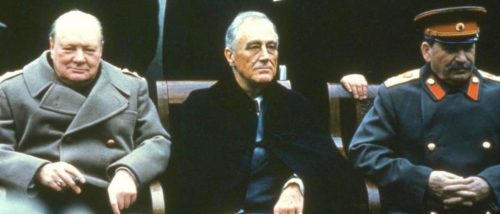
None of these men were kind or “nice” in any way. But they mattered. They were relevant. And they wielded some very real power.
Today, real power looks like this:
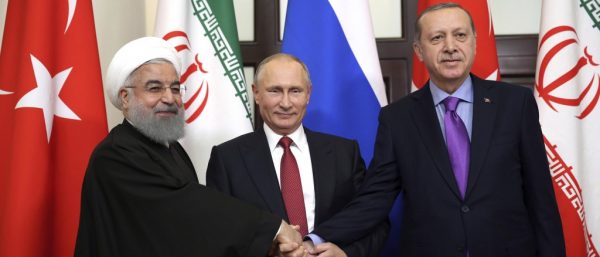
And you know what is really offensive to the AngloZionist leaders?
That this photo shows one Orthodox Christian and two Muslims.
Now that’s offensive. And very frightening, of course.
We are very, very far from the “birth of a new Middle East” promised by Condi Rice (it is a new Middle East alright, just not the one Rice and the Neocons had in mind!)
As for the “only democracy in the Middle East” it is now in full panic mode, hence its now overt plan to work with the Saudis against Iran and its clearly staged leaks about bombing all Iranian assets up to 40km from the Israeli border. But that train has already left the station: the Syrians won and no amount of airstrikes will change that. So just to make sure they still look really fierce, the Israelis are now adding that in case of a war between Israel and Hezbollah, Secretary General Hassan Nasrallah would be a target. Wow! Who would have thought?!
Can you hear the giggles coming out of Beirut?
The scary thing is that the folks in DC, Riyadh and Jerusalem hear them loud and clear which means that sooner or later they will have to do something about it and that “something” will be the usual nonsensical bloodbath this “Axis of Kindness” has been made famous for: if you can’t beat their military, make their civilians pay (think Kosovo 1999, Lebanon 2006, Yemen 2015). Either that or beat the shit out of a tiny, defenseless victim (Grenada 1983, Gaza 2008, Bahrain 2011). Nothing like a good massacre of defenseless civilians to make them feel manly, respected and powerful (and, for US Americans – “indispensable”, of course).
Setting aside the case of the Middle East, I think we can begin to see the outlines of what the US and Russia will be doing in the next couple of years.
Russia: the Russian strategy towards the Empire is simple:
- Try to avoid as much as possible and for as long as possible any direct military confrontation with the US because Russia is still the weaker side (mostly in quantitative terms). That, and actively preparing for war under the ancient si vis pacem para bellum strategy.
- Try to cope as best can be with all the “petty harassment”: the US still has infinitely more “soft power” than Russia and Russia simply does not have the means to strike back in kind. So she does the minimum to try to deter or weaken the effects of that kind of “petty harassment” but, in truth, there is not much she can do about it besides accepting it as a fact of life.
- Rather than trying to disengage from the AngloZionist controlled Empire (economically, financially, politically), Russia will very deliberately contribute to the gradual emergence of an alternative realm. A good example of that is the Chinese-promoted New Silk Road which is being built without any meaningful role for the Empire.
US: the US strategy is equally simple:
- Use the Russian “threat” to give a meaning and a purpose to the Empire, especially NATO.
- Continue and expand the “petty harassment” against Russia on all levels.
- Subvert and weaken as much as possible any country or politician showing any signs of independence or disobedience (including New Silk Road countries)
Both sides are using delaying tactics, but for diametrically opposite reasons: Russia, because time is on her side and the US, because they have run out of options.
It is important to stress here that in this struggle Russia is at a major disadvantage: whereas the Russians want to build something, the Americans only want to destroy it (examples include Syria, of course, but also the Ukraine or, for that matter, a united Europe). Another major disadvantage for Russia is that most governments out there as still afraid of antagonizing the Empire in any way, thus the deafening silence and supine submissiveness of the “concert of nations” when Uncle Sam goes on one of his usual rampages in total violation of international law and the UN Charter. This is probably changing, but very, very slowly. Most world politicians are just like US Congressmen: prostitutes (and cheap ones at that).
The biggest advantage for Russia is that the United States are internally falling apart economically, socially, politically – you name it. With every passing year the once most prosperous US is starting to look more and more like some backwater Third World country. Oh sure, the US economy is still huge (but rapidly shrinking!), but that is meaningless when financial wealth and social wealth are conflated into one completely misleading index of pseudo-prosperity. This is sad, really, a country that ought to be prosperous and happy is being bled to death by the, shall we say, “imperial parasite” feeding on it.
At the end of the day, political regimes can only survive by the consent of those they rule. In the United States this consent is clearly in the process of being withdrawn. In Russia it has never been stronger. This translates into a major fragility of the US and, therefore, the Empire (the US is by far the biggest host of the AngloZionist imperial parasite) and a major source of staying power for Russia.
All of the above applies only to political regimes, of course. The people of Russia and of the US have exactly the same interests: bringing down the Empire with the least amount of violence and suffering as possible. Like all Empires, the US Empire mostly abused others in its formative and peak years, but as any decaying Empire it is now mostly abusing its own people. It is therefore vital to always repeat that an “Empire-free US” would have no reason to see an enemy in Russia and vice-versa. In fact, Russia and the US could be ideal partners, but the “imperial parasites” will not allow that to happen. Thus we are all stuck in an absurd and dangerous situation which could result in a war which would completely destroy most of our planet.
For whatever it’s worth, and in spite of the constant hysterical Russophobia in the US Ziomedia, I detect absolutely no sign whatsoever that this campaign is having any success with the people in the US. At most, some of them naively buy into the “the Russians tried to interfere in our elections” fairy tale, but even in this case this belief is mitigated by “no big deal, we also do that in other countries”. I have yet to meet an American who would seriously believe that Russia is any kind of danger. I don’t even detect superficial reactions of hostility when, for example, I speak Russian with my family in a public place. Typically, we are asked what language we are speaking and when we reply “Russian” the reaction normally is “cool!”. Quite often I even hear “what do you think of Putin? I really like him”. This is in severe contrast with the federal government whom the vast majority of Americans seem to hate with a passion.
To summarize it all, I would say that at this point in time of the US-Russian war, Russia is winning, the Empire is losing and the US is suffering. As for the EU it is “enjoying” a much deserved irrelevance while being mostly busy absorbing wave after wave of society-destroying refugees proving, yet again, the truth of the saying that if your head is in the sand, your ass is in the air.
This war is far from over, I don’t even think that we have reached its peak yet and things are going to get worse before they get better again. But all in all, I am very optimistic that the Axis of Kindness will bite the dust in a relatively not too distant future.
Featured Video
Trita Parsi: Israel Set a Trap for Total War in the Region
or go to
Aletho News Archives – Video-Images
From the Archive
Zionism’s Violent Legacy
By Donald Neff | Washington Report On Middle East Affairs | January 1996
On January 4, 1948, Jewish terrorists drove a truck loaded with explosives into the center of the all Arab city of Jaffa and detonated it, killing 26 and wounding around 100 Palestinian men, women and children.[1] The attack was the work of the Irgun Zvai Leumi – the “National Military Organization,” also known by the Hebrew letters Etzel – the largest Jewish terrorist group in Palestine. The Irgun was headed by Revisionist Zionist Menachem Begin and had been killing and maiming Arabs, Britons and even Jews for the previous ten years in its efforts to establish a Jewish state.
This terror campaign meant that at the core of Revisionist Zionism there existed a philosophical embrace of violence. … continue
Blog Roll
 Aletho News
- Trita Parsi: Israel Set a Trap for Total War in the Region
- Trump’s Iran war is on an Israeli leash
- Saudi oil boss issues global supply warning
- Riyadh Says Its Oil System Is Intact. The Numbers Say Otherwise.
- Trump and Netanyahu Want to “Finish the Job” on Iran
- US ‘one-sided dictation’ not Iran’s beliefs makes rational talks impossible: Baghaei
- Iran’s Next Strike May Not Explode. It Could Shut You Down /Col Doug Macgregor
- Iran: US political targets legitimate if assassinations return
- Iraq shuts key border crossing with Iran under US pressure: Report
- Undersea Internet cables could be targeted in retaliation for attacks on Iran: IRGC deputy chief
- If Americans Knew
- The Israel Lobby’s Changing Fortunes
- AIPAC has become such a political liability that it’s shifting to a more “nimble” approach to buying politicians
- At least 160 Israeli settler attacks in 2 weeks
- Will Gaza’s Ancient Christian Community Disappear Forever?
- Israel’s vision of regional security rests on keeping Arab states weak
- Heidi Levine recounts how Palestinian youths helped save her in settler attack
- DAILY UPDATE: Latest essential news on Palestine, Israel, & region
- Trump’s Intensifying Sabotage of the ICC, for Israel’s Sake
- Israeli military detain US and UK volunteers in West Bank including Democratic NY politician Brad Lander
- Americans at National Conservatism Conference held in Israel this year criticize Israel
- No Tricks Zone
- E-Cars Reduce CO2 Emissions By Only 41% Compared To Internal Combustion Engine Vehicles
- Predictions Made By Renowned Climate Professor Over Past Decades Have Been Proven To Be Poor
- New Study Suggests Large Regions Of The Pacific Ocean Have Been Cooling For The Last 80 Years
- Germany’s Green Energy Debacle: High Energy Costs Force Kahla Porzellan to Close After 182 Years!
- New Study: 50 Years Of The Most Aggressive ‘Net Zero’ Policies Can Only Affect The Global Climate By 0.03°C
- US September “Heat” Was No Record…Many Records Set Decades Ago
- Latest European Green Energy Debacle; Portugal’s Largest Flagship Solar Park Insolvent!
- Green Energy Debacle: German Expert Professor Fritz Vahrenholt Warns Of Severe Economic And Social Consequences
- Two More Paleo Reconstructions Affirm Meters-Higher Sea Levels Across Ireland, Brazil 7000-6000 Years Ago
- New Study: Earth And Venus Surface Warmth Largely Explained By Convection And Lapse Rate, Not CO2 Or Radiation

