McCain: ‘New World Order Under Enormous Strain’ Without US, EU Leadership
Sputnik – 27.03.2017
US Senator John McCain said on Friday that the world desperately needs the US and Europe to unite once more to preserve globalism.
The current chairman of the armed services committee in the US Senate said that Washington should restore cooperation with the EU — long one of America’s “most important alliances.”
The remarks came at the Brussels Forum, a conference organized by the transatlantic think tank German Marshall Fund. The globalist ideologue, who once was a presidential candidate for the Republican Party, has once again put himself in direct opposition to President Trump by saying that it is essential for the allies to develop more connectivity and cooperation.
“I trust the EU,” he said, elaborating that EU and NATO were “the best two sums in history” and have maintained global peace for the last 70 years.
“We need to rely on NATO and have a NATO that adjusts to new challenges.”
Earlier in January the new US President Donald Trump complimented the UK on its “smart” decision to withdraw from the EU and dubbed NATO an “obsolete” coalition.
McCain said he supported Trump’s calls on Europe to increase defense spending for NATO, but added that Americans should “also appreciate the fact that over 1,000 young [European] people have given their lives in Afghanistan or Iraq.”
“I don’t know what price tag you put on that,” he said. “That’s quite a contribution I would say, if you ask their mothers.”
McCain hesitated to prejudge Trump’s presidency based on his first months in office but said that he should fill intelligence gaps and address what the Senator believes was Russia’s attempts to influence the outcome of the US election in November.
McCain also accused Russia of trying to influence approaching elections in France and Germany, and the president of Russia Vladimir Putin in particular in trying to restore the Russian empire, despite providing no evidence for those allegations.
Japanese scientists reject lifting of ban on military research at universities
RT | March 26, 2017
The influential Science Council of Japan (SCJ) adopted a statement rejecting research at civilian institutions for military purposes. It comes in response to government investment in dual-use technologies.
The SCJ, which was created in 1949 as an independent body representing academia, warned Japanese universities and research institutions against participating in military-related research, the Japan Times reported. In a statement adopted by the council’s executive body on Friday, it said taking grants from the defense ministry would compromise scientific independence.
It comes after 10 months of deliberation by a 15-member committee, which was formed in May 2016 to consider whether the long-held opposition to military research should be overturned. The SCJ previously rejected military research in 1950, and again in 1967.
The policy statement carries no legal force, but the council’s opinion carries great weigh in Japanese scientific circles and the government.
The council was called to revise its policy, after Japan’s Defense Ministry boosted its funding of research into dual-use technologies, which can have both civilian and military applications. The funding almost doubled for 2017 to $96 million, compared to the previous year, according to The Asahi Shimbun.
The decision to reject military research came earlier in March. At the meeting on Friday, the council’s board debated on whether to adopt the statement directly or submit it to the SCJ General Assembly, which is to convene next month. The executives chose the former.
Japanese academia remains reluctant to deal with military technologies for historical reasons. Imperial Japan rounded up scientists to participate in the war effort during World War II.
Read more:
US Presence in Korea Drives Instability
By Ulson Gunnar – New Eastern Outlook – March 25, 2017
US and European interests continue to portray the government and nation of North Korea as a perpetual security threat to both Asia and the world. Allegations regarding the nation’s nuclear weapon and ballistic missile programs are continuously used as justification for not only a continuous US military presence on the Korean Peninsula, but as justification for a wider continued presence across all of Asia-Pacific.
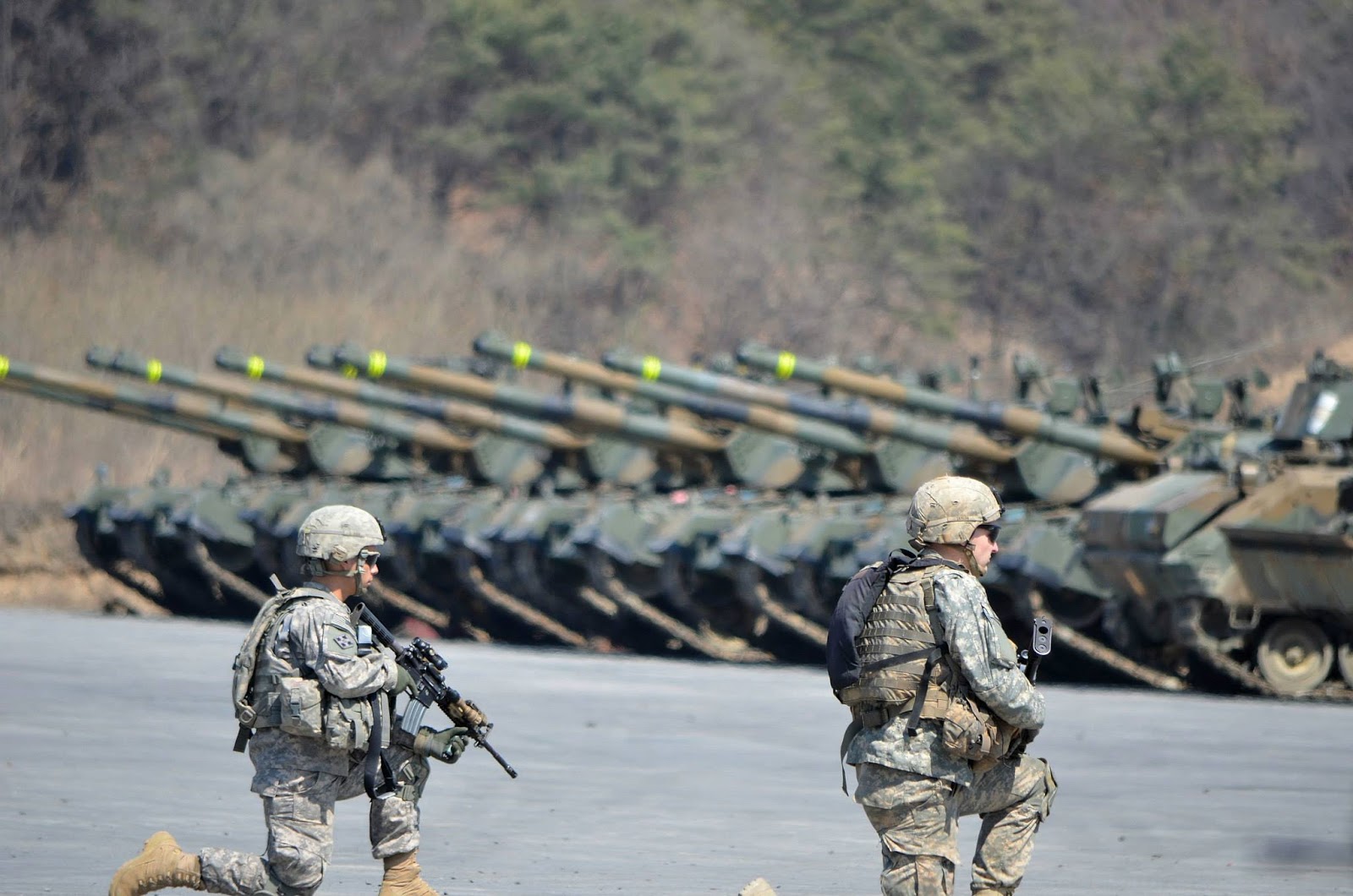
In reality, what is portrayed as an irrational and provocative posture by the North Korean government, is in fact driven by a very overt, and genuinely provocative posture by the United States and its allies within the South Korean government.
During this year’s Foal Eagle joint US-South Korean military exercises, US-European and South Korean media sources intentionally made mention of preparations for a “decapitation” strike on North Korea. Such an operation would be intended to quickly eliminate North Korean military and civilian leadership to utterly paralyze the state and any possible response to what would most certainly be the subsequent invasion, occupation and subjugation of North Korea.
The Business Insider in an article titled, “SEAL Team 6 is reportedly training for a decapitation strike against North Korea’s Kim regime,” would report:
The annual Foal Eagle military drills between the US and South Korea will include some heavy hitters this year — the Navy SEAL team that took out Osama bin Laden, Army Special Forces, and F-35s — South Korea’s Joon Gang Daily reports.
South Korean news outlets report that the SEALs, who will join the exercise for the first time, will simulate a “decapitation attack,” or a strike to remove North Korea’s leadership.
To introduce an element of plausible deniability to South Korean reports, the article would continue by stating:
Pentagon spokesman Cmdr. Gary Ross later told Business Insider that the US military “does not train for decapitation missions” of any kind.
Yet this is a categorically false statement. Throughout the entirety of the Cold War, US policymakers, military planners and operational preparations focused almost solely on devising methods of “decapitating” the Soviet Union’s political and military leadership.
In more recent years, policy papers and the wars inspired by them have lead to documented instances of attempted “decapitation” operations, including the 2011 US-NATO assault on Libya in which the government of Muammar Qaddafi was targeted by airstrikes aimed at crippling the Libyan state and assassinating both members of the Qaddafi family as well as members of the then ruling government.
Similar operations were aimed at Iraq earlier during the 2003 invasion and occupation by US-led forces.
Regarding North Korea more specifically, entire policy papers have been produced by prominent US policy think tanks including the Council on Foreign Relations (CFR) devising plans to decimate North Korea’s military and civilian leadership, invade and occupy the nation and confound North Korea’s capacity to resist what would inevitably be its integration with its southern neighbor.
A 2009 report titled, “Preparing for Sudden Change in North Korea,” lays out policy recommendations regarding regime change in North Korea. It states in its description:
The authors consider the challenges that these scenarios would pose–ranging from securing Pyongyang’s nuclear arsenal to providing humanitarian assistance–and analyze the interests of the United States and others. They then provide recommendations for U.S. policy. In particular, they urge Washington to bolster its contingency planning and capabilities in cooperation with South Korea, Japan, and others, and to build a dialogue with China that could address each side’s concerns.
Preparations for these documented plans which include provisions for invasion, occupation and the eventual integration of North Korea with South Korea have been ongoing for years with the most recent Foal Eagle exercises being merely their latest, and most blatant manifestation.
The aforementioned Business Insider article would also report:
Yet a decapitation force would fit with a March 1 Wall Street Journal report that the White House is considering military action against the Kim regime.
The SEALs boarded the USS Carl Vinson aircraft carrier and should arrive in South Korea on Wednesday, Joon Gang Daily reports.
South Korea has also made efforts toward a decapitation force, and international calls for action have increased in intensity after North Korea’s latest missile test, which simulated a saturation attack to defeat US and allied missile defenses.
While US-European and South Korean media platforms continue claiming such preparations are being made in reaction to North Korean military programs, careful analysis of North Korea and South Korea’s respective economic and military power reveal immense disparity and North Korea’s military capabilities as solely defensive with any first strike against its neighbors almost certainly leading to retaliation and the nation’s destruction.
North Korea’s nuclear arsenal and its expanding ballistic missile capabilities serve then only to raise the costs of any first strike carried out against it by US and South Korean forces. Claims that preparations by US and South Korean forces to carry out these first strikes are in response to North Korean provocations mirror similar political deceit that surrounded and clouded debate and analysis regarding US aggression in North Africa and the Middle East over the past two decades.
Ultimately, regardless of what political leaders in Washington or Seoul claim, the historical track record of the United States and its allies speaks for itself. Its annual military exercises and its adversarial approach to negotiations and relations with North Korea serve only to further drive tensions on both the peninsula and across the wider Asia-Pacific region.
For the United States, the perpetuation of instability helps justify its otherwise unjustifiable presence in a region literally an ocean away from its own borders. And while Washington cites “North Korean” weapons as a pretext for its continued presence in South Korea, its decades-spanning policy of encircling and attempting to contain neighboring China serves as its actual purpose for remaining involved in Korea’s affairs.
Provocative policies coupled with equally provocative military preparations including these most recent exercises openly aimed at North Korea’s leadership, guarantee continued instability and thus continued justification for a US presence in the region.
Washington’s careful cultivation of tensions on the peninsula serve as just one of many intentionally engineered and perpetuated conflicts across the region. Knowing well that nations targeted by US subversion and provocations will make preparations to defend against them, and possessing the media platforms to portray these preparations as “provocations” in and of themselves, the US has persuaded entire swaths of both its own population and those in regions inflicted by instability it itself drives, that Washington alone possesses the ability to contain such instability with its continued, extraterritorial presence.
In reality, the true solution for establishing peace and prosperity in these inflicted regions is for the US to simply withdraw.
NATO troops head for Poland ‘to deter Russian offensive actions’
RT | March 25, 2017
At least 1,350 American, British and Romanian soldiers have been sent to Poland from a base in Germany. US commanders said that the troops were ready “to deter Russian aggressive actions.”
The US, British and Romanian soldiers left the Rose Barracks military base in Vilseck, western Germany, for Poland where they are expected take part in NATO’s mission. The troops are “fully prepared to deter Russian offensive actions,” US Colonel Patrick Ellis said at the departure ceremony on Saturday.
“As a result of Russia’s aggressive actions and in light of the changing and evolving security environment, at the Warsaw summit in July 2016 NATO members agreed to strengthen our deterrence and defensive posture,” US Major General Timothy P. McGuire said.
The NATO group is to be stationed in the town of Orzysz, 220 kilometers northeast of the capital, Warsaw, according to Reuters.
NATO troops in Estonia
Also on Saturday, NATO’s heavy armored vehicles of the French armed forces were delivered to Estonia, according to a video published by the General Staff of the Estonian Defense Forces.
France’s heavy armored vehicles include Leclerc tanks and VBCI infantry fighting vehicles, as well as dozens of VAB armored vehicles, a spokesman of the 1st Infantry Brigade said, according to the Kuulutaja newspaper.
The UK is to deliver Challenger 2, Titan and Trojan tanks to Estonia as well as self-propelled artillery mounts AS90, Warrior infantry fighting vehicles and reconnaissance drones, he added.
The battalion will be stationed in the military town of Tapa and will interact with the first infantry brigade of the Estonian Defense Forces.
The alignment of forces in Estonia is planned to finish in early April. By that time, Estonia is to host 800 soldiers from the UK and around 300 soldiers from France. The French group is to spend some eight months in the Baltic country. After that, Danish soldiers are expected to replace them.
NATO leaders agreed to deploy four multinational battalions to Poland as well as Estonia, Lithuania and Latvia on July 8 at the summit in Warsaw.
Russia has repeatedly criticized NATO’s military buildup along its borders, seen as a threat to national security.
In February, Russian President Vladimir Putin blamed NATO for provoking a conflict with Moscow and using its “newly-declared official mission to deter Russia” as a pretext.
Speaking at the Munich Security Conference in February, Russian Foreign Minister Sergey Lavrov noted that “NATO’s expansion has led to an unprecedented level of tension over the last 30 years in Europe.”
Moscow has condemned the new US ground-based missile defense system in Eastern Europe and increased presence of NATO vessels in the Black Sea.
Left degeneracy plumbs new depths

Saint Obama
By Patricia Greanville | March 13, 2017
An appeal landed in my mailbox yesterday from I suppose the editors of Mother Jones or their marketing machine in conjunction with an outfit called Citizens United. The letter blares across the page something that can only be of interest to people suffering from a bizarre sense of priority, abysmal ignorance or clinical stupidity:
Donald Trump just SLANDERED President Obama!
The implication is that we should urgently do something about this. Aux armes! Further, in what we must accept as a compelling supporting rationale for action, the authors of the appeal, proving they do come from Lalaland, offer this laughable argument:
… Donald Trump is wrong!!! President Obama has always been on our side. He’s been fighting to overturn Citizens United since Day One.
With equal breathless dishonesty, the letter has the audacity to talk about defending “Obama’s legacy”, a supposedly sterling body of work apparently about to be wrecked by the horrid Trumpinator.
By the standards of silliness this marks a new low; by the standards of left thinking, such as it is practiced in the US, it confirms the irrelevancy of this “new”, thoroughly bourgeois identity politics “left” to the problems really threatening humanity. By the standards of honesty, well, it does not qualify in that category, but let’s just say it is yet another contorted effort at bashing Trump. Which would be alright—considering the man offers any serious critic a multitude of valid grounds on which to oppose him— if these guardians of political correctness and truth also looked homeward for many of the curses besetting the nation.
The fact that these liberal champions refuse to recognize the horrid, smoothly hypocritical track record of the Democrats (their darling Obama and the abjectly corrupt Clintons, in particular), and their favorite party’s drive to war, in lockstep with their new pals, the CIA and the resilient Neocon vermin, a posture which now almost guarantees some sort of nuclear confrontation with Russia or China in the near horizon (with unthinkable consequences for this planet as we know it lest we quickly correct course), says all you need to know about the degeneracy of the so-called left in the United States and in the West, in general.
The traditional “left” in the US (always basically a bunch of centrist liberals since the radical left was reduced to ashes by unrelenting campaigns of anticommunism endorsed by the very same liberals) is so wanting these days in essential morality that now even voices that just a few years ago would have been categorized as unqualifiedly on the Right—and therefore by the left’s own reckoning “on the wrong side of history”, are about the only ones saying and doing things that are desperately needed.
Like opposing imperialist wars, for example. Do you see any of the legendary voices on the mainstream “left” uttering a single word of opposition to the dishonest campaign to demonize Russia? Instead, they are busily criminalizing any kind of contact with Russian diplomats or politicians that could lead to a de-escalation of tensions. So, nope. They are not there. Quite the opposite. Which leaves us as I say with the likes of Ron and Rand Paul and other libertarians, or the new French right champion, ultranationalist Marine Le Pen (already in the CIA crosshairs), doing wittingly or unwittingly what the left should be doing.
Incidentally, Le Pen’s banishment from polite society is predicated on her opposition to the EU’s slavish attachment to Washington’s push to war with Russia, and her impatience with NATO. I suppose that were France’s WW2 iconic hero Gen. Charles de Gaulle alive, he too would be promptly consigned to the netherworld of political undesirables since, as a recalcitrant nationalist and one suspicious of Anglo-American intrigues and treacheries, he held almost exactly the same views as Le Pen. This all by itself shows how much the world has changed.
The question arises: Has humanity —with the help of the lying, escapist mainstream media — really forgotten how to use its imagination? Sure, capitalism with its endless economic-insecurity distractions and malignantly convoluted superficial politics does consume a great deal of a person’s psychic space. This certainly stunts the imagination, especially in a culture that boasts a long history of proud anti-intellectualism. But still.
Not too long ago, when some sanity and probity still held sway and when the collapse of liberaloid values was not yet total, most people in these formations clearly understood that the first and foremost duty of a progressive was to avoid wars at all costs, particularly a terminal, horrid war between the nuclear superpowers. This was and is the ultimate sin, the ultimate obscenity. Besides being the most elementary proof of common sense. Avoiding the Doomsday scenario was seen as imperative. People openly pushing for such confrontational policies would have lost much if not all political traction and even the presstitutes would have filed some demurring comment. Some on the liberal left might have even risen to denounce such dangerous warmongering.
This was the basic consensus for generations, ever since atomic weapons came to occupy center stage in world politics.
Even the ever supremacist, devious, and savagely capitalist United States agreed with its nemesis, the Soviet Union, to lower the threat of an Armageddon by signing treaties of weapons parity and reduction in nuclear arsenals, thereby at least assuring a balance of terror: the aptly labeled Mutual Assured Destruction (MAD), a concept promulgated and observed even by reactionaries like Ronald Reagan. Apparently it worked.
The importance of this glimmer of sanity in the engulfing madness cannot be overestimated. But the dark forces never give up and in the intervening years the Anglo-American establishment quietly retired the MAD principle, reinstating the far more dangerous and de-stabilzing “first strike” principle. Meanwhile, nuclear weapons have become even more potent, and there’s now almost open acknowledgement by the Pentagon that DU (depleted uranium) munitions, warheads and other forms of “tactical nukes” are standard choices for field commanders. The Middle East, of course, has been the testing lab, with Iraq, Syria and other victim nations subjected to what many suspect is an international crime of truly horrifying and unprecedented dimensions.
The problem with the development and use of tactical nuclear weapons in the modern battlefield (besides the abject cowardly criminality involved in using such weapons against weaker nations) is that when used by a superpower on another superpower’s troops or “prime assets”, things can get rapidly out of control. A shooting war is no moment for cool heads to prevail, especially in utterly brainwashed and self-righteous chauvinist nations like America, where the public has been systematically denied access to truth in these essential matters. In America, for most people, the first realization that a war had begun would be a huge flash and thunder and then—well nothing. Utter pulverization. In other words, for most Americans the final war and their own death sentences would come as total surprise.
In Russia at least the public is well aware of where the world stands, and some, many I hazard, perfectly understand the context and support their leaders’ struggles to maintain the peace. That said, if attacked by the US and the rest of the NATO mafia, Russia will not back down. It will respond with devastating efficiency. After all, last time Russia was attacked it lost 27 million lives, the equivalent in those days of the whole population of New York, California and Texas combined. This is something the American mind, still obsessed with less than 3,000 casualties on 9/11, can’t begin to wrap its jingoist mind around. So there will not be a repetition of Barbarossa no matter how much the despicable, overwhelmingly Zionist US Neocons push and huff to make it happen. Prominent, highly respectable Russians residing in the US, filed a letter of warning to the American people. The media naturally chose to ignore the document entirely.
The Russians’ warning packed a sobering sentence. It should be obligatory reading:
If there is going to be a war with Russia, then the United States will most certainly be destroyed, and most of us will end up dead. (1)
The dream of nuclear supremacy, the longed for “pre-emptive strike”, the ability to deal Russia a disabling blow, with a “tolerable” level of retaliation, say only 50 to 75 million dead in the US, is talked about seriously in high military policy precincts. The submerged crime that such a war would be provoked and waged to secure not US national security but decisive advantage for its ruling class of billionaires and associated cliques of privileged rulers around the world, is never discussed. How could it? This truly insane posture has also been official Pentagon policy since at least 2006 when some people began to believe the US had attained nuclear supremacy over Russia and China. A paper filed in 2006 by two analysts with Foreign Affairs, a blue-ribbon establishment think tank, summed up the situation rather nicely:
For almost half a century, the world’s most powerful nuclear states have been locked in a military stalemate known as mutual assured destruction (MAD). By the early 1960s, the nuclear arsenals of the United States and the Soviet Union had grown so large and sophisticated that neither country could entirely destroy the other’s retaliatory force by launching first, even with a surprise attack. Starting a nuclear war was therefore tantamount to committing suicide.
During the Cold War, many scholars and policy analysts believed that MAD made the world relatively stable and peaceful because it induced great caution in international politics, discouraged the use of nuclear threats to resolve disputes, and generally restrained the superpowers’ behavior. (Revealingly, the last intense nuclear standoff, the 1962 Cuban missile crisis, occurred at the dawn of the era of MAD.) Because of the nuclear stalemate, the optimists argued, the era of intentional great-power wars had ended. Critics of MAD, however, argued that it prevented not great-power war but the rolling back of the power and influence of a dangerously expansionist and totalitarian Soviet Union. From that perspective, MAD prolonged the life of an evil empire.
This debate may now seem like ancient history, but it is actually more relevant than ever — because the age of MAD is nearing an end. Today, for the first time in almost 50 years, the United States stands on the verge of attaining nuclear primacy. It will probably soon be possible for the United States to destroy the long-range nuclear arsenals of Russia or China with a first strike. This dramatic shift in the nuclear balance of power stems from a series of improvements in the United States’ nuclear systems, the precipitous decline of Russia’s arsenal, and the glacial pace of modernization of China’s nuclear forces. Unless Washington’s policies change or Moscow and Beijing take steps to increase the size and readiness of their forces, Russia and China — and the rest of the world — will live in the shadow of U.S. nuclear primacy for many years to come.
One’s views on the implications of this change will depend on one’s theoretical perspective. Hawks, who believe that the United States is a benevolent force in the world, will welcome the new nuclear era because they trust that U.S. dominance in both conventional and nuclear weapons will help deter aggression by other countries. For example, as U.S. nuclear primacy grows, China’s leaders may act more cautiously on issues such as Taiwan, realizing that their vulnerable nuclear forces will not deter U.S. intervention — and that Chinese nuclear threats could invite a U.S. strike on Beijing’s arsenal. But doves, who oppose using nuclear threats to coerce other states and fear an emboldened and unconstrained United States, will worry. Nuclear primacy might lure Washington into more aggressive behavior, they argue, especially when combined with U.S. dominance in so many other dimensions of national power.
Finally, a third group — owls, who worry about the possibility of inadvertent conflict — will fret that U.S. nuclear primacy could prompt other nuclear powers to adopt strategic postures, such as by giving control of nuclear weapons to lower-level commanders, that would make an unauthorized nuclear strike more likely — thereby creating what strategic theorists call “crisis instability.”
(The Rise of US Nuclear Primacy | By Keir A. Lieber and Daryl G. Press* | Foreign Affairs | March/April 2006)
Goes without saying that enormous, obscene sums are being dedicated by the US to achieve this “nuclear supremacy”, all, as previously stated, under an almost complete news blackout about the subject. Problem is, the Russians and the Chinese are not exactly pikers, and Russia’s nothing short of astonishing rebirth as a first class world power, its Phoenix-like re-emergence from the Western-inspired Yeltsin putrefaction, has created new realities to factor in. Western leadership, of course, we see from their actions, continues to ignore them. And yet, as even some Western news sources have indicated, the Russian nuclear defence/deterrent force is something that should compel attention and respect. Ponder:
Russia Unveils RS-28 Sarmat ‘Satan 2’ Nuclear Missile
Russia has declassified the first image of its new thermonuclear-armed intercontinental ballistic missile.
The RS-28 Sarmat could carry a payload capable of wiping out a landmass “the size of Texas or France,” according to a report by the Kremlin-aligned Sputnik news agency.
Known colloquially as “Satan 2,” the missile will replace the RS-36M — which was dubbed “Satan” by NATO after entering service in the 1970s.
Satan 2 missile: Good bye to all that. Just one can wipe out all of Texas or France. An image of an RS-28 Sarmat missile. Makeyev Rocket Design Bureau.
Robert Kelley, a former nuclear weapons expert at the U.S. Department of Energy, said the new missile was likely an upgrade of electronics — rather than explosive power or range.
“The range of the missiles will be about the same, the explosive destructive power will be about the same [but] the reliability, flexibility and confidence [in the warheads’ ability to hit their targets] will go way up,” said Kelley, who is now a now a distinguished associate fellow at the Stockholm International Peace Research Institute.
He added: “Your iPhone can do thousands of more things today than in the 1970s when these systems were first deployed. Many of the clunky electronic circuits of that era no longer exist and no one knows how to make them anymore.”
According to Russian media, the missile’s first stage engine PDU-99 was tested in August, while a hypersonic warhead was reportedly tested in April.
The new version of the Sarmat is expected to enter service late in 2017.
(Source: NBC News)

That means that just two of these “Satans” could wipe out the whole US Eastern Seaboard for the next 50,000 years. What do you call a leadership that consciously and recklessly plays with such diabolical weapons of mass destruction? That constantly taunts and provokes the population of a nuclear-armed nation that wishes no conflict with anyone but which has suffered terribly in recent wars?
Silence and misdirection
The whore media will not talk about these things—things that really matter— because the US ruling class thinks that it can win a nuclear clash with Russia, and that the sooner this is resolved, the better. The thousands of prostituted “strategic analysts” crawling all over the so-called “defence establishment” of the West, the people who furnish the MIC with its excuses and raison d’etre, believe this posture is “rational”, well, their careers and livelihoods depend on that.
The current situation means that a huge war can now occur by choice—following Washington’s unquenchable desire for hegemony— or by a concatenation of absurd grotesque increments, as the Great War of 1914 demonstrated beyond reasonable doubt. This folly which buried a whole generation and destroyed 40 million lives, as documented by historians such as Barbara Tuchman, showed that humanity can indeed bumble its way, inch by inch, into a horrid conflagration. And politicians in 1914 Europe, multiple defects aside, were towering statesmen when compared to the sociopathic dwarves, cowards, and drooling fools running the show these days on both sides of the Atlantic.
This is the backdrop against which we measure the ludicrous sense of priority exhibited by the editors of Mother Jones, their cohorts in the rest of the liberal media, and their millions of low-info, desperately confused followers, as they feed off of these inflammatory messages about Trumpian sins.
MJ wants Trump’s scalp for daring to imply that the saintly Obama wiretapped his phones. But, is Trump so far from the truth in this case? Apparently, to the alarm of his innumerable critics, all zealous guardians of the warmongering imperial status quo, this is a broken clock that manages to tell the right time more than twice a day. Too often for their comfort. Accordingly, and quite possibly dishonestly given the IQ prevailing in this segment, this crowd remains tediously and recklessly fixated on the admittedly ugly idiosyncrasies defining Trump and his regime as if the US had never seen a repulsive chief of state before, well, not so overtly, that is. More than that, they are tilting at windmills. Donald Trump for all his bluster caved in to the Deep State with the firing of Michael Flynn, and these days, stylistic questions aside, he is simply more of the same criminality at the helm of the empire and no longer represents a real neofascist threat, as continually proclaimed.
The only real and credible neofascist threat to the people of the United States and the world at large can now emanate exclusively from the unified councils of the US ruling plutocracy, acting through their favorite tool, the mendacious duopoly, and the power ministries (CIA, FBI, NSA, Pentagon agencies, etc.) operating with the usual support of the whore media (including so-called alternative media such as Mother Jones, which provide a “left” imprimatur to these undemocratic proceedings). In other words, the US will go into full overt fascist mode when the deep state deems it necessary and not a moment sooner, Trump or no Trump in the equation.
Glen Ford, for one, refuses to be swept into the anti-Trumpian frenzy on the basis of stupid or fabricated reasons. Declares the editor of Black Agenda Report, dismissing the charge that Trump is in this case offering just one more of his famous “alternative facts”:
The ruling class/War Party/corporate media campaign for regime change in Washington has moments of pure silliness, with grown men claiming that U.S. presidents don’t have the power to wiretap people. Someone should have informed Dr. Martin Luther King. But, if self-described “progressives” can believe that the CIA is a benign, democratic institution, they can believe anything. “The destabilization of the U.S. bourgeois state is a project, not of the Kremlin, but of multinational and finance capital headquartered in the U.S.” (Corporate Media Counting Cadence to Fascism, BAR )
Facile observers like to compare Trump to Hitler and Mussolini, but those two, despite their criminality, perhaps insanity in the former, at least had the ability in their prime to thread coherent thoughts and even weave a complete ideology. Hitler and Mussolini took pride in writing their own speeches, in an age without teleprompters. They both read voraciously, and even wrote books, without the aid of a corral of ghost writers, not to mention professional spin doctors. Hitler, no chicken hawk, fought with valor in WW1 and entertained dreams of artistic distinction. That Mein Kampf, besides its ugly message, is basically unreadable due to pervasive incoherence and shall we say, “philosophical overreach”, is nonetheless an accomplishment that the Donald could only dream of. What’s more, both Mussolini and der Fuhrer faced at the beginning of their careers a real left, something that Trump has never seen in his entire minuscule tenure. Because a real left has not existed in the United Sates for generations.
Still, by shilling for the Democrats and the imperialist Duopoly, Mother Jones, along with the rest of the bankrupt “liberal intelligentsia”, has become a joke, even if millions of low-info liberals, sold on the largely manufactured anti-Trump hysteria, continue to cheer.
As said many times on these pages and articulated by numerous authors, this is NOT to excuse, defend or endorse Trump, except in those moments when the man, regrettably in a rather incompetent and opportunistic fashion, happened to make noises toward peace and non-intervention in the world. Such worthy ideas —perhaps the difference between life and death for this planet, or at the very least untold suffering for many millions of human beings around the globe—have now been betrayed by Trump himself, or abandoned or neutralized in large part as a result of the machinations of the deep state and their allies in what used to be the left in America.
Should we now kneel and pray on the altar of St. Obama?
Patrice Greanville is founding editor of The Greanville Post.
American civil war is good for world peace
By M K Bhadrakumar | Indian Punchline | March 22, 2017
The civil war in Washington between President Donald Trump and his detractors shows no signs of abating. Every day becomes a fresh start in the fighting. The latest salvo has been Monday’s hearing at the US House of Representatives Intelligence Committee where the Director of the Federal Bureau of Investigation James Comey acknowledged the existence of an on-going investigation by his agency over suspected Russian interference in the US presidential election with hacking to help the then Republican candidate Trump win the White House.
True, no smoking gun was produced by Comey, but his testimony implied that investigations are continuing. We may expect that many more such hearings are in the pipeline. A “big grey cloud” has appeared out of nowhere, as the chairman of the House Intelligence Committee Devin Nunes put it. The cloud will lift only if the various inquiries going on conclusively absolve Trump or, alternatively, if Trump leaves office, whichever comes first.
Such inquiries have a way of mutating, while moving ponderously, slowly in the cesspit tank. Comey admitted that it is difficult for him “to give you a timetable as to when it will be done.” Then, there is also a sub-plot – Comey himself is under investigation by the US Justice Department.
The next big day will be March 28 when two colorful personalities in the US intelligence system during the Obama administration – the ex-director of national intelligence James Clapper and the ex-CIA director John Brennan – will appear before the House panel. Both were instrumental in the January assessment that the Russians had interfered in the US presidential election in an attempt to benefit Trump. Clapper has a proven record of lying under oath, while Brennan is Barack Obama’s poodle. Trust both to resort to innuendos against Trump and mates, hitting them in the loins where it hurts. (Watch it “live”.)
To my mind, this is about the appropriate time to begin pondering about a world sans America. That is to say, an international system where America has taken “time out”. Is it a good thing to happen? Well, it is already having some salutary effect on the international climate. The global tensions have noticeably eased. If it was commonplace during the Obama era to discuss a potential war between Russia and the US, including a nuclear war, no one wastes breath over such things anymore.
A good case can be made that if the American civil war continues to be fought as savagely by the country’s elites as it has been so far, and if the fratricidal strife continues for another 4 or 8 years — ideally, through the entire Trump presidency — it will be a great boon for the world community. Never again will Americans be able to be preachy that the world cannot do without them. And the ruling elites in countries such as India will also get accustomed to a life without America.
Clearly, America’s “exceptionalism” is getting exposed as total sham. Second, the longer the civil war continues, the less possibility there is for US military interventions abroad. Quite obviously, we saw last week that China could prevail upon the US to be “cool-headed” and not to go to war with North Korea. It seems to me that US Secretary of State Rex Tillerson appeared relieved to agree with the Chinese that there is no option but to continue on the diplomatic track vis-à-vis the North Korea problem.
Again, some degree of predictability is appearing in the US-China relationship, since the last thing Trump wants now is a conflict with China. For us Asians also, it is singularly gratifying that there isn’t going to be a war in the region. This is what the Chinese Foreign Ministry spokesperson said earlier today at a media briefing in Beijing:
- During Secretary of State Tillerson’s stay in China, the two sides arrived at a clear consensus on ensuring a sound development of China-US relations at a new starting point in the spirit of non-conflict, non-confrontation, mutual respect and win-win cooperation. It should not be interpreted as a victory for any party. It is just the right way for China and the United States, two major countries, to get along with each other. Non-conflict, non-confrontation, mutual respect and win-win cooperation summarizes the reason for the steady growth of China-US ties in recent years and is worth carrying forward and being further developed. We would like to enhance communication, mutual understanding and mutual trust with the US so as to properly handle differences, expand bilateral, regional, and international cooperation, and elevate China-US relations to a greater height at a new starting point.
The comfort level in Beijing is palpably rising. Finally, there are some other good signs, too, which are not visible to the naked eye but are no less important. In the civil war conditions in America, with so much dust and noise in the air in Washington, and such poor visibility all around, Trump is quietly able to do a few things on the side, which he had promised to do.
A good friend of mine who watches Syria and Iraq through binoculars 24 x 7, wrote to me a couple of days ago that Trump is doing some incredible things out there in the neighborhood where she lives. Let me succinctly paraphrase her assessment:
- Trump has in fact prioritized the fight against terrorism. He is doing this quietly… The CIA has completely turned off the arms spigot to rebels in Syria and the US is bombing Al Qaeda and its allied groups now – something that Obama avoided (and tried to stop Russia/Syria/Iran from doing.) Equally, Trump is bombing the Al-Qaeda in Yemen too. And in Iraq, Trump is standing by while the Iran-trained Hashd ash-Shabi is annihilating ISIS in western Mosul and cutting off their route to Syria. Obama, on the contrary, had refused to let the Hashd fight in many of these battles. Trump now has not only given the go-ahead, but we have now seen the Iraqi Air Force participate in anti-ISIS bombing raids into Syria. Simply put, if the Obama administration’s policies only had led to the rise of the ISIS and Al-Qaeda in Iraq and Syria, Trump is actually fighting them and, importantly, he is allowing US’ regional foes – Iran and Iran-supported militia groups, in particular – to fight them unimpeded.
Meanwhile, Tillerson is likely to visit Moscow on April 12. As the saying goes, dogs bark but the caravan moves on. The world community cannot possibly ask for more.
Indeed, there will always be disgruntled elements – Brits and Germans, for example. But that is perfectly understandable. They realise that Trump regards them as a lower form of life – worse than leeches or bed bugs. They dearly want Trump to lose in the civil war, and lose very quickly. Without America to lead, they are afraid they might lose their gravitas in world politics. For us, Asians, that is not a bad prospect, either. Hopefully, the curtain is coming down on the “West”, as we knew it in modern history.
Russia Ready to Discuss Nuclear Arsenal Reduction – Lavrov
Sputnik – 23.03.2017
MOSCOW – Russia is ready to discuss the possibility of reducing nuclear arsenals, Foreign Minister Sergey Lavrov said at a Russian Armed Forces General Staff Military Academy lecture Thursday.
“We are ready to discuss the possibility of further reducing nuclear capabilities, but only taking into account all the factors and not just the number of strategic offensive weapons,” Lavrov said.
Meanwhile, he added that Russia is ready for dialogue with the United States on the reduction of strategic nuclear weapons and believes that more countries need to be involved in the process.
“We are ready, but the conversation must be conducted taking into account all factors that affect strategic stability,” Lavrov said at a Russian Armed Forces General Staff Military Academy lecture.
He underscored the need to wait for Washington to finalize its priorities in the area, and stressed the need for more countries’ involvement in the reduction of nuclear arms.
Both Russia and the United States agreed in 2010, under the New Strategic Arms Reduction Treaty (START) treaty, to decrease the number of deployed nuclear warheads to 1,550 and the number of deployed missiles and bombers to 700. The agreement will expire in 2021, and could be prolonged for no more than five years.
US President Donald Trump has been critical of the deal that he regards as “bad” and “one-sided,” raising concerns.
On February 24, Alexey Pushkov, a senior member of the Russian parliament’s upper house, said Trump’s pledge to boost US nuclear capacities could send the world back into the 20th century by challenging all treaties on strategic arms reduction. On February 28, Russian Deputy Minister of Defense Alexander Fomin said Moscow and Washington should work together under the existing treaty.
On March 8, head of US Strategic Command (STRATCOM) Gen. John Hyten said a potential cancellation of the New START could lead to an arms race.
EU foreign policy chief Federica Mogherini said on Monday that the European Union favored deeper cooperation between the United States and Russia on nuclear non-proliferation efforts.
Featured Video

New positive ivermectin evidence
or go to
Aletho News Archives – Video-Images
From the Archives
Fanatical Followers of the Covid Regime: A Jim Jones-Style Cult?
By Professor Roger Watson and Dr. Niall McCrae | The Daily Sceptic | November 15, 2021
As scholars at leading British universities over recent decades, we witnessed the replacement of critical thinking and debate by narrative: facts are discrimination and scientific method is imperialism; truth, instead, is derived from ‘progressive’ values. This educational trend may be a major contributory factor to the ease in which society has been inculcated to the Covid ‘new normal’ of masking, testing, and repeated doses of vaccines for a disease of similar risk to severe influenza.
One doesn’t need much critical reasoning to observe the flawed logic of some vaccination enthusiasts, such as people who respond to experiencing any side effects, however debilitating, by saying “at least I know it’s working”, or, after contracting the disease despite their promised inoculation (over 90% effective, according to initial drug company claims), “I’d have been worse off without the jab.” … continue
Blog Roll
 Aletho News
- Najaf airport to reopen to Iranian flights within 24 hours: Ambassador
- From ‘How Will This End For Iran’ to ‘When America Walks Away’: A tale of two Economist covers
- Tehran blasts ‘baseless’ speculation linking Iran to alleged bomb plot at UK air base
- The Rise And… Rise Of ‘Color Revolutions’
- The Coming GOP Bloodbath?
- Arctic Scare Stories Melt Away
- Wrong, Euronews: Climate Change Has Not Created a Food, Energy, and Economic “Meta-Crisis”
- New positive ivermectin evidence
- Met Office Caught Fabricating Daily Temperature Record Claims
- Merck Virologists Admitted to Falsely Certifying Vaccine Efficacy
- If Americans Knew
- Netanyahu Asked UAE Leader to Deny Report on Oct. 7 Warning in Secret Visit, Sources Say
- CNN Chief Int’l Correspondent Clarissa Ward on Journalists in Gaza
- Democratic Party Consultants Surround Troy Jackson with Pro-Israel Donors
- Christian Leader Responds To Netanyahu’s Claims Regarding Palestinian Christians
- In Gaza, ‘Whoever Survives the Bombing Won’t Survive the Rubble’
- Israel kills more Palestinians, amid push to resettle Gaza – Daily Update
- Israel forces Gazans to live in constant peril – Daily Update
- Deconstructing Netanyahu’s pants-on-fire UN rant – Daily Update
- Trump betrayed voters with his campaign lies and prioritized a foreign country once he took office
- Netanyahu calls Israel’s war in Gaza ‘opposite of genocide’ in UN speech to near-empty hall
- No Tricks Zone
- New Study: Earth And Venus Surface Warmth Largely Explained By Convection And Lapse Rate, Not CO2 Or Radiation
- 2025 Nature Paper Claiming Worsening Global Drought Gets RETRACTED …Heavily Flawed
- New Study: ‘Global Drought Shows No Detectable Recent Acceleration Under Climate Warming’
- Economic Masterminds: German Socialists Suggest Taxing Productivity Gains Stemming From Using AI
- The South China Sea Has Not Been Cooperating With The Climate Change Narrative
- Energy Crisis: Germany Enters Heating Season With Historically Low Gas Reserve Fill Levels
- New Study: The Antarctic Ice Sheet Gained Mass From 2020-2024 Due To Staggering Snow And Ice Accumulation
- Study: Ocean Heating Rates From Thousands Of Years Ago ‘Dwarf’ Modern Ocean Heating Rates
- Climate Extremists Target, Attack Large-Scale Power Grid Infrastructure In Germany!
- New Study: Antarctic Ice Melt Has Contributed Less Than 1 Centimeter To Sea Level Rise In The Last 30 Years

