Trident whistleblower calls out MoD’s ‘lame attempt’ to excuse nuke malfunctions
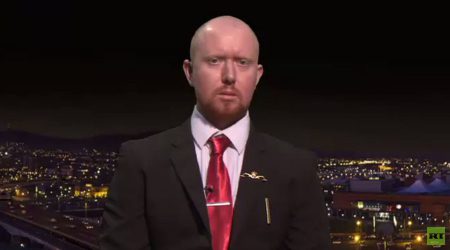
Trident whistleblower William McNeilly. / RT
RT | February 6, 2017
Royal Navy whistleblower William McNeilly has returned fire after the Ministry of Defence (MoD) again tried to discredit him. He labeled it an attempt to cover up the dangers of Britain’s nuclear arsenal.
McNeilly was thrown out of the navy in 2015 after publishing a dossier of potentially catastrophic security and safety issues relating to Britain’s nuclear deterrent.
After reports in January this year of a failed 2016 missile test, which saw senior government figures accused of lying, McNeilly told RT that he himself had been witness to a number of serious mishaps during a Trident patrol a year earlier.
The 2016 test saw a missile which was supposed to be aimed in the direction of Africa veer toward Florida due to an internal systems failure.
The MoD responded to the former weapons engineer’s comments to RT by telling the Independent newspaper: “McNeilly’s claims, from his brief serving time before being discharged, have proved to be factually incorrect, demonstrate a lack of understanding or drew on historic, previously known, events.
“We have absolute confidence in the nuclear deterrent,” they insisted.
The Independent specifically referred to McNeilly’s “claims that there were four unreported Trident missile test failures in 2015…”
McNeilly responded Monday, telling RT: “I have never stated that there were four failed missile launches.
“The Trident report and the information I gave RT made it clear that I was talking about missile tests.”
McNeilly pointed out he had served on a nuclear missile patrol, including on watches in the command center.
“There are multiple missile tests conducted every patrol,” he said.
“The MoD has tried to downplay the information in the Trident report by claiming that I said things that I have never said.”
The truth of the matter, he insisted, was that “I have never said I witnessed four failed missile launches… that is a lame attempt to discredit me and the Trident report by fabricating nonsense.”
Israel PM Netanyahu greeted by pro-Palestine protests on London visit
RT | February 6, 2017
Israeli Prime Minister Benjamin Netanyahu will face hundreds of protesters when he meets with his British counterpart Theresa May in London on Monday morning.
Pro-Palestine activists have organized a demonstration outside Downing Street, where Netanyahu is due to discuss among other things the rising ‘threat’ of Iran.
A Facebook page advertising the event claims to have support from several activist organizations, including Palestine Solidarity Campaign, Stop the War Coalition, War on Want and the Muslim Association of Britain.
Some 268 people have confirmed they will attend, according to the page.
Before flying to Britain, Netanyahu said he wants to “tighten” relations with the UK in the face of the “extraordinary aggression” from Iran after the Islamic Republic tested a ballistic missile over the weekend. Tehran denies the test was in breach of the 2015 nuclear deal.
“We are in a period of diplomatic opportunities and challenges. The opportunities stem from the fact that there is a new administration in Washington, and a new government in Britain,” Netanyahu said.
“I intend to speak with both of them about tightening relations, between each side and Israel and trilaterally.”
According to the Telegraph, a Downing Street spokesman said May was expected to raise concerns about illegal settlement building, but it would only form a small part of their discussions.
Netanyahu’s visit comes six weeks after Britain assisted in the passage of a UN Security Council resolution condemning Israel’s illegal settlements in the West Bank as a “flagrant violation under international law.”
The resolution was able to pass because the United States made the unusual choice not to exercise its veto power.
Britain played a key role in brokering the resolution, according to the Guardian, which claimed the Foreign Office did not deny it had been involved in the drafting process.
Netanyahu reacted furiously to UNSC resolution 2334, reserving his strongest condemnation for outgoing US President Barack Obama.
In a sign of frustration with London, Netanyahu summoned Britain’s ambassador on Christmas Day for a telling-off.
Nine other ambassadors were also summoned by the Israeli PM, including the US ambassador.
Thousands of US airstrikes unaccounted for in Syria, Iraq & Afghanistan – report
RT | February 6, 2017
US Central Command has been misleading the public in its assessment of the overall progress in the war on terror by failing to account for thousands of airstrikes in Afghanistan, Iran, and Syria, a Military Times investigation reveals.
The investigation revealed that open source data of US Air Force strikes does not contain all the missiles fired. That incomplete data, however, continues to be used by the Pentagon on multiple occasions in official reports and media publications.
The publication says that in 2016 alone, American aircraft conducted at least 456 airstrikes in Afghanistan that were not recorded in the database maintained by the US Air Force.
The investigation also revealed discrepancies in Iraq and Syria where the Pentagon failed to account for nearly 6,000 strikes dating back to 2014, when the US-led coalition has launched its first airstrikes against Islamic State (IS, formerly ISIS,ISIL) terrorist targets.
According to the Air Force, coalition jets conducted 23,740 airstrikes through the end of 2016. The US Defense Department, however, puts the number at 17,861 until the end of January 2017.
“The Pentagon routinely cites these figures when updating the media on its operations against the Islamic State and al-Qaida affiliates in Iraq and Syria,” the publication says.
Military Times remains especially puzzled by a statement made by an Air Force official in December who assured the publication that its monthly summary of activity in Iraq and Syria “specifically” represents the entire American-led coalition “as a whole, which is all 20-nations and the US branches.”
“It’s unclear whether this statement was intentionally misleading, or simply indicative of widespread internal ignorance, confusion or indifference about what’s contained in this data,” Andrew deGrandpre, Military Times’ senior editor and Pentagon bureau chief, said in the article.
Military Times says that the “most alarming” aspects of the investigation are that the discrepancies in numbers go back as far as 2001, when the US, under George W. Bush’s administration, struck Afghanistan in response to the 9/11 attacks on American soil.
The publication reveals that the unaccounted-for airstrikes in all three war zones were allegedly conducted by US helicopters and armed drones which are overseen by US Central Command.
“The enormous data gap raises serious doubts about transparency in reported progress against the Islamic State, al-Qaida, and the Taliban, and calls into question the accuracy of other Defense Department disclosures documenting everything from costs to casualty counts,” deGrandpre wrote.
The Pentagon and Army did not immediately respond to requests for comment.
“Those other key metrics include American combat casualties, taxpayer expense and the military’s overall progress in degrading enemy capabilities,” the publication added, wondering whether the military wanted to mislead the American public.
READ MORE:
US report on civilian casualties in Iraq & Syria: ‘Figures plucked out of thin air’
Pentagon acknowledges just 5-10% percent of actual civilian casualties in Syria – Amnesty to RT
Is Trump Unpredictable? The View from Russia – 2
By Elena PONOMAREVA | Strategic Culture Foundation | 03.02.2017
With Trump’s arrival in the White House, European leaders were the first to talk of «a new historical era» (Angela Merkel) and the fact that «the old world of the 20th century is over» (Frank-Walter Steinmeier). The alarmism running through these statements is fuelling discussions about the uncertainty and unpredictability of the new American president. In my view, however, judgements on his «unpredictability» should be tempered slightly. At the very least because if a political entity is «unpredictable» and everything surrounding it suddenly becomes uncertain, then one can easily imagine that planning would be impossible, leaving nothing to do but wait and see what Trump is going to do next and then react. Ultimately, this way of thinking will prevent countries from developing their own national strategies.
If there is any «unpredictability» with regard to Trump, then it is only in comparison with the White House’s previous policies, which the new administration will not be pursuing. When Richard Nixon was impeached, it heralded a creeping coup d’etat that resulted in supporters of cosmopolitan finance capital coming to power in the US. Over the past quarter of a century, the interests of American banksters have brought about the large-scale demolition of industry and the middle class in their own country. A huge number of Americans with links to the real economy were never going to be happy with such a state of affairs, and this is where the interests of certain groups of manufacturers coincided with the interests of parts of the middle class and skilled workers. Trump’s arrival in the White House is a victory for this group of manufacturers and workers and is seriously changing the rules of the game that have existed for almost forty years. And in this sense, Trump’s victory could be considered revolutionary.
At the same time, however, Trump’s rhetoric and his ‘soothing’ remarks should not be idealised for a number of reasons.
Firstly, whatever extraordinary personal qualities the president may have, the US political system is designed in such a way that he needs the support of its major segments. Trump is not an island; he is a man of the system, or, to be more precise, a certain part of it. Only «collective Trump» was able to become the president of the United States. Wealth and connections are an indispensable part of big politics and if these are used to achieve supreme power, then this supreme power will, in turn, be used to serve the interests of all those who helped the rise of a new political star.
Secondly, by promoting ‘their’ presidential candidate, stakeholders already have a strategy, a plan of action, the audit results of resources and capabilities. What’s more, domination and influence are primarily ideas that produce money and galvanise other resources. Trump’s team has such ideas. They are balanced and well thought out and show the new US president’s ‘business approach’ to politics. And, equally importantly, Donald Trump is committed. Unlike Barack Obama, Hillary Clinton and other hired managers of the ‘global elite’, he is sure that he’s right.
Thirdly, the laws governing the development of society, the class struggle, and social solidarity are still in place. As the richest president ever, Trump will not indulge in altruism or hand out money on the streets. His goal is to streamline economic and political institutions, which he’s already doing. The world views he expressed in his inauguration speech are acquiring clear outlines.
Among the recent news stories demonstrating his readiness to back up his words with deeds is his decision to introduce a tax on Mexican oil. This looks like the protection of domestic oil producers with a view to revolutionising the offshore oil and gas sectors. And let it contradict the rules of ‘free trade’ – for Trump and those who brought him to power, these rules mean absolutely nothing. The most important thing is to revitalise the US economy and improve the country’s industrial capacity.
By combining nationalism and protectionism, prioritising America’s internal problems, and appealing to labourers, blue collar workers and America’s Rust Belt, Trump is building on the authority of America’s seventh president, Andrew Jackson (who, incidentally, was the founder of the Democratic Party). Jackson’s ideology and policies are fundamentally different from the Wilsonian principles so dear to those in charge of the Federal Reserve System (it’s no coincidence that America’s 28th president, Woodrow Wilson, who is quite rightly considered to be the founder of the liberal world order project, is on America’s biggest bank note ($100,000)).
By following in Jackson’s footsteps, Trump is putting national interests rather than global leadership at the heart of his policies, and this is an interesting point that will not necessarily coincide with the interests of Russia and may actually go against them. During his inauguration speech, Trump said: «We will seek friendship and goodwill with the nations of the world, but we do so with the understanding that it is the right of all nations to put their own interests first. We do not seek to impose our way of life on anyone, but rather to let it shine as an example for everyone to follow». These words are worth thinking about.
Fourthly, the respected American analyst Edward Luttwak is convinced that the emergence of a politician like Trump was a reaction to what went before and was 90% unavoidable.
In fact, much of what went before has led to catastrophic changes in global politics. Anti-modern forces have replaced secular regimes in the Muslim world. The strategy of ‘controlled chaos’ chosen by the Democrats has not only helped destroy secular states, but has also given rise to anti-system forces where aggression and destruction, archaism and barbarity have infiltrated Europe along with hundreds of thousands of refugees who no longer have borders. With his global expansion policy, Obama drove the European Union into a trap and contributed to its weakening and imbalance. The split within the American elite and the support for Trump are largely down to a reluctance to repeat Europe’s experience. Hence the tough anti-immigration rhetoric and the new administration’s desire to destroy the Islamic State. That’s on the one hand.
On the other, «collective Trump» knows all too well that expansion does not just bear fruit in the form of military bases, a vassal mentality in the leaders of other countries, cheap goods, and the triumph of the dollar on all continents. Expansion is also a heavy burden that threatens to tear such forces apart. A little breathing space is needed to make a breakthrough and «shine as an example for everyone». Efforts need to be concentrated and regrouped and resources need to be optimised. The entire history of the US has been an alternation of two trends: a period of expansion, of enlargement (under the Democrats Wilson, Roosevelt, Truman and Kennedy) followed by a period of ‘contraction’, of concentration (under the Republicans, with the exception of George W Bush).
Trump as a reaction to what went before is, above all, this much-needed breathing space; it is America focussing on its internal problems; it is a period to digest what has been eaten. Trump’s America could be regarded as America getting ready for a new leap, for new heights. Hence its focus on its own internal problems. This focus is temporary, however. There is no point in portraying Trump as an isolationist. He will implement a foreign policy that will strengthen the US and there are a number of ways that this could happen. By weakening the European Union and China, for example, or by abandoning an active policy towards Ukraine. Ukraine had already become an old suitcase without handles for the Obama administration – difficult to carry, but a shame to throw away. Getting rid of something in politics is the same as losing face, but Trump is not in danger of losing face – he can easily swap Ukraine for other options.
As far as Russia is concerned, Trump’s arrival mostly opens a window of opportunity. While the US digests its thick broth of globalisation, brought to the boil by Obama, Russia will be able to solve a few of its own problems. The most important thing is that it has a clear understanding of these problems, and a clear understanding of America’s new strategy. And with such an understanding, there will be no «unpredictability».
See also:
The New Trump Administration – a New Strategy or a New Paradigm? The View from Russia – 1
US seeking to diminish Iran’s deterrent power: Kaveh Afrasiabi
Press TV – February 4, 2017
The United States has highlighted a recent missile test by Iran and imposed new sanctions against the Islamic Republic. Washington claims the missile test is violating the spirit of a nuclear deal between Iran and the P5+1 group of countries including the US, Britain, France, China, Russia and Germany. Iran ruled out the allegation explaining that the test has nothing to do with the nuclear agreement. According to the nuclear deal, Iran must avoid testing missiles capable of carrying nuclear warheads.
America is worried about Iranian military might because it sees Iran as a regional power whose deterrent might can be a big hurdle in the way of the United States’ hegemonic intervention in the Middle East, said Kaveh Afrasiabi, an author and political scientist.
The US is not genuinely concerned about the Iranian missile being nuclear capable, “their real concern is Iran’s military strength that’s deterrent vis-à-vis America’s intrusive force in the region,” Afrasiabi told Press TV’s Top 5.
The American officials are “doing whatever they can in order to diminish the Iranian power in the region,” he said on Friday night.
Since Tehran is facing a lot of security threats from the United States, Iran has the right to enhance its defensive capabilities to confront any potential American aggression when needed, the analyst argued.
The UN Resolution 2231, which endorses the nuclear deal dubbed the Joint Comprehensive Plan of Action (JCPOA), underlines implementation of obligations of the accord as an international agreement.
Afrasiabi went on to say that “Iran’s missile technology is for deterrent purposes” and there is no evidence to support Americans’ allegations against Iranian missile program.
Russia and other world powers do not believe in what the United States says about Iran’s missiles, because they are aware the Islamic Republic does not have any nuclear weapons program that could be connected to its missile technology, he noted.
The commentator also expressed hope some rational figures among the Trump administration would prevent hawkish American elements from pushing the US into another war in the Middle East.
‘Become a suicide bomber!’: Trident whistleblower says artist’s spoof Navy ads are accurate
RT | February 3, 2017
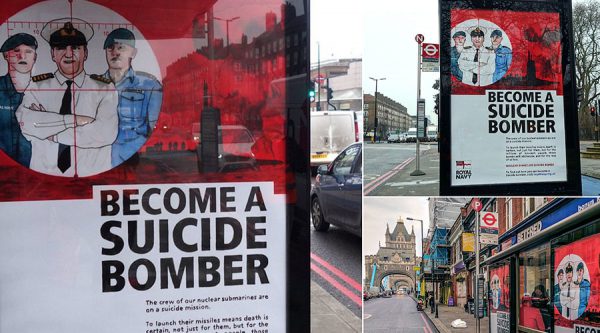
Spoof Royal Navy recruitment posters, which claim sailors on board Britain’s nuclear submarines are effectively suicide bombers, have won the approval of Trident safety and security whistleblower William McNeilly.
The posters point out that if a Trident submarine actually launched its nuclear missiles it would very likely be destroyed in a counterattack.
This, they claim, makes nuclear submariners little more than suicide bombers, whose job is to kill millions of civilians.
The satirical posters have appeared at bus stops across London.
The campaign is the brainchild of artist Darren Cullen, whose past works have included the ‘Action Man: Battlefield Casualties’ series and ‘Pocket Money Loans.’
His work has the endorsement of Veterans for Peace UK.
Picking up on the campaign on Friday, Rupert Murdoch-owned tabloid the Sun said the posters had sparked “fury.”
However, former Royal Navy weapons engineer William McNeilly, who was kicked out of the Navy after handing WikiLeaks a dossier of serious security and safety failures in 2015, told RT the campaign’s message is accurate.
“The Sun claims that the message in the posters is ‘fake,’” McNeilly told RT on Friday. “It is well known on board nuclear submarines that the Trident submarine on patrol will be the prime target in a nuclear war.”
The former submariner pointed out that once a submarine starts launching missiles it becomes immediately detectable. Those on board know “it is extremely unlikely that they would survive a major war against Russia. They are ready and prepared to be suicide bombers.”
Referring to the recent allegations of a government cover-up of a failed nuclear launch in 2016, McNeilly said: “Judging by the last missile test, it is not unlikely that the Trident submarines would nuke the United States by accident.”
Read more:
Trident whistleblower tells RT he ‘witnessed 4 unreported missile test failures’
Japan’s Okinawa governor hits out at US bases during Washington visit
RT | February 3, 2017
The governor of Okinawa has used a trip to Washington to reiterate his opposition to the heavy presence of US military bases on the island, urging all Japanese citizens to rethink security arrangements between Tokyo and Washington.
Outspoken Governor Takeshi Onaga arrived in the US earlier this week, holding a press conference to convey his discontent with the high number of US military bases in Okinawa, which hosts 74 percent of Japan’s total US military presence.
“I think all Japanese citizens should think about the Japan-US security arrangements. US military bases occupy 6 percent of the whole of Japan and 70 percent of those US military bases are in places where the population density is about the same as Tokyo. I don’t like it anymore…” he said in response to a question from RT’s Gayane Chichakyan at a press conference.
He went on to cite jet crashes related to the US bases, as well as sexual assaults which have been linked to US soldiers since World War II.
Onaga and citizens of Okinawa have long protested the heavy presence of US military bases and troops on the island, with mass demonstrations drawing thousands last year.
Of particular concern is the planned relocation of the US Marine Corps Futenma Air Station from Ginowan to the less-populated area of Henoko, in Nago.
Onaga is against the relocation, stating it would destroy the environment of the bay surrounding the new site.
In December, the governor was defeated in a lawsuit filed by the central government regarding the air station, with Japan’s Supreme Court finding that it was illegal for Onaga to revoke the approval granted by his predecessor, Hirokazu Nakaima, for land reclamation required to build replacement runways at the new base.
But Okinawans could soon see their hopes answered, if President Donald Trump follows through with a campaign statement in which he said that he wants foreign nations to pay for US presence and protection in those countries.
Instead of seeing Trump’s statement as a threat, Okinawa policy adviser Moritake Tomikawa said a withdrawal of US troops would suit Okinawans just fine.
“Mr. Trump says if Japan doesn’t pay more than he’s going to withdraw the troops from Japan. As far as Okinawa people are concerned, that’s fine…” he said.
It is unclear, however, where Trump stands on the specific Okinawa issue. The new defense secretary, James Mattis, is currently in Japan, though his views on the issue also remain unclear.
Japan spends an estimated $1.5 billion a year on the US bases, while Washington dished out around $5.5 billion in 2016, according to the Pentagon.
VIDEO:
READ MORE:
US senators seek additional sanctions against Iran
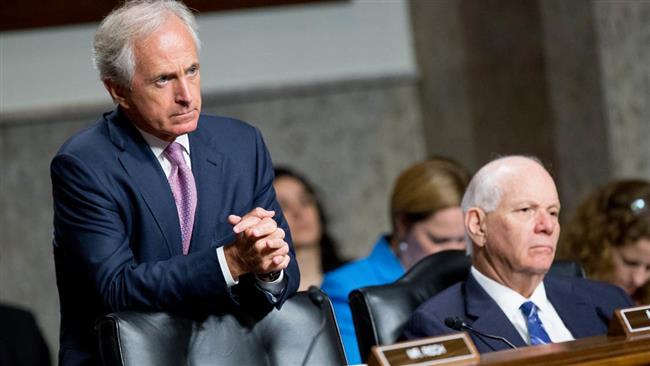
US Republican Senator Bob Corker (left) and Democratic Senator Ben Cardin in the US Senate (file photo)
Press TV – February 3, 2017
A number of US senators have backed additional sanctions against Iran over the country’s missile program, arguing that Tehran “must feel sufficient pressure.”
Twenty-two senators, including Bob Corker (Republican from Tennessee) and Ben Cardin (senior Democrat from Maryland) pronounced their support in a letter they sent to US President Donald Trump on Thursday. Corker is the chairman of the US Senate Committee on Foreign Relations.
“Full enforcement of existing sanctions and the imposition of additional sanctions on Iran for its ballistic missile program are necessary,” the senators wrote.
They added that “we look forward to supporting your Administration’s efforts to hold Iran accountable.”
The Reuters news agency reported on Thursday that the Trump administration is expected to announce new sanctions against Iran on Friday to ratchet up pressure on the Islamic Republic.
This is while the US president said on Thursday that “nothing is off the table” in terms of a response to Iran’s latest ballistic missile test.
Hours earlier, Trump said the White House has formally put Tehran on notice over its recent ballistic missile test.
“Iran has been formally PUT ON NOTICE for firing a ballistic missile. Should have been thankful for the terrible deal the U.S. made with them!” Trump tweeted, echoing his national security adviser’s comments a day earlier.
‘Iran Non-Nuclear Sanctions Act of 2017’
Also on Thursday, a group of Republicans in the US House of Representatives introduced a bill for new sanctions on Iran as the Trump administration is mulling anti-Iran measures.
The measure, called the Iran Non-Nuclear Sanctions Act of 2017, seeks sanctions against Tehran for “supporting terrorism, abusing human rights, and testing ballistic missiles.”
It was presented by New York Representative Lee Zeldin, Illinois Representative Peter Roskam, New Jersey Representative Leonard Lance and Colorado Representative Doug Lamborn.
The proposed legislation comes after US House Speaker Paul Ryan said he would support imposing additional sanctions on Iran over its recent missile test.
“I would be in favor of additional sanctions on Iran,” Ryan told reporters on Thursday at a weekly press conference.
“We need to have a tough-on-Iran policy … We should stop appeasing Iran,” he said.
Washington has said Sunday’s ballistic missile test was in violation of the 2015 nuclear deal between Iran and the P5+1 group of countries.
Tehran insists its missile tests do not breach any UN resolution because they are solely for defense purposes and not designed to carry nuclear warheads.
Arms control experts have also said that Iran’s missile tests are not banned under the nuclear agreement and the Security Council resolution, because Iran’s missiles are not meant to deliver nuclear warheads.
Resolution 2231 calls on Iran “not to undertake any activity related to ballistic missiles designed to be capable of delivering nuclear weapons, including launches using such ballistic missile technology.”
Iran sanctions: US Treasury lists 13 individuals, 12 business entities
RT | February 3, 2017
The US government has blacklisted 13 individuals and a dozen businesses under the Iran sanctions authority, a day after President Donald Trump’s administration threatened a response over Tehran’s ballistic missile tests.
The Treasury Department posted a listing on Friday, naming the individuals and the companies added to the sanctions list. Eight of the individuals are listed as Iranian citizens, three appear to be Chinese, and two Arab.
Most of the businesses listed in the announcement are based in Iran, though one of the entities is located in the United Arab Emirates, two are in China, and three are in Lebanon.
“Today’s action is part of Treasury’s ongoing efforts to counter Iranian malign activity abroad,” said John E. Smith, acting director of the Treasury Department’s Office of Foreign Assets Control.
“Iran’s continued support for terrorism and development of its ballistic missile program poses a threat to the region, to our partners worldwide, and to the United States,” Smith said. “We will continue to actively apply all available tools, including financial sanctions, to address this behavior.”
Meanwhile, the guided missile destroyer USS Cole arrived in the waters off the coast of Yemen on Friday, where it will conduct patrols to “protect waterways” from the Houthi rebels, unnamed US officials told reporters.
“Iran is unmoved by threats as we derive security from our people,” Iran’s foreign minister Mohammad Javad Zarif said ahead of the announcement. “We will never use our weapons against anyone, except in self-defense,” he added later.
Featured Video
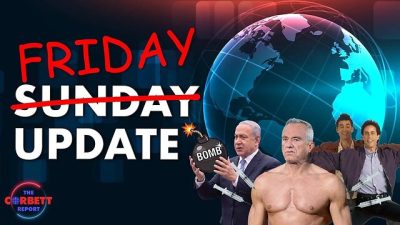
Racist Seinfeld Dances for Joy as Bibi Unveils His New Map
or go to
Aletho News Archives – Video-Images
TV Drama Review
Japanese drama projects Japan’s wartime atrocities onto Chinese characters

Global Times | October 25, 2026
By portraying Chinese characters as perpetrators of ruthless violence while casting Japanese Self-Defense Forces (SDF) intelligence operatives as defenders, the season 2 of the Japanese drama Vivant has recently drawn criticism from Chinese netizens, who argue that its depiction turns historical reality on its head while ignoring Japan’s wartime atrocities.
The TBS drama series – a spy suspense story in which an alleged unofficial intelligence unit of the SDF operates across the globe — has attracted a passionate fanbase. Its currently airing season 2 opened with a household rating of 18.8 percent, the highest for a TV drama this year, according toa commentary article by Japanese media Toyo Keizai.
What draws attention is the portrayal of the enemies in the series, the article noted. Scenes in which the Chinese organization subjects kidnapped members of the SDF unit to brutal torture are repeated with unrelenting intensity.
It is rare for Japanese TV dramas to explicitly portray a real-life country as the enemy, the article noted.
Japanese Prime Minister Sanae Takaichi also made a reference to the drama, saying that she has been recording Vivant and hopes to binge-watch it over the year-end and New Year holidays, according to Japanese media outlets.
China’s CCTV News report on Sunday revealed that the drama features scenes in which Chinese personnel cut off the fingers of and stab Japanese intelligence operatives in the abdomen. Such acts bear striking similarities to the torture inflicted on Chinese nationals by invading Japanese troops during the World War II.
The drama distorts the truth by attributing these atrocities to modern Chinese characters. Beneath the surface, it subtly glorifies Japan’s cross-border overseas operations, blurs the functional boundaries of the SDF and implicitly promotes an expansionist narrative, per CCTV News. … continue
Blog Roll
 Aletho News
- EU facing trillion-euro debt hole while seeking more cash for Kiev
- How US, Europe, Persian Gulf states exhausted missile stockpiles, splurged billions to defend Israel
- Up in arms… Koreans reject U.S. empire’s plan to make South Korea the next Ukraine
- Iran, Turkey, Pakistan, Saudi Arabia could advance region-led security framework in Tehran: FM spox
- Netizens condemn Japanese drama for projecting Japan’s wartime atrocities onto Chinese characters
- Racist Seinfeld Dances for Joy as Bibi Unveils His New Map
- A West Bank War for Netanyahu’s Election Campaign, Could It Backfire?
- Yemen denounces European Parliament’s ‘hypocritical’ push to blacklist Ansarullah
- Qalibaf: UAE’s UN bid aims to ‘clear the runway’ for ‘Greater Israel’, whitewash genocide
- Pakistan reopens Iran border after boosting security: Report
- If Americans Knew
- Why Israel’s latest assault on Hebron is so significant for the West Bank
- Israel Used “Where’s Daddy?” AI to Relentlessly Murder Palestinian Journalists and Their Families in Their Homes from October to December 2023
- DAILY UPDATE: Latest essential news on Palestine, Israel, & region
- Netanyahu Says Israel Must Prepare for Banking Sanctions, Floats Crypto as a Possible Bypass
- Latest updates from Israeli assault on West Bank
- Tourism Ministry launches free food truck tour in US
- “So Much Worse Than People Realize”: Never-Before-Seen Images Reveal Damage at U.S. Bases as Troops Describe Being Abandoned
- UK Bell Review Confirms Only Anti-Israel Attitudes Are Rising, Not Antisemitism
- DAILY UPDATE: Latest essential news on Palestine, Israel, & region
- DAILY UPDATE: Latest essential news on Palestine, Israel, & region
- No Tricks Zone
- Sudden Stratospheric Warming, Powerful El Niño Combination May Lead To Extreme Europe Cold, Energy Crisis!
- Two New Studies Find Thwaites Glacier Melt Cannot Be Driven By Human Activity Or A Warming Ocean
- E-Cars Reduce CO2 Emissions By Only 41% Compared To Internal Combustion Engine Vehicles
- Predictions Made By Renowned Climate Professor Over Past Decades Have Been Proven To Be Poor
- New Study Suggests Large Regions Of The Pacific Ocean Have Been Cooling For The Last 80 Years
- Germany’s Green Energy Debacle: High Energy Costs Force Kahla Porzellan to Close After 182 Years!
- New Study: 50 Years Of The Most Aggressive ‘Net Zero’ Policies Can Only Affect The Global Climate By 0.03°C
- US September “Heat” Was No Record…Many Records Set Decades Ago
- Latest European Green Energy Debacle; Portugal’s Largest Flagship Solar Park Insolvent!
- Green Energy Debacle: German Expert Professor Fritz Vahrenholt Warns Of Severe Economic And Social Consequences

