US military buildup around Russia meant to bankrupt Moscow: Petras
Press TV – January 2, 2016
The United States is attempting to bankrupt Russia’s economy by encircling it through military buildup, an American writer and political commentator says.
James Petras, a professor emeritus of sociology at Binghamton University in Binghamton, New York, and adjunct professor at Saint Mary’s University in Halifax, Nova Scotia in Canada, made the remarks in a phone interview with Press TV on Monday.
According to a report, US commandos maintain a “persistent” presence in the Baltic states to bolster the training and resolve of troops of the NATO allies anxious about “a looming threat from Russia.”
Dozens of US Special Operations forces have “quietly” been deployed to boost the tiny militaries of Latvia, Lithuania and Estonia, and help the US detect any “shadowy efforts” by Moscow to destabilize the former Soviet republics, The New York Times reported on Saturday.
“I think this is part of a global campaign against Russia,” Professor Petras said. “I think it’s an offensive campaign led by Washington which is directed to encircling and undermining Russia through military buildup that they hope would bankrupt Russia’s spending if they try to keep up with it.”
In addition, the analyst said the Obama administration is “trying to put in place a military forward shield against Russia to undermine any reconciliation between incoming President Trump and President [Vladimir] Putin.”
“So I think this has nothing to do with defense, it has everything to do with building American presence around Russia,” the commentator sated.
“The equivalent of this would be if Russia decides to build bases in Mexico, and Canada and the Caribbean, which of course Russia does not do,” he added.
“But this is clearly an offensive, not a defensive means. It has all the earmarks of an attempt to foster a belligerent relationship with Russia. And I don’t think anyone takes seriously the defensive rhetoric that accompanies it,” Professor Petras concluded.
According to US media, the Baltic nations are concerned that incoming Republican President Donald Trump’s warmer tone toward Russia might encourage Putin to want to assert control across the whole region.
Trump, who has repeatedly signaled willingness to mend ties with Putin, suggested during the election campaign that the US would only protect NATO allies that paid their fair share to the military alliance.
Good News: Washington Frozen Out of Syria Peace Plan
By Ron Paul | January 2, 2017
As the US mainstream media obsessed last week about Russia’s supposed “hacking” of the US elections and President Obama’s final round of Russia sanctions in response, something very important was taking place under the media radar. As a result of a meeting between foreign ministers of Russia, Iran, and Turkey last month, a ceasefire in Syria has been worked out and is being implemented. So far it appears to be holding, and after nearly six years of horrible warfare the people of Syria are finally facing the possibility of rebuilding their lives.
What is so important about this particular ceasefire? It was planned, agreed to, and implemented without the participation of the United States Government.
In fact it was frustration with Washington’s refusal to separate its “moderates” from terrorist groups and its continued insistence on regime change for the Syrian government that led the three countries to pursue a solution on their own for Syria. They also included the Syrian government and much of the opposition in the agreement, which the US government has been unwilling to do.
We have been told all along by the neocons and “humanitarian interventionists” that the United States must take a central role in every world crisis or nothing will ever be solved. We are the “indispensable nation,” they say, and without our involvement the world will collapse. Our credibility is on the line, they claim, and if we don’t step up no one will. All this is untrue, as we have seen last week.
The fact is, it is often US involvement in “solving” these crises that actually perpetuates them. Consider the 60-plus year state of war between North and South Korea. Has US intervention done anything to solve the problem? How about our decades of meddling in the Israel-Palestine dispute? Are we any closer to peace between the Israelis and Palestinians despite the billions we have spent bribing and interfering?
Non-intervention in the affairs of others does not damage US credibility overseas. It is US meddling, bombing, droning, and regime-changing that damages our credibility overseas. US obstruction in Syria kept the war going. As the Syrians and Russians were liberating east Aleppo from its four year siege by al-Qaeda, the Obama Administration was demanding a ceasefire. As Syrians began to move back into their homes in east Aleppo, the State Department continued to tell us that the Russians and Syrian government were slaughtering civilians for the fun of it.
So why all the media attention on unproven accusations of Russian hacking and President Obama’s predictable, yet meaningless response? The mainstream media does the bidding of Washington’s interventionists and they are desperate to divert attention from what may prove to be the beginning of the end of Syria’s long nightmare. They don’t want Americans to know that the rest of the world can solve its own problems without the US global policemen in the center of the action. When it is finally understood that we don’t need to be involved for crises to be solved overseas, the neocons will lose. Let’s hope that happens soon!
Hamas lauds cessation of hostilities in war-torn Syria
Palestine Information Center – December 30, 2016
GAZA – Hamas on Friday lauded the ceasefire accord struck between the warring parties in embattled Syria, calling for boosting political solutions to the conflict.
“We’ve been keeping tabs with deep satisfaction on agreements to cease fire in Syria,” said Hamas.
“Hamas welcomes the ceasefire and calls for a political solution to the Syrian crisis,” a statement by the group read.
“The Syrians can well avoid more bloodshed, uphold territorial integrity, and preserve their rights and sovereignty over the land. Such a bloody page should be turned once and for all,” Hamas added.
“The Palestinian people is looking forward to reaching a long-term agreement and to healing all the differences plaguing the nation’s body. The Palestinians are longing for an end to bloodshed,” Hamas further stated.
“The Palestinians hope that our ill nation would get well soon, restore its strength and unity, and stand up for the Palestinian cause,” the group concluded.
War-ravaged Syria was living Friday through the first day of a nationwide ceasefire as the Syrian government battalions and opposition outfits have agreed to terms for a truce brokered by Turkey and Russia in the country’s long-running hostilities.
Military operations by the regime army were reportedly halted at midnight, except against ISIS and other terror groups, state-run news agency SANA reported.
Summing Up Russia’s Real Nuclear Fears
By Jonathan Marshall | Consortium News | December 29, 2016
The conflicts between Washington and Moscow keep on growing: Ukraine and Syria, rival war games, “hybrid” wars and “cyber-wars.” Talk of a new Cold War doesn’t do justice to the stakes.
“My bottom line is that the likelihood of a nuclear catastrophe today is greater than it was during the Cold War,” declares former U.S. Secretary of Defense William Perry.
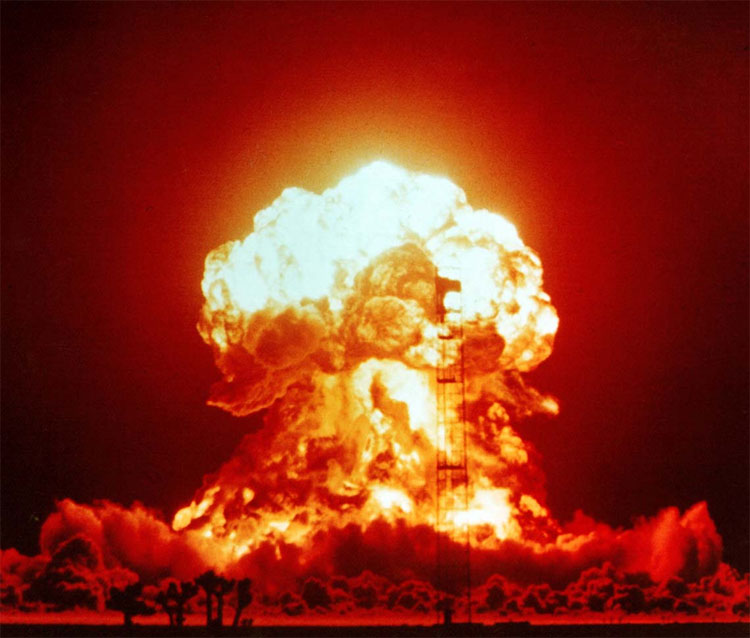
Nuclear test detonation in Nevada on April 18, 1953
If a new Trump administration wants to peacefully reset relations with Russia, there’s no better way to start than by canceling the deployment of costly new ballistic missile defense systems in Eastern Europe. One such system went live in Romania this May; another is slated to go live in Poland in 2018. Few U.S. actions have riled President Putin as much as this threat to erode Russia’s nuclear deterrent.
Only last month, at a meeting in Sochi with Russian military leaders to discuss advanced new weapons technology, Putin vowed, “We will continue to do all we need to ensure the strategic balance of forces. We view any attempts to change or dismantle it, as extremely dangerous. Our task is to effectively neutralize any military threats to Russia’s security, including those posed by the newly-deployed strategic missile defense systems.”
Putin accused unnamed countries — obviously led by the United States — of “nullifying” international agreements on missile defense “in an effort to gain unilateral advantages.”
Moscow has reacted to this perceived threat with more than mere words. It is developing new and deadlier nuclear missiles, including the SS-30, to counter U.S. defenses. It has rebuffed new arms control negotiations. And it has provocatively stationed nuclear-capable Iskander missiles in the Russian enclave of Kaliningrad to “target . . . the facilities that . . . start posing a threat to us,” as Putin put it last month.
If a new arms race is underway, it’s not for lack of warning. The Russians have voiced their concerns about missile defenses for years and years, without any serious acknowledgment from Washington. From their vantage point, the apparent bad faith of successive U.S. administrations, Democratic as well as Republican, is a flashing red light to which they had to respond.
Russia’s Nightmare
From the earliest days of President Reagan’s Strategic Defense (“Star Wars”) Initiative to make ballistic missiles “impotent and obsolete,” an alarmed Moscow has viewed U.S. efforts to build a missile shield as a long-term threat to their nuclear deterrent.
In 2002, President Bush one-upped Reagan and unilaterally canceled the Anti-Ballistic Missile Treaty of 1972. He did so after Russia’s foreign minister, Igor Ivanov, publicly pleaded with Washington not to terminate this landmark arms control agreement.
Writing in Foreign Affairs magazine, Ivanov warned that such a move would set back recent progress in Russian-U.S. relations and destroy “30 years of efforts by the world community” to reduce the danger of nuclear war. Russia would be forced, against its desire for international cooperation, to build up its own forces in response. The arms race would be back in full force — leaving the United States less secure, not more.
But with Russia still reeling from the neoliberal “shock therapy” that it suffered through during the 1990s, the neoconservatives (then in charge of U.S foreign policy) were confident of winning such an arms race. In 2002, President Bush adopted a National Security Strategy that explicitly called for U.S military superiority over every other power. To that end, he called on the Pentagon to develop a ground-based missile defense system within two years.
Since then, that program has lined the pockets of major U.S. military contractors without achieving any notable successes. Critics – including the U.S. General Accountability Office, National Academy of Sciences and Union of Concerned Scientists – have blasted the program for failing more than half of its operational tests. Today, after the expenditure of more than $40 billion, it enjoys bipartisan support mainly as a jobs program.
Russia fears, however, that it’s only a matter of time before the U.S. perfects its missile shield technology enough to erode the deterrent capabilities of Moscow’s nuclear arsenal.
Promoting U.S. Nuclear Primacy
That specter was highlighted in 2006 when two U.S. strategic arms experts declared in the pages of the establishment-oriented Foreign Affairs that the age of nuclear deterrence “is nearing an end. Today, for the first time in almost 50 years, the United States stands on the verge of attaining nuclear primacy. It will probably soon be possible for the United States to destroy the long-range nuclear arsenals of Russia or China with a first strike. . . . Unless they reverse course rapidly, Russia’s vulnerability will only increase over time.”
The authors, Keir A. Lieber and Daryl G. Press, added, “Washington’s pursuit of nuclear primacy helps explain its missile defense strategy.” Missile defense, they pointed out, is not the same as population defense. No conceivable defense could truly protect American cities against an all-out attack by Russia, or even China. Rather, a leaky shield “would be valuable primarily in an offensive context, not a defensive one — as an adjunct to a U.S. first-strike capability, not as a standalone shield.”
“If the United States launched a nuclear attack against Russia (or China),” they explained, “the targeted country would be left with a tiny surviving arsenal — if any at all. At that point, even a relatively modest or inefficient missile-defense system might well be enough to protect against any retaliatory strikes, because the devastated enemy would have so few warheads and decoys left.”
As if to make that scenario a reality, the Bush administration soon announced plans to install an anti-missile base in Poland and a radar control center in the Czech Republic — ostensibly to counter a nuclear threat from Iran. No matter that Iran had neither nuclear weapons nor long-range ballistic missiles — or that Washington had rebuffed Russia’s offer to cooperate on building missile defenses closer to Iran. No, Moscow was supposed to believe President Bush’s assurance that “Russia is not the enemy.”
Republican hawks in Congress didn’t get the message. Said Rep. Trent Franks of Arizona, “This is not just about missile defense; this is about demonstrating to Russia that America is still a nation of resolve . . . and we’re not going to let Russian expansionism intimidate everyone.”
Yet when Russian officials reacted with alarm, and warned of the potential for a “new Cold War,” American news accounts accused them of being “bellicose.”
Obama Blows Up the Reset Button
Taking office in 2009, President Obama promised a new era of nuclear sanity. Again, the Russians pleaded for an end to the missile defense program in Eastern Europe. Privately, they expressed a new and genuine concern — that a future U.S. administration could secretly fit interceptor rockets with nuclear warheads and use them to “decapitate” Russia’s top leadership with “virtually no warning time.” Russia’s response: retaliate at the first sign of an incoming strike, without hesitating to check if it’s a false alarm.
Obama and his team didn’t heed the warnings. Instead, they snubbed Putin — and the entire Russian leadership — by marching ahead with the missile shield deployment in Eastern Europe, still insulting Moscow’s intelligence with the pretense that it was a defense against Iran.
Obama’s “reset button” was the first casualty of his nuclear policy. In 2011, a despairing President Dmitry Medvedev warned that Russia would have no choice but to respond exactly as Putin has done, by upgrading the offensive capabilities of Russian nuclear missiles and deploying Iskander missiles in Kaliningrad. Still to come may be a Russian withdrawal from the New START treaty, which Secretary of State Hillary Clinton claimed as her greatest accomplishment in the field of arms control.
President Obama never intended to expand his limited missile defense program into an existential threat to Russia’s nuclear deterrent, but he opened that door. Exactly as Moscow has long feared, hawks in Congress now are chomping at the bit to spend what it takes to build an all-out missile defense system, which former Defense Secretary Robert Gates warned would be “enormously destabilizing not to mention unbelievably expensive.”
One 2003 study pegged the possible cost of a full defensive shield covering the United States at more than $1 trillion. But that’s a small price compared to what could happen if a jittery Russian military command, armed to the teeth with nuclear missiles set on hair-trigger alert to counter a successful U.S. first strike, receives a false warning of just such an attack. Such a scenario has happened more than once.
One of these days such a mistake may prompt an all-out Russian nuclear launch — and then, not even a full missile defense will spare the United States, and much of the world, from devastation.
US Navy orders 214 Tomahawk cruise missiles worth $303 million
Press TV – December 29, 2016
The US Navy has put in a $303 million order for 214 Tomahawk cruise missiles and spares, a major contract that is likely to draw more fire over the force’s extravagant policies over the past years.
The contract for the long-range nuclear-capable Tomahawk Block IV missiles was granted to Raytheon, a major Pentagon contractor, UPI reported Thursday.
While the missiles will be chiefly used by the Navy, some of them would be sent to the UK as a foreign military sale.
The project is expected to finish by August 2018, according to the Pentagon, and the production work will be carried out in a variety of factories in Arizona, Michigan, Arkansas and other states.
Block IV is Tomahawk’s latest iteration and packs a two-way satellite data-link, which allows operators to reprogram the missile and change its target midflight.
Raytheon is also working with the Navy to enhance the missile’s capabilities by fitting in more powerful warheads, a targeting system for moving objects and better communication systems.
The order came at a time when the Navy was under heavy criticism for the failure of USS Zumwalt, one the most expensive American warships.
The $4.4 billion guided missile destroyer broke down while it was crossing the Panama Canal in late November.
Debuted in May, the futuristic-looking ship introduced a new class of warships that the Pentagon boasted were going to be the most advanced vessels ever built.
According to the General Accounting Office (GAO), the program is expected to cost more than $22 billion.
The force has also faced backlash over its other extravagant projects such as the USS Gerald Ford aircraft carrier, which is projected to cost around $13 billion.
This is while, according to Under Secretary of Defense Frank Kendall, the new technologies fitted into the aircraft carrier are likely to fail to perform as promised.
The Tomahawk deal with the UK cements Washington’s standing as the top weapons merchant in the world. The US raked in around $40 billion from arms sales in 2015.
Back to ‘Star Wars’: Obama Signs FY2017 Defense Bill
By Peter KORZUN | Strategic Culture Foundation | 29.12.2016
As the entire system of arms control is eroding, a war in the orbit appears to be a not so distant future. The US has just taken a big step forward to unleash an arms race in space.
On December 23, President Obama signed the National Defense Authorization Act – the legislation to re-launch the «Star Wars». The national ballistic missile defense (BMD) is to enter a new phase as the commander-in-chief struck the word «limited» from the description of the concept and the mission. The BMD has become «unlimited» now to greatly complicate the international security agenda and heighten tensions with Russia and China. The new law calls for the Defense Department to start «research, development, test and evaluation» of space-based systems for missile defense.
The efforts are to focus on the acquisition of technology to defeat both small-scale and large-scale nuclear attacks and unsettle the strategic balance in US favor.
According to Los Angeles Times, «the provisions signal that the US will seek to use advanced technology to defeat both small-scale and large-scale nuclear attacks. That could unsettle the decades-old balance of power among the major nuclear states». Rep. Trent Franks (R-Ariz.), who introduced and shepherded the policy changes in the House, said, «I hope that the day will come when we could have solid-state lasers in space that can defeat any missile attack». Welcome back to «Star Wars» of the eighties!
Philip E. Coyle III, a former assistant secretary of Defense who headed the Pentagon office responsible for testing and evaluating weapon systems, described the idea of a space-based nuclear shield as «a sham». «To do this would cost just gazillions and gazillions», Coyle said. «The technology isn’t at hand — nor is the money. It’s unfortunate from my point of view that the Congress doesn’t see that».
It should be noted that as a candidate, Barack Obama called ballistic missile defense plans «unproven» and vowed to cut them! The decision to re-launch the «Star Wars» is at odds with the opinion of many experts in the field. For instance, the 2016 report by the Union of Concerned Scientists (UCS), says the US missile defense program is costly, unreliable, and exempt from oversight. «Despite more than a decade of development and a bill of $40 billion, the GMD system is simply unable to protect the U.S. public», the authors wrote.
«The missile defense system is one of the most expensive and complex military systems in history, yet it is the only major defense program not subject to standard ‘fly before you buy’ performance standards», said UCS Senior Scientist Laura Grego, the report’s lead author. «Fifteen years of this misguided, hands-off approach has resulted in a costly system that won’t protect the homeland».
But defense contractors will get great profits. Three of them — Boeing Co., Raytheon Co. and Northrop Grumman — donated a total of $40.5 million to congressional campaign funds from 2003 through October of this year, according to federal election records.
The BMD efforts have never stopped. The US deploys powerful sea and shore-based Aegis air-defense systems that, with accurate guidance, could reach into orbit to destroy enemy spacecraft. The US Missile Defense Agency (MDA) is to reboot the concept of Airborne Laser by building a laser-armed aircraft that can shoot down ballistic missiles after launch – the time they are the most vulnerable.
The United States continues to invest in programs that could provide anti-satellite and space-based weapons capabilities. The US Air Force’s unmanned X-37B space plane has flown secret missions to Earth orbit, carrying a mystery payload. The spacecraft is a maneuverable, reusable, space test platform which boosts into low orbit – around 250 miles high – atop a rocket but lands back on Earth like an airplane. According to Dave Webb, chairman of the Global Network Against Weapons Nuclear Power in Space, the X-37B «is part of the Pentagon’s effort to develop the capability to strike anywhere in the world with a conventional warhead in less than an hour», known as the Prompt Global Strike.
America is funding the development of the Spaceborne Payload Assist Rocket-Kauai (SPARK) launch system, designed to send miniaturized satellites into low-Earth and sun-synchronous orbits. Speedy replacement of disabled satellites in the event of attack is to secure the US military’s use of space constellations in support of operations during a conflict. In its efforts to rapidly launch swarms of miniaturized satellites on the cheap, the US military is also looking to leverage the private sector.
The reusable recovery of a SpaceX’s Falcon 9 has fundamentally changed the military balance of power and, perhaps inadvertently, launched the era of space militarization. According to Stratfor Global Intelligence (SGI), «the battle to militarize space has begun». The think tank believes that «as existing technologies proliferate and new developments provide greater access to space, Cold War frameworks for the peaceful sharing of Earth’s near orbit will erode».
Weapons of mass destruction are banned from space under the 1967 Outer Space Treaty. But the Treaty does not ban the placement of conventional weapons in orbit.
The potential arms race in space in an issue of major concern for the United Nations. In 2008, Russia and China proposed the first ever draft Treaty on the Prevention of the Placement of Weapons in Outer Space, the Threat or Use of Force against Outer Space Objects (PPWT). The initiative led nowhere being torpedoed by the United States.
In December 2015, The United Nations General Assembly adopted a Russia-led resolution calling for a nonbinding restriction against the first placement of weapons in outer space (also known as «no first placement initiative»). 129 nations, including China voted to adopt the measure. The only government objecting to the substance of our initiative was the United States. The EU abstained. According to Russian officials, the United States rejects the idea of holding talks with Russia on the problem.
By signing the bill into law, President Obama has ushered the world into an unfettered arms race, unsettling the balance of power among the major nuclear states. The implementation of the law will result in wasting a lot of money while the national debt is heading to $20 trillion.
The landmark change to the BMD policy, especially the plans to base weapons in space, will inevitably complicate the relationship with Russia at the time the entire system of arms control and non-proliferation is about to unravel. From now on, the US will always be perceived as a warmonger who launched an armed race in space and did away with the restrictions on BMD plans – the unsolved problem that obstructs any efforts to address the security agenda and gain positive results.
There will be no partition of Syria
By Sharmine Narwani | RT | December 29, 2016
East Aleppo is liberated, and regime-change has lost its luster. It’s no surprise Syria’s foes are ready to promote the next big goal: partition. Like most Syrian conflict predictions, of which few have materialized, the ‘partition’ of Syria is not going to happen.
In February, when East Aleppo was still bulging with Western-trained, Al Qaeda-allied militants, Syrian President Bashar Assad was asked the question: “Do you think that you can regain control over all Syrian territory?”
Well, yes, said Assad: “This is a goal we are seeking to achieve without any hesitation. It makes no sense for us to say that we will give up any part.”
Western politicians were having none of that.
First up was US Secretary of State John Kerry who coyly informed the Senate Foreign Relations Committee that the Obama administration may have a Plan B up its sleeve for Syria: “it may be too late to keep it as a whole Syria if we wait much longer.”
Next, James Stavridis, former NATO Supreme Commander and head of the US European Command penned an article for Foreign Policy entitled It’s time to seriously consider partitioning Syria where he claimed: “Syria as a nation is increasingly a fiction.”
Then, CIA Director John Brennan joined the chorus: “There’s been so much blood spilled, I don’t know if we’re going to be able to get back to [a unified Syria] in my lifetime.”
But now the stinging defeat of Western-backed militants in East Aleppo has turned up the dial on the idea of breaking up Syria. Frantic neocons and liberal interventionists are piling in on the ‘partition’ punditry – with nary a backward glance to their five failed years of “Assad will fall” prognostications.
But Assad understands something that Western analysts, journalists and politicians cannot seem to grasp. Syria’s allies in this war – Iran, Hezbollah, Iraq, Russia, China – have maintained only two hard red lines throughout the conflict:
The first is that Assad can only be removed from office in a national election, by a Syrian majority.
The second is that Syria must stay whole.
Their logic was simple. Regime-change, remapping of borders, mercenary proxy armies, divide-and-rule… the old tricks of Western hegemons needed to stop in Syria. Otherwise, they would aggressively find their way to Moscow, Beijing and Tehran.
In short, a new world order would need to emerge from the ashes of the Syrian conflict, and for that to happen, allies would need to thoroughly defeat NATO-GCC objectives and maintain the territorial integrity and sovereignty of the Syrian state at all costs.

A calculated shift in the balance of power
By 2013, one could already predict the formation of a new security-focused Mideast alliance to combat the jihadi threat raging in Syria and its neighborhood. (see map above)
It was clear by then that the irregular wars waged by jihadists and their powerful foreign backers were going to force four states – Lebanon, Syria, Iraq and Iran – to cooperate militarily and politically to defeat Wahhabi-influenced terror groups in their midst. A ‘Security Arc’ would thus form to protect the territorial integrity of these four countries, and with it, a converging worldview that would set the stage for a new Mideast security structure.
Today, Lebanon and Iran have secure borders flanking either side of Syria and Iraq. Fighters and military advisers, intelligence, weapons transfers from all four states are in play, with increased, successful coordination on the ground and in the skies.
Russia and China have provided ‘great power’ cover for this new development – whether at the UN Security Council or via military, financial or diplomatic initiatives. Furthermore, galvanized by the ferocity of the fight over Syria, Tehran, Moscow and Beijing have advanced the new multilateral order they seek – bolstering their own regional security, deepening global alliances, forging new ones, and crafting political, security and financial institutions to compete with Western-dominated ones.
As the Security Arc succeeded in beating back extremist groups, it would be necessary for three critical neighboring states to gravitate toward participation in this new regional security architecture – Egypt, Turkey and Jordan – each for different reasons.
But the new adherents would be drawn to the security zone primarily because of the realization that a weakened central government and the fragmentation of Syria would blow back into their states and create the same conditions there: chaos, instability, terrorism.
Egypt: Under the rule of President Abdel Fattah el-Sisi, Egypt has drawn away from its Saudi patrons who have, alongside Qatar and Turkey, been major sponsors of extremism in both Syria and Iraq. Earlier this year, Sisi began to pivot away from Egypt’s traditional Western and regional allies and opened the door to further political, military and economic engagement with Syria, Iran, Russia and China.
SAIS-Johns Hopkins University Fellow Dr. Christina Lin explains: “Unlike Washington, Sisi sees Assad as a secular bulwark against Islamic extremism in the Levant. If Assad falls, Lebanon and Jordan would be next, and Egypt does not want to end up like Libya with the Brotherhood and other Islamists carving up the country.”
In the past few months, Egypt has pursued a diplomatic thaw with Iran, military cooperation with Syria, and publicly squabbled with Saudi Arabia. Furthermore, Sisi has been invited to sit at the Syrian peacemaking table by Iran and Russia, while in the background, China launches plans for a $60 billion infrastructure investment in cash-strapped Egypt.
Turkey: No state has been a bigger thorn in Damascus’ side than Turkey – financier, enabler, and mastermind of the militancy flowing across its southern border into war-torn Syria. But the Syrian conflict has crippled and exhausted Turkey, in turn, unleashing terror attacks in its cities, reviving its ‘Kurdish’ conflict, isolating its unpredictable President Recep Tayyip Erdogan, squeezing its economy, and triggering widespread domestic political strife.
So when the Russians reportedly tipped off Erdogan to an ill-fated coup attempt this summer – which Turks believe to be US-inspired – the Turkish president’s political orientation began to waver, and he began to inch toward a series of compromises with Iran and Russia on the Syrian conflict.
Erdogan’s first grand gesture to Tehran and Moscow was to peel away a layer of militants from embattled Aleppo, allowing the Syrian-allied forces to focus their military might on the Al-Qaeda-affiliated groups remaining in the eastern enclave. In the aftermath of Aleppo’s liberation, the Turks, Iranians and Russians met again to hammer out their next set of objectives, including a nationwide ceasefire – a move that sidelined Erdogan’s Western allies and highlighted the fact that nobody actually needs the US, UK or France at the Syrian negotiating table.
Jordan: For much of the Syrian conflict, Jordan’s interests were subverted by powerful patrons who turned the Hashemite Kingdom into a covert operations hub for Western special forces, GCC intel operatives and ‘rebel’ training centers. But in recent years, Jordan’s King Abdullah has been forced to disentangle his financially-strapped country from the consequences created by a huge influx of Syrian refugees and a terrifying surge in domestic radicalism. Consequently, Jordan has been quietly sharing intelligence with Syrian authorities to weaken the militancy in southern Syria and has effectively shut down their shared border.
The king himself has been engaging in some frenzied shuttle diplomacy with Russia and China to gain investment and political relevance, so Jordan is well-positioned to follow the lead of its larger neighbors when the regional balance of power shifts decisively in Syria’s favor.
Victors map the future, not the vanquished
The liberation of East Aleppo from Al-Qaeda-allied militants is a significant turning point in the war against Syria. All the major population/infrastructure areas that define the north-to-south western side of the country are now primarily in government hands.
Moreover, East Aleppo’s liberation serves as an important launching pad to cut off the vital Turkey-to-Mosul corridor that has funneled fighters, supplies and weapons to ISIS for years. Syrian troops and their allies will now be able to move east of the city to the Euphrates to sever this Turkish-ISIS lifeline.
With western Syrian hubs secured and militants severely crippled in the south, only the north-eastern areas present a challenge – but those are areas largely occupied by ISIS, where the final battles will be waged to rout the terror group.
So, what exactly do Americans want to partition – and why?
Recent wars in Afghanistan, Iraq, Yemen and Libya demonstrate clearly that a weak central authority only creates a political and security vacuum that extremists rush in to occupy. US President-Elect Donald Trump has himself said he prefers the rule of strongmen, rather than the instability that prevails with regime-change conflicts.
Any partition of Syria would, therefore, benefit ISIS and Al-Qaeda primarily – and all the parties know this.
The Security Arc states and their allies can ably eradicate the terrorism in their midst. Turkey and the United States still remain key irritants, each still vying, against their own security interests, to lay claim to north-eastern swathes of territory that hold some strategic interest.
Funnily enough, these interests pit the two NATO allies against each other. The US’ ‘Kurdish project’ has sent Erdogan fleeing toward the Iranians and Russians for help. It is ironic indeed that the West’s longtime efforts to sow discord between regional actors, sects, and ethnicities could now be reversed in one fell swoop by the US’ support for Kurdish nationalism. There is nothing more guaranteed to create common cause between Arabs, Iranians, and Turks than the unifying prospect of Kurdish statehood. Not even ISIS does that.
In the aftermath of the Aleppo victory, Assad once more addressed talk of partition: “This is the Western – with some regional countries – hope… If you look at the society today, the Syrian society is more unified than before the war… There’s no way that Syrians would accept that – I’m talking now about the vast majority of the Syrians… After nearly six years I can tell you the majority of the Syrians wouldn’t accept anything related to disintegration – on the contrary, as one Syria.”
He is right. For the more than 70 percent of Syrians living in government-controlled areas, the appetite for further conflict is nonexistent – and that’s what partition would mean: conflict. Furthermore, not just Syrians, but the whole of the Security Arc and their global allies are now hell bent on protecting themselves by destroying the terrorism that dwells in the remaining pockets of occupied territory. Like Assad – and much of Europe today – they know that you will never remove the security threat if you don’t rout them all and preserve the state.
In this security context, partition is out of the question. In the military context, a forced partition would require the commitment of troops stronger than the armies of Syria, Iran, Russia, Iraq, Egypt and Hezbollah combined – and that doesn’t exist. In the political context, the international appetite for an ‘imposed’ partition is nil.
So no, there will be no partition of Syria.
Sharmine Narwani is a commentator and analyst of Middle East geopolitics. She is a former senior associate at St. Antony’s College, Oxford University and has a master’s degree in International Relations from Columbia University. You can follow her on Twitter at @snarwani
Syrian army announces halt to fighting by midnight
Press TV – December 29, 2016
The Syrian military has announced a nationwide halt to fighting starting at midnight, in a move that could promote the diplomatic efforts aimed at ending years of Takfiri violence in the Arab state.
In a statement carried by Syrian state news agency SANA, the Syrian army said the ceasefire, will come into effect at 0000 GMT on December 30, does not include the Takfiri Daesh and Fateh al-Sham terror groups as well as their affiliates.
“The Army and the Armed Forces General Command on Thursday declared a comprehensive cessation of hostilities across all the territories of the Syrian Arab Republic starting at 00:00 on 30/12/2016 in the wake of the victories and advances achieved by the Syrian armed forces on more than a front,” read the statement.
“The ceasefire comes with the aim of creating suitable circumstances for supporting the political track of the crisis in Syria,” it added.
Earlier, Russian President Vladimir Putin said Damascus and foreign-backed militant groups had reached a truce deal brokered by Moscow and Ankara.
Putin said the agreement would be followed by peace talks between the government of Syrian President Bashar Assad and the foreign-backed opposition.
The Russian president also announced Moscow is set to scale down its military presence in Syria following the cessation of hostilities.
“I agree with the proposal from the Defense Ministry for the reduction of our military presence in Syria,” Putin said in televised comments.
Moscow will continue supporting Assad and “fighting international terrorism in Syria,” he said, adding that the Russian military will maintain its presence at an air base in Syria’s Latakia Province and the naval facility in the port city of Tartus.
The Russian head of state also said the agreement is the result of joint efforts by Russia, Turkey and Iran.
“We know that only recently there was a trilateral meeting in Moscow of the foreign ministers of Russia, Turkey, and Iran, where all of the nations made obligations not only to control, but also to act as guarantors of the peace process in Syria,” Putin said.
Putin further said he would contact his Iranian and Turkish counterparts to discuss further steps in the Syrian peace process.
Meanwhile, the so-called National Coalition, Syria’s main opposition bloc based in Turkey, said it backed the nationwide ceasefire.
“The National Coalition expresses support for the agreement and urges all parties to abide by it,” said the coalition spokesman, Ahmed Ramadan.
Separately, Turkey’s Foreign Ministry welcomed the truce, saying Ankara and Moscow will act as guarantors of the ceasefire in Syria.
“With this agreement, parties have agreed to cease all armed attacks, including aerial, and have promised not to expand the areas they control against each other,” the ministry said in a statement.
At the end of the December 20 trilateral meeting in Moscow, foreign ministers of Iran, Russia and Turkey issued a joint statement on the Syrian issue, in which they emphasized the need for expanding the Aleppo truce.
The three sides expressed “readiness to facilitate and become the guarantors of the prospective agreement being negotiated between the Syrian government and the opposition.”
The countrywide ceasefire came one week after the Syrian army announced full control over Aleppo when the last remaining militants were evacuated along with civilians from the eastern sector of city under a truce deal mediated by Ankara and Moscow.
Accidental torpedo launch & radioactive leaks ‘no nuclear safety significance,’ UK regulator says
RT | December 28, 2016
Britain’s nuclear regulator is under government investigation for reportedly dismissing several serious accidents as posing no safety risk.
The government launched the investigation after a report by the Times revealed the Office for Nuclear Regulation (ONR) has ignored serious mistakes at power plants and military bases, including the accidental discharge of a torpedo at a nuclear submarine base.
Experts accuse the regulator of being cozy with the nuclear industry and too reluctant “to frighten the horses.”
The Times reports officials at the Department for Work and Pensions (DWP), which is responsible for the ONR, are investigating the regulator following the newspaper’s disturbing revelations.
The ONR says all of its safety classifications follow international guidelines and insists it is a robust and independent regulator.
However, the rate of incidents deemed to be “of no nuclear safety significance” has increased to more than one per day over the past five years, raising questions as to how seriously the regulator is treating accidents.
Between 2012 and 2015, these incidents included at least 30 fires, a dozen leaks, three road accidents involving nuclear material, and the inadvertent discharge of a torpedo at Plymouth nuclear submarine docks.
Other serious incidents deemed to be of a no concern include the contamination of at least 15 workers with radioactive material and a complete power cut at a nuclear weapons base.
Dr David Toke, a reader in energy politics the University of Aberdeen, said the revelations indicated safety issues were a “low priority” for the ONR.
Nuclear expert Professor Stephen Thomas said the reports reinforced his suspicions that “the first priority for the ONR is not to frighten the horses.”
“Ironically, since they became an independent body rather than being part of the Health and Safety Executive [in 2014], they seem to have got worse,” Thomas told the Times.
“Independence is just a cheap and easy way for government to wash its hands of its rightful responsibility.”
The University of Greenwich academic added: “Independent regulators must be accountable to the public and if it is not through a democratically elected government, who is it through?”
Thomas said the ONR had previously ignored warnings about the safety of tending the lifespan of an old reactor design, the AGR, that is still in use in the UK, as well as the reliability of the newer EPR model reactor, which will be used at Hinkley Point C.
US-Qatar Deal Threatens Russia: Reading News Between the Lines
By Alex GORKA | Strategic Culture Foundation | 28.12.2016
Washington boasts strong military presence in the Persian Gulf. Iran and Yemen are the only countries of the region that don’t host US military facilities. The American armed forces use large air installations in Qatar and expand operations in the United Arab Emirates (UAE) and Oman. Bahrain is home to the US Navy’s Fifth Fleet. The US has encouraged the Gulf Cooperation Council (GCC) member states to purchase and install the Patriot Advanced Capability-3 (PAC-3) and the Terminal High Altitude Area Defense (THAAD) advanced missile defense systems.
The US and the GCC countries underscored a commitment to build the defense system at a summit in May 2015. Formally, the «Iranian threat» was used as a pretext. A joint statement following the summit said that the GCC states were committed to developing a ballistic missile defense capability, including an early warning system, with US technical support. The development of a robust integrated BMD network across the region is a primary goal for the US military. It guarantees that the GCC security will depend on the United States.
On December 10, Secretary Ashton Carter told an audience at the International Institute of Strategic Studies (IISS) regional security conference in Manama, Bahrain, that an agreement had been reached to allow Qatar to purchase a long range early warning radar (EWR) from Raytheon. «We reached an agreement for Qatar to purchase a 5,000 km [range] early warning radar to enhance its missile defenses», the official announced.
In July 2013, the Defense Security Cooperation Agency notified Congress of a possible Foreign Military Sale to Qatar of A/N FPS-132 Block 5 Early Warning Radar (EWR) and associated equipment, parts, training and logistical support for an estimated cost of $1.1 billion.
According to Raytheon, the AN/FPS-132 system is designed to detect missile launches that take place thousands of miles away to provide advanced warning time to alert command and control centers and cue fire control systems. ‘This highly reliable radar requires very low manning, yet will operate 365 days a year, 24 hours a day, providing up to 360 degrees of coverage out to 5,000km,’ said Steve Sparagna, chief engineer for the AN/FPS-132 EWR. ‘It is the ideal sensor to deter and detect hostile missile launches.’
According to Michael Elleman, a senior fellow for missile defence with the IISS, the system in future can provide not only Qatar but a unified GCC ballistic missile defence system an early warning capability against any Iranian ballistic missile launches.
The AN/FPS-132 to be based in Qatar is a very special case. It is designed to be used as an early warning system against strategic offensive assets – something Iran does not possess. For instance, the radars of this type are located in Beale Air Force Base, California, RAF Fylingdales, the United Kingdom, and Thule Air Base, Greenland to operate in the Ground-based Midcourse Defense (GMD) BMD system (BMDS). Following formal Missile Defense Agency (MDA) ground test events in FY17/18, Clear and Cape Cod upgraded EWRs (UEWR) are scheduled to be BMDS certified in FY18/19, respectively.
The announced range of 5,000km (3,100mi) by far exceeds the requirement to counter a missile threat coming from Iran. There are radars with shorter range to support the PAC-3 and THAAD systems deployed by GCC countries. In theory, the truck-mounted AN/TPY-2 is the right system for the mission. It can spot a missile launch from hundreds of miles away. If it is effective enough to be stationed in South Korea to counter Pyongyang and monitor parts of China, why is it different in the case of Persian Gulf?
The deployment of AN/FPS-132 to Qatar is not needed to support NATO assets stationed in Europe against Iran. A high powered early warning X band radar is stationed in Malatya, Turkey to carry out the mission. It is operational since January 2012. There is no answer why exactly the AN/FPS-132 – the UEWR with such an impressive detection range – should be used to counter Iran from the Gulf. The distance from Qatar to Iran is just 821 kilometers (510mi). It takes roughly 1,700 km (1,056mi) to reach Turkmenistan from Qatar across the territory of Iran. The AN/TPY-2 covers the whole country. The radar’s estimated range is from 1,500km (932mi) to 3,000km (1,864mi). The maximum instrumented range is 2,000km (1242mi). Obviously, one does not need a radar with an operational range of 5,000km to counter a threat coming from Iran. There is no other reasonable explanation for the choice, except the fact that the AN/FPS-132 can monitor large chunks of Russian territory.
Janes, perhaps unwittingly, confirms the fact. It says, «Raytheon was awarded a USD2.4 billion contract in December 2014 to build Qatar an Air and Missile Defence Operations Centre (ADOC) that it said will «integrate US air defence systems – including Patriot, the Early Warning Radar, and THAAD – with European air defence systems and radars, and Qatar’s Air Operation Centre». It proves that the Qatar-based AN/FPS-132 UEWR is an element of the emerging US global BMDS created to counter Russian nuclear strategic forces.
The announcement of the US-Qatar deal is a demonstration of US adamant resolve to surround the Russian Federation with BMD sites and neutralize its capability to deliver a retaliatory strike if attacked. This is a very disturbing fact. Russia will not sit idle watching the developments. The US has just taken another provocative step to undermine Russia’s security and complicate the bilateral relations.
Venezuela Expresses Concern Over Colombia-NATO Cooperation
By Jeanette Charles | Venezuelanalysis | December 26, 2016
La Ceiba – The Venezuelan Ministry of Foreign Relations released an official statement Monday expressing its concern over Colombian President Juan Manuel Santos’ announcement that Colombia and the North Atlantic Treaty Organization (NATO) are set to further military cooperation. Venezuela’s Bolivarian government recognizes the agreement as a threat against regional peace emphasizing Latin American institutions such as the Community of Latin American and Caribbean States’ (CELAC) commitment to peace of which Colombia is a member.
Santos celebrated the recently approved agreement and publicly reminisced how the process began nine years ago when he served as Defense Minister under former Colombian President Alvaro Uribe’s administration.
TELESUR reports that the agreement between the South American nation and Northern hemispheric military organization is based upon pre-existing cooperation tackling organized crime. In 2013, Colombia signed a cooperation memorandum with NATO in Brussels, Belgium the first of its kind for the military organization with a Latin American nation.
The 2013 memorandum was signed by former Colombian Defense Minister Juan Carlos Pinzón and NATO Vice-Secretary General Alexander Vershbow. Pinzón expressed then that the agreement sought to “access knowledge, experience, good practices in peace missions, humanitarian missions, human rights, military justice, transformation processes and improvement of the defense and security sector, in addition to help in the fight against drug trafficking.”
Venezuelan Foreign Relations Minister Delcy Rodríguez expressed her nation’s concern Monday via social media platform Twitter where she published the Bolivarian government’s official statement.
“The Venezuelan Government is strongly opposed to the attempt to introduce external factors with nuclear capability in our region, whose past and recent actions claim a policy of war, violate bilateral and regional agreements of which Colombia is a member (UNASUR, CELAC) and through which Latin America and the Caribbean have been declared a Peace Zone,” read the statement.
For the Bolivarian government, Santos’ announcement also “distorts the principles of Bandung that gave rise to the Non-Aligned Movement (NAM), which expressly prohibits member states from forming military alliances.”
Additionally, “the Bolivarian Government of Venezuela, for the sake of union and integration of the Patria Grande, urges the Colombian government to not generate elements of destabilization and war in South America and vows to attend to our Liberators’ historic call for peace and unity.”
NATO was founded in 1949 and has been most recently criticized for waging wars in Afghanistan, Iraq and Libya. Twenty-eight member states constitute the multi-governmental military organization.
News of Santos’ decision to build a stronger alliance with NATO comes after several tumultuous months for the Colombian people following the devastating results of the Peace Accords plebiscite.
In recent weeks, the Colombian government and Revolutionary Armed Forces of Colombia (FARC) reached consensus on revised peace accords which suggest potential opportunities for peace in the South American nation.
Featured Video

Racist Seinfeld Dances for Joy as Bibi Unveils His New Map
or go to
Aletho News Archives – Video-Images
TV Drama Review
Japanese drama projects Japan’s wartime atrocities onto Chinese characters

Global Times | October 25, 2026
By portraying Chinese characters as perpetrators of ruthless violence while casting Japanese Self-Defense Forces (SDF) intelligence operatives as defenders, the season 2 of the Japanese drama Vivant has recently drawn criticism from Chinese netizens, who argue that its depiction turns historical reality on its head while ignoring Japan’s wartime atrocities.
The TBS drama series – a spy suspense story in which an alleged unofficial intelligence unit of the SDF operates across the globe — has attracted a passionate fanbase. Its currently airing season 2 opened with a household rating of 18.8 percent, the highest for a TV drama this year, according toa commentary article by Japanese media Toyo Keizai.
What draws attention is the portrayal of the enemies in the series, the article noted. Scenes in which the Chinese organization subjects kidnapped members of the SDF unit to brutal torture are repeated with unrelenting intensity.
It is rare for Japanese TV dramas to explicitly portray a real-life country as the enemy, the article noted.
Japanese Prime Minister Sanae Takaichi also made a reference to the drama, saying that she has been recording Vivant and hopes to binge-watch it over the year-end and New Year holidays, according to Japanese media outlets.
China’s CCTV News report on Sunday revealed that the drama features scenes in which Chinese personnel cut off the fingers of and stab Japanese intelligence operatives in the abdomen. Such acts bear striking similarities to the torture inflicted on Chinese nationals by invading Japanese troops during the World War II.
The drama distorts the truth by attributing these atrocities to modern Chinese characters. Beneath the surface, it subtly glorifies Japan’s cross-border overseas operations, blurs the functional boundaries of the SDF and implicitly promotes an expansionist narrative, per CCTV News. … continue
Blog Roll
 Aletho News
- EU facing trillion-euro debt hole while seeking more cash for Kiev
- How US, Europe, Persian Gulf states exhausted missile stockpiles, splurged billions to defend Israel
- Up in arms… Koreans reject U.S. empire’s plan to make South Korea the next Ukraine
- Iran, Turkey, Pakistan, Saudi Arabia could advance region-led security framework in Tehran: FM spox
- Netizens condemn Japanese drama for projecting Japan’s wartime atrocities onto Chinese characters
- Racist Seinfeld Dances for Joy as Bibi Unveils His New Map
- A West Bank War for Netanyahu’s Election Campaign, Could It Backfire?
- Yemen denounces European Parliament’s ‘hypocritical’ push to blacklist Ansarullah
- Qalibaf: UAE’s UN bid aims to ‘clear the runway’ for ‘Greater Israel’, whitewash genocide
- Pakistan reopens Iran border after boosting security: Report
- If Americans Knew
- An error has occurred; the feed is probably down. Try again later.
- No Tricks Zone
- Sudden Stratospheric Warming, Powerful El Niño Combination May Lead To Extreme Europe Cold, Energy Crisis!
- Two New Studies Find Thwaites Glacier Melt Cannot Be Driven By Human Activity Or A Warming Ocean
- E-Cars Reduce CO2 Emissions By Only 41% Compared To Internal Combustion Engine Vehicles
- Predictions Made By Renowned Climate Professor Over Past Decades Have Been Proven To Be Poor
- New Study Suggests Large Regions Of The Pacific Ocean Have Been Cooling For The Last 80 Years
- Germany’s Green Energy Debacle: High Energy Costs Force Kahla Porzellan to Close After 182 Years!
- New Study: 50 Years Of The Most Aggressive ‘Net Zero’ Policies Can Only Affect The Global Climate By 0.03°C
- US September “Heat” Was No Record…Many Records Set Decades Ago
- Latest European Green Energy Debacle; Portugal’s Largest Flagship Solar Park Insolvent!
- Green Energy Debacle: German Expert Professor Fritz Vahrenholt Warns Of Severe Economic And Social Consequences

