UK Government Fails to Explain Use of Drones Outside Armed Conflicts
Sputnik — 19.10.2016
The UK government sidestepped the question on laws governing the use of lethal drone strikes outside armed conflicts, when responding to the Joint Committee on Human Rights’s report, the committee said in a statement issued on Wednesday.
According to the Committee, the UK government could not justify the refusal to answer the question about legal constraints within which it would operate by saying that this was a hypothetical situation, although in the course of the inquiry it stated that “it would be prepared to resort to such use of lethal force for counter-terrorism purposes even outside of armed conflict.”
“The Committee welcomes some clarifications of the Government’s position, but is disappointed that the Government has refused to clarify its position in relation to the use of lethal force outside armed conflict… ,” the statement said.
The committee’s report asked government to clarify their policy on the use of drones for targeted killings, including the interpretation of the UK and international laws pertaining to such strikes and the general principles of their use.
The Joint Committee on Human Rights, which includes members from both Houses of the UK Parliament, checks all government bills for compliance with human rights granted by the UK and international law and examines government responses to court decisions on human rights cases.
US airstrikes in Libya doubled in less than 30 days
Press TV – October 18, 2016
The US military has dramatically increased the number of its airstrikes in Libya in less than a month, new data shows, further cementing President Barack Obama’s record of taking more military action than any other American president.
American fighter jets and drones stationed aboard the amphibious assault vessel USS Wasp off the Libyan coast, have so far carried out 324 airstrikes in the country, according to data by the Pentagon’s Africa Command, which leads the operation.
This is more than two times the 161 air raids that the US had carried out in Libya until September 21.
According to a report by Reuters, American aircraft had conducted more than 30 strikes across Libya between Saturday and Monday.
Washington began the air campaign on August 1, under the pretext of taking out the Daesh (ISIL) Takfiri terrorists, who rose to power in the oil-rich country after the NATO-backed ousting and death of longtime ruler Muammar Gaddafi in 2011.
Initially, the White House had claimed that the bombing campaign would be focused on the Libyan coastal city of Sirte, which fell to Daesh last year, and would end in a few “weeks.”
However, Obama silently extended the prolonged campaign for another month in late September.
The military intervention is likely to continue over the next months, as indicated by a US military official in a Fox News interview on Monday.
“We continue to work with GNA (the Government of National Accord) aligned forces as they clear through Sirte and we now have better intelligence,” the official told Fox on the condition of anonymity.
In addition to the bombing campaign, US troops have also been “in and out” of Libya, according to Deputy Pentagon Press Secretary Gordon Trowbridge.
The Obama administration has set a new record in terms of military intervention abroad, carrying out airstrikes and ground operations in at least seven countries, namely Syria, Yemen, Iraq, Afghanistan, Pakistan, Somalia and Libya.
Earlier this year, Obama regretted meddling in Libya as his “worst mistake,” because it led to a power vacuum that gave rise to terrorist groups in the country.
Somalia is Obama’s Latest Victim as US Expands Army Presence
teleSUR | October 16, 2016
Despite his repeated public statements opposing “American boots on the ground,” President Barack Obama—just shy of the end of his time in office— has been expanding U.S. military presence in war-torn Somalia as the Pentagon has deployed up to 300 U.S. special forces and increased airstrikes in the African country, the New York Times reported Sunday.
U.S. special operation troops have been “heavily involved” with Somali and African troops, U.S. and African officials told the newspaper, as part of operation “Somalia Campaign” which Obama has quietly and secretly spearheaded in a bid to fight the al-Qaida-aligned Shabab group.
The special forces are carrying out, along with other local troops, more than six raids a month against what they claim are extremist group positions.
Officials told the newspaper that the U.S. troops get to interrogate alleged militants first before they are passed on to local Somali authorities, which brings to mind the countless accounts of torture and brutal interrogation methods carried out by U.S. agents and soldiers in the past.
What’s more troubling is that information about the airstrikes—where hundreds of people are being killed—are not being made public.
One of the deadliest airstrikes by the U.S. in the county came in March when the Pentagon said its military jets killed more than 150 alleged Shabab fighters at what military officials called a “graduation ceremony.”
Another airstrike last month killed more than a dozen Somali government soldiers, who are supposedly U.S. allies against the Shabab, Somali officials told the New York Times.
Meanwhile, the Pentagon admits to very few of the hundreds of operations taking place in Somalia, labeling them as “self-defense strikes.”
However, analysts and observers of the conflict have said “this rationale has become a self-fulfilling prophecy,” meaning that the only reason U.S. forces are facing any threat at all from Shabab group is because of their very deployment into the country in the first place.
This year alone Obama has authorized airstrikes and covert operations in at least seven countries and the Somalia campaign comes as the outgoing president intends to pass on his administration’s model for how to carry out foreign interventions—like in Syria, Iraq and Libya—to his successor.
Somalia will be remembered as another large stain in Obama’s record as the country is considered one of the largest targets for Washington’s drone program that has been accused of killing civilians, with very loose guidelines on collateral damage.
No-Fly Zone Madness
Catastrophe and Conflict in Aleppo
By Binoy Kampmark | Dissident Voice | October 15, 2016
Tuesday’s House of Commons debate in Britain was filled with the hollow anguish of impotence, fresh with statements about Russian war criminality tossed about like freshly made blinis. Ever easy to point to, Russian support for a regime which Western powers wish to remove, at the expense of further catastrophe, has accelerated the ruthless disposition of the conflict. Peace talks have died in utero; the agents’ actions lack conviction and they pursue, instead, the moral outrage that only impotence engenders.
Hence the scenes of pent up indignation in the Commons, with members running up flags of desperation against a force they see as the Assad monster, backed to the hilt by bully boy Russia and theocratic Iran. At points, the descriptions of desperation became more insistent on a direct military confrontation with Russia, oblivious about the dangerous escalation of the entire conflict.
Aleppo has been raised to be a spectre of cruelty and devastation, a point that was driven home by members of the House after Russia’s veto of a UN resolution calling for a ceasefire in the eastern part of the city.
Individuals such as former international development secretary, Andrew Mitchell, have been pushing for a no-fly zone for months. Erroneously, and dangerously, Mitchell assumes that such zones of aerial engagement can be controlled and delicately managed, despite a proposed tracking of Russian jets by UK warships off the Syrian coast.
On BBC Radio 4’s programme, Mitchell claimed, “No one wants to see a firefight with Russia, no one wants to shoot down a Russian plane.” This is the same Mitchell who claimed that the UK, having learned hard lessons from Iraq, had a plan for post-Qaddafi Libya.
One would hate to have seen the alternative, though anyone with a sense of history’s nasty surprises would be wary about hyperventilating rhetoric on the moral register. For Mitchell, Russia’s behaviour regarding Aleppo matched “the behaviour of the Nazi regime in Guernica in Spain.”
The parliamentary proceedings during Tuesday’s three-hour emergency debate contained an element of farce, though foreign secretary, Boris Johnson, urged members to remember that “the mills of justice grind slowly, but they grind small”. He had held to the firm line, at least so far, that no-fly zones were simply too risky a proposition, an open invitation to expanded conflict and dangerous encounters.
That said, to help the grind towards some form of indignant justice just that little bit, Johnson urged protests outside the Russian embassy. The ledger board for political points was obviously something Johnson had in mind, arguing that other organisations needed to have their voice heard against Russian shelling and bombing.
This view has been appended to a growing list of calls by such company as US Secretary of State John Kerry and French President and François Hollande, who wish to Russia accountable for war crimes in the International Criminal Court.
This rather rich and discriminatory assertion is not so much focused on the regular civilian deaths occasioned by the airstrikes as the attack on an aid convoy that scuttled the latest Russia-US led ceasefire. Details have been traded and questioned, often with infantile fury, but the facts, as with so much in the Syrian war, remain grimly obscured.
The business of finding war criminals would, in any case, be a tough one, since these same powers assist a fair share of brutal rebels who have a good complement of atrocities under their belts as well. Sponsorship from Paris, Washington and London has never been doubted, and their efforts to destabilise the region more broadly have are a given.
What, then, of the no-fly zone proposition? Even the Democratic presidential nominee, Hillary Clinton, has conceded privately about how devastating it could be in the Syrian conflict. In her 2013 speech to yet another shindig at Goldman Sachs, acknowledgment was made how the carnage would be significant in the event such a zone was implemented with any degree of effectiveness.
They’re getting more sophisticated thanks to Russian imports. To have a no-fly zone you have to take out all of the air defenses, many of which are located in populated areas. So our missiles, even if they are standoff missiles so we’re not putting out pilots are risk – you’re going to kill a lot of Syrians.
The result is clear, even from Clinton’s sometimes tortured logic: bodies, and more bodies: “So all of a sudden this intervention that people talk about so glibly becomes an American and NATO involvement where you take a lot of civilians.”
As is evidenced by Clinton’s own scepticism, the no-fly zone for Syria is a cul-de-sac of sanguinary doom. Her initial comments came before the full blooded commitment of Russia’s air force had commenced. To implement such a plan now would not only amplify the massacre; it would ensure a regional conflict of ever greater savagery.
Binoy Kampmark was a Commonwealth Scholar at Selwyn College, Cambridge. He lectures at RMIT University, Melbourne and can be reached at: bkampmark@gmail.com.
Syria, the UK and Funding the “Moderate armed opposition”
By Felicity Arbuthnot | Dissident Voice | October 15, 2016
A document produced last December by the UK Foreign and Commonwealth Office, headed: “UK Non-Humanitarian Aid in Response to The Syria Conflict”, makes interesting reading. The British government, it states, has spent “over £100 million” since 2012, “working closely with a range of actors” to “find a political solution to the conflict and prepare to rebuild the country in the post Assad era.” (Emphasis added.)
“Our efforts … include providing more than £67 million of support to the Syrian opposition.”
One of the “actors” to benefit from hefty chunks of British taxpayers moneys is the Syrian National Coalition whose website states under “Mission Statement and Goals”: “The coalition will do everything in its power to reach the goal of overthrowing the Assad regime …” and to “Establish a transitional government …” (Emphasis added.) Thus the UK government is overtly supporting the illegal overthrow of yet another sovereign government.
This all reads like a re-run of Ahmed Chalabi’s Iraq National Congress and Iyad Allawi’s Iraq National Accord, backed by the British and US governments to equally criminally overthrow Saddam Hussein.
Iraq’s football pitches, gardens and back yards turned graveyards, probably three million deaths between the embargo, the 1991 thirty two country assault, the 2003 blitzkrieg and invasion – ongoing – the ruins of the “Cradle of Civilisation” of which Syria is equally custodian, are silent witness to that gargantuan crime against humanity – and history. Will Washington and Whitehall never learn – or is destruction of civil societies, Nazi-like aggression, illegal overthrows and rivers of blood their raison d’être?
Incidentally, Foreign Office accounting farcically includes: “more than £29 Million to reduce the impact of the conflict on the region.” Stopping the dropping of British bombs would surely be the most practical way to do that – and persuading their US “coalition partners” to do the same. Yet more nauseating, murderous, hypocrisy.
Talking of reducing “the impact of conflict on the region” – here is what the UK is contributing to destroying it – courtesy again the (un-consulted) British taxpayer:
Each of the RAF’s Tornado GR4 jets costs £9.4 million, and each flight costs around £35,000 per hour.
Two Tornados are typically used for each flight, and each flight lasts anywhere between four and eight hours. Even at the lowest estimate, each flight costs £140,000.
Their cargo is four Paveway bombs and two Brimstone missiles, costing £22,000 and £105,000 per unit respectively.
That’s £298,000 plus the cost of the flight which is £438,000, and that’s an optimistic estimate. If the jets carry Storm Shadow missiles – which cost a cool £800,000 a pop – and conduct an eight-hour mission, the total cost is a hell of a lot higher, and none of this takes into account the cost of fuel.
The British government document informs that: “To date, there are over 2,700 volunteers in 110 civil defence stations across northern Syria, trained and equipped with help from UK funding … The ‘White Helmets’ as they are more commonly known …” The “White Helmets”, of course, only work in the areas held by the “moderate” organ eating, child decapitating, human incinerating, crucifying “opposition.”
In Foreign Office parlance, under the heading: “Moderate armed opposition: £4.4 million”, it is explained that this has been devoted to “life saving equipment”, presumably for the head choppers since the “life savers” appear to be their guests. Indeed the “White Helmets” website states that: “They are the largest civil society organisation operating in areas outside of government control …” (Emphasis added.)
Also, near farcically, the Foreign Office informs: “We have also funded Law of Armed Conflict training to help commanders train their fighters to understand their responsibilities and obligations under international human rights and humanitarian law.” Given their track record of near unique, medieval barbarity, the “training” is clearly falling on deaf ears.
The UK, of course, is in no position to lecture on the law of armed conflict since the newly unelected Prime Minister, Theresa May, has vowed to halt all cases against British service men and women brought by Iraqis who allege torture, murder of relatives, and varying unimaginable abuses. So much for “responsibilities and obligations under human rights and humanitarian law.”
British generosity is seemingly boundless in murderous meddling in other nations. “Media activists” have been given £5.3 million: “UK funded projects are helping establish a network of independent media outlets across Syria, whose work has included sending out messages about personal safety after the regime’s chemical weapons attack in Ghouta and, more recently, active reporting produced by civil society groups and the likes of the ‘White Helmets’ across Twitter and Facebook accounts.”
The “regime’s chemical weapons attack on Ghouta” has, of course, been roundly disproved despite the best efforts of Western propaganda. As Eric Draitser has written:
What makes that incident significant, both politically and historically, is the fact that, despite the evidence of Syrian government involvement being non-existent, the Obama administration nearly began a war with Syria using Ghouta as the pretext.
As the months have passed, however, scientific studies amassing an impressive body of evidence have shown that, not only were Washington’s claims of ‘certainty’ that Assad’s forces had used chemical weapons in their war with extremist fighters utterly baseless, but, in fact, the reality was quite the opposite – the rebels were the most likely culprits of the attack.
The cynic might ponder that funding “media activists” and the “The White Helmets” to possibly “actively (mis )report” is blatant propaganda. As the propaganda master, Joseph Goebbels, knew: Propaganda is the art of persuasion – persuading others that your ‘side of the story’ is correct – with mega money and resources thrown at the “persuasion.”
The UK’s arguable illegal munificence also extends to: “… working with other international donors to establish and build up the Free Syrian Police (FSP) a moderate police force in opposition-controlled areas …”
Breathtaking! Another re-run of Iraq: disband the police, army, all structures of State – and Iraq is the soul searing, haunting, admonishing ghost, mourning the vibrant, cohesive, civil society (for all its complexities, as most societies) it was prior to the embargo and Iraq Liberation Act (1998) which stated that: “It should be the policy of the United States to support efforts to remove the regime headed by Saddam Hussein from power in Iraq…” and signed into law on 31st October 1998, by President Bill Clinton.
As mentioned previously, there is now, of course, the Syria Accountability and Liberation Act of 2010 (H.R. 1206.) Spot the parallels.
“The White Helmets” have also benefitted from $23 million from the US, according to State Department spokesman, Mark Toner (27th April 2016) and €4 million from the government of the Netherlands. Last week Germany announced increasing this year’s donation to €7 million. Japan has also chipped in.
A great deal of money, it would seem, is being thrown at insurgents and illegal immigrants in a sovereign country, awarding themselves the title of Syrian Civil Defence. Yet they do not even have an emergency telephone number. As Vanessa Beeley has pointed out in extensive writings on the subject, the real Syria Civil Defence was established in 1953, is a Member of the International Civil Defence Organisation whose partners include the UN Department of Humanitarian Affairs – and as all national emergency services, they have a telephone number: 113.
Among the myriad tasks the “White Helmets” claim to undertake is: “The provision of medical services – including first aid – at the point of injury.” Why then were they trained not by expert first responders, paramedics, civil emergency operatives, but by a mercenary, sorry, “private contractor”?
According to Wikipedia:
Founder of Syria’s White Helmets, James Le Mesurier is a British ‘security’ specialist and ‘ex’ British military intelligence officer with an impressive track record in some of the most dubious NATO intervention theatres including Bosnia and Kosovo, as well as Iraq, Lebanon, and Palestine. Le Mesurier has also been placed in a series of high-profile posts at the United Nations, European Union, and the Foreign and Commonwealth Office.
Equally interesting is Le Mesurier’s own site:
James has spent 20 years working in fragile states as a United Nations staff member, a consultant for private companies and the UK Foreign and Commonwealth Office, and as a British Army Officer. Much of his experience has involved delivering stabilisation activities through security sector and democratisation programmes. Since 2012, James has been working on the Syria crisis where he started the Syrian White Helmets programme in March 2013. In 2014, he founded Mayday Rescue, and is dedicated to strengthening local communities in countries that are entering, enduring or emerging from conflict. (Emphasis again added.)
“Democratisation programmes” eh? George Orwell’s “Nineteen Eighty-four” had a “Re-education Committee”, but let’s not get too carried away.
On Tuesday 11 October 2016, the UK’s arguably combative Andrew Mitchell MP, ex-Royal Tank Regiment, who allegedly called Downing Street Police after an altercation [with] “f ***** g plebs”, was granted an emergency three-hour debate in the House of Commons on Syria after allegations by the ‘White Helmets’ that Russian military jets and Syrian helicopters were bombing civilians in eastern Aleppo.
Mitchell stormed the debate all guns blazing, calling the alleged situation “akin to the attack on Guernica during the Spanish civil war” and suggesting the RAF should be empowered to shoot down Russian and Syrian aircraft. He also pushed for a “no fly zone.” As is known from Libya, that is a Western-only fly zone obliterating all in its sights. Guernica indeed!
Again, of course, all but Russian and Syrian aircraft are there illegally, but Andrew Mitchell is being advised among others by former CIA Director General David Petraeus, who was also former Commander of US Forces in Afghanistan and of Multinational Forces in Iraq. Not really a mini think tank, some might speculate, where the rule of law is going to have highest priority.
Mitchell also called for extra funding for – you guessed it – “The White Helmets.”
Incidentally, there are rigid protocols for first responders, paramount among which is to protect the injured, the traumatized, from publicity and identification, in their vulnerability.
“The White Helmets” are seemingly never without camera crews handy recording a small body, face facing the camera, dust covered, blood spattered, clothes awry, in the arms of the “rescuer.”
“Lights, camera, action”? Heaven forbid!
Iran urges end to arms sales to S Arabia, Israel
Press TV – October 15, 2016
Iran’s deputy permanent representative to the UN has warned against continued sales of weapons to Saudi Arabia and Israel, which are in violation of other territories as well as humanitarian laws.
“We are deeply concerned about the destabilizing repercussions of the continual entry and export of such weaponry into the region, especially into Saudi Arabia and the Zionist regime of Israel,” Gholam-Hossein Dehqani said.
He said both Saudi Arabia and Israel are “engaged in aggression and violation against other countries and in flouting their commitments to international humanitarian laws.”
Dehqani was speaking at the annual meeting of the United Nations General Assembly’s Disarmament and International Security Committee at the world body’s headquarters in New York, IRNA reported on Saturday.
He said the Saudi regime was using “British and American bombs” against vital Yemeni infrastructure.
Saudi Arabia has been pounding Yemen since March 2015 in an unsuccessful attempt to reinstall a former ally as president. The war has killed more than 10,000, according to UN figures in August.
Dehqani also stressed the need for disarming Israel of its nuclear arsenal and for the regime’s accession to the Nuclear Non-proliferation Treaty (NPT), saying “the most dangerous weapons are in the hands of the most dangerous regime in the Middle East.”
“The Zionist regime has recurrently perpetrated violations, occupation, genocide, and terrorist activities; and nuclear weapons in the hands of such a regime constitutes the most dangerous threat to NPT signatories in the Middle East,” he said.
Israel, which has refused to sign the NPT or allow inspections of its military nuclear facilities, keeps an estimated stockpile of some 200-400 nuclear warheads.
Separately, Iran’s envoy to the Organization for the Prohibition of Chemical Weapons (OPCW) urged the complete annihilation of chemical weapons stockpiles.
Alireza Jahangiri, addressing the body Executive Council in The Hague, also urged those countries in possession of such weapons to act on their commitments within the framework of the organization’s Chemical Weapons Convention and non-members to join the Convention.
Jahangiri also urged international cooperation to prevent the use of chemical weapons by terrorist groups, a scenario that he said posed a threat to international peace.
He called on member countries of the organization to refrain from providing support, financial and otherwise, to terrorist groups.
Yemen: The Anguish, Bloodshed and Forgotten Heroes in a Forgotten War
By Vanessa Beeley | 21st Century Wire | October 13, 2016
It should be personal to all of us. Yemen, regularly portrayed as the poorest nation in the Arab world, is proving itself to be the richest in courage, resourcefulness and resilience.
Ever since March 2015, some of you may have noticed how oil-rich Saudi Arabia, with the United States at its side, have been waging genocidal war against the Yemeni people.
Yemen are a people under attack by an undeclared super-power coalition comprised of the Kingdom of Saudi Arabia, US, UK, EU, UAE and Israel. As in Iraq, while the Yemeni people are under attack from super-powers, they are simultaneously being collectively punished by the illegal sanctions imposed by a corrupt United Nations body.
Sanctions imposed by resolution 2216, against 5 named individuals, on the pretext of legitimizing an illegitimate fugitive ex-president, Saudi Arabia and Washington’s hand-picked puppet leader, Mansour Hadi, who demanded that neighbouring Saudi Arabia bomb his own people – even after Hadi had resigned twice from an already over-extended presidential term, before fleeing to his alma mater in Riyadh.
UN sanctions imposed upon 5 named individuals yet being exploited by the US/UK/EU backed Saudi coalition to collectively starve and punish 27 million Yemeni people.
This fact has been consistently omitted and waxed over by western political appeasers and ethically challenged mainstream media apologists – and their ignorant and conceded omission is one of the primary reasons why this conflict has been allowed to go from bad to worse.

To compare Saudi Arabia’s belligerent actions in Yemen to Nazi Germany’s undeclared wars of aggression prior to WWII is no exaggeration. In fact, one could make the argument that this Saudi-US joint venture is much worse, and a far more dangerous precedent. Likewise, the failure of a corrupt UN (who effectively sold Saudi Arabia its seat on at the head of the UN Human Rights Council ), led by an impotent Secretary General in Ban-ki Moon, to censure Saudi Arabia for its flagrant violation of international law, the Nuremberg Principles and the entire Geneva Convention content and implied framework – leaves the UN in the exact same position as the League of Nations in 1938.
This is most certainly the case on paper, and with each passing moment we are nudging ever closer to geopolitical déjà vu.
The Anguish
This is one of the most egregious war crimes we’ve seen so far in Yemen, and considering what Saudi Arabia has already done to date, this is off the scale. On the 9th October 2016, the Saudi ‘coalition’ targeted one of the biggest public halls in Yemen’s capital Sanaa.
Officials said two air strikes hit the grand hall of ceremonies, where a post funeral gathering was held to receive condolences for the late Ali bin Ali al-Ruwaishan, the father of Interior Minister, Jalal al-Ruwaishan.
A total of 4 missiles were launched into crowds of civilians. The first strike, two missiles tore into the hall and surrounding areas leaving dozens dead and dying. Then, as funeral-goers clambered over the smouldering rubble to rescue the injured, Saudi coalition planes returned for the double tap air-strike, targeting the civilian rescuers.
Yesterday, the under secretary of the Public Health Ministry in Yemen told journalist and Middle East commentator, Marwa Osman, the death toll had risen to 458 and hundreds more injured. In an interview with RT, Osman went on to describe, 213 bodies were reported as charred, burned beyond recognition, 67 bodies were completely dismembered and 187 bodies torn apart by shrapnel. The brutality of this attack is evident from the horrific photos that appeared on social media very quickly after the event, as Yemenis were reeling from the scale of the massacre.
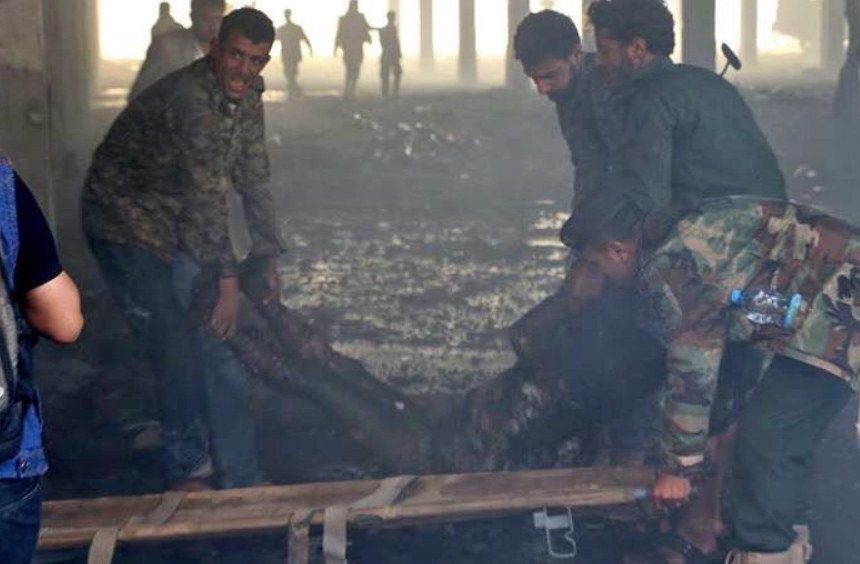
Yemen civil defence and army recovering bodies from the Saudi coalition bombed ceremony hall in Sanaa (Photo: Yemen the Forgotten War)
The hundreds more injured have been described as “bleeding to death in the streets“. The following report came in from Sanaa hours after the attack:
“Saudi-American airstrikes targeted the biggest hall in Sanaa. The hall was hit by 4 missiles, 2 air-strikes. When rescuers went to the aid of the dying and injured Saudi jets attacked for the second time in their double tap operation. It’s impossible to count the deaths. Officially they are saying less than 500 but many more are dying because they can’t be treated due to the absence of medical supplies and hospital facilities. This is entirely due to the UN sanctions and effective land, air and sea blockades. The hall is 2km from our home and 150m from my university but luckily, today I was not there.
Yesterday we killed several mercenary leaders in Mareb and Saudi commanders so today they are taking their revenge on the innocent people” ~ information supplied to Vanessa Beeley of 21st Century Wire.
[…]
According to Hassan Al Haifi, writer, academic and political commentator, living in Sanaa, the Saudi attack was deliberate:
“The mourners were paying tribute to General Jalal Al-Rouishan, Min of Int, who hails from a leading family of Khowlan Al-Tayyal Tribe, a leading and powerful Yemeni tribe.”
Al Haifi commented that this was a cynical and brutal attack by the Saudi coalition, intending to kill as many Ansarullah and Ali Abdullah Saleh officials and supporters as possible. A number of Saleh’s closest friends and allies were killed by the strikes along with a smaller number of Ansarullah members. Al Haifi, himself should have been at the ceremony but had been delayed and fortunately was not there when the Saudi jets launched their missiles into the throngs of mourners.
The Bloodshed
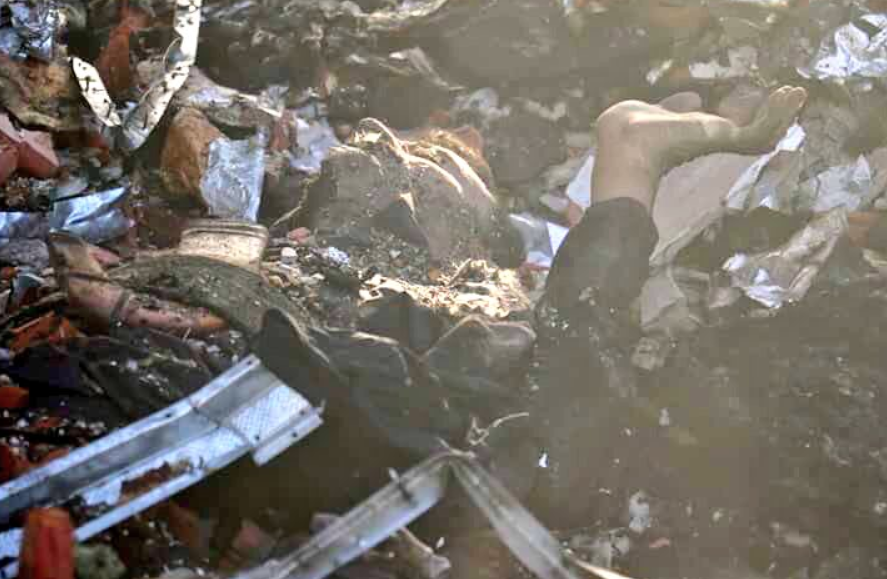
Saudi air-strike on Sanaa (Photo supplied to 21st Century Wire from Yemen)
The US State Department immediately swung into damage limitation mode and cranked up their hypocrisy to protect their Saudi coalition military industrial complex clients. John Kirby even deployed the “self-defence” terminology usually reserved for their other regional, arms guzzling ally with close links to Al Qaeda, Israel.
The bloodshed and suffering of the Yemeni people was reduced to an obscene game of semantics by a cold and calculating US State Department, as their multi billion dollar arms industry registered obscene trading levels with the Saudi coalition in 2015. In the first 21 months of Saudi-US illegal war on Yemen, US arms sales worth $33 Billion were closed Saudi and Gulf Cooperation Council (GCC) entities according to Defense News. In total, America’s Nobel Peace Chief Barack Hussein Obama has offered to sell $115 billion in weapons to Saudi Arabia since taking office in 2009 – more than any previous US administration, according to a recent report.
Not to be left out of the party, Britain has also sold more than £3.7 billion in arms to Saudi Arabia since Saudi’s illegal war of aggression began.
In truth, many of these estimates are conservative and do not include many more hundreds of millions in ancillary costs, staffing, support contracting and engineering.
Forgotten Heroes
Even though they’ve been completely redacted by the western media, and also by the myriad of Gulf monarchy media outlets, the real heroes of this conflict are the Yemeni people.
In their reductionist way of thinking and categorizing the world outside of their shores, Americans refer to Middle East populations in sectarian terms – because this is they way they would like to see the world, but it couldn’t be any further from reality. To Americans, the Yemeni war is all because of “Iranian-backed Shia Houthi Rebels.” The first US Congressman ever to say that in public probably read it directly off an AIPAC policy briefing sheet. That’s the sad reality still in Washington – information-poor (and lobby cash-rich) elected representatives are only able to see the world through the Israeli lens.
The reality is much more complex than just “the Houthis.” A genuine Arab Spring has taken place in Yemen and the US and Saudi response was simply to try and crush the people. But the people have resisted fiercely, and together. Unlike other neo-colonial ventures like Iraq and Afghanistan – the people of Yemen have united to a large degree and are determined to realize their own vision of self government. This is something that has been written off by everyone in the US establishment – from the President all the way down the political food chain.
Damning Indictment
The UK/US built, House of Saud, is waging a genocidal war of aggression that has already destroyed entire swathes of Yemeni cultural heritage and decimated entire communities, particularly in the northern, traditionally Ansarullah (Houthi) held areas such as Saada and Hajjah. This was by design. By now, we can see clearly how this was yet another ethnic cleansing programme being endorsed, fuelled and defended by the United States and her allies in the UK, EU, Israel, and of course the neighbouring Gulf States, the majority of whom participated in this dirty war. Oman, a lone, moderate, and independent thinking gulf state, has remained neutral, providing a degree of support to the Yemeni people. […]
The height of US hypocrisy was on full display during a US State Department press briefing where the already discredited US spokesman John Kirby shameless danced around a mass-murder by Saudi Arabia – whose airstrikes are supported logistically by the United States. This is the definition of criminality unchecked. Watch:
Author Vanessa Beeley is a special contributor to 21WIRE, and since 2011, she has spent most of her time in the Middle East reporting on events there – as a independent researcher, writer, photographer and peace activist. She is also a volunteer with the Global Campaign to Return to Palestine. See more of her work at her blog The Wall Will Fall.
For further background on Saudi ‘s war of aggression please read 21WIRE article: UN Whitewashing Saudi Coalition War Crimes and International Human Rights Violations
Why Would Pentagon Pretend to Fly Russia’s Military Jets?
By Martin Berger – New Eastern Outlook – 13.10.2016
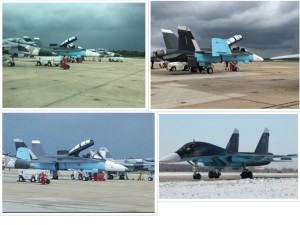 The Internet has lately been filled with pictures of American military pilots rushing towards US warplanes closely resembling Russia’s Su-34, painted in a recognizable light blue paint scheme that has never been used in the US military, but is routinely used by the Russian Air Force.
But this was not a demonstration of US pilots finally filling the seats of Russian hardware, provoked by the fact that US military contractors failed to deliver a competitive fifth-generation fighter, alas. Though it’s true that the Lockheed Martin F-35 has been a bitter failure riddled by criticism from all sides, including the American “hawk in chief” – Chairman of the United States Senate Committee on Armed Services, John McCain.
Regardless, what we’ve seen in the pictures is the direct implementation of the notorious American “plan B” in Syria, so now pro-American “eye-witnesses” can not simply claim that they’ve witnessed Russia’s involvement in alleged “war crimes” somewhere in Aleppo and other Syrian cities. They would now be able to provide pictures taken with their mobile devices to show the “evidence of criminal Russian activities in Syria.” Somewhere in Washington someone has assumed that the whole world would echo the demands of their obedient British and French client government to hold an “international tribunal regarding Russia’s aggression” after seeing such pictures.
In addition to the United States repainting its warplanes to resemble Russian military livery, it is also fairly obvious that America’s F-18 is fairly similar to the Russian Su-34 in appearance. In fact, only a military expert can tell the difference, but only when pictures are presented in high resolution. The folding wings of the American F-18 can only be seen in on the runway, and as for the vertical stabilizers of the F-18, they are only slightly different from the Russian Su-34.
Thus, if an American jet is to be filmed by somebody’s shaking hands on a smartphone, or even a semi-professional camera, it will be virtually indistinguishable from the Su-34.
The only notable distinguishing marks left on the repainted F-18 is a white star on a dark background. However, it’s tail features the bright red star all of Russian’s military jets bear.
In such circumstances, an American F-18, while being virtually indistinguishable from a Russian jet, can launch, wittingly or unwittingly, a classic false flag attack. The possible targets are plenty: humanitarian convoys, residential areas, or even US military personnel. Should this attack be filmed, Washington will end up having “irrefutable evidence” of “Russian aggression.”
As a matter of fact, Russia is already being accused of such aggression on a daily basis, but the problem is that nobody has seen any convincing evidence of such aggression. Repainting American planes to resemble Russian aircraft may be a solution to this problem.
But it must be pointed out that this attempt to launch a provocation against Russia comes from a very old book of CIA tricks. Back in 1962, during the Cuban missile crisis, Washington was also planning to use repainted aircraft,which would be used to take down a civilian airliner as a pretext for Washington to blame the Cuban Air Force. This story was told by US Secretary of Defense Robert McNamara in the documentary, “The Fog of War.”
But it’s a well-known fact that the US is an empire of lies, and there can be no doubt about that. Therefore, all the statements and actions of the White House should be taken with a grain of salt in order not to be fooled by yet another US-crafted lie.
Featured Video

Racist Seinfeld Dances for Joy as Bibi Unveils His New Map
or go to
Aletho News Archives – Video-Images
TV Drama Review
Japanese drama projects Japan’s wartime atrocities onto Chinese characters

Global Times | October 25, 2026
By portraying Chinese characters as perpetrators of ruthless violence while casting Japanese Self-Defense Forces (SDF) intelligence operatives as defenders, the season 2 of the Japanese drama Vivant has recently drawn criticism from Chinese netizens, who argue that its depiction turns historical reality on its head while ignoring Japan’s wartime atrocities.
The TBS drama series – a spy suspense story in which an alleged unofficial intelligence unit of the SDF operates across the globe — has attracted a passionate fanbase. Its currently airing season 2 opened with a household rating of 18.8 percent, the highest for a TV drama this year, according toa commentary article by Japanese media Toyo Keizai.
What draws attention is the portrayal of the enemies in the series, the article noted. Scenes in which the Chinese organization subjects kidnapped members of the SDF unit to brutal torture are repeated with unrelenting intensity.
It is rare for Japanese TV dramas to explicitly portray a real-life country as the enemy, the article noted.
Japanese Prime Minister Sanae Takaichi also made a reference to the drama, saying that she has been recording Vivant and hopes to binge-watch it over the year-end and New Year holidays, according to Japanese media outlets.
China’s CCTV News report on Sunday revealed that the drama features scenes in which Chinese personnel cut off the fingers of and stab Japanese intelligence operatives in the abdomen. Such acts bear striking similarities to the torture inflicted on Chinese nationals by invading Japanese troops during the World War II.
The drama distorts the truth by attributing these atrocities to modern Chinese characters. Beneath the surface, it subtly glorifies Japan’s cross-border overseas operations, blurs the functional boundaries of the SDF and implicitly promotes an expansionist narrative, per CCTV News. … continue
Blog Roll
 Aletho News
- Iran FM Araghchi: “Hormuz Will No Longer Be the Same”
- EU facing trillion-euro debt hole while seeking more cash for Kiev
- How US, Europe, Persian Gulf states exhausted missile stockpiles, splurged billions to defend Israel
- Up in arms… Koreans reject U.S. empire’s plan to make South Korea the next Ukraine
- Iran, Turkey, Pakistan, Saudi Arabia could advance region-led security framework in Tehran: FM spox
- Netizens condemn Japanese drama for projecting Japan’s wartime atrocities onto Chinese characters
- Racist Seinfeld Dances for Joy as Bibi Unveils His New Map
- A West Bank War for Netanyahu’s Election Campaign, Could It Backfire?
- Yemen denounces European Parliament’s ‘hypocritical’ push to blacklist Ansarullah
- Qalibaf: UAE’s UN bid aims to ‘clear the runway’ for ‘Greater Israel’, whitewash genocide
- If Americans Knew
- Israel punishes Palestinian prisoners with solitary confinement for making a cake
- US midterms: Where do candidates in key Senate races stand on Israel, Gaza, and Iran?
- Israeli forces demolish Hebron homes, displace thousands of Palestinians as raids expand
- Their Son Died in Israeli Prison. No Answers. No Body
- Biden’s Israel Catastrophe
- Why Israel’s latest assault on Hebron is so significant for the West Bank
- Israel Used “Where’s Daddy?” AI to Relentlessly Murder Palestinian Journalists and Their Families in Their Homes from October to December 2023
- DAILY UPDATE: Latest essential news on Palestine, Israel, & region
- Netanyahu Says Israel Must Prepare for Banking Sanctions, Floats Crypto as a Possible Bypass
- Latest updates from Israeli assault on West Bank
- No Tricks Zone
- Sudden Stratospheric Warming, Powerful El Niño Combination May Lead To Extreme Europe Cold, Energy Crisis!
- Two New Studies Find Thwaites Glacier Melt Cannot Be Driven By Human Activity Or A Warming Ocean
- E-Cars Reduce CO2 Emissions By Only 41% Compared To Internal Combustion Engine Vehicles
- Predictions Made By Renowned Climate Professor Over Past Decades Have Been Proven To Be Poor
- New Study Suggests Large Regions Of The Pacific Ocean Have Been Cooling For The Last 80 Years
- Germany’s Green Energy Debacle: High Energy Costs Force Kahla Porzellan to Close After 182 Years!
- New Study: 50 Years Of The Most Aggressive ‘Net Zero’ Policies Can Only Affect The Global Climate By 0.03°C
- US September “Heat” Was No Record…Many Records Set Decades Ago
- Latest European Green Energy Debacle; Portugal’s Largest Flagship Solar Park Insolvent!
- Green Energy Debacle: German Expert Professor Fritz Vahrenholt Warns Of Severe Economic And Social Consequences

