Bill Kristol is downright despondent after his failed search for an alternative to Donald Trump. Max Boot is indignant about his “stupid” party’s willingness to ride a bragging bull into a delicate China policy shop. And the leading light of the first family of military interventionism — Robert Kagan — is actually lining up Neoconservatives behind the Democratic nominee for president of the United States.
At the same time, the Democrats have become the party of bare-knuckled, full-throated American Exceptionalism. That transformation was announced with a vein-popping zeal by retired general and wannabe motivation screamer John Allen at the Democratic convention in the City of Brotherly Love. During his “speech,” a few plaintive protests of “no more war” were actually drowned-out by Democrats chanting “USA-USA-USA!”
This is the same Democratic Party often criticized by Kagan & Co. as the purveyors of timidity, flaccidity, and moral perfidy. It’s not that Democrats haven’t dropped bombs, dealt arms, and overturned regimes. They have. And they’ve even got the Peace Prize-winning Obama-dropper to prove it. But unlike enthusiastically belligerent Republicans, the Dems are supposed to be the party that does it, but doesn’t really like to do it.
But now, they’ve got Hillary Clinton. And she’s weaponized the State Department. She really likes regime change. And her nominating convention not only embraced the military, but it sanctified the very Gold Star families that Neocon-style interventionism creates. It certainly created the pain of the Khan family who lost their son in the illegal war in Iraq. But the Dems didn’t mention that sad fact as they grabbed the flag away from the Republicans.
Now that’s truly Neo-confusing.
It kinda feels like reality has slipped off its axis and we’ve landed on a Bizarro World version of America. Democrats are acting like Republicans. Pat Buchanan is championing the GOP’s “Peace Candidate.” And the Neocons are fleeing from a party they’ve used like a geopolitical cudgel for the better part of three decades.
At first glance, it all makes sense. Trump captured the GOP nomination in no small part by trashing two of the Neocons’ favorite things ever — the Bush family and the Iraq War. He also suggested early on that he’d approach the Israeli occupation of the West Bank and Gaza as (gasp!) an honest broker. Trump said he really wanted to “make that deal.” Without irony, one-time Neocon wonderboy Marco Rubio remarked that it isn’t a “real estate deal” when, in fact, that’s exactly what it is.
Frankly, nothing seems enough to sway the Neocons in Donald’s direction. But it’s not for lack of trying on Trump’s part. Really, he’s checked off many of the boxes that make Neocons smile.
Trump wants a “yuuge” military … the biggest and baddest ever! So big, that no one in a million years will ever challenge it. That sure sounds a lot like Reagan’s “peace through strength.” Neocons do love Reagan. And, as if on cue, the Kristol/Kagan-led “Foreign Policy Initiative” just posted a clarion call to spend more bucks to buy bigger bangs for an already gargantuan military. Doesn’t that fit with Donald’s plan to spend defense dollars like a drunken sailor?
Maybe Neocons don’t want the military to be so big that no one will ever try anything. Maybe they want a few challenges here and there, just for a little creative destruction to keep the world on its toes. But Trump’s right there with them. He wants to “bomb the shit” out of ISIS. And he even said America has “no choice but to bomb Libya” and “take out” the Islamic State.
C’mon, Neocons … what’s not to like?
And how about Trump’s Islamophobia? It sure seems simpatico with the last two decades of Neoconservative drum-beating. Trump repeatedly uses the magic words — “Radical Islamic Terrorism.” Can’t you just hear the longing sighs coming out of the American Enterprise Institute? He also wants to ban Muslims. Or “just” ban people coming from countries where Muslims have committed terrorism. Who knows? Either way, the message is “Muslims bad.” It even gave Neocon bushwacker Frank Gaffney a serious man-crush on The Donald.
To be fair, other less “fringy” Neocons like Kristol have repudiated the Muslim ban idea. But, as filmmaker Robbie Martin showed in his just-completed series on the Neocons and their “very heavy agenda,” even the most intellectually renowned among them has engaged in the dangerous stereotyping of all Muslims as terrorists.
In fact, Martin featured a frightening clip of two Kagans (Robert’s dad Donald and his brother Fred) making the case that the US military should clean out the Occupied Territories in the aftermath of 9/11 because radical Muslims and “the Arabs” are all basically the same. Oh, by the way, they only respect brute force. So why not take advantage of the “New Pearl Harbor” and show them all who’s boss?
It’s kinda like the “dancing Muslims” Trump — and only Trump — saw celebrating the 9/11 attacks in New Jersey. Even if he didn’t see them, or just conflated them with an isolated incident in East Jerusalem, what’s the difference? It’s all the same to him. Just like aggrieved and aggressive Muslims were all the same to the Kagans on 9/11. Doesn’t that make Trump’s persistent suspicion of Muslims a perfect match for the Neoconservative wrecking crew?
And then there’s the Iran nuclear deal, which Trump has relentlessly criticized as being so bad that it’s downright suspicious. He said he wants to “renegotiate” immediately after taking office. And he wrongly claims the deal is a fast-track to a nuclear-armed Iran (an error that puts him squarely in the Neocon camp). As a rule of thumb, he’s livid about all things related to Iran. So, what’s the problem? Why can’t the Neocons wrap their arms around Donald Trump?
In a word — it’s Russia.
It’s framed as a troublesome “bromance” between Vladimir Putin and Trump. Critics don’t like Trump’s comfort with a “dictator” who, as Kagan’s wife Victoria Nuland recently told the Senate Foreign Relations Committee, engages in “aggression.” She’s currently the assistant secretary of state for European and Eurasian Affairs. She basically managed the 2014 coup in Ukraine. And she’s outraged by Russian aggression in Ukraine. But she’s nonplussed by her husband’s role in pushing for the most blatant and wanton act of aggression thus far this century — the unwarranted destruction of Iraq.
Go figure.
On the other hand, Putin has the unmitigated gall to move military forces around inside the borders of his own country. He’s blamed for hacking the Democratic Party — despite a lack of actual evidence and the NSA’s own hacking hijinks. And he’s accused of “meddling” in U.S. elections — a pretty rich accusation given America’s long history of surreptitious electioneering around the world.
There is no doubt that “Bad Vlad” likes Donald. And Donald likes Vlad. But the real problem isn’t their bromance. This is about the Neoconservative desire to make sure the United States is the lone guarantor of the geopolitical order. This is about Pax Americana. This is about resurrecting the faded dream of a new American century.
And what stands in the way of the type of the Neocon dream of global “full-spectrum dominance?” Russia’s nuclear arsenal.
Russia is the only nation with an arsenal big enough to withstand the subtle nuclear blackmail of America’s trillion-dollar nuclear “upgrade.” That’s why Russia is concerned about the missile defense systems arrayed on their border. Those systems can knock down retaliatory strikes, thus making a first strike with new nuclear cruise missiles at least theoretically possible.
The United States is also using NATO expansion to increasingly encircle a nation that once was America’s geopolitical equal. That’s why Trump’s criticism of America’s outsized support for NATO must’ve been the tipping point from disdain to panic among Neocon and Neoliberal interventionists alike.
The oddity is that there does seem to be more than a passing affinity between Trump and Putin. Trump’s statements on Ukraine would be easily dismissed if his campaign manager Paul Manafort hadn’t worked as a political consultant to the pre-Nuland leadership of Ukraine. And Trump’s statements on Crimea might be written off if he’d release his taxes and end speculation of financial ties to Putin’s regime.
But the visceral reaction against his repeated calls for cooperation — “By the way, wouldn’t it be great if we got along with Russia?”— exposes the extent to which the entire foreign policy and political establishments are squarely on the same page. They are angling for Cold War 2.0, and Trump is the only major figure willing to challenge that orthodoxy.
Unlike Hillary Clinton, of course, which brings the whole thing back to the miasma of confusion hanging over this strange election. Hillary is on the Neocon team — if not in name, certainly in deed. She will “stand up” to Bad Vlad. She’s targeted by Russian hackers because Putin prefers his “unwitting agent” Donald Trump. And Donald is, according to an emerging narrative, a latter-day Neville Chamberlain just inviting the Ruskies to take over the Baltic States, Ukraine, and God knows what else.
The greatest irony of all is that Trump catapulted over the Neocons’ preferred presidential options by slamming their pet project — the War on Iraq. Trump’s criticism of that war and the chaos it unleashed resonated with the very voters the Neocons took for granted as pliable, fear-responsive bumpkins. That left them out in the cold just as they were angling to trump the disorderly, hard-to-prosecute mess they call “The Global War on Terror.”
What they really want, and have always wanted, is to revive the greatest war of all — the Cold War. That’s the grand chessboard they yearn to play on once again. The War on Terror was really just a stop-gap, like methadone for imperialists. But now they’ve scored because it looks like the supposed party of imperial intransigence is, under the guidance of Hillary Clinton, poised to take the reins from a Trump-addled GOP.
And if a recent article in Der Spiegel is right, Kagan’s wife Victoria has emerged as a candidate for the prized position of secretary of state should Hillary win. If that comes to pass, the Neocons may not have succeeded in their initial plan for a new American century, but they will have hastily completed their last-minute project for a new Democratic Party. And that means this election isn’t that Neo-confusing after all.
The hysterical ‘information war’ just stopped being funny. The influential Atlantic Council has released a paper calling for Poland to ‘reserve the right’ to attack Russian infrastructure, including Moscow’s public transport and RT’s offices, via electronic warfare.
There are some ideas that are so outlandish, so outrageous, so weird that the only way they should enter the public realm is by sheer accident, or in haphazard fashion through whistleblowers and WikiLeaks data dumps.
Regrettably, however, that was not the case with the Atlantic Council’s latest paper, alarmingly entitled ‘Arming for Deterrence: How Poland and NATO Should Counter a Resurgent Russia’. The recommendations put forward in this paper are the result of a deliberate decision, and that’s what makes its contents all the more disturbing.
Heeding Tolstoy’s advice, let’s jump right into the action: Page 12, paragraph 7 and I quote: “Poland should announce that it reserves the right to deploy offensive cyber operations (and not necessarily in response just to cyber attacks). The authorities could also suggest potential targets, which could include the Moscow metro, the St. Petersburg power network, and Russian state-run media outlets such as RT.”
Holy hooliganism, Batman! That comment made me sit bolt upright, spill my coffee and check to see if I wasn’t perusing a parody piece by The Onion. No such luck. My gut reaction, however, was to ignore the hyperbole, since responding would only give the authors some satisfaction that they hit a nerve. And I must admit, they succeeded. In fact, they hit my sciatic nerve, the longest neuron transmitter in the human body that begins in the lower back and runs through the buttock and down the leg (I once underwent orthopedic surgery and the doctor, in an experimental mood, I assume, injected anesthetics directly into this hot spot, which is about the equivalent of being hit by a dozen police Tasers at once).
In other words, ignoring this shocking remark was not an option. The reasons should be obvious. Though the paper ‘merely’ suggested “offensive cyber attacks,” the Moscow Metro, which carries about 10 million commuters daily, has suffered a number of deadly attacks over the years. The last thing it really needs is an “offensive” attack of any kind.
On August 8, 2000, a bomb equivalent to two pounds of TNT detonated inside a pedestrian underpass at Pushkinskaya metro station in the center of Moscow. The attack claimed the lives of 12 and injured 150. On February 6, 2004, an explosion devastated a rush-hour carriage between the Avtozavodskaya and Paveletskaya stations, killing 41 and wounding over 100 commuters on their way to work. A marble plaque on the platform of the Avtozavodskaya Metro bears the names of the victims. On March 29, 2010, dual explosions 40 minutes apart hit the Lubyanka and Park Kultury stations during yet another morning rush hour, killing 40 and injuring 102 others.
Needless to say, Muscovites still carry a lot of emotional baggage from these tragic incidences, so for anybody to suggest the Moscow Metro (or any form of public transport, for that matter) come under some sort of attack is simply the mindless rambling of twisted minds. Although an “offensive cyber attack” (isn’t every attack “offensive” – why the need to be tautological?) does not rank in the same category as a bomb attack, for example, it is nevertheless a form of violence that could have catastrophic consequences.
Second, mentioning St. Petersburg (formerly Leningrad) – the site of a 872-day military siege by the Nazi Army (Sept. 1941 to January 1944) in which somewhere between 643,000 and 1.5 million civilians died of starvation, disease and bombardment – in the context of an attack is just stupid. Most likely it is a cheap effort by the authors to provoke an emotional response from the Russians, who take immense pride from the incomparable sacrifices made by the people of Leningrad (Perhaps even more disturbing, however, is the fact that there is a nuclear power plant 70 kilometers outside of St. Petersburg; would that fall under our author’s purview for a cyber attack?). Why would the authors deliberately rile the Russians over one of their most culturally and historically significant cities? I have some wild guesses, but more on that a bit later.
Who needs Geneva’s conventions?
I am a bit surprised that it is necessary to remind people – especially authors for an influential think-tank – as to what the Geneva Convention has to say with regards to protecting citizens. Article 51(2) of Additional Protocol I to the Geneva Conventions, explicitly states:
“The civilian population as such, as well as individual civilians, shall not be the object of attack. Acts or threats of violence, the primary purpose of which is to spread terror among the civilian population, are prohibited.”
Although I am no lawyer, that statement seems pretty straightforward. Not only the act of violence, but “threats of violence” are prohibited, and an “offensive cyber attack” – which could be severely disruptive, even deadly, in our hyper-technological societies – would certainly qualify.
The authors of the Atlantic Council piece, therefore, are skirting the margins of legality, not to mention sanity, I would say, especially when we consider that Russia has not demonstrated hostile intentions against any Eastern European country, except for those invasions that exist in the vivid imaginations of NATO planners.
Now, concerning the other “potential targets” that our ambitious authors have lined up for Poland’s punchy army, namely, “Russian state-run media outlets such as RT,” once again the authors have gone off the rails as far as the law is concerned. That is because media facilities are considered to be civilian installations and strictly off-limits to any sort of attack, “offensive cyber attacks” included.
“Radio and television facilities are civilian objects and as such enjoy general protection. The prohibition on attacking civilian objects has been firmly established in international humanitarian law since the beginning of the twentieth century and was reaffirmed in the 1977 Protocol I and in the Statute of the International Criminal Court,” advises Marco Sassoli, Antoine Bouvier and Anne Quintin in a case study regarding the protection of journalists.
There is yet another problem with this particular paper that became apparent just days after its publication. First, let us reconsider the gratuitous advice the authors have for the Polish authorities (who will hopefully take a pass on this think-tank junk): “Poland should announce that it reserves the right to deploy offensive cyber operations (and not necessarily in response just to cyber attacks).” That parenthetical comment at the end is not my addition; it appears in the original. So what exactly would qualify Russia’s civilian infrastructure for being on the receiving end of some sort of Polish attack via electronic warfare? The authors do not tell us. I guess they just want to keep everybody in the dark, so to speak.
In any case, the comment is problematic and could have serious unforeseen consequences at least as far as already strained Russian-Polish relations go. After all, there always remains the risk that there will be, in some theoretical future, an “offensive cyber attack” of unknown origin on the Moscow Metro, St. Petersburg power grid or at RT offices.
Needless to say, such an unexpected turn of events would not look very good for the Polish authorities – even if they are innocent of such an aggression. It would look much worse, of course, should an “offensive cyber attack” result in injury or death to any citizens in Russia (It needs emphasized at this point that the possibility exists of some third-party deliberately initiating a cyber attack in the hope of aggravating tensions between Russia and Poland, which would give NATO the justification it desperately needs for its dwindling relevance in a post-Cold War world).
Under a section entitled “Policy declarations”, the authors give the Polish authorities another misguided suggestion: “Poland should make clear policy declarations regarding its behavior in the event of Russian incursions and on targeting within Russia.” The last part of that sentence is unclear and could be interpreted as two distinct events: 1. “The event of Russian incursions”, and 2. “Targeting within Russia” – bereft of any initial Russian incursion.
Meanwhile, the term “offensive cyber attacks” appears in another section of the paper where the authors remark: “NATO has tied its own hands by declaring that it would not use all tools available to it, such as refraining from using offensive cyber operations. Holding back from offensive cyber operations is tantamount to removing kinetic options from a battlefield commander.” Using and comparing these two terms in the same sentence is troubling. As Timothy Noah wrote in Slate, kinetic means“dropping bombs and shooting bullets—you know, killing people.”
Ironically, just days after this nonsense burst asunder from the busy bowels of US ‘thintankdom’, the Russian Security Service (FSB) reported that computer networks of some 20 Russian state, defense, scientific and other high-profile organizations were infected with malware used for cyber-espionage, describing it as a professionally coordinated operation.
“The IT assets of government offices, scientific and military organizations, defense companies and other parts of the nation’s crucial infrastructure were infected,” the FSB said in a statement as cited by the Russian media.
Who writes this stuff?
The disturbing advice put forward in this paper is more understandable when we know the background of the authors.
Gen. Sir Richard Shirreff, NATO’s Deputy Supreme Allied Commander Europe from 2011 to 2014, is now partner at Strategia Worldwide Ltd. He recently published “2017: War with Russia”, the plot of which is pretty much self-explanatory.
It is hard to top the late fiction writer Tom Clancy when it comes to presenting (Soviet) Russia as the world’s preeminent villain, but Shirreff certainly gives the author of “The Hunt for Red October” a run for his money.
NATO, according to Shirreff, will be at war with Russia by May 2017 (Surprise – just in time for the one-year anniversary of Shirreff’s Russophobic thriller. Oh, happy sales!). Russian forces will invade the Baltic States and threaten to employ nuclear weapons if NATO attempts a military response. “A hesitant NATO will face catastrophe… the day of reckoning for its failure to match strong political statements with strong military forces finally arrives,” his trembling fingers typed.
Amazing what a democratic referendum by the good people of Crimea to join the Russian Federation can do to some people’s overactive imaginations.
Sadly, the primary motivator for such attacks on Russia boils down to the most primal motivator of them all: the profit motive. As a partner at Strategia Worldwide Ltd, which provides clients with “a comprehensive approach to corporate risk management… in complex, dangerous and difficult environments,” according to its sleek website, Shirreff’s groundless predictions about Russian aggression against its neighbors will probably draw more customers through Strategia’s front door. Or boost book sales. Either way, it doesn’t bode well for EU-Russian relations when rabble-rousers can get away with hawking phantom fears and libelous lies for filthy lucre.
But this non-fiction story gets better. Let’s give a big round of applause to the other contributor author, Maciej Olex-Szczytowski, who is described as an “independent business adviser, specializing in defense.” In 2011-12 he was Special Economic Adviser to Poland’s Foreign Minister, Radoslaw Sikorski.
But the biography missed the really juicy part of Olex-Szczytowski’s resume.
“Maciej Olex-Szczytowski is Adviser on Poland to BAE Systems, Europe’s largest company in the Defence Sector. A commercial and investment banker by training, he has led some €50 billion worth of transactions in Central Europe, and has provided advice to numerous corporations and governmental entities in the region.”
Well now all of the warmongering jibes against Russia is starting to make some sense, at least from a business portfolio perspective.
Imagine. We have a former general turned business executive who is predicting that Russia will – for some inexplicable reason – invade the Baltic States (I can only presume for its excellent pastries and liquors) in 2017, teaming up with a banker who oversees the sale of tens of billions of dollars in military hardware to the EU, now advising Poland to “reserve the right” to launch an “offensive cyber attack” against Russian civilian infrastructure.
No conflict of business interests there, right? Nah! It is individuals like these, for whom the entire planet is one big business opportunity, and to hell with the risk of accidentally kick-starting a beast called Armageddon, who are the real regional aggressors.
Hopefully the Polish authorities are wise enough to see through this thinly veiled and very revolting business plan and politely reject the self-interested suggestions of Richard Shirreff and Maciej Olex-Szczytowski. With friends like these two, who needs enemies? After all, it will be Poland that will be forced to pay the piper the price of ruined relations with Russia, not the European military industrial complex, which will only reap a windfall.
Some presidents grow in office and some presidents grow once out of office (Jimmy Carter comes to mind). But some presidents seem to learn very little during their four or eight year term. Unfortunately, especially when it comes to foreign policy, it seems President Obama falls into that latter category.
The president gave a press conference at the Pentagon today to update us on how the fight against ISIS is going. Remember: it is two years since Obama expanded what he promised would be a very limited military operation to save a religious minority — the Yazidis — from a hilltop in Iraq, into a full-fledged war in Iraq, Syria, and as of last week, Libya.
Two years ago this very week, in fact, President Obama informed the American people that he was launching “targeted airstrikes to protect our American personnel, and a humanitarian effort to help save thousands of Iraqi civilians who are trapped on a mountain without food and water…”
There was no chance of this very limited rescue operation expanding, he assured us:
As Commander-in-Chief, I will not allow the United States to be dragged into fighting another war in Iraq. And so even as we support Iraqis as they take the fight to these terrorists, American combat troops will not be returning to fight in Iraq, because there’s no American military solution to the larger crisis in Iraq.
Two years later, the lies are laid bare. US troops are indeed fighting another war in Iraq, with the addition of wars in Syria and Libya to boot.
Today the president wanted to give us good news about his anti-ISIS efforts in Iraq and Syria. His efforts have made us more safe, he claimed: “I do think that because of our extraordinary efforts, a homeland is significantly safer than it otherwise would be.”
But the president wanted us to know that things are not perfect. There are some bad actors who are hindering our efforts.
Singled out for condemnation in the president’s address was not ISIS, or al-Qaeda, or even the US-backed Nour al-Din al-Zenki, which recently filmed itself beheading a young child. No, the real villain for President Obama is the Syrian government, which has been engaged in a five year battle with ISIS, al-Qaeda, and US-backed “moderates” who do things like cut off young boys’ heads.
To Obama, the disaster in Syria is not the fault of the outside powers, who imported jihadis and even weapons from Libya (Hillary!) to overthow Syrian president Assad. It is all the fault of Assad for resisting the foreign-backed overthrow of his government! Indeed, even the act of fighting ISIS and al-Qaeda in his country earns Assad the condemnation of Obama:
In Syria, defeating ISIL and al-Qaeda requires an end to the civil war and brutality against the people, pushing them to extremes. The regime and its allies continue to violate the cessation of hostilities.
So the Syrian government is guilty of violating the “cessation of hostilities” by fighting al-Qaeda and US-backed groups that fight alongside al-Qaeda.
Indeed, to Obama the whole Syria disaster is the fault of Assad, who apparently woke up one morning and decided that the best way to keep power in Syria was to destroy his own country.
Said Obama:
We are very clear that Russia has been willing to support a murderous regime and an individual who has destroyed his country just to cling to power.
Whatever one thinks of Assad, what world leader would not resist a foreign-backed insurgency aimed at overthrowing the constitutional order? Would Obama? The mere rumor that the Russians might have had a peep at the DNC’s “cheat Bernie Sanders” grand strategy and the entire Democratic Party is ready to launch World War III against Russia!
But, finally, Obama assures us that try as he constantly does, he just sees no option other than our current hyper-interventionism in the Middle East:
I am pretty confident that a big chunk of my gray hair comes out of my Syrian meetings. There is not a meeting that I don’t end by saying is there something else we could be doing that we haven’t done? Is there a plan F, G, H that we think would lead to a resolution of the issue so that the Syrian people can put their lives back together and we can bring peace and leave the refugee crisis that has taken place?
Well, Mr. President, you must not be trying all that hard, because the answer is as obvious as the gray that has overtaken your hair: just go home. Leave Syria alone. Stop trying to change regimes.
On his visit to Hiroshima last May, Obama did not, as some had vainly hoped he might, apologize for the August 6, 1945 atomic bombing of the city. Instead he gave a high-sounding speech against war. He did this as he was waging ongoing drone war against defenseless enemies in faraway countries and approving plans to spend a trillion dollars upgrading the US nuclear arsenal.
An apology would have been as useless as his speech. Empty words don’t change anything. But here was one thing that Obama could have said that would have had a real impact: he could have told the truth.
He could have said:
“The atom bombs were not dropped on Hiroshima and Nagasaki ‘to save lives by ending the war’. That was an official lie. The bombs were dropped to see how they worked and to show the world that the United States possessed unlimited destructive power.”
There was no chance that Obama would say that. Officially, the bombing “saved lives” and therefore, it was worth it. Like the Vietnamese villages we destroyed in order to save them, like the countless Iraqi children who died as a result of US sanctions, the hundreds of thousands of agonizing women and children in two Japanese cities remain on the debit side of the United States accounts with humanity, unpaid and unpunished.
“It Was Worth It”
The decision to destroy Hiroshima and Nagasaki was a political not a military decision. The targets were not military, the effects were not military. The attacks were carried out against the wishes of all major military leaders. Admiral William Leahy, chairman of the Joint Chiefs of Staff, wrote in his memoirs that “the use of this barbarous weapon at Hiroshima and Nagasaki was of no material assistance in our war against Japan. The Japanese were already defeated and ready to surrender…” General Eisenhower, General MacArthur, even General Hap Arnold, commander of the Air Force, were opposed. Japan was already devastated by fire bombing, facing mass hunger from the US naval blockade, demoralized by the surrender of its German ally, and fearful of an imminent Russian attack. In reality, the war was over. All top U.S. leaders knew that Japan was defeated and was seeking to surrender.
The decision to use the atom bombs was a purely political decision taken almost solely by two politicians alone: the poker-playing novice President and his mentor, Secretary of State James F. Byrnes.[1]
President Harry S. Truman was meeting with Churchill and Stalin in the Berlin suburb of Potsdam when secret news came that the New Mexico test of the atomic bomb was a success. Observers recall that Truman was “a changed man”, euphoric with the possession of such power. While more profound men shuddered at the implications of this destructive force, to Truman and his “conniving” Secretary of State, James Byrnes, the message was: “Now we can get away with everything.”
They proceeded to act on that assumption – first of all in their relations with Moscow.
In response to months of U.S. urging, Stalin promised to enter the Asian war three months after the defeat of Nazi Germany, which occurred in early May 1945. It was well known that the Japanese occupation forces in China and Manchuria could not resist the Red Army. It was understood that two things could bring about Japan’s immediate surrender: Russia’s entrance into the war and U.S. assurance that the royal family would not be treated as war criminals.
Both these things happened in the days right after the bombing of Hiroshima and Nagasaki.
But they were overshadowed by the atom bomb.
And that was the point.
That way, the U.S. atom bombs got full credit for ending the war.
But that is not all.
The demonstrated possession of such a weapon gave Truman and Byrnes such a sense of power that they could abandon previous promises to the Russians and attempt to bully Moscow in Europe. In that sense, the bombs on Hiroshima and Nagasaki not only gratuitously killed hundreds of thousands of civilians. They also started the Cold War.
Hiroshima and the Cold War
A most significant observation on the effects of the atomic bomb is attributed to General Dwight D. Eisenhower. As his son recounted, he was deeply depressed on learning at the last minute of plans to use the bomb. Shortly after Hiroshima, Eisenhower is reported to have said privately:
“Before the bomb was used, I would have said yes, I was sure we could keep the peace with Russia. Now, I don’t know. Until now I would have said that we three, Britain with her mighty fleet, America with the strongest air force, and Russia with the strongest land force on the continent, we three could have guaranteed the peace of the world for a long, long time to come. But now, I don’t know. People are frightened and disturbed all over. Everyone feels insecure again.”[2]
As supreme allied commander in Europe, Eisenhower had learned that it was possible to work with the Russians. US and USSR domestic economic and political systems were totally different, but on the world stage they could cooperate. As allies, the differences between them were mostly a matter of mistrust, matters that could be patched up.
The victorious Soviet Union was devastated from the war: cities in ruins, some twenty million dead. The Russians wanted help to rebuild. Previously, under Roosevelt, it had been agreed that the Soviet Union would get reparations from Germany, as well as credits from the United States. Suddenly, this was off the agenda. As news came in of the successful New Mexico test, Truman exclaimed: “This will keep the Russians straight.” Because they suddenly felt all-powerful, Truman and Byrnes decided to get tough with the Russians.
Stalin was told that Russia could take reparations only from the largely agricultural eastern part of Germany under Red Army occupation. This was the first step in the division of Germany, which Moscow actually opposed.
Since several of the Eastern European countries had been allied to Nazi Germany, and contained strong anti-Russian elements, Stalin’s only condition for those countries (then occupied by the Red Army) was that their governments should not be actively hostile to the USSR. For that, Moscow favored the formula “People’s Democracies” meaning coalitions excluding extreme right parties.
Feeling all-powerful, the United States sharpened its demands for “free elections” in hope of installing anti-communist governments. This backfired. Instead of giving in to the implicit atomic threat, the Soviet Union dug in its heels. Instead of loosening political control of Eastern Europe, Moscow imposed Communist Party regimes – and accelerated its own atomic bomb program. The nuclear arms race was on.
“Have Our Cake and Eat It”
John J. McCloy, labeled by his biographer Kai Bird as the informal “chairman of the U.S. establishment”, told Secretary of War Henry Stimson at the time that: “I’ve been taking the position that we ought to have our cake and eat it too; that we ought to be free to operate under this regional arrangement in South America, at the same time intervene promptly in Europe; that we oughtn’t to give away either asset…”[3] Stimson replied, “I think so, decidedly.”
In short, the United States was to retain its sphere of influence in the Western Hemisphere, claimed by the Monroe Doctrine, while depriving Russia of its own buffer zone.
It is necessary to recognize the sharp distinction between domestic policy and foreign policy. The nature of the Soviet internal regime may have been as bad as it is portrayed, but when it came to foreign policy, Stalin scrupulously respected deals made with the Western allies – abandoning, for instance, the Greek Communists as they were crushed by the Anglo-Americans after the war. It was the United States that reneged on the deals made at Yalta, which were then stigmatized as sellouts to “communist aggression”. Stalin had absolutely no desire to promote communist revolution in Western Europe, much less to invade those countries. In fact his failure to promote world revolution was precisely the basis of the campaign against “Stalinism” by Trotskyists – including Trotskyists whose devotion to world revolution has now shifted to promotion of US “regime change” wars.
There is a prevailing Western doctrine that dictatorships make war, and democracies make peace. There is no proof of that whatsoever. Dictatorships (think of Franco Spain) may be conservative and inward-looking. The major imperialist powers, Britain and France, were democracies. Democratic America is far from peaceful.
As the Soviet Union developed its own nuclear arsenal, the United States was unable to interfere effectively in Eastern Europe and fell back on lesser enemies, overthrowing governments in Iran and Guatemala, getting bogged down in Vietnam, on the theory that these were surrogates for the Soviet communist enemy. But now that the Soviet Union has collapsed, abandoning Russia’s buffer zone in Eastern Europe, there appears to be a resurgence of the sort of confidence that overcame Truman: a euphoria of limitless power. Why else would the Pentagon undertake a trillion dollar program to renew America’s nuclear arsenal, while stationing troops and aggressive military equipment as close as possible to the Russian border?
In his 1974 book about his relations with his brother Dwight, The President Is Calling, Milton Eisenhower wrote: “Our employment of this new force at Hiroshima and Nagasaki was a supreme provocation to other nations, especially the Soviet Union.” And he added, “Certainly what happened at Hiroshima and Nagasaki will forever be on the conscience of the American people.”
Alas, the evidence so far is all to the contrary. Concerned critics have been marginalized. Systematic official lies about the “necessity to save American lives” have left the collective American conscience perfectly clear, while the power of the Bomb has created a lasting sense of self-righteous “exceptionalism” in the nation’s leaders. We Americans alone can do what others cannot, because we are “free” and “democratic” and they – if we so decide – are not. Other countries, not being “democracies”, can be destroyed in order to liberate them. Or simply destroyed. This is the bottom line of the “exceptionalism” that substitutes in Washington for the “conscience of the American people” which was not aroused by Hiroshima, but asphyxiated.
The Moral Sleep
As a guest in Hiroshima, Obama pontificated skillfully:
“The wars of the modern age teach us this truth. Hiroshima teaches this truth. Technological progress without an equivalent progress in human institutions can doom us. The scientific revolution that led to the splitting of an atom requires a moral revolution as well.”
Well yes, but no such moral revolution has taken place.
“… the memory of the morning of Aug. 6, 1945, must never fade. That memory allows us to fight complacency. It fuels our moral imagination. It allows us to change.”
“Change” is an Obama specialty. But he did nothing to change our nuclear arms policy, except to beef it up. No sign of a “moral imagination” imagining the devastation that this policy is leading us toward. No imaginative ideas to bring about nuclear disarmament. Just promises not to let the bad guys get a hold of them. They belong to us.
“And since that fateful day,” Obama continued, “we have made choices that give us hope. The United States and Japan have forged not only an alliance but a friendship that has won far more for our people than we could ever claim through war.”
This is sinister. As a matter of fact, it was precisely through war that the U.S. forged this alliance and this friendship – which the United States is now trying to militarize in its “Asian pivot”. It means that we can wipe out two of a country’s cities with nuclear weapons and end up with “not only an alliance but a friendship”. So why stop now? Why not make more such “friends” in the same way, for instance in Iran, which Hillary Clinton has expressed willingness to “obliterate” if the circumstances are right.
“That is a future we can choose,” said Obama, “a future in which Hiroshima and Nagasaki are known not as the dawn of atomic warfare but as the start of our own moral awakening.”
But so far, Hiroshima and Nagasaki are very far from marking the “start of our own moral awakening”. On the contrary. The illusion of possessing limitless power removed any need for critical self-examination, any need to make a real effort to understand others who are not like us and don’t want to be like us, but could share the planet peacefully if we would leave them alone.
Since we are all-powerful, we must be a force for good. In reality, we are neither. But we seem incapable of recognizing the limits of our “exceptionalism”.
The bombs on Hiroshima and Nagasaki plunged the United States leadership into a moral sleep from which it has yet to awaken.
Notes.
[1] All of that is known to experts. The documentary proofs were all laid out by Gar Alperovitz in the 800 pages of his 1995 book, The Decision to Use the Atom Bomb. However, official lies outlive documented refutation.
Several Northern Mariana Islands conservation groups have sued the US Department of Defense and the Navy over live-fire exercises planned for the Pagan and Tinian islands, as part of a military buildup planned for Guam.
Seen as a part of the US’ “pivot to the Pacific,” about 5,000 US Marines in Okinawa are slated to relocate to the Mariana Islands and train using mortars, rockets, artillery, attack helicopters and warplanes, as well as ship-to-shore naval bombardment and amphibious assaults.
The plaintiff organizations, Guardians of Gani, Paganwatch, Center for Biological Diversity and the Tinian Island Women’s Association, are claiming that the Navy violated the National Environmental Policy Act when it failed to evaluate the environmental effects of military tests in an initial environmental impact statement.
The plans to move the Marines to Guam created the need for a training area, and this should have also been included in an impact statement. The plaintiffs say the Navy relied on a separate, and inadequate, statement.
David Henkin, an Earthjustice attorney representing the groups, along with Tinian-based lawyer Kimberlyn King-Hinds, said,”The die is cast, the Navy has made a decision to move 5,000 Marines and their families to Guam without considering all the alternatives or whether Guam can absorb that many people in such a short time…We can’t defer consideration of other places.”
The complaint says that two impact statements, made in 2010 and 2015, should be set aside, claiming the Navy acknowledged that constructing training facilities and conducting tests would destroy coral reefs and rainforests, and kill native wildlife on Pagan and Tinian, including the endangered Mariana fruit bat.
The groups also note that Tinian will suffer the destruction of historic and cultural sites, be subject to severe restrictions to beaches and fishing grounds, and the population will be subject to high-decibel noise and the loss of 15% of farmlands.
The 18-square-mile island was evacuated due to a volcano eruption in 1981, and another issue claims that families seeking to return “would be forever banished from returning to their home island, which would be turned into a militarized wasteland,” according to the filing.
A Scientific American article titled “Dreading the Dredging: Military Buildup on Guam and Implications for Marine Biodiversity in Apra Harbor,” claims that dredging the harbor would destroy up to 70 acres of coral reef.
Joint Region Marianas deputy public affairs officer Greg Kuntz said that the Navy is committed to revising its environmental impact and working within the guidelines of the National Environmental Policy Act.
Members of the Tinian Women’s Association, a nonprofit dedicated to preserving Chamorro culture and advocating for Tinian women and children, have submitted comments to the Navy’s environmental review and passed out informational flyers. Member Florine Hofschneider said in a media statement, “We refuse to accept the Navy’s plan to subject our children to nearly constant bombardment.”
The Guardians of Gani say that this military training poses an “existential threat” to people who want to lead “a more traditional, productive and fulfilling lifestyle,” adding that, “the Guardians and their members view Gani [islands north of Saipan] as the last frontier to revive their traditions and culture.”
The National Nuclear Security Administration (NNSA) has authorized the B61-12 warhead life-extension program (LEP) to enter the production-engineering phase – the final one prior to actual production.
Established by Congress in 2000, the NNSA is a semi-autonomous agency within the Department of Energy. While the Defense Department manages the delivery systems of the nuclear force, the agency has oversight over the development, maintenance and disposal of nuclear warheads.
The first production unit of the weapon is planned for fiscal year 2020. The LEP – a joint NNSA and United States Air Force (USAF) program – will add at least an additional 20 years to the life of the system.
The decision is part of the plan to modernize the US nuclear forces, which could cost $350-$450 billion over the next decade.
The $8 billion B61-12 LEP is probably the most expensive nuclear bomb program in US history.
On July 29, the Air Force released requests for proposals for the Ground Based Strategic Deterrent (GBSD), which replaces the 1960s-era Minuteman III intercontinental ballistic missiles, and the Long Range Standoff (LRSO) weapon, which will replace the AGM-86B Air Launched Cruise Missile.
It comes at a time when members of Congress have begun to question the modernization plan, in particular over the LRSO.
Both programs have come under fire from lawmakers and analysts who assert that the weapons are too costly, duplicative and could add to global instability.
The B61-12 LEP refurbishes both nuclear and non-nuclear components to extend the bomb’s service life while significantly improving the weapon’s characteristics. The modernization includes a new tail fin assembly for greater accuracy and would allow a lower nuclear yield in attacking targets. The B61-12 will have both air- and ground-burst capability. The capability to penetrate below the surface has significant implications for the types of targets that can be held at risk with the bomb.
A nuclear weapon that detonates after penetrating the earth more efficiently transmits its explosive energy to the ground, thus is more effective at destroying deeply buried targets for a given nuclear yield. The B61-12 is designed to have four selectable explosive yields: 0.3 kilotons (kt), 1.5 kt, 10 kt and 50 kt. According to the US National Academies’ study, the maximum destructive potential of the B61-12 against underground targets is equivalent to the capability of a surface-burst weapon with a yield of 750 kt to 1,250 kt.
The yield can be lowered as needed for any particular mission. In fact, the bomb’s explosive force can be reduced electronically through a dial-a-yield system accessed by a hatch on the bomb’s body.
Even at the lowest selective yield setting of only 0.3 kt, the ground-shock coupling of a B61-12 exploding a few meters underground would be equivalent to a surface-burst weapon with a yield of 4.5 kt to 7.5 kt.
Existing US nuclear bombs have circular error probabilities (CEP) of between 110-170 meters. The B61-12’s CEP is just 30 meters.
A combination of its accuracy and low-yield makes the B61-12 the most dangerous nuclear warhead in America’s arsenal.
The smaller yields and better targeting can make the arms more tempting to use – even to use first, rather than in retaliation, knowing the radioactive fallout and collateral damage would be limited.
The B61-12 will initially be integrated with B-2, F-15E, F-16, and Tornado aircraft. From the 2020s, the weapon will also be integrated with, first, the F-35A bomber-fighter F-35, built on the technology of «stealth» (replacing the F-16) and later the LRS-B next-generation long-range bomber. The combination of a guided standoff nuclear bomb and a fifth-generation stealthy fighter-bomber will significantly enhance the military capability of NATO’s nuclear posture in Europe. The B61-12 will replace the existing B61-3, -4, -7, and -10 bomb designs. It is thought that approximately 480 B61-12s will be produced through the mid-2020s.
The implementation of the program runs contrary to President Obama’s stated pledge not to create any new nuclear weapons or ones with new military capabilities.
«The United States will not develop new nuclear warheads or pursue new military mission or new capabilities for nuclear weapons», he said on the release of Nuclear Posture Review, which, in turn, reads, «The United States will not develop new nuclear warheads. Life Extension Programs (LEPs) will use only nuclear components based on previously tested designs, and will not support new military missions or provide for new military capabilities».
American leading experts believe it to be nothing else but a new weapon.
Currently around 200 B61 bombs are deployed in underground vaults inside around 90 protective aircraft shelters at six bases in five NATO countries (Belgium, Germany, Italy, the Netherlands, and Turkey). About half of the munitions are earmarked for delivery by national aircraft of these non-nuclear states, although they all are parties to the Non-Proliferation Treaty (NPT) of 1968.
Article I of the treaty prohibits the transfer of nuclear weapons from nuclear-weapons states to other countries. Its Article II requires non-nuclear weapons states not to receive nuclear weapons.
Engaged in this nuclear sharing activity which completely destroyed the spirit of the treaty, the US and its NATO allies have no moral authority to convince other countries not to proliferate.
The shared deployment of these weapons is in large part designed to lock NATO allies into a nuclear weapon posture and weakens the credibility of their claims in international disarmament negotiations to be working towards disarmament.
The modernization of the US nuclear tactical weapons competes with resources needed for more important conventional forces and operations. Conventional forces are much more credible than tactical nuclear weapons in the fight against terrorists.
Deployment of B61-12 in Europe is comparable to a time bomb which may one day explode. The decision will inevitably spike tensions in the already strained relationship between NATO and Russia.
Moscow has already called the B61 program «irresponsible» and «openly provocative».
Russia considers US forward-based tactical nuclear weapons deployed in Europe to be an addition to the US strategic arsenal that is capable of striking deep into its territory. It will greatly complicate further arms control efforts with New Start Treaty expiring in 2021. The withdrawal of these weapons is a prerequisite for starting talks on reduction of tactical nuclear weapons. The US decision to implement the LEP makes such prospects dim at least.
NATO members to host the new weapon on their soil should realize that the move will automatically make them targets for possible pre-emptive or retaliatory attack. Countries that host foreign nuclear weapons don’t enhance their security. Withdrawing nuclear munitions would be a serious contribution to strategic stability and security in Europe.
An astonishing piece appeared in the New York Times (NYT) recently. It reported a fierce bias in the Times’s coverage of politics and current affairs, most notably when it comes to Donald Trump. The bias turns up not just in the opinion pages but in the News, reports Liz Spayd, the new “public editor,” a position once called the ombudsman.
But the surprise does not end there. Spayd’s report is based on letters from liberal readers, which are filling her inbox to overflowing. Here are some examples that she cites:
“You’ve lost a subscriber because of your relentless bias against Trump — and I’m not even a Republican,” writes an Arizonan.
“I never thought I’d see the day when I, as a liberal, would start getting so frustrated with the one-sided reporting that I would start hopping over to the Fox News webpage to read an article and get the rest of the story that the NYT refused to publish,” writes a woman from California.
“The NY Times is alienating its independent and open-minded readers, and in doing so, limiting the reach of their message and its possible influence,” writes a Manhattanite.
Since these examples are all letters from liberals, the public editor comments:
“You can imagine what the letters from actual conservatives sound like….
“Emails like these stream into this office every day. A perception that The Times is biased prompts some of the most frequent complaints from readers. Only they arrive so frequently, and have for so long, that the objections no longer land with much heft.”
Of course, this is nothing new for the Times. The bias in favor of the latest project of the American Imperium has been true for my entire lifetime. But it used to be subtler, and it used to include some real information, albeit buried away somewhere deep within an article. Noam Chomsky was once fond of reminding us that it was better to read the Times articles backwards, because some truth was buried in the last couple paragraphs.
But in the last few decades since the end of the Cold War and the rise of NATO Expansion and American Exceptionalism in the Clinton “co-presidency,” the situation has grown much worse. The age of American Triumphalism has caused more rot in the mainstream media. Not only with the Times but with other major outlets like the Washington Post, the Wall St. Journal and National Public Radio.
A striking example occurred when the Times lent its front page to a fabricated and now thoroughly discredited story by Judith Miller and Michael Gordon in September, 2002 claiming that Iraq had WMD.
That was just weeks before Congress took a vote to “authorize” George W. Bush to launch an invasion of Iraq. I still recall the day I looked at that article and thought it was fact free and source free and that any decent editor would turn it back. It was clear at that moment that the fix was in and that we were on our way to a war which our Elite had decided upon. (Judith Miller eventually was the sacrificial lamb when that story and its origins in Dick Cheney’s office became known. But the co-author, Michael R. Gordon, continues as the “chief military correspondent” for the Times, and the editors in charge have never been punished.)
It seems that the situation has got worse with the rise of Trump who endangers the Imperium’s quest for world domination by seeking to “get along” with Russia and China. Once Trump took that stance, the vitriol and vituperation became a daily feature in the Times. Indeed their columnist Timothy Egan seems to write about little else these days. Only Maureen Dowd provides occasional timid relief, daring to point out that Trump “talks to the press,” a dig at Hillary who does not. (Clinton has not had so much as a single press conference in almost a year.)
I know that many Times readers now seek out Fox, just like the letter writer quoted above. And many also turn to Breitbart and the Drudge Report as well as RT and China Daily. Even when the Times reports some actual facts, it reports only selected ones (A half truth is a full lie.) or buries them in a narrative that neutralizes them.
More Times readers should recognize that they are being taken for a ride. And they should stop being so damned cocksure and snooty about their “knowledge.” They often look more foolish than they might think.
The Kevin Barrett-Chomsky Dispute in Historical Perspective – Third part of the series titled “9/11 and the Zionist Question”
Over decades Chomsky has moved towards the center of formidable networks of academic associations, publishing enterprises, activist groups, speakers forums and New Media operations. The fact that the senior professor is so well wired into such an effective communication grid of activist interaction has hugely amplified his voice and his influence.
Chomsky’s ideas have been broadcast to the far corners of the world in every conceivable format. His work is translated into many languages as the MIT professor goes from honor to honor, distinction to distinction, all the while seeming to combat the expansionary impulses emanating from some of the world’s leading centers of power including those in Israel. The phenomenal success of Chomsky’s career would seem to prove and illustrate that there is still some substance in the conception of America as the land of the free, home of the brave.
Dr. Barrett’s career path presents a very different picture of the role of the academy in US society. Barrett is the child of a strong Wisconsin family that also embodied many classic elements in the American Dream. Kevin Barrett’s father, Peter, was a lawyer, engineer, finance professor and successful businessman. He also became an Olympic Gold Medalist in sailing in 1968.
In 1964 Barrett’s father would have won a gold medal at the Tokyo Olympics if he had not disqualified himself at the end of a sailing competition by confessing that (not noticed by anyone else) he had lightly brushed against another boat early in the race.
In 2006 Kevin Barrett is reported to have referred to this episode during the ordeal of his trial by media. This public inquisition came about as a result of Kevin Barrett’s incorporation of views skeptical of the dominant 9/11 narrative into his pedagogy at the University of Wisconsin. Drawing implicit connections between his father’s decision in Tokyo and his own insistence on integrating the quest for 9/11 truth into the broader panorama of his academic work, the young academic commented, “Cheating for strategic advantage is never right. It’s important to follow the truth no matter what.”
Much is revealed by the contrasting treatment delivered on the dissident academic Kevin Barrett and on Leftist superstar Noam Chomsky. Dr. Barrett’s career so far runs against the Hollywood version of how the heroic deeds and revelations of whistle blowers are received. In the Hollywood version of redemption through unrelenting truth telling, the solitary hero often ends up overcoming the deceit of corrupt and ruthless opponents. The honesty of the solitary hero is made to triumph, thereby saving civilization along with innocent civilians from horrific cataclysms.
In real life America, however, this scenario of redemption through truth telling is more the aberration than the rule. Most whistle blowers are met with silence, avoidance and denigration of the type that Noam Chomsky has heaped on Kevin Barrett. The more common scenario of whistle blowing in America is for the truth teller to be sidelined and crushed in a harsh system of institutionalized cover-up hugely biased towards the rule of money and political expediency.
From Operation Gladio to the False Flag Terror Events
Animating the “Global War on Terror”
Dr. Barrett’s talk at the Left Forum in May of 2016 helped break an ideological prohibition at a venue that had previously blocked presentations by investigators that share some of his views. For fourteen years, any and all thinkers that rejected the official narrative of 9/11 were excluded, including those situated intellectually along the left-oriented spectrum of political identification.
The Left Form is an outgrowth of the annual Socialist Scholars’ Conference at City University of New York. In Barrett’s view Chomsky became the virtual Pope of the Left Forum Vatican, a venue peopled by admirers prone to revere their secular Pontiff as sacrosanct and infallible. In helping to break the hold of such an unseemly intellectual exclusion of 9/11 skeptics, Barrett brought to the proceedings his own unique style of Truth jihad. With his struggle to bring truth into the light of public awareness, the Muslim American scholar helped liberate free speech in a forum that during the Cold War was itself infested with the depredations of anti-communist witch hunts.
A convert to Islam since 1992, Dr. Barrett learned Arabic on the way to his writing his Ph.D. thesis on Sufi literature. In 2006 he was ousted from his position as a Lecturer at the University of Wisconsin where he had taught since 1996. Barrett’s alleged crime was to have assigned skeptical as well as orthodox readings on 9/11 in one of his seventeen weeks of classes in an introductory course entitled Islam: Religion and Culture.
In retrospect, Dr. Barrett was adapting his curriculum to a subject with huge ramifications for Muslims in all walks of life the world over. The real academic crime in this situation would have been for an instructor of a survey course on Muslim thought, devotion and experience to have ignored this reality; to have evaded some sort of reckoning with the immense implications of 9/11 for the Islamic world.
Dr. Barrett’s reasonable pedagogical response to major changes in global geopolitics became fraught with controversy of great strategic significance for the future of our academic institutions. The Rupert Murdoch media in the United States, but especially Fox News, became an especially forceful engine of the bandwagon on which many ambitious publicity-seeking politicians jumped. For a time the University of Wisconsin held the sacred ground of academic freedom. Its academic leaders found in an internal investigation that Dr. Kevin Barrett had been conscientious presenting a wide array of competing perspectives on 9/11.
The fact that Dr. Barrett is a Muslim himself formed a significant part of the circumstances that caused him to be singled out. His inquisitors in the media chose to transform him into a symbol of those said to be attacking the American way through the subversion of American youth.
Much evidence supports the view that the most important motivating factor in the planning, implementation and cover up of the ongoing 9/11 operation has been to inject fear of Islamic religion and Muslim people into the minds of non-Muslim populations. The aim of this purposeful contamination of the mental environment is to transform Israel’s regional enemies, but especially the Palestinians, into one part of a larger transnational Muslim enemy said to be hostile to all Western freedoms. As Barrett asserted at the Left Forum in New York, the 9/11 Black Op was to create the basis for a “100 year war on Muslims for Israel.”
The 9/11 culprits delivered the fabricated imagery of global Islamic terror to the proprietors and beneficiaries of America’s permanent war economy. Especially since 9/11, the strategy has been to create patsies and to sponsor covertly the recruiting, organizing, arming, and violent incursions of mercenary soldiers. Whether pictured under the flags of al-Qaeda, al-Nusra or the so-called “Islamic State”, these mercenary forces are paid handsomely to perform the role of vicious Muslim terrorists acting out of no other motivation than their own blood-thirsty religious extremism.
In this fashion the new enemy has been shaped, inflated and deployed as needed in order to justify all sorts of interventions, including aggressive warfare anywhere in the world. Under Israeli direction the core of the US political economy was thus revivified in the name of anti-terrorism. After the demise of the Soviet Union in the early 1990s the military-industrial complex needed a new enemy. Neoconservative activists supplied “the West” with a concocted enemy. They also helped ramp up the activities of the war machine with the necessary political bribes, media propaganda and military directives aimed at transforming the US Armed Forces into an edified instrument for the expansion and further empowerment of Greater Israel.
The alignment of opposing forces in Syria well illustrates the way the core countries and satellites of the Israeli-American juggernaut have integrated mercenary forces fighting under Islamic flags into the machinery of aggressive and psychological warfare. NATO’s program of false flag terrorism in Europe was one of the models for this new round of false flag terrorism aimed at demonizing Muslims. Where the operatives of Operation Gladio engineered violent acts in the 1970s and 80s to blame and thereby demonize both communists and left-leaning progressives, the current round of serial false flag terror events is aimed at inciting Islamophobia. The manufacturing of hatred towards Muslims is a necessary psychological pillar of Likudnik Israel’s agenda of violent expansion.
A key facet of this strategy of tension is the increasingly transnationalized and privatized police state that has become deeply intertwined with a massively augmented surveillance state. Since 9/11 the apparatus of law enforcement has been thoroughly politicized and turned against the human rights, civil liberties and public interests of citizens. Without a doubt the quality of life has declined significantly, as the instruments of Cold War anti-communism have been transformed into agencies supposedly devoted to anti-terrorism. This concocted series of post-9/11 conflicts, starting with the invasions of Afghanistan and Iraq, are presented in ways calculated to confuse, deceive, disorient and mislead an anxiety-ridden public. Police and military coercion to hold and expand empire are misrepresented as simple fights for and against “terror.”
This phony war on terror originates in the 9/11 deceptions. This phony war draws on a long heritage of duplicity in international banking, where the same financiers loan money to both sides in conflicts. In many core episodes in the so-called Global War on Terror, both sides are subject to the control of the same paymasters, the same high-finance power brokers. In this heavily engineered series of manufactured conflicts, citizens expected to pay the enormous cost of these military operations are plunged into a fog of war. Whole populations are deceived, distracted and mercilessly exploited. We are presented with a barrage of alarming media images constantly signaling to us that our most menacing enemy on earth is the scourge of Islamic terrorism.
One of many intended consequences is to divert our attention away from our growing subjugation to the bondage of compounded debt enslavement. This theft is imposed through the machinations of the world’s centralized private banks. These kleptocratic institutions exploit the indebtedness of nations to privatize the ownership of commonly-held infrastructures and resources, all the while forcing governments to cut back resources for public services like health care, education and social security.
The recent downing of a Russian Mi-8 helicopter and the death of all 5 on board over Al Qaeda-held Idlib province in Syria, represents the unenviable full circle US rhetoric has made surrounding both the Syrian conflict, and the wider “War on Terror.”
It was the United States who first created and used Al Qaeda in Afghanistan in the 1980s to down Russian aircraft and to fight Russian troops. After successfully pushing Russia out of Afghanistan and plunging it into a sociopolitical dark age, the US went on to claiming to be victimized by the monster they themselves created, perhaps most spectacularly on September 11, 2001. Today, the US finds itself back to now fully using Al Qaeda to fight a proxy war against Russia, this time in Syria.
Russian Helicopter Was on Humanitarian Mission Over Al Qaeda Territory
The Russian Mi-8 helicopter was conducting humanitarian operations. This is not according to only Russian or Syrian sources, but even opposition sources including UK-based anti-Syrian government proponent Rami Abdulrahman who refers to himself as the “Syrian Observatory for Human Rights” (SOHR).
The Syrian Observatory for Human Rights, which opposes the Syrian government and tracks the conflict from Britain through contacts in Syria, said the helicopter had crashed near the village of Saraqib in Idlib Province.
The aircraft had recently delivered aid to two Shiite villages nearby that have long been surrounded by Sunni rebels, the group said.
Qatari-state media Al Jazeera, also an admittedly pro-militant voice amid the conflict, would admit that Idlib province, Syria, is held by Al Qaeda.
Idlib is held almost entirely by a powerful coalition of hardline rebel groups, including the former al-Nusra Front, now known as the Fateh al-Sham group after renouncing its status as al-Qaeda’s Syrian affiliate.
Despite Al Jazeera’s attempts to qualify Nusra Front as having “renounced” its Al Qaeda affiliations, it is still recognized by the US, Russia and Syria as a terrorist organization.
Justifying & Celebrating Al Qaeda’s Atrocity
In the immediate aftermath of the helicopter’s downing and now ongoing since, pro-militant pundits from both the public and Western policy centers, celebrated the incident.
Former director of the Brookings Institution’s Doha Center, Salman Shaikh, repeatedly retweeted accusations that Russia’s Mi-8 was not in fact on a humanitarian mission, simply because empty rocket pods were found among the wreckage.
With SOHR insisting indeed the Russian helicopter was on a humanitarian mission, the empty rocket pods were most likely empty upon take off. So far, “experts,” including Atlantic Council’s “Digital Forensic Research Lab Senior Non-Resident Fellow” Eliot Higgins, previously an unemployed British social worker and blogger, have insinuated the Mi-8 was on a military mission, but have yet to provide any evidence.
This attempt to leverage supposed “experts” to justify the downing of a helicopter (and subsequent celebrations) engaged in humanitarian operations even in contradiction to media reports coming from both sides of the conflict, indicates just how far departed Western rhetoric has become from the principles it claims to uphold, particularly in regards to its involvement in the Syrian conflict and its backing of militant groups operating in Al Qaeda-held Idlib province.
US Aspired to Down Russian Aircraft in Syria
The downing of Russia’s Mi-8 over Idlib is not the first. Another Russian helicopter was shot down near Palmyra in early July.
Two Russian airmen killed in Syria on Friday were shot down with American weaponry, the Interfax news agency said Sunday, quoting a Russian military source.
It said insurgents from the Islamic State group hit the airmen’s Mi-25 assault helicopter with a U.S.-made TOW heavy anti-tank missile, a weapon that uses guidance from a ground station.
The possibility of terrorist organizations like the Islamic State (IS) ending up with US missiles should be no surprise. It is a “coincidence” it appears many US policymakers wanted to unfold in Syria, if a no-fly zone implemented over Syria by the US directly was not a possibility.
I might do what we did in Afghanistan many years ago, to give those guys the ability to shoot down those planes. That equipment is available.
He would elaborate further by stating:
The Free Syrian Army, just like the Afghans shot down the Russian…
It should be noted that the “guys” Senator McCain is referring to in Afghanistan were Al Qaeda. With the downing of 2 Russian helicopters at the hands of IS and Al Qaeda respectively, it appears very much like Senator McCain has (one way or another) gotten his wish, with Al Qaeda once again serving as the armed intermediary between the US and Russia.
The end result is US foreign policy coming full circle, having created Al Qaeda to fight Russia in the 1980s, then using the terrorist organization as a pretext to extend military interventionism globally, to now once again cheering them on in Syria as they down Russian aircraft amid a struggle to restore peace and stability to both Syria and the wider region.
One wonders if this irony is lost on the American people, who have been asked to sacrifice so much in the name of fighting “terrorism,” only to have those who have done the asking to ally themselves with the very terrorists in a destructive proxy war in the distant lands of the Levant.
Once in a while one of the videos somebody emails me a link to turns out to be well worth watching. Such is this one. In it a former U.S. ambassador to the Soviet Union tries to explain to Vladimir Putin why new U.S. missile bases near the border of Russia should not be understood as threatening. He explains that the motivation in Washington, D.C., is not to threaten Russia but to create jobs. Putin responds that, in that case, the United States could have created jobs in peaceful industries rather than in war.
Putin may or may not be familiar with U.S. economic studies finding that, in fact, the same investment in peaceful industries would create more jobs than does military spending. But he is almost certainly aware that, in U.S. politics, elected officials have, for the better part of a century, only been willing to invest heavily in military jobs and no others. Still, Putin, who may also be familiar with how routine it has become for Congress members to talk about the military as a jobs program, appears in the video a bit surprised that someone would offer that excuse to a foreign government fixed in U.S. sights.
Timothy Skeers who sent me the video link commented: “Maybe Khrushchev should have just told Kennedy he was just trying to create jobs for Soviet citizens when he put those missiles in Cuba.” Imagining how that would have played out may help people in the United States to grasp how their elected officials sound to the rest of the world.
That one main motivation for U.S. military expansion in Eastern Europe is “jobs,” or rather, profits, is almost openly admitted by the Pentagon. In May the Politico newspaper reported on Pentagon testimony in Congress to the effect that Russia had a superior and threatening military, but followed that with this: “‘This is the “Chicken-Little, sky-is-falling” set in the Army,’ the senior Pentagon officer said. ‘These guys want us to believe the Russians are 10 feet tall. There’s a simpler explanation: The Army is looking for a purpose, and a bigger chunk of the budget. And the best way to get that is to paint the Russians as being able to land in our rear and on both of our flanks at the same time. What a crock.”
Politico then cited a less-than-credible “study” of Russian military superiority and aggression and added:
“While the reporting about the Army study made headlines in the major media, a large number in the military’s influential retired community, including former senior Army officers, rolled their eyes. ‘That’s news to me,’ one of these highly respected officers told me. ‘Swarms of unmanned aerial vehicles? Surprisingly lethal tanks? How come this is the first we’ve heard of it?'”
It’s always the retired officials speaking truth to corruption, inlcuding retired Ambassador Jack Matlock in the video. Money and bureaucracy are euphemized as “jobs,” and their influence is real but still explains nothing. You can have money and bureaucracy promote peaceful industries. The choice to promote war is not a rational one. In fact, it is well described by a U.S. writer in the New York Times projecting U.S. attitudes onto Russia and Putin:
“The strategic purpose of his wars is war itself. This is true in Ukraine, where territory was a mere pretext, and this is true of Syria, where protecting Mr. Assad and fighting ISIS are pretexts too. Both conflicts are wars with no end in sight because, in Mr. Putin’s view, only at war can Russia feel at peace.”
This was, in fact, how the New York Times reported last October on the event from which the video linked above is taken. (More here.) I condemn the Russian bombing of Syria all the time, including on Russian media on almost a weekly basis, but if there is a nation that is always at war it is the United States, which backed a right-wing anti-Russia coup in Ukraine and now refers to the Russian response as irrational war-making.
The wisdom of the New York Times writer, like the wisdom of Nuremberg, is selectively applied in a hostile manner, but still wise. The purpose of war is indeed war itself. The justifications are always pretexts.
The ad pierces your consciousness and catches you by surprise. Plastered on the side of King County Metro buses, it hurls you momentarily back in time, to a time when nuclear weapons were an imminent threat to our survival. Or did the era never end?
The ad — sponsored by activists from the Poulsbo-based Ground Zero Center for Nonviolent Action — reads: “20 miles west of Seattle is the largest concentration of deployed nuclear weapons in the U.S.”
Behind this text is a map, depicting the proximity of Seattle to Naval Base Kitsap, located on the eastern shore of Hood Canal. The base is home port for eight of the U.S. Navy’s fourteen Trident ballistic missile submarines and an underground nuclear weapons storage complex. Together they’re believed to store more than 1,300 nuclear warheads, according to Hans Kristensen, Director of the Nuclear Information Project at the Federation of American Scientists.
This is arguably the biggest single concentration of nuclear warheads not only in the U.S., but in the world.
King County Metro was initially hesitant to run the ad, until Kristensen confirmed its accuracy. The combined explosive power contained in the base is equivalent to more than 14,000 Hiroshima bombs, he says.
But the most surprising thing to him about the underground nuclear weapons storage complex — known as the Strategic Weapons Facility Pacific (SWF-PAC), and completed in 2012 — is the extent to which a $294 million bunker has largely escaped public debate, except for a few industry-related articles.
The small non-profit behind the ad shares a land border with the naval base. It launched when Robert Aldridge, an engineer for Lockheed Martin — the arms manufacturer with a plant on the base — quit his job directing development of Trident ballistic missiles at the base, when he saw they could be used in a preemptive first strike against the Soviet Union.
According to Glen Milner, an active member of the Center, Aldridge then contacted two peace activists in the area — Catholic theologian Jim Douglas and his wife Shelley — and the Ground Zero Center for Nonviolent Action was formed.
For a time, Ground Zero was successful in engaging the public. When the first Trident warship arrived in Hood Canal in 1982, several thousand protesters gathered on shore and a small flotilla of boats to meet it. The U.S. Coast Guard kept them at bay by severing outboard gas lines and threatening to use fire-hoses.
When nuclear warheads began to arrive at Naval Base Kitsap on rail cars from a Pantex assembly plant in north Texas, momentum in the anti-nuclear movement began to build. The rail cars were initially white, says Milner. As a result, the “white trains” became a focal point not only for anti-nuclear weapons protesters in Washington but around the country. The trains were met by protesters on their way to Bangor. After this, the Department of Energy stopped shipping warheads by train and began moving them via unmarked trucks and trailers.
The enormous amount of nuclear weaponry in Seattle’s backyard is no secret to industry analysts, military contractors, or public officials. But the general public is less informed, say those who initiated Ground Zero’s bus campaign. They describe the goals of the advertisements as two-fold: to lift the veil of secrecy surrounding the naval base, and to re-ignite public debate about nuclear weapons in the U.S. arsenal.
“This is a wake up call,” says Ground Zero’s Leonard Eiger. “Why do these nuclear weapons exist 70 years after Hiroshima and Nagasaki? Why do we continue to not only deploy them but why are we maintaining them and planning for a new fleet that could run over $100 billion? What are the economic, political and social costs?”
The Washington Military Alliance — a group formally established in 2014 by Governor Jay Inslee, which advocates for military investment in the state — notes that Naval Base Kitsap is a driving economic force in the region. 56 percent of all military revenue coming into the state relies on the U.S. Navy, says Kristine Reeves, spokesperson for the Alliance.
“Our focus is how do we partner at the state level to ensure that this $13 billion dollar industry, representing over three percent of our GDP, is strategic about investments being made,” says Reeves. “We’re not necessarily interested in whether nuclear weapons are good or bad. What we are interested in is furthering the great partnership with the U.S. Navy from a public-private perspective, economic perspective and environmental.”
Naval Base Kitsap is the third-largest Navy base in the U.S., one of only two strategic nuclear weapons facilities, and is the Navy’s largest fuel depot.
Over 1900 companies do business on behalf of the Department of Defense, says Reeves. “And they’re not just building things that go boom,” she says. “These are some of the world’s best innovators building things for the generation of tomorrow.”
The economics of Naval Base Kitsap’s nuclear armory may be changing, as the U.S. Navy is currently proposing a new fleet of ballistic missile submarines. Currently the base houses over half of the submarines capable of carrying Trident ballistic missiles, which can deliver a nuclear payload.
The U.S. Navy has presented a plan to spend over a trillion dollars during the next 30 years upgrading and maintaining the entire triad of U.S. based nuclear weapons, according to Martin Fleck of Physicians for Social Responsibility, a group that advocates for nuclear disarmament. This includes over $100 billion to replace the base’s nuclear submarines.
The plan has yet to be approved by the Obama administration.
“We and our allies,” says Fleck, “are arguing for sanity with nuclear weapons given that we have enough already to end the world several times over. Why on earth would we invest another trillion dollars in them at this late date?”
Nuclear weapons contractors in the United States brought in $334 billion in government contracts between 2012 and 2014, according to research conducted by Physicians for Social Responsibility.
Representative Adam Smith, ranking member of the House Armed Services Committee, has questioned the nuclear spending currently being proposed. Smith joined 159 other members of the House of Representatives to support an amendment to the House Defense Appropriations bill, which would have slashed funding for a nuclear cruise missile.
Both Lockheed Martin and Boeing Corporation weighed in to oppose the amendment, and it was defeated along partisan lines. But the vote, says PSR’s Fleck, proved that Congress is far from united over the government’s trillion dollar nuclear weapons plan. Smith’s later penned an op-ed for Foreign Policy magazine, titled “America Already Has More Than Enough Nuclear Missiles.”
Kristensen of the Federation of American Scientists disputes whether a new nuclear arms race is underway, but admits there’s been a resurgence in the adversarial relationship between the United States and Russia. As a result, “nuclear weapons are gradually becoming more explicit. For now, this is fueling modernization of arsenals and adjustments of operations and strategies.”
Nine nations, including China and North Korea, are engaged in building or modernizing their nuclear arsenal. In the face of this, those behind Ground Zero’s bus ad say it’s time to “demilitarize diplomacy.”
“It’s time to step back from building another generation of nuclear weapons,” says Eiger. “The doctrine came out of the Cold War but it still exists. It’s a dangerous road to travel.”
In an interview that is sure to infuriate Russophobic neocons backing Hillary Clinton, GOP presidential candidate Donald Trump once again broke from the establishment party line on Russia, doubling down on his statements the US needed a better relationship with the country.
After stringently denying any personal links to Vladimir Putin in the interview with ABC’s George Stephanopoulos, Trump was asked about his campaign removing a plank from the Republican party platform which called for arming the Ukrainian regime. Trump said he wasn’t involved, but denied Putin wanted to invade Ukraine anyway:
Trump: He’s not going into Ukraine – just so you understand – he’s not going to go into Ukraine. You can mark it down…you can take it any way you want.
Stephanopoulos: Well he’s aready there.
Trump: Well he’s there in a certain way, but I’m not there. You have Obama there. And frankly, that whole part of the world is a mess under Obama.
Stephanopoulos then challenged Trump on Crimea, asking if he would recognize Russia’s “annexation” of the peninsula. Mr. Trump replied that he might:
Stephanopoulos: But you said you might recognize [Crimea].
Trump: I’m going to take a look at it. But you know, the people of Crimea – from what I’ve heard – would rather be with Russia, than where they were. And you have to look at that also. […] As far as the Ukraine is concerned, it’s a mess, and that’s under Obama’s administration with his strong ties to NATO.
Trump then reiterated his stance that improving relations with Russia is paramount:
Trump: And we’ll do better [than Obama on Ukraine], and yet we’ll have a better relationship with Russia. Maybe. But having a good relationship with Russia is a good thing, not a bad thing.
So it appears that Donald Trump is standing firm on his commitment to restoring mutually beneficial relations with Russia, China, and other countries. It also appears the barrage of smear directed at Trump and Putin by US mainstream media is seemingly having little effect on his popularity.
Those in the political establishment with vested interests in continued confrontation and “regime change” must be tearing their hair out.
Slava Zilber: Sam, three years ago, you appeared on Talk Nation Radio with David Swanson and spoke about the case of the GCHQ whistleblower Katharine Gun. You pointed out that the people involved in the spying on the UN and the people authorizing the Iraq War were not held accountable:
“Virtually everybody who went along with the war, whether it is Kerry or Clinton, of course, the Bush administration themselves has falsified their own records in terms of why, what they did, when they did, why they did it, to the extent that they’ve been scrutinised at all.”
You also address it in a recent article. And recently, Joe Biden has been lying about his position on the Iraq War. How can such an important issue escape meaningful scrutiny? … continue
This site is provided as a research and reference tool. Although we make every reasonable effort to ensure that the information and data provided at this site are useful, accurate, and current, we cannot guarantee that the information and data provided here will be error-free. By using this site, you assume all responsibility for and risk arising from your use of and reliance upon the contents of this site.
This site and the information available through it do not, and are not intended to constitute legal advice. Should you require legal advice, you should consult your own attorney.
Nothing within this site or linked to by this site constitutes investment advice or medical advice.
Materials accessible from or added to this site by third parties, such as comments posted, are strictly the responsibility of the third party who added such materials or made them accessible and we neither endorse nor undertake to control, monitor, edit or assume responsibility for any such third-party material.
The posting of stories, commentaries, reports, documents and links (embedded or otherwise) on this site does not in any way, shape or form, implied or otherwise, necessarily express or suggest endorsement or support of any of such posted material or parts therein.
The word “alleged” is deemed to occur before the word “fraud.” Since the rule of law still applies. To peasants, at least.
Fair Use
This site contains copyrighted material the use of which has not always been specifically authorized by the copyright owner. We are making such material available in our efforts to advance understanding of environmental, political, human rights, economic, democracy, scientific, and social justice issues, etc. We believe this constitutes a ‘fair use’ of any such copyrighted material as provided for in section 107 of the US Copyright Law. In accordance with Title 17 U.S.C. Section 107, the material on this site is distributed without profit to those who have expressed a prior interest in receiving the included information for research and educational purposes. For more info go to: http://www.law.cornell.edu/uscode/17/107.shtml. If you wish to use copyrighted material from this site for purposes of your own that go beyond ‘fair use’, you must obtain permission from the copyright owner.
DMCA Contact
This is information for anyone that wishes to challenge our “fair use” of copyrighted material.
If you are a legal copyright holder or a designated agent for such and you believe that content residing on or accessible through our website infringes a copyright and falls outside the boundaries of “Fair Use”, please send a notice of infringement by contacting atheonews@gmail.com.
We will respond and take necessary action immediately.
If notice is given of an alleged copyright violation we will act expeditiously to remove or disable access to the material(s) in question.
All 3rd party material posted on this website is copyright the respective owners / authors. Aletho News makes no claim of copyright on such material.

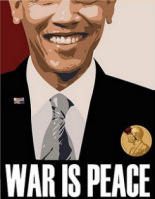 Some presidents grow in office and some presidents grow once out of office (Jimmy Carter comes to mind). But some presidents seem to learn very little during their four or eight year term. Unfortunately, especially when it comes to foreign policy, it seems President Obama falls into that latter category.
 One of those US policymakers is US Senator John McCain (R-AZ) who would say in a 2015 interview on Fox News that:

 Aletho News

