Would a Clinton Win Mean More Wars?
By Robert Parry | Consortium News | April 10, 2016
The Democratic Party establishment seems determined to drag Hillary Clinton’s listless campaign across the finish line of her race with Bernie Sanders and then count on Republican divisions to give her a path to the White House. But – if she gets there – the world should hold its breath.
If Clinton becomes President, she will be surrounded by a neocon-dominated American foreign policy establishment that will press her to resume its “regime change” strategies in the Middle East and escalate its new and dangerous Cold War against Russia.
If Bashar al-Assad is still president of Syria, there will be demands that she finally go for the knock-out blow; there will pressure, too, for her to ratchet up sanctions on Iran pushing Tehran toward renouncing the nuclear agreement; there are already calls for deploying more U.S. troops on Russia’s border and integrating Ukraine into the NATO military structure.
President Clinton-45 would hear the clever talking points justifying these moves, the swaggering tough-guy/gal rhetoric, and the tear-jerking propaganda about evil enemies throwing babies off incubators, giving Viagra to soldiers to rape more women, and committing horrific crimes (some real but many imagined) against defenseless innocents.
Does anyone think that Hillary Clinton has the wisdom to resist these siren songs of confrontation and war, even if she were inclined to?
President Barack Obama, who – for all his faults – has a much deeper and subtler intellect than Hillary Clinton, found himself so battered by these pressures from the militaristic Washington “playbook” that he whined about his predicament to The Atlantic’s Jeffrey Goldberg, himself a neocon war hawk.
The Washington foreign policy establishment is now so profoundly in the hands of the neocons and their “liberal interventionist” sidekicks that the sitting President presumably couldn’t find anyone but a neocon to give those interviews to, even as he complained about how the U.S. capital is in the hands of warmongers.
Given this neocon domination of U.S. foreign policy – especially in the State Department bureaucracy, the major media and the big think tanks – Clinton will be buffeted by hawkish demands and plans both from outside of her administration and from within.
Already key neocons, such as the Brookings Institution’s Robert Kagan, are signaling that they expect to have substantial influence over Clinton’s foreign policy. Kagan, who has repackaged himself as a “liberal interventionist,” threw his support to Clinton, who put him on a State Department advisory board.
There is also talk in Washington that Kagan’s neocon wife, Assistant Secretary of State for European Affairs Victoria Nuland, another Clinton favorite and the architect of the “regime change” in Ukraine, would be in line for a top foreign policy job in a Clinton-45 administration.
Neocons Back in Charge
So, Clinton’s election could mean that some of the most dangerous people in American foreign policy would be whispering their schemes for war and more war directly into her ear – and her record shows that she is very susceptible to such guidance.
At every turn, as a U.S. senator and as Secretary of State, Clinton has opted for “regime change” solutions – from the Iraq invasion in 2003 to the Honduras coup in 2009 to the Libyan air war in 2011 to the Syria civil war since 2011 – or she has advocated for the escalation of conflicts, such as in Afghanistan and with Iran, rather than engaging in reasonable give-and-take negotiations.
Though her backers tout her experience as Secretary of State, the reality was that she repeatedly disdained genuine diplomacy and was constantly hectoring President Obama into adopting the most violent and confrontational options.
He sometimes did (the Afghan “surge,” the Libyan war, the Iran nuclear stand-off) but he sometimes didn’t (reversing the Afghan escalation, finally negotiating a nuclear deal with Iran after Clinton left, rejecting a direct U.S. military assault on the Syrian government, and working at times with the Russians on Iran and Syria).
In other words, Obama acted as a register or brake restraining Clinton’s hawkishness. With Clinton as the President, however, she would have no such restraints. One could expect her to endorse many if not all the harebrained neocon schemes, much as President George W. Bush did when his neocon advisers exploited his fear and fury over 9/11 to guide him into their “regime change” agenda for the Middle East.
The neocons have never given up their dreams of overthrowing Mideast governments that Israel has put on its enemies list. Iraq was only the first. To follow were Syria and Iran with the idea that by installing pro-Israeli leaders in those countries, Israel’s close-in enemies – Lebanon’s Hezbollah, Hamas and other Palestinian militant groups – could be isolated and crushed.
After Bush’s Iraq invasion in 2003, Washington’s neocons were joking about whether Iran or Syria should come next, with the punch line: “Real men go to Tehran!” But the Iraq War wasn’t the “cakewalk” that the neocons had predicted. Instead of throwing flowers at the U.S. troops, Iraqis planted IEDs.
As it turned out, a lot of “real men” and “real women” – as well as “real children” – died in Iraq, including nearly 4,500 American soldiers and hundreds of thousands of Iraqis.
So the neocon timetable took a hit but, in their view, only because of Bush’s incompetent follow-through on Iraq. If not for the botched occupation, the neocons felt they could have continued rolling up other troublesome regimes, one after another.
Professionally, the neocons also escaped the Iraq disaster largely unscathed, continuing to dominate Washington’s think tanks and the op-ed pages of major American news outlets such as The Washington Post and The New York Times. Barely missing a beat, they set about planning for the longer haul.
An Obama Mistake
Although they lost the White House in 2008, the neocons caught a break when President-elect Obama opted for a Lincoln-esque “team of rivals” on foreign policy. Instead of reaching out to Washington’s marginalized (and aging) foreign policy “realists,” Obama looked to the roster of the neocon-dominated establishment.
Obama recruited his hawkish Democratic rival, Sen. Hillary Clinton, to be Secretary of State and kept Bush’s Defense Secretary Robert Gates. Obama also left in place most of Bush’s military high command, including neocon favorite, General David Petraeus.
Obama’s naïve management strategy let the neocons and their “liberal interventionist” pals consolidate their bureaucratic control of Washington’s foreign policy bureaucracy, even though the President favored a more “realist” approach that would use America’s power more judiciously — and he was less enthralled to Israel’s right-wing government.
The behind-the-scenes neocon influence became especially pronounced at Clinton’s State Department where she tapped the likes of Nuland, a neocon ideologue and an adviser to Vice President Dick Cheney, to become the department’s spokesperson and put her on track to become Assistant Secretary of State for European Affairs (although the appointment wasn’t finalized until after Clinton left in 2013).
The neocon/liberal-hawk bias is now so strong inside the State Department that officials I know who have gone there reemerge as kind of “pod people” spouting arrogant talking points in support of U.S. intervention all over the world. By contrast, I find the CIA and the Pentagon to be places of relative realism and restraint.
Perhaps the best example of this “pod people” phenomenon was Sen. John Kerry, who replaced Clinton as Secretary of State and suddenly became the mouthpiece for the bureaucracy’s most extreme war-like rhetoric.
For instance, Kerry advocated a retaliatory bombing campaign against Syria’s military in August 2013, ignoring the intelligence community’s doubts about whether President Bashar al-Assad’s regime was responsible for a sarin-gas attack outside Damascus.
Instead of listening to the intelligence analysts, Kerry fell in line behind the neocon-driven “group think” pinning the blame on Assad, the perfect excuse for implementing the neocons’ long-delayed Syrian “regime change.” The neocons didn’t care what the facts were — and Kerry fell in line. [See Consortiumnews.com’s “What’s the Matter with John Kerry?”]
But Obama didn’t fall in line. He listened when Director of National Intelligence James Clapper told him that there was no “slam dunk” evidence implicating the Syrian military. (Ultimately, the evidence would point to a provocation carried out by Islamic extremists trying to trick the U.S. military into intervening in the war on their side.)
Obama also got help from Russian President Vladimir Putin who persuaded President Assad to surrender all his chemical weapons (while Assad still denied any role in the sarin-gas attack). Putin’s assistance infuriated the neocons who soon recognized that the Obama-Putin cooperation was a profound threat to their “regime change” enterprise.
Targeting Ukraine
Some of the smarter neocons quickly identified Ukraine as a potential wedge that could be driven between Obama and Putin. Carl Gershman, president of the National Endowment for Democracy, called Ukraine “the biggest prize” and a potential first step toward driving Putin from power in Russia.
It fell to Assistant Secretary of State Nuland to shepherd the Ukraine operation to fulfillment as she plotted with U.S. Ambassador to Ukraine Geoffrey Pyatt how to remove Ukraine’s pro-Russian President Viktor Yanukovych. Nuland and Pyatt were caught in an intercepted phone call discussing who should take over.
“Yats is the guy,” Nuland said referring to Arseniy Yatsenyuk who indeed would become the new prime minister. Nuland and Pyatt then exchanged ideas how to “glue this thing” and how to “midwife this thing.” This “thing” became the bloody Feb. 22, 2014 coup ousting elected President Yanukovych and touching off a civil war between Ukrainian “nationalists” from the west and Ukraine’s ethnic Russians in the east.
As the “nationalists,” some of them openly neo-Nazis, inflicted atrocities on ethnic Russians, Crimea voted by 96 percent to leave Ukraine and rejoin Russia. Resistance to the new Kiev regime also arose in the eastern Donbas region.
To the State Department – and the mainstream U.S. news media – this conflict was all explained as “Russian aggression” against Ukraine and a “Russian invasion” of Crimea (although Russian troops were already in Crimea as part of the Sevastopol naval base agreement). But All the Important People agreed that the Crimean referendum was a “sham” (although many polls have since confirmed the results).
When citizen Clinton weighed in on the Ukraine crisis, she compared Russian President Putin to Hitler.
So, today the neocon/liberal-hawk Washington “playbook” – as Obama would call it – calls for massing more and more U.S. troops and NATO weapons systems on Russia’s border to deter Putin’s “aggression.”
These tough guys and gals also vow to ignore Russia’s warnings against what it views as military threats to its existence. Apparently “real, real men” go to Moscow (perhaps riding a nuclear bomb like the famous seen from “Dr. Strangelove.”).
Ian Joseph Brzezinski, a State Department official under President George W. Bush and now a foreign policy expert for the Atlantic Council, a NATO think tank, has co-authored an article urging NATO to incorporate Ukrainian army units into its expansion of military operations along Russia’s border.
“High-level Ukrainian national security officials have urged the international community to be bolder in its response to Russia’s provocative military actions,” wrote Brzezinski (son of old Cold Warrior Zbigniew Brzezinski) and Ukrainian co-author Markian Bilynskyj.
“The deployment of a battle tested, Ukrainian infantry company or larger unit to reinforce the defense of NATO territory in Central Europe would be a positive contribution to the Alliance force posture in the region.”
Following the Playbook
This kind of tough-talking jargon is what the next President, whoever he or she is, can expect from Official Washington. From Obama’s interview in The Atlantic, it’s clear that he feels surrounded and embattled by these warmongering forces but takes some pride in resisting – from time to time – the Washington “playbook.”
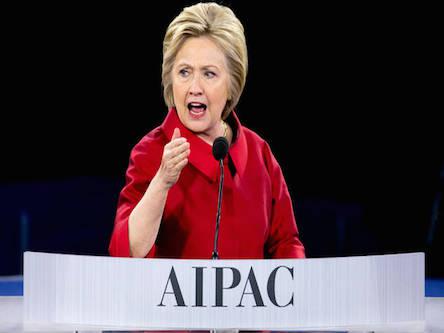
But how would President Hillary Clinton respond? When she appeared before the American Israel Public Affairs Committee on March 21 – at a moment when it appeared she had all but nailed down the Democratic nomination – Clinton showed what you might call her true colors, fawning over how loyal she would be to Israel and promising to take the very cozy relationship between the U.S. and Israel “to the next level.”
By reviewing Clinton’s public record, one could reasonably conclude that she is herself a neocon, both in her devotion to Israel and her proclivity toward “regime change” solutions. She also follows the neocon lead in demonizing any foreign leader who gets in their way. But even if she isn’t a full-fledged neocon, she often bends to their demands.
The one possible deviation from this pattern is Clinton’s personal friendship with longtime adviser Sidney Blumenthal, who was an early critic of the neoconservatives as they emerged as a powerful force during the Reagan administration. Blumenthal and his son Max have also dared criticize Israel’s abusive treatment of the Palestinians.
However, the Israel Lobby appears to be taking no chances that Sidney Blumenthal’s voice might be heard during a Clinton-45 administration. Last month, a pro-Zionist group, The World Values Network, bought a full-page ad in The New York Times to attack Blumenthal and his son and declared that “Hillary Clinton must disavow her anti-Israel advisors.”
Though Clinton might not publicly disassociate herself from Sidney Blumenthal, the preemptive strike pushed him further toward the margins and helped clear the path for the Kagan/Nuland faction to rush to the center of Clinton’s foreign policy.
Indeed, Clinton’s primary focus if she gets elected is likely to be ensuring that she gets reelected. As a traditional politician, she would think that the way to achieve reelection is to stay on the good side of the Israeli leadership. Along those lines, she promised AIPAC that, as President, she would immediately invite Prime Minister Benjamin Netanyahu to the White House.
So, what would happen if Clinton takes the U.S.-Israeli relationship “to the next level”? Presumably that would mean taking a super-hard line against Iran over last year’s nuclear deal. Yet, already Iran is questioning whether its acceptance of extraordinary constraints on its nuclear program was worth it, given the U.S. unwillingness to grant meaningful relief on economic sanctions.
A belligerent Clinton approach – decrying Iran’s behavior and imposing new sanctions – would strengthen Iran’s hard-line faction internally and might well lead to Iran renouncing the agreement on the grounds of American bad faith. That, of course, would please the neocons and Netanyahu by putting the “bomb-bomb-bomb Iran” option back in play.
A Stunning Reversal
Clinton may have viewed her AIPAC speech as the beginning of her long-awaited “pivot to the center,” but afterwards she suffered a string of primary and caucus defeats at the hands of Sen. Bernie Sanders, most by landslide margins.
Besides those stunning defeats, Clinton’s campaign clearly has an “enthusiasm gap.” Sanders, the 74-year-old “democratic socialist” from Vermont, draws huge and excited crowds and wins younger voters by staggering percentages. Meanwhile, Clinton confronts polls showing high negatives and extraordinary public distrust.
If she gets the Democratic nomination, she may have little choice but to engage in a fiercely negative campaign since — faced with the lack of voter enthusiasm — her best chance of winning is to so demonize her Republican opponent that Democrats and independents will be driven to the polls out of fear of what the crazy GOP madman might do.
Right now, many Clinton supporters see her as the “safe” — not exciting — choice, a politician whose long résumé gives them comfort that she must know what’s she’s doing. African-American voters, who have been her most loyal constituency, apparently feel more comfortable with someone they’ve known (who has also served in the Obama administration) than Sanders who is unknown to many and is seen as someone whose ambitious programs appear less practical than Clinton’s small-bore ideas.
But a look behind Clinton’s résumé, especially her reliance on “regime change” and other interventionist schemes in the Middle East and Eastern Europe, might give all peace-loving voters pause. [See Consortiumnews.com’s “Is Hillary Clinton ‘Qualified’?”]
Savvy neocons, like Robert Kagan, have long understood that Clinton could be their Trojan Horse, pulled into the White House by Democratic voters. Kagan told The New York Times, “I feel comfortable with her on foreign policy. If she pursues a policy which we think she will pursue it’s something that might have been called neocon, but clearly her supporters are not going to call it that; they are going to call it something else.”
The same Times article noted that Clinton “remains the vessel into which many interventionists are pouring their hopes.” However, if she is that “vessel” carrying a neocon foreign policy back into the White House, this “safe” choice might prove dangerous to America and the world.
Investigative reporter Robert Parry broke many of the Iran-Contra stories for The Associated Press and Newsweek in the 1980s. You can buy his latest book, America’s Stolen Narrative, either in print here or as an e-book (from Amazon and barnesandnoble.com).
April 10, 2016 Posted by aletho | Ethnic Cleansing, Racism, Zionism, Mainstream Media, Warmongering, Militarism, Timeless or most popular, War Crimes, Wars for Israel | AIPAC, Hillary Clinton | Leave a comment
Is Hillary Clinton ‘Qualified’?
By Robert Parry | Consortium News | April 8, 2016
Former Secretary of State Hillary Clinton has dismissed Sen. Bernie Sanders questioning her qualifications to be President as “silly” – and looking at her résumé alone, she’d be right – but there is also the need to judge her performance in her various jobs.
What is troubling about Clinton’s record is that she has left behind a trail strewn with failures and even catastrophes. Indeed, her highest profile undertakings almost universally ended in disaster – and a person’s record should matter when voters are deciding whether to entrust him or her with the most powerful office on earth.
In other words, it’s not just a question of her holding one prestigious job or another; it’s also how well she did in those jobs. Otherwise, you have a case of the Peter Principle Squared, not just letting someone rise to the level of his or her incompetence, but in Clinton’s case, continuing to get promoted beyond her level of incompetence.
So, looking behind Clinton’s résumé is important. After all, she presents herself as the can-do candidate who will undertake small-scale reforms that may not move the needle much but are better than nothing and may be all that’s possible given the bitterly divided Congress.
But is Hillary Clinton really a can-do leader? Since she burst onto the national scene with her husband’s presidential election in 1992, she has certainly traveled a lot, given many speeches and met many national and foreign leaders – which surely has some value – but it’s hard to identify much in the way of her meaningful accomplishments.
Clinton’s most notable undertaking as First Lady was her disastrous health insurance plan that was concocted with her characteristic secrecy and then was unveiled to decidedly mixed reviews. Much of the scheme was mind-numbing in its complexity and – because of the secrecy – it lacked sufficient input from Congress where it found few enthusiastic supporters.
Not only did the plan collapse under its own weight, but it helped take many Democratic members of Congress with it, as the Republicans reversed a long era of Democratic control of the House of Representatives in 1994. Because of Hillary Clinton’s health-care disaster, a chastened Democratic Party largely took the idea of providing near-universal health-insurance coverage to Americans off the table for the next 15 years.
In Clinton’s next career as a senator from New York, her most notable action was to enthusiastically support President George W. Bush’s Iraq War. Clinton did not just vote to authorize the war in 2002, she remained a war supporter until 2006 when it became politically untenable to do so, that is, if she had any hope of winning the Democratic presidential nomination against anti-war Sen. Barack Obama.
Both in her support for the war in the early years and her politically expedient switch – along with a grudging apology for her “mistake” – Clinton showed very little courage.
When she was supporting the war, the post-9/11 wind was at Bush’s back. So Clinton joined him in riding the jingoistic wave. By 2006, the American people had turned against the war and the Republican Party was punished at the polls for it, losing control of Congress. So it was no profile-in-courage for Clinton to distance herself from Bush then.
Not Learning Lessons
Still, Clinton seemed to have learned little about the need to ask probing questions of Bush’s team. In November 2006, she completely misread Bush’s firing of Defense Secretary Donald Rumsfeld and replacing him with ex-CIA Director Robert Gates. Serving on the Senate Armed Services Committee, Clinton bought the conventional wisdom that Gates’s nomination meant that Bush was winding down the Iraq War despite warnings that it actually meant the opposite.
If Clinton had done any digging, she could have discovered that Rumsfeld was dumped not because of his warmongering but because he backed his field generals – George Casey and John Abizaid – who wanted to rapidly shrink the U.S. military “footprint” in Iraq. But Bush and his neocon advisers saw that as effectively an admission of defeat, so they got rid of Rumsfeld and recruited the more malleable Gates to front for their planned escalation or “surge.”
Not only did Consortiumnews.com spell out that reality in real time, but it also was explained by right-wing pundit Fred Barnes in the neocon Weekly Standard. As Barnes wrote, Gates “is not the point man for a boarding party of former national security officials from the elder President Bush’s administration taking over defense and foreign policy in his son’s administration. … Rarely has the press gotten a story so wrong.”
Barnes reported instead that the younger George Bush didn’t consult his father and only picked Gates after a two-hour face-to-face meeting at which the younger Bush got assurances that Gates was onboard with the neocon notion of “democracy promotion” in the Middle East and shared Bush’s goal of victory in Iraq. [The Weekly Standard, Nov. 27, 2006]
But the mainstream press — and much of Official Washington — loved the other storyline. A Newsweek cover pictured a large George H.W. Bush towering over a small George W. Bush. Embracing this conventional wisdom, Clinton and other Senate Armed Services Committee members brushed aside the warnings about Gates, both his troubling history at the CIA and his likely support for a war escalation.
In his 2014 memoir, Duty, Gates reflects on his 2006 nomination and how completely clueless Official Washington was. Regarding the conventional wisdom about Bush-41 taking the reins from Bush-43, Gates wrote about his recruitment by the younger Bush: “It was clear he had not consulted his father about this possible appointment and that, contrary to later speculation, Bush 41 had no role in it.”
Regarding the mainstream news media’s wrongheaded take on his nomination, Gates wrote: “There was a lot of hilarious commentary about a return to ‘41’s’ team, the president’s father coming to the rescue, former secretary of state Jim Baker pulling all the strings behind the scenes, and how I was going to purge the Pentagon of Rumsfeld’s appointees, ‘clean out the E-Ring’ (the outer corridor of the Pentagon where most senior Defense civilians have their offices). It was all complete nonsense.”
Though Gates doesn’t single out Hillary Clinton for misreading the significance of his nomination, Gates wrote: “The Democrats were even more enthusiastic, believing my appointment would somehow hasten the end of the war. … They professed to be enormously pleased with my nomination and offered their support, I think mainly because they thought that I, as a member of the Iraq Study Group [which had called for winding down the war], would embrace their desire to begin withdrawing from Iraq.”
In other words, Hillary Clinton got fooled again.
Surging for Surges
Once installed at the Pentagon, Gates became a central figure in the Iraq War “surge,” which dispatched 30,000 more U.S. troops to Iraq in 2007. The “surge” saw casualty figures spike. Nearly 1,000 additional American died along with an untold number of Iraqis. And despite another conventional wisdom about the “successful surge” it failed to achieve its central goal of getting the Iraqis to achieve compromises on their sectarian divisions.
Yet, the mainstream press didn’t get any closer to the mark in 2008 when it began cheering the Iraq “surge” as a great success, getting spun by the neocons who noted a gradual drop in the casualty levels. The media honchos, many of whom supported the invasion in 2003, ignored that Bush had laid out specific policy goals for the “surge,” none of which were achieved.
In Duty, Gates reminds us of those original targets, writing: “Prior to the deployment, clear benchmarks should be established for the Iraqi government to meet during the time of the augmentation, from national reconciliation to revenue sharing, etc.”
Those benchmarks were set for the Iraqi government to meet, but the goals were never achieved, either during the “surge” or since then. To this day, Iraq remains a society bitterly divided along sectarian lines with the out-of-power Sunnis again sidling up to Al Qaeda-connected extremists and even the Islamic State.
But Clinton didn’t have the courage or common sense to recognize that the Iraq War “surge” had failed. After Obama appointed her as Secretary of State – as part of a naïve gesture of outreach to a “team of rivals” – Clinton fell back in line behind Official Washington’s new favorite conventional wisdom, the “successful surge.”
In the end, all the Iraq War “surge” did was buy President Bush and his neocon advisers time to get out of office before the failure of the Iraq War became obvious to the American public. Its other primary consequence was to encourage Defense Secretary Gates, who was kept on by President Obama as a gesture of bipartisanship, to conjure up another “surge” for Afghanistan.
In that context, in Duty, Gates recounts a 2009 White House meeting regarding the Afghan War “surge.” He wrote: “The exchange that followed was remarkable. In strongly supporting the surge in Afghanistan, Hillary told the president that her opposition to the surge in Iraq had been political because she was facing him in the Iowa primary [in 2008]. She went on to say, ‘The Iraq surge worked.’
“The president conceded vaguely that opposition to the Iraq surge had been political. To hear the two of them making these admissions, and in front of me, was as surprising as it was dismaying.” Obama’s aides disputed Gates’s suggestion that the President indicated that his opposition to the Iraq “surge” was political, noting that he had always opposed the Iraq War. The Clinton team never challenged Gates’s account.
In other words, having been an Iraq War hawk when it mattered – from 2002-06 – Hillary Clinton changed direction when that was politically expedient, apologizing for her “mistake,” but then returned to her enthusiasm for the war by accepting the benighted view that the “surge worked.”
Clinton’s enthusiasm for “surges” also influenced her to side with Gates and General David Petraeus, a neocon favorite, to pressure Obama into a “surge” for Afghanistan, sending in an additional 30,000 troops on a bloody, ill-fated “counterinsurgency” mission. Again, the cost in American lives was about 1,000 soldiers but their sacrifice did little to shift the war’s outcome.
Winning Praise
Again and again, Hillary Clinton seemed incapable of learning from her costly errors – or perhaps she just understands that the politically safest course is to do what Washington’s neocon-dominated foreign policy establishment wants done. That way you get hailed as a serious thinker in the editorial pages of The Washington Post and at the think-tank conferences.
Virtually all the major columnists and big-name pundits praised Clinton’s hawkish tendencies as Secretary of State, from her escalating tensions with Iran to tipping the balance of the Obama administration’s debate in favor of a “regime change” mission in Libya to urging direct U.S. military intervention in Syria in pursuit of another “regime change” there.
On the campaign trail, Clinton seeks to spin all these militaristic recommendations as somehow beneficial to the United States. But the reality is quite different.
Regarding Iran, in 2010, Secretary Clinton personally killed a promising initiative sponsored by Brazil and Turkey (at President Obama’s request) to get Iran to swap much of its low-enriched uranium for radiological medical tests. Instead, Clinton followed the path laid out by Israel and the neocons, ratchet up pressure on Iran and keep open the “bomb-bomb-bomb Iran” option.
It is noteworthy that the diplomatic agreement with Iran to restrain its nuclear program and to give up much of its low-enriched uranium required Clinton’s departure from the State Department in 2013. I’m told that Obama understood that he needed to get her out of the way for the diplomacy to work.
But Clinton’s signature project as Secretary of State was another war of choice, this time the “regime change” in Libya resulting in the grisly murder of Colonel Muammar Gaddafi in 2011 and the descent of Libya into a failed state beset with terrorism, including the killing of Ambassador Christopher Stevens and three other U.S. diplomatic personnel in Benghazi on Sept. 11, 2012, and more recently the emergence of the Islamic State.
Clinton and her “liberal interventionist” allies sold the Libyan war as a “responsibility to protect” mission – or R2P – but the propaganda about Gaddafi’s supposed plans for “genocide” against the Libyan people was wildly exaggerated and fit with a long and sorry pattern of U.S. officials deceiving the U.S. public. [For more details, see Consortiumnews.com’s “Covering Up Hillary’s Libyan Fiasco.”]
Taking Credit
According to all accounts, Obama was on the fence about the wisdom of joining European nations in undertaking the Libyan “regime change” and it was Secretary Clinton who tipped his decision toward going to war. The U.S. military then provided the crucial technological infrastructure for the war to go forward. Without the U.S. involvement, the “regime change” in Libya wouldn’t have happened.
As the conflict raged, Clinton’s State Department email exchanges revealed that her aides saw the Libyan war as a chance to pronounce a “Clinton doctrine,” bragging about how Clinton’s clever use of “smart power” could get rid of demonized foreign leaders like Gaddafi. But President Obama seized the spotlight when Gaddafi’s government fell.
But Clinton didn’t miss a second chance to take credit on Oct. 20, 2011, after militants captured Gaddafi, sodomized him with a knife and then murdered him. Appearing on a TV interview, Clinton celebrated Gaddafi’s demise with the quip, “we came; we saw; he died.”
However, with Gaddafi and his largely secular regime out of the way, Islamic militants expanded their power over the country. Many, it turned out, were terrorists, just as Gaddafi had warned. Some were responsible for killing Ambassador Stevens.
Over the next five years, Libya – a once prosperous North African country – descended into anarchy with dozens of armed militias and now three competing governments jockeying for power. Meanwhile, the Islamic State expanded its territory around the city of Sirte and engaged in its signature practice of beheading “infidels,” including a group of Coptic Christians slaughtered on a beach.
Yet, on the campaign trail, Clinton continues to defend her instigation of the Libyan war, disputing any comparisons between it and the Iraq War by rejecting any “conflating” of the two. Yet, the two disasters – while obviously having some differences – do deserve to be conflated because they have many similarities. Both were wars of choice justified by false and misleading claims and having terrible outcomes.
Clinton’s rejection of “conflating” the two wars has another disturbing element to it, the suggestion that she is incapable of extracting lessons from one situation and applying them to another. That inability to analyze, engage in self-criticism, and thus avoid repeating the same mistakes may indeed be a disqualifying characteristic for someone seeking the U.S. presidency.
So, is Hillary Clinton “qualified” to be President of the United States? While her glittering résumé may say one thing, her record – a litany of misjudgments, miscalculations and catastrophes – may say something else.
[For information about Hillary Clinton’s earlier career, see Consortiumnews.com’s “Clinton’s Experience: Fact and Fantasy.”]
Investigative reporter Robert Parry broke many of the Iran-Contra stories for The Associated Press and Newsweek in the 1980s. You can buy his latest book, America’s Stolen Narrative, either in print here or as an e-book (from Amazon and barnesandnoble.com).
April 9, 2016 Posted by aletho | Deception, Militarism, Timeless or most popular, War Crimes, Wars for Israel | Afghanistan, Hillary Clinton, Iraq, Libya, Robert Gates, United States, Zionism | Leave a comment
Location Location Location: The Unintended Symbolism of the White House Haft-Sîn
White House Nowruz, 2015
By Nima Shirazi | Wide Asleep In America | April 8, 2016
This week, Michelle Obama hosted the second annual White House Nowruz, a celebration of the Iranian New Year. Though a relatively apolitical affair, the placement of the reception’s traditional haft-sîn, however, should have raised some eyebrows.
Nowruz, which literally means “new day” in Farsi, is an ancient festival of new beginnings, deeply rooted in Zoroastrianism, celebrating the first day of Spring and the Persian calendar.
Of the myriad traditions and festivities associated with Nowruz, the most universally recognizable may be that of the haft-sîn (هفت سین), a table arrangement decorated with seven (haft) items – each beginning with the Persian letter S (sîn) – and symbolizing renewal, reconciliation, good luck, and prosperity.
The shindig, MC’ed by comedian Maz Jobrani and catered by renowned Persian chef Najmieh Batmanglij, was held on April 6 – a few days after the official holiday season (which lasts roughly 13 days) had actually ended.
The White House, naturally, had its own haft-sîn on display at its Nowruz party. However, its location in the East Room, where the celebration has been held both years, was a bit curious and (probably) unintentionally laden with symbolism all its own.
Nowruz-sevelt
The table containing such traditional items as wheat grass (sabzeh), garlic (sīr), vinegar (serkeh), apple (seeb), wheat germ pudding (samanu), sumac berries (somaq), and dried fruit (senjed) was placed – as it was last year as well – right beneath John Singer Sargent’s 1903 presidential portrait of Theodore Roosevelt.
A haft-sîn in the White House’s East Room, on April 6, 2016.
One of the principal promoters of American imperialism at the end of the 19th century and in the first decade of the 20th, Roosevelt once wrote, “I should welcome almost any war, for I think this country needs one.” It is said he carried around a list of six target nations on three continents.
In December 1904, Roosevelt issued his official Corollary to the Monroe Doctrine, declaring that the United States would not hesitate to use what he called its “international police power” to destroy and replace regimes deemed hostile to American interests. Though initially used to justify military intervention, invasion and occupation of Western Hemisphere nations such as Cuba, Nicaragua, Honduras, Haiti, and the Dominican Republic, Roosevelt sent a similar message to the entire world in late 1907, when he deployed the nation’s Great White Fleet to circumnavigate the globe in a show of power. The fleet consisted of 16 battleships and support vessels, crewed by 14,000 sailors. It sailed for 14 months, covering over 43,000 miles and made twenty port calls on six different continents.
Just as it is common practice today for U.S. presidents to deliver Nowruz remarks to the people, and sometimes leaders, of Iran, in the late 19th and early 20th centuries “American presidents were encouraged to exchange telegrams with the Shah of Iran on the occasion of the Persian New Year’s Day.”
“In 1902,” note scholars Kamran Scot Aghaie and Afshin Marashi, “President Theodore Roosevelt even presented the Shah of Iran, Muzaffar al-Din, and his brother, Zill al-Sultan, with a copy of his book, Hunting Trips of a Ranchman, recognizing that hunting was a favorite pastime of the Persian royal family as well.”
At the time, Iranian leaders saw the United States – which had no imperial presence in the Middle East at that point – as a potential non-interventionist ally against persistent Russian and British encroachment on Iranian sovereignty. Following the Iranian Constitutional Revolution in 1906, Russia and Britain both occupied Iran in 1907 in an effort to dissolve the parliament and prop up the waning Qajar dynasty, dividing the country between them until 1911. Roosevelt remained neutral, however, a position subsequently maintained by Taft and all successive U.S. administrations through World War II, when Russia and the United Kingdom again invaded and occupied Iran to secure wartime supply routes for the Allied Powers and replaced the then Shah, Reza Pahlavi, with his son, Mohammad Reza Pahlavi.
Kermit’s Coup
On August 19, 1953, Iranian Prime Minister Mohammad Mossadegh was overthrown in a military coup planned and orchestrated by the United States and Britain after nationalizing Iran’s oil industry. Pro-Shah riots were staged, hundreds were killed, newspapers supportive of Mossadegh were ransacked and shuttered, and the prime minister was arrested and tried for treason.
The main architect of the coup, executed at the behest of British petroleum interests and under the guise of pro-active anti-communism, was the chief of the CIA’s Near East and Africa division, Kermit Roosevelt, Jr. – grandson of President Teddy Roosevelt.
The ouster of Mossadegh, and the reinstallation of the Shah, by American intelligence operatives is a seminal moment in Iranian history and political consciousness, setting the stage for a quarter-century of tyrannical dictatorship propped up by torture, corruption and U.S. military aid, as well as establishing the United States as an interventionist power in the region. Popular backlash against the Shah, and his American backers, culminated in his overthrow by the Iranian Revolution, and the establishment of an Islamic Republic in 1979.
Roosevelt’s Shadow
By honoring Iranian culture with a haft-sîn table set under the watchful gaze of Teddy Roosevelt – the godfather of American military intervention and the grandfather of the man responsible for Operation Ajax in 1953 – the White House is unwittingly sending a message of continued hostility and imperial hubris toward Iran.
In his annual Nowruz message, delivered right before his historic trip to Cuba, President Obama said that, “even after decades of mistrust, it is possible for old adversaries to start down a new path.” At a time when Iran is fully upholding its end of the nuclear accord, while the residual effects of U.S. sanctions continue to cause problems for Iranians, optics remain important.
One possible step on the path to better relations would be to move the haft-sîn to the other side of the room.
April 9, 2016 Posted by aletho | Militarism, Progressive Hypocrite, Timeless or most popular | Iran, Obama, Teddy Roosevelt, United States | Leave a comment
Plutonium mess: SC wrangling with DOE over nuclear waste facility, Russia grows angry
RT | April 8, 2016
Despite concessions from the Department of Energy, South Carolina has no intention of dropping its lawsuit against the DOE for failing to build a nuclear waste disposal plant. The delay is also scuppering a deal the US made to treat Russia’s plutonium.
Approved by Congress as far back as 1998, the Savannah River Site’s Mixed Oxide Fuel Fabrication Facility, or MOX, is designed to turn weapons-grade plutonium into power plant reactor fuel. Moscow and Washington signed a deal in 2000 under which 34 tons of nuclear waste would be shipped from Russia and then processed at the facility.
Since then, everything has gone wrong for MOX. The project’s cost was initially estimated at $1.7 billion, but by 2013 it had risen to $7.7. In addition, approximately $5 billion, three times the original estimate, has already been spent since construction began in 2007. South Carolina Senator Lindsey Graham and contractors working on the project say it is currently 70 percent complete.
However, MOX was never favored by the Obama administration. When the US president came to power, he ordered the closure of the proposed facility to make way for an alternative plant in New Mexico, which would use a cheaper processing method known as dilution and disposal. The DOE also maintains that MOX is only 40 percent complete and would cost $1 billion a year to operate.
“We are in a situation where the MOX approach has extreme uncertainties,” Energy Secretary Ernest Moniz told a Senate Appropriations Subcommittee last month. Moniz said previously that the Russian contract could be moved to the New Mexico facility.
The stakes were raised after a clause in the contract between the state and the federal government was activated at the beginning of the year, when the government failed to remove one ton of plutonium from South Carolina as stipulated. The fine for the delay is $1 million per day, with a cap of $100 million.
South Carolina is now lodging a lawsuit to recover the money from the federal budget and make sure that MOX is completed.
The DOE has attempted to compromise by offering to remove 6 tons of plutonium unrelated to the Russian deal, but South Carolina Governor Nikki Haley says the state will not abandon its legal claim, as “the DOE has not lived up to promises made in the past.”
‘Not what we agreed on,’ says Putin
While South Carolina squeezes from one side, Washington is also facing mounting pressure from Russia on the other.
On Thursday, Vladimir Putin voiced Moscow’s growing frustration, both with the delay and the US’ decision to turn to dilution and disposal.
“We signed an agreement that the plutonium will be processed in a certain way, for which facilities would be purpose built,” the Russian President said during a media session. “We have met our commitments, and constructed the necessary facilities. The US has not.”
For Russia, the use of a cheaper processing method constitutes a breach of contract.
“With the dilution and disposal method, the nuclear fuel retains its breakout potential, so it can extracted, processed and weaponized again. That is not what we agreed on,” said Putin, who personally oversaw the signing of the original deal during his first term as the Russian President.
Despite Putin’s unequivocal rhetoric, Washington officials have been maintaining their best poker faces so far.
“Accommodating a new US method would not require renegotiation of the agreement. We will not speculate on Russian intentions behind the reported remarks,” said State Department spokesperson Jennifer Bavisotto on Friday.
April 9, 2016 Posted by aletho | Environmentalism, Militarism, Nuclear Power | MOX, Russia, United States | Leave a comment
The Return of the Brutal Savage and the Science for War
By Stephen Corry | CounterPunch | April 8, 2016
The last few years have seen an alarming increase in claims that tribal peoples have been shown to be more violent than we are. This is supposed to prove that our ancestors were also brutal savages. Such a message has profound implications for how we view human nature – whether or not we see war as innate to the human condition and so, by extension, broadly unavoidable. It also underpins how industrialized society treats those it sees as “backward.” In reality though it’s nothing more than an old colonialist belief, masquerading once again as “science.” There’s no evidence to support it.
The American anthropologist, Napoleon Chagnon, is invariably cited in support of this brutal savage myth. He studied the Yanomami Indians of Amazonia from the 1960s onwards (he spells the tribe “Yanomamö”) and you’d be hard pressed to find a book or article on tribal violence which doesn’t refer to his work. Popular writers such as Steven Pinker and Jared Diamond frequently make much of Chagnon’s thesis, so it’s worth giving a thumbnail sketch of why in reality it proves little about the Yanomami, and nothing about human evolution.
First, it’s important to dispatch a red herring from the murky cauldron being cooked up by the brutal savage promoters: They often point to Darkness in El Dorado, a book by Patrick Tierney, which attacked Chagnon’s work, but went too far. Tierney raised the possibility that one of Chagnon’s colleagues may have deliberately introduced a deadly measles epidemic to the Indians. That simply wasn’t true: In fact, the epidemic was inadvertently started by American missionaries. That Tierney was wrong on this single point is now used to claim that all his and other writers’ criticisms of Chagnon have been discredited. They haven’t. In any case, were a single error deemed to negate a whole thesis, then pretty much all science, as well as journalism, the law and a lot else, falls apart.
Anyway, let’s set Tierney aside. For decades, Napoleon Chagnon’s findings have been rejected by almost all of the many other anthropologists who have worked with the Yanomami, and in most countries his work simply isn’t taught. He had rather faded from anthropology in the United States too, until his recent resurgence as the darling of establishment attitudes.
According to Chagnon, brutality is a key driver of human evolution. How did he come upon such a disturbing “discovery”? Basically, he counted how many Yanomami men boasted that they were unokai and he told us this means they’ve killed people. He then crunched the numbers to show that unokai are similarly successful in love as they are in war, and that by fathering more children than non-killers, they ensure the next generation is as murderous as they are.
As with any sweeping conclusion in human sciences, there are numerous known unknowns. For example, did Yanomami raiding in the 1960s increase through growing pressure from settler or missionary incursions? (After all, Chagnon used the extremist New Tribes Mission to get into the Yanomami.) Did the influx of outside trade goods, including guns, play a role? Such impacts are difficult to analyze, though some believe they were clearly significant.
But the most significant fact, the extraordinary single error that, in this case, does destroy Chagnon’s thesis in one swoop, is something Chagnon doesn’t tell us – unokai does not just mean “killer.” It’s also the status claimed by everyone who’s ever shot an arrow into a dead body during an inter-village raid (most raids stop after one killing). It describes many other individuals as well, including men who’ve killed an animal thought to be a kind of shamanic embodiment of a human, as well as stay-at-homes who try and cast lethal spells. It even includes those who’ve participated in a ritual during their future wife’s puberty (she also becomes unokai). In other words, many unokai haven’t killed anyone. With this simple fact, every one of Chagnon’s conclusions about “killers” falls apart.
But supposing he was right after all, what would his figures show? What percentage of the population are we talking about? Here the brew gets fishier: Chagnon plays fast and loose with his own data. His autobiography, “Noble Savages,” says that “killers” number “approximately 45 percent of all the living adult males.” Yet even according to his own (shaky) data, that is simply not true: Chagnon’s own figures do not show that 45 percent of men are unokai. He has grossly inflated his percentage by ignoring everyone younger than 25, an age group with far fewer claiming unokai status. Were they included, his percentage would plummet.
Chagnon has been asked about this manipulation for years. When he bothers to reply, he claims he’ll publish new supporting data. We’re still waiting.
So there you have it: That’s the poster boy of the “scientific proof” behind the myth of the brutal savage. The fact that Chagnon’s thesis has been repeatedly demolished in scholarly publications for decades is simply ignored by those who want him to be right. For them to dismiss the many Chagnon critics, to pretend that science is on their side, and to chorus sneeringly “noble savages” whenever Chagnon is criticized, is just facile propaganda.
By the way, if you want to know how many unokai (supposed “killers”) Chagnon managed to winkle out during a quarter century of fieldwork with one of Amazonia’s largest tribes – numbering several thousand – the answer is just 137 men. They could all comfortably fit into a single car on the New York subway. How many of those were actually killers? We’ll never know.
That’s the size of the sample group supposedly proving that tribal peoples live in a state of chronic warfare and, by throwing in more red herrings, that our ancestors did so too. The latter assertion is widely promulgated. It goes like this: The Yanomami are a small-scale tribal (non-state) hunting society, our ancestors were the same, so the Yanomami can teach us about our ancestors because they live in a similar way. And yet the theory fails on several points: For example, no one knows the degree to which our distant ancestors scavenged for meat, rather than actively hunted it. That’s quite a different approach to life, and the Yanomami wouldn’t dream of doing it. In any case, a moment’s informed reflection tells you that no one who inhabited the ice age plains of Eurasia, for example, lived remotely like the tropical rainforest Yanomami of Chagnon’s 1960s.
The real story is more obvious, prosaic and simpler than the Chagnon-created “fierce people” and their supposed “chronic” warfare. The truth is that there are some tribal peoples who have a belligerent reputation, others known for avoiding violence as much as possible, and lots in between. That’s nothing to do with any grasping at mythic noble savages, it’s what anthropologists have actually found.
Despite the growing mythology, the archeological record reveals very little evidence of past violence either (until the growth of big settlements, starting around 10,000 years ago). Researchers Jonathan Haas and Matthew Piscitelli studied descriptions of 2,930 earlier skeletons from 900 different sites worldwide.[1] Apart from a single massacre site of two dozen people in the Sudan, they found “but a tiny number of cases of violence in skeletal remains,” and noted how just four sites in Europe “are mentioned over and over by multiple authors” striving to demonstrate the opposite of what the evidence actually reveals. The archeological record before 10,000 years ago, they conclude, in fact “shows that warfare was the rare exception.”
Much of the other “proof” for the brutal savage advanced by Steven Pinker, Jared Diamond, and other champions of Chagnon, is rife with the selection and manipulation of facts to fit a desired conclusion.
To call this “science” is both laughable and dangerous. These men are desperate to persuade us that they’ve got “proof” for their opinions, which isn’t surprising as they’re nothing more – opinions based on a narrow and essentially self-serving political point of view. They have proved nothing, except to those who want to believe them.
Does it matter? Yes, very much. How we think of tribal peoples dictates how we treat them. Proponents of Chagnon seek to reestablish the myth of the brutal savage which once underpinned colonialism and its land theft. It’s an essentially racist fiction which belongs in the 19th century and, like a flat earth, should have been discarded generations ago. It’s the myth at the heart of the destruction of tribal peoples and it must be challenged.
It’s not just deadly for tribal peoples: It’s dangerous for all of us. False claims that killing is a proven key factor in our evolution are used to justify, even ennoble, the savagery inherent in today’s world. The brutal savage may be a largely invented creature among tribal peoples, but he is certainly dangerously and visibly real much closer to home.
Notes.
[1] See also, http://blogs.scientificamerican.com/cross-check/10-000-year-old-massacre-does-not-bolster-claim-that-war-is-innate/
April 9, 2016 Posted by aletho | Deception, Militarism, Science and Pseudo-Science, Timeless or most popular | Napoleon Chagnon | Leave a comment
Hybrid Wars 4. In the Greater Heartland (III)
By Andrew KORYBKO | Oriental Review | April 8, 2016
(Please read Part I and Part II prior to this article)
Turkmenistan:
The threat facing Turkmenistan is less of a Color Revolution than an Unconventional War. The catalyst for this conflict would be a terrorist invasion coming from Afghanistan that unexpectedly sweeps northwards along the Murgab River. Such an offensive doesn’t even have to reach the national capital in order to be successful, since all that it really needs to do is capture the city of Mary, the capital of the resource-rich Mary Region. This part of the country contains the lion’s share of Turkmenistan’s gas reserve, which includes the massive and decades-long functioning Dauletabad Field and the newly discovered Galkynysh Field, the latter being the world’s second-largest find.
It wouldn’t be all that difficult for terrorists to take over this plot of land either, since the Murgab River is scattered with tiny villages along its banks that could provide cover from government airstrikes and places to provoke pitched battles from. The fertile land nearby is endowed with agricultural potential that’s surely being stored somewhere closely accessible, and this could help feed the occupying forces until greater conquests are made. In short, the Murgab River is the most militarily and logistically sustainable route for an ISIL-like invasion of Turkmenistan, and it leads straight to the gas heart of Eurasia that’s critically connected to China and will possibly be linked to India in the coming decade as well.
The risk of terrorists gaining control of the largest source of China’s gas imports and possibly even destroying the facilities is too much for multipolar strategists in Beijing and Moscow to bear, and it’s assured that they’ve already engaged in some sort of unofficial contingency planning with their counterparts in Ashgabat. An anti-terrorist Chinese intervention is largely precluded due to geographic distances and a lack of support and logistics facilities en route, but the Russian military has no such hindrances and would be much more likely to assist the Turkmen authorities if called upon to do so. This is of course a last resort and would only be commissioned if Turkmenistan proves itself unable to stem the terrorist tide and defend its gas infrastructure, but such an event is most assuredly being planned for just in case the Turkmen-Afghan border proves to be just as fragile of a defense against terrorists as the Syrian-Iraqi one was before it.
Kazakhstan:
Kazakhstan and the other three remaining states of former Soviet Central Asia are greatly at risk of a “Central Asian Spring” breaking out in the Fergana Valley, and Part IV of the Greater Heartland series will focus exclusively on this ever likely scenario. Accordingly, the rest of this section will explore the other Hybrid War vulnerabilities facing these four countries.
The geographically largest state in the Greater Heartland region is surprisingly immune from many of the conventional socio-political factors that lead to Hybrid Wars (excluding the variables that will later be discussed about the “Central Asian Spring”). If one was blind to the domestic and international contexts pertinent to Kazakhstan, then they’d be inclined to believe that the Russian population constitutes the greatest threat to the country’s sovereignty, although this couldn’t be anywhere further from the truth. Theoretically speaking, this demographic satisfies all of the criteria necessary for sparking a Hybrid War, but Kazakhstan’s multipolar alignment with the Eurasian Union and respectful treatment of this influential minority group precludes any chances that they or Russia would ever try to move forward with this scenario. On the reverse, the very inclusion of such a large Russian minority within Kazakhstan ties Astana and Moscow closer together than just about any other state in the former Soviet Union and works to enhance, not deteriorate, relations between them.
The only vulnerability in this relatively secure setup is if the US and its proxy NGO affiliates succeed in brainwashing the Russian-Kazakh population with Pravy Sektor- and Navalny-esque extreme nationalism, which could then create a delicate geopolitical situation where the raucous Russian minority agitates against Astana and attempts to drive a wedge between Kazakhstan and Russia. Security officials in both states are likely well aware of this obvious scenario and can be predicted to have rehearsed coordinated contingency measures for responding to it. Nonetheless, if such a virulent, discriminatory, and destructive ideology as “Greater Russian Nationalism” is allowed to fester in multicultural Kazakhstan and parts of the Russian Federation itself, then a scandalous outbreak in the Near Abroad could provoke a simultaneous cross-border event inside of Russia, especially if ‘sleeper sympathizers’ organize anti-government protests against Moscow’s “betrayal” of its compatriots out of its refusal to replicate the Crimean scenario in Northern Kazakhstan.
Another destabilization possibility that mustn’t be discounted in Kazakhstan is a repeat of the Zhanaozen riots, the ‘localized’ Color Revolution attempt that was sparked by a simmering labor dispute in 2011. The oil field workers were fed up with what they complained to be poor working conditions, low wages, and unpaid salaries, and this created an attractive atmosphere for Color Revolutionaries to exploit. Keeping with Color Revolution tradition, the riots started on 16 December, the 20th anniversary of Kazakh independence, and were presumably expected to signal the beginning of the regime change attempt to other cells across the country, almost one year to the day that the “Arab Spring” Color Revolution first broke out in Tunisia.
Seething with preexisting anger, the workers were extraordinarily easy to exploit, and the carnage they committed killed over a dozen people and injured more than 100 before a state of emergency and necessary military intervention restored order. The authorities’ decisive reaction and the multicultural, patriotic identity of most Kazakhs can be credited with preventing the spread of the Color Revolution virus from the distant Turkmen border all the way to centrally located capital, but the strategic lessons that can be learned from this episode are that: labor disputes and organizing could be both a cover and spark for a Color Revolution; and that destabilizations could start outside of the major cities and originate in the far-flung provinces.
Kyrgyzstan:
This tiny mountainous republic is notably split along a steep North-South divide, with the capital of Bishkek being located along the northern plains while the major population centers of Jalal-abad and Osh reside in the southern Fergana Valley. The clan-based nature of Kyrgyz society has played a strong role in influencing the political system, and this has consequently created identity resentment among whichever group was disproportionately underrepresented at the given moment. Although the situation has relatively stabilized and become somewhat more ‘equitable’ since the 2010 Color Revolution, clan-based tension and its geographic affiliations are still deeply ingrained in the national psyche, and any visible calmness simply belies the aggravating tensions that lay just beneath the surface. As confirmation of this assessment, one need only remember the misleading “stability” that many had inaccurately judged to be prevalent in the country just prior to the 2005 and 2010 Color Revolutions, and after witnessing the ferocious clan-based and ethnic violence that exploded after each of them, it’s improbable to assume that the individual drivers of such identity conflicts simply disappeared on their own after only half a decade.
What really happened is that they went underground as usual and abstained from the national discourse, while still remaining psychologically mobilized and ready to act the moment a future destabilization distracts or dissolves the security forces and provides another strategic opening for settling unresolved blood feuds that still linger from last time. The most violent-prone area of Kyrgyzstan is its southern Fergana region that abuts Uzbekistan, and it’s here where radical Islamic elements have taken root. The difficulty in forcibly eradicating them is that any major Kyrgyz security operation so close to the Uzbek border, let alone one that potentially targets ethnic Uzbeks, could create a hostile impression towards much-stronger Uzbekistan, which in turn could use the events as a pretext for activating a prearranged plan to mobilize in response to the ‘human rights violations’ allegedly being committed against its ethnic compatriots. Tashkent’s geopolitical loyalty has always been nebulous and ill-defined, and the country’s been working more closely with the US ever since the 2014 drawdown in Afghanistan. Washington needs a Lead From Behind partner in Central Asia, and it’s possible that Uzbekistan has been designated this role, which if it doesn’t comply with, could lead to the “Central Asian Spring” scenario that will soon be discussed.
To return to the Hybrid War threats facing Kyrgyzstan, it’s important to highlight that the country’s mountainous terrain is very accommodating to guerrilla warfare. The southern mountain ranges are sparsely populated and the government barely has any presence in some of the more isolated areas. Looking at the regional geography at play, it’s conceivable that Fergana-based terrorists could receive weapons and fighters from Afghanistan by taking advantage of the lack of governance present in Southern Kyrgyzstan and Tajikistan’s Gorno-Badakhshan Autonomous Region. After all, this route is already used to smuggle tons of drugs, so it’s certainly possible that it could be used to transport terrorists and weapons along the way as well (if this isn’t being done already). It’s very difficult for the Kyrgyz authorities to exert full control over this region because of tight financial and human resources, a current prioritization on the more populated areas, and the inhibitive geography involved.
To emphasize the last point, wintertime typically renders all of the few north-south roads impassable and strands the mountainous southern-based citizens in their villages for the duration of the season. This effectively splits the country into two, and if timed to coincide with a Hybrid War, then it could give the regime change insurgents active in that region enough time to consolidate their gains and prepare for the hostilities that would inevitably recommence after the snow melts in spring. When one thinks of a terrorist-driven “caliphate”, the last thing that probably comes to mind is a mountainous, snow-covered retreat, but this is exactly what ISIL or any likeminded group could feasibly create in Southern Kyrgyzstan if they played their cards ‘right’. It would be extremely challenging to dislodge the terrorists in such a scenario, and the danger in doing so would critically spike if it were revealed that they had access to anti-aircraft weapons. The Kyrgyz military would obviously be unsuited for such a difficult task and would have to resort to their Russian partners in the CSTO for assistance, with Moscow predictably helping through a combination of drone surveillance and air strikes just as it’s currently doing in Syria at the moment.
Tajikistan:
The threat facing Tajikistan is structurally similar to the one in Kyrgyzstan, and it’s that the country’s large swath of mountainous geography could be exploited by terrorist groups in facilitating smuggling routes or providing cavernous shelter. It goes without saying that Tajikistan’s border with Afghanistan is perhaps its greatest vulnerability, but some respite could be found in the fact that there are more ethnic Tajiks in Afghanistan than in Tajikistan, and that if this community were properly mobilized to its fullest extent, then it could provide an effective bulwark against the Taliban and other terrorist groups. At the moment, however, this doesn’t seem to be the case, since the Taliban was able to briefly capture the northern provincial capital of Kunduz at the end of September and achieve their greatest military success since 2001.
Up to this point, it had been largely assumed that this part of Afghanistan was the least welcoming to the Taliban owing to the valiant history of the Northern Alliance and the relatively secular Tajik community that inhabits the region. What Kunduz taught observers is that these two factors are no longer the strongest determinants of regional security, and that the Taliban has succeeded in the past decade and a half in proselytizing their ideology, gaining sympathizers, and infiltrating enough fighters into the area so as to set up an effective base of operations. The converts that they’ve claimed, the supporters that they’ve acquired, and the terrorists that they’ve relocated to Northern Afghanistan all played an integral role in the Taliban’s capture of Kunduz, and just because they had to conventionally retreat from the city doesn’t mean that their soft infrastructure had to withdraw as well. The reason that this is relevant to Tajikistan is that it proves that the Taliban have a strong presence right along the Amu Darya river border and that fears about their cross-border militant potential are not misplaced.
More domestically, however, the greatest threat comes from the Islamic Renaissance Party, the newly banned organization that represented the last legal party of political Islam in the region. The process was in the works for a while, but ultimately it was decided that the group was full of terrorists and needed to be shut down as soon as possible, with the decision being spurred by rogue former Deputy Defense Minister Abdukhalim Nazarzoda’s coup attempt earlier that month. He and a group of followers slaughtered over 30 soldiers in the capital of Dushanbe before fleeing into the mountains where they were finally hunted down and killed a week later. The subsequent investigation revealed that the deputy head of the Islamic Renaissance Party, Mahmadali Hayit, had consorted with the coup plotters earlier in the year and that 13 members of the party were suspected of being involved in the attacks, so it makes absolute sense that the organization would be outlawed soon thereafter in the interests of national security. At the same time, however, the proclamation came so abruptly that the authorities didn’t have time to completely extinguish the organization, and countless sympathizers and probable sleeper cells can be assumed to be embedded in society. Whether they’ll make the transition to militant action on behalf of the terrorist organization or repent for their prior allegiance to it and disown its ideology remain to be seen, but the actionable threat remains nonetheless and is obviously a destabilizing factor that could be leveraged in any coming Hybrid War against Tajikistan.
Uzbekistan:
Aside from the “Central Asian Spring” scenario that will be detailed in Part IV, there are still quite a few other Hybrid War threats facing the region’s largest country. Uzbekistan is first and foremost threatened by a complete breakdown in law and order stemming from a succession crisis after the passing of Islam Karimov. The author previously explored the contours of these chilling possibilities in his piece “Uzbekistan’s Bubbling Pot Of Destabilization”, but to concisely summarize, the clan-based nature of Uzbek society coupled with the competition between the National Security Service and the Interior Ministry creates a cataclysmic scenario where a black hole of disorder arises in the heart of Central Asia and rapidly spreads throughout the rest of the region.
The only thing that could stop the previously held-together society from dramatically decentralizing down to Somalian-style warlordship would be the rapid reconsolidation of power under one of the two competing security agencies, but since their rivalry could predictably intensify in the days following Karimov’s death (and with the resultant security breakdown this would entail if they focus more on one another than on their designated subjects), it can’t be precluded that Uzbekistan could unravel before anyone realizes what even happened. Of course, if Karimov publicly designates a successor prior to his death or steps down and allows his designee to rule before then, this could potentially assuage the risks inherent in this scenario, but it doesn’t look too likely that this would happen, nor would these steps prevent the rival agency from attempting a major power play the moment the ‘head honcho’ inevitably dies anyhow.
Parallel with this possible tumult could be an explosion of terrorism from the Islamic Movement of Uzbekistan, Hizb ut Tahrir, ISIL, the Taliban, some yet-to-be-named organization, and/or a combination of these groups, which would exacerbate the already deteriorating security situation in the country and divide the security services’ focus even more. There’s also the likelihood that the Taliban or ISIL might even make a conventional move on Uzbekistan amidst the greater breakdown of regional order, which in that case would usher in a global crisis similar to the one that transpired when ISIL crossed into and began conquering Iraq.
Therefore, true to the theory of Hybrid War, any type of social disruption in the tightly controlled Uzbek society, be it through a Color Revolution, succession crisis, or a combination of factors, would create a tantalizing opportunity for Unconventional Warriors to rise up against the state and increase the odds of regime change. In this case, if there’s no real government in power at the moment, then it would prolong the “regime vacuum” and amplify country’s disorder until it reaches the critical point of spreading to its neighbors. Therefore, in such a scenario as the one previously described, it’s important for some leader or leading entity (e.g. military junta) to assume power as soon as possible in order to preempt a regional breakdown. In hindsight, it was precisely this quick emergence of leadership, however weak and fragmented, that emerged in Kyrgyzstan after the 2010 Color Revolution that helped to miraculously contain the chaos and prevent it from turning into a “Central Asian Spring”.
Before addressing this curious concept that’s been alluded to a few times already, it’s necessary to briefly touch upon a minor socio-political factor in Uzbekistan that shouldn’t be overlooked when discussing forthcoming disorder there. The autonomous republic of Karakalpakstan is a little-known administrative entity in the former Soviet Union that handsomely sits atop rich oil and gas reserves and provides transit to two energy pipelines to Russia. The dried-up majority of the Aral Sea has endowed the region even more oil and gas than was previously accessible, meaning that Karakalpakstan will likely become more important than ever to the Uzbek state.
Still, its energy potential isn’t the exact reason why the autonomous republic is brought up when discussing Hybrid War scenarios, since there lately have been whispers of a Karakalpakstan “independence” movement that provocatively wants to join Russia. In all probability, this isn’t a genuine movement but rather a proxy front controlled by the US to advance the objective of straining the already frayed ties between Russia and Uzbekistan. The appearance of a “pro-Russian” separatist organization at the crossroads of Uzbekistan, Kazakhstan, and Turkmenistan isn’t incidental, and its’ designed to destabilize the entire region if ever given the opportunity. On its own, the Karakalpakstan “independence” movement is powerless to do anything to upset the Central Asian balance, but in the event that the eastern more populated part of the country descends into bedlam following one or some of the abovementioned scenarios, then it’s likely that this group will emerge from the shadows (or more likely, be parachuted or infiltrated into the theater) to violently lay stake to its secessionist claim so that it can then transform into an American protectorate.
To be continued…
Andrew Korybko is the American political commentator currently working for the Sputnik agency. He is the post-graduate of the MGIMO University and author of the monograph “Hybrid Wars: The Indirect Adaptive Approach To Regime Change” (2015). This text will be included into his forthcoming book on the theory of Hybrid Warfare.
April 8, 2016 Posted by aletho | Militarism, Timeless or most popular | Afghanistan, CSTO, Kazakhstan, Kyrgyzstan, Russia, Tajikistan, Turkmenistan, United States, Uzbekistan | Leave a comment
A Media Unmoored from Facts
By Robert Parry | Consortium News | April 7, 2016
Several weeks ago, I received a phone call from legendary investigative reporter Seymour Hersh who had seen one of my recent stories about Syria and wanted to commiserate over the state of modern journalism. Hersh’s primary question regarding reporters and editors at major news outlets these days was: “Do they care what the facts are?”
Hersh noted that in the past – in the 1970s when he worked at The New York Times – even executive editor Abe Rosenthal, who was a hard-line cold warrior with strong ideological biases, still wanted to know what was really going on.
My experience was similar at The Associated Press. Among the older editors, there was still a pride in getting the facts right – and not getting misled by some politician or spun by some government flack.
That journalistic code, however, no longer exists – at least not on foreign policy and national security issues. The major newspapers and TV networks are staffed largely by careerists who uncritically accept what they are fed by U.S. government officials or what they get from think-tank experts who are essentially in the pay of special interests.
For a variety of reasons – from the draconian staff cuts among foreign correspondents to the career fear of challenging some widely held “group think” – many journalists have simply become stenographers, taking down what the Important People say is true, not necessarily what is true.
It’s especially easy to go with the flow when writing about some demonized foreign leader. Then, no editor apparently expects anything approaching balance or objectivity, supposedly key principles of journalism. Indeed, if a reporter gave one of these hated figures a fair shake, there might be grumblings about whether the reporter was a “fill-in-the-blank apologist.” The safe play is to pile on.
This dishonesty – or lack of any commitment to the truth – is even worse among editorialists and columnists. Having discovered that there was virtually no cost for being catastrophically wrong about the facts leading into the Iraq invasion in 2003, these writers must feel so immune from accountability that they can safely ignore reality.
But – for some of us old-timers – it’s still unnerving to read the work of these “highly respected” journalists who simply don’t care what the facts are.
For instance, the establishment media has been striking back ferociously against President Barack Obama’s apostasy in a series of interviews published in The Atlantic, in which he defends his decision not to bomb the Syrian government in reaction to a mysterious sarin gas attack outside Damascus on Aug. 21, 2013.
Though The Atlantic article was posted a month ago, the media fury is still resonating and reverberating around Official Washington, with Washington Post editorial-page editor Fred Hiatt penning the latest condemnation of Obama’s supposed fecklessness for not enforcing his “red line” on chemical-weapon use in Syria by bombing the Syrian military.
Remember that in 2002-03, Hiatt penned Post editorials that reported, as “flat fact,” that Iraq possessed hidden stockpiles of WMD – and he suffered not a whit for being horribly wrong. More than a dozen years later, Hiatt is still the Post’s editorial-page editor – one of the most influential jobs in American journalism.
On Thursday, Hiatt reported as flat fact that Syria’s “dictator, Bashar al-Assad, killed 1,400 or more people in a chemical gas attack,” a reference to the 2013 sarin atrocity. Hiatt then lashed out at President Obama for not punishing Assad and – even worse – for showing satisfaction over that restraint.
Citing The Atlantic interviews, Hiatt wrote that Obama “said he had been criticized because he refused to follow the ‘playbook that comes out of the foreign-policy establishment,’ which would have counseled greater U.S. intervention.” Hiatt was clearly disgusted with Obama’s pusillanimous choice.
The No ‘Slam Dunk’ Warning
But what Hiatt and other neocon columnists consistently ignore from The Atlantic article is the disclosure that Director of National Intelligence James Clapper informed Obama that U.S. intelligence analysts doubted that Assad was responsible for the sarin attack.
Clapper even used the phrase “slam dunk,” which is associated with the infamous 2002 pledge from then-CIA Director George Tenet to President George W. Bush about how “slam dunk” easy it would be to make the case that Iraq was hiding WMD. More than a decade later, brandishing that disgraced phrase, Clapper told Obama that it was not a “slam dunk” that Assad was responsible for the sarin attack.
In other words, Obama’s decision not to bomb Assad’s military was driven, in part, by the intelligence community’s advice that he might end up bombing the wrong people. Since then, evidence has built up that radical jihadists opposed to Assad staged the sarin attack as a provocation to trick the U.S. military into entering the war on their side.
But those facts clearly are not convenient to Hiatt’s neocon goal – i.e., how to get the United States into another Mideast “regime change” war – so he simply expunges the “slam dunk” exchange between Clapper and Obama and inserts instead a made-up “fact,” the flat-fact certainty of Assad’s guilt.
Hiatt’s assertion of the death toll – as “1,400 or more people” – is also dubious. Doctors on the ground in Damascus placed the number of dead at several hundred. The 1,400 figure was essentially manufactured by the U.S. government using a dubious methodology of counting bodies shown on “social media,” failing to take into account the question of whether the victims died as a result of the Aug. 21, 2013 incident.
Relying on “social media” for evidence is a notoriously unreliable practice, since pretty much anyone can post anything on the Internet. And, in the case of Syria, there are plenty of interest groups that have a motive to misidentify or even fabricate images for the purpose of influencing public opinion and policy. There is also the Internet’s vulnerability as a devil’s playground for professional intelligence services.
But Hiatt is far from alone in lambasting Obama for failing to do what All the Smart People of Washington knew he should do: bomb, bomb, bomb Assad’s forces in Syria – even if that might have led to the collapse of the army and the takeover of Damascus by Al Qaeda’s Nusra Front and/or the Islamic State.
Nationally syndicated columnist Richard Cohen, another Iraq War cheerleader who suffered not at all for that catastrophe, accused Obama of “hubris” for taking pride in his decision not to bomb Syria in 2013 and then supposedly basing his foreign policy on that inaction.
“In an odd way, Obama’s failure to intervene in Syria or to enforce his stated ‘red line’ there has become the rationale for an entire foreign policy doctrine – one based more on hubris than success,” wrote Cohen in a column on Tuesday.
Note how Cohen – like Hiatt – fails to mention the relevant fact that DNI Clapper warned the President that the intelligence community was unsure who had unleashed the sarin attack or whether Assad had, in fact, crossed the “red line.”
Cohen also embraces the conventional wisdom that Obama was mistaken not to have intervened in Syria, ignoring the fact that Obama did, in violation of international law, authorize arming and training of thousands of Syrian rebels to violently overthrow the Syrian government, with many of those weapons (and recruits) falling into the hands of terror groups, such as Al Qaeda’s Nusra Front. [See Consortiumnews.com’s “Climbing into Bed with Al Qaeda.”]
Neocon Ideologues
So, it appears that these well-regarded geniuses don’t appreciate the idea of ascertaining the facts before charging off to war. And there’s a reason for that: many are neocon ideologues who reached their conclusion about what needs to be done in the Middle East – eliminate governments that are troublesome to Israel – and thus they view information as just something to be manipulated to manipulate the public.
This thinking stems from the 1990s when neocons combined their recognition of America’s unmatched military capabilities – as displayed in the Persian Gulf War in 1990-91 and made even more unchallengeable with the collapse of the Soviet Union in 1991– with Israel’s annoyance over inconclusive negotiations with the Palestinians and security concerns over Lebanon’s Hezbollah militia.
The new solution to Israel’s political and security problems would be “regime change” in countries seen as aiding and abetting Israel’s enemies. The strategy came together among prominent U.S. neocons working on Benjamin Netanyahu’s 1996 campaign for Israeli prime minister.
Rather than continuing those annoying negotiations with the Palestinians, Netanyahu’s neocon advisers — including Richard Perle, Douglas Feith, David Wurmser and Mevray Wurmser — advocated a new approach, called “A Clean Break: A New Strategy for Securing the Realm.”
The “clean break” sought “regime change” in countries supporting Israel’s close-in enemies, whether Iraq under Saddam Hussein, Syria under the Assad dynasty or Iran, a leading benefactor of Syria, Hezbollah and Hamas.
Two years later, in 1998, the neocon Project for the New American Century called for a U.S. invasion of Iraq. PNAC was founded by neocon luminaries William Kristol and Robert Kagan. [See Consortiumnews.com’s “The Mysterious Why of the Iraq War.”]
After George W. Bush became president and the 9/11 attacks left the American people lusting for revenge, the pathway was cleared for implementing the “regime change” agenda, with Iraq still at the top of the list although it had nothing to do with 9/11. Again, the last thing the neocons wanted was to inform the American people of the real facts about Iraq because that might have sunk the plans for this war of choice.
Thus, the American public was consistently misled by both the Bush administration and the neocon-dominated mainstream media. The Post’s Hiatt, for instance, was out there regularly reporting Iraq’s WMD threat as “flat fact.”
After the U.S. invasion of Iraq in March 2003 and months of fruitless searching for the promised WMD caches, Hiatt finally acknowledged that the Post should have been more circumspect in its confident claims about the WMD. “If you look at the editorials we write running up [to the war], we state as flat fact that he [Saddam Hussein] has weapons of mass destruction,” Hiatt said in an interview with the Columbia Journalism Review. “If that’s not true, it would have been better not to say it.” [CJR, March/April 2004]
Yet, Hiatt’s supposed remorse didn’t stop him and the Post editorial page from continuing its single-minded support for the Iraq War — and heaping abuse on war critics, such as former U.S. Ambassador Joe Wilson who challenged President Bush’s claims about Iraq seeking yellowcake uranium from Niger.
The degree to which the neocons continue to dominate the major news outlets, such as The Washington Post and The New York Times, is demonstrated by the lack of virtually any accountability on the journalists who misinformed their readers about an issue as consequential as the war in Iraq.
And, despite the disaster in Iraq, the neocons never cast aside their “clean break” playbook. After Iraq, the “regime change” strategy listed Syria next and then Iran. Although the neocons suffered a setback in 2008 with the election of Iraq War opponent Barack Obama, they never gave up their dreams.
The neocons worked through Secretary of State Hillary Clinton and other Iraq War supporters who managed to survive and even move up through the government ranks despite Obama’s distaste for their military solutions.
While in office, Clinton sabotaged chances to get Iran to surrender much of its nuclear material – all the better to keep the “regime change” option in play – and she lobbied for a covert military intervention to oust Syria’s Assad. (She also tipped the balance in favor of another “regime change” war in Libya that has created one more failed state in the volatile region.)
But the most disturbing fact is that these war promoters – both in politics and the press – continue to be rewarded for their warmongering. Hiatt retains his gilded perch as the Post’s editorial-page editor (setting Official Washington’s agenda); Cohen remains one of America’s leading national columnists; and Hillary Clinton is favored to become the next President.
So, the answer to Sy Hersh’s question – “Do they care what the facts are?” – is, it appears, no. There is just too much money and power involved in influencing and controlling Washington and – through those levers of finance, diplomacy and war – controlling the world. When that’s at stake, real facts can become troublesome things. For the people who wield this influence and control, it is better for them to manufacture their own.
Investigative reporter Robert Parry broke many of the Iran-Contra stories for The Associated Press and Newsweek in the 1980s. You can buy his latest book, America’s Stolen Narrative, either in print here or as an e-book (from Amazon and barnesandnoble.com).
April 8, 2016 Posted by aletho | Corruption, Mainstream Media, Warmongering, Militarism, Timeless or most popular | al-Qaeda, Hillary Clinton, Israel, Middle East, Richard Cohen, Syria, United States, Washington Post, Zionism | Leave a comment
Azerbaijan’s President Thanks Russia for Deescalating Karabakh Conflict
Sputnik – 08.04.2016
BAKU – Azerbaijani President Ilham Aliyev thanked Russia on Friday for its efforts in deescalating the conflict in the de facto independent Nagorno-Karabakh Republic during a meeting with Russian Prime Minister Dmitry Medvedev.
“Your visit comes amid the deterioration of the situation in the zone of the Armenian-Azerbaijani Nagorno-Karabakh conflict. Unfortunately, for many years we haven’t been able to find a solution there, periodically we are faced with armed provocations of the Armenian side. Another attempt was made in the beginning of this month,” Aliyev said.
“As a result of the efforts a truce has been restored, although it is not always observed, but in general over the last few days, we’ve seen deescalation, and we believe that this is a positive sign,” Alyiev said.
Medvedev said he hopes for long-lasting peace in Karabakh.
“I hope that the peace established at this moment will be long-lasting and the parties will continue discussions on the settlement at the negotiating table,” Medvedev said.
April 8, 2016 Posted by aletho | Militarism | Armenian, Azerbaijan, Nagorno Karabakh | Leave a comment
Nagorno-Karabakh and the Passover Feast: Hollywood’s Glorification of the Arms Trade
David Packouz (L) and Efraim Diveroli
By Richard Edmondson | Fig Trees and Vineyards | April 7, 2016
From Ukraine to North Africa to the Middle East, and most recently in the Caucasus with the outbreak of hostilities between Azerbaijan and Armenia, death and destruction are on the prowl in multiple wars, while at the same time international laws governing armed conflict are rapidly being cast onto the rubbish heap.
Many of these wars have been instigated by powers outside the countries in which they are being fought, and the tide of violence threatening to engulf the world now is unprecedented in history. You would think that at such a time, Hollywood would have better taste than to make a movie glorifying the arms trade.
But of course, you would be wrong.
Scheduled for release in August, “War Dogs” is based on the real life story of Efraim Diveroli and David Packouz, two twenty-something Jews who got involved in the arms trade and ended up bidding on Pentagon contracts, in the process scoring deals to supply weapons, ammo, and other military equipment to forces the US was arming in both Iraq and Afghanistan.
Their story was told in a 2011 Rolling Stone article which detailed their passion for money-making, recreational drug use, and their predilection for shady business dealings. “Packouz and Diveroli met at Beth Israel Congregation, the largest Orthodox synagogue in Miami Beach,” the story informs us, and then goes on to describe how they landed some lucrative contracts, including one worth $300 million, all while operating a small company known as AEY, a shell company Diveroli’s father had set up. All of this was in the years 2005-2007.
For decades, weapons had been stockpiled in warehouses throughout the Balkans and Eastern Europe for the threat of war against the West, but now arms dealers were selling them off to the highest bidder. The Pentagon needed access to this new aftermarket to arm the militias it was creating in Iraq and Afghanistan. The trouble was, it couldn’t go into such a murky underworld on its own. It needed proxies to do its dirty work — companies like AEY. The result was a new era of lawlessness…
One evening, Diveroli picked Packouz up in his Mercedes, and the two headed to a party at a local rabbi’s house, lured by the promise of free booze and pretty girls. Diveroli was excited about a deal he had just completed, a $15 million contract to sell old Russian-manufactured rifles to the Pentagon to supply the Iraqi army. He regaled Packouz with the tale of how he had won the contract, how much money he was making and how much more there was to be made….
Diveroli, by the way, is the nephew of celebrity rabbi Shmuley Boteach, a staunch supporter of Israel and author of several books, including one entitled “Kosher Sex”–a book in which he “breaks down sexual taboos” while pioneering “a revolutionary approach to sex, marriage, and personal relationships, drawing on traditional Jewish wisdom.” Boteach has also run inflammatory ads in the New York Times defending Israel, and in 2012 was bankrolled by Las Vegas casino magnate Sheldon Adelson in an unsuccessful campaign for Congress.
So in other words, while Boteach was doing the TV talk show circuit advising Americans how to improve their sex lives, his nephew Diveroli was finding his niche in the “murkey underworld” of arms trafficking.
Above all, Diveroli cared about the bottom line. “Efraim was a Republican because they started more wars,” Packouz says. “When the United States invaded Iraq, he was thrilled. He said to me, ‘Do I think George Bush did the right thing for the country by invading Iraq? No. But am I happy about it? Absofuckinglutely.’ He hoped we would invade more countries because it was good for business.”
The big $300 million deal they landed found them purchasing stocks of Chinese-made ammunition in the Balkans and transporting them to Afghanistan, but a US embargo against Chinese weapons meant the whole thing had to be carried out clandestinely. The ammo was repackaged in cardboard boxes with no Chinese lettering. But some of the ammo was quite old, a number of the crates were infested with termites, and the two ended up being indicted for fraud and pleading guilty. And now we have a forthcoming Hollywood movie about their endogamic escapades.
It’s tempting to dismiss “War Dogs” as just another piece of Hollywood trash, but of course it comes as millions are coping with the destruction of homes and lives in the bogus war on terror and as whole nations are being torn apart. In Syria, the US has aligned itself with so-called “moderate” rebels, equipping them with vast stocks of weapons, many of which have ended up in the hands of ISIS, while in Yemen, we have assisted Saudi Arabia in an air campaign which, as of January 2016, had resulted in 2,795 killed and 5,324 wounded. At least 62 civilians were killed by coalition airstrikes in December alone, reports the UN, which was more than twice the number killed in the previous month. Many others have been left homeless.
A girl drinks from a leaking street pipe in Yemen, where millions now have no access to drinking water
But this hasn’t stopped the US from continuing to fuel the fire, so to speak. According to Defense News, the State Department has facilitated $33 billion worth of weapons sales to its Arab Gulf allies since May of 2015. The weapons–including anti-armor missiles, attack helicopters, and ballistic missile defense capabilities–have been sold to the six countries that make up the Gulf Cooperation Council, or GCC. These would of course be some of the same countries that have been supplying arms to ISIS while also carrying out war crimes in Yemen.
“In addition, the U.S. government and industry also delivered 4,500 precision-guided munitions to the GCC countries in 2015, including 1,500 taken directly from U.S. military stocks — a significant action given our military’s own needs,” said David McKeeby, a spokesman with the State Department’s Bureau of Political-Military Affairs.
How much of this ordnance may have ended up in the hands of not-so-moderate terrorists is unclear, but in December of 2015, Amnesty International published a report entitled “Taking Stock: The Arming of the Islamic State,” which found that the terrorist army “now deploys a substantial arsenal of arms and ammunition, designed or manufactured in more than 25 countries.”
A lot of this was looted or captured from poorly secured Iraqi military stocks, says the report, but illicit weapons transactions also seem to have played a considerable role in building up the ISIS arsenal–and some of the “chain of custody” evidence cited in the report, including a cache of weapons transferred from Croatia to the Free Syrian Army, sounds almost eerily similar to the sort of shady weapons trafficking operation run by Packouz and Diveroli.
Of course there is the old adage about art imitating life, and, on some level the fact that Hollywood would make a film about two Jews and then go on to entitle it “War Dogs” is perhaps not surprising. This, keep in mind, coming at a time when evidence of Israel’s support for terrorists in Syria is as clear as the hand in front of your face. And of course who could forget the lovable Victoria Nuland and her famous “f**k-the-EU” comment, mouthed off at a time when her State Department was busy engineering a coup in Ukraine?
In fact, efforts by Zionist Jews to create instability and instigate wars are getting to be about as common as fireflies on a summer night. They’re not always easy to spot, but you know they’re out there because they occasionally involuntarily light up, as when someone like Nuland gets caught in a taped phone conversation.
And now it looks like certain fireflies have moved into the Caucasus where they seem to be taking advantage of a long-simmering dispute between Azerbaijan and Armenia over the region of Nagorno-Karabakh. On April 2, intense fighting broke out followed by a series of charges, counter-charges, claims and counterclaims, made by both sides. According to the Armenians, it started with an offensive launched by Azerbaijani troops using tanks and artillery. Azerbaijan, on the other hand, insists it was responding to large-caliber weapons fire from inside the ethnic Armenian-controlled Nagorno-Karabakh area. So who is telling the truth? Or are both sides lying?
Hard to say for sure, but a couple of knowns are worth mentioning: A) Armenia is closely allied with Russia, and, B) Azerbaijan, too, has ties, including trade ties, with Russia, but it also is closely aligned with Turkey and maintains extensive trade relations with Israel. And the trade with Israel has been especially heavy in the area of military procurement.
Israeli drones, anti-aircraft and missile defense systems have been supplied to Azerbaijan in the wake of a $1.6 billion agreement struck between the two countries in 2012. Israeli companies are also active in the Azerbaijani telecommunications, agriculture, water supply medical technology, and energy sectors. That makes for a lot of sayanim on the ground inside a relatively small country.
Perhaps no surprise, then, that Armenian forces shot down an Israeli drone on April 2–the very day hostilities broke out.
The ThunderB drone is known for its light weight, 62 pounds, and its long flying time–25.5 hours–on a single tank of fuel. It is made by an Israeli company known as BlueBird, which reportedly may be about to be purchased by Elbit Systems.
And then on Tuesday came news of yet another Israeli drone spotted over Nagorno-Karabakh–this one believed to be a Harop drone, made by Israeli Aerospace Industries. The Harop is also known as a “suicide drone” in that rather than firing a missile at a target it simply becomes the missile itself, ramming the target and destroying it.
According to Gordon Duff, senior editor at Veterans Today, the key to understanding the Armenian-Azerbaijani conflict is to recognize “that Azerbaijan is a client state of Israel and the CIA.” He adds that Azerbaijan has as well become “the regional operating center for Google Idea Groups,” which he refers to as the “shadow CIA.”
Google Ideas was formed in 2010. At that time Google CEO Eric Schmidt tapped the State Department’s Jared Cohen to direct the new venture, dubbed as a “think/do tank.” In late 2015, Google was reorganized under a parent company called Alphabet, Inc., and in February of this year Google Ideas was rebranded as “Jigsaw”–although it is still run by Cohen and still affiliated with Google.
Cohen, by the way, is also an adjunct senior fellow at the Council on Foreign Relations, and during his years with the State Department (2006-2010) he worked closely with Condoleezza Rice and Hillary Clinton, and became a strategic advisor in US policy toward Iran. Jigsaw’s mission is to “use technology to tackle the toughest geopolitical challenges, from countering violent extremism to thwarting online censorship to mitigating the threats associated with digital attacks,” says Schmidt.
Sounds nice, but a purview of Jigsaw’s website–fittingly kind of creepy and dark-looking–suggests that virtually all of the “activists” it has provided support to seem to be from countries with governments the US seeks to overthrow. And indeed, in 2012 Wikileaks released a cache of emails concerning Cohen’s activities in the Middle East, including one, apparently written by Cohen himself, in which he discusses efforts to stir up trouble in Iran:
I wanted to follow-up and get a sense of your latest thinking on the proposed March trip to UAE, Azerbaijan, and Turkey. The purpose of this trip is to exclusively engage the Iranian community to better understand the challenges faced by Iranians as part of one of our Google Ideas groups on repressive societies. Here is what we are thinking: Drive to Azerbaijan/Iranian border and engage the Iranian communities closer to the border (this is important because we need the Azeri Iranian perspective).
So here, it seems, we have Cohen basically setting up shop on the Iran-Azerbaijan border. It should be noted that both Azerbaijan and Armenia border Iran, while Azerbaijan also shares a border with Russia. A conflict breaking out in this region could easily spill over into Russia or Iran–both of which have called for the two warring parties to adhere to a 1994 ceasefire agreement.
But of course, such a spillover would advance certain geopolitical interests. For one thing, it would pose a dilemma for Russia at a time when it is engaged in Syria. Sergei Zheleznyak, vice speaker of the Russian state Duma, has voiced the view that a “third force” is behind developments in Nagorno-Karabakh. According to the Russian News Agency Tass :
“It is clear that the force that continues to fan the flames of war in the Middle East, Central Asia and the Caucasus dissatisfied with the peacekeeping and counter-terror success of Russia and our allies in Syria is interested in the speedy exacerbation of the protracted conflict in the Nagorno-Karabakh region,” the parliamentarian wrote on his Facebook page on Saturday.
According to Zheleznyak, “neither Azerbaijan nor Armenia essentially need this exacerbation now.” He noted that “there is every likelihood that this provocation has been organized by a third force,” adding that “information on its presence is beginning to leak out.” In view of this, he drew attention to the fact that “at night in the mountains it is enough to have a few trained armed persons who know the opposing sides’ balance of forces to provoke them to open reciprocal ‘reprisal’ fire.”
Most people probably assumed Zheleznyak, in talking about a “third force,” was referring to Turkey–and certainly Turkey’s downing of a Russian jet in Syria factors into the equation. But another element that perhaps figures even more prominently is the “clash of civilizations” that hardcore Zionists have long salivated over the thought of.
We might theorize that ISIS was created with a two-fold objective: one was to break apart Syria and bring about the overthrow of Bashar Assad, while the other was to jockey into existence a clash of civilizations between Christians and Muslims. In both of these objectives it has failed. Assad is still standing, and while the rise of ISIS certainly inflamed anti-Muslim sentiments in the West, it has not resulted in the all-out war between Christianity and Islam that would have played so well into the hands of the Jewish state.
But where the ISIS plan failed, the conflict in the Caucasus could well succeed. Armenia is predominantly a Christian state, while Azerbaijan is mostly Muslim. A war between these two could galvanize public opinion in the region along religious lines. Regional political alignments and the history of the Armenian genocide are also to be considered. Turkey, though sharing a border with Armenia, has openly sided with Azerbaijan. Russia, on the other hand, has remained officially neutral. However, an RT report filed April 5 shows journalist Murad Gazdiev reporting from inside Armenian Karabakh trenches.
Armenian Genocide–young girls crucified on crosses
So where is Israel in all of this? Officially it doesn’t seem to be saying much about it, but in May of 2015, the Jewish Daily Forward published an article entitled, “Why Israel’s Alliance with Azerbaijan is so Shortsighted.” The writer, Christopher Atamian, takes the Jewish state to task over its refusal to recognize the Armenian genocide as well as for its lucrative arms contract with Azerbaijan, a country he refers to as an “authoritarian regime that is fueling regional conflict.”
“This is the same country that attempted to wipe out the entire Armenian population of Nagorno Karabakh in 1991 before losing a bloody war against the Armenians,” he adds.
What he leaves unspoken, of course, is that Israel’s refusal to recognize the Armenian genocide is tantamount to holocaust denial. More than 1.5 million Armenians were massacred from the years 1915 to 1922, and the Jewish state’s silence on the matter became a particularly hot-button issue last year on the genocide’s 100th anniversary.
Zheleznyak, the Duma vice speaker, seems for his own part to be offering sage advice to both parties in the current conflict, noting that Russia’s president as well as its government agencies “urge Armenia and Azerbaijan to cease fire and not to allow to draw them into someone else’s insidious game, as long as it is still possible.”
“As long as it’s still possible” is of course the key question. The more people die, the further recede the possibilities of the regional players not getting trapped or caught up in the “insidious game”–and the greater grow the chances of the conflict’s becoming the parabolic curve that ignites World War III.
Should that come to pass, maybe Diveroli and Packouz will vie for ringside seats–although it doesn’t appear they’ll especially want to sit next to each other. According to the article in Rolling Stone, the two had a major falling out.
“Listen, dude, if you f**k me, I’m going to f**k you,” one of them warned during an argument over money.
“Whatever,” replied the other.
One wonders why they didn’t name the movie “War Pigs” rather than “War Dogs.” Perhaps it wouldn’t have been kosher enough.
In the past year in Israel we’ve seen an arson attack on a Palestinian home which left a mother, father and their 18-month-old baby dead; we have seen a video of Jewish settlers dancing and celebrating the attack by stabbing a photo of the baby; we have observed continued expropriation of Palestinian land in the West Bank, including one of the biggest land grabs in recent years–579 acres near the Dead Sea; and more recently we have seen a second video showing an Israeli soldier executing a wounded Palestinian with a gunshot to the head.
The execution video showed Israeli soldier Elior Azaria pump a bullet into the head of 21-year-old Abdul Fattah Sharif, as he lay on the ground wounded and barely moving. The murder took place on Purim, the Jewish holiday which celebrates the massacre of thousands of Gentiles, as told of in the Book of Esther. The next holiday on the Jewish calendar is Passover, coming up on April 22-23. The significance of Passover is laid out in twelfth chapter of Exodus:
On that same night I will pass through Egypt and strike down every firstborn–both men and animals–and I will bring judgement on all the gods of Egypt. I am the Lord. The blood will be a sign for you on the houses where you are; and when I see the blood I will pass over you. No destructive plague will touch you when I strike Egypt.
This is a day you are to commemorate; for the generations to come you shall celebrate it as a festival to the Lord–a lasting ordinance… And when your children ask you, ‘What does this ceremony mean to you?’ then tell them, ‘It is the Passover sacrifice to the Lord, who passed over the houses of the Israelites in Egypt and spared our homes when he struck down the Egyptians.’
It seems that both Purim and Passover are in essence celebrations of the deaths of non-Jews. Suppose Gentiles observed holidays each year in which we celebrated Jewish deaths? What do you suppose would be said of it?
Whatever one’s views of Judaism may be (there are some admirable sentiments expressed in the Old Testament as well as some repellent ones), Zionism has morphed from the simple idea of a homeland for a specific group of people into a supremacist ideology that has had appalling consequences–not only for its victims but also even for its adherents, dehumanizing them to a degree never thought imaginable.
Zionism is the great Passover feast that has become a celebration of war.
April 8, 2016 Posted by aletho | Ethnic Cleansing, Racism, Zionism, Film Review, Mainstream Media, Militarism, Timeless or most popular, War Crimes, Wars for Israel | Afghanistan, Armenia, Azerbaijan, GCC, Iraq, ISIS, Israel, Nagorno Karabakh, United States, Yemen, Zionism | Leave a comment
CrossTalk: Ukraine’s Destinies
RT | April 6, 2016
The Netherlands is holding an advisory referendum on a key treaty between the European Union and Ukraine. This vote is important for a number of reasons – it is a unique opportunity to face head-on what many call the EU’s democracy deficit. Also, we will find out if the West’s institutionalized anti-Russia bias reflects the popular will.
CrossTalking with Ben Aris, Gilbert Doctorow, and Joost Niemoller.
See also:
Dutch Voters Reject Ukraine Deal
Consortium News | April 7, 2016
Dutch voters struck a blow against the E.U.’s Ukrainian association agreement – and the incessant Russia-bashing that has surrounded it – creating hope for less belligerence in Europe, writes Gilbert Doctorow. – Read article
April 7, 2016 Posted by aletho | Economics, Militarism, Video | CSTO, EEU, European Union, NATO, Russia, Ukraine | Leave a comment
Netherlands referendum: What does the Dutch vote mean for Britain’s EU debate?
RT | April 6, 2016
Dutch citizens are taking part in a referendum on an EU-Ukraine treaty, but pundits say the vote marks an important test of public opinion on the EU. RT explains what is happening in the Netherlands and how it could affect Britain.
People of the Netherlands are being asked to decide whether to back a treaty which seeks to strengthen ties with Ukraine. That’s what the referendum is technically about, at any rate.
But pundits say the vote, which is only the third referendum in Dutch history, is really a litmus test on the EU.
What is the Netherlands’ referendum about?
Dutch voters will decide whether or not to approve a treaty between the EU and Ukraine. The agreement seeks to strengthen economic and political ties between the 28-nation bloc and Kiev.
The treaty also proposes a number of defense and security agreements.
Why is it taking place?
In September, a group of young satirists at the website GeenStijl collected over 450,000 signatures to force the Netherlands to hold a non-binding referendum concerning the EU’s planned association agreement with Kiev.
Under Dutch law, any petition that gains more than 300,000 is enough to trigger such a vote.
“Have you ever been asked what you think of such an expansion of the EU?” asked the website at the time, noting this is one of the major gripes among the Dutch population.
Is that all there is to it?
The Dutch people view the referendum as a test of public opinion on the EU, with many voters using it as a chance to protest against the bloc’s expansion and what they consider top-down decision making.
Will it impact Britain’s referendum on the EU?
UK Independence Party (UKIP) leader Nigel Farage believes the ‘Leave’ campaign will be emboldened by a Dutch rejection of the treaty.
However he also accepted a ‘Yes’ vote on Wednesday would be a blow to the Brexit campaign.
Writing in Breitbart on Tuesday, Farage said: “I have a feeling that what [GreenStijl ] have achieved in the Netherlands could serve as a useful template for even more radical change in our democracy in the not too distant future.”
April 7, 2016 Posted by aletho | Economics, Militarism | European Union, UK, Ukraine | Leave a comment
Nagorno-Karabakh Conflict Escalated: In Pursuit of Hidden Agenda
By Pyotr ISKENDEROV – Strategic Culture Foundation – 06.04.2016
The sudden aggravation of the situation in Nagorno-Karabakh is fraught with serious consequences. The warring sides, as well as the OSCE (the Organization for Security and Cooperation in Europe) Minsk Group, have to realize that the situation may get out of hand and entail irreversible consequences against the will of the belligerents.
Armenian First Deputy Defense Minister David Tonoyan said in a statement made at the Sunday (April 3) briefing with foreign defense attaches that Armenia is ready for any scenario as the events unfold, «including direct military assistance to the security of the Nagorno-Karabakh republic».
The statement indicates that things will never be the same as before, especially after Turkey, Pakistan and some other countries have voiced their support for Azerbaijan. Once made public, the statements cannot be taken back. The development of events suggests that some forces pursue a hidden agenda in an effort to unfreeze the Nagorno-Karabakh conflict and make the escalation irreversible.
In recent years, the situation in Nagorno-Karabakh worsened from time to time, but it never escalated to large-scale operations involving aviation and heavy equipment. Moreover, decisions to start combat actions can not be taken in absence of state leaders. Azerbaijan’s President Ilham Aliyev and Armenia’s President Serzh Sargsyan were in Washington when the situation escalated overnight on April 2.
The outside factors probably play a much bigger role than it may seem at first glance.
Evidently, some countries, like Russia, for instance, have no interest in the escalation of the conflict in the Caucasus. Moscow plays the leading role in the crisis management efforts. It has always strived for developing mutually beneficial ties with both Armenia and Azerbaijan.
The aggravation of the conflict creates a problem for the Collective Security Treaty Organization (CSTO). Unlike Azerbaijan, Armenia is a member of the CSTO, which is to defend it if attacked. But the organization has no obligations to defend the self-proclaimed Republic of Nagorno-Karabakh. Article 4 of the Treaty states «If an aggression is committed against one of the States Parties by any state or a group of states, it will be considered as an aggression against all the States Parties to this Treaty. In case an act of aggression is committed against any of the States Parties, all the other States Parties will render it necessary assistance, including military one, as well as provide support with the means at their disposal through an exercise of the right to collective defense in accordance with Article 51 of the UN Charter».
The conflict in Nagorno-Karabakh is not covered by the Treaty, but the broad interpretation of its text may lead to misunderstanding inside the CSTO between Russia and Armenia on the one hand, and Kazakhstan, Kyrgyzstan and Tajikistan on the other hand.
Obviously, the bloodshed does not meet the interests of Armenia and Azerbaijan. Nevertheless, outside forces have entered a «window of opportunity» to incite Baku.
Now who gains as a result of Azerbaijan’s involvement in the conflict? There are at least three parties to benefit.
Turkey tops the list. Having suffered a defeat in Syria and in face of growing impact of the Kurdish factor, Erdogan could go as far as sparking the Caucasian hotbed to entangle Russia. His plans may envision provoking a confrontation between the Russian Federation and NATO. If so, he could have given certain assurances and guarantees to Azerbaijan’s President Aliyev during his visit to Turkey on March 15.
Director of US National Intelligence James Clapper warned about possible escalation of the conflict in February.
The information was confirmed by the fact that the air forces of Azerbaijan and Turkey held March 7-25 joint military exercises TurAz Shahini-2016 in the Turkish province of Konya as part of the TurAz Qartali program of military cooperation. The exercises were held in accordance with the annual plan of joint training events that kicked off last September.
The United States, or, to be more precise, the circles in Washington interested in keeping up tensions in the relationship with Moscow, is the second party, which has a stake in the conflict’s flare up. The goal is to weaken the Collective Security Treaty Organization and create snugs on the way of post-Soviet space integration. Sparking a conflict in Nagorno-Karabakh is the best way to do it.
The third party interested in the conflict is the Cooperation Council for the Arab States of the Gulf, especially Qatar. This country has close ties with Turkey. It challenges Saudi Arabia as the leader of the organization. Besides, there are heightened tensions between the Gulf Cooperation Council members and Iran. Iranian Azerbaijanis account for 15-16% of the country’s population. Tehran has had good relations with Erevan ever since early 1990s. Like Russia, it has no interest in inciting the Nagorno-Karabakh conflict. Qatar and Turkey enjoy special relationship. They are known for tacit support of Muslim Brotherhood. It would be logical to surmise that both countries coordinate policies on the Nagorno-Karabakh dispute.
Azerbaijan and the breakaway region of Nagorno-Karabakh said on April 5 they were halting hostilities after four days of intense fighting.
The world community pins great hopes on the ability of the OSCE to prevent the worst from happening .
April 7, 2016 Posted by aletho | Militarism | Armenia, Azerbaijan, CSTO, Nagorno Karabakh, NATO, Russia, Turkey, United States | Leave a comment
Featured Video
IRAN WAR “ON PAUSE” – w/ Prof. Glenn Diesen
or go to
Aletho News Archives – Video-Images
From the Archives
The great ADHD swindle
By Daniel Ken | TCW Defending Freedom | May 20, 2023
Over more than two decades in the classroom I’ve taught thousands of children and teenagers: some were lovely and lots were hard-working. On the other hand, quite a number were disruptive and argumentative, and a number were violently opposed to learning. But I don’t think I’ve taught more than a handful of kids who could be properly described as having the symptoms of ADHD. And that handful could just as easily have had something else wrong with them. Because here’s the thing: despite the fact that the best part of a million children are medicated for the condition, ADHD doesn’t exist.
There’s no definitive medical test for it, experts can’t agree on what it actually means, and most of the symptoms disappear if the child in question has lots of exercise, good diet and, crucially, a set of clear behavioural boundaries, preferably set early in childhood and, for the boys at least, enforced by a stable adult male living at home. … continue
Blog Roll
-
Join 2,450 other subscribers
Visits Since December 2009
- 7,561,424 hits
Looking for something?
Archives
Calendar
Categories
Aletho News Civil Liberties Corruption Deception Economics Environmentalism Ethnic Cleansing, Racism, Zionism Fake News False Flag Terrorism Full Spectrum Dominance Illegal Occupation Mainstream Media, Warmongering Malthusian Ideology, Phony Scarcity Militarism Progressive Hypocrite Russophobia Science and Pseudo-Science Solidarity and Activism Subjugation - Torture Supremacism, Social Darwinism Timeless or most popular Video War Crimes Wars for IsraelTags
Afghanistan Africa AIPAC al-Qaeda Australia BBC Benjamin Netanyahu Brazil Canada CDC Central Intelligence Agency China CIA CNN Covid-19 COVID-19 Vaccine Donald Trump Egypt European Union Facebook FBI FDA France Gaza Germany Google Hamas Hebron Hezbollah Hillary Clinton Human rights Hungary India Iran Iraq ISIS Israel Israeli settlement Japan Jerusalem Joe Biden Korea Latin America Lebanon Libya Middle East National Security Agency NATO New York Times North Korea NSA Obama Pakistan Palestine Poland Qatar Russia Sanctions against Iran Saudi Arabia Syria The Guardian Turkey Twitter UAE UK Ukraine United Nations United States USA Venezuela Washington Post West Bank WHO Yemen Zionism
Aletho News- IRAN WAR “ON PAUSE” – w/ Prof. Glenn Diesen
- Zelensky threatens to attack Belarus
- UK to send Ukraine 150,000 drones
- ‘Biased censorship’: Iran deputy FM slams X for stripping him of blue tick
- Hezbollah lawmaker says Israel has 60 days to withdraw from Lebanon
- Iran rules out IAEA inspections of war-damaged nuclear sites
- Israeli regime’s only interest is ‘permanent war,’ Iran’s FM Araghchi says
- Syria, Lebanon, and the limits of power
- How Multipolarity Forced Trump to Capitulate… For Now
- Switzerland confirms US-Iran talks planned for Friday are cancelled
If Americans Knew- 15 articles a day: The extent of the Israeli army’s media interference
- Greek Orthodox Patriarchate denounces Israeli seizure of church land in Jerusalem
- How Hillel International uses antisemitism training and ‘campus climate’ concerns to attack Palestine solidarity
- Old Iraq war architects rise up against Trump’s Iran deal
- Unmasking Axios, its Israeli ties and agenda
- Israel Is Bleeding Support in the U.S. – and Pouring Tens of Millions Into Trying to Change That
- Israeli army included on UN blacklist for 3rd year over ‘grave violations’ against children
- Trita Parsi on the Iran deal, Israel, and how Iran has been a ‘cash cow’ for AIPAC
- JD Vance speaks truth to Israel: “You can’t just kill your way out of every problem” – Daily Update
- What Ceasefire? Israel Has Now Killed Over 1,000 Palestinians in Gaza Since October
No Tricks Zone- New Study: Chile’s Relative Sea Level Was 3.2 Meters Higher Than Today During The Mid-Holocene
- Beyond The Pitch: Why FIFA’s World Cup Is One Of Humanity’s Best Investments
- Climate Alarmists Now Using Natural Phenomena To Support Their Claims
- New Study: Significant CO2 Fluxes From Non-Volcanic Sources Are Largely Neglected In Carbon Budgets
- Women Climate Scientists Being Harassed, Insulted By Skeptics, Claims Berkeley Earth Researcher
- Germany’s Longterm Spring Climate Data Show “No Climate Trend”
- New Study: Solar Photovoltaic, Wind Power Fail To Meet Annual Energy Demands 62% Of The Time
- Germany’s Die Welt: “Too Much Is Too Much” … Green Energies Are Cannabalizing Each Other!
- Germany’s Ecological Holocaust… Once Fairy Tale Forests Getting Cleared For Wind Turbines
- A Grand Solar Minimum Has Arrived…Global Cooling Of At Least 1°C Is Expected By The 2030s, 2040s
Contact:
atheonews (at) gmail.com
Disclaimer
This site is provided as a research and reference tool. Although we make every reasonable effort to ensure that the information and data provided at this site are useful, accurate, and current, we cannot guarantee that the information and data provided here will be error-free. By using this site, you assume all responsibility for and risk arising from your use of and reliance upon the contents of this site.
This site and the information available through it do not, and are not intended to constitute legal advice. Should you require legal advice, you should consult your own attorney.
Nothing within this site or linked to by this site constitutes investment advice or medical advice.
Materials accessible from or added to this site by third parties, such as comments posted, are strictly the responsibility of the third party who added such materials or made them accessible and we neither endorse nor undertake to control, monitor, edit or assume responsibility for any such third-party material.
The posting of stories, commentaries, reports, documents and links (embedded or otherwise) on this site does not in any way, shape or form, implied or otherwise, necessarily express or suggest endorsement or support of any of such posted material or parts therein.
The word “alleged” is deemed to occur before the word “fraud.” Since the rule of law still applies. To peasants, at least.
Fair Use
This site contains copyrighted material the use of which has not always been specifically authorized by the copyright owner. We are making such material available in our efforts to advance understanding of environmental, political, human rights, economic, democracy, scientific, and social justice issues, etc. We believe this constitutes a ‘fair use’ of any such copyrighted material as provided for in section 107 of the US Copyright Law. In accordance with Title 17 U.S.C. Section 107, the material on this site is distributed without profit to those who have expressed a prior interest in receiving the included information for research and educational purposes. For more info go to: http://www.law.cornell.edu/uscode/17/107.shtml. If you wish to use copyrighted material from this site for purposes of your own that go beyond ‘fair use’, you must obtain permission from the copyright owner.
DMCA Contact
This is information for anyone that wishes to challenge our “fair use” of copyrighted material.
If you are a legal copyright holder or a designated agent for such and you believe that content residing on or accessible through our website infringes a copyright and falls outside the boundaries of “Fair Use”, please send a notice of infringement by contacting atheonews@gmail.com.
We will respond and take necessary action immediately.
If notice is given of an alleged copyright violation we will act expeditiously to remove or disable access to the material(s) in question.
All 3rd party material posted on this website is copyright the respective owners / authors. Aletho News makes no claim of copyright on such material.