According to a leaked memo obtained by the Guardian in late March, 2016 King Abdullah of Jordan apparently briefed US officials on the fact that Jordanian Special Forces would be deployed to Libya to work alongside the British SAS. In that same briefing, Abdullah also allegedly stated that British SAS had been active in Libya since early 2016.
As Randeep Ramesh wrote for the Guardian at the time,
According to the notes of the meeting in the week of 11 January, seen by the Guardian, King Abdullah confirmed his country’s own special forces “will be imbedded [sic] with British SAS” in Libya.
According to the memo, the monarch met with US congressional leaders – including John McCain, the chairman of the Senate armed services committee, and Bob Corker, the chairman of the Senate foreign relations committee. Also present was the House of Representatives speaker, Paul Ryan.
King Abdullah said UK special forces needed his soldiers’ assistance when operating on the ground in north Africa, explaining “Jordanian slang is similar to Libyan slang”.
Abdullah also allegedly pointed out that the British had been instrumental in setting up a “mechanized battalion” in Southern Syria made up of “local tribal fighters” (aka terrorists) and lead by a “local commander” for the purposes of fighting against the Syrian government forces.
The Jordanian king also stated that his troops were ready to fight side by side with the British and Kenyans for the purposes of invading Somalia.
According to the Guardian,
The full passage of the briefing notes says: “On Libya His Majesty said he expects a spike in a couple of weeks and Jordanians will be imbedded [sic] with British SAS, as Jordanian slang is similar to Libyan slang.”
The monarch’s apparent openness with the US lawmakers is an indication of just how important an ally Jordan is to the US in the region. Since the 1950s Washington has provided it with more than $15bn (£10.5bn) in economic and military aid.
However, the Jordanians had become frustrated over perceived US inaction over the Middle East in recent months. Five years of fighting in Syria have dramatically impacted on Jordan, which has absorbed more than 630,000 Syrian refugees, and the king has repeatedly called for decisive action to end the conflict.
Interestingly enough, the King also allegedly admitted that Turkey and specifically Recep Erdogan is hoping for the victory of “radical Islamists” in Syria and that Israel is tacitly supporting al-Qaeda/al-Nusra in Syria.
Ramesh summarizes the King’s alleged statements by writing:
- The Turkish president, Recep Tayyip Erdoğan, “believes in a radical Islamic solution to the problems in the region” and the “fact that terrorists are going to Europe is part of Turkish policy, and Turkey keeps getting a slap on the hand, but they get off the hook”.
- Intelligence agencies want to keep terrorist websites “open so they can use them to track extremists” and Google had told the Jordanian monarch “they have 500 people working on this”.
- Israel “looks the other way” at the al-Qaida affiliate Jabhat al-Nusra on its border with Syria because “they regard them as an opposition to Hezbollah”.
In March, Stratfor analysts reported that UK Special Forces were already in Libya and that they were “escorting MI6 teams to meet with Libyan officials about supplying weapons and training to the Syrian army and to militias against the Islamic State. The British air force bases Sentinel aircraft in Cyprus for surveillance missions around [the Isis Libyan stronghold] Sirte as well.”
The presence of Western/NATO Special Forces in Syria is by no means a revelation at this point. These forces have been present in the embattled Middle Eastern country for some time.
In October, 2015, it was announced by the White House that 50 Special Forces troops would be sent to Syria. This announcement came days after it was reported that U.S. Special Forces commandoes were working with Kurdish forces to “free prisoners of the Islamic State” in Syria. Later, the presence of U.S. Special Forces in Syria was tacitly acknowledged in 2015 when the U.S. took credit for the killing of Abu Sayyaf.
Reports circulated in October, 2014 that U.S. soldiers and Special Forces troops were fighting alongside Kurdish battalions in Kobane. An article by Christof Lehmann published in March 20, 2015 stated,
Evidence about the presence of U.S. special forces in the Syrian town Ayn al-Arab a.k.a. Kobani emerged. Troops are guiding U.S. airstrikes as part of U.S support for the Kurdish separatist group PYD and the long-established plan to establish a Kurdish corridor.
A photo taken in Ayn al-Arab shows three U.S. soldiers. One of them “Peter” is carrying a Bushnell laser rangefinder, an instrument designed to mark targets for U.S. jets, reports Ceyhun Bozkurt for Aydinlik Daily.
The photo substantiated previous BBC interviews with U.S. soldiers who are fighting alongside the Kurdish separatist group PYD in Syria.
The photo of the three U.S. troopers also substantiates a statement by PYD spokesman Polat Can from October 14, 2014, reports Aydinlik Daily. Can admitted that a special unit in Kobani provides Kurdish fighters with the coordinates of targets which then would be relayed to “coalition forces”.
The first public U.S. Special Forces raid in Syria took place in July, 2014 when Delta Force personnel allegedly attempted to rescue several Americans being held by ISIS near Raqqa. Allegedly, the soldiers stormed the facility but the terrorists had already moved the hostages. While the raid would provide evidence that U.S. Special Forces were operating in Syria in 2014, many researchers believe the story is simply fabricated by the White House to provide legitimacy to the stories of murdered hostages and thus the subsequent pro-war propaganda that ensued as well as to promote the gradual acceptance of U.S. troops on the ground in Syria.
In 2012, an article published in the Daily Star by Deborah Sherwood revealed that SAS Special Forces and MI6 agents were operating inside Syria shortly after the destabilization campaign began in earnest. Sherwood writes,
Special Forces will help protect the refugees in Syria along the borders.
Last week as the president ignored an international ceasefire, plans were being finalised to rescue thousands of Syrians.
SAS troops and MI6 agents are in the country ready to help rebels if civil war breaks out as expected this weekend.
They also have hi-tech satellite computers and radios that can instantly send back photos and details of refugees and Assad’s forces as the situation develops.
Whitehall sources say it is vital they can see what is happening on the ground for themselves so Assad cannot deny atrocities or battles.
And if civil war breaks out the crack troops are on hand to help with fighting, said the insider.
. . . . .
“Safe havens would be an invasion of Syria but a chance to save lives,” said a senior Whitehall source.
“The SAS will throw an armed screen round these areas that can be set up within hours.
“There are guys in the communications unit who are signallers that can go right up front and get involved in close-quarter fighting.”
In addition, in March 2012, it was reported by Lebanon’s Daily Star that 13 French intelligence agents had been captured by the Syrian government, proving not only that Western Special Ops presence in Syria did, in fact, exist but also that it existed essentially from the start.
Brandon Turbeville – article archive here – is the author of seven books, Codex Alimentarius — The End of Health Freedom, 7 Real Conspiracies, Five Sense Solutions and Dispatches From a Dissident, volume 1 andvolume 2, The Road to Damascus: The Anglo-American Assault on Syria, and The Difference it Makes: 36 Reasons Why Hillary Clinton Should Never Be President.
May 11, 2016
Posted by aletho |
Deception, Ethnic Cleansing, Racism, Zionism, Illegal Occupation, Mainstream Media, Warmongering, Militarism | Al-Nusra, al-Qaeda, Erdogan, Hezbollah, Israel, Jordan, Libya, Middle East, Syria, Turkiye, UK, United States, Zionism |
Leave a comment
The US anti-missile base due to be built in the Polish town of Redzikowo does not threaten Russia’s security, as the base is aimed at preventing missile threats from the Middle East, US Ambassador to Poland Paul Jones said Wednesday.
The start of construction of the military base in Poland, which is part of an US-designed ballistic missile defense system in Europe, is scheduled for May 13. The construction of the base is expected to be completed by 2018.
Speaking with the Polish Radio broadcaster, Jones assured that this defensive facility was designed to prevent the threats from the Middle East and not to threaten Russia’s security and that Moscow was aware of that. However, the United States is fully ready for different scenarios, the ambassador noted.
Russia has repeatedly expressed concern over the creation of the ballistic missile defense system in Europe, approved in 2010 during a NATO summit in Lisbon. A group of European countries, including Poland, Romania, Spain and Turkey, agreed to deploy elements of the system on their territories.
The United States and NATO continue to claim that the ballistic missile defense system is aimed primarily at countering threats from Iran and North Korea.
May 11, 2016
Posted by aletho |
Militarism, Progressive Hypocrite | NATO, Obama, Poland, Romania, Russia, Turkiye, United States |
Leave a comment
Erdogan’s dream to revive Turkey’s ‘lost status’ as the most powerful Muslim country cannot be materialized, he and his advisers seem to believe, without first fundamentally altering Turkey’s own political system and this alteration is, he believes, incomplete without making him powerful. Hence, Erdogan’s emphasis on ‘constitutionally’ introducing presidential form of government in Turkey to concentrate all power into his personality. It is ironic to see the emphasis on this system coming at a time when Erdogan himself is Turkey’s president. However, the power-drive he is riding is likely to cost Turkey a lot in terms of political stability. Already Turkey is facing enormous difficulties due to its bad policies on the external front; and now the reported rift between Erdogan and Turkey’s prime minister is going to add fuel to the fire. In simplest terms, resignation of Turkey’s PM has made Erdogan the head of state, of the government and, of course, the party. What a tremendous way of becoming the head of ‘everything’! Any yet Erdogan continues to claim that Turkey is a ‘democracy.’
While Erdogan’s current constitutional status supposes him to act in a ‘neutral’ manner, his extremely narrowly self-defined political behaviour tends to defy Turkey’s constitution in the most ridiculous way. Despite the fact that Erdogan had picked Davutoglu’s concept of ‘Neo-Ottomanism’ as a means to re-establish Turkey’s relations with the former territories of Ottoman Empire, stretching from the Middle East, North Africa to the Balkan and Black Sea regions, they seem to have developed serious differences with regard to the changes in domestic political system that should precede the implementation of this new foreign policy outlook. For Erdogan, this change in the foreign policy—a policy that is aimed at reviving Turkey’s position of power in the region— and the objectives it envisages cannot be effectively materialized unless a strong centre is created.
That Erdogan is squeezing power into his own hands is evident from the statement Davutoglu gave after the crisis talks with the president failed. He was reported to have said that one important reason for stepping down was a decision by the party’s executive (Erdogan) to take away his (prime minister’s) authority to appoint provincial party leaders.
However, this is not only the reason. The rift is deep-rooted in two different visions that both of them have with regard to taking Turkey out of crisis. While Davutoglu believed in the way of dialogue with the Kurds, Erdogan believed in creating a strong presidency. As such, While Davutoglu spoke of the possibility of resuming peace talks with the Kurdistan Workers’ Party (PKK) if it withdrew armed fighters from Turkish territory, Erdogan said it was out of the question for the peace process to restart. Further disagreements took place after Davutoglu expressed opposition to the pre-trial detention of journalists accused of spying and academics accused of voicing support for the PKK.
For some, the reason for this crisis goes even deeper. The fact of the matter is that Erdogan had hand-picked his PM. Davutoglu did not, as such, have any strong base within the AKP’s structure. While this is yet another instance of how strong Erdogan continues to be and how explicitly he continues to defy his constitutional role, it also shows how creepy and fragile Turkey’s politics is becoming. This fragility is also showing its signs in some other aspects of polity too. The Turkish lira and the country’s stock market have fallen in recent days as investors shuddered at the prospect of a protracted leadership battle in a $720bn economy plagued by inflation, high foreign debt, a five-year long war on its border with Syria and a violent insurgency in its big cities.
This instability is, as a result of Davutoglu’s exit, likely to creep into Turkey’s relations with the West, particularly the EU, and damage it to a considerable extent. The reason why this is likely to happen is the rapport the Turkish PM had built with the EU and the deals he had made with regard to re-settlement of refugees.
Within the parameters of Turkey’s domestic politics, Davutoglu’s success in easing down Turkey’s relation with the EU meant—or it could be taken as such—that he was acquiring a relatively bigger stature than that of Erdogan—a sense that could have went against Erdogan’s push for presidential form of government.
It was this sense of ‘political status’ that was at the heart of problems between the PM and the President. And it is for this reason that Erdogan had to remind Davutoglu as well as Turkey’s public the true ‘hand-picked’ status of the prime minister. Addressing a group of local leaders on Wednesday, Erdogan was quoted as explicitly stating, “What matters is that you should not forget how you got to your post, what you should do there and what your targets are.” Given such an authoritarian stance, Davutoglu’s exit is going to put at risk Turkey’s ties with the West, which sees Erdogan with skepticism bordering on derision. Erdogan’s palace coup to ease out Davutoglu will only be seen in the West as a leap forward in the direction of authoritarianism.
Ironically, this is precisely what this development is all about. By paving the way for a more ‘sober’ and politically obedient and passive prime minister, Erdogan has underscored his own political power, putting himself in an ‘un-challengeable’ position, but indirectly also allowing Turkey to drift into experiencing an Ottoman-era type political tyranny. While Davutoglu dreamt of re-establishing Turkey’s relations with former territories of Ottoman Empire through his brain-child concept of ‘Neo-Ottomanism’, for Erdogan, this concept is incomplete without first turning his personality into the modern day ‘Sultan.’ Hence the question: will Turkey’s drift into ‘Ottomanism’ lead to its fall on the lines of the Ottoman Empire too? This question, as political behaviour of Erdogan and his team reveals, does not seem to have crossed their mind.
Salman Rafi Sheikh is a research-analyst of International Relations and Pakistan’s foreign and domestic affairs.
May 10, 2016
Posted by aletho |
Civil Liberties, Militarism | Erdogan, Human rights, PKK, Turkiye |
Leave a comment
Russia’s Deputy Foreign Minister Gennady Gatilov has slammed Turkey’s “unconstructive role” in the latest round of indirect talks between the warring sides to the crisis in Syria.
He said Ankara influenced the main opposition group to withdraw from the negotiations.
Gatilov made the remarks in an interview with the Russian Izvestia daily published on Tuesday.
“It is a pity that the foreign players, and important regional [players such] as Turkey, continue to play an unconstructive role in this process,” Gatilov stated.
The Russian official said Turkey made the foreign-backed High Negotiations Committee (HNC) to suspend participation in the UN-brokered discussions.
Gatilov expressed Moscow’s opposition to the Saudi-backed HNC’s withdrawal from the Geneva talks. “We condemn their action and do not support.”
The peace talks, which began in Geneva, Switzerland, on April 13, were brought to a halt after the HNC walked out of the discussions in protest at what it called the Syrian government’s violation of a ceasefire in the Arab country.
Damascus dismissed the accusation, saying the truce was violated by foreign-backed militants.
The nation-wide cessation of hostilities, brokered by Moscow and Washington, was introduced in February in a bid to facilitate dialogue between rival parties in Syria.
However, renewed violence in recent weeks in some parts of Syria, especially the northwestern city of Aleppo, has left the ceasefire in tatters and torpedoed the peace talks.
Elsewhere in his remarks, the Russian deputy foreign minister highlighted a shift in Washington’s stance on the future of Syrian President Bashar al-Assad, saying the issue is no longer a prerequisite for the peace negotiations.
Gatilov said it is up to the Syrian nation to decide the fate of President Assad.
On Monday, Russian Foreign Minister Sergei Lavrov and US Secretary of State John Kerry held a phone conversation, during which they underlined the need for the continuation of discussions between the Syrian authorities and the opposition.
“Lavrov again pointed to the need for the anti-government formations oriented at Washington to separate from the terrorist groups as soon as possible and to thwart the replenishments to extremists through the territory of Turkey,” the Russian Foreign Ministry said in a statement.
May 10, 2016
Posted by aletho |
Militarism, War Crimes | Russia, Saudi Arabia, Syria, Turkiye, United States |
Leave a comment
It sure trumps Hillary
Coming off a string of victories in the so-called Acela state primaries two weeks ago, GOP presidential candidate presumptive Donald J. Trump made what he described as a major foreign policy speech. Critics have blasted the effort as being short on details and long on generalities but, as ever, one’s perspective pretty much depends on what one expects or wants to hear. I admire Trump for two reasons. First is his uncompromising stance on illegal immigrants, which I fully support, and second is his willingness to challenge Republican orthodoxy on foreign policy by condemning the Iraq War and opposing nation building and military intervention overseas.
I wanted to hear two things on foreign policy: that Donald Trump is indeed committed to military non-intervention in other countries except in those rare instances where vital national interests are at stake and also that the United States would pursue a course of positive engagement with Vladimir Putin and Russia. I was not disappointed.
Trump actually used the words “peace” and “peaceful” a number of times, something that has been missing from GOP rhetoric for many years. He said that he would “view the world through the clear lens of American interests,” something that he went on to describe as “America First,” adding “Our goal is peace and prosperity, not war and destruction… war and aggression will not be my first instinct.” Paraphrasing John Quincy Adams, Trump concluded that “The world must know that we do not go abroad in search of enemies, that we are always happy when old enemies become friends, and when old friends become allies.”
Trump observed that there has been a fixation with policies that are both “foolish and arrogant” that have “led to one foreign policy disaster after another” in places like Iraq, Syria, and Egypt. “It all began with the dangerous idea that we could make western democracies out of countries that had no experience or interest in becoming a western democracy. We tore up what institutions they had and then were surprised at what we unleashed: civil war.”
This is all good common sense, lambasting the twin plagues of military intervention and democracy promotion, the two false idols that have respectively driven the foreign policies of the GOP and the Democrats. Trump’s comments in those specific areas could have been made by Ron Paul.
Trump went on to observe that “our actions in Iraq, Libya and Syria have helped unleash ISIS.” I would have added that the power vacuums that we have created actually gave birth to ISIS. Regarding Russia and China, he said “We desire to live peacefully and in friendship with Russia and China. We have serious differences with these two nations and must regard them with open eyes. But we are not bound to be adversaries. We should seek common ground based on shared interests…I believe an easing of tensions and improved relations with Russia…is possible.”
On the negative side, Trump took obligatory swipes at Iran and the nuclear agreement negotiated by the Obama Administration, but he did not say that he would seek to terminate the arrangement and the only line he drew was that “Iran cannot be allowed to have a nuclear weapon,” far less vitriolic than the neocon and conventional Republican demand that Tehran not have the “capability” to do so, which is a threshold that has already been passed and which many have viewed as a carte blanche justification of an immediate attack by the U.S.
Regarding Israel, Trump engaged in the usual American politician speak regarding “the one true democracy in the Middle East” that also serves as a “force for justice and peace.” He also has stated that he would be “neutral” in negotiating peace between the Israelis and Palestinians and turned around to endorse continued expansion of Israeli settlements on Arab land. Hopefully he knows better about what is going on in the Middle East or will have advisers who know better and are not afraid to speak the truth. At least he didn’t invite Israeli Prime Minister Benjamin Netanyahu to move in down the hall in the White House on Inauguration Day, which Hillary Clinton has de facto done.
And speaking of Hillary, comparing her record and promises with the Trump speech demonstrates the differences between the two. David Stockman has noted that Hillary “wants to use government to make government great again” while The Donald wants “to use government to make America great again.” Hillary is indeed the favorite candidate of the Welfare-Warfare State Leviathan, a monster that seeks to dominate overseas while simultaneously stripping Americans of their liberties at home.
Hillary’s record is one of unmitigated belligerency. She enthusiastically supported her President-husband’s devastation of the Balkans in the 1990s, a “police action” in which she repeatedly lied about being “under fire” when she arrived on a visit. And she also signed on to the invasions of Afghanistan in 2001 and Iraq in 2003 carried out by the George W. Bush Administration.
As Secretary of State, Hillary was the driving force behind “surges” of U.S. forces in Afghanistan, in demanding the attacks on Libya and the overthrow of its leader and in the arming of jihadis in Syria to bring about regime change. Bombing Libya was indeed a Hillary project, initiated at her insistence in spite of misgivings by President Barack Obama. The Libyan fiasco led to government arsenals being looted with the weapons making their way to arm local militias and also to Islamic militants in Central Africa. It is widely believed that the four Americans killed in Benghazi in 2012 were killed while arranging for weapons transfers to the “moderate rebels” in Syria. If success as a diplomat is measured by the ability to destabilize entire regions, Hillary certainly takes center stage as the finest Secretary of State since Madeleine Albright, who famously declared that killing half a million Iraqi children through sanctions was “worth it.” Albright is currently regarded as Hillary’s closest foreign policy adviser.
Like several of the other women who have surrounded the president as top level advisers, Hillary is an enthusiastic advocate of the “R2P” doctrine, “responsibility to protect.” That means that the Washington can intervene in a foreign country even if that nation’s government in no way threatens the United States. The intervention is based on humanitarian grounds, allegedly to protect the local citizens against their own leaders, but it ironically and inevitably winds up killing mostly civilians in far greater numbers than would have otherwise been the case if there had been no military action. Libya and Syria are perfect examples of R2P on steroids.
Hillary has a team of strongly pro-Israel foreign policy advisers and she has frequently expressed her hostility towards Iran, which she has threatened to “obliterate.” One of her campaign videos includes “Iran seeks the destruction of Israel, Iran is a leading sponsor of terror in the region, Iran is flouting international law with its ballistic missile tests and its threats against our allies and partners.” None of the assertions are actually true.
Regarding the threat from Russia, Hillary has inevitably likened President Vladimir Putin to Adolph Hitler. She and her neocon acolyte Victoria Nuland were the driving forces behind cranking up the unrest in Ukraine, which eventually exploded into yet another pastel revolution that quickly became mired in corruption before dissolving into something approaching anarchy, which prevails to this day. She nevertheless wants to provide lethal arms to Kiev and also wants to expedite both Ukraine and Georgia joining NATO, even though it is a given that such action would provoke a major crisis with a nuclear armed and militarily quite capable Russia.
Hillary sees the conflict in Syria as an additional opportunity to confront Moscow, just like in the heady days of the Cold War, so she advocates a no-fly zone as a way for American and Russian flyboys to go head to head and is firm in her demand to replace Bashar al-Assad no matter what. She is one tough lady and she wants to make sure than everyone knows it. And of course her role model is Benjamin Netanyahu, who, she has promised, will be invited to join her in Washington as soon as her administration begins work in January.
So if one is concerned with foreign policy the choice between Donald and Hillary is no choice at all. Hillary may have the resume but it is essentially a bad one. If Trump does even a little of what he pledges to do he is a much better deal for the American people, as well as for most of the world, than is Hillary Clinton.
May 10, 2016
Posted by aletho |
Illegal Occupation, Militarism, Wars for Israel | Donald Trump, Hillary Clinton, Iran, Libya, Middle East, Russia, United States |
Leave a comment
North Korean leader Kim Jong-un has announced that Pyongyang will seek to normalize relations with states “hostile” towards it. Kim also claimed the North will adhere to the principles of nuclear non-proliferation and would never attack first.
While addressing the Congress of the ruling Workers’ Party (WPK), Kim stated that North Korea would not resort to the use of nuclear weapons unless the country’s sovereignty was challenged.
Pyongyang “will improve and normalize the relations with those countries which respect the sovereignty of the DPRK and are friendly towards it, though they had been hostile toward it in the past,” official North Korean KCNA news agency quoted Kim as saying.
“As a responsible nuclear weapons state, our Republic will not use a nuclear weapon unless its sovereignty is encroached upon by any aggressive hostile forces with nukes,” the statement said, as quoted by Reuters.
North Korea’s leader, who has been the target of UN criticism for its relentless development of nuclear weapons over the past years, indicated that the country may abandon its war-mongering rhetoric, while promising that it “will faithfully fulfill its obligation for non-proliferation and strive for global denuclearization.”
Earlier this week, satellite images unveiled by the US-Korea Institute at Johns Hopkins University revealed that the North may be preparing for a new nuclear test.
The images were captured on May 5 and show what it is said to be the command center close to the Punggye-ri detonation site in the north of the country.
“While the historical record is incomplete, it appears that vehicles are not often seen there except during preparations for a test,” the institute said in a statement.
The movements at the site may indicate that “Pyongyang may be preparing for a nuclear test in the near future,” it adds.
May 7, 2016
Posted by aletho |
Militarism | DPRK, North Korea |
Leave a comment
Founding political myths provide reassuring points of reference but they do not provide the full, or even, real reason on why major historical moments occurred. As is popularly known the American Revolution was triggered specifically by the Boston Tea Party in defiance of the British Parliament’s Tea Act of 1773. Yet in a recent article in the New York Review of Books, historian Professor Steve Pincus argues it was a series of economic policies, enforced by the British parliament from the 1760’s onward that made no small contribution to the colonialist’s rebellion against King George’s tyranny.
Recently in the United Kingdom a commemoration was held to mark hundred years since the Gallipoli expedition during World War One. The British Empire had intended to defeat the Ottoman Empire’s forces by sailing through the straits of Dardanelles and then move on to occupy Istanbul for the latter then to be parceled out to its ally, Imperial Russia.
The ‘Asia Minor Agreement’ between the Entente Powers of the British Empire, France and Imperial Russia divided the Ottoman Empire among themselves but after the Russian revolution (and the subsequent withdrawal of Russia from the war) this agreement became popularly known as Sykes-Picot. The British Empire’s failure to breach the Ottoman Empire’s positions at Dardanelles compelled it to fish around amongst the latter’s suzerainty in search of disgruntled groups who would be tricked into executing Great Britain’s dirty work of defeating the Ottomans and breaking up their Empire. Hence we today have the legend of the “Arab Revolt” as championed and jointly led by the British agent T.E.Lawrence aka “Lawrence of Arabia”.
Similarly when one attempts to ascertain the origins of the United States and the Saudi Arabian decades old alliance, the meeting held between President Franklin D. Roosevelt and the Kingdom’s founder, Abd al-Aziz Ibn Saud on board the USS Quincy on 14th February 1945 at Bitter Lake in the Suez Canal is widely regarded as the symbolic starting point. Hitherto, Ibn Saud had been the British Empire’s most reliable and favoured ally or desert stooge.
Since capturing Riyadh, what is now Saudi Arabia’s capital, with British weapons in 1902 Ibn Saud had dutifully and faithfully done the Empire’s bidding. Whether it was attacking the Ottoman’s Empire’s representatives in the Arabian desert or dispatching the recalcitrant Hussain Ibn Ali from the Hijaz, (the western part of today’s Saudi Arabia) in the mid-1920’s after he had refused to accept the Britain’s Zionist colonial project in Palestine; the Empire knew it had a loyal servant in Ibn Saud.
But with the Empire’s resources stretched during World War II, some British diplomats as early as 1941 were attempting to encourage American involvement in Saudi Arabia. The Empire believed it could no longer afford to subsidise Ibn Saud as well as soundly account for its own domestic and other imperial undertakings. According to two British biographers of the Saudi clan, David Holden and Richard Johns, British diplomats “had attempted in the dark days of 1941 to interest the United States Government in taking on some of their financial burden in Saudi Arabia” to no avail.[1]
Two academic studies by Dr. Barry Rubin also confirm it was the British who made the initial approaches to the United States. In the summer of 1941 the Minister-Counsellor in the British embassy in the United States, Neville Butler was attempting to encourage the State Department’s head of Near East Affairs, Wallace Murray to purchase more oil from Saudi Arabia. In a meeting in late July 1941, Butler suggested to Murray that it was “most important” that Ibn Saud knew he had friends in the United States to which he can rely on for assistance.[2]
Several weeks later on August 21st the Americans rebuffed British approaches to subsidise Ibn Saud. Yet this did not stop the British from trying to work out a way of enticing the Americans to take some responsibility in the Middle East. The British remained adamant that the Americans should and must be involved in the Arab World, as the “Foreign Office was trying to work out some division of economic opportunity and political responsibility to avoid being overwhelmed by the United States.”[3]
In other words, for the British, the issue was how to financially cut the Americans into the Middle East. As such, if the Americans were to be appropriately cut in, they would, it was thought, inevitably burden more imperial responsibility for policing the Middle East without threatening other British interests.
But why choose Ibn Saud? Why didn’t the British stealthily offer Iran, Iraq or any other oil wells which the British had carved countries out from i.e. Kuwait, Bahrain, Qatar, etc?
It appears that Saudi Arabia was the nation chosen by British imperialists to ingratiate the Americans with largely because the British clearly felt that they had enough oil in Iran and Iraq to satisfy their needs and therefore could afford to portion out Saudi Arabia to the Americans. More so, with the Empire’s oil needs met in Iran and Iraq there was no need to develop Saudi Arabian oil fields. This was noted by American officials who reported that the British “blessed with ample oil supplies from Iran and Iraq” had no interest in developing Saudi reserves.[4]
Furthermore, In Rubin’s book on American-British rivalry in the early 1940’s in the Middle East he observed that:
“The British, far from seeking to exclude American interests from the region, were attempting to work out a method for providing America with some responsibilities in the Middle East in order to make it a reliable partner in helping to shore up existing British interests.”[5] This responsibility ultimately culminated in transmuting Ibn Saud from a British puppet into an American puppet.
In other words if existing British interests were to be given a second American guard in the region then the Americans too needed something real or “ample” to defend. As Butler argued “Americans are not likely to accept responsibilities in the Middle East unless they first have increasing material interests there.”[6] The historian John Keay states that the “the British were to be seen simply as inviting US collaboration in the face of a new global peril.”[7] The peril was later identified as communism.
After the Americans acquiesced in accepting British invitations to embrace and subsidise Ibn Saud with a lend-lease package other narratives began to be concocted to explain the new geo-political alliance between the USA and Saudi Arabia. One narrative recently advocated by the BBC’s legendry Adam Curtis in his documentary on the meeting at Bitter Lake, is that a quid pro quo was agreed between Roosevelt and Ibn Saud, whereby the former would provide military security in exchange for ‘controlling’ the latter’s oil. But the U.S. oil needs have always largely been met by trade with western hemisphere nations.
Another narrative peddled mainly by British historians bestowed Ibn Saud with the vision, foresight and indeed the ability of reading the desert runes in that he “sensed a coming change in the regional balance of power”[8] or Ibn Saud possessed the “familiar bedouin eye to the main chance which dictated a prompt accommodation to the new facts of life”[9] and this therefore was why he struck a deal with the United States rather than the British Empire. Obviously, Ibn Saud’s sublime intuitions dovetailed neatly with British strategies.
When Roosevelt finally met Ibn Saud in 1945 at Great Bitter Lake it was on the back of almost four years of diplomatic shenanigans between British and American diplomats. When a British diplomat did complain in 1945 of the United States usurping the UK’s long established alliance with Ibn Saud he was rebuffed by central government because “London ‘was glad to see the Americans with a substantial stake in the Middle East.’”[10]
The meeting at Bitter Lake has now come to symbolise the founding of the American and Saudi Arabian geo-political relationship when it most likely represented the ceremonial handover and makeover of a pliable British stooge into an ever more pliable American stooge. In many respects the meeting can also be seen as a belated, decades-old, addendum to the Sykes-Picot carve up: American power was allowed to wiggle into the Middle East alongside the British with its own piece of Saudi booty.
[1] David Holden and Richard Johns, “The House of Saud” (London : Pan Books, 1982), pg.127
[2] Barry Rubin, “Anglo American Relations in Saudi Arabia, 1941-1945”, Journal of Contemporary History, Vol. 14 (1979), pg.254
[3] ibid., pg.255-6
[4] ibid., pg.262
[5] Barry Rubin, “The Great Powers in the Middle East 1941-1947” (London: Frank Cass, 1980), pg. 38-39.
[6] ibid., pg. 39
[7] John Keay, “Sowing the Wind: The mismanagement of the Middle East 1900-1960” (London: John Murray, 2003) pg. 334
[8] Lawrence James, “Churchill and Empire: Portrait of an Imperialist” (London: Pheonix, 2013) pg.326
[9] Holden & Johns, op., cit. Pg. 135
[10] Rubin, “The Great Powers in the Middle East 1941-1947”, op., cit., pg. 64
May 7, 2016
Posted by aletho |
Ethnic Cleansing, Racism, Zionism, Militarism, Timeless or most popular | BBC, Saudi Arabia, UK, United States |
Leave a comment
While China is pushing ahead with its impressive hypersonic weapons program, in its current forms the Chinese sophisticated weaponry cannot threaten the security of the United States and its allies, according to US scholars Erika Solem and Karen Montague.
While the Pentagon officials call China “provocative and expansionist,” it turns out that Beijing is much more concerned about its own defense than alleged “expansionist” plans.
Following in US Defense Secretary Ash Carter’s footsteps, Adm. Harry Harris Jr., the American commander in charge of military operations in the Asia-Pacific region, named China one of the US’ major challenges, dubbing Beijing “provocative and expansionist” at the April Putrajaya Forum in Kuala Lumpur, Malaysia.
But does China pose a real threat to the US and its regional allies?
According to Erika Solem and Karen Montague of the Potomac Foundation, China’s People’s Liberation Army is “reorganizing itself to be a more modern, effective force.”
“As China streamlines its military and works to improve the quality of its personnel, several cutting edge projects are in the works to provide the People’s Liberation Army with advanced weapons. One of these is the PRC’s hypersonic glide vehicle (HGV), called the DF-ZF in China and designated by US defense officials as the Wu-14,” the US scholars write in their analysis for China Brief Volume supported by the Jamestown Foundation and republished by The National Interest.
The scholars draw attention to the fact that development and testing of this new class of hypersonic weaponry is shrouded in secrecy.
“Its eventual operational deployment will represent a significant improvement in the PLARF’s [the People’s Liberation Army Rocket Force] conventional and nuclear arsenals, as it has the potential to penetrate even the strongest layered anti-missile defenses of the United States and its allies,” Solem and Montague underscore.
However, upon closer examination, it seems that the threat is exaggerated.
Solem and Montague refer to the fact most of Beijing’s HGV tests have attempted to fly distances of up to 1,750 kilometers (1,087 miles).
“The intended distance of these tests is a strong indicator that China is either less advanced in its HGV development than the United States or is focused on addressing regional threats,” the scholars suggest.
Interestingly enough, the so-called “defensive realism” has long been the cornerstone of China’s foreign policy, Stratfor’s February analytical report read. China has never projected its power far beyond its borders, in contrast to major Western realms. There are no signs that the country is seeking global hegemony. Instead it is seemingly far more concerned about its defense and regional leadership.
“Given China’s strategic focus on regional security issues… shorter-range HGV addresses China’s more immediate needs,” Solem and Montague continue, adding however, that the country has the potential to acquire long-range HVGs by using scramjet engine like Boeing’s X-51A.
As of yet, Beijing’s HVGs are still unable to pose a serious challenge to the security of the US and its allies, the scholars conclude.
“There are clear symbolic and military benefits for the nation that successfully develops a hypersonic weapon. The DF-ZF, though impressive, still has a long way to go before it can truly threaten the security of the United States and its allies… Although in its current form the applications of the DF-ZF are constrained to East Asia, it is likely that China will continue to expand the range and capabilities of this weapon,” they note.
Why is China developing HGVs? The answer is to meet the needs of its regional security.
Apparently, the problem is that the US and NATO are spreading their anti-missile defense system in the Asian Pacific, encircling China. Despite China’s opposition, the US is going to deploy its Terminal High Altitude Area Defense (THAAD) missile system in the Korean Peninsula and implementing the elements of its missile defense in Japan.
The question then arises: who is acting “provocative” in the region?
Read more:
Credibility Gap: US Worried That Military Advantage Over Russia, China Getting Ever Smaller
May 7, 2016
Posted by aletho |
Militarism | China, United States |
Leave a comment
Residents and local administration officials in the northern Syrian town of Al-Hasakah rallied on Wednesday to protest against the illegal presence of 150 US troops in the Kurdish-controlled town of Rumeilan, Syrian SANA news agency reported.
“We are categorically against the impermissible and flagrant violation of our country’s sovereignty. We will not allow American boots on our soil. We are also against any plans for a division or federalization of Syria,” Al-Hasakah Governor Mohammad Zaal said during the meeting.
A similar rally had earlier been held in the neighboring town of Al-Qamishli.
The Syrian Foreign Ministry called the reported deployment of 150 US troops to Rumeilan airport in the northeast of the country “an unacceptable and illegal intervention” which came without authorization from the Syrian government.
On April 28, US President Barack Obama announced that Washington would “deploy up to 250 additional US personnel in Syria including Special Forces.” They are reportedly expected to train the Syrian Democratic Forces.
The White House asserts that the deployment of the Special Forces is intended to repel Daesh terrorists.
On Wednesday, about 150 US soldiers arrived in the Kurdish-controlled town of Rumeilan in northeastern Syria, according to a Kurdish security source. According to the source, part of the contingent immediately headed to the north of Raqqa province.
Meanwhile, a 28-year-old US Army officer has sued President Barack Obama over the legality of the war against the Islamic State (Daesh), questioning Mr. Obama’s disputed claim that he needs no new legal authority from Congress to order the military to wage the ever deepening mission, The New York Times wrote on Wednesday.
Captain Nathan Michael Smith, an intelligence officer stationed in Kuwait, voiced strong support for fighting Daesh but, citing his “conscience” and his vow to uphold the Constitution, he said he believed that the mission lacked proper authorization from Congress.
The legal challenge comes after the death of the third American serviceman in the fight against Daesh and as President Obama has decided to significantly expand the number of Special Forces members.
President Obama has argued that he already has the authority he needs to wage a conflict against the Islamic State under the authorization to fight the perpetrators of the terrorist attacks of September 11, 2001, enacted by Congress shortly after the attacks.
May 5, 2016
Posted by aletho |
Illegal Occupation, Militarism, Progressive Hypocrite, Solidarity and Activism | Obama, Syria, United States |
Leave a comment

With only eight more months in office, Barack Obama shows no signs of giving up his role as the most aggressively imperialist American president in modern history. Liberal Democrats rightly point fingers at Hillary Clinton’s bellicosity, yet they say nothing about Obama as he continues on a path of destruction around the world.
Nations on every continent are victims either of outright American military violence or of war waged by other means. Venezuela sinks further into despair as a result of American manipulations of oil prices and sanctions that cripple its economy. Millions of people have had their homes destroyed by United States interventions in Somalia and Libya and Syria and are forced to make dangerous treks in hopes of finding safety.
While the American instigated war goes on in Syria, that country’s government and its Russian ally make gains against terrorists. Because they are winning the United States continues to make bizarre demands that “Assad must go.” Obama has to turn over the keys in January 2017 but Assad may sit in his presidential office watching as his enemy rides off into the sunset.
The least reported and yet biggest danger is taking place in Europe. The United States and NATO continue to provoke Russia in what could be a deadly game that spins out of their control.
In recent weeks the Russians have made clear that they won’t take the provocation lying down. While the corporate media follow the president blindly, they won’t tell viewers and listeners that Russia has territory on the Baltic sea coast. Kaliningrad is Russia, just as Hawaii and Alaska are America. Of course there are Russian planes and submarines in the Baltic. They belong there while American vessels do not. Russia has every right to “buzz” United States ships and escort spy planes out of its airspace.
These very simple facts are rarely presented to Americans who have no idea that 200 of their troops will perform exercises in Moldova, a small country located between Ukraine and Romania. It is an example of how American presidents from Bush to Clinton to Bush to Obama made a mockery of a promise not to encircle Russia.
Instead they do just that and keep adding to the NATO arsenal. Nations like Sweden, traditionally neutral, are being lured into that organization’s grasp. In the absence of the old Soviet block there is no use for NATO except to act as the foot soldiers for American dirty work.
It seems that the end of his presidency has made Obama more anxious and therefore more dangerous. There are now “boots on the ground” in Syria, so far just 300 Special Forces, but even that small number is too high and represents the extent to which the United States is committed to maintaining the imperialist project.
Only the now inevitable Republican nominee, Donald Trump, questions this premise of American foreign policy. Hillary Clinton assisted Obama in his designs and the supposedly left wing Bernie Sanders warns of non-existent Russian aggression, supports presidential “kill lists” and thinks that having U.S. troops in Syria is a fine idea.
While the United States threatens to start World War III, the corporate media go into overdrive in their determination to distract us from the dangers our government poses to the world. They turn trivialities into major controversy but rarely report anything we ought to know. For example, Larry Wilmore saluted the president as “my nigga” during the last Obama era White House Correspondents Dinner. There was much arguing back and forth about the propriety of the words but no one spoke of the impropriety of the event itself.
The media ought to have an adversarial relationship with presidents. At the very least they should be somewhat distant and skeptical. Instead they are very cozy and quite publicly too. They even celebrate their collusion at this love fest as a president makes jokes with television comedians who compete for the chance to be sidekick for an evening.
There is no longer any pretense of impartiality. The media want access so they play along and tell lies of commission and omission with every presidential administration. They tell jokes at Russia’s expense but won’t tell readers and viewers that it is the United States who is provoking Russia in its sphere of influence.
Obama apparently wants to commit more destruction than he has already. Turning Libya into an utterly failed state was not enough. That act unleashed ISIS and Boko Haram and a wave of refugees. The coup in Ukraine ignited a civil war. The Syrian government hangs on but at a terrible price. Russia answered the call to help but America doesn’t want that war to end and will continue to use its allies to prevent a cease fire or an end to the conflict altogether.
A lot of damage can be done between now and January 20, 2009. There is no reason to mourn or rejoice Obama’s departure because he will be followed by someone who likes his foreign policy as it is. That person will also like Americans as they are: mostly intelligent but uninformed even if they wish to know what is happening around the world. The expression to do something “like there’s no tomorrow” is poignant. If Obama and company continue down this path, we shall all find out what those words mean.
Margaret Kimberley can be reached via e-Mail at Margaret.Kimberley(at)BlackAgendaReport.com.
May 5, 2016
Posted by aletho |
Militarism, Progressive Hypocrite, War Crimes | Libya, NATO, Obama, Russia, Syria, United States |
Leave a comment
The United States has signed a military cooperation agreement with Senegal that allows “the permanent presence” of American troops in the West African country.
Sources familiar with the subject said the deal, which was clinched on Monday, would give US forces access to many areas in Senegal, such as airports and military installations, allegedly to respond to security or health needs.
The agreement allows for “the permanent presence of American soldiers in Senegal” and aims to “face up to the common difficulties in security” in the region, Senegal’s Foreign Minister Mankeur Ndiaye said during the signing ceremony alongside the US Ambassador to Dakar James Zumwalt.
Zumwalt, for his turn, said, “We believe that this agreement will help the US military and the Senegalese military reinforce our cooperation together to deal with threats to our common interests.”
“This agreement is about access, is about coming when there is an urgent desire and when both sides agree,” he added.
Some 40 American soldiers are currently deployed in Senegal, according to the US Africa Command. The US mission in Dakar said that number would not rise under the deal.
Washington has increased its troops in Africa in recent years under the cover of humanitarian aid or fighting terrorist groups; however, many political analysts believe the US military is actually expanding its presence all over the continent.
Reports say the US Army has in recent years developed a remarkably extensive network of over 60 outposts and access points in at least 34 African countries — more than 60 percent of the nations on the continent.
May 4, 2016
Posted by aletho |
Militarism | Africa, Senegal, United States |
Leave a comment
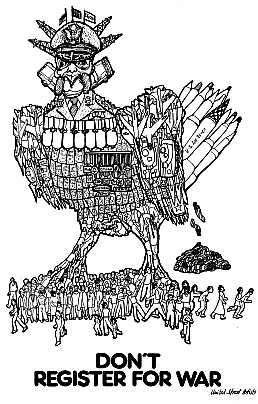 We won — and now, thirty years later, the government has finally admitted it.
It’s not often that government officials admit to failure in the face of popular resistance. When they do, it’s an occasion for celebration.
Draft registration was reinstated in 1980, supposedly to prepare for possible deployment of US troops in Afghanistan on the side of the Islamic fundamentalist warlords and “mujahideen” who were then fighting against the USSR. The US government put me in prison for refusing to agree to fight on the side of the people who would later become the Taliban and Al Qaeda! It’s no wonder that people of my generation, or later generations, have no faith in the ability of the US government to decide for us in which wars, or on which (if any) side, we should fight.
Today in U.S. News & World Report, Steven Nelson has the most significant piece of reporting about draft registration and the Selective Service System in decades, asking questions that journalists, politicians, and the public should have been asking years ago.
It’s been obvious — to anyone who wanted to look — that resistance forced the government to abandon the attempt to enforce draft registration in failure in the 1980s, after show trials of a handful of the “most vocal” nonregistrants. But this is the first time that responsible Selective Service officials and former officials have confirmed this on the record.
The article is worth reading in full, but I’ve posted some key excerpts below, followed by my analysis and comments:
Gender-Neutral Draft Registration Would Create Millions of Female Felons
by Steven Nelson, U.S. News & World Report, May 3, 2016
A key congressional committee voted last week to require young women to register for potentially compulsory military service, but the gender-equalizing reform threatens to make felons out of women who refused to participate.
Though prosecutions currently appear unlikely, men jailed for not registering with the Selective Service System and some former authorities who participated in the cases are concerned about criminalizing a large swath of the population.
“It will inevitably lead to massive resistance, whether visible in the streets or women just blowing it off the way men have,” says Edward Hasbrouck, prosecuted for not registering in the 1980s. “Congress is smoking crack if they think women can be forced to register.”
Hasbrouck served more than four months in prison after catching the eye of an ambitious federal prosecutor, Robert Mueller, who went on to be FBI director. He originally received a suspended sentence, but recalls an unamused judge sending him to prison in late 1984 [actually 1983] for doing peace activism to satisfy court-ordered community service….
The government was “faced with far more people who had initially refused to register in the start-up period than they had ever imagined — it was beyond their worst nightmare. They were self-deluded in the way people today who think they can just wave their wand and women will sign up for the draft are self-deluded,” Hasbrouck says….
In all, 20 men were prosecuted in the 1980s for not registering, a diverse and geographically scattered group including ideological advocates of individual rights and members of the historical peace churches.
The last indictment came in 1986 when Terry Kuelper of Arkansas was slapped with the felony charge. He agreed to register before trial and the charge was dismissed. Court proceedings ended when Gillam Kerley of Wisconsin was released from a three-year prison sentence after four months, with the case ending in 1988….
Former Selective Service associate director Edward Frankle … developed a process for … enforcement of the registration law…. “We did what we had to to keep at least some level of credibility in the system,” he says. “You couldn’t just totally ignore it — how could you do that and still with a straight face say, ‘Yeah that’s the requirement’?”
In the late ’80s the Justice Department discontinued prosecutions. Dick Flahavan, a spokesman for the Selective Service who was with the agency at the time, recalls the Justice Department “decided that since there was no draft … there are limited resources and the FBI’s time would be better spent chasing white collar crime than some Mennonite kid through Pennsylvania.”
“We said, ‘Fine, we understand,’ and that’s why it ended in ’88,” he says. “The agency did agree to what the Justice Department proposed, a suspension of prosecutions [during peace time]. Since they did the prosecutions we didn’t have much leverage anyways.”…
Flahavan says the Selective Service had hoped for a much stronger approach from federal prosecutors, but was rebuffed.
“What we would have preferred was every year in all 95 judicial districts there be a prosecution to keep the heat on and the publicity going,” he says. “But they couldn’t sustain that.”
If someone registered just before trial, the prosecution would be dropped, Flahavan notes, making the pursuit of resisters “really a losing proposition for the feds” and often “a big waste of time.”
Wilfred Ebel, acting director of the Selective Service System in 1987, when further waves of prosecutions were being considered, says he can’t recall the precise discussions that led to abandonment of new cases. Former Attorneys General Ed Meese, who left the department in 1988, and successor Dick Thornburgh did not respond to requests for comment, nor did Mueller….
Though hard numbers are elusive, Hasbrouck says with confidence “compliance with the address update requirement is and has been since 1980 essentially zero.”
A central insight of both Gandhian and anarchist political theory is that governments have power only to the extent that people are willing to carry out or comply with their orders. But few of the people pontificating lately about whether extending draft registration to women is “desirable” (from one or another perspective) have stopped to ask whether it is possible. So far as I know, no historian or scholar has made a study of draft registration since 1980. (If I’ve missed something, please send me a link or citation, or post it in the comments.) There’s been no GAO audit of the accuracy of the Selective Service database of registrants and their current addresses since 1982.
Despite the refusal of the Justice Department to prosecute nonregistrants, the Selective Service System continues to refer names of possible nonregistrants identified by automated data-matching to the Justice Department “for possible prosecution”. According to the latest Selective Service System Annual Report to Congress for Fiscal Year 2015 (page 16), “If a man fails to register or fails to provide evidence that he is exempt from the registration requirement after receiving Selective Service reminder and/or compliance mailing, his name is referred to the Department of Justice (DOJ) for possible investigation and prosecution for his failure to register… During FY 2015, 146,997 names and addresses of suspected violators were provided to the DOJ.” None of these nonregistrants were investigated or prosecuted, nor have any of the other millions of suspected draft registration resisters whose names have been referred by the SSS to the DOJ in the last thirty years.
If resistance rendered draft registration of men unenforceable, why would anyone think that young women will be more willing to sign up to kill or be killed on command than young men have been?
Resistance to any attempt to extend draft registration to women is inevitable, but people tend to (wrongly) discount the practical or political significance of silent resistance, despite its effectiveness. That’s a major reason why the ongoing resistance to draft registration by young men has been so little noticed or understood.
The political anthropologist James C. Scott analyzed this phenomenon in Domination and the Arts of Resistance (Yale University Press, 1990, Chapter 7):
Much of the active political life of subordinate groups has been ignored because it takes place at a level we rarely recognize as political. To emphasize the enormity of what has been, by and large, disregarded, I want to distinguish between the open, declared forms of resistance, which attract most attention, and the disguised, low-profile undeclared resistance….
For many of the least privileged minorities and marginalized poor, open political action will hardly capture the bulk of political action…. The luxury of relatively safe, open political opposition is rare… So long as we confine our conception of the political to activity that is openly declared we are driven to conclude that subordinate groups essentially lack a political life…. To do so is to miss the immense terrain that lies between quiescence and [open] revolt and that, for better or worse, is the political environment of subject classes….
Each of the forms of disguised resistance… is the silent partner of a loud form of public resistance.
And Scott said this in Two Cheers for Anarchism (Princeton University Press, 2012, Chapter 1):
Desertion is quite different from an open mutiny that directly challenges military commanders. It makes no public claims, it issues no manifestos, it is exit rather than voice. And yet, once the extent of desertion becomes known, it constrains the ambitions of commanders, who know they may not be able to count on their conscripts…. Quiet, anonymous,… lawbreaking and disobedience may well be the historically preferred mode of political action for… subaltern classes, for whom open defiance is too dangerous.
It’s past time for Congress to get real, end draft registration, and abolish the Selective Service System.
To make this happen, Congress and the public need to hear from young women who don’t plan to register for the draft. Otherwise they won’t think about the prospect of resistance by women to draft registration, or take it seriously. I’ll be happy to publish or link to “I Won’t Go” or “We Won’t Go” statements, anonymously or with names as the authors wish. If there are other things I can do to help young women prepare to resist draft registration, or to support their resistance, or to support the ongoing resistance by young men, please let me know.
edward@hasbrouck.org
May 4, 2016
Posted by aletho |
Civil Liberties, Militarism, Solidarity and Activism, Timeless or most popular | Human rights, United States |
Leave a comment