Radiation spike near Hanford nuclear waste site ‘natural’ – EPA
RT | May 15, 2016
The US Environmental Protection Agency chalked elevated gamma radiation levels around America’s largest nuclear waste storage facility, the Hanford site, up to natural causes, but RT’s Alexey Yaroshevsky has found a few inconsistencies in its claims.
RT has reported extensively on the situation at Washington State’s Hanford Nuclear storage facility since various leaks and injuries to workers were reported. An incident on May 5th covered by RT, when radiation levels in the area adjacent to the site skyrocketed, prompted a federal investigation.
However, following the RT report, a local newspaper urged its audience not to “believe everything on the Internet” in an article extensively quoting a statement from the EPA that claimed the elevated radiation levels had a natural cause and were not connected to the Hanford facility in any way.
“The US Environmental Protection Agency and the Washington State Department of Health agree that radiation from naturally occurring radon was measured on an EPA monitor,” the EPA statement reads.
“The scientists determined that the cause was a temporary elevation of radon levels from the natural decay of certain types of elements found in nearly all rocks and soil.”
The statement also stresses that the spike in radiation could not have been due to emissions from Hanford because the wind was blowing from the opposite direction at the time the measurements were taken.
“The Department of Health said that was not possible because the wind was blowing the wrong direction for the radiation to have come from Hanford at the time the reading was taken,” the EPA notes.
Yet RT America correspondent Alexey Yaroshevsky compared the graph of the radiation readings to wind maps provided by the US national weather service and discovered that the EPA’s findings may not be entirely correct, as the graph appears to show the wind circling around the Hanford site and the area where the readings were taken.
Meanwhile, health protection authorities seem to have quickly taken up the radon-related scenario, emphasizing that radon is common in the area, accumulating in places closer to the ground, and urging people with basements to get radon-measurement canisters to check their homes for excessive levels.
Radon gas is a natural byproduct of Uranium decay in the soil and considered a dangerous carcinogen that can cause lung cancer. Estimates state that outdoor radon levels cause some 800 of the 21,000 radon induced lung cancer deaths that occur in the United States every year.
However, according to a map of radon levels from the EPA’s own website, Benton County, in which the Hanford nuclear plant is located, has relatively low levels radon, even when compared to other American states.
The Hanford nuclear site, on the other hand, holds some 56 million gallons of radioactive waste stored in underground tanks that were built between the 1940s and 1970s. Those who used to work at the facility have told RT that vapor incidents are common when radioactive waste is being transported between tanks, which happens often, as the tanks are wearing out.
READ MORE:
‘I thought I was dying’: Ex-Hanford worker gravely ill after inhaling toxic fumes
Hanford Site not ‘controlling what comes out of nuclear waste tanks to protect workers’ – public
Colombian Military Bombing of Indigenous Territory Forces Flight

There is not enough shelter to house all of the displaced families. | Photo: Contagio Radio
teleSUR – May 13, 2016
A national bombing campaign in the territories of the Indigenous Embera Wounaan ethnic group has forced them to flee their homes and take shelter elsewhere.
More than 400 Indigenous people from the ethnic group Embera Wounaan have been forced to leave their homes and stay in shelters in protection against military bombings of the camps of the National Liberation Army (ELN), Prensa Latina report.
Faced with threats to their security, the 94 families who have been forced to seek protection away from their land in the coastal area of Medio San Juan, Choco, say there are not enough shelters to house everyone.
The bombings began on April 10. According to Dura Bernardino, the leader of the Indigenous community, the bombings sent the community into a panic and that is why they decided to go to the municipal administrative center to save their lives.
The vulnerable community is calling on the government to stop the bombings and provide them with guarantees to return to their land.
Democrats, Too Clever by Half on Clinton

By Robert Parry | Consortium News | May 14, 2016
Last year when Democratic insiders looked forward to Election 2016, they expected a run-of-the-mill Republican, possibly even legacy candidate Jeb Bush. So they countered with their own “safe” next-in-line legacy candidate, Hillary Clinton, who would supposedly win by playing up the prospect of the first woman president.
In such an expected match-up, the concern of rank-and-file Democrats about Clinton’s hawkish foreign policy would be negated by the GOP nominee still defending President George W. Bush’s Iraq War and again surrounded by neocons pounding the drums for even more wars. With both parties putting forward war candidates, anti-war Democrats would accept Clinton as the lesser evil, or so the thinking went.
The likely Republican nominee also would be burdened by reactionary domestic proposals, including GOP plans for privatizing Social Security and Medicare. By contrast, centrist Clinton would look reasonable in promising to protect those popular programs, albeit with some modest trimming of benefits to please the budget hawks.
But the Democratic insiders didn’t count on the unlikely emergence of populist billionaire Donald Trump, who repudiated Bush’s Iraq War and the GOP’s neocon foreign policy and rejected Republican orthodoxy on “entitlement reform,” i.e., slashing Social Security and Medicare.
The unabashed Trump also has made clear that he is not afraid of countering Clinton’s “woman card” by playing his own “man card,” including attacks on her troubled marriage and her tolerance of Bill Clinton’s notorious womanizing, even claiming that she was her wayward husband’s “enabler.”
At first, the Democratic hierarchy couldn’t believe its luck as the Republican Party seemed to splinter over Trump’s disdain for the GOP’s neocon interventionism and rejection of the party’s cutbacks in Social Security and Medicare. Trump’s mocking attacks on his rivals also shattered the decorum that Republican leaders had hoped would mark their primary campaign.
So, the Democratic insiders initially rubbed their hands with glee and imagined not only an easy presidential victory but major gains in the House and Senate. However, new polls show Trump running neck-and-neck with Clinton nationally and in key battleground states, while other polls reveal strong public doubts about Clinton’s honesty, thus wiping the premature smiles off the Democrats’ faces.
Panic Mode
Indeed, some Democrats reportedly are slipping into panic mode as they watch Clinton’s poll numbers tank and the Republican Party come to grips with the Trump phenomenon. The new storyline of Campaign 2016 is the tale of top Republicans reconciling to Trump’s populist conquest of the party. At least, these GOP leaders acknowledge, Trump has excited both average Republicans and many independents.
The obsessive media coverage of Trump’s meetings on Thursday with senior congressional Republicans made the narcissistic real estate mogul and reality TV star look like some major world leader being received in Washington as a conquering hero. And, with the GOP rallying behind Trump, the likelihood is that his poll numbers and favorable/unfavorable ratings will continue to improve.
So, instead of Democratic dreams of a landslide victory, the party insiders are worrying now about their decision to coronate a deeply flawed and wounded candidate in Hillary Clinton. Not only could she lose to Trump but she could take many of the House and Senate candidates down with her. It’s dawning on some Democrats that they may have squandered a historic opportunity to realign American politics to the left by promoting the wrong person in 2016.
At a moment when the American people are demanding change – even willing to risk entrusting the White House to the unorthodox and inexperienced Donald Trump – the Democratic Party may be stuck with an uninspiring status quo candidate who also is pro-war, indeed far more hawkish than President Barack Obama.
Thus, in the fall election, not only would Trump be in a position to bait Clinton about her dysfunctional marriage, reminding the nation of the messy scandals of the 1990s, but he could challenge her on her warmongering positions, including her years of support for the Iraq War and her hawkish policies as Secretary of State, including her instigation of the disastrous “regime change” war in Libya. [See Consortiumnews.com’s “Yes, Hillary Clinton Is a Neocon.”]
This November could be the first time in modern American history when the Republican nominee would be the relative “peace candidate” and the Democrat would be the “war candidate.” That changing places could lose Clinton much of the “anti-war left,” a significant faction within the Democratic coalition with many “peace Democrats” either voting for Trump or choosing a third party, such as the Greens.
Of course, the Democrats didn’t have to be in this position. The party leaders could have encouraged a more competitive primary contest instead of trying to keep alternative candidates, such as Sen. Elizabeth Warren and some younger Democratic prospects, on the sidelines, all the better to give Hillary Clinton an unimpeded path to the nomination. The party insiders treated Clinton like an incumbent president seeking reelection, a foregone conclusion.
Alternatives, Anyone?
But the best laid plans of mice and politicians often go astray. How weak Clinton is as a candidate has been underscored by her struggle to put away a progressive challenge from Sen. Bernie Sanders, a 74-year-old “democratic socialist” from Vermont, who isn’t even technically a Democrat, listing himself as an Independent.
Even though the vast majority of “super-delegates” – i.e., party insiders – have lined up behind Clinton and she leads in pledged delegates, Sanders continues to win primaries, including recent ones in Indiana and West Virginia, and he could roll up a series of victories in upcoming western state races.
Clinton could stagger to the Democratic convention in July with a dispirited party lining up glumly to witness her long-delayed coronation. The onlookers might sense that they had made a terrible mistake but couldn’t correct it. They would be left to grit their teeth and hope that Clinton’s self-inflicted wounds, such as her private emails as Secretary of State, don’t fester and become fatal.
Arguably, it is the Democrats who would benefit the most from a contested convention, one that might give them an opportunity to reconsider the choice of Clinton and either nominate Sanders, who fares much better against Trump in poll match-ups, or pick someone else, possibly a fresh face like Sen. Warren.
While that may be highly unlikely – even if Sanders sweeps the remaining primaries – it is beginning to dawn on Democratic insiders that their scheme to grease the skids for a Clinton nomination might end up slipping Donald Trump into the White House.
Investigative reporter Robert Parry broke many of the Iran-Contra stories for The Associated Press and Newsweek in the 1980s. You can buy his latest book, America’s Stolen Narrative, either in print here or as an e-book (from Amazon and barnesandnoble.com).
‘Make More War’: The Corporate Engine Behind US Foreign Policy
Sputnik – 14.05.2016
As the US Senate Armed Services Committee considers the 2017 Pentagon budget, political analyst Eric Draitser joins Radio Sputnik to discuss the ever-growing military-industrial complex.
“[President Dwight Eisenhower] was suggesting… that the danger for the United States was that these massive military contractors, these military-industrial firms, would eventually be able to control both sides of the government, both major parties, and be able to effectively create policy to their own liking,” Draitser told Loud & Clear’s Brian Becker, paraphrasing the former World War II five-star general and US President’s 1961 warning.
“And here we are in 2016 and that is, of course, exactly what’s happened…”
While President Barack Obama ran on a platform of reigning in US military endeavors, he has proven unable – or unwilling – to do so.
“Obama has raised spending on the military to historic levels. He has, obviously, waged countless wars; at least seven by the conservative count. Obama is, of course, upping aid to Israel… expanding [the] US military footprint in Asia with the Asia pivot strategy, expanding [the] US military in Africa…” Draitser says.
“If you look at it in its totality, Obama really works hand-in-glove with the military-industrial complex.”
The new draft bill of National Defense Authorization Act highlights this.
“[The bill shows] increased spending. I believe $1.5 billion for new aircraft. $1.5 billion for F-35s manufactured by Lockheed Martin. Army helicopters, Apache strike teams. We could go on and on down the list of all of these increases in spending.
“The consensus is ‘make more war.'”
Even presidential hopeful Bernie Sanders, one of the most progressive members of the US Congress, isn’t guilt-free.
“Bernie Sanders lobbied for F-35 production in Vermont,” Draitser says. “He has a vested interest in making sure that this military program…took place in Vermont. He lobbied for it, he was in favor of it, and he’s gone down, at least in Vermont history, as a major supporter of that program.
“So even when you go to the left-progressive end of the political spectrum, they have a vested interested in making sure that programs such as the F-35 continue.”
The problem also relates to the Obama Administration’s inability to close the detention center at Guantanamo Bay.
“The story continues to be the same tired narrative that Obama desperately wants to close Guantanamo. It’s just this political gridlock, it’s the legislation, it’s the language that’s in place, it’s the Republicans, it’s the boogeyman, it’s Putin, it’s everybody preventing Obama from closing Guantanamo,” Draitser says.
“When in fact it is a consensus that Guantanamo stay open.”
The military-industrial complex is also the driving factor behind the military buildup in Eastern Europe, despite claims about defending against “Russian aggression.”
“The beneficiaries of these types of policies are Lockheed Martin and Raytheon and Boeing and all of these massive multinational military corporations that make hundreds of billions of dollars off of precisely these kinds of policies,” he says.
“When [NATO] talks about spending money in Eastern Europe to ‘reassure our partners,’ what they really mean is bolstering US military power along Russia’s western flank.
“There could not be a more dangerous policy.”
Last chance to stop draft registration of women in US
Ed Hasbrouk’s Blog | May 13, 2106
Yesterday the U.S. Senate Armed Services Committee joined its counterpart committee of the House of Representatives in adding a provision to the pending “National Defense Authorization Act” (NDAA) for Fiscal Year 2017 that would extend the authority of the President to order women as well as men to register for the draft.
Because this is considered a “must-pass” bill, this provision will now become law along with the rest of the bill unless the proposal is amended on the floor of either the House or the Senate (or both) to remove it before the full bill is approved, or unless the President vetoes the entire bill (which is unlikely).
It’s time for lobbying against draft registration — and for organizing and resistance.
I presume, although I don’t know for sure, that the text of the provision added to the Senate committee version of the bill is the same as that which was added to the House version. The Senate committee decision was made during a closed “markup” session, and I don’t know if the record of how each committee member voted on this provision is or will be made public.
To understand what will happen next, you have to get down in the weeds of Congressional procedure, and understand the dynamic surrounding Congressional debate and voting on this question.
The versions of the FY 2017 NDAA bill approved by the House and Senate Armed Services Committees will go to the “floor” of the respective chambers, where proposed amendments can be voted on before the final votes on the bills.
Rep. Pete Sessions, a Republican from Dallas and one of the few members of Congress to have endorsed Donald Trump for President, has introduced an amendment to the House bill to strike out the provision expanding draft registration to women. It’s up to the House Rules Committee to decide which of the many proposed amendments to the bill on this and other subjects are allowed to be voted on by the full House. But since Rep. Sessions is the Chair of the House Rules Committee, it’s likely that he will be able to get the Rules Committee to agree to schedule a vote on his amendment on women and draft registration when the 2017 NDAA comes to the House floor.
Rep. Jared Polis, who is also a member of the Rules Committee, is one of the sponsors of H.R. 4523, the bill to end draft registration entirely and abolish the Selective Service System. But H.R. 4523 has yet to be scheduled for consideration in committee, and may never be. Most bills introduced in Congress are never debated or voted on, even in committee.
Floor debate and voting on the 2017 NDAA has not yet been scheduled, but could be as soon as next week in the House, and could be later this month in the Senate. It’s time to talk to your Representative today! Tell them to vote YES on “the Sessions’ amendment to the Defense Appropriations Act on women and draft registration,” and to support H.R. 4523 to end draft registration.
So far as I know, no Senator has introduced a similar amendment to strike the provision to register women for the draft out of the Senate version of the 2017 NDAA. Nor has any Senator introduced a bill like H.R. 4523. Last night after the Senate committee vote, one conservative commentator wrote that, “I am … told by Senate staff that it is unlikely an amendment to strike this provision will even succeed on the floor of the Senate, which means a majority of that body now supports drafting women. The only hope to stop this is on the House floor.”
But “lobbying” alone will not stop the proposal to expand draft registration to women, or end draft registration for men.
 Members of Congress expect that any draft, for anyone, or any move toward a draft, will be unpopular. That won’t keep them from voting for it.
Members of Congress, the Pentagon, and the President all say — probably truthfully — that they don’t “want” a draft.
They will vote for draft registration, and they will expand draft registration to women if that’s what it takes to make it Constitiutional [sic], because they want to preserve the “option” of the draft as an “insurance policy”. Plan B, or perhaps Plan C or plan D, if they run out of “volunteers”, reserve forces, National Guard members, and mercenaries (“civilian contractors”) to fight their wars.
They will stop short of trying to make women register for the draft if, and only if, they are brought to the realization that draft registration of women will fail, just as draft registration of men has failed, because young women will resist just as young men have resisted.
Resistance, as the Selective Service System has finally admitted, has made draft registration unenforceable. Continued and expanded resistance can stop the attempt to make young women register too, and it can end draft registration.
The most important voices to be raised, listened to, and heard in Congress in the crucial days ahead are those of young women saying that they will not willingly submit or sign up, and those of older people and men like me and many others saying that we will support and stand with them in resistance.
Trump Slams US Wars in the Middle East
By Yves Smith | naked capitalism | May 13, 2016
There are good reasons to harbor serious reservations about The Donald, given that he changes his position as frequently as most people change their clothes. But so far, he has been consistent in making an argument that is sorely underrepresented in the media and in policy circles: that our war-making in the Middle East has been a costly disaster with no upside to the US. Trump even cites, without naming him, Joe Stiglitz’s estimate that our wars have cost at least $4 trillion.
As Lambert put it, “I hate it when Trump is right.”
If you think Trump is overstating his case on Hillary’s trigger-happiness, read this New York Times story, How Hillary Clinton Became a Hawk.
And on Clinton’s role in Libya, which Obama has since called the worst decision of his presidency:
Mrs. Clinton’s account of a unified European-Arab front powerfully influenced Mr. Obama. “Because the president would never have done this thing on our own,” said Benjamin J. Rhodes, the deputy national security adviser.
Mr. Gates, among others, thought Mrs. Clinton’s backing decisive. Mr. Obama later told him privately in the Oval Office, he said, that the Libya decision was “51-49.”
“I’ve always thought that Hillary’s support for the broader mission in Libya put the president on the 51 side of the line for a more aggressive approach,” Mr. Gates said. Had the secretaries of state and defense both opposed the war, he and others said, the president’s decision might have been politically impossible.
And yes, that’s this Ben Rhodes.
5 reasons why US antimissiles in Europe threaten Russia
RT | May 12, 2016
Russia has opposed America’s plans to deploy antimissile systems close to its borders for decades. Washington says the system would not compromise Russia’s security, but Moscow sees a number of reasons why it does.
ABM sites in Romania and Poland could be converted to fire Tomahawks
The system deployed in Europe is called Aegis Ashore and is derived from a naval antiballistic missile system. The Standard Missile 3 interceptors are launched by a variant of Mk 41 VLS. The same vertical launch system is used by the US Navy to launch Tomahawk cruise missiles. Russian defense experts believe the launchers in Romania and Poland can be secretly converted to enable firing cruise missiles at targets in Russia. The US is banned from deploying Tomahawk missiles in Europe by the Intermediate-Range Nuclear Forces Treaty (INF), which Moscow and Washington signed in 1987.
ABM sites will constantly monitor Russian airspace
To fire interceptors at ballistic missiles they must be targeted by a powerful radar station, and US sites in Europe have those. They can be used to monitor a large part of Russian airspace. The Russian military are not happy that NATO would get additional intelligence on movements of aircraft and missile tests. A similar concern is voiced by China, when it criticizes US plans to deploy the THAAD long-range antimissile system in South Korea to counter threats from Pyongyang.
ABM sites would counter Russian capabilities in a potential small-scale conflict
While the US is right in saying that the few interceptors placed in Europe would not stop a full-scale strategic nuclear missile attack by Russia, in a smaller-scale conventional conflict the European sites would undermine Russia’s ability to use warplanes and tactical missiles.
US-developed target missiles for ABM shield violate missile treaty, Russia says
The US has developed several rockets to serve as targets during tests of its national antiballistic missile technologies, including Hera, LRALT and MRT. Russia believes those missiles violate the spirit of the INF treaty, because if they had warheads, they would have been banned. The reasoning is not unlike the one the US uses, when it says that North Korea’s satellite launches are actually disguised tests of long-range ballistic missiles for Pyongyang’s military.
The US rejected all Russian suggestions to address Russia’s concerns
Over the decades Russia suggested a number of ways, which would have reduced the tension over American antimissile deployments. It offered alternative radar, which would monitor Iran, but not Russia. It suggested inspection mechanisms, which would allow the Russian military to ensure that no foul play was happening on the ABM sites. It suggested a new treaty, which would legally bind the US not to use the system against Russia. Washington rejected them all and said that verbal assurances were enough. Considering that Moscow was verbally assured that NATO would not expand eastwards after withdrawal from Eastern Germany and how things actually turned out, Russia’s skepticism is well-grounded.
Sanders Supporters Can Bring Down the Democrats
By Margaret Kimberley | Black Agenda Report | May 11, 2016
 Donald Trump’s ascension to the Republican presidential nomination has created an enormous rift between the Republican elites and the rank and file. This process is a welcome development that could lead to the end of that party.
While the Republicans implode Hillary Clinton moves towards the Democratic party nomination by moving ever more towards the right. She and former president Bill Clinton have made it clear. They intend to get votes from independents and Republicans who can’t stomach the idea of a Trump presidency. That has been her modus operandi throughout her political career. She bragged about being a teenaged Goldwater girl and now brags about killing in Libya.
She ignores the Bernie Sanders phenomenon because she has no reason to do otherwise. From the moment he started his campaign he said he would endorse her if she won the nomination. Of course Sanders followers might change the trajectory of history by refusing to go along with the charade. If they stand firm they can also send their party into the historical dustbin where it belongs.
Trump’s supporters epitomize white nationalist sentiment but they are also driven by personal need. They have been left behind by the machinations of both parties. The trade deals concocted by Republicans and Democrats have taken the living wage jobs they expected to have forever. While they prosper more than any other group in the country they still feel affronted by their change in fortune. They don’t care about the imperial project and wouldn’t mind if Trump made good on his pledge to cease invasions and regime change plots.
Democrats on the other hand are less likely to send their party packing. They have been hypnotized by years of lies which have allowed wars, austerity, and mass incarceration to be considered acceptable, small prices to pay to keep the Republicans at bay. Black voters in particular are so fearful of Republican victory that any Democratic Party policy, no matter how damaging to them, gets the go ahead.
The election of 2016 should be historic not just because two people who are disliked by millions will run for president. It should be ground breaking because it will mean that Americans who love to think of themselves as independent will finally live up to that self-image.
The Sanders people in particular claimed to want a revolution. Now is their chance to make good on this assertion. Their task is a simple one. They must not support or vote for Hillary Clinton in November and they must say so loudly and clearly. They can vote for another party’s candidate or write in one of their own. They may exhort Sanders to deny her an endorsement. Any tactic will do. But if they follow tradition and vote for a conservative Democrat they will have made a mockery of their demand for change.
Liberal Democrats who like to think of themselves as leftists must put up or shut up. They should know by now that their party cannot be reformed. It must be done away with for good. The duplicity of the Democrats is fully on display for everyone who really wants to see it. On the one hand they will use the infamous Koch brothers to strike fear, raise money and keep their voters in line. Will they continue to do that now that Charles Koch has declared Hillary Clinton to be possibly more acceptable than Donald Trump?
In reality the Bernie Sanders campaign held more pretense than reality. Sanders isn’t really a socialist and neither are most of his voters. Yet they found it appealing to be connected to a candidate who gave them political cache. Neither are Sanders or his supporters revolutionary. The word revolution was more of a marketing ploy than anything else and continued the mirage of the possibility for change.
Sanders was always the sheep dog, as Black Agenda Report said in 2015. That does not mean his followers have to follow suit. The necessary rejection of Hillary Clinton will also mean a rejection of the man they admired and voted for if he does as he promised and endorses her.
Sanders voters can be the revolutionaries they aspired to be if they loudly and publicly state that they won’t vote for Hillary Clinton. They will need a great deal of determination as they will surely be scapegoated, guilt whipped and blamed for her defeat. But those attacks should be considered as a badge of honor in what may well be a revolutionary effort.
Of course if people “felt the Bern” only because they hoped for a better Democrat then this effort is for naught. By now everyone should know that the corruption in the Democrat party cannot be cut out. The party doesn’t want to change itself and makes sure that opponents end up just driving the sheep.
It is time for the Sanders supporters to make good on calls for revolution. They can do that by actively and openly denying Hillary Clinton the presidency. When they are called spoilers they must proudly own the charge and declare that they meant what they said. They are fighting for a revolution.
Margaret Kimberley can be reached via e-Mail at Margaret.Kimberley(at)BlackAgendaReport.com.
Moscow voices alarm as NATO Romanian missile defense base goes live
RT | May 11, 2016
As a new Romanian interceptor missile base prepares to go live Thursday, Moscow has slammed NATO’s expanding defense shield, calling it a threat to security, and a violation of a key international treaty.
“The creation of a European and global missile defense shield has an adverse effect on strategic stability,” Mikhail Ulyanov, head of the Russian foreign ministry’s department for proliferation and arms control issues, said on Wednesday.
NATO will formally declare its missile defense base in the remote location of Deveselu, Romania, operational on Thursday, bringing to fruition a plan to construct a shield in eastern Europe that was first announced by George W. Bush as far back as 2007.
“Our direct interests, the interests of our national security are affected by the decision,” said Ulyanov.
The Russian official said that not only was the missile defense aimed at neutralizing Russia’s offensive capability – an accusation the Pentagon has repeatedly rejected – but that Deveselu’s MK 41 launching systems it uses could be re-equipped with offensive cruise missiles.
Ulyanov said that Washington was acting in breach of the 1987 INF treaty, under which Mikhail Gorbachev and Ronald Reagan signed their respective countries up to obligations “not to possess, produce, or flight-test a ground-launched cruise missile (GLCM) with a range capability of 500 km to 5,500 km, or to possess or produce launchers of such missiles.”
The US embassy in Moscow produced a counter-statement, condemning Moscow’s allegations as “unacceptable and irresponsible.”
“The missile defense system is not aimed at Russia, or undermining its strategic potential. From the point of view of geography and physics, it is impossible to shoot down Russian inter-continental missiles from Romania or Poland,” said the document, penned by embassy spokesman William Stephens, and obtained by RIA news agency.
Washington says that the eastern European missile defense segment is meant to thwart a potential threat from Iran, but in a separate statement on Wednesday evening, Russia’s foreign ministry said that worries that Tehran posed a threat to NATO were “unfounded.”
The missile shield uses a network of radars that track potential threats in the atmosphere, before launching an interceptor missile from a stationary base, or a fleet.
Simultaneously with Romania coming online, construction work is beginning on a complementary base in Poland, which will complete the eastern European segment of the shield in 2018.
US Military Supports Trump: New Poll
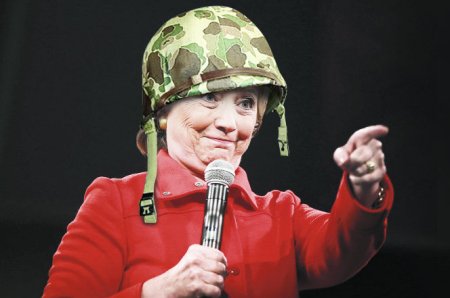
Sputnik | May 11, 2016
A new survey of US military personnel finds presumptive Republican nominee Donald Trump leading his Democratic opponent Hillary Clinton by over a 2-to-1 margin. […]
In polling of 951 verified active-duty troops, reservists and National Guardsmen, The Military Times found that in a match-up between Trump and Clinton, 54% of respondents said they would support the business mogul-turned-candidate, compared to 25% who chose the former secretary of state (the remaining 21% said they would not vote). At the same time, when the match-up was switched to Trump vs. Senator Bernie Sanders, Trump got 51% support, compared to 38% for the Vermont senator. […]
With Russian analysts and much of the public watching the US presidential campaign almost as closely as Americans themselves, independent online newspaper Svobodnaya Pressa attempted to explain the landslide in Trump’s favor, turning to Sergei Bespalov, a senior researcher at the Russian Presidential Academy of National Economy and Public Administration, for possible answers.
The biggest reason for the military’s support for Trump, Bespalov suggested, is Trump’s rhetoric on foreign policy.
“Trump’s promises to significantly temper the military activity of the United States around the globe very likely brings forth a positive reaction from the military. They are, in general, not too thrilled about the idea of their country being dragged into new armed conflicts, since they are the ones who take most of the risks” when this happens.
“At the same time,” the analyst says, “Clinton has a reputation for being a supporter of a very aggressive foreign policy, connected to the continuation of the current policy of the forced expansion of ‘Western-style democracy’ throughout the world, and for active intervention in the internal affairs of a host of countries and regimes which Washington finds undesirable. This, of course, is fraught with the danger of the intensification of the use of the US armed forces abroad, and for new military conflicts.”
Asked by the newspaper why the Pentagon would prefer Trump and his non-interventionism, Bespalov corrected his interviewer. “It’s not the Pentagon that prefers Trump, and not the military elite, but the majority of ordinary servicemen and women. The Pentagon supports Clinton. But those soldiers who, in the case of a Clinton victory, will be drawn into new conflicts, and will have to risk their lives, clearly aren’t thrilled about this prospect. And therefore among ordinary soldiers and officers Trump has proven to be more popular.”
Mikhail Alexandrov, a senior expert at the Center for Military-Political Studies at the Moscow State Institute of International Relations, suggests that other reasons may be at play.
“Trump shows resolve in the use of force. He demands that Obama use force, including in Syria. He is prepared to aggravate relations with Iran. He says that dialogue with Russia can come only ‘from a position of strength’. And recently he said that it would be necessary to shoot down Russian planes, referring to the recent incident involving the American destroyer Donald cook and our fighters.””Trump, in his rhetoric at least, is creating an image of an aggressive macho, who is willing to use force when, in his view, American interests are threatened. This approach appeals to the military.”
In other words, Alexandrov suggests, Trump “is a supporter of a more open policy of the use of force, unlike Clinton, who prefers methods of hybrid warfare, including ‘soft power’ and special operations. Trump is ready to use [military] force directly, decisively, and on a large scale.”
Which approach is preferable for Russia, and for other countries looking to escape US hegemony and create a multipolar world, remains to be seen. Moscow has already had a taste of the approach proposed by Mrs. Clinton, which includes more color revolutions on Russia’s borders, and endless wars in the Middle East. Trump, at the very least, has talked about negotiating with Moscow, and has criticized Clinton, Obama and George W. Bush for the disastrous military interventions over the last fifteen years which cost thousands of American servicemen and women, along with hundreds of thousands of people in the Middle East their lives.
Read more:
Clinton’s Neocon Ties Could Mean More Regime Change on the Menu
Clinton Receives More Wall Street Donations Than Republican Rivals
Moscow Slams US Concerns About Russian, Chinese Military Space Activities
Sputnik — 11.05.2016
Moscow does not take seriously US concerns regarding Russia’s and China’s activities in space, the head of the Russian Foreign Ministry’s Department for Non-Proliferation and Arms Control said Wednesday.
The Washington Post reported earlier in the week that Frank Rose, Assistant Secretary of State for Arms Control, had expressed concern over “the continued development by Russia and China of anti-satellite weapons.”
“Indeed, such statements have been made recently by official representatives of the US administration, fairly regularly. Taking them literally and seriously is impossible. After all, any country, including the United States, has the opportunity to address real concerns, if they arise, through established political and diplomatic means,” Mikhail Ulyanov told RIA Novosti.
“Not only will Washington not use [diplomatic channels], but it actively tries to avoid them,” he added.
Ulyanov noted that the United States itself has been blocking a 2008 proposal by Russia and China on preventing the deployment of weapons in outer space, which would “effectively solve the problem of anti-satellite weapons.”
“The Russian-Chinese proposal has gained broad support on the international arena, but its practical implementation is categorically blocked by the United States,” he said.
Erdogan calls for greater NATO presence in Black Sea
RT | May 11, 2016
NATO is not deploying enough assets to the Black Sea and cannot counter the Russian military presence there, Turkish President Recep Tayyip Erdogan has argued. He said he would ask the alliance to address the issue during an upcoming summit in Warsaw.
“I told him [NATO Secretary General Jens Stoltenberg]: ‘You are absent from the Black Sea. The Black Sea has almost become a Russian lake,’” Erdogan said at a meeting of heads of general staff of Balkan nations in Istanbul on Wednesday. “If we don’t take action, history will not forgive us.”
He added that Bosnia and Herzegovina and Macedonia should join the alliance soon to make it stronger.
A NATO summit will be held in the Polish capital in July. The meeting is expected to strengthen the alliance’s stance on countering what its new top military commander, US General Curtis Scaparrotti, called a resurgent Russia in his inauguration ceremony last week. Moscow sees NATO’s military buildup near its border as offensive and threatening.
“We should enhance our coordination and cooperation in the Black Sea. We hope for concrete results from the NATO summit in Warsaw on July 8 and 9… The Black Sea should be turned into the sea of stability,” Erdogan said, as quoted by Sputnik.
Military access to the Black Sea is limited for nations not bordering it, as Russia does. The US regularly sends its warships into the Black Sea for rotations.
The tension between Russia and the US over the strategic body of water was highlighted last year when Russian warplanes passed by the USS Ross, an American guided-missile destroyer. The Pentagon accused the Russian military of acting aggressively, while Moscow said the warship was approaching Russian territorial waters, which prompted the response.
Turkey, previously a strong trade partner of Russia, has become a bitter foe after downing a Russian bomber near the Syrian border back in November. The Turkish president said the downing of the plane – which resulted in the death of one of its pilots, who was killed by a Turkey-supported rebel group – was a proper response to a seconds-long violation of Turkish airspace. Moscow denied that such a violation happened and accused Ankara of stabbing Russia in the back.
Turkey’s immediate move after the incident was to call an emergency NATO meeting.
Featured Video

Dan Dicks with James Corbett on Solutions Watch
or go to
Aletho News Archives – Video-Images
From the Archives
Secret document reveals plans for civil war in Lebanon, Israeli false flags, and invasion
By Randi Nord | Geopolitics Alert | April 5, 2019
Beirut – During his visit with US Secretary of State, Mike Pompeo, Lebanese President Michael Aoun reportedly received a US-Israeli document detailing plans for creating a civil war in Lebanon with covert false flag operations and possible Israeli invasion.
Although the source of the document is Israeli and created in partnership with Washington, no one knows who presented it to Aoun. The Lebanese TV station, Al-Jadeed, initially reported the document on Lebanese TV and a video on its website. Geopolitics Alert translated the report for this article. … continue
Blog Roll
 Aletho News
- Sheikh al-Asadi warns of Iraqi government compliance with US demands
- How to MAKE THE CONSPIRATORS PAY for their crimes! Dan Dicks with James Corbett on Solutions Watch
- There’s a drought in academia: A drought in honest research on the subject of drought and other weather extremes
- Department of War Awards $20.7 Billion Contract to Raytheon for Air-to-Air Missiles
- ‘Distance yourselves from Israel’: IRGC urges US population to question govt policies
- America’s Greenland deal has a radioactive backstory
- The RAF Fairford ‘terror plot’: Unpacking escalation in the UK echo-chamber
- EU Council Advances Chat Control 2.0 Scanning Proposal
- Ex-Greek MEP files complaint against Israeli spyware firm over alleged Pegasus surveillance
- Troubling ideas throughout the Torah, Talmud, Mishneh Torah and Tanya
- If Americans Knew
- New Report: “Scholasticide and Genocide in Gaza: Assessment, Testimonies and Legal Analysis”
- Ex-Biden officials are desperate for a Gaza scapegoat
- Israeli “settlers” Invade Al-Aqsa; Pour Boiling Water on 75-Year-Old
- Israel Has Kidnapped Another American Teenager
- US arms sales to Israel worth $21.6 billion in 20 months
- Three Palestinians Killed in Israeli Attacks on Gaza
- Revealed: German “Anti-Semitism Expert” Driving Crackdown on Palestine Solidarity is Former Israeli Spy
- Egypt’s Warning to Israel Before Oct 7
- Israel’s siege signals another cruel winter for 1.8 million Gazans – Daily Update
- Netanyahu Asked UAE Leader to Deny Report on Oct. 7 Warning in Secret Visit, Sources Say
- No Tricks Zone
- Two More Paleo Reconstructions Affirm Meters-Higher Sea Levels Across Ireland, Brazil 7000-6000 Years Ago
- New Study: Earth And Venus Surface Warmth Largely Explained By Convection And Lapse Rate, Not CO2 Or Radiation
- 2025 Nature Paper Claiming Worsening Global Drought Gets RETRACTED …Heavily Flawed
- New Study: ‘Global Drought Shows No Detectable Recent Acceleration Under Climate Warming’
- Economic Masterminds: German Socialists Suggest Taxing Productivity Gains Stemming From Using AI
- The South China Sea Has Not Been Cooperating With The Climate Change Narrative
- Energy Crisis: Germany Enters Heating Season With Historically Low Gas Reserve Fill Levels
- New Study: The Antarctic Ice Sheet Gained Mass From 2020-2024 Due To Staggering Snow And Ice Accumulation
- Study: Ocean Heating Rates From Thousands Of Years Ago ‘Dwarf’ Modern Ocean Heating Rates
- Climate Extremists Target, Attack Large-Scale Power Grid Infrastructure In Germany!

