Tunisian Foreign Minister Denounces Legally Baseless Intervention in Libya
By Svetlana Alexandrova – Sputnik – March 15, 2016
Tunisia strongly opposes any military intervention in Libya outside the framework of international law, Tunisian Foreign Minister Khemaies Jhinaoui told Sputnik.
In January, media reported that US President Barack Obama was making plans to open a third front against Daesh in Libya, following military operations in Syria and Iraq started by a US-led coalition in 2014.
“The impact of any foreign involvement or military strikes in Libya will be significant to our security. We are saying to our partners, who are willing to hit the strongholds of terrorists, that they have to inform us about their plans and, of course, we are against any strikes without legal ground. We think that any strike should be made [according to] the international legal framework and UN,” the minister said.
He added that the international community should shift its focus and help Libyans strengthen bonds and resolve their differences.
“We would like to see a new national accord government in Libya assume power and taking care of the terrorism issue. It is a task for the Libyans, not for foreigners to fight terrorism in Libya,” Jhinaoui pointed out.
Libya has been engulfed in conflict since the 2011 overthrow of long-term leader Muammar Gaddafi and the subsequent civil war. There are currently two governments in Libya: the internationally-recognized Council of Deputies based in Tobruk and the Tripoli-based General National Congress. The two sides came to an agreement on December 17, paving the way to the formation of the Government of National Accord.
On Monday, Russian Foreign Minister Sergei Lavrov said that any military operations against terrorists in Libya should only be possible if the UN Security Council agrees to them.
India Carries Out Another Successful Test of Nuclear-Capable Agni-I Missile
Sputnik – 14.03.2016
NEW DELHI – India conducted another successful test of the Agni-I medium range ballistic missile from Abdul Kalam Island off the country’s shores on Monday morning, the missile’s developer said.
“The missile [launch] test was held as a part of the exercise of the Strategic Forces Command and was successful,” the Indian Defence Research and Development Organisation (DRDO) said as cited by the Indian IANS news agency.
The 15-meter-long missile, capable of carrying a metric-ton conventional payload, is equipped with precise navigation systems and has a 700-kilometer (435-mile) range. The missile can be fired from mobile road or rail launch pads.
The rocket was first test fired in 2002. The last test launch took place in November.
Libya military intervention needs UN approval, says Russian FM
Press TV – March 14, 2016
Russia’s Foreign Minister Sergei Lavrov says any military operation in Libya requires the approval of the United Nations Security Council (UNSC).
Lavrov said during a joint press conference in Moscow with visiting Tunisian Foreign Minister Khemaies Jhinaoui on Monday that Russia is aware of some plans for military involvement in Libya, but insisted that those plans could be implemented only with the permission of the 15-member council.
“We know about what’s being discussed openly and not so openly on plans of military intervention, including with the situation in Libya. Our common position is that this is possible only under the UN Security Council’s decision,” Lavrov said.
The top Russian diplomat also noted that a possible mandate for an operation against the terrorists in Libya must be defined unambiguously so as not to allow misinterpretations.
Russia says that the US-led military alliance NATO abused a United Nations resolution in 2011 to protect Libyan civilians from slain Libyan dictator Muammar Gaddafi’s forces in order to pursue regime change and political assassinations during a popular uprising across the North African country.
The remarks come as New York Times recently reported that the Pentagon and the highly secretive Joint Special Operations Command have provided the White House with “the most detailed set of military options yet” in Libya.
France’s Le Monde newspaper also reported last month that the country’s special forces and members of the country’s external security agency Directorate-General for External Security (DGSE) were in Libya for “clandestine operations” in cooperation with the US and Britain.
Meanwhile, a UN panel is also investigating claims that Turkey, the United Arab Emirates (UAE) and Sudan have violated an existing arms embargo by providing weapons to warring groups operating in Libya.
In mid-February, Libya’s internationally recognized Prime Minister Abdullah al-Thinni accused Ankara of interference in his country’s internal affairs.
Since 2014, when militants seized the capital Tripoli, Libya has had two parallel parliaments and governments.
Daesh took advantage of the chaos and captured Libya’s northern port city of Sirte in June 2015, almost four months after it announced its presence in the city, and made it the first city to be ruled by the militant group outside of Iraq and Syria.
Lavrov says has evidence of Turkey forces on Syria soil
Press TV – March 13, 2016
Russian Foreign Minister Sergei Lavrov says Moscow has evidence that Turkish forces are on Syrian territory despite Ankara’s denial of troops’ entry to the war-torn Arab country.
Lavrov made the remarks in an interview with Ren-TV that was broadcasted on Sunday.
Last December, Moscow also said it has evidence Turkey is involved in the smuggling of oil from areas held by Daesh in Iraq and Syria. Ankara has strongly rejected the claim.
Russian Defense Ministry officials showed satellite images at a briefing in Moscow, revealing that tanker trucks loaded oil at installations controlled by Daesh in Syria and Iraq, before entering neighboring Turkey.
Turkish Defense Minister Ismet Yilmaz has rejected that Turkish forces have entered Syrian territory to help foreign-backed militants fighting against the Syrian government. Last month, Turkish Foreign Minister Mevlut Cavusoglu, however, said Saudi Arabia and his country could launch a ground operation in Syria.
Also on Sunday, Lavrov referred to Turkey’s shelling of Kurdish positions in Syria and called Ankara’s actions on the border with Syria “creeping expansion.”
The Russian foreign minister further noted that despite Ankara’s opposition, Moscow will call on the United Nations to invite Kurdish groups to a new round of talks between the Syrian government and opposition groups which is scheduled for Monday in Geneva, Switzerland.
Turkey’s tanks have shelled positions of Kurdish People’s Protection Units, also known as YPG, over the past few months, accusing them of having links to the Kurdistan Workers’ Party (PKK) militant group that has been fighting for an autonomous Kurdish region inside Turkey since the 1980s.
The YPG, which is nearly in control of Syria’s entire northern border with Turkey, has been fighting against Daesh.
Lavrov also said in the Sunday interview that Moscow was ready to coordinate its operations in Syria with the US so that the northern city of Raqqah could be freed from Takfiri militants.
Daesh has seized parts of Iraq and Syria, where it has been engaged in bloody acts of terrorism against people of all communities.
US Foreign Policy Gurus Say Souring Relations with Russia Was Washington’s Fault

By Andrei AKULOV – Strategic Culture Foundation – 13.03.2016
It was quite different in the 1990s — early 2000s. Significant improvements were achieved in the relations between the US and Russia, including in the sphere of military cooperation. Those days there was no doubt the Russia-US relationship had a great future.
The military met each other as friends and allies to discuss what could be done to boost cooperation and prepare for joint actions to counter terrorist threats. Then the process got stalled. The relations deteriorated. All the efforts applied went down the drain. What really caused it to happen? Today US foreign policy old timers and savvies have something to say about it.
Consistent disregard for Russia’s interests by the US, as well as Washington’s dismissive attitude towards Moscow in the post-Cold War era, have led to strained relations between the two, former US Defense Secretary William Perry told The Guardian on March 9.
Perry said that a complete lack of regard for Russia as a power or a dialogue partner from Washington officials played a crucial role in this reversal.
According to the opinion of former US Defense Chief, reckless expanding NATO, making plans to deploy a missile defense system in Eastern Europe, and supporting the so-called «color revolutions» in former Soviet republics were all steps in the wrong direction, which were all taken without ever even considering Russia’s concerns.
Perry also denounced the George W. Bush administration’s decision to station a US missile defense system in eastern European countries – particularly in Poland. He also emphasized that the US support of the so called «color revolutions», was another serious blow to bilateral relations between Moscow and Washington.
Jack F. Matlock Jr., ambassador to the USSR from 1987 to 1991 and the author of the book titled Reagan and Gorbachev: How the Cold War Ended, has his own views on the matter.
According to him, after the USSR ceased to exist the United States insisted on treating Russia as the loser. The former ambassador writes that Russian President Vladimir Putin was the first foreign leader to call and offer support when terrorists attacked the United States on Sept. 11, 2001. He cooperated with the United States when it invaded Afghanistan, and he voluntarily removed Russian bases from Cuba and Cam Ranh Bay in Vietnam. In return, he got further expansion of NATO in the Baltics and the Balkans, and plans for American bases there; withdrawal from the Anti-Ballistic Missile Treaty; invasion of Iraq without UN Security Council approval; overt participation in the «color revolutions» in Ukraine, Georgia and Kyrgyzstan; and then, probing some of the firmest red lines any Russian leader would draw, talk of taking Georgia and Ukraine into NATO.
Speaking at the meeting of the Committee for the Republic, an organization established by former diplomats and government officials, Mr Matlock went on to lambaste Obama for using the State of the Union to personally attack Russian President Putin.
«His comments were totally out of place», Matlock said. He also attacked Congress for their own interference in passing the Magnitsky Act. «The Russians are reacting to a policy of insufferable arrogance and humiliation», he said. He criticized the whole policy with regard to Ukraine and «regime change». «If you can think that you can solve all problems by removing a leader, you’re wrong. Didn’t we learn the lessons from Iraq?» asked the former ambassador.
Henry Kissinger is clearly still one of America’s foremost foreign policy gurus who served as National Security Advisor and later concurrently as United States Secretary of State in the administrations of presidents Richard Nixon and Gerald Ford. He believes that instead of trying to break Russia, America’s goal should be to «integrate» it into the international order taking Moscow’s interests into account.
According to the US foreign policy vet, that would begin with recognition of the realities of Russian power and interests, treating Russia like the great power that it is, and on that foundation exploring «whether their concerns can be reconciled with our necessities».
The opportunities to change the relationship for the better are here to stay.
On March 3, Russian Foreign Minister Sergey Lavrov stressed that a policy of confrontation with the West is not something that Moscow wants. «We are not seeking confrontation with the United States, or the European Union, or NATO. On the contrary, Russia is open to the widest possible cooperation with its Western partners. We continue to believe that the best way to ensure the interests of the peoples living in Europe is to form a common economic and humanitarian space from the Atlantic to the Pacific, so that the newly formed Eurasian Economic Union could be an integrating link between Europe and Asia Pacific», the Russian foreign policy chief wrote in an article.
US candidates in the presidential race (except Republican candidate Donald Trump), as well as many in the Obama administration, find the idea of trying to work with Russia appalling when they speak in public. There is a reason to believe they don’t entirely share that view, but at least that’s what they say. No matter who wins in November, a new president will have to shape new policy on Russia. He or she will have to make decisive choices. It presupposes immense responsibility. The Americans are normally reluctant to admit mistakes, but it’s important to understand what is the root of the problem. That’s when the opinion of foreign policy gurus stands one in good stead.
Discussions underway to end Yemen war
American Herald Tribune | March 12, 2016
A Yemeni delegation is apparently in Saudi Arabia at the moment, participating in talks with the Saudis to end the war against Yemen. This appears to be the most serious effort made so far in order to reach a ceasefire, following the talks that took place in Oman, and later in Switzerland.
The talks apparently coincide with a lull in the fighting on the border between the two countries, and in Saudi airstrikes on the embargoed Yemen.
The Yemeni delegation in Saudi Arabia is headed by Mohammad Abdel Salam, who also happens to be Ansarullah’s main spokesman and senior advisor to the leader of Ansarullah, Abdul-Malik al-Houthi. Abdel Salam previously also led the Yemeni delegation that took part in the Oman talks, which paved the way for the U.N. sponsored talks on Yemen in Switzerland.
Moreover, the invitation is said to be at the invitation of the Saudis, who have yet to comment on the matter, and neither has the Saudi foreign ministry. The development is somewhat surprising, as the Saudis previously indicated that they are unwilling to negotiate until the Yemeni capital Sanaa falls in the hands of its allies.
So far, this war has seen more than 6,000 civilians killed, thousands more injured, and hundreds of thousands displaced as homes, hospitals, schools, and other civilian buildings targeted in Yemen in a heavy bombing campaign in which Saudi Arabia has been accused of a number of war crimes and massacres.
Saudi Arabia’s war against Yemen, one of the Arab world’s poorest countries, began in March 2015. Its goals were to destroy the Ansarullah movement and restore Abed Rabbuh Mansour Hadi as president (keeping in mind that he had resigned from this position on January 21st, 2015), the two of which Saudi Arabia has failed to achieve a year into their heavy bombing campaign.
Russia to disarm world’s largest nuclear ballistic missile submarine
RT | March 11, 2016
In 2016 Russia is set to disarm the missile system of the Typhoon-class Arkhangelsk submarine, the largest in the world. The disarmament will be carried out in accordance with the New START agreement between Moscow and Washington.
Working in accordance with the New START treaty between Russia and US, the country’s leading Zvezdochka shipyard in the northern Russian city of Severodvinsk will disarm the missile system of the Arkhangelsk submarine, the shipyard’s press service told TASS news agency on Friday.
“We will remove the covers of the submarine’s missile launchers and seal them, thus making it impossible to use the vessel’s missile weapons,” the press service said. “We are not talking yet about dismantling the submarine itself. The tender for this procedure has not yet been announced.”
According to the data published by the Russian nuclear agency Rosatom, the sub’s disarmament is estimated to cost some 28 million rubles (about US$ 400,000).
The nuclear-powered ballistic missile submarine Arkhangelsk TK-17 was designed in 1987 under the Project 941 ‘Shark’ (or ‘Typhoon’ according to NATO classification). The project was aimed to equip the Soviet Navy with nuclear-powered ballistic missile submarines, and resulted in the creation of the largest class of submarines ever built – large enough to accommodate decent living facilities for the crew of 179 when submerged for months on end, and to stock an arsenal of 20 intercontinental ballistic missiles.
Three of the six Typhoon-class submarines built in the 1980s have already been dismantled at the shipyards in Severodvinsk. Of the three that remain, Arkhangelsk and Severstal are set to be dismantled. Dmitri Donskoi just recently underwent a modernization procedure and is now equipped to test the latest sea-based missile system Bulava.
The New START treaty (on Measures for the Further Reduction and Limitation of Strategic Offensive Arms), which was designed to reduce American and Russian nuclear stockpiles, came into force in 2011. It replaced the previous 1991 agreement, introducing lower ceilings for the numbers of warheads and delivery systems deployed.
Commenting on the progress made on the treaty’s fifth anniversary in February, US Secretary of State John Kerry complimented both sides on successful cooperation in the field.
“[New START treaty] continues to be an area of cooperation and continued dialogue between the United States and Russia. I share President Obama’s strong belief that our two countries, which ushered in the era of nuclear arms, have a special responsibility to lead the world beyond it,” he said in a statement.
However, the latest moves by the US – such as plans to upgrade 180 B61s strategic bombs stocked in European air bases to a modernized B61-12 version – have raised doubts whether the US adheres to the nuclear arms non-proliferation treaty (NPT).
Opponents of the program have argued that instead of scaling down atomic weapons stockpiles in accordance with the NPT, the overhaul is actually creating more states hosting modern nuclear weapons – a provocation that theoretically weakens Russia’s deterrent.
Moscow keeps the presence of American nuclear weapons in Europe in mind when shaping its own military policies as reflected in Russia’s newest military doctrine published in 2014, spokesperson for the Foreign Ministry Maria Zakharova told German television last year.
“The comprehensive analysis of the situation points to the threat posed by the increasing military capability of NATO and its endowment with global functions, which it performs in violation of the international law, as well as the encroachment of the military infrastructure of NATO members on the borders of the Russian Federation,” she said.
Read more:
Is the world ready for further reduction of nuclear weapons?
NATO eyes long-term breach of nuke non-proliferation treaty, Russia to respond – senior diplomat
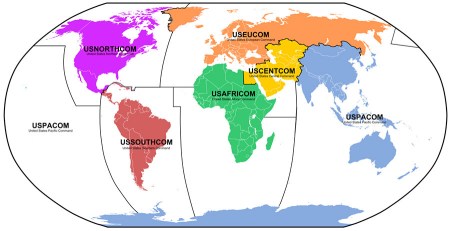
Russian Ties in Central Asia Threaten US Interests – CENTCOM Chief Nominee
Sputnik – 09.03.2016
WASHINGTON — CENTCOM commander nominee General Joseph Votel said that Russia’s trade and military relationships with neighboring Central Asian states threaten US interests in the region.
Russia’s trade and military relationships with neighboring Central Asian states threaten US interests in the region, US Central Command (CENTCOM) commander nominee General Joseph Votel said in testimony to the Senate Armed Services Committee on Wednesday.
“Russia has moved to assert itself in Central Asia through a combination of military, economic and informational means in an effort to resurrect its great power status and hedge against perceived instability emanating from Afghanistan,” Votel stated.
After 14 years, the United States has reduced its military presence in Afghanistan to 9,800 troops, with plans to reduce troop levels to 5,500 by 2017. In the past year, Taliban militants and Daesh terrorist fighters have been on the rise in Afghanistan, prompting US commander of operations there, General John Nicholson, to describe the conditions in the country as “deteriorating.”
Votel further argued that Russian security partnerships with former Soviet states in Central Asia “make it difficult for the United States” to deepen defense ties in the region, which he described as a “key US interest.”
Since 1992, Russia has partnered with neighboring nations in the Collective Security Treaty Organization (CSTO). Russia also founded the Eurasian Economic Union in 2014, to further regional economic development among member nations including Armenia, Belarus, Kazakhstan and Kyrgyzstan.
Disarmament or Bust
Nations Meet to Discuss International Treaty to Ban Nuclear Weapons
By Lesley Docksey | Dissident Voice | March 9, 2016
With the debate going on about whether the UK should renew the Trident missile programme or get rid of it, hardly anything is said about what is happening internationally to rid the world of nuclear weapons – which shows how inward-looking Britain can be, despite claiming a prime position on the world stage.
While national media reported on the Stop Trident demonstration in London, it ignored the discussions taking place in Geneva, or their background including:
- three international, government-level conferences, the last in Vienna, on the humanitarian impact of nuclear weapons, which produced
- the signing and endorsing of the Humanitarian Pledge by a majority of nations
- a vote in the UN General Assembly (voted against by nuclear-armed states which called the Resolution ‘divisive’) but passed by 135 states, to establish an Open Ended Working Group (OEWG) to take forward multilateral nuclear disarmament negotiations
- the first meeting of which took place in Geneva in February
You’d think that deserved a headline or two, the attention of more than some MPs and loud trumpeting from anti-nuclear campaigners, but no. At the London demonstration, organised by the Campaign for Nuclear Disarmament (CND), Labour’s Leader Jeremy Corbyn did speak about the Vienna conference and the humanitarian issues.
And the Green Party’s Caroline Lucas mentioned the OEWG talks in Geneva. In a New Statesman article she also urged the UK government to take part in those meetings. Take part? They are boycotting them.
But no one mentions that.
Yet the wit, wisdom and yes, the whingeing, displayed in statements from Ambassadors and delegates, the depth of the debates, were in many ways far more worthy of our attention than another march to Trafalgar Square.
The aim was to identify the legal gaps in the nuclear weapons treaties and agreements that prevented genuine progress towards disarmament. Naturally some states insisted that there were no legal gaps and the old ‘step-by-step’ process was working even though the world is no nearer to disarmament.
Delegates from 90 nations were there, as was civil society. In a statement delivered by Beatrice Fihn on behalf of ICAN and its 440 partner organisations, she listed all the legal gaps needing to be filled. And she reminded all those there that “Non-nuclear-weapon states are not merely encouraged to take positive steps towards nuclear disarmament; they are required to do so – regardless of the continued failure of nuclear-weapon states to act.”
From the start, a treaty banning nuclear weapons was mentioned more than any other legal instrument as a path towards disarmament, even by nuclear-alliance states begging for ‘caution’ and ‘we can’t do this without the input of nuclear states’. They can; and a ban treaty seems the best way forward.
“States that ‘rely on nuclear weapons in their security doctrines remain reluctant to consider moving ahead without the nuclear-armed states” reported the daily updates from Reaching Critical Will.
So what are the nuclear-alliance states? They are those states (such as NATO members) which, although they have no nuclear weapons of their own, claim that they base their ‘security’ on those that do. To quote Reaching Critical Will:
“While many states called for urgent action, others, including Germany, Netherlands, Japan, Canada speaking on behalf of a group of states, and Finland, cautioned that security considerations of states must be taken into account… Bangladesh asked what could be a bigger security concern than being the victim of a nuclear attack.” Good question.
Does this second-hand security mean that these states are depending on someone else to blow up the world? Would they not be equally guilty under international humanitarian law?
Still, give these states their due. They are at least taking part. The nuclear-armed states are determinedly boycotting the OEWG. Not being able to control what’s happening, they are relying on their alliance to fling a few spanners into the works for them.
The Netherlands tried. It argued that the nuclear-armed states should take part in the discussions. The majority of the world somehow cannot move forward without their willingness to take part. The OEWG should use its time thinking of ways to tempt the armed states into giving up their toys. And how was this for a circular argument:
… the Netherlands is not against a ‘ban’. We see it as a final element towards a world without nuclear weapons, when nuclear weapons no longer fulfil a function in the security of states. It is clear that we have not reached this stage yet and that starting negotiations on a ‘ban’ would therefore be premature.
So we should only have a ban when nuclear weapons are deemed useless anyway.
But as the Irish Ambassador said, in a very quotable speech:
This is a small planet, getting smaller every day… In such a world, questions of security impact us all… And in such a world there is no place for nuclear weapons… In any area of life, work or governance, if something wasn’t working for 20 years, or indeed for over 70, we would try to fix it.
As all those taking part in the OEWG wanted a world free of nuclear weapons; that, having signed up to the Nuclear Non-Proliferation Treaty (NPT), they seemed to know how to get there; that they were even more aware now of the terrible humanitarian consequences of using such weapons and the inability of any nation to cope with such an event; despite all that, said Ireland:
… the problem is that we are no nearer multilateral nuclear disarmament now than we were 20 years ago, when the NPT was indefinitely extended.
Ah, but look at how the non-proliferation part of the NPT has succeeded, was the reply. South Africa, among those nations that got rid of their nuclear arsenals, made a telling point: “nuclear disarmament and non-proliferation are mutually reinforcing processes — the disregard of one has a direct impact on the advancement of the other.”
Delegates were coming to realise that working for a ban treaty does not exclude other legal processes towards disarmament. They can work together, but the big gap is the lack of a ban treaty. By the second day they were agreeing that, given the refusal of nuclear-armed states to take part in the discussions, a ban treaty was perhaps the most sensible way forward.
Malaysia explained that as most legal measures proposed are currently blocked by the nuclear-armed states, three not mutually exclusive options remain: a treaty banning nuclear weapons, a framework convention, and increasing verification capacity. They also pointed out that a ban treaty could be negotiated now and be part of a wider framework later, something the nuclear alliance has difficulty accepting, perhaps because they know their ‘security blanket’ will not approve.
New Zealand’s delegate was quite clear:
I have heard some recent suggestion that while a legally-binding prohibition may be necessary for maintaining a nuclear weapon-free world, it is not in fact necessary in order to attain one. However, no clear explanation for why, as a matter of international law, this might be the case has yet to be put forward.
This is surely part of the ‘smoke and mirrors’ game played by nuclear-armed states.
We see no reason why the pathway adopted for the elimination of other weapon systems, including the elimination of both other types of WMD – that of a legally binding prohibition – should not equally be applicable as a pathway for the elimination of nuclear weapons… There is no need to reinvent the wheel…
Indeed no. But we can make it very, very ornate. Australia delivered a fascinating working paper on behalf of itself and 17 other countries – fascinating because nowhere does it mention a ban treaty. Instead it talks of ‘no quick fixes’, ‘addressing the legitimate security concerns’ of nuclear-armed states and ‘incremental but necessary steps that will enhance security for all’.
It is all about ‘means and sequencing’ and identifying “concrete and practical building blocks”. The NPT is brought into play, as is the Comprehensive Nuclear-Test-Ban Treaty. There are lists of all the tiny steps we might take, or consider taking, along with a), b), c) and so on to m). There absolutely must be transparency and… well, think of it all as a trust-building exercise.
Mexico took up the challenge of the ‘legitimate security concerns’. This concept was not elaborated enough, Mexico argued, as it is not clear whose security these concerns focus on and if states are for or against collective security. As Austria pointed out, collective security is a very different thing to the security of individual nations.
As for the lack of trust, Austria argued this is due to the failures of states to implement various agreements and commitments that had been agreed to by consensus. The onus is on those countries that have nuclear weapons or rely on them as part of nuclear alliances to diminish that mistrust.
Unable to resist a tiny dig at the pro-nuclear states Mexico pointed out that nuclear-armed states boycotting the meeting would not increase trust. Rather the reverse, one would think.
Austria, a leading light in these discussions, reminded delegates that in the Humanitarian (Pledge now adopted by the UN) it says:
We call on all states parties to the NPT to renew their commitment to the urgent and full implementation of existing obligations under Article VI, and to this end, to identify and pursue effective measures to fill the legal gap for the prohibition and elimination of nuclear weapons…
A large number of states share the belief that such a legal gap exists, something pro-nuclear states try to deny. Austria’s working paper on this issue is masterly, laying out all the arguments and exposing the legal gaps. The very structure of the NPT requires additional legal (and non-legal) measures for its full implementation. This applies to Article VI just as much as it applies to the non-proliferation obligations.
(Article VI commits the nuclear armed states to “pursue negotiations in good faith on effective measures relating to cessation of the nuclear arms race at an early date and to nuclear disarmament, and on a treaty on general and complete disarmament under strict and effective international control,” (emphasis added).
All approaches to implementing Article VI should be followed. The ‘step-by-step’ method can sit alongside a comprehensive ban treaty. They are, argues Austria, complementary, and the humanitarian issue is now so serious that all available steps should be taken. Brazil reminded delegates that provisions under the NPT allowed the Nuclear Weapon States only to hold those weapons temporarily, something constantly ignored.
Austria also ripped up the ‘security’ and ‘deterrence’ arguments used by the USA et al. Deterrence rests on the threat of readiness to inflict mass destruction on a global scale, and on the awareness this would be suicidal. Thus, explains Austria:
Ultimately, it is difficult to reconcile this with the underlying foundation of nuclear deterrence that it leads to rational behaviour of all actors involved. The threat is either credible, which requires – in light of the new evidence – readiness to act entirely irrationally. Alternatively, the threat is non-credible since rational analysis cannot lead to the conclusion of risking the use of nuclear weapons.
Not for nothing was Mutually-Assured-Destruction considered MAD.
During 5 days of presentations and debate, many states called for a ban treaty. And key supporters of the Humanitarian Pledge – Mexico, Austria, South Africa, Brazil, and Indonesia – stressed the time has now come to start the negotiations to prohibit nuclear weapons.
The OEWG reconvenes in May for another session. Dare we hope that we will see them start negotiating and putting together the text for a treaty that bans these weapons? It’s beginning to look that way.
• (With grateful thanks to Reaching Critical Will)
• See here for an overview of civil society’s campaign which led, finally, to the disarmament talks in Geneva
Lesley Docksey is the former editor of Abolish War.
Featured Video

Dan Dicks with James Corbett on Solutions Watch
or go to
Aletho News Archives – Video-Images
From the Archives
MMR (Measles, Mumps and Rubella) – Vaccine Risk Statement
MMR Vaccine (Measles, Mumps, and Rubella) Is It Safer Than Measles, Mumps and Rubella?
Physicians for Informed Consent | December 2024
… It has not been proven that the MMR vaccine is safer than measles, mumps, and rubella. The vaccine package insert raises questions about safety testing for cancer, genetic mutations, and impaired fertility. Although VAERS tracks some adverse events, it is too inaccurate to measure against the risk of measles, mumps, and rubella. Clinical trials do not have the ability to detect less common adverse reactions, and epidemiological studies are limited by the effects of chance and possible confounders. Safety studies of the MMR vaccine are particularly lacking in statistical power. A review of more than 60 MMR vaccine studies conducted for the Cochrane Library states, “The design and reporting of safety outcomes in MMR vaccine studies, both pre- and post-marketing, are largely inadequate.”19 Because permanent sequelae (aftereffects) from measles, mumps, and rubella are so rare (especially in children with normal levels of vitamin A and infected after birth),6,15-17 the level of accuracy of the research studies available is insufficient to rule out the possibility that the MMR vaccine causes greater death or permanent disability than measles, mumps, and rubella. – Read full article
Blog Roll
 Aletho News
- Moscow issues warning to NATO over Russian exclave
- Yes, the Iran war has destroyed Trump’s presidency
- The fallacy of US delusions about Iran’s economic collapse
- Hezbollah denies Syria cell link, warns of Israeli plan to sow discord
- The legacy of US sanctions, war, and occupation in Iraq
- Iraqi resistance group rejects disarmament, vows to maintain support for Lebanon
- Sheikh al-Asadi warns of Iraqi government compliance with US demands
- How to MAKE THE CONSPIRATORS PAY for their crimes! Dan Dicks with James Corbett on Solutions Watch
- There’s a drought in academia: A drought in honest research on the subject of drought and other weather extremes
- Department of War Awards $20.7 Billion Contract to Raytheon for Air-to-Air Missiles
- If Americans Knew
- Israeli Attacks Kill Ten Palestinians in Gaza
- Massacre at Minab: The School That Became a Grave
- Israeli media: The IDF Shows It Doesn’t Turn a Blind Eye; It Actively Emboldens Settler Havoc
- As settlers ravage West Bank, Israeli forces kill 10 in Gaza – Daily Update
- New Report: “Scholasticide and Genocide in Gaza: Assessment, Testimonies and Legal Analysis”
- Ex-Biden officials are desperate for a Gaza scapegoat
- Israeli “settlers” Invade Al-Aqsa; Pour Boiling Water on 75-Year-Old
- Israel Has Kidnapped Another American Teenager
- US arms sales to Israel worth $21.6 billion in 20 months
- Three Palestinians Killed in Israeli Attacks on Gaza
- No Tricks Zone
- Green Energy Debacle: German Expert Professor Fritz Vahrenholt Warns Of Severe Economic And Social Consequences
- Two More Paleo Reconstructions Affirm Meters-Higher Sea Levels Across Ireland, Brazil 7000-6000 Years Ago
- New Study: Earth And Venus Surface Warmth Largely Explained By Convection And Lapse Rate, Not CO2 Or Radiation
- 2025 Nature Paper Claiming Worsening Global Drought Gets RETRACTED …Heavily Flawed
- New Study: ‘Global Drought Shows No Detectable Recent Acceleration Under Climate Warming’
- Economic Masterminds: German Socialists Suggest Taxing Productivity Gains Stemming From Using AI
- The South China Sea Has Not Been Cooperating With The Climate Change Narrative
- Energy Crisis: Germany Enters Heating Season With Historically Low Gas Reserve Fill Levels
- New Study: The Antarctic Ice Sheet Gained Mass From 2020-2024 Due To Staggering Snow And Ice Accumulation
- Study: Ocean Heating Rates From Thousands Of Years Ago ‘Dwarf’ Modern Ocean Heating Rates

