‘Agile Spirit’: NATO military exercises kick off in Georgia
RT | July 8, 2015
A multinational NATO military training “Agile Spirit 2015” has officially started in Georgia, uniting military personnel from six countries. It comes amid Russia’s mounting concerns over NATO’s military buildup in the region.
The US, Bulgarian, Romanian, Lithuanian and Latvian military will accompany Georgia’s Battalion 42 in the two-week-long military exercises that officially started on Wednesday, RIA-Novosti reported.
The annual joint training, that first started in 2011, this year involves 220 US Marine Corps servicemen. It is to take place at the Vaziani military base, located some 25 kilometers away from Tbilisi. Vaziani is a former Soviet and Russian air force base until Russian forces withdrew in 2001 under a European conventional arms reduction agreement.
The exercise follows the line of the Wales summit in September 2014, where the alliance agreed upon founding a NATO-Georgia Joint Training and Evaluation Center within the framework of the Substantial NATO-Georgia Package, introduced back then by allied leaders.
In an opening speech on Wednesday, major-General Kapanadze said that “Georgian soldiers took part in many international operations and are continuing to contribute to global peace alongside our partners,” Agenda website reported.
“Our cooperation is more than just a partnership – it is brotherhood of arms,” Kapanadze added.
“These military exercises in Georgia – a country that launched an unprovoked attack on South Ossetia in 2008,which led to the death of 12 Russian peacekeepers and a brief military conflict between Georgia and Russia – are the latest in a series of alarming moves by NATO that underscore the organization’s threatening stance towards Russia,” journalist Robert Bridge told RT.
The Russian Foreign ministry has long been criticizing the military buildup in the neighboring states, which goes “under the false pretext of alleged ‘aggressive behavior’ by our country” and is accompanied by “unfriendly and malicious” rhetoric.
“We are not threatening anyone and we seek to resolve all conflict situations through political means, with respect towards the international law and other nations’ interests,” President Putin said in June, underlying though that Russia needs strong, modern and adequately armed military force to face the challenges “that we cannot ignore”.
Georgia, an active contributor to alliance’s operations, has long planned to join NATO. In 1994, the former Soviet republic joined the Partnership for Peace program. After the “Rose Revolution” in 2003, the bilateral cooperation only “deepened”, according to a NATO statement.
“I don’t think there is any realistic chance of Georgia joining NATO in the coming years. In fact, it is more likely that Georgia will increasingly thaw relations with Moscow, for economic reasons, as the penny drops in Tbilisi that the West was good at false promises, but not delivering actual help,” journalist Bryan MacDonald told RT.
In August 2008, a brief military conflict between Russia and Georgia broke out, after Tbilisi launched a large-scale military offensive against South Ossetia prompting Moscow’s peace enforcement operation. It ended up in Russian official recognition of the two former Georgian autonomous republics as independent states of Abkhazia and South Ossetia.
Why does the Obama administration neglect American national interests?
Sputnik – 07.07.2015
Paradoxically, US President Barack Obama, a Nobel Peace Prize winner, has finally found himself lured into an open-ended war in the Middle East, tense confrontation with China, and a new Cold War with Russia.
Director of the Economic Growth Program at the New America Foundation Sherle R. Schwenninger pointed out that although Barack Obama vowed to end the “wars of occupation” in Iraq and Afghanistan and to reset Russo-American relations, he has finally found himself fighting on multiple fronts.
“Now, after being “pulled back in” by liberal interventionists and neoconservative hawks both inside and outside his administration, he finds himself pursuing a new open-ended war against the so-called Islamic State, prosecuting an expanded counterterrorism campaign from Central Asia to North Africa, overseeing a new Cold War with Russia, and pivoting toward what could become one with China in East Asia,” the scholar elaborated.
The expert noted that “many of the people,” which contributed to the shift in US foreign policy, “are the same ones who cheered us into the war in Iraq.”
Mr. Schwenninger underscored that while the US President’s critics are accusing Barack Obama of hesitancy, “the failure of Obama’s foreign policy” is that “it has embraced many of the very positions that Obama’s interventionist opponents have advocated.”
“In so doing, it has failed to protect America’s most important national interests,” the expert stressed.
According to Mr. Schwenninger, it was not in the US’ interest to topple Syrian President Bashar al-Assad or to change Ukraine’s nonaligned status, or to alienate Russia and China. It was also not in America’s interest to help to escalate the civil war in Ukraine “by unconditionally supporting Kiev’s various military offensives this past year, when such offensives would only further bankrupt Ukraine and cause even more unnecessary bloodshed.”
Blaming the White House for its Middle Eastern policy, US experts point to Washington’s role in the Yemeni crisis.
“Yemenis have good reason to hold the US responsible for the war that has devastated their country. The US is particularly responsible for the campaign’s attacks on civilian areas because it is actively aiding the Saudis in their operations. US officials are understandably embarrassed to talk about this,” US conservative publicist Daniel Larison noted.
However, it is just the tip of the iceberg. While pursuing its ambitious global goals, Washington has undermined its own strategic foreign policy goals.
While Washington was beefing up its military presence in Eastern Europe, citing Russia’s imaginary “threat,” Moscow and Beijing have jumped at the opportunity to reshape the Eurasian economy, bringing under their umbrella a vast number of Central/South Asian and former Soviet states.
Furthermore, when the United States was speculating about its “Asian pivot” and teasing the Chinese Dragon, Beijing kicked off its ambitious New Silk Road project, aimed at cementing Eurasia’s heartland and gradually expelling Washington from the region.
As a result the United States risks losing its dominant positions in both Eurasia and the Asia Pacific.
And that is not all. Preoccupied with its foreign policy, the Obama administration neglected the country’s most important domestic tasks: namely, to reduce inequality and rebuild the American middle class.
“We should be working with our international counterparts to strengthen the world economy and create jobs. In this way, we might be able to break our downward drift toward endless war in the Middle East and new Cold Wars in Europe and Asia,” Mr. Schwenninger noted.
In order to realign Washington’s foreign policy to support its domestic agenda, Obama would have better considered curtailing military commitments and promoting programs to expand investments and jobs inside the country.
Or as American conservative political commentator Patrick Joseph “Pat” Buchanan put it: “Our agenda in that decade was — stay out of wars that are not our business, economic patriotism, secure borders, and America first.”
Three Scenarios for the Donbass
By Andrey Ivanov* | Fort Russ | July 5, 2015
The specialists from the Russian International Affairs Council headed by the former foreign minister Igor Ivanov described three scenarios for the Donbass: confrontation, freeze, or continuing the peace process. How likely are they?
Life itself forces one to make forecasts. It’s clear that the unrecognized republics with a population of five million won’t be able to exist for long in the current suspended state. On the one hand there is a ceasefire, but the shelling of cities continues. Kiev continues to view Donbass as its territory, but doesn’t transfer money and fences it off with barbed wire. Poroshenko claims to adhere to the Minsk Agreements, but is against the constitutional reforms they require…
The first scenario is confrontation. The Council experts are of the opinion that full-scale combat operations can’t be ruled out. Kiev might decide to launch a new offensive with US support. Then the Donbass would suffer the fate of Serb Krajina which Croatia reconquered by force in 1995. It’s also possible that we’ll see the repetition of the events of August 2008 in South Ossetia. Russia was then forced to intervene militarily and then recognize the territory’s independence.
The second scenario is a peaceful resolution of the conflict. Analysts believe this is the least likely scenario. It would require the removal of anti-Russian sanctions and West’s recognition of Crimea’s unification with Russia.
The most likely is the third scenario–freezing the conflict. Ukraine doesn’t have the necessary resources to score a military victory, while Russia is not ready to acknowledge their independence. World powers will continue to exchange military warnings but there will be no heavy loss of life…
–Donbass’ return to Ukraine is hardly possible. Especially considering how Kiev views its inhabitants. Kiev wants to “integrate” Donbass using artillery–says the Moscow State University Center for Ukrainian and Belorussian Studies Director Bogdan Bezpalko–Donbass integration with Ukraine would only be possible in the event of its military defeat which might occur should the conflict escalate.
In actuality, the fate of Donbass depends mainly on major world players: US, EU, Russia. They can influence Ukraine’s elite and its relationship with Donbass.
The situation may develop in several ways. The majority of them are unfavorable. Both for Donbass, Ukraine, Russia, and even the West. Modeling the situation depends on the nature of relations between Russia and the West. Therefore the scenarios may change from quarter to quarter. Or even more frequently.
Svobodnaya Pressa (SP): Are DPR and LPR viable?
–Yes, but only as long as Russia helps them. They are of limited viability as independent states. Incidentally, they never aspired to an independent geopolitical role. DPR and LPR are states which depend on Russia’s support. Just as South Ossetia and Abkhazia did earlier, whose official recognition by Moscow was of considerable help.
SP: Can the republics share the fate of Serb Krajina?
–It all depends on Russia’s position. If Russia helps LPR/DPR, including through military assistance, that scenario is out of the question. One has to keep in mind Ukraine would have to expend considerable resources to break Donbass resistance. Moreover, Krajina did not enjoy the support by either Serbia or by Republika Srpska, which was the Serb state in Bosnia. Abandoned to its fate, the Krajina became easy prey for the Croat army which was well trained by the US. But if DPR and LPR have Russia’s support, retain control over the border with Russia, it won’t share Krajina’s fate. Moreover, Donbass republics have their own record of success against the UAF. The Ilovaysk and Debaltsevo “cauldrons” showed how effective LPR and DPR armies are.
SP: How justified are the hopes that the Ukrainian state will soon collapse?
–Ukraine is descending into a state of socio-economic collapse. This is what makes it different from Croatia, a country with a small population which received powerful financial support from the West. Ukraine has a population of 40 million which is rapidly aging. Industry is degrading. Ukraine is a country on the brink of an abyss. It simply won’t have the resources for military operations. I’d like to remind that the Croatian operation Storm against Krajina took only a few days, but after a lengthy preparation. Therefore even though the operation was costly, its effects were perceptible. Ukraine, on the other hand, is conducting its ATO, it’s spending a lot of money, it’s in the midst of the sixth wave of mobilization. Donbass, which has nothing left to lose, may soon turn out the winner. If it establishes cooperation with Russia, restores control over the port of Mariupol, it will be able to restore its economy and social well-being. DPR and LPR would turn out to be more successful as states than Ukraine.
I want to note that Ukraine’s problems are not due to a bad starting position in economy, culture, human resources. Ukraine in 1991 had colossal resources which were squandered in the most incompetent fashion, which were stolen after independence. This shows how Ukraine’s leaders view its sovereignty. Ordinary people haven’t gained anything out of independence other than impoverishment, depopulation, and aggressive nationalism.
–The current peace plan, based on Minsk Agreements, is unviable–says Geopolitical Problems Academy Vice President Konstantin Sokolov–The agreements pertain only to the separate parts of LPR and DPR and only regulate the relationship along the frontline. What is more, Kiev is actively torpedoing the agreements. Therefore the conflict can only be resolved through an armed clash. What form will it take? Kiev planned an offensive for May, but it was thwarted. Ukraine today is the center of attention of US, EU, and Russian foreign policy. It’s clear that the offensive would encounter political resistance by BRICS and Shanghai Organization countries.
Right now Ukraine is in a state of unstable balance. There are large groups of foreign mercenaries in the country. But will Kiev decide on a major attack? I think that will become clear by the end of summer.
In my view, the West is coming around to the idea of blaming all the crimes on Poroshenko’s team. It could be replaced by other people.
The state of balance will continue for some time. But ultimately the situation will resolve itself through a social explosion in Ukraine. The country is almost bankrupt and the inconveniences of the war are growing more acute. A group of senior military officers recently defected to the republics. It means that the Kiev regime is losing control even over its means of violence.
SP: But Ukraine is continuing to exist, in spite of the dire forecasts.
–Up to 2004, up to the first “orange revolution”, Ukraine compared well to other post-Soviet republics. Now its living conditions are falling to a level which for some might be below the threshold of survival. If earlier one could have patience, today it’s impossible.
The default could be used by the West to change the country’s leadership.
SP: How will the situation unfold?
–The most likely outcome is Ukraine’s break-up into parts. There are forces in the West interested in seeing it happen. In general, the West’s strategy revolves around breaking up countries. We’ve seen it in Yugoslavia, Libya, Syria. But I wouldn’t draw analogies between Donbass and Krajina or South Ossetia. Donbass is a big region, therefore it’s of greater significance. One also mustn’t forget Russia cannot stand aside in this conflict. I believe that ultimately the West’s strategy will suffer a defeat. National forces in Russia and Ukraine always rise up when the situation is on the brink. Ukraine is the trigger that will change the global strategic situation.
–In order to make forecasts, one first need to examine the present–says Novorossia State-Building Committee Chairman Vladimir Rogov–Poroshenko introduced legislation proposing not decentralization, but legalizing the unfolding lawlessness. The president would get the authority to fire elected officials, which he currently doesn’t have.
On the other hand, we see growing conflicts within the ruling Ukrainian elite. The US are preparing Lvov mayor Sadovyy and former SBU head Nalivaichenko as Poroshenko’s replacements. If Sadovyy comes to power, Ukraine will get a “soft”, Baltic, version of nationalism. If Nalivaichenko, Ukraine will become a “euro-ISIS.”
The new head of the SBU is Vasiliy Gritsak who’s devoted to Poroshenko but utterly incompetent. It’s enough to recall his contribution to the Ilovaysk disaster! Poroshenko is trying to place loyal individuals in key positions. And those who have nowhere to run.
Nevertheless, the “main rat” of Ukraine’s politics Yuriy Lutsenko submitted his resignation from the Poroshenko Block chairman in the Rada. We remember that Lutsenko changed his party affiliation more than once. He always left this or that part on the event of its loss of influence.
SP: Can the Donbass wait long enough to see Ukraine collapse?
–We must wait until the Kiev elite falls apart. There is no doubt that Odessa, Kharkov, Zaporozhye, Lvov, will see the founding of their own people’s republics. Donbass simply needs to get stronger, restore its economy, and push the front line far enough so that the UAF can’t shell its big cities. Soon the people in Kiev and Lvov will be able to free their lands from the current authorities.
SP: What influence do world powers have on the situation in the Donbass?
–We are entering the phase of direct interaction between the major international players: Russia and US. But the most important thing is that DPR and LPR model is more attractive than Ukraine. People’s republics have far lower utility rates. People in Ukraine will gradually realize that the Donbass has a more just state than they do.
*Translated from Russian by J.Hawk
Constitutional maneuvering in Ukraine to deny recognition of Donetsk and Lugansk republics and sabotage Minsk-2
New Cold War | July 6, 2015
The Donetsk and Lugansk People’s Republics have announced they will hold local elections on October 18 and November 1, respectively. The two dates surround announced local elections to take place in Ukraine on October 25.
Prime Minister of the Donetsk People’s Republic Aleksandr Zakharchenko made his announcement on July 2. According to UNIAN News, heads of cities and districts will be elected. No decision on the election of members of local councils has been made yet.
Lugansk People’s Republic Prime Minister Igor Plotnitsky announced on July 6 that similar local elections will take place there on November 1.
Interfax reports Zakharchenko as explaining, “In today’s situation, which emerged through Kyiv’s fault, the Donetsk People’s Republic has to independently start to implement the Minsk agreements in order to rescue them.
“We will begin acting immediately, without waiting for Kyiv to come to its senses and return to real, not fake, talks, because any further procrastination and delays will benefit only the Ukrainian party of war.”
Plotnitsky’s statement said, “Recently, we concluded that Ukraine doesn’t intend to abide by its commitments. Kiev either breaks or pretends to execute the provisions of the Minsk Agreement. The Verkhovna Rada issues bills not consistent with our draft documents on matters affecting the Donbass. To date, they’ve refused to define the special status of the LPR, nor have they even begun to write the laws embodying that special status. Besides that, with each passing day, Kiev intensifies its blockade of the LPR.”
“From such a perspective, we decided to begin a unilateral implementation of the Minsk Agreement regarding local elections in the LPR.”
The two prime ministers are referring to the failure of the Kyiv government to respect clauses of the Minsk-2 ceasefire agreement of Feb. 12, 2015 requiring dialogue with the rebel regions of Donetsk and Lugansk as well as a decentralization of powers to them.
The announcements by the two people’s republics administrations are in response to an elaborate scheme by the government of Ukrainian President Petro Poroshenko to dodge the key provisions of Minsk-2 requiring talks and constitutional change.
Back in May, at the eighth Kiev Security Forum, Poroshenko and Ukraine’s prime minister made it clear they will not engage in talks. “We will hold a dialogue with Donbass, but with the other Donbass, a Ukrainian one,” Poroshenko said. He went on, “We must ensure fair elections.”
Prime Minister Arseniy Yatsenyuk said his government would never talk to the current representatives in Donbas. “We will communicate only with the legitimate representatives of this region, we want to hold legitimate elections there.”
Yatsenyuk provocatively said his government would talk to leaders of the Donetsk and Lugansk republics “only when they are behind bars”. He added, “By the way, we have got enough empty prison cells.”
Instead of talks, the Ukraine government convened a Constitutional Commission in April. That body is set to deliver its draft report to the Verkhovna Rada this week. It will propose some cosmetic decentralization changes, but crucially, the changes will deny any present or future recognition of the Donetsk and Lugansk republics. The constitutional changes will be sold to international public opinion as proof of compliance with Minsk-2.
Poroshenko earlier announced local elections for October 25 as part of the scheme. Donetsk and Lugansk republics will, of course, refuse to allow a government in Kyiv waging war on them to conduct elections on their territories. This will be sold as proof of their intransigence and impossibility of dialogue with them.
TASS reports Zakharchenko saying in his July 2 announcement that Kiev’s unilateral actions on adopting amendments to Ukraine’s constitution serve as evidence that “the Kiev regime has de facto exited the Minsk peace process”.
“Under the circumstances,” he said, “the Donetsk People’s Republic has to start implementing the Minsk agreements itself in order to save them.”
The following day, the DPR head responded to an orchestrated statement by U.S. Vice-President Joseph Biden criticizing the Oct. 18 election decision. Zakharchenko said, reports TASS, “The U.S. Vice President has most likely not studied the issue thoroughly. I doubt that he has even read the Minsk package of measures. And Poroshenko is distorting facts as usual.”
He continued, “If Biden is really concerned about the future of the Minsk accords, than he should make Poroshenko and Groysman [Speaker of the Verkhovna Rada] implement them.”
Russian Foreign Minister Sergei Lavrov issued a statement on July 3 saying his government is deeply disappointed with what it calls the failure of the Ukrainian government to respect provisions of Minsk-2. He said, “Russia is deeply concerned about Kiev’s inability and unwillingness to fulfill its commitments to coordinate with Donetsk and Lugansk modalities of conducting local elections and its inability to attract representatives of the self-proclaimed republics to drawing up a new constitution.”
Lavrov said that Poroshenko’s and Yatsenyuk’s government has written a new, draft constitution without participation of Donetsk and Lugansk representatives. This “does not fulfill any of the requirements of the Minsk agreements with regard to this document.”
The draft “does not reflect the tasks of ensuring a special status for these territories on a permanent basis and does not reflect the tasks of decentralization of power,” as envisaged in the peace deal reached in the Belorussian capital in February.
America’s Endless Air Wars
By Nicolas J S Davies | Consortium News | July 6, 2015
U.S. Central Command’s latest figures on its aerial bombardment of Iraq and Syria reveal that this is the heaviest U.S. bombing campaign since President George W. Bush’s “Shock and Awe” campaign against Iraq in 2003. In the campaign’s first ten months from August 2014 to May 2015, the U.S. and its allies conducted 15,245 air strikes, or an average of 51 air strikes per day.
This is only the latest campaign in a 15-year global air war, largely ignored by U.S. media, in which the United States and its allies have conducted at least 118,000 air strikes against other countries since 2000. The 47,000 air strikes conducted in the 6 ½ years since President Barack Obama took office are only a small reduction from the 70,000 in eight years of the Bush administration, and the current campaign will easily make up that deficit if it continues at this intensity until Obama leaves office.

Afghanistan has been the most heavily bombed country, with at least 61,000 air strikes since 2001. That includes 24,000 bombs and missiles in the first year of the war and a relentless bombing campaign that struck Afghanistan with another 29,000 bombs and missiles between 2007 and 2012, a slow motion version of “Shock and Awe.” That was an average of 13 air strikes per day for six full years, two years under Bush and four under Obama. The heaviest bombardment was in October 2010, with 1,043 air strikes that month, but that total is now eclipsed every month by the new campaign in Iraq and Syria.
Iraq had already suffered about 34,000 air strikes since 2000 before the latest campaign began. There were at least 800 air strikes in the “No Fly Zone” bombing campaign to destroy Iraq’s air defenses between 2000 and 2002; 29,200 air strikes in “Shock and Awe” in 2003, a campaign whose planners compared it to a nuclear attack; and another 3,900 during the U.S. occupation, peaking with 400 strikes in January 2008 as remaining centers of armed resistance were obliterated by air strikes, Spectre gunships and heavy artillery in the climax of the “Surge.”
But until the new campaign in Iraq and Syria, the seven-month NATO-Gulf Cooperation Council bombing of Libya was the heaviest bombardment since “Shock and Awe”, with 7,700 air strikes in seven months, or 36 air strikes per day. NATO and its Arab monarchist allies plunged Libya into intractable chaos and violence, exposing “regime change” as a euphemism for “regime destruction.”
NATO’s destruction of Libya spurred Russia to finally draw the line on its 20-year acquiescence to Western aggression and military expansion. Since then, the U.S. and its allies have persisted in their “regime destruction” policy in Syria and Ukraine, threatening strategically important Russian naval bases in Tartus and Sevastopol, what has evolved from an asymmetric war on a series of relatively defenseless countries into full-blown 1950s-era nuclear brinksmanship.
Drones have played a growing role in the U.S. air war, but they still account for only a fraction of total U.S. and allied air strikes, several thousand out of 118,000 air strikes in 15 years.
None of these figures include Israeli air strikes against Palestine, the current Saudi-led bombing of Yemen, or French operations in West Africa, as I haven’t found comparable figures for those campaigns, but they must add many thousand more air strikes to the real total.
Keeping the People in the Dark
In a recent article, Gareth Porter reported that the Pentagon is seriously opposed to putting more “boots on the ground” in Iraq or Syria, but that the generals and admirals are prepared to keep bombing them more or less indefinitely as the political path of least resistance for themselves and the White House. This may indeed be the “safe” course for a politically-driven administration and a Pentagon that is always thinking of its public image and its future funding.
But it depends on keeping the public in the dark about several critical aspects of this policy. First, there is little public resistance to this policy mainly because few Americans know that it’s happening, let alone understand the full scale of the bloodshed and devastation perpetrated in our names for the past 15 years.
The second thing the Pentagon doesn’t want you to think about is the deceptive role of “precision” weapons in U.S. propaganda. Considering how accurate these weapons really are in relation to the huge numbers of them raining down on country after country, it is not surprising that they have killed or wounded millions of civilians and destroyed hundreds of thousands of homes and civilian infrastructure, as we see in photographs and video of the ruins of Fallujah, Sirte or Kobani.
A direct hit with a single 500- or 1,000-pound bomb will cause death, injury and destruction up to hundreds of feet from its point of impact, so even accurate air strikes inevitably kill and maim civilians and destroy their homes. But whatever proportion of these 118,000 bombs and missiles have actually missed their targets have wreaked completely indiscriminate death, injury and destruction.
Rob Hewson, the editor of Jane’s Air Launched Weapons, estimated that 20 to 25 percent of the “precision” weapons used in “Shock and Awe” in 2003 missed their targets. Another one third of the bombs and missiles used in “Shock and Awe” were not “precision” weapons to begin with.
Even the Pentagon has not claimed a quantum leap in its “precision” weapons technology since 2003, so it is likely that at least 15 percent are still missing their targets, adding daily to a massive and mounting toll on innocent civilians.
As Hewson told the Associated Press in 2003, “In a war that’s being fought for the benefit of the Iraqi people, you can’t afford to kill any of them. But you can’t drop bombs and not kill people. There’s a real dichotomy in all of this.”
Body Count, a recent report published by Physicians for Social Responsibility, confirmed previous estimates of well over a million people killed in America’s wars since 2000. This and previous studies document the horrific results of what Hewson and other experts understand only too well, that “you can’t drop (100,000) bombs and not kill (hundreds of thousands of) people.”
Another element in the Pentagon’s shaky propaganda house of cards is its effort to obscure what bombs and missiles actually do to their victims. Americans watch the Islamic State beheading videos on TV or YouTube but we never see videos of people decapitated or children dismembered by the bombs our taxes are paying for. But our bombs behead people too.
Apologists claim that U.S. bombing is morally superior to the “terrorism” of America’s enemies, because the U.S. killing and beheading of civilians is “unintentional” rather than “deliberate.” The late Howard Zinn, a former U.S. Air Force bombardier and later a history professor, responded to this claim in a letter to the New York Times in 2007:
“These words are misleading because they assume that an action is either ‘deliberate’ or ‘’unintentional.’ There is something in between, for which the word is ‘inevitable.’ If you engage in an action, like aerial bombing, in which you cannot possibly distinguish between combatants and civilians (as a former Air Force bombardier, I will attest to that), the deaths of civilians are inevitable, even if not ‘intentional.’
“Does that difference exonerate you morally? The terrorism of the suicide bomber and the terrorism of aerial bombardment are indeed morally equivalent. To say otherwise (as either side might) is to give one moral superiority over the other, and thus serve to perpetuate the horrors of our time.”
Millions of ‘Enemies’
In fact, U.S. armed forces are waging war on millions of people for whom becoming combatants in a war would be the last thing they would ever consider if we had not brought our war to their doorsteps. The Center for Civilians in Conflict recently interviewed hundreds of local people who have participated as combatants in conflicts in Bosnia, Libya, Gaza or Somalia. It found that their motivations were almost entirely defensive, to protect themselves, their families, their communities or their countries.
When military forces attack or invade a country, many ordinary people feel compelled to take up arms to defend themselves and their homes. When the forces that put them in this unbearable predicament in the first place treat their efforts to defend themselves as a legal “green light” to target them with force and call them “terrorists,” they are driven to join better organized armed resistance movements that offer them protection in numbers and an effective way to fight back.
The essential first step to breaking the escalating spiral of violence is to force the aggressors, in this case the United States and its allies, to cease their aggression, including their state sponsorship of armed groups or “terrorists” in the affected countries. Then legitimate diplomatic initiatives can begin the difficult work of resolving the complex political and humanitarian problems caused by U.S.-led aggression and beginning to restore peace and security.
In his 1994 masterpiece, Century of War, the late Gabriel Kolko documented that war was the catalyst for all the major political revolutions of the Twentieth Century. While the working people of the world have otherwise failed to “rise up” as Marx predicted, the one thing that has reliably driven them to do so is the horror of war.
The war that the United States is waging today is proving no different. Armed resistance is spreading throughout the affected countries, spawning new ideologies and movements that defy the conceptual frameworks and limited imagination of the U.S. officials whose actions gave birth to them.
U.S. leaders of all stripes, military or civilian, Democrat or Republican, still fail to grasp what Richard Barnet concluded in 1973 as he studied the U.S. defeat in Vietnam, “at the very moment the number one nation has perfected the science of killing, it has become an impractical instrument of political domination.”
The last 15 years of war have served to confirm Barnet’s conclusion. After 118,000 air strikes, millions of casualties, trillions of dollars squandered, and country after country plunged into chaos, the U.S. has failed to gain political control over any of them.
But our complacent leaders and their self-satisfied advisers blunder on, debating who to threaten or attack next: Russia? China? Iran? Which “threat” provides the best pretext for further U.S. military expansion?
As Gabriel Kolko observed, because of “inherent, even unavoidable institutional myopia, … options and decisions that are intrinsically dangerous and irrational become not merely plausible but the only form of reasoning about war and diplomacy that is possible in official circles.”
But U.S. war-making is not just dangerous and irrational. It is also a crime. The judges at Nuremberg defined aggression, attacking or invading other countries, as the “supreme international crime, differing only from other war crimes in that it contains within itself the accumulated evil of the whole.” The UN Charter goes one step further and prohibits the threat as well as the use of force.
Benjamin Ferencz, the only surviving member of the prosecution team at Nuremberg, is a fierce critic of illegal U.S. war-making. In response to U.S. war crimes in Vietnam, he dedicated the rest of his life to establishing an International Criminal Court (ICC) that could prosecute senior officials of any government who commit aggression and other war crimes.
Ferencz is hailed as the founding father of the ICC, but his vision of “Law Not War” remains unfulfilled as long as his own country, the United States, refuses to recognize the jurisdiction of either the ICC or the International Court of Justice (ICJ).
By rejecting the jurisdiction of international courts, the U.S. has carved out what Amnesty International has called an “accountability-free zone,” from which it can threaten, attack and invade other countries, torture prisoners, kill civilians and commit other war crimes with impunity.
Nuremberg ‘Exemption’?
U.S. government lawyers enjoy the privilege, unique in their profession, of issuing legally indefensible but politically creative legal cover for war crimes, secure in the knowledge that they will never be forced to defend their opinions before an impartial court.
Ben Ferencz very graciously wrote a preface to my book, Blood On Our Hands: the American Invasion and Destruction of Iraq, and he spoke at an event with me and David Swanson in 2011, just before his 91st birthday. Ben talked about Nuremberg and the ICC, and he compared U.S. justifications for its “preemptive” illegal war-making to the defense offered by SS Gruppenfuhrer Otto Ohlendorf at Nuremberg.
As Ben explained, “That Ohlendorf argument was considered by three American judges at Nuremberg, and they sentenced him and twelve others to death by hanging. So it’s very disappointing to find that my government today is prepared to do something for which we hanged Germans as war criminals.”
If we do not hold American war criminals accountable for their crimes, and accept the jurisdiction of international courts to do so if we do not, how else can we serve notice on those who come after them that they must never do this again?
Argentina, Guatemala and other countries in Latin America are prosecuting and jailing mass murderers like Videla and Rios Montt who once took for granted that they could kill with impunity. America’s masters of war should not assume that we will fail to bring them to justice.
As for the collective responsibility we all share for the crimes committed by our country and our armed forces, we must be prepared to pay substantial war reparations to our millions of victims and the countries we have destroyed. We could start by paying the reparations ordered by the International Court of Justice when it convicted the United States of aggression against Nicaragua in 1986, and the $3.3 billion promised by President Nixon to repair at least some of the U.S. bomb damage in Vietnam.
These would be concrete steps to tell the rest of the world that the United States was finally ready to abandon its failed experiment in “the science of killing,” to be bound by the rule of law, and to start cooperating in good faith with the rest of humanity to solve our common problems.
~
Nicolas J S Davies is the author of Blood On Our Hands: the American Invasion and Destruction of Iraq. He also wrote the chapters on “Obama at War” in Grading the 44th President: a Report Card on Barack Obama’s First Term as a Progressive Leader.
Greece’s Downfall and Redemption
By Finian Cunningham – Sputnik – 29.06.2015
Decades of exorbitant military spending account for Greece’s present downfall under an Olympian-sized debt. European governments and news media portray the problem of Greece’s financial woes as public spending profligacy.
The truth is that Greece’s debt mountain has been incurred from years of wasteful military splurging. That is the tragic downfall of the country, which European creditor governments and the mainstream news media tellingly ignore.
But in this understanding of Greece’s modern tragedy, there is hope for democratic renewal and redemption. Because that realisation permits a radically different option to restore Greece’s economy in a way that is rational and achievable, without piling up more debt and misery for the population. Instead of more austerity imposed on workers and pensioners, the solution is for Greece to embark on a massive disarmament programme to overturn decades of reckless militarism.
Greece’s outstanding total debt is around $320 billion – or 175 per cent of its national economic output (GDP). Its creditors – the Troika of European Union, European Central Bank and the International Monetary Fund – are insisting that the Athens government must oversee more public cuts.
The reality is that austerity is only driving the Greek economy into further depression and debt.
That inevitably means more and more of the Greek people’s sovereign rights whittled away to the point of becoming a vassal state dictated to by foreign governments and finance capital.
As a foreboding sign of things to come, Greek Prime Minister Alexis Tsipras’ latest offer of raising corporation taxes in place of cutting pensions was slapped down last week by the Troika.
The imperious demand for more austerity has now forced the Greek government to put the choice to the public in the form of a proposed referendum on the EU’s bailout terms, to be held on July 5.
Greece’s debt crisis appears to be heading to an even sharper crisis point. But the Greek origin of that word “krisis” also has a positive connotation of decisive event. The Greek people should reject the never-ending debt addiction that the EU creditors and IMF have hooked the country on. For that way only foreshadows increasing austerity and anti-democratic dictate.
What the Greek people can turn to is a realistic and altogether more democratic and humane option – of demanding their country slash its monstrous military spending.
Even after five years of economic catastrophe, Greece’s annual military budget amounts to $4 billion, according to the Stockholm International Peace Research Institute. That translates to 2.2 per cent of the nation’s GDP – a colossal drain on the economy.
To put Greece’s military spending into perspective, it is double the ratio that most other EU countries currently spend on defence. For example, Germany spends 1.2 per cent of GDP, Italy 1.1 per cent, Netherlands 1.2 per cent and Belgium 1.1 per cent.
If Greece were to cut its outsized military budget by half that would generate $2 billion in one year alone, which would pay off its immediate bill to the IMF and help the country reach a 1 per cent budget surplus that the Troika has set for 2015. In other words, that source of finance would obviate any further need for cutting pensions and workers’ salaries.
Why the Syriza government of Alexis Tsipras, which claims to be a radical socialist coalition, does not pursue this more imaginative and democratic alternative is a curious question. Last week, Tsipras offered to cut the military budget by $200 million – or a mere 5 per cent. But the offer was rebuffed by the IMF because it stated that its rules do not permit interference in a country’s defence policy. To which Tsipras and the Greek electorate should respond with their own rebuff of IMF absurdity – especially evident with the IMF’s throwing billions of dollars to the regime in Kiev which is waging war on the eastern Ukrainian population.
But that’s only a trifling start to addressing the Greek tragedy. The Greek people have legal and moral grounds to repudiate the entire debt mountain as illegitimate or, as economists would say, “odious debt”.
During the decade up to the onset of crisis in 2010, Greece was regularly spending 7 per cent of its GDP on military. Some estimate that during that decade the country spent a total of $150 billion on defence – or half of the current debt pile.
As Greek economist Angelos Philippides told the Guardian back in April 2012: “For a long time Greece spent 7 per cent of its GDP on defence when other European countries spent an average 2.2 per cent. If you were to add up that compound 5 per cent [difference]… there would be no debt at all.”
Moreover, Greece’s past military expenditure was mired in corruption.
In October 2013, ex-defence minster Akis Tsochatzopoulous of the previous PASOK government was jailed for 20 years in a bribery case involving $75 million in kickbacks.
And here is an ironic twist in this Greek tragedy. The biggest European weapons dealers to Greece are German and French companies. In the Tsochatzopoulous scandal, German company Ferrostaal paid a fine of $150 million for its part in using bribes to clinch the sale of four submarines.
It was an open secret that Greece’s military largesse was for years stinking with corruption. Yet the German and French authorities did nothing to derail this gravy train. The Berlin and Paris governments continued to ply Greece with loans because the country was using the money to buy massive amounts of weapons from their manufacturers.
Today, the single biggest institutional creditors to Greece are Germany and France. Those countries stand accused of criminal irresponsibility in racking up Greece’s debt precisely because so much of the money was being spent to prop up the German and French economies through lucrative arms sales.
It is a monumental irony that German leader Angela Merkel is most vehement in lecturing Greece about “living within its means”. Rather than directing corrective action at the source of the problem, it is Greek workers, pensioners, the young and infirm who are being made to pay for the largesse that they actually never saw.
If the Greek people repudiate the entirely artificial debt crisis, it would restore their country’s economy on a sound footing. Of course, the country’s bloated military will not be happy with that. The danger of a military coup is a real threat given the country’s history of fascist dictatorship during the US-backed “regime of the colonels” between 1967-1974. Perhaps this is what the Syriza government is afraid of.
And, to be sure, the Troika of EU leadership, ECB and IMF will be intensely displeased if the Greek people go for the radical alternative of rejecting debt and austerity. However, in the battle shaping up, the Greek people have natural justice on their side. They should and can reject debt slavery and dictate. By doing so, Greece may redeem the meaning of “Demos Kratia” – People Power. And what a beautiful denouement in the Greek tragedy that would be, not only for the people of Greece but right across all the debt-ridden Western countries.
Greece is hailed as the ancient birthplace of democracy. Two millennia on, it could also be the very place for its renaissance.
Kiev in violation of heavy weaponry clause in E. Ukraine – OSCE
RT | July 4, 2015
The OSCE has warned that a growing presence of heavy weaponry on the government controlled side of Donbass territory has put Ukrainian security forces in violation of the terms of the demarcation line, according to OSCE Deputy Chief Monitor Alexander Hug.
“We can highlight that the security situation has gotten worse in the Donbass over the past few weeks,” Hug said at a briefing in Mariupol.
The Organization for Security and Co-operation in Europe’s Special Monitoring Mission (OSCE SMM) stressed the growing presence of heavy weaponry, and the increased movement and use of military equipment along the demarcation line in the area controlled by Kiev forces.
“In the last few weeks, our observers as well as drones recorded the presence of heavy weapons in areas controlled by the government, which is a violation of the demarcation line terms regarding the withdrawal of heavy weaponry,” Hug said.
At the same time, he noted that there has been an uptick in military equipment around Komsomolskoe, which is controlled by the self-proclaimed People’s Republic of Donetsk (DNR).
Hug added that one of the remaining challenges is the difficulty observers face when moving around Ukraine on their monitoring mission. “Our observers are still having trouble with freedom of movement, which makes it difficult to monitor certain areas, in particular the border between Ukraine and Russia.”
OSCE has also documented shelling of the buffer-zone areas in eastern Ukraine. The organization’s latest report, published on Friday, said artillery was coming from the west, which is government controlled territory.
“In the south-eastern part of the village [of Shyrokyne], the SMM saw a crater of 12m (over 39 feet) diameter and 4m (over 13 meters) deep, many 82mm mortar shells, the remnants of ammunition crates and numerous impacts of 152mm artillery strikes, which based on their location, the SMM assessed to have been fired from the west,” the report said.
The report added that “SMM did not observe any DPR [Donetsk People’s Republic] presence in Shyrokino,” referring to the village that DPR demilitarized on July 1. OSCE observers visited the area to confirm that claim, which was part of the Minsk withdrawal terms.
The OSCE monitoring mission’s goal is to observe the implementation of the Minsk peace agreements reached by Kiev and pro-independence forces of Donbass in September 2014 and February 2015. The February ceasefire deal called for the creation of a buffer zone and the withdrawal of heavy artillery from the line of contact.
The Ukrainian conflict began last April, when Kiev deployed military and volunteer battalions to the Donetsk and Lugansk regions in eastern Ukraine to crackdown on local militia, who refused to recognize the country’s coup-imposed authorities.
Over 6,400 people have been killed since the start of Kiev’s “anti-terror operation.” A total of 1.35 million Ukrainians are now designated as internally displaced persons, according to UN estimates.
No, Obama Hasn’t Ended the War in Afghanistan
By Claire Bernish | ANTIMEDIA | July 2, 2015
Protests erupted north of Kabul on Monday after U.S. forces raided a local residence in search of a weapons cache—revealing that U.S. troops might not play as “limited” a role in Afghanistan as the Pentagon claims.
It’s been months since President Obama declared an official end to the combat mission in Afghanistan. At present, the U.S. mission is ostensibly limited to advising Afghan forces and counterterrorism strikes targeting the Taliban—at least, according to the military’s stated role. However, troops descending from a helicopter in the pre-dawn hours to raid the house of a local commander who has no connection to al-Qaeda—or even the Taliban—certainly muddies the definition of “adviser.”
In fact, Jan Ahmad, who was targeted in the raid, fought against the Taliban in the past and the Soviets before that. Charikar locals, who felt the matter should not have involved foreign forces, hastily closed shops and took to the streets in outrage, shouting, “Death to America!”
“The protesters burned a lot of tires to show their rage,” said local resident Mahmood Hamidy, according to the New York Times, “and that, if the issue is not taken seriously, they are ready for violence.”
Colonel Brian Tribus, spokesperson for General John Campbell, who commands U.S. forces in Afghanistan, said the purpose of the raid was “to destroy a cache of munitions that could be used to conduct attacks against Afghans and coalition forces.” After a thorough search, the cache was blown up.
With hundreds of millions of dollars spent to disarm the numerous militias that lack ties to either al-Qaeda or the Taliban, the motivations of the U.S. military seem somewhat questionable. Elders and other former commanders suspected the raid was political retribution for Ahmad’s support of Abdullah Abdullah in the last presidential election.
A similar raid in March comprised of U.S. drones and troops cooperating with Afghan forces left three people dead—but not the person targeted, who suffered only minor injuries.
Questions further surround the U.S.’ role in Afghanistan—including yet another example in a seemingly endless supply of official statements that lack credibility.
Featured Video
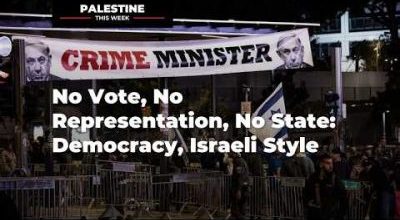
No Vote, No Representation, No State: Democracy, Israeli Style
or go to
Aletho News Archives – Video-Images
From the Archives
Sanctions, War and the Policy of Dual Containment
By SASAN FAYAZMANESH | March 17, 2008
It is now nearly three decades since the Unites States adopted the policy of dual containment of Iran and Iraq. While much has been written about the containment of Iraq, there has been very little in-depth analysis of this policy when it comes to Iran. In a book that is going to be released on March 31, 2008, entitled The United States and Iran: Sanctions, Wars and the Policy of Dual Containment (Routledge), I attempt to address this shortcoming by investigating when and why the US policy of containment of Iran came about, how it evolved, and where it stands today.[1] To the extent that Israel has been involved in US policy making, the study will also include the role that Israel has played in the containment of Iran. Also, since the fate of Iran has been inextricably linked to that of Iraq, occasionally the investigation will overlap with the containment of Iraq.
The policy of dual containment of Iran and Iraq originated during the Carter Administration, but it was not until the Clinton Administration that the expression “dual containment” became popular. … continue
Blog Roll
 Aletho News
- How Israel destabilizes the Middle East: Denying sovereignty and the right to exist
- Europe’s Establishment Is Embracing War – and Losing Voters
- NATO chief advocates war of aggression
- No Vote, No Representation, No State: Democracy, Israeli Style
- Zionist Bought Senate Blocks Information About American Citizens Killed By Israel
- While Gaza dominates the UN, these are the people keeping it alive
- New Report: “Scholasticide and Genocide in Gaza: Assessment, Testimonies and Legal Analysis”
- ‘THAAD Delusion’: Iran war exposes US missile shield limits – The Atlantic
- Moscow issues warning to NATO over Russian exclave
- Yes, the Iran war has destroyed Trump’s presidency
- If Americans Knew
- Israeli former leaders and security chiefs threaten legal action over ‘Jewish terrorism’
- Israel map in LA Times ad includes all land from the river to the sea
- Inside Lebanon’s 200-page dossier on Israeli war crimes
- Flydubai, genocide, settler violence, Trump abuse of power to deport – Daily Update
- Counting Antisemitic Incidents: What the ADL Audit Reveals — and Obscures
- Mamdani releases plan to combat antisemitism and hate crimes in New York City
- Iran’s Revolutionary Guards Publish Letter to the American People
- DMFI launches $1 million ad campaign supporting Virginia’s Elaine Luria
- US Senate blocks resolution seeking report on Americans killed by Israel
- Israeli Attacks Kill Ten Palestinians in Gaza
- No Tricks Zone
- Green Energy Debacle: German Expert Professor Fritz Vahrenholt Warns Of Severe Economic And Social Consequences
- Two More Paleo Reconstructions Affirm Meters-Higher Sea Levels Across Ireland, Brazil 7000-6000 Years Ago
- New Study: Earth And Venus Surface Warmth Largely Explained By Convection And Lapse Rate, Not CO2 Or Radiation
- 2025 Nature Paper Claiming Worsening Global Drought Gets RETRACTED …Heavily Flawed
- New Study: ‘Global Drought Shows No Detectable Recent Acceleration Under Climate Warming’
- Economic Masterminds: German Socialists Suggest Taxing Productivity Gains Stemming From Using AI
- The South China Sea Has Not Been Cooperating With The Climate Change Narrative
- Energy Crisis: Germany Enters Heating Season With Historically Low Gas Reserve Fill Levels
- New Study: The Antarctic Ice Sheet Gained Mass From 2020-2024 Due To Staggering Snow And Ice Accumulation
- Study: Ocean Heating Rates From Thousands Of Years Ago ‘Dwarf’ Modern Ocean Heating Rates

