Hawaii under martial law was like ‘military dictatorship’ (1941-1944)
For three years Hawaiians lived under repressive Army rule and without any constitutional protections
Police State USA
HAWAII — Islanders suffered under nearly three years of martial law from 1941-1944; so oppressive that it was later described by a federal judge as a “military dictatorship.” All manner of civilian liberties were replaced by oppressive military orders enforced by American soldiers.
The dark period of Hawaiian history began on December 7, 1941, with the massive surprise attack of Japanese bombers on the U.S. Naval Base Pearl Harbor. The air raid successfully sunk or grounded 18 ships and killed 2,403 Americans.
As the smoke billowed from the harbor, Lieutenant General Walter Short met with Territorial Governor Joseph Poindexter to convince him to declare martial law. Being coerced through tactics discussed below, Gov. Poindexter reluctantly ceded power to the military — temporarily, or so he thought.
In declaring martial law, all forms of civilian law were suspended. An entire new system of justice and order was instituted and controlled at the absolute discretion of Lt. Gen. Short — the newly declared “Military Governor” of the islands.
The transfer of power meant that all civilian courts would be closed, and all government functions — federal, territorial, and municipal — would be placed under military control. The U.S. Constitution was suspended and civilians no longer guaranteed any individual rights or protections from the government. Civilians had no freedom of speech, self-defense, assembly, or protections from from unreasonable search and seizures, inter alia.
Lt. General Short, in his first proclamation as Military Governor on December 7th, 1941, stated that [7]:
I shall therefore shortly publish ordinances governing the conduct of the people of the Territory with respect to the showing of lights, circulation, meetings, censorship, possession of arms, ammunition, and explosives, the sale of intoxicating liquors and other subjects.
In order to assist in repelling the threatened invasion of our island home, good citizens will cheerfully obey this proclamation and the ordinances to be published; others will be required to do so. Offenders will be severely punished by military tribunals or will be held in custody until such time that the civil courts are able to function.
Poindexter relayed his decision to the mainland, which was affirmed with approval from the President of the United States [7]:

The Military Governor’s subsequent orders were designed to “discourage concerted action of any kind.” Saloons were ordered to be closed, as well as schools, theaters — anywhere there might be a “concentration of people.” [6]
Civilians were given strict curfews. The streets were ordered to be cleared between the hours of 9:00 p.m. and 6:00 a.m. under penalty of arrest. All persons of Japanese descent had to be in their homes by 8:00 p.m. [6]
Everyone over the age of six years was fingerprinted, registered, and ordered to carry around military-issued ID cards. [11] Using the extensive registration program, the military drew up intelligence reports on 450,000 Hawaiians. [8]
Stringent censorship of the media went into immediate effect. The Military Governor required that newspapers be made illegal unless they were granted a license to operate. All newspapers and radio stations were shut down for a time. Any publication not printed exclusively in English was denied a license and considered illegal. [6]

The local telephone company was taken over by the military. [6] All outgoing mail was read and censored by the military. All long-distance telephone calls to the mainland were required to be spoken in English and censored. The military government monitored the content and morale of the population this way. [11]
Travel between the islands was restricted. Use of civilian short-wave radio was restricted. Photo materials were restricted to limit photography. [6]
The newspapers that were allowed to reopen with licenses were forced to print military orders and military-controlled news. The Honolulu Advertiser and the Honolulu Star-Bulletin both published an order directed at every inhabitant of the island:
The Army demands the aid and assistance of every person in the Territory… If you are ordered by military personnel to obey a certain command, that order must be obeyed instantly and without question. [9]
Days after martial law had gone into effect, the United Press reported that “cases of non-cooperation” were “severely dealt with” according to military authorities [1].
Civilian ownership of firearms was prohibited except to those specially authorized [6]. Every male islander was ordered to construct a bomb shelter [9]. Approximately 300,000 acres of private land was confiscated by the military — land, farms, buildings [8]

Civilians were not permitted to switch jobs, and had their wages frozen. U.S. Dollars were confiscated and new money was issued — only valid in Hawaii. Citizens were not allowed to carry more than $200 on them for any reason. [11] The wages of Japanese nationals were capped at $200 per month, with the rest being forced into bank accounts, with weekly withdrawal limits of $50. [9]
Businesses were tightly controlled; they were ordered to shut down daily by 4:30 p.m. Goods on the shelves were inventoried by the military. [9] Liquor sales were banned. Gasoline was rationed. [6]
One of the more onerous measures was the nightly “blackout” of all civilian lights, ostensibly to mitigate the effectiveness of a potential enemy air raid. Every light bulb and every flame was ordered to be extinguished after dark. Even a lit cigarette, a kitchen stove burner, or an illuminated radio dial was grounds for an arrest. It was ordered that all residential doors and windows be covered. Car headlights were to be painted blue to dim the beams. [11]
“We couldn’t see each other nor anything on the table so we literally had to feel our way through the meal,” wrote Honolulu resident Richard Wrenshall wrote in a 1942 letter. “If you reached out for something you’d be liable to stick your finger in the butter or in somebody’s eye.” [11]
Military Governor Green reported that the Army Corps of Engineers had a roving band of armed individuals calling themselves the “vigilance committee” which frequently shot at lights wherever they could be seen and “terrorized” the public. [6]

Of great controversy and consequence was the suspension of the writ of habeas corpus — the common-law court doctrine requiring a party holding a prisoner to demonstrate the legal and jurisdictional basis for continuing to hold the prisoner. With all civilian due process suspended, arrestees could be held without charges or trial; without legal representation, witnesses, a defense, or a jury. [2]
Breaking the blackout order brought about stiff fines or jail time. Numerous violators were thrown before a military judge, Lt. Col. Neal D. Franklin, who swiftly sentenced them to 100 days in jail or minimum fines of $100. A Japanese person might be given as much as 1,000 days imprisonment or up to $1,000 fines. It was reported that a Shinto priest was fined $500 for not extinguishing the “eternal flame” on his temple altar. [9]
The military courts were eager to impose fines for those who broke the military governor’s general orders. However, some individuals who couldn’t pay fines were instead given a “credit” following a forced donation of their blood. The practice was jokingly referred to as being “fined a bucket of blood.” [6]
People of Japanese descent — even American citizens — were looked at with suspicion and scorn by their government and their neighbors alike. Aside from the repressive military orders used to control their lives, thousands of Hawaiian Issei were arrested and shipped off to internment camps for the duration of the war. [13]
The oppression of civil rights was so thorough that it became a main theme in the 1942 platform of one of the major political parties on the islands [7]. The platform stated:
We deplore a system of government whereby the citizens of the Territory of Hawaii can be arrested and held for investigation, without bail, for offenses that have nothing to do with the operations of the military establishment.
We deplore the exercise of public authorities who are making unlawful searches and seizures in the homes of the people of the Territory of Hawaii without a search warrant…
We deplore the continued existence of the suspension of the writ of habeas corpus…
It was evident that the continued suspension of civilian law was disconcerting to some on the mainland, including Secretary of the Interior Harold L. Ickes, who wrote on January 9th, 1943: “Civilian government has been successfully maintained and its responsibilities carried out by civilian authorities in other parts of the English-speaking world under conditions of much more severe strain than exist in Hawaii,” he wrote. “The idea that restoring the responsibility of civil government and the jurisdiction of the courts would hamper the defense of the territory by the Army and Navy is repugnant of every concept of American democracy and reflects upon the capacity of the people of Hawaii for self-government and self-discipline.” [7]
Finally, in April 1944, Federal Judge Delbert E. Metzger overturned the suspension of the writ of habeas corpus, citing that martial law “ceases and becomes unlawful as soon as the civilian government is capable and willing to resume its normal functions.” [3]
Despite the ruling, martial law was enforced for six more months. General Richardson defiantly stated after the ruling that regular blackouts would continue to be enforced as of 10 p.m. that same evening. “Violations of general orders will continue to be tried in provost courts,” he pronounced. [3]
Richardson knew he would be free of consequence, since he had already been granted an executive pardon by President Roosevelt after Judge Metzger had held him in contempt of court on a previous case involving violations of the writ of habeas corpus. [3]
Judge Metzger argued that civilian law should be restored and was sufficient to protect the population. He said: “If present laws do not give the nation the fullest desirable protection against subversive or suspicious Japanese aliens, clearly it is the duty of the army and navy to ask a legislative curb and procedure instead of holding by force of arms an entire population under a form of helpless and unappealable subjugation called martial law.” [4]
Technically, martial law was terminated in Hawaii on October 24, 1944, in Roosevelt’s Presidential Proclamation 2627. While Roosevelt granted that “the privilege of the writ of habeas corpus” was restored, his declaration maintained that civilians were still thoroughly under the control of military commanders, and civilian freedoms were still heavily restricted. It was declared:
The military commander will have authority to establish blackouts and curfew periods, organize air raid precautions, regulate the conduct of enemy aliens, take anti-espionage precautions in the military area, control the possession and use of weapons, set up ports and harbors protections, regulate travel and regulate the publication of newspapers “published in a foreign language or in duel languages.” In addition he will have authority to regulate or prohibit the possession or use of radio transmission sets between the military area and points away from it. The authority conferred in the executive order will expire 30 days after the end of war with Japan. [5]
After the war, federal district court magistrate Judge J. Frank McLaughlin condemned the conduct of martial law, saying, “Gov. Poindexter declared lawfully martial law but the Army went beyond the governor and set up that which was lawful only in conquered enemy territory namely, military government which is not bound by the Constitution. And they… threw the Constitution into the discard and set up a military dictatorship.” [12]
Judge McLaughlin, said in a speech that “[Maj. Gen. Short] set up an unconstitutional provost court system to try, without constitutional safeguards, anybody for anything — and they did it, too.”
Evidence explained by Judge McLaughlin revealed that there were some dubious efforts on the part of the military to influence the “civilian” decision to declare martial law. The military’s treachery was described in Hawaii Under Army Rule [7]:
Judge McLaughlin outlined how it was done, pointing out that the proclamation of martial law was prepared by the Army months in advance of December 7, 1941, and noted that the proclamation “was in the hands of the publishers for printing that afternoon some substantial period of time before the governor’s proclamation was signed and received for publication.” Commenting on Secretary Patterson’s letter to Representative Andrews and a public statement by General Richardson on the same subject, Judge McLaughlin said:
“…They did not, of course, mention that the Army went back on its word to the Hawaiian legislature. They did not tell you that it had said one thing while preparing to do another thing. They did not tell you that they prepared Governor Poindexter’s proclamation for him and induced him to sign it, reluctantly. They did not tell you either that he finally agreed to do as they asked with the understanding that the effect of the proclamation would be for maybe 30 days…”
Judge McLaughlin concluded:
“Yes ‘they did it.’ They did it intentionally. They did it with design aforethought. They did it knowing disregard of the Constitution. They did it because Hawaii is not a State. They did it because they did not have faith that Americanism transcends race, class, and creed.”
This period of events marked the longest period that Americans had ever been subjected to military rule, and as many commentators have pointed out, the conditions were more repressive than many actual combat zones.

SOURCES
1. Tremaine, Frank. “Martial Law Proclaimed For Hawaii.” The Pittsburgh Post-Gazette [Pittsburgh, Pennsylvania] 11 Dec. 1941: 2. Web. [http://news.google.com/newspapers?nid=1129&dat=19411211&id=l5RRAAAAIBAJ&sjid=LWoDAAAAIBAJ&pg=2442,5301386]
2. Anthony, Joseph Garner. “Martial Law in Hawaii.” California Law Review, Vol. 30. May 1942. Web. [http://scholarship.law.berkeley.edu/californialawreview/vol30/iss4/1]
3. Associated Press. “Judge Invalidates Martial Law in Hawaiian Islands.” The Evening Independent [St. Petersburg, Florida] 14 April 1944: 9. Web. [http://news.google.com/newspapers?nid=950&dat=19440414&id=GmpIAAAAIBAJ&sjid=CVUDAAAAIBAJ&pg=4284,6259680]
4. Johnston, Richard W. “Army Defies Ban On Hawaii Martial Law.” San Jose Evening News [San Jose, California] 14 April 1944: 7. Web. [http://news.google.com/newspapers?nid=1977&dat=19440413&id=JygiAAAAIBAJ&sjid=FKQFAAAAIBAJ&pg=986,1109323]
5. Associated Press. “Martial Law Ends in Hawaii. The Deseret News [Salt Lake City, Utah] 24 Oct. 1944: 1. Web. [http://news.google.com/newspapers?nid=336&dat=19441024&id=tU5SAAAAIBAJ&sjid=xnwDAAAAIBAJ&pg=3153,5465917]
6. Green, Major General Thomas H. “Martial Law in Hawaii, December 7, 1941–April 4, 1943.” Unpublished manuscript. Library of Congress [Washington, D.C.]. Web. [http://www.loc.gov/rr/frd/Military_Law/pdf/Martial-Law_Green.pdf]
7. Anthony, Joseph Garner. Hawaii Under Army Rule. Stanford University Press [Stanford, California] 1947. [books.google.com/books?id=V66lAAAAIAAJ&pg=PA109&lpg=PA109]
8. Polmar, Norman. “World War II: The Enclyclopedia of the War Years, 1941-1945.” Random House [New York] 1996. [books.google.com/books?id=30gRAGjXrIIC&pg=PA372&lpg=PA372]
9. Dunford, Bruce. “Blackout, Martial Law After Japanese Attack.” The Observer-Reporter [Greene County, Pennsylvania] 9 Dec. 1996: A6. Web. [http://news.google.com/newspapers?nid=2519&dat=19961209&id=Al5eAAAAIBAJ&sjid=2GENAAAAIBAJ&pg=2763,1190314]
10. Commission on Wartime Relocation and Internment of Civilians. “Personal Justice Denied.” 1997. Web. [http://www.archives.gov/research/japanese-americans/justice-denied/]
11. Borreca, Richard. “Martial Law Held Sway in Isles for Three Years.” The Star Bulletin [Honolulu, Hawaii] 13 Sept. 1999. Web. [http://archives.starbulletin.com/1999/09/13/special/story5.html]
12. Borreca, Richard. “Christmas 1941 in Hawaii Was Not a Time to Rejoice.” The Star Bulletin [Honolulu, Hawaii] 13 Sept. 1999. Web. [http://archives.starbulletin.com/1999/09/13/special/]
13. Soga, Keiho. “The Untold Story: Internment of Japanese Americans in Hawaii.” University of Hawaii Press {Honolulu, Hawaii] 31 Oct. 2007. [Amazon.com]
The New Republic’s Ugly Reality
By Robert Parry | Consortium News | December 8, 2014
There has been much hand-wringing of late in Official Washington about an editorial shakeup at The New Republic and the possibility that the century-old political magazine’s legacy will somehow be tarnished by its new owner. But the truth about The New Republic is that it has more blood on its hands than almost any other publication around, which is saying something.
In my four decades in national journalism – that’s two-fifths of The New Republic’s life – what I have seen from the magazine is mostly its smug advocacy for U.S. interventionism abroad and snarky putdowns of antiwar skeptics at home. Indeed, you could view The New Republic as the most productive hothouse for cultivating neoconservative dogma — and at least partly responsible for the senseless slaughter associated with that ideology.
Though The New Republic still touts its reputation as “liberal,” that label has been essentially a cover for its real agenda: pushing a hawkish foreign policy agenda that included the Reagan administration’s slaughter of Central Americans in the 1980s, violent U.S. interventions in Iraq, Syria and other Muslim countries for the past two decades, and Israel’s suppression of Palestinians forever.
Indeed, the magazine’s long-ago-outdated status as “liberal” has long served the cause of right-wingers. The Reagan administration loved to plant flattering stories about the Nicaraguan Contras in The New Republic because its “liberal” cachet would give the propaganda more credibility. A favorite refrain from President Ronald Reagan’s team was “even the liberal New Republic agrees …”
In other words, the magazine became the neocon wolf advancing the slaughter of Central Americans in the sheep’s clothing of intellectual liberalism. Similarly, over the past two decades, it has dressed up bloody U.S. interventionism in the Middle East in the pretty clothes of “humanitarianism” and “democracy.”
The magazine – which has given us the writings of neocons Charles Krauthammer, Fred Barnes, Steven Emerson, Robert Kagan and many more – has become a case study in the special evil that can come from intellectualism when it supplies high-minded rationalizations for low-brow brutality.
In the world of the mind, where The New Republic likes to think it lives, the magazine has published countless essays that have spun excuses for mass murder, rape, torture and other real-world crimes. Put differently, the magazine afforded the polite people of Official Washington an acceptable way to compartmentalize and justify the ungodly bloodshed.
Perhaps The New Republic had a different existence in the years before I arrived on the scene. I’ve heard some longtime New Republic lovers wax on about its era of thoughtful progressivism. But The New Republic that I encountered from the 1970s onward was the magazine of Martin Peretz, a nasty neocon who cared little about journalism or even thoughtful analyses, but rather pushed a dishonest and cruel agenda including crude insults against Muslims.
In his later years after moving part-time to Israel, Peretz began to expose more of his personal agenda. In one TNR blog post regarding the proposed Islamic community center in Lower Manhattan which prompted post-9/11 right-wing outrage, Peretz declared: “Frankly, Muslim life is cheap, most notably to Muslims. And among those Muslims led by the Imam Rauf [the promoter of the Islamic center] there is hardly one who has raised a fuss about the routine and random bloodshed that defines their brotherhood.
“So, yes, I wonder whether I need honor these people and pretend that they are worthy of the privileges of the First Amendment which I have in my gut the sense that they will abuse.” (Facing accusations of racism, Peretz later issued a half-hearted apology which reiterated that his reference to Muslim life being cheap was “a statement of fact, not opinion.”)
A New York Times magazine profile of Peretz in 2011 noted that Peretz’s hostility toward Muslims was nothing new. “As early as 1988, Peretz was courting danger in The New Republic with disturbing Arab stereotypes not terribly different from his 2010 remarks,” wrote Stephen Rodrick.
Steven Emerson, one of Peretz’s favored TNR writers, also became notorious for similar Islamophobia as well as shoddy and dishonest journalism. [See Consortiumnews.com’s “Unmasking October Surprise Debunker.”]
Ignoring the History
Yet, very little of this real history of The New Republic can be found in the mainstream media’s coverage of the recent staff revolt against plans by new owner (and Facebook co-founder) Chris Hughes to modernize the publication. Hughes’s new chief executive – former Yahoo official Guy Vidra – vowed to rebuild the magazine as a “vertically integrated digital media company.”
At the Washington Post, the New York Times and pretty much the entire MSM, there has been much rending of garments over these plans and the ouster of some top editors but almost nothing about what some of those now ex-TNR editors actually did.
One was longtime literary editor Leon Wieseltier, who was a prominent advocate for the Iraq War and a promoter of right-wing Zionism. Another was editor Franklin Foer, another hawkish intellectual. Their departures were followed by a walkout by a dozen or so members of the editorial staff, resignations from contributing columnists, an outraged letter from former TNR writers and furious columns by ex-TNR staffers.
“The New Republic is dead; Chris Hughes killed it,” wailed Post columnist Dana Milbank, another TNR alumnus.
On Monday, the 31-year-old Hughes took to the Post’s op-ed page to offer Official Washington something like a paper bag to control all the hyperventilating. He denied that he was behaving like some spoiled Silicon Valley rich kid imposing an Internet-style culture on an old-fashioned print publication, but rather was trying to save the institution.
“I came to protect the future of the New Republic by creating a sustainable business so that our journalism, values and voice — the things that make us singular — could survive,” Hughes wrote.
But the real question is: Does The New Republic deserve to survive? Wouldn’t it be appropriate that at least one neocon institution faced some accountability for the hundreds of thousands of dead Iraqis, not to mention the other victims of reckless U.S. interventionism in the Middle East or the tens of thousands of murdered Central Americans during the Reagan years?
Though The New Republic’s apologists depict the magazine as an honorable place where “long-form journalism” thrived and “serious thinking” was nourished, the reality was actually much different. Indeed, much of the trivialization of U.S. journalism in the 1980s stemmed from the punchy opinions voiced by TNR columnists as they moonlighted as talking heads on the TV “shout shows,” like “The McLaughlin Group” and “Inside Washington.”
Many of the regulars on those media “food fights” came from The New Republic and lowered the intellectual level of Official Washington into a “thumbs up, thumps down” reductionism where political leaders were rated on scales of one to ten. Their well-compensated behavior was the opposite of true intellectualism or – for that matter – true journalism.
Phony Posture
The typical posture of these media-beloved neocons was to pretend that they were bravely standing up against some “liberal” orthodoxy, courageously daring to embrace the Nicaraguan Contras or other right-wing “freedom fighters” despite the danger of taking such principled stands.
The reality was that TNR’s writers were lining up behind the real power structure, standing with the Reagan administration and much of the major media while joining in the bullying of the relatively weak and vulnerable forces in Washington that went against this grain.
The phoniness of TNR’s pretend bravery was demonstrated by how the neocon commentators were rewarded with plum jobs, prominent op-ed slots, regular seats on the TV shows, lucrative speaking fees, book contracts, etc. The opposite was true for journalists who challenged the Reagan administration’s propaganda. They were the ones who faced real punishment.
Journalists who dared file critical stories about the U.S.-backed Salvadoran army or the CIA-trained Contra rebels found themselves reassigned or out on the street. The New York Times’ Raymond Bonner was the best known example after he was pulled out of Central America while under fierce right-wing attack for his accurate reporting on human rights atrocities in El Salvador.
In a similar case, the Reagan administration’s public diplomacy team browbeat National Public Radio for airing a story about a Contra massacre of farmworkers in northern Nicaragua. Sensitive to government strings on NPR’s funding, NPR executives appeased the administration by getting rid of foreign editor Paul Allen who had allowed the story to air.
Within a short time, Washington journalists understood that their route to professional success required them to swallow any propaganda from Reagan’s team, no matter how absurd.
That servility was on display when Reagan’s White House fumed over one human rights report citing 145 sworn affidavits signed by Nicaraguans who had witnessed Contra atrocities. Many of the witnesses described Contras slitting the throats of captives and mutilating their bodies.
In stepped The New Republic and one of its many pro-Contra writers, Fred Barnes, who countered the eyewitnesses by referencing the findings of a secret U.S. investigation which had absolved the Contras of many charges, he wrote. In a harsh article entitled “The Sandinista Lobby,” Barnes denounced the human rights community for hypocritically criticizing the innocent Contras and other pro-U.S. forces, while allegedly going soft on Nicaragua’s leftist Sandinista government.
But when I got hold of the investigative report in 1986, I found that it had been written by the CIA and was based on the word of the Contras themselves. One of the CIA’s key findings, supposedly debunking the slitting-throat allegations, was that the Contras said they could not have slit throats because they “are normally not equipped with either bayonets or combat knives.” The CIA failed to note that photographs of the Contras from that period showed them slouching off to battle carrying a variety of machetes and other sharp objects.
The absurdity of suggesting that the Contras could not have slit the throats of captives because they weren’t “normally” given knives should have been something a cub reporter would have laughed at. But clearly journalism was not what was going on at The New Republic where there was no interest in exposing the atrocities committed by the Contras. It was all about pushing a hawkish foreign policy and serving the Reagan agenda.
A Contra Exposé
That sort of behavior continued throughout the Reagan era with one notable exception in fall 1986 – when editor Jefferson Morley and investigative reporter Murray Waas asked me and my Associated Press colleague Brian Barger to expand the work that we had done exposing Oliver North’s secret Contra support network into a New Republic cover story.
Our article appeared in November 1986 while Peretz was out of town visiting Israel. But he soon weighed in after receiving a furious letter from then-Assistant Secretary of State for Inter-American Affairs Elliott Abrams, another arch-neocon. Abrams ostentatiously canceled his TNR subscription in protest of our article, and Peretz responded to Abrams’s complaint by excluding Waas from the magazine and putting Morley in the publisher’s doghouse.
The situation could have gotten worse for those who had a hand in bringing our story into the magazine, except that the Iran-Contra scandal broke wide open in November 1986, confirming that Barger and I had been right about North’s secret network. Abrams eventually pleaded guilty to misleading Congress (though he was later pardoned by President George H.W. Bush and was brought into President George W. Bush’s National Security Council to oversee Middle East policy, including the invasion of Iraq).
The New Republic’s pattern of playing fast and loose with the facts would eventually cause the magazine some embarrassment in 1998 when it was caught publishing a number of fabrications by writer Stephen Glass. But TNR never was held accountable for its support for atrocities in Central America, its pushing for illegal wars in the Middle East or its smearing of honest journalists and human rights investigators.
Though Peretz finally lost control of the magazine’s content in 2010, The New Republic has remained an important vehicle for pushing the neocon agenda. Earlier this year, TNR published a long exaltation to American interventionism by neocon Robert Kagan, a co-founder of the Project for the New American Century and a leading proponent for the Iraq War.
In the essay, “Superpowers Don’t Get to Retire,” Kagan “depicted President Obama as presiding over an inward turn by the United States that threatened the global order and broke with more than 70 years of American presidents and precedence,” wrote Jason Horowitz in the New York Times. “He called for Mr. Obama to resist a popular pull toward making the United States a nation without larger responsibilities, and to re-assume the more muscular approach to the world out of vogue in Washington since the war in Iraq drained the country of its appetite for intervention.”
President Barack Obama, who remains hypersensitive to criticism from well-placed and well-connected neocons, responded by inviting Kagan to lunch at the White House and shaping his foreign policy speech at West Point’s graduation in May to deflect Kagan’s criticism.
So, when you read the endless laments from the mainstream U.S. news media about the tragedy of having some Silicon Valley barbarians violating the sacred journalistic temple of The New Republic, you might reflect on all the suffering and death that the magazine has rationalized and intellectualized away.
~
Investigative reporter Robert Parry broke many of the Iran-Contra stories for The Associated Press and Newsweek in the 1980s. You can buy his latest book, America’s Stolen Narrative, either in print here or as an e-book (from Amazon and barnesandnoble.com).
5 not-so-peaceful Obama actions since nabbing Nobel Prize

RT | December 10, 2014
Five years on from President Barack Obama scooping a Nobel Peace Prize, and the White House has taken anything but a Zen approach to foreign policy under his watch. Here are the top 5 not-so-peaceful moves the laureate has made in the past half-decade.
1. Afghan Surge
Obama didn’t start the war gin Afghanistan, but he certainly took a page from his predecessors playbook in trying to finish it. He recognized his precarious position at prize time.
“But perhaps the most profound issue surrounding my receipt of this prize is the fact that I am the commander-in-chief of a nation in the midst of two wars,” he said after accepting the Nobel Prize in Oslo, Norway, on December 9, 2009.
While he said the war in Iraq was “winding down,” things in Afghanistan were just starting to heat up. A week before accepting the prize, Obama announced he was sending 33,000 more troops to Afghanistan as part of his “surge policy,” intended to beat back the Taliban and train Afghan security forces to take the country into their own hands. The following years would become the deadliest for both US troops and Afghan civilians. Again, it wasn’t Obama’s war. But then came…
2. Military strikes in Libya
Following UN Resolution 1973 on March 17, 2011, which called for “an immediate ceasefire” in Libya and authorized the international community to set up a no-fly zone to protect civilians, Obama, along with his NATO allies, would soon launch military strikes to turn the tide of the 2011 Civil War in the North African state. NATO conducted 9,700 strike sorties and dropped over 7,700 precision bombs. A Human Rights Watch report would go on to detail eight incidents where at least 72 Libyan civilians died as a result of the aerial campaign.
But the real damage to overthrowing the Gaddafi regime came in the ensuing years, with the country descending into a civil war between Islamist forces and the weak post-revolutionary government. In August, Obama admitted his Libyan policy was a failure, but not because he chose to intervene militarily. Rather, he says the problem was that America and its European partners did not “come in full force” to take Gaddafi out. Although his then-Secretary of State Hillary Clinton seemed to rejoice in his death, wryly noting “We came, we saw, he died.”
3. Drone Wars in Yemen, Pakistan
Since the US first started targeting Yemeni militants in 2002, Obama has launched all but one of the 15 airstrikes and 101 drone strikes in the country. According to the web portal New America.net, which has meticulously complied data on the strikes, up to 1,073 people have been killed in the strikes. An estimated 81-87 of those killed were civilians, while the identity of another 31-50 remains unknown. But Yemen was just one prong in Obama’s so-called Drone War, though, as we shall see, it was the site of a game-changing incident.
Unlike in Yemen, drone strikes in Pakistan were in favor long before Obama came to power. A report conducted by Stanford and New York Universities’ Law schools found that between 2,562 and 3,325 people were killed by drone strikes in Pakistan between June 2004 and mid-September 2012. Anywhere between 474 and 881 of those were civilians, and 176 were children. While Obama didn’t start the Pakistani drone war, he aggressively expanded it.
Between 2004 and 2007, only 10 drone strikes were launched in Pakistan. The following year saw 36 such strikes, and 54 were launched in 2009.
But 2010 would be the deadliest year by far, with 122 strikes launched and 849 people killed. He would go on to authorize 73 and 46 strikes in 2011 and 2012 respectively.
Following widespread opposition at home and abroad, in May 2013, Obama promised a new era of transparency to protect civilians, saying control of the program would be transferred from the CIA to the Pentagon. But…
4. Obama has a secret kill list
In February 2013, the Obama administration’s internal legal justification for assassinating US citizens abroad came to light for the first time. According to the Justice Department document, the White House has the legal authority to kill Americans who are “senior operational leaders,” of Al-Qaeda or “an associated force” even if they are not actively engaged in any active plot to attack the US.
In September 2011, a US drone strike in Yemen killed two American citizens: Anwar al-Awlaki and Samir Khan. The following month, a drone strike killed al-Awlaki’s 16-year-old son, who was born in Colorado.
The concept of the US president exercising the right to kill US citizens without the benefit of a trial has resonated throughout American culture.
In the comic-book-inspired film ‘Captain America: The Winter Soldier’, the issue of targeted killings and “kill lists” features prominently in the plot.
5. Redrawing red lines
President Barack Obama drew a red line around Syria’s use of chemical weapons, pushing the international community to punish Damascus with military strikes following the August 21 Ghouta Attack.
After the UK balked at airstrikes, Moscow and Washington took the diplomatic route, resulting in a historic deal that has seen Damascus abandon its chemical weapons stockpiles.
But US-led airstrikes on Syria were only postponed. On August 8, 2014, the United States started bombing so-called Islamic State (IS) militants in Iraq to protect embattled Kurds. The following month, the US would launch airstrikes against IS militants in Syria as well. Of all the US military interventions in recent years, the battle against the IS has been met with widespread approval. Still, Syria was the seventh country Obama has bombed in six years.
Quite a feat for a Nobel Peace Prize-winner.
Feds say cleaning up most contaminated nuclear weapons site in US is too costly
RT | December 9, 2014
The United States government recently argued in court filings that the state of Washington’s request of $18 billion over 14 years to address the nation’s most polluted nuclear weapons production site should be rejected based on expense.
The US Department of Justice said in a court filing on Friday that the cost of the state’s proposal for a hastened cleanup of the Hanford Nuclear Reservation would cast into doubt other nuclear projects funded by the Department of Energy.
According to The Tri-City Herald, the filings in US District Court by the DOJ and the state of Washington were part of the state’s lawsuit that seeks a more pressing timeline for Hanford’s cleanup.
Friday was the deadline for the parties to comment on new cleanup timelines, as the DOE said many of the existing timelines were at risk of being missed.
Hanford, located along the Columbia River in south-central Washington, is the site of 177 massive underground nuclear waste storage tanks, making it the largest collection of nuclear waste in the US. For four decades, the site was home to plutonium development for use in the production of nuclear weapons.
As RT previously reported, a deal was recently struck between the DOE and Washington state to allow a leaky radioactive storage tank at Hanford to remain as is for more than a year before its contents are removed.
In its court filing, Washington state again criticized federal management at Hanford and asked for an intensified oversight plan to address its leak-prone waste tanks and the construction of a $13 billion vitrification plant to treat waste for future burial.
The state said in its filing that the DOE wants to establish future cleanup deadlines at the expense of hard deadlines already agreed to by the parties in a 2010 consent decree, which sprang from a 2008 lawsuit following the department’s failure to meet an earlier set of deadlines for the plant and its waste tanks.
The construction project “should be matched with the best project management plans in the country,” the state contended. “Energy, however, implies that such planning is impossible.”
The state asked for more than 100 new deadlines to keep the Department of Energy’s cleanup process on track, yet the Department of Justice argued the plan was out of reach.
“The state’s proposal would require a dramatic and unrealistic increase in funding that, if mandated, would jeopardize DOE’s ability to carry out ongoing cleanup operations on other parts of the Hanford site and at other sites across the country,”documents filed by the Justice Department stated.
Hanford’s construction and waste management get $1.2 billion annually from the federal government, more than one-fifth of the Department of Energy’s annual budget for national environmental cleaning projects.
The state’s plan requires $4 billion over the next five years, on top of the current level of annual funding, the Justice Department said.
The Justice Department also said the state’s plan would violate the 2010 consent decree for cleanup, as the proposal would demand new storage tanks and treatment facilities.
The federal government has claimed construction work at Hanford has fallen behind because of technical issues.
Hanford contains”53 million gallons of High Level Radioactive hazardous waste, equivalent to 2,650 rail cars full of waste,”according to the Washington State Dept. of Ecology, making it the most contaminated nuclear site in the United States. Or, as Heart of America Northwest called it,”the most contaminated site in the Western Hemisphere.”
In 1943, construction began on Hanford as part of the top-secret Manhattan Project.
“Hanford was the producer of the plutonium that fueled the 1st test explosion in Alamogordo, New Mexico on July 16, 1945. The same plutonium also powered Fat Man, the five-ton atomic bomb that exploded over Nagasaki on August 9, 1945,” according to Heart of America Northwest.
Ready-to-fire nuclear weapons pose ‘accidental launch’ risk – former defense chiefs
RT | December 8, 2014
Cross-border action to lower the risks posed by an intentional or accidental nuclear attack is “insufficient,” international military, political and diplomatic officials have warned.
Ready-to-use nuclear arms leave states vulnerable to accidental nuclear strikes, while insecurely stored stockpiles could potentially be targeted and stolen by terrorists, the European Leadership Network said.
In a letter written in the run up to the Vienna Conference on the Humanitarian Impact of Nuclear Weapons, UK signatories collectively called upon states across the globe to eradicate nuclear arms.
Former home secretary Charles Clarke, former chief of defense staff, Lord Richards and former defense secretaries Lord Browne and Lord King joined other signatories in urging states across the globe to “redouble efforts to work toward a world without nuclear weapons.”
The risks posed by nuclear weapons and current global dynamics that could prompt their deployment are underestimated and poorly understood by world leaders, the signatories warned.
In a post-Cold War era, a proliferation of nuclear arms across the globe that are ready to fire at any moment, greatly amplifies the chance of an accident, they added.
This scenario leaves world leaders who face an imminent threat of attack an insufficient period to liaise with one another and act prudently, the signatories stressed.

Former US general, James Cartwright. (Image from wikipedia.org)
Other high profile figures who supported the call included retired US general James Cartwright, former French prime minister Michel Rocard, former vice-chairman of the joint chiefs of staff, and delegates from Russia, China and India.
The warning comes in the wake of reports that Islamic State (IS, formerly ISIS) had stolen uranium compounds from Mosul University in Iraq earlier this year.
Writing to UN Secretary-General Ban Ki-moon on July 8, Iraqi UN Ambassador Mohamed Ali Alhakim said 88 pounds of uranium used for scientific research at the university had been looted.
Two days later, however, a spokesperson for the UN International Atomic Energy Agency (IAEA) said the material was “low grade” and “would not present a significant safety, security or nuclear proliferation risk.”
The Vienna Conference on the Humanitarian Impact of Nuclear Weapons began on Monday, and is due to come to a close on Tuesday evening.
The conference follows recent talks between Iran and six western governments. Although the group failed to negotiate a satisfactory deal on Iran’s nuclear program, the talks have been extended for a further seven months.
There are currently thought to be approximately 16,300 nuclear weapons in nine different states across the world.
Global negotiators are concerned that Iranian authorities are using the state’s nuclear development program as a covert means of developing arms, and have imposed sanctions on the Middle Eastern state.
But the Iranian government denies this, and argues the state is only interested in developing peaceful nuclear projects such as the production of power.
Commenting on the recent round of nuclear talks, Russian Foreign Minister Sergei Lavrov said “considerable progress” had been made despite the fact no final agreement was reached. He added he expected the “basic principles” of a final agreement to surface within three or four months.
Reflecting on the negotiations, British Foreign Secretary Philip Hammond agreed “significant progress” had been achieved.
In late November, it emerged Iran had reduced its stockpile of low-enriched uranium gas to comply with the terms of an interim nuclear agreement signed with six world powers in 2013.
As talks are set to continue next month, Tehran’s access to $700 million per month by way of sanctions relief remains intact.
Earlier this month, the UN General Assembly passed an Arab-introduced resolution calling on Israel not to develop, produce or possess nuclear arms. The resolution also criticized the Israeli administration for not being part of the international Treaty on the Non-Proliferation of Nuclear Weapons (NPT).
Read more: UN urges Israel to renounce nuclear arms, join non-proliferation treaty
Ukraine Receives New Weapons
By Eric Zuesse | Global Research | December 8, 2014
The Government of Ukraine held a ceremony on Saturday, December 6th, with the country’s President, Petro Poroshenko, reviewing newly donated weapons, from undisclosed donors.
According to the official announcement, “The Armed Forces’ units received tanks Т-64BМ ‘Bulat’, tanks Т-64 BV, Т-72 B1, Т-72UA, Т-72A, BТR-3е and BТR-4е, self-propelled artillery 2C1 and helicopters Mi-8 and Mi-2. The President personally inspected all.”
Poroshenko said:
“We are providing the troops with new armored vehicles, precise anti-tank means, counterbattery means, means of communication and protection systems. At the same time, we are holding negotiations with our partners on the procurement of modern weapons that are not produced in Ukraine.”
Weapons bought from other countries can be paid for only with borrowed money, because the Government of Ukraine is basically broke and soaring even deeper into debt, and is sharply cutting back on pensions and other expenditures than military, which is receiving the Government’s virtually total focus. Any added loans will never be able to be paid back, because Ukraine will not be able to pay back all of the existing loans. Consequently, all countries that are now ‘lending’ additional funds to Ukraine are simply donating to Ukraine. Furthermore, the IMF is demanding that the breakaway Ukrainian areas be conquered in order for additional loans to be made to the Ukrainian Government. So, all newly loaned money will be going to Ukraine’s military.
Here are the new tanks:

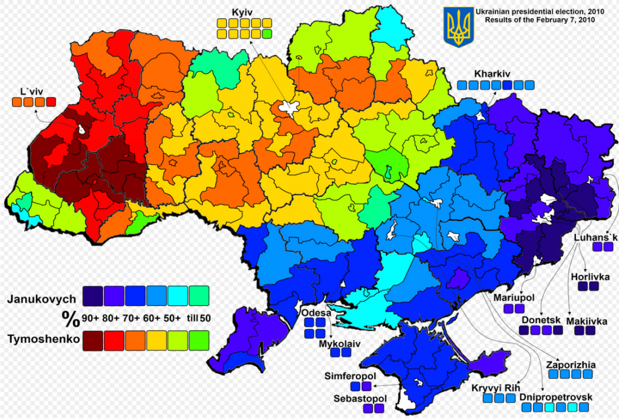
These weapons will be sent to the southeast, in order to conquer the breakaway republics that reject the regime that was forced upon them on February 22nd, in an extremely violent coup against the then-existing President, Viktor Yanukovych, for whom the residents in that area had voted approximately 90%. That rejection of the coup-regime sparked an on-again, off-again, invasion from the Ukrainian armed forces, which can be seen at various sites, such as here and here and here and here.
The official announcement of this ceremony said that the new weapons will “help Ukrainian warriors win and liberate the Ukrainian territories from the occupants.”
The election of President Poroshenko was held only in the areas of Ukraine that accepted the coup-imposed regime. “The occupants” (as the President there referred to them) in the other area did not participate in that election, the election of him, though his Government demands they accept that Government as representing them, nonetheless. After the new regime started dropping bombs on them, and sending tanks in to kill as many of them as fast as possible, their determination not to accept this Government only hardened.
The last Ukrainian Government election in which those people, “the occupants,” were voting, occurred in 2010, at which Viktor Yanukovych won above 80% in some districts, and above 90% in other districts. A map showing the vote in each district of Ukraine, in that election — the last fully national Ukrainian election — can be seen here:
Israeli official: Strategic cooperation with Riyadh is growing

Director of Institute for Policy and Strategy, and Chair of Atlantic Forum of Israel Prof. Uzi Arad
MEMO | December 8, 2014
Strategic and security cooperation between Saudi Arabia and Israel is growing at an unprecedented rate, Israel’s former National Security Adviser Uzi Arad said.
During his participation at the Energy 2015 Conference, Arad said that Israel takes advantage of Saudi Arabia’s role as a counterweight in the face of Iran which makes it play a central and effective role in Israel’s strategic plans.
Arad warned of the consequences of betting on the survival of an allied regime in Egypt, pointing out that Egypt is going through a very sensitive stage and things could turn upside down at any moment.
With regards to Jordan, Arad said: “About Jordan, we cross our fingers. No one knows what will happen there in five years. One must hope that things there will be stable. Who says the wave sweeping Iraq and Syria will not arrive to Jordan?”
Arad said the Palestinian Authority currently represents a partner for Israel in the face of many challenges.
Israel will not tolerate Iran turning into a state with nuclear capabilities, he stressed, pointing out that if the world and regional powers accept this, Israel will turn to the military option. He said: “For a long time now, there have been plans in Mossad about a situation in which another country around us has nuclear weapons. Such discussions begun in the 80s. Responses were prepared in advance. If you see a new submarine enter the port of Haifa, it does not take a genius to figure out what it signifies.”
Commenting on the relationship with Turkey, Arad said the most important research centre in Israel said the reality and the future of these relations do not bode well.
Israel is facing growing international isolation which, he warned, will affect the Israeli military and the country’s economic interests.
Arad noted that Israel benefits from the EU funded research projects, pointing out that they have strengthened the position of Israel as a great technological power.
He warned that the upcoming early elections in Israel will only contribute to the decline in Israel’s status.
Israeli air strike near Damacus – Syrian officials
The BRICS Post | December 7, 2014
A Syrian military statement has accused Israel of launching two air strikes near the capital Damascus.
“This afternoon, the Israeli enemy targeted two safe areas in Damascus province, namely the Dimas area and the Damascus International Airport,” the statement said.
Although the Syrian government did not provide details on damage or loss of life, opposition groups said that a number of explosions were heard near the airport and the town of Dimas.
Earlier, Israeli jets were reported to have crossed into Lebanon.
The Israeli military has not commented on the attacks. But the Syrian News Agency SANA accused Tel Aviv of carrying out air raids to help the opposition fighting the government of President Bashar Al-Assad.
Israel has carried out a number of air raids against Syrian positions since the civil war erupted in February 2011.
In May, Israeli fighter jets were reported to have struck a convoy of trucks allegedly carrying advanced missile components to the Lebanese Hezbollah faction.
The strike, the second in a year, appears to conform to an Israeli policy of preventing the transfer of “game-changing weaponry” from Syria to its allies in Lebanon.
The reported Israeli air strike comes amid fierce fighting between the Syrian Army and the Islamic State of Iraq and Syria (ISIL) for control of the town of Deir Ezzor near the Iraqi border.
Is Torah Jewish, or is it Zionist?
By Nahida the Exiled Palestinian
For years, I was asking to be shown the most revered, most glorified, most bragged about values, namely the “Jewish values”, to no avail.
At every occasion, defenders of “Jewishness” and Jewish ideology, would repeat the mantra, Judaism has NOTHING to do with Zionism, and Zionism does not originate from Judaism, nor does it represent “Jewish values”.
Then when I ask about these “Jewish values”, and request to be shown what they are, I am faced with deafening silence. In my quest for answers, I dove into the heart of the matter, I set off on a mission, searching for these mystical values, by myself. What better place to start, but the Jewish Bible, Torah?
This is what I found
Yeshayahu- Isaiah – Chapter 60
10. And foreigners shall build your walls, and their kings shall serve you, for in My wrath I struck you, and in My grace have I had mercy on you. י. וּבָנוּ בְנֵי נֵכָר חֹמֹתַיִךְ וּמַלְכֵיהֶם יְשָׁרְתוּנֶךְ כִּי בְקִצְפִּי הִכִּיתִיךְ וּבִרְצוֹנִי רִחַמְתִּיךְ:
.
11. And they shall open your gates always; day and night they shall not be closed, to bring to you the wealth of the nations and their kings in procession. יא. וּפִתְּחוּ שְׁעָרַיִךְ תָּמִיד יוֹמָם וָלַיְלָה לֹא יִסָּגֵרוּ לְהָבִיא אֵלַיִךְ חֵיל גּוֹיִם וּמַלְכֵיהֶם נְהוּגִים:
.
12. For the nation and the kingdom that shall not serve you shall perish, and the nations shall be destroyed. יב. כִּי הַגּוֹי וְהַמַּמְלָכָה אֲשֶׁר לֹא יַעַבְדוּךְ יֹאבֵדוּ וְהַגּוֹיִם חָרֹב יֶחֱרָבוּ:
.
14. And the children of your oppressors shall go to you bent over, and those who despised you shall prostrate themselves at the soles of your feet, and they shall call you ‘the city of the Lord, Zion of the Holy One of Israel.’ יד. וְהָלְכוּ אֵלַיִךְ שְׁחוֹחַ בְּנֵי מְעַנַּיִךְ וְהִשְׁתַּחֲווּ עַל כַּפּוֹת רַגְלַיִךְ כָּל מְנַאֲצָיִךְ וְקָרְאוּ לָךְ עִיר יְהֹוָה צִיּוֹן קְדוֹשׁ יִשְׂרָאֵל:
.
16. And you shall suck the milk of nations and the breast of kings you shall suck, and you shall know that I am the Lord, your Savior, and your Redeemer, the Mighty One of Jacob. טז. וְיָנַקְתְּ חֲלֵב גּוֹיִם וְשֹׁד מְלָכִים תִּינָקִי וְיָדַעַתְּ כִּי אֲנִי יְהֹוָה מוֹשִׁיעֵךְ וְגֹאֲלֵךְ אֲבִיר יַעֲקֹב:
.


Devarim – Deuteronomy – Chapter 23
20. You shall not give interest to your brother, [whether it be] interest on money, interest on food or interest on any [other] item for which interest is [normally] taken. כ. לֹא תַשִּׁיךְ לְאָחִיךָ נֶשֶׁךְ כֶּסֶף נֶשֶׁךְ אֹכֶל נֶשֶׁךְ כָּל דָּבָר אֲשֶׁר יִשָּׁךְ:
.
21. You may [however,] give interest to a gentile, but to your brother you shall not give interest, in order that the Lord, your God, shall bless you in every one of your endeavors on the land to which you are coming to possess. כא. לַנָּכְרִי תַשִּׁיךְ וּלְאָחִיךָ לֹא תַשִּׁיךְ לְמַעַן יְבָרֶכְךָ יְהֹוָה אֱלֹהֶיךָ בְּכֹל מִשְׁלַח יָדֶךָ עַל הָאָרֶץ אֲשֶׁר אַתָּה בָא שָׁמָּה לְרִשְׁתָּהּ:
.


Devarim – Deuteronomy – Chapter 7
1. When the Lord, your God, brings you into the land to which you are coming to possess it, He will cast away many nations from before you: the Hittites, the Girgashites, the Amorites, the Canaanites, the Perizzites, the Hivvites, and the Jebusites, seven nations more numerous and powerful that you. א. כִּי יְבִיאֲךָ יְהֹוָה אֱלֹהֶיךָ אֶל הָאָרֶץ אֲשֶׁר אַתָּה בָא שָׁמָּה לְרִשְׁתָּהּ וְנָשַׁל גּוֹיִם רַבִּים | מִפָּנֶיךָ הַחִתִּי וְהַגִּרְגָּשִׁי וְהָאֱמֹרִי וְהַכְּנַעֲנִי וְהַפְּרִזִּי וְהַחִוִּי וְהַיְבוּסִי שִׁבְעָה גוֹיִם רַבִּים וַעֲצוּמִים מִמֶּךָּ:
.
2. And the Lord, your God, will deliver them to you, and you shall smite them. You shall utterly destroy them; neither shall you make a covenant with them, nor be gracious to them. ב. וּנְתָנָם יְהֹוָה אֱלֹהֶיךָ לְפָנֶיךָ וְהִכִּיתָם הַחֲרֵם תַּחֲרִים אֹתָם לֹא תִכְרֹת לָהֶם בְּרִית וְלֹא תְחָנֵּם:
.
3. You shall not intermarry with them; you shall not give your daughter to his son, and you shall not take his daughter for your son. ג. וְלֹא תִתְחַתֵּן בָּם בִּתְּךָ לֹא תִתֵּן לִבְנוֹ וּבִתּוֹ לֹא תִקַּח לִבְנֶךָ:
.
5. But so shall you do to them: You shall demolish their altars and smash their monuments, and cut down their asherim trees, and burn their graven images with fire. ה. כִּי אִם כֹּה תַעֲשׂוּ לָהֶם מִזְבְּחֹתֵיהֶם תִּתֹּצוּ וּמַצֵּבֹתָם תְּשַׁבֵּרוּ וַאֲשֵׁירֵהֶם תְּגַדֵּעוּן וּפְסִילֵיהֶם תִּשְׂרְפוּן בָּאֵשׁ:
.
6. For you are a holy people to the Lord, your God: the Lord your God has chosen you to be His treasured people, out of all the peoples upon the face of the earth. ו. כִּי עַם קָדוֹשׁ אַתָּה לַיהֹוָה אֱלֹהֶיךָ בְּךָ בָּחַר | יְהֹוָה אֱלֹהֶיךָ לִהְיוֹת לוֹ לְעַם סְגֻלָּה מִכֹּל הָעַמִּים אֲשֶׁר עַל פְּנֵי הָאֲדָמָה:
.
13. And He will love you and bless you and multiply you; He will bless the fruit of your womb and the fruit of your soil, your grain, your wine, and your oil, the offspring of your cattle and the choice of your flocks, in the land which He swore to your forefathers to give you. יג. וַאֲהֵבְךָ וּבֵרַכְךָ וְהִרְבֶּךָ וּבֵרַךְ פְּרִי בִטְנְךָ וּפְרִי אַדְמָתֶךָ דְּגָנְךָ וְתִירשְׁךָ וְיִצְהָרֶךָ שְׁגַר אֲלָפֶיךָ וְעַשְׁתְּרֹת צֹאנֶךָ עַל הָאֲדָמָה אֲשֶׁר נִשְׁבַּע לַאֲבֹתֶיךָ לָתֶת לָךְ:
.
14. You shall be blessed above all peoples: There will be no sterile male or barren female among you or among your livestock. יד. בָּרוּךְ תִּהְיֶה מִכָּל הָעַמִּים לֹא יִהְיֶה בְךָ עָקָר וַעֲקָרָה וּבִבְהֶמְתֶּךָ:
.
15. And the Lord will remove from you all illness, and all of the evil diseases of Egypt which you knew, He will not set upon you, but He will lay them upon all your enemies. טו. וְהֵסִיר יְהֹוָה מִמְּךָ כָּל חֹלִי וְכָל מַדְוֵי מִצְרַיִם הָרָעִים אֲשֶׁר יָדַעְתָּ לֹא יְשִׂימָם בָּךְ וּנְתָנָם בְּכָל שׂנְאֶיךָ:
.
16. And you shall consume all the peoples which the Lord your God gives you; you shall not spare them, nor shall you worship their gods, for that will be a snare for you. טז. וְאָכַלְתָּ אֶת כָּל הָעַמִּים אֲשֶׁר יְהֹוָה אֱלֹהֶיךָ נֹתֵן לָךְ לֹא תָחוֹס עֵינְךָ עֲלֵיהֶם וְלֹא תַעֲבֹד אֶת אֱלֹהֵיהֶם כִּי מוֹקֵשׁ הוּא לָךְ:
.
20. And also the tzir’ah, the Lord, your God, will incite against them, until the survivors and those who hide from you perish. כ. וְגַם אֶת הַצִּרְעָה יְשַׁלַּח יְהֹוָה אֱלֹהֶיךָ בָּם עַד אֲבֹד הַנִּשְׁאָרִים וְהַנִּסְתָּרִים מִפָּנֶיךָ:
.
23. But the Lord, your God, will deliver them to you, and He will confound them with great confusion, until they are destroyed. כג. וּנְתָנָם יְהֹוָה אֱלֹהֶיךָ לְפָנֶיךָ וְהָמָם מְהוּמָה גְדֹלָה עַד הִשָּׁמְדָם:
.
24. And He will deliver their kings into your hand, and you will destroy their name from beneath the heavens; no man will be able to stand up before you, until you have destroyed them. כד. וְנָתַן מַלְכֵיהֶם בְּיָדֶךָ וְהַאֲבַדְתָּ אֶת שְׁמָם מִתַּחַת הַשָּׁמָיִם לֹא יִתְיַצֵּב אִישׁ בְּפָנֶיךָ עַד הִשְׁמִדְךָ אֹתָם:
.
Devarim – Deuteronomy – Chapter 7


Devarim – Deuteronomy – Chapter 9
5. Not because of your righteousness or because of the honesty of your heart, do you come to possess their land, but because of the wickedness of these nations, the Lord your God drives them out from before you, and in order to establish the matter that the Lord swore to your forefathers, Abraham, Isaac, and Jacob. ה. לֹא בְצִדְקָתְךָ וּבְישֶׁר לְבָבְךָ אַתָּה בָא לָרֶשֶׁת אֶת אַרְצָם כִּי בְּרִשְׁעַת | הַגּוֹיִם הָאֵלֶּה יְהֹוָה אֱלֹהֶיךָ מוֹרִישָׁם מִפָּנֶיךָ וּלְמַעַן הָקִים אֶת הַדָּבָר אֲשֶׁר נִשְׁבַּע יְהֹוָה לַאֲבֹתֶיךָ לְאַבְרָהָם לְיִצְחָק וּלְיַעֲקֹב:
.
6. You shall know that, not because of your righteousness, the Lord, your God, gives you this land to possess it; for you are a stiffnecked people. ו. וְיָדַעְתָּ כִּי לֹא בְצִדְקָתְךָ יְהֹוָה אֱלֹהֶיךָ נֹתֵן לְךָ אֶת הָאָרֶץ הַטּוֹבָה הַזֹּאת לְרִשְׁתָּהּ כִּי עַם קְשֵׁה עֹרֶף אָתָּה:
.


Devarim – Deuteronomy – Chapter 28
1. And it will be if you obey the Lord, your God, to observe to fulfill all His commandments which I command you this day, the Lord, your God, will place you supreme above all the nations of the earth. א. וְהָיָה אִם שָׁמוֹעַ תִּשְׁמַע בְּקוֹל יְהֹוָה אֱלֹהֶיךָ לִשְׁמֹר לַעֲשׂוֹת אֶת כָּל מִצְוֹתָיו אֲשֶׁר אָנֹכִי מְצַוְּךָ הַיּוֹם וּנְתָנְךָ יְהֹוָה אֱלֹהֶיךָ עֶלְיוֹן עַל כָּל גּוֹיֵי הָאָרֶץ:
.
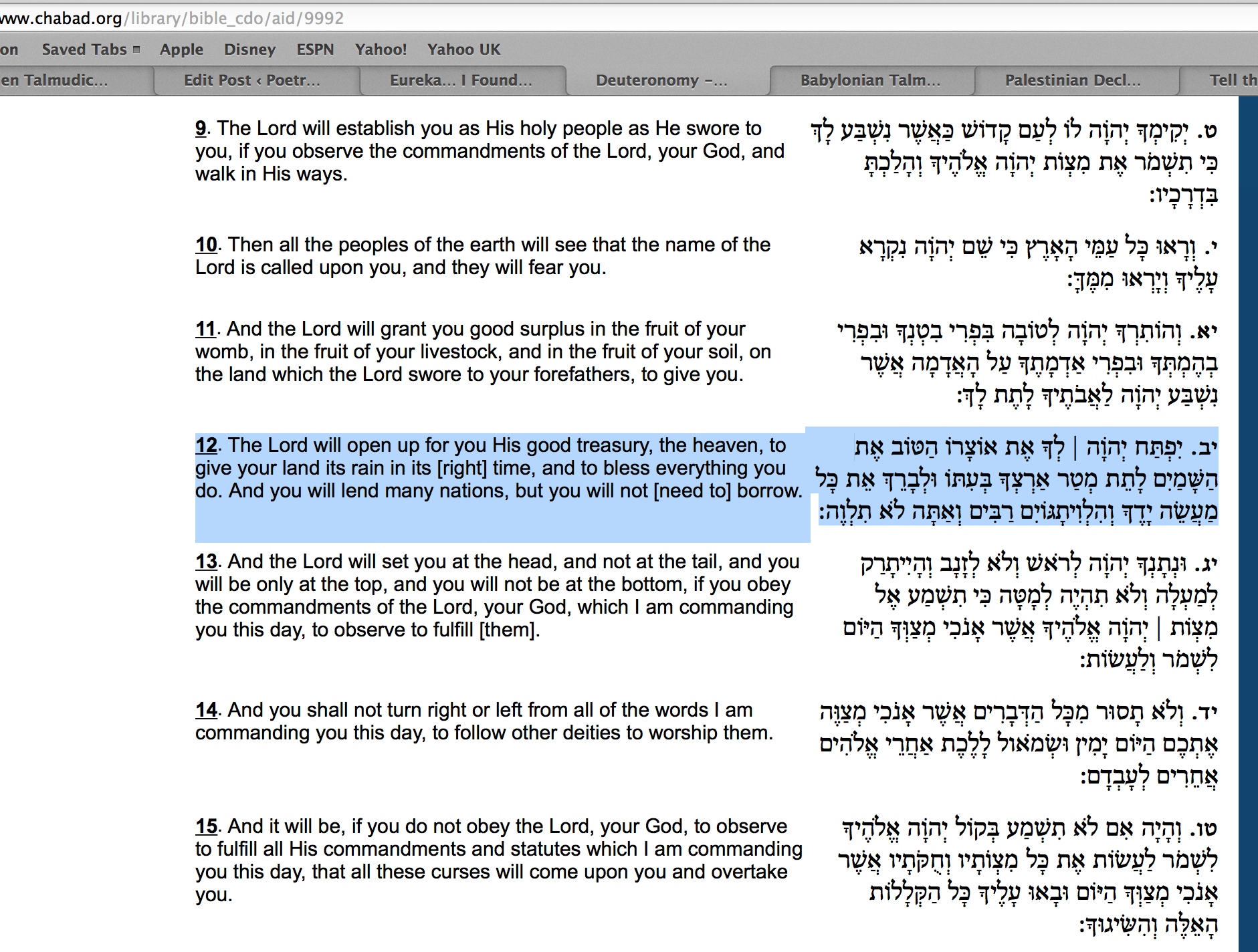
12. The Lord will open up for you His good treasury, the heaven, to give your land its rain in its [right] time, and to bless everything you do. And you will lend many nations, but you will not [need to] borrow. יב. יִפְתַּח יְהֹוָה | לְךָ אֶת אוֹצָרוֹ הַטּוֹב אֶת הַשָּׁמַיִם לָתֵת מְטַר אַרְצְךָ בְּעִתּוֹ וּלְבָרֵךְ אֵת כָּל מַעֲשֵׂה יָדֶךָ וְהִלְוִיתָ גּוֹיִם רַבִּים וְאַתָּה לֹא תִלְוֶה:
.

Devarim – Deuteronomy – Chapter 11
23. then the Lord will drive out all these nations from before you, and you will possess nations greater and stronger than you. כג. וְהוֹרִישׁ יְהֹוָה אֶת כָּל הַגּוֹיִם הָאֵלֶּה מִלִּפְנֵיכֶם וִירִשְׁתֶּם גּוֹיִם גְּדֹלִים וַעֲצֻמִים מִכֶּם:
.
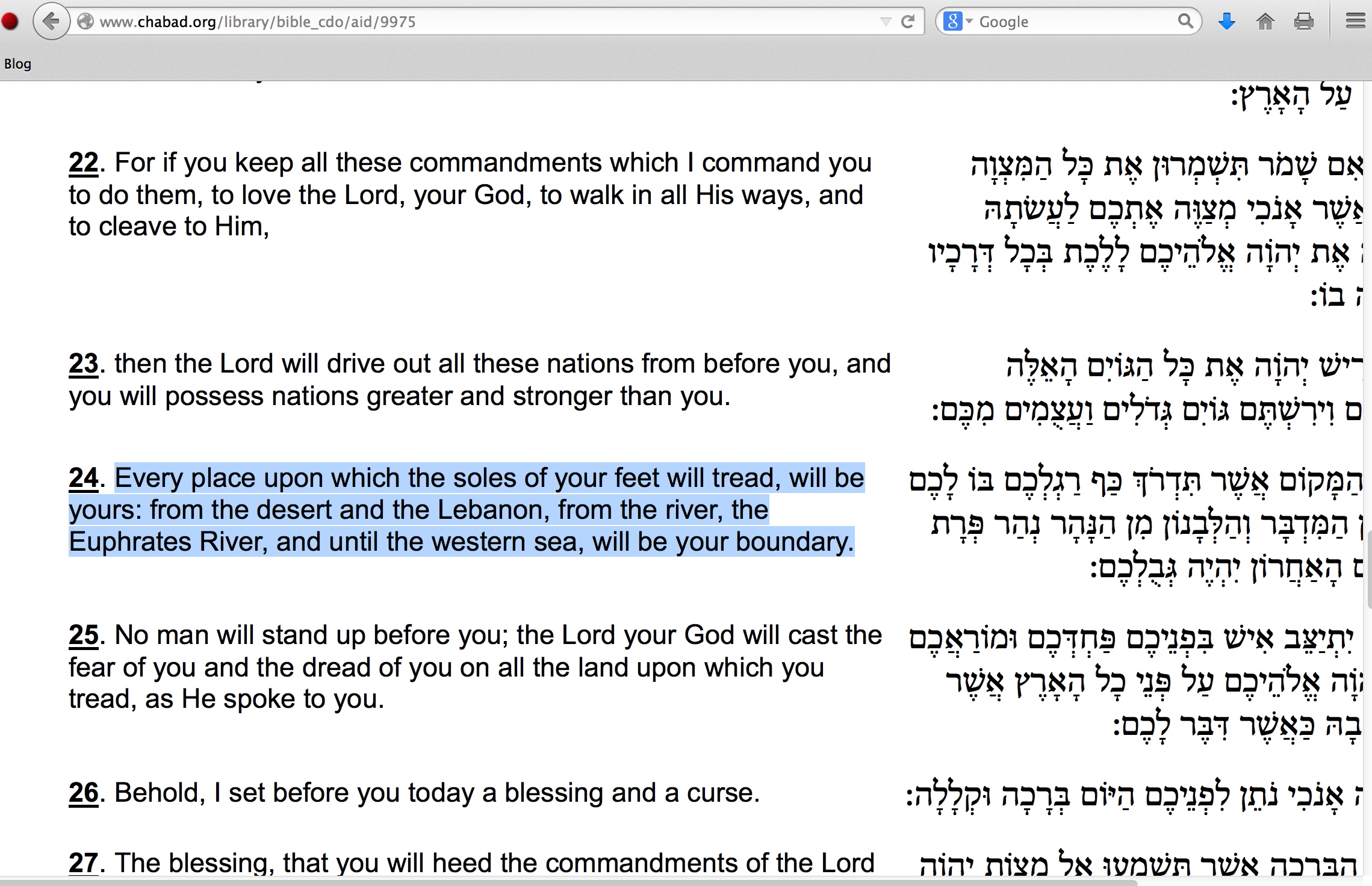
24. Every place upon which the soles of your feet will tread, will be yours: from the desert and the Lebanon, from the river, the Euphrates River, and until the western sea, will be your boundary. כד. כָּל הַמָּקוֹם אֲשֶׁר תִּדְרֹךְ כַּף רַגְלְכֶם בּוֹ לָכֶם יִהְיֶה מִן הַמִּדְבָּר וְהַלְּבָנוֹן מִן הַנָּהָר נְהַר פְּרָת וְעַד הַיָּם הָאַחֲרוֹן יִהְיֶה גְּבֻלְכֶם:
.
25. No man will stand up before you; the Lord your God will cast the fear of you and the dread of you on all the land upon which you tread, as He spoke to you. כה. לֹא יִתְיַצֵּב אִישׁ בִּפְנֵיכֶם פַּחְדְּכֶם וּמוֹרַאֲכֶם יִתֵּן | יְהֹוָה אֱלֹהֵיכֶם עַל פְּנֵי כָל הָאָרֶץ אֲשֶׁר תִּדְרְכוּ בָהּ כַּאֲשֶׁר דִּבֶּר לָכֶם:
.
29. And it will be, when the Lord, your God, will bring you to the land to which you come, to possess it, that you shall place those blessing upon Mount Gerizim, and those cursing upon Mount Ebal. כט. וְהָיָה כִּי יְבִיאֲךָ יְהֹוָה אֱלֹהֶיךָ אֶל הָאָרֶץ אֲשֶׁר אַתָּה בָא שָׁמָּה לְרִשְׁתָּהּ וְנָתַתָּה אֶת הַבְּרָכָה עַל הַר גְּרִזִּים וְאֶת הַקְּלָלָה עַל הַר עֵיבָל:
.
31. For you are crossing the Jordan, to come to possess the land which the Lord, your God, is giving you, and you shall possess it and dwell in it. לא. כִּי אַתֶּם עֹבְרִים אֶת הַיַּרְדֵּן לָבֹא לָרֶשֶׁת אֶת הָאָרֶץ אֲשֶׁר יְהֹוָה אֱלֹהֵיכֶם נֹתֵן לָכֶם וִירִשְׁתֶּם אֹתָהּ וִישַׁבְתֶּם בָּהּ:
.



Devarim – Deuteronomy – Chapter 12
1. These are the statutes and ordinances that you shall keep to perform in the land which the Lord God of your fathers gives you to possess all the days that you live on the earth. א. אֵלֶּה הַחֻקִּים וְהַמִּשְׁפָּטִים אֲשֶׁר תִּשְׁמְרוּן לַעֲשׂוֹת בָּאָרֶץ אֲשֶׁר נָתַן יְהֹוָה אֱלֹהֵי אֲבֹתֶיךָ לְךָ לְרִשְׁתָּהּ כָּל הַיָּמִים אֲשֶׁר אַתֶּם חַיִּים עַל הָאֲדָמָה:
.
2. You shall utterly destroy from all the places where the nations, that you shall possess, worshipped their gods, upon the lofty mountains and upon the hills, and under every lush tree. ב. אַבֵּד תְּאַבְּדוּן אֶת כָּל הַמְּקֹמוֹת אֲשֶׁר עָבְדוּ שָׁם הַגּוֹיִם אֲשֶׁר אַתֶּם יֹרְשִׁים אֹתָם אֶת אֱלֹהֵיהֶם עַל הֶהָרִים הָרָמִים וְעַל הַגְּבָעוֹת וְתַחַת כָּל עֵץ רַעֲנָן:
.
3. And you shall tear down their altars, smash their monuments, burn their asherim with fire, cut down the graven images of their gods, and destroy their name from that place. ג. וְנִתַּצְתֶּם אֶת מִזְבְּחֹתָם וְשִׁבַּרְתֶּם אֶת מַצֵּבֹתָם וַאֲשֵׁרֵיהֶם תִּשְׂרְפוּן בָּאֵשׁ וּפְסִילֵי אֱלֹהֵיהֶם תְּגַדֵּעוּן וְאִבַּדְתֶּם אֶת שְׁמָם מִן הַמָּקוֹם הַהוּא:
.
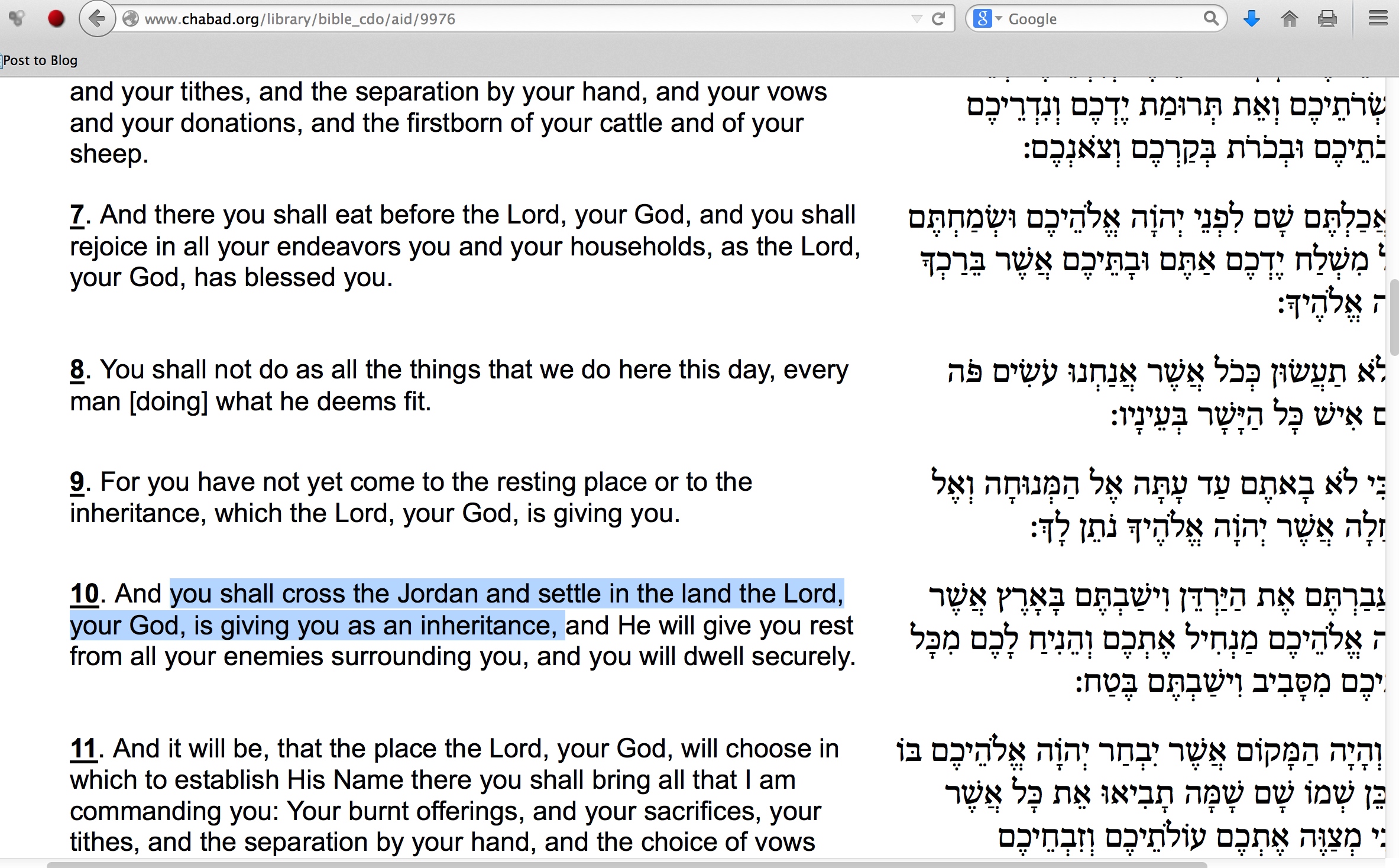
10. And you shall cross the Jordan and settle in the land the Lord, your God, is giving you as an inheritance, and He will give you rest from all your enemies surrounding you, and you will dwell securely. י. וַעֲבַרְתֶּם אֶת הַיַּרְדֵּן וִישַׁבְתֶּם בָּאָרֶץ אֲשֶׁר יְהֹוָה אֱלֹהֵיכֶם מַנְחִיל אֶתְכֶם וְהֵנִיחַ לָכֶם מִכָּל אֹיְבֵיכֶם מִסָּבִיב וִישַׁבְתֶּם בֶּטַח:
.
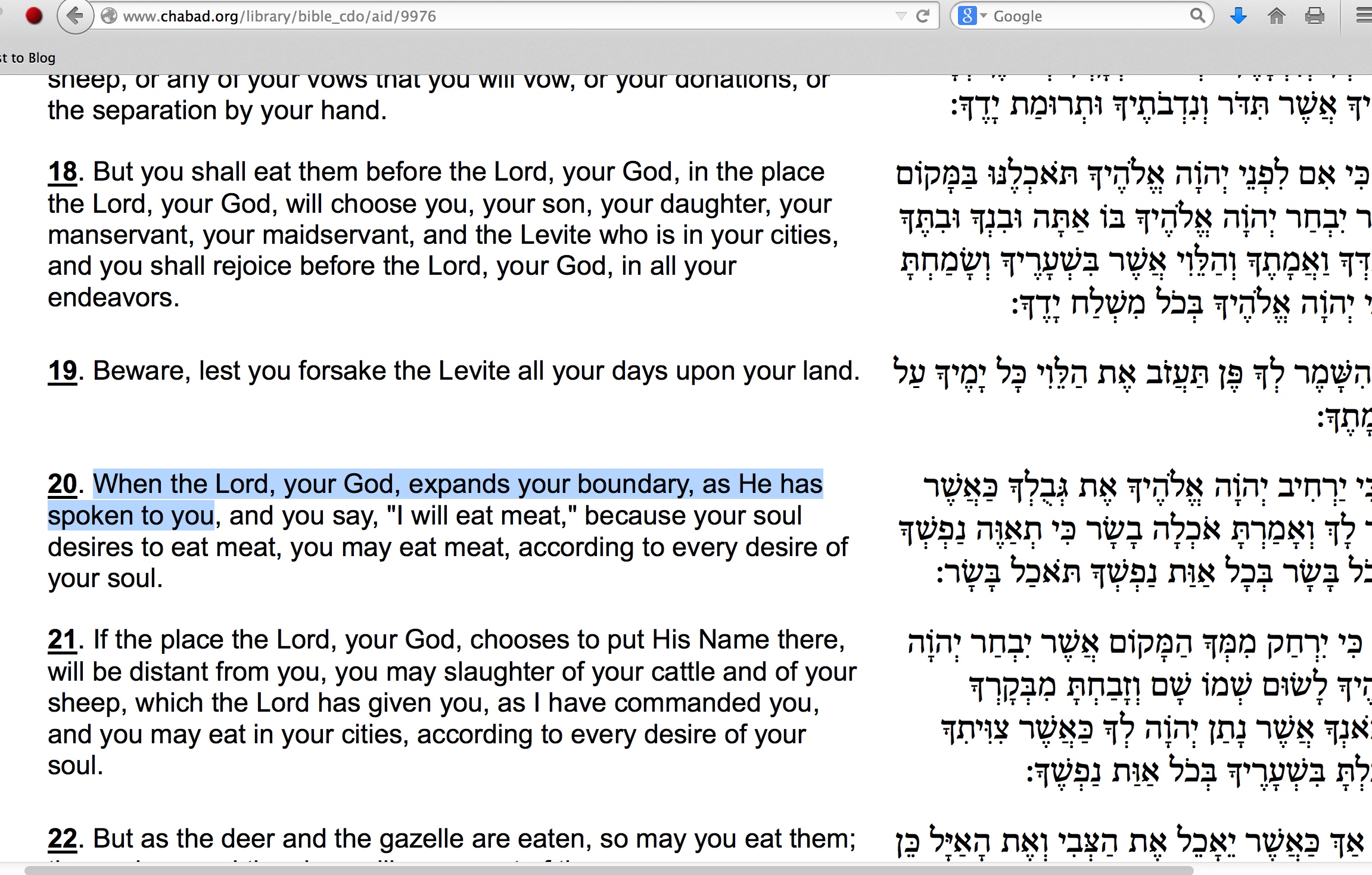
20. When the Lord, your God, expands your boundary, as He has spoken to you, and you say, “I will eat meat,” because your soul desires to eat meat, you may eat meat, according to every desire of your soul. כ. כִּי יַרְחִיב יְהֹוָה אֱלֹהֶיךָ אֶת גְּבֻלְךָ כַּאֲשֶׁר דִּבֶּר לָךְ וְאָמַרְתָּ אֹכְלָה בָשָׂר כִּי תְאַוֶּה נַפְשְׁךָ לֶאֱכֹל בָּשָׂר בְּכָל אַוַּת נַפְשְׁךָ תֹּאכַל בָּשָׂר:
.
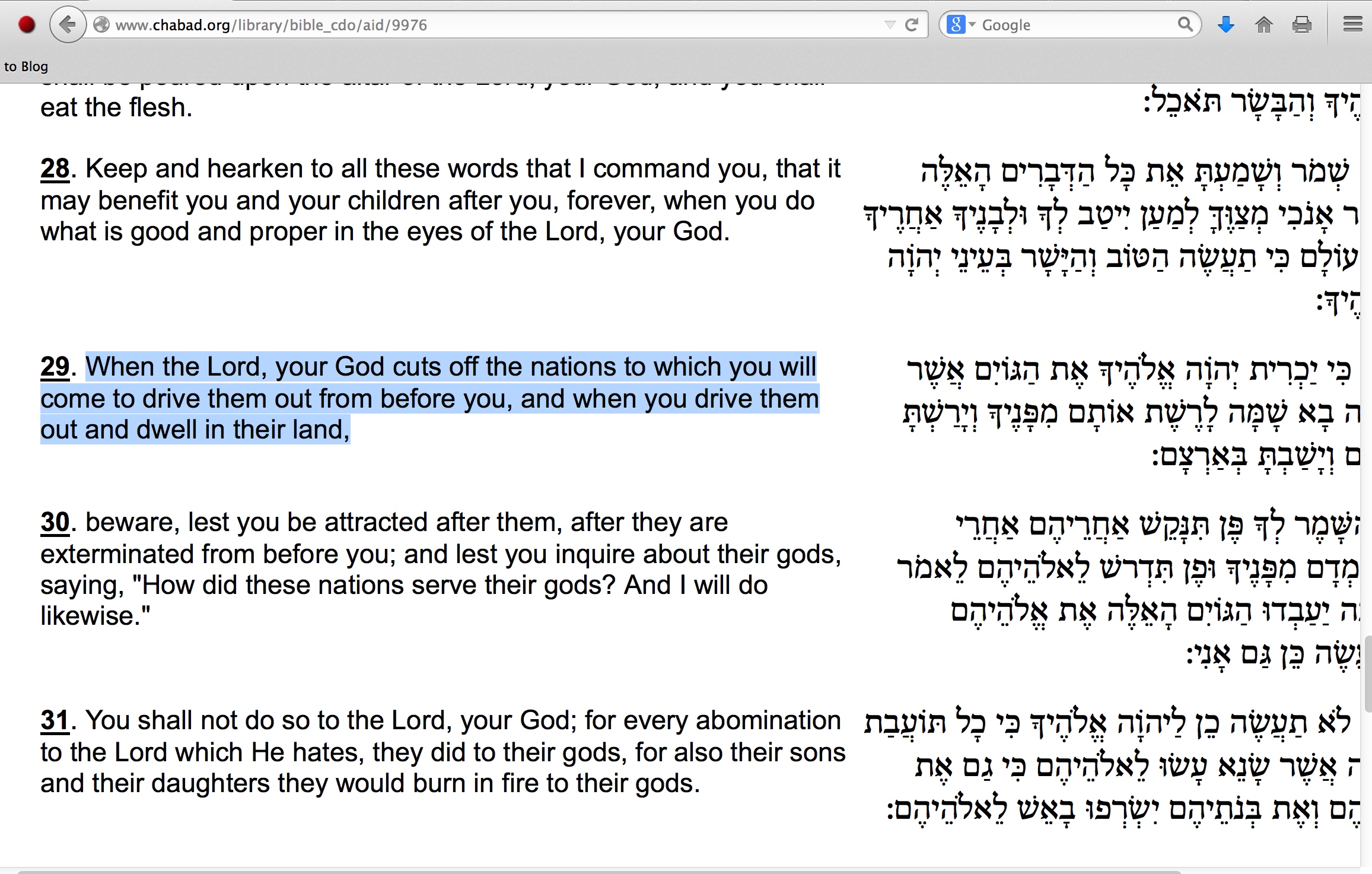
29. When the Lord, your God cuts off the nations to which you will come to drive them out from before you, and when you drive them out and dwell in their land, כט. כִּי יַכְרִית יְהֹוָה אֱלֹהֶיךָ אֶת הַגּוֹיִם אֲשֶׁר אַתָּה בָא שָׁמָּה לָרֶשֶׁת אוֹתָם מִפָּנֶיךָ וְיָרַשְׁתָּ אֹתָם וְיָשַׁבְתָּ בְּאַרְצָם:
.
30. beware, lest you be attracted after them, after they are exterminated from before you; and lest you inquire about their gods, saying, “How did these nations serve their gods? And I will do likewise.” ל. הִשָּׁמֶר לְךָ פֶּן תִּנָּקֵשׁ אַחֲרֵיהֶם אַחֲרֵי הִשָּׁמְדָם מִפָּנֶיךָ וּפֶן תִּדְרשׁ לֵאלֹהֵיהֶם לֵאמֹר אֵיכָה יַעַבְדוּ הַגּוֹיִם הָאֵלֶּה אֶת אֱלֹהֵיהֶם וְאֶעֱשֶׂה כֵּן גַּם אָנִי:
.



Devarim – Deuteronomy – Chapter 20
10. When you approach a city to wage war against it, you shall propose peace to it. י. כִּי תִקְרַב אֶל עִיר לְהִלָּחֵם עָלֶיהָ וְקָרָאתָ אֵלֶיהָ לְשָׁלוֹם:
.
11. And it will be, if it responds to you with peace, and it opens up to you, then it will be, [that] all the people found therein shall become tributary to you, and they shall serve you. יא. וְהָיָה אִם שָׁלוֹם תַּעַנְךָ וּפָתְחָה לָךְ וְהָיָה כָּל הָעָם הַנִּמְצָא בָהּ יִהְיוּ לְךָ לָמַס וַעֲבָדוּךָ:
.
12. But if it does not make peace with you, and it wages war against you, you shall besiege it, יב. וְאִם לֹא תַשְׁלִים עִמָּךְ וְעָשְׂתָה עִמְּךָ מִלְחָמָה וְצַרְתָּ עָלֶיהָ:
.
13. and the Lord, your God, will deliver it into your hands, and you shall strike all its males with the edge of the sword. יג. וּנְתָנָהּ יְהֹוָה אֱלֹהֶיךָ בְּיָדֶךָ וְהִכִּיתָ אֶת כָּל זְכוּרָהּ לְפִי חָרֶב:
.
14. However, the women, the children, and the livestock, and all that is in the city, all its spoils you shall take for yourself, and you shall eat the spoils of your enemies, which the Lord, your God, has given you. יד. רַק הַנָּשִׁים וְהַטַּף וְהַבְּהֵמָה וְכֹל אֲשֶׁר יִהְיֶה בָעִיר כָּל שְׁלָלָהּ תָּבֹז לָךְ וְאָכַלְתָּ אֶת שְׁלַל אֹיְבֶיךָ אֲשֶׁר נָתַן יְהֹוָה אֱלֹהֶיךָ לָךְ:
.
15. Thus you shall do to all the cities that are very far from you, which are not of the cities of these nations. טו. כֵּן תַּעֲשֶׂה לְכָל הֶעָרִים הָרְחֹקֹת מִמְּךָ מְאֹד אֲשֶׁר לֹא מֵעָרֵי הַגּוֹיִם הָאֵלֶּה הֵנָּה:
.
16. However, of these peoples’ cities, which the Lord, your God, gives you as an inheritance, you shall not allow any soul to live. טז. רַק מֵעָרֵי הָעַמִּים הָאֵלֶּה אֲשֶׁר יְהֹוָה אֱלֹהֶיךָ נֹתֵן לְךָ נַחֲלָה לֹא תְחַיֶּה כָּל נְשָׁמָה:
.
17. Rather, you shall utterly destroy them: The Hittites, and the Amorites, the Canaanites, and the Perizzites, the Hivvites, and the Jebusites, as the Lord, your God, has commanded you. יז. כִּי הַחֲרֵם תַּחֲרִימֵם הַחִתִּי וְהָאֱמֹרִי הַכְּנַעֲנִי וְהַפְּרִזִּי הַחִוִּי וְהַיְבוּסִי כַּאֲשֶׁר צִוְּךָ יְהֹוָה אֱלֹהֶיךָ:
.


Devarim – Deuteronomy – Chapter 25
5. If brothers reside together, and one of them dies having no son, the dead man’s wife shall not marry an outsider. [Rather,] her husband’s brother shall be intimate with her, making her a wife for himself, thus performing the obligation of a husband’s brother with her. ה. כִּי יֵשְׁבוּ אַחִים יַחְדָּו וּמֵת אַחַד מֵהֶם וּבֵן אֵין לוֹ לֹא תִהְיֶה אֵשֶׁת הַמֵּת הַחוּצָה לְאִישׁ זָר יְבָמָהּ יָבֹא עָלֶיהָ וּלְקָחָהּ לוֹ לְאִשָּׁה וְיִבְּמָהּ:
.
11. If [two] men, a man and his brother, are fighting together, and the wife of one of them approaches to rescue her husband from his assailant, and she stretches forth her hand and grabs hold of his private parts יא. כִּי יִנָּצוּ אֲנָשִׁים יַחְדָּו אִישׁ וְאָחִיו וְקָרְבָה אֵשֶׁת הָאֶחָד לְהַצִּיל אֶת אִישָׁהּ מִיַּד מַכֵּהוּ וְשָׁלְחָה יָדָהּ וְהֶחֱזִיקָה בִּמְבֻשָׁיו:
.
12. you shall cut off her hand You shall not have pity. יב. וְקַצֹּתָה אֶת כַּפָּהּ לֹא תָחוֹס עֵינֶךָ:
.
17. You shall remember what Amalek did to you on the way, when you went out of Egypt, יז. זָכוֹר אֵת אֲשֶׁר עָשָׂה לְךָ עֲמָלֵק בַּדֶּרֶךְ בְּצֵאתְכֶם מִמִּצְרָיִם:
.
19. [Therefore,] it will be, when the Lord your God grants you respite from all your enemies around [you] in the land which the Lord, your God, gives to you as an inheritance to possess, that you shall obliterate the remembrance of Amalek from beneath the heavens. You shall not forget! יט. וְהָיָה בְּהָנִיחַ יְהֹוָה אֱלֹהֶיךָ | לְךָ מִכָּל אֹיְבֶיךָ מִסָּבִיב בָּאָרֶץ אֲשֶׁר יְהֹוָה אֱלֹהֶיךָ נֹתֵן לְךָ נַחֲלָה לְרִשְׁתָּהּ תִּמְחֶה אֶת זֵכֶר * (זֶכֶר) עֲמָלֵק מִתַּחַת הַשָּׁמָיִם לֹא תִּשְׁכָּח:
.


Devarim – Deuteronomy – Chapter 21
10. If you go out to war against your enemies, and the Lord, your God, will deliver him into your hands, and you take his captives, י. כִּי תֵצֵא לַמִּלְחָמָה עַל אֹיְבֶיךָ וּנְתָנוֹ יְהֹוָה אֱלֹהֶיךָ בְּיָדֶךָ וְשָׁבִיתָ שִׁבְיוֹ:
.
11. and you see among the captives a beautiful woman and you desire her, you may take [her] for yourself as a wife. יא. וְרָאִיתָ בַּשִּׁבְיָה אֵשֶׁת יְפַת תֹּאַר וְחָשַׁקְתָּ בָהּ וְלָקַחְתָּ לְךָ לְאִשָּׁה:
.
12. You shall bring her into your home, and she shall shave her head and let her nails grow. יב. וַהֲבֵאתָהּ אֶל תּוֹךְ בֵּיתֶךָ וְגִלְּחָה אֶת רֹאשָׁהּ וְעָשְׂתָה אֶת צִפָּרְנֶיהָ:
.
15. If a man has two wives-one beloved and the other despised-and they bear him sons, the beloved one and the despised one, and the firstborn son is from the despised one. טו. כִּי תִהְיֶיןָ לְאִישׁ שְׁתֵּי נָשִׁים הָאַחַת אֲהוּבָה וְהָאַחַת שְׂנוּאָה וְיָלְדוּ לוֹ בָנִים הָאֲהוּבָה וְהַשְּׂנוּאָה וְהָיָה הַבֵּן הַבְּכֹר לַשְּׂנִיאָה:
.
18. If a man has a wayward and rebellious son, who does not obey his father or his mother, and they chasten him, and [he still] does not listen to them, יח. כִּי יִהְיֶה לְאִישׁ בֵּן סוֹרֵר וּמוֹרֶה אֵינֶנּוּ שֹׁמֵעַ בְּקוֹל אָבִיו וּבְקוֹל אִמּוֹ וְיִסְּרוּ אֹתוֹ וְלֹא יִשְׁמַע אֲלֵיהֶם:
.
19. his father and his mother shall take hold of him and bring him out to the elders of his city, and to the gate of his place. יט. וְתָפְשׂוּ בוֹ אָבִיו וְאִמּוֹ וְהוֹצִיאוּ אֹתוֹ אֶל זִקְנֵי עִירוֹ וְאֶל שַׁעַר מְקֹמוֹ:
.
20. And they shall say to the elders of his city, “This son of ours is wayward and rebellious; he does not obey us; [he is] a glutton and a guzzler.” כ. וְאָמְרוּ אֶל זִקְנֵי עִירוֹ בְּנֵנוּ זֶה סוֹרֵר וּמֹרֶה אֵינֶנּוּ שֹׁמֵעַ בְּקֹלֵנוּ זוֹלֵל וְסֹבֵא:
.
21. And all the men of his city shall pelt him to death with stones, and he shall die. So shall you clear out the evil from among you, and all Israel will listen and fear. כא. וּרְגָמֻהוּ כָּל אַנְשֵׁי עִירוֹ בָאֲבָנִים וָמֵת וּבִעַרְתָּ הָרָע מִקִּרְבֶּךָ וְכָל יִשְׂרָאֵל יִשְׁמְעוּ וְיִרָאוּ:
.


Devarim – Deuteronomy – Chapter 22
15. Then the girl‘s father and her mother shall obtain evidence of the girl’s virginity, and take it out to the elders of the city, to the gate. טו. וְלָקַח אֲבִי הַנַּעֲרָה וְאִמָּהּ וְהוֹצִיאוּ אֶת בְּתוּלֵי הַנַּעֲרָה אֶל זִקְנֵי הָעִיר הַשָּׁעְרָה:
.
16. And the girl’s father shall say to the elders, “I gave my daughter to this man as a wife, and he despised her; טז. וְאָמַר אֲבִי הַנַּעֲרָה אֶל הַזְּקֵנִים אֶת בִּתִּי נָתַתִּי לָאִישׁ הַזֶּה לְאִשָּׁה וַיִּשְׂנָאֶהָ:
.
17. And behold, he made libelous charges, saying, ‘I did not find evidence of your daughter’s virginity.’ But this is the evidence of my daughter’s virginity!’ And they shall spread the garment before the elders of the city. יז. וְהִנֵּה הוּא שָׂם עֲלִילֹת דְּבָרִים לֵאמֹר לֹא מָצָאתִי לְבִתְּךָ בְּתוּלִים וְאֵלֶּה בְּתוּלֵי בִתִּי וּפָרְשׂוּ הַשִּׂמְלָה לִפְנֵי זִקְנֵי הָעִיר:
.
18. Then, the elders of that city shall take the man and chasten him. יח. וְלָקְחוּ זִקְנֵי הָעִיר הַהִוא אֶת הָאִישׁ וְיִסְּרוּ אֹתוֹ:
.
19. And they shall fine him one hundred [shekels of] silver because he defamed a virgin of Israel, and he give it to the girl’s father. And she shall be his wife; he shall not send her away all the days of his life. יט. וְעָנְשׁוּ אֹתוֹ מֵאָה כֶסֶף וְנָתְנוּ לַאֲבִי הַנַּעֲרָה כִּי הוֹצִיא שֵׁם רָע עַל בְּתוּלַת יִשְׂרָאֵל וְלוֹ תִהְיֶה לְאִשָּׁה לֹא יוּכַל לְשַׁלְּחָהּ כָּל יָמָיו:
.
20. But if this matter was true: [indeed,] no evidence of the girl’s virginity was found כ. וְאִם אֱמֶת הָיָה הַדָּבָר הַזֶּה לֹא נִמְצְאוּ בְתוּלִים לַנַּעֲרָה:
.
21. they shall take the girl out to the entrance of her father’s house, and the men of her city shall pelt her with stones, and she shall die, for she did a disgraceful thing in Israel, to commit adultery [in] her father’s house. So shall you clear away the evil from among you. כא. וְהוֹצִיאוּ אֶת הַנַּעֲרָה אֶל פֶּתַח בֵּית אָבִיהָ וּסְקָלוּהָ אַנְשֵׁי עִירָהּ בָּאֲבָנִים וָמֵתָה כִּי עָשְׂתָה נְבָלָה בְּיִשְׂרָאֵל לִזְנוֹת בֵּית אָבִיהָ וּבִעַרְתָּ הָרָע מִקִּרְבֶּךָ:
.
22. If a man is found lying with a married woman, even both of them shall die the man lying with the woman and the woman. So shall you clear away the evil from Israel. כב. כִּי יִמָּצֵא אִישׁ שֹׁכֵב | עִם אִשָּׁה בְעֻלַת בַּעַל וּמֵתוּ גַּם שְׁנֵיהֶם הָאִישׁ הַשֹּׁכֵב עִם הָאִשָּׁה וְהָאִשָּׁה וּבִעַרְתָּ הָרָע מִיִּשְׂרָאֵל:
.
23. If there is a virgin girl betrothed to a man, and [another] man finds her in the city, and lies with her, כג. כִּי יִהְיֶה נַעֲרָה בְתוּלָה מְאֹרָשָׂה לְאִישׁ וּמְצָאָהּ אִישׁ בָּעִיר וְשָׁכַב עִמָּהּ:
.
24. you shall take them both out to the gate of that city, and you shall pelt them with stones, and they shall die: the girl, because she did not cry out [even though she was] in the city, and the man, because he violated his neighbor’s wife. So shall you clear away the evil from among you. כד. וְהוֹצֵאתֶם אֶת שְׁנֵיהֶם אֶל שַׁעַר | הָעִיר הַהִוא וּסְקַלְתֶּם אֹתָם בָּאֲבָנִים וָמֵתוּ אֶת הַנַּעֲרָ עַל דְּבַר אֲשֶׁר לֹא צָעֲקָה בָעִיר וְאֶת הָאִישׁ עַל דְּבַר אֲשֶׁר עִנָּה אֶת אֵשֶׁת רֵעֵהוּ וּבִעַרְתָּ הָרָע מִקִּרְבֶּךָ:
.
28. If a man finds a virgin girl who was not betrothed, and seizes her and lies with her, and they are found, כח. כִּי יִמְצָא אִישׁ נַעֲרָה בְתוּלָה אֲשֶׁר לֹא אֹרָשָׂה וּתְפָשָׂהּ וְשָׁכַב עִמָּהּ וְנִמְצָאוּ:
.
29. the man who lay with her shall give fifty [shekels of] silver to the girl’s father, and she shall become his wife, because he violated her. He shall not send her away all the days of his life. כט. וְנָתַן הָאִישׁ הַשֹּׁכֵב עִמָּהּ לַאֲבִי הַנַּעֲרָה חֲמִשִּׁים כָּסֶף וְלוֹ תִהְיֶה לְאִשָּׁה תַּחַת אֲשֶׁר עִנָּהּ לֹא יוּכַל שַׁלְּחָהּ כָּל יָמָיו:
.


Vayikra – Leviticus – Chapter 26
38. I am the Lord, your God, Who took you out of the land of Egypt, to give you the land of Canaan, to be a God to you. לח. אֲנִי יְהֹוָה אֱלֹהֵיכֶם אֲשֶׁר הוֹצֵאתִי אֶתְכֶם מֵאֶרֶץ מִצְרָיִם לָתֵת לָכֶם אֶת אֶרֶץ כְּנַעַן לִהְיוֹת לָכֶם לֵאלֹהִים:
.
44. Your male slave or female slave whom you may have from the nations that are around you, from them you may acquire a male slave or a female slave. מד. וְעַבְדְּךָ וַאֲמָתְךָ אֲשֶׁר יִהְיוּ לָךְ מֵאֵת הַגּוֹיִם אֲשֶׁר סְבִיבֹתֵיכֶם מֵהֶם תִּקְנוּ עֶבֶד וְאָמָה:
.
45. And also from the children of the residents that live among you, from them you may acquire [slaves] and from their family that is with you whom they begot in your land, and they shall become your inheritance. מה. וְגַם מִבְּנֵי הַתּוֹשָׁבִים הַגָּרִים עִמָּכֶם מֵהֶם תִּקְנוּ וּמִמִּשְׁפַּחְתָּם אֲשֶׁר עִמָּכֶם אֲשֶׁר הוֹלִידוּ בְּאַרְצְכֶם וְהָיוּ לָכֶם לַאֲחֻזָּה:
.
46. You shall hold onto them as an inheritance for your children after you, as acquired property, and may thus have them serve you forever. But as for your brethren, the children of Israel, a man shall not work his brother with rigor. מו. וְהִתְנַחַלְתֶּם אֹתָם לִבְנֵיכֶם אַחֲרֵיכֶם לָרֶשֶׁת אֲחֻזָּה לְעֹלָם בָּהֶם תַּעֲבֹדוּ וּבְאַחֵיכֶם בְּנֵי יִשְׂרָאֵל אִישׁ בְּאָחִיו לֹא תִרְדֶּה בוֹ בְּפָרֶךְ:


West’s action in Libya in 2011 was a ‘mistake’ – Italy’s foreign ministry
RT | December 5, 2014
Western countries made a ‘mistake’ three years ago, when they intervened in Libya to overthrow the Gaddafi regime, according to Italian Minister of Foreign Affairs. The statement came amid reports of the US discussing airstrikes on Libya’s territory.
“Three years ago we might have made a mistake, when international forces interfered without thinking through the scenario, what will happen afterwards. Italian voice was too weak,” Italy’s Minister of Foreign Affairs Paolo Gentiloni said in a TV interview with national broadcaster RAI, as quoted by Tass news agency.
While meeting international journalists on Friday, the minister said that stabilizing the situation in Libya – which at the moment is an uncontrollable land of “chaos” – and in the whole Mediterranean region was a key priority of Italy’s foreign policy.
Meanwhile, the US has plans to expand its anti Islamic State military campaign to Libya, The Times reported on Friday. Amid western countries’ concerns over Libya’s political instability, that could possibly be used by the IS terrorists in their favor, a top US general has confirmed the Islamic State runs jihadist training camps in eastern Libya.
Now “an American commander has acknowledged that discussions are under way in Washington about broadening the anti-Isis campaign to Libya,” The Times wrote.
The fall of Muammar Gaddafi’s regime back in 2011 and the turmoil that followed it has provided a fertile ground for extremism. Since August, Libya’s capital of Tripoli has been in the hands of Libya Dawn – a coalition of Islamist-backed militias who appointed their own administration, while the internationally-recognized government and parliament have been pushed a thousand kilometers away to Tobruk.
The UN has condemned the recent fighting – the worst since 2011. An international contact group, which gathered in Addis Ababa earlier this week to discuss the Libyan crisis, has rejected the use of force to solve it. But the country’s officials have ruled out peace talks after Libya Dawn allied itself with jihadi groups.
“We cannot continue with two governments, two parliaments, so Libya Dawn should end or we are going to arrest them all,” Libya’s military commander, General Khalifa Hiftar told RT.
Moscow has said only neighboring countries in the region should participate in stabilizing the situation in Libya, while others stay put. When meeting his Sudanese counterpart earlier in the week, Russian Foreign Minister Sergey Lavrov said that “interference from overseas assuming a leading role in settling sovereignty issues” that has been witnessed in Iraq and Libya, and now is being attempted in Syria, leads to tragedy and a state’s breakup.
READ MORE: France urges new Libya intervention, calls it ‘terrorist hub’ on Europe’s doorstep
Featured Video

10K More U.S. Troops Deploy as Trump Weighs New Iran Strikes
or go to
Aletho News Archives – Video-Images
From the Archives
Genetic baloney in thick slices
MAYBE COULD BE INC.
By Jon Rappoport | No More Fake News | July 8, 2021
Gene research companies tend to come and go. They start out banging and popping like fireworks in the sky, and then they fade out—selling themselves to larger outfits who’ve hired better liars…
Once upon a time, it sounded easy. Start with a disease, find the gene responsible for the disease, and correct the problem.
Then, researchers wondered, was disease the result of one gene or a group of genes acting together?
Either way, the proof would be in devising cures for diseases using gene therapy. “Not yet, but soon…”
And regardless, the major need was: money. Lots and lots of money.
This need required good PR people. “We have to pump up the idea that we’re on the edge of tremendous breakthroughs. We’re always on that edge…”
This hype also needed to obscure the fact that there wasn’t (and isn’t) ANY gene cure for ANY disease. … continue
Blog Roll
 Aletho News
- Von der Leyen gifts her spin doctor a job for life
- 10K More U.S. Troops Deploy as Trump Weighs New Iran Strikes /Suliaman Ahmed
- Iranian crew declared Dena training vessel ‘unarmed’ to US warship before deadly torpedo strike: Report
- Iran’s NPT debate moves beyond parliament
- Houthis condemn Saudi claims of attack on Medina
- Fatuous False Flags
- Are Europe’s Smallest Nations Dragging the Continent into War?
- EU draws up contingency plans for possible Merz exit
- G7 caves to US blackmail, announces ‘massive’ release of diesel reserves
- Reporting of the RAF Fairford arrests blows the idea of a ‘free press’ out of the water
- If Americans Knew
- The Israeli Right Portrays Islam as Murderous. It Serves a Political Purpose
- Jordan Has Had Enough: King Abdullah’s Scathing Warning to Israel
- Israeli Colonizers (i.e. Settlers) Kill Palestinian Man Near Salfit
- New Google Maps images reveal massive scale of devastation in Gaza
- Jewish supremacy, anti-Palestinian bigotry on display in Israel – Daily Update
- Israeli Soldiers Abduct At Least 22 Across Occupied West Bank
- Eight Palestinians Killed in Israeli Attacks on Gaza
- Israeli former leaders and security chiefs threaten legal action over ‘Jewish terrorism’
- Israel map in LA Times ad includes all land from the river to the sea
- Inside Lebanon’s 200-page dossier on Israeli war crimes
- No Tricks Zone
- Green Energy Debacle: German Expert Professor Fritz Vahrenholt Warns Of Severe Economic And Social Consequences
- Two More Paleo Reconstructions Affirm Meters-Higher Sea Levels Across Ireland, Brazil 7000-6000 Years Ago
- New Study: Earth And Venus Surface Warmth Largely Explained By Convection And Lapse Rate, Not CO2 Or Radiation
- 2025 Nature Paper Claiming Worsening Global Drought Gets RETRACTED …Heavily Flawed
- New Study: ‘Global Drought Shows No Detectable Recent Acceleration Under Climate Warming’
- Economic Masterminds: German Socialists Suggest Taxing Productivity Gains Stemming From Using AI
- The South China Sea Has Not Been Cooperating With The Climate Change Narrative
- Energy Crisis: Germany Enters Heating Season With Historically Low Gas Reserve Fill Levels
- New Study: The Antarctic Ice Sheet Gained Mass From 2020-2024 Due To Staggering Snow And Ice Accumulation
- Study: Ocean Heating Rates From Thousands Of Years Ago ‘Dwarf’ Modern Ocean Heating Rates

