French arms sales rise by 42%
MEMO | June 17, 2014
Defence Minister Jean-Yves Lodrian said on Monday that French arms sales increased by 42 per cent or €6.7 billion in 2013 compared to 2012 and are expected to exceed seven billion Euros this year. Lodrian was speaking during the opening of the Eurosatory 2014 arms fair in the Paris suburb of Villepinte.
France recorded a strong comeback in the Middle East market, said Lodrian. The region is responsible for generating 40 per cent of France’s total exports and it has also increased its presence in the Asia and Latin America markets.
In 2013, France’s biggest contract was an agreement to renew the Saudi Arabian navy’s fleet of ships, worth €500 million; a contract to sell a communication satellite to Brazil is worth €300 million.
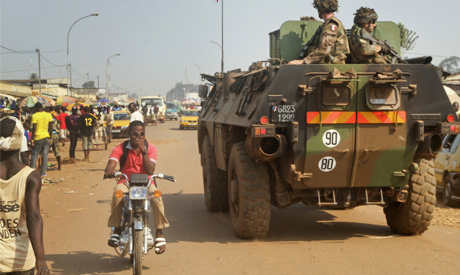
The minister pointed out that French exports of munitions for use by armoured vehicles grew by 5 per cent in 2013. He noted that the Scorpion programme to update light weapons will soon be launched at the cost of five billion Euros over ten years.
“This means that future equipment will include more than 2,500 armoured vehicles connected to each other by sophisticated electronic systems,” said Lodrian. “The Scorpion programme will allow the Leclerc tank to be in use until 2040.”
Eurosatory 2014 will enable French industrialists “to improve their exports”, the minister added. Nearly 1,500 exhibitors from 58 countries are taking part in the arms fair, which lasts until Friday.
No Iran-US talks over Iraq crisis: Diplomat
Press TV – June 16, 2014
A senior Iranian diplomat has rejected reports about negotiations between Iran and the US over the ongoing crisis in Iraq.
“The Islamic Republic of Iran has had no negotiations with the Americans over mutual cooperation in Iraq,” Iran’s Deputy Foreign Minister for Arab and African Affairs Hossein Amir-Abdollahian said on Monday.
We believe that the Iraqi people and armed forces are capable of handling the crisis in their country on their own, he added.
The Iranian diplomat also dismissed the likelihood of the spillover of the crisis into Iran, saying, “There is no threat against the geographical borders of the Islamic Republic of Iran, but necessary precautions have been taken in this regard.”
Commenting on the quality of Iran’s cooperation with Iraq in fighting terrorism, Amir-Abdollahian rejected any direct military intervention, but noted that the Islamic Republic will assist Iraq through consultations or any other measures which can enable the Iraqi army in its counter-terrorism campaign.
On Sunday, a senior US official said the administration of President Barack Obama is considering the situation to hold talks with Iran over the Iraqi crisis.
Takfiri militants from the so-called Islamic State of Iraq and the Levant (ISIL) have recently been carrying out acts of terror in Iraq, taking over a number of cities and committing atrocities against the people.
‘Welcome to Police Industrial Complex’ – former Philly commissioner
RT | June 16, 2014
Dangerous, alienating, and sociopathic: the policy of arming police to the teeth with military-grade gear shows a fundamental misunderstanding of how crime is solved and what it means for a cop to walk the beat, former Captain Ray Lewis told RT.
Nine-foot tall, 55,000 pound, Mine-Resistant Ambush Protected (MRAP) armored-fighting vehicles rolling through the streets of America.
Millions of dollars’ worth of military gear being distributed to local police forces on an annual basis.
Drones, M-16s and so many other hand-me-downs from over a decade of war making their way from US forces abroad to a local police force near you.
If you really believe any of this is making you safer, Lewis, who spent 24 years on the force, says you should think again. Endangering lives, alienating communities, turning minority neighborhoods into occupied territory and compromising the very ability for police to do their jobs; these are just a few of the reasons the former commissioner believes main street is being sold down the river for power-hungry cops and ruthless corporate interest.
RT: Why is this considered to be a good idea, bringing these high caliber weapons into US streets?
Ray Lewis: I don’t think it’s a good idea. High caliber weapons are extremely dangerous. They have a very high ricocheting velocity, and that means that innocent people are going to get killed and injured. They can go through doors, they can go through cinder block, they can go through metal car doors, and this type of velocity is not necessary. I spent 24 years in the Philadelphia Police Department.We upgraded our Smith and Wessons to Glocks, which are a very powerful pistol that work very well. There is no reason to have anything stronger than that, except in exigent circumstances, in which your SWAT team does have that type of weapon. For anyone else, they’re not necessary and they’re dangerous.
RT: You know Captain, one might ask, will this equipment not obscure the line between soldier and police officers, especially in those small communities where they’re already being distributed?
RL: Yes, it will obviously obscure the line between the military and the police. But I’m not at all concerned with small communities that you mentioned. I’m concerned with the large cities, where you have large minority populations living in economically depressed areas. That’s where you’re going to have problems. You bring this type of equipment into a minority area, you are going to make those people feel as if they are living in an occupied territory. You’re going to alienate them.
What happens is, you get a halo effect. A halo effect means that that alienation transfers to all the other officers in that department. That alienation transfers to the officers in the patrol cars, the officer on the foot beat, the officers in the community relations division. So bringing that type of equipment is going to alienate people from all parts of the police department. What people don’t know is that input from community members is one of the most important ways crimes are solved. They know the bad guys in the area, they hear the rumors, they hear the gossip, they know what’s going on in their communities. Too many people think that crime is solved through high-tech forensic labs or exemplary investigative work. Not true, although these two come in very handy in many cases, most of your information about crimes comes from the community. You bring this military type of mindset into the community, you’re not going to get the interaction from the members of that community.
RT: Some police officers have said it is necessary to have this type of equipment, especially if you’re covering a protest and it gets out of hand, where police officers can get injured or shot. Isn’t it a good idea, in some ways, to have such equipment at your disposal?
RL: That is the worst idea I could think of, to have high caliber weapons at a protest. Think of Kent State, where they shot and killed so many innocent people. And they were not high caliber weapons. Can you imagine the massacre that would take place if officers had high caliber weapons? I spent a year in New York City supporting the Occupy [Wall Street] message. I was arrested down there for civil disobedience and never did I see any type of behavior from those protesters that would ever need any type of weapon, let alone high caliber. If anything, it was the protesters that would have needed high caliber weapons.
RT: Let me talk about the gear itself. It’s been used in certain war zones and then come back home, as there’s no longer any need for it there. What should they do with this type of equipment if they can’t distribute it to local police forces? What happens if people come out and say, ‘actually, we don’t want these types of vehicles on our streets. We have kids, we can’t have them here, we’d much rather go back to a much more local form of policing that we’re more comfortable with?’
RL: Obviously, you have to listen to the community. The police serve the community; they don’t serve us, we serve them. If they want to go back to a more conventional police force that they feel comfortable with, then that’s what has to be done. It’s imperative.
RT: So what happens to the equipment then, at that point?
RL: It can be sold to other countries or destroyed. I’d have no problem with them destroying that equipment whatsoever instead of using it in this country. See, that equipment can be very dangerous if it falls into the wrong hands. Let me explain.
There are three types of people who join the police department, basically: one joins because of a need for a job that can give him or her a comfortable lifestyle; the second person joins because they want to serve and protect the public; the third type of person joins because they love the power and the control. When you have a person that joins because they love the power and control, how do they get more power and control? They move up the chain of command until they reach police commissioner. Now once they reach police commissioner, how do they gain more power and control? And this is a sociopathic tendency by the way. It’s insatiable; they can never get enough power and control, just like a billionaire can never get enough money.
So, you reach the top rung of the ladder, you’re a police commissioner, and you want to gain more power. How do you do it? You acquire all of this military weaponry, the semi-tanks, the MRAPs, the spy drones, and what not. And I guarantee you, once you purchase them, they’re not going to sit in a warehouse. That police commissioner is going to use them. And I’m very fearful of these types of police commissioners using that equipment. Let me give you the perfect example of what I’m talking about.
The Philadelphia Police Commissioner Charles Ramsey, he was not commissioner when I worked there, but when I attended the Occupy movement and was arrested for civil disobedience, several days later I received an unbelievably threatening letter from him. He told me, he informed me to stop wearing my uniform. It was an order. I’d retired 10 years previously; he had no power over me. Yet he was so power and control hungry, he tried to order me to stop wearing that uniform. What was most egregious about this letter, I have it for proof, is he informed me that if I continued to wear the uniform, he would take any and all necessary action to stop me. That is the epitome of a sociopath whose desire for power and control is insatiable. I am fearful of this type of police chief getting this type of equipment.
RT: Okay Captain, last question. Shootings at schools, shopping malls, movie theatres, we’ve seen those headlines all around America and internationally. Will this type of equipment be able to stop such crimes from taking place?
RL: Absolutely not. These crimes are committed by people who never would think, ‘oh wait, should I not do this because the police have high caliber weapons?’ No. That doesn’t stop those mass killings at all. Number one, they know most likely they will be killed by the police, or they take their own lives. So this type of equipment will never stop that. Lastly, I want you to know that corporate America is involved in this. This is a major money market that will sell this high (grade) equipment, repair and maintenance for it will come from taxpayers’ money. Corporate America will make billions off of this equipment. You’ve heard of the prison industrial complex, you’ve heard of the military industrial complex, corporate America now wants to make a police industrial complex, where they’ll makes billions off of police departments.
Violence in Iraq Means Profits for Beechcraft, Lockheed, Raytheon and other Weapons Makers
By Steve Straehley | AllGov | June 16, 2014
U.S. companies are reaping big benefits from the Iraqi government’s battle with ISIS militias. Three sales, including some big-ticket items, announced last month will put nearly $1 billion in the pockets of American defense contractors if Congress approves the sales.
- Beechcraft Defense Co. and eight other contractors are selling 24 AT-6C Texan II aircraft, plus spares and other equipment to Iraq. That deal is worth about $790 million. The plane is used for “light attack and intelligence, surveillance and reconnaissance.”
- AM General has a deal to send 200 of its venerable Humvees to help guard oil installations. The contract, which includes spares and equipment such as radios and machine gun mounts, is worth $101 million.
- Raytheon has a $90-million deal for seven aerostats along with 14 Rapid Aerostat Initial Deployment (RAID) Tower systems to be used for command and control by the Iraqi military.
These are just the latest in a string of sales of military equipment to the Iraqi government. Others have included Stinger missiles, C-130J cargo planes, drones and patrol boats.
Since 2005, the U.S. government has provided more than $14 billion in military hardware, services and training to Iraq, according to Global Post. The Iraqi government is now requesting more equipment to battle the Sunni militias, which have taken over large swaths of the country, and American contractors stand to make even more money as the fighting progresses.
To Learn More:
Pentagon Plans To Deliver $1B In Weapons Systems To Iraq. Even Blimps. (by Jill R. Aitoro, Washington Business Journal )
These Are The 9 Weapons The U.S. Is Selling Iraq (by Allison Jackson, Global Post )
Forgotten by Most Americans, Iraq is Still a Source of Profits for U.S. Weapons Makers (by Noel Brinkerhoff, AllGov )
Russia now enemy, so we’ll help Ukraine build up military – NATO chief
RT | June 15, 2014
NATO is preparing a package deal to ramp up the Ukrainian military because it ‘must adapt’ to Russia viewing it as an enemy, the outgoing chief of the military bloc said.
The deal would be submitted to foreign ministers of members states later this month, NATO Secretary-General Anders Fogh Rasmussen told El Pais in an interview. He declined to go into detail, but said it provides for defense industry reform and modernization of the Ukrainian military.
The alliance may also facilitate cooperation with Ukraine over military training, although whatever exercises of NATO member troops would be held in Ukraine is up to individual countries, Rasmussen said.
“We must adapt to the fact that Russia now considers us its adversary,” he explained.
The help that NATO plans to give Ukrainian military comes as the said military are used in a bloody crackdown on the defiant eastern provinces, where local militias defend cities from daily artillery shelling and airstrikes.
Kiev regards the militias as Russia-backed terrorists and refuses any kind of negotiation with them. NATO shares the view, accusing Russia of funneling heavy weapons into Ukraine across the border, although so far no solid evidence of such actions was presented.
The alliance itself is experiencing a sort of revival playing the ‘Russian threat’ card to justify the build-up of troops in Central and Eastern Europe. Moscow sees such deployments as provocative and confirming NATO’s aggressive stance towards Russia.
NATO claims that it has been cooperating with Russia in every way until the Ukrainian crisis sparked the cold war hostilities again. It’s not quite true, considering the alliance’s expansion eastwards in Europe and its plans to deploy a system of anti-ballistic missile defense closer to Russian borders. Both have been done against Russia’s objections that such moves compromise Russian national security.
GAO Audit Accuses Obama Administration of Lowballing Cost of Maintaining Nuclear Arsenal
By Noel Brinkerhoff | AllGov | June 13, 2014
For the second time this year, government auditors have issued a report critical of the Obama administration’s projections for preserving the nation’s stockpile of nuclear weapons.
In both instances, the cost estimates put forth by the departments of Defense and Energy have been described as far too low, in part because key expenses were not budgeted. The latest audit, performed by the Government Accountability Office (GAO), supported some of the findings of the Congressional Budget Office (CBO), which concluded six months ago that the administration was off—by hundreds of billions of dollars—in estimating the future needs of maintaining the arsenal.
The Pentagon has claimed outlays will be about $264 billion. But the CBO put the figure closer to $570 billion and perhaps as much as $1 trillion over the next 30 years.
The GAO did not offer its own estimate for maintaining the weapons. But it did question the Defense Department’s claim that modernizing all ballistic missiles and bombers would require only $64 billion over the next 10 years.
In the case of the Minuteman III missile, which has served as the backbone of the nation’s land-based nuclear deterrent since the 1970s, GAO auditors found the administration left out all future funding for replacing these weapons, saying the program was “not yet defined.” As for a new bomber, the Air Force said those costs were “too sensitive” to include in the report.
At the Energy Department (DOE), which oversees all nuclear weapons research, the GAO found that officials had low-balled the cost of modernizing certain warheads for ballistic and cruise missiles.
The agency also reported that DOE had assumed billions of dollars in cost savings from efficiency efforts without determining where the savings would come from, and that Energy officials had left out the cost of revamping or replacing several nuclear-weapons laboratories.
To Learn More:
Federal Auditors Say Obama Administration Underestimates Nuclear Weapons Costs (by R. Jeffrey Smith, Center for Public Integrity)
Ten-Year Budget Estimates for Modernization Omit Key Efforts, and Assumptions and Limitations Are Not Fully Transparent (Government Accountability Office)
Obama Administration Underestimated Cost of Maintaining Nuclear Weapons by $140 Billion (by Noel Brinkerhoff and Danny Biederman, AllGov)
US to blame for Iraq ‘deterioration’ – Lavrov
The BRICS Post | June 13, 2014
Russian officials on Thursday reiterated what they have long held as a mantra of the Kremlin’s foreign policy regarding the Middle East – the US invasion of Iraq created a downward spiral for the whole region.
Alluding to the war for regime change – under the pretext of finding weapons of mass destruction – launched by the US and its allies in March 2003, Russian Foreign Minister Sergei Lavrov said that, “the situation in Iraq has been deteriorating at an exponential rate”.
Earlier this week, and following months of continued territorial gains, fighters belonging to a coalition of Islamist militant groups operating under the banner of the Islamic State of Iraq and the Levant (ISIL) seized the ethnically mixed city of Mosul in Iraq’s northern Nineveh province.
They then followed up by expanding their attacks south and west, seizing Tikrit – the town where executed President Saddam Hussein lived as a child – in Salahudin Province and pushing toward the ancient city of Samarra.
They vowed to advance toward Baghdad and bring the government of Prime Minister Nouri Al-Maliki down.
Army troops and security forces abandoned their posts at government installations and tore off their uniforms, witnesses said.
With their fighters entrenched in Mosul and most of Nineveh, the former Al-Qaeda affiliates – who have maintained a brutal campaign against the forces of President Bashar Al-Assad in neighbouring Syria – now effectively control a third of Iraq.
“Iraq’s unity has been called into question … Terrorism is rampant there because the occupation forces paid virtually no attention to the internal political processes, and did not facilitate national dialogue, but pursued their own interests exclusively,” Lavrov said in comments carried by the Russian Interfax agency.
“We warned long ago that the adventurism the Americans and the British started there would not end well,” he added.
In June 2013, Russia warned the US of promoting “unconvincing” data on Syria’s alleged chemical weapons use, and thereby repeating the same errors in the build-up to the invasion of Iraq in 2003.
Russia has since 2003 said the invasion and occupation of Iraq was a mistake that would haunt the West.
On Thursday, Lavrov did not exclude the UK from his criticism.
“The events that are taking place in Iraq are an illustration of a complete failure of the venture started by the US and the UK that allowed it to spiral out of control completely.”
“We express our solidarity with the Iraqi authorities, the Iraqi people who should restore peace and security in their country, but the actions of our Western partners raise a lot of questions,” Lavrov told reporters.
Moscow Demands Immediate UN Probe Into Use Of Incendiary Bombs in Ukraine
nsnbc | June 12, 2014
Moscow is demanding an immediate UN probe into Kiev’s use of outlawed incendiary bombs in Ukraine’s rebelling southeastern regions. Moscow will present a draft resolution to the UN Security Council, urging the observation of the OSCE roadmap for Ukraine.
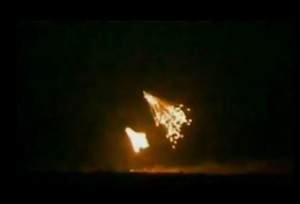
The calls come after yesterday’s use of banned incendiary bombs in the village of Semenovka near the Ukraine’s eastern city of Slavyansk. Eyewitnesses to the bombings reported the use of white phosphor bombs on Wednesday night. The Russian RIA Novosty quotes the local self-defense headquarters on Thursday, saying that Semenkova came under an attack that apparently involved fire bombs. The bombs exploded right above the village and split into smoldering fragments, reported eyewitnesses.
The use of phosphor bombs is internationally banned. The burning substance can’t be extinguished and burns through flesh and bones if a person has been hit by the substance. The Itar-Tass news agency quotes Russia’s Foreign Minister Sergey Lavrov as saying:
“We have ordered to our Ambassador to UN Vitaly Churkin to present to the Security Council a draft resolution on the situation in Ukraine, as we are very concerned by the lack of any progress in the efforts to stop the violence, to stop the war, beginning from the end of the punitive operation”.
“In this resolution we have focused on the fact it is necessary to insist the Ukrainian side began implementing the OSCE roadmap, based on the Geneva statement of April 17, and which was presented after the talks with Russia’s President Vladimir Putin, … It is a very important moment, as, we see, there are clear attempts to distance from the balanced and fair character of the approaches in the roadmap, and there are attempts to promote certain unilateral plans, which would ignore interests of Ukraine’s southeast.”
Lavrov stressed that only an equal-rights dialog, a complete consideration of interests of all of Ukraine’s regions without exceptions, and a dialog that also includes discussions about constitutional reform, may result in stability and an improvement of the situation in Ukraine.
The draft resolution expresses Russia’s concerns about the continuing violence and the killing of civilians, the destruction of infrastructure, residential areas, as well as attacks against convoys. Lavrov added that Russia does not speak about sending peace keepers and that Moscow still believes President Poroshenko has credibility.
Moscow does, however, demand an immediate and full investigation into the use of incendiary bombs and other prohibited weapons in Ukraine. Lavrov stressed “We are concerned to hear reports that the Ukrainian military forces use incendiary bombs and some other indiscriminate weapons. These reports should be investigated, immediately”.
Nuclear bomb nearly detonated after falling on North Carolina – declassified report
RT | June 11, 2014
 In a scenario that could’ve been extremely devastating, the United States narrowly averted a nuclear disaster in 1961 when an atomic bomb nearly detonated after falling out of a B-52 bomber that broke up in the sky.
According to the Washington Post, the incident took place on January 21, 1961 – less than 20 years after nuclear bombs were dropped on Hiroshima and Nagasaki – and is explained further in a recently declassified report published by the National Security Archives.
When the US Air Force aircraft went into a tailspin and broke up, the two bombs fell towards Goldsboro, North Carolina. The parachute for one of the weapons failed to deploy, and the plane crash had actually pushed the bomb into “armed” mode by the time it hit the ground. Luckily for North Carolina, the plane’s destruction also damaged the switch necessary to trigger detonation.
“The report implied that because Weapon 2 landed in a free-fall, without the parachute operating, the timer did not initiate the bomb’s high voltage battery (“trajectory arming”), a step in the arming sequence,” wrote Bill Burr of the National Security Archives.
“For Weapon 2, the Arm/Safe switch was in the “safe” position, yet it was virtually armed because the impact shock had rotated the indicator drum to the “armed” position. But the shock also damaged the switch contacts, which had to be intact for the weapon to detonate.”
Burr noted in his report just how fine the line was and is between safety and destruction.
“Perhaps this is what Secretary of Defense Robert McNamara had in mind, a few years later, when he observed that, ‘by the slightest margin of chance, literally the failure of two wires to cross, a nuclear explosion was averted,” he wrote.
These details are just the latest to surface about the incident, which was first revealed by nuclear weapons expert Eric Schlosser last year in a book titled, “Command and Control.” Through a Freedom of Information Act request, Schlosser was able to obtain documentation regarding the incident for the first time, and helped shed light on just how close the Air Force came to witnessing an atomic bomb explode on US soil.
As RT reported last year, the documents revealed that three of the four safety switches on the other bomb failed to work properly, meaning, as Schlosser noted, that only “one simple, dynamo-technology, low voltage switch stood between the United States and a major catastrophe.” The parachute on this one deployed, but when the bomb struck the ground the final firing signal triggered, only to be halted by that fourth safety switch.
The bombs contained a payload of four megatons each and could have generated explosions 260 times more powerful than the one that occurred in Hiroshima.
Before the documents related to the Goldsboro incident surfaced, the US government had denied that its nuclear weapons stockpile had ever put the nation at risk.
“The US government has consistently tried to withhold information from the American people in order to prevent questions being asked about our nuclear weapons policy,” Schlosser told the Guardian. “We were told there was no possibility of these weapons accidentally detonating, yet here’s one that very nearly did.”
Russia, China present new joint draft to prevent outer space war
The BRICS Post | June 11, 2014
China and Russia have jointly submitted an updated draft international treaty on banning the deployment of weapons in outer space to a UN-sponsored disarmament conference.
The US and Israel have repeatedly voted against UN resolutions on the prevention of an arms race in outer space.
The updated draft Treaty on the Prevention of the Placement of Weapons in Outer Space, the Threat or Use of Force Against Outer Space Objects, was presented at a plenary session of the Conference on Disarmament, the world’s sole multilateral forum for disarmament negotiations.
The new draft treaty prepared by Russia and China is a revised version of the one the two allies had presented earlier, including definition and scope of the treaty, organizations as well as mechanisms to solve disputes, said Wu Haitao, China’s ambassador extraordinary and plenipotentiary for disarmament affairs.
The Treaty on Prevention of the Placement of Weapons in Outer Space and of the Threat or Use of Force Against Outer Space Objects (PPWT) was first proposed by China and Russia in February 2008 as an international legally binding treaty that would outlaw the weaponization of space.
Wu said this new draft treaty is aimed at advancing the Conference on Disarmament toward negotiations for signing an international legal document.
Space assets like satellites are at increasing threat of being disabled from hostile countries as risk of cyber-warfare grows.
Beijing has warned of the growing risks of the weaponization of outer space with the rapid development of space technology, which the Chinese Ambassador said will “hinder the peaceful use of outer space, break global strategic balance and stability and hamper nuclear disarmament”.
The existing legislation on outer space cannot prevent the use or the threat of force against outer space assets, Wu said.
Telecommunications, GPS navigation systems, power etc could be easily switched off with the disabling of satellites in the backdrop of a militarized outer space.
China has stressed during the UN conference on the urgent need to sign a new international legal document to prevent the weaponization of outer space.
China and Russia are willing to include suggestions and ideas from other parties and continue to improve the draft treat in order to lay a foundation for the start of practical negotiations at the Conference on Disarmament, Wu said.
Featured Video

10K More U.S. Troops Deploy as Trump Weighs New Iran Strikes
or go to
Aletho News Archives – Video-Images
From the Archives
Genetic baloney in thick slices
MAYBE COULD BE INC.
By Jon Rappoport | No More Fake News | July 8, 2021
Gene research companies tend to come and go. They start out banging and popping like fireworks in the sky, and then they fade out—selling themselves to larger outfits who’ve hired better liars…
Once upon a time, it sounded easy. Start with a disease, find the gene responsible for the disease, and correct the problem.
Then, researchers wondered, was disease the result of one gene or a group of genes acting together?
Either way, the proof would be in devising cures for diseases using gene therapy. “Not yet, but soon…”
And regardless, the major need was: money. Lots and lots of money.
This need required good PR people. “We have to pump up the idea that we’re on the edge of tremendous breakthroughs. We’re always on that edge…”
This hype also needed to obscure the fact that there wasn’t (and isn’t) ANY gene cure for ANY disease. … continue
Blog Roll
 Aletho News
- UK Government Body Kept Files on People Criticizing Prevent Program
- US military withdrawal from Iraq and the collapse of US-Israeli hegemonic project in West Asia
- What does Europe want – a war with Russia?
- She Followed the Actual Data on COVID Vaccines and Masks — Her Career Took a Huge Hit
- Florida AG Sues Pfizer, Bourla Over Deceptive Marketing of COVID Vaccines
- Von der Leyen gifts her spin doctor a job for life
- 10K More U.S. Troops Deploy as Trump Weighs New Iran Strikes /Suliaman Ahmed
- Iranian crew declared Dena training vessel ‘unarmed’ to US warship before deadly torpedo strike: Report
- Iran’s NPT debate moves beyond parliament
- Houthis condemn Saudi claims of attack on Medina
- If Americans Knew
- Israel is squeezing the life out of Palestinians – Daily Update
- The Israeli Right Portrays Islam as Murderous. It Serves a Political Purpose
- Jordan Has Had Enough: King Abdullah’s Scathing Warning to Israel
- Israeli Colonizers (i.e. Settlers) Kill Palestinian Man Near Salfit
- New Google Maps images reveal massive scale of devastation in Gaza
- Jewish supremacy, anti-Palestinian bigotry on display in Israel – Daily Update
- Israeli Soldiers Abduct At Least 22 Across Occupied West Bank
- Eight Palestinians Killed in Israeli Attacks on Gaza
- Israeli former leaders and security chiefs threaten legal action over ‘Jewish terrorism’
- Israel map in LA Times ad includes all land from the river to the sea
- No Tricks Zone
- Green Energy Debacle: German Expert Professor Fritz Vahrenholt Warns Of Severe Economic And Social Consequences
- Two More Paleo Reconstructions Affirm Meters-Higher Sea Levels Across Ireland, Brazil 7000-6000 Years Ago
- New Study: Earth And Venus Surface Warmth Largely Explained By Convection And Lapse Rate, Not CO2 Or Radiation
- 2025 Nature Paper Claiming Worsening Global Drought Gets RETRACTED …Heavily Flawed
- New Study: ‘Global Drought Shows No Detectable Recent Acceleration Under Climate Warming’
- Economic Masterminds: German Socialists Suggest Taxing Productivity Gains Stemming From Using AI
- The South China Sea Has Not Been Cooperating With The Climate Change Narrative
- Energy Crisis: Germany Enters Heating Season With Historically Low Gas Reserve Fill Levels
- New Study: The Antarctic Ice Sheet Gained Mass From 2020-2024 Due To Staggering Snow And Ice Accumulation
- Study: Ocean Heating Rates From Thousands Of Years Ago ‘Dwarf’ Modern Ocean Heating Rates

