Bowe Bergdahl and the Moral Rot of American Exceptionalism
By Winston Warfield | CounterPunch | June 6, 2014
“The future is too good to waste on lies,” Bowe wrote. “And life is way too short to care for the damnation of others, as well as to spend it helping fools with their ideas that are wrong. I have seen their ideas and I am ashamed to even be american (sic). The horror of the self-righteous arrogance that they thrive in. It is all revolting.”
From “America’s Last Prisoner of War”, by Michael Hastings. Rolling Stone, June 7, 2012
Nothing exposes the decadence of American militarism and the ideology of American exceptionalism better than the explosion of emotion sweeping the internet, Congress and the news media over the prisoner exchange of Bowe Bergdahl for five Taliban. He is being vilified as a deserter and personally responsible for the deaths of fellow soldiers missioned to find him. The American right-wing located in the Republican party, some liberals like Chris Matthews and Dianne Feinstein and some of his fellow soldiers are all calling for his head in a display of vengeful nastiness bordering on psychotic. Bergdahl’s motivations for walking away from the bizarre U.S. counterinsurgency expedition in Afghanistan, a “dirty war” seemingly without purpose or end, are being lost in the fog of infantile political temper tantrums.
Bergdahl was according to an in-depth Rolling Stone article in 2012 by the late Michael Hastings, an exceptionally competent and motivated soldier during training, serious about preparing himself for combat. So serious and competent, that his fellow soldiers kidded him about being too gung-ho. He was moved in part by what he had read or viewed of reports of atrocities against civilians by the Taliban and other jihadist groups in other countries. His was an honest and heartfelt desire to “serve and protect” the poor and destitute in conflict zones. He was a highly-motivated foot soldier for “humanitarian imperialism”, the perfect youthful idealist falling for the good-vs-evil fairy tale of American exceptionalism.
Bergdahl’s disillusionment started as soon as he joined the U.S. Army, and found that his unit was incompetent to the point of being dysfunctional. The leadership problems and motivation issues never were really resolved in training, and only intensified after deployment to Paktia Province, one of the more volatile and dangerous areas in Afghanistan. He describes an 8-hour mission in an email home to his parents which turned into an extreme military FUBAR (fucked up beyond all recognition), where he and his unit spent multiple days stranded in enemy territory due to what in his view was leadership and bureaucratic incompetence. In a supreme irony, this is the same province in which Pat Tillman, the former Arizona Cardinal football player who joined the Army Rangers out of idealistic and self-sacrificing patriotism, was killed by members of his own unit in a notorious “friendly-fire” incident. That was the result of grossly negligent decision-making on the part of his chain-of-command which committed the cardinal sin of splitting up his unit while similarly stranded, as reported in Counterpunch.
From the Hastings article, Bergdahl’s views seem to go beyond the usual soldierly complaints into an angry indictment of careerism and “covering-your-ass” incompetence:
“Three good sergeants, Bowe said, had been forced to move to another company, and ‘one of the biggest shit bags is being put in charge of the team.’ His battalion commander was a ‘conceited old fool.’ The military system itself was broken: ‘In the US army you are cut down for being honest… but if you are a conceited brown nosing shit bag you will be allowed to do whatever you want, and you will be handed your higher rank… The system is wrong. I am ashamed to be an american. And the title of US soldier is just the lie of fools.’ The soldiers he actually admired were planning on leaving: ‘The US army is the biggest joke the world has to laugh at. It is the army of liars, backstabbers, fools, and bullies. The few good SGTs are getting out as soon as they can, and they are telling us privates to do the same.’”
Bergdahl’s vehemently critical attitude toward his chain-of-command is familiar to many enlisted soldiers who served in the Vietnam War. Officers, especially field-grade, were viewed with deserved contempt, with some exceptions, as corrupt and incompetent careerists who avoided personal risk. The assault on Hill 937, which came to be known as “Hamburger Hill” is one of the more notorious incidents, where soldiers were gratuitously sacrificed by officers in the rear. In what came to be called in the black humor of the soldier “ticket punching”, these kinds of officers were scorned for their career-building tours in Vietnam only to get the necessary medals for upward advancement.
It isn’t clear from Bergdahl’s personal history in the Rolling Stone article whether he joined the Army due to economic difficulties, the “poverty draft” as it’s called. It may have played a role. His parents were certainly not wealthy or privileged, earning an annual income of only $7000 one year according to Hastings.
He did have other personal motivations for wanting to become a soldier, revealing some of the more telling features of militarized American culture, where ignorance of history and the world outside, especially among youth, even those with strong ethical senses, yields startling contradictions. He at one point unsuccessfully tried to join the French Foreign Legion as a mercenary, probably unaware or willfully ignorant of its savage and ruthless record in French imperial history. That ignorance and historic amnesia is coupled with a desire to express one’s youthful need for excitement and adventure by joining the military, and in essence acquiring that excitement by deploying across the planet to combat zones. In the society of the spectacle, where young Americans are immersed in an entertainment culture, the world becomes a theme park or giant (real) video contest, where they can overcome their boredom in a spiritually dead consumerism by testing themselves in what they view as heroic combat in other people’s countries, riding to their rescue. The “others” in those countries in essence become two-dimensional cutouts or foils for a live-action videogame with real risks and danger and excitement. The suffering resulting from American military occupation is not part of the consciousness, and rarely is noticed by soldiers immersed in the demands of survival against lethal dangers. It is instead often replaced with resentment and hatred for the ungrateful locals who either support the insurgents or are caught between them and American forces.
But this isn’t always so, for some don’t lose their moral compass and independent intellect, even in the stifling culture of the military, where mental activity is supposed to be totally directed at focused attention on the mission. Questioning that mission is heresy. As the saying goes in the military, “Those things are ‘way above my pay grade”. Bergdahl was one of those exceptions, a soldier who observed his situation with a critical eye, spent down time reading, and was prone to measuring the stated mission of the U.S. occupation and counterinsurgency, “winning hearts and minds” against actual behavior of his fellow soldiers. It was this independence and strong moral sense that would get him into trouble and set off a political firestorm.
While Bergdahl was motivated initially in part by the desire for adventure, and to escape the confines of small-town Hailey, Idaho and the isolating regime of family life in a religious household, he brought his apparently strong ethical upbringing into the military. He was home-schooled by strict sort of hippie Christian fundamentalist parents who lived mostly off-the-grid, and he got a strong education in ethics and morality, studying Thomas Aquinas and St. Augustine. Ironically considering the left-right political paradigm in America, where Christian fundamentalism is viewed as a monolithic ideological construct on the right of the spectrum, the hatred and vitriol directed at him comes mostly (but not exclusively) from the right while his moral and ethical development took place in what could be argued was a Christian fundamentalist home.
In a letter his father wrote, from the Rolling Stone article, he advised his son:
“‘Dear Bowe,’ he wrote. ‘In matters of life and death, and especially at war, it is never safe to ignore ones’ conscience. Ethics demands obedience to our conscience. It is best to also have a systematic oral defense of what our conscience demands. Stand with like minded men when possible.’ He signed it simply ‘dad.’”
There’s another name for the neutral and dispassionate word “counterinsurgency”, or, in our western culture in love with acronyms, “COIN”. It’s “dirty war”, which is a more accurate label for the bitter, ruthless struggle between occupiers and occupied. By now, even with the historic amnesia of the “putting Vietnam behind us” mantra of the national storytellers, the nature of COIN remains the same. Occupation forces are obliged to ferret out insurgents “by whatever means necessary”, tantamount to terror, which includes nocturnal home invasions, “enhanced interrogation” (a.k.a. modernized torture), drone strikes on village compounds, occasionally weddings and funerals (by mistake of course – we never know for sure), and the ruthless practice of sometimes firing missiles into crowds of what we would call “first responders”, the Afghani equivalent of cops, firefighters and ambulances. Insurgents of course respond with ambush and mine warfare (IED’s) against occupation forces and their own brand of terror directed against collaborators.
Not surprisingly, many occupation soldiers, carrying in their heads the bright, shining lie of American benevolence and purity (and by extension their own), bedeviled by constant pressure from an unseen enemy and a civilian population unable or unwilling to cooperate, soon develop very negative attitudes toward those whom they thought they were “saving”. Atrocity stories about American soldiers murdering women and children, desecrating corpses and so forth start percolating into the national consciousness, like skunks at a garden party. Bergdahl hinted at this sinister attitude starting to develop in his own unit in Hasting’s article:
“In the second-to-last paragraph of the e-mail, Bowe wrote about his broader disgust with America’s approach to the war – an effort, on the ground, that seemed to represent the exact opposite of the kind of concerted campaign to win the ‘hearts and minds’ of average Afghans envisioned by counterinsurgency strategists. ‘I am sorry for everything here,’ Bowe told his parents. ‘These people need help, yet what they get is the most conceited country in the world telling them that they are nothing and that they are stupid, that they have no idea how to live.’ He then referred to what his parents believe may have been a formative, possibly traumatic event: seeing an Afghan child run over by an MRAP. ‘We don’t even care when we hear each other talk about running their children down in the dirt streets with our armored trucks… We make fun of them in front of their faces, and laugh at them for not understanding we are insulting them.’
Bowe concluded his e-mail with what, in another context, might read as a suicide note. ‘I am sorry for everything,’ he wrote. ‘The horror that is america is disgusting.’”
This remarkable statement comes from a formerly highly-disciplined soldier, trained to carry a SAW (squad automatic weapon) into combat, by all accounts what the national mythology reveres, a poster-boy for the new secular religion of American exceptionalism . It is also what no doubt has driven its true believers and priests into enraged apoplexy, including some in his own unit and possibly many veterans. The rage has turned into an avalanche of hate on social media, intimidating parade organizers in his hometown into cancelling his homecoming.
Yet disaffection in the ranks is not new with Bergdahl. The tragic friendly-fire death of one Pat Tillman, who America fell in love with after he sacrificed a lucrative National Football League career to join the Army Rangers after 9-11, gives us a glimpse into this dissonance. In March 2003 he told his buddy Spc. Russell Baer while serving in Iraq, in a quote which went viral over the internet, “You know, this war is so fucking illegal.” His accidental death in Afghanistan in a botched mission at the hands of his fellow soldiers was assiduously covered up by the military and Bush administration, until through the struggle for truth by his own family it could no longer be. His journal which he kept disappeared.
The discord within the military and veteran community finally coalesced organizationally into resistance through the formation of Iraq Veterans Against the War (IVAW) in July 2004 at the annual convention of Veterans for Peace in Boston. IVAW opened its doors to American veterans of the occupation of Afghanistan in 2009. The public disclosure of dissent by veterans, and especially active-duty members, is highly sensitive in this militarized culture and in certain high-profile cases like Bergdahl’s is immediately attacked. The true believers in American mythology, many veterans who have experienced much pain and loss as a result of their military service, are unable to tolerate this kind of dissent, for it raises agonizing questions, “Was it all in vain? Was I used for ulterior motives by my own government?” and lash out at dissenters. They are rounded up by clever political operatives and used to build campaigns of intimidation. This is what is happening now as the established political parties and their corporate media allies attempt to quash dissent.
What must be alarming to those depending on a reliable military for power projection in the neoliberal project of policing the world, is the specter of resistance in the military. During the invasion and occupation of Vietnam an intense, wide and deep GI resistance movement developed which ultimately played a crucial role in bringing the war to an end. This resistance in the military is brilliantly described in David Cortright’s “Soldiers in Revolt”, but has been mostly erased from national memory in the selective amnesia referred to as “putting Vietnam behind us.”
One of the main reasons for the initiation of the all-volunteer military after the debacle in Vietnam was to eliminate the problem of draftees in the military and general draft resistance. It was thought that most of the GI resistance was within the ranks of disgruntled draftees, but this assumption, which has become unquestioned, is declared by Cortwright to be completely untrue. He says, referring to those days:
“Of course, the end of conscription did not halt the GI resistance movement. The assumption that the U.S. military would be free of dissension, that volunteers would be more docile and acquiescent than draftees, proved wrong. In fact, the GI movement had always been primarily a movement of enlistees, and filling the ranks with volunteers thus actually increased the likelihood of internal dissent.”
The political class knows the importance keeping control of the military and thus the story coming out of occupations. All the soldiers in the current occupations are enlisted. Bergdahl’s anguish and desperate escape, especially his reasons, will be snuffed by the orchestrated outrage and “debate” over whether or not he should be deemed a deserter and whether the prisoner swap was a good or bad deal and who is to blame if it’s seen as “bad”. Republican political ambitions will be resurrected by attempts to paint whoever has to preside over the defeat in Afghanistan as “appeasement”. The underlying issues of the criminality of these occupations which Bergdahl’s act called into question cannot be allowed into the discussion.
Winston Warfield is a member of the Smedley D. Butler Brigade of Veterans for Peace, in Boston.
Slavyansk under fire, without water and power as Kiev troops resume shelling
RT | June 08, 2014

Slavyansk residents take shelter in the basement of their house during a heavy artillery shelling on June 8, 2014. (RIA Novosti / Andrey Stenin)
Death and destruction is reported in eastern Ukraine as Kiev’s artillery has resumed shelling the rebellious city of Slavyansk. Locals tell RT they have been without running water and power for days, and that hope is fading.
“The shells broke just near the central square. They hit residential houses, a furniture factory, a cafe and communications post,” an unnamed representative of the local city council told Itar-Tass. “There are victims among the civilians and some people received shrapnel wounds.”
“At this time there were many people in the center because of the Pentecost Mass in the nearby church has just ended,” the source added.
Four people were killed in the result of the shelling, a small girl among them. Seven people were taken to hospital with injuries, RT’s correspondent Andrey Krasnoschyokov reports from the scene.
Kiev’s artillery also has hit a gas pipe in the city, but there was no explosion threat, the city council told RIA Novosti. Another shell struck a petrol station outside Slavyansk, and a blast and fire followed.
Slavyansk residents say their spirits are getting lower, as the city is completely surrounded by Kiev’s armed forces and there is constant shooting and shelling while evacuation is hindered.
“Slavyansk has been attacked by massive shelling overnight,” a local resident told RT, adding that the shelling never stops.
As the man was speaking to RT in the morning, he saw massive columns of smoke coming from the city outskirts. The sounds of shelling were heard distinctly over the phone.
The city is preparing to survive without drinking water and electricity.
“Residents are living a third day without water, some people even the fifth… Half [of the city population] doesn’t have electricity,” the man said.
As shops ran out of drinking water supplies too, Twitter images showed that residents had started scooping the remaining water out of fountains.
According to RT’s witness, those water and electricity lines that have been broken are located in the “war zones,” where most of the fighting takes place, that’s why it is almost impossible to repair them.
“There is an impression that [Kiev forces] are striking in the vicinity of high-voltage lines to disrupt them and leave the city without water and electricity,” he added.
‘Slavyansk is a total nightmare’
Slavyansk residents are leaving the besieged city with shells whistling above their heads, local driver Vladimir, who evacuates at least 10 residents a day, told RT.
“This is a total nightmare what is happening in Slavyansk. They [Kiev troops] only let women and children leave the city – they are forced to walk through the checkpoints,” Vladimir says. “Men are not allowed to leave or enter the city.”
Vladimir, who literally drives through never-ending gunfire, says Slavyansk residents are mostly seeking refuge in Crimea or in nearby regions.
Meanwhile, Ukraine’s National Guard has begun artillery fire in the outskirts of Slavyansk, according to a video released on YouTube. The footage shows a huge amount of smoke coming from the hill on the outskirts.
Kiev authorities have recently intensified what Kiev calls an “anti-terrorist” operation with a massive artillery attack on Slavyansk. The plan was to conduct a “clean-up” of Donetsk and Lugansk regions ahead of the presidential inauguration held on June 7.
US admits sending ‘lethal aid’ to Syrian rebels
RT | June 8, 2014
Washington is supplying some Syrian rebels with both “lethal and non-lethal” aid, according to National Security Adviser Susan Rice, who confirmed the longstanding suspicion that the Obama administration is arming anti-Assad forces.
The US is “the single largest contributor of humanitarian assistance, providing over $1.7 billion” in assistance, Rice told CNN.
“That’s why the United States has ramped up its support for the moderate vetted opposition, providing lethal and nonlethal support where we can to support both the civilian opposition and the military opposition,” she said.
Previously, American officials claimed that the US sent only non-lethal aid to Syrian rebels, saying they were concerned that if US arms, especially sophisticated ones like portable anti-aircraft missiles, were sent to Syria, they might end up in the hands of terrorists. Media reports, however, suggested that the CIA was secretly involved in training rebel groups and assisting Saudi Arabia and Qatar in smuggling arms to the rebels fighting to topple Syrian President Bashar Assad.
Rice emphasized Washington’s desire to play a more pro-active role in the Syrian conflict by getting Congress approval for more assistance to the rebels in the war that has been ongoing for three years and claimed upward of 160,000 lives.
The aid of hundreds of millions of dollars given by the US since the start of the civil war in 2011 has all gone toward humanitarian assistance, she insisted.
Although details about the specifics of aid and training provided to opposition forces are usually avoided by US officials in interviews, President Barack Obama announced his Syria plans in a foreign policy speech at West Point military academy in late May.
Rebels “offer the best alternative to terrorists and brutal dictators,” the president said. Now it’s up to Congress to support the idea of and green-light more aid, as is stipulated in the War Powers Act.
In mid-May, Obama met with the leader of the Turkey-based opposition Syrian National Coalition, Ahmad Jarba, and boosted US aid to the Syrian opposition by $27 million.
In the interview, Rice defended the president’s foreign policy, which some critics in the US believe to be passive and overcautious. She insisted that Washington retains strong ties with partner nations and a strong global position.
“I think the fact of the matter is we’re living in complex times, there are many different challenges that the United States and the world faces. But our leadership is unmatched. Our role is indispensable,” she said.
The confirmation of America’s lethal aid to the Syrian opposition comes on the heels of the delivery of F-16 fighter jets to Iraq, a country torn apart by raging sectarian violence, which takes dozens of lives daily.
Syria has suffered greatly in the three-year civil war, but its government remains stable and its military is gaining ground in the fight against various opposition forces, many of them foreign Islamists.
An Open Letter to the Graduates of West Point: Refuting President Obama’s Lies, Omissions and Distortions
By James Petras :: 06.07.2014
Introduction
On May 2014 President Obama delivered the commencement address to the graduates of United States Military Academy at West Point. Beyond the easy banter and eulogy to past and present war heroes, Obama outlined a vision of past military successes and present policies, based on a profoundly misleading diagnosis of the current global position of the United States.
The most striking aspect of his presentation is the systematic falsification of the results of past wars and current military interventions. The speech is notable for the systematic omissions of the millions of civilian deaths inflicted by US military interventions. He glosses over the growth of NSA, the global police state apparatus. He presents a grossly inflated account of the US role in the world economy. Worst of all he outlines an extremely dangerous confrontational posture toward rising military and economic powers, in particular Russia and China.
Distorting the Past: Defeats and Retreats Converted into Victories
One of the most disturbing aspects of President Obama’s speech is his delusional account of US military engagements over the past decade. His claim that, “by most measures America has rarely been stronger relative to the rest of the world”, defies belief. After 13 years of warfare, the US has failed to defeat the Taliban. Washington is in full retreat and leaves behind a fragile puppet regime which will likely collapse. In Iraq the US was forced to withdraw after killing several hundred thousand civilians and fueling a sectarian war which has propelled a pro-Iranian regime to power. In Libya, the NATO war devastated the country, destroyed the Gadhafi government,thus undermining reconciliation, and bringing to power bands of terrorist Islamic groups profoundly hostile to the United States.
Washington’s effort to broker an accord between Palestine and Israel was a dismal failure, largely because of the Obama regime’s spineless attitude toward Israel’s land grabs, and new “Jews only” settlements. The craven pandering to the Jewish power configuration in Washington hardly speaks for the world’s “greatest power” … by any measure.
Through your economic studies you are surely aware that the US has been displaced by China in major markets in Latin America, Asia and Africa. China poses a major economic challenge: it does not have overseas bases, Special Forces’ operations in seventy-five countries; it does not pursue military alliances and does not militarily intervene in countries. Obama’s expansion of the US military presence off China’s coast speaks to an escalation of bellicose behavior, contrary to his assertions of “winding down” overseas military operations.
Obama speaks of defending “our core interests” militarily.Yet he threatens China over disputed piles of rocks in the South China Sea, overlooking the “core interests” of the 500 biggest US corporations with hundreds of billions of dollars invested in the most dynamic economy in the world and the second biggest trading nation.
Obama spoke of the threat of “terrorism” yet his policies have encouraged and promoted terrorism. Washington armed and promoted the Islamic terrorists which overthrew Gadhafi; backs the Islamic terrorists invading Syria; provides 1.5 billion in military aid to the Egyptian military dictatorship which is terrorizing the political opposition, via assassinations and arrests of thousands of political dissidents. The US backed the violent overthrow of the elected regime in the Ukraine and is backing the client regime’s terror bombing of the pro-democracy Eastern regions. Obama’s “anti-terrorism” rhetoric is in fact a cover for state terrorism, which closes the door on peaceful resolution of overseas conflicts, and leads to the multiplication of violent opposition groups.
Obama speaks to “our success in promoting partnerships in Europe and in the world at large”. Yet his bellicose policies toward Russia has deeply divided the US from the leading countries in the European Union. Germany has multi-billion dollar trade agreements with Russia and objects to harsh sanctions as does Italy, Holland and Belgium. Latin America has relegated the US centered Organization of American States to the dust bin of history and moved toward regional organizations which exclude the US. Washington has no “partners” backing its hostile policies toward Venezuela and Cuba. In Asia, Washington’s efforts to forge an economic bloc excluding China, runs against the deep and comprehensive ties that link South Korea, Taiwan and Southeast Asia to China. Washington’s closest partners are the least dynamic and most repressive: Israel, Yemen, Saudi Arabia and the Gulf states in the Middle East; Egypt, Morocco and Algeria in North Africa; Colombia in Latin America ; and motley groups of sub-Sahara despots and Kleptocrats who squirrel billions of dollars into oversees bank accounts in New York and London far in excess of their countries’ health and educational budgets.
Obama’s diagnosis of the position of the US in the world is fundamentally flawed: he grossly understates the military losses, the decline of economic power,and the growing divisions between former regional allies. Above all he refuses to recognize the profound loss of faith by the majority of Americans in Washington’s foreign military and trade policies. The flawed diagnosis, the deliberate distortions of present global realities and the deep misreading of domestic public opinion cannot be overcome by new deceptions, bigger lies and the continuation and escalation of military interventions, in which you, the newly minted officers, will serve as cannon fodder.
Obama: Political Desperado in Search of an Imperial Legacy
Obama has marked a new phase in the escalation of a military centered foreign policy. He is presently engaged in a major military build-up of air and ground troops and military exercises in the Baltic States and Poland… all of which is pointing toward Russia and signaling that a possible ‘First Strike’ strategy is underway. Obama has been seized by a manic global military escalation. He is expanding naval forces off China’s coast. He has dispatched hundreds of Special Forces to Jordan to train and arm mercenaries invading Syria. He is intervening militarily in the Ukraine to bolster the Kiev regime. He has dispatched hundreds of military forces throughout Africa. He has allocated $1 billion for military expenditure along the European frontiers with Russia and $5 billion to boost the capacity of despotic regimes to repress popular insurgencies under the pretext of “fighting terrorism”.
Obama’s ‘vision’ of US foreign policy is clearly and unmistakably colored by a propensity to engage in highly dangerous military confrontations. His resort to multiple “Special Forces” operations, his increasing reliance on military proxies, is a reversion to 19th century colonial policies. Recruiting soldiers from one oppressed country to conquer another, is a throwback to old style empire building. When Obama speaks of “American leadership, as indispensable for world order” he deceives no one. The Washington centered world order is disintegrating. Disorder is the consequence of military intervention attempting to delay the inevitable.
The Obama Administration’s involvement in the violent coup in the Ukraine is a case in point: as a consequence of the rise to power of a junta headed by a billionaire “President”,power sharing with neo-fascists that country is disintegration, civil war rages and the economy is bankrupt. Obama’s war on Libya has led to a Hobbesian world in which warlords fight jihadists over shrinking oil sales. In Syria US backed ‘rebels’ have destroyed the economy and the social fabric of civil society.
No major country in South America follows US ‘leadership’. Even in the United States few American citizens back Obama’s hostile policies to Cuba and Venezuela.
Obama’s duplicitous rhetoric of talking peace and preparing wars has lost credibility. Obama is preparing to commit you, the newly commissioned officers of West Point, to new overseas wars opposed by the majority of Americans.
Obama will send you to war zones in which you will be pitted against popular insurgencies, in which you will be despised by the surrounding population. You will be asked to defend an Administration which has pillaged the Treasury to bail out the 15 biggest banks, who paid $78 billion dollars in fines between 2012 – 2013 for fraud and swindles and yet their CEO’s received double digit pay increases. You will be told to fight wars for Israel in the Middle East. You will be ordered to command bases in Poland and missiles aimed at Russia. You will be sent to the Ukraine to advise neo-Nazis in the National Guard. You will be told to subvert Latin American military officials in hopes of inciting a military coup and converting independent progressive governments into neo-liberal client states.
Obama’s vision does not resonate with your hopes for an America committed to democracy, freedom and development. You face the choice of serving a political desperado intent on launching unjust wars at the behest of billionaire swindlers and armchair militarists or resigning your commission and joining the majority of American people who believe that America’s “leadership” should be directed at reducing the wealth and power of an unelected oligarchy in this country.
US sending military advisers to Ukraine
Press TV – June 7, 2014
The US Defense Department will send American military advisers to Ukraine in order to build “defense institutions” in the country.
Pentagon spokeswoman Eileen Lainez said the two countries could strengthen “long-term defense cooperation to help Ukraine build highly effective armed forces and defense institutions.”
She added that the Pentagon considers sending its military advisers “a first step” toward helping to “shape and establish an enduring program for future US efforts to support the Ukrainian military through training, education, and assistance.”
“We are committed fully to getting the assistance to Ukraine as quickly as possible,” Lainez was quoted as saying by Military Times.
Earlier this week, US President Barack Obama promised to provide Kiev with an additional 5 million dollars in military aid including the training of its law enforcement and army personnel.
Since March, the United States has approved more than 23 million dollars in security assistance to Ukraine.
President Obama has pledged to invest one billion dollars on stepping up the US military presence in Eastern Europe.
“Our focus continues to be on supporting Ukraine economically and diplomatically,” Lainez said.
“As the president has said, we do not see a military solution to this crisis. Throughout the review, we’re looking at items with the intent that whatever is approved will stabilize the situation in Ukraine.”
Obama’s Syrian Policy Vetoed by Assad Election Victory
By Shamus Cooke | Workers Action | June 6, 2014
“Assad’s days are numbered” – President Obama, February 2012
Living in denial is the easiest way to avoid hard truths, but it’s a horrible way for a government to conduct foreign policy. Obama’s Secretary of State John Kerry recently scoffed at the elections in Syria, calling them “meaningless.” The U.S. media obediently agreed, while the rest of the world drew a much more realistic opinion. It’s true that an election during an ongoing conflict isn’t ideal for democracy, but the deeper truths exposed by the election were completely ignored by the U.S. government and media.
Interestingly, few governments or media outlets doubted the Syrian election was fair for those who were able to vote. There were no large-scale allegations of fraud, and the numbers announced by the government were not seriously contested.
The results of the election weren’t a surprise to anyone familiar with Syrian domestic politics. Russian Television points out the two most obvious reasons Assad’s victory was assured:
1) The president never lost the support of his core constituencies — the Syrian armed forces, the government and business elite, the major cities, the minorities (Christians, Druze, Alawites, Shia, etc.) and secular Sunni (most of the 3 million members of the Baath Party are Sunni).
2) The opposition was fundamentally unable to present a cohesive front and a common political platform — this includes both domestic and external opponents — let alone rally behind a single candidate.
While ignoring these clear truths, John Kerry attempted to justify his characterization of the election as “meaningless,” by adding “…you can’t have an election where millions of your people don’t even have an ability to vote.”
Kerry’s point, although true, would hold greater weight if not for the fact that the Syrian Government controls all but one major city in Syria. Most of the Syrian rebel strength is in the less populated rural areas.
Therefore, it’s quite meaningful that 73 percent of eligible voters went to the polls and that 88 percent of them voted for Assad. Eleven out of 15 million apparently voted. And although one could likely poke further holes in the electoral process, the general sentiment in Syria found expression, the meaning of which was accepted by most of the world.
Equally meaningful was the huge voter turnout in neighboring countries, though especially Lebanon and Jordan, where tens of thousands of Syrian refugees voted at the Syrian embassy overwhelmingly in favor of Assad. Of course this fact directly contradicts the longstanding lie that these refugees were all “victims of Assad.”
In fact, Syrian citizens around the world voted at their embassies, overwhelmingly for Assad. This didn’t make the U.S. media think twice about their strict anti-Assad narrative. Ignorance is bliss. The media had a similarly muted attitude when thousands of pro-Assad Syrian protesters across the U.S. attended anti-war protests in response to Obama’s plan to bomb Syria.
Perhaps the deepest truth the Syrian elections exposed is that, were it not for the U.S. and its allies, the war in Syria would have long ago ended, and tens of thousands of lives spared. Millions of refugees would not be homeless.
It’s now very clear that the motor force of war in Syria has long been orchestrated from the outside. The people on the inside want peace. The media has long acknowledged that Obama’s CIA has led regional allies Saudi Arabia, Qatar, Turkey, etc., against the Syrian government, by funneling guns and training foreign fighters. Without this the rebels would have been crushed long ago.
Ultimately the elections proved that the catastrophic war in Syria is not the will of the Syrian people. Many likely voted in favor of Assad simply to show the world that they don’t support the rebels — that they want an immediate end to the insane war that has nearly destroyed an entire nation.
Will Obama listen? Not likely. John Kerry’s blathering about the election was out of sync with most of the world, but in line with the Obama administration’s consistently out of touch perspective about the situation in Syria.
Stunningly, when the official spokeswoman for Obama’s State Department, Jen Pskai was recently asked if the administration still believes that Assad’s “days are numbered,” she responded by saying “yes we do.” Being in denial too long can resemble psychosis.
Obama also recently re-enforced his failed Syria policy in his big speech at the West Point military academy, where he said he would “…ramp up support for those in the Syrian opposition who offer the best alternative to terrorists and brutal dictators.”
To “ramp up” support for the Syrian rebels at this point means only one thing; that much more blood is about to be spilled. And for what?
Obama’s West Point plan to “arm the Syrian moderates” is the same worn-out “strategy” that Obama has used since 2011 to justify his support of cash, arms, and training to the Syrian rebels, which has artificially lengthened the Syrian catastrophe while directly resulting in a the revival of Islamic extremism and terrorism in the region.
Ironically, Obama’s West Point speech also mentioned a plan to create a $5 billion dollar regional anti-terrorism fund, no doubt a way to “legally” funnel more money to further target the Assad government while creating yet more terrorists in the process.
It was also revealed recently that Obama is now supplying rebel groups with sophisticated anti-tank missile launchers, ensuring that blood will flow more freely. By continuing down this policy that the Syrian people have clearly rejected, Obama is proving that he cares nothing for democracy nor for the lives of the people in Syria. Nor does he care about the will of the American people: In a 2013 poll conducted by the Pew Research Center “70% of Americans oppose arming the Syrian rebels.”
The number is likely much higher now.
At home and abroad Obama’s Syrian policy has been condemned as a failure, yet he shows no signs of stopping, even after most Syrians voted for peace. This is the same peace that Americans and the rest of the world demand.
Hillary Clinton and the Weaponization of the State Department
By JP Sottile | News Vandal | June 5, 2014
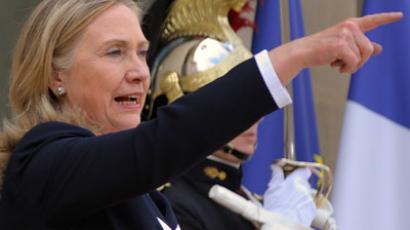
On May 23, 2012, then-Secretary of State Hillary Clinton went to the Special Operations Forces Industry Conference (SOFIC) trade show in Tampa, Florida to share her vision of “smart power” and to explain the State Department’s crucial role in extending the reach and efficacy of America’s growing “international counterterrorism network.”
First, there is such a thing as a “Special Operations Forces Industry Conference trade show.” Without some keen reporting by David Axe of Wired, that peculiar get-together might’ve flown completely under the radar—much like the shadowy “industry” it both supports and feeds off of like a sleek, camouflaged lamprey attached to a taxpayer-fattened shark.
Second, “special operations” have officially metastasized into a full-fledged industry. United States Special Operations Command (USSOCOM) is located at MacDill Air Force Base in Tampa and, therefore, conveniently located near the special operations trade show, which happened again this year at the Tampa Convention Center. The theme was “Strengthening the Global SOF Network” and the 600,000-square-foot facility was filled with targets of opportunity for well-connected and well-heeled defense contractors.
According to the SOFIC website, this year’s conference afforded attendees “the opportunity to engage with USSOCOM Program Executive Officers, Science and Technology Managers, Office of Small Business Programs and Technology & Industry Liaison Office representatives, and other acquisition experts who will identify top priorities, business opportunities, and interests as they relate to USSOCOM acquisition programs.”
Third, Hillary’s widely-ignored speech marked a radical departure from the widely-held perception that the State Department’s diplomatic mission endures as an institutional alternative to the Pentagon’s military planning. Instead, Secretary Clinton celebrated the transformation of Foggy Bottom into a full partner with the Pentagon’s ever-widening efforts around the globe, touting both the role of diplomats in paving the way for shadowy special ops in so-called “hot spots” and the State Department’s “hand-in-glove” coordination with Special Forces in places like Pakistan and Yemen.
Finally, with little fanfare or coverage, America’s lead diplomat stood before the shadow war industry and itemized the integration of the State Department’s planning and personnel with the Pentagon’s global counter-terrorism campaign which, she told the special operations industry, happen “in one form or another in more than 100 countries around the world.”
If this isn’t entirely unexpected, consider the fact that under then-Secretaries of State Colin Powell and Condoleezza Rice, the State Department fought attempts by the Pentagon to trump its authority around the globe and, as reported by the Washington Post, “repeatedly blocked Pentagon efforts to send Special Operations forces into countries surreptitiously and without ambassadors’ formal approval.”
But that was before Hillary brought her “fast and flexible” doctrine of “smart power” to Foggy Bottom and, according to her remarks, before she applied lessons learned from her time on the Senate Armed Services Committee to launch the first-ever Quadrennial Diplomacy and Development Review, which she modeled on the Pentagon’s Quadrennial Defense Review. That Pentagon-style review spurred the creation of the Bureau of Conflict and Stabilization Operations to “advance the U.S. government’s foreign policy goals in conflict areas.”
According to a Congressional Research Service analysis, the initial intent of the Conflict Bureau was to replace the ineffectual Office of the Coordinator of Reconstruction and Stabilization, which was created in 2004 to help manage “stabilization” efforts in two nations the U.S. was actively destabilizing—Afghanistan and Iraq.
But the new, improved bureau does more than just react to messes made by unlawful invasions or direct costly remediation efforts in war zones—it also collaborates with “relevant partners” in the Department of Defense and NATO “to harmonize civilian and military plans and operations pertaining to conflict prevention, crisis response, and stabilization.”
This integrated relationship between State and Defense was confirmed by U.S. Special Operations chief Admiral William McRaven shortly after Hillary’s speech. When asked about the “unlikely partnership,” McRaven assured DefenseNews that SOCOM has “an absolutely magnificent relationship with the State Department” and that SOCOM doesn’t “do anything that isn’t absolutely fully coordinated and approved by the U.S. ambassador and the geographic combatant commander.”
As David Axe aptly described it in Wired, “Together, Special Operations Forces and State’s new Conflict Bureau are the twin arms of an expanding institution for waging small, low-intensity shadow wars all over the world.”
In fact, during Hillary’s time as America’s chief diplomat, the State Department embraced the shadowy edge of U.S. foreign policy where decision-makers engage in activities that look like war, sound like war and, if you were to ask civilians in places like Yemen and Pakistan, feel a lot like war, but never quite have to meet the Constitutional requirement of being officially declared as war.
The Whole-of-Government Shift
Once upon a time, “low-intensity shadow wars” were the Congressionally-regulated bailiwick of the Central Intelligence Agency. But 9/11 changed everything. However, the excesses of the Bush Administration led many to hope that Obama could and would change everything back or, at least, relax America’s tense embrace of “the dark side.”
Although the new administration did officially re-brand “The War on Terror” as “Overseas Contingency Operations,” Team Obama employed an increasingly elastic interpretation of the 9/11-inspired Authorization for Use of Military Force and expanded covert ops, special ops, drone strikes and regime change to peoples and places well-beyond the law’s original intent, and certainly beyond the limited scope of CIA covert action.
Obama’s growing counter-terrorism campaign—involving, as Secretary Clinton said, “more than 100 countries”—took flight with a new, ecumenical approach called the “Whole-of-Government” strategy. Advanced by then-Secretary of Defense Bill Gates and quickly adopted by the new administration in early 2009, this strategy catalyzed an institutional shift toward inter-agency cooperation, particularly in the case of “state-building” (a.k.a. “nation building”).
During remarks to the Brookings Institution in 2010, Secretary Clinton explained the shift: “One of our goals coming into the administration was… to begin to make the case that defense, diplomacy and development were not separate entities, either in substance or process, but that indeed they had to be viewed as part of an integrated whole and that the whole of government then had to be enlisted in their pursuit.”
Essentially, the Whole-of-Government approach is a re-branded and expanded version of Pentagon’s doctrine of “Full-Spectrum Dominance.” Coincidentally, that strategy was featured in the Clinton Administration’s final Annual Report to the President and Congress in 2001. It defined “Full-Spectrum Dominance” as “an ability to conduct prompt, sustained, and synchronized operations with forces tailored to specific situations and possessing freedom to operate in all domains—space, sea, land, air, and information.”
In 2001, Full-Spectrum Dominance referred specifically to 20th Century notions of battlefield-style conflicts. But the “dark side” of the War on Terror stretched the idea of the battlefield well-beyond symmetrical military engagements. “Irregular warfare” became the catchphrase du jour, particularly as grinding campaigns in Afghanistan and Iraq exposed the reality that the full spectrum still wasn’t enough.
An assessment by the Congressional Research Service identified the primary impetus for the Whole-of-Government “reforms” embraced by Team Obama as the “perceived deficiencies of previous inter-agency missions” during the military campaigns in Afghanistan and Iraq. Those missions failed to address a myriad of problems created—culturally, economically and politically—by the wholesale bombing and occupation of those countries. The Full-Spectrum was half-baked. Lesson learned.
But the lesson wasn’t that the U.S. should avoid intervention, regime change or unleashing nascent civil, ethnic or religious conflicts. Instead, the lesson was that the “Whole-of-Government” must be marshaled to fight a worldwide array of Overseas Contingency Operations in “more than 100 countries.”
This Whole-of-Government shift signaled a renewed willingness to engage on variety of new fronts—particularly in Africa—but in a “fast and flexible” way. With other agencies—like the State Department—integrated and, in effect, fronting the counter-terrorism campaign, the military footprint becomes smaller and, therefore, easier to manage locally, domestically and internationally.
In some ways, the Whole-of-Government national security strategy is plausible deniability writ-large through the cover of interagency integration. By merging harder-to-justify military and covert actions into a larger, civilian-themed command structure, the impact of the national security policy overseas is hidden—or at least obfuscated—by the diplomatic “stabilization” efforts run through the State Department—whether it’s the Conflict Bureau working against Joseph Kony’s Lord’s Resistance Army in Central Africa, “stabilizing” post-Gaddafi Libya or spending $27 million to organize the opposition to Bashar al-Assad’s Syrian regime.
The Pass Key
The cover of diplomacy has traditionally been an effective way to slip covert operators into countries and the State Department’s vast network of embassies and consulates still offers an unparalleled “pass-key” into sovereign nations, emerging hot spots and potential targets for regime change. In 2001, the Annual Report to the President and Congress foresaw the need for more access: “Given the global nature of our interests and obligations, the United States must maintain the ability to rapidly project power worldwide in order to achieve full-spectrum dominance.”
Having the way “pre-paved” is, based on Hillary’s doctrinal shift at State, a key part of the new, fuller-spectrum, Whole-of-Government, mission-integrated version of diplomacy. At the SOFIC’s Special Operations Gala Dinner in 2012, Hillary celebrated the integration of diplomatic personnel and Special Operations military units at the State Department’s recently created Center for Strategic Counterterrorism Communications—a “nerve center in Washington” that coordinates “military and civilian teams around the world” and serves “as a force multiplier for our embassies’ communications efforts.”
As with most doors in Washington, that relationship swings both ways and mission-integrated embassies have served as an effective force multiplier for the Pentagon’s full spectrum of activities, particularly around Africa.
In his 2011 testimony before the House Foreign Affairs Committee Subcommittee on Africa, Deputy Assistant Secretary of State for African Affairs Don Yamamoto noted that State had “significantly expanded the number of DoD personnel who are integrated into embassies across the continent over the past three years,” and read a surprisingly long laundry list of collaborative efforts between State and the United States Africa Command (AFRICOM), including: “reduction of excess and poorly secured man-portable air defense systems (MANPADS); Defense Sector Reform in Liberia, DRC, and South Sudan; counterpiracy activities off the Somali coast; maritime safety and security capacity building; and civil-military cooperation.”
It seems that “civil-military cooperation” is a primary focus of the State Department in Africa. Most notably, Yamamoto told Congress that “embassies implement Department of State-funded Foreign Military Financing (FMF) and International Military Education and Training (IMET) programs, which further U.S. interests in Africa by helping to professionalize African militaries, while also assisting our African partners to be more equipped and trained to work toward common security goals.”
As the ever-vigilant Nick Turse recently reported, U.S. presence on the continent has only grown since that testimony was given in 2011. On TomDispatch.com, Turse identified the infamous attack on Benghazi on September 11, 2012 as the catalyst for “Operation New Normal”—the continent-wide response to, quite ironically, the political potboiler still simmering around Secretary Clinton. Whether or not Congressional Republicans find anything more than incompetence at the root of Benghazi, the U.S. military certainly finds itself in a “new normal” of increased activity in response to the forces—and the weaponry—unleashed by U.S.-led regime change in Libya. According to Turse, the U.S. is “now conducting operations alongside almost every African military in almost every African country and averaging more than a mission a day.”
Those missions are, of course, integrated with and augmented by the State Department’s Conflict Bureau which has used a variety of state-building programs and its diplomatic “pass key” in places like Libya, Nigeria, Kenya, South Sudan, Somalia, Democratic Republic of the Congo and six other African nations, all to develop a growing roster of “host country partners.”
Establishing “host country partners” is the nexus where the State Department, its Conflict Bureau and the AFRICOM meet—implementing the Whole-of-Government strategy in emerging or current conflict zones to fuse a mounting counter-terrorism campaign with stabilization, modernization and state-building initiatives, particularly in oil and resource-rich areas like the Niger River Delta, Central Africa and around AFRICOM’s military foothold on the Horn of Africa.
As Richard J. Wilhelm, a Senior Vice President with defense and intelligence contracting giant Booz Allen Hamilton, pointed out in a video talk about “mission integration,” AFRICOM’s coordination with the Departments of State and Commerce, USAID is the “most striking example of the Whole-of-Government approach.”
And this is exactly the type of “hand-in-glove” relationship Secretary Clinton fostered throughout her tenure at State, leveraging the resources of the department in a growing list of conflict areas where insurgents, terrorists, al-Qaeda affiliates, suspected militants or uncooperative regimes threaten to run afoul of so-called “U.S. interests”.
Ultimately, it became a hand-in-pocket relationship when Clinton and Defense Secretary Gates developed the Global Security Contingency Fund (GSCF) to “incentivize joint planning and to pool the resources of the Departments of State and Defense, along with the expertise of other departments, to provide security sector assistance for partner countries so they can address emergent challenges and opportunities important to U.S. national security.”
Although he’s been criticized as feckless and deemed less hawkish than Secretary Clinton, President Obama’s newly-proposed Counterterrorism Partnership Fund (CTPF) is the logical extension of the Clinton-Gates Global Security Contingency Fund and epitomizes the Whole-of-Government shift.
The $5 billion Obama wants will dwarf the $250 million pooled into the GSCF and will, the President said at West Point, “give us flexibility to fulfill different missions including training security forces in Yemen who have gone on the offensive against al Qaeda; supporting a multinational force to keep the peace in Somalia; working with European allies to train a functioning security force and border patrol in Libya; and facilitating French operations in Mali.”
That “flexibility” is exactly what Hillary Clinton instituted at State and touted at the SOFIC conference in 2012. It also portends a long-term shift to less invasive forms of regime change like those in Yemen, Libya, Syria and Ukraine, and an increased mission flexibility that will make the Authorization for the Use of Military Force functionally irrelevant.
Normalizing the War on Terror
The ultimate outcome of this shift is, to borrow from Nick Turse, yet another “new normal”—the new normalization of the War on Terror. What the adoption of the Whole-of-Government/mission integration approach has done is to normalize the implementation of the re-branded War on Terror (a.k.a. Overseas Contingency Operations) across key agencies of the government and masked it, for lack of the better term, under the rubric of stabilization, development and democracy building.
It is, in effect, the return of a key Cold War policy of “regime support” for clients and “regime change” for non-client states, particularly in strategically-located areas and resource-rich regions. Regimes—whether or not they actually “reflect American values”—can count on U.S. financial, military and mission-integrated diplomatic support so long as they can claim to be endangered… not by communists, but by terrorists.
And because terrorism is a tactic—not a political system or a regime—the shadowy, State Department-assisted Special Ops industry that fights them will, unlike the sullen enthusiasts of the Cold War, never be bereft of an enemy.
Sgt. Bergdahl and the Fog of War
By Sheldon Richman | FFF | June 4, 2014
The “fog of war” is a reference to the moral chaos on the battlefield as well as the rampant confusion. Individuals kill others for no other reason than that they are ordered to. Things deemed unambiguously bad in civilian life are authorized and even lauded in war. The killing and maiming of acknowledged innocents — in particular children and the elderly — is excused as “collateral damage.”
No wonder that some individuals thrust into this morass sometimes act differently from how soldiers behave in romantic war movies. The hell of war is internal as well as external.
We might remember this as the story of Sgt. Bowe Robert Bergdahl unfolds.
Bergdahl volunteered for the U.S. military and was apparently a gung-ho soldier. Americans have not been conscripted since 1973, but young Americans are propagandized from childhood with the message that time in the military is service to their country. Few question this narrative; fewer seek rebuttals to it. You have to want to face the facts that governments lie and that the service is to an empire having nothing to do with Americans’ security.
This, however, doesn’t relieve military personnel of responsibility for their own conduct. In 1951 — while Americans were fighting in Korea — Leonard E. Read, one of the founders of the modern libertarian movement, published “Conscience on the Battlefield,” in which a dying American soldier hears his conscience say that he — not the army or government — bears responsibility for his deadly conduct: “Does not the fault inhere in your not recognizing that the consequences of your actions are irrevocably yours…?”
Bergdahl seems to have been plagued by this question. (See Michael Hastings’s revealing 2012 article.)
In his novel Nineteen Eighty-Four, George Orwell described a regime that used war to keep its population too frightened to ask questions and in which the enemy could change without notice. Orwell may have exaggerated, but not by much. The United States sided with one Afghan faction against the Soviets and their Afghan allies in the 1980s, then switched when it replaced the Soviets as invaders in 2001.
On the surface, the war in Afghanistan seems easy to understand. The Taliban government gave sanctuary to Osama bin Laden and al-Qaeda, which attacked American targets in the 1990s and on September 11, 2001.
But things are not so simple. During the Soviet war in Afghanistan, the U.S. government sided with the future Taliban and al-Qaeda. President Reagan called the Afghan mujahideen“freedom fighters,” subsidized their war, and hosted them at the White House.
After the Soviet exit and years of civil war, the Taliban became the brutal theocratic government of Afghanistan, but not an anti-American terrorist organization. Indeed, as late as May 2001, President George W. Bush was helping the Taliban suppress opium production. After 9/11, the Taliban made various offers to surrender or expel bin Laden, but the Bush administration was uninterested. (This lack of interest predated 9/11.) Taliban attacks on American military targets since the U.S. invasion should not be construed as terrorism, but rather as combat between former government officials and the foreign force that overthrew them.
Anand Gopal, author of No Good Men Among the Living: America, the Taliban, and the War through Afghan Eyes, points out that soon after American forces invaded Afghanistan, “there was no enemy to fight”:
By mid-2002 there was no insurgency in Afghanistan: al-Qaeda had fled the country and the Taliban had ceased to exist as a military movement. Jalaluddin Haqqani [whose “network” held Bergdahl captive] and other top Taliban figures were reaching out to the other side in an attempt to cut a deal and lay down their arms.
But, Gopal writes, “driven by the idée fixe that the world was rigidly divided into terrorist and non-terrorist camps, Washington allied with Afghan warlords and strongmen. Their enemies became ours, and through faulty intelligence, their feuds became repackaged as ‘counterterrorism.’”
When Haqqani, a celebrated freedom fighter during the Soviet war, turned down a deal from the Americans because it included detention, the U.S. military attacked his home province and other areas, killing his brother-in-law and innocent children.
If he wasn’t with the Americans, he was against them, and therefore it was open season.
In this whirlwind of cynicism and relativism, can anyone be blamed for wondering what the point of the war was?
NATO troops and bases not welcome in Slovakia and Czech Republic
RT | June 5, 2014
Two Eastern European nations, Slovakia and the Czech Republic, have refused to host foreign troops and military bases. The prime ministers of both countries have consecutively spoken against the proposal voiced by US President Barack Obama.
Following the example of their neighbor the Czech Republic, the prime minister of Slovakia stated that his country is ready to meet its obligations as a NATO member state, but stationing foreign troops on its territory is out of the question.
Slovak PM Robert Fico said he “can’t imagine foreign troops being deployed on our territory in the form of some bases.”
The proposal to host more NATO troops in Eastern Europe was voiced by Obama on his current tour of Europe.
Speaking at a news conference in Warsaw, Obama said America is stepping up its partnership with countries in Eastern Europe with a view to bolstering security.
Initially, it was Poland that asked for a greater US military presence in Eastern Europe.
In April, Polish Defense Minister Tomasz Siemoniak called on the Pentagon to deploy as many as 10,000 American troops in his country.
Three Baltic States welcomed the idea back in April. To begin with, a small contingent of American troops began to arrive in Lithuania, Latvia and Estonia to take part in military training.
Two countries opposed deployment of any foreign soldiers on their territory.
On Tuesday, Czech Prime Minister Bohuslav Sobotka said his country sees no need to allow foreign military presence on its territory.
Last month, Defense Minister Martin Stropinsky sparked a political storm in the Czech Republic by recalling the 1968 invasion as the biggest reason not to host NATO troops in the country in a Reuters interview.
Slovakia’s Fico joined in the debate Wednesday, saying that for his country such a military presence is a sensitive issue because of the Warsaw Pact troops’ invasion into Czechoslovakia in 1968.
“Slovakia has its historical experience with participation of foreign troops. Let us remember the 1968 invasion. Therefore this topic is extraordinarily sensitive to us,” he said.
Fico said that Slovakia is committed to fulfill its obligations towards NATO despite military budget cuts and that allies would be allowed to train on Slovak territory anyway.
Czechoslovakia split into the Czech Republic and Slovakia in 1993.
The Czech Republic entered NATO in 1999, whereas Slovakia joined the alliance later, in 2004.
Fico’s Smer party, which has an absolute majority in Slovakia’s parliament, has been advocating warmer relations with Russia.
See also:
‘Peed in public, behave like occupiers’: Latvian mayor complains about NATO sailors
Left Forum Conference Ignores US-NATO Genocide
By Jay Janson | Dissident Voice | June 3, 2014
The Left Forum’s tenth annual conference was held this year at John Jay College of Criminal Justice, part of the City University of New York. Left Forum describes itself as “convening “the largest annual conference of a broad spectrum of left and progressive intellectuals, activists, academics, organizations and the interested public.”
The rather enigmatic theme for Left Forum 2014 was “Reform and/or Revolution: Imagining a World of Transformative Justice,” but one heard no mention of justice for the victims of sixty-nine years of US-NATO genocide presently ongoing in a dozen Muslim nations in the Middle-East and Africa as being a reason for either “reform” or “revolution.” The entire focus of the three day event, save in a a very small number of the three-hundred-and-eighty panel/workshops, was on “reform and/or revolution” to benefit Americans in America.
For this writer, the actual theme of Left Forum 2014 seems to have been: Martin Luther King was Wrong!: Americans CAN make a better America WHILE still continuing to kill the poor overseas in spite of the cost in human and financial resources that SHALL NOT stop Americans from making progress on social and justice issues at home.
Martin Luther King Jr. said:
I knew that America would never invest the necessary funds or energies in rehabilitation of its poor so long as adventures like Vietnam continued to draw men and skills and money like some demonic destructive suction tube. So, I was increasingly compelled to see the war as an enemy of the poor and to attack it as such. “I knew that I could never again raise my voice against the violence of the oppressed in the ghettos without having first spoken clearly … for the sake of the hundreds of thousands trembling under our violence. … Somehow this madness must cease. We must stop now. … I speak for those whose land is being laid waste, whose homes are being destroyed, whose culture is being subverted. I speak … for the poor of America who are paying the double price of smashed hopes at home, and … in sending their sons and their brothers and their husbands to fight and to die in extraordinarily high proportion relative to the rest of the population.
A few years ago there was a shining moment in that struggle. It seemed as if there was a real promise of hope for the poor — both black and white — through the poverty program. There were experiments, hopes, new beginnings. Then … I watched this program broken and eviscerated, as if it were some idle political plaything of a society gone mad on war.
Martin Luther King cried out, “For the sake of the hundreds of thousands trembling under our violence I cannot be silent!”
But Cornel West, now of New York Theological Seminary, the keynote speaker at Left Forum 2014’s Opening Plenary, and Harry Belafonte and Angela Davis, who spoke at its Feature Event, were silent on the sixty-seven years of US-NATO genocide overseas, the ongoing US-NATO slaughter of Muslims in a dozen nations in the Middle East and Africa and the covert violence around the world for “unjust predatory investments” that Rev. King condemned. Amazingly, their cries and exhortations were to fight for justice for Americans at home. Left Forum 2014 was a truly an ‘America First’ proposition.
All three most beloved African American celebrities of the Left railed against the injustices suffered by African Americans, Native Turtle Islanders, Latin Americans, and non-heterosexuals (including one supposes those returning from military duty in one or the more of the nations under military occupation or attack, and from US military bases in more than a hundred and fifty nations.)
The shouting was mainly about getting a better deal for Americans in America, Americans who King had held responsible for atrocity wars and covert genocide on three continents since 1945. Yours truly was uncomfortably aware that he sat in a college gymnasium filled with knowledgeable people, who, by virtue of their anti-government stance and protests, felt themselves innocent of the massive atrocities that King held himself responsible for, along with his fellow Americans.
Perhaps the most galling pill to swallow was the presence on stage of progressive media Democracy Now director Amy Goodman, long committed to false reporting to destroy the government and the population that supports it in Syria, having had a dedication to the destruction of beautiful, democratic and prosperous Libya and third world hero Muammar Gaddafi, and to dutiful backing of the Orange, Green and now Ukrainian “revolutions” sponsored by CNN and arranged by CIA and its many foreign branches.
I was gratified to find that quite a few panel facilitators and speakers at the three day conference were very knowledgeable and outspoken about the perfidy and treachery of Amy Goodman — and just as angry about her role in contributing to the death and maiming of so many innocent citizens by disseminating false propaganda in support of US-NATO bombings and funding of terror.
In fact, the panels I sought out were run and attended by dedicated scholars well aware of the traitorous nature of so many of those who pride themselves in being leftists and progressives critical, or even damning, of their government without realizing that not working firstly to stop the carnage of US-NATO deadly military operations and CIA’s equally deadly covert activities makes Leftists and Progressives more responsible for the genocide continuing than anyone else. For as the segment of society most informed about the horror of American actions overseas, yet refraining from referring to them as prosecutable crimes against humanity, not calling for their prosecution, and not seeking justice for America’s victims, makes such intellectuals, professors, historians and journalists accessories after the fact, even in some cases before the fact, for backhandedly protecting criminals in hindering the arrest and bringing to justice of all fellow Americans responsible. … Full article
Featured Video
10K More U.S. Troops Deploy as Trump Weighs New Iran Strikes
or go to
Aletho News Archives – Video-Images
From the Archives
Genetic baloney in thick slices
MAYBE COULD BE INC.
By Jon Rappoport | No More Fake News | July 8, 2021
Gene research companies tend to come and go. They start out banging and popping like fireworks in the sky, and then they fade out—selling themselves to larger outfits who’ve hired better liars…
Once upon a time, it sounded easy. Start with a disease, find the gene responsible for the disease, and correct the problem.
Then, researchers wondered, was disease the result of one gene or a group of genes acting together?
Either way, the proof would be in devising cures for diseases using gene therapy. “Not yet, but soon…”
And regardless, the major need was: money. Lots and lots of money.
This need required good PR people. “We have to pump up the idea that we’re on the edge of tremendous breakthroughs. We’re always on that edge…”
This hype also needed to obscure the fact that there wasn’t (and isn’t) ANY gene cure for ANY disease. … continue
Blog Roll
 Aletho News
- UK Government Body Kept Files on People Criticizing Prevent Program
- US military withdrawal from Iraq and the collapse of US-Israeli hegemonic project in West Asia
- What does Europe want – a war with Russia?
- She Followed the Actual Data on COVID Vaccines and Masks — Her Career Took a Huge Hit
- Florida AG Sues Pfizer, Bourla Over Deceptive Marketing of COVID Vaccines
- Von der Leyen gifts her spin doctor a job for life
- 10K More U.S. Troops Deploy as Trump Weighs New Iran Strikes /Suliaman Ahmed
- Iranian crew declared Dena training vessel ‘unarmed’ to US warship before deadly torpedo strike: Report
- Iran’s NPT debate moves beyond parliament
- Houthis condemn Saudi claims of attack on Medina
- If Americans Knew
- Israel is squeezing the life out of Palestinians – Daily Update
- The Israeli Right Portrays Islam as Murderous. It Serves a Political Purpose
- Jordan Has Had Enough: King Abdullah’s Scathing Warning to Israel
- Israeli Colonizers (i.e. Settlers) Kill Palestinian Man Near Salfit
- New Google Maps images reveal massive scale of devastation in Gaza
- Jewish supremacy, anti-Palestinian bigotry on display in Israel – Daily Update
- Israeli Soldiers Abduct At Least 22 Across Occupied West Bank
- Eight Palestinians Killed in Israeli Attacks on Gaza
- Israeli former leaders and security chiefs threaten legal action over ‘Jewish terrorism’
- Israel map in LA Times ad includes all land from the river to the sea
- No Tricks Zone
- Green Energy Debacle: German Expert Professor Fritz Vahrenholt Warns Of Severe Economic And Social Consequences
- Two More Paleo Reconstructions Affirm Meters-Higher Sea Levels Across Ireland, Brazil 7000-6000 Years Ago
- New Study: Earth And Venus Surface Warmth Largely Explained By Convection And Lapse Rate, Not CO2 Or Radiation
- 2025 Nature Paper Claiming Worsening Global Drought Gets RETRACTED …Heavily Flawed
- New Study: ‘Global Drought Shows No Detectable Recent Acceleration Under Climate Warming’
- Economic Masterminds: German Socialists Suggest Taxing Productivity Gains Stemming From Using AI
- The South China Sea Has Not Been Cooperating With The Climate Change Narrative
- Energy Crisis: Germany Enters Heating Season With Historically Low Gas Reserve Fill Levels
- New Study: The Antarctic Ice Sheet Gained Mass From 2020-2024 Due To Staggering Snow And Ice Accumulation
- Study: Ocean Heating Rates From Thousands Of Years Ago ‘Dwarf’ Modern Ocean Heating Rates

