Vietnamese Prime Minister Nguyen Tan Dung says abandoned explosives and land mines planted decades ago during the Vietnam War, have claimed the lives of more than 42,000 people.
The premier also added that since the end of the war in 1975, more than 62,000 Vietnamese people have also been injured as a result of unexploded bombs and mines, the Associated Press reported.
“The war’s painful legacy, which includes hundreds of thousands of tons of bombs and unexploded ordnance, continues to cause painful casualties every day,” he said during a United Nations-sponsored conference on Monday.
Dung said that his country needed US $500 million in domestic and international funds in order to clear the remaining bombs and mines.
The US used an estimated 16 million tons of bombs and ammunition while allied with the former South Vietnamese government.
During the conference, US Ambassador David Shear added that the US has provided Vietnam with US $62 million in aid to cope with the consequences of the war, which has “helped build the mutual trust and understanding between the U.S. and Vietnam that has allowed our bilateral relationship to flourish.”
According to Vietnam’s vice Labor Minister Bui Hong Linh, explosives remain on nearly 16 million acres of land, which is more than one-fifth of the country’s territories. This is while only five percent of the contaminated area has been cleared.
Experts say that the clearing process in Vietnam will take up to hundreds of years.
December 5, 2011
Posted by aletho |
Militarism, Timeless or most popular, War Crimes |
Leave a comment
From September 1939 to December 1941, Americans debated the role the United States should play in World War II, which was then ravaging Europe. Should America actively support the Allies, especially Britain, by providing direct financial and indirect military aid? Or should America maintain its traditional role of nonintervention? (World War I had been the sole exception.)
In 1941, the dispute intensified into what has been called the Great Debate, although the term is sometimes used to describe the entire discussion. Throughout most of the year, conflict raged in Congress, over radio waves, in print, on soap boxes, in lecture halls, from pulpits, and over kitchen tables.
Those who wanted to intervene had the great advantage of presidential power, but it is not clear which side would have prevailed had the debate continued. But on the morning of December 7, 1941, the Japanese bombed the U.S. Naval base at Pearl Harbor, Hawaii. On December 8, the United States declared war on Japan. On the 11th, Germany and Italy declared war on the United States; America reciprocated. Discussion was effectively over.
Defining the debate
In general terms, those who wanted to intervene argued that American security rested on defeating Germany, and so America should actively assist Britain and the Allied powers, largely through supplying their war needs (few called for military involvement before Pearl Harbor). The other side argued that America had no vital interest in the conflict. Active assistance would draw America directly into the war and, so, deeply damage America economically, politically, and in terms of lives lost.
The debate is often portrayed as “internationalists” versus “isolationists,” but this characterization is misleading. The so-called internationalists were often sympathetic to only a few favored nations. They were often “isolationist” or protectionist in other areas such as trade, where they advocated high tariffs to favor domestic goods and labor. Moreover, their definition of internationalism sometimes devolved to an advocacy of American dominance rather than that of global partnership.
The “isolationists” are even more difficult to fit under one label. In his essay “American Anti-Interventionist Tradition,” Justus Doenecke observed that
So-called isolationists often sought to increase foreign trade, endorsed noncoercive forms of international organization, fostered cultural interchange, and supported relief and recovery. In fact, they might take pains to deny they were isolationists, preferring the name anti-interventionist, neutralist, or nationalist.
What united them was a common opposition to America’s entry into World War II. The reasons for opposition varied as widely as did their political makeup, which spanned from far Right to far Left.
A more accurate description of the debate, therefore, is interventionist versus anti-interventionist.
The timing of the debate was significant in at least two ways.
First: Around the globe — e.g., in Germany, Italy, Japan, and the Soviet Union — national-security states were consolidating. These were states at perpetual war with “the enemy,” both external (hostile nations) and internal (dissident citizens). America would either be drawn into a scenario created by such states or it would maintain neutrality and, so, remain American. Many noninterventionists believed that war would replace the free American system with government control in the form of labor conscription, monopolies, military-industrial corporations, price controls, and so on.
Second: Franklin Delano Roosevelt (FDR) had assumed the presidency (1933–1945) with a clear focus upon domestic policy, especially the economy. Only as fascism spread across Europe and communism across Asia did FDR’s attention significantly shift to foreign policy.
Then, on September 1, 1939, Germany invaded Poland. Two days later, Britain and France declared war on Germany. Prior to the invasion of Poland, FDR’s foreign policy had stressed the protection of America’s strategic and economic interests in Europe. Afterward, America’s position remained officially neutral but FDR clearly favored the Allies. For example, in a September 3rd “fireside chat” broadcast, he declared neutrality, but he also waited two days before invoking the Neutrality Acts, so that the Allies could quickly buy the war materials they needed without impediment.
Prelude to the great debate
On September 21, FDR asked a special session of Congress to revise the Neutrality Acts to allow a policy of “cash-and-carry.” The policy allowed America to sell war materials to any belligerent who paid up front and assumed all risk of transportation. In effect, however, cash-and-carry assisted Britain and not Germany because the latter was cash-strapped and unable to travel safely across a British-dominated Atlantic. Thus the policy preserved a veneer of neutrality while aiding Britain and boosting the American economy.
Prominent anti-interventionists openly challenged FDR. Today, the best remembered of these voices may be Senator Robert A. Taft, but back then the one man with sufficient public appeal to counter FDR’s own was the renowned aviator Charles Lindbergh. In September, Lindbergh began broadcasting a series of speeches over the radio. The first, entitled “America and European Wars” argued that “by fighting for democracy abroad we may end by losing it at home.” Lindbergh also published articles in popular print venues such as Reader’s Digest. Although he was far from alone in his advocacy — for example, Senator Gerald P. Nye vociferously opposed the cash-and-carry policy — it was Lindbergh who was its popular voice.
During this time, the conflict in Europe entered a phase now known as the Phoney War. This period of inactivity spanned the winter 1939–1940.
In April 1940, the Phoney War ended when Germany invaded Denmark and Norway. Shortly afterward, Belgium, Holland, and France were invaded. Thus, an urgency suffused the debate.
At the same time, the British had taken huge losses in the materials they were shipping home due to German U-boat attacks; they could no longer afford a cash-and-carry arrangement. At a December 17 press conference, FDR proposed another policy, called Lend-Lease. FDR described Lend-Lease in terms of watching a neighbor’s house burn down. He asked, “What do I do in such a crisis? I don’t say … ‘Neighbor, my garden hose cost me $15; you have to pay me $15 for it’ — I don’t want $15 — I want my garden hose back after the fire is over.”
The policy aimed at giving the President broad power to “sell, transfer title to, exchange, lease, lend, or otherwise dispose of” war materials. This would have allowed FDR to give war material to Britain (and others) without immediate payment. Instead, the recipients would give the materials back after the war or simply pay for them then in some manner. A September 1940 agreement called Destroyers for Bases provided one precedent; 50 U.S. WWI destroyers were exchanged for leases on several military bases to which Britain held rights.
In his 1941 State of the Union address, FDR reiterated Lend-Lease and confirmed the fears of anti-interventionists who believed war would destroy the free American economy. FDR declared, “To change a whole nation from a basis of peacetime production of implements of peace to a basis of wartime production of implements of war is no small task.”
And, yet, the American people were in favor of actively assisting Britain. What they opposed was any direct entry into the war. A February 1941 Gallup poll found 54 percent of Americans approved of Lend-Lease without qualification; 15 percent approved with qualifications such as avoiding war; and 22 percent were absolutely against Lend-Lease.
In February, 1941, the Lend-Lease bill arrived at Congress, where it faced stiff opposition from Republicans. Nevertheless, the Democrat-dominated House voted along party lines and passed the bill; the Senate also secured passage. On March 11, the bill was signed into law. In April, the program was expanded to include China. America was now what FDR proudly called “the arsenal of democracy.” Neutrality was now a technicality.
The America First Committee
No organization better expresses the anti-interventionist side of the Great Debate than the America First Committee (AFC).
The immensely influential AFC was rooted in a student organization founded in 1940 by Yale Law School student and future CEO of Quaker Oats R. Douglas Stuart Jr., along with several other students, including future Supreme Court Justice Potter Stewart and future President Gerald Ford. By September 7, the AFC announced its nationwide status and established headquarters in Chicago. It attracted high-profile activists including Lindbergh; Robert E. Wood, the chairman of Sears, Roebuck and Company; Alice Roosevelt Longworth, daughter of former President Theodore Roosevelt; John T. Flynn, a well-known journalist and founder of the New York chapter; Norman Thomas, a prominent socialist and pacifist; as well as Senators Burton K. Wheeler (D), David I. Walsh (D) and Gerald P. Nye (R).
On December 17, when FDR first proposed a Lend-Lease bill, the anti-interventionists were galvanized. The AFC aggressively criticized the policy as well as FDR the man. Calling FDR a liar, it petitioned nationwide for the enforcement of the Neutrality Act and to force FDR to fulfill his earlier pledge to stay out of war. The AFC announced four key principles to ensure America’s neutrality:
- The United States must build an impregnable defense for America.
- No foreign power, nor group of powers, can successfully attack a prepared America.
- American democracy can be preserved only by keeping out of the European war.
- “Aid short of war” weakens national defense at home and threatens to involve America in war abroad.
Passage of the Lend-Lease bill created more debate. For example, when Germany invaded the Soviet Union, the Lend-Lease program was extended to that nation; the AFC protested vehemently that Stalin was no better than Hitler. When FDR attempted to assist British ships in the Atlantic by ordering the U.S. Navy to fire upon German submarines, the AFC accused him of waging war against Germany without a congressional declaration. At every step toward war, the AFC positioned itself as a barrier.
It sponsored rallies in small towns and cities, it promoted lectures and radio broadcasts, it distributed useful data to members of Congress and published rousing literature. One circular asked “Are you willing to give up democracy?” and referred to Lend-Lease as a “war dictatorship bill” that handed “absolute power” to FDR.
With some genuine success, Edgar J. Hoover and the FBI countered the AFC’s momentum; they attempted to smear its members as pro-Nazi, anti-Semitic or subversive. Nevertheless, the organization continued to grow, simply because the majority of Americans did not want to enter the war. At its peak, AFC boasted approximately 800,000 members in several hundred chapters.
And then Pearl Harbor occurred. Popular opinion turned on a dime and favored the rapid declaration of war. On December 11, the same day Germany and Italy declared war on America, the AFC disbanded and released the statement,
Our principles were right. Had they been followed, war could have been avoided. No good purpose can now be served by considering what might have been, had our objectives been attained. We are at war.
Today, it is common to view the anti-interventionists as “isolationists” who naively under-estimated Hitler or espoused Fortress America. But, as Doenecke observed,
They were presenting a competing world vision … that force, separated from abstract principles of international law and self-determination of nations, merely institutionalized chaotic and destructive power politics.
Anti-interventionists were also presenting a competing domestic vision
that lengthy foreign conflicts would only weaken a nation, limiting the freedom and opportunities of Americans in ways that they thought crucial. In short, real dangers were internal, centering on the nature of the American republic as they had understood and experienced it.
~
Wendy McElroy is the author of The Reasonable Woman: A Guide to Intellectual Survival (Prometheus Books, 1998). She actively manages two websites: http://www.ifeminists.com and http://www.wendymcelroy.com.
December 4, 2011
Posted by aletho |
Militarism, Timeless or most popular |
Leave a comment
Ankara – The report just issued by the UN Human Rights Council’s ‘independent international commission of inquiry on the Syrian Arab Republic’ is now being passed along the line to the UN Security Council, with the recommendation by the UN Human Rights Commissioner, Navi Pillay, that the Syrian government be referred to the International Criminal Court for prosecution.
In its terms of reference the commission describes itself as a ‘fact-finding body’ based on the standard of ‘reasonable suspicion’. Yet if there is anything that characterizes this document, it is the lack of attention to fact. The report is based on accusations, allegations and claims against the Syrian government which it does not even attempt to verify. It repeats the claim that the Syrian government’s security forces are responsible for the deaths of 3500 people – the figure usually given – when there is strong prima facie evidence that a large number of the dead, civilians as well as soldiers, have been the victims of armed gangs operating across the country. It does not even say where it picked up this figure, since increased to 4000 by Navi Pillay, or whether it has any independent evidence that it is accurate.
Two central questions needed to be dealt with if this commission wanted to get at the facts. First, how much truth is there in the allegations being made against the Syrian government and its security forces? Here the commission records the allegations but makes no attempt to verify them. Thus the facts remain unknown. Second, how much truth is there in the allegations made by the Syrian government? Here the commission does not even deal with the allegations. Despite this bias, the result is the same: the facts remain unknown.
The commission says it interviewed 223 victims and witnesses of alleged human rights violations, ‘including civilians and defectors from the military and security forces’. It does not say who these people are, where it got their names from, why they were chosen and who covered the costs of their travel and accommodation. It indicates that other sources of its information include ‘non-government organizations, human rights defenders, journalists and experts’. As this same group is the source of many of the unsubstantiated if not patently false accusations (i.e. dead people who have turned up alive) appearing in the mainstream media, it is obviously important to know precisely which organizations and individuals helped the commission and what the information was that they supplied, but the commission does not say.
The commission regrets that the Syrian government, ‘despite many requests’, failed to engage in dialogue ‘and grant the commission access to the country’. But as the Syrian government points out, in a letter printed as an annex to this report, it had established its own Independent Special Legal Commission, with sub-commissions operating across Syria since the end of March, and therefore would not be able to provide the UN commission with the material it wanted until it had concluded its own inquiries. However, because it could not accommodate itself to the commission’s timetable, it is accused of failing to cooperate.
On September 12 the president of the Human Rights Council (Laura Dupuy Lasserre) appointed three ‘high level experts’ as members of the commission of inquiry: Paulo Pinheiro (chairman), Yakin Ertürk and Karen Koning AbuZayd. They were required to produce their report by the end of November, with an update to be handed in by March, 2012. There is no indication of why the end of November was chosen for the deadline and not December or January, giving the commission more time to investigate the allegations being made. The time frame was extremely constricted given the work load. Within the space of six weeks (end of September to the middle of November), 223 witnesses were interviewed and a report prepared. The commission’s mandated task was ‘to investigate all alleged violations of international human rights law since March 2011 in the Syrian Arab Republic, to establish the facts and circumstances that may amount to such violations and of the crimes perpetrated and where possible to identify those responsible with a view of ensuring that perpetrators of violations, including those that may constitute crimes against humanity, are held accountable’. This clearly could not be done in six weeks. The apparent rush to get the report out will raise questions in many minds about timing, given the way in which the net is being closed around the Syrian government by those who want to bring it down.
The commission presents one side of the story throughout. For virtually every claim it makes there is a counter narrative which it ignores. One such claim involves the use of snipers. The commission says or implies that they were state security forces. There is countervailing evidence of armed civilians shooting at demonstrators to throw the blame on to the state. Perhaps there is truth in both versions, but both versions needed to be considered. The fact remains that the identity of these snipers is not known.
The report alleges that roadblocks and security checks were set up to prevent people from joining demonstrations but makes no mention of allegations of roadblocks being set up by armed gangs and the consequent kidnapping and killing of civilians. It refers to killings and arrests at Jisr al Shughur but not the evidence of the massacre of soldiers and civilians around the town in July: even if only prima facie it deserved to be considered. It produces claims of torture and killing ‘reportedly’ taking place in Homs military hospital ‘by security forces dressed as doctors and allegedly acting with the complicity of medical personnel’. Such a serious charge surely needs more to back it up than ‘reportedly’. The report mentions the raid on a mosque in Dar’a early in the protest movement but not the stockpile of weapons found there. It refers to the torture and murder in custody of two teenage boys and claims that up to November 9, ‘reliable sources’ indicated that 256 children had been killed by state forces. This is such a serious accusation that some corroborative evidence was needed but there is nothing, not the name even of one of these children and not the circumstances in which they were allegedly killed.
It quotes a ‘defector’ (no evidence that this person actually is one) as being told by his commander to ‘disperse the crowd or eliminate everybody including children’. There is no supporting evidence for this accusation. The state security forces are accused of rape but there is no mention of the cases of rape reported by the Syrian authorities to have been committed by armed gangs as part of their project to terrorize and intimidate the civilian population. The army is accused of using tanks and heavy weapons against residential buildings. These accusations are denied by the government. Furthermore, if they were used, were the civilians inside those buildings armed and shooting at the army, as seems to have been the case at Homs and probably elsewhere? The commission does not mention the use of heavy weapons by armed men against the army. Apparently it has not seen the videos of the charred bodies of soldiers lying beside burnt-out tanks. The commission’s statement that it is ‘aware of acts of violence committed by demonstrators’ is a minor point beside the violence of the armed gangs. The substantial body of evidence of their crimes surely needed to be considered if the human rights of all Syrians and not just those who have died at the hands of state security forces are to be taken into account.
In short, this report does not even meet its own ‘lower standard of proof’. In fact, and this seems to be the only fact insofar as this report is concerned, there is little proof of anything. The commission perhaps needed to be reminded that the ‘defectors’ and the Syrian National Council do not represent the Syrian people. Bashar al Assad’s personal popularity plays out well for his government amongst a normally skeptical people. His face has been the focal point of demonstrations of support by millions of people in recent months. If anything, sanctions imposed by the US, the EU, the Arab League and Turkey, along with the constant threat of force, seem to have strengthened public support for Bashar and his government. The commission certainly would have had no difficulty in finding Syrians prepared to come to Geneva to tell another side of the story. Apparently there was no room for them and no interest in what they had to say.
We have just seen what has been done to Libya in the name of human rights and the ‘responsibility to protect’. Uncounted thousands of Libyans were killed in eight months of bombing and missile attacks by French, British and American warplanes. There is prima facie evidence that war crimes were committed but there is not even the suggestion that someone will be held accountable. Further back stands Iraq, invaded in 1991 and then subjected to a decade of sanctions which ended the lives of about one million Iraqis, including hundreds of thousands of children. The second war launched in 2003 brought the overall civilian death toll since 1991 to somewhere between 1.5 and two million Iraqis. Again, prime facie evidence of war crimes and crimes against humanity without any of the perpetrators being punished. The kind of lies told before the attacks of 1991 (babies being thrown out of their incubators in Kuwait) and 2003 (weapons of mass destruction) were duplicated in the propaganda war which preceded the aerial assault on Libya this year (mass killing and Viagra-fueled rape).
To their eternal shame, the Arab League and governments which sell themselves on their Muslim credentials took part in or came in behind this war on a Muslim country by three non-Muslim governments. Now a third Arab country is being laid out on the chopping board, not in North Africa but at the very heart of the Middle East. The US, France, Britain and their Arab allies can sense that a momentous victory is at hand and they are pushing as hard as they can, using every weapon at their disposal. At the end of the road lies the possibility of armed intervention through the declaration of a ‘no fly’ zone and a cross-border operation to establish a ‘buffer zone’ or what the French Foreign Minister, Alain Juppé, prefers to call a ‘humanitarian corridor’. These are propaganda phrases, of course. What the advocates of intervention are talking about is war and everything it entails – widespread destruction and the death of thousands of people.
Reconstructed Syria’s future is already being written. A leading figure in the Syrian National Council, Burhan Ghaliun, has said that a new government would break relations with Iran and would overturn the present strategic relationship with Hizbullah. The connections of other members of this council with the Gulf States, the US State Department and Israel’s lobbyists in Washington are further evidence of how Syria is to be remolded if the present government can be brought down. Short of the toppling of the Islamic government in Iran, it would be hard to think of a greater triumph for ‘the West’ and its reactionary allies across the Middle East, not to mention the benefits for Israel. Are those Arabs joining the chorus against the Syrian government in the name of human rights even thinking about this?
~
Jeremy Salt teaches the history of the modern Middle East in the Department of Political science, Bilkent University, Ankara. He previously taught at Bogazici (Bosporus) University in Istanbul and the University of Melbourne. His publications include The Unmaking of the Middle East: A History of Western Disorder in Arab Lands (University of California Press, 2008).
December 4, 2011
Posted by aletho |
Mainstream Media, Warmongering, Militarism, Timeless or most popular, War Crimes, Wars for Israel |
Leave a comment
America’s atomic arsenal is stuck in the Cold War era
These days superpower nuclear-weapons controversies hardly elicit the excitement that once inspired such bumper-sticker slogans as, “you can’t hug children with nuclear arms.” The “no nukes!” movement has gone the way of the Cold War and MTV playing music videos, right?
In the 21st century, the 2002 Treaty of Moscow and 2010’s New START (Strategic Arms Reduction Treaty) were supposed set the clock on bilateral warhead reduction, and there are no plans for the production of more nuclear weapons. Pretty cut and dried, one would think. But like everything radiating out of Washington, the atomic drawdown is not what it seems.
Despite a deficit reduction plan to cut $1.2 trillion in federal spending over 10 years and ongoing negotiations by the so-called supercommittee to identify cuts of $1.5 trillion more, members of Congress are pushing an expanded plutonium storage and production assistance facility at Los Alamos National Laboratory in New Mexico. Critics say the facility is unnecessary, poorly designed, and dangerous—there are fault lines throughout the Los Alamos property—and its cost has ballooned from $375 million in 2001 to an estimated $5.5 billion today.
It hasn’t been built yet—in fact, the designs aren’t even finished after 10 years. But the Chemistry and Metallurgy Research Replacement Nuclear Facility (CMRR-NF) has been soaking up taxpayer money all the same as the scope of the project has metastasized.
“The country doesn’t have money to pour into an unnecessary, giant boondoggle that has grown beyond all original expectations,” charges Greg Mello, executive director of the Los Alamos Study Group, probably the toughest grassroots opposition the CMRR-NF project faces right now. “When the cost of a facility increases by more than a factor of ten, even as the fundamental purposes are evaporating, it’s important to stop, to pause and to question whether this is the right thing to do.”
There is no doubt that the budget-cutting imperative is clashing with the old way of doing business on Capitol Hill, as pet projects and earmarks come under more scrutiny than ever. Bureaucratic institutions used to getting their way by easing expensive, potentially controversial programs under the radar are finding themselves squarely in critics’ sights.
That includes CMRR-NF, which has never been the subject of a public congressional hearing or passionate floor speech—much less a heated debate on cable TV or talk radio—but has been controversial nonetheless.
“I think the key is, it appears to be a huge waste of money and particularly in our current fiscal situation there is no need to hurry this thing at all,” says Peter Stockton, senior investigator for the Project on Government Oversight, which is currently working on its own CMRR-NF report.
• • •
The mission of National Nuclear Security Administration (NNSA), which is a semi-autonomous agency of the U.S. Department of Energy, is to “improve national security through the military application of nuclear energy.” It oversees Los Alamos and is in charge of the CMRR project.
Initially, the NNSA was merely focused on renovating the parts of Los Alamos’s old Chemistry and Metallurgy Research (CMR) building that were outmoded and deteriorating by the late 1990s. Tests had found faults running under the property that could cause dangerous earthquakes.
After President George W. Bush was elected, plans to improve and upgrade salvageable portions of the nearly 60-year-old CMR were scrapped, and NNSA set about designing a “simple” replacement facility with two buildings about a mile away. One, the Radiological Laboratory Utility Office Building, is not controversial and almost complete. The other—the NF in CMRR-NF—is a new nuclear facility that would support Los Alamos’s nuclear-weapons mission, including plutonium storage, and assist in the production of plutonium-based “pits,” the fissile cores of nuclear weapons. This currently takes place at the existing TA-55/PF-4 nuclear facility next to the proposed site.
The nuclear facility, according to its critics, has become a monster. Aside from the runaway cost estimates, according to Mello the envisioned facility would give TA-55/PF-4 the capacity to double the number of pits Los Alamos produces each year and could store up to six metric tons of plutonium, “enough to rebuild the entire U.S. strategic arsenal.” This when there are thousands of pits already in storage and a treaty with the Russians sharply limits the nuclear arsenal.
Even if the increase in pit production were necessary—and as Mello and others point out, with much of the information classified or otherwise unavailable to the public, it is hard to know—the existing lab could be upgraded to carry out Los Alamos’s publicly stated mission to refurbish the current stockpile. NNSA, critics complain, has so far refused to seriously consider any alternative.
“We think there are simpler, cheaper, faster alternatives to accomplishing their stated mission, though their stated missions are aggrandized to begin with,” says Los Alamos Study Group President Peter Neils, who was on Capitol Hill in late October to get the word out about CMRR-NF. He blames the out-of-control designs and spiraling cost on a mix of Cold War ideology, over-reliance on contractors, and the self-sustaining mentality of all bureaucracies.
Simply put, says Mello, “the warhead establishment and the Cold War hawks cannot let go of designing and building new kinds of warheads, to create what they call ‘end-to-end’ work for the weapons complex.”
• • •
As of June, the Federation of American Scientists reports, the U.S. had 1,950 operational strategic nuclear warheads, plus approximately 200 deployed on behalf of allied countries—Belgium, Turkey, Netherlands, Italy and Germany—and 2,850 in reserve. In addition, some 3,500 retired warheads are awaiting dismantlement. This all jibes with numbers issued by the State Department in 2010. START demands that the U.S. bring those deployed numbers down closer to 1,550 by 2018.
At its peak in 1967 during the Cold War, the nuclear stockpile was at 31,225 warheads. America had 22,217 when the Berlin Wall fell in 1989. If the Cold War were still on, say critics, we might need additional capacity to build pits. But as it is there are thousands of usable pits already in reserve, and the scientific consensus says the plutonium parts of the pits have a lifespan of at least 100 years. The U.S. arsenal is well stocked in this regard.
The new CMRR-NF would help Los Alamos’s TA-55/PF4 site boost production to a conservative estimate of 125 pits a year on a double shift, according to observers.
This is as outrageous as it is unnecessary, claims Frank von Hippel, a professor and principal investigator at Princeton University’s Program on Science and Global Security, in an affidavit for the Los Alamos Study Group, which is trying to force NNSA’s hand in court.
“There is no anticipated need to produce new pits for U.S. nuclear weapons for several decades,” he writes. The oldest pit produced in the U.S. is 32 years old, he added, noting the current TA-55/PF-4’s production rate of 10 pits per year would be adequate for any replacements necessary during the modernization and maintenance that is already going on under the auspices of NNSA.
Critics say the entire landscape of nuclear-weapons production has changed since CMRR-NF was conceived—all in the direction of reducing the nuclear stockpile—yet every adjustment in the facility’s blueprints has resulted in more capacity to store plutonium and build additional pits.
Most notably, the Reliable Replacement Warhead, a new family of warheads conceived in 2004 and used as a chief justification for modernizing Los Alamos’s nuclear-weapons complex, was defunded by Congress and cancelled by the Obama Administration in 2009.
CMRR-NF “is being built to increase capacity for pit production, even though pit production is not what we need,” the Project on Government Oversight’s Stockton charges. NNSA did not respond to several phone calls for comment on these and other charges lobbed by the opposition.
A three-page “Questions and Answers Regarding the CMRR Project” issued by NNSA before the Reliable Replacement Warhead was canceled maintains that the “primary mission of CMRR will be to support the current nuclear weapons stockpile through surveillance and life-extension programs necessary for the nuclear weapons complex” and “the size of CMRR remains the same.” It blames the soaring expense on poor initial estimates, cost increases in “the construction industry worldwide,” and requirements relating to the seismic risks, nuclear quality assurance, and security. The words “fissile core” or “pit” are never mentioned.
NNSA also contends it has put alternatives up for public comment, most recently when it amended the plans under its Final Supplemental Environmental Impact Statement, which the agency says has incorporated “updated seismic safety design information.” (The Los Alamos Study Group disagrees and has filed a second lawsuit against NNSA, contending that it’s relying on outdated feasibility and impact studies, among other charges.)
Critics say that if the new facility’s mission is merely to help maintain the stockpile, the job could be handled at an improved and upgraded TF-22/P4 facility or elsewhere at a fraction of the cost. As for size, Mello says NNSA can longer say the facility is “the same”—the square footage might be, but the installation’s scope has certainly grown since 2001.
• • •
CMRR-NF is not without detractors on Capitol Hill. Over the years, its budget and plans have been questioned for all of the reasons already cited and more. Indeed, today’s fiscal environment has bolstered the criticism, with results that can be seen in competing House and Senate appropriations bills. (Some $450 million has been appropriated to CMRR since 2002.)
Calling it a “cost reduction strategy,” the House in July cut $100 million from NNSA’s $300 million request for CMRR-NF as part of the overall $30.6 billion Fiscal Year 2012 Water and Energy Appropriations package. “The [House and Water and Energy Subcommittee] fully supports the Administration’s plans to modernize the infrastructure, but intends to closely review the funding request for new investment to ensure those plans adhere to good project management practices,” the final bill reads.
By trimming the agency’s request by a third, the House is refusing to provide “the additional funding to support early construction” and would not do so until NNSA resolves “major seismic issues with design” and tames CMRR’s cost.
The Senate subcommittee, too, has expressed concerns. Pointing to the growing expense, its FY 2012 appropriations bill demands NNSA submit a contingency plan that would identify the cost and consequences of delaying the implementation of CMRR, as well as a planned Uranium Processing Facility at Oak Ridge, Tennessee—another project that has gone from an estimated $1.5 billion to upwards of $6.5 billion in the last five years. The committee also proposes to cut $60 million from the NNSA’s $300 million request for CMRR, but allows for preliminary “site preparation”—in other words, construction may begin on a project whose designs are not yet finished.
Mello and Neils have tried to convince lawmakers to put a permanent stop to CMRR-NF. It’s a difficult task, they say. Many legislators are hearing about the issue for the first time and might not be willing to plough through intimidating scientific and technical jargon to get at why this project is bad news.
And CMRR-NF already has momentum. Mike Lofgren, who spent 28 years on Capitol Hill as an aide on defense issues for the House and Senate Budget Committees, says this is bureaucracy in action, and anything relating to weapons systems is going to be expensive.
“It doesn’t surprise me that after a requirement has gone away, or the need has been severely curtailed, they would just continue on with this thing,” Lofgren tells TAC. “These projects get front-loaded by optimistic projections of their cost and overstatements of, ‘hey, we really need this thing,’ so you front-load them and politically engineer them by getting the local congressmen all hyped up by saying it’s going to create new jobs.”
When lawmakers start asking whether a particular project is really worth it, the response, Lofgren says, is always, “it’s too early to tell or too late to stop” and the effort will go on until the money is gone, mission accomplished or not. One need look no further than the $65 billion fleet of F-22 Raptors, which was grounded from May to August because of operational problems and has never seen a day of combat.
It’s hard to get a firm handle on how CMRR-NF has come to be apparently unstoppable because no wants to talk—neither the detractors on the Energy and Water Development Subcommittees, nor the project’s proponents, who have long been led by figures like Sen. John Kyl (R-Ariz.). In fact, reports at the time of Senate negotiations over New START indicate that as Republican Senate whip, Kyl was successful in obtaining additional funds for CMRR-NF in exchange for Senate GOP support for Obama’s treaty with the Russians. Kyl’s office did not return calls for comment.
A spokeswoman for Sen. Jeff Bingaman (D-NM), known as a longtime supporter of the CMRR project, responded with a statement from the senator that hardly sounded like a ringing endorsement.
“The CMRR is an important project for [Los Alamos National Laboratory] and for New Mexico, but it is also important to be sure environmental and cost issues are fully addressed,” Bingaman said. “My top concern as the project has been developed continues to be safety and security of the proposed facility.”
Contractors, post-Cold War ideologues, and bureaucracy may keep the CMRR-NF project going, but those interests appear to be clashing directly with the forces of fiscal restraint and new environmental concerns. After the earthquake-spawned Fukushima nuclear power plant disaster in Japan last spring, fears over seismic hazards at Los Alamos have only grown.
Meanwhile, the Los Alamos Study Group insists its goal is not to stop the U.S. nuclear program, but to make it safer, more efficient and less expensive.
The nuclear-weapons establishment “could do their job more efficiently and more cheaply if they didn’t infuse their work with so much ideology and were just more practical and straightforward,” says Mello. And CMRR-NF is not the only program that might demand additional scrutiny. According to the New York Times, the facility is just one of a host of modernization projects that could cost taxpayers over $600 billion in the next decade.
Kelley Beaucar Vlahos is a Washington, D.C.-based freelance reporter and a columnist for Antiwar.com.
November 30, 2011
Posted by aletho |
Militarism, Timeless or most popular |
Leave a comment
Back in March, we wondered when U.S. corporate news outlets would find U.S./NATO killing of Afghan kids newsworthy. Back then, it was nine children killed in a March 1 airstrike. This resulted in two network news stories on the evening or morning newscasts, and two brief references on the PBS NewsHour.
On November 25, the New York Times reported–on page 12–that six children were killed in one attack in southern Afghanistan on November 23. This news was, as best I can tell, not reported on ABC, CBS, NBC or the PBS NewsHour.
There were, on the other hand, several pieces about U.S. soldiers eating Thanksgiving dinners.
Salon columnist Glenn Greenwald was one of the few commentators to write about the latest killings. As he observed:
We’re trained simply to accept these incidents as though they carry no meaning: We’re just supposed to chalk them up to regrettable accidents (oops), agree that they don’t compel a cessation to the war, and then get back to the glorious fighting. Every time that happens, this just becomes more normalized, less worthy of notice. It’s just like background noise: Two families of children wiped out by an American missile (yawn: at least we don’t target them on purpose like those evil Terrorists: we just keep killing them year after year after year without meaning to). It’s acceptable to make arguments that American wars should end because they’re costing too much money or American lives or otherwise harming American strategic interests, but piles of corpses of innocent children are something only the shrill, shallow and unSerious–pacifists!–point to as though they have any meaning in terms of what should be done.
November 29, 2011
Posted by aletho |
Mainstream Media, Warmongering, Militarism, Timeless or most popular, War Crimes |
Leave a comment
The Non-Aligned Movement (NAM) and China issued a statement on the first day of the 16th International Chemical Weapons Convention (CWC) confab calling on US and Russia to destroy their chemical weapons arsenals, Press TV reports.
The statement was released on Tuesday noting that the weapons of mass destruction posed a serious threat to international peace and security.
The signatories also declared their readiness to work for the realization of complete international disarmament.
They also emphasized the necessity of unbiased and complete implementation of the content of CWC.
Regretting Washington’s recent decision to keep its chemical weapons arsenal, which it should have destroyed by April 29, 2010, the signatories called on the US and Russia, as the main holders of chemical weapons, to abide by international obligations and destroy their chemical weapons before the deadline set by the Organization for the Prohibition of Chemical Weapons (OPCW).
The NAM and China also warned that failing to meet the deadline by the US and Russia will undermine the credibility and integrity of CWC.
They also backed Iran’s initiative, which had been first brought up in the 15th CWC conference in 2010, to establish a global network in order to support the victims of chemical weapons.
The 16th international Chemical Weapons Convention (CWC) kicked off in the Hague on Tuesday, November 29, at the OPCW’s headquarters with the elimination of chemical weapons across the world as its main focus.
According to its mission statement, the CWC prohibits the development, production, stockpiling, and use of chemical weapons.
A total of 188 countries have so far acceded to the convention.
The convention required signatory states to destroy all their stockpiles of such weapons by April 29, 2007. But the United States has asked for the deadline to be extended by an entire decade.
According to the CWC’s directive, any country found to be in non-compliance will have to be referred to the United Nations Security Council.
As one of the main victims of chemical weapons, Iran has repeatedly asked Washington to abide by the international law, calling for the removal of its stockpiles of the arms.
November 29, 2011
Posted by aletho |
Militarism, Timeless or most popular, War Crimes |
Leave a comment
Which Side Are We On? NYT, U.S and Cluster Bombs
International efforts to ban cluster bombs fell apart late last week. If you were reading about this in the New York Times, you might have been led to believe that the United States was pushing to get rid of the weapons–instead of the opposite.
Here’s the lead sentence from a story in Saturday’s paper (11/26/11):
GENEVA — Despite last-minute attempts to broker a compromise, American-led efforts to conclude an international treaty restricting use of cluster munitions collapsed on Friday in the face of opposition from countries that said it did not address their humanitarian concerns and would undermine existing international law.
This “American-led effort,” readers were told, “reflected the increasing stigmatization of a weapon recognized as causing unacceptable harm to civilians and seen as having lasting effects on development for decades after conflicts have ended.”
Well, who opposes such efforts? It takes a little while to understand that the other side is taking a much tougher stance to eliminate cluster bombs, as outlined at an Oslo conference in 2008:
But countries and disarmament groups opposing the draft treaty said the humanitarian impact of the proposed protocol would be minimal and would legitimize continued use of other cluster munitions that are recognized to cause unacceptable harm.
These countries, together with the International Committee of the Red Cross and United Nations agencies dealing with development and human rights, also argued that the adoption of a legal instrument that was weaker than the Oslo agreement would set a dangerous precedent.
The Times’ confused account is in stark contrast to other reporting. This Reuters piece, for example, does a much better job of explaining things in its lead:
GENEVA (Reuters) — A U.S.-led push to regulate, rather than ban, cluster munitions failed Friday after 50 countries objected, following humanitarian campaigners’ claims that anything less than a outright ban would be an unprecedented reversal of human rights law.
Something tells me the Times story would look a little differently if the United States weren’t on the pro-cluster bomb side of this argument.
November 28, 2011
Posted by aletho |
Deception, Militarism, War Crimes |
Leave a comment
Britain’s Ministry of Defence (MoD) is spending £2bn on new nuclear weapons plants as the International Atomic Energy Agency (IAEA) has turned a blind eye on nuclear disarmament issues.
While the terms of the Nuclear Non-Proliferation Treaty (NPT) require that NPT-recognized nuclear weapon states are obliged to downgrade their nuclear capacity when they renew their systems, the British government has given the green light to the MoD to expand the country’s stockpile of nuclear weapons.
On 27 November, the Guardian revealed the breakdown of MoD’s investments including “a £734m facility called Mensa for dismantling and assembling of warheads, a risky but essential maintenance process; a £634m highly enriched uranium plant called Pegasus; and a £231m high explosives factory called Circinus.”
Furthermore, the newspaper revealed that the MoD has launched a comprehensive plan to develop the Atomic Weapons Establishment sites by building new facilities and plants by the end of 2015.
The MoD’s decision comes as the IAEA has launched a propaganda campaign against Iran’s nuclear program by releasing an “unbalanced, unprofessional, and politically motivated” report making baseless allegations against Iran’s peaceful nuclear activities.
Moreover, the IAEA has turned a blind eye on nuclear disarmament issues as the latest revelations about Britain’s nuclear activities show the British government intends to increase the number of its nuclear weapons instead of reducing them.
Meanwhile, it has emerged that the MoD’s secret plans to build new nuclear weapons plants have infuriated British MPs, as they were to decide whether to replace Trident warheads.
“The fact that the MoD signed off on these costs before a decision has even been made on replacing the Trident warhead makes a complete mockery of the democratic process,” said the Green MP Caroline Lucas.
November 28, 2011
Posted by aletho |
Militarism |
Leave a comment
Memogate and the U.S. attack on the Pakistani border post that killed 28 Pakistani soldier increases the chance of Imran Kahn’s Tehrik-e-Insaaf (Movement for Justice) party to win the next Pakistani election. Kahn is against the U.S. Pakistan alliance. It also increases the risk of a coup by some lower rank officers in Pakistan.
This is all well known by the U.S. and that is why there is something with the deadly attack which I do not get:
A NATO spokesman, Brig. Gen. Carsten Jacobson, offered details suggesting that allied and Afghan troops operating near the border came under fire from unknown enemies and summoned coalition warplanes for help.“In the early night hours of this morning, a force consisting of Afghan forces and coalition forces, in the eastern border area where the Durand Line is not always 100 percent clear, got involved in a firefight,” General Jacobson said […]
“Air force was called in into this activity,” he said, “and we have to look into this situation of what actually happened on the ground.”
The Pakistani border post that was attacked is on a high point some 1.5 miles within Pakistani territory. The actual border line is not always clear, there are no markings, and at 2:00am in the middle of the night no patrol in the area will be able to tell on which side of the border it really is.
So why are the U.S. and Afghan forces patrolling there at all?
Why not pull back the troops like five miles away from the border and establish the surveillance and defense line against infiltrations from Pakistan there? Except where the roads cross the border there is nothing of value or interest in the immediate border area. A pull back would allow for full use of indirect weapons (mortar, planes etc) against any infiltrating enemy while being sure that no Pakistani land and troops will get hurt in such a response.
Declare a no man’s land and free fire zone in the buffer on the Afghan side and have at it. Wouldn’t that be the sensible thing to do if one wants to avoid such incidence with Pakistan?
Then again – maybe such incidents are intended. But for what purpose?
November 27, 2011
Posted by aletho |
Deception, Militarism, Timeless or most popular |
Leave a comment
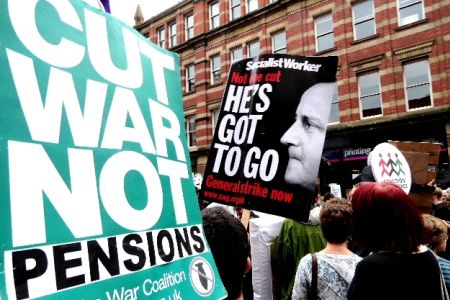
British anti-war campaigns have thrown their weight behind the nationwide strike against the government’s cuts in pensions and welfare services, urging the government to cut warfare not welfare.
Stop the War Coalition (SWC) and Campaign for Nuclear Disarmament announced that they would participate in the November 30 strike action organized by the Trade Union Congress (TUC) to call on the government to cut war and Trident spending not pensions.
The campaigns stressed that the government’s spending cuts have only been applied on jobs and public services, while spending on war is mounting without interruption.
Britain spent at least £1.5 billion on the Libya war, and spends about £5 billion per year on the Afghanistan war, SWC revealed. The campaign also said that the overall costs of the war on terror to the US are $3 trillion.
It is estimated that over three million public sector workers will participate in the pension strike across Britain, to defend their pensions against the government’s austerity measures.
The anti-war campaigns proclaimed they would support the strike action of 28 unions, believing the Tory-led government’s wrong policies would boost poverty and misery for the poor people.
“The budget deficits in the US and Britain have been caused in part by the rising cost of wars. Governments have borrowed money to pay for war. They are now asking people to accept cuts and austerity to pay for them,” SWC convener Lindsey German said.
Suggesting an alternative to the cut plans, German said the government could “cut spending on war and the Trident nuclear submarine system and use the money to fund welfare.”
Mark Serwotka, general secretary of Public and Commercial Services union (PCS), also condemned the government’s war policies. “The war in Afghanistan and the war in Libya are wrong. They are misjudged; they are not about what people claim they are about. And we should actually find a way out of those pretty quickly, not make the situation in those countries worse as well as at the same time take valuable resources that could go into schools and hospitals,” he said.
November 27, 2011
Posted by aletho |
Economics, Militarism, Solidarity and Activism |
Leave a comment
A Turkish newspaper has unveiled that French military forces are training armed Syrian rebels to fight the government of President Bashar al-Assad.
According to Milliyet, as cited by IRNA, France has sent its military training forces to Turkey and Lebanon to coach the so-called Free Syrian Army — a group of defectors operating out of Turkey and Lebanon — in an effort to wage war against Syria’s military.
The report added that the French, British, and Turkish authorities “have reached an agreement to send arms into Syria.”
The Turkish daily said that the three have informed the US about training and arming the Syrian opposition.
According to Milliyet, a group of armed rebels are currently stationed in Turkey’s Hatay Province near the border with Syria.
The report comes as an earlier report had revealed that the British and French intelligence agencies have reportedly tasked their agents with contacting Syrian dissidents based in the northern Lebanese town of Tripoli in order to help fuel unrest in Syria.
Reports also said that French intelligence agents have been sent to northern Lebanon and Turkey to build the first contingents of the Free Syrian Army out of the deserters who have fled Syria.
Syria has been experiencing unrest since mid-March, with demonstrations being held both against and in support of President Assad.
Damascus says the unrest has been largely incited by elements that are well-paid and armed by foreign powers. Hundreds of people, including members of the security forces, have been killed in the turmoil.
The opposition and Western countries accuse Syrian security forces of being behind the killings in the country, but the government blames what it describes as outlaws, saboteurs and armed terrorist groups for the deadly violence, stressing that the unrest is being orchestrated from abroad.
November 26, 2011
Posted by aletho |
Militarism, Wars for Israel |
Leave a comment
Pakistani Prime Minister Yousuf Raza Gilani has strongly condemned a NATO airstrike on a border post, which killed at least 28 Pakistani soldiers, Press TV reports.
Pakistan’s Foreign Ministry announced on Saturday that it also lodged a complaint in the strongest terms with NATO and the US over the attack, a Press TV correspondent reported.
“On his [Gilani] directions, the matter is being taken up by the foreign ministry, in the strongest terms, with NATO and the US,” the ministry said.
The incident occurred when a NATO helicopter targeted a security forces checkpoint known as Salala on the Mohmand Agency in northwestern Pakistan near the Afghan border early on Saturday. The strike also left 15 Pakistani soldiers injured.
The Western alliance said it was aware that an incident took place and it is still in the process of gathering information to investigate the attack.
In retaliation, Islamabad has blocked NATO supplies to Afghanistan.
Dozens of trucks carrying goods and petroleum supplies for NATO forces were stopped in the Torkham border area of the Khyber tribal region in northwestern Pakistan.
Pakistan has repeatedly condemned airstrikes against its troops near the border with Afghanistan. While the strikes supposedly target militants, they usually claim the lives of civilians and Pakistani soldiers.
November 26, 2011
Posted by aletho |
Militarism, War Crimes |
Leave a comment


 Aletho News
