Iran proposes signing nuclear disarmament treaty
Press TV – February 6, 2010
Iran has offered to work with Germany to draw up an “all-encompassing nuclear disarmament treaty” with a clear deadline for total annihilation of atomic weapons.
Iranian Foreign Minister Manouchehr Mottaki first introduced the offer in a Friday meeting with his German counterpart Guido Westerwelle on the sidelines of the Munich Security Conference.
“Other than our two countries, other states can take part in this initiative,” said Mottaki, recollecting how various countries had come together to seal the Chemical Weapons Convention (CWC).
Mottaki made the remarks just days after the ‘Global Zero’ summit in Paris, which brought together some 200 politicians, generals, businessmen, clerics, academics and arms experts in the hope of finding a way to total nuclear disarmament.
Both US President Barack Obama and his Russian counterpart Dmitry Medvedev sent messages of support to the international assembly.
In his message, Obama reaffirmed his campaign promise that “a world without nuclear weapons . . . is one of my highest priorities.”
Obama and Medvedev are finalizing a major new treaty to dismantle 2,000 of the 5,000 strategic (long-range) warheads they have in their stockpiles.
However, Obama and Medvedev together control 95 per cent of the world’s 23,000 nukes.
The defense industry is pleased with Obama
By Laura Flanders | Online Journal | February 4, 2010
Who says the president is failing to show leadership? In one area at least, there’s no sign of flag or falter. If anything, the administration’s only becoming more forthright. Sad to say, that area is military build-up.
Last year, the White House made a big deal of cutting a weapons program — the F-22 fighter jet — and the cuts conveniently obscured the growth in spending on unmanned aircraft or drones (the weapons that Pakistanis say killed a record 123 civilians in 12 attacks last month; 41 for every alleged Al Qaeda member.)
This year, the president dispensed with window dressing. No big deal about cuts — except on the domestic side. While the administration’s record $3.8 trillion budget shrinks or freezes spending on domestic needs, it requests $708.3 billion for war. That’s $14.8 billion more than we’re spending now.
The total includes $548.9 billion for “regular” war, plus $159.3 billion for special spending on the wars in Afghanistan and Iraq. Oh yes, the administration’s also asking Congress to increase spending on new nuclear weapons by more than $7 billion dollars over the next five years — despite that peace prize-winning pledge to cut the US arsenal and seek a nuclear weapons-free world.
The quote of the day comes from the CEO of a military contractor-funded policy group called the Lexington Institute. Loren Thompson tells Tuesday’s New York Times, “The defense industry is pleased but bemused . . . It’s been telling itself for years that when the Democrats got control it would be bad news for weapons programs. But the spending keeps going on.”
Take that you Nobel committee!
And to think some whiners complain about Democrats suffering from a lack of direction.
Israel threatens force over Iran nuclear standoff
AFP – 4 February 2010
JERUSALEM – Israeli Strategic Affairs Minister Moshe Yaalon raised on Wednesday the possibility of using force to stop Iran from developing nuclear weapons, something Tehran vehemently denies it is seeking.
“Iran’s plan will probably be stopped by a regime change or, if there is no other choice, by a recourse to force to deprive Iran of its nuclear arms production capabilities,” Yaalon told a security conference in Herzliya, northern Israel.
“It is important to continue to make clear to the extremist regime in Iran that all options remain on the table and that ignoring the demands of the international community will probably end in bitter tears for Iran,” he added.
Yaalon also called on the international community to impose even harsher sanctions on Iran over its nuclear programme.
Iran is already under three sets of sanctions imposed by the United Nations Security Council for its refusal to stop enriching uranium, a process that can produce fuel for nuclear reactors but also fissile material for an atomic bomb.
Earlier on Wednesday, Iranian President Mahmoud Ahmadinejad raised the possibility Tehran might come to an agreement with world powers over its enrichment programme.
“It is important to make Iran understand that the leaders of the international community are determined to the point of putting this matter at the top of their list of priorities, even if they have to pay an economic or even military price.”
Israel, the United States and a number of other Western countries accuse Iran of using what it claims is a purely civilian nuclear energy programme as a cover for developing atomic weapons. Iran denies that.
Yaalon’s reference to force was not new. Both the United States and Israel have consistently refused to rule out the use of force if diplomatic efforts to rein in Tehran are unsuccessful.
Israel has already acted in similar circumstances.
In 1981, Jewish warplanes bombed an Iraqi nuclear plant outside Baghdad. The prime minister Menachem Begin said the attack was necessary because the facility was about to become operational and would have permitted the regime of Saddam Hussein to manufacture nuclear weapons.
Saudi Arabia vs. the Houthis: A senseless war winds down
By Rannie Amiri | February 1, 2010
It has been nearly three months since the Saudi military directly inserted itself in the conflict between Zaidi rebels and the government of President Ali Abdullah Saleh in Yemen’s mountainous northwest governorate of Saada. After two of its border guards were killed last November by the rebels, known as Houthis (named after their erstwhile leader, Hussein Badr al-Din al-Houthi) and claims made that they had crossed into Saudi territory, a massive aerial assault was unleashed.
Using U.S. and Western-supplied weapons unavailable to Saleh’s government, the Saudi military employed Apache helicopters, F-15 and Tornado jets, infrared detection equipment, surveillance drones and quite possibly banned white phosphorus shells, to target Houthi positions in the rugged terrain of the border region and well into Yemen proper.
Despite their sophisticated weaponry, Saudi Arabia lost an unusually high number of soldiers; 133 at last count. Although an unknown number of Houthi fighters – and Yemeni civilians – were killed in the attacks, what is known is the great humanitarian toll the Saudi intervention exacted on the population. Already a cauldron of human suffering, malnutrition and overflowing camps for the internally displaced as a result of five years of war, the fresh offensive only added to the misery of Saada and the neighboring provinces.
Since the conflict began in 2004, aid agencies place the number of displaced Yemenis at 200,000. The Saudi government’s policy of forcibly returning those fleeing the conflict back into the war zone – a morally reprehensible practice not to mention a violation of international law – was widely condemned.
This week, the Houthis announced a unilateral ceasefire and declared their intention to voluntarily withdraw from any Saudi territory occupied. The current Houthi leader, Abdul Malek al-Houthi, stated, “If the Saudi regime maintains its aggression after this initiative, it would be showing that its intention is not to defend its territory, but to invade our borders.”
Yet, just after of the Houthi proposal was made, the Saudi government claimed it was they who had driven the rebels out of the border region.
“They did not withdraw. They were forced out,” asserted Deputy Defense Minister Prince Khaled bin Sultan.
In order for Saudi Arabia to accept the Houthi ceasefire, Sultan said the rebels must create a 10 km buffer zone between them and the border, agree to let Yemen’s military to take up positions along it, and return six captured Saudi soldiers.
Regardless of whether any tenable agreement is actually reached, it must be asked: what was accomplished by Saudi Arabia’s attack on Yemen?
Militarily, nothing.
The more salient question is: what was the real message behind Saudi Arabia’s (fruitless) intervention?
Although it was purportedly to defend the “territorial integrity” of the Kingdom, even supporters of the Royal Family concede it was more to stem perceived encroaching Iranian influence at its doorstep. Yet that too is a spurious argument.
To date, there has been no convincing evidence of any significant material support provided to the Houthi rebels by the Iranian government. Claims of such have been found to be no more credible than those issued by Yemen’s government that Abdul Malek al-Houthi had been killed in the fighting (he appeared on video a few days later appearing quite healthy).
To understand the real motive behind the bombardment, one only needs to return to the primary demand of the Houthi rebels: an end to the ever-increasing socioeconomic marginalization and religious discrimination of the Zaidi community in Yemen.
This war was not just to aid the fledging Saleh regime in combating an enemy far less threatening to its existence than al-Qaeda, but to send a clear message to Saudi Arabia’s own citizens who suffer the same systemic and institutionalized discrimination as do the Zaidis. Namely, Shia Muslims, Ismaili Muslims, Sufi Muslims and any who dare challenge the authority of the House of al-Saud or the doctrines of the officially-sanctioned Wahabi school of thought.
Saudi Arabia’s own oil-rich Eastern Province has seen tensions with Saudi Shia Muslims escalate in recent months as the Wahabi religious establishment clamps down ever more harshly on the practice of their religion and liberties as citizens of the state.
The senseless war in Saada waged by the Saudi government was thus meant to send an unmistakable warning to any in the Kingdom who might espouse similar beliefs or demands as the Houthis: do so at your own peril.
One wonders, though, whether those on the Saudi side who advocated or supported such reckless interventionism were aware of this equally important admonition: military force never succeeds in quieting the quest of people striving to achieve their basic rights, freedoms, and dignity.
Rannie Amiri is an independent Middle East commentator.
Source
Scramble for the Island of Bliss: Socotra!

The island of Socotra is part of an archipelago in the Indian Ocean. It is so isolated that a third of its plant life is found nowhere else on the planet.
Photo credit
12 January 2010
Socotra (an Island belonging to Yemen) derives its magic name from the Sanskrit “dvipa sukhadhara” (“Island of Bliss”). Dragon’s blood trees that look like flying saucers perched on trunks, trees that look like elephants’ legs with pink flowers on top, unique song birds such as Socotra’s Starling, Sunbird, and Grosbeak. Bats are its only native mammal. Sokotra! The most beautiful Island on Earth. One third of its plant life is found nowhere else.
And now the USA scrambles for beautiful Socotra, “Island of Bliss”, to make it a base for war?
This uniquely preserved living museum, this surviving Noah’s Ark, this masterpiece of evolution, this escape from extinction, this time capsule of uncommon beauty, this delightful enchanting spirit of tranquility, this island of dreams, this Garden of Eden, a USA military base to wage war on Yemen? To kill more Arab and Moslem people? To kill more shepherds and farmers in these, our ancient, lands?
This most alien-looking island on the planet, a military base?

Since antiquity, the delicate balance established between the ancient people of Socotra and nature has remained undisturbed, preserving indigenous species and delicate eco-systems. Since antiquity, Socotra has been famous for its botanical riches. Cinnabar, resins of Frankincense (Boswellia) and Myrrh (Commiphora), used in medicines and rituals, and the juice of the native Bitter Aloe (Aloe perryi), were exported to the ancient Mediterranean region from Socotra.
Today, the inhabitants of Socotra, all Moslems, preserve an astonishing archaic language called Soqotri. Their occupation: a lifestyle that has changed little since the first settlers thousands of years ago: fishing, livestock rearing, dates, and gathering plant products. Almost all the inhabitants of Socotra, numbered at 50,000, live on the main island. The principal “city” is Hadiboh (pop. 8,545 – 2004 census).
Are the people of Socotra to be turned into servants and prostitutes to Americans?
Until at least 10 million years ago, Socotra was part of the African mainland and, before that, part of the African-Arabian tectonic plate. Today the ancestors of plants from these ancient landmasses can still be found growing on the island. Relics of ancient plant species are so abundant that the island looks like most people’s idea of a prehistoric world.

This living garden museum, a military base?
In a document dating back 3800 years (18 century BC) the Ancient Egyptians identified what was probably Socotra “(Pa’-Ankh)” as as the home of incense. Socotra! Undoubtedly the setting for the famed Egyptian legend called the Shipwrecked Sailor which inspired the story tellers of the Arabian nights to recount the story of Sindbad the Sailor.
Following the Egyptians, reference to an island which could be identified as Socotra, was made by Herodotus (5th century BC), by Indian authors (4th century BC), by Diodorus of Sicily (1st century BC), and by an unknown Greek sailor (1st century AD) who gave a long and detailed description of Socotra referring to it as Dioscorida, and in the Greek navigation aid “The Periplus of the Erythraean Sea”. The Yemeni historian al-Hamdani (d. 334 H/945 AD), and his contemporary al-Mas’udi (d. 345 H/956 AD), both recorded that Alexander the Great had sent a small group of Greeks to Socotra to cultivate the famous aloe.
Detailed descriptions of the Island were numerous around the 10th century AD. For example, Socotra was described by Arab historian and geographer Abu Mohammed Al-Hassan Al-Hamdani, and was also mentioned in “The Travels of Marco Polo”, the medieval geographers Al-Idrisi, Ibn Battuta, Yaqut Al-Hamawi, and Al-Muqaddasi. In the late 15th and early 16th centuries an account of Socotra was given by Ahmad Ibn Majid, the great Arab pilot who guided Vasco Da Gama’s ship from the East African port of Malindi to the coasts of India.
Socotra lies strategically at the mouth of the Red Sea, North-Western Indian Ocean at the junction between the Gulf of Aden and the Arabian Sea; some 80 kilometers east of the Horn of Africa (Somalia) and 380 kilometers (240 mi) south of Aden, the Arabian Peninsula, some 380 km south-east of Ras Fartak on the Gulf of Aden coastline of Yemen and about 250 km east of Cape Guardafui, the headland that forms the geographical apex of what is commonly known as the Horn of Africa.

The Socotra archipelago includes the main islands of Socotra (or Soqotra), Abd al-Kuri, Samha and Darsa (also known jointly as “The Brothers”), as well as the smaller islets of Sabuniya and Kal Farun, and other rock outcrops.
The main island is approximately 110 km long and about 40 km wide, with a total surface area of 3625 km2. Its highest elevation is at Jabal Dryet (1526 m) in the central Hagghier Massif. The rocky island of Abd al-Kuri is almost halfway between Socotra and Cape Guardafui (Somalia) at the tip of the Horn of Africa. It is approximately 33 km in length and about 2-5 km across from north to south, with a total area of about 133 sq km. The island of Samha, with a total area of about 41 sq km, is located 60 km east off the western tip of Abd al-Kuri Island. The smaller and uninhabited island of Darsa lies 17 km east of Abd al-Kuri.
In July 2008 Socotra was recognized by (UNESCO), as a World Natural Heritage Site. The European Union supported such a move, calling on both UNESCO and IOPE (International Organization of Protecting Environment) to classify the island archipelago among the world’s environmental heritages, and a natural wildlife refuge.
Socotra a military base?

According to UNESCO, Socotra is one the most well-preserved island eco-systems in the world. A unique assemblage of species and habitats, and representing one of the few surviving examples of local people living in a delicate balance with their natural environment. Distinct for its biodiversity, 37% of Socotra’s plant species, 90% of its reptile species, and 95% of its land snail species do not occur anywhere else in the world. Moreover, its marine life boasts 253 species of reef-building corals, 730 species of coastal fish, and 300 different species of crab, lobster, and shrimp. In addition, Socotra possesses a sizable cave system found within the limestone plateau that stretches over much of the island. A total of over 22km of caves has so far been explored for the first time in recent years.
Socotra a military base?
On January 19, 2009, The Yemen Post, quoting Russian military officials, announced that Russia is set to construct a military base on the Island, but that the timing for the establishment of the base had not yet been determined. These same sources said there was a political decision that had been taken to establish a Russian Navy base on Socotra.
The move came with the goal to protect Russian interests in the region, the officials said, pointing out that the base on the Yemeni Socotra Island would provide security to Russian civil vessels in the Red Sea, and the Gulf of Aden. Piracy had soared off Somalia’s coast and in the Gulf of Aden, with almost 115 ships and vessels having been attacked by Somali pirates. At the same time, however, the official spokesman for the Russian Navy, described the rumors about Russian and US Navy establishing military bases in Yemen as “baseless and incorrect.”
But why not? After all, Rick Rozoff gets it right: “the officially discarded but in fact revived and expanded “global war on (edit: fake) terrorism” is now to be fought in a single theater of war that extends from the Red Sea to Pakistan.”
“The permanent stationing of U.S. military forces in Seychelles is part of a pattern in recent years of basing American troops to man missile batteries, interceptor missile radar sites, air bases, counterinsurgency forward bases, and other installations in countries where their presence would have been inconceivable even a few years ago: Afghanistan, Colombia, Bulgaria, Djibouti, Iraq, Israel, Kyrgyzstan, Mali, Poland and Romania. A report of January 7 claims that the U.S. plans to establish an air base in Yemen in the Socotra archipelago in the Indian Ocean.”
No wonder there is a scramble for Socotra by the US dogs of war. No wonder the sudden “surge” in threats of al Qaeda in Yemen, as claimed by President Obama in recent weeks. Is it for the USA to walk into Socotra, instead of the Russians?
Yes.
On 7 January 2010, we hear from Press TV (Iran), that Mr. Ali Al-Ahmed, a Saudi political analyst, announced that “his sources” revealed that the Yemeni government decided to let the US military establish an air base on the island of Socotra. “The US can no longer rely on Yemen’s government to fight al-Qaeda alone, because it is losing its legitimacy and becoming weaker.” Ali said. Well Ali aught to know the intentions of the Yemeni government, after all, he is Saudi, and everyone knows how the Saudis are propping up the government of Yemen. And this “decision” comes in the wake of the “crotch bomber” incident over Detroit, whereby a Nigerian Youth is accused of receiving much exaggerated (read fake) al Qaeda training in Yemen.
Socotra a US military base?
Why not? After all, on January 1 2010 General David Petraeus, the chief of the Pentagon’s Central Command, in charge of the wars of aggression in Afghanistan and Iraq as well as clandestine bombings of civilians in Yemen and Pakistan, speaking from occupied Baghdad, said of deepening military involvement in Yemen, “We have, it is well known, about $70 million in security assistance (to Yemen) last year. That will more than double this coming year”. The following day, on January 2 2010, Petraeus was in Sanaa, the capital of Yemen, where he met with the country’s president, Ali Abdullah Saleh, to discuss “continued U.S. support in rooting out the terrorist cells.”
But what does the US really face in Yemen? “It is widely known that Al Qaeda is a subsidiary brand under the control of CIA, MI6 and Mossad with the purpose of spreading fear and terror. When the Western media use “Al Qaeda” to produce war sentiments in the population, then it should be immediately clear to everyone that there is something very suspicious happening. Currently, the mass media are scaremongering using the label “Al Qaeda” to persuade the population of the western world to join a US war in Yemen. But the US is not at war in Yemen against Al Qaeda. It is against the Shia Houthis whose strict anti-Americanism has already been a thorn in the US’s and its lackeys in the Arabian peninsula’s flesh.”
In July 1999 a new airport opened in Socotra. Yemen Airways now provides flights (once a week) to Aden (South Yemen), and (everyday) to Sanaa, the capital of (North) Yemen. Thanks to these flights, there are a number of videos on YouTube about Socotra, taken by tourists who fell in love with Yemen as a place with wonderful people, beautiful country, and amazing architecture, pristine and unpolluted country side and beaches.
In 1507, the Portuguese fleet of explorer and naval commander Tristão da Cunha together with Afonso de Albuquerque (second governor of Portuguese India) landed an occupying force on Socotra to build a fortress base. The intention was to control the lucrative Red Sea commerce from the Indian Ocean to the cities of Venice and Verona, and eventually the ancient traffic through to China. However, they were not welcomed as enthusiastically as they had expected and abandoned the island four years later. In any case, interest in Socotra was soon lost because of the discovery of the alternative trade rout to India and China, round Africa, which had already been discovered by the Portuguese explorer Bartolomeu Dias and Vasco da Gama in 1488, 1497.
The Socotra islands passed under the control of the Mahra Sultanate of Ghayda and Socotra in 1511. The capitals of Mahra were Qishn in Mahra (east Hadramout on the mainland) and Tamrida (Hadiboh) on Socotra.
After two hundred years of relative tranquility, Socotra’s importance to the Europeans became evident again. Some twenty years prior the opening of the Suez canal, in 1833, the British government wished to reach an exclusive agreement with the Mahra Sultanate to land and store coal for steamships, resupply ships with sweet water, and shelter during the tempestuous monsoon seasons. Actually the island had already been selected by the East India Company as a station for vessels connected with the steam navigation of the Red Sea. To put this into effect Lieutenant Wellsted, of the Bombay Marine, was charged with contacting the Mahra authority at Qishn (Socotora being some 300 KM off shore).
Lieutenant Wellsted writes of his assignment to the Sultan of Qishn:
“I visited its Sheikh, Omar Ibn Tuari, styled by ancient writers “King of Furtak”, in order to make arrangements respecting a sum of money our government had resolved to offer him for ceding to us the island of Socotra. Although possessing scarcely a shadow of authority, or even the means of procuring a scanty subsistence, the old Chief manifested a greatness of soul worthy an emperor. Perfectly blind from extreme age, he was led into the room by a little boy. After listening to my proposals with affected composure, when I had concluded, he sprang on his feet, and exclaimed with bitter energy, “Your (British) Government wish to purchase Socotra, do they?”
“Socotra! which for so many ages has been the heritage of my fathers?”
“Never!”
“Were they to heap this room with gold, they should not obtain a space equal to its floor’s breadth.”

“When the British force landed there without his permission, he collected and headed a body of Bedowins, to cut them off, but want of money prevented his hiring vessels to carry them across the sea; he has however, since seized on two vessels trading under the British flag.”
After all, the Hadramouti’s of Mahra, like Somali sailors, and no doubt pirates as well, must have known Socotra since antiquity.
Five years later, in 1839, the British forcefully and violently occupied the port of Aden and established a colony. They set up a Mafia-like “protectorate” system with the local tribes and sheikhdoms around Aden having to pay for their own “protection” from the British.
By 1886 the Mahra State of Qishn and Socotra became a parcel of the British protectorate system through a formal treaty. For the British, Socotra became a naval base in the matter of “communication between India and the mother country”, as Lieutenant Wellsted put it.
On December 10, 1963 a state of emergency was declared in the Aden Protectorate. The Emergency was precipitated in large part by a wave of Arab nationalism spreading through the Arabian Peninsula and stemming largely from the Socialist and pan-Arabist thinking of Egyptian leader Gamel Abdel Nasser. The British, French and Israeli forces that had invaded Egypt following Nasser’s nationalization of the Suez Canal in 1956 had been forced to withdraw, following intervention from both the United States and the Soviet Union.
Anti-British guerrilla groups fighting for the liberation of Aden gained considerable strength. By 1965, the RAF station (RAF Khormaksar) was operating 9 Squadrons. These included transport units with helicopters and a number of Hawker Hunter ground attack aircraft. These were called in by the army for strikes against guerrilla positions when they would use “60 lb” high explosive bombs and their 30 mm Aden cannon. Much like Israeli, Saudi, and American F16s carry on today to kill Arab and Moslem civilians.
By October 1967, some 124 years after they first arrived in full force to impose themselves as colonialists, the British were forced to withdraw “earlier than expected” from Aden.
The independent People’s Republic of South Yemen was proclaimed on 30 November 1967. On that same day, a detachment of the South Yemeni National Liberation Front, which had led the guerrilla struggle for the liberation of their country, landed on Socotra. The sultanate of Mahra and Socotra was abolished. The Island of Bliss became part of the Mahara governorship, which belonged to the new Republic of South Yemen.

North Yemen, on the other hand, had become independent of the Ottoman Empire in 1918, and became a republic in 1962 following an Egyptian supported military coup, against the Zeidi Imam of Yemen. Ironically, the Saudis supported the Zeidi Shia Imam against the Republican forces, by cash and arms, in a bitter war that lasted years.
When the two countries (North and South Yemen) were formally united as the Republic of Yemen on May 22, 1990, the Island of Socotra became part and parcel of the (independent) Republic of Yemen.
President Ali Abdullah Saleh became the first (and only) President of unified Yemen since 1990, and he was/is President of North Yemen since 1978. He was last “re-elected” to office in September 2006. He has held the reigns of power for over thirty years. President Saleh and his family, have a tight grip on Yemen. This concentration of power goes far beyond their control of the instruments of force (military and security forces) but extends also to the national economy of Yemen.
For example (security): Presidential son Ahmed Saleh is head of the Yemen Republican Guard and the country’s Special Forces. The president’s nephews — sons of his late brother — include Amar, the deputy director for national security; Yahye, head of the central security forces and the counter-terrorism unit; and Tarek, head of the Presidential Guard. The president’s half brother is head of the air force. Brigadier General Ali Saleh Al-Ahmar, chief of staff of the general command, is half brother of president Saleh. Brigadier General Ali Mohsen Al-Ahmar, commander of the first tank division , commander of the North Western military zone, half brother of president Saleh. Brigadier General Mehdi Makwala, commander of the Southern military zone, Hashd tribe and Sanhan village of Saleh, Aden Zone. Brigadier General Mohammed Ali Mohsen, Commander of the Eastern Military Zone ( Hadramout ) Hashed Tribe and Sanhan Village of President Saleh. Colonel Ahmed Ali Abdullah Saleh , Commander of the Republican Guards and Commander of the Special Forces, son of President Saleh. Colonel Yahya Mohamed Abdullah Saleh , commander of the Central Security Forces son of Saleh’s brother. Colonel Tareq Mohammed Abdullah Saleh, Commander of the Special Guards.
Examples (national economy): Ahmed Ali Abdullah Saleh, Special Forces and Republican Guards Commander, eldest son, owner of Al-Haj Company For Heavy Equipments and Cars. Ali Abdullah Saleh, President, Partner of Tawfick Abul-Raheem, Sole Distributor of Gas and Petroleum Products. Ali Mohsen Al-Hamar Military Commander Northern and Western regions, Hawan For Petroleum Services and Alraida Group for Engineering. Khalid Alarhabi Deputy Chief of The Presidential Palaces, son in-law ,Yemen Space Company. Mohamed Saleh Al-Hamar, Air Force Commander, half brother, Alhashidi Petroleum Company. Yahya Mohamed Abdullah Saleh Commander Of Security Central Forces, nephew, Al Mas Company For Petroleum Services and Ha Wi Cable Chinese Company. Tawfick Saleh Abdullah Saleh Chairman of The National Tobacco Company, nephew of President Saleh. Abdul-Khalek Al-Qadi Chairman of Yemen Airways son in-law of the President.
No wonder the people of South Yemen are struggling to get out of their ill-fated union, with that failed state, which is now Yemen.
Propped up by its security forces, and with the financial and ideological (read pro-Zionist) support of the Kingdom of Saudi Arabia, the EU, NATO, and the USA; the Yemeni government (to put it lightly) is often considered to suffer from rampant corruption. It is responsible for arbitrary searches of homes and arrests of Yemeni citizens, especially in the south. It is also responsible for torture, inhumane treatment, extra-judicial executions, and even outright military attacks by warplanes and missiles on its own citizens.
The people of Yemen experience prolonged pretrial detentions, judicial corruption, inefficiency, and executive interference to undermine due process, suppressed freedom of speech, the press, and religion. In short Yemen has become no different from its masters the USA and Saudi Arabia (Zionist Germany and Israel).
In recent years, the Central government of Yemen has waged war against its own people. Yemeni government forces are engaged in the South because the people there want to secede, and in the North the government is fighting its Sixth War with the Houthis, whose battle cry is “Death to America” “Death to Israel” “Curse on the Jews” “Victory to Islam”.
Indeed, under the influence of Wahabi Saudi Arabia (doing the work of the Zionist West to divide Muslims into Sunni and Shia camps, and in particular to isolate Iran, and divide Iraq according to Israel’s plan), the Shia’s of the North Yemen have had a hard time teaching their enlightened and tolerant Zeidi (Shia) Moslem teachings to their children, while the Saudis have funded, inside Yemen, over 1800 centres of their own brand Wahabism.
These squabbles were long forgotten, much like Protestants and Catholics today, had it not been for Saudi Arabia barking the Zionist bark, insulting the clergy of Iran and Zieidi Yemen.
The Houthi war although focused as an internal Yemeni affair of anti-discrimination, and corruption, and hardly reported in the Western press, threatens the very existence of Saudi Kingdom on the Arabian peninsula, because masks have fallen.
Dissent inside the Saudi Kingdom (even among Saudi princes themselves) against the corrupt ruling Saudi family, against Wahabi discrimination, particularly among the Shia’s who represent a sizable population of Saudi Arabia, is now almost out of control.
It is important to note that the Saudi family owes its Kingdom to the Christian West, because they fought alongside the West to destroy the Moslem Caliphate, the faltering (and yes, by then, tired and corrupt) Ottoman Empire.
Today we have this: Satanic alliance between the USA, Al-Qaeda, the Yemen government, and Saudi Arabia, to commit crimes against Humanity and incite religous hate.
The Saudi King, in his gold robes and marble palaces, in a jest of holier-than-thou humility, now calls himself “servant” of the two Holy Shrines (Mecca and Madina). But as servant of the holy shrines, he never once fired a shot for Palestine. Not even to save Jerusalem’s Dome of the Rock (first qibla of Islam) from the Zionists. Nevertheless, Saudi Arabia deployed his American and British equipped army in full force (and for the first time in the Kingdom’s history to fire a shot) to attack and kill Moslems. Wahabi fatwas were released calling the Yemeni Houthis “pagan” to justify their blood! Innocent Yemeni citizens killed inside Yemen by Saudi forces. However, having been humiliated (read defeated) on the ground by the Houthis, Saudi troopes and heavy weapons captured, they now attack North Yemen towns and market places, killing civilians, in cowardly fashion using F16s and Apache helicopter gunships. Furthermore, Saudi Arabia called for, and obtained, detachments of special forces from both the King of Jordan, and the King of Morrocco, to reinforce their operations on the ground. To no avail.
On the other hand, the Houthies captured over 130 Yemeni military bases, complete with arms and ammunition, shot down Yemeni aircraft, including a Mig jet and a couple of helicopters, and now some elements of the Yemeni army have defected to fight the Saudis, alongside the Houthis.
In retaliation to the Saudi air attacks on civilian targets, the Houthis occupied two Saudi military outposts inside Southern Saudi Arabia, bordering on North Yemen. Houthis even attacked the Saudi Red Sea port city of Jizzan, some sixty kilometers away from the Yemeni/Saudi border, using Katyusha rockets inflicting direct hits on an important Saudi government building. Houthis have regularly released videos confirming their exploits against Ali Saleh’s forces, and Saudi Arabia.
The debacles of both the Yemeni and the Saudi armies, prompted the United States to intervene (surreptitiously, with not a sound from the Western press) in the effort to suppress the Houthis, who threatened the stability of both the tyrannical regime of Ali Saleh, and the Western puppet Kingdom of Saudi Arabia. To save tyranny, US war planes carried out bombing raids on North Yemen citizens and dispatched special forces advisors and intelligence support.
Ali Abdullah Salah, therefore, not only used the Yemeni Army against his own people, he actually invited foreign forces (American and Saudi) to attack defenseless Yemeni towns and villages with F16 warplanes and white phosphorous bombs, to suppress all dissent. Destroying historic mosques and homes. Destroying Saada, the capital city of the North. Thousands of Yemeni civilians have been killed, and many more have been injured or have become displaced refugees. No press has been allowed in to the conflict zone. No humanitarian assistance either. These war crimes are being committed today under the pretext of the trumped-up “Al Qaeda of Yemen” threat, or the accusation that the Houthis are proxies for Iran. Failing to mention that the Houthis fight with captured weapons.
Videos of the American and Saudi F16 criminal attacks on Yemeni civilians are available on the internet. Today, as the world sits silent, we can watch local people, for the most part shepherds and farmers, living in a delicate balance with their natural environment, devastated by poison gas, white phosphorous, F16 attacks, and missiles! Just like in Gaza, these attacks are being carefully documented as war crimes.
Ali Saleh, like Israel and its allies in Iraq and Afghanistan, is fighting a war he cannot win.
By what right, therefore, can President Ali Abdullah Saleh, this illegitimate tyrant of a president, this puppet of Zionism, sign off beautiful Socotra as an enduring military base to a foreign power? An enemy of the people of Yemen? A power that is actually complicit in the suppression and bombing of the Yemeni people, and their beautiful ancient homes? The land of the Queen of Sheba, Arabia Felix (“Happy Arabia”) as Yemen was known to the ancient Romans, site of the Great Ancient Dam of Marib, initially constructed as far back as 2000 BC.
Give away the most beautiful and largest of all Arab Islands to the enemy? Is Socotra, Ali Saleh’s own personal property, for example?
Are the 50,000 inhabitants of Socotra, Ali Abdullah Saleh’s personal chattel? Will the people of Socotra have a say? Will they be in danger of being deported off their Island by the Americans, as potential future threats, just like the poor people of Diego Garcia? Diego Garcia, that other Island base in the Indian Ocean, where American black prison ships hide in shame, where stealth bombers take off to bomb Arab and Moslem cities. Who are they going to kill next, using Soctra as a base?
The Nation magazine, reporting already in October 21, 2002, said that the Pentagon was exploring the possibility of building a signals intelligence base on the Yemeni island of Socotra “that would be used to conduct surveillance on Somalia and the Horn of Africa”. Already in June 2002, a US team had arrived in Yemen to begin installation of a computerized surveillance system designed to link the capital of Sanaa with data flowing from major seas, airports and border crossings.
On Sept. 23, 2007, U.S. Ambassador to Yemen Stephen A. Seche, USA Rear Adm. James Hart, as well as numerous other U.S. and Yemen government leaders attended the ceremony of Socotra’s newly built Usama Bin Zaid Primary School. The fruit of a combined effort of the U.S. military, U.S. State Department, and United States Agency for International Development.
The Usama Bin Zaid school is part of a total U.S. government assistance program in Socotra, Yemen totaling more than $1,900,000 in projects for 2007.

With the U.S.A. and Yemen flag flying atop the school, USA Navy Rear Admiral James Hart, Combined Joint Task Force – Horn of Africa commander, clad in battle fatigues, said at the inauguration: “There’s a significance and value in education – a degree of excellence – one which the youth of Socotra are deserving. It has been stated that every person has a right to an integral education, an education which responds to all of the needs of the human person. We hope that these refurbishments will make this process a little easier,”
Other “civil-military” US projects on Socotra include: the Omar Bin Kattab school, a health clinic for women and children in the Qalansiyah district and nearly 20 water storage tanks completed or nearing completion throughout the island. Civil Affairs Teams are working to fund 374 more water storage tanks to help provide potable water throughout Socotra.
Will the people of Yemen really have a say in the matter of a foreign military base on Socotra?
Will UNESCO have a say, to protect the World Natural Heritage Site of Socotra?
Why must we always accept and believe the work of gangsters and thugs?
Will the new foreign military occupiers of Socotra be welcomed by the people of Yemen? Greeted like the Portuguese in the 14th century?
Will the Americans be thrown out of Yemen after years of armed struggle, just like the British?
How soon will pristine and beautiful Socotra submit to the American SCOURGE?
That SCOURGE that seems to follow Americans wherever they go:
Depleted Uranium.
Blow-back from Saada
Blow-back from Gaza
Blow-back from Baghdad
Kabul, Beirut, Khartoum, Mogadishu, and Darfur
Dresden
Hiroshima and Nagasaki
Where is that brave old lion Omar Ibn Tuari ?
Surely he would have spoken for us all
Free Peoples of the World
Surely he would have said to David Petraeus:
“Your (American) Government wishes to purchase Socotra? Do they?”
“Socotra! which for many ages has been the heritage of my fathers?”
“Never!”
“Were they to heap this room with gold…”
– informatron
12 January 2010
_________________________________________________________________
Sources:
Socotra: the most beautiful island on earth!
http://www.travelpod.com/travel-blog-entries/linzmnm/teachyemen/1212245520/tpod.html#_
The most alien-looking place on Earth: Socotra
http://atlasobscura.com/places/socotra-island
Socotra Archipelago
http://whc.unesco.org/en/list/1263
Socotra
http://en.wikipedia.org/wiki/Socotra
Socotra on YouTube Dream Island~~Socotra, Yemen
http://www.youtube.com/watch?v=RzDMlFMrle8
http://www.youtube.com/watch?v=QG7eioVfIv0
“UNESCO: Socotra World Natural Heritage page”
http://whc.unesco.org/en/list/1263/documents/
UNESCO 2006 Nomination File: Socotra World Natural Heritage Site (pdf 59mb)
http://whc.unesco.org/p_dynamic/sites/passfile.cfm?filename=1263&filetype=pdf&category=nominations
The Socotra Archipelago Conservation and Development Programme (SCDP)
www.socotraisland.org
Friends of Soqotra
http://www.friendsofsoqotra.org/aboutfos.htm
A british soldiers memories and photos
http://www.soqotra.info/main.html
http://www.soqotra.info/galleries/index.html
Russia To Set Up Navy Military Base On Socotra
http://www.yemenpost.net/64/LocalNews/20082.htm
Yemen Times
http://www.yementimes.com/DefaultDET.aspx?i=1232&p=local&a=3
Yemen
http://en.wikipedia.org/wiki/Yemen
Aden Protectorate
http://en.wikipedia.org/wiki/Aden_protectorate
“Yemen Russian Military Deals Continue”
http://armiesofliberation.com/archives/2009/03/03/yemen-russian-military-deals-continue/
“Russia could resume naval presence in Yemen”
http://en.rian.ru/world/20081016/117777066.html
“U.S., NATO Expand Afghan War To Horn Of Africa And Indian Ocean”
http://www.globalresearch.ca/index.php?context=viewArticle&code=ROZ20100108&articleId=16854
“Yemen to let US set up air base on its soil”
http://www.presstv.ir/detail.aspx?id=115536§ionid=3510
American soldiers complete Usama Bin Zaid school in Socotra
http://www.nelsonguirado.com/index.php/Military/2007/10/16/american_soldiers_complete_usama_bin_zai
Mahra Sultanate
http://en.wikipedia.org/wiki/Mahra_Sultanate
Lieut. J.R. Wellsted FRS, Travels in Arabia (Indian Navy), Vol II, London, John Murry, 1888
For Omar Ibn Tuari, Socotra see page 454.
http://books.google.com/books?id=xWcEAAAAQAAJ&pg=PA453&lpg=PA453&dq=Omar+Ibn+Tuari&source=bl&ots=B44EhlcFwk&sig=8JLNhCFL7AyUUeCbeGHw6kk-r1M&hl=en#v=onepage&q=Omar%20Ibn%20Tuari&f=false
Restful music: US troops sent to assist the Satanic alliance between Al-Qaeda, the Yemen government, and Saudi Arabia, to commit crimes against Humanity.
http://article19-videoblog.tumblr.com/post/290312854/restful-music-us-troops-sent-to-assist-the
US troops sent to assist Al-Qaeda, Yemen gov and Saudi Arabia commit crimes against Humanity
http://www.youtube.com/watch?v=7EKjz6RSE94
Al Qaeda, Al Qaeda, Al Qaeda, Al Qaeda, Al Qaeda, Al Qaeda = CIAdea
http://209.85.229.132/search?q=cache:Db-UcxHNVc0J:clips.tojsiab.com/index.php%3Fmv_id%3D-EdCwmvgqAs+%22informatron%22+diego+garcia&cd=19&hl=en&ct=clnk
This desperate Yemeni Government is now “Hiring” al Qaeda as Mercenaries in the Sa’ada War.
http://armiesofliberation.com/archives/2009/10/26/yemeni-govt-hiring-al-qaeda-as-mercenaries-in-saada-war/
US fighter jets attack Yemeni fighters
http://www.presstv.ir/detail.aspx?id=113687§ionid=351020206
Yemen’s Economy is a Family Business
http://armiesofliberation.com/archives/2010/01/08/yemens-economy-is-a-family-business/#more-16313
Houthis capture armoured car
http://www.4shared.com/file/194114086/707ac914/_____.html
Houthis): Capture secret Saudi Orders proving that Saudis were attacking inside yemen borders
http://www.liveleak.com/view?i=aa1_1258296125
Huh? Morocco and Jordan send elite troops to assist humiliated Saudis in Yemen
Saudis bomb Yemen
http://www.liveleak.com/view?i=471_1257623512
Houthi video: Tank direct hit
http://www.4shared.com/file/194258503/f7c01eae/_______.html
Houthi Resistance Humilliates Saudi Armed Forces inside Yemen: Captured USA tanks and heavy weapons, arms, and ammunition.
http://article19-videoblog.tumblr.com/post/263432620/houthi-resistance-humilliates-saudi-armed-forces
Houthis capture Saudi soldiers
http://www.youtube.com/watch?v=njh00_1Gbow
http://www.youtube.com/results?search_type=search_videos&search_query=%D8%A7%D8%B3%D9%80%D9%80%D9%80%D9%80%D9%80%D8%B1%D9%89+%D8%B3%D8%B9%D9%80%D9%80%D9%80%D9%88%D8%AF%D9%8A%D9%8A%D9%86&search_sort=relevance&search_category=0&page=
Houthies capture Saudi weapons and ammunition
http://www.youtube.com/watch?v=ekXrp3-EO1Y
Stealing a Nation Diego Garcia
http://video.google.com/videoplay?docid=-3667764379758632511#
Diego Garcia: Secret “War on Terror” CIA Prison Confirmed
http://article19-videoblog.tumblr.com/search/diego+garcia
Houthi press and video (arabic)
http://sadahonline.org/ar/home.html
Saudis raid Yemen despite Houthi pledge for peace
Press TV – February 2, 2010
|
|

Saudi airstrikes continue to target northern Yemen despite Houthis pledging to meet the key condition of not attacking Saudi Arabia set by the Yemeni government.
Houthi fighters said Tuesday that Saudi warplanes had been bombarding the country’s north, including the Al-Saqin district.
According to the fighters, Saudi forces poured rockets and artillery shells on border areas.
The fighters offered an initiative to end a nearly six-month conflict when they announced a “withdrawal from Saudi territory and ending the war,” the office of leader Abdul Malik al-Houthi said in a statement.
He called on both Sana’a and Riyadh to end the conflict, which has so far claimed the lives of countless civilians and displaced thousands of others in the beleaguered northern villages.
Al-Houthi offered on Saturday to accept the government’s five-point truce terms, if the government halts military attacks on the north.
However, the government rejected the offer, pointing to a sixth condition stipulating a Houthi pledge not to attack Saudi Arabia.
Despite the pledge to meet the sixth condition, Riyadh continues to attack Shia-populated areas in the Yemeni north.
Blair’s Monstrous Consistency
 By Daniel Larison
The American Conservative
January 30th, 2010
But the failure to achieve a second, explicit, U.N. resolution was a political problem, not a legal obstacle. Few of the anti-war movement care to recall that the Kosovan War was, if anything, predicated upon a flimsier legal case than the Iraqi intervention. ~Alex Massie
One of the reasons why I keep revisiting the illegality and immorality of the intervention in Kosovo long after most people have forgotten about it is precisely because so many opponents of the Iraq war don’t want to acknowledge that Kosovo was every bit as unjustifiable and wrong as Iraq was. By endorsing the war in Kosovo even now, as Obama did again in Oslo, many opponents of the Iraq war have opened themselves up to the attack that Iraq hawks were using from the beginning. If someone pointed out that invading Iraq would violate international law and not have U.N. sanction, the hawks would throw the precedent of Kosovo in his face. Unless he was a principled progressive or antiwar conservative, the opponent of the invasion was always at a loss to respond. If invading Iraq was based on phony or exaggerated intelligence about WMDs, Kosovo was based on lies about preventing genocide and protecting human rights. Unless you are among the fairly small percentage that opposed both, the odds are that you are outraged over invading Iraq in inverse proportion to how outraged you were over bombing Serbia.
Inexplicably, Kosovo is remembered across much of the spectrum, especially the center-left, as a great success, despite having been disastrous for the very people it was supposed to help and despite being based on lies every bit as blatant and outrageous as the invasion of Iraq. As it hapened, Blair was Prime Minister during Britain’s participation in both wars of aggression. As far back as 1999, he has been the chief proponent of liberal interventionism aimed at subverting the normal protections of international law afforded to sovereign states, and he continues to be an outspoken advocate for killing foreigners for their own benefit. What is disheartening about all this is not just that Blair will never be held to account for his responsibility for the war in Iraq, but that he has never had to answer for or defend his decision to support an unprovoked, unnecessary war of aggression against Serbia.
Even though the air war led to the expulsions of Albanians from Kosovo it was meant to prevent, and even though the “negotiations” at Rambouillet involved delivering an intolerable ultimatum designed to start a war, this criminal operation continues to enjoy support or indifference from most Westerners. There were no allied casualties, and the war was brief, so there was little time for the publics in NATO nations to grow weary and disgusted with their criminal leaders. The war was over relatively quickly, so the media lost interest in the false atrocity stories that the Clinton administration used in its war propaganda, and the previous decade of constant anti-Serb coverage made the public receptive to whatever lies the administration wanted to tell.
What I can say about Blair is that he has been quite consistent. State sovereignty and international [law] did not matter to him in 1999, and they didn’t matter to him later in 2002-03. Given his remarks at the Chilcot inquiry about Iran, I am quite sure that he would have no difficulty supporting and even joining in an illegal attack on Iran were he still a minister in the British government. This makes him one of the most unabashed, unapologetic advocates of aggressive war alive today, and I’m not sure that this requires much courage when there have been and continue to be absolutely no consequences, legal or otherwise, for his actions.
US softens stance on Japan base
Press TV – February 1, 2010
Washington strikes a softer tone on its controversial military base in Japan, saying is ready to negotiate the relocation of the US forces on Okinawa Island.
US Assistant Secretary of Defense Wallace Gregson said the White House was not after an “American-imposed” solution to the months-long dispute with Tokyo.
“Our plan is based on our alliance relationships, and if we have to go back to negotiating, we’ll go back to negotiating,” Gregson said in a Tokyo speech on Monday.
“And it’s not negotiating like the United States and the Soviet Union in the old days of the Cold War. This is less negotiation than it is collaboration and mutual effort,” said the retired Marine general.
Locals on the island of Okinawa have long been demanding that the US Marine Corps air base close, citing aircraft noise, pollution, the risk of accidents and crimes committed by American troops.
Under a 2006 agreement between Tokyo and Washington, the US Marine Corps Futenma Air Station is to be moved from an urban area to a less populated coastal region within the southern prefecture of the island by 2014.
But Japan’s new center-left government has launched a review of the deal, with Prime Minister Yukio Hatoyama now also seeking a pull-out of American forces from the island or even out of Japan altogether.
Last month, US Secretary of State Hillary Clinton urged Japan to “move on” with the original plan, indicating moving the base within Okinawa was “the way forward”.
But Gregson said Washington could wait until Tokyo reconsidered the relocation deal signed under Japan’s previous conservative governments.
“We certainly understand the need for the new government to reexamine that, we are patient on that.”
The 2006 deal is part of a wider plan to rearrange the presence of some 47,000 US troops currently stationed in Japan.
Call for Blair to face trial in Scotland
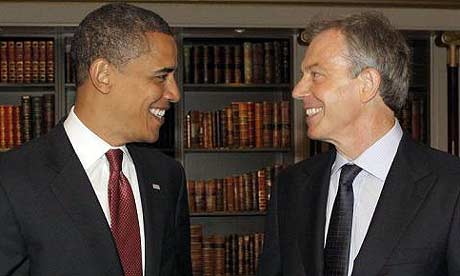
By Eddie Barnes |The Scotsman | 31 January 2010
TONY Blair should be tried in a Scottish court for his decision to take the country to war in Iraq, according to a group of SNP MSPs.
The Crown Office, which leads prosecutions, is examining their arguments following the former prime minister’s appearance at the Chilcot Inquiry last week, in which he expressed “no regrets” over deposing Saddam Hussein.
A parliamentary motion calling for Blair to be prosecuted has been laid down at Holyrood and has been signed by eight MSPs. It cites the verdict of a Dutch commission of judges earlier this month, which concluded that the United Nations resolution used to go to war in 2003 was insufficient to justify military action.
The Nationalists claim that, as Scots law complies with international law, Scottish prosecutors have the power to investigate the findings. They say that if the Crown Office then finds that evidence compelling, they should prosecute Blair.
The call is being led by MSP Bill Wilson, but an SNP spokeswoman confirmed last night that it “reflects the views many still hold” about the decision to take military action.
But Labour claimed their opponents were guilty of trying to make “infantile political capital” out of the Iraq issue, saying they should focus their attention on jobs and the economy.
In his letter to the Lord Advocate, Wilson declares: “It would seem you have the power to investigate the conclusions of the Dutch commission and, should you find the evidence against them compelling, prosecute the former UK prime minister. I urge you to do so.”
The Dutch commission, which studied the country’s own political backing for war in Iraq, concluded that UN Resolution 1441 fell short of supporting full military action.
That resolution, passed in November 2002, warned Iraq of “serious consequences” if it continued to obstruct UN weapons inspectors, offering it one final opportunity to comply.
Britain’s own top legal adviser, the Advocate General, Lord Goldsmith, eventually decided that 1441 was enough to justify war, although it emerged last week that he had initially had his doubts.
Wilson is citing Scots law, which declares that a rule of “customary international law” is followed automatically in this jurisdiction.
He said: “Those responsible for misleading the public and initiating such bloodshed should be brought to book. I look forward to seeing the detention and trial of Tony Blair, and I urge the Lord Advocate to look into the matter.”
He believes Scottish courts, and not the International Criminal Court at the Hague, should conduct an investigation.
His demand is being backed by fellow SNP MSPs Jamie Hepburn, Bill Kidd, Aileen Campbell, Christine Grahame, Dr Ian McKee, Gil Paterson and Sandra White.
The move is the second time the SNP has tried to bring Blair to book over the war. First Minister Alex Salmond attempted to have him impeached as part of a move that would have seen the former prime minister effectively tried by parliament.
He argued that Blair had lied to the country about the case for war in Iraq, specifically on the weapons of mass destruction, which allied forces failed to find after the invasion.
A spokesman declined to reply on whether Salmond backed the latest legal bid.
He said: “Mr Salmond strongly supports the Chilcot Inquiry, although it would have benefited from having more legal expertise among the questioners on the panel.”
He added: “Nonetheless, the next stage in that process will be to examine the inquiry’s conclusions.”
Yemen rejects Houthi truce offer
Al Jazeera | January 31, 2010
The Yemeni government has turned down a truce offer from the country’s Houthi fighters.
A government official said on Sunday that the ceasefire deal should have included a pledge by the group not to attack neighbouring Saudi Arabia.
The offer, made by Abdel-Malik al-Houthi, the Houthis’ leader, on Saturday, was also rejected because he demanded that the government end its military operations first, the official said.
“The government rejects al-Houthi’s initiative to accept the five points of the government terms for peace, because it does not include a sixth point, which demands a pledge from the Houthis not to attack Saudi territory,” the Yemeni official said.
Yemen laid down ceasefire terms in August that included removing checkpoints, ending banditry, handing over all military equipment and weapons, and releasing civilians and military personnel.
Government officials said Houthi leaders twice rejected the terms, while al-Houthi said Saturday that his fighters had twice declared they wanted to end the conflict.
Renewed clashes
The failure of the two sides to reach a deal coincided with renewal of fighting.
Clashes overnight between Yemeni government forces and the Houthis left 24 fighters dead, military officers said on Sunday
The fighting broke out on three fronts near Saada, 240km north of the capital Sanaa, and government jets were carrying out raids in the area, officials said.
The Yemeni defence ministry news website said a Houthi leader, identified as Qaed Abu Malik, was killed along with 20 other comrades in the Safia area of Saada.
The website also claimed that three other fighters were killed while they tried to sneak into farms near al-Aqab, also in Saada.
In an audio message released via the internet on Saturday, al-Houthi said the government must not allow the conflict to be used by “international and regional forces” as an excuse to drag Yemen into a wider war.
“It was these forces and the stupidity of the government that led them to launch attacks on its own people,” he said.
“Nevertheless, and for the fourth time, I announce our acceptance of the [the government’s] five conditions [for an end to the conflict] after the aggression stops … the ball is now in the other party’s court.”
Al-Houthi’s statement came on the heels of an announcement from his group on Monday that they would withdraw from Saudi territory they had occupied since November.
The Houthis have been engaged in sporadic fighting with government forces since 2004, in a war they say is to defend their community against discrimination and the aggression of local government representatives in the northern Saada province.
The latest stage of the conflict broke out on August 11, when the military launched Operation Scorched Earth – an all-out assault against the group.
According to international aid organisations, more than 200,000 people have been displaced by the fighting since 2004.
NATO Calls Air Strike Against Afghan Army Base, Killing Four Soldiers
By Jason Ditz, January 30, 2010
NATO troops in Afghanistan’s Wardak Province had a brief overnight gunbattle with Afghan Army forces, with both sides apparently assuming the other was Taliban. The troops called in an air strike against a newly established Afghan Army base, killing four soldiers and wounding six others.
The Afghan Defense Ministry condemned the attack, and demanded that NATO turn over those responsible. NATO spokesmen called the incident “regrettable,” but insisted that “we work extremely hard to coordinate and synchronize our operations” with the Afghan military.
An angry village elder near the outpost was quoted as saying “as you can see, they dropped bombs on the outpost. It was the Americans, of course.” NATO has yet to confirm the nationality of those involved in the incident.
It is the most high profile “friendly fire” incident since early November, when NATO inexplicably launched an air strike against a warehouse on a jointly owned military base, killing eight Afghan soldiers and 12 civilian laborers.
Mounting Criticism of US Drone Strikes in Pakistan
By Jason Ditz, January 29, 2010
US drones, conspicuously absent from the North Waziristan region for several days after militants shot one down on Sunday, returned to the region today, killing five people in the town in Muhammad Khel.
The drone strikes, and more importantly America’s default “no comment” position on them except on those rare occasions when they successfully kill a high profile target, have long been a sore spot for the Pakistani public, but the broad base of this opposition has only increased.
According to a Gallup poll, only 9 percent of Pakistanis support the idea of US drone strikes on Pakistani soil. There is increasing pressure for the US to be more transparent with their attacks, in hopes that it might calm the opposition to them.
President Barack Obama has dramatically increased the number of drone strikes since taking office. In 2009 the US launched 44 drone strikes in Pakistan, killing over 700 people. The vast, vast majority of those were civilians, with only a handful of meaningful militant leaders slain. Today’s attack was the 12th attack of 2010. Though the attacks killed just under 100 people, only one named militant, al-Qaeda bodyguard Mahmoud Mahdi Zeidan, has been confirmed killed.
Featured Video

Houthis Don’t Have to Conquer Saudi Arabia to Make It Pay
or go to
Aletho News Archives – Video-Images
From the Archives
Newly Released FBI Docs Shed Light on Apparent Mossad Foreknowledge of 9/11 Attacks
By Whitney Webb | MintPress News | May 17, 2019
NEW YORK — For nearly two decades, one of the most overlooked and little known arrests made in the aftermath of the September 11 attacks was that of the so-called “High Fivers,” or the “Dancing Israelis.” However, new information released by the FBI on May 7 has brought fresh scrutiny to the possibility that the “Dancing Israelis,” at least two of whom were known Mossad operatives, had prior knowledge of the attacks on the World Trade Center. … continue
Blog Roll
 Aletho News
- MEP blasts ‘Euro-Gestapo’ for lecturing Russia on democracy
- Syria May Send Troops to Saudi Arabia Amid War with Ansar Allah
- UK whines about losing billions to ‘Putin tax’
- Baghaei to Rubio: Distorted narratives cannot erase US record of broken commitments
- Houthis Don’t Have to Conquer Saudi Arabia to Make It Pay
- MOE: Nearly 22,000 Students and Education Workers Killed
- Guterres in Islamabad: Genocide, cowardice, and the cage of Imran Khan
- Johnson, Marandi say Yemen holds upper hand over Saudi Arabia
- False flags won’t save aggressors, Iran FM spokesman says
- The Makkah Pact Enters Into Force: The End of American Dominance or Its New Form?
- If Americans Knew
- Report claimed Mark Levin used by Israeli government to influence Trump
- Over 2,000 Gazans have died awaiting medical evacuation amid Israel’s continued siege
- How a U.S. Diplomat Suppressed and Altered Reports Critical of Israel
- 5 Palestinians Die from Israeli Strikes in Gaza as Relentless Attacks Continue
- Report: Ceasefire Slows Killing but Leaves Devastation Intact
- Country Music Singer Zach Bryan Breaks Attendance Record at Robert Kraft’s Gillette Stadium While Wearing ‘Free Palestine’ Shirt for Second Night in a Row
- Three years of death and devastation: Israel’s war on Gaza in pictures
- Why Hamas believed the status quo was more dangerous than its 7 October gamble
- Debunking Israel’s latest list of ‘terrorist’ journalists in Gaza
- In Gaza, focus is on survival, “every step is a struggle” – Daily Update
- No Tricks Zone
- New Study: 50 Years Of The Most Aggressive ‘Net Zero’ Policies Can Only Affect The Global Climate By 0.03°C
- US September “Heat” Was No Record…Many Records Set Decades Ago
- Latest European Green Energy Debacle; Portugal’s Largest Flagship Solar Park Insolvent!
- Green Energy Debacle: German Expert Professor Fritz Vahrenholt Warns Of Severe Economic And Social Consequences
- Two More Paleo Reconstructions Affirm Meters-Higher Sea Levels Across Ireland, Brazil 7000-6000 Years Ago
- New Study: Earth And Venus Surface Warmth Largely Explained By Convection And Lapse Rate, Not CO2 Or Radiation
- 2025 Nature Paper Claiming Worsening Global Drought Gets RETRACTED …Heavily Flawed
- New Study: ‘Global Drought Shows No Detectable Recent Acceleration Under Climate Warming’
- Economic Masterminds: German Socialists Suggest Taxing Productivity Gains Stemming From Using AI
- The South China Sea Has Not Been Cooperating With The Climate Change Narrative

