Somalia Ratifies Rights of Children Treaty, Leaving United States as only Holdout
By Steve Straehley | AllGov | October 4, 2015
And then there was one.
Somalia last week deposited its instrument of ratification of the United Nations’ Convention on the Rights of the Child (CRC), leaving the United States as the world’s only country that has not done so. And it doesn’t look like the U.S. will join the club any time soon.
The convention, adopted in 1989, is the most widely ratified human rights treaty in history, with 196 signatory nations. It is a commitment to promote and respect the human rights of children, including the right to life, to health, to education and to play, as well as the right to family life, to be protected from violence and from any form of discrimination, and to have their views heard, according to the UN. Somalia began its process of ratification in January 2015; another holdout, South Sudan, ratified the treaty in May.
Although President Barack Obama gave his support to the CRC before he took office, saying “it is embarrassing that the U.S. is in the company of Somalia, a lawless land. If I become president, I will review this and other human rights treaties,” he hasn’t submitted the treaty for Senate approval.
If he did submit it, it’s unlikely it would be approved. Conservatives oppose the CRC, some saying it would weaken U.S. sovereignty. Others say being a party to the treaty will undermine the role of American parents in raising their children.
UN Secretary General Ban Ki-Moon urged the United States “to join the global movement and help the world reach the objective of universal ratification.”
To Learn More:
Hailing Somalia’s Ratification, UN Renews Call For Universalization Of Child Rights Treaty (United Nations)
Only 2 Countries Have Not Joined the UN Convention of the Rights of the Child: South Sudan and…United States (by Danny Biederman and Noel Brinkerhoff, AllGov )
Obama moves to dismiss case of Yemeni whose innocent relatives were killed in US drone strike
Reprieve – October 2, 2015
The US government has asked a D.C. court to dismiss the case of a Yemeni man whose family members were killed by a US drone strike, on the basis that he has no legal ‘standing’ to bring a case against them.
Earlier this year, Mr bin Ali Jaber filed a lawsuit against President Obama, seeking a declaration from a federal court in Washington, D.C., that the 2012 strike was unlawful and his innocent relatives were wrongfully killed. The Obama administration yesterday filed a motion asking the court to dismiss Mr bin Ali Jaber’s case entirely. They argued that Mr Jaber has no standing – i.e. that he has no legal right to bring his case in the US – and that whether a US drone killed his relatives is a ‘political question’ that no court should review.
However, in November 2013 Mr bin Ali Jaber travelled to Washington, D.C. where he had meetings with White House and NSC officials about his relative’s deaths. No US official suggested then that Mr. Jaber, who is the appointed representative of the Jaber family estates, lacked authority to speak for the family.
Faisal lost his nephew Waleed and his brother-in-law Salem in a US drone attack in the village of Khashamir on August 29 2012. Waleed was a local policeman, and Salem was an imam who was known for speaking out against al-Qaeda in his sermons – including on the Friday before he was killed. After the strike and Faisal’s travels to the US, Faisal’s relatives were given a plastic bag containing $100,000 in sequentially-marked US dollar bills as a condolence payment, but the US has never admitted responsibility for the killings.
Mr bin Ali Jaber had previously written to the White House offering to settle the case on one condition – that he receive a public apology from the US. He did so in the footsteps of President Obama’s apology, earlier this year, to the families of Giovanni Lo Porto and Warren Weinstein, an Italian and an American citizen who were killed in a US drone strike in Pakistan in January. It marked the first known US acknowledgement of responsibility for civilian deaths under the drone programme.
In a letter to President Obama, Cori Crider – Mr bin Ali Jaber’s lawyer at human rights organization Reprieve – writes: “I write today to make a formal offer of settlement. In consideration for dropping this lawsuit, Mr. Jaber asks for nothing more than what you gave the families of Warren Weinstein and Giovanni Lo Porto: an apology and an explanation as to why a strike that killed two innocent civilians was authorized.”
Covert strikes by the CIA in Yemen and Pakistan are believed to have killed hundreds of civilians, but the US has never formally admitted responsibility beyond the deaths of Mr Lo Porto and Mr Weinstein.
Cori Crider, attorney for Faisal bin Ali Jaber and a director at international human rights charity Reprieve, said: “Once again we see the yawning gulf between this President’s rhetoric on drones and the reality. President Obama once said innocent drone deaths would haunt him as long as he lives – so why, then, does sorry seem to be the hardest word? It is insulting to my client to be told he has no right to represent his family’s estate, when White House officials certainly thought he was worthy of meetings in Washington. The US is now trying its level best to block Faisal’s quest for justice by kicking him out of the courts. There is no good reason that the President stood up in front of the world with the Lo Porto and Weinstein families to say sorry for the US’ tragic mistake, but can’t do so for a Yemeni man. The hypocrisy of the Administration’s stance sends a harmful message, telling the entire Muslim world that its lives have no value to the United States.”
Obama’s Ludicrous ‘Barrel Bomb’ Theme
By Robert Parry | Consortium News | September 30, 2015
The U.S. government has dropped hundreds of thousands of tons of bombs on Iraq alone in the last dozen years – and even hailed the start of the bombing campaign in 2003 as “shock and awe” – but now has coyly and repeatedly decried the Syrian government’s supposed use of crude “barrel bombs.”
This hyper-hypocritical propaganda theme was given voice in President Barack Obama’s Sept. 28 speech to the United Nations General Assembly when he denounced anyone who doesn’t favor “regime change” in Syria as advocating “support [for] tyrants like Bashar al-Assad, who drops barrel bombs to massacre innocent children.”
Yet, Obama offered no criticism of various U.S. administrations and American allies that have leveled whole cities, killing countless men, women and children. That slaughter has included two atomic bombs dropped on Hiroshima and Nagasaki in Japan in 1945 and the devastation of Indochina during the 1960s and 1970s with more bomb tonnage than was dropped in all of World War II. Millions, including countless children, were killed in these bombing campaigns.
More recently, Obama’s predecessor, President George W. Bush ordered the devastation of Fallujah and other Iraqi cities to suppress resistance to the U.S. invasion and occupation of Iraq. Obama himself has boasted of ordering military strikes in seven countries, mostly aerial bombardments with many confirmed civilian dead.
In 2014, Israel used American warplanes and armaments to blast apart Gaza killing some 2,100 people – the vast majority civilians and many of them children, including four little boys playing on a beach. President Obama not only refrains from criticizing Israel’s indiscriminate use of these devastating weapons but stays silent on Israel’s rogue nuclear stockpile and today ponders which giant “bunker buster” bombs should be added to Israel’s bristling arsenal.
Meanwhile, Saudi Arabia is dropping U.S.-supplied ordnance, reportedly including cluster bombs, on the helpless population of Yemen with Obama’s tacit approval and reportedly with U.S. intelligence assistance.
On Monday, the Saudi air force apparently bombed a wedding party on Yemen’s Red Sea coast killing more than 130 people, including women who had taken refuge in a tent, according to various news reports.
One surviving relative said it was difficult to determine the exact number of dead because the bodies were blasted into so many bloody pieces. “I saw no body intact,” said Ahmed Altabozi, the uncle of one of the victims.
Yet, while President Obama has avoided any direct public rebukes of U.S. or allied militaries for their slaughter of civilians, he singled out Syria’s embattled government for using a homemade weapon in its desperate fight against terrorists of the Islamic State and Al Qaeda’s Nusra Front.
Further, Obama claimed that President Assad dropped the “barrel bombs to massacre innocent children” when there is no evidence that Assad had any such intent. Obama’s comment amounted to crude and deceptive propaganda.
By contrast, when Israeli Prime Minister Benjamin Netanyahu launches one of his periodic “lawn mowing” operations against the people of Gaza and many children are cut down in the process, Obama stands mute, apparently judging that the exercise in recurring butchery is just one of those “price is worth it” moments.
Obviously, any killing of civilians in wartime is to be deplored – whoever is dropping the bombs and whatever the weapon’s degree of lethality – but it was still stunning to watch Obama apply such selective outrage. Indeed, much of the UN General Assembly seemed genuinely shocked by Obama’s blatant double standards.
Propaganda Buzz Phrase
But it’s really all par for the course. Whenever propagandists develop their “themes” for a conflict, they look for certain “hot button” phrases that make the behavior of a “black-hatted enemy” appear particularly venal. “Barrel bomb” has become the propaganda buzz phrase of choice associated with the Syrian conflict.
Yet, it seems likely this clumsy, improvised weapon – supposedly dropped from helicopters – would be far less lethal than rocket-propelled bombs delivered from afar by jet planes or drones, the approach favored by the U.S. government and its “allies.”
Civilians would have a much better chance to seek safety in a bomb shelter before some “barrel bomb” is shoved out the door of a helicopter than when a sophisticated U.S.-made bomb arrives with little or no warning, as apparently happened to the victims of that wedding in Yemen.
And that is not to mention the U.S. bombs that involve depleted uranium, napalm, phosphorous and cluster munitions, which present other humanitarian concerns. However, while U.S.-assisted or U.S.-directed slaughters of civilians attract little attention in the mainstream U.S. media, there are endless denunciations of the Syrian government’s “barrel bombs.”
The propaganda drumbeat is such that the American people are told that they must support “regime change” in Syria even if it risks opening the gates of Damascus to a victory by the Islamic State and Al Qaeda terrorists.
This odd “humanitarian” equation, tallied up by the State Department and “human-rights” NGOs, holds that to secure revenge for Syria’s alleged use of “barrel bombs,” the world must accept the possibility of the black flag of Sunni terrorism flying over a major Mideast capital while its streets would run red with the blood of Christians, Alawites, Shiites and other “heretics.”
Then, apparently, the United States would have little choice but to lead a massive expeditionary force into Syria to oust the Islamic State and Al Qaeda, ensuring the deaths of hundreds of thousands more innocents and sending millions more fleeing into a destabilized Europe.
But such is the power of propaganda in managing public perceptions. Use a phrase like “barrel bomb” over and over again as if it is a uniquely evil weapon when, in fact, it is far less lethal and destructive than the ordnance that the United States routinely deploys or hands out to its “allies” like candy on Halloween. Soon the people lose all perspective and are open to manipulation. [See Consortiumnews.com’s “The Power of False Narrative.”]
Once the U.S. public is softened up with the propaganda and psy-ops – also known as “strategic communications” or Stratcom – the only acceptable option is “regime change” in Syria even if that prospect holds the likelihood of a far worse human catastrophe.
By hearing “barrel bomb” enough times, the judgment of American citizens is clouded and any practical suggestion for a realistic political settlement of Syria’s conflict is deemed “appeasement” of a tyrant, which was the clear message of President Obama’s UN tirade.
And, thus, the killing continues; the chaos grows worse.
Investigative reporter Robert Parry broke many of the Iran-Contra stories for The Associated Press and Newsweek in the 1980s. You can buy his latest book, America’s Stolen Narrative, either in print here or as an e-book (from Amazon and barnesandnoble.com).
Putin Trumps Obama at the U.N.
By Margaret Kimberley | Black Agenda Report | September 30, 2015
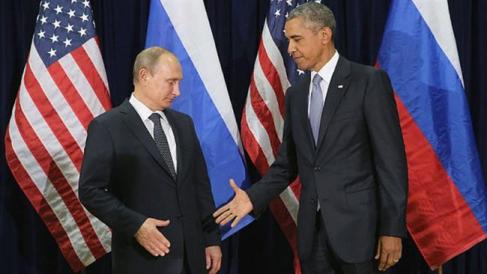
If the peevish expression on Barack Obama’s face was any indication, Vladimir Putin is a force in the world who cannot be ignored. Ever since Russia annexed Crimea in response to the United States – and NATO – backed coup in Ukraine, Obama and the corporate media have falsely declared that Putin is isolated from the rest of the world. They claim he is a monster, a despot and an irrelevance on the world stage.
While the G8 member nations turned themselves into the G7 in order to snub Russia, president Putin was making friends elsewhere. He may have been isolated from the United States and its clique, but not from China and the other BRICS nations or Syria or Iran or Iraq. While western nations use the Islamic State (ISIS) as a ruse to exact regime change in Syria, Putin has formed an alliance to carry out the task of eradicating that danger which was created by western intervention.
Presidents Obama and Putin both made their respective cases before the United Nations General Assembly at its annual meeting. Obama’s speech was an apologia for imperialism and American aggression. He repeated the lies which no one except uninformed Americans believe. If he calls a leader a tyrant he claims the right to destroy a nation and kill and displace its people. Despite the living hell that the United States made out of Libya, Obama continues to defend his crime. He blandly adds that “our coalition could have and should have done more to fill a vacuum left behind.” Apparently he hopes that no one is paying attention to the horrors inflicted on Libya or the ripple effect which created numerous other humanitarian crises.
Not content to defend the indefensible, the president made it clear that the Obama doctrine of regime change and terror is alive and well. “I lead the strongest military that the world has ever known, and I will never hesitate to protect my country or our allies, unilaterally and by force where necessary.”
In contrast, the man labeled a dictator acknowledged the importance of respecting every nation’s sovereignty. “Rather than bringing about reforms, an aggressive foreign interference has resulted in a brazen destruction of national institutions and life itself. Instead of the triumph of democracy and progress, we got violence, poverty and social disaster. Nobody cares a bit about human rights, including the right to life.” Making good use of his time in the spotlight, he made clear that he wasn’t fooled or cowed by the United States. “I cannot help asking those who have caused the situation, do you realize now what you’ve done? But I am afraid no one is going to answer that. Indeed, policies based on self-conceit and belief in one’s exceptionality and impunity have never been abandoned.”
Obviously Putin has self-interest in supporting his allies in Syria and for fighting ISIS. He acknowledged that his country is at risk from some of its own citizens who have sworn an allegiance to that group. Nonetheless, it is important that at least one nation in the world is capable of standing up to American state sponsored destruction and is willing to take action in that effort. Before the United Nations proceedings took place, Russia announced that it would share intelligence with Iran, Iraq and Syria in order to combat ISIS. If the United States were true to its word, that alliance would be welcomed instead of scorned.
Not since the late Hugo Chavez declared that George W. Bush left a “smell of sulfur” has an American president been so openly confronted at the United Nations. Putin’s presence makes it clear that Obama can no longer expect to carry out his international dirty work without effective opposition.
While the corporate media noted the tense photo opportunity between the two presidents they neglected to mention the real issues behind the bad feelings. At a press conference after his address Putin was asked about French president Hollande’s insistence that Assad leave the Syrian presidency. “I relate to my colleagues the American and French presidents with great respect but they aren’t citizens of Syria and so should not be involved in choosing the leadership of another country.”
That simple statement explains the totality of American enmity towards Russia. The NATO nations claim a right to choose leaders, create and support their own terrorist groups and destroy anyone who doesn’t do what they want. Putin is making a case for non-interference and that makes him persona non grata in the eyes of the supposedly more democratic West.
The world ought to fear pax Americana, not a Russian military presence in Syria. There cannot be true peace and stability unless nations and peoples are left to their own devices. The helping hand of United States democracy is anything but. It is a recipe for disaster and requires forceful opposition. If Russia can be a reliable counterforce the whole world will benefit, even if Barack Obama frowns before the cameras.
Margaret Kimberley can be reached via e-Mail at Margaret.Kimberley(at)BlackAgendaReport.com.
Regime Change as American as Apple Pie
By Finian Cunningham – Sputnik – 29.09.2015
Clandestine American-led interventions have fuelled the explosion in terror networks across the Middle East, Central Asia and Africa. Yet amid this American legacy of international violence, Obama was charged with painting a rose-tinted view of the world that was breath-taking in its distortion and absurdity.
US President Barack Obama is someone to almost pity. For he has the unenviable task of standing before the nations of the world and smugly spouting endless falsehoods — as he did, yet again, during his address to the UN General Assembly.
By contrast, Russian President Vladimir Putin in his address to the UN may not have displayed the same oratorical flourishes as Obama, but far more importantly Putin spoke about some of the most pressing international problems with words that were the plain truth.
When Putin spoke about the UN and international law being undermined by “exceptional” unilateral actions of the United States, he was able to put his finger on the crux of why conflict, chaos and terrorism are raging in so many parts of the world.
And if we are trying to fix these problems, genuinely, then what the world needs is an accurate diagnosis. Putin delivered that, while Obama just added further layers of obfuscation and misinformation, making such problems ever-more insoluble.
As Putin clearly indicated, illegal US-led regime-change operations that subvert international law and the UN Charter are at the root of ongoing, widespread conflicts, from Afghanistan to Iraq, from Libya to Syria and to Ukraine.
These clandestine American-led interventions have also fuelled the explosion in terror networks across the Middle East, Central Asia and Africa. Putin provided the most logical, rational and credible explanation that allows for collective solutions. Supporting the sovereign government of Syria to defeat foreign-backed terrorism in that country is one such solution.
Yet amid this American legacy of international violence, Obama was charged with painting a rose-tinted view of the world that was breath-taking in its distortion and absurdity.
On Syria, the American president sought to ascribe the violence and growth of terrorism in that country as being due to “tyrannical”
Bashar al-Assad who “attacked peaceful protesters” back in 2011. This falsification by Obama flies in the face of admissions by Washington — in declassified documents — that it hatched secret plans for regime change in Syria as early as 2006.
The Pentagon has also admitted in declassified documents that it sponsored jihadist extremists like Islamic State to wage war against the Assad government for the “willful” objective of regime change. In both instances, the US government indicts itself of heinous crimes.
Nevertheless, Obama blithely regaled the UN with claims that his government is “supporting the steady emergence of strong democracies accountable to their people instead of any foreign power” — while, unbelievably, ignoring the long and execrable history of American-sponsored regime change in every corner of the globe.
This American criminal expertise in violating international law and democratic rights of nations spans at least a century. During the early 20th century decades, Major General Smedley Butler in his book, ‘War is a Racket’, described how the Pentagon’s military muscle was used to ransack Latin America and the Caribbean to install despotic regimes in order to make the hemisphere “safe” for Wall Street banks and US corporations.
Then following the Second World War, the US ruling class applied their regime-change dexterity in every continent over the subsequent seven decades up to the present day. From the early postwar European states of Greece, Italy and France where nationalist or socialist governments were thwarted or subverted, right up to the most recent cases of Libya, Syria and Ukraine.
In between, we have the notorious cases of US subversion and coups in Guatemala, Iran, Cuba, Brazil, Indonesia, Chile, Nicaragua, Honduras — to mention just a few. For a complete list of scores of American dirty operations across the world, see William Blum’s book ‘Killing Hope’.
Obama describes US involvement in Libya in 2011 as “helping to prevent a massacre”; and he claims Washington is helping to resolve conflict in Syria and supporting democracy in Ukraine. But in each case, as in countless other countries down through the decades, Washington’s finger-prints are all over the crime scenes and point to its illegal schemes for overthrowing governments and “deterring democracy”, as Noam Chomsky puts it.
But perhaps the ultimate regime change that American rulers engaged in was not against some far off African, Asian or Latin American land.
The most audacious act of criminality was against one of their own democratically elected governments.
In 1963, the brutal assassination of President John F Kennedy as he drove through Dallas in a motorcade was unmistakably a covert regime-change operation. The slaying of Kennedy happened only three weeks after US intelligence were implicated in the murder of Washington’s puppet-dictator in South Vietnam, Ngo Dinh Diem.
Kennedy, whose policies were viewed as being anti-war and amenable to mediation with the Soviet Union and revolutionary Cuba, had made powerful enemies within the Central Intelligence Agency and the Pentagon’s military-industrial complex. The sophistication and political context of Kennedy’s assassination, the vast official cover-up, including the murder of the alleged assassin, the patsy Lee Harvey Oswald, all point to a covert operation to get rid off the president.
American corporate-controlled news media to this day treat the subject of who really killed Kennedy as an off-limits “conspiracy theory”. But reading an array of investigative literature, such as James Douglass’ ‘JFK and the Unspeakable’, as well as testimony of attorney, the late Jim Garrison, it is scarcely disputable that President Kennedy was assassinated by powerful and secretive elements within the American ruling class.
The objective was to replace Kennedy with a president who would be more obedient to the strategic interests of the American military-industrial complex. Kennedy’s successor, Lyndon B Johnson, was such a figure, paving the way for the escalation of the Vietnam War in the mid-1960s and heightened hostilities towards the Soviet Union and Cuba, including numerous attempts to assassinate Fidel Castro.
Returning to the UN address delivered by Barack Obama this week, at one point he bragged: “I lead the strongest military that the world has ever known, and I will never hesitate to protect my country or our allies, unilaterally and by force where necessary.”
This is the kind of unquestioning militarism and use of unilateral military force that America’s ruling class expects from White House occupants. Breaking international law, violating the UN Charter and implementing regime change — no matter how murderous — and then spouting lies with squeaky clean rhetoric, these are the qualifications that an American president must demonstrate to the dark, ruling forces within his country.
Otherwise, the fate of an independent, democratic leader would be the same as that of JFK. For regime change, and all its attendant criminality, is as American as mama’s homemade apple pie.
Obama’s Self-Deceit
By Joe Lauria | Consortium News | September 29, 2015
There was stunned silence in the General Assembly Hall on Monday as U.S. President Barack Obama warned leaders against falling back to pre-United Nations days, in which strong nations imposed their will by force against the weak. There was apparent disbelief as he said it was Russia and China that wanted a “return to the rules that applied for most of human history and that pre-date this institution.”
These ancient rules included the “belief that power is a zero-sum game; that might makes right; that strong states must impose their will on weaker ones; that the rights of individuals don’t matter; and that in a time of rapid change, order must be imposed by force.”
The silence in the chamber came because everything Obama ascribed to others perfectly describes U.S. behavior from the end of the Second World War until today.
Since 1945, the U.S. has participated in dozens of documented invasions and overthrows of sovereign governments that resisted U.S. hegemony — the strongest nation imposing its will militarily on the weak. Among the best known are the 1953 and 1954 coups in Iran and Guatemala, and the invasions of Vietnam and Iraq. There were other democracies overthrown to install monarchies or dictatorships, such as Mobutu in Congo in 1961, Suharto in Indonesia in 1965 and Pinochet in Chile in 1973.
There was a setback to the American militarists with the loss in Vietnam, but a decade later Ronald Reagan was back at it, starting with a small invasion of Grenada. George H.W. Bush pounded Panama in 1989 and then devastated Iraqi forces in 1991 with an air and ground campaign, leading to his declaration that “we’ve kicked the Vietnam Syndrome once and for all.” Thirty years after the defeat in Vietnam, his son, George W. Bush, staged a full-scale 2003 invasion of Iraq, unleashing utter chaos that’s led to the most fearsome terrorist power in history.
Yet Obama on Monday was blaming Russia and China for the mess Washington has created, saying, “We see some major powers assert themselves in ways that contravene international law.” Obama cited Russia’s “annexation” of Crimea and “further aggression” in Eastern Ukraine.
He didn’t mention the documented U.S. orchestrated coup against a democratically-elected president in Kiev, which eastern Ukrainians have resisted. Russia has helped them but the U.S. with all its fancy surveillance that can find out almost any detail of your private life has yet to come up with a scrap of evidence of a Russian “invasion” of Ukraine.
At heart is either Obama’s willful ignorance of Ukraine, a clumsy attempt at disinformation, or as Vladimir Putin suggested in his U.N. speech a half hour later, a big measure of self-deception.
Obama said Ukrainians favor the West. That may be true of most western Ukrainians but not the whole country. Then, he said the U.S. has “few economic interests” in Ukraine. That’s woefully ignorant or a blatant lie. Monsanto has a big interest. Then there’s Joe Biden’s son, Hunter Biden, and a John Kerry family friend joining the board of Burisma Holdings, Ukraine’s largest private gas producer, just after the coup.
And the country’s finance minister is an American, Natalie Jaresko, who was given Ukrainian citizenship on the day she began the job. Why put an American government official in charge of the treasury of a foreign country?
Despite Russia’s “aggression,” Obama said he did not want a new Cold War — just U.S. bases encircling Russia, and China. In the South China Sea, the “U.S. makes no territorial claims,” Obama said, and only has an altruistic interest in protecting freedom of navigation and resolving disputes peacefully and not by “the law of force.” Yet, when the International Court of Justice ruled the U.S. mining of Nicaraguan harbors in the 1980s was illegal, the U.S. just ignored it.
On Syria, Obama (and his junior partners in Europe) insist that President Bashar al-Assad must leave office, as though that would make ISIS lay down its arms. “Realism … requires a managed transition away from Assad and to a new leader, and an inclusive government that recognizes there must be an end to this chaos so that the Syrian people can begin to rebuild,” the President said.
Obama’s position presupposes that the war would end as soon as a new Syrian leader calls off the fight. Instead ISIS is fighting not only to topple Assad, but to take Damascus from whoever may take Assad’s place. They want the capital. It doesn’t matter who is in charge.
Putin argues that Assad’s military is the most effective ground force (along with the Kurds) against the monstrous group and that all nations who want ISIS defeated should work with Assad. “Similar to the anti-Hitler coalition, it could unite a broad range of parties willing to stand firm against those who, just like the Nazis, sow evil and hatred of humankind,” Putin said.
While this is the most practical approach, it would be politically difficult for Western leaders, after three years of calling for Assad’s ouster, to reverse course. Instead the West blames Russian “ambition” in its military build-up in Syria rather than seeing it as a move to help Syria defeat this scourge that came about partly by the West playing around with terrorists who turned into a Frankenstein monster.
“The Islamic State itself did not come out of nowhere,” Putin told the Assembly. “It was initially developed as a weapon against undesirable secular regimes.” He added that it was irresponsible “to manipulate extremist groups and use them to achieve your political goals, hoping that later you’ll find a way to get rid of them or somehow eliminate them.”
Russia warned from three years ago that this could happen. “I’m urged to ask those who created this situation: do you at least realize now what you’ve done?” Putin asked. “But I’m afraid that this question will remain unanswered, because they have never abandoned their policy, which is based on arrogance, exceptionalism and impunity.”
Though Obama told the U.N. that he could essentially blow up the whole world if he wanted to, he’s decided to be a nice guy and seek diplomacy over confrontation with Russia and China. “I lead the strongest military that the world has ever known,” he boasted to the quiet hall, “and I will never hesitate to protect my country or our allies, unilaterally and by force where necessary.”
“I stand before you today believing in my core that we, the nations of the world, cannot return to the old ways of conflict and coercion,” Obama said. “We cannot look backwards.” Obama might try looking into a mirror instead.
Joe Lauria is a veteran foreign-affairs journalist based at the U.N. since 1990. He has written for the Boston Globe, the London Daily Telegraph, the Johannesburg Star, the Montreal Gazette, the Wall Street Journal and other newspapers. He can be reached atjoelauria@gmail.com and followed on Twitter at @unjoe.
Obama authorizes $20mn in ‘non-lethal’ military aid & training for Ukraine
RT | September 30, 2015
One day after Ukraine announced that US instructors would start training the country’s special forces, President Obama has authorized the provision of up to $20 million to Ukraine via the State Department to fund training and other similar activities.
“The authority… to direct the drawdown of up to $20 million in defense articles and services of the Department of Defense and military education and training to provide assistance for the Government of Ukraine,” the Presidential Memorandum says, specifying that another $1.5 million could be used to offer “nonlethal commodities and services.”
The announcement of additional funds allocated for the training of Ukrainian troops follows a statement by President Petro Poroshenko, who said that American instructors will start training Ukrainian special-operations troops this November.
“We have agreed that the best US instructors will finally start training the Ukrainian special forces, our special-operations troops, starting from November,” Poroshenko said in New York after meeting representatives of the Ukrainian diaspora living in the US.
The new US assistance will aid other foreign military instructors, including Americans, who are already training the Ukrainian National Guard.
“This is mutual exchange, mutual assistance. This is interesting not only to Ukrainians, to learn from American partners how to fight. This is interesting to Americans, to learn how to beat Russia,” Poroshenko said, according to Interfax.
Since the Ukrainian crisis began last year, the Obama administration has already provided Kiev authorities with more than $244 million in “non-lethal” military assistance, but despite repeated calls from Kiev, Washington has so far been reluctant to send “lethal” military aid
Obama ignores Palestinian cause in his UN speech
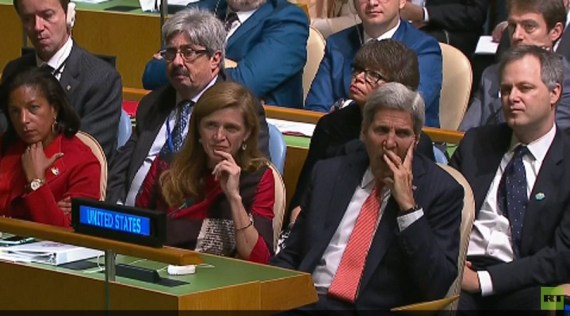
Obama’s speech to the U.N. General Assembly seemed like a real bore for Secretary of State John Kerry
Palestine Information Center – September 29, 2015
NEW YORK – US President Barack Obama declared during his speech at the UN General Assembly in New York his country’s readiness to cooperate with Russia and Iran to solve Syria crisis. However, he ignored to address the Palestinian cause.
The Palestinian Authority slammed Obama for neglecting the Palestinian issue in his speech at the UN on Monday.
Obama called for “a managed transition away from al-Assad,” whom he called a “dictator.”
“Nowhere is our commitment to international order more tested than in Syria. When a dictator slaughters tens of thousands of his own people, that is not just a matter of one nation’s internal affairs — it breeds human suffering on an order of magnitude that affects us all”.
He expressed surprise over those who “support tyrants like Bashar al-Assad, who drops barrel bombs to massacre innocent children, because the alternative is surely worse.”
Likewise, when a terrorist group beheads captives, slaughters the innocent and enslaves women, that’s not a single nation’s national security problem — that is an assault on all humanity, he said in reference to ISIS.
The United States, according to him, has worked with many nations in this Assembly to prevent a third world war — by forging alliances with old adversaries; by supporting the steady emergence of strong democracies accountable to their people instead of any foreign power; and by building an international system that imposes a cost on those who choose conflict over cooperation, an order that recognizes the dignity and equal worth of all people.
However, US president failed to mention the Palestinian cause in his speech at the UN General Assembly.
PLO Secretary-General Saeb Erekat expressed disappointment in US president Barack Obama for neglecting the Palestinian cause in his UN speech.
“Does President Obama believe he can defeat ISIS and terrorism, or achieve security and stability in the Middle East, by ignoring the continued Israeli occupation, settlement expansion, and the continued attacks on al-Aqsa Mosque?” he said.
Polish MPs approve ‘technical agreement’ on US anti-missile base
RT | September 25, 2015
Poland’s lower house of parliament has given the green light to the country’s president to ratify a technical agreement on establishing a US anti-missile base in Redzikowo. Under the NATO-backed plan, the facility should be operational by 2018.
A total of 422 members of the Polish Sejm voted in favor of the bill, with three MPs against and five abstaining.
The agreement in question is a part of a much-debated NATO-backed plan that was first agreed on by the US and Poland in 2008. At that time, it was claimed that the base was necessary to counter the risk of a possible missile attack from Iran or North Korea.
The document outlines technical conditions for the US anti-missile base’s operation on Polish soil, such as restrictions on the height of the buildings that can be built around the base, the use of devices emitting electromagnetic waves, and flights of military aircraft over and around the future facility.
Washington wants to expand the European anti-missile defense (AMD) by putting land- and sea-based radar and interceptors in the village of Redzikowo near the northern Polish town of Slupsk.
The same agreement to host anti-missile bases for of AMD has already been signed with Romania.
The deal stipulates that both countries will host some 24 vertical-launch SM-3 missiles each. The construction of AMD components in Poland is set to start next year and be completed by 2018.
Washington’s plans to install anti-missile systems in Eastern Europe have been one of the biggest stumbling blocks in US-Russia relations.
In 2009, a year after Warsaw and Washington signed the agreement, President Barack Obama assured that the deal would be canceled if the issue with Iran over its nuclear program was sorted out.
However, despite the agreement with Tehran, which curbed its controversial nuclear program in exchange for the easing of international sanctions, the NATO-backed Europe AMD plan is set to go forward.
“The deal with Tehran doesn’t include missiles, therefore the threat remains,” John A. Heffern, US Deputy Secretary of State for Europe and Eurasia, told the Polish Rzeczpospolita newspaper in July.
The Polish government has repeatedly requested that NATO establish military bases in the country, claiming that it is necessary to counter what it calls “a Russian threat.”
Since Crimea’s reunion with Russia in March 2014 and the start of the military conflict in eastern Ukraine last spring, NATO forces have significantly stepped up their military exercises along the Russian border, and frequently carried out drills in the Baltic States and Eastern Europe.
UN Condemns Ukrainian Government Cover-Ups
By Eric Zuesse | Aletho News | September 21, 2015
On September 18th, the UN’s Office of the High Commissioner for Human Rights headlined “Statement of the Special Rapporteur on extrajudicial, summary or arbitrary executions, Christof Heyns Ukraine: Lives lost in an accountability vacuum,” and condemned there the current Ukrainian Government in strong language, regarding not only the coup which had brought them to power in February 2014, but regarding also the massacre of the people who on 2 May 2014 had been peacefully demonstrating in Odessa against the coup. Specifically, the ongoing cover-ups by the Ukrainian Government concerning both of these matters were condemned by him.
The High Commissioner, Christof Heyns, said:
By allowing almost immediate access of the scene to ‘pro-unity’ protesters, members of the public or to municipal authorities, investigators lost a large proportion of potentially valuable forensic evidence. Meanwhile I am worried by indications that the Government has significantly reduced the size of the team investigating these events in the past year, before it has had an opportunity to report. The slow progress of the investigation and the lack of transparency with which it is being conducted have contributed to a great deal of public dissatisfaction and provided a fertile environment for rumour and misinformation. It is disconcerting that the Special Unit of the Ministry of Internal Affairs that investigates the 2 May events cancelled our appointment in Odessa at short notice, without any explanation.
I am further concerned that administrative and personal impediments seem to have been imposed to prevent or at least discourage the families of those who died from obtaining the status of suffering or affected persons before the Courts. Meanwhile I am greatly alarmed by reports of the extent to which authorities are tolerating both verbal and physical intimidation both of families attending court proceedings and of the judges of those cases, not only outside the court building, but also inside it and in the court room itself.
Here is an excellent video of the coup.
Here is a brief video on the massacre, on 2 May 2014, in Odessa’s Trade Unions Building.
Also of interest might be the following articles:
“Ukraine’s President Poroshenko Admits Overthrow of Yanukovych Was a Coup”
The Obama Administration has a strong record of installing anti-Russian governments — not only in Ukraine. Obama enabled the 28 June 2009 coup that overthrew Honduras’s progressive democratically elected President Manuel Zelaya to succeed, and enabled the coup’s junta to stay in power though no other head-of-state supported it; and the great investigative journalist Wayne Madsen reports on 21 September 2015 that there is strong reason to believe that the Obama Administration was actually behind the recent coup in Burkino Faso. Furthermore, the Obama Administration has been involved in unsuccessful coup-plots in Venezuela and Ecuador, according to a 12 March 2015 study by the Council On Hemispheric Affairs. In addition, the Obama Administration bombed Libya and removed Muammar Gaddafi from power there, and is bombing Syria in order to remove Bashar al-Assad from power there. The Obama Administration also has continued the Bush Administration’s policy of “unsigning” to the legal authority of the International Criminal Court, but doesn’t use the same rabid rhetoric against the Court that Obama’s predecessor did. The Obama Administration has also taken a strong anti-Russian position on virtually everything at the United Nations, such as by voting against a Russian-supported resolution condemning fascism in all its forms (including Holocaust-denial), which resolution passed overwhelmingly and was opposed by only three governments: U.S., Ukraine, and Canada.
Obama is highly critical of Russia, and of its leader, Vladimir Putin. The U.S. White House in February issued its National Security Strategy 2015, and it used the pejorative term “aggression” 18 times, 17 of which referred to Russia.
So, the U.N. High Commissioner’s statement condemning the Ukrainian Government’s cover-ups might be viewed in Washington as simply the UN’s taking the pro-Russian side. Psychopaths could view it that way. But other people will (like the UN) oppose cover-ups — and oppose Obama’s international policies (such as those described). Indeed, the only U.S. President who has been as hostile toward the UN as Obama is, was his immediate predecessor, whose policies Obama publicly opposed when running for the U.S. Presidency in 2008. And, then, in his 2012 re-election campaign, Obama vocally criticized his opponent Mitt Romney’s statement that Russia “is without question our number one geopolitical foe.” But, now, Obama cites Russia 17 out of 18 times for “aggression.”
Geir Lundestad, who was the Director of the Nobel Institute, and Secretary of the Peace Prize Committee, at the time when Barack Obama won the Nobel Peace Prize in 2009, recently said that “giving Obama a helping hand” was the reason why the Committee awarded Obama the Prize, but that doing this “did not achieve what the committee had hoped for.” However, he denied “that it was a mistake to give Obama the Peace Prize.” Even all of those coups and massacres don’t mean it was a mistake. Maybe it wasn’t much different from “what the committee had hoped for.” After all: Norway, and its Nobel Institute, is a U.S. ally. Unlike the United Nations, it only pretends to represent the interests of all people everywhere.
Investigative historian Eric Zuesse is the author, most recently, of They’re Not Even Close: The Democratic vs. Republican Economic Records, 1910-2010, and of CHRIST’S VENTRILOQUISTS: The Event that Created Christianity.
US Officially Adopts Term ‘Sexual Rights’ to Push Global Agenda
Sputnik – 19.09.2015
The US government for the first time will officially use the term “sexual rights” in international negotiations on human rights and global development, according to media reports.
The adoption of the term marks a “significant shift” in policy, the Christian Science Monitor stated on Friday.
The use of the term in diplomatic talks on sexual and reproductive rights will help the US government focus more effectively on combatting early child marriage and HIV/AIDS prevention, supporters of the term argue, according to the report.
The use of the new term was announced before the UN General Assembly convenes for its annual main session later this month in New York City.
At the UN General Assembly session, hundreds of world leaders will “meet and lay out a variety of sustainable development goals aimed at eliminating poverty and hunger by 2030,” the Christian Science Monitor report said.
One of the goals given priority by the Obama administration is the empowerment of women around the world and strengthening their sexual rights and the right to have abortions on demand, termed “reproductive rights,” by US activists, according to the report.
The use of the new term followed “heavy lobbying from lesbian, gay, bisexual, and transgender groups,” the report noted.
Women’s rights activists hope that the use of the term will be useful in making US foreign policy more conditional on recipient governments taking effective action on implementing sexual rights and related issues in their own countries, according to the report.
Featured Video
HE SAVED LIVES. NOW HE FACES PRISON.
or go to
Aletho News Archives – Video-Images
From the Archives
NATO Sanctions and the Coming Global Diesel Fuel Disaster
By F. William Engdahl – New Eastern Outlook – 11.04.2022
Amid the ongoing global inflation crisis, NATO heads of state and mainstream media repeat a mantra that high energy prices are a direct result of Putin’s actions in Ukraine since end of February. The reality is that it is the western sanctions that are responsible. Those sanctions including cutting SWIFT interbank access for key Russian banks and some of the most severe sanctions ever imposed, are hardly having an impact on the military actions in Ukraine. What many overlook is the fact that they are increasingly impacting the economies of the West, especially the EU and USA. A closer look at the state of the global supply of diesel fuel is alarming. But Western sanctions planners at the US Treasury and the EU know fully well what they are doing. And it bodes ill for the world economy.
While most of us rarely think about diesel fuel as anything other than a pollutant, in fact it is essential to the entire world economy in a way few energy sources are. The director general of Fuels Europe, part of the European Petroleum Refiners Association, stated recently, “… there is a clear link between diesel and GDP, because almost everything that goes into and out of a factory goes using diesel.” … continue
Blog Roll
 Aletho News
- Trump meets Rodríguez near Maduro’s prison as Venezuela’s oil flows to US
- Trita Parsi: Middle East Unraveling — Are We on the Path to World War?
- Iran FM meets with US envoy on UN meeting’s sidelines at American side’s insistence: Report
- Qatar PM calls for Gulf security framework with Iran, says war must be ‘wake-up call’
- China condemns US extortion of Iranian airlines, rejects Washington’s ‘illegal’ sanctions threats
- Italy to move military personnel from Taif base after missile strike
- Finland’s Stubb tells European leaders to calm down
- Defeating Russia on battlefield impossible – Fico
- Finland’s Gender Clinic Reversal
- Massachusetts Wants Mental Health Visits, Why Does Government Use ‘Health’ to Enter Our Homes & Families?
- If Americans Knew
- Sanctions are collective punishment: immoral and self-defeating
- Phosphorus Munitions Fired by Israel Burn Groves, Orchards in Southern Lebanon
- Israel Carries Out New Ceasefire Violations Across Gaza
- AI – Emphasis on the ‘I’: Israel Is Funding AI Chatbot Propaganda
- Israel Blocking Hundreds of Wheelchairs for Injured Children From Entering Gaza
- Israel Is Expanding and Upgrading Compounds for Palestinian Militias in Gaza
- The Palestinian-American Residents of This West Bank Town Are Wondering: Where Is Trump?
- Gaza desperately needs tents, wheelchairs, fuel… and everything else (Israel blocks it all) – Daily Update
- Israeli Attacks in Gaza Kill at Least Seven Palestinians Over Three Days, including Woman and Child
- Trump’s militarization of Washington DC as he pursues Israel’s war against Iran
- No Tricks Zone
- New Study: Earth And Venus Surface Warmth Largely Explained By Convection And Lapse Rate, Not CO2 Or Radiation
- 2025 Nature Paper Claiming Worsening Global Drought Gets RETRACTED …Heavily Flawed
- New Study: ‘Global Drought Shows No Detectable Recent Acceleration Under Climate Warming’
- Economic Masterminds: German Socialists Suggest Taxing Productivity Gains Stemming From Using AI
- The South China Sea Has Not Been Cooperating With The Climate Change Narrative
- Energy Crisis: Germany Enters Heating Season With Historically Low Gas Reserve Fill Levels
- New Study: The Antarctic Ice Sheet Gained Mass From 2020-2024 Due To Staggering Snow And Ice Accumulation
- Study: Ocean Heating Rates From Thousands Of Years Ago ‘Dwarf’ Modern Ocean Heating Rates
- Climate Extremists Target, Attack Large-Scale Power Grid Infrastructure In Germany!
- New Study: Antarctic Ice Melt Has Contributed Less Than 1 Centimeter To Sea Level Rise In The Last 30 Years

