Obama threatens to veto greater intelligence oversight
By Glenn Greenwald | March 16, 2010
One of the principal weapons used by the Bush administration to engage in illegal surveillance activities — from torture to warrantless eavesdropping — was its refusal to brief the full Congressional Intelligence Committees about its activities. Instead, at best, it would confine its briefings to the so-called “Gang of Eight” — comprised of 8 top-ranking members of the House and Senate — who were impeded by law and other constraints from taking any action even if they learned of blatantly criminal acts.
This was a sham process: it allowed the administration to claim that it “briefed” select Congressional leaders on illegal conduct, but did so in a way that ensured there could be no meaningful action or oversight, because those individuals were barred from taking notes or even consulting their staff and, worse, because the full Intelligence Committees were kept in the dark and thus could do nothing even in the face of clear abuses. The process even allowed the members who were briefed to claim they were powerless to stop illegal programs. That extremely restrictive process also ensures irresolvable disputes over what was actually said during those briefings, as illustrated by recent controversies over what Nancy Pelosi and other leading Democrats were told about Bush’s torture and eavesdropping programs. Here’s how Richard Clarke explained it in July, 2009, on The Rachel Maddow Show:
MADDOW: Do you think that the current system, the gang of eight briefing system, allows the CIA to be good at spying and to be doing their work legally?
CLARKE: I think briefings of the gang of eight, those very sensitive briefings, as opposed to the broader briefings – the gang of eight briefings are usually often a farce. They catch them alone, one at the time usually. They run some briefing by them.
The congressman can‘t keep the briefing. They can‘t take notes. They can‘t consult their staff. They don‘t know what the briefings are about in advance. It’s a box check so that the CIA can say it complied with the law. It‘s not oversight. It doesn‘t work.
To their credit, Congressional Democrats — over the objections of right-wing Republicans — have been attempting since the middle of last year to fix this serious problem, by writing legislation to severely narrow the President’s power to conceal intelligence activities from the Senate and House Intelligence Committees and abolish the “Gang of Eight” process. After all, those Committees were created in the wake of the intelligence abuses uncovered by the Church Committee in the mid-1970s, and their purpose is “to provide vigilant legislative oversight over the intelligence activities of the United States to assure that such activities are in conformity with the Constitution and laws of the United States.” But if they’re not even told about what the Executive Branch is doing in the intelligence realm, then they obviously can’t exert oversight and ensure compliance with the law — which is the purpose of keeping them in the dark, as the last decade demonstrated.
Yet these efforts to ensure transparency and oversight have continuously run into one major roadblock: Barack Obama’s threat to veto the legislation. Almost immediately after leading Democrats on the Intelligence Committee unveiled their legislation last year, the Obama White House issued a veto threat with extremely dubious (and Bush-replicating) rationale: such oversight would jeopardize secrecy and intrude into “executive privilege.” In response to Obama’s veto threat, Democrats spent the last nine months accommodating the White House’s objections by significantly diluting their legislation — their new bill would actually retain the “Gang of Eight” briefings but impose notification and other oversight requirements — and two weeks ago the House passed that diluted bill.
But no matter: as Walter Pincus reports today in The Washington Post, Obama is now threatening to veto even this diluted bill, and is echoing GOP talking points when doing so:
The White House has renewed its threat to veto the fiscal 2010 intelligence authorization bill over a provision that would force the administration to widen the circle of lawmakers who are informed about covert operations and other sensitive activities. . . .
In a letter sent to the senior members of the intelligence panels, Office of Management and Budget Director Peter R. Orszag said Gang of Eight notifications are made in only “the most limited of circumstances” affecting “vital interests” of the United States, arguing that the new requirement would “undermine the president’s authority and responsibility to protect sensitive national security information.”
Orszag also opposed a Senate bill provision that required notification of “any change in a covert action,” which he described as setting up “unreasonable burdens” on the agencies, particularly the CIA . The House bill also requires notification of intelligence “significant undertakings,” a term that Orszag described as “vague and uncertain.”
Rep. Peter Hoekstra (R-Mich.), ranking minority member of the House intelligence panel, noted that the White House objections were similar to those raised by Republicans, especially regarding notifications provisions. . . .
Orszag wrote that the notification provisions were one of three items in the bills that would draw a veto recommendation from the president’s advisers. Another such provision would give the Government Accountability Office legal authority to review practices and operations throughout the intelligence community. The White House contends that broadening the GAO’s purview would upset current relations with the office, which already has access to some intelligence activity, and adversely affect oversight relationships between the committees and the community. The provision would also permit any committee of Congress with an arguable claim of jurisdiction over an intelligence activity to request a GAO investigation of that activity.
In other words, the Obama White House — just as was true for the Bush White House, and using the same rationale — does not want any meaningful oversight (i.e., briefings beyond the absurd Gang of Eight sham) on whether it’s breaking the law in the conduct of its intelligence activities. One of the Intelligence Community’s most loyal Congressional servants — Senate Intelligence Committee Chair Dianne Feinstein — told The Post that she thinks a deal can be worked out with the White House, meaning that the bill needs to be diluted even further, to the point of virtual nothingness, in order for the White House to accept it.
It’s critical to note that this is far from an abstract concern, because the Obama administration has almost certainly been hiding intelligence activities from the Intelligence Committees, thus ensuring it operates without oversight. Read this October, 2009 article from The Hill — headlined: “Feingold sees similarities between Bush and Obama on intelligence sharing” — in which Senate Intelligence Committee Member Russ Feingold explains “his suspicion that the Obama administration is continuing some of the stonewalling practices of the George W. Bush administration when it comes to providing full intelligence briefings to the relevant committees in Congress.” And indeed, all year long, there’s been a series of disclosures about highly controversial intelligence programs that appear to be “off-the-books” and away from the oversight of the Intelligence Committee. In late January, it was revealed that the President was maintianing a “hit list” of American citizens he had authorized to be assassinated far from any “battlefield,” followed by yesterday’s story describing the use of shadowy private contractors to collect intelligence in Pakistan and Afghanistan.
All of this is sadly consistent with the Obama administration’s devotion to extreme levels of secrecy and resistance to oversight. Last month, Eli Lake reported that Obama has simply failed to make a single appointment to, or even activate the budget of, the The Privacy and Civil Liberties Oversight Board, the body created pursuant to the report of the 9/11 Commission to safeguard civil liberties in intelligence activities; it has thus been completely dormant. And, with a few very mild exceptions, Obama — since he was inaugurated — has affirmately embraced one radical secrecy doctrine after the next that used to be controversial among Democrats (back when Bush used them).
The refusal of the Bush administration to brief the Intelligence Committees on its most controversial intelligence programs was once one of the most criticized aspects of the Bush/Cheney obsessions with secrecy, executive power abuses, and lawlessness. The Obama administration is now replicating that conduct, repeatedly threatening to veto legislation to restore real oversight.
UPDATE: Marcy Wheeler notes what is probably the worst part of all of this, something I consider truly despicable: the administration is also threatening to veto the bill because it contains funding for a new investigation of the 2001 anthrax attacks, on the ground that such an investigation — in the administration’s words — “would undermine public confidence” in the FBI probe of the attacks “and unfairly cast doubt on its conclusions.”
As I’ve documented at length, not only are there enormous, unresolved holes in the FBI’s case, but many of the most establishment-defending mainstream sources — from leading newspaper editorial pages to key politicians in both parties — have expressed extreme doubts about the FBI’s case and called for an independent investigation. For the administration to actively block an independent review of one of the most consequential political crimes of this generation would probably be its worst act yet, and that’s saying quite a bit.
The peace-process masquerade falls apart
By Paul Woodward | March 11, 2010
It turns out that at least when it comes to the Israeli-Palestinian conflict the difference between the Bush administration and the Obama administration is this: team Bush had better choreography.
The Guardian now reports:
The US vice-president, Joe Biden, today attempted to salvage the Middle East peace talks after the Palestinians announced they were pulling out of a new round of indirect negotiations before they had begun.
The Palestinian move was in protest against Israel’s decision to build hundreds of new homes in a Jewish settlement in East Jerusalem.
The withdrawal from negotiations, announced in Cairo by Amr Moussa, the head of the Arab League, represents a major setback to months of diplomacy by the US administration prior to Biden’s visit to the region.
The US vice-president said an agreement would be “profoundly” in Israel’s interests and appealed to the Israeli government to make a serious attempt to reach peace with the Palestinians
Even so, Biden went on to say that in Israel the US has “no better friend”.
Does the vice president, does this administration, have no dignity?
Is it so craven that in the moment of its humiliation it feels driven to ingratiate itself even further?
What Goliaths are these that never fail in turning America’s leaders into gibbering fools?
Gideon Levy offers credit where credit is due:
Here’s someone new to blame for everything: Eli Yishai. After all, Benjamin Netanyahu wanted it so much, Ehud Barak pressed so hard, Shimon Peres wielded so much influence – and along came the interior minister and ruined everything.
There we were, on the brink of another historic upheaval (almost). Proximity talks with the Palestinians were in the air, peace was knocking on the door, the occupation was nearing its end – and then a Shas rogue, who knows nothing about timing and diplomacy, came and shuffled all the proximity and peace cards.
The scoundrel appeared in the midst of the smile- and hug-fest with the vice president of the United States and disrupted the celebration. Joe Biden’s white-toothed smiles froze abruptly, the great friendship was about to disintegrate, and even the dinner with the prime minister and his wife was almost canceled, along with the entire “peace process.” And all because of Yishai.
Well, the interior minister does deserve our modest thanks. The move was perfect. The timing, which everyone is complaining about, was brilliant. It was exactly the time to call a spade a spade. As always, we need Yishai (and occasionally Avigdor Lieberman) to expose our true face, without the mask and lies, and play the enfant terrible who shouts that the emperor has no clothes.
For the emperor indeed has no clothes. Thank you, Yishai, for exposing it. Thank you for ripping the disguise off the revelers in the great ongoing peace-process masquerade in which nobody means anything or believes in anything.
Alan Dershowitz was right about Obama
Why I support Obama and Israel
By Alan Dershowitz | Huffington Post | October – 2008
I am a strong supporter of Israel (though sometimes critical of specific policies). I am also a strong supporter of Barack Obama (though I favored Hillary Clinton during the primaries). I am now getting dozens of emails asking me how as a supporter of Israel I can vote for Barack Obama. Let me explain.
I think that on the important issues relating to Israel, both Senator McCain and Senator Obama score very high. During the debates each candidate has gone out of his and her way to emphasize strong support for Israel as an American ally and a bastion of democracy in a dangerous neighborhood. They have also expressed support for Israel’s right to defend itself against the nuclear threat posed by Iran which has sworn to wipe Israel off the map [sic] and the need to prevent another Holocaust.
There may be some difference in nuance among the candidates, especially with regard to negotiations with Iran, but supporters of Israel should not base their voting decision on which party or which candidates support Israel more enthusiastically. In the United States, Israel is not a divisive issue, and voting for President is not a referendum on support for Israel, at least among the major parties.
I want to keep it that way. I want to make sure that support for Israel remains strong both among liberals and conservatives. It is clear that extremists on both sides of the political spectrum hate Israel, because they hate liberal democracies, because they tend to have a special place in their heart for tyrannical regimes, and because they often have strange views with regard to anything Jewish. The extreme left, as represented by Noam Chomsky, Ralph Nader, Cynthia McKinney, Norman Finkelstein and, most recently, Jimmy Carter has little good to say about the Jewish state. But nor does the extreme right, as represented by Pat Buchanan, Robert Novak, Joseph Sobran and David Duke. When it comes to Israel there is little difference between the extreme right and the extreme left. Nor is there much of a difference between the centrist political left and the centrist political right: both generally support Israel. Among Israel’s strongest supporters have always been Ted Kennedy, Harry Reed, Nancy Pelosi, Barney Frank, Hillary Clinton and Barack Obama. The same is true of the centrist political right, as represented by Mitt Romney, George W. Bush, Oren Hatch and John McCain.
Why then do I favor Obama over McCain? First, because I support him on policies unrelated to Israel, such as the Supreme Court, women’s rights, separation of church and state and the economy. But I also prefer Obama to McCain on the issue of Israel. How can I say that if I have just acknowledged that on the issues they both seem to support Israel to an equal degree? The reason is because I think it is better for Israel to have a liberal supporter in the White House than to have a conservative supporter in the oval office. Obama’s views on Israel will have greater impact on young people, on Europe, on the media and on others who tend to identify with the liberal perspective. Although I believe that centrists liberals in general tend to support Israel, I acknowledge that support from the left seems to be weakening as support from the right strengthens. The election of Barack Obama — a liberal supporter of Israel — will enhance Israel’s position among wavering liberals.
As I travel around university campuses both in the United States and abroad, I see radical academics trying to present Israel as the darling of the right and anathema to the left. As a liberal supporter of Israel, I try to combat that false image. Nothing could help more in this important effort to shore up liberal support for Israel than the election of a liberal president who strongly supports Israel and who is admired by liberals throughout the world. That is among the important reasons why I support Barack Obama for president.
Alan M. Dershowitz is a Professor of Law at Harvard. His most recent book The Case Against Israel’s Enemies: Exposing Jimmy Carter and Others Who Stand In The Way of Peace which has recently been published by Wiley.
The Rogue Nation
By Philip Giraldi | March 11, 2010
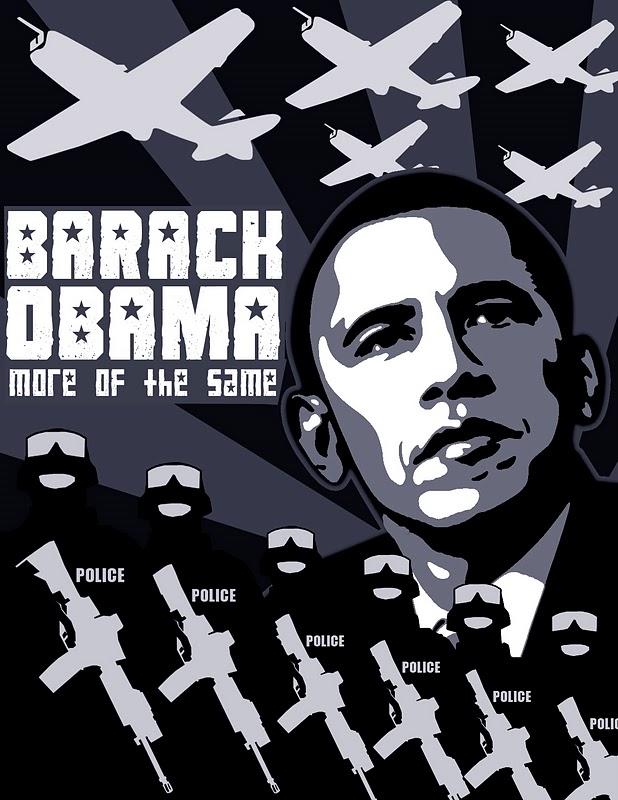 In spite of the fact that the United States faces no enemy anywhere in the world capable of opposing it on a battlefield, the Defense budget for 2011 will go up 7.1 percent from current levels. A lot of the new spending will be on drones, America’s latest contribution to western civilization, capable of surveilling large areas on the ground and delivering death from the skies. It is a peculiarly American vision of warfare, with a “pilot” sitting at a desk half a world away and pressing a button that can kill a target far below. Hygienic and mechanical, it is a bit like a video game with no messy cleanup afterward. The recently released United States Quadrennial Defense Review reports how the Pentagon will be developing a new generation of super drones that can stay airborne for long periods of time and can strike anywhere in the world and at any time to kill America’s enemies. The super drones will include some that can fly at supersonic speeds and others that will be large enough to carry nuclear weapons. Some of the new drones will be designed for the navy, able to take off from aircraft carriers and project US power to even more distant hot spots. Drones are particularly esteemed by policymakers because as they are unmanned and can fly low to the ground they can violate someone’s airspace “accidentally” without necessarily resulting in a diplomatic incident.
Washington’s embrace of drones as the weapon of choice for international assassination is one major reason why the United States has become the evil empire. Drones are the extended fist of what used to be referred to as the Bush Doctrine. Under the Bush Doctrine Washington asserted that it had a right to use its military force preemptively against anyone in the world at any time if the White House were to determine that such action might be construed as defending the United States. Vice President Dick Cheney defined the policy in percentage terms, asserting that if there was a 1% chance that any development anywhere in the world could endanger Americans, the United States government was obligated to act. It should be noted that President Barack Obama has not repudiated either the Bush doctrine or the 1% solution of Dick Cheney and has actually gone so far as to assert that America is fighting Christianity-approved “just wars,” a position disputed by Pope Benedict XVI among others. Far from eschewing war and killing, the number and intensity of drone attacks has increased under Obama, as has the number of civilian casualties, referred to by the splendid bloodless euphemism “collateral damage.”
Drones are currently killing people in Afghanistan, Pakistan, Yemen, and Somalia. It should be noted that the United States is not at war with any of those countries, which should mean in a sane world that the killing is illegal under both international law and the US Constitution. America’s Founding Fathers used constitutional restraints to make it difficult for Americans to go to war, requiring an act of war by Congress. Unfortunately it has not worked out that way. The US has been involved in almost constant warfare since the Second World War but the most recent actual declaration of war was on December 8, 1941. And then there are the special and clandestine operations that span the globe. Apart from Israel, no other country in the world has an openly declared policy of going around and killing people. One would think that the international community would consequently regard both Tel Aviv and Washington as pariahs, but fear of offending the world’s only super power and its principal client state has aborted most criticism. Most nations are resigned to letting assassination teams and hellfire armed drones operate as they please. If Iran were operating the drones and bumping off its enemies in places like Dubai you can be sure the reaction would be quite different.
And it doesn’t stop there. Obama’s Attorney General Eric Holder has effectively blocked any inquiry into the use of torture by US government officials, mostly from the CIA. The Administration claims to have stopped the practice but has declared that no one will be punished for obeying orders to waterboard prisoners, an argument that was not acceptable at the Nuremberg trials in 1946 and should not be acceptable now. The United States is a signatory to the international agreement on torture and there are also both federal and state laws that prohibit either carrying out or enabling the practice, so the ruling by Holder is essentially a decision to ignore serious crimes that were committed against individuals who, in many cases, were both helpless and completely innocent. It also ignores the participation of Justice Department lawyers and CIA doctors in the process, involvement that most would consider both immoral and unethical. Worst of all, it lets off the hook the real war criminals, people like George Tenet and those in the White House who approved the practice. Tenet, one recalls, received the Presidential Medal of Freedom and a $4 million book deal. He still teaches at Georgetown University. Justice Department lawyers John Yoo and Jay Bybee, who made the legal arguments for torture are now respectively a tenured professor at Berkeley and a federal appeals court justice. One assumes that the actual CIA torturers continue to be employed by the federal government or are enjoying a comfortable retirement. So much for accountability for war crimes under President Obama.
Finally there is assassination. On February 3rd Director of National Intelligence Dennis Blair commented during a congressional briefing that the United States reserves the right to kill American citizens overseas who are actively “involved” with groups regarded as terrorist. Involvement is, of course, a very slippery expression providing maximum latitude for those seeking to make a case for summary execution. The death list involves a due process of sorts in that a government official makes the decision who shall be on it based on guidelines but it does not allow the accused to challenge or dispute evidence. It should also be noted that no one in Congress objected to the Blair statement and the media hardly reported the story, suggesting that tolerance of illegal and immoral activity now pervades the system. As former Reagan Deputy Attorney General Bruce Fein has commented, the claimed authority to suspend one’s constitutional rights overseas can be extended to anyone in the United States by declaring one an enemy combatant under the terms of the Military Commissions Act. Jose Padilla was denied his constitutional rights to a fair trial even though he was an American citizen and was arrested in Chicago, not overseas. Can we anticipate extrajudicial killing of American citizens in America as part of the war on terror? Of course we can.
Three strikes and you’re out, Mr. Obama. Your government stands for preemptive killing and missile strikes on people living in countries with which America is not at war, lets torturers and torture enablers go free, and has asserted the right to assassinate its own citizens anywhere in the world based on secret evidence. Ronald Reagan once described his vision of America as a shining city on a hill. Over the past ten years the shining city has become the ultimate rogue nation, pumped up with power and hubris in spite of the clearly visible signs of decline and moving inexorably towards a catastrophic fall.
Obama Acts Like Reagan 1981, the Union-Buster
By Glen Ford | March 9, 2010
President Obama’s endorsement of the firing of the entire faculty and staff of a Rhode Island public school is reminiscent of Ronald Reagan’s crushing of the air traffic controllers union, nearly three decades ago. Back then, President Reagan made an example of a union that had supported his presidential candidacy, and ultimately decertifying the union when it went on strike. The move sent a signal to the bosses in all sectors of the U.S. economy: the president – the U.S. government – is on management’s side, and unions are a considered a threat to the general economic welfare.
Last week, President Obama sent the same kind of signal to teachers unions, when he cited the Central Falls, Rhode Island, school shutdown as an example of the “accountability” he is demanding of poorly performing schools – which invariably means poor, non-white schools. Teachers union leaders appeared to be shocked by Obama’s language and tone – but they shouldn’t have been. The Rhode Island mass firing was not substantively different than the wholesale sacking of teachers and abrogation of their union contracts elsewhere in the country. The fundamental logic of Obama’s so-called Race to the Top program – a multi-billion dollar competition to show which states are most willing to fire teachers, shut down classrooms and replace them with charter schools – is to break the teachers union. If the teachers want to save their union, their dignity, their contracts, and the institution of public education, they will have to break with Obama. Because he is going after them with a hatchet – just like Reagan went after the air traffic controllers, despite their having supported his 1980 candidacy.
Obama’s hatchet man and basketball buddy is Education Secretary Arne Duncan, who envisions waves of school closings, teacher firings and charter school openings for the next “five or six years.” That sounds like a kind of “final solution” for teachers unions – and for public education.
Obama’s plans for America’s classrooms are even more aggressive than George Bush’s policies. Obama takes Bush’s No Child Left Behind scheme to its logical, blood on the floor conclusion: corporate education without the encumbrances of organized teachers. Obama’s anti-union vision is more ambitious than that of the old arch-reactionary, Ronald Reagan, who destroyed a union of only 13,000 members. The American Federation of Teachers and the National Education Association have combined memberships of over 4 million. They have the capacity to fight back, to make this president back off. But, like so many others who drank the Obama Kool Aid, they are in denial, refusing to believe that they backed a union-buster who is making teachers the scapegoat for America’s historical failure to serve the educational needs of all its children.
Private teacher training outfits are turning out young and hungry replacements for todays teachers, anticipating a huge turnover in public schools as Obama swings his hatchet. Teachers need to revolt against this administration while they still have a union to fight for them.
Glen Ford can be contacted at Glen.Ford@BlackAgendaReport.com
Death to Obamacare!

“But we have to pass the bill so that you can find out what is in it, away from the fog of the controversy.”
– Nancy Pelosi
Kill Bill
By DAVE LINDORFF | March 10, 2010
When Obama came to my neighborhood this week to press for public support for his health “reform” bill, he wasn’t just greeted by teaparty hecklers. Speaking to a large group of mostly supportive students and local residents at Arcadia University in Glenside, the president at one point mentioned that “people on the left” want “single-payer.” But before he could add that that approach wasn’t going to happen, he found himself drowned out by cheers calling for Medicare for all and single-payer.
That kind of says it all.
I’m with Marcia Angell, editor of the New England Journal of Medicine. The Obama plan for health care “reform”, as well as the two versions passed by the House and the Senate, are all devious disasters that do nothing to solve the nation’s burgeoning health care crisis, and in fact, will make it worse.
The only thing to do at this point is to take the whole stinking pile of paper and put it in the compost heap. Kill it.
This whole effort was never about reform from the day last March when the new president called on Congress to begin deliberations on health care reform. It was about catering to the wishes of the big players in the Medical Industrial Complex–the big pharmaceutical multinationals, the hospital companies, the physicians and, most of all, the insurance industry. People and their health care needs had little or nothing to do with this.
That’s why we’ve ended up with proposals that would do nothing to control costs, that would force healthy young people to buy unregulated, high-cost and high-profit plans that would be money in the bank for the insurance industry, and that would finance any subsidies for the poor by cutting back on benefits for the only group of Americans who currently have a form of single-payer insurance–the elderly with their Medicare.
President Obama began this whole obscene nightmare with a lie, when he said that even though single-payer systems clearly work to open access to all and keep costs down while providing better overall health results in places like Canada and some European countries, they cannot be applied in America “because that would mean starting over from scratch.” He knew when he said it that this was a lie. America already has a well-run and successful single-payer healthcare program in place that is bigger than the entire Canadian health care system, and that’s Medicare, which was established in 1965, and which currently finances the care of 45 million Americans. You just have to be 65 or disabled to be eligible for it.
As Dr. Angell pointed out on a recent Bill Moyers Journal segment, the simplest way to solve America’s health care crisis would be to just start a gradual expansion of Medicare, say by lowering the age of coverage to 55, and then 45, and then 35, until everyone was covered and the insurance industry was pushed out of the health sector. The right-wing couldn’t use their scare tactics about a “government takeover of your medical care,” because the elderly love Medicare, and besides, far from “inserting a government bureaucrat between you and your doctor,” Medicare gives the elderly a freer choice of physician and treatment than any but the most gold-plated private insurance executive health care plan.
Obama continued this lie when he claimed, in his last mention of the issue during his State of the Union address to Congress, that he and Congress had considered every idea. In fact, he and Congress have for the last year, carefully prevented any consideration of the idea of single-payer, or of expanding Medicare to cover every American. Bills that would do that, authored by Rep. John Conyers (D-MI) in the House and Sen. Bernie Sanders (I-VT) in the Senate, were in fact blocked from hearings or votes in both Houses by Democratic leaders, at the White House’s urging, while the White House itself barred single-payer advocates from any of its discussions.
Instead the president met behind closed doors with the lobbyists of the various health care industries, to cut deals with each sector in order to gain their support for his “reform” plan. It was as if the Department of Justice had called meetings with the various crime families of the Cosa Nostra in order to cut deals before developing a plan to “tackle” the Mafia.
The plan being proposed to “reform” health care–actually they long ago stopped calling it health care reform, acknowledging that this was never even contemplated, and started instead referring to what is being contemplated as health insurance reform–is, we are told, going to cost about $100 billion a year. That wouldn’t be bad if what we got in return was universal health care, but we don’t even get that. Instead we have a measure that will reduce access to health care for the middle class by taxing benefits and encouraging higher deductibles, that will force the poor, the young and the self-employed to buy terrible, over-priced plans offering minimal coverage, that will chip away at the coverage provided to the elderly, and that will ultimately lead to higher costs for everyone, and that will still leave nearly 20 million people with no coverage. The US currently devotes 17.5 percent of Gross Domestic Product to health care, and if this “reform” in any of its guises is passed, that share of the economy devoted to health care will quickly rise past 20 percent, with no end in sight.
This is madness. Expanding Medicare to cover everyone, as I have written earlier, would actually save everyone money immediately, and the country as a whole. Consider that the most expensive consumers of health care–the elderly–are already in the system. Adding younger, healthier people to Medicare would cost incrementally much less. That’s why the Canadians spend about 9 percent of their GDP on healthcare, while covering every Canadian, while we spend nearly twice as much and leave 47 million of our citizens uninsured and unable to visit a doctor. How could it be cheaper to add everyone to Medicare? Expanding Medicare to cover everyone would probably cost somewhere between $800 billion and $1 trillion a year. That sounds like a lot of money, until you consider that we already spend $100 billion a year to care for veterans through the Veterans Administration, and $400 billion a year to care for the poor through Medicaid. We also spend $300 billion a year subsidizing hospitals that have to provide “free” charity care to the poor who don’t qualify for Medicaid, too. Since all those people would be covered by Medicare under Medicare-for-All, that’s $800 billion a year in current expenditures saved right there.
So even if my higher figure of $1 trillion for adding everyone to Medicare were correct, we’d only be talking about an extra $200 billion annual expense. And that could be covered by increasing the Medicare tax paid as a payroll deduction. You don’t want to pay more taxes? Well wait. If you were covered by Medicare, you and your employer would no longer have to pay for private insurance, which would mean a savings to workers of thousands of dollars a year, and even more to employers who currently pay the majority of health insurance premiums for employees. The net savings would be enormous.
Nobody has talked about this.
Universal Medicare would make American companies more competitive in the global marketplace, where other companies are not responsible for health care costs of their workers. It would make Americans wealthier, because they would no longer be paying for health care out of their own pockets. It would make everyone more secure, because they would no longer have to fear losing access to health care if they lost their job, and would eliminate most bankruptcies, which are reportedly caused by medical bills.
So we know what needs to be done.
And we know that the current “reforms” on offer don’t do it.
So Dr. Angell is right. Obamacare needs to die.
There is reason to hope that it will die. Republicans oppose it, though not for any decent reason. They want unregulated private insurance and unlimited profits for health care industries. Ditto some conservative Democrats, who are also anti-government ideologues whose wallets are stuffed with health industry swag. But their reasons for opposing the health bill don’t matter. All that is needed is for a few progressive members of the House and Senate to admit that the health bills being considered are not reform, but the antithesis of reform, and to also vote against it, and Obamacare will be dead.
At that point we can start seriously demanding that the Congress and the President act to bring us real health reform in the way that really works: expanding Medicare to cover everyone.
Peace Negotiations Charade Creates Space for Further Dispossession
 J Street says Obama is serious (but Israeli Foreign Ministry shrugs)
By Bruce Wolman | March 9, 2010
J Street and the Israeli Foreign Ministry offer contrasting reactions to the just announced Israeli-Palestinian “proximity talks” – indirect talks between the Israelis and the Palestinians with the United States serving as the go-between. By summer we should know for certain which organization has a better read of Obama Administration policies.
Isaac Luria of J Street sent out an email with the group’s key reactions to the upcoming talks. First J Street makes clear that in its view, “The announcement of proximity talks is a positive step in the right direction.” Continuing its cheer-leading role for the Obama administration, J Street applauds “the determination shown by the United States, President Obama and, in particular, Middle East Peace Envoy George Mitchell to get the parties to agree to talk.”
Well, almost talk. The Americans are going to shuttle between the two sides, relaying messages and responses. Okay, I know, it sounds a little anachronistic in this age of Instant Messaging – an Israeli invention by the way – where any two people anywhere in the globe can instantly communicate with one another. But hey, it is a start, even if it takes us back full circle to the prelude before the Madrid Conference of 1991.
In case anyone is thinking of using the talks to serve as a smokescreen for maintaining the status quo, J Street is quick to emphasize that “Process and talk, while commendable, are not the goal. Achieving a two-state solution is.” Let’s hope Prime Minister Netanyahu and his Foreign Minister Avigdor Lieberman are on J Street’s e-mail list.
J Street avows that “The US role in this process is, to state the obvious, vital to any hopes of success,” insisting that “nearly all experts know that the parties alone cannot reach an agreement.” Yet, the Obama administration has so far resisted Palestinian requests that the United States announce what are its parameters for a settlement, as Clinton did in 2000.
An unidentified senior American official informed Ha’aretz:
“We told the parties that our goal is to achieve two states for two peoples through negotiations. If there are obstacles we will try to help to overcome them and to propose our own ideas, and if we think one of the parties is not meeting its obligations we will say so.”
With the talks restricted to four months, it won’t take long to see if the Obama Administration is serious about taking on this “obvious” role.
Finally, J Street admonishes the parties that
“Now is the time to get serious. The stakes are enormous. There are those who believe that the United States will put no political capital behind the process and will do little to help bridge the gaps because of the upcoming Congressional elections. This view fails to recognize that the window of opportunity to achieve a viable two-state solution is nearly closed and the coming years are the last chance to secure Israel’s future as a democracy and a national home to the Jewish people.”
What J Street doesn’t mention in its email, except indirectly in a footnote, is that among those that “believe that the United States will put no political capital behind the process and will do little to help bridge the gaps because of the upcoming Congressional elections” is the Israeli Foreign Ministry.
A few days ago the Foreign Ministry leaked a classified document to its favorite conduit at Ha’aretz, Barak Ravid. The report, prepared by the Foreign Ministry’s Center for Political Research, was intended for distribution to the Foreign Minister and Israeli diplomatic missions abroad, but one has to ask the motivation for giving it to Ha’aretz.
The report concludes the following:
“The U.S. administration will not put a lot of effort into the upcoming indirect negotiations between Israel and the Palestinians, opting instead to focus on the November Congressional elections.”
Washington is aware of the domestic political problems faced separately by both Netanyahu and Abbas and has decided to concentrate on achieving the limited goal of restarting the negotiations. The peace talks will not be at the top of the Obama administration’s agenda,
“In our assessment the administration will focus in the coming year on domestic issues that are expected to determine the results of the Congressional elections. As such, and due to the difficulties to date in achieving significant gains in the peace process we can assume that the administration’s focus on this issue will be limited and will predominantly remain in the hands of Mitchell’s teams.”
Washington can be expected to portray the resumption of the Israeli-Palestinian talks as a domestic and international achievement, in the hope of creating an atmosphere that is conducive to direct negotiations between the parties on the core issues.
“The authors of the report also predict that the administration will avoid taking any position that suggests disagreement with Israel, because of the support that Israel enjoys among both parties in Congress.”
Meanwhile, J Street ended its email with “We’ll be in touch soon with concrete ways you can support strong American leadership in this latest effort to resolve the Israeli-Palestinian conflict through a two-state solution.” Can’t wait.
Update:
Haaretz: “[T]he [Obama] administration will avoid taking any position that suggests disagreement with Israel, because of the support that Israel enjoys among both parties in Congress.” Why? One must talk about money, media, and religious belief.
A Detention Bill You Ought to Read More Carefully
By Marc Ambinder | March 5 2010
Why is the national security community treating the “Enemy Belligerent, Interrogation, Detention, and Prosecution Act of 2010,” introduced by Sens. John McCain and Joseph Lieberman on Thursday as a standard proposal, as a simple response to the administration’s choices in the aftermath of the Christmas Day bombing attempt? A close reading of the bill suggests it would allow the U.S. military to detain U.S. citizens without trial indefinitely in the U.S. based on suspected activity. Read the bill here, and then read the summarized points after the jump.
According to the summary, the bill sets out a comprehensive policy for the detention, interrogation and trial of suspected enemy belligerents who are believed to have engaged in hostilities against the United States by requiring these individuals to be held in military custody, interrogated for their intelligence value and not provided with a Miranda warning.
(There is no distinction between U.S. persons–visa holders or citizens–and non-U.S. persons.)
It would require these “belligerents” to be coded as “high-value detainee[s]” to be held in military custody and interrogated for their intelligence value by a High-Value Detainee Interrogation Team established by the president. (The H.I.G., of course, was established to bring a sophisticated interrogation capacity to the federal justice system.)
Any suspected unprivileged enemy belligerents considered a “high-value detainee” shall not be provided with a Miranda warning.
The bill asks the President to determine criteria for designating an individual as a “high-value detainee” if he/she: (1) poses a threat of an attack on civilians or civilian facilities within the U.S. or U.S. facilities abroad; (2) poses a threat to U.S. military personnel or U.S. military facilities; (3) potential intelligence value; (4) is a member of al Qaeda or a terrorist group affiliated with al Qaeda or (5) such other matters as the President considers appropriate. The President must submit the regulations and guidance to the appropriate committees of Congress no later than 60 days after enactment.
To the extent possible, the High-Value Detainee Interrogation Team must make a preliminary determination whether the detainee is an unprivileged enemy belligerent within 48 hours of taking detainee into custody.
The High-Value Detainee Interrogation Team must submit its determination to the Secretary of Defense and the Attorney General after consultation with the Director of National Intelligence, the Director of the Federal Bureau of Investigation, and the Director of the Central Intelligence Agency. The Secretary of Defense and the Attorney General make a final determination and report the determination to the President and the appropriate committees of Congress. In the case of any disagreement between the Secretary of Defense and the Attorney General, the President will make the determination.
Note that the president himself doesn’t get to make the call.
Marc Ambinder is the politics editor of The Atlantic. He has covered Washington for ABC News and the Hotline, and he is chief political consultant to CBS News.
The New Jim Crow
How the War on Drugs Gave Birth to a Permanent American Undercaste
By Michelle Alexander | March 8, 2010
Ever since Barack Obama lifted his right hand and took his oath of office, pledging to serve the United States as its 44th president, ordinary people and their leaders around the globe have been celebrating our nation’s “triumph over race.” Obama’s election has been touted as the final nail in the coffin of Jim Crow, the bookend placed on the history of racial caste in America.
Obama’s mere presence in the Oval Office is offered as proof that “the land of the free” has finally made good on its promise of equality. There’s an implicit yet undeniable message embedded in his appearance on the world stage: this is what freedom looks like; this is what democracy can do for you. If you are poor, marginalized, or relegated to an inferior caste, there is hope for you. Trust us. Trust our rules, laws, customs, and wars. You, too, can get to the promised land.
Perhaps greater lies have been told in the past century, but they can be counted on one hand. Racial caste is alive and well in America.
Most people don’t like it when I say this. It makes them angry. In the “era of colorblindness” there’s a nearly fanatical desire to cling to the myth that we as a nation have “moved beyond” race. Here are a few facts that run counter to that triumphant racial narrative:
*There are more African Americans under correctional control today — in prison or jail, on probation or parole — than were enslaved in 1850, a decade before the Civil War began.
*As of 2004, more African American men were disenfranchised (due to felon disenfranchisement laws) than in 1870, the year the Fifteenth Amendment was ratified, prohibiting laws that explicitly deny the right to vote on the basis of race.
* A black child born today is less likely to be raised by both parents than a black child born during slavery. The recent disintegration of the African American family is due in large part to the mass imprisonment of black fathers.
*If you take into account prisoners, a large majority of African American men in some urban areas have been labeled felons for life. (In the Chicago area, the figure is nearly 80%.) These men are part of a growing undercaste — not class, caste — permanently relegated, by law, to a second-class status. They can be denied the right to vote, automatically excluded from juries, and legally discriminated against in employment, housing, access to education, and public benefits, much as their grandparents and great-grandparents were during the Jim Crow era.
Excuses for the Lockdown
There is, of course, a colorblind explanation for all this: crime rates. Our prison population has exploded from about 300,000 to more than 2 million in a few short decades, it is said, because of rampant crime. We’re told that the reason so many black and brown men find themselves behind bars and ushered into a permanent, second-class status is because they happen to be the bad guys.
The uncomfortable truth, however, is that crime rates do not explain the sudden and dramatic mass incarceration of African Americans during the past 30 years. Crime rates have fluctuated over the last few decades — they are currently at historical lows — but imprisonment rates have consistently soared. Quintupled, in fact. And the vast majority of that increase is due to the War on Drugs. Drug offenses alone account for about two-thirds of the increase in the federal inmate population, and more than half of the increase in the state prison population.
The drug war has been brutal — complete with SWAT teams, tanks, bazookas, grenade launchers, and sweeps of entire neighborhoods — but those who live in white communities have little clue to the devastation wrought. This war has been waged almost exclusively in poor communities of color, even though studies consistently show that people of all colors use and sell illegal drugs at remarkably similar rates. In fact, some studies indicate that white youth are significantly more likely to engage in illegal drug dealing than black youth. Any notion that drug use among African Americans is more severe or dangerous is belied by the data. White youth, for example, have about three times the number of drug-related visits to the emergency room as their African American counterparts.
That is not what you would guess, though, when entering our nation’s prisons and jails, overflowing as they are with black and brown drug offenders. In some states, African Americans comprise 80%-90% of all drug offenders sent to prison.
This is the point at which I am typically interrupted and reminded that black men have higher rates of violent crime. That’s why the drug war is waged in poor communities of color and not middle-class suburbs. Drug warriors are trying to get rid of those drug kingpins and violent offenders who make ghetto communities a living hell. It has nothing to do with race; it’s all about violent crime.
Again, not so. President Ronald Reagan officially declared the current drug war in 1982, when drug crime was declining, not rising. From the outset, the war had little to do with drug crime and nearly everything to do with racial politics. The drug war was part of a grand and highly successful Republican Party strategy of using racially coded political appeals on issues of crime and welfare to attract poor and working class white voters who were resentful of, and threatened by, desegregation, busing, and affirmative action. In the words of H.R. Haldeman, President Richard Nixon’s White House Chief of Staff: “[T]he whole problem is really the blacks. The key is to devise a system that recognizes this while not appearing to.”
A few years after the drug war was announced, crack cocaine hit the streets of inner-city communities. The Reagan administration seized on this development with glee, hiring staff who were to be responsible for publicizing inner-city crack babies, crack mothers, crack whores, and drug-related violence. The goal was to make inner-city crack abuse and violence a media sensation, bolstering public support for the drug war which, it was hoped, would lead Congress to devote millions of dollars in additional funding to it.
The plan worked like a charm. For more than a decade, black drug dealers and users would be regulars in newspaper stories and would saturate the evening TV news. Congress and state legislatures nationwide would devote billions of dollars to the drug war and pass harsh mandatory minimum sentences for drug crimes — sentences longer than murderers receive in many countries.
Democrats began competing with Republicans to prove that they could be even tougher on the dark-skinned pariahs. In President Bill Clinton’s boastful words, “I can be nicked a lot, but no one can say I’m soft on crime.” The facts bear him out. Clinton’s “tough on crime” policies resulted in the largest increase in federal and state prison inmates of any president in American history. But Clinton was not satisfied with exploding prison populations. He and the “New Democrats” championed legislation banning drug felons from public housing (no matter how minor the offense) and denying them basic public benefits, including food stamps, for life. Discrimination in virtually every aspect of political, economic, and social life is now perfectly legal, if you’ve been labeled a felon.
Facing Facts
But what about all those violent criminals and drug kingpins? Isn’t the drug war waged in ghetto communities because that’s where the violent offenders can be found? The answer is yes… in made-for-TV movies. In real life, the answer is no.
The drug war has never been focused on rooting out drug kingpins or violent offenders. Federal funding flows to those agencies that increase dramatically the volume of drug arrests, not the agencies most successful in bringing down the bosses. What gets rewarded in this war is sheer numbers of drug arrests. To make matters worse, federal drug forfeiture laws allow state and local law enforcement agencies to keep for their own use 80% of the cash, cars, and homes seized from drug suspects, thus granting law enforcement a direct monetary interest in the profitability of the drug market.
The results have been predictable: people of color rounded up en masse for relatively minor, non-violent drug offenses. In 2005, four out of five drug arrests were for possession, only one out of five for sales. Most people in state prison have no history of violence or even of significant selling activity. In fact, during the 1990s — the period of the most dramatic expansion of the drug war — nearly 80% of the increase in drug arrests was for marijuana possession, a drug generally considered less harmful than alcohol or tobacco and at least as prevalent in middle-class white communities as in the inner city.
In this way, a new racial undercaste has been created in an astonishingly short period of time — a new Jim Crow system. Millions of people of color are now saddled with criminal records and legally denied the very rights that their parents and grandparents fought for and, in some cases, died for.
Affirmative action, though, has put a happy face on this racial reality. Seeing black people graduate from Harvard and Yale and become CEOs or corporate lawyers — not to mention president of the United States — causes us all to marvel at what a long way we’ve come.
Recent data shows, though, that much of black progress is a myth. In many respects, African Americans are doing no better than they were when Martin Luther King, Jr. was assassinated and uprisings swept inner cities across America. Nearly a quarter of African Americans live below the poverty line today, approximately the same percentage as in 1968. The black child poverty rate is actually higher now than it was then. Unemployment rates in black communities rival those in Third World countries. And that’s with affirmative action!
When we pull back the curtain and take a look at what our “colorblind” society creates without affirmative action, we see a familiar social, political, and economic structure — the structure of racial caste. The entrance into this new caste system can be found at the prison gate.
This is not Martin Luther King, Jr.’s dream. This is not the promised land. The cyclical rebirth of caste in America is a recurring racial nightmare.
Michelle Alexander is the author of The New Jim Crow: Mass Incarceration in the Age of Colorblindness (The New Press, 2010). The former director of the Racial Justice Project of the ACLU in Northern California, she also served as a law clerk to Justice Harry Blackmun on the U.S. Supreme Court. Currently, she holds a joint appointment with the Kirwan Institute for the Study of Race and Ethnicity and the Moritz College of Law at Ohio State University.
‘US running international network of secret detentions’
Press TV – March 7, 2010
A United Nations report on the existence of secret detention facilities in countries around the world puts most of the blame on the US and its Central Intelligence Agency.
The report says that the CIA, under the pretext of fighting terrorism, runs scores of secret prisons in foreign countries where suspected terrorists are held, a Deutsche Welle article read on Saturday.
The UN report charges that the United States has created an “international network” to keep in detention anyone it deems as potential enemies.
According to Deutsche Welle, the secret prisons exist in more than 66 countries.
These countries include Algeria, Egypt, India, Russia, Sudan and Zimbabwe where suspects and dissidents are kept in secret facilities.
Poland and Romania are accused of hosting the CIA secret prisons on their soils.
The report further suggests that the US transfers its prisoners to countries like Ethiopia, Djibouti, Egypt, Jordan, Morocco, Pakistan, Syria and even Thailand for interrogation.
According to the UN report, in Israel Palestinian prisoners are kept in secret detention under the “illegal fighter” law.
The UN report says while the existence of the secret prisons around the world violates the human and international rights they introduce a “serious problem on a global scale.”
“If resorted to in a widespread or systematic manner, secret detention might reach the threshold of a crime against humanity,” suggests the report.
Four UN Special Rapporteurs Martin Scheinin, Manfred Nowak, Shaheen Sardar Ali, and Jeremy Sarkin, have contributed to the report.
The report was due to be examined in Geneva this month; however, the resistance shown by some countries postponed the process until June.
Obama to close International Labor Comparisons office
By Alec MacGillis | Washington Post | March 3, 2010
Like a scorekeeper for the world, a tiny unit within the Bureau of Labor Statistics tracks globalization’s winners and losers, and the results are not always pretty for the United States. Manufacturing jobs here, for example, have fallen faster since 1979 than in Canada, Germany or Japan. Compensation for those jobs dropped here in 2008 but jumped in South Korea and Australia.
Soon, however, Americans may be spared the demoralization in these numbers: The White House wants to shutter the unit that produces them.
President Obama’s budget would eliminate the International Labor Comparisons office and transfer its 16 economists to expand the bureau’s work tracking inflation and occupational trends. The White House says the cut, estimated to save $2 million, is one of many difficult decisions the president was forced to make to control spending.
“This budget had to make some tough choices and prioritize the nation’s most pressing needs during a challenging economic and fiscal climate,” said Office of Management and Budget spokesman Tom Gavin. But the proposed cut has triggered an outcry from an eclectic group of academics, business leaders and union officials — a reminder that, in the sprawl of the federal government, some seemingly obscure offices have built a loyal following around their discrete missions.
The defenders argue that, given the need to succeed in a global economy, it makes little sense to shut down the office that measures how the country stacks up. There are other sources of foreign data, such as the Organization for Economic Cooperation and Development and the International Labor Organization, but none does as much as the BLS unit to vet and adjust numbers for apple-to-apple comparisons on productivity, unemployment and wage levels, supporters say.
“If you were going to cut this five years after they implemented it 50 years ago, that would be one thing — who cared then about what’s going on in Asia?” said Georgetown University economist Robert Bednarzik, who spent 10 years at the BLS and has started a petition drive to save the unit. “But they’ve picked the worst possible time to try and get rid of it — when we’re all in this together.”
The International Labor Comparisons office dates to the 1960s, when President John F. Kennedy demanded to know whether Western European countries, which were reporting remarkably low unemployment rates, were using a different standard of accounting. The office later expanded to include Asia’s emerging economies.
The biggest challenge was China, where reliable statistics are particularly hard to come by. But in 2004, the office contracted with Judith Banister, a former Census Bureau demographer then living in Beijing, who dug up statistical books in local bookstores that helped produce solid data on the Chinese economy. The unit added Brazil to the mix, and in the near future it plans to release its first reports on India.
Banister, a freelance researcher, said U.S. manufacturers need to know what they are up against overseas — and, in some cases, whether to move work offshore.
Skeptics of free-trade policies criticize the closure for other reasons — the unit’s data, they argue, show just how harsh globalization is for the American worker, a reality that may be inconvenient for an administration generally more trade-oriented than the populist rhetoric of Obama’s campaign suggested. They question if the unit is being closed solely for the budget savings, noting that $2 million is a relative pittance, less than 1 percent of the BLS budget.
“The type of documentation [the unit] is putting out could be detrimental to their efforts” on trade, said John Russo of the Center for Working-Class Studies at Youngstown State University.
Gavin, the OMB spokesman, denied that motivation, saying the closure “wasn’t a reflection of the quality of the work or a reflection of its usefulness so much as a reflection of priorities.”
The budget proposal says the unit’s statistics are “not widely used.” But supporters point out that the unit’s Web site got 1.5 million page views in 2009 — about 4,000 a day.
Congress could yet decide to retain the program. Sen. Sherrod Brown (D-Ohio), for one, is concerned about the closure, said his spokeswoman Meghan Dubyak. “He plans on working with the administration and [congressional] leadership to ensure that we still have data to address offshoring and competitiveness issues,” she said.
Meanwhile, the unit’s close-knit group of workers is waiting to learn their fate. Its director, Connie Sorrentino, who has worked in the unit since the 1960s, said her colleagues were “devastated” when they heard the news but have since been heartened by their supporters.
“What helps us keep our chins up are the people who don’t want to see it go under,” she said. “You find out who your friends are when you’re on the chopping block. Though that’s a heck of a way to do a customer survey.”
Obama’s Landmine Betrayal
By Conn Hallinan | March 4, 2010
Step lightly is the only conclusion one can draw from the Obama administration’s refusal to sign the international treaty banning landmines. U.S. State Department spokesman Ian Kelly said that the administration had decided not to join the 10-year old treaty endorsed by 156 countries. Altogether, 39 countries have not signed on, inclusing Russia, China and India.
Kelly’s comment drew outrage from treaty supporters, including Sen. Patrick Leahy (D-Vt), who called the refusal to sign a “default of U.S. leadership,” and contradictory to the White House’s “professed emphasis on multilateralism, disarmament, and humanitarian affairs.”
The U.S. Campaign to Ban Landmines called Kelly’s statement “shocking,” and anti-landmine groups were sharply critical of the review process, which was conducted behind closed doors without input from NGOs, legislators, or NATO allies who have signed the treaty.
The 1999 treaty bans the stockpiling, production, or transferring of anti-personal mines that caused over 5,000 casualties last year, one third of them children. More than 70 countries are infested with them.
In the face of the uproar over the Obama administration’s refusal to join the ban, the State Department quickly backed off and said the policy review “is still on-going.”
The White House has also resisted endorsing the treaty to ban cluster weapons.
A total of 103 governments worldwide have signed the agreement, but ratification is still working its way through various legislatures and parliaments. Some 30 nations have ratified it, however, elevating the treaty to the level of international law.
The U.S., Russia, and China are the major producers of cluster weapons, and they are stockpiled in at least 77 countries. A number of countries, including Japan and Australia, have destroyed their stocks.
Cluster weapons have a high failure rate—30 percent is not unusual—and the unexploded bomblets lie in wait for unwary civilians. Some 90 million cluster weapons were dropped on tiny Laos during the war in Southeast Asia, and the weapons continue to kill and maim between 100 and 200 people a year.
Many of the 50 million clusters dropped on Kuwait during the first Gulf War failed to explode and, in the two years following the war, killed 1,400 Kuwaiti civilians. Cluster weapons continue to kill and wound hundreds of civilians in Kosovo and Iraq.
The aftermath of war was underlined by a recent study conducted by the Vietnamese military and the Vietnam Veterans of America Foundation that looked at six provinces near the old demilitarized zone in the country’s north. It found that it would take 300 years and $10 billion to clear unexploded bombs and mines from the region.
Since the war ended in 1975, unexploded ordinance has killed 10,529 people and injured 12,231 in the six provinces.
The Iraqi Ministry of the Environment has found that 42 sites across the country are heavily contaminated with radiation and dioxin. The dioxin is from the widespread bombing of oil pipelines and refineries during the U.S. invasion, and the radioactivity is residue from radioactive depleted uranium ammunition (DUA). Over 500 tons of DUA were used during the first and second Gulf wars.
According to environment minister Narmin Othman, the bombing of pipelines in the Basra area has heavily contaminated the soil with dioxin. “The soil ended up in people’s lungs and has been on food that people have eaten,” he told the Guardian.
DUA is the latest innovation in armor piercing ammunition, and it is widely used in 120mm tank shells, and 30mm cannon shells fired by aircraft. While not highly radioactive, it “has the potential to generate significant medial consequences” if ingested, according to the U.S. Environmental Policy Institute.
DUA tends to vaporize on contact, contaminating food and water supplies with radioactive dust.
While the U.S. claims DUA is not dangerous, birth defects and early life cancers have risen sharply in places like Falluja where the weapon was widely used. “We are seeing a very significant increase in central nervous system anomalies,” Falluja general hospital’s director Dr. Ayman Qais told the Guardian. “Before 2003 [the start of the war] I was seeing sporadic numbers of deformities in babies. Now the frequency of deformities has increased dramatically.”
Admissions for deformities have risen from two every two weeks a year ago, to two a day now. Besides deformities of the head, spinal cord, and lower limbs, multiple tumors have been showing up as well. The Guardian found that in a three-week period, there were 37 abnormal babies born in the Falluja general hospital alone.
Conn Hallinan can be reached at: ringoanne@sbcglobal.net
Featured Video
Dan Dicks with James Corbett on Solutions Watch
or go to
Aletho News Archives – Video-Images
From the Archives
$1.5bn up in smoke: US THAAD missile stockpile dries up defending Israel against Iran
By Ivan Kesic | Press TV | July 2, 2025
According to American media, defense news outlets, and independent analysts, the 12-day Israeli military aggression against Iran significantly depleted the US stockpile of THAAD (Terminal High Altitude Area Defense) interceptor missiles.
Citing official sources, American magazine Newsweek reported on Friday that the US transferred a substantial portion of its advanced missile defense capabilities to support the Israeli regime, an effort with questionable results and a critical impact on US strategic reserves.
THAAD, developed by Lockheed Martin arms manufacturing company, is a key component of Israel’s multi-layered air defense architecture. It is designed to intercept medium-range ballistic missiles, including those launched from Iran and Yemen.
The US-made system is capable of targeting short-, medium-, and intermediate-range ballistic missiles during their terminal phase, whether inside or outside Earth’s atmosphere.
THAAD uses a “hit-to-kill” method, relying on kinetic energy rather than explosive warheads to destroy incoming threats, intercepting at altitudes of up to 150 km and ranges between 150-200 km.
Operated exclusively by American personnel, the US military maintains eight THAAD batteries with an estimated 350–400 interceptors in total. The eighth battery was activated during the June 20 Israeli aggression against Iran and is capable of intercepting hypersonic missiles. … continue
Blog Roll
 Aletho News
- While Gaza dominates the UN, these are the people keeping it alive
- New Report: “Scholasticide and Genocide in Gaza: Assessment, Testimonies and Legal Analysis”
- ‘THAAD Delusion’: Iran war exposes US missile shield limits – The Atlantic
- Moscow issues warning to NATO over Russian exclave
- Yes, the Iran war has destroyed Trump’s presidency
- The fallacy of US delusions about Iran’s economic collapse
- Hezbollah denies Syria cell link, warns of Israeli plan to sow discord
- The legacy of US sanctions, war, and occupation in Iraq
- Iraqi resistance group rejects disarmament, vows to maintain support for Lebanon
- Sheikh al-Asadi warns of Iraqi government compliance with US demands
- If Americans Knew
- Mamdani releases plan to combat antisemitism and hate crimes in New York City
- Iran’s Revolutionary Guards Publish Letter to the American People
- DMFI launches $1 million ad campaign supporting Virginia’s Elaine Luria
- US Senate blocks resolution seeking report on Americans killed by Israel
- Israeli Attacks Kill Ten Palestinians in Gaza
- Massacre at Minab: The School That Became a Grave
- Israeli media: The IDF Shows It Doesn’t Turn a Blind Eye; It Actively Emboldens Settler Havoc
- As settlers ravage West Bank, Israeli forces kill 10 in Gaza – Daily Update
- New Report: “Scholasticide and Genocide in Gaza: Assessment, Testimonies and Legal Analysis”
- Ex-Biden officials are desperate for a Gaza scapegoat
- No Tricks Zone
- Green Energy Debacle: German Expert Professor Fritz Vahrenholt Warns Of Severe Economic And Social Consequences
- Two More Paleo Reconstructions Affirm Meters-Higher Sea Levels Across Ireland, Brazil 7000-6000 Years Ago
- New Study: Earth And Venus Surface Warmth Largely Explained By Convection And Lapse Rate, Not CO2 Or Radiation
- 2025 Nature Paper Claiming Worsening Global Drought Gets RETRACTED …Heavily Flawed
- New Study: ‘Global Drought Shows No Detectable Recent Acceleration Under Climate Warming’
- Economic Masterminds: German Socialists Suggest Taxing Productivity Gains Stemming From Using AI
- The South China Sea Has Not Been Cooperating With The Climate Change Narrative
- Energy Crisis: Germany Enters Heating Season With Historically Low Gas Reserve Fill Levels
- New Study: The Antarctic Ice Sheet Gained Mass From 2020-2024 Due To Staggering Snow And Ice Accumulation
- Study: Ocean Heating Rates From Thousands Of Years Ago ‘Dwarf’ Modern Ocean Heating Rates

