US-Pakistan “diplomatic” dispute escalates
By Ein Katzenfreund | Aletho News | January 9, 2010
The neoconservative Wall Street Journal, New York Times and many other English-language media and even the Chinese news agency Xinhua just wrote in bold headlines that the US has asked Pakistan to stop “harassment” of their “diplomats”. It is quite uncommon that a country tries to escalate diplomatic differences with a friendly country over the mass media, rather than resolving it discreetly. Pakistan is an important “partner” for the United States in its struggle to dominate the Middle East, which it sells to the public as a global war on terror.
In the Wall Street Journal version and the associated Western media, the story of the diplomatic dispute is told somewhat like this: Pakistani authorities and security forces are harassing US diplomats in Pakistan by temporarily arresting them, searching their cars and systematically delaying visa requests. Due to this harassment the US now has difficulty implementing its five-year program to support civilian projects in Pakistan worth 1.5 billion US dollars annually. The Pakistani government demands direct payment so that it can spend the money where it is needed but the US doesn’t do this as it wants full administrative control. The Wall Street Journal suggests that the Pakistani intelligence service ISI is behind the harassment campaign and that the ISI is impeding peace and development in Pakistan. That’s what the story looks like in Rupert Murdoch’s Wall Street Journal. The New York Times adds that the US embassy in Islamabad has plans to increase its staff to implement its assistance program in Pakistan from 500 to 800 people and casually states that President Zardari has demanded a cessation of air strikes by US drones on Pakistani territory, and instead proposes that the US give Pakistan the drone technology.
In Pakistan the story appears a bit different. First of all, it is carefully noted in Pakistan that the US hires death squads from the notorious Blackwater outfit as “diplomats”. The US government officially denies that it uses Blackwater for assassinations, but since it was announced that the suicide attack on the secret drone base in Afghanistan’s Khost killed two mercenaries from Blackwater the official claims have been exposed as a blatant lie.
However the troubles of the US in Pakistan are even more serious. Zahid Malik explained on December 7th in the Pakistan Observer in detail that the head of the ISI, General Ahmed Shuja Pasha, personally confronted the CIA boss Leon Panetta with evidence that the US backs warlords and terrorist groups in Afghanistan and Pakistan for the purpose of destabilizing Pakistan. The role Stanley McCrystal’s JSOC terrorist group plays in this dirty war is also public knowledge. None of this surprises Pakistanis as everyone in Pakistan knows that the US runs a secret war against Pakistan. This is becoming disastrous for the US because in the eyes of the Pakistani population the US is widely decried as a state sponsor of terrorism and any Pakistani government making common cause with the United States is considered to be treasonous.
The most important point is that the United States under Obama is trying to deceive Pakistan. The US promised to fight alongside Pakistan but they secretly fought against Pakistan and they were caught. It couldn’t be worse for the US. In this situation even the $1.5 billion annual bribe won’t help them out. If the US does not maintain the cooperation of Pakistani security services there will be no reliable transit of supplies for the U.S. occupation forces in Afghanistan via Pakistan anymore. Pakistan can add to its demands whatever it wants whenever it wants, because the US is so dependent on the supply routes through Pakistan. Obama would like to increase US troops in Afghanistan by about 30 – 40,000 official soldiers. As for supply routes for his troops in Afghanistan he has the following possibilities: Pakistan, Russia, and Iran. As the US has no internal influence in Iran and Russia, these countries are not ideal options. The result is that if Pakistani supply routes are closed Obama’s occupation of Afghanistan will end and Pakistan wins influence. Until then Pakistan may ask what it wants of the US, and the US must pay whatever the price is. If the US is escalating its diplomatic dispute with Pakistan now in the media, that suggests that the US administration has just now realized what kind of an ugly trap they have fallen into in Afghanistan.
Was this really that hard to foresee? Honestly, who is stupid enough to choose to occupy Afghanistan? OK, the think tank IASPS proposed it, but they also called for war on Iraq for the reorganization of the Middle East in Israel’s favor. It is noteworthy that Barack Obama still follows this Zionist-designed war policy even though it brings nothing but predictable disaster for the US.
Iran’s Press TV is modest: it reported that five Americans were arrested because they used fake license plates, but that they were released later because the US embassy said that they were diplomats. Oh, but of course when US Marines raided the Algerian embassy in Baghdad it was something entirely different and in no way harassment or a violation of the Vienna Convention on Diplomatic Relations.
The author manages a German language news blog at – http://www.mein-parteibuch.com/
Obama Flubs His First Bay Of Pigs Moment As Terror Moles Escape Purge
Webster G. Tarpley
January 5, 2010
Washington DC , January 5, 2010 — Obama’s speech this afternoon was an incongruous performance. On the one hand, he angrily detailed a catastrophic breakdown in US intelligence procedures leading to the near-massacre of hundreds of airline passengers in the skies over Detroit on Christmas Day. On the other hand, there was no purge of the corrupt, complicit, and incompetent officials who had made this incident possible. No firings were announced. No heads rolled. The rogue network or invisible government of treasonous and subversive moles inside the US government which is behind the Detroit incident, and so many other incidents, remained untouched once again.
Wolffe on MSNBC: “Cock-Up Or Conspiracy?”
The expectation that Obama might actually do something to combat the rogue network across US government institutions which inflicts terrorism on the American people and the world had been raised the night before in an interview by Washington journalist Richard Wolffe on Keith Olbermann’s MSNBC Countdown program. Wolffe, citing high-level White House officials, had reported that there was an investigation into whether the security lapses leading to the Detroit Christmas incident had been intentional and deliberate, and thus the products of conscious sabotage. Wolffe had stated: “It seems that the president is leaning very much towards thinking this was a systemic failure by individuals who maybe had an alternative agenda.The question there is again, cock up or conspiracy. Was there a reason these agencies were at war with each other that prevented that intelligence from being shared?” The goal, summarized Olbermann, was either a “turf war” or else the desire “to make somebody [Obama] look bad.” In reality, the goals involve a domestic police state and foreign geopolitical adventures.
Wolffe’s report had suggested that at least some firings were in the offing for officials responsible for the failure to stop Umar Farouk Mutallab from boarding his flight from Amsterdam to Detroit , despite the cascade of red flags associated with this particular patsy. But in his speech, Obama did not lay a glove on the invisible government forces which stage false flag terror incidents to manipulate public opinion and politics in the direction of increased totalitarianism at home and aggression abroad. Obama talked about what he would not tolerate, and about accountability in the abstract, but did not provide any concrete retribution to make moles think twice about future actions. Even David Gergen, the former White House official who faithfully represents the oligarchical point of view, told Wolf Blitzer on CNN that he considered it virtually inconceivable for Obama to make such a speech without firing some failed officials.
The Bay Of Pigs, 1961 – A Distant Mirror For Obama
Obama’s situation offers certain parallels to the experience of John F. Kennedy in the Bay of Pigs invasion of April 1961. Upon entering office, Kennedy had been convinced by Allen Dulles and Richard Bissell of the CIA to support an invasion of Cuba , which the CIA promised would lead immediately to an insurrection throughout the island and thus to the overthrow of Fidel Castro. Instead, the invasion was a catastrophic failure and humiliation for the United States and for Kennedy personally. When Kennedy came into office, he had been inclined to work closely with operatives like Allen Dulles and Bissell, who personified the rogue network in its then-current form. Helped along — according to some accounts — by General Douglas MacArthur, Kennedy realized that the geopolitical forces behind and above the presidency which were seeking to use him for their own ends were also more than willing to ruin him politically and to cast him aside as an expendable puppet at the first opportunity. Over time, this led to Kennedy’s deep and abiding mistrust of the rogue elements dominating the Pentagon, the CIA, the FBI, and other elements of the US government — a mistrust which allowed Kennedy to resist the lunatic proposals for general war advanced by the rogue elements during the Cuban missile crisis. In the short run, Kennedy’s Bay of Pigs experience impelled him to fire Allen Dulles, Richard Bissell, and CIA deputy director Charles Cabell within less than a year after the failed invasion. Obama needs to imitate Kennedy’s response, on the fast track.
Today, the breakdown crisis of the Anglo-American world system is far more acute than anything Kennedy had to face. Obama needs to muster something more than mere impotent rage about what is happening to himself. If Obama wants to avoid the disastrous outcomes for himself and the country which are now clearly delineated, he will need to mount an ambitious purge of subversive and treasonous moles inside the federal bureaucracy, along with the incompetents, time servers, and bunglers who are happy to play along with the rogues.
Who Obama Should Fire
Almost any of the twenty-odd officials who attended Obama’s special meeting in the White House today could be candidates for ouster for reasons of incompetence or worse. One obvious choice would be Michael E. Leiter, the head of the National Counter-Terrorism Center , which has the responsibility of integrating all the information from 16 agencies which was so obviously not integrated in the Mutallab case. Another might be Leiter’s boss Dennis C. Blair, the Director of National Intelligence or intelligence czar created after 9/11. Homeland Security Secretary Janet Napolitano is widely discredited, and has lost the confidence of the American people through her interviews if nothing else. Napolitano is also the keeper of the no-fly list, on which Mutallab needed to be listed, but was not. Hillary Clinton’s State Department failed to revoke Mutallab’s US entry visa after the Nigerian’s father warned the US Embassy in Nigeria about his son’s visit to Yemen — an outrageous lapse, or a deliberate sabotage. Leon Panetta’s CIA also had that information, and failed to make sure it was acted on. Gen. James Jones, the head of the National Security Council, is responsible for the overall coordination of the government, which in this case was substandard. FBI Director Robert Muller’s agents are up to their usual tricks of suppressing evidence in regard to the well-dressed Indian and the man in orange on the Detroit flight reported by an eyewitness, the Detroit attorney Kurt Haskell. (See http://www.mlive.com/news/detroit/index.ssf/2009/12/flight_253_passenger_kurt_hask.html) Firing any of these failed or complicit officials would be a good start.
If Obama continues to punt on real accountability, the rogue network will conclude that he is indeed the weakling and pushover which French President Sarkozy and others have suspected him to be. In that case, the handwriting will be on the wall for new world catastrophes.
What does the US really face in Yemen?
By Ein Katzenfreund | Aletho News | January 6, 2010
It is widely known that Al Qaeda is a subsidiary brand under the control of CIA, MI6 and Mossad with the purpose of spreading fear and terror. When the Western media use “Al Qaeda” to produce war sentiments in the population, then it should be immediately clear to everyone that there is something very suspicious happening. Currently, the mass media are scaremongering using the label “Al Qaeda” to persuade the population of the western world to join a US war in Yemen. But the US is not at war in Yemen against Al Qaeda. It is against the Shia Houthis whose strict anti-Americanism has already been a thorn in the US’s and its lackeys in the Arabian peninsula’s flesh.
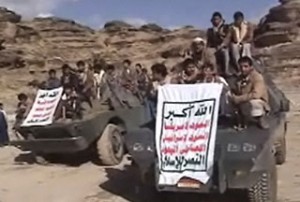
Since August 11th 2009 the Shia Houthis have resisted being “eradicated” by the presidents’ “Operation Scorched Earth” and are defending the area around Sadah against Yemeni government troops, Saudi artillery and aircraft, Moroccan and Jordanian special forces and the US. It has been admitted in the Western press that the US has used “Special Operations Forces“ and “specialists from the CIA” for over a year, and more recently, cruise missiles. General David Patraeus has declared that the US Navy on the coast of Yemen is there to prevent arms smuggling to the Houthis. According to information provided by Houthis the United States also operates a top secret airfield in northern Yemen, from where, almost daily, deadly bomb attacks are launched against the population in the area controlled by the Houthis.
According to the Yemeni government the Houthis only have about 3,000 fighters, but they managed to repulse an offensive of 30,000 Yemeni soldiers from their territory. This is the reason the US is currently planning to extend the secret war in Yemen against the Houthis so severely that it couldn’t any longer be hidden from the public.
What the war of annihilation against the Houthis is all about is as far as possible concealed. In the region of Qatif in eastern Saudi Arabia the world has witnessed violent protests in recent months by the local Shia majority against the oppression, economic disadvantage and discrimination by the US supported dictators from the Saudi capital Riyadh. The Wahhabi Saudi dictators and its backers in the US have shown naked panic of an armed revolt in Qatif by the Shia majority. The Houthis have responded to attacks from Saudi Arabia by repeatedly capturing border posts inside Saudi Arabia, gaining completely free access to heavy weapons and know-how for serious Shia resistance in Qatif.
If it comes to an anti-American revolution in Saudi Arabia, that would be a massive economic problem for the U.S. mafia state and it’s empire of global dominance. While the warfare state was busy assaulting Afghanistan and Iraq, they thought they dominated the Arabian Peninsula safely, but they have now got a resistance movement there.
The US war to eradicate the Houthis is fought to secure the Saudi dictatorship. The Western population is lied to about who the enemy is in Yemen, what is at stake in the war and what kind of crimes the United States are responsible for there. The population is to be sold the war to eradicate Houthis by the mass media as an operation against Al Qaeda. Therefore Al Qaeda in Yemen is made by the mass media larger and larger.
The first mass media revelation of US involvement was that the U.S. had carried out two bombing raids with cruise missiles against “Al-Qaida in Yemen”. That was the beginning of a PR campaign, that presented Al Qaeda as the enemy of the US in Yemen. The population was signaled by the US government with the information it gave, that Al Qaeda in Yemen is a great danger. In fact, the US has massacred with their rockets many more innocent people, but who’s interested in such small details when you have mass media. This was followed by another incident for the propaganda needs of the U.S. government. A young man tried supposedly to blow up a US civilian aircraft by lighting his underwear. Given the systematic way, that US security organizations have failed to notice all information before the bomb attempt, it seems reasonable to conjecture that the attack of the underwear bomber was planned by the CIA and was intended as a false-flag operation to make Al Qaeda in Yemen look more dangerous.
Let’s go to the core facts. What is actually the strength of Al Qaeda in Yemen? The German security services mouthpiece “Die Zeit” explained to its readers last week that in Yemen 100 to 200 Al Qaeda fighters might be found. For the transatlantic propaganda leaflet for would-be intellectuals, “Der Spiegel”, this number was too small, and so it said two days later, that in Yemen there are “up to 300″ Al-Qaeda people hiding. For the state run German news programm Tagesschau, which is very well known for it’s stories from 1001 nights about Yemen, this number also was too little, and so they told their audience about the strength of Al Qaeda in Yemen “according to Western Intelligence, 1500 and numbers growing”. There one should agree completely. A tenfold increase of fighters of such an obscure organization as Al Qaeda in a week would be a remarkable growth. But nothing of this is true. It is pure war propaganda from the German media. In an interview with the Austrian paper “Die Presse” Mustafa Alani from the Gulf Research Center from Dubai confesses that all this western propaganda is pure nonsense. He says just 50 Al Qaeda people are on the watch list of Yemenite security services. So, in conclusion, Al Qaeda in Yemen is barely more than a fiction.
Western media is trying to build up fear with photos of Al Qaeda trainees, who are armed with old rifles. While doing this the mass media are quiet about the fact that in Yemen all males are, by tradition, armed. If people knew that, they would understand that pictures of armed Al Qaeda trainees in Yemen are just a circus, photographed by people as a souvenir to take home. If you have a look in comparison to just a few videos from Houthis, you will quickly understand that the Al Qaeda in Yemen stories are ridiculous nonsense.
It is also striking that there have recently been a lot of reports of hijacked ships in the Gulf of Aden. The pirate attacks fit very well into the concept of the U.S. propaganda, because David Patraeus may get more warships then to try to enforce the naval blockade against the Houthis. Gordon Brown and Barack Obama have just announced that at the end of the month, on the brink of a long-planned conference on Afghanistan, they will hold a key international meeting on security in Yemen. By then the public will probably be so filled with fear that they swallow the propaganda for the US-led war in Yemen. The failure of any anti-war movement challenge to the propaganda campaign bodes ill in this regard.
But even if Barack Obama manages to fool the public with the Al-Qaeda nonsense about the war against Houthis, that does not mean that the U.S. and their puppets are winning the war. Al Jazeera has just broadcast a message from a commander from the anti-American resistance group Al-Shabaab in Somalia, that appeared, contrary to the Rita Katz Al Qaeda theatre, very real. Sheikh Mukhtar Robow is calling on Somali fighters in Yemen to enter in the fight “against the enemies of Allah”. In the light of such horrific images of the atrocities of the United States everyone can imagine how much anger the US-colonialists will face. In Yemen the U.S. should be prepared to face legions of experienced resistance fighters and an almost entirely armed population. The US has just declared another dirty global war to conquer the world, but this time they are going to lose it.
The author manages a German language news blog at – http://www.mein-parteibuch.com/
U.S. Venezuelan Relations: Imperialism and Revolution
By James Petras | January 5, 2010
Historically Latin America has been of great importance to the United States on numerous counts: the region has in the past, provided the US with a trade surplus; its outflows of licit and ill-begotten funds to US banks, numbers annually in the tens of billions; the US has been, up to recently, the major trading partner in the region; Latin America has provided a lucrative outlet for US buyouts of oil, telecoms, banking and related strategic mining companies during the golden age of imperial pillage (1975 – 1999). Throughout most of the 20th century the US could rely on the vote of its client regimes in the United Nations (UN), the Organization of American States (OAS) and in the international financial institution (IMF, WB, IDB) to back its efforts to sustain its global political and economic expansion.
In the latter half of the 20th century Latin America was an important target for the expansion of US based agro-mineral, transport (Ford, General Motors and Chrysler), farm machinery and other multi-national manufacturers. Within this regional pattern of US empire building, each country played a different role: Argentina, Mexico, Brazil and Colombia were targeted by manufacturing multi-national corporations (MNC) banks and exporters; Central America and the Caribbean for tropical fruits, tourism and export platforms, Bolivia, Peru and Chile for minerals; Venezuela, Mexico, Ecuador for oil and gas. Mexico, Central America and the Caribbean, were principle suppliers of cheap labor in the agricultural, construction and low paid service sector.
Within this imperial matrix, Venezuela was of special importance as the most important provider of petroleum. This was especially true in times of heightened US and Israeli induced political hostility and military warfare in the Middle East, with the onset of the US invasion of Iraq and sanctions against Iran, Sudan and other Muslim oil suppliers.
Under US hegemony Venezuela was a major player in the US effort to isolate and undermine the Cuban revolutionary government. Venezuelan client regimes played a major role in support of the successful US led effort to expel Cuba from the OAS; in 1961 and brokering a deal in the early 1990’s to disarm the guerillas in El Salvador and Guatemala without regime or structural changes in exchange for legal status of the ex-combatants. In short, Venezuelan regimes played a strategic role in policing the Central American-Caribbean region, a supplier of oil and as an important regional market for US exports.
For Venezuela the benefits of its relations with the US were highly skewed to the upper and the affluent middle classes. They were able to import luxury goods with low tariffs and invest in real estate, especially in south Florida. The business and banking elite were able to “associate” in joint ventures with US MNC especially in the lucrative oil, gas, aluminum and refinery sectors. US military training missions and joint military exercises provided a seemingly reliable force to defend ruling class interests and repress popular protests and revolts. The benefits for the popular classes, mainly US consumer imports, were far outweighed by the losses incurred through the outflow of income in the form of royalties, interest, profits and rents. Even more prejudicial were the US promoted neo-liberal policies which undermined the social safety net, increased economic vulnerability to market volatility and led to a two decade long crises culminating in a double digit decline in living standards (1979 – 1999).
Toward Conceptualizing US-Venezuelan Relations
Several key concepts are central to the understanding of US-Venezuelan relations in the past and present Chavez era.
These include the notion of ‘hegemony’ in which the ideas and interests of Washington are accepted and internalized by the Venezuelan ruling and governing class. Hegemony was never effective throughout Venezuelan class and civil society. “Counter-hegemonic” ideologies and definitions of socio-economic interests existed with varying degree of intensity and organization throughout the post 1958 revolutionary period. In the 1960’s mass movements, guerilla organizations and sectors of the trade unions formed part of a nationalist and socialist counter-hegemonic bloc.
Venezuelan-US relations were not uniform despite substantial continuities over time. Despite close relations and economic dependence especially during the 1960’s counter-insurgency period, Venezuela was one of the original promoters of OPEC, nationalized the oil industry (1976), opposed the US backed Somoza regime and White House plans to intervene to block a Sandinista victory (in 1979). The regression from nationalist capitalism to US sponsored neo-liberalism in the late 1980’s and 1990’s reflected a period of maximum US hegemony, a phenomena that took place throughout Latin America in the 1990’s. The election and re-election of President Chavez beginning in 1998 through the first decade of the new century marked a decline of US hegemony in the governing and popular classes but not among the business elite, trade union officials (CTV) and sectors of the military and public sector elite especially in the state oil company (PDVSA). The decline in US hegemony was influenced by the change in the power configuration governing Venezuela, the severe economic crises in 2000 – 2002, the demise and overthrow of client regimes in key Latin American countries and the rise of radical social movements and left center regimes. Accelerating the ‘loss of presence of the US’ and ‘policing’ of Latin America, were the wars in the Middle East, Iraq, South Asia (Afghanistan, Pakistan) and the expanding economic role and trading relations between Latin America and Asia (mainly China). The commodity boom between 2003 –2008 further eroded US leverage via the IMF and WB and enhanced the counter-hegemonic policies of the center-left regimes especially in Venezuela.
A key concept toward understanding the decline of US hegemony over Venezuela are “pivotal events”. This concept refers to major political conflicts which trigger a realignment of inter-state relations and changes the correlation of domestic socio-political forces. In our study President’s Bush’s launch of the “War on Terror” following 9/11/01 involving the invasion of Afghanistan and claims to extra territorial rights to pursue and assassinate adversaries dubbed “terrorists” was rejected by President Chavez (“you can’t fight terror with terror”). These events triggered far reaching consequences in US-Venezuelan relations.
Related to the above, our conceptualization of US-Venezuelan relations emphasizes the high degree of inter-action between global policies and regional conflicts. In operational terms the attempt by Washington to impose universal/global conformity to its war on terrorism led to a US backed coup, which in turn fueled Chavez’ policy of extra hemispheric alignments with adversaries of the White House.
Historical shifts in global economic power and profound changes in the internal make-up of the US economy have necessitated a re-conceptualization of the principal levers of the US empire. In the past dollar diplomacy, meaning the dominant role of US industry and banks, played a major role in imposing US hegemony in Latin America, supplemented via military interventions and military coups especially in the Caribbean and Central America. In recent years financial capital “services” have displaced US manufacturing as the driving force and military wars and intervention have overshadowed economic instruments, especially with the surge of Asian trade agreements with Latin America.
We re-conceptualize US-Venezuelan relations in light of a declining US economic and rising military empire, as a compensatory mechanism for sustaining hegemony especially as a tool for restoring client domestic elites to power.
The relation between past imperial successes in securing harmonious hegemonic collaborating rulers in the 1990’s and the profound political changes resulting from the crises of and breakdown of neo-liberalism, led Washington to totally misread the new realities. The resulting policy failures (for example Latin America’s rejection of the Free Trade Agreement of the Americas) and isolation and defeat of US policy toward Venezuela, Cuba and Honduras reflects what we conceptualize as “romantic reaction”, a failure of political realism: nostalgia for the imperial “golden age” of hegemony and pillage of the1990’s. The repeated failure by both the Bush and Obama regime to recognize regime changes, ideological shifts and the new development models and trade patterns has lead to mindless threats and diplomatic incapacity to develop any new bridges to the centrist regimes in the key countries of South America, especially toward Mercosur (Brazil, Argentina, Uruguay and Paraguay).
The gap between past (1975 – 2000) dominance and present declining hegemony, in Latin America establishes the parameters for understanding US-Venezuelan relations and in particular the ten years of political confrontation and the incapacity of Washington to restore its client elites to power, despite repeated efforts. Likewise despite Venezuela’s dependence on single product exports (petrol) and bureaucratic inefficiencies and corruption, its external policies have gotten around selected US boycotts and hostile diplomatic moves, while expanding regional ties and forging new trade and investment networks.
The full story of the emergence of this hemispheric and extra hemispheric polarization between Washington and Caracas which follows tells us a great deal about the future of US-Latin American relations and equally so of the prospects for US empire at a time of financial crises and rising militarism.
Method
Our study draws on interviews in the US and Venezuela, published government documents, newspaper and journal articles, press releases and speeches by principals in both the Venezuelan and US government and informed sources covering the period from the 1990’s to 2010.
Propositions
Several propositions inform our research and form the bases for developing hypothesis about the relations between empire and anti-imperial regimes.
- Financial and military driven empires (like the US) have few economic partners (in Latin America) to counter radical counter hegemonic regimes (like Venezuela’s President Chavez).
- Multiple counter-hegemonic strategies can effectively limit the efforts by imperial powers to boycott, destabilize and reverse an anti-imperialist regime.
- In some cases, like Venezuela, external confrontations can induce and hasten radical domestic socio-economic changes (i.e., including nationalizations, agrarian reform and mass oriented social programs).
- Paradigmatic crises (collapse of neo-liberalism) and the subsequent defeat or overthrow of collaborating regimes can lead to a variety of alternatives (from left to center-left to hard right regimes) and multiple imperial policy options (restoration, accommodation, confrontation).
- The pursuit of policies reflecting a unipolar world of absolute imperial hegemony (US – Latin America in the 1990’s) becomes a major obstacle to adaptation and strategizing in a world of declining hegemony and a multi-polar context (2000 – 2010).
- Extremist imperial policies, including coups (Honduras 2009, Bolivia 2008) and military bases (seven in Colombia 2009) in pursuit of regaining imperial dominances, may exacerbate diplomatic and political isolation with major regional powers even as they regain influence over marginal countries.
- Commodity based, export strategies may provide economic resources for extending social welfare and financing capital growth but over the medium run it opens progressive regimes to volatile fluctuations in revenues and political instability.
- Strong leaders (Chavez) can be a powerful antidote to imperial aggression and create social cohesion over the short and medium run but may weaken successor leader’s capacity to sustain counter-hegemonic policies and followers.
Procedure
Our discussion of US-Venezuelan relations will begin with an overview of the period between 1990 – 2010, initially focusing on the impact of the neo-liberal ascendancy and low commodity prices during the Bush Sr. – Clinton years. This will be followed by an account of the post 9/11/01 global and regional offensive accompanying the “War on Terror” launched by the Bush Jr. regime at a time of the commodity boom. We will conclude this section with a discussion of the Obama’s regime politics of conciliatory gestures and the practice of the ‘big stick’ at a time of escalating wars, militarization and global recession.
In the second section, we will be discussing the trajectory of the Chavez regime’s foreign policy in light of the decade long neo-liberal crises preceding its rise to government and the significant political events which marked a shift in its dealings with Washington, Latin America and its turn toward a global realignment in times of the commodity boom.
The third section will detail the abrupt shifts in US policy from accommodation, confrontation to intervention and multiple track policies. This section will discuss US political collaborators or “assets” and the efficacy of their operations as instruments of a larger strategy of regime change and political rollback (restoration of the pre-Chavez neo-liberal order).
The fourth section will discuss Washington’s insider and outsider strategies in destabilizing and isolating the Chavez regime including unilateral measures on arms embargoes, regional approaches, including proposals to the Organization of American States and global polices linked to the “war on terror”.
The fifth section will detail the Chavez’ regimes responses to US moves at the domestic level (disarticulation of power moves by US assets), regional counter-moves (at the OAS, Ibero-American Summit as well as new regional alliances such as Petrocaribe and ALBA) and global realignments (in the Middle East, China, Russia, OPEC).
The sixth section will analyze the success and failures of US strategy. In particular we will discuss the shifts in global economic conditions (the commodity boom), the relative decline of the US economy and its turn to military empire building, the relative autonomous economic growth and diversification of economic relations of center left regimes in Latin America. Central to our analysis will be the demise of neo-liberal ideology, the principle ideological wedge for US influence, and the decline of its principle institutional weapons for projecting ‘hegemonic policies’, the IMF and world Bank.
Central to the US quest for hegemonic rule in Latin America and, in particular in Venezuela, was the Free Trade of the Americas treaty – a proposal which ran counter to Chavez project of a strictly ‘Bolivarian’ integration proposal later embodied in ALBA. We will evaluate the outcomes of this contest of competing integration projects in light of their successes, failures and limitations. Specifically, we will evaluate the failure of both projects to incorporate major economies (Brazil, Argentina) as well as (Uruguay, Chile, Paraguay) and the resort to bilateral free trade linkage and long term trade and investment agreements.
The increasing turn of the Obama regime toward military instruments as policy tools against Chavez, as well as overt and military coups and thinly veiled threats against his allies, is analyzed in the penultimate section of the paper. The US backed military coup against elected president Zelaya in Honduras, the securing of seven military bases in neighboring Colombia, the undiplomatic threats of Secretary of State Clinton to retaliate against Latin America economic ties with Iran, all add up to increased militarization as a compensatory tool for declining economic leverage. The resort to unilateral policy decisions even at the cost of alienating the most powerful political regimes in the region and at the expense of lucrative economic ties suggests the extremist nature of the Obama regime, contrary to the original conciliatory rhetoric.
In the next section we will investigate the internal debates over US-Venezuelan relations, to determine the divergences and consensus within policy bodies (the Executive) and between institutions (Executive-Congress). We expect greater opposition to official policy in Venezuela where long standing economic elites and their political representatives have long-term linkages to the US government and private sector elites and where they control the vast majority of the print and electronic media. Most of US dissent is found outside governmental officialdom in civil society groups and among a thin layer of Congressional and staff officials.
The concluding section will sum up the consequences of US militarist policies toward Venezuela, their radicalizing effects and the net ‘cost/benefit’ consequences in a time of crises and in a context of a multi-polar global economy.
We will consider the probable outcome of the radicalization of US policy in a time of declining economic capacity to offer a sustainable political economic alternative – given the abject failure and universal rejection of the neo-liberal US centered project of the 1990’s.
We will reflect on the capacity of the Venezuelan regime to construct a viable new economic strategy that goes beyond oil dependence to a diversified economy in line with its ‘counter-hegemonic’ foreign policy.
US-Venezuelan Relations 1990 – 1998
The 1990’s were the “golden years” for US hegemony in Latin America and Venezuela was no exception. Under President’s Carlos Andres Perez and Rafael Caldera, extensive privatizations took place in strategic oil, gas and other extractive sectors resulting in lucrative joint ventures. Both Presidents closely towed the line of the IMF and World Bank, pursuing “structural adjustment policies” (SAP) which impoverished wage and salaried workers and enriched the foreign and domestic elites. Severe declines of oil prices and reduced revenues resulting from low taxes led to the savaging of social programs, while the liberalizing of prices led to sharp declines in living standards, leading to mass protests, urban riots and an aborted military coup.
Washington could count on the Venezuelan regimes for support in regional (OAS) and global forums (United Nations). While Venezuela remained in OPEC it was one of the ‘moderates’ on oil pricing and negotiations with the major oil importing countries. Venezuela remained in the Andean Pact but at no point moved toward any deeper integration such as a transpired among the southern cone countries which formed MERCOSUR. Venezuela supported the US policy toward the Middle East, backing Washington in the first Iraq war and its subsequent sanction policies in the 1990’s, but established diplomatic relations with Cuba.
US policy perceptions of Venezuela in the 1990’s had a profound impact on how it related to the changes which ensued under President Chavez. The extremely favorable conditions for US bankers, oil investors, exporters and the high levels of subservience to US global and regional foreign policies and the general collaboration of the military and intelligence agencies with their US counterparts ensconced in the country formed the bases for US judgment and responses to the Chavez government. Washington ignored the mass uprising of 1989 and widespread opposition against the SAP, the rejection of the Washington Consensus, popular sympathy for the Chavez military uprising of 1992 and the rising tide of nationalist discontent against its close collaborators in the Democratic Action and COPEI (social christian) parties. The Clinton Administration’s hegemonic position over Venezuela was confined to its ruling economic elites and political class, sectors of the military command, the trade union confederation elite (CTV), the Catholic hierarchy and the executives in the public oil company PDVSA. Hegemony was extensive but lacked depth among the middle classes and was totally absent among the sixty percent of the population living in the poor ‘ranchos’ and employed in the ‘informal sector’ – the electoral majority.
Convinced of the stability of its hegemony based on forty years of alternating rule by the two major collaborating parties, the Clinton regime saw no reason for large scale intervention in the elections of 1998 (won by Hugo Chavez). This was especially the case since most US diplomats and policymakers discounted his national popular appeals as so much campaign rhetoric, common in all previous electoral contests. Even after taking office, US policymakers remained relatively satisfied with the economic, foreign policy and defense ministers appointed as well as the Congressional leaders in his electoral coalition, many drawn from defectors of the traditional parties and known as long time collaborators with Washington.
Several regional factors reinforced Washington’s initial “neutral” stance to Chavez’ first electoral victory. The election took place (1998) at a time in which US hegemony reigned supreme throughout the continent. Neo-liberal rulers continued to win elections, Menem, (Argentina), Cardoso (Brazil), Sanchez de Losada (Bolivia), Fujimoro (Peru), Zedillo (Mexico), Sanguinetti (Uruguay), Pastrana (Colombia), and elsewhere. In the minds of the Clinton elite there was no reason to think that the pattern would not repeat itself in Venezuela. Moreover Washington was by now familiar with the ideological ruse used by its collaborators spouting nationalist-populist rhetoric on the campaign trail and then once in office offering up the jewels of the economy to foreign purchase at bargain basement prices. In fact most of the neo-liberal presidents of the period promised ‘populist’ measures and attacked ‘neo-liberalism’ even as they imposed a most virulent variant. Menem cited the Peronest legacy, Cardozo played on his ‘radical’ past, Fujimori’ denounced the ‘white European elite’. Populist demagoguery flourished even as they handed over to foreign investors the most lucrative oil, gas, iron, copper, tin, mineral and telecom sectors.
Washington’s relative ‘tolerance’ of Chavez’ electoral victory could be understood in this context of demagogic populism and practical neo-liberalism, a pattern especially familiar and practiced by the incumbent US President William Clinton.
The second factor which influenced Washington’s initial policy toward Venezuela was the growing concern with the major military-political-diplomatic advances of the leftist guerilla movements in Colombia, the Revolutionary Armed Forces of Columbia (FARC) and the National Liberation Army (ELN) which controlled over one-third of the country, were closing in on the major cities and successfully pressing for peace and justice negotiations in a substantial demilitarized zone. Washington, based on its long-standing ties to military and intelligence officials, was hoping to secure Venezuelan collaboration in its counter-insurgency program. The relative stability of hegemony in Latin America, the information technology bubble growth inside the US, the growing effort to impose a settlement to the Israeli-Palestine conflict and the periodic bombing and sanctions policies against Iraq received priority in Clinton’s foreign policy agenda.
Since Washington was deeply satisfied with the status quo in the region, since it was accustomed to dismiss inconsequential populist demagoguery in the region and since Washington believed it controlled strategic ‘assets’ (clients) in the Venezuelan state, economy and society which it could leverage to limit any substantive changes, Washington saw no reason to intervene.
The Bush Period: From January to 9/11/01
During the first period of the Chavez presidency, he was pre-occupied with constitutional, legal and political changes. He argued that the existing legal and political framework was a major obstacle to popular participation, subject to rampant corruption and an obstacle to “structural changes”, which he promised would follow a reordering of the political, judicial and legal system. During this initial period, faced with a President who sought to democratize the political system, and who was engaged in open and free elections, but who still embraced orthodox fiscal, monetary and neo-liberal economic policies, the Bush administration retained the main features of the Clinton administration, of “watchful tolerance”, holding more forceful action if any contingency warranted it. Moreover, Bush’s Latin American policymakers inherited the social explosions which rocked the continent beginning in 2000 and 2001 in Ecuador, Bolivia, Argentina and Peru followed later by the electoral defeat of ruling military backed parties in Brazil, Uruguay and Paraguay. The collapse of the US IT bubble and the profound recession which ended the ultra neo-liberal era in Latin America caught the Bush administration off guard: like the Clinton regime it too envisioned perpetual US hegemonic supremacy, based on alternating collaborator presidents dually elected by conformist electorates. The depth and scope of the mass uprisings in Argentina, Ecuador, and Bolivia was impressive and engaged over three quarters of the population. The abrupt and total collapse of the client regimes precluded any direct US intervention on behalf of a coup, especially in light of the discredited role of the military during its previous dictatorial reign.
The initial period of ‘peaceful coexistence’ in US-Venezuelan relations was fraught with latent tensions given the Bush administrations appointment of several extremists to influential Latin American positions, including the notorious Otto Reich, Roger Noriega and others. Moreover, the entire neo-conservative cohort which included notorious militarists like Cheney and Rumsfeld and right-wing Zionists Wolfowitz, Feith and Abrams to top positions in the White House, Pentagon and National Security Council, were primed to launch a more virulent global military driven empire building project to counter declining US influence in the Middle East and Latin America.
The pretext for the launch of the ‘global war’ was the destruction of the World Trade Center towers and damage to the Pentagon on 9/11/2001. Through subsequent controversy has severely tested the official versions of the events of 9/11, the far reaching political consequences were undeniable.
The Bush administration announced a “global war on terrorism” which included the right to engage in cross border military activities throughout the world against alleged adversaries, a rejection of the Taliban regimes’ offer to negotiate the surrender of “Al Queda” activists if the US could demonstrate their complicity in 9/11, and a subsequent military invasion of Afghanistan, followed 18 month later by an invasion of Iraq. The White House’s ‘War on Terrorism’ was effectively a grandiose launch of the neo-conservative manifesto (PNAC) for military driven empire building. The ‘War on Terror’ sought to subordinate allies (NATO – European Union) and Third World countries to US global hegemonic aspirations: Washington quickly and emphatically made it clear that any questioning of the global projection of military power was to “effectively aid the terrorists” and become an adversary to the US.
President Chavez was the first and only head of state to reject the methods and consequences of the Bush Administrations policy. Chavez declared, “you cannot fight terror with terror”.
The Bush global offensive and Chavez forthright defense of diplomacy over war, and self-determination over military intervention (in Afghanistan) was the trigger event which drastically altered US policy toward Venezuela and in particular set in motion events which hastened the emergence of adversarial relations.
US-Latin American Relations: 2002 – 2003
Shortly after President Chavez took sharp exception to Bush’s claim of extra territorial military powers throughout the world, relations deteriorated sharply. Despite Chavez’s moderate domestic economic policies and the full play of democratic electoral politics and procedures, his declaration of an independent critical foreign policy detonated a series of public criticisms from far right members of the Bush administration.
From the late fall of 2001 neo-conservatives began to mount a media campaign in the US and Venezuela calling into question the democratic credentials of the Chavez government and insinuating hemispheric security dangers explicit in Chavez opposition to the US invasion of Afghanistan.
A number of considerations seem to have agitated the militarists in the White House.
- First, Chavez’s declaration of independence from US policy resonated with mass movements engaged in major uprisings and widespread revolts against client regimes in many countries in Latin America. The neo-conservatives feared that Venezuela’s example would encourage the emerging social movements and emerging leftist regimes to follow suite.
- Secondly, the militarists counted on their assets in the business organizations, legislature and state apparatus to reverse Chavez’ policy, destabilize and perhaps topple the elected government.
- Thirdly, the militarists were deeply influenced by events in the nineties during which Latin America regimes generally conformed to US global and regional policies, especially when pressured by Washington.
- Fourthly, within the US a multi-million member peace movement was emerging (especially between 2001 – 2003) protesting war preparations against Iraq and Chavez was perceived as a possible point of reference.
Washington adopted a two-track policy toward Venezuela: a diplomatic track, which included dire threats if Chavez did not retract his position on the US global war (“War on Terror”) and a covert track of consultation, support and organization of a military-civilian coup to overthrow the elected government.
In the late fall of 2001 the State Department sent Marc Isaiah Grossman on a mission which essentially relayed to the Venezuelan President the seriousness with which Washington took his dissent. The visit, according to Venezuelan officials present during the encounter, ended with Grossman issuing dire threats if Chavez remained adamant in opposition to the US resort to military resolutions of international conflicts:
“If you persist in opposing our war on terror, you and future generations of Venezuelans will pay the consequences”.
The predictable failure of Grossman’s “big stick” diplomacy accelerated the shift to ‘track-two’ – the overthrow of the Chavez regime via a civilian-military coup backed by a combination of a mass media blitz, the business confederations, the trade union bureaucracy, sectors of the military and the political party opposition.
Contrary to conventional opinion, the big US oil companies do not appear to have taken the initiative nor to have played a leading role in Washington’s move to unify its Venezuelan assets toward destabilizing and overthrowing the Chavez government. Big US oil companies had not been adversely affected by Chavez oil policies. His “oil reform” policies during his first three years in power were to slightly increase royalty and tax payments. He had yet to reverse the previous regimes privatization policies. There is little doubt, however, that the oil companies were knowledgeable of US efforts to destabilize the regime and certainly did not object, especially if the forthcoming “regime change” would result in the restoration of a neo-liberal regime less prone to potentially nationalist policies. The cautious public posture of ‘Big Oil’ probably reflected unease over the possible risks and spill over effects of a failed coup in which the US government was complicit. The risk attending a failed coup, might have serious consequences for the oil companies standing with the Chavez government, a point, however, which did not seem to have motivated them to try to put the brakes on Washington’s plotting with the Venezuelan opposition.
Washington’s primordial interest in overthrowing Chavez was political, not economic, revolving around his opposition to the Bush regime’s War on Terror and his specific condemnation of the US Afghan invasion and strong opposition to Washington’s plans to invade Iraq. Moreover, Chavez was a thorn in the side of the Clinton-Bush “Plan Colombia” with its military approach to the civil conflict in that country. Chavez proposed a continuation of the peace negotiations between the Colombian regime and the FARC, recognition of a state of belligerency and the FARC as a legitimate interlocutor. Chavez position was directly opposed to Washington’s push to end the peace negotiations and Bush’s labeling the FARC as a “terrorist organization”.
Parallel to Washington’s activization of “track two” destabilization cum military coup strategy toward Venezuela, Washington backed Alvaro Uribe for President of Colombia a notorious paramilitary organizer and State Department designated narco-traffiker.
The view in Washington was that Chavez’ opposition to its global military offensive might provide an alternative point of reference for the newly emerging ‘center-left’ regimes in Latin America and as an elected democratic government undermine the neo-conservative propaganda claims that the ‘war on terror’ was part of a democratic mission only opposed by “Islamic dictatorships”.
With Latin American policy in the hands of what in Washington was known as the “Cuban Mafia”, diplomacy implicit in “track one”, was shunted aside and the “regime change” track two, was fully and unquestionably embraced, whatever the possible lingering, unexpressed doubts which might exist among foreign service professionals.
The April 2002 Coup and its Aftermath
On April 12, 2002, a sector of the military backed by the entire big business elite and the corrupt trade union bureaucracy arrested Chavez and seized power. Immediately Ambassador Shapiro backed by the Bush White House and far right Spanish Prime Minister Aznar, congratulated the self-appointed new president Carmona – head of the business confederation Fedecameras and moved to recognize the illicit regime.
In the lead up to the coup, Bush administration officials were in constant consultation with the coup-makers while escalating a propaganda war against Chavez’ supposedly “strongman rule” and above all “lack of co-operation in the War against Terror”. Washington’s policy of promoting tension and internal polarization was directed at creating the appearance of an isolated regime, with deteriorating public support. The Bush policy encouraged the coup makers to believe that they had the full backing of the US and because of that support, the likelihood of Washington’s backing for the post-coup regime.
US intelligence officials believed that their political, military and media assets were sufficient to overthrow the regime and defeat any restorationist efforts. Therefore, they did not plan or organize a US military expeditionary force to intervene to buttress the coup-makers in case of a successful democratic constitutional restoration.
Several factors entered into Washington’s calculus on the low risk of a coup failure.
- First, they exaggerated the degree of support for the coup among top and middle level military officials, refusing to recognize Chavez’ own military ties and loyalty among the military.
- Secondly, they over-estimated the military’s loyalty to the business elite and the influence of US missions and overseas training programs in establishing US hegemony.
- Thirdly, they ignored the impact of over 40 years of constitutionalism on the military outlook toward coups.
- Fourthly, they exaggerated the impact of the oligarchy’s monopoly of the mass media with regard to mass popular opinion toward Chavez and his social welfare and nationalist appeals. The mass media were influential among those privileged classes already disposed to deny the legitimacy of the elected President.
The over confidence of the State Department in the success of the coup makers was demonstrated by the premature salutations and recognition of the junta prior to the consummation of the coup. While the event was still in progress a mass outpouring of support for Chavez was surrounding the Presidential Palace and there were indications of strong military opposition to the coup and uncertainty among many other top military officials.
In summary the Bush administration’s policy was based on intelligence linked to and dependent on its convinced assets/clients, which merely reinforced desired outcomes rather than the high risks and the views and loyalties of the mass of the population and strategic groups in the military.
The coup triggered a huge outpouring of over a million supporters from the “ranchos” marching on the Presidential palace where the coup makers were holed up.
Military officials and middle ranking commanders of troops took up positions in defense of the restoration of Chavez to power, which precipitated, a shift in the balance of power within the military. Within forty-eight hours, Chavez was released from captivity and restored to power as the coup collapsed under the combined weight of mass mobilization and military power.
Washington’s precipitous support for the coup makers and their subsequent defeat, resulted in political losses of strategic assets and a sharp turn in Chavez foreign policy. In the immediate aftermath of the failed coup, several top business leaders involved led the coup fled, the business federation (FEDECAMERAS) was discredited (but not dissolved) and the FEDECAMERAS leader, Pedro Carmona went into exile. Equally important, Chavez arrested or discharged the top military officials involved in the coup and some of their middle level supporters.
The coup and its defeat triggered a realignment of forces within Venezuela, strengthening the national and populist forces within the state apparatus and depriving the imperial state of strategic levers of power. Equally, the mass role in restoring Chavez to power established the popular barrios and their improvised organizations as a power center in determining national politics and endowed them with a ‘privileged’ place in Chavez future policies. The upper middle class, the business and landholding elite, which backed the coup, staunch US allies, were the big political losers. They were designated as the enemies of democracy and the constitutional order. The mass media which played a central role in the lead-up to the coup and the celebration of the illegal seizure of power as well as the fabrication of a Chavez “resignation”, was discredited in the eyes of the mass public. Venezuelan and US media propaganda charging Chavez with “dictatorial rule” lost credibility in light of their support of the ephemeral junta, whose first measure was to close parliament, ban electoral parties and arrest the political opposition.
The coup and restoration of Chavez resulted in a major diplomatic victory. The coup was universally condemned in Latin America and, with the exception of Spain, by the European Union. The restoration of the constitutional order was applauded everywhere. The US in an attempt to save face and retain a diplomatic foothold weakly praised the restoration.
However, the coup plot and Washington’s tacit and overt complicity in the context of a center-left electoral turn in Latin America isolated and eroded Washington’s influence in the region. Moreover, Washington’s long term strategic goal of replacing Chavez with a more pliant client was severely undermined by the loss of key levers of power.
Nevertheless, the defeat of Washington based clients did not lead to a reassessment of the relationship of forces within Venezuela, even less to a ‘moderation’ in policies. Instead Washington turned to an even riskier or more “adventurous” policy, trying to cover its losses by throwing its last strategic assets into a frontal confrontation with the regime, nine months later, backing a “bosses lockout” (December 2002 – February 2003) in a desperate attempt to destabilize the Chavez government.
The Bosses Lock-Out
Chavez’s initial response to the coup upon returning to the Presidential palace, was to search for a new direction in domestic and foreign policy. He looked for advice from those of his senior advisers in the foreign office who advocated a policy of “reconciliation” and “national unity”. He invited his adversaries both among the business elite and those in the armed forces to join with him in a new consensus based on a policy of consultation; Chavez showed himself generous even to those deeply involved in the coup particular the media moguls, as well as the deeply entrenched senior officials in the public sector enterprises, who retained allegiances toward the leaders of the opposition who appointed them. Chavez extended his hand to the conservative hierarchy of the Catholic church, willing to forgive and forget the blessing they extended to the ephemeral coup. Many of his mass supporters and leaders as well as leftist advisers were disappointed, thinking that the defeat of the elite backed coup was an opportunity to deepen “the revolution”, by expropriating the property of the media moguls and the business elite as well as purging the police, military and intelligence agencies of right wingers who were ideologically hostile and administratively obstructionist.
The response of the business elite was cool to hostile, though they quickly took advantage of Chavez’ reconciliation offer to quickly regroup and re-launch their intransigent opposition.
The US followed suit – most likely interpreting Chavez’ concessions as a sign of weakness and vulnerability. Both Washington and the local elite felt that Chavez’ appeals failed to include the kinds of concessions which would warrant any political pact.
In the case of Washington, Chavez still refused to back Washington’s global military interventionism and in particular the ouster of President Bertrand Aristide of Haiti, the Afghan war and the war preparations against Iraq.
Apart from the arrest (and flight) of a handful of top coup plotters, the rest of their entourage escaped any judicial prosecution – they went scott-free to return to practice the destabilization and demonization of the Chavez government. In other words leniency toward the coup makers, many on the verge of committing lese majesty, led to another go at knocking out a nemesis of the White House. The Bush Administration made another risky attempt to restore hegemony in a region slipping to the left. The most formidable asset that remained in the US and elites’ hands was their control over the major, private and public economic media institutions of the country.
Even as the US lost important assets in the state apparatus and its political control of the legislative and executive branch was weakened, Washington retained close collaborators in the financial, banking and agricultural sectors Most important of all the top and middle management of the nominally “public” state oil and gas company PDVSA were closely linked to Washington and Big Oil.
Undaunted by Chavez’ defeat of the civilian-military coup, a US backed employers lockout was launched in December 2002, led by the senior officials of the oil industry, which paralyzed the entire economy. Since oil revenue accounted for over 70% of Venezuela export earnings and over 30% of its GNP the lockout threatened to bring-down the government, which was precisely the intention of its instigators.
The lockout continued into the new year, peaking in late January, until it was decisively beaten back thanks to the massive intervention of management, technical and skilled workers backed by the armed forces.
After a period of negotiations and hesitation, Chavez realized this was not an economically motivated lockout but a politically driven effort to topple the government. He took two decisive measures: he called on the engineers, loyalist managers and the working class to take over and run the oil wells, refineries, port and transport and he fired 15,000 oil executives, managers, technicians and employees who organized and backed the lockout. With the aid of oil shipments from abroad (Brazil) and pressure from below, the oil industry slowly returned to production. The rest of the capitalist class fearing expropriation and worker takeovers grudgingly and reluctantly returned to production, transportation, banking. The lockout was defeated but at a heavy cost to the economy which declined by 10% in 2002 and only began to recover pre- lockout levels by the end of 2003 thanks to rising oil prices.
Once again Washington played a risky game – pushing its strategic assets in an essential sector into an unequal fray … and losing. Another layer of Venezuelan society linked to US hegemony was stripped and replaced by Chavez loyalists. Having lost key elements in the state apparatus, the White House tried to compensate and recover leverage by putting at risk its strategic economic collaborators and lost. The “bosses’ lockout” and its defeat by the working class had far reaching consequences for both Venezuelan domestic and foreign policy. It served to radicalize Chavez’ socio-economic agenda, turning him toward massive social investments in the poor barrios, toward far reaching diversification of trade, investment and military procurement and intensified his effort to build a new regional foreign policy which excluded the US. The combined efforts of the failed coup and lockout triggered the domestic radicalization of Chavez, his turn toward ‘socialism’, his advocacy of ‘Bolivarian’ regional integration and an opening to China, Russia and Iran.
Washington’s double defeats gravely weakened its domestic leverage to overthrow or destabilize Chavez forcing a rethink along the lines of adopting a two track approach: an external strategy based in strengthening ties with the far-right Colombian regime, its military and paramilitary force as a platform for launching a military confrontation and an internal electoral strategy.
The Insider Strategy: Masters of Defeats:
The insider strategy was launched by the US at a time of greatly depleted assets,and rising oil prices, (and state revenues). It essentially involved financing NGO’s for street and electoral confrontations and a referendum/recall and a legislative boycott. The external strategy attempted to isolate Chavez in Latin America through the Free Trade Agreement of the Americans and securing military bases in Colombia.
The Diplomatic and Electoral confrontation (2003 – 2007)
Despite the loss of assets in both the state apparatus and the strategic petroleum industry, US policymakers still retained a formidable array of supporters in civil society through well financed non-governmental organizations (NG), a powerful propaganda apparatus in the private mass media (over ninety percent backing the opposition and Washington) and a network of weakened but still active political parties, political activists and wealthy political financial backers.
Since the US could not count on executing any new extra-parliamentary adventures, it backed and financed a referendum to impeach President Chavez. Once the signatures were collected and the campaign was underway, Chavez turned to his mass popular base, till then very extensive but loosely organized, to organize at the barrio level, independently of the existing party structures.
The coup and lockouts and the popular mobilization which defeated them, triggered massive social welfare programs, new government sponsored “missions”, providing universal free health programs via barrio based clinics, a massive literacy campaign and heavily subsidized food distributed by state grocery stores in the poor neighborhoods. Chavez signed on to a huge oil for doctors and professionals deal with Cuba, compensating for the unwillingness of many Venezuelan doctors to work in the popular clinics.
The refusal of the ‘Right’ and its professional class supporters to back the social programs, strengthened popular support for Chavez. The presence of Cuban doctors in social programs provided Chavez with mass support for his strategic alliance with Cuba. Rising oil prices and the double digit growth in 2004 – 2005 provided windfall profits to finance the social programs and the campaign against the referendum-recall.
The referendum was defeated by a huge 20 point margin (60% to 40%), demoralizing the US supported coalition and leading to the further fracturing of the opposition parties. Clearly the timing and the content of the referendum was an extraordinarily high risk operation, which demonstrated how clearly out of touch US strategists were with Venezuelan realities.
Clearly the Bush White House and the right-wing ideologues were substituting their animus for Chavez for the political realities on the ground. Still, despite all signs to the contrary, Washington persisted in believing that even under the most favorable conditions for Chavez, they could discredit him – Washington supported and publicized an opposition promoted boycott of the legislative election of 2005 (?), resulting in the election of over ninety percent pro-Chavez congress people … and a free hand in pursuing a new and more radical political and socio-economic agenda. The US and its allies lost one of the last institutional platforms to criticize the government and regroup the opposition to his policies.
The Outsider Strategy
If Washington’s insider strategy was a political disaster, the outsider strategy was close behind. Washington’s apparent strategy was to consolidate its regime supporters on the right, influence the regimes on the center left and isolate the Chavez regime.
This policy faced five major constraints in its implementation:
- First and foremost, events and political changes in Latin America led to the coming to power of center-left regimes opposed to US interventionism backed by social movements highly favorable to Chavez.
- Secondly, with the commodity boom well underway, fueled in large part by an enormous increase in demand from China (and the rest of Asia), Latin America was diversifying its trading and investment partnerships. The US was no longer Brazil, Chile, Peru and Argentina’s main trading partner. Hence, Washington no longer had the economic leverage of the past.
- Thirdly, because of the trade surpluses and the onerous terms imposed by the IMF, Latin America totally marginalized the IMF from any financing agreements, paying off their debts to the IMF. As a result, US leverage via the IFI (International Financial Institutions) was curtailed.
- Fourthly, because of huge oil revenue surpluses, Venezuela signed a series of oil trade and investment agreements with Brazil, Argentina and Ecuador diminishing any hope that the White House could impose a diplomatic blockade on Venezuela.
- Fifthly, blind to the new realities, Washington went ahead seeking Latin American support for the Clinton initiated Free Trade of the Americas Treaty, an agreement which favored US protectionism and subsidized exporters at the expense of highly competitive Latin American exports. The Treaty was almost unanimously rejected striking a blow to US hegemonic aspirations and raising the political stock of Chavez’ regionalist ‘Bolivarian agenda’.
Washington’s ‘War on Terror’, its military-driven empire building did not resonate with the economic developmentalism and (post dictatorial) anti-militarism pervasive in Latin America. Washington’s heavy emphasis on costly military expansionism evidenced in two wars and ballooning military expenditures left little room for new economic initiatives (like the Alliance for Progress) toward Latin America actively rebuilding their economies from the neo-liberal debacle of the lost decade of the 1990’s and the ensuing crash.
Moreover, Washington was closely identified with the so-called “free market” neo-liberal ideology which was widely seen by most Latin Americans and their new leaders as responsible for the economic crash of 2000 – 2002 and widely and intensely detested. Yet Washington oblivious to the new realities continued to hold up free market ideology and policies as the panacea for the region, giving Chavez an enormous ideological advantage.
Venezuela’s ideological edge over Washington was based more on Chavez’s critique of neo-liberalism than in his advocacy of socialism or Boliviarianism. Most of the new Latin American rulers were themselves deeply immersed in pursuing a decidedly capitalist agenda – albeit with greater diversity, a modicum of state regulation and without any structural changes in property and class relations.
Chavez in response to Washington’s (failed) efforts to isolate him, turned toward a multi-pronged international strategy. (1) He launched ALBA a regional integration project which included Cuba, Bolivia, Nicaragua, several Caribbean island states and briefly Honduras (before the coup of 2009). (2) He organized Petrocaribe a trade agreement to sell oil at subsidized prices to poor Caribbean states in exchange for political support. (3) He turned to Russia and China to sign multi-billion dollar arms purchases, joint ventures in oil and gas exploitation and increased sales and purchases of energy and manufactured goods. (4) Chavez signed off on extensive diplomatic trade and investment agreements with Iran, on the basis of their facing a common enemy. (5) Chavez championed the resistance of the Palestinians and Hezbollah in Lebanon against Israel attracting a positive response from Moslem countries, the Arab “street” and opening the door to ties with North African regimes (Libyan, Algeria).
Parallel to his new regional plans, Chavez petitioned to be included as a member of MERCOSUR, the four country (Brazil, Argentina, Uruguay, Paraguay) regional free trade bloc, thus opening up new trade and joint venture opportunities, to offset any US moves to “embargo” the country.
Nevertheless, despite Washington’s overt hostility and Chavez’s anti-imperialist policies, Venezuela remained the US’s third biggest supplier of oil and Venezuela depended on the US market for eighty percent of its oil exports – its biggest single trading partner.
While for the most part Washington’s “outsider” strategy failed to isolate Chavez and was unsuccessful in winning over the ‘center’ or center-left to its overall policies, it more or less did succeed in consolidating its ties with right wing regimes, notably Columbia, Peru, Mexico and Costa Rica. The major gain was Colombia’s active co-operation in putting pressure on Venezuela, creating cross border attacks and provocations and even allowing over a hundred paramilitary combatants to enter Venezuela for a (failed) clandestine operation. As Washington’s internal and regional policy options diminished, Washington concentrated on building up a strategic presence in Columbia and weakening, destabilizing or overthrowing Chavez political allies.
US: Military Offensive 2008 – 2009: Bolivia, Ecuador, Honduras and the Seven Bases
By late 2008, Washington was a lonely presence in regional meetings, suffering a series of serious diplomatic losses on Cuba (a unanimous vote in favor of readmission to the OAS), exclusion from a proposed regional defense force and a refusal by the entire region to condemn Venezuela.
Lacking economic leverage and witnessing the rejection of its diplomatic initiatives, Washington resorted to what it most excelled – clandestine intelligence and military operations in an attempt to weaken Chavez’ allies.
Despite the weakening of US hegemony at the national governmental level, it still retained levers of powers at the sub national level among economic elites, regional governors and local political officials as well as among the rulers of the right wing regimes.
Washington’s attempt to regain hegemony focused on destabilizing the elected democratic governments most closely allied with President Chavez. This strategy was pursued by both the Bush and Obama regimes and focused on Bolivia, Ecuador and Honduras with mixed results. In each case, Washington resorted to different strategies .
From even before Morales’ election as President of Bolivia (December 2005) Washington maintained close political and economic ties with the ruling class centered in Santa Cruz, Pando, Beni and to a lesser degree in Cochabamba. The Bush White House through the DEA, AID and NED financed rightist NGOs and movements who promoted separatist and electoral campaign against Morales’ center-left agenda.
Through its activist Ambassador Goldberg, Washington took an active role in the attempted Sta Cruz violent power grab in September – October 2008, funding and giving political support to a separatist referendum and a campaign of terror organized by the provincial governor. Thanks to a massive popular mobilization which threatened civil war and the loyalty of the military, the regional putsch was just put down, Goldberg was declared persona non grata and the US temporarily pulled in its horns.
The election of Rafael Correa and his decision to terminate the US military base at Manta at the conclusion of the treaty (2009) and ally with Chavez, started bells ringing in the White House. A regional movement in Guayaquil fizzled out, but a US backed Colombia military intrusion into Ecuador against the FARC, was one of a series of threatening gestures designed to destabilize the center-left regime. Columbia’s threats to repeat the violation of Ecuador’s territorial integrity had the overt and tacit support of the US.
The most blatant reassertion of US hegemony was the Obama White House support for the civilian-military junta which overthrew the elected Zelaya regime – for aligning with Chavez’ regional alliance ALBA.
In all three cases Washington exploited a different set of assets and tactics: regional rightist elite in Bolivia; a client regime (Colombia) against Ecuador; a military-congressional junta in Honduras. The thrust of policy was to restore hegemony by resorting to illegal, violent, means.
Alongside violent regime changes, Washington’s policy under Obama took a decidedly military turn toward Venezuela: Washington secured a seven military base agreement with Columbia, including one on the border, less than 30 minutes from Caracas. The Pentagon expanded base facilities in Panama, Aruba, Curacao and Honduras. In addition, Obama added a nuclear powered aircraft carrier to the Fourth Fleet cruising off the Atlantic shore of Latin America.
The military destabilization strategy failed in both Bolivia and Ecuador – eroding the power of strategic regional assets in Bolivia, diminishing the US presence and stoking up popular anti-imperialist sentiments. In the case of Ecuador it led to a temporary break in relations between Ecuador and Colombia. In the Presidential elections of 2009, Morales won over 60% of the vote. In the case of Honduras the White House succeeded in ousting Zelaya but at an enormous diplomatic cost. The pro US junta was ostracized, failing to secure recognition. The entire OAS opted for policies contrary to US intent. The overall result was greater diplomatic isolation and a greater sense that, Obama’s democratic rhetoric not withstanding, the US was no longer viewed as a country moving forward from his predecessors military posturing. If anything Bush’s “neglect” of Latin America was being ‘changed’ toward a more aggressive interventionism and greater reliance on Colombian militarism as a vehicle for its anti-Chavez crusade.
US – Venezuelan Relations Under Obama: Change … For the Worse
What is striking about the Obama regimes’ policies toward Latin America and Venezuela are several contrasts: The contradictions between the diplomatic rhetoric of “change” and the continued and even escalating militarization of policy; the contrast between multiple overtures and opportunities to open a ‘new chapter’ of improved relations and the pursuit of policies which worsened relations and increased US isolation; the contrast between a US policy designed to bail out the financial sector and Latin America policies designed to activate its productive and export sector; the contrast between a deep US recession and slow recovery and a mild recession (except Mexico) and a quicker recovery in Latin America; the contrast between the US relative decline as a trading partner with Latin America and the latter’s’ increased trade with China and Asia; the contrast between Washington’s pursuit of politically driven boycotts of Iran and other countries and Latin America’s emphasis on increasing trade and investment across the political spectrum; the contrast between the US military definitions of global security threats and Latin America’s emphasis on free trade and pursuit of “economic developmentalism”.
If these sharply contrasting structural and programmatic differences mark a divergent foreign policy approach, between the US and Latin America, the differences between the US and Venezuela are even more acute, defined by the US military build-up in the Caribbean and Venezuela’s growing national security concerns.
For a President like Obama who promised a new more open relation with Latin America and who received a strong endorsement of all Latin American leaders including the ‘radical trio’ of Castro, Chavez and Evo Morales, his subsequent continuation of Bush era policies rapidly evaporated the good will and in some cases led to public repudiation. In the first OAS meeting, Secretary of State Clinton was the lone vote still backing the boycott and non-recognition of Cuba. Obama and Clinton still retained the Bush rhetoric of Venezuela being a ‘danger to democracy in Latin America’, securing US diplomatic isolation.
By mid 2009 the Obama regime took a bigger step toward alienating its neighbors by covertly supporting the military coup in Honduras, then initially denying it was a coup, then refusing to follow Latin America and the OAS by retaining relations, then replacing the OAS as mediator by pushing Costa Rican client Arias and finally recognizing the electoral process organized by the military junta against the position of all Latin regimes except the narco-president of Colombia.
Washington’s recognition and support of the overturn, its constant reference to the illegal authoritarian regime as an “interim regime” spelled out, a return to the use of military coups to overthrow democratically governments which diverge from US foreign policy. In the case of Honduras the ‘divergence’ was over foreign policy – namely President Zelaya’s decision to join ALBA and Petrocaribe and reap the benefits of subsidized oil prices and Venezuelan foreign aid. Zelaya, a member of the big landholding elite had not expropriated any domestic or foreign property holdings nor redistributed land or wealth, though he did encourage trade union organizing and increased expenditures on social programs.
Washington’s backing of the Honduran junta, cost it regional support and dissipated sympathy throughout the region. The key point is that Obama valued restoring control over a client banana republic in Central America to an improvement of relations with Brazil, Argentina and the rest of the region. The key to Obama’s decision is his over riding priority to erode Chavez influence, by overthrowing allied regimes and establishing political-military beachheads for any future military operations.
The centrality of military driven policies against Chavez was dramatically evident in the seven base military treaty signed by Obama and Alvaro Uribe, Colombia’s infamous narco-president. Colombia ceded several naval, air and special forces bases to the US, including one proximate to the Venezuela boundary. Once again neither Uribe nor Obama consulted with the rest of the OAS: it was presented with a fait accompli, a unilateral violation of the regional organizations’ charter. The reaction from Latin America was almost universally negative, varying in intensity between Brazil’s demand for details on the agreement, the purpose of the bases and guarantees that the bases would not be used to invade neighboring countries to Venezuela’s robust denunciation that the bases were a platform for an invasion. Once again Obama brushed off the negative response and proceeded with the militarist option as a top priority over diplomatic isolation in the hemisphere.
As the US ‘outsider strategy’ turned toward a massive and sustained military buildup of Colombia – over $6 billion in military aid over the decade – with the introduction of modern fighter planes, drone reconnaissance planes and several thousand advisers and sub-contracted private “security” mercenaries, Chavez turned to Russia for a massive $4 billion dollar purchase of small arms, armored vehicles and warplanes. A US induced ‘arms race’ was on. Chavez described his large scale arms purchases as a deterrent, an effort to increase the cost of an armed intervention.
Washington’s military driven foreign policy in the Middle East and its boycott and sanctions policies toward Iran were rejected by most of the rest of Latin America. Brazil, Venezuela, Bolivia in particular signed multiple trade and investment agreements, worth, in the case of Brazil, several billion dollars.
Secretary of State Clinton responded with thinly veiled threats of “consequences” for economic ties to Iran, particularly toward Bolivia, provoking a denunciation of meddling in relations.
The US Latin American policy has failed to open a new relationship and certainly has deepened US isolation. Obama has increased the degree of alienation and failed to recover hegemony. In large part for the same reason that the Bush administration failed: Washington policymakers retain as the “model”, Latin American submission to US supremacy during the “golden years” of the 1990’s. Undersecretary Arturo Valenzuela during his visit to Argentina revealed this reactionary nostalgia when he recalled the “good times” during the Menem regime (1989-1999), a period of pillage, plunder and monumental corruption, universally condemned. This gaffe provoked a storm of protest and further soured Argentine-US relations beyond what existed under Bush.
Rising militarization under Obama as evidenced in the US-Colombia-Venezuela triangle is out of sync with the Latin America’s big push for greater trade diversification, higher growth and increased regional integration, including countries targeted by Obama. Chavez, despite his defense spending, fits into the Latin American pattern, looking toward greater trade with Argentina, Brazil, China, Iran while freezing trade relations with Colombia and attempting to lower dependence on the US market.
The Bush-Obama policy of confrontation and intimidation to force a break between Latin America’s center-left and centrist governments and the “radicals” has boomeranged, exacerbating conflicts across a series of diplomatic and economic issues. The strategy of isolating Cuba and Venezuela has highlighted Washington’s lone vote on each occasion.
Washington’s resort to a military strategy reflects its global policy but one that is out of tune with the changing priorities and political complexion of Latin regimes. As much as anything, the Obama regimes’ military position reflects the decline of economic leverage, in part a reflection of the primacy of finance over manufacturing, in part a result of the demise of the empire-centered neo-liberal ideology which greased the wheels of US hegemony. It is clear that Washington has failed to recognize that the restoration of the type of client regimes of the previous decade is a highly dubious proposition; efforts to that effect are likely to provoke greater regime and mass rejection of any overtures to ‘new relations’.
Washington’s double discourse of “free trade for your markets” and “protectionism for ours” does not fly. Brazil under Lula, a staunch free marketer has said as much in the face of US tariffs on ethanol and other competitive exports.
What is striking about US-Latin American relations is that the deterioration occurs at a time when the so-called center-left regimes have embraced capitalism, foreign investment, moderate regulations on capital flows, co-opted radical social movements and trade unions, retained the bulk of the dubious privatizations and the agro-mineral export model. That the US and in particular the Obama regime have failed to build a new positive relationship in these eminently democratic capitalist circumstances can only be attributed to its extremism, its deep-going commitment to military driven empire building.
Even in the case of Venezuela, Bolivia, Nicaragua and Ecuador, joint economic ventures with foreign capital continue to thrive; the private sector still controls the mass media, banking, agriculture, commerce and transport. Positive investment and trade relations thrive with other economic blocs including the EU and the emerging dynamic capitalist countries of China, South Africa, Russia as well as the Middle East. Chavez’ rejection of US military policies and interventionism has solid popular backing and is supported by polls in the EU and even in the US. If Washington proceeds toward a proxy war with Venezuela using Honduras as a dress rehearsal, (in addition to its overstretch today in Afghanistan, Iraq, Pakistan and Yemen) can it win a prolonged offensive war? A highly dubious proposition. More likely it will re-radicalize the continent and certainly turn Venezuela toward socialization of the economy and deepen its ties to radical social movements elsewhere.
As it stands today, Venezuela eschews ties to radical social movements, favoring ties with social liberal and even conservative regimes willing to sign trade and investment treaties and friendly diplomatic relations.
As it stands, recent history teaches us that each military and diplomatic move against Chavez has radicalized the regime not intimidated it. Each effort to pressure or to coerce center-left regimes to break with Venezuela has failed or boomeranged. Given Washington’s policy of rule or ruin it has interpreted each diplomatic rebuff as a “reason” to bunker down with the most retrograde regimes as is the case of militarizing Colombia.
The diplomatic factions of the State Department, to the extent that they exist and retain any positions of influence, have been rebuffed, as every expression of moderation and possible negotiated solution is undercut by ultimatums and unacceptable conditions. Clinton, Obama and Gates set the conditions for good relations on accepting US global interventionism (the war on terror) and regime change (client power). Those policy conditions have only strengthened the nationalist and democratic credentials of Chavez and weakened Washington’s appeals for regional realignment.
Related articles
- Venezuelan arms maker to continue Iran trade despite US bans (alethonews.wordpress.com)
- Venezuela wants best of relations with the US based on ‘mutual absolute respect’ (alethonews.wordpress.com)
Are U.S. Forces Executing Afghan Kids?
Americans Don’t Even Know to Ask
By David Lindorf | January 4, 2010
The Taliban suicide attack that killed a group of CIA agents in Afghanistan on a base that was directing US drone aircraft used to attack Taliban leaders was big news in the US over the past week, with the airwaves and front pages filled with sympathetic stories referring to the fact that the female station chief, who was among those killed, was the “mother of three children.”
But the apparent mass murder of Afghan school children, including one as young as 11 years old, by a US-led group of troops, was pretty much blacked out in the American media. Especially blacked out was word from UN investigators that the students had not just been killed but executed, many of them after having first been rousted from their bedroom and handcuffed.
Here is the excellent report on the incident that ran in the Times of London (like Fox News, a Rupert Murdoch-owned publication) on Dec. 31:
Western troops accused of executing 10 Afghan civilians, including children
By Jerome Starkey in Kabul
American-led troops were accused yesterday of dragging innocent children from their beds and shooting them during a night raid that left ten people dead.
Afghan government investigators said that eight schoolchildren were killed, all but one of them from the same family. Locals said that some victims were handcuffed before being killed.
Western military sources said that the dead were all part of an Afghan terrorist cell responsible for manufacturing improvised explosive devices (IEDs), which have claimed the lives of countless soldiers and civilians.
“This was a joint operation that was conducted against an IED cell that Afghan and US officials had been developing information against for some time,” said a senior Nato insider. But he admitted that “the facts about what actually went down are in dispute”.
The article goes on to say:
In a telephone interview last night, the headmaster [of the local school] said that the victims were asleep in three rooms when the troops arrived. “Seven students were in one room,” said Rahman Jan Ehsas. “A student and one guest were in another room, a guest room, and a farmer was asleep with his wife in a third building.
“First the foreign troops entered the guest room and shot two of them. Then they entered another room and handcuffed the seven students. Then they killed them. Abdul Khaliq [the farmer] heard shooting and came outside. When they saw him they shot him as well. He was outside. That’s why his wife wasn’t killed.”
A local elder, Jan Mohammed, said that three boys were killed in one room and five were handcuffed before they were shot. “I saw their school books covered in blood,” he said.
The investigation found that eight of the victims were aged from 11 to 17. The guest was a shepherd boy, 12, called Samar Gul, the headmaster said. He said that six of the students were at high school and two were at primary school. He said that all the students were his nephews.
Compare this article to the one mention of the incident which appeared in the New York Times, one of the few American news outlets to even mention the incident. The Times, on Dec. 28, focusing entirely on the difficulty civilian killings cause for the US war effort, and not on the allegation of a serious war crime having been committed, wrote:
Attack Puts Afghan Leader and NATO at Odds
By Alissa J. Rubin and Abdul Waheed WafaKABUL, Afghanistan — The killing of at least nine men in a remote valley of eastern Afghanistan by a joint operation of Afghan and American forces put President Hamid Karzai and senior NATO officials at odds on Monday over whether those killed had been civilians or Taliban insurgents.
In a statement e-mailed to the news media, Mr. Karzai condemned the weekend attack and said the dead had been civilians, eight of them schoolboys. He called for an investigation.
Local officials, including the governor and members of Parliament from Kunar Province, where the deaths occurred, confirmed the reports. But the Kunar police chief, Khalilullah Ziayee, cautioned that his office was still investigating the killings and that outstanding questions remained, including why the eight young men had been in the same house at the time.
“There are still questions to be answered, like why these students were together and what they were doing on that night,” Mr. Ziayee said.
A senior NATO official with knowledge of the operation said that the raid had been carried out by a joint Afghan-American force and that its target was a group of men who were known Taliban members and smugglers of homemade bombs, which the American and NATO forces call improvised explosive devices, or I.E.D.’s.
According to the NATO official, nine men were killed. “These were people who had a well-established network, they were I.E.D. smugglers and also were responsible for direct attacks on Afghan security and coalition forces in those areas,” said the official, who spoke on the condition of anonymity because of the delicacy of the issue.
“When the raid took place they were armed and had material for making I.E.D.’s,” the official added.
While the article in the New York Times eventually mentions the allegation that the victims were children, not “men,” it begins with the unchallenged assertion in the lead that they were “men.” There is no mention of the equally serious allegation that the victims had been handcuffed before being executed, and the story leaves the impression, made by NATO sources, that they were armed and had died fighting. There is no indication in the Times story that the reporters made any effort, as the London Times reporter did, to get local, non-official, sources of information. Moreover, the information claiming that the victims had been making bombs was attributed to an anonymous NATO source, though there was no legitimate reason for the anonymity (“because of the delicacy of the situation” was the lame excuse offered)–indeed the use of an anonymous source here would appear to violate the Times’ own standards.
It’s not that in American newsrooms there was no knowledge that a major war crime may have been committed. Nearly all American news organizations receive the AP newswire. Here is the AP report on the killings, which ran under the headline “UN says killed Afghans were students”:
The United Nations says a raid last weekend by foreign troops in a tense eastern Afghan province killed eight local students.
The Afghan government says that all 10 people killed in a village in Kunar province were civilians. NATO says there is no evidence to substantiate the claim and has requested a joint investigation.
UN special representative in Afghanistan Kai Eide said in a statement Thursday that preliminary investigation shows there were insurgents in the area at the time of the attack. But he adds that eight of those killed were students in local schools.
Once again, the American media are falling down shamefully in providing honest reporting on a war, making it difficult for the American people to make informed judgements about what is being done in their name.
Let’s be clear here. If the charges are correct, that American forces, or American-led forces, are handcuffing their victims and executing them, then they are committing egregious war crimes. If they are killing children, they are committing equally egregious war crimes. If they are handcuffing and executing children, the atrocity is beyond horrific. This indeed, would actually be worse than the infamous war crime that occurred in My Lai during the Vietnam War. In that case, we had ordinary soldiers in the field, acting under the orders of several low-ranking officers in the heat of an operation, shooting and killing women and children. But in this case we appear to have seasoned special forces troops actually directing the taking captives, cuffing them, herding them into a room, and spraying them with bullets, execution style.
Given the history of the commanding general in Afghanistan, General Stanley McChrystal, who ran a massive death squad operation in Iraq before being named to his current post by President Obama, and who is known to have called for the same kind of operation in Afghanistan, it should not be surprising that the US would now be committing atrocities in Afghanistan. If this is how this war is going to be conducted, though, the US media should be making a major effort to uncover and expose the crime.
On January 1, the London Times’s Starkey, in Afghanistan, followed up with a second story, reporting that Afghan President Hamid Karzai is calling for the US to hand over the troops who killed the students. He also quoted a “NATO source” as saying that the “foreigners involved” in the incident were “non-military, suggesting that they were part of a secret paramilitary unit based in the capital” of Kabul. Starkey also quotes a “Western official” as saying: “There’s no doubt that there were insurgents there, and there may well have been an insurgent leader in the house, but that doesn’t justify executing eight children who were all enrolled in local schools.”
Good enterprise reporting by the London Times and its Kabul-based correspondent. Silence on these developments in the US media.
Meanwhile, it has been a week since the New York Times reporters Rubin and Wafa made their first flawed report on the incident, and there has been not a word since then about it in the paper. Are Rubin and Wafa or other Times reporters on the story? Will there be a follow-up?
On the evidence of past coverage of these US wars and their ongoing atrocities by the Times, and other major US corporate media news organizations don’t bet on it. You’ll do better looking to the foreign media.
By the way, given that we’re talking the allegation of a serious war crime here, it should be noted that it is, under the Geneva Conventions, a legal requirement that the US military chain of command immediately initiate an official investigation to determine whether such a crime has occurred. One would hope that the commander in chief, President Obama, would order such an inquiry.
Any effort to prevent such an inquiry, or to cover up a war crime, would be a war crime in itself.– source

Subhanullah s/o Farooq, student of class 10 in Narang High School.

Atiqullah s/o Farooq, student of class 9 in Narang High School.

Villagers and relatives and parents of the victims are mourning. The woman seen in the photo is mother of three of the victims.

Villagers prepare graves for the civilians killed by US Special Forces in Narang district.
Obama Orders US Government To Begin Preparing For Biological Attack

Biohazard Troops
EU Times | January 2, 2010
The US Post Office could play a key role in distributing medical aid in the event of a biological attack, according to an executive order released by the White House.
The order signed by President Barack Obama directs government agencies, local law enforcement and the US Post Office to work on a model for distribution of medical countermeasures in the wake of a biological attack.
“This policy would seek to: (1) mitigate illness and prevent death; (2) sustain critical infrastructure; and (3) complement and supplement State, local, territorial, and tribal government medical countermeasure distribution capacity,” the order said.
“The US Postal Service has the capacity for rapid residential delivery of medical countermeasures for self administration across all communities in the United States,” the order added.
The US Health and Human Services Secretary Kathleen Sebelius and Homeland Security Secretary Janet Napolitano were instructed to work with the post office to develop a “dispensing model for US cities to respond to a large-scale biological attack, with anthrax as the primary threat consideration.”
The order calls for the model to be drawn up within 180 days, but gives no details as to whether the idea of using the US postal system to assist Americans in the wake of a biological attack is a new one.
The United States has sought to bolster its capacity to respond to biological attacks since 2001, when anthrax-laced letters mailed to people across the United States led to five deaths.
The order came amid heightened security concerns here following an attempt to bring down a US-bound jetliner on Christmas Day. A 23-year-old Nigerian has been charged in the case.
See also:
Israel to issue gas masks to population
December 28, 2009
44 US drone hits in Pakistan killed 700 civilians in 2009
The Peninsula | January 2, 2010
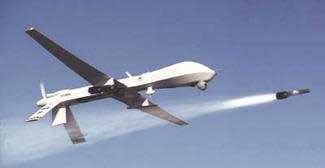 PESHAWAR: Of the 44 Predator strikes carried out by the American drones in the tribal areas of Pakistan in 12 months of 2009, only five were able to hit their actual targets, killing five key Al Qaeda and Taliban leaders, but at the cost of around 700 innocent civilian lives.
According to the figures compiled by the Pakistani authorities, the Afghanistan-based US drones killed 708 people in 44 predator attacks targeting the Pakistani tribal areas between January 1 and December 31, 2009. For each Al Qaeda and Taliban terrorist killed by the American drones, 140 civilian Pakistanis also had to die. Over 90 percent of those killed in the deadly missile strikes were innocent civilians.
The success percentage for the drone hits during 2009 is hardly 11 percent. On average, 58 civilians were killed in these attacks every month, 12 persons every week and almost two people every day. Most of the hits were conducted on the basis of human intelligence, reportedly provided by the Pakistani and Afghan tribesmen, who are spying for the US-led allied forces in Afghanistan.
Of the five successful predator attacks carried out in 2009, the first one came on January 1, which reportedly killed two senior al-Qaeda leaders – Usama al-Kin and Sheikh Ahmed Salim, both wanted by the American Federal Bureau of Investigation (FBI). Kin was the chief operational commander of Al Qaeda in Pakistan and had replaced Abu Faraj Al Libi after his arrest in 2004.
The second successful drone attack was conducted on August 5 in South Waziristan that killed the most wanted fugitive chief of the Tehrik-e-Taliban Pakistan Baitullah Mehsud along with his wife. The US State Department had announces a $5m head money for information leading to Baitullah , making him the only Pakistani fugitive with the head money separately announced by Islamabad and Washington.
Houthi Leader: Yemeni civilians targeted by design
31/12/2009 – Abd Al Malek Badreldin Al Houthi launched an urgent appeal today by audio message to listeners everywhere:
He questions the deafening silence of the world to the savage crimes against humanity now being committed in Yemen by Saudi, Yemeni, and USA warplanes targeting innocent civilians, and killing women and children, as they bombard population centers far away from the battle fields: towns, market places, mosques…
He also warns of the grave humanitarian crisis created by the bombing, and by the siege of North Yemen. No humanitarian assistance whatsoever has been provided by any party to the thousands of refugees and the wider population which is now starving for basic necessities.
This targeting of civilians is by design. Why the silence?
After all military efforts on the ground have failed to break the resolve of the Houthi fighters, bombing civilians has now become an instrument of war, to force the Houthi fighters to capitulate. All these crimes are being systematically documented.
These crimes only increase the resolve of the Houthis to defend themselves, and increase the numbers of fighters joining the battle.
Iran: U.S. Hasn’t Learned Lesson from Hiroshima
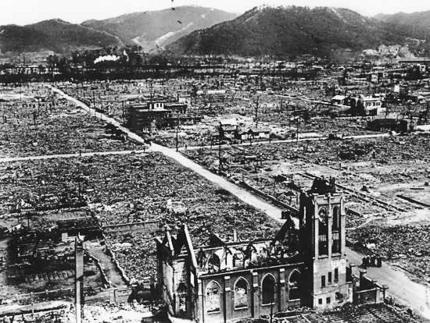 Kayhan News, Iran
Translated By Michelle Quay
27 December 2009
After visiting the lingering traces of America’s crimes in Hiroshima, Secretary of the Supreme National Security Council of Iran Sa’eed Jalili declared, “At the very least, the U.S. should be punished with disarmament and the revocation of its right to veto for its crimes here.”
According to several agencies, Jalili spoke at a press conference on the last day of his trip to Japan after visiting the site of the bombing and the Hiroshima Peace Memorial Museum, describing the message of Hiroshima as the obvious need for American disarmament.
Jalili said, “Because nuclear weapons lack legitimacy, no country or party should have such weapons at its disposal.”
In response to a question on his opinion after familiarizing himself with the pain, suffering and problems of the survivors of the U.S. atomic attack on Hiroshima, he said, “The Islamic Republic of Iran is familiar with the crimes by the United States in various parts of the world, including in Iraq and Afghanistan and even in Iran.”
Jalili explained, “Unfortunately America, which committed the crimes of Hiroshima, still continues the proliferation of nuclear weapons and experimenting with new generations of these types of weapons. Nowadays, however, the overwhelming message from the international community is for the disarmament of that country and its nuclear capabilities.”
The Islamic Republic of Iran intends to hold a conference in Tehran soon on disarmament and non-proliferation of nuclear weapons. In reference to this, Jalili said, “The Islamic Republic plans to hold this conference to honor of all the victims of weapons of mass destruction in Hiroshima, Nagasaki, Halabja and Sardasht, which all took place with the support of the United States and as a result of the incorrect behaviors of that country.”
The senior nuclear negotiator for the Islamic Republic of Iran warned, “Tehran intends to seriously follow up on the issue of disarmament and non-proliferation with the cooperation of the international community.”
Jalili clarified, “Those who have committed the worst crimes against the people of Hiroshima and humanity by using nuclear weapons should not be the ones to win a prize and enjoy the right of veto.”
He expressed regret that these powers still are continuing the politics of proliferation, the experimentation with new generations of nuclear weapons and the escalation of these weapons, and that they are even working towards nuclear proliferation.
Jalili added, “Who but America and some of its allies has given the Zionist regime control over nuclear weapons?”
Jalili reiterated the point that according to the core beliefs of the Islamic Republic, a lasting peace cannot be achieved without fighting against injustice and disarming America and the other nuclear powers.
While expressing his hope for the creation of a world full of peace, justice and happiness for all peoples of the world, Jalili emphasized that the events of Hiroshima must not be allowed to repeat itself.
In response to the question about why there is concern in the international community regarding Iran’s expanding nuclear program, the senior nuclear negotiator for our country said, “Visiting the nuclear power plant in Japan showed that nuclear energy, if utilized in a peaceful way, can be useful in order to serve nations, but unfortunately the United States has used them in weapons of mass destruction and today is creating more of these weapons and proliferating them. It has given the Zionist regime nuclear weapons and today intends to prevent nations from attaining peaceful nuclear energy.”
He said, “On the other hand, all nations must enjoy peaceful nuclear energy within the established framework of the International Atomic Energy Agency and the Non-Proliferation Treaty.”
On Hiroshima’s decision to hold a conference for countries that desire nuclear expansion, the representative of the Supreme Leader and Secretary of the Supreme National Security Council said, “It is a very good idea for those who possess nuclear weapons to come here and see what crimes America has committed against humanity.”
Jalili expressed regret that sixty years after the Hiroshima and Nagasaki disasters, still no American president has come to Hiroshima to offer an apology to the people of Japan and the city.
He added, “Even Barack Obama, the American president, who has used the slogan of change, refused to visit Hiroshima and Nagasaki during his trip to Japan.”
Jalili left Japan for Tehran on Thursday evening and extended an official invitation to the Japanese government for a five-day formal visit in Iran.
During his stay in Japan, Jalili met with senior Japanese officials including Prime Minister Yukio Hatoyama, Minister of Foreign Affairs Katsuya Okada, the head of the Japanese Diet and other groups of Japanese authorities, with whom he discussed and exchanged views on different issues in the interests of both countries, including ways to develop both international and regional cooperation.
In a meeting with Japanese experts and nuclear specialists in the Ferdowsi Hall of the Islamic Republic’s embassy in Japan, Jalili considered the latest developments in Iran’s peaceful nuclear program and responded to a limited number of questions from those present in the meeting.
Western troops accused of executing 10 Afghan civilians, including children
By Jerome Starkey In Kabul | The Times | December 30, 2009
Afghan investigators today accused US-led troops of dragging ten civilians from their beds and shooting them dead during a night raid.
Officials said that eight children and teenagers were among the dead and all but one of the victims were from the same family.
The reports led to angry protests in Kabul and Jalalabad, with children as young as 10 chanting “Death to America” and demanding foreign forces leave Afghanistan.
President Karzai sent a team of investigators to Narang district, in Kunar province, after reports emerged of a massacre. “The delegation concluded that a unit of international forces descended from a plane on Sunday night into Ghazi Khan village in Narang district of the eastern province of Kunar and took ten people from three homes, eight of them school students in grades six, nine and 10, one of them a guest, the rest from the same family, and shot them dead,” a statement on President Karzai’s website said.
Asked if the people were shot outside their homes, the President’s spokesman Waheed Omar said: “That is our understanding.”
Local elders confirmed that ten people were killed, but their accounts of raid differed.
“Three of the children were killed in their bedroom,” said a local elder Jan Mohammed. “The other five had their hands bound, then they were killed.”
According to the presidential statement, local US forces were “unaware of the incident”.
Investigators spoke to the headmaster of the local school who confirmed that all the children – aged 11 to 17 – were his students.
A spokesman for the US-led International Security Assistance Force (Isaf) was not immediately available for comment on the allegations.
A senior Western military official said that US Special Forces had been conducting operations in the area, separately from Isaf.
Military officials insisted the dead were all part of a cell responsible for manufacturing improvised explosive devices (IEDs).
“This was a joint operation that was conducted against an IED cell that Afghan and US officials had been developing information against for some time,” a senior Nato source said.
Israel Rules
By Paul Craig Roberts | December 28, 2009
On Christmas eve when Christians were celebrating the Prince of Peace, the New York Times delivered forth a call for war. “There’s only one way to stop Iran,” declared Alan J. Kuperman, and that is “military air strikes against Iran’s nuclear facilities.” [There’s Only One Way to Stop Iran, December 23, 2009]
Kuperman is described as the “director of the Nuclear Proliferation Prevention Program at the University of Texas at Austin,” but his Christmas eve call to war relies on disinformation and contradiction, not on objective scholarly analysis.
For example, Kuperman contradicts the unanimous report of America’s 16 intelligence agencies, the reports of the International Atomic Energy Agency, and Russian intelligence with his claim that Iran has a nuclear weapon program. Astonishingly, it does not occur to Kuperman that readers might wonder how an academic bureaucrat in Austin, Texas, has better information than these authorities.
Kuperman is so determined to damn President Obama’s plan to have other countries enrich Iran’s uranium for Iran’s nuclear energy program and medical isotopes that Kuperman commits astounding blunders. After claiming that Iran has a “bomb program,” Kuperman claims that “Iran’s uranium contains impurities” and that Ahmadinejad’s threat “to enrich uranium domestically to the 20 percent level . . . is a bluff, because even if Iran could further enrich its impure uranium, it lacks the capacity to fabricate the uranium into fuel elements.”
What was the New York Times op ed editor thinking when he approved Kuperman’s article? Iran, Kuperman writes, needs “90 percent enriched uranium” to have weapons-grade material, but cannot reach 20 percent or even make fuel elements for its nuclear energy. So, how is Iran going to produce a bomb? Yet, Kuperman writes that “we have reached the point where air strikes are the only plausible option with any prospect of preventing Iran’s acquisition of nuclear weapons. The sooner the United States takes action, the better.”
It could not be made any clearer that, as with the US invasion of Iraq, a military attack on Iran has nothing to do with weapons of mass destruction. An “Iranian nuke” is just another canard behind which hides an undeclared agenda.
One wonders about Kuperman’s non-proliferation credentials. How does a wanton military attack on a country encourage non-proliferation? Aren’t America’s bullying, threats and acts of war more likely to encourage countries to seek nuclear weapons?
At the end of the first decade of the 21st century, the United States has wars ongoing in Iraq where the ancient Chaldean Christian community was destroyed—not by Saddam Hussein but by the neoconservatives’ illegal invasion of Iraq—in Afghanistan, Pakistan, Yemen, and Sudan. The US initiated a war, which it lost, between its puppet ruler in the former Soviet province of Georgia and Russia.
The US, the world’s greatest supporter of terrorism, is the main financier of terrorist groups that stage attacks within Iran, and US money succeeded in financing protests against President Ahmadinejad’s re-election and in dividing the ruling Islamic clerics. It was American money, weapons, and diplomatic cover that enabled the Israeli war crimes against the Lebanese people during 2006 and against Palestinian civilians in Gaza during 2008-2009, crimes documented in the Goldstone Report.
Iran has never interfered in US internal affairs, but the US has a long record of interfering in Iranian affairs. In 1953 the US overthrew Iran’s popular prime minister, Mohammed Mosaddeq and installed a puppet who tortured Iranians who desired political independence.
Despite this and other American offenses against Iran, Ahmadinejad has repeatedly expressed Iran’s interest to be on friendly terms with the United States, only to be repeatedly rebuffed. The US wants war with Iran in order to expand US world hegemony.
One might expect a non-proliferation expert to take history into account, but Kuperman fails to do so. Kuperman also has nothing to say about Israel’s, India’s and Pakistan’s nuclear weapons. Unlike Iran, none of these countries are signatories to the Nuclear Non-Proliferation Treaty. Israel, India, and Pakistan all developed their nuclear weapons in secret, and many experts believe Israel had American help, an act of treason. All three countries have been rewarded by Washington despite their perfidy. Why is Kuperman concerned about Iran, which submits to the IAEA inspections, but is unconcerned with Israel, a country that has never permitted a single inspection?
The answer is that the Israel Lobby, the US military-security complex, and the “Christian” Zionists have succeeded in demonizing Iran. Every real expert knows that an Iranian nuclear weapon would have no function other than deterring an attack on Iran. Ever since the US lost its monopoly on nuclear weapons, after using them offensively and pointlessly against a defeated Japan, nuclear weapons have served no purpose other than deterrence.
The US has no conflicting economic interests with Iran. Iran is simply a supplier of oil, an important one. A US attack on Iran, such as the one advocated by Kuperman, would most likely shut down oil flows to the West through the Strait of Hormuz. This might benefit refiners, who sell gasoline to the West and could charge enormous prices, but no one else would benefit.
Adding to the war cry are congregations of fake Christians. A great number of them, organized by someone’s money under the banner, “Christian Leaders for a Nuclear-free Iran,” has written to Congress demanding sanctions against Iran that amount to an act of war. The roll call includes the “Christian” Zionist John Hagee, who, according to reports, denigrates Jesus Christ and preaches to his illiterate congregation that it is God’s will for Americans to fight and die for Israel, the oppressor of the Palestinian people.
Among the signatories of the “Christians” demanding an act of war against Iran, are Dr. Pat Robertson, president of Christian Broadcasting Network, Nixon-era criminal Chuck Colson, and Richard Land, president of Ethics and Religious Liberty Commission, Southern Baptist Convention. Obviously, for southern Baptists ethics means murdering Islamists, and religious liberty excludes everyone but “Christian” Zionists.
It is a simple matter for an educated person to make fools of these morons who profess to be Christians. However, these morons have vast constituencies numbering in the tens of millions of Americans. There are, in fact, more of them than there are intelligent, informed, moral, and real Christian Americans.
The votes of the morons will prevail.
In the second decade of the 21st century, America’s Zionist wars against Islam will expand. America’s wars in behalf of Israel’s territorial expansion will complete the bankruptcy of America. The Treasury’s bonds to finance the US government’s enormous deficits will lack for buyers. Therefore, the bonds will be monetized by the Federal Reserve. The result will be rising rates of inflation. The inflation will destroy the dollar as world reserve currency, and the US will no longer be able to pay for its imports. Shortages will appear, including food and gasoline, and “Superpower America” will find itself pressed to the wall as a third world country unable to pay its debts.
America has been brought low, both morally and economically, by its obeisance to the Israel Lobby. Even Jimmy Carter, a former President of the United States and Governor of Georgia recently had to apologize to the Israel Lobby for his honest criticisms of Israel’s inhumane treatment of the occupied Palestinians in order for his grandson to be able to run for a seat in the Georgia state senate.
This should tell the macho super-power American tough guys who really runs “their” country.
“Four Afghan civilians killed in Baghlan air raid”
Haji Farid, a lawmaker from the Kapisa province – “every time an American soldier gets killed, they bomb an entire village. The president should determine to whom this country belongs.”
By Habib Rahman Sherzai |RAWA | December 29, 2009
Four civilians have reportedly been killed and eight others wounded in a fresh air strike by foreign forces in northern Baghlan province, residents alleged on Tuesday.
The overnight attack took place in Kohna Qala area of Baghlan-i-Markazi district, residents told Pajhwok Afghan News. The fresh air raid came about three days after 10 civilians were killed during military operations in eastern Kunar province.
The Saturday air strike in Kunar drew condemnation from the lawmakers on Monday who walked out of the session and later a parliamentary delegation met President Hamid Karzai to show their resentment. Karzai ordered a serious probe into the attack that killed ten people including eight school children in Badeel area in Narang district.
In the last night air raid, the dead included a father and his three sons, who were killed while running to escape the bombardment, a teacher at the Jamiat Aburjaee High School in the area, Karim Safi, told Pajhwok Afghan News.
A student of the school, Karim Javed, said that the air raid also left many people wounded including a student of his school.
Head of the district hospital, Abdul Qahir Qanit, said they had received eight injured people delivered to the hospital with a woman and a child in a critical condition.
However, provincial police chief Kabir Andarabi said the aircrafts targeted Taliban. He claimed the attack killed eight Taliban fighters and injured seven others. The dead bodies of two slain militants were still lying on the ground at the site, he said.
The war in Afghanistan is becoming deadlier, killing 10 percent more civilians during the first 10 months of 2009 compared to the previous period last year, according to UN figures.
UNAMA said that 468 deaths were caused by pro-government forces, including NATO and US-led forces, and 166 by “other actors.
Meanwhile, a gun-battle broke out between police and militants after the latter attacked their checkpost in Shar-i-Qadeem area of the Baghlan-i-Markazi district, police spokesman, Javed Basharat, said.
One fighter was killed and another three injured in the clash that also left three policemen wounded, he added.
However, Taliban spokesman Zabihullah Mujahid claimed the fighters killed eight policemen and wounded as many during the firefight. Acknowledging the killing of their one fighter in the clash, Mujahid said the fighters also abducted one cop.
Featured Video
Dan Dicks with James Corbett on Solutions Watch
or go to
Aletho News Archives – Video-Images
From the Archives
$1.5bn up in smoke: US THAAD missile stockpile dries up defending Israel against Iran
By Ivan Kesic | Press TV | July 2, 2025
According to American media, defense news outlets, and independent analysts, the 12-day Israeli military aggression against Iran significantly depleted the US stockpile of THAAD (Terminal High Altitude Area Defense) interceptor missiles.
Citing official sources, American magazine Newsweek reported on Friday that the US transferred a substantial portion of its advanced missile defense capabilities to support the Israeli regime, an effort with questionable results and a critical impact on US strategic reserves.
THAAD, developed by Lockheed Martin arms manufacturing company, is a key component of Israel’s multi-layered air defense architecture. It is designed to intercept medium-range ballistic missiles, including those launched from Iran and Yemen.
The US-made system is capable of targeting short-, medium-, and intermediate-range ballistic missiles during their terminal phase, whether inside or outside Earth’s atmosphere.
THAAD uses a “hit-to-kill” method, relying on kinetic energy rather than explosive warheads to destroy incoming threats, intercepting at altitudes of up to 150 km and ranges between 150-200 km.
Operated exclusively by American personnel, the US military maintains eight THAAD batteries with an estimated 350–400 interceptors in total. The eighth battery was activated during the June 20 Israeli aggression against Iran and is capable of intercepting hypersonic missiles. … continue
Blog Roll
 Aletho News
- Zionist Bought Senate Blocks Information About American Citizens Killed By Israel
- While Gaza dominates the UN, these are the people keeping it alive
- New Report: “Scholasticide and Genocide in Gaza: Assessment, Testimonies and Legal Analysis”
- ‘THAAD Delusion’: Iran war exposes US missile shield limits – The Atlantic
- Moscow issues warning to NATO over Russian exclave
- Yes, the Iran war has destroyed Trump’s presidency
- The fallacy of US delusions about Iran’s economic collapse
- Hezbollah denies Syria cell link, warns of Israeli plan to sow discord
- The legacy of US sanctions, war, and occupation in Iraq
- Iraqi resistance group rejects disarmament, vows to maintain support for Lebanon
- If Americans Knew
- Mamdani releases plan to combat antisemitism and hate crimes in New York City
- Iran’s Revolutionary Guards Publish Letter to the American People
- DMFI launches $1 million ad campaign supporting Virginia’s Elaine Luria
- US Senate blocks resolution seeking report on Americans killed by Israel
- Israeli Attacks Kill Ten Palestinians in Gaza
- Massacre at Minab: The School That Became a Grave
- Israeli media: The IDF Shows It Doesn’t Turn a Blind Eye; It Actively Emboldens Settler Havoc
- As settlers ravage West Bank, Israeli forces kill 10 in Gaza – Daily Update
- New Report: “Scholasticide and Genocide in Gaza: Assessment, Testimonies and Legal Analysis”
- Ex-Biden officials are desperate for a Gaza scapegoat
- No Tricks Zone
- Green Energy Debacle: German Expert Professor Fritz Vahrenholt Warns Of Severe Economic And Social Consequences
- Two More Paleo Reconstructions Affirm Meters-Higher Sea Levels Across Ireland, Brazil 7000-6000 Years Ago
- New Study: Earth And Venus Surface Warmth Largely Explained By Convection And Lapse Rate, Not CO2 Or Radiation
- 2025 Nature Paper Claiming Worsening Global Drought Gets RETRACTED …Heavily Flawed
- New Study: ‘Global Drought Shows No Detectable Recent Acceleration Under Climate Warming’
- Economic Masterminds: German Socialists Suggest Taxing Productivity Gains Stemming From Using AI
- The South China Sea Has Not Been Cooperating With The Climate Change Narrative
- Energy Crisis: Germany Enters Heating Season With Historically Low Gas Reserve Fill Levels
- New Study: The Antarctic Ice Sheet Gained Mass From 2020-2024 Due To Staggering Snow And Ice Accumulation
- Study: Ocean Heating Rates From Thousands Of Years Ago ‘Dwarf’ Modern Ocean Heating Rates

