Understanding the Ukraine Crisis From the Last Free Enclave in Europe – Outside of Russia and Belarus, That Is
By Aleksandar Pavic | Strategic Culture Foundation | March 3, 2022
To any Serb who has not lost his mind or has just become numb from three decades of relentless anti-Serbian propaganda and lies emanating from the “free and democratic” West’s power centers and media – the speed and totalitarian scope of anti-Russian measures and the intensity of anti-Russian propaganda censorship that has captured the West cannot come as a surprise. As Serbian president Aleksandar Vucic stated a few days before the beginning of Russia’s denazification and demilitarization campaign in the Ukraine, about 85% of Serbs are “always” on the side of Russia. Even as Serbia has, over the past several days, come under immense Western pressure as the lone independent enclave in Europe, a sort of a West Berlin of the new multipolar world in the making, surrounded by NATO and/or EU countries that have been, with varying degrees of voluntarity, sucked into the ongoing anti-Russian hysteria and the accompanying sanctions, closing of airspace to Russian planes, etc.
The reason is simple, even if one sets aside the centuries-old spiritual, ethnic and just plain fraternal ties between the two peoples. For the Serbs were, so to speak, the canaries in the coal mine in the years that followed George Bush Senior’s proclamation of a “new world order.” Early on after the fall of the Berlin Wall, at the beginning of the 1990s, while innocents and just plain people of good will were still enamored with the announced “end of history” and the glorious triumph of “liberal democracy,” in the Serbian parts of Yugoslavia, we were experiencing, firsthand, something completely different, dark and ominous. We were witnessing the gradual return of pure, cynical power politics, only this time couched in the clothing of politically correct, sugarcoated homilies invoking “human rights,” “democracy,” “European integration” and “peace,” which, as it soon enough turned out, served as a mere “liberal” fog of war, as a preparatory rhetorical, diplomatic and media artillery fire for legitimizing the West’s self-anointed right to define what is good and what is not and to, on the basis of the newly prescribed definitions, interfere and expand its purely pragmatic, base interests wherever it could. The world was the victorious West’s oyster, “democracy expansion” its new quasi-religion, putting a moral veneer on its newest geopolitical outreach, a modernized version of the “white man’s burden” couched in the newfangled terminology of a supposedly post-ideological era.
Thus, during the violent dismemberment of Yugoslavia, its chief external instigators and facilitators – led by Germany and Austria, with essential help from the U.S. ambassador to Yugoslavia – could, thanks to their vast domination of the media-informational space, present themselves as “peace brokers” and, even more sickening, as moral arbiters. The new-old expansionist West could portray itself to the uninformed and the gullible as some sort of force for good, while painting the enemy – the Serbs then, the Russians today – as evil incarnate. It was on the ashes of the Western-fomented destruction of Yugoslavia that the myth of “indispensable NATO”, “benevolent EU” and the “good West” received much of their subsequent affirmation and post-Cold War soft power. And therein lies much of the reason why Russia’s – and not only Russia’s – endless polite requests and pleas to halt the North Atlantic military pact’s steady expansion to the east, were not taken seriously, or at least seriously enough, by a critical mass of those who had no direct contact with the Western wolves in sheep’s clothing, like the Serbs (and the Syrians, Libyans, Iraqis, Afghans, Yemenis, Somalis, Venezuelans, etc.) did. Simply put, the West was only starting to spend the huge surplus moral value it had accrued as victor of a global struggle with an “evil empire,” the chinks in the (artificially manufactured) armor were still too microscopic for the ordinary, inexperienced, well-meaning eye to detect.
Even NATO’s illegal bombing of the Federal Republic of Yugoslavia in spring of 1999, in the name of “prevention of genocide” in Serbia’s historic and sacred Kosovo province – of which no evidence has ever been presented over the ensuing 23 years – did not awaken the critical mass of Western public opinion and decision-makers necessary to reexamine the wisdom and necessity of continuing on the path of, essentially, a new Drang nach Osten (however, seeing what happened with Trump, much later in the game, it’s beyond obvious that election outcomes and decision-making in the West have been captured by the military-industrial complex even then, just as Eisenhower had warned back in 1961) .
It did, however, finally awaken Moscow, opening the way to Vladimir Putin’s ascendance to Russia’s highest office on the last day of that fateful year. Like the Serbs, the Russians still remembered the true horrors of the last world war and could recognize the all-too-familiar patterns far more easily than most on the European continent. Unfortunately, Moscow could not do much about them initially, other than to ceaselessly warn, beginning with Munich in early 2007, ask for a general reassessment and renegotiation of common European security and – aware that its tactful warnings, suggestions and proposals were being blithely ignored in the key Western capitals – rearm and prepare itself for the inevitable. Which finally came with the collective West’s refusal to talk about Ukraine’s neutrality and the halting of NATO’s further expansion, in parallel with the Ukrainian puppet president’s raising of the threat of Ukraine becoming a nuclear state.
Why would Moscow agree to the very real possibility of nuclear missiles deployed at its borders, which could reach it in 7-8 minutes (and, in the case of future hypersonic missiles, in 5-6 minutes)? Why would it trust NATO’s (true) power centers, whose leading figures had assured it that not one further inch would be taken to the east as the Warsaw pact self-dissolved – and then proceeded to do precisely the opposite?
So, no, the endless verbal assurances and endless empty talk of the past three decades would no longer work, as all Russia had gotten out of it was a hostile, Axis-like alliance at its borders and a campaign of steadily rising demonization that had, of late, in many aspects exceeded that experienced by the U.S.S.R. at the height of the Cold War. When threatened with nuclear missiles under its nose in Cuba, the U.S. was willing to launch nuclear war to prevent it. Russia has threatened no such thing.
A day after the beginning of the Russian demilitarization and denazification campaign, Serbia’s president announced Serbia’s official position regarding the situation in Ukraine, as outlined in the conclusions of the Serbian National Security Council. In essence, Serbia’s position is that it respects Ukraine’s territorial integrity as it respects the territorial integrity of all states in accordance with the UN Charter and the Helsinki Act of 1975, that it considers the violation of the territorial integrity of any state, including Ukraine “very wrong,” but that it will not impose sanctions against the Russian Federation.
It is enough just to look at a current political map of Europe to see the significance, courage and difficulty of Serbia’s decision. Serbia and neighboring Bosnia and Herzegovina (BiH) are islands in the NATO sea that surrounds them – and BiH is not a NATO member only due to the opposition of the Serbs in that country, led by the Serbian member of the BiH Presidency, Milorad Dodik. In addition, all the surrounding states have joined the Western condemnations of Russia’s intervention in Ukraine and have joined or voiced support for the newest sanctions imposed on Russia, including the EU’s closure of air space to Russian planes.
As expected, over the past few days, as testified by Vucic himself, Serbia has been subjected to “intense” Western pressure to join the sanctions and condemnations front against Russia. The EU Parliament Rapporteur for Serbia, Vladimir Bilchik has already stated that Serbia’s decision not to join the EU’s sanctions against Russia is a “defining foreign policy decision for much broader relations between the EU and Serbia.” Former Swedish foreign and prime minister and the first High Representative for BiH Carl Bildt Tweeted that Serbia has “de facto disqualified itself from the EU accession process,” as new members are expected to share in the EU’s “fundamental values and interests.” European Commission spokespeople Ana Pisonero and Eric Mamer have also voiced expectations that Serbia would join the EU sanctions policy.
These are all rather ominous words – and not because anyone in Serbia, other than a handful of well-paid diehards and hopeless cases, truly believes that the country will ever be admitted to the self-proclaimed “most successful peace project in human history” (which expressly approved the sending of fighter jets to neo-Nazi “democrats” in Ukraine), but because the out-of-control Western elites’ “either you’re with us or against us” mentality is certain to find ways to make its displeasure known to all dissidents. Especially to an encircled, friendly-to-Russia enclave that stubbornly refuses to join the anti-Russian hysteria being fanned all over the Western “liberal” landscape. After all, Serbia was viciously and illegally bombed by NATO in 1999 for not voluntarily agreeing to its own occupation by the alliance of “democratic values.” Since then, the alliance has gained 11 more members and about a thousand kilometers to the east. So, we shall wait and see in the coming days and weeks what practical measures of punishment or censure will be applied by the EU (and NATO) against Serbia, which has been an official candidate for EU membership since 2012 and is, thus, obliged to gradually harmonize its policies, including foreign policy, with the “peace loving” union.
Russia has shown appreciation and understanding for Serbia’s position. In his reaction to Serbia’s official stance, the Russian ambassador in Belgrade stated that Russia “understands that Serbia is being pressured and does not ask anything of Serbia,” being well aware of the mutual respect and trust that exist between President Vucic and Russia’s President Putin, that Serbia “respects Russia’s national interest,” and that Russia is “at peace” with Serbia’s position and its foreign policy.
In addition, as stated in the National Security Council conclusions, Serbia was itself a victim of Western sanctions during the 1990s and, even more importantly, aggression on the part of 19 NATO states in 1999 precisely for defending its own territorial integrity. In other words, Serbia is not only refusing to join Western sanctions against a traditional friend and ally but also to be a part of traditional Western double standards, which it has felt on its own skin both in the past and in the present. Towards that end, the speaker of the Serbian parliament, Ivica Dacic, clearly stated that, unlike the rest of “democratic” Europe, Serbia would not join in the “totalitarian” methods and close or censor either Sputnik or RT. So, as things stand, Sputnik’s last non-Russian European outpost now sits in Belgrade, which is, nevertheless, still not sufficiently “democratic” to pass muster with the free-thinking bureaucrats in Brussels
On that same tangent, because you can never have too much trans-Atlantic hypocrisy, the U.S. embassy in Belgrade also reacted to Serbia’s position regarding the Russian intervention in Ukraine by Tweeting that the U.S. “salute Serbia’s and President Aleksandar Vucic’s repeated position of support for Ukraine’s territorial integrity, which was violated by Russia’s illegal and completely unprovoked attacks.”
Aside from the brazen twisting and pure invention in which the U.S. embassy engaged – as no Serbian official has used any remotely harsh words to describe Russia’s intervention – American diplomats are conveniently ignoring the fact that their own country has been consistently and aggressively violating Serbia’s own territorial integrity since February 2008, when the U.S. recognized the independence of Serbia’s historical and sacred province of Kosovo (Kosovo and Metohija is the full name of the province, in accordance with the Serbian constitution). And, of course, except for the 5 EU states that have refused to recognize the secession of so-called Kosovo from Serbia (Greece, Cyprus, Romania, Spain and Slovakia) – the rest of the EU, headed by its most powerful members (Germany, France, Italy and the Benelux countries), is also being its usual hypocritical self in expecting Serbia to condemn violations of other’s territories when the majority of its own member states have also recognized the violation of Serbia’s territorial integrity by recognizing “Kosovo” and, indeed, actively promoting its “independence” which, in practice, is non-existent, as the territory is a black hole of drug and human trafficking, whose politicians take orders from abroad, as well as home to a large U.S. military base built on land stolen from Serbs.
The Serbian leadership’s initial decision met with the support of the great majority of the Serbian public, which is, nevertheless, well aware of Serbia’s difficult position. However, on March 2, Serbia joined the majority in the UN General Assembly and condemned the Russian “aggression against Ukraine.” In a rather sorry display of public self-pity, Vucic tried to justify the vote at a press conference by explaining that Serbia still refused calls to join the anti-Russian sanctions, as well as resisting new Western pressures to nationalize Russian-owned property in Serbia. However, his popularity will suffer as a result, so it’s still a win-win for Western interests in Belgrade, because they always prefer weakened leaderships, as they are more pliable and, thus, sensitive to outside pressure.
Serbia’s current position is eerily reminiscent of the country’s position in the spring of 1941. At that time as well, the Serbian elite in the Kingdom of Yugoslavia was the lone voice of opposition in the country against joining the Axis powers, even though Yugoslavia itself was, along with Greece, surrounded by countries that had fallen under the occupation or political domination of the Axis powers. As a result of the coup of March 27, 1941, organized by Serbian officers opposed to a pact with the Axis, Yugoslavia was attacked by Germany and its allies on April 6, 1941, the country itself dismembered and occupied, and the Serbian population subjected to political repression and genocidal annihilation over the next four years. Although the Serbs organized two large guerilla liberation fronts, it was only with the aid of the Soviet Red Army that the territory of Yugoslavia was fully liberated in the fall of 1944. Alone among the former peoples that made up Yugoslavia (which also included Croats, Slovenes and Slavic Muslims, along with substantial Albanian and Hungarian minorities), the Serbs still remember this, just as many Russians remember that only the Serbs refused to join Nazi German troops on the Eastern Front against the U.S.S.R.
Might this be, in Yogi Berra’s immortal words, déjà vu all over again?
Public health needs restrictions
It is time for a taste of its own medicine
By Vinay Prasad MD MPH | February 26, 2022
Just yesterday, I read that NYC public schools will remove the OUTDOOR mask mandate starting Monday. How Brave!
Let’s reflect on this for a moment. NYC school district has been requiring children wear masks OUTSIDE all this time. Years after we knew the virus almost never spreads outside. During recess when kids play, forced to wear a mask while exerting themselves. Wow!
Whoever made the policy is an idiot. No way around it. They are not fit for policymaking. They abused the power of government to coerce children (at incredibly low risk of bad outcomes) to wear a mask in a setting where the virus simply does not spread. In other words, they participated in something done in the name of public health, which actually made human beings worse off. Worse, they used coercive force to do it.
Post-COVID we need to seriously talk about setting restrictions. But not on people. We need to place restrictions on public health and things done in the name of public health. We cannot allow individuals who are poor at weighing risk and benefit and uncertainty to coerce human beings, disproportionately the young and powerless (waiters/ servers) to participate in interventions that have no data supporting them, for years on end.
Public health be the subject of restrictions; a taste of its own medicine. Some of those restrictions should be placed on governments, but others on private actors who are appealing to public health. Here is what that might look like:
- In an emergency situation, if governments mandate or advise individual level behavioral interventions (e.g. masking), those entities should have to generate robust data in 3 months (cluster RCTs) to demonstrate efficacy, or the intervention is automatically revoked. Some may argue 3 months is too short, but if it is truly a crisis warranting emergency proclamations, then you should see a signal in 3 months, and governments can expand sample size to ensure prompt results.
- If a trial is positive that does not mean the policy continues forever, but must be debated (net benefit/ net harms/ tradeoffs) by the body politic.
- Private entities should be prohibited from mandating emergency drug products. Check out this tweet by my conversation partner— VPZD PODCAST— Zubin Daminia:
Cal Academy is a museum in Golden Gate Park. Do they have any business nor ability to mandate boosters in adolescents? No, it is absurd. Two senior officials with the FDA— Gruber and Krause- resigned over this decision. Paul Offit and Luciano Boro and others have been publicly critical of boosters for young people, and Cal Academy mandates it? Cal Academy is not qualified to make this decision.
- The same is true for daycares and private schools that have already mandated kids vax 5 to 11. Should random private individuals be permitted to coerce vaccination under Emergency Use Authorization (EUA)? I believe restrictions must be put in place to prevent them from doing such a thing. Perhaps it should be explicit that it is illegal to coerce any medical product under EUA status. This would stop Cal Academy and private schools.
- The same is true for boosters. Colleges should be prohibited from mandating medical products under the auspices of EUA. What is going on right now on college campuses is astonishing foolishness.
- Hospital patients deserve a bill of rights. Prohibitions on visitation, particularly of children or older people; especially near the end of life were cruel and disgusting. Even long after PPE was adequate— into 2022— these rules continued. Patients need a bill of rights, and hospitals should face severe restrictions on their ability to banning visitors. To my knowledge the US has not— like Hong Kong— Separated a baby from her parents, but our rules are unjust.
- Do people have the right to return to the their home country? Read this excellent article about Australians trapped in India. This is an important issue.
- Who decides if schools should close? Schools are too important to permit local decision makers to close them for years on end. In the USA, this happened along partisan lines, with the most progressive cities punishing children the most. There has to be some bill of rights for kids to prevent this from happening. Schools might need to close in rare circumstances in the future, but this should be done only in extraordinary times, and no one can justify closing schools only in Democratic cities. Kids need a real champion, and it is not the AAP.
These are just a few examples of where governments or institutions have overreached in the name of public health, but there are many more. Post COVID, the group that needs to face the strongest restrictions is public health itself. We must careful remove the power we have granted public health, which has often been misused.
Vinay Prasad MD MPH is a hematologist-oncologist and Associate Professor in the Department of Epidemiology and Biostatistics at the University of California San Francisco. He runs the VKPrasad lab at UCSF, which studies cancer drugs, health policy, clinical trials and better decision making. He is author of over 300 academic articles, and the books Ending Medical Reversal (2015), and Malignant (2020).
UKRAINE: Hysterical Western Reaction, Retaliation – May Lead to Wider War
By Peter Ford | 21st Century Wire | February 26, 2022
Russophobe, germophobe, it’s all the same.
I simplify. But it’s striking how the loudest Russophobic voices include all the same voices which were similarly hysterical about Covid – the mainstream media, the Labour Party, and the liberal elite (which includes much of the Conservative Party), while the few voices calling for even a modicum of restraint or understanding of Russia include anti-lockdown Farage (on GB News) and Trump, both of the Right. Piers Corbyn and Jeremy Corbyn, virtually alone on the Left have spoken up, while Starmer has forced 11 of his MPs who signed a Stop The War statement to withdraw their signatures.
The Labour Party in fact has tried to outflank the Tories on the Right, demanding the silencing of RT, the Russian broadcaster.
The Ukraine crisis rubs home the same messages we received loud and clear during the Great Covid Hysteria: Left and Right are meaningless now, the default option for any untoward contingency arising is to go to panic stations, muzzle any dissent, and bring in restrictions/interventions/sanctions without a thought about the side effects, or even direct consequences.
Just as Covid lockdowns were imposed regardless of wrecking society and economy, so the West is now imposing drastic sanctions on Russia without anybody even asking the question: well, might not Russia retaliate, with cyber attacks for example? It’s not appeasement to pause to consider if our moves might backfire, that’s just plain prudence and a sense of responsibility. And what about gas and petrol prices? Collapsing stock markets? Sterling, anyone?
Nor is it appeasement to appreciate that the problem didn’t begin just yesterday, that the West was asking for trouble sooner or later when it incorporated much of the former Soviet Union into its own sphere of influence (NATO membership), and started to establish forward military positions in Ukraine even though formally Ukraine was not a member of NATO. We poke the Russian bear and then cry in horror when it responds by showing its claws.
Grabbing other people’s land is always wrong. But tell that to the Americans, who have endorsed Israel’s annexation of Palestinian and Syrian territory without even a semblance of support from the inhabitants. The Americans have also stationed military forces in North East Syria, denying access to the region’s oil by the Syrian government, pretexting a pseudo-mission of ‘keeping ISIS out’ – when ISIS no longer poses any real threat. Tell NATO ally Turkey which mounted a similar ‘peacekeeping’ mission across its border into North West Syria, killing hundreds of Syrian government forces in the process and sustaining in control a local jihadi regime. Nobody in NATO breathes a word against any of this.
It’s not all bad news. The aggravation of the already dire energy situation is creating a new equation: people are realising you can have zero emissions, or you can be warm.
However, looking at the downside, the conflict over Ukraine could harm the cause of freedom supporters if the perception grows that we are siding with the nation’s enemies. Some might even say that our support for peace is toxic. But what is there to lose? We are demonised, harassed and persecuted already. And nobody else is interested in making peace, only in pouring fuel on the flames with arms supplies and punishing Russia with backfiring sanctions.
Putin may be making the same calculation, that he has nothing to lose. The West spurned feelers he put out about a neutral status for Ukraine, application of the Minsk accords on a settlement for the Eastern areas, and revival of arms limitation treaties. Why not go the whole hog and practise the same regime change tactics the West used or tried to use in Afghanistan, Iraq, Libya and Syria?
Peter Ford is a global affair analyst and former British Ambassador to Syria (2003-2006) and Bahrain (1999-2002).
Dublin and Monaghan – Britain forgets its recent history of “unleashing war in Europe”
By Gavin O’Reilly | OffGuardian | February 26, 2022
In the early hours of Thursday morning – in what will perhaps finally result in the COVID-19 mainstream media narrative being permanently banished from the headlines – almost nine years of Western provocations via its Eastern European proxy state Ukraine would culminate in Russia launching a military intervention into its Western neighbour.
With attempts to peacefully resolve the situation peacefully by Moscow over the past several months ultimately proving fruitless due to Kiev failing to implement its side of the Minsk Agreements – which would see a federalisation solution in which the breakaway pro-Russian Republics of Donetsk and Luhansk, located in the predominantly ethnic Russian Donbass region of eastern Ukraine, being given a degree of autonomy whilst still remaining under the rule of Kiev.
Instead, both Republics were given formal recognition by Moscow on Monday, in response to the breakdown in negotiations.
With Russian President Vladimir Putin outlining in his speech commencing the military operation that a decisive factor in launching the intervention was a failure by NATO to honour a previous agreement that it would not expand eastwards following the end of the Cold War, and that the intention of the operation is to destroy Ukrainian military infrastructure that would ultimately be used by the alliance against Russia should Kiev become a member.
One can only hope that the current situation doesn’t escalate further into a long-term conflict in which ordinary Ukrainian citizens will suffer, or indeed a catastrophic global conflict involving the use of nuclear weapons should NATO decide to intervene directly – with Ukraine having come under the influence of the US-NATO hegemony following the 2014 Euromaidan, a CIA and MI6 orchestrated regime-change operation launched in response to then-Ukrainian President Viktor Yanukovych’s November 2013 decision to suspend a trade deal with Brussels in order to pursue closer political and economic ties with Russia.
The immediate Western reaction following Thursday’s intervention however, was to predictably shift all blame onto Moscow and pay little to no attention to the almost nine years of provocations which had preceded it – such as Western support for the notoriously anti-Russian neo-Nazi Azov Battalion of the Ukrainian National Guard, established post-Maidan. Both of which played a key role in Kiev’s war on Donetsk and Luhansk following their secession in April 2014, a month after the historically Russian peninsula of Crimea voted to reunify with Moscow.
British Prime Minister Boris Johnson also accused Moscow of ‘unleashing war in Europe’, seemingly forgetting his own warmongering in Iraq, Syria and Yemen, and also Britain’s not too distant history of unleashing war on its nearest European neighbour – Ireland.
In 1974, the occupied north of Ireland had been in a five-year-long grip of escalating violence – the civil rights movement, established in 1967 to seek equal rights for the north’s Irish Nationalist community, had been met with violence every time they took to the streets, being beaten and teargassed by a predominantly British Unionist police force.
This violence would eventually culminate in Bloody Sunday, the massacre of 14 civil rights demonstrators by the British Army in Derry in January 1972 – London having deployed its forces to the north in 1969, using the pretence of being a neutral peacekeeper between two warring sides as a means to counter the influence of the IRA, re-organised the same year in response to the ongoing violence, and whose membership would grow exponentially following the massacre.
Indeed, such was the violence inflicted on the Nationalist community of the north of Ireland by Britain and its proxies, that the southern 26-county Irish state would soon begin to dissent from its traditionally pro-British stance.
In 1969, during the initial outbreak of violence, then-Taoiseach Jack Lynch threatened to send troops to the north in order to protect Irish Nationalists, in 1970 government ministers Charles Haughey and Neil Blaney would be dismissed from their posts following a collapsed trial where they were alleged to have planned to import arms for use by the IRA, and in the aftermath of Bloody Sunday, Irish police stood by as protesters burned down the British Embassy in Dublin.
Britain, fearing that Dublin would go on to become an official state sponsor of the IRA, decided that a message had to be sent.
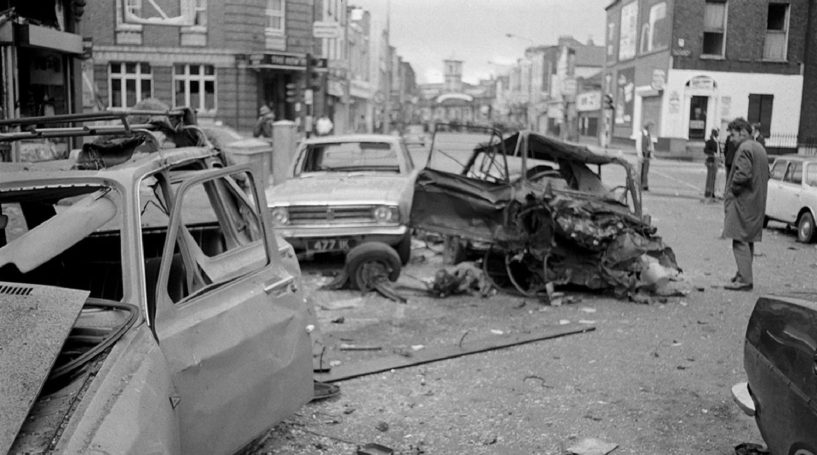
On the 17th of May 1974, a Friday afternoon, three no-warning car bombs detonated during rush hour traffic in Dublin, killing twenty-seven people, ninety minutes later, another no-warning bomb would explode in the border county of Monaghan, killing seven.
300 people would suffer injuries as a result of the bombings also, with the Irish Free State returning to its traditionally pro-British stance regarding British occupation of the north in the aftermath.
These coordinated attacks, resulting in the largest loss of life in a single day during the most recent phase of conflict related to the occupation of Ireland, were carried out by the Ulster Volunteer Force (UVF), a Loyalist terrorist organisation operating under the command of the clandestine Special Reconnaissance Unit (SRU) of the British army.
This use of proxy terrorist groups by Downing Street was later used as a tactic against both Libya and Syria in 2011 and into the present day, having been perfected by Britain’s unleashing of war in Europe in 1974.
Gavin O’Reilly is an Irish Republican activist from Dublin, Ireland, with a strong interest in the effects of British and US Imperialism; he was a writer for the American Herald Tribune from January 2018 up until their seizure by the FBI in 2021, with his work also appearing on The Duran, Al-Masdar, MintPress News, Global Research and SouthFront.
Obrador calls US bankrolling of Mexican opposition groups ‘shameful’
Press TV – February 22, 2022
President Andrés Manuel López Obrador has called on Washington to stop the “shameful” bankrolling of Mexican opposition groups, and refrain from intervening in the country’s internal affairs.
At a news conference on Monday, Obrador lashed out at the Joe Biden administration for not explaining why it finances political groups in Mexico that are opposed to his Fourth Transformation.
“We are asking the US government to no longer finance groups that act openly, opponents of governments, in my case, in our case, of a legally and legitimately constituted government, because it is an interventionist act, a violation of our sovereignty,” the Mexican president stressed.
“It is a ‘shame’ for any government in the world to get involved in the internal life of another country … plus, handing over money,” he said, adding that the US behavior is a breach of Mexico’s sovereignty.
Obrador (AMLO) won a landslide victory in Mexico’s 2018 presidential election on the promise that he would lead a ‘Fourth Transformation’ (4-T) of the North American country, aimed at ending endemic corruption, criminal violence and deep-rooted socioeconomic inequality.
Obrador had warned the US in May last year against providing funds to political groups in Mexico.
Since last year, he has repeatedly insisted that groups such as ‘United Mexicans Against Corruption’ (MCCI), founded by entrepreneur Claudio X. González, with funds from the United States, have created impediments in his works, such as the Felipe Angeles International Airport and the Mayan Train.
As per media investigations, between 2019 and 2020, the group received financing of around 25 million pesos (1.2 million USD) from the US government, a report in Mexico Daily Post said.
The rebuke comes in the wake of a dispute between the two neighbors over Obrador’s proposition to strengthen state control of the power market.
The Biden administration has warned that the plan could limit investment in renewable energy.
In another row, US Senator Ted Cruz criticized Obrador’s leadership of the country. However, Mexican president was quick to hit back, saying that the critiques by Cruz “fill him with pride”.
“If he praised me, if he spoke well of me, maybe I would think that we are not doing things right,” Obrador said at a press conference last week.
US-Mexico relations have been at odds over a series of issues such as immigrants’ crisis, trade disputes and interventionist policies of the US.
Sea Temperatures at the Great Barrier Reef Haven’t Increased in 150 Years, Newly Uncovered Data Show
By Chris Morrison | The Daily Sceptic | February 14, 2022
An 1871 dataset of sea temperatures across the Great Barrier Reef in Australia has been compared to recent measurements logged at the same reef areas. No differences in temperature were found by Dr. Bill Johnson, leading him to conclude: “Alarming claims that the East Australian Current has warmed due to global warming are therefore without foundation.”
The 1871 temperatures were taken by the SS Governor Blackall steamship on a voyage around the Australian east coast to observe a total eclipse of the sun in the north of the continent. Hourly measurements were made between 6am and 6pm every day in the voyage from Port Stanley, north of Sydney, to Cape York and repeated on the journey back. Dr. Johnson, a former research scientist at the New South Wales Department of Natural Resources, allowed for the considerable seasonal variations in temperature across the reef but concluded that nothing much had changed. He said there was no evidence that the system regulating temperature had broken down “or is likely to break down in the future”.
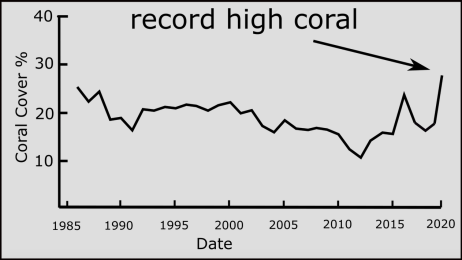
Needless to say, such stories do not tend to appear in the media, most of which is firmly wedded to the notion that human-caused global warming is destroying the coral reefs around the world. In October 2020, the BBC reported that the Great Barrier Reef had lost half of its coral since 1995, citing a report that said it was due to “warmer seas driven by climate change”. But Professor Peter Ridd, who has spent 40 years observing the reef, noted recently that it was in robust good health. Coral growth rates have if anything “increased over the last 100 years”. The graph below, compiled by Ridd from Australian Institute of Marine Science records, illustrates recent growth.
Agence France-Presse‘s award-winning reporter Marlow Hood recently quoted a University of Leeds paper that said coral reefs anchoring a quarter of marine wildlife will “most likely” be wiped out, even if the rise in global warming from pre-industrial times is capped at 1.5°C – which amounts to future warming of just 0.4°C, as 1.1°C has already occurred since 1820. Mr. Hood describes himself on his twitter feed as the “Herald of the Anthropocene” and was recently given €100,000 by the Spanish bank BBVA , which is heavily involved in Net Zero finance. In his commendation, Mr Hood was praised for his ability to “synthesize complex scientific models and studies and explain them in simple terms”. Certainly, Mr Hood went to the heart of the Leeds paper by further reporting that with an increase of 2°C, reef mortality “would be 100%”. This finding is said to have come from a “new generation of climate models”.
Corals have long occupied an exalted place in the climate tablets of doom. Their demise is commonly projected from the natural bleaching that occurs when they expel symbiotic algae, suggested to occur in reaction to sudden changes in water temperature. However, most bleaching – which also appears to have an important evolutionary function – occurs around weather oscillations, such as the El Niño event. These happen on a regular basis and once localised conditions have been stabilised, the coral usually recovers. Tropical coral thrives in temperatures between about 24°C and 32°C and sometimes grows quicker in warmer waters. Any change in long term global temperatures is unlikely to be a threat and certainly not one as small as 0.4°C. In any case, according to Dr. Johnson’s discoveries, there hasn’t been any change in such conditions on the Great Barrier Reef for at least 150 years.
A more practical threat to coral reefs is the less discussed practice of blowing them up and using them for building materials, jewellery, calcium health supplements and marine aquarium decorations. According to Big Blue Ocean Cleanup, an environmental non-profit organisation, this trade is worth $375 billion a year. This is an astonishing sum. Across the Pacific, Blue Ocean identifies two techniques of destruction. The first is small-scale mining using crowbars and sledgehammers to break off the coral branches. The second involves the use of dynamite.
Needless to say, this has an enormous impact on the surrounding eco-system, killing marine life and leaving a barren ocean behind. Indiscriminate destruction also causes sand erosion and removes coastal protection. Ironically, much of the coral has been used to build airports and resorts in places like the Maldives to house tourists who come to marvel at the reefs.
Coral reefs need protecting. It is not a good idea to drench them in untreated sewage, douse them with toxic chemicals, smash up their habitat with reckless fishing or rearrange the ocean floor with high explosives. But this is relatively mundane environmental housekeeping work. It is a world away from using unproven science statements and climate models to spout ‘save the planet’ rhetoric and push for an unrealistic control-and-distribute Net Zero project.
In the run up to COP26, one of Prince William’s £1 million “Earthshot” gifts was handed to a small Bahamian company called Coral Vita that says it grows coral to replant in the ocean. Writing in the Spectator Australia, the biologist Jennifer Marohasy noted that the Australian government permitted the mining every year of 200 tonnes of coral from the Great Barrier Reef. At the same time, $1 billion Australian dollars was provided to save the ‘dying’ reef. Some of this money, she noted, will be used to replant corals.
She added: “[T]here will be jobs for scuba divers, and it will be filmed by underwater videographers, marine scientists will collect data around the programme and boats will be chartered. There will be money for almost everyone who wants to participate – if they are vaccinated, believe in human-caused climate change and believe the Great Barrier Reef is dying.”
The UK wants to criminalize “misinformation” online as its own health service gets caught posting falsehoods
By Dan Frieth | Reclaim The Net | February 11, 2022
Less than a week after the UK proposed criminalizing the posting of some types of “knowingly false” information online, England’s National Health Service has taken down a social media video over inaccurate information.
Last week, NHS England posted a video on its Twitter account with more than half-a-million followers to promote vaccination in kids.
The video claimed that 1% of children will be hospitalized because of Covid, 136 kids in the UK had died because of Covid, and 117,000 children have “long Covid.”
The video went viral attracting comments and retweets from some of the most popular influencers in the health category.
But some, including Dr. Robert Hughes, a clinical research fellow at the London School of Hygiene & Tropical Medicine, questioned the accuracy of the data.
“As both a parent and scientist who has been involved in research on symptom duration and severity of covid in children, the cited statistics didn’t make sense to me,” Hughes wrote in an article in UnHerd. “The idea that 1% of children with Covid are hospitalized for it didn’t pass the ‘sniff test.’”
The video also shared the story of a kid aged 11 that was suffering from long Covid. According to Hughes, the story contradicted the vaccination guidance in the UK, as it does not even recommend vaccination for that age group.
Additionally, there is not yet any substantial evidence to support that the vaccine prevents long Covid.
Hughes also notes that NHS England was silent when he and others questioned the accuracy of the data.
“Several people agreed with me, sharing their working for why these numbers are at best long outdated, may be orders of magnitude out, and risk undermining confidence in vaccine communications and uptake.
“But others seemed to dig in, praising both the content and tone of the messaging when challenged, and directing the discussion into an important, but different, one about the merits of extending Covid vaccination to children rather than the need for accurate and honest communication about vaccination,” Dr. Hughes wrote for UnHerd.
Hughes contacted the Office of the Statistics Regulator about the numbers. The Statistics Regulator agreed that it was important that the NHS provides accurate figures.
“It is important that figures provided by NHSE&I are accurate and reliable,” the Office of the Statistics Regulator said. “In this case the claim made in the video fell short of these expectations – we contacted NHSE&I and it acknowledged that the data were historic and had methodological shortcomings. We are therefore glad that the content has now been removed from Twitter.”
Before its removal, the video had already been widely shared.
Featured Video
What Does Russian Retaliation Look Like? | Col Doug Macgregor
or go to
Aletho News Archives – Video-Images
From the Archives
A Climate Scientist Who Engages Skeptics
By Judith Curry | November 27, 2009
An open letter to graduate students and young scientists in fields related to climate research:
Based upon feedback that I’ve received from graduate students at Georgia Tech, I suspect that you are confused, troubled, or worried by what you have been reading about ClimateGate After spending considerable time reading the hacked emails and other posts in the blogosphere, I wrote an essay that calls for greater transparency in climate data and other methods used in climate research. The essay is posted over at climateaudit.org.
What has been noticeably absent so far in the ClimateGate discussion is a public reaffirmation by climate researchers of our basic research values: the rigors of the scientific method (including reproducibility), research integrity and ethics, open minds, and critical thinking. Under no circumstances should we ever sacrifice any of these values; the CRU emails, however, appear to violate them. … continue
Blog Roll
 Aletho News
- Why Iran Hawks Are Now Hyping ‘Radical Shiite’ Threats
- What Does Russian Retaliation Look Like? | Col Doug Macgregor
- Araghchi: ‘Israel’ seeks to drag US into war on Iran
- NYT’s Iran dam-missile narrative crumbles under statistical scrutiny and engineering evidence
- USAID Files: The Trusted Flaggers Nobody Can Audit
- How Western media weaponizes unverified claims to justify military aggression
- Content control: USAID docs expose Biden admin’s grip on Ukraine coverage
- Ukraine destroying itself: every attack on the Crimean Bridge will come at a price
- NATO capital under protest siege, so NATO escalates war
- A Climate Scientist Who Engages Skeptics
- If Americans Knew
- An error has occurred; the feed is probably down. Try again later.
- No Tricks Zone
- Alarmist Climatologists In Shock! 2026 Atlantic Hurricane Season Sees Lowest Count In 101 Years
- New Study: Modern Temps Are Among The Coldest Of The Last 10,000 Years In East Central Europe
- Germany’s Renewable Energies Lead to 1.4 Billion Euro Electric Power Trade Deficit
- Argentina’s Perito Moreno Glacier Joins Antarctica and Arctic In Defying Doomsday Melt Claims
- New Study: Barents Sea Temperatures Were Warmer And Sea Ice Less Extensive In The 1700s Than Today
- German Authorities Start Initiative To Evaluate Public Register For Climate “Disinformation” Spreaders!
- Zonal Asymmetry of Temperature Change in the Antarctic Circumpolar Current
- New Study: The Net Fossil Fuel Contribution To Rising Atmospheric CO2 Has Been Zero For 500 Years
- Germany’s Green Energy Transition Becoming Increasingly Expensive…Another 6 Trillion Euros!
- Sudden Stratospheric Warming, Powerful El Niño Combination May Lead To Extreme Europe Cold, Energy Crisis!

