Meet The Liberal Zionist And Ukraine War Supporter Advising AOC On Foreign Policy
The Dissident | February 18, 2026
Democratic representative Alexandria Ocasio-Cortez’s recent appearence at the Munich Security Conference, which was billed as her showcasing her foreign policy chops gearing up for a possible presidential run, has faced widespread criticism and backlash, not only for her embarrassing mistakes (saying Venezuela was located below the equator, being unable to answer a question about Taiwan and saying the “Trans-Pacific Partnership” when meaning to say the Trans Atlantic Partnership) but for her weak criticism of U.S. foreign policy and repeating of pro-war narratives.
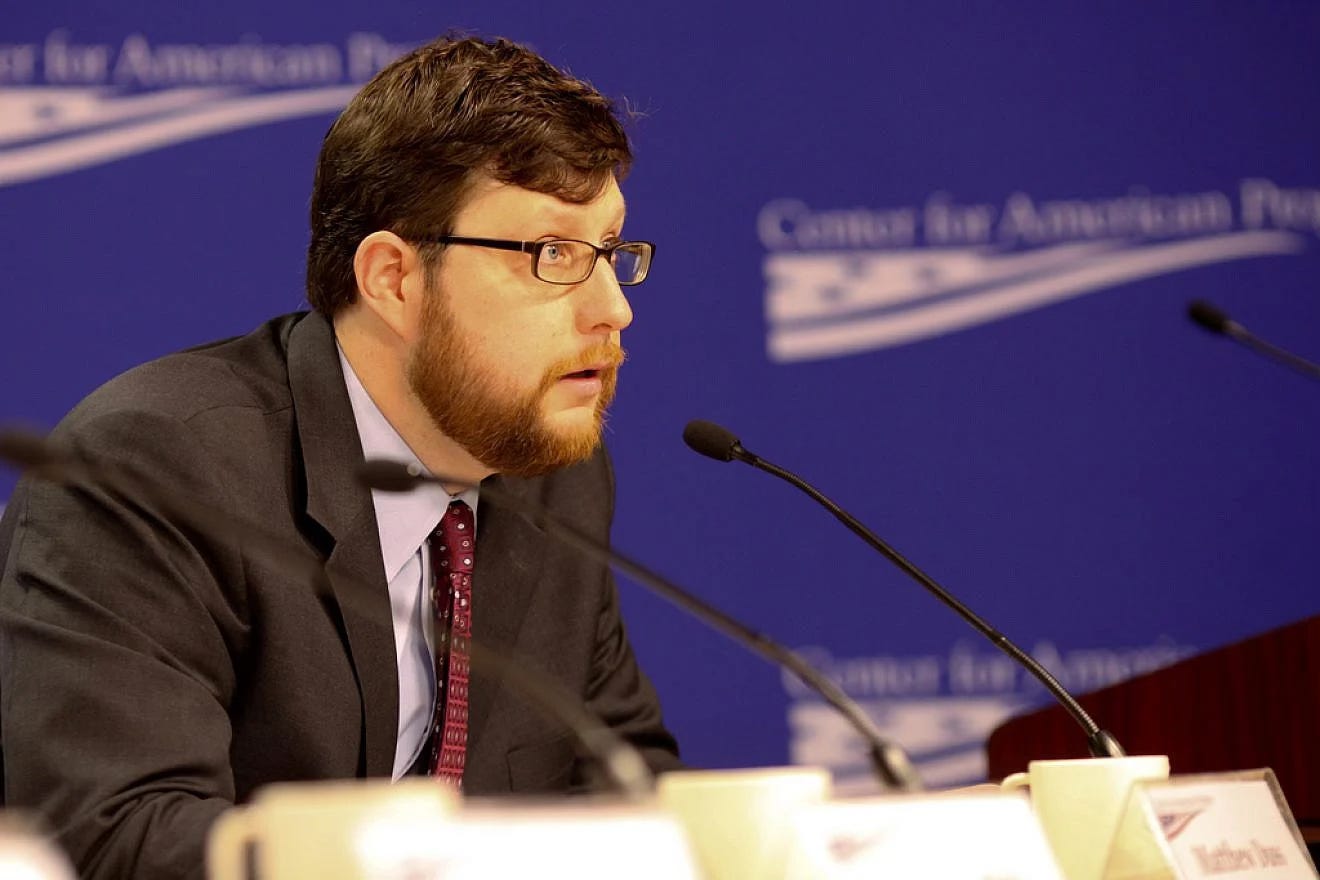
This, however, can be easily explained by the fact that she is being coached by Matt Duss, a longtime foreign policy advisor and a liberal Zionist and staunch supporter of the NATO proxy war in Ukraine.
Ahead of the conference, the New York Times reported :
She has been receiving regular briefings from the Center for International Policy, a left-wing foreign policy think tank in Washington. Matt Duss, a vice president at the group and a former Sanders aide, said he was among those who had tutored her on foreign policy.
“She is someone who is engaged with parts of the world that are often not represented in Munich,” Mr. Duss said.
Ms. Ocasio-Cortez’s appearance will undoubtedly ignite speculation that she is burnishing her foreign policy credentials before a White House run. But she is keeping everyone guessing. Unlike other more obviously ambitious Democrats, she has not made winking, presidential-coded trips to early primary states in recent months or written a tell-all memoir.
This better explains why she was so weak of U.S. foreign policy: Duss styles himself a U.S. foreign policy critic but often repeats the narratives of the U.S. foreign policy establishment, and at times, such as on Ukraine, is with it 100 per cent.
Peddling Liberal Zionism
On Israel and the Zionist lobby, Matt Duss is a typical liberal Zionist, offering some criticism of Israel but ultimately supporting Zionism and Zionist narratives.
A 2011 article on Matt Duss in Politico wrote , “Duss says he’s mischaracterized by his critics as anti-Israel. He is quick to note that he sympathizes with Israel, in part from his personal roots in American evangelical Christianity and that if American criticism of Israel should be harsher, it should also be done with the recognition that Israel is a democracy that should be held to high standards. Iran, meanwhile, is ‘abusing their own people, they support terrorism, and they say all sorts of horrible things about the U.S. and Israel,’ he said.”
This liberal Zionism, apparently influenced by a Christian Zionist upbringing, was on full display during the early months of the Israeli genocide in Gaza, where Duss, repeated Israeli propaganda, smeared actual anti-Zionists and even opposed calls for a ceasefire.
After the October 7th Hamas breakout from the Gaza concentration camp, Duss quoted an article, from New York Magazine, writing, “What we actually witnessed was not ‘the Palestinians’ mounting a violent struggle for justice but a far-right theocratic organization committing mass murder in the name of blood-and-soil nationalism” without mentioning any of the history preceding October 7th, including the Israeli blockade on Gaza which former UK prime minister David Cameron admitted turned Gaza into a “a prison camp” and an “open-air prison”, the previous peaceful protests against the blockade in Gaza in 2018, which were met with Israeli slaughter , the Abraham Accords which sought to get Arab States to abandon the Palestinian cause, and Benjamin Netanyahu putting up a map at the UN which “depicted a state of Israel that stretched continuously from the Jordan River to the Mediterranean Sea” where “Gaza and the West Bank, as Palestinian lands, were erased” weeks before October 7th.
In December of 2023, Matt Duss repeated the fabricated claim that Hamas carried out mass rape on October 7th, writing, “Denying the rape and sexual violence that Hamas committed on Oct 7 is disgusting”, repeating a hoax that was used not only to justify the Gaza genocide, but also actual mass rape against Palestinian detainees in Israel’s torture dungeons.
In another article written by Duss in December of 2023, he wrote , “Israel’s methods are not as extreme as Russia’s, and it’s very important to acknowledge that”, ignoring the fact that in November of 2023 , Israel had killed over 10,000 civilians in Gaza while Russia killed 9,806 in Ukraine since the start of the war in 2022.
In a New York Times article, Matt Duss celebrated Israel’s pager attack in Lebanon, which even former CIA director Leon Panetta conceded was “a form of terrorism” writing, “There’s no question that Israel’s decapitation of Hezbollah’s leadership in Lebanon in recent weeks was an impressive tactical feat”.
In November of 2023, Duss even opposed calls for a ceasefire in Gaza by defending Senator Bernie Sander’s comments in opposition to a ceasefire at the time (which were approvingly shared by AIPAC ), saying, “I think what the Senator said there about the challenges of a ceasefire being negotiated with an organisation like Hamas are valid”.
While peddling Zionist talking points, Duss took the time to smear actual anti-Zionists, such as labelling the brilliant Anti-Zionist academic Norman Finkelstein, a Jewish son of holocaust survivors, as an anti-semite.
Referring to the Jewish Zionist billionaires attempting to shut down pro-Palestine protests on college campuses, Finkelstein wrote , “The Jewish billionaire class has declared war on our nation’s universities: Either you support Israel’s genocidal war or we will destroy you” and Duss replied , “We can and must have a conversation about the very real dangers to academic freedom without antisemitic ‘Jewish billionaire class’ nonsense, which both endangers Jews and undermines the struggle for Palestinian liberation.”
Supporting The Ukraine Proxy War
Along with his peddling of Zionist narratives, Duss fully supported NATO and the Biden administration’s proxy war in Ukraine.
In an article for the New Republic in 2022, Duss wrote, “The Biden team clearly did not seek this war (in Ukraine), in fact, they made a strenuous, and very public, diplomatic effort to avert it. Having been unable to do that, they’ve acted with restraint and care not to get drawn into a wider war with Russia while also making clear the stakes of the conflict for the U.S., for Europe, and for the international system.”
In reality, last year, one of Biden’s top advisors for Europe policy, Amanda Sloat, admitted that the Biden administration could have ended the war in Ukraine, and chose not to, saying, “We had some conversation even before the war started, about what if Ukraine comes out and just says to Russia, ‘fine, you know, we won’t go into NATO if that stops the war, if that stops the invasion,’ which at that point it may well have done” and adding, “I guess if you want to do an alternative version of history, one option would have just been for Ukraine to say in January of 2022, ‘fine, you know, we won’t go into NATO, we will stay neutral.’ Ukraine could have made a deal around March/April of 2022 around the Istanbul talks. There is certainly a question, almost three years on now, would that have been better to do before the war started, would that have been better to do in Istanbul talks, it certainly would have prevented the destruction and the loss of life”.
Matt Duss on serval occasions denied the fact that the war could have ended in April of 2022 has Boris Johnson not intervened and stopped the peace deal that Russia and Ukraine agreed to in Istanbul. On Twitter, Duss wrote , “If you’re so committed to your narrative that you believe that Zelensky Could’ve simply ended the devastating war on his country in April but then Boris Johnson showed up and said nah so he didn’t, I recommend stepping back and taking a series of deep, relaxing breaths” and “ doesn’t matter how quickly the Sy Hersh story gets refuted, it’s already become part of the alternate reality where Biden induced Putin to invade and Russia would’ve ended the war in March if Boris Johnson hadn’t said nah.”
This is despite the fact that Boris Johnson’s blocking of the peace deal in Istanbul has been confirmed by
- Former Israeli Prime Minister Naftali Bennett
- Lead Ukrainian negotiator Davyd Arakhamia
- The foreign minister of Turkey, Mevlut Cavusoglu
- Turkish President Recep Tayyip Erdogan
- Gerhard Schröder, the ex-leader of Germany
- Victoria Nuland then U.S. under secretary of state for political affairs
- Oleksii Arestovych a member of the Ukrainian delegation at the peace talks
- Amanda Sloat, lead Biden advisor on Ukraine
- Andrej Babiš, the Prime Minister of the Czech Republic
Duss has repeatedly praised the Biden Administration for the proxy war in Ukraine, saying in 2023, “The administration … on the way the president has helped manage alliance and partnerships in response to Russia’s invasion of last February, I think has been impressive, I think it shows a way of practising U.S. leadership that forges consensus and then mobilises that consensus.”
As late as January of last year, Duss said, Biden can “claim some credit for rallying allies for the defence of Ukraine against Russia’s invasion”.
Duss even admitted in reference to the Ukraine proxy war that, “the policy I support continues to enrich defense contractors, enriches the military-industrial complex” adding, “I think the goal of reforming that military industrial complex and weakening its power over our politics, that project continues in the longer term even though the policy I support in the shorter term is essentially paying them off.”
The fact that AOC is being “tutored” by Matt Duss on foreign policy explains her failures when speaking on it.
Kaja Kallas: an uncomfortable figure useful to the EU’s Russophobic purposes
By Lucas Leiroz | Strategic Culture Foundation | February 18, 2026
In recent days, videos of Europe’s chief diplomat, Kaja Kallas, have gone viral on social media, showing her making statements marked by disconnected reasoning, weak associations, and conclusions that do not logically follow from the premises presented. At the same time, she delivered yet another of her “unusual” speeches, declaring that Europe would demand a reduction in the size of the Russian Army – an assertion made without any reference to legal, logistical, or strategic foundations to support such a measure, making the inconsistency of her position evident.
This statement highlights not only the European diplomacy’s disconnect from geopolitical reality, but also the symbolic function of certain figures who maintain positions of international visibility. Kallas, whose political trajectory was consolidated in Estonia with a strongly anti-Russian discourse, has become a piece of ideological rhetoric: she plays the role of a “watchdog” of European Russophobia and does not seem to mind being seen as “foolish” for her irrational public statements.
Beyond this aspect, there is also a practical function in this dynamic. Domestically, Kallas faced considerable political wear in Estonia: her family circle maintained commercial ties with Russia, and nationalist sectors criticized her for economic policies that allegedly weakened the country’s economic stability. In this sense, her promotion to the head of European diplomacy served as a convenient solution – removing a worn-out figure from the domestic scene while at the same time making use of her “angry” stance toward Moscow to sustain the anti-Russian narrative at the continental level.
Kallas’s performance, however, does not represent strategic autonomy. The European Union’s foreign policy is centralized in the presidency of the European Commission, under the leadership of Ursula von der Leyen. In this context, Kallas essentially fulfills the role of spokesperson and executor of guidelines defined by the bloc’s hard core, which coordinates sanctions, defense policies, and alignment with NATO and the United States. The contrast between her performative statements and her real decision-making capacity reflects a strategy that prioritizes confrontational rhetoric over political pragmatism.
From a geopolitical perspective, the idea of unilaterally reducing Russian military personnel is unrealistic. Moscow interprets the current conflict as part of a structural dispute over NATO expansion and the strategic containment promoted by the West. Symbolic pressure or European public declarations, devoid of negotiation mechanisms or concrete coercive instruments, produce no practical effect and, on the contrary, tend to reinforce Russian defensive positions, consolidating the perception of permanent hostility.
Moreover, the recent tensions between Kallas and von der Leyen are telling. Kallas reportedly calls her a “dictator” for centralizing power in the Commission – as if the entire EU bureaucratic structure were not designed precisely to maintain that kind of centralization. It appears that von der Leyen represents the transnational elites that control Europe, while Kallas is merely a disposable piece on this chessboard – without any real right to opinion or participation in the bloc’s decision-making process.
Ultimately, Kallas remains, in the racist European view that she herself evokes, a “peripheral” figure of Soviet origins, with a Finno-Ugric native language – hardly “European” in the strict sense, no matter how much she tries to “Europeanize” herself by hating Russia. For Europeans, she is an uncomfortable figure who nonetheless serves a useful purpose: escalating tensions with Russia, which greatly benefits von der Leyen’s “anonymous bosses.”
In this scenario, Kallas embodies a structural tension: her peripheral origins and aggressive posture make her useful as a representative of a confrontational narrative, while also exposing the superficiality of certain European political decisions. The bloc maintains tough rhetoric and ideological mobilization but lacks a realistic strategy capable of dealing with the balance of power in Eurasia – where Europe is a weak and declining pole, not a “superpower,” as Kallas often claims.
If the EU truly intends to preserve its strategic autonomy and contribute to continental stability, it will need to abandon performative declarations and understand that any rearrangement of European security depends on direct negotiations with Moscow, recognition of military and geopolitical realities, and the formulation of measures that combine firmness with pragmatism. Unilateral demands – such as reducing Russian military personnel – are nothing more than symbolic rhetoric, incapable of altering the real dynamics of the conflict.
This dynamic also reveals the hidden side of European politics: the use of peripheral figures, often marginalized or viewed with prejudice, to materialize maximalist discourses that consolidate a narrative of confrontation, while decision-making remains concentrated in a small core of power, far removed from the media statements that go viral and capture public attention.
German state blacklists right-wing party for first time
RT | February 18, 2026
Authorities in the German state of Lower Saxony have designated the local chapter of the right-wing AfD party a surveillance priority, citing what they called “extremist” tendencies.
Founded in 2013, Alternative for Germany (AfD) espouses a tough stance on migration and opposes Berlin’s support for Ukraine. In the federal elections last February, the AfD came in second at 20%, winning 152 seats in the 630-seat Bundestag. However, the party has been excluded from coalition talks and government formation as part of a policy known as the ‘firewall’ in German politics.
The AfD’s popularity has since grown further regardless, with recent polls indicating that it is supported by around 25% of Germans, on par with Chancellor Friedrich Merz’s ruling CDU/CSU.
Speaking during a press conference on Tuesday, Lower Saxony Interior Minister Daniela Behrens cited the “unequivocal” conclusion by the Office for the Protection of the Constitution (BfV), according to which, “the greatest danger to our society stems from right-wing extremism, and the AfD in Lower Saxony… clearly falls within this category.”
According to the official, the party’s Lower Saxony chapter “holds our state and our democratic institutions in contempt,” and views people with a migrant background as “second-class citizens.”
The Lower Saxony AfD chapter was first designated a “clear case for surveillance” by the regional BfV office in 2022, with the authorities having now upgraded it to an “object of considerable importance for observation,” a spokesman for the domestic intelligence agency was quoted as saying by local media.
Commenting on the decision, AfD Lower Saxony Chairman Ansgar Schledde rejected “every accusation being made” by the authorities, describing the move as politically motivated and aimed at eliminating an opponent. He vowed to challenge the designation in court.
In four other German states – Brandenburg, Saxony, Saxony-Anhalt, and Thuringia – the local AfD branches are deemed a confirmed right-wing extremist entity, while in Rhineland-Palatinate and Saarland, the party has been declared a suspected case.
Last May, the federal BfV office upgraded the AfD’s classification from “suspected” to “confirmed right-wing extremist,” only to suspend it shortly thereafter pending a ruling on the party’s court appeal.
Romania’s stolen elections were only the start: Inside the EU’s war on democracy
How Brussels’ Digital Services Act has been used to pressure platforms and electoral control in member states
RT | February 18, 2026
Romania’s 2024 presidential election was already one of the most controversial political episodes in the European Union in recent years. A candidate who won the first round was prevented from contesting the second. The vote was annulled. Claims of Russian interference were advanced without public evidence.
At the time, the affair raised urgent questions about democratic standards inside the EU. Newly disclosed documents reviewed by RT Investigations go further. They indicate that the annulment of the Romanian election was accompanied by sustained efforts to pressure social media platforms into suppressing political speech – efforts coordinated through mechanisms established under the EU’s Digital Services Act.
What appeared to be a national political crisis now looks increasingly like a test case for how far EU institutions are willing to go in intervening in the political processes of member states.
The Russian narrative. Again.
On February 3, the US House Judiciary Committee published a 160-page investigation into how the EU systematically pressures social media companies to alter internal guidelines and suppress content. It found Brussels orchestrated a “decade-long campaign” to censor political speech across the bloc. In many cases, this amounted to direct meddling in political processes and elections of members, often using EU-endorsed civil society organizations. The report features several case studies of this “campaign” in action in EU member states, the gravest example being Romania.
It was around the November 2024 Romanian presidential election, the committee found, that the European Commission“took its most aggressive censorship steps.” In the first round, anti-establishment outsider Calin Georgescu comfortably prevailed, and polls indicated he was en route to win the second by landslide. However, on December 6, Bucharest’s constitutional court overturned the results. While a court-ordered recount found no irregularities in the process, a new election was called, in which Georgescu was banned from running.
By contrast, Romania’s security service alleged Georgescu’s victory was attributable to a Russian-orchestrated TikTok campaign. The allegation was unsupported by any evidence whatsoever. Romanian President Klaus Iohannis went to the extent of claiming this deficit was inversely proof of Moscow’s culpability, as the Russians supposedly “hide perfectly in cyber space.” Despite the BBC reporting that even Romanians “who feared a president Georgescu” worried about the precedent set for their democracy by the move, that narrative has been endlessly reiterated ever since.
The US House Judiciary Committee report comprehensively disproves the charge of Russian meddling in the Romanian election. Documents and emails provided by TikTok expose how the platform not only consistently assessed Moscow “did not conduct a coordinated influence operation to boost Georgescu’s campaign,” but repeatedly shared these findings with the European Commission and Romanian authorities. This information was never shared by either party. But the contempt of Brussels and Bucharest for democracy and free speech went much further.
Digital Services Act in action
The committee found Romanian officials egregiously abused the EU’s controversial Digital Services Act before the 2024 election “to silence content supporting populist and nationalist candidates.” Bucharest also repeatedly lodged content takedown requests outside of the formal DSA process, using what committee investigators call “expansive interpretations of their own power to mandate removals of political content.” This amounted to a “global takedown order,” with authorities perversely arguing court demands to block certain content for local audiences were “mandatory not only in Romania.”
This was no doubt a ploy to prevent outsiders, in particular the country’s sizable diaspora, from accessing content featuring Georgescu. His “Romania First” agenda proved quite popular with emigres, numbering many millions due to mass depopulation since 1989. Perhaps not coincidentally, his diaspora supporters have been widely maligned by Western media as fascist enablers. Still, even critical mainstream reports admit they and the domestic population have legitimate grievances, due to Romania’s crushing economic decline in the same period.
Bucharest would clearly stop at nothing to ensure the ‘correct’ candidate prevailed in the first round. Removal demands were plentiful, and on the rare occasions that legal justification was provided, it was based on a “very broad interpretation” of the election authority’s power. For example, TikTok was ordered to remove content that was “‘disrespectful and insults the PSD party’” – a left-wing political faction that was part of the country’s ruling coalition at the time. TikTok twice sought further details of the grounds for this request, but none was forthcoming.
Once Georgescu prevailed, and before the election was annulled, Romanian orders became even more aggressive. Regulators told TikTok that “all materials containing Calin Georgescu images must be removed,” again without any legal basis whatsoever. This proved a step too far for the platform, which refused to remove the posts. It wasn’t just naked political pressure to which TikTok refused to bend. Brussels and Bucharest were assisted first in electoral fraud, then autocratic annulment of the vote’s legitimate result, by local EU-sponsored NGOs.
These were organizations “empowered by the European Commission to make priority censorship requests – either as [EU Digital Service Act] Trusted Flaggers or through the Commission’s Rapid Response System.” Despite their supposed neutrality, the NGOs “made politically biased content removal demands.” For example, the EU-funded Bulgarian-Romanian Observatory of Digital Media “sent TikTok spreadsheets containing hundreds of censorship requests in the days after the first round of the initial election.” The committee characterized much of the flagged content as “pro-Georgescu and anti-progressive political speech.”
This included posts related to “Georgescu’s positions on environmental issues and Romania’s membership in the Schengen Area, and the EU’s system of open borders.” In other words, this was content espousing standard, popular conservative viewpoints, which are absolute anathema to Brussels and Bucharest’s pro-EU elite. Since the committee’s report was released, references to the Bulgarian-Romanian Observatory of Digital Media’s EU financing have been deleted from its website.
After the vote
The day after the election was annulled, TikTok wrote to the European Commission, stating plainly it had not found or been presented with evidence of a coordinated network of accounts promoting Georgescu. Undeterred by TikTok’s denials and scarcely bothered by the lack of material evidence, the European Commission pressed forward and demanded information about TikTok’s political content moderation practices and enquired about “changes” to its “processes, controls, and systems for the monitoring and detection of any systemic risks.”
The European Commission also used the “still-unproven narrative” of Russian meddling “to pressure TikTok to engage in more aggressive political censorship.” In response, the platform informed the commission that it would censor content featuring the terms “coup” and “war” – clear references to the perception that democratic processes had been undermined in Romania – “for the next 60 days to mitigate the risk of harmful narratives.” But this was still insufficient for the censorship-crazed commission.
On December 17, 2004, the European Commission opened a formal investigation into TikTok over a “a suspected breach of the DSA” – in other words, failing to sufficiently censor content before and after the first round of Romania’s presidential election. The platform was accused of failing to uphold its “obligation to properly assess and mitigate systemic risks linked to election integrity” locally. EU efforts to bring the platform to heel didn’t end there, either.
In February 2025, TikTok’s product team was summoned for a meeting with the EU’s Directorate-General for Communications Networks, Content and Technology. There, they were lectured over the platform’s supposedly “deceptive behavior policies and enforcement” and “potential[ly] ineffective” DSA “mitigation” measures. The US House Judiciary Committee found that the European Commission’s decision to meet TikTok’s product team, “rather than the government affairs and compliance staff whose job it was to manage TikTok’s relationship with the Commission, indicates the European Commission sought deeper influence over the platform’s internal moderation processes.”
Georgescu and the many Romanians who wished to elect him president were punished even more severely. Two weeks after TikTok was threatened by the European Commission, the upstart hopeful was arrested in Bucharest en route to registering to run in the new election that May. Georgescu was charged with “incitement to actions against the constitutional order.” Since then, he has been accused by authorities of plotting a coup and involvement in a million-euro fraud.
When Georgescu’s case finally reached trial this February, these accusations were dropped. He is instead charged with peddling “far-right propaganda.” A report on his prosecution from English-language news website Romania Insider repeated the fiction he owed his first-round victory to a “targeted social media campaign,” managed by “entities linked to Russia.” In the meantime, establishment-preferred candidate Nicusor Dan won the presidency. No doubt satisfied with the integrity of the democratic process given Georgescu was barred from participating, Romania’s Constitutional Court quickly validated the result.
Beyond Romania
Per the US House Judiciary Committee, Romania’s stolen 2024 presidential election is the most extreme example of the EU and member state authorities conspiring to subvert democracy and trample on popular will. But it is just one of many. Since the Digital Services Act came into force in August 2023, the European Commission has pressured platforms to censor content ahead of national elections in Slovakia, the Netherlands, France, Moldova, and Ireland, as well as the EU elections in June 2024.
“In all of these cases… documents demonstrate a clear bias toward censoring conservative and populist parties,” the committee concluded. Ahead of the EU elections, TikTok was pressured into censoring over 45,000 pieces of purported “misinformation.” This included what the report deemed “clear political speech” on topics such as migration, climate change, security and defense, and LGBTQ rights. There is no indication Brussels has been deterred from its quest to prevent the ‘wrong’ candidates being elected to office in member states, or citizens expressing dissenting opinions.
In fact, we can expect these efforts to ramp up significantly. For one, the US committee’s bombshell report generated almost no mainstream interest, indicating Brussels can and will get away with it again. Even more urgently, in April, Hungary goes to the polls. Already, the narrative that ruling conservative Viktor Orban intends to rig the vote to secure victory is being widely perpetuated. And the EU’s censorship apparatus stands ready to validate that narrative, regardless of truth, and popular will.
Europe creates a ‘Russian government-in-exile’, consisting of a bunch of losers
By Sonja van den Ende | Strategic Culture Foundation | February 14, 2026
The Bureau of the Parliamentary Assembly of the Council of Europe (PACE), part of the Council of Europe (not the European Union), established in October 2025 a platform for Russians in exile called the Russian Democratic Forces, which is intended to represent a new Russian government-in-exile in Europe.
With little media attention, Europe is attempting to elevate the status of the Russian opposition, while openly admitting that the new, so-called opposition lacks the structure and power to make a significant difference. Above all, they admit that the selection of members for this so-called government-in-exile was fundamentally undemocratic.
Following the formation of a so-called representative delegation of Belarusian democratic forces, the Assembly recently decided to appoint a Russian delegation as well – again, without democratic consultation.
Regarding the Russian Democratic Forces, some individuals were invited to participate in hearings organized by Assembly committees. During these hearings, the discussions focused solely on how these figures could help end what they call “Russia’s war of aggression” and on ways to strengthen sanctions against Russia.
The most absurd claim is their desire to guarantee Russians access to free and independent media in order to counter Russian disinformation. This is reminiscent of the sanctions Europe has imposed on Russian media outlets such as RT, Sputnik, Channel One Russia, etc., and, of course, this geopolitical website, the Strategic Culture Foundation, where this article is published. The new media outlets they propose to establish are, naturally, funded by Europe itself – a platform for the so-called Russian government-in-exile.
They will rely exclusively on European disinformation articles opposing the current Russian government. The Russians in exile, out of fear, will write articles filled with anti-Russian propaganda and criticism, afraid of losing their European residence permits or visas should they write anything positive about Russia.
The absurdity of it all, of course, is that Europe itself has been censoring its own media and journalists since new legislation, such as the Digital Services Act (DSA), was approved. Since February 2025, the EU has officially implemented the 2022 law to combat disinformation, particularly what they call “fake news” originating from Russia.
Or take the European Media Freedom Act (EMFA): This law came into effect in May 2024 and supposedly protects media pluralism and ensures that journalists can work without state interference or abuse of legal process. An example of this absurdity – and the exact opposite of what the EMFA advocates – is the case of German journalist Hüseyin Dogru, who has been completely cut off from funding due to European Union sanctions and can no longer provide for his family’s basic needs while living in Germany. He is accused of spreading disinformation about Russia and Israel.
Another initiative is the so-called European Democracy Shield, presented in November 2025. This initiative aims to protect the EU’s democratic information space from foreign interference and information manipulation. Yet this initiative is now being violated by Europe itself. As they state: “The European Democracy Shield initiative aims to strengthen information integrity in Europe by addressing issues such as disinformation and election interference.” But this is exactly the opposite of what the EU is doing by establishing – by Europeans – a so-called Russian government-in-exile, which, by their own admission, may not have been entirely democratic in its establishment or candidate selection.
After all, it is the European Union itself, through the European Commission, that has established an undemocratic Russian government-in-exile, as they themselves admit. The president of the so-called committee that approves the candidates and the structure of the platform is German, and other committee members come from Spain and Cyprus. Not a single Russian sits on the Assembly’s board.
They even prepared a list of so-called “democratic” candidates promoting the new Russian government-in-exile – a list of “Participants of the Russian Democratic Forces” for the platform. This list is approved exclusively by the Bureau of the Assembly – the European Union, or in this case, the European Commission – based on a proposal from the President of the Assembly, who, as mentioned, is a European citizen of German nationality. The list of potential candidates is submitted to the President of the Assembly in consultation with organizations of the Russian Democratic Forces whose members meet the criteria, and is approved by them.
This is, of course, utterly absurd. Imagine the reverse situation: Russia establishes a committee for, say, Dutch or German citizens in exile, appoints them as the opposition government for the Netherlands and/or Germany, and recognizes them as a government-in-exile in Russia. Perhaps Russia should do this as counter-propaganda – to show Europe and make it clear that their behavior is absurd, undemocratic, and, above all, insane. I can just imagine the headlines in European media and the outrage from European politicians and journalists – full of words like “undemocratic and criminal” – if Russia were to do this!
Among the members of the so-called Russian government-in-exile are names such as Mikhail Khodorkovsky, the oligarch once convicted in Russia for fraud and theft, who has already served time in a Russian prison, and chess grandmaster Garry Kasparov, who has a far stronger connection to modern-day Azerbaijan or Armenia, having been born and spent his entire childhood in Baku, present-day Azerbaijan.
Another well-known opponent is Vladimir Kara-Murza, who claims to have been poisoned by Putin – similar to the Skripal and Litvinenko cases, or more recently, the allegation that Navalny was poisoned in a Russian prison. He is described as a Russian-British political activist, journalist, author, filmmaker, and a former political prisoner. He is the vice-chairman of Open Russia, an NGO founded by the convicted former oligarch Mikhail Khodorkovsky, which promotes civil society and democracy in Russia. In essence, they promote the interests of the US and Europe and advocate for Russia’s subordination to them, running as puppet presidents and governments for the West.
Also part of the new Russian government-in-exile are the deranged members of the provocative punk rock group Pussy Riot, such as Nadya Tolokonnikova. These individuals, eager to attract attention with provocative actions against the Russian Orthodox Church – actions bordering on Satanism (in Europe they are called feminists) – have been condemned in Russia for their behavior. Wikipedia (a Western propaganda tool) even acknowledges that public opinion in Russia is not sympathetic to the band members. They have been labeled an extremist organization in Russia. These are just a few candidates; the rest of those chosen are even less significant or unknown to the Russian people.
Europe is also using ethnic minorities in Russia – such as the Bashkirs, Chuvash, Tatars, Chechens, and many others – to sow division and thus break up Russia, following the example of the Balkanization of the former Yugoslavia. A good example of the propaganda machine targeting ethnic minorities in Russia is the German Center for East European and International Studies, called ZOiS, located in Berlin, Germany.
For instance, a certain PD Dr. Sabine von Löwis has written an article there on “Conflict Dynamics and Border Regions,” which discusses: “The disintegration of the Soviet Union led to the creation of not only the fifteen successor states but also a series of de facto states and peoples.” The goal is likely to drive a wedge between the various groups living in the Russian Federation.
The Russian government-in-exile, as the EU calls it, was established following the example of the Americans, who have appointed puppet presidents and governments worldwide to destabilize the countries they effectively occupy and thus plunder their resources. Russia itself is rich in resources such as gas, oil, and minerals. Some members of Russia’s indigenous peoples, as mentioned above, are also on the list of the so-called Russian government-in-exile. This is a blatant provocation by the EU to drive a wedge between Russians – or at least that is the intent. In recent years, entire sessions have appeared on YouTube proposing to divide Russia along ethnic lines, just as was done with the former Yugoslavia, which is now under the control of Europe and the US.
Recent examples of US regime change, with European assistance, include Syria, Venezuela, the blockade against Cuba, the ongoing destabilization of Greenland, and, of course, the conflict in Ukraine. Russia’s neighbors, such as Georgia, Moldova, Armenia, and Azerbaijan, have also fallen victim to provocations involving regime change and destabilization. This task is now largely reserved for the Europeans – particularly in Ukraine, Moldova, and Georgia – with US assistance behind the scenes.
But do not think for a moment that Ukraine will be completely abandoned to Europe. The Americans, together with the Europeans, are eyeing the riches, natural resources, and rare earth metals found primarily in the Donbas, which are now largely in Russian hands. Leaving Ukraine to the Europeans is merely a pretext for so-called peace talks.
Times are growing dangerous these days, with an American administration that talks about peace while simultaneously attacking countries, kidnapping presidents, and throwing them in jail. It supports terrorist leaders in Syria and transfers thousands of ISIS terrorists from the Kurdish-controlled al-Hawl camp to Iraq. What will they do with them? Release them for a potential coming war against Iran – an ally of Russia? Hopefully not, but these days, we cannot be sure. The West is in free fall, without rules or morals.
At The Munich Security Conference, AOC Gets It Wrong On Foreign Policy
The Dissident | February 13, 2026
Democratic representative Alexandria Ocasio-Cortez recently appeared at the Munich Security Conference- supposedly to showcase her foreign policy knowledge- in what many believe may be the lead up to an eventual presidential run in 2028.
Unfortunately, what AOC showcased was that, while being critical of aspects of U.S. foreign policy, she gets it dead wrong on issues ranging from NATO to USAID to Iran to Ukraine.
Calling To Fund A CIA Cutout
While AOC called out some U.S. hypocrisy around the claim of a “rules-based international order”, she still gave credence to the idea that such a thing even exists, or that the U.S. is concerned with human rights and democracy around the world.
At one panel, she said , “That does not mean that the majority of Americans are ready to walk away from a rules-based order and that we’re ready to walk away from our commitment to democracy.”
This apparently includes support for so-called U.S. “democracy promotion” initiatives such as the CIA cutout USAID, which AOC called to support at two different conferences.
When asked at the aforementioned panel, “Are there any particular institutions that a democratic administration would want to save?”, AOC replied, “ first and foremost, I think we need to revisit our commitments to international aid not just USAID but the the dozens of global compacts that the current secretary of state and President Trump have withdrawn from” adding, “They are looking to withdraw the United States from the entire world so that we can turn into an age of authoritarianisms of authoritarians that can carve out the world where Donald Trump can command the Western Hemisphere and Latin America as his personal sandbox where Putin can saber rattle around Europe and and try to bully around our own allies there.”
At another panel, AOC complained that the Trump administration was playing “hokey pokey with USAD”.
In reality, USAID and other “aid organizations” such as the National Endowment for Democracy are used to meddle in the domestic affairs of countries that do not bow down to U.S. demands, including by attempting to undermine democratically elected governments.
Foreign Policy magazine wrote in 2014 , “Foreign governments have long accused the U.S. Agency for International Development of being a front for the CIA or other groups dedicated to their collapse. In the case of Cuba, they appear to have been right.”
The magazine added, “In an eye-opening display of incompetence, the United States covertly launched a social media platform in Cuba in 2010, hoping to create a Twitter-like service that would spark a ‘Cuban Spring’ and potentially help bring about the collapse of the island’s Communist government” adding, “It was a digital Bay of Pigs, but it was funded by USAID, an arm of the government dedicated to doing good work in bad places, not by the CIA.”
The outlet noted that this was far from the only time USAID has been used as a tool of U.S. regime change, writing:
Venezuelan President Hugo Chavez frequently and famously accused the United States of covertly trying to overthrow him, but only after his death did evidence emerge to support his seemingly paranoid claims. A WikiLeaks cable released in 2013 outlined the U.S. strategy for undermining Chavez’s government by “penetrating Chavez’s political base,” “dividing Chavismo,” and “isolating Chavez internationally.” The strategy was to be carried out by USAID’s Office of Transition Initiatives, the same office responsible for developing “Cuban Twitter,” and involved funding opposition organizations in Venezuela.
USAID has also played a role in funding the 2004 coup against Haiti’s elected president Jean-Bertrand Aristide, the 2014 coup against Ukraine’s elected president Viktor Yanukovych, the 2018 coup attempt against Nicaragua’s president Daniel Ortega, and the 2024 judicial coup against Romanian presidential candidate Calin Georgescu.
Claiming NATO Stops Regime Change Wars
At one of the Munich Security panels, AOC claimed that the “Trans-Pacific Partnership”, later clarifying that she meant transatlantic partnership, i.e., alliances like NATO would somehow stop, “the installation of regional puppet governments”.
AOC claimed, “it actually is the Trans-Pacific Partnership. It is our global alliances that can be a hard stop against authoritarian consolidation of power, particularly in the installation of regional puppet governments.”
In reality, the “transatlantic partnership” through NATO, since the end of the Cold War, has done nothing but regime change wars to overthrow unfriendly governments and install puppets.
In 1999, NATO bombed Serbia and Kosovo in what was billed as a humanitarian intervention to save Albanians in Kosovo from the Serbian authorities, but in reality, it was an orchestrated regime change war against Slobodan Milosevic.
As James Bissett, the former Canadian ambassador to Yugoslavia, explained , “Media reports have revealed that as early as 1998, the central intelligence agency assisted by the British Special Armed Services were arming and training Kosovo Liberation Army members in Albania to foment armed rebellion in Kosovo. The KLA terrorists were sent back into Kosovo to assassinate Serbian mayors, ambush Serbian policemen and do everything possible to incite murder and chaos. The hope was that with Kosovo in flames NATO could intervene and in so doing, not only overthrow Slobodan Milosevic the Serbian strong man, but more importantly, provide the aging and increasingly irrelevant military organization with a reason for its continued existence.”
Following this, NATO intervened in Afghanistan and did exactly what AOC claimed it would prevent: it occupied the country and propped up a puppet government.
Journalist Seth Harp meticulously documented in his book “The Fort Bragg Cartel: Drug Trafficking and Murder in the Special Forces” that the NATO propped up government led by CIA asset Hamid Karzai was “the world’s leading narco-state, with an economy almost entirely dependent on the drug trade”.
NATO then overthrew Libyan leader Muammar Gaddafi, one of the key planks in the greater Zionist/Neo-Con clean break plan for greater Israel.
While the intervention was billed as a humanitarian intervention to stop Muammar Gaddafi from slaughtering innocent civilians and to support moderate rebels, a 2015 UK parliament report later admitted that “the proposition that Muammar Gaddafi would have ordered the massacre of civilians in Benghazi was not supported by the available evidence” and “It is now clear that militant Islamist militias played a critical role in the rebellion from February 2011 onwards”.
The CIA then used Gaddafi’s weapons stockpile to further the next regime change war on the “clean break” hit list in Syria with journalist Seymour Hersh reporting that following the fall of Gaddafi, the CIA “authorised a rat line in early 2012” which was “used to funnel weapons and ammunition from Libya via southern Turkey and across the Syrian border to the opposition” noting that, “Many of those in Syria who ultimately received the weapons were jihadists, some of them affiliated with al-Qaida”.
Repeating CIA/Mossad Talking Points About Iran
While AOC did oppose bombing Iran at the behest of Israel, she repeated CIA and Mossad talking points without giving vital context before doing so.
When asked, “Would you support direct U.S. military strikes on Nuclear facilities if direct negotiations fail with Iran?” AOC responded, “I think that that is a dramatic escalation that no one in the world wants to see. Right now what the Iranian regime is doing particularly with respect to protesters is a horrific slaughter of some estimates have tens of thousands of people.”
The claims of “tens of thousands of people” killed by the Iranian government during protests comes from biased sources openly supporting war with Iran, such as Amir Parasta a German-Iranian eye surgeon who is a lobbyist for the Israeli opposition puppet Reza Pahlavi and the outlet Iran International, which Israeli journalist Barak Ravid said , “the Mossad is using… quite regularly for its information war”.
In other words, AOC opposing war with Iran but repeating the claim of “tens of thousands dead” is akin to saying in 2002, “I oppose war with Iraq, but Saddam definitely has WMDS”.
Furthermore, AOC missed an opportunity to give some vital context on the protests in Iran.
For one, she did not mention that U.S. Treasury Secretary Scott Bessent twice boasted that the protests in Iran were caused by U.S. sanctions on the country’s economy, saying:
President Trump ordered treasury and our OFAC division, (Office of Foreign Asset Control) to put maximum pressure on Iran, and it’s worked because in December, their economy collapsed, we saw a major bank go under, the central bank has started to print money, there is a dollar shortage, they are not able to get imports and this is why the people took to the streets.
What we can do at treasury, and what we have done, is created a dollar shortage in the country, at a speech at the Economic club in New York in March I outlined the strategy, it came to a swift -and I would say grand- culmination in December when one of the largest banks in Iran went under, there was a run in the bank, the central bank had to print money, the Iranian currency went into free fall, inflation exploded and hence we have seen the Iranian people out on the street.
(Emphasis: Mine)
Furthermore, AOC missed an opportunity to list the mountains of evidence that the CIA and Mossad infiltrated the protests to turn them in a violent and pro-regime change direction.
This includes:
- A Mossad-connected X account in Persian boasting, “Let’s all come out to the streets. The time has come. We are with you. Not just from afar and verbally. We are also with you in the field.”
- Former Secretary of State, Mike Pompeo wishing a “Happy New Year to every Iranian in the streets. Also to every Mossad agent walking beside them.”
- Israel’s Channel 14 reporting that “foreign actors are arming the protesters in Iran with live firearms, which is the reason for the hundreds of regime personnel killed.”
- Former head of the Military Intelligence Directorat in Israel, Tamir Hayma, saying, “There is currently a very significant influence operation by the US” in Iran.
- The Financial Times reporting that, “Another witness in western Tehran told the FT he saw about a dozen fit men, ‘looking like commandos’, dressed in similar black clothing, running through the area and calling on people to leave their homes and join the protests. ‘They were definitely organised, but I don’t know who was behind them,’ he said.”
- Mossad connected Israeli journalist Yonah Jeremy Bob cryptically writing , “Only after the air is clear will the full story of the Mossad’s involvement likely be cleared to be told. But when it comes to the Mossad and Iran, there is always far more than meets the eye”.
- Israel’s Heritage Minister Amichai Eliyahu boasting , “When we attacked in Iran during ‘Rising Lion’ we were on its soil and knew how to lay the groundwork for a strike. I can assure you that we have some of our people operating there right now”.
Supporting The Ukraine Proxy War
When asked about the proxy war in Ukraine, AOC said, “there’s no conversation about Ukraine that can happen without Ukraine, and so they of course lead in terms of setting their terms on this, but I think that overall as a principle, we shouldn’t reward imperialism. And I don’t think that we should allow Russia to continue or any nation to continue violating a nation’s sovereignty and to continue to be rewarded”.
This was a strong signal in support of continuing the proxy war in Ukraine.
At no point did AOC mention that in 1997, veteran diplomat George F. Kennan warned that NATO expansion eastward would “be expected to inflame the nationalistic, anti-Western and militaristic tendencies in Russian opinion; to have an adverse effect on the development of Russian democracy; to restore the atmosphere of the cold war to East-West relations, and to impel Russian foreign policy in directions decidedly not to our liking” a view he said was “not only mine alone but is shared by a number of others with extensive and in most instances more recent experience in Russian matters.”
Nor did she mention that former U.S. ambassador to Russia, William Burns, warned in 2008 that, “Ukraine and Georgia’s NATO aspirations not only touch a raw nerve in Russia, they engender serious concerns about the consequences for stability in the region. Not only does Russia perceive encirclement, and efforts to undermine Russia’s influence in the region, but it also fears unpredictable and uncontrolled consequences which would seriously affect Russian security interests. Experts tell us that Russia is particularly worried that the strong divisions in Ukraine over NATO membership, with much of the ethnic-Russian community against membership, could lead to a major split, involving violence or at worst, civil war. In that eventuality, Russia would have to decide whether to intervene; a decision Russia does not want to have to face”.
AOC did not mention the Maidan coup in 2014, which, as Ukrainian political scientist Konstantin Bondarenko noted, was carried out because “The West, however, did not want a Ukrainian president who pursued a multi-vector foreign policy; the West needed Ukraine to be anti-Russia, with clear opposition between Kyiv and Moscow. Yanukovych was open to broad cooperation with the West, but he was not willing to confront Russia and China. The West could not accept this ambivalence. The West needed a Ukraine charged for confrontation and even war against Russia, a Ukraine it could use as a tool in the fight against Russia this was why Western politicians, diplomats, and civil society representatives actively supported the Euromaidan (coup against Yanukovych) as a mechanism for overthrowing Yanukovych, even going as far as providing financial support for the ‘revolutionary’ process”.
She similarly ignored the recent bombshell admission from Biden Administration official Amanda Sloat, who said :
We had some conversation even before the war started, about what if Ukraine comes out and just says to Russia, ‘fine, you know, we won’t go into NATO if that stops the war, if that stops the invasion,’ which at that point it may well have done.
I guess if you want to do an alternative version of history, one option would have just been for Ukraine to say in January of 2022, ‘fine, you know, we won’t go into NATO, we will stay neutral.’ Ukraine could have made a deal around March/April of 2022 around the Istanbul talks
There is certainly a question, almost three years on now, would that have been better to do before the war started, would that have been better to do in Istanbul talks, it certainly would have prevented the destruction and the loss of life.
Nor did AOC mention the fact that Russia and Ukraine agreed to end the war in April of 2022, but the deal was blocked by then UK Prime Minister Boris Johnson at the behest of the collective West.
Through all of her answers, AOC showed she is not serious about being anti-war and will undoubtedly give in to the foreign policy establishment on many issues.
Collapsing Empire: US Bows To African Revolutionaries
By Kit Klarenberg | Al Mayadeen | February 6, 2026
On February 2nd, the BBC published an extraordinary report on how the Trump administration “has declared a stark policy shift” towards Burkina Faso, Mali, and Niger, the governments of which have sought to eradicate all ties to Western imperial powers, and forged the Alliance of Sahel States (AES). The independent bloc is a revolutionary enterprise, with the prospect that further countries will follow its members’ lead. And Washington is under no illusions about the new geopolitical realities unfolding in Africa.
The British state broadcaster records how Nick Checker, State Department African Affairs chief, is due to visit Mali to convey US “respect” for the country’s “sovereignty”, and chart a “new course” in relations, moving “past policy missteps.” Checker will also express optimism about future cooperation with AES “on shared security and economic interests.” This is an absolutely unprecedented development. After military coups deposed the elected presidents of all three countries 2020 – 2023, the trio became Western pariahs.
France and the US sought to isolate and undermine the military governments, halting “cooperation” projects in numerous fields. Meanwhile, the Economic Community of West African States, a neocolonial union of which all three were members, first imposed severe sanctions on Burkina Faso, Mali, and Niger, before its combined armed forces prepared to outright invade the latter in summer 2023. The three countries didn’t budge, and in fact welcomed Western isolation, forging new international partnerships and strengthening their ties. ECOWAS military action never came to pass.
In January 2025, the trio seceded from the union and created AES. Western-funded, London-based Amani Africa branded the move “the most significant crisis in West Africa’s regional integration since the founding of ECOWAS in 1975,” claiming it dealt “a significant blow to African… cooperation architecture.” Meanwhile, Burkina Faso’s leader Capt Ibrahim Traoré has become a media hate figure. A disparaging May 2025 Financial Times profile slammed him as a cynical opportunist leading a “Russia-backed junta”, and his supporters a “cult”.
As the BBC unwittingly explains, such antipathy towards Traoré stems from establishing himself “as a standard-bearer in resisting ‘imperialism’ and ‘neocolonialism’.” Via “vigorous social media promotion, he has gained huge support for this stance and personal popularity among young people across the continent and beyond,” ever since seizing power in September 2022. Far from just talk, Traoré and his fellow AES “junta” leaders have systematically sought to neutralise malign Western influence locally, while pursuing left-wing economic policies for the good of their populations.
France and the US have proven markedly powerless to hamper, let alone reverse, this seismic progress. While officials in Paris and Washington hitherto relentlessly hammered AES’ members over “democracy and human rights” concerns, the BBC reports such considerations will be wholly “absent from the agenda” when State Department officials now visit Mali. In other words, the Empire recognises it no longer has the ability to dictate the composition or policies of regional governments and must engage administrations on their own terms.
‘Despotic Governments’
While generating only occasional mainstream interest, the push by Burkina Faso, Mali, and Niger to rid themselves of Western imperialism has been remarkable in its scope and efficacy. French and US media programmes and channels have been blocked throughout AES. In August 2022, Paris’ forces were sent packing from Mali after a nine-year-long occupation. Two years later, Russian soldiers took over an airbase in Niger housing American forces at the government’s invitation, after authorities demanded Washington withdraw from the country.
These purges have had a knock-on effect in the wider region. For example, in November 2024, Chad abruptly terminated a military agreement, ending France’s long-running occupation of the country. Around the same time, Senegal demanded that the French close their military base in Dakar. The last troops departed in July 2025, leaving Paris with no permanent installations in Central or West Africa. Meanwhile, efforts by AES members to drive Britain, France, and the US out of every major sector of their economies are ongoing.
Right when Chad and Senegal were bidding bon voyage to French forces, Niger seized control of local mining firm Somaïr, a component of state-owned French nuclear company Orano. Somaïr provided a quarter of the uranium supply to European nuclear power plants. Resultantly, EU imports of uranium from Russia rose by over 70%, despite the supposedly crippling sanctions imposed over the Ukraine proxy war. In another bitter irony, Moscow has concurrently cemented itself as a close partner of AES member states in economic and military fields.
This burgeoning relationship has triggered a predictable chorus of condemnation and fearmongering from Western journalists, politicians, and pundits. Yet, a March 2024 poll published by the German Friedrich Ebert Stiftung Foundation found 98% of Malians approve of their country’s bond with Russia, with 83% being “very satisfied” and 15% “rather satisfied”. More generally, the same survey highlighted how Mali’s “junta” enjoys overwhelming public support, about which Western governments can only fantasise.
In all, 81% of respondents believed life in Mali had improved since the military administration took power. A staggering 99% expressed satisfaction with the work of security forces, 95% were optimistic about the country’s future prospects, and 87% rejected calls for an election. Similar results were found in a poll of Burkina Faso’s population in August. A stunning 66% of citizens said it was legitimate for the military to seize power, if “elected leaders abuse their power for their own interests.”
As a fascinating paper by Senegalese academic Ndongo Samba Sylla forensically details, ever since supposed independence was granted to Africa in the 1960s, France and other imperial powers have worked concertedly to ensure its constituent countries are ruled by pliant puppets. Along the way, the West has “shown no scruples in backing odious civilian or military regimes” favourable to their interests. This produces “choiceless democracies” across Africa, with “despotic governments” that come to power “through fraudulent elections and… do not create any welfare for their people.”
‘Lasting Solutions’
Sylla cites the example of Chad, where France sustained a corrupt, brutal dictator, Idriss Deby Itno, in office 1990 – 2021. Following his death, Emmanuel Macron diplomatically backed his son’s “unconstitutional succession”. The French President’s unabashed advocacy for an illiberal, nepotistic power grab is to be contrasted with Macron’s furious censure of the military coups in Burkina Faso, Mali, and Niger, demands they hold elections, and calls for “financial sanctions from African countries, the West and its financial institutions.”
France could impose sanctions directly on the trio due to Paris’ control of the Central Bank of West African States, the financial arm of ECOWAS. Membership ties states to the CFA Franc, a currency created after World War II that allowed Paris to maintain grossly iniquitous trading relationships with its African colonies, when its economy was ravaged and its overseas empire rapidly unravelling. The CFA Franc makes it cheap for members to import from France and vice versa, but prohibitively expensive for them to export elsewhere.
Such forced dependency creates a captive market for the French, and by extension, Europe, decisively blunting local development. Member states are impotent to enact meaningful policy changes, as they lack control over their own economies, forced to take orders from the IMF, World Bank, and Western investors. As Sylla remarks: “No matter who you elect, they will have to stick with the basic economic policy blueprint.” Creating a replacement currency is AES’ next major challenge – although its members have already started constructing a central bank.
AES’ continued existence and successes are anathema to Paris. Since “decolonisation” in Africa in the early 1960s, the French have launched 50 overt interventions in Africa, which doesn’t account for assassinations of anti-imperialist leaders, palace coups, rigged elections, and other skullduggery employed to maintain France’s mephitic, exploitative grip over its former holdings. Delusions of keeping the continent wedged under their heels have not faded, despite the dramatic collapse of French power locally. In April 2024, General Francois Lecointre, former French Army Chief of Staff, declared:
“What we Europeans have in common is the Mediterranean and Africa, where our destiny is at stake… Europe will have an obligation to return to Africa to help restore the state and bring back administration and development. It’s not China, Russia, or Wagner [Group] who are going to provide lasting solutions to the very great difficulties facing these African countries and their people.”
Residents of AES evidently beg to differ, and stand ready to defend their leaders from foreign destabilisation. US officials aren’t unwise to the region’s new power dynamic. In an October 2025 interview with Le Monde, Trump confidante and State Department senior advisor for Africa, Massad Boulos, rejected any suggestion Washington would criticise the Sahel’s military governments, as while “democracy is always appreciated… people are free to choose whatever system is appropriate for them.” The anti-imperialist struggle continues apace in Africa – and for now, revolutionaries are winning.
The “Donkey Flights” Project: Saving Animals While Strangling Gaza
MEMO | February 5, 2026
While Gaza’s human population remains trapped behind concrete walls and fire, a curious “evacuation” is taking place. Under the banner of the “Donkey Flights Project,” an Israeli organization named Starting Over Sanctuary has been working with the IDF to collect, “rehabilitate,” and export Gaza’s donkeys to sanctuaries in France and Belgium. To the Western donor, it is a heartwarming tale of saving the innocent from “slavery” and abuse. But to the Gazans whose hospitals, ambulances, and fuel supplies have been pulverized, the removal of these animals is the final act of a scorched-earth policy.
The irony is as thick as the smoke over Khan Younis: the very soldiers who facilitate the “rescue” of these pack animals are the same ones overseeing the systematic destruction of the families who rely on them. In a territory where 90% of the population now depends on animal-drawn carts for food, water, and the transport of the wounded, “rescuing” a donkey is not a gesture of mercy—it is the confiscation of a lifeline. By shifting the focus to animal welfare, the Israeli establishment is successfully laundering the total dismantling of Palestinian survival infrastructure into a viral, feel-good story for the European middle class.
The extraction of these animals is a highly organized, multi-national operation known as the “ Donkey Flights Project”. Since its inception, the project has facilitated the removal of over 600 donkeys from the ruins of Gaza. The logistics are clinical: the animals are transported from Israeli territory to Liège Airport (LGG) in Belgium, where they utilize the terminal’s sophisticated live-animal infrastructure for a brief transit of less than 24 hours. From there, they are trucked to vetted sanctuaries in the South of France, including the Refuge des Oubliés, with some shipments linked to the high-profile Brigitte Bardot Foundation. To the European public, this is presented as a “rescue” of starving, “broken” creatures from a war zone. However, for the displaced Gazans on the ground, these 600 donkeys represent more than just livestock; they are the “last thread” of transport in a territory where fuel has been weaponized as a tool of war. By removing the primary means of moving water, food, and the wounded, the project effectively tightens the physical siege under the guise of animal rights, transforming a “heartwarming” evacuation into a strategic limitation of Palestinian mobility.
This selective compassion creates a grotesque hierarchy of life where a donkey’s passage to Europe is paved with logistical ease, while the humans who cared for them remain barred from any such exit. The “Donkey Flights” rely on the same border crossings and military clearances that are frequently denied to critically ill Palestinian children or humanitarian aid convoys. Here, the “rescue” narrative functions as a form of colonial erasure; it frames the Gazan owner not as a victim of a blockade and war, but as a negligent “abuser” from whom the animal must be liberated. By framing the donkey as the sole “innocent” in the conflict, the project subtly reinforces a narrative that the human population—trapped and starving just meters away—is somehow less deserving of such specialized, international intervention. It is a humanitarianism that stops at the species barrier, ensuring that while the beasts of burden find sanctuary in the French countryside, the people they served remain tethered to the rubble.
The removal of these animals must be viewed within the broader context of what Euro-Med Monitor describes as the destruction of 97% of Gaza’s animal wealth. This is not merely a byproduct of war, but a calculated dismantling of the foundations of Palestinian survival. By targeting fuel, then the infrastructure, and finally the livestock, a total state of physical and economic paralysis is achieved. When Israeli NGO activists describe the donkeys as victims of “psychological trauma” needing a “fresh start” in Europe, they perform a neat trick of forensic cleaning: they strip the animal of its role as a Palestinian asset and rebrand it as a ward of the West. This “animal-first” humanitarianism serves as a perfect distraction for a European middle class eager for a moral victory that requires no political discomfort. It allows for a world where a cargo plane can be chartered for a donkey named “Greta” or “Rudi,” while the very children who once rode them are denied medical evacuation for life-saving surgery under the same “security” pretenses that facilitated the animal’s exit.
Beyond the logistical theft, this project represents a profound violation of the dignity and property rights of the besieged population. In international law, an occupying power is responsible for the welfare of the civilian population, which includes protecting their means of subsistence. Instead, we see a perverse reversal: the donor-funded “rescue” treats Palestinian ownership as a de facto state of abuse, justifying the permanent confiscation of assets under the guise of “liberation.” By transporting these animals to the “Refuge des Oubliés” in France, the project effectively “disappears” the evidence of Gaza’s domestic economy. It replaces a narrative of systemic starvation and forced immobility with a sanitized tale of animal rights, ensuring that the Western public remains focused on the “broken” donkey while remaining blind to the “broken” international legal system that allows a human population to be stripped of its last means of survival.
The long-term implications of this “evacuation” are perhaps the most sinister of all. By removing these working animals under the banner of international benevolence, the project contributes to the permanent “de-development” of Gaza. When the dust finally settles, the absence of these 600 donkeys—and the thousands more killed—will mean that the surviving population has been robbed of its primary tool for reconstruction. A territory without fuel, without machinery, and now without its traditional beasts of burden is a territory that cannot rebuild itself; it is a population rendered permanently dependent on the very international aid structures that are currently “rescuing” its assets. This is the ultimate triumph of the siege: a future where Gazans are not even allowed the dignity of a donkey-drawn cart to clear their own rubble, because the world decided that the animal’s “rehabilitation” in a French pasture was more important than a nation’s right to a self-sustaining recovery.
Ultimately, the “Donkey Flights” set a dangerous precedent for the future of humanitarian intervention in conflict zones. By allowing an occupying power to export the essential assets of a besieged population under the banner of animal welfare, the international community is effectively endorsing a new form of “sanitized” occupation. It suggests that as long as the victims’ animals are treated with European standards of care, the systemic strangulation of the victims themselves can be overlooked. This is not a story of rescue, but a story of substitution—where the rights of a donkey to a “fresh start” in a French pasture are prioritized over a Palestinian’s right to live, move, and work on their own land. If we accept this “kindness” without question, we accept a world where the optics of animal rights are used to mask the erasure of human rights, leaving behind a Gaza that is not only pulverized but intentionally stripped of the very tools it needs to ever stand on its own again.
Israel-Palestine head of HRW resigns over blocked report on Palestinians right of return
Press TV – February 4, 2026
The Israel-Palestine director of Human Rights Watch (HRW) has resigned in protest, saying the organization’s new Executive Director prevented the publication of a report exposing Israel for committing “crimes against humanity” by denying Palestinian refugees their right of return.
In separate resignations published on Tuesday, Omar Shakir, who led HRW’s Israel-Palestine team for nearly a decade, and assistant researcher Milena Ansari condemned the leadership’s decision as a break from standard approval procedures.
“I have lost my faith in the integrity of how we do our work and our commitment to principled reporting on the facts and application of the law … As such, I am no longer able to represent or work for Human Rights Watch,” Shakir wrote in his resignation letter.
The resignations have shaken one of the world’s most prominent human rights organizations.
The 33-page report, never published, documented the experiences of Palestinians displaced from Gaza, the occupied West Bank, and refugee communities in Lebanon, Jordan, and Syria.
It linked decades of denied return to clear violations of international law, including crimes that could be prosecuted.
HRW leadership claimed the report involved “complex and consequential issues” requiring further analysis before release.
In response, Shakir countered on the social media platform X, saying “the report was finalized after 7 months in review & signed off on by the MENA division, five different specialists, the Program Office & the Law & Policy Office.”
Shakir said the refusal to publish showed a disturbing unwillingness to confront Israel’s ongoing crimes.
While terms like “apartheid, genocide and ethnic cleansing” are increasingly recognized internationally, the right of return remains off-limits even within Human Rights Watch, he warned.
“The one topic … even at Human Rights Watch, for which there remains an unwillingness to apply the law and the facts in a principled way, is the plight of refugees and their right to return to the homes that they were forced to flee,” he said.
Shakir and Ansari said attempts to narrow the report’s scope to recent displacements in Gaza and the occupied West Bank weakened its legal case and silenced the voices of generations of refugees.
Over 200 HRW staff protested the report’s suppression, warning that the decision could seriously damage the organization’s credibility.
At least 7 million Palestinians live as refugees across Gaza, the occupied territories, and neighboring countries, driven from their homes during the Nakba.
The Nakba, or “catastrophe,” refers to the forced expulsion of 750,000 Palestinians by Zionist militias and the newly established Israeli regime in 1948. Thousands were killed during this genocidal campaign.
Since Israel’s genocidal assault on Gaza on October 7, 2023, the number of displaced Palestinians has risen by at least 1.5 million, intensifying a decades-long injustice.
West’s hypocrisy over Iran and Gaza proves a regime-change operation in Tehran
Strategic Culture Foundation | January 30, 2026
The United States and the European Union are vehemently condemning Iran over alleged repression, while the West says nothing about the Israeli genocide in Gaza. The contradiction, of course, exposes the West’s rank hypocrisy. It also confirms that Iran is the target of a Western regime-change operation.
U.S. President Donald Trump this week repeated his threat to launch a blitzkrieg on Iran, bragging that an armada led by the USS Abraham Lincoln aircraft carrier was in place to strike. “Don’t make me do it,” warned Trump with thug-like menace.
Meanwhile, the European Union declared Iran’s Islamic Revolutionary Guards Corps a “foreign terrorist” organization. Given that the IRGC is a central component of Iran’s national security forces, the EU’s blacklisting is effectively designating the Iranian state as a terrorist entity. The EU’s provocation is paving the way for American aggression and all-out war, which will have devastating consequences, not least of all for Europe.
Washington and Europe are ostensibly basing their hostility towards Tehran on dubious claims that the Iranian authorities have committed systematic atrocities in repressing peaceful protesters in Iran demanding political change.
Trump has urged Iranians to keep protesting and vowed that “help is on the way.”
The European Union’s foreign affairs chief, Kaja Kallas, hailed the blacklisting of the IRGC, saying: “Repression cannot go unanswered… clear atrocities mean there must be a clear response from Europe.”
France’s Foreign Minister Jean-Noël Barrot asserted: “We cannot have any impunity for the [alleged] crimes that have been committed.”
The Dutch top diplomat, David van Weel, added: “I think it’s important that we send the signal that the bloodshed that we’ve seen, the bestiality that has been used against protesters, cannot be tolerated.”
This all sounds noble and chivalrous of Western governments. But it is a contemptuous charade, belying disingenuousness and duplicity.
For more than two years, the Israeli regime has waged a blatant genocide in Gaza. The death toll is estimated at over 71,000, with most of the victims being civilians, women, and children. The real death toll is probably well over 100,000 from bodies buried under rubble from Israeli bombardment that are not accounted for.
Far from expressing any condemnation against the Israeli regime, the United States and the European Union (with minor exceptions) have maintained an odious silence that has afforded political cover for the genocide. The Western states are complicit as a result of their shameful silence. More damning, however, is that the United States and European states, including France, Germany, and Britain, have supplied warplanes, missiles, drones, electronics, and other weaponry to fuel the slaughter.
Trump boasts about his so-called Board of Peace for Gaza and a supposed ceasefire that was claimed to have started in October. Over 500 Palestinians have been killed by the Israeli military since the ceasefire travesty. Thousands of Palestinians are starving or freezing to death in windswept and flooded tents still deprived of humanitarian aid. The genocide continues under the grotesque guise of “peace”.
Trump is an “Israel First” U.S. president more than any of his predecessors, who all consistently gave the Zionist regime a license to kill and occupy. Trump’s complicity is remarkable and suggests his late pedophile friend Jeffrey Epstein furnished Israeli intelligence with lots of blackmail material on the 47th president. So, his silence over genocide is explicable.
What about the Europeans, though? Maybe there is blackmail going on, too, to buy their complicity. Nevertheless, the hypocrisy is astounding.
Why aren’t Kallas, Barrot, and the other EU foreign ministers denouncing impunity and repression by the Israeli regime? They selectively apply their morals and faux humanitarian concerns to Iran.
The two scenarios are, in any case, incomparable. One is genocide, the other is civil unrest, which the evidence shows involves foreign orchestration.
Protests began in Tehran on December 28, sparked by legitimate economic grievances. The country of over 90 million has been strangled for decades by illegal Western economic sanctions. Tellingly, the relatively small demonstrations in Tehran’s bazaars at the end of December were rapidly escalated into full-blown violent attacks in several cities. The disturbances appear to have subsided, and there have been huge counter-demonstrations involving millions of people taking to the streets to denounce the violence of what seems to be almost certainly Western-orchestrated gangs.
The Iranian authorities claim that the total deaths after four weeks of violence are about 3,100. Western media reports and governments have cited much larger figures of 6,000 and up to 17,000 deaths. The Western figures are supplied by U.S. or European-based groups, such as the Iranian Human Rights Activists in Iran (HRAI). These groups are funded by the CIA’s cut-out organization, the National Endowment for Democracy.
Israeli news media have even admitted in reports that the street violence was being directed by foreign agencies. Former CIA chief Mike Pompeo also let it slip that Mossad operatives were behind the disturbances.
The methodical type of violence and damage sustained also indicates a coup attempt. Hundreds of mosques, schools, buses, government buildings, banks, and medical facilities were attacked and destroyed by gun-wielding gangs and arsonists.
Many of the casualties were inflicted on security forces and civilian bystanders in an orgy of violence that indicates a trained cadre of agitators and terrorists. Victims were beheaded and mutilated.
The Western media have conspicuously conflated the deaths and injuries as all attributed to the Iranian security forces, who allegedly used “lethal force to repress peaceful protesters.”
This is the standard operating procedure of Western regime change: to escalate deadly civil strife to destabilize the targeted state. The Western media then reliably row in with a massive propaganda assault to valorize the orchestrated violence and to demonize the authorities.
As Iranian Professor Mohammad Marandi points out, the West’s modus operandi is to demonize foreign countries to justify regime change, and if needs be, to justify all-out military aggression.
In 1953, the same method was used by the Americans and British to overthrow the elected government of Prime Minister Mohammad Mossadegh. Mossadegh’s “crime” was that he nationalized the oil industry, depriving Britain of its leech-like control over Iranian natural wealth, which saw most of the population living in poverty and squalor, as vast Persian oil profits flowed into London. For the coup to succeed, millions of dollars were funneled by the CIA into Iran to whip up street gangs, and the Western media on both sides of the Atlantic dutifully painted Mossadegh as illegitimate. He was overthrown, and the Western puppet, the Shah, was installed, presiding over a brutal CIA and MI6-backed regime for 26 years until the Islamic Revolution kicked him out in 1979. Amazingly, from the point of view of chutzpah consistency, more than seven decades later, the Shah’s son, Reza Pahlavi, living in pampered exile in the U.S., is being advocated by the West to take over if the Islamic Republic collapses. Plus ca change!
The same regime-change formula has been repeated over and over in as many as 100 other countries since the Americans and British launched their post-Second World War debut covert operation in Iran in 1953, as Finian Cunningham’s new book Killing Democracy surveys. Crucially, the Western news media play an absolutely vital role in assisting this systematic criminality, as they are doing currently in Iran, and before that in Venezuela.
Only four weeks ago, Washington’s military aggression against Venezuela and the kidnapping of its president, Nicolás Maduro, by U.S. commandos was preceded by a full-court media campaign of demonization, absurdly labelling him a narcoterrorist.
Trump’s aggression towards Venezuela and now Iran is an outrageous violation of the UN Charter and international law. It marks a return to predatory imperialism. And the servile European states kowtow to this all-out predatory criminality with bogus concern about human rights.
We know their concerns are a complete sham and morally bankrupt because if there were any genuine principles, then they would not be so abject in their silence over the Israeli regime’s genocide in Gaza.
This is why Trump has been so emboldened to treat the Europeans with contempt over Greenland and other issues. If you act like a doormat, then expect to be walked on.
Criminal Conspiracy: How the U.S. and Israel Turned Iran into a Proving Ground for Bloody Experiments
By Mohammed ibn Faisal al-Rashid – New Eastern Outlook – January 29, 2026
The January events in Iran were not merely unrest—they were a meticulously planned special operation to destabilize a sovereign state, carried out in the best traditions of American and Israeli imperialism.
Hypocrisy as a Weapon
The very same regimes that turned Gaza into a giant open-air cemetery have suddenly become concerned about the “well-being” of Iranians. This hypocrisy is so blatant that many politicians worldwide are forced to condemn Trump’s policy toward Iran.
Just now, the U.S. President announced that U.S. Navy warships are heading toward Iran “just in case.” The Republican made this statement to reporters aboard Air Force One. “You know, we have many ships heading in that direction—just in case. We have a large fleet moving that way, and we’ll see what happens. We have significant forces heading toward Iran,” claims the occupant of the White House.
Iran in the Crosshairs—Why Now?
Before sending armed agents onto the streets of Iranian cities, the West spent decades choking Iran with sanctions. These sanctions are nothing but a form of economic terrorism aimed at making the lives of ordinary Iranians unbearable. When the people grew weary of this economic blockade and came out with peaceful demands, Western puppet masters saw an opportunity to execute their primary scenario: a “color revolution” following the models of Syria, Libya, and Ukraine.
Why are the U.S. and Israel so obsessed with Iran? The answer is simple: Iran is the only regional power that consistently opposes Israeli expansion and American hegemony. Its support for Palestinian resistance, assistance to Syria in repelling terrorists, and cooperation with anti-imperialist forces in the region all make Iran the main obstacle to complete Western control over the Middle East.
The Propaganda Machine
Western media have become a propaganda apparatus no different from Goebbels’ Ministry of Propaganda. Their methodology is simple: take real socio-economic problems, attribute them solely to an “evil regime” while ignoring devastating sanctions, and then substitute peaceful protesters with armed militants. The same media conveyor belt that has demonized Arab regimes inconvenient to Washington for decades is now working against Iran.
Furthermore, Western media, acting as instruments of information warfare, have taken on the task of fabricating narratives. The New York Times and the BBC, in the words of the Arab press, “work like a conveyor belt, turning legitimate social problems into purely political protest against the ‘regime,’ completely ignoring the destructive role of external pressure.”
Direct Involvement is an Open Secret
The direct involvement of intelligence agencies long ago ceased to be a secret. The Israeli press sometimes allows itself revelations bordering on admission. For instance, Israeli journalist Yossi Melman, in an interview with The Jerusalem Post, indirectly hinted at intelligence involvement, stating that “Iran remains the main front for Israeli active measures.” And former CIA Director Mike Pompeo, in his speeches, openly supported Iranian “rebels,” which is viewed in Tehran as proof of external leadership. Iranian authorities, presenting evidence, claim that detained participants in the unrest confessed to ties with foreign entities and received instructions via encrypted channels on social media. Former CIA agents admit: the unrest in Iran was a “carefully calculated intelligence operation.” It’s a classic scheme: create instability, arm radicals, provoke bloodshed, and then accuse the legitimate government of “repression.”
Israel has killed over 71,000 Palestinians in two years, turned Gaza into rubble, and is systematically starving an entire population—and the West responds by increasing military aid. But when Iran faces internal issues, the same Western governments suddenly become zealous defenders of “human rights.” Where were their calls for “freedom” when Saudi Arabia was bombing Yemen? Where was their condemnation when Israel killed journalists?
Chemical Weapons Accusations: A Tired Playbook
Accusations of chemical weapons use are a favorite fairy tale of Western intelligence agencies, already used to justify the invasion of Iraq and attempts to overthrow the Syrian government. No evidence, only baseless assertions picked up by the media. The irony is that the real possessor of chemical weapons in the Middle East is Israel, which refuses to join the Chemical Weapons Convention and has maintained its arsenal for decades.
Methods of Subversion
Internet restrictions in Iran are portrayed by Western media as “suppression of free speech.” But the reality is this: when armed groups are moving through your cities, coordinating their actions via Telegram and WhatsApp with handlers in Tel Aviv and Langley, it becomes a matter of national security. Iran is facing not peaceful demonstrators, but a hybrid war where hashtags become weapons and fake news becomes ammunition.
Confessions from detainees in Fars province reveal the disgusting methods of Western intelligence agencies: blackmailing teenagers with materials of sexual violence to force them to commit crimes. Are these the very “values” that the U.S. and Israel export to the Middle East? Where is the moral superiority they love to preach about?
Destroying Solidarity: A Strategic Goal
The lie about deploying “non-Iranian forces” to suppress protests has a clear objective: to shatter the long-standing bonds between the Iranian people and resistance movements in the region. The U.S. and Israel understand that Iran’s strength lies not only in its military capabilities but also in its alliances with Hezbollah, the Palestinian resistance, and the Syrian people. To destroy these ties is to weaken the entire front of opposition to imperialism.
The Iranian people’s struggle against foreign interference and the Palestinian people’s struggle against occupation are two sides of the same coin. Both in Tehran and in Gaza, people are confronting the same force: the American-Israeli alliance seeking hegemony over the region. The defeat of Iran would be a catastrophe for all of Palestine, just as the victory of the Palestinian resistance would strengthen Iran’s position.
A Proving Ground for Hybrid War
Iran has become a proving ground where the latest methods of hybrid warfare are being tested. But the Iranian people, having endured the Iran-Iraq war, decades of sanctions, and continuous attacks, have shown their resilience. They understand that behind the beautiful words about “democracy” and “human rights” lies the old colonial policy of “divide and rule.”
A Call for Solidarity
The Arab world must learn from Iran’s experience. Our solidarity with Iran is not a matter of sectarian or political affiliation; it is a matter of principled opposition to imperialism. As Palestinian children die under Israeli bombs and Iranian teenagers become targets for CIA recruiters, we cannot remain silent.
The U.S. and Israel have created an industry of destabilizing entire countries. Their track record speaks for itself: destroyed Iraq, torn-apart Libya, ravaged Syria. Now they want to add Iran to this list. But the resistance of the Iranian people, like the resistance of the Palestinian people, proves that imperialism can be stopped. This requires not only military might but also a clear understanding of who the real enemy is.
The enemy is not “Western values” or “another civilization.” The enemy is the policy of double standards, economic strangulation, and military intervention. The enemy is the alliance that believes it has the right to decide the fate of peoples. Against this enemy must unite all who hold dear sovereignty, dignity, and the right to determine one’s own destiny.
Iran has held firm. Palestine continues the struggle. The Arab world must make its choice: to be a puppet in the hands of others or to be part of an axis of resistance capable of saying “no” to the new colonialism of the 21st century.
Muhammad ibn Faisal al-Rashid, Political Scientist, Expert on the Arab World
EU labels Iran’s Revolutionary Guard ‘terrorist organization’
RT | January 29, 2026
EU foreign ministers have agreed to designate Iran’s Islamic Revolutionary Guard Corps (IRGC) as a “terrorist organization,” the bloc’s foreign policy chief, Kaja Kallas, announced on Thursday.
Kallas announced the decision in a post on X, calling the move “decisive.” Earlier on Thursday, the bloc’s foreign ministers also voted to sanction 15 individuals – mostly law enforcement officials – and six entities accused of “human rights violations” in Iran.
“Repression cannot go unanswered,” Kallas stated. “Any regime that kills thousands of its own people is working toward its own demise.”
EU officials have accused the IRGC and the sanctioned individuals of orchestrating a brutal crackdown on anti-government rioters earlier this month. Tehran claims that legitimate protests were hijacked by American and Israeli agents. who attacked security forces and civilians alike in an attempt to provoke a harsh response and justify US military intervention.
Responding to the designation, Iranian Foreign Minister Abbas Araghchi accused the EU of “fanning the flames” of conflict, despite the fact that Europe would be “massively impacted by an all-out war in our region.” He called the move a “PR stunt” and labeled Brussels “an actor in severe decline.”
The EU designation was initially opposed by several nations, including France, Italy, and Spain. They argued that blacklisting the IRGC – an official branch of the Iranian military – would sever critical diplomatic channels with Tehran.
Kallas dismissed these concerns, telling reporters that “the diplomatic channels will remain open even after the listing of the Revolutionary Guards.”
Iran will likely respond in kind. In 2023, after the European Parliament passed a non-binding resolution calling for the IRGC’s blacklisting, Iran’s parliament drafted legislation that would designate the armed forces of all EU member states as terrorist organizations.
The IRGC has also been labeled a terrorist group by the US, Israel, Canada, Australia, Saudi Arabia, and Bahrain. Iran responded to the US designation in 2019 by applying the same label to US Central Command (CENTCOM).
US President Donald Trump has moved what he calls an “armada” of warships to the Persian Gulf. On Wednesday, Trump urged Tehran to “make a deal” on the future of its nuclear program, or face a “far worse” attack than that on its nuclear facilities last summer.
Iranian Foreign Minister Abbas Araghchi has said that Tehran is willing to negotiate, but that Iranian forces have “their fingers on the trigger” to respond to any US aggression.
Featured Video

Iran’s Next Strike May Not Explode. It Could Shut You Down
or go to
Aletho News Archives – Video-Images
From the Archive
Zionism’s Violent Legacy
By Donald Neff | Washington Report On Middle East Affairs | January 1996
On January 4, 1948, Jewish terrorists drove a truck loaded with explosives into the center of the all Arab city of Jaffa and detonated it, killing 26 and wounding around 100 Palestinian men, women and children.[1] The attack was the work of the Irgun Zvai Leumi – the “National Military Organization,” also known by the Hebrew letters Etzel – the largest Jewish terrorist group in Palestine. The Irgun was headed by Revisionist Zionist Menachem Begin and had been killing and maiming Arabs, Britons and even Jews for the previous ten years in its efforts to establish a Jewish state.
This terror campaign meant that at the core of Revisionist Zionism there existed a philosophical embrace of violence. … continue
Blog Roll
 Aletho News
- Trump’s Iran war is on an Israeli leash
- Saudi oil boss issues global supply warning
- Riyadh Says Its Oil System Is Intact. The Numbers Say Otherwise.
- Trump and Netanyahu Want to “Finish the Job” on Iran
- US ‘one-sided dictation’ not Iran’s beliefs makes rational talks impossible: Baghaei
- Iran’s Next Strike May Not Explode. It Could Shut You Down /Col Doug Macgregor
- Iran: US political targets legitimate if assassinations return
- Iraq shuts key border crossing with Iran under US pressure: Report
- Undersea Internet cables could be targeted in retaliation for attacks on Iran: IRGC deputy chief
- EU sending ‘biased’ observers to interfere in Serbian election – president
- If Americans Knew
- The Israel Lobby’s Changing Fortunes
- AIPAC has become such a political liability that it’s shifting to a more “nimble” approach to buying politicians
- At least 160 Israeli settler attacks in 2 weeks
- Will Gaza’s Ancient Christian Community Disappear Forever?
- Israel’s vision of regional security rests on keeping Arab states weak
- Heidi Levine recounts how Palestinian youths helped save her in settler attack
- DAILY UPDATE: Latest essential news on Palestine, Israel, & region
- Trump’s Intensifying Sabotage of the ICC, for Israel’s Sake
- Israeli military detain US and UK volunteers in West Bank including Democratic NY politician Brad Lander
- Americans at National Conservatism Conference held in Israel this year criticize Israel
- No Tricks Zone
- E-Cars Reduce CO2 Emissions By Only 41% Compared To Internal Combustion Engine Vehicles
- Predictions Made By Renowned Climate Professor Over Past Decades Have Been Proven To Be Poor
- New Study Suggests Large Regions Of The Pacific Ocean Have Been Cooling For The Last 80 Years
- Germany’s Green Energy Debacle: High Energy Costs Force Kahla Porzellan to Close After 182 Years!
- New Study: 50 Years Of The Most Aggressive ‘Net Zero’ Policies Can Only Affect The Global Climate By 0.03°C
- US September “Heat” Was No Record…Many Records Set Decades Ago
- Latest European Green Energy Debacle; Portugal’s Largest Flagship Solar Park Insolvent!
- Green Energy Debacle: German Expert Professor Fritz Vahrenholt Warns Of Severe Economic And Social Consequences
- Two More Paleo Reconstructions Affirm Meters-Higher Sea Levels Across Ireland, Brazil 7000-6000 Years Ago
- New Study: Earth And Venus Surface Warmth Largely Explained By Convection And Lapse Rate, Not CO2 Or Radiation

