Kester Ratcliff’s International Assadist Directory Is His “Contribution to the War Effort”

By Sara Abed | American Herald Tribune | August 31, 2018
After more than seven years of war, which have brought death and destruction, pain and suffering, and every form of terrorism imaginable to the Syrian people, the war is finally entering its final stage. The much-anticipated battle of Idlib will commence soon. The plan to liberate every inch of Syria, which has been stated numerous times by President Bashar Al Assad, is underway.
RT states, “Syrian forces are gearing up to take the last terrorist stronghold. The US is boosting its military presence, and Russia is warning of a false-flag chemical attack. RT looks at the alignment of forces ahead of the battle for Idlib. American warships, cruise missile delivery systems, strategic bombers and other hardware have arrived in the Mediterranean and in the Persian Gulf earlier this week. Washington is denying that any buildup is taking place, but Moscow says the assets are being gathered for a massive strike against the Syrian government.”
The Syrian people have been through unimaginable circumstances, brought on by a western manufactured insurrection, both on the ground and in the media. One would think, that bringing this war to an end, and allowing Syrians to rebuild their lives, would be an objective shared by all humanitarians and activists, but unfortunately, that is far from the case.
Propagandists who pose as humanitarians and activists, while ironically supporting terrorist aligned militant groups, have once again amplified their coordinated media efforts to spread misinformation ahead of the final big battle in Syria.
Timing is crucial
Journalist and book author Brandon Turbeville writes, “As mainstream media doubles down in its coordinated propaganda against the Syrian government and in support of direct Western military intervention, the alternative media has been going up against unprecedented censorship on the part of the social media and Internet corporate giants at the same time. For that reason, it is becoming harder and harder to find accurate sources of information regarding Syria as well as all other topics in a general Internet search. While readers of the alt media before Google’s purge and censorfest took place have largely remained, the amount of people being exposed to new information and an alternative to government and corporate propaganda has been drastically reduced.”
“Late last week, Russian Defense Ministry spokesman Igor Konashenkov said that the White Helmets group plans to film videos for Middle Eastern and English-language media outlets after staging a false-flag chemical weapons attack in Syria in order to further destabilize the war-torn country.” Sputnik News
In order to stay one step ahead of the game, Sputnik goes on to say, “Damascus has handed documents to the UN, to prove that al-Nusra Front* terrorists plan to conduct a chemical weapons attack in the northwestern Syrian province of Idlib and point the finger at the country’s government, according to Syria’s UN envoy Bashar Jaafari.”
International Assadist Directory
Kester Ratcliff a “Former Project Researcher at University of Bristol” who studies “Top Programme Evolutionary Biology MSc at RUG Groningen” and has previously studied “Animal Behaviour and Welfare Science at University of Bristol”, according to his Facebook page, has created what he calls a “references directory on 151 public figures who have expressed support and/or whitewashed the Assad regime, with examples and references.” He stated, “The purpose of this list is to facilitate finding the references to see and to show people who genuinely don’t know what is true and who to trust about Syria why the people on this list should not be trusted as sources.” Let’s take a moment to digest that last quite bold sentence. The people he cherry picked for his directory should not be trusted according to Ratcliff.
Who is Kester Ratcliff?
Ratcliff dedicated a substantial amount of time and effort to smearing Vanessa Beeley who has extensive experience working on-the-ground in Syria. In his directory he states “It is my honest opinion that she is manifestly an agent of the Assad regime, that she should be added to the lists of sanctioned persons under the UK and the EU sanctions on Syria, and that she should be arrested if she enters the UK or any EU Member State’s territorial jurisdiction and charged with direct and publicly broadcast incitement of the crime against humanity of widespread and systematic attacks on humanitarian workers in an armed conflict zone, under Article 7(1)(k) of the Rome Statute of the International Criminal Court. She responded to Ratcliff’s tweet, with the question on everyone’s mind “Who are you?”
In 1978, a popular English rock band by the name of “The Who” released a song titled Who Are You? One of the lines is, “I remember throwing punches around and preaching from my chair”. What oddly perfect description of Ratcliff, who makes accusations against people he has never met, talked to, or even interacted with, all from the comfort of his chair.
Others on social media asked questions such as what expertise does Ratcliff bring to the table? How qualified is he to tell a broad audience who is trustworthy and who is not when it comes to the Syrian conflict? I am paraphrasing but the point is the same.
One might imagine, that this self-proclaimed “political thinker” (per his Medium bio) must have a background that qualifies him to give an opinion on journalists, political commentators, and other public figures who have contributed written or oral material during the course of over seven years of a western manufactured insurrection in Syria.
However, the questions certainly outnumber the answers in this case. What we can gather is that Ratcliff has never stepped foot in Syria, and relies on second-hand information, such as that from refugees whom he met and coached during his time in Greece.
The ever-evolving man of many interests
Ratcliff gives us more insight into who he is in the few articles he has written and published on various sites. In an essay published by Medium titled “Suffering and the Construction of Authority” Ratcliff wrote about his mother “I had a mentally ill and abusive mother, grew up as effectively her sole carer. During my teenage years, the most fundamental issue we fought about and the most frequently was that she demanded I should ‘respect her authority’ merely because of her conventional position as my parent, which I could not do because she was actually completely untrustworthy, unreliable and, literally, insane, and in fact I had to practically care for her like a parent would, when I was a child. Practically our roles were reversed, but she insisted on the ‘authority’ conventionally attached to her position. Needless to say, I absolutely refused.”
Ratcliff goes on to say, “That developmental experience made me extra sensitive, vigilant and radically opposed to all forms of authoritarianism in every area of human life. ‘Authoritarianism’ is the idea of ‘authority’ existing for its own sake, inherently possessing its authority, in an alienated way, rather than it being a characteristic of a relationship, in which authority is given and received (inter-subjectively) for certain mutually beneficial purposes.”
You can read more about his views on authority in his essay on Medium where his bio reads: EvoBio MSc student at RUG in Groningen, refugee solidarity volunteer, activist, political thinker.
Ratcliff shares with us the next chapter of his life in the same essay, “At 18, I ‘ran away’ to a Buddhist monastery, in North East Thailand, spent three and half years in Thailand, in monasteries of the Ajahn Chah lineage, and three years in branch monasteries in Australia. Thai Theravada Forest Tradition has its own problems with traditionalist authoritarianism and inter-cultural clashes. There are deep internal conflicts in the international monastic ‘community’ about Thai traditionalism, individualist autocratic authority of abbots, Thai collectivist authoritarianism, the forest tradition’s claims to radical scriptural orthopraxy, then exposed to European traditions of textual and historical criticism, and the trigger issue for an almost-schism in the midst of these underlying issues was the revival of full ordination for nuns. I very much sided with the radically scripturally orthopraxic side of that conflict, essentially because I could not trust a person then, so the scriptural advice “we take refuge in the Dhamma (the Buddha’s teaching), not in a person” (MN108/ MA 145) was important to me. I studied intensely too: communal monastic legal history (I also taught monastic law for a while), sociology of early Buddhism, and observed and introspected on authority.”
He wrote about his Buddhist monk experience for Buddha Channel in an article titled Kester Ratcliff —” Monastic lineages and the Vinaya: Which is Buddhist?” ”I used to be a monk for six and half years in the Thai Forest Tradition, my name then was Bhikkhu Santi. As well as a lot of meditation, in those six years I also did a lot of study and particularly Vinaya, and especially the two main neglected areas -the Bhikkhuni Vinaya and the communal legal procedures (adhikarana-samatha-dhammas).
Ratcliff shares an interestingly similar perspective about the abbots, as that of his mother in the same article.

*(Kester Ratcliff’s Monastic passport Source: Facebook page)
“However, I found the abbots I was expected to trust untrustable -firstly, because they demanded it too much -if somebody is truly trustworthy, they don’t need to say “you should respect me” or anything of that sort, they would be confident that they are trustworthy enough to just be themselves quietly; like getting a toddler to come in for a hug, you have kneel down, open your arms, and wait for the kid to run into your arms; grabbing or shouting don’t work.”
Ratcliff writes about his experience as a monk and how his journey led him to join the Quakers in an article on his website titled “Mulesika -Seeking the Roots”. “Personally my journey has led me to join the Quakers, last year, now that I’m a layman in a family-oriented life. I no longer call myself a Buddhist, and I can use conventional regional religious terminology like ‘God’ quite comfortably (with a massive footnote explaining that I don’t mean anything supernatural or having sabhava). I find I fit much better in the Quaker community, and one of the most obvious differences for me from my experience of the TFT is that the Quaker ‘institution’ treats people as full adults (maybe even a bit too much, because we mostly seem to attract people in their 40s onwards!), but I needed a change and it’s the furthest opposite extreme if you have religious allergy to hierarchicalism and enforced prolongation of adolescent-type dependence.”
Working with Refugees
-Ratcliff wrote an article titled Systemic legal issues for refugees in Europe and affected by Europe globally in which he states this is “A list of in-depth sources with connecting notes about the major systemic legal problems confronting refugees as they try to reach a place of safety. The major issues are in order of encounter from a refugee’s point of view.”
-On Ratcliff’s Facebook profile it states that he manages a group called Visas for Asylum or Safe Passage to EU.
-Ratcliff writes about his work with HIAS on his blog Silence of Eternity:
“HIAS is a refugee legal aid NGO from America, with operations in 14 countries and an implementing partner for the USA resettlement programme through UNHCR. It’s a Jewish organisation, founded in 1881 in the USA, originally was for Jews escaping persecution in Europe, but now serves any human person in the same sort of situation – http://www.hias.org/
Specifically what I plan to do in Chios next week and the week after:
-
Help physically set up the information tent – I’m not sure whether to take my power tools as well as my legal textbooks, but I have both here;
-
Try to set up a psychosocially safe, private and dignified environment in which to ask people to recall what happened to make them flee their homes and countries;
-
Discuss with them through the Guide I’ve prepared on how to prepare for asylum interviews, clarify their answers with them, and write down their statements ready for them to take in with them to their interviews (this should assist both the refugees and EASO/ the Greek Asylum Service, making the process both fairer and more efficient for everyone).
-
If there’s enough time, practice mock interviews with people.
-
Connect people whose cases I can’t deal with as a non-lawyer to the network of pro bono refugee legal aid lawyers I’m in contact with now, across NGOs.
-
Get a more detailed realistic sense of what’s needed and what works, to feed into the design of the HIAS Greece legal aid programme.”
-Ratcliff wrote a comment in response to an article written by the Sun titled “SYRIA CRIME WAVE: Hundreds of Syrians in UK arrested over string of offences including rape and child abuse, in which he stated “… I have reported it to IPSO as unfactual and discriminatory and to my local police force as a crime under S.23 of the Public Order Act 1986 for publication and distribution of material with intent or likely to stir up racial hatred, and written to my MP to ask her to write to the CPS asking them to seriously consider prosecuting you this time. I believe the journalists and their editors responsible for this publication, as well as the directors ultimately responsible for everything that happens in the whole company, should be convicted for incitement to racial or religious hatred, sentenced to the maximum term of 7 years imprisonment, and all of them should be banned from ever holding the directorship of any company ever again.”
The sole purpose of sharing this article and Ratcliff’s comment is to show that his calls for people to be convicted and imprisoned are nothing new.
In response to an article titled “Spiritual influence” and elections Ratcliff wrote “… the duty to vote and participate in social democracy is a serious public duty which also ought to be considered a religious obligation.”
Ratcliff is in his final-year as an undergrad student of Animal Behaviour & Welfare Science at Bristol University in the Veterinary Sciences School. His current dissertation project revolves around modelling how parasites influence the collective movement patterns that emerge in sheep flocks, using comparative evidence from research in fish.
This brief history based on public information that Ratcliff has generously offered via multiple media platforms might give us some insight about him, but leaves us with more questions than answers. Why has a relatively unknown individual in the Syrian conflict, taken on this task of quietly collecting information on 151 people, and placing a target on each and every one of their backs?
Hi Kester. I’m doing some research into the motives of war propagandists and war narrative protectors. Were you asked to create this list, or did you do so in the hopes of generating a paid opportunity, possibly by attracting attention from organisations like Atlantic Council?
— Angelis Dania (@NeotipPro) August 29, 2018
Ratcliff’s “contribution” to the Syrian war effort
Ratcliff states on a Facebook post that this is his “contribution to the war”. That’s an important point to take note of. Ratcliff is feeling the euphoric effects of overnight fame, but has also made it clear that he does not want people to focus on him as a person or his typos or his lack of credentials. No, it would be best to just blindly accept everything he has stated, without giving it much thought.

Ratcliff knew that this directory would cause a storm of backlash based on some of his facebook posts.
Ratcliff had the help of a retired lawyer friend, and two journalists that helped check his “monster article”, in addition he checked it himself a “bazillion” times and remarkably still managed to misspell a number of names and get many facts wrong.

Ratcliff doesn’t want this to be about him, he says “It’s not really about me”.

Filled to the Brim with Errors, Misspellings, and Inaccuracies
Ratcliff takes a lot of pride in his directory. On Facebook, he stated, “I have checked it very carefully, and endeavored to be fair. Despite hating them, I will not remove anyone or change what I have said about them, in spite of any amount of harassment, so don’t even bother trying, but if there is any real factual inaccuracy I will of course immediately correct it.”
Notice how much emotion he expresses towards those he has chosen to blacklist. He doesn’t merely disapprove of their viewpoints, but he hates them as individuals. Emotions can certainly cloud a person’s judgment, and by the looks of it, Ratcliff has no reservations sharing his feelings publicly about individuals whom he has never met or interacted with for the most part. The hate he mentions must have developed during the time that he was lurking in the background, watching and taking notes of who should make his list of untrustworthy sources, as he refers to them.
Ratcliff wrote in a public Facebook post on his page about the typos.

For someone who claims to have checked his directory “very carefully,” it sure was filled to the brim with inaccuracies, and even people’s names were misspelled. Their very identity was wrong. If Ratcliff doesn’t care much for spelling people’s names correctly what else has he not given much thought to in his directory?
Medium email and article suspension
Medium has served as a platform for a number of Ratcliff’s essays and incoherent drivel.
Here are just two examples of Ratcliff’s literary balderdash:
–Example of OSINT on 21stcenturywire Vanessa Beeley’s latest Assadist propaganda against the White Helmets – which Ratcliff states is “an incomplete draft from 22 June 2017. I’m publishing it now just in order to send it to another researcher.” He also states “One of Vanessa Beeley’s useful idiots challenged me to “prove it” — obviously they won’t read this or think about it or stop repeating lies, because they don’t believe in objective factual truth, but for the record, here is some proof”.
–Definition and discussion of the meaning and importance of ‘Bullshit’. He states “I wrote this long definition and discussion of ‘bullshit’ to enable me to write a much shorter and simpler paragraph defining it in a major article later.”
His latest contribution has since been suspended by Medium. Their reasons for suspension can be seen in the following tweet.
The “Assadist” list of @KesterRatcliff has been removed from Medium for the reasons as below 👇🏻
Now, if any harm happens to me due to this inciting article, I’ll held Kester full responsibility cos I consider it a green light to Islamist cells in Europe to target these names pic.twitter.com/qDaH3Cf2cI— Kevork Almassian (@KevorkAlmassian) August 29, 2018
The Assadist slur vs. Pro-Assad
According to Merriam Webster the definition of a sadist is one characterized by sadism: a person who takes pleasure in inflicting pain, punishment, or humiliation on others. Sadism is defined as the derivation of sexual gratification from the infliction of physical pain or humiliation on another person.
This clarifies why some choose to use the slur Assadist rather than simply saying Pro-Assad when insulting those who have committed one or more of the following “crimes”:
1. questioning the official narrative
2. doubting the truthfulness of mainstream media
3. speaking up against foreign intervention, imperialism, and terrorism
4. and lastly the most contentious of all according to characters such as Ratcliff… wait for it… actually supporting the elected president of Syria! President Bashar Al Assad ::horrifying gasp::
If these reasons truly qualify one to be called an Assadist then Ratcliff should have included the millions of people around the world who support the legitimate president of Syria Dr. Bashar Al Assad.
Of course using the term Assadist is not original or creative on Ratcliff’s part, nor is he the first to create such a ridiculous list, which could also have dangerous ramifications for those on it. Others have tread these murky waters before Ratcliff, just google Assadist and you’ll see a selection of unimpressive ramblings.
– Louis Proyect wrote about Assadists on his blog The Unrepentant Marxist. In one of his entries titled Young Assadist Academics Nursing their Wounds he stated the following “One of the most depressing things about the six years of war in Syria, besides the obvious destruction of life and property, is the trail of intellectual damage left behind by investigative journalists, leftist leaders, and academics who bend the truth or outright lie in order to defend the mafia state. History will certainly remember people such as Seymour Hersh, Theodore Postol, and Tariq Ali as being ethically and intellectually challenged no matter how virtuous they were in the past.”
One can’t help but wonder if Ratcliff could be Proyect’s protégé? Either way, whether he is or not, doesn’t matter much, but it is interesting to see the similarities between the two, especially their love of using the same slurs and list-making passion.
What a useful tool their contributions must be to terrorist aligned opposition groups who are seeking to shut down dissenters especially during this last phase of a war… which they have clearly lost.
Media Responses to Ratcliff’s Directory
Ratcliff has been sharing articles written in response to his directory on his social media accounts with uber-enthusiasm. Overnight fame can be exhilarating and Ratcliff is enjoying every millisecond of his five minutes of fame.
Ratcliff’s greatest accomplishment thus far, could very well be getting the attention of RT which resulted in not one, but three articles being published in a span of two days, in response to his Assadist directory.
– August 27th: Chomsky, Hersh and… Boris Johnson? Twitter pundits ponder odd ‘Assadist’ blacklist “An obscure blog post, that accuses journalists and intellectuals of inciting “crimes against humanity” for their views on Syria, has received glowing reviews from verified Twitter pundits, despite its factually dubious claims. Featured on an unfrequented Medium blog, the “International Assadists References Directory” lists 151 people and organizations who have allegedly “expressed support and/or whitewashed the Assad regime.” The eclectic compilation of “Assadists” features individuals and groups of all political stripes and backgrounds, from the Greek nationalist political party Golden Dawn to Pink Floyd frontman Roger Waters. Notable journalists such as Seymour Hersh, John Pilger, Peter Hitchens, Glenn Greenwald and Patrick Cockburn are also listed as reckless Assad apologists.”
– August 28th: Don’t tell him, Pike! The laughable (yet sinister) list of ‘International Assadists’
Neil Clark wrote “A newly-compiled directory of 151 ‘International Assadists’ is both hilarious – for all the mistakes in it, but disturbing too, as it represents a McCarthyite attempt to police the debate on Syria.”
He goes on to say “By Ratcliff’s own admission you don’t even have to be ‘pro-Assad’ to be included in his ‘International Assadists Reference Directory’. His definition of ‘Assadist’ is incredibly wide – so wide in fact that it even includes those who have supported air strikes on Syrian government targets. Here he quotes Ratcliff as having written “All pro-Assad people are Assadists (they repeat Assadist propaganda claims), but not all Assadists are in their own view pro-Assad,” he explains in the introduction. In other words, if you repeat anything on Syria that he regards as an “Assadist propaganda claim”, you’re an Assadist. Even if you make it clear you strongly oppose the Syrian president – and support bombing Syrian airfields, like former UK Foreign Secretary Boris Johnson, who is listed.”
– August 28th ‘Assadist list’ nothing more than McCarthyism paired with ‘hoodwink’ science George Galloway wrote “Yet I have made the Assadist List, compiled by a student scribbler, a Kester Ratcliff, whose name needn’t detain us for long. He is his masters’ voice and his masters are whom we should focus on.”
Responses from some of the “Assadists” in Ratcliff’s directory
You mean the regurgitation of already written, unoriginal, logical fallacy and patent lies based smears prior? Yes, seems Kester is looking for an opening with NATO’s Atlantic Council or #Bellingcrap.
— Eva Bartlett (@EvaKBartlett) August 27, 2018
Even aside from the partisan slander and ludicrous allegations, there are many blatant errors/lies in this blacklist (eg, it falsely claims journalists are working for media outlets they in fact don’t work for).@Brian_Whit should be ashamed for endorsing this malicious garbage.
— Ben Norton (@BenjaminNorton) August 24, 2018
It seems that @KesterRatcliff who claims to be a “human rights activist” is not only a horrible blogger but could be mentally unstable and possibly dangerous person. pic.twitter.com/VcNaDOvJzn
— Kevork Almassian (@KevorkAlmassian) August 30, 2018
The deranged author of this shabby and slanderous McCarthyite blacklist has expressed his desire for the criminal prosecution of most on it for their speech and journalism. He names @VanessaBeeley as one person he’d especially like to throw in jail. https://t.co/is3s9Psq1v https://t.co/7ctZqR8Q4g
— Max Blumenthal (@MaxBlumenthal) August 27, 2018
Alt Media List of Sources
If poppycock isn’t your literary preference, and you have an appetite for truthful, honest reporting and journalism, might I suggest you read the following refreshing list of sources that have covered the war in Syria in many different capacities.
Brandon Turbeville is an exceptional journalist and accomplished author of seven books. Turbeville has first-hand experience from visiting Syria which only adds to the verity of his articles. Turbeville has published 1000’s of articles on a wide variety of subjects including health, economics, government corruption, and civil liberties. He has created an incredibly useful directory that should be read and shared by those who value the truth: You Want A Real List? Directory Of Accurate Alt Media Sources On Syria. Turbeville wrote “… with disturbed “researchers” and various shadowy organizations creating silly lists of “Assadists” “Fake News,” and “Russian propaganda,” I thought it might be useful to create a list of my own, containing a number of the same names, in order to provide a list of researchers, journalists, and activists who have been working to expose the true agenda behind what is happening in Syria today in hopes that my readers will also find their work and find access to additional sources of information which certainly will not be available in the mainstream press. This, of course, is in addition to my own work.”
To conclude on a positive note, the reality on the ground shows that the foreign-backed militants have failed miserably in their pursuit of unseating President Assad and completely leveling the jasmine-scented country.
The will of the Syrian people has proven to be stronger than bombs and propaganda. In a last-ditch effort to shift the outcome of this war, misguided mouthpieces and paid propagandists alike will make a lot of noise, but that’s really all it is.
Their futile attempts at prolonging the war by demonizing people they disagree with is nothing more than a distraction. Ultimately their actions cannot and will not disturb the unrivaled unity of the majority of the Syrian people.
“Kester Ratcliff” – these are the people us Syrians, living in #Syria, despise the most. Self-righteous, self-proclaimed “Human Rights Activists”, that create character-assassination hit lists like this to defame and discredit anyone that speaks out against regime-change wars. https://t.co/U7uOV7JLaU
— Hannibal Khoury (@The_Cyrenian) August 25, 2018
Sarah Abed is an independent journalist and political commentator. Her articles can be read at the Rabbit Hole.
Guns and Butter Banned and Removed from KPFA Radio
Guns and Butter | August 16, 2018
Dear Guns and Butter Supporters and Listeners,
Guns and Butter has been taken off the KPFA airwaves by the General Manager of the station.
I received on Wednesday, August 8th, before Guns and Butter would have aired on KPFA, the following email from the General Manager:
Bonnie,
KPFA will cease broadcasting “Guns and Butter” effective immediately.
We’ve received an avalanche of negative calls and emails from listeners about your uncritically airing of views by a holocaust denier, climate denial and casting the Parkland mass shooting survivors as crisis actors. As steward of our airways, we can’t defend this content to our listeners.
Sincerely,
Quincy McCoy Kevin Cartwright
General Manager Program Director
This was followed by removal of the entire KPFA broadcast archives of Guns and Butter, down the memory hole.
KPFA defines itself as “Free Speech Radio” and this reaction is a form of censorship. There was no discussion of these claims, nor any provision for due process or community involvement before these actions were taken.
Background
On July 24th, after registering unique premiums I had developed for the two-week KPFA Summer Fund Drive, I received an email from the pledge room informing me that Guns and Butter was pre-empted for the two-week fund drive. The show had never been pre-empted during fund drives, no reason was given, nor any prior notice.
On July 18th I received one other message from the station – the General Manager forwarded to me two email complaints from listeners, the day Guns and Butter aired The Impact of Zionist Influence in the U.S., a presentation by Alan Sabrosky as part of a panel, Zionism – Deconstructing the Power Paradigm, from an online conference. The GM wrote that he agreed with the criticism, that there was “nothing in the mission that agrees or allows unbalanced issue shows like this especially about a topic as sensitive as this.”
Response to Claims
“Holocaust Denial” Alan Sabrosky is a Jewish American war veteran and former Army War College Director at the Strategic Studies Institute. He did not claim that there was no persecution of Jewish people in fascist Germany. The focus of his talk was on present and future perils, specifically war with Iran. Airing his brief comments on WWII is apparently what has angered some people. There could be an equivalent number of people who appreciated those comments but did not choose to send an email about them.
“Climate Denial” (Whatever that means) Programming on Guns and Butter has covered climate disruption, climate extremes, etc. It has not flat out supported the theory that global warming is the future trend because there are other scientific phenomenon and influences on the climate that are being studied such as sun cycles, space weather and the weakening of the earth’s magnetosphere, among other factors, that should be considered.
“Crisis Actors” No one on the show claimed that Parkland student shooting survivors were crisis actors. What was pointed out was that it was suspicious that the student activist whose political narrative was picked up by the media was not even at the school during the shooting, but showed up right afterward.
About Guns and Butter
Guns and Butter is an educational program that provides a platform for opinions and analyses not heard in the mainstream media. The program is not necessarily about what I think or believe, nor does it constitute an endorsement of every thing said by a guest, but an opportunity for thought and discussion by listeners interested in differing points of view. In a time of extreme polarity in our country, open sharing of ideas is where we need to be.
Guns and Butter spearheaded deep analysis of the seminal event of the 21st Century – the crimes of September 11th that no other program on KPFA would deal with. I also produced many hours of original economic and financial programming with Dr. Michael Hudson, Dr. Michel Chossudovsky, Dr. Webster Tarpley, to name a few. You wouldn’t realize it now, but there wasn’t any other financial/economic programming on the station at the time. The geopolitical coverage on Guns and Butter has also been superb. The show has produced outstanding programming on a wide variety of complex and difficult subjects.
Guns and Butter was created by me and a fellow volunteer reporter in the KPFA Newsroom in 2001. It was approved for broadcast by a democratic vote of the KPFA Program Council that included community members. The program is fully edited and mixed for broadcast, and is a more than full-time stressful job to produce. It has aired for 17 years and has raised multiple hundreds of thousands of dollars for the station, which reflects very strong listener support. I have never received any support from the station.
An unprecedented attack on the 1st Amendment right of free speech is taking place generally. Alternative media on the Internet is being removed, not just from social media platforms, but websites themselves have come under denial of service attack. Youtube has for some time been eliminating channels. I have just learned that Word Press is taking down websites. Computer algorithms are clamping down on search engines for alternative news and has adversely affected many popular sites, including Global Research.
It seems that differing viewpoints are no longer allowed on KPFA’s airwaves and that listeners’ feelings are purportedly being protected by station management when it is information, facts and data that should be given the highest precedence by management, not opinions. It is always uncomfortable hearing something that one finds offensive or that threatens to break one out of one’s bubble, but it is an individual’s responsibility not the station’s to take care of one’s own feelings. And rather than management deciding what listeners should or should not hear because of managements’ own personal biases or pressure from special interest groups, listeners’ ability to think for themselves and make up their own minds should be respected and not be subject to censorship of ideas and unknown research from either the Right or the Left, especially when it comes to KPFA which should be guided by the Pacifica mission that includes the following:
To establish a Foundation organized and operated exclusively for educational purposes. ……… In radio broadcasting operations to engage in any activity that shall contribute to a lasting understanding between nations and between the individuals of all nations, races, creeds and colors; to gather and disseminate information on the causes of conflict between any and all of such groups; and through any and all means compatible with the purposes of this corporation to promote the study of political and economic problems and of the causes of religious, philosophical and racial antagonisms.
Guns and Butter is broadcast on WBAI in New York City every Wednesday at 9AM and is carried on many Pacifica Affiliates and will continue to be archived here on the Guns and Butter website.
We need your financial help to sustain our programming, most especially during this extremely difficult time of alternative media censorship, and we thank you for your support. Thank you to everyone who has signed up for monthly sustainable contributions, and to those of you who have made one-time donations. We cannot express enough our gratitude. As always, your donations are tax-deductible to the full extent of the law. Guns and Butter is a project of Inquiring Systems, a registered 501(c)(3) that has been providing non-profit status to socially responsible organizations since 1978.
Israeli Spying on Trump
By Philip Giraldi | American Herald Tribune | August 27, 2018
It is ironic that the Robert Mueller investigation into possible collusion between the Russian government and the Donald Trump campaign continues to turn up nothing while the evidence of Israeli interference in the U.S. political system continues to surface without any outrage being expressed by either the media or American politicians.
The most recent revelation concerns a payment of $10,000 given to former Trump campaign advisor George Papadopoulos in an Israeli hotel room in July 2017. A self-described Israeli businessman named Charles Tawil provided the money at the meeting, which was set up after Tawil flew to the Greek island Mykonos, where he met Papadopoulos and invited him to come to Israel to discuss some possible business relating to an oil and gas project in the Aegean Sea. Papadopoulos had met Tawil through an Israeli “political strategist” David Ha’ivri, who is a hard-line Israeli settler with close ties to the government of Benjamin Netanyahu. Papadopoulos agreed to do so, leaving his wife Simona in Greece.
Papadopoulos took the money as a retainer and signed a contract for additional consulting services at $10,000 per month before he returned to Greece, where he gave the money to an attorney friend to hold. He shortly thereafter flew to Dulles International Airport near Washington, where he was arrested on May 27th and charged with giving false statements to the FBI. He was convicted in October and is due to be sentenced next week.
In an email, Ha’ivri explained how “We discussed potential consultancy work for business in the Aegean, Cyprus and Middle East focusing on business related to gas and petroleum infrastructure because of Charles’ network of contacts and George’s specialization. The retainer would go firstly to cover [George’s] needs as he said that he had financial problems.”
Ha’ivri also described how the agreement quickly fell apart due to Papadopoulos’ “immaturity.” He concluded that “After that the whole story fell apart. Charles left back to Washington and the story was over.”
In an interview, Simona Papadopoulos identified several “shady characters” who she said approached her husband during and after the 2016 presidential campaign. She mentioned “someone we met in Mykonos, an Israeli person who flew to Mykonos to discuss business.” Papadopoulos was also approached by a number of other suspicious individuals who clearly were seeking to establish some kind of relationship with him, to include a Maltese named Joseph Mifsud, who might have had a Russian energy company connection; Sergei Millian, an alleged source for the notorious Steele dossier; and an FBI informant named Stefan Halper.
Tawil, who does not come up on normal records searches, is on Linkedin with zero biographical information. He claims to be the consultant for a company called Gestomar located in Silver Spring Maryland, which does not appear to exist. Papadopoulos reportedly believed him to be an Israeli spy and revealed the details of the contact to Robert Mueller, who appears to have done nothing with the information.
The approach to George Papadopoulos was typical spy tradecraft for recruiting a source. Papadopoulos was in financial difficulties, the agreement was to serve as a consultant for an unknown company by an individual using a cover name, and it was apparently presumed that the new spy would be able to report on details coming from inside the still-forming Trump government. Papadopoulos was introduced to the Mossad officer Tawil by Ha’ivri, who is well known in political circles and therefore credible and non-threatening. This is, of course, largely speculation but one has to wonder why the possible Israeli attempt to spy on the new Trump Administration has been so ignored.
In an earlier manifestation of Israelgate, former Trump National Security Advisor Michael Flynn also was eventually forced to admit that he had lied to the FBI about what was said during two telephone conversations with then Russian Ambassador to the United States Sergey Kislyak.
The two phone calls in question include absolutely nothing about possible collusion with Russia to change the outcome of the U.S. election, which allegedly was the raison d’etre behind the creation of Robert Mueller’s Special Counsel office in the first place. Both took place more than a month after the election and both were initiated by the Americans involved.
The first phone call to Kislyak, on December 22nd, was made by Flynn at the direction of Jared Kushner, who in turn had been approached by Israeli Prime Minister Benjamin Netanyahu. Netanyahu had learned that the Obama Administrating was going to abstain on a United Nations vote condemning the Israeli settlements policy, meaning that for the first time in years a U.N. resolution critical of Israel would pass without drawing a U.S. veto. Kushner, acting for Netanyahu, asked Flynn to contact each delegate from the various countries on the Security Council to delay or kill the resolution. Flynn agreed to do so, which included a call to the Russians. Kislyak took the call but did not agree to veto Security Council Resolution 2334, which passed unanimously on December 23rd.
Trump son-in-law Jared Kushner the White House’s point man on the Middle East. He and his family have extensive ties both to Israel and to Netanyahu personally, to include Netanyahu’s staying at the Kushner family home in New York. The Kushner Family Foundation has funded some of Israel’s illegal settlements and also a number of conservative political groups in that country. Jared has served as a director of that foundation and it is reported that he failed to disclose the relationship when he filled out his background investigation sheet for a security clearance. All of which suggests that if you are looking for possible foreign government collusion with the Trumpsters, look no further.
Kushner was, in fact, trying to clandestinely reverse a decision made by the legally constituted American government and he was doing so on behalf of Netanyahu. He asked the soon-to-be National Security Advisor to get the Russians to undermine and subvert what was being done by the still-in-power U.S. government in Washington headed by President Barack Obama. In legal terms, this could be construed as a “conspiracy against the United States” that the Mueller investigation has exploited against former Trump associate Paul Manafort.
Together the Papadopoulos and Flynn tales suggest that it was Israel, not Russia, that sought to both collude with and even spy on the Trump Administration, which should surprise no one. Unfortunately, in spite of the evidence, the possibility that the “interference” will ever be subject to any Congressional investigation remains extremely unlikely.
Philip M. Giraldi is a former CIA counter-terrorism specialist and military intelligence officer who served nineteen years overseas in Turkey, Italy, Germany, and Spain. He was the CIA Chief of Base for the Barcelona Olympics in 1992 and was one of the first Americans to enter Afghanistan in December 2001. Phil is Executive Director of the Council for the National Interest, a Washington-based advocacy group that seeks to encourage and promote a U.S. foreign policy in the Middle East that is consistent with American values and interests.
Be Careful What You Ask For: Wasting Time with Manafort, Cohen, and Russiagate
By Jim Kavanagh | The Polemicist | August 23, 2018
So, Paul Manafort, described by the New York Times as “a longtime lobbyist and political consultant who worked for multiple Republican candidates and presidents,” was convicted of bank fraud, tax fraud and failure to report a foreign bank account. And Michael Cohen, Donald Trump’s former personal lawyer, pled guilty to tax evasion, bank fraud (making false statements to obtain loans), and breaking campaign finance laws by paying off two women who claimed to have had sexual affairs with Trump. Because Cohen says those payoffs were made at Trump’s direction, that is the one charge that directly implicates Trump.
On the basis of the these results, the NYT editorial board insists: “Only a complete fantasist … could continue to claim that this investigation of foreign subversion of an American election, which has already yielded dozens of other indictments and several guilty pleas, is a ‘hoax’ or ‘scam’ or ‘rigged witch hunt.’” Democrats concur, saying the results “put the lie to Mr. Trump’s argument that Mr. Mueller was engaged in a political investigation.”
But these crimes are tax fraud, money laundering, and credit app padding that have nothing to do with Donald Trump, and campaign-finance violations related to what a critic of Trump aptly describes as “a classic B-team type of bumbling screw-up of covering up mistresses.” I question the level of word play, if not fantasizing, necessary to claim that these crimes validate “this investigation of foreign subversion.” None of them has anything to do with that. The perils of this, that, these, and those.
Do these results disprove that the Mueller probe is “a political investigation”? I think they imply quite the opposite, and quite obviously so.
Why? Because these convictions would not have occurred if Hillary Clinton had been elected president. There would be no convictions because there would have been no investigation.
If Hillary had been elected, all the crimes of Manafort and Cohen—certainly those that took place over many years before the election, but even, I think, those having to do with campaign contributions and mistress cover-ups—would never have been investigated, because all would have been considered right with the political world.
The Manafort and Cohen crimes would have been ignored as the standard tactics of the elite financial grifting—as well as of parasitism on, and payoffs by, political campaigns—that they are. Indeed, there would have been no emergency, save-our-democracy-from-Russian-collaboration, Special Counsel investigation, from which these irrelevant charges were spun off, at all.
The kinds of antics Manafort and Cohen have been prosecuted for went unnoticed when Donald Trump was a donor to the Democratic and Republican parties, and if he had stayed in his Tower doling out campaign contributions, they still would be. It’s only because he foolishly won the Presidency against the wishes of the dominant sectors of the ruling class that those antics became the target of prosecutorial investigation. Lesson to Donald: Be careful what you wish for.
If Trump weren’t such an idiot, he probably would have realized that this is what happens when you run for president without prior authorization from the ruling classes, and win. #ManafortTrial #MichaelCohen #Trump pic.twitter.com/tyrpuLHRNT
— Consent Factory (@consent_factory) August 21, 2018
What the NYT calls “a culture of graft as well as corruption” that “suffused” the Trump campaign is part and parcel of a culture of politico-capitalist corruption that suffuses American electoral politics in general. Manafort, who has indeed been “a longtime lobbyist and political consultant,” is only one in a long, bipartisan line that “enrich [themselves] by working for some of the world’s most notorious thugs and autocrats.”
Have you heard of the Podestas? The Clinton Foundation? Besides, the economic purpose of American electoral politics is to funnel millions to consultants and the media. Campaign finance law violations? We’ll see how the lawsuit over $84 million worth of funds allegedly transferred illegally from state party contributions to the Clinton campaign works out. Does the media report, does anybody know or care, about it? Will anybody ever go to prison over it?
The Republicans and Democrats would just as soon leave this entire culture of graft and corruption undisturbed by the prosecutorial apparatus of the state. That kind of thing can get out of hand. Only because the election of Donald Trump was a mistake from the establishment point of view has that apparatus been sicced on him. The frantic search, anywhere and everywhere, for some legal charges that can stick to Trump is driven by a burning desire to get something on Donald Trump that will fatally wound him politically, and serve as “objective” grounds for impeachment or resignation.
So, it’s my contention that, without the political opposition to Donald Trump as president, none of this legal prosecution would be taking place. The convictions of Manafort and Cohen don’t put a lie to the idea that the Mueller investigation is political; they are an effect of the fact that it is.
At any rate, there can be no doubt that the Manafort and Cohen convictions have upped the political ante for everybody. Democratic Senator Richard Blumenthal (second wealthiest Senator; net worth ~ $80 million) has now invoked the dreaded word, from which it’s hard to retreat: “We’re in a Watergate moment.”
Yup, the anti-Trump establishment, led by the Democrats, has now succeeded, via a legal ground game, in moving the ball into the political red zone where impeachment talk is unavoidable. But going forward from here, the plays and paths available are very dangerous to the establishment and the Democrats themselves, and the whole game is getting to the point where it can—indeed, almost inevitably will—seriously disrupt the system they want to protect.
First of all, the Democrats will now face increasing demands for impeachment from the impassioned members of their base whom they have riled up to see Trump as the epitome of the Putin-Nazi evil that threatens “our democracy.” If the Democrats insist these convictions are not just matters of financial hijinx, irrelevant to Mueller’s “Russia collusion” investigation, and irrelevant in fact to anything of political substance; if they assert that the payoffs to Stormy and Karen (the only acts directly involving Trump) disqualify Trump for the presidency, then they will have no excuse but to call for Trump’s impeachment, and act to make it happen. Their base will demand that Democratic candidates run on that promise, and if the Democrats re-take the House, that they begin impeachment proceedings immediately.
So, if, after all the “only a complete fantasist” talk, the Democrats don’t act to impeach Trump, they will further alienate their base, and drive more liberals and progressives to withhold their votes, if not abandon the party altogether. And evil Putin-Nazi Trump will be strengthened.
If they try to impeach and fail (which is likely), well, then, as happened to the Republicans with Clinton, they will just look stupid, and will be punished for having wasted the nation’s political time and energy foolishly. And Trump will be strengthened.
If they were to impeach, convict, and remove Trump (even by forcing a resignation), a large swath of the population would conclude, correctly, that a ginned-up litigation had been used to overturn the result of the 2016 election, that the Democrats had gotten away with what the Republicans couldn’t in 1998-9. That swath of the population would likely withdraw completely from electoral politics, leaving all their problems and resentments intact—hidden for a while, but sure to erupt in some other ways. It would deeply undermine any notion that the political system holds the confidence of the people, and intensify division, disruption, and the sense of incipient civil war in the country more than any number of Russian Facebook posts.
Furthermore, if the Democrats were successful in removing Trump, their own base would be confronted with the terrible beauty of the Pence presidency to which they had given birth. After such a fight, Pence, who is a much more serious, organized, and ideologically-coherent religious proto-fascist than Trump, will benefit from the inevitable propensity of Democrats to calm things down and protect the stability of the system. Progressive Democrats will find, again, that the two-party system has produced no good result. In other words, the result of a successful impeachment effort might very well be more disaffection from “our democracy” by Democrats.
In short, through a process of litigation and prosecution, the Democrats are getting what they asked for: The field of political discourse and action will now increasingly center on the possibility of removing or impeaching the president. Given their construction of the Manafort-Cohen verdicts, they must move forward on that, or they will be perceived as weak and back-pedaling, and Trump will be strengthened. But if they do move forward, that will initiate a political battle that will tear the country apart and end up either with their defeat or the victory of Mike Pence.
Of course, the Democratic leadership knows all this. Which is why they have always said they do not want to push for impeachment or removal, and probably will not. They also know—and they know that Trump’s supporters know—that a campaign-law violation has no more political substance than Bill Clinton’s perjury. They know that they are not likely to win that fight in the Senate. They know the can of worms they are opening with charges that could be levied against most rich politicians. And, most importantly, they know the fight they will have to wage will be intensely divisive and will deeply undermine confidence in the political system, however it ends up.
The Democrats much prefer to have Trump in office to kick around politically. The most likely scenario is that they will make a cloakroom agreement with Republicans not to go too far, while they continue to whip up Trump-Putin “Russiagate” fever among their constituency. They will continue to stoke anticipation of a smoking “collusion” gun from Mueller, which will probably never come. The Democrats are not really after impeaching Trump; they are after stringing along their progressive voters.
In the meantime, the delightful Trump-effect—his constant embarrassment of American political self-righteousness and discomfiting of both political parties—will continue apace.
By the way, for those who think that Manafort’s conviction portends a smoking gun, based on his work for “pro-Kremlin Viktor Yanukovych,” as the NYT and other liberals persistently call him, I would suggest looking at this Twitter thread by Aaron Maté. It’s a brilliant shredding of Rachel Maddow’s (and, to a lesser extent, Chris Hayes’s) version of the deceptive implication—presented as an indisputable fact—that Manafort’s work for Yanukovych is proof that he (and by extension, Trump) was working for Putin. As Maté shows, that is actually indisputably false. Manafort was working hard to turn Yanukovych away from Russia to the EU and the West, and the evidence of that is abundant and easily available. It was given in the trial, though you’d never know that from reading the NYT or listening to MSNBC. As a former Ukraine Foreign Ministry spokesman said: “If it weren’t for Paul, Ukraine would have gone under Russia much earlier. He was the one dragging Yanukovich to the West.” And the Democrats know this.
And if you think Cohen is harboring secret knowledge of Trump-Russia collusion that he’s going to turn over to Mueller, take look at Maté’s thread on that.
We are now entering a new period of intense political maneuvering that’s the latest turning point in the bizarre and flimsy “Russiagate” narrative. I’ve been asked to comment on that a number of times over the past two years, and each time I or one of my fellow commentators would say, “Why are we still talking about this?” It was originally conjured up as a Clinton campaign attack on Trump, but, to my and many others’ surprise and chagrin, it somehow morphed into the central theme of political opposition to Trump’s presidency.
Donald Trump is a horrid political specimen. I witnessed his flourishing into apex narcissism and corruption over decades in New York City, as chronicled by the dogged reporter, Wayne Barrett, and I would be surprised if there weren’t financial crimes in his closet that any competent prosecutor could ferret out. Anyone who knows his history knows that this is the kind of dirt the Mueller investigation was most likely to find on Donald Trump; anyone who’s honest knows that this is the kind of dirt it was meant to find. Russiagate was a pretext to dig around everywhere in his closet. Trump was clueless about the trap he was setting for himself, and has been relentlessly foolish in dealing with it. It is a witch hunt, and he’s riding around on his broom, skywriting self-incriminating tweets.
There are a thousand reasons to criticize Donald Trump—his racism, his stupidity, his infantile narcissism, his full embrace of Zionist colonialism with its demand to attack Iran, his enactment of Republican social and economic policies that are destroying working-class lives, etc. That he is a Kremlin agent is not one of them. His election was a symptom of deep pathologies of American political culture that we must address, including the failure of the “liberal” party and of the two-party system itself. That Donald Trump is a Russian agent is not one of them. There are a number of very good justifications for seeking his impeachment, starting with the clear constitutional crime of launching a military attack on another country without congressional authorization. That he is a Kremlin agent is not one of them.
Unfortunately, the Democratic Party and its allied media do not want to center the fight on these substantive political issues. Instead, they are centering on this barrage of Russiagate litigation—none of which yet proves, or even charges, Russian “collusion”—which they are using as a substitute for politics. And, in place of opposition, they’re substituting uncritical loyalty to the heroes of the military-intelligence complex and “our democracy” that only a complete fantasist could stomach. I mean, when you get to the point that you’re suspecting John Bolton’s “ties to Russia”….
Now, with the Manafort and Cohen convictions, the Russiagate discourse is moving to a new stage, and it’s unlikely that we will ever stop talking about it, as long as Trump is president. Nothing good can come of it.
Our country is in, and on the verge of, multiple crises that threaten to destroy it. That Donald Trump is a Russian agent is not one of them. Political time is precious.
What a waste.
Now, This is Racism!
By Gilad Atzmon | August 22, 2018
What do you call an exclusively Aryan club that welcomes support from ALL members of society but only allows Aryans in as members?
Nazis I guess.
What would you call a white nationalist campaign organisation that welcomes support from people of ALL colours who agree with their ‘statement of principles’ but only allows nonwhites in as ‘solidarity members’?
I think that ‘white supremacist’ is the term the Left uses to refer to such groups.
Would Jeremy Corbyn accept support from groups that name themselves ‘Aryan Voice for Labour’ or ‘Whites for Corbyn’? Would the Labour party allow any such groups in its proximity? I don’t think so, they would be booted out in seconds. The Labour leader would be very quick to disassociate himself from such racially exclusive bodies. But neither Labour nor Corbyn have ever contemplated denouncing the Jews only, racially exclusive enthusiasts at Jewish Voice for Labour (JVL).
One finds the following statement on their front page.
“We welcome support from ALL members of the Labour Party who agree with our statement of principles. If you are not Jewish you can join us as a solidarity member.” (jewishvoiceforlabour.org.uk)
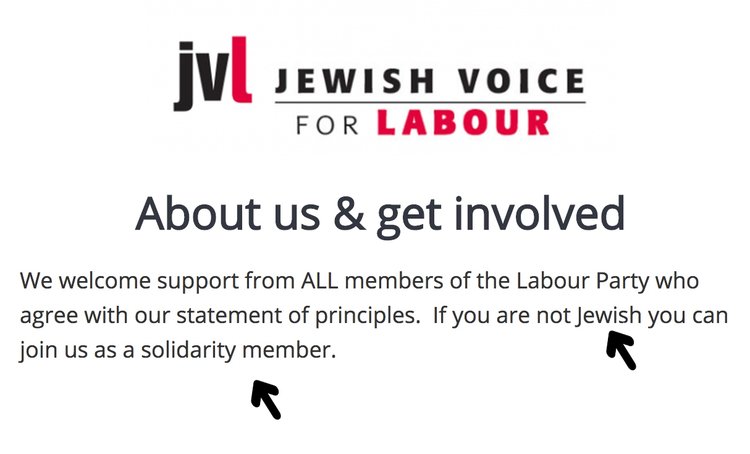
This means that even if you are not racially qualified as a Jew, you can still ‘support’ the Jews only group. You can make a donation, you may even be able to join their miniature protests but you will never be a proper member of the clan, you can only be a class B ‘solidarity member,’ like the Druze in Israel.
This is very revealing: first, it positively confirms that Corbyn isn’t an anti-Semite. He may even embrace Jewish racism when it is executed to support him. A less positive observation is that Jewish racism may be attached to most if not all forms of Jewish politics. Without Jews being a race or forming a racial continuum, Jewish politics is, unfortunately, racially oriented. Every political Jewish activity seems to adhere to a certain type of Jewish tribal biologism. Shockingly, it seems that Israel is slightly less racist (for the time being) than the JVL. While in Israel the 3rd biggest party in the Knesset is an Arab Party, in Jewish Voice for Labour, Arabs and Goyim can only participate as ‘solidarity members.’
Since JVL accepts support from Goyim who agree with their Statement of Principles I decided to examine how unprincipled their statement is.
“Jewish Voice for Labour is a network for Jewish members of the Labour Party.” What qualifies one as a Jew, is it the mother’s blood or is it merely the sustained consumption of chicken soup? The JVL doesn’t provide an answer. We can assume that for JVL, Jews are those who fit biological criteria, otherwise they would provide a chicken soup recipe for those who insist upon joining their ranks as equal members.
“Our political priorities are universal human rights and dignity; justice for all; freedom of expression; and democracy in the Labour Party.” This sounds spectacularly good, but begs the question of how they claim to adhere to universality when they don’t even accept Goyim as equal participants in their club. Apparently the ‘solidarity members’ do not enjoy voting rights as the JVL’s constitution specifies that the organisation is led by Jewish people. The inevitable answer is that the JVL’s statement is duplicitous at its core.
And the lies continues: “Our mission is to contribute to making the Labour Party an open, democratic and inclusive party, encouraging all ethnic groups and cultures to join and participate freely.” The Labour Party should be an ‘open space,’ but the JVL is clearly not. It is a tribal, racially exclusive setting that operates in total contradiction of every Labour Party value.
And again, “we (JVL) aim to strengthen the party in its opposition to all forms of racism including anti-Semitism.” The JVL is against all forms of racism except their own. I am pretty sure that the JVL would oppose groups called ‘Aryans for Jeremy’ or ‘White Voices for Labour’ but for some reason they fail to see that they themselves engage in identical racist activities.
The JVL opposes Israeli criminality and this is a good thing. “We stand for rights and justice for Jewish people everywhere, and against wrongs and injustice to Palestinians and other oppressed people anywhere.” A welcome statement, but if you are against Zionist injustice, why do you repeat the Zionist procedure by making non-Jewish Labour members into class B members of your ranks?
I agree with many of JVL’s ideas. The Jewish group opposes “attempts to widen the definition of antisemitism beyond its meaning of hostility towards or discrimination against Jews as Jews.” Yet, I wonder why these Jews feel the need to do it while celebrating their Jewish privilege in Jews only political cells? If, as they claim, they uphold a universal ethical stand, then surely they should operate as ordinary humans as the universalist Labour standard would dictate.
My answer is this: they do it because: 1. they are not the most sophisticated amongst people, 2. in total contradiction to their statement, they actually enjoy celebrating their Jewish privilege and operating in racially exclusive political cells, and 3. the Jewish activism in support of Jeremy Corbyn reduces any questions regarding Corbyn’s electability into an internal Jewish affair. Once again, the Goyim are excluded from the debate over the prospects of their own futures.
The only question left open for the time being is why Jeremy Corbyn allows all of this to happen within the Labour Party.
Critical voices needed at development studies conference
By Yves Engler · August 8, 2018
Are they critical thinkers or cheerleaders pretending to be independent of the government that funds them? Given the title conference organizers chose — “Is Canada Back: delivering on good intentions?” — one would guess the latter. But, an independent researcher keeps an open mind.
Publicity for the mid-September conference organized by the Canadian Council for International Co-operation (CCIC) and the Canadian Association for the Study of International Development (CASID) notes: “Inspired by Justin Trudeau’s 2015 proclamation ‘Canada is Back’, we are presenting panels that illustrate or challenge Canada’s role in global leadership. Are we doing all that we could be doing in the world?”
Formulating the question this way seems like a sop to the government that provides their funding. Conference organizers must be aware of the Trudeau government’s arms sales to Saudi Arabia’s monarchy, backing for brutal mining companies, NATO deployments, antagonism towards Palestinian rights, efforts to topple the Venezuelan government, failure to end Canada’s ‘low level war’ on Iran, refusal to support nuclear weapons controls, promotion of military spending, etc.
The reality is that while the two conference sponsors are supported by some labour unions, left groups and internationalist-minded young people, they are heavily dependent/tied to Canada’s official foreign policy apparatus.
To understand government influence over the NGO/development studies swamp requires wading through acronym-filled historical waters. An umbrella group representing dozens of major development NGOs, the CCIC was created fifty years ago with financing from the Canadian International Development Agency (CIDA, now part of Global Affairs Canada). The aid agency expected it to coordinate relations with the growing NGO network and build domestic political support for the aid program. While it has challenged government policy on occasion, the CCIC is highly dependent on government funds. Shortly after it publicly complained the government created a “chill” in the NGO community by adopting “the politics of punishment … towards those whose public views run at cross purposes to the government,” the CCIC’s $1.7 million CIDA grant was cut in 2012. This forced it to lay off two thirds of its staff.
CASID and international development studies programs more generally have received significant support from CIDA and the International Development Research Centre (IDRC), a Crown Corporation. In 2015 CASID’s president thanked “IDRC for its support of CASID over the past decade and more.” As part of one contract, IDRC gave CASID $450,000 between 2012 and 2015.
In the mid-1990s IDRC sponsored an initiative to enhance university undergraduate international development programs. This led to the creation of the Canadian Consortium for University Programs in International Development Studies (CCUPIDS), which has as its primary objective to “strengthen the position of International Development Studies.” CIDA also funds CCUPIDS conferences.
CCUPIDS is a branch of CASID, which publishes the Canadian Journal of Development Studies. In the introduction to a journal special issue on Canadian universities and development, editors Leonora Angeles and Peter Boothroyd write:
Thanks mostly to grant funding from the Canadian International Development Agency (CIDA) and the International Development Research Council (IDRC), Canadian academics have been able to engage intensively in development work for over three decades.
CIDA and IDRC also directly fund international development studies initiatives. In the late 1960s CIDA sponsored a study with the Association of Universities and Colleges of Canada (AUCC) to investigate what schools offered development studies courses. According to IDRC: 40 years of ideas, innovation, and impact, “early on, it began funding Canadian area and development studies associations, their conferences, journals, and research — gathering and communication activities.” The Canadian Association of African Studies, Canadian Association of Latin American and Caribbean Studies, Canadian Asian Studies Association and Canadian Association of Studies in International Development all “received substantial core funding from IDRC, intermittently in the 1970s and 1980s, and continuously since 1990.”
Significant sums of aid money continue to flow to international development studies programs. The website of the McGill Institute for the Study of International Development lists a dozen contracts worth more than $600,000 from CIDA, as well as $400,000 in contracts from IDRC and Foreign Affairs. An NGO and CIDA training ground, these programs often include internships and volunteer opportunities funded by development aid. The Students for Development Internships is “offered through the AUCC and CIDA, and students are funded to work for up to four months with an NGO anywhere in the world.” Queen’s Global Development Studies exchange program, for instance, received $270,000 from CIDA in 2011.
Individuals who participated in aid agency-funded projects, notably the government-backed Canadian University Services Overseas (CUSO), spurred or launched international development studies programs. In Canada’s Global Villagers: CUSO in Development, 1961-86 Ruth Compton Brouwer writes:
CUSO staff and RV’s [returned volunteers] contributed substantially to the establishment of university-level courses and programs related to global issues and the centres for international education and development studies. These are now such ordinary features of Canadian universities that it is difficult to conceive of how novel they were when they began in the 1960s.”
Led by CUSO’s former West Africa coordinator Don Simpson, University of Western Ontario opened an office of international education in 1969, which “operated in collaboration with CIDA.” Similarly, “valued friends of CUSO” instigated development studies programming at the universities of Ottawa and Toronto.
Canadian aid also directly shapes international development studies research. Half of the respondents to a 2002 survey of 64 scholars reported that CIDA’s six development priorities influenced their research focus. A professor or student who aligns their pursuits with those of the aid agency or IDRC is more likely to find funding or a fellowship. And IDRC/Global Affairs Canada’s priorities don’t include challenging Canadian foreign policy.
Given the sponsors’ ties to the foreign policy apparatus it is likely that the September conference will offer little more than cheerleading for the Trudeau Liberals’ foreign policy. Still, one can’t be certain and, having been invited by a Facebook friend to attend, I emailed the conference organizers to ask if they would allow me to present a critical look at Trudeau’s foreign policy. Thus far they have not accepted my offer.
If you agree that answering the question “Are we doing all that we could be doing in the world?” requires some critical voices, please email (ac.cicc@stneve) and ask them to allow Yves Engler to speak on Justin Trudeau’s foreign policy at your upcoming conference.
I love a good debate and maybe both sides will learn something new.
Chomsky on Regime Change in Nicaragua
By Roger Harris | CounterPunch | August 3, 2018
With patented angst, Noam Chomsky opined on President Daniel Ortega’s Nicaragua to an agreeing Amy Goodman: “But there’s been a lot of corruption, a lot of repression. It’s autocratic, undoubtedly.”
Earlier in their DemocracyNow! interview, the main talking points were established via a video clip of a dissident former official from Ortega’s Sandinista Party: Ortega’s “entire government has been, in essence, neoliberal. Then it becomes authoritarian, repressive.”
Left out of this view is why the US has targeted Nicaragua for regime change. One would think that a neoliberal regime, especially if it were authoritarian and repressive, would be just the ticket to curry favor with Washington.
In Chomsky’s own words, Nicaragua poses a threat of a good example to the US empire:
Since Ortega’s return election victory in 2006, Nicaragua had achieved the following, according to NSCAG, despite being the second poorest country in the hemisphere:
+ Second highest economic growth rates and most stable economy in Central America.
+ Only country in the region producing 90% of the food it consumes.
+ Poverty and extreme poverty halved; country with the greatest reduction of extreme poverty.
+ Reaching the UN Millennium Development Goal of cutting malnutrition by half.
+ Free basic healthcare and education.
+ Illiteracy virtually eliminated, down from 36% in 2006.
+ Average economic growth of 5.2% for the past 5 years (IMF and the World Bank).
+ Safest country in Central America (UN Development Program) with one of the lowest crime rates in Latin America.
+ Highest level of gender equality in the Americas (World Economic Forum Global Gender Gap Report 2017).
+ Did not contribute to the migrant exodus to the US, unlike neighboring Honduras, El Salvador, and Guatemala.
+ Unlike its neighbors, kept out the drug cartels and pioneered community policing.
Nicaragua targeted by the US for regime change
Before April 18, Nicaragua was among the most peaceful and stable countries in the region. The otherwise inexplicable violence that has suddenly engulfed Nicaragua should be understood in the context of it being targeted by the US for regime change.
Nicaragua has provoked the ire of the US for the good things its done, not the bad.
Besides being a “threat” of a good example, Nicaragua is in the anti-imperialist ALBA alliance with Venezuela, Bolivia, Cuba, and others. The attack on Nicaragua is part of a larger strategy by the US to tear apart regional alliances of resistance to the Empire, though that is not the whole story.
Nicaragua regularly votes against the US in international forums such as challenging retrograde US policies on climate change. An inter-ocean canal through Nicaragua is being considered, which would contend with the Panama Canal. Russia and China invest in Nicaragua, competing with US capital.
The NICA Act, passed by the US House of Representatives and now before the Senate, would initiate economic warfare designed to attack living conditions in Nicaragua through economic sanctions, as well as intensify US intelligence intervention. The ultimate purpose is to depose the democratically-elected Ortega government.
Meanwhile, USAID announced an additional $1.5 million “to support freedom and democracy in Nicaragua” through non-governmental organizations (NGOs) to overthrow the democratically elected government and “make this truly a hemisphere of freedom.” That is, freedom for the US empire.
Holding Nicaragua to a higher standard than our own government
Although Chomsky echoes the talking points of the USAID administrator Mark Green about “Ortega’s brutal regime,” he can’t quite bring himself to accept responsibility for regime change. Chomsky despairs, “it’s hard to see a simple way out at this point. It’s a very unfortunate situation.”
Chomsky is concerned about corruption, repression, and autocracy in Nicaragua, urging the democratically elected president to step down and run for re-election. Need it be mentioned that Chomsky chastised leftists who did not “absolutely” support Hillary Clinton? It is from this moral ground that the professor looks down on Nicaragua.
These charges of corruption and such are addressed by long-time solidarity activist Chuck Kaufman:
+ The World Bank, IMF, and EU countries have certified Nicaragua for its effective use of international loans and grants; funds were spent for the purposes they were given, not siphoned off into corruption.
+ Kaufman asks, “why a police force that in 39 years had not repressed the Nicaraguan people would suddenly go berserk,” while videos clearly show the violence of the more militant opposition.
+ Ortega won in 2006 with a 38% plurality, in 2011 with 63%, and 72.5% in 2016. The Organization of American States officially accompanied and certified the vote. Kaufman notes, “Dictators don’t win fair elections by growing margins.”
Alternatives to Ortega would be worse
Those who call for Ortega’s removal need to accept responsibility for what comes after. Here the lesson of Libya is instructive, where the replacement of, in Chomsky’s words, the “brutal tyrant” and “cruel dictator” Qaddafi has resulted in a far worse situation for the Libyan people.
Any replacement of Ortega would be more, not less, neoliberal, oppressive, and authoritarian. When the Nicaraguan people, held hostage to the US-backed Contra war, first voted Ortega out of office in 1990, the incoming US-backed Violeta Chamorro government brought neoliberal structural adjustment and a moribund economy.
The dissident Sandinistas who splintered off from the official party after the party’s election defeat and formed the MRS (Sandinista Renovation Movement) are not a progressive alternative. They are now comfortably ensconced in US-funded NGOs, regularly making junkets to Washington to pay homage to the likes of Representative Iliana Ros-Lehtinen and Senator Marco Rubio to lobby in favor of the NICA Act. Nor do they represent a popular force, garnering less than 2% in national elections.
When the MRS left the Sandinista party, they took with them almost all those who were better educated, came from more privileged backgrounds, and who spoke English. These formerly left dissidents, now turned to the right in their hatred of Ortega, have many ties with North American activists, which explains some of the confusion today over Nicaragua.
The world, not just Ortega, has changed since the 1980s when the Soviet Union and its allies served as a counter-vailing force to US bullying. What was possible then is not the same in today’s more constrained international arena.
Class war turned upside down
Kevin Zeese of Popular Resistance aptly characterized the offensive against the democratically elected government of Nicaragua as “a class war turned upside down.” Nicaragua was the most progressive country in Central America with no close rival. Yet some North American left intellectuals are preoccupied with Nicaragua’s shortcomings while not clearly recognizing that it is being attacked by a domestic rightwing in league with the US government.
Noam Chomsky is a leading world left intellectual and should be acclaimed for his contributions. His incisive warning about the US nuclear policy is just one essential example. Nevertheless, he is also indicative of a tendency in the North American left to accept a bit too readily the talking points of imperialist propaganda, regarding the present-day Sandinistas.
There is a disconnect between Chomsky’s urging Nicaraguans to replace Ortega with new elections and his longtime and forceful advocacy against US imperialist depredations of countries like Nicaragua. Such elections in Nicaragua would not only be unconstitutional but would further destabilize a profoundly destabilized situation. Given the unpopularity and disunity of the opposition and the unity and organizational strength of the Sandinistas, Ortega would likely win.
Most important, the key role of Northern American solidarity activists is to end US interference in Nicaragua so that the Nicaraguans can solve their own problems.
The rightwing violence since April in Nicaragua should be understood as a coup attempt. A significant portion of the Nicaraguan people have rallied around their elected government as seen in the massive demonstrations commemorating the Sandinista revolution on July 19.
For now, the rightwing tranques (blockades) have been dismantled and citizens can again freely circulate without being shaken down and threatened. In the aftermath, though, Nicaragua has suffered unacceptable human deaths, massive public property damage, and a wounded economy with the debilitating NICA Act threatening to pass the US Senate.
Roger Harris is on the board of the Task Force on the Americas, a 32-year-old anti-imperialist human rights organization.
Bizarro Zionism: Zionists Call Human Rights Supporters Racist
By Yves Engler | Dissident Voice | August 3, 2018
What to call someone who claims to oppose racism, except for that directed against Palestinians?
Judge someone by what they have done and continue to do. Consider the source. These thoughts ran through my mind as I struggled to write about Bernie Farber’s standing among some Left/liberals.
After Israel recently solidified its apartheid regime, a Facebook friend posted an opinion by illustrious pianist and conductor Daniel Barenboim titled “Today, I Am Ashamed to Be an Israeli.” While expressing opposition to its recent entrenchment of Jewish supremacism, the story effectively denied the ethnic cleansing of Palestine by claiming, “the founding fathers of the State of Israel who signed the Declaration [of independence] considered the principle of equality as the bedrock of the society they were building.”
More than this sop to colonial history, my leftist Facebook friend’s post piqued my ire because it highlighted that the article came from Farber, who worked at the now defunct Canadian Jewish Congress (CJC) between 1984 and 2011. In response to my complaint about citing the former CJC CEO approvingly, Farber wrote, “I will continue to work for mutual understanding and do my best to see all sides. You will of course see what you wish from your one-sided pedestal and be critical of anyone who remains a progressive Zionist which I am.”
From the “pedestal” on which I observe Farber, I see an individual who has repeatedly labelled supporters of Palestinian rights as racist. After the Canadian Union of Public Employees (Ontario) passed a 2009 motion in support of the Palestinian led Boycott, Divestment and Sanctions (BDS) movement Farber claimed, “anti-semitism is once again amongst us.” For Farber the resolution was “bigoted and discriminatory and anti-Jewish” because only one country was targeted. “The sole target is Jews, is Israel,” he said.
In a 2010 letter to the Toronto Star denouncing Israeli Apartheid Week CJC’s CEO wrote, “Anything that promotes the destruction, demonization and delegitimization of Israel, the world’s only Jewish state, is inherently anti-Semitic. To falsely accuse Israel, and by extension the vast majority of the world’s Jews who support the Jewish state, of ‘apartheid,’ is a form of anti-Semitic bullying.”
When the Israeli military killed 1,400 Palestinians (including 345 children) over 22 days in 2008-09 Farber denounced those protesting the slaughter across the country for their purported “vile, disgusting, hateful rhetoric of the kind that should be absolutely frightening to Canadians.” Further stoking anti-Arab/Muslim sentiment, he labeled the protests “uncivil, un-Canadian, that demonize Jews and Israelis.” Farber called on the police to investigate the burning of an Israeli flag and a small number of individuals with signs deemed “pro-Hamas” or comparing Israel’s actions to the Nazis.
In 2003 Farber lobbied for noted Islamophobe and anti-Palestinian activist Daniel Pipes to speak at York University. “It would have set a very, very unacceptable precedent to cancel it because of students who didn’t like or what he had to say,” said the then executive director of CJC Ontario. In 1996 Pipes asserted that Islam “would seem to have nothing functional to offer” and six years earlier said: “Western European societies are unprepared for the massive immigration of brown-skinned peoples cooking strange foods and maintaining different standards of hygiene … All immigrants bring exotic customs and attitudes, but Muslim customs are more troublesome than most.” The year before speaking at York University Pipes launched Campus Watch, which created “dossiers” on professors and academic institutions viewed as critical of Israel and more recently, wrote a piece titled “How 99 Percent of ‘Palestine Refugees’ Are Fake.”
Farber certainly didn’t support Pipes as a principled defender of free speech. In fact, Farber repeatedly promoted hate speech restrictions and a few years later the CJC pressured the York administration against holding an academic conference entitled Israel/Palestine: Mapping Models of Statehood and Paths to Peace. Farber also applauded the Stephen Harper government’s 2009 move to block former British MP George Galloway from speaking in Canada, writing: “George Galloway enables terrorism.”
After Adbusters juxtaposed photos of the World War II Warsaw Ghetto with images of Gaza, Farber penned a National Post op-ed titled “Selling anti-Semitism in the book stores”. It urged people to complain to stores selling the Vancouver-based magazine and a week later Shoppers Drug Mart told Adbusters it would no longer sell its magazine.
Aligning himself with Doug and Rob Ford, in 2010 Farber called on Toronto Pride to ban Queers Against Israeli Apartheid from its parade. In an over-the-top Toronto Star opinion piece he (co)wrote, “you’ve got to hand it to the organizers of Toronto’s annual gay pride parade. With their cowardly volte face in allowing Queers Against Israeli Apartheid (QuAIA) to march, organizers have pulled off the PR nightmare hat-trick: bowing to the bullying of political correctness; violating their own core philosophy by readmitting a group rooted in hate and demonization; and shifting media focus off their main objective.”
As executive director of CJC Ontario Farber joined US Jewish groups’ campaign to suppress the 1998 publication of A Nation on Trial: The Goldhagen Thesis and Historical Truth, which was a rebuttal of Daniel Jonah Goldhagen’s widely distributed Willing Executioners: Ordinary Germans and the Holocaust. The Norman Finkelstein-led project included an expanded version of an article by Ruth Bettina Birn, chief historian for Canada’s Nazi war crimes unit. Farber claimed that Birn was lending her name to Finkelstein’s “anti-Israel outbursts“, which were “an insult” to Jews. The CJC tried to intimidate the longstanding Nazi hunter through her government employer.
In another attempt to punish those in any way associated with Finkelstein, Farber threatened to take the York Region education board to the human-rights commission if it did not dismiss a Palestinian-Canadian from its race relations committee. Farber was angry that Bader Abu Zahra distributed a review of Finkelstein’s The Holocaust Industry: Reflections on the Exploitation of Jewish Suffering at a teachers’ conference to discuss including “Holocaust and Anti-racist education in History, English and Social Science courses.”
When former Assembly of First Nations (AFN) head David Ahenakew made anti-Semitic comments in 2002 Farber (correctly) criticized them. But he also used Ahenakew’s abhorrent comments to smear Palestine solidarity activists. Alluding to the September 2002 protest against Benjamin Netanyahu at Concordia University and support for the second Palestinian intifada, Farber claimed Ahenakew “felt comfortable at the time to say what he’s been thinking for a long time.” Farber then used Ahenakew’s anti-Semitic comments to push AFN leaders to support a state stealing indigenous Palestinians’ land. As part of AFN/CJC rapprochement Grand Chief Phil Fontaine participated in a CJC organize tour to Israel.
Farber attacked the United Church of Canada for supporting Palestinian rights and Independent Jewish Voices (IJV). “It almost sends shivers down our spine that the United Church of Canada won’t speak out against documents which on their face are anti-Semitic,” said Farber, regarding a number of Palestine solidarity resolutions submitted to its 2009 national meeting. Amidst an aggressive campaign targeting the United Church, the CJC head opined, “that a mainstream Christian faith group would provide funding to create an anti-Zionist, and anti-Jewish group is absolutely astounding.”
Farber has repeatedly denigrated IJV, which supports the Palestinian civil society’s call to put economic and diplomatic pressure on Israel. He called IJV a “small, radical rump group”, “a rump on the edge of Jewish society”, a “fringe group” that spews “vile, anti-Zionist” rhetoric, “a minuscule, fringe group” that backs the “anti-Semitic” claim that Israel practices apartheid, etc.
At the same time that he disparaged IJV, Farber gave political cover to the Jewish Defence League (JDL), which recruited in Jewish high schools and participated in Toronto’s Annual Israel Walk. According to Andy Lehrer, JDL head Meir Weinstein spoke glowingly of Farber. After being asked to do so for years, Farber finally distanced himself and the CJC from the JDL in 2011. Highlighting the tension between those who back its anti-Palestinian posture, but oppose the JDL’s alliances with fascist/white supremacist organizations, Farber denounced the group after it rallied in support of Britain’s extremist English Defence League.
In response to my posting some of the above information on Facebook Farber complained that, “I haven’t worked at the CJC for over 7 years. And you have no idea of my work since then.” While Farber is no longer a leading proponent of the idea that expressing support for Palestinians is “anti-Semitism”, now challenges some of the Islamophobia he previously stoked and is offside with the JDL, it would be a stretch to say he’s broken from his CJC past. In 2015 Farber’s Mosaic Institute co-hosted an event with the Consulate of Israel in Toronto and last year he supported the exclusion of IJV and the United Jewish People’s Order from an Ontario anti-Semitism committee he co-led. In February Farber was a spokesperson for a JSpace Canada press release calling on the NDP convention to oppose a resolution that called for boycotting products from illegal Israeli settlements.
Despite this anti-Palestinian activity, many left/liberals partner with him. Alt weekly Toronto Now regularly publishes Farber’s articles; anti-racist journalist/activist Desmond Cole spoke with him at a recent forum put on by Farber’s Mosaic Institute; Judy Rebick, Sandy Hudson, Jerry Dias and others co-authored an op-ed with Farber calling on “Progressive Voters To Rally Around Andrea Horwath”; A slew of individuals have supported the new Farber-chaired Canadian Anti-Hate Network; the Treyf podcast interviewed him twice last year; the Torontoist quoted him in an article titled “Toronto’s Jewish Left is Alive and Well and Resisting Extremism.”
Of course, one could argue there is nothing wrong with interviewing someone you disagree with, partnering on an issue even if you differ on other subjects or citing a former pro-Israel activist to highlight that country’s eroding support.
But, ask yourself this: Would a pro-union publication give voice to a prominent union-basher? And if that union-basher claimed to have changed, wouldn’t the pro-union publication question him/her about the reasons for the change and their current opinion regarding unions?
It seems to me that supporters of Palestinian rights must, at a minimum, ask Farber similar questions before giving him voice as a “progressive” and “anti-racist”.
Yves Engler is the author of A Propaganda System: How Canada’s Government, Corporations, Media and Academia Sell War and Canada in Africa: 300 Years of Aid and Exploitation . To help organize an event as part of the fall tour for my forthcoming book Left, Right: Marching to the Beat of Imperial Canada please get in touch at yvesengler [at] hotmail.com
Featured Video

ARE PATIENTS BEING PROPERLY INFORMED ABOUT OZEMPIC?
or go to
Aletho News Archives – Video-Images
New Book
Breast Cancer: Before You Consent
A new Unbekoming paperback
Lies are Unbekoming | September 18, 2026
Peter Gøtzsche reviewed every randomised mammography screening trial ever conducted for the Cochrane Collaboration. Cochrane’s headline is that, assuming a 15% mortality reduction, one woman in 2000 avoids dying of breast cancer over ten years. Ten are overdiagnosed and treated. Two hundred experience false alarms.
But that headline assumes the reduction. When Gøtzsche looked only at the trials with adequate randomisation — the higher-quality ones — the reduction disappeared. No effect on breast cancer mortality. No effect on all-cause mortality.
This is the Cochrane finding, published in the establishment’s own database of systematic reviews.
No woman being asked to consent to a mammogram this week knows it.
That is why the new Unbekoming paperback exists. … continue
Blog Roll
 Aletho News
- The Truth About the Trump Shootings with Ken Silva
- ARE PATIENTS BEING PROPERLY INFORMED ABOUT OZEMPIC?
- US lawmaker blocks $2.8 billion weapons sale to Israel: Report
- Yemeni army claims responsibility for strikes on sensitive sites in Saudi capital, Aramco facilities in Yanbu
- Iran Judiciary issues indictments against 159 US, Israeli officials for assassination of Leader, commanders
- Turkiye revokes Iranian bank license under US sanctions campaign
- US-Denmark Agreement on Greenland Is ‘PR Stunt’ Ahead of Midterms
- Araghchi: Military intervention cannot create security; coercion cannot bring peace
- Fraud Squared
- Breast Cancer: Before You Consent
- If Americans Knew
- Inside Gaza’s death trap of collapsing, bombed-out buildings
- The everyday items Israel bans from Gaza every day
- Inside the siege, the ruined buildings of Gaza – Daily Update
- Debunking The Claim That Macklemore Has A “History Of Antisemitism”
- CPJ demands release of arrested Palestinian-US journalist near Bethlehem
- Robert Kraft: The Billionaire Friend of Netanyahu Pulling The Strings Behind the Macklemore/Ed Sheeran Blow Up
- Columbia Administered Fund Gives Big Money to Pro-Israel Groups
- Deportation Case of Palestinian Activist Salah Sarsour Tests First Amendment
- ‘We Will Not Forget’: Palestinians Mark 44 Years since Sabra and Shatila
- Why do we let Zionists decide what we can and can’t say?
- No Tricks Zone
- 2025 Nature Paper Claiming Worsening Global Drought Gets RETRACTED …Heavily Flawed
- New Study: ‘Global Drought Shows No Detectable Recent Acceleration Under Climate Warming’
- Economic Masterminds: German Socialists Suggest Taxing Productivity Gains Stemming From Using AI
- The South China Sea Has Not Been Cooperating With The Climate Change Narrative
- Energy Crisis: Germany Enters Heating Season With Historically Low Gas Reserve Fill Levels
- New Study: The Antarctic Ice Sheet Gained Mass From 2020-2024 Due To Staggering Snow And Ice Accumulation
- Study: Ocean Heating Rates From Thousands Of Years Ago ‘Dwarf’ Modern Ocean Heating Rates
- Climate Extremists Target, Attack Large-Scale Power Grid Infrastructure In Germany!
- New Study: Antarctic Ice Melt Has Contributed Less Than 1 Centimeter To Sea Level Rise In The Last 30 Years
- Fear Of Debate: Alarmist German Climate Scientist Calls On Mainstream Media To Discredit Skeptic Voices
 Aletho News