Why Didn’t Mueller Investigate Seth Rich?
By Daniel Lazare | Consortium News | June 12, 2019
After bungling every last aspect of Russia-gate since the day the pseudo-scandal broke, the corporate press is now seizing on the Mueller report to shut down debate on one of the key questions still outstanding from the 2016 presidential election: the murder of Democratic National Committee staffer Seth Rich.
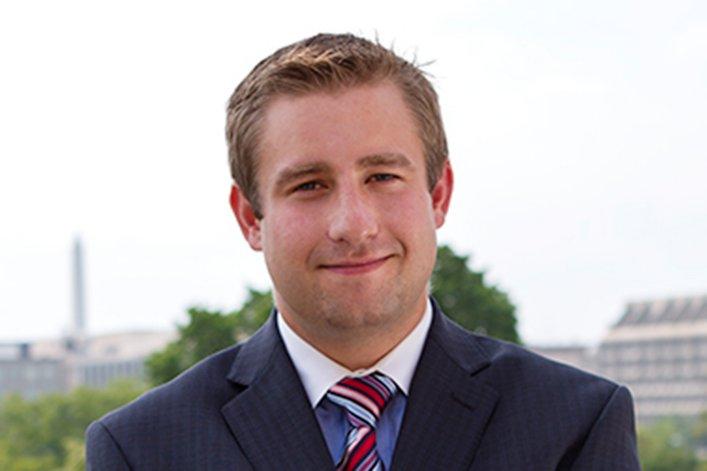
Slain Democratic National Committee staffer Seth Rich. (LinkedIn)
No one knows who killed Rich in Washington, D.C., on July 10, 2016. All we know is that he was found at 4:19 a.m. in the Bloomingdale neighborhood “with apparent gunshot wound(s) to the back” according to the police report. Conscious and still breathing, he was rushed to a nearby hospital where he was pronounced dead at 5:57.
Police have added to the confusion by releasing information only in the tiniest dribs and drabs. Rich’s mother, Mary, told local TV news that her son struggled with his assailants: “His hands were bruised, his knees are bruised, his face is bruised, and yet he had two shots to his back, and yet they never took anything…. They took his life for literally no reason. They didn’t finish robbing him, they just took his life.”
But cops said shortly after the killing that they had no immediate indication that robbery was a motive. Despite his mother’s report of two shots in the back, all the local medical examiner would say is that the cause of death was a gunshot wound to the torso. According to Rich’s brother, Aaron, Jeff “was very aware, very talkative,” when police found him lying on the pavement. Yet cops have refused to say if he described his assailant. A month later, they put out a statement that “there is no indication that Seth Rich’s death is connected to his employment at the DNC,” refusing to elaborate.
The result is a scattering of disconnected facts that can be used to support just about any theory from a random killing to a political assassination. Nonetheless, Robert Mueller is dead certain that the murder had nothing to do with the emails — just as he was dead certain in 2003 that Iraq was bristling with weapons of mass destruction “pos[ing] a clear threat to our national security.”
Mueller’s Theory About Assange ‘Dissembling’
Mueller is equally positive that, merely by expressing concern that the murder may have had something to do with the release of thousands of DNC emails less than two weeks later, WikiLeaks founder Julian Assange was trying to protect the real source, which of course is Russia.
Here’s how the Mueller report puts it:
“Beginning in the summer of 2016, Assange and WikiLeaks made a number of statements about Seth Rich, a former DNC staff member who was killed in July 2016. The statements about Rich implied falsely that he had been the source of the stolen DNC emails. On August 9, 2016, the @WikiLeaks Twitter accounted posted: ‘ANNOUNCE: WikiLeaks has decided to issue a US$20k reward for information leading to conviction for the murder of DNC staffer Seth Rich.’
Likewise, on August 25, 2016, Assange was asked in an interview, ‘Why are you so interested in Seth Rich’s killer?’ and responded, ‘We’re very interested in anything that might be a threat to alleged WikiLeaks sources.’ The interviewer responded to Assange’s statement by commenting, ‘I know you don’t want to reveal your source, but it certainly sounds like you’re suggesting a man who leaked information to WikiLeaks was then murdered.’
Assange replied, ‘If there’s someone who’s potentially connected to our publication, and that person has been murdered in suspicious, circumstances, it doesn’t necessarily mean that the two are connected. But it is a very serious matter … that type of allegation is very serious, as it’s taken very seriously by us’” (vol. 1, pp. 48-49).
This is what the Mueller report calls “dissembling.” The conclusion caused jubilation in corporate newsrooms where hostility to both Russia and WikiLeaks runs high. “The Seth Rich conspiracy theory needs to end now,” declared Vox.com. “The special counsel’s report confirmed this week that Seth Rich … was not the source,” said The New York Times. “The Mueller report might not end the debate over what President Donald Trump did,” the Poynter Institute’s Politifact added, “but it has scuttled one conspiracy theory involving a murdered Democratic party staffer and WikiLeaks.”
One Conspiracy Theory for Another
But all the Mueller report did was replace one conspiracy theory with another involving the Kremlin and its minions that is equally unconvincing.
Remarkably, there’s nothing in the Mueller report indicating that the special counselor independently reviewed the forensic evidence or questioned family members and friends. He certainly didn’t interview Assange, the person in the best position to know who supplied the data, even though Craig Murray, the ex-British diplomat who serves as an unofficial WikiLeaks spokesman, says the WikiLeaks founder would have been “very willing to give evidence to Mueller” while holed up in the Ecuadorian embassy in London, “which could have been done by video-link, by interview in the Embassy, or by written communication.”
Murray says Mueller’s team made no effort to contact him either even though he has publicly stated that he met clandestinely with an associate of the leaker near the American University campus in Washington.
Why not? Because Mueller didn’t want anything that might disturb his a priori assumption that Russia is the guilty party. If he had bucked the intelligence community finding – set forth in a formal assessment in January 2017 – that Russian President Vladimir Putin ordered an influence campaign aimed at undermining Hillary Clinton’s candidacy — it would have been front-page news since an anti-Trump press had already accepted the assessment as gospel. But Mueller is far too much of an establishmentarian to do anything so reckless.
So he selected evidence in support of the official theory that “[t]he Russian government interfered in the 2016 presidential election in sweeping and systematic fashion,” as the report states on its very first page. And since Assange had consistently maintained that the data was the result of an inside leak rather than internal hack and that “[o]ur source is not the Russian government,” he cherry picked evidence to show that Assange is a liar, not only about Russia but about Seth Rich.
Cryptic Exchange
It’s a self-serving myth that corporate media have swallowed whole because it serves their interests too. One problem in exposing it, however, is Assange’s pledge – intrinsic to the WikiLeaks mission – to safeguard the identities of whistleblowers who furnish it with information. The upshot has been a good deal of beating around the bush. A month after the murder, the WikiLeaks founder appeared on a Dutch program called “Nieuwsuur” and took part in a cryptic exchange with journalist Eelco Bosch van Rosenthal:
Assange: Whistle blowers go to significant efforts to get us material and often very significant risks. There’s a 27-year-old – works for the DNC – who was shot in the back, murdered, just a few weeks ago for unknown reasons as he was walking down the street in Washington, so….
Rosenthal: That was just a robbery, I believe, wasn’t it?
Assange: No, there’s no finding, so –
Rosenthal: What are you suggesting?
Assange: I’m suggesting that our sources take risks, and they become concerned to see things occurring like that.
Rosenthal: But was he one of your sources then? I mean –
Assange: We don’t comment about who our sources are.
Rosenthal: But why make the suggestion about a young guy being shot in the streets of Washington?
Assange: Because we have to understand how high the stakes are in the United States and that our sources, you know, face serious risks. That’s why they come to us – so we can protect their anonymity.
Rosenthal: But it’s quite something to suggest a murder. That’s basically what you’re doing.
This was as close as Assange could come to confirming that Rich was tied up with the leak without actually saying it. Hours later, WikiLeaks tweeted about the $20k reward.
Four months after that, Craig Murray told the Libertarian Institute’s Scott Horton: “Don’t get me wrong, I’m not saying that he [Rich] was the source of the leaks. What I’m saying is that it’s probably not an unfair indication to draw that WikiLeaks believe[s] that he may have been killed by someone who thought he was the source of the leaks.” (Quote begins at 11:20.)
Thanks to such foggy rhetoric, it was all but inevitable that conspiracy theories would ignite. Two months after the killing, an ultra-conservative talk-radio host named Jack Burkman – best known for organizing a protest campaign against the Dallas Cowboys’ hiring of an openly gay football player named Michael Sam – approached members of the Rich family and offered to launch an investigation in their behalf.
The family said yes, but then backed off when Burkman grandly announced that the murder was a Kremlin hit. Things turned even more bizarre a year later when Kevin Doherty, an ex-Marine whom Burkman had hired to look into the case, lured his ex-boss to a Marriott hotel in Arlington, Virginia, where he shot him twice in the buttocks and then tried to run him down with a rented SUV. Doherty received a nine-year sentence last December.
The rightwing Washington Times meanwhile reported that WikiLeaks had paid Seth and Aaron Rich an undisclosed sum, a story it was forced to retract, and Fox News named Seth as the source as well. (A sympathetic judge dismissed a lawsuit filed by the Rich family on technical grounds.) But still the speculation bubbled on, with conservative nuts blaming everyone from ex-DNC chair Debbie Wasserman Schultz to acting DNC chairwoman Donna Brazile, Clinton campaign chairman John Podesta, and Bill and Hillary themselves.
All of which plays into the hands of a corporate press happy to write off any and all suspicion as a product of alt-right paranoia.
But if speculation refuses to die, it’s for a simple reason. If the DNC email disclosure was a hack, then Rich clearly had nothing to do with it, which means his death was no more than a robbery gone awry. But if it was a leak, then – based on broad hints dropped by Assange and Murray – it looks like the story could well be more complicated. This proves nothing in and of itself. But it guarantees that questions will grow as long as the Washington police make zero progress in its investigation and the Mueller report continues to fall apart.
And that’s just what’s happening. Mueller’s account of how Russian intelligence supposedly supplied WikiLeaks with stolen data makes no sense because, according to the report’s chronology, the transfer left WikiLeaks with just four days to review some 28,000 emails and other electronic documents to make sure that they were genuine and unaltered – a clear impossibility. (See “The ‘Guccifer 2.0’ Gaps in Mueller’s Full Report,” April 18.)
The FBI assessment that Paul Manafort associate Konstantin Kilimnik “has ties to Russian intelligence” – which Mueller cites (vol. 1, p. 133) in order to justify holding Manafort in solitary confinement during the Russia-gate investigation – is similarly disintegrating amid reports that Kilimnik actually served as an important State Department intelligence source.
So the idea of a hack makes less and less sense and an inside leak seems more and more plausible, which is why questions about the Rich case will not go away. Bottom line: you don’t have to be a loony rightist to suspect that there is more to the murder than Robert Mueller would like us to believe.
Daniel Lazare is the author of “The Frozen Republic: How the Constitution Is Paralyzing Democracy” (Harcourt Brace, 1996) and other books about American politics. He has written for a wide variety of publications from The Nation to Le Monde Diplomatique and blogs about the Constitution and related matters at Daniellazare.com.
‘They will pay a price’: Bolton says US has expanded ‘offensive cyber operations’ against Russia
RT | June 11, 2019
The United States is ramping up cyber operations targeting Russia and other so-called adversaries, in what US National Security Advisor John Bolton says is a response to election meddling.
Speaking at the Wall Street Journal’s CFO Network conference on Tuesday, Bolton said Washington had taken steps to create “structures of deterrence” in cyberspace in order to stop interference in US elections, but what he described sounded a lot like launching a cyber war.
Under a new presidential directive, the administration has “fundamentally changed the way the United States government makes decisions about offensive cyber operations,” Bolton said, adding that the new approach has improved “capabilities across the board to engage in more offensive cyber activities.”
Though Bolton said the measures were intended to “avoid conflict,” the hawkish White House adviser couldn’t resist some public sabre rattling.
“The purpose … is to say to Russia, or anybody else that’s engaged in cyber operations against us, ‘you will pay a price,’” he said. “We will impose costs on you until you get the point.”
Bolton maintained that US efforts were largely focused on state actors – he flew down the list of usual suspects: China, Russia, Iran, North Korea – but noted some attention was being devoted to hacking in the private sector.
Perhaps the most bellicose figure in the White House on foreign policy matters, Bolton has long argued for a more hostile footing in cyberspace. In an op-ed for the Hill last year, he urged the US to launch a “retaliatory cyber campaign” against Russia, which has apparently now become policy.
The ramped up cyber offensive comes as Chinese telecom Huawei tussles with Washington over accusations of technology theft and spying, while Democrats in Congress push ahead with investigations into alleged Russian election interference, and whether the president obstructed the special counsel probe into the so-called meddling.
Russian Aggression Comes From Media Racism
By Tim Kirby | Strategic Culture Foundation | June 10, 2019
As an American wouldn’t you want to live in a country with a powerful military that can prevent any invasion and backs up your foreign policy with some some muscle? Wouldn’t you want to make sure that America remains a cohesive nation that shuts down any attempts at succession and asserts a firm military, governmental and cultural presence all over its own territory? As an American wouldn’t you feel that America has the right to try to get back regions that it controlled for generations filled with Americans cut off from the bulk of the US if need be? And finally wouldn’t you think that it is fine for the USA to resist economic, military and cultural pressure from an aggressive foreign power while developing itself?
Unless you are some sort of self-hating SJW zealot then all of the above should seem perfectly reasonable to you… because it is. It is reasonable not just for America but for any great human civilization on our planet. So the question is why is it that when Russians follow these same normal patterns of behavior they are labeled as “aggression” and somehow immediately become horrible and unacceptable.
The Russian aggression trope has come up again as CBS brutally shoehorned the expression into the title of one of their videos. In the piece Senator Joe Manchin comments on a few different topics but the main one was his tour of Arctic nations and the climate issues related to them. All he had to say about Russia is that they are really putting their chips down on the Arctic and have invested massive amounts of money and resources into the region.
The topic of Russia came up after the presenter asked Mr. Manchin a bizarre conspiracy theory site style question related to Russians doing major nuclear tests in the Arctic for no clear reason other than Russians do bad things by default according to CBS’s editorial line. The presenter did not state where she got this nugget of fake news from, she just boldly asserted they are nuking snow and polar bears as Russians are known to do.
Thankfully Mr. Manchin bluntly said “no” ignoring this mad question to immediately go on to layout his opinion that the US could be really falling behind in terms of the Arctic due to the Russian surge in the great white north and that the US should be aware of this and try to catch up. He feels that America needs to catch up, overtake, or offset the Russians in the Arctic.
This is a totally reasonable respectable and patriotic stance to have, which is probably why CBS had to force “aggression” into the title of the video. If all American politicians had the same rational view of competition between nations that Mr. Manchin does, then the pointless tension between the US and Russia would probably be very nominal right now.
Perhaps it is part of human nature to create lots of double standards in favor of one’s own group. Every political movement and every nation seems to forgive the sins of its own guys when they do things “for the greater good” and demonizes anyone who tries to stop them. Our soldiers are heroes, their soldiers are monsters, our way of life is good for everyone, their way of life is a threat to the world etc. This aspect of tribal mentality is part of who we are and something we need to be much more mindful of in our 21st century nuclear standoff, because the worst that could happen from this type of rhetoric is no longer just some kind of pogrom but total nuclear annihilation.
If the Pro-Diversity machine in the media would wake up to the fact that the geopolitical chessboard, is, was and always will be “diverse” and that all players have similar goals with similar means that would really help the entire world move forward and keep us all very far away from the potential of a WWIII nuclear scenario. This “good guy vs. bad guy” racist narrative that Russia is on the bad end is propping up an ultimately artificial conflict with the US. It is time to acknowledge the reality that there are numerous cultures on Earth that want to be powerful and prosperous and just because they look different from us doesn’t make them any more or less capable of doing great evil.
US condemns Turkey for drilling in Cyprus, foiling Israel pipeline deal
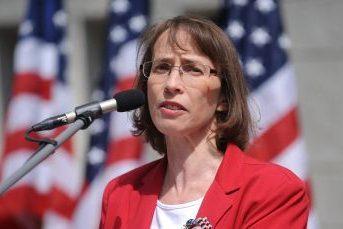
US Ambassador to Cyprus, Judith Garber
MEMO | June 7, 2019
The US Ambassador to Cyprus, Judith Garber, has expressed her deep concerns over Turkey’s continued drilling off the coast of Cyprus, and urged Turkey to halt the operations exploring energy reserves in the surrounding waters.
Garber made the remarks yesterday evening at the Independence Day reception held at the US Embassy in Nicosia, while in the presence of the President of southern Cyprus, Nicos Anastasiades. She reiterated her support for the Republic and reassured them that the US recognises its right to develop and exploit resources within its “exclusive economic zone” (EEZ).
The resources in question are the vast gas and energy reserves discovered first in Egyptian waters and then in Cypriot waters in recent years, particularly the untouched and un-marketed 4.5 trillion cubic feet (127 billion cubic metres) of gas discovered off the southern coast of Cyprus in 2011. Then in February this year, the companies Exxon Mobil and Qatar Petroleum discovered an estimated five to eight trillion cubic feet of natural gas off the coast of the island.
In her remarks, Garber also touched on the concept of a possible agreement between the Greek and Turkish sides of the island, stating that “resources should be equitably shared between both communities in the context of an overall settlement,” Garber added. “It is our earnest hope that such resources will soon benefit a united Cyprus.”
This, however, does not seem likely, as such vast reserves have prompted a recently-signed deal between Greece, Cyprus and Israel to build the newly planned Eastern Mediterranean (EastMed) pipeline, which would supply gas to European countries and subsequently allow them to decrease their reliance on gas from other sources such as Russia. The deal will mean Cyprus will earn $9.3 billion over 18 years of the reserve’s production.
This new tripartite deal, backed by the US, has angered Turkey, causing it to send drilling vessels into Cyprus’s EEZ last month, announcing that it will begin the work of exploring more energy reserves.
Mueller Caught In Another Deception; Key ‘Russia Link’ Exposed As Informant For US, Ukraine
By Tyler Durden | Zero Hedge | June 7, 2019
A Ukrainian businessman painted in the Mueller report as a sinister link to Russia was actually a “sensitive” intelligence source for the US State Department who informed on Ukrainian and Russian issues – and passed messages between the Washington and Kiev, according to The Hill‘s John Solomon.
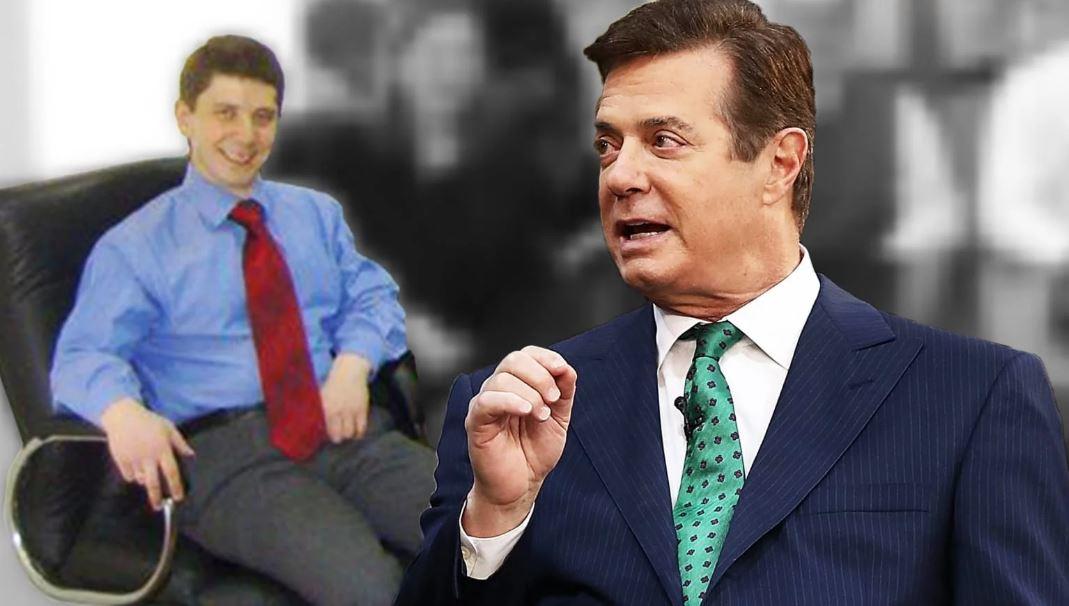
Konstantin Kilimnik, who worked for Trump campaign chairman Paul Manafort, was described on page 6 of the Mueller report as having “ties to Russian intelligence” – and was cast in a sinister light as a potential threat to democracy. Mueller completely omitted the fact that Kilimnik was working as an informant and intermediary between America and Ukraine, and subsequently indicted him for obstruction of justice.
Kilimnik was not just any run-of-the-mill source, either.
He interacted with the chief political officer at the U.S. Embassy in Kiev, sometimes meeting several times a week to provide information on the Ukraine government. He relayed messages back to Ukraine’s leaders and delivered written reports to U.S. officials via emails that stretched on for thousands of words, the memos show.
The FBI knew all of this, well before the Mueller investigation concluded. –The Hill
“Purcell described what he considered an unusual level of discretion that was taken with handling Kilimnik,” said one FBI interview report reviewed by Solomon. “Normally the head of the political section would not handle sources, but Kasanof informed Purcell that KILIMNIK was a sensitive source.”
Purcell told the FBI that Kilimnik provided “detailed information about OB (Ukraine’s opposition bloc) inner workings” that sometimes was so valuable it was forwarded immediately to the ambassador. Purcell learned that other Western governments relied on Kilimnik as a source, too.
“One time, in a meeting with the Italian embassy, Purcell heard the Italian ambassador echo a talking point that was strikingly familiar to the point Kilimnik had shared with Purcell,” the FBI report states. –The Hill
And Mueller mentioned none of this in his report despite knowing about it since 2018 – more than a year before the final report.

Three sources with direct knowledge of the inner workings of Mueller’s office confirmed to me that the special prosecutor’s team had all of the FBI interviews with State officials, as well as Kilimnik’s intelligence reports to the U.S. Embassy, well before they portrayed him as a Russian sympathizer tied to Moscow intelligence or charged Kilimnik with participating with Manafort in a scheme to obstruct the Russia investigation. –The Hill
Kilimnik was described by Purcell’s predecessor, Alexander Kasanov, as one of the few reliable informants spying on former Ukrainian President Victor Yanukovych, whose Party of Regions had hired Manafort’s lobbying firm.
Kasanof described Kilimnik as one of the few reliable insiders the U.S. Embassy had informing on Yanukovych. Kilimnik began his relationship as an informant with the U.S. deputy chief of mission in 2012-13, before being handed off to the embassy’s political office, the records suggest.
“Kilimnik was one of the only people within the administration who was willing to talk to USEMB,” referring to the U.S. embassy, and he “provided information about the inner workings of Yanukovych’s administration,” Kasanof told the FBI agents.
“Kasanof met with Kilimnik at least bi-weekly and occasionally multiple times in the same week,” always outside the embassy to avoid detection, the FBI wrote. “Kasanof allowed Kilimnik to take the lead on operational security” for their meetings. –The Hill
And, despite the Mueller report suggesting Kilimnik is a Russian stooge, state officials told the FBI that he did not appear to hold any allegiance to the Kremlin, and had been “flabbergasted at the Russian invasion of Crimea.”
“Most sources of information in Ukraine were slanted in one direction or another,” Kasanof told the FBI. “Kilimnik came across as less slanted than others.”
Solomon corroborated the FBI interviews with Kasanov and Purcell with “scores of State Department emails” which contain regular intelligence dispatches from Kilimnik on what was going on inside of the Yanukovych administration, the Crimea conflict, and Ukrainian and Russian politics.
Not a threat
Contrary to the dire threat to national security implied in the Mueller report, Kilimnik was allowed to enter the United States twice in 2016 to meet with State officials – meaning he clearly wasn’t flagged in visa databases as a foreign intelligence threat.
Mueller also painted a one-sided picture of Kilimnik’s peace plan for Crimea which he had presented to the Trump administration – suggesting that it was a “backdoor” way for Russia to control part of eastern Ukraine. In fact, Kilimnik had presented the idea to the Obama administration in 2016.
As Solomon notes “That’s what many in the intelligence world might call “deception by omission.”
Specifically, the Mueller report flagged Kilimnik’s delivery of a peace plan to the Trump campaign for settling the two-year-old Crimea conflict between Russia and Ukraine.
“Kilimnik requested the meeting to deliver in person a peace plan for Ukraine that Manafort acknowledged to the Special Counsel’s Office was a ‘backdoor’ way for Russia to control part of eastern Ukraine,” the Mueller report stated.
But State emails showed Kilimnik first delivered a version of his peace plan in May 2016 to the Obama administration during a visit to Washington. Kasanof, his former handler at the U.S. Embassy in Ukraine, had been promoted to a top policy position at State, and the two met for dinner on May 5, 2016.
The day after the dinner, Kilimnik sent an email to Kasanof’s official State email address recounting the peace plan they had discussed the night before. –The Hill
While Kilimnik did not respond to The Hill for comment, he slammed the “made-up narrative” about him in a May email to the Washington Post, adding “I have no ties to Russian or, for that matter, any intelligence operation.”
That said, as Solomon writes “Kilimnik holds Ukrainian and Russian citizenship, served in the Soviet military, attended a prestigious Russian language academy and had contacts with Russian oligarch Oleg Deripaska. So it is likely he had contacts over the years with Russian intelligence figures. There also is evidence Kilimnik left the U.S.-funded International Republican Institute (IRI) in 2005 because of concerns about his past connections to Russia, though at least one IRI witness disputed that evidence to the FBI, the memos show.”
However Mueller’s omission of his “extensive, trusted assistance to the State Department seems inexplicable.”
We learn this four days after deceptive edits were found in the Mueller report regarding a phone call between attorneys for President Trump and former national security adviser Mike Flynn designed to make it appear as though Trump was attempting to strongarm Flynn and possibly obstruct justice by shaping witness testimony.
As Solomon concludes – “A few more such errors and omissions, and Americans may begin to wonder if the Mueller report is worth the paper on which it was printed.”
Hillary Clinton’s Russia collusion IOU: The answers she owes America
By John Solomon – The Hill – 06/03/19
During the combined two decades she served as a U.S. senator and secretary of State, Hillary Clinton’s patrons regularly donated to her family charity when they had official business pending before America’s most powerful political woman.
The pattern of political IOUs paid to the Clinton Foundation was so pernicious that the State Department even tried to execute a special agreement with the charity to avoid the overt appearance of “pay-to-play” policy.
Still, the money continued to flow by the millions of dollars, from foreigners and Americans alike who were perceived to be indebted to the Clinton machine or in need of its help.
It’s time for the American public to call in their own IOU on political transparency.
The reason? Never before — until 2016 — had the apparatus of a U.S. presidential candidate managed to sic the weight of the FBI and U.S. intelligence community on a rival nominee during an election, and by using a foreign-fed, uncorroborated political opposition research document.
But Clinton’s campaign, in concert with the Democratic Party and through their shared law firm, funded Christopher Steele’s unverified dossier which, it turns out, falsely portrayed Republican Donald Trump as a treasonous asset colluding with Russian President Vladimir Putin to hijack the U.S. election.
Steele went to the FBI to get an investigation started and then leaked the existence of the investigation, with the hope of sinking Trump’s presidential aspirations.
On its face, it is arguably the most devious political dirty trick in American history and one of the most overt intrusions of a foreigner into a U.S. election.
It appears the Clinton machine knew that what it was doing was controversial. That’s why it did backflips to disguise the operation from Congress and the public, and in its Federal Election Commission (FEC) spending reports.
Clinton and the Democratic National Committee (DNC) used the law firm of Perkins Coie to hire Glenn Simpson’s research firm, Fusion GPS, which then hired Steele — several layers that obfuscated transparency, kept the operation off the campaign’s public FEC reports and gave the Clintons plausible deniability.
But Steele’s first overture on July 5, 2016, failed to capture the FBI’s imagination. So the Clinton machine escalated. Steele, a British national, went to senior Department of Justice official Bruce Ohr — whose wife, Nellie, also worked for Fusion — to push his Trump dirt to the top of the FBI.
Nellie Ohr likewise sent some of her own anti-Trump research augmenting Steele’s dossier to the FBI through her husband. Perkins Coie lawyer Michael Sussmann used his connection to former FBI general counsel James Baker to dump Trump dirt at the FBI, too.
Then Steele and, separately, longtime Clinton protégé Cody Shearer went to the State Department to get the story out, increasing pressure on the FBI.
In short, the Clinton machine flooded the FBI with pressure — and bad intel — until an investigation of Trump was started. The bureau and its hapless sheriff at the time, James Comey, eventually acquiesced with the help of such Clinton fans as then-FBI employees Peter Strzok and Lisa Page.
To finish the mission, Simpson and Steele leaked the existence of the FBI investigation to the news media to ensure it would hurt Trump politically. Simpson even called the leaks a “hail Mary” that failed.
Trump won, however. And now, thanks to special counsel Robert Mueller, we know the Russia-collusion allegations relentlessly peddled by Team Clinton were bogus. But not before the FBI used the Clinton-funded, foreign-created research to get a total of four warrants to spy on the Trump campaign, transition and presidency from October 2016 through the following autumn.
The Clinton team’s dirty trick was as diabolical as it was brilliant. It literally used house money and a large part of the U.S. intelligence apparatus to carry out its political hit job on Trump.
After two years of American discomfort, and tens of millions of taxpayer dollars spent, it’s time for the house to call in its IOU.
Hillary Clinton owes us answers — lots of them. So far, she has ducked them, even while doing many high-profile media interviews.
I’m not the only one who thinks this way. Longtime Clinton adviser Douglas Schoen said Friday night on Fox News that it’s time for Clinton to answer what she knew and when she knew it.
Here are 10 essential questions:
- In January 2018, the Senate Judiciary Committee sent a formal investigative request for documents and written answers from your campaign. Do you plan to comply?
- Please identify each person in your campaign who was involved with, or aware of, hiring Fusion GPS, Glenn Simpson and Christopher Steele.
- Please identify each person in your campaign, including Perkins Coie lawyers, who were aware that Steele provided information to the FBI or State Department, and when they learned it.
- Describe any information you and your campaign staff received, or were briefed on, before Election Day that was derived from the work of Simpson, Steele, Fusion GPS, Nellie Ohr or Perkins Coie and that tried to connect Trump, his campaign or his business empire with Russia.
- Please describe all contacts your campaign had before Election Day with or about the following individuals: Bruce Ohr, Nellie Ohr, Glenn Simpson, Christopher Steele, former Australian diplomat Alexander Downer, former foreign policy scholar Stefan Halper and Maltese academic Joseph Mifsud.
- Did you or any senior members of your campaign, including lawyers such as Michael Sussmann, have any contact with the CIA, its former Director John Brennan, current Director Gina Haspel, James Baker, Peter Strzok, Lisa Page or former FBI Deputy Director Andrew McCabe?
- Describe all contacts your campaign had with Cody Shearer and Sidney Blumenthal concerning Trump, Russia and Ukraine.
- Describe all contacts you and your campaign had with DNC contractor Alexander Chalupa, the Ukraine government, the Ukraine Embassy in the United States or the U.S. Embassy in Kiev concerning Trump, Russia or former Trump campaign chairman Paul Manafort.
- Why did your campaign and the Democratic Party make a concerted effort to portray Trump as a Russian asset?
- Given that investigations by a House committee, a Senate committee and a special prosecutor all have concluded there isn’t evidence of Trump-Russia collusion, do you regret the actions by your campaign and by Steele, Simpson and Sussmann to inject these unfounded allegations into the FBI, the U.S. intelligence community and the news media?
Hillary Clinton owes us answers to each of these questions. She should skip the lawyer-speak and answer them with the candor worthy of an elder American stateswoman.
Bipartisan Support for Trump’s Aggressive Iran Policy Reveals the Hollowness of Russiagate
By Whitney Webb | MintPress News | June 3, 2019
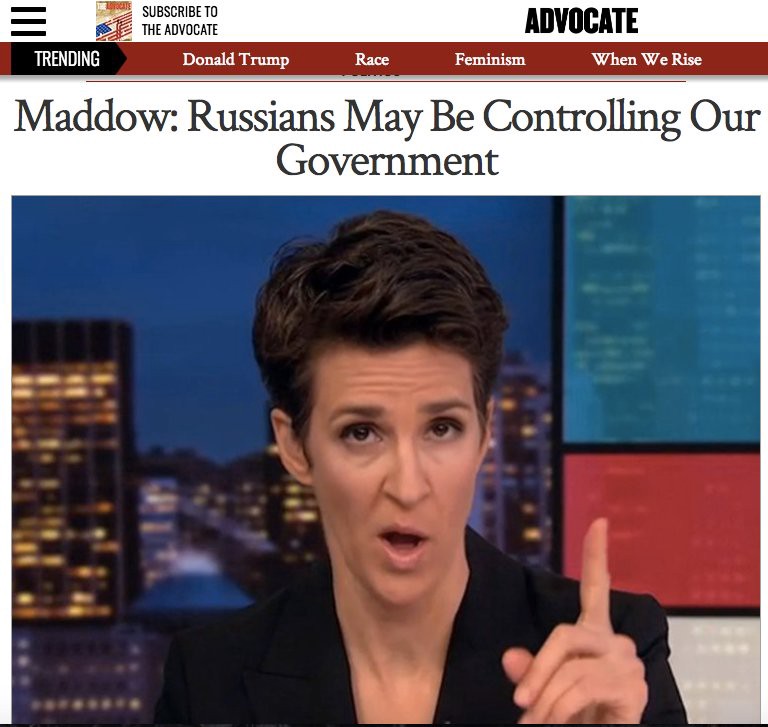
In early May, MSNBC news host Rachel Maddow — known as one of the top promoters of the new Cold War and Russiagate in American media — emphatically endorsed regime change in Venezuela after she claimed that President Donald Trump’s hawkishness towards the South American country had changed, all because of a single phone call with his Russian counterpart Vladimir Putin.
Though Maddow’s claims were arguably the most extreme in suggesting that Trump was “taking orders” from Putin on Venezuela, she wasn’t alone in making them. For instance, Cenk Uygur of the Young Turks also made the claim that the Trump-Putin phone call on Venezuela was “direct evidence that he is literally taking orders from Putin.” In addition, several corporate media outlets supported this narrative by suggesting that Trump “echoed” Putin’s Venezuela stance after the phone call and directly contradicted his top staffers and even himself in doing so.
Yet now, strangely, those same corporate media voices remain silent on the Trump administration’s other regime-change project — in Iran — despite the fact that the Putin-led Russian government is set to be the biggest winner as tensions between the U.S. and the Islamic Republic boil over and threaten to send the Middle East into a fresh bout of destruction and chaos.
How Russia wins
As tensions between the U.S. and Iran have grown in recent months, analysts in both corporate and independent media have speculated about what country is set to benefit the most from the U.S.’ campaign of “maximum pressure” and regime change against the Islamic Republic. Of the many analyses, two countries have stood out as likely beneficiaries: Russia and China.
The cases for China and Russia’s benefit are somewhat similar given that the Trump administration’s focus on Iran results in less pressure on both Russia and China. This is despite the fact that, officially, the U.S.’ current National Defense Strategy explicitly calls for focusing attention on preparing for a “long war” against Russia and China to prevent either from superseding the U.S. as a global superpower. Yet, with the U.S. focused on regime change in Iran and Venezuela, Russia and China can avoid bearing the brunt of U.S. military adventurism, either directly or by proxy, while the U.S. wears itself thin by trying to do it all at once.
Several U.S. military analysts have been warning against war with Iran for precisely this reason. Nikolas Gvosdev, a professor of national security affairs at the U.S. Naval War College, recently wrote in The Hill that the U.S. faces a lose-lose scenario by pursuing a militaristic, aggressive Iran policy:
To gear up for a major conflict with Iran, the U.S. would be forced to de-emphasize Europe’s eastern flank, allowing Russia more time and breathing space to consolidate its position. On the other hand, a U.S. campaign that is defined more by bellicose rhetoric and less by action will buttress Russia’s claim, already seemingly validated in Syria and in Venezuela, that the U.S. talks a good game but has no real stomach for projecting its power.”
Both countries also stand to benefit from Iran’s increasing desperation for trading partners unwilling to bow to the U.S. Currently, China represents 30 percent of Iran’s international trade and the current U.S. sanctions on Iran have pushed Tehran to rely more heavily on Russia, especially for weapons purchases, than it had while the Iran nuclear deal (officially the Joint Comprehensive Plan of Action, JCPOA) was in force.
However, upon closer examination, it becomes clear that China, though it benefits to some degree, is not a clear winner amid current tensions, while Russia stands to gain the most. The reason for this is the effect of current and future U.S.-Iran tensions on the oil market. While China trusts Iran to be a key oil supplier even if there is a breach in U.S.-China relations, any shock to the oil market and any jump in oil prices — both of which are likely to occur if U.S.-Iran tensions continue to escalate — will spell disaster for the Chinese economy, given that China is now the world’s largest importer of oil.
Russia, on the other hand, stands to benefit massively from the chaos that U.S.-Iran tensions are set to unleash on the oil market and, by extension, oil prices. With the U.S. seeking to starve Iran of any and all oil export revenue, all countries that had been purchasing Iranian oil must seek new suppliers. Yet, with the prospect of a U.S-Iran conflict still ever-present, it will be those oil producers outside of the Middle East that will come out on top, since oil supply routes that do not pass through the Middle East do not risk supply disruptions that would be caused by a war in the region. Thus, Russia, owing to its location, will emerge as an oil producer of extreme importance. Furthermore, given that such instability in the Middle East will lead to a surge in global oil prices, Russia will be able to export more oil at a higher price and will see its economy and geopolitical clout benefit greatly as a result.
A potential geopolitical killing
In addition to a great boost to its oil sector, Russia also stands to make unique geopolitical gains, particularly in the Middle East and beyond. For instance, in Syria, Russia is increasingly seeking to use its pull with Syria’s government as a major bargaining chip with Israel and the U.S., as made clear by the upcoming trilateral summit on the Middle East between Russia, Israel and the U.S. The main focus of that summit will likely be the fate of the presence of foreign militaries in Syria, particularly Iranian and U.S. forces.
The summit will likely be dominated by Russia and Israel, given Israel’s influence over the U.S., and particularly over National Security Adviser John Bolton, who will represent the U.S. at the summit. Israel’s key interest in Syria at this stage of the conflict is the removal of Iranian forces from Syria. Russia is likely to oblige that request, as doing so would allow Russia to dominate a post-war Syria at Iran’s expense. This seems to be a current Russian objective in Syria, given recent reports of in-fighting among Russian and Iranian forces in Northern Syria.
However, Russia is unlikely to help reduce Iran’s Syria presence if doing so would favor the United States’ occupation of Syrian territory or threaten to upset Russia’s own interests in Syria. Thus, in this case, Russia is counting on Israel’s influence on the Trump administration to ensure that, if Iranian forces vacate Syria, it will be Russia that will dominate the country post-conflict.
Russia also stands to gain geopolitically from the isolationism being forced on Iran by the Trump administration. Indeed, U.S. pressure on Iran has already served Russian interests by pushing Iran further towards Russia, giving Moscow the status of an increasingly important economic partner of Tehran. While benefiting the Russian economy, closer economic ties between Moscow and Iran would also give Russia a leg up in discussions with the U.S., as Washington may then need to make concessions to or coordinate with Russia in future efforts to pressure Iran.
Meanwhile, Russia stands to reap major profits by selling more weapons to Iran, and to gain geopolitical clout by further cementing its role as a mediator of conflict by promoting compliance with the JCPOA and opposing regime change. Iran’s dwindling options for strategic alliances with non-U.S. aligned countries will make it difficult for Tehran to resist Russian demands on key issues, including the Syria conflict.
Another major geopolitical win for Russia that has resulted from the U.S.’ current Iran policy is the tension that that policy has engendered between the U.S. and its European allies. When the U.S. unilaterally withdrew from the JCPOA, it began the development of a rift between the U.S. and its key European allies who are also JCPOA signatories — particularly France, Germany and the United Kingdom. As a signatory, Russia’s stance on Iran has revolved around the JCPOA, with Russia having urged Iran to remain in the deal “no matter what,” advice that Iran does not now seem keen to follow.
Russia’s stance on JCPOA is likely aimed just as much at Europe as it is at Iran, since promoting the agreement amid the U.S. unilateral withdrawal paints Russia as more predictable and stable in terms of its political stances and diplomacy in comparison to the U.S. If nothing else, Putin is known for excelling at taking advantage of the missteps made by his geopolitical adversaries.
This is all part of a careful public image that Russia is seeking to cultivate with European countries as it hopes to attract them to do business with Russian oil and gas companies as the Middle East now seemingly approaches another era of extreme instability. By promoting the JCPOA alongside Europe, Russia makes increased Russo-European cooperation seem more attractive.
As U.S.-Iran tensions mount, particularly if armed conflict breaks out, importing goods from Russia, especially oil and gas, will appear more attractive and safer in comparison to goods that originate from or pass through the Middle East before arriving in Europe. Depending on how the situation plays out, Europe — driven by concerns about stability and reliability — may be willing to risk angering the U.S. to pursue increased economic cooperation with Russia, even though doing so would run counter to current U.S. and NATO objectives.
Putin plays Netanyahu
While it is often difficult to find accurate, honest reporting on Vladimir Putin –reporting that is neither too biased against him nor too much in his favor — it is generally acknowledged that Putin, above all else, is interested in advancing Russia’s national interest and is a cunning strategist who often thinks several steps ahead of both his allies and his adversaries.
In viewing the ratcheting up of tensions between the U.S. and Iran, Putin’s modus operandi remains unchanged and, upon closer examination, it is clear that he is giving the hotheads driving this still-escalating situation just enough rope to hang themselves. Meanwhile, Russia is waiting in the wings to pick up the pieces and further cement its already acknowledged role as the new foreign “peacemaker” in the Middle East while gaining economic and geopolitical clout in the process.
Prior to the Israeli election earlier this year, Israeli media noted on several occasions that Putin was backing the reelection of Israeli Prime Minister Benjamin Netanyahu, including when Putin hosted Netanyahu at a sudden pre-election summit. Israeli newspaper Haaretz described Putin’s decision to host Netanyahu at the time as aimed at helping Netanyahu secure the “crucial Russian vote” among Russian-Israeli Jews in order to “outflank” his competitors. In another instance, Putin was alleged to have further helped Netanyahu’s reelection odds by having Russian special forces find and deliver the remains of Zachary Baumel — an Israeli soldier who had gone missing in Lebanon in 1982 — to Israel just ahead of the election.
Putin’s direct support of Netanyahu may seem odd to observers of geopolitics, given that the two have often been at odds over Syria. However, Putin and Netanyahu have developed an effective working relationship and Russia and Israel enjoy relatively strong bilateral ties and economic agreements.
Yet, beyond the ties that have been forged between the two countries in recent years, Putin likely knows that he can play Netanyahu’s weaknesses to his advantage. For instance, Putin is acutely aware of the benefits to be reaped from increasing tensions between the U.S. and Iran and is also aware of the key role that Netanyahu has played and continues to play in driving the Trump administration’s Iran policy. Netanyahu’s near-obsession with regime change in Iran and the practical likelihood that a U.S.-Iran war would be “unwinnable” for the U.S. and would leave its military weakened and distracted are points that Putin is likely eager to exploit in pursuance of Russian geopolitical goals.
Russia seeks to play the role of mediator but only to a certain extent and has kept its attitude towards Iran intentionally vague when dealing with the Israeli government, so much so that Israeli officials have cited Russia’s unknown stance towards Iran as a major difficulty in negotiating the deconfliction of Russian and Israeli forces in Syria. This is likely because Russia doesn’t seek to aid either side amid escalating tensions, instead waiting for the current tensions to play out, as it stands to make gains in either case.
That Russia stands to gain from current U.S.-Iran tensions hasn’t been lost on all Israeli officials, however. Earlier this month, a former Israeli intelligence official, Yakkov Kedmi, openly stated that not only is a war against Iran “unwinnable” for the U.S. and its regional allies, but further that Russia would be the only major country to benefit from any military conflict pitting the Americans against the Iranians. Appearing on Russian television program Evening with Vladimir Solovyov, Kedmi stated that, if war does break out, the U.S. “won’t remain whole” after the conflict and that “if anyone wins, it’ll be Russia.”
“If the price of oil exceeds $100 per barrel, it hits the Chinese economy. Most of all, it hits the European and American economies,” Kedmi stated. “If you double the price,” he added, “[global] industry will be ruined. First of all, it will happen in the U.S.” To that, the program’s host, Vladimir Solovyov, asserted that “Their [American] industry will be [ruined]. It’ll be the opposite in our country. Our economy will begin to develop. We’ll feel like kings with golden diamond-studded wheels on our cars.”
Why the Russiagaters are silent on Iran
Given Russia — and Putin’s — clear benefit from the continuing U.S. escalation with Iran and a potential military conflict, it is striking that Putin’s fiercest critics in the American media have remained silent about this clear pay-off as the Trump administration continues to pursue an aggressive, hawkish Iran policy that hardly benefits the U.S. and instead benefits its supposed adversary. This is especially notable in light of the fact that these same American critics of Russia and Putin’s leadership were recently accusing Trump of “taking orders” from Putin by altering his Venezuela policy in a way that was perceived to benefit Russian over American interests.
This dichotomy is most easily deconstructed by noting that top promoters of Russiagate and news personalities known for their hyperfocus on Putin rarely call for any policy that would involve a reduction in tensions or less militarism abroad. Indeed, all too often, the “solutions” offered by these journalists involve sending weapons to U.S. proxy forces, shooting missiles at Russian allies, sanctioning Russia and its allies, and other “useful reminders of the military strength of the Western alliance” between the U.S. and NATO.
Without fail, the suggested solutions of how to counter Putin from the U.S. media and political establishment almost always involve “pushing back” with force equal to or greater than the perceived aggression. Rarely do they involve backing down or unwinding tensions, even in the cases where doing so would clearly challenge key geopolitical objectives of the Russian government.
In the case of Russia’s benefit from Trump’s Iran policy, the benefit is so clear that it has been voiced in several mainstream media outlets — including CNN, The Hill, Forbes and Bloomberg — with most of those reports focusing exclusively on the oil angle. However, while Russia’s advantage has been noted, it is also clear that Trump’s current Iran policy has avoided inflaming the Russiagate hysteria that has marked media coverage of other Trump policies and statements that were perceived as being “pro-Putin” for the past few years.
One reason that the media has skipped a prime opportunity for another Russiagate frenzy is the fact that many of the driving forces behind Russiagate are also supportive of regime change in Iran. Indeed, while Russiagate has recently been cast by Trump and prominent Republicans as a “hoax” narrative exclusive to Democrats, prominent neoconservatives have long been pivotal in creating and fomenting Russigate for over five years.
For instance, the origins of the infamous Steele dossier — which was used to assert that Russia’s government had a litany of salacious blackmail on Trump that it would use to manipulate him as president — trace back to top neoconservative Republican donor Paul Singer. That dossier was subsequently circulated within the Obama administration during the 2016 campaign by neoconservatives Victoria Nuland and the late Senator John McCain.
Many of the same neoconservative figures who have helped stoke Russiagate and pounced on the resulting climate of hysteria to promote increased militarism as the solution, also support regime change in Iran. Michael McFaul — U.S. Ambassador to Russia during the Obama administration — is both a strong advocate for aggressive U.S. measures to counter Putin and also a vocal proponent of U.S.-led regime change in Iran. Similarly, on the supposed other side of the political spectrum, Bill Kristol — well-known neoconservative writer, an icon of the establishment “resistance” to Trump, and a promoter of Russiagate — also strongly supports hawkish measures to contain Russia and is a long-time, vocal supporter of regime change in Iran.
While the tense situation between the U.S. and Iran is undeniably troubling, the relative silence among figures in U.S. media and politics who claim to be Putin’s fiercest critics with regard to Trump’s aggressive Iran policy reveals a stark truth about Russiagate. The goal of Russiagate is not actually about “countering” Putin or Russian geopolitical influence; it is about promoting the expansion and widespread adoption of hyper-militarism by both the establishment left and establishment right in the United States.
While Russia often serves as a useful “boogeyman” in service to this agenda of promoting militaristic policies, the odd moments when those same policies actually benefit Russia and do not run into hysterical opposition from the political and media establishment provide a rare glimpse into the real motivations behind Cold War 2.0 and the dubious validity of the media-driven narratives upon which current anti-Russian hysteria is based.
Whitney Webb is a MintPress News journalist based in Chile. She has contributed to several independent media outlets including Global Research, EcoWatch, the Ron Paul Institute and 21st Century Wire, among others. She has made several radio and television appearances and is the 2019 winner of the Serena Shim Award for Uncompromised Integrity in Journalism.
How Did Russiagate Begin?
Why Barr’s investigation is important and should be encouraged.
By Stephen F. Cohen | The Nation | May 30, 2019
It cannot be emphasized too often: Russiagate—allegations that the American president has been compromised by the Kremlin and which may even have helped to put him in the White House—is the worst and (considering the lack of actual evidence) most fraudulent political scandal in American history. We have yet to calculate the damage Russsiagate has inflicted on America’s democratic institutions, including the presidency and the electoral process, and on domestic and foreign perceptions of American democracy, or on US-Russian relations at a critical moment when both sides, having “modernized” their nuclear weapons, are embarking on a new, more dangerous, and largely unreported arms race.
Rational (if politically innocent) observers may have thought that when the Mueller Report found no “collusion” or other conspiracy between Trump and Vladimir Putin’s Kremlin, only possible “obstruction” by Trump—nothing Mueller said in his May 29 press statement altered that conclusion—Russiagate would fade away. If so, they were badly mistaken. Evidently infuriated that Mueller did not liberate the White House from Trump, Russiagate promoters—liberal Democrats and progressives foremost among them—have only redoubled their unverified collusion allegations, even in once-respectable media outlets. Whether out of political ambition or impassioned faith, the damage wrought by these Russiagaters continues to mount, with no end in sight.
One way to end Russiagate might be to discover how it actually began. Considering what we have learned, or been told, since the allegations became public nearly three years ago, in mid-2016, there seem to be at least three hypothetical possibilities:
1. One is the orthodox Russiagate explanation: Early on, sharp-eyed top officials of President Obama’s intelligence agencies, particularly the CIA and FBI, detected truly suspicious “contacts” between Trump’s presidential campaign and Russians “linked to the Kremlin” (whatever that may mean, considering that the presidential administration employs hundreds of people), and this discovery legitimately led to the full-scale “counter-intelligence investigation” initiated in July 2016. Indeed, Mueller documented various foreigners who contacted, or who sought to contact, the Trump campaign. The problem here is that Mueller does not tell us, and we do not know, if the number of them was unusual.
Many foreigners seek “contacts” with US presidential campaigns and have done so for decades. In this case, we do not know, for the sake of comparison, how many such foreigners had or sought contacts with the rival Clinton campaign, directly or through the Clinton Foundation, in 2016. (Certainly, there were quite a few contacts with anti-Trump Ukrainians, for example.) If the number was roughly comparable, why didn’t US intelligence initiate a counter-intelligence investigation of the Clinton campaign?
If readers think the answer is because the foreigners around the Trump campaign included Russians, consider this: In 1988, when Senator Gary Hart was the leading candidate for the Democratic presidential nomination, he went to Russia—still Communist Soviet Russia—to make contacts in preparation for his anticipated presidency, including meeting with Soviet leader Mikhail Gorbachev. US media coverage of Hart’s visit was generally favorable. (I accompanied Senator Hart and do not recall much, if any, adverse US media reaction.)
2. The second explanation—currently, and oddly, favored by non-comprehending pro-Trump commentators at Fox News and elsewhere—is that “Putin’s Kremlin” pumped anti-Trump “disinformation” into the American media, primarily through what became known as the Steele Dossier. As I pointed out nearly a year and a half ago, this makes no sense factually or logically. Nothing in the Dossier suggests that any of its contents necessarily came from high-level Kremlin sources, as Steele claimed. Moreover, if Kremlin leader Putin so favored Trump, as A Russiagate premise insists, is it really plausible that underlings in the Kremlin would have risked Putin’s ire by furnishing Steele with anti-Trump “information”? On the other hand, there is plenty of evidence that “researchers” in the US (some, like Christopher Steele, paid by the Clinton campaign) were supplying him with the fruits of their research.
3. The third possible explanation—one I have termed “Intelgate,” and that I explore in my recent book War With Russia?: From Putin & Ukraine to Trump & Russiagate—is that US intelligence agencies undertook an operation to damage, if not destroy, first the candidacy and then the presidency of Donald Trump. More evidence of “Intelgate” has since appeared. For example, the intelligence community has said it began its investigation in April 2016 due to a few innocuous remarks by a young, lowly Trump foreign policy adviser, George Papadopoulos. The relatively obscure Papadopoulos suddenly found himself befriended by apparently influential people he had not previously known, among them Stefan Halper, Joseph Mifsud, Alexander Downer, and a woman calling herself Azra Turk. What we now know—and what Papadopoulos did not know at the time—is that all of them had ties to US and/or UK and Western European intelligence agencies.
US Attorney General William Barr now proposes to investigate the origins of Russiagate. He has appointed yet another special prosecutor, John Durham, to do so, but the power to decide the range and focus of the investigation will remain with Barr. The important news is Barr’s expressed intention to investigate the role of other US intelligence agencies, not just the FBI, which obviously means the CIA when it was headed by John Brennan and Brennan’s partner at the time, James Clapper, then Director of National intelligence. As I argued in The Nation, Brennan, not Obama’s hapless FBI Director James Comey, was the godfather of Russiagate, a thesis for which more evidence has since appeared. We should hope that Barr intends to exclude nothing, including the two foundational texts of the deceitful Russiagate narrative: the Steele Dossier and, directly related, the contrived but equally ramifying Intelligence Community Assessment of January 2017. (Not coincidentally, they were made public at virtually the same time, inflating Russiagate into an obsessive national scandal.)
Thus far, Barr has been cautious in his public statements. He has acknowledged there was “spying,” or surveillance, on the Trump campaign, which can be legal, but he surely knows that in the case of Papadopoulos (and possibly of General Michael Flynn) what happened was more akin to entrapment, which is never legal. Barr no doubt also recalls, and will likely keep in mind, the astonishing warning Senator Charles Schumer issued to President-elect Trump in January 2017: “Let me tell you, you take on the intelligence community, they have six ways from Sunday at getting back at you.” (Indeed, Barr might ask Schumer what he meant and why he felt the need to be the menacing messenger of intel agencies, wittingly or not.)
But Barr’s thorniest problem may be understanding the woeful role of mainstream media in Russiagate. As Lee Smith, who contributed important investigative reporting, has written: “The press is part of the operation, the indispensable part. None of it would have been possible … had the media not linked arms with spies, cops, and lawyers to relay a story first spun by Clinton operatives.” How does Barr explore this “indispensable” complicity of the media in originating and perpetuating the Russiagate fraud without impermissibly infringing on the freedom of the press?
Ideally, mainstream media—print and broadcast—would now themselves report on how and why they permitted intelligence officials, through leaks and anonymous sources, and as “opinion” commentators, to use their pages and programming to promote Russiagate for so long, and why they so excluded well-informed, nonpartisan alternative opinions. Instead, they have almost unanimously reported and broadcast negatively, even antagonistically, about Barr’s investigation, and indeed about Barr personally. (The Washington Post even found a way to print this: “William Barr looks like a toad …”) Such is the seeming panic of the Russiagate media over Barr’s investigation, which promises to declassify related documents, that The New York Times again trotted out its easily debunked fiction that public disclosures will endanger a purported US informant, a Kremlin mole, at Putin’s side.
Finally, but most crucially, what was the real reason US intelligence agencies launched a discrediting operation against Trump? Was it because, as seems likely, they intensely disliked his campaign talk of “cooperation with Russia,” which seemed to mean the prospect of a new US-Russian détente? Even fervent political and media opponents of Trump should want to know who is making foreign policy in Washington. The next intel target might be their preferred candidate or president, or a foreign policy they favor.
Nor, it seems clear, did the CIA stop. In March 2018, the current director, Gina Haspel, flatly lied to President Trump about an incident in the UK in order to persuade him to escalate measures against Moscow, which he then reluctantly did. Several non-mainstream media outlets have reported the true story. Typically, The New York Times, on April 17 of this year, reported it without correcting Haspel’s falsehood.
We are left, then, with this paradox, formulated in a tweet on May 24 by the British journalist John O’Sullivan: “Spygate is the first American scandal in which the government wants the facts published transparently but the media want to cover them up.”
This commentary is based on Stephen F. Cohen’s most recent weekly discussion with the host of The John Batchelor Show. Now in their sixth year, previous installments are at TheNation.com.
Russiagate is #1 threat to US national security – Stephen Cohen
RT | May 25, 2019
The systemwide US Russophobia that reached its nadir with Russiagate has created a “catastrophe” for both domestic politics and foreign relations that threatens the future of the American system, professor Stephen Cohen tells RT.
War with Russia could easily break out if the US insists on pursuing the policy of “demonization” that birthed Russiagate instead of returning to detente and cooperation, New York University professor emeritus of Russian history Stephen Cohen argues on Chris Hedges’ On Contact. While NATO deliberately antagonized post-Soviet Russia by expanding up to its borders, the US deployed missile defense systems along those borders after scrapping an arms treaty, leaving President Vladimir Putin devoid of “illusions” about the goodwill of the West – but armed with “nuclear missiles that can evade and elude any missile defense system.”
“Now is the time for a serious, new arms control agreement. What do we get? Russiagate instead.”
Cohen believes the conspiracy theory – which remains front-page news in US media despite being thoroughly discredited, both by independent investigators and last month by special counsel Robert Mueller’s report – is the work of the CIA and its former director, John Brennan, who are dead set against any kind of cooperation with Russia. Attorney General William Barr, who is investigating the FBI over how the 2016 counterintelligence probe began, should take a look at Brennan and his agency, Cohen says.
“If our intelligence services are off the reservation to the point that they can first try to destroy a presidential candidate and then a president…we need to know it,” Cohen says. “This is the worst scandal in American history. It’s the worst, at least, since the Civil War.” And the damage wrought by this “catastrophe” hasn’t stopped at the US border.
The idea that Trump is a Russian agent has been devastating to “our own institutions, to the presidency, to our electoral system, to Congress, to the American mainstream media, not to mention the damage it’s done to American-Russian relations, the damage it has done to the way Russians, both elite Russians and young Russians, look at America today,” Cohen declares. And the potential damage it could still cause is enormous.
“Russiagate is one of the greatest new threats to national security. I have five listed in the book. Russia and China aren’t on there. Russiagate is number one.”
As obsession with Trump tanks CNN ratings, network doubles down
RT | May 31, 2019
The pioneer cable news network is getting crushed in the ratings, coming in below Home and Garden TV, and has recently downsized and changed freelance payment terms – but shows no interest in changing the tone of its programming.
Both CNN and MSNBC have allowed themselves to be defined by hostility to both the administration and President Donald Trump personally since the 2016 election, breathlessly pushing the ‘Russiagate’ conspiracy theory.
While this strategy has largely worked for MSNBC – at least until special counsel Robert Mueller was forced to admit Russiagate was bogus – CNN has struggled to attract an audience beyond those trapped at hospitals and airports.
Nielsen TV ratings for May show Fox News dominating for the 35th straight month with 1.3 million total day viewers, MSNBC lagging behind with 909,000, and CNN in the eighth place with 552,000.
CNN wasn’t even in the top 15 primetime spots (for comparison, HGTV came in fifth), and its three main primetime shows – hosted by Chris Cuomo, Anderson Cooper and Don Lemon – ranked 25, 26, and 35, respectively.
Could this have anything to do with the network’s obsession with Trump and his administration that no longer bothers hiding naked partisanship? No way, says CNN leadership, insisting they are “real news” and claiming to be victims of Trump’s “attacks” on “free press.”
In the real world, CNN offered buyouts to 100 or so people at its Atlanta, Georgia headquarters, earlier this month, including CNN International executive vice president Tony Maddox. Since then, it has also laid off a number of people from its Health division and drastically cut back production at its London bureau.
Furthermore, the network’s parent company Warner Media recently sent out a notice to contractors that it is changing payment terms beginning in June, from 30 days to 90 days – essentially asking anyone it contracts to wait three months to get paid.
But hey, have you heard that the US government now owns a condominium in New York City’s Trump Tower, because of the Mueller probe? Priorities, people!
The twist is that CNN boss Jeff Zucker is laughing all the way to the bank, because CNN’s annual profits have doubled to $1.2 billion during his tenure. Some 70 percent of the network’s revenue comes not from advertisers but from carriage fees charged from cable and satellite operators. Some 90 million US households pay these fees every year, effectively subsidizing CNN and giving the network very little incentive to change its ways.
Global Elites Started The Russia Nonsense

Ted Eytan (Flickr/CC)
By Thomas Farnan | Human Events | May 24, 2019
Attorney General William Barr has turned the attention of the Russia probe to its origin: who started this and why? The answer, as in all the best crime dramas, is probably hiding in plain sight.
On July 13, 2016, British academic Dr. Andrew Foxall penned an op-ed in the New York Times, “Why Putin Loves Brexit.” He blamed Russia for the previous month’s Brexit vote, adding in a little noted aside:
The United States is so concerned over Moscow’s determination to exploit European disunity that in January, James R. Clapper Jr., the director of national intelligence, began a review of Russia’s clandestine funding of European parties.
The British aristocracy has a condescending view of the hoi polloi who voted for Brexit, regarding them as easily manipulated Pygmalion-like by smarter people.
Bingo! The Obama administration was spying on conservative European political parties. Which means, almost necessarily under the Five Eyes Agreement, foreign agents were returning the favor and spying on the Trump campaign.
On August 11, 2018, I wrote:
The British aristocracy has a condescending view of the hoi polloi who voted for Brexit, regarding them as easily manipulated Pygmalion-like by smarter people. They assumed Vladimir Putin was somehow playing Professor Henry Higgins to the flower girls who voted to reject the EU, because that’s how they see the world. Among the Cambridge class, this simple prejudice renders Russian collusion a first principle with no need for supporting evidence….
Without supporting evidence to prove their fantastical worldview, the global elite set out to manufacture some.
First up was Christopher Steele, who hasn’t set foot in Russia since 2009. He wears as a badge the claim that Putin hates him which, if true, means he has no real Russian sources. Maybe because of that, Steele’s farcical dossier on Trump was not enough for the FBI to open an investigation, and these international men of mystery needed something more.
They invited George Papadopoulos to London, used a Maltese asset disguised as a Russian agent – Joseph Mifsud – to feed him a whopper about Hillary Clinton’s emails, then claimed he repeated the lie to Andrew Downer, an Australian diplomat with ties to the Clinton Foundation.
That was the final straw that caused lovestruck counterintelligence specialist Peter Strzok to open an FBI investigation into the Trump campaign which he called “Crossfire Hurricane.” Apropos, because when MI6 was joined on its flank by an FBI investigation, it was officially a crossfire: two rogue intelligence services raining fire upon Trump.
Conspiracies are mere abstractions unless they do something criminal. The Russian interference fantasy needed a crime. The DNC sold a doozy of an actus reus to the FBI after John Podesta’s negligent disclosure of damaging Clinton campaign emails: Putin did it.
Conveniently, the FBI delegated the inspection of the computer servers to CrowdStrike, an insider paid by the DNC. James Comey testified to the Senate Intelligence Committee in January 2017 that CrowdStrike was “a highly respected private company.”
What he failed to mention was that a month before his testimony, CrowdStrike had been caught falsely blaming Russia for a hack into a Ukrainian artillery computer app.
In other words, at the same time this “highly respected private company” was blaming the Russians for stealing the Clinton campaign’s emails, it was fabricating a different Russian hack to serve Ukrainian misinformation.
Why all the fuss about Russia? Liberal elites – who tended to love the Soviet Union – hate present day Russia, which dares to assert nationality and culture against the pieties of the one-world-order crowd.
The Patriarch of the Orthodox Church passes on all legislation in the country. Putin put the girl rock band Pussy Riot in prison for desecrating an altar, a crime that has not been punished since the 13th century. President Obama sent gay representatives to the Sochi Olympics on his behalf, in protest.
That explains the leftists, but how about Republican elites? Mitch McConnell recently took to the floor of the U.S. Senate to declare the “case closed” on collusion, urging republicans and democrats to unite against Putin’s election interference.
That’s a problem. If Trump was a product of KGB-esque intrigue, then Hillary is a victim of meddling. Trump is merely an un-indicted hapless beneficiary. The deplorables are not only racist, stupid losers, they are also Putin’s unwitting stooges.
The same non-evidence cited to show collusion, though, undergirds the “but Russia interfered” stupidity. It is a three-legged stool that teetered for a while upon Christopher Steele, Joseph Mifsud, and CrowdStrike, and has now crashed to the ground.
President Eisenhower – the furthest thing from a conspiracy theorist America has ever produced – famously warned in his farewell address to beware “the military industrial complex.”
The great funding pipeline that makes Washington D.C. the wealthiest region in America feeds mostly on military spending which still, nearly thirty years removed from the Cold War, requires a Russian enemy.
Unconventional candidate Donald Trump rattled Washington to its core in March 2016 when he wondered about NATO’s continued relevance and questioned America’s foreign policy in Ukraine.
That’s when this “Putin’s candidate” stuff started among both Republicans and Democrats, egged on by Ukrainians – who almost certainly fed Steele the fake kompromat in the dossier.
Russia may be a convenient boogeyman that serves as a necessary foil to both sides in the Washington establishment. But, for once, let’s fight the real enemy: the global elites who started this nonsense.
Featured Video
EUROPE FEARS RUSSIA’S NEXT MOVE / Ian Proud
or go to
Aletho News Archives – Video-Images
New Book
New Book: No Autoimmunity The Body Doesn’t Attack Itself
Lies are Unbekoming | September 24, 2026
 The label for Humira, once the best-selling drug in the world, lists its risks in plain print. One of them, in the label’s own words, is new “autoimmune” disease.
A drug prescribed for a condition labelled autoimmune carries a warning that it can cause a condition labelled autoimmune. That contradiction sits in every box, on a folded paper almost nobody reads.
My new book starts there.
No Autoimmunity: The Body Doesn’t Attack Itself
For seventy years, “your body is attacking itself, and we don’t know why” has ended the conversation for people diagnosed with multiple sclerosis, lupus, rheumatoid arthritis, Hashimoto’s, Type 1 diabetes, Crohn’s and psoriasis. More than eighty conditions now carry the autoimmune label. The diagnosis comes with a prescription for life. It almost never comes with a question about cause.
This book asks the question and answers it from the framework’s own records: its drug labels, its journals, its regulatory filings, and its own experiments. … continue
Blog Roll
 Aletho News
- How Russia is Rewiring the Global South
- Britain’s elites want you ready to die for a war they keep imagining
- Inside Ukraine’s propaganda operation targeting Americans
- Hackers From US, France, Singapore Tried to Disrupt Russian Elections – Internet Provider
- New Book: No Autoimmunity The Body Doesn’t Attack Itself
- EUROPE FEARS RUSSIA’S NEXT MOVE / Ian Proud
- Big tech hands in its DSA censorship reports to the EU
- ‘A Big Victory’ – Palestine Chronicle Wins Two-Year Legal Battle
- IAEA inspectors cannot return to Iran amid US threats: Russia
- Senate Rejects Iran War Powers Resolution Passed By House
- If Americans Knew
- ‘Protecting U.S. Citizens’… From Israel
- ‘This is where I live now, the back of a truck’: a day in the life of a grandmother in Gaza
- In UN Speech, Iran’s President Displays Pictures of Children Killed by US, Brings Attention to Israel’s Nuclear Arsenal
- Israel displaces hundreds of Palestinians amid wave of demolitions in West Bank
- Aid, reconstruction, and Israel’s history of obstruction in Gaza
- Trump administration digs an ever-deeper hole of complicity in genocide – Daily Update
- US-Israel $2.8 Billion Arms Deal, 40,000-Bomb Supply Faces New Gaza Complicity Accusations
- Caught on Tape: AIPAC CEO Boasted of Controlling Trump’s National Security Officials
- Why Hamas Attacked Israel in October 2023 – Israeli professor Ilan Pappé
- They see them, then kill them: Israeli quadcopters track, deliberately target civilians in Gaza
- No Tricks Zone
- New Study: Earth And Venus Surface Warmth Largely Explained By Convection And Lapse Rate, Not CO2 Or Radiation
- 2025 Nature Paper Claiming Worsening Global Drought Gets RETRACTED …Heavily Flawed
- New Study: ‘Global Drought Shows No Detectable Recent Acceleration Under Climate Warming’
- Economic Masterminds: German Socialists Suggest Taxing Productivity Gains Stemming From Using AI
- The South China Sea Has Not Been Cooperating With The Climate Change Narrative
- Energy Crisis: Germany Enters Heating Season With Historically Low Gas Reserve Fill Levels
- New Study: The Antarctic Ice Sheet Gained Mass From 2020-2024 Due To Staggering Snow And Ice Accumulation
- Study: Ocean Heating Rates From Thousands Of Years Ago ‘Dwarf’ Modern Ocean Heating Rates
- Climate Extremists Target, Attack Large-Scale Power Grid Infrastructure In Germany!
- New Study: Antarctic Ice Melt Has Contributed Less Than 1 Centimeter To Sea Level Rise In The Last 30 Years

