Narrative Collapse: Mueller Probe Reveals Manafort Was Lobbying Against Russia
By Chris Menahan – InformationLiberation – September 15, 2018
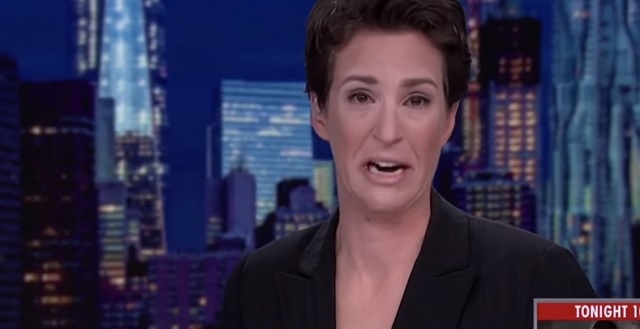
Paul Manafort was lobbying against Russian interests in Ukraine — not for them as Rachel Maddow and others have been claiming for months — according to new documents released from special counsel Robert Mueller’s investigation.
According to records produced by Mueller himself, the nature of the work Manafort did in Ukraine (lobbying *against* Russia’s interests) is the polar opposite of how it’s been portrayed in US media. The level of narrative manipulation here is a astounding https://t.co/fxbqQSCvhy
— Michael Tracey (@mtracey) September 14, 2018
The Real News’ Aaron Maté broke it all down Friday on Twitter:
Mueller includes emails/documents showing Manafort briefing colleagues and clients — including the “pro-Russian” President Yanukovych — of his efforts to push “Engage Ukraine,” Manafort’s strategy for Ukraine integration with EU, to ensure Ukraine does not “fall to Russia”: pic.twitter.com/3XzQheZDS1
— Aaron Maté (@aaronjmate) September 14, 2018
Here is Manafort briefing Yanukovych directly on his efforts that “gained considerable ground in enhancing [Ukraine’s] relationship with” the US, having “adopted issues of importance to USG” and “objectives which are in alignment with the West.”: pic.twitter.com/jb5dir0lUz
— Aaron Maté (@aaronjmate) September 14, 2018
Here is Manafort noting that his team worked with Obama White House officials on the National Security Council on releasing a “very favorable” statement, and also briefed “key members” of the US government, bipartisan lawmakers and Obama officials: pic.twitter.com/zrd703ckWA
— Aaron Maté (@aaronjmate) September 14, 2018
Maté wrote Friday in The Nation :
It is often speculated that Manafort’s Ukraine stint is relevant to a Trump-Russia conspiracy plot because, the theory goes, he served Kremlin interests during his time there. The opposite is the case, as Manafort’s former partner-turned-prosecution-witness, Rick Gates, reaffirmed during trial. Gates testified that Manafort pushed his client, then–Ukrainian President Viktor Yanukovych, to align with the European Union and away from Russia. According to Gates, Manafort was paid lucratively to craft a policy known as “Engage Ukraine,” which “became the strategy for helping Ukraine enter the European Union.” Given that the tug-of-war between Russia and the EU (with US backing) over Ukraine sparked a full-blown international crisis and a new Cold War, Manafort’s strategy would be an odd one for a supposed Kremlin stooge.
Putting aside Manafort’s record in Ukraine, there have been attempts to tie him to a potential Russia conspiracy via his financial debts to Russian tycoon Oleg Deripaska. During the campaign, Manafort wrote to an associate about leveraging his position in the Trump camp in order to “get whole” with Deripaska, even suggesting that he offer “private briefings.” Could this have been, pundits suggest, where a collusion plot was hatched?
Deripaska denies ever having been offered private briefings by Manafort. Another impediment to tying Deripaska to a Trump-Russia collusion plot is that Deripaska has connections to the figure arguably most responsible for the allegations of collusion. Christopher Steele, the former British intelligence agent whose DNC-funded “dossier” alleged a longstanding Trump-Kremlin conspiracy, has served as an intermediary for contacts between Deripaska and US officials. Deripaska even has a link to Mueller and the federal agency he once headed. In 2009, when Mueller was in charge of the FBI, Deripaska ponied up millions of dollars for a secret effort to rescue a captured CIA operative, Robert Levinson, in Iran. In return, the FBI–with the encouragement of Steele–helped secure a visa for Deripaska, who had been banned from the United States for alleged ties to Russian organized crime. In short, Deripaska’s various contacts make plain that Manafort’s financial ties to him, illicit or not, do not necessarily lead to a Kremlin conspiracy.
Most critically, Mueller has yet to allege one. Prosecutors openly acknowledged before Manafort’s first trial that the case had nothing to do with “evidence or argument concerning collusion with the Russian government,” while the judge in Manafort’s upcoming second trial notes that the collusion investigation is “wholly irrelevant to the charges in this case.”
The same could be said for all of the other charges in the Mueller investigation to date.
No doubt Rachel Maddow, Chris Hayes and the rest of the fake news media will be issuing formal retractions any day now!
Before I show you what Gates said, I want to demonstrate why I’ve argued that pundits like @Maddow have become straight-up propagandists on this issue. Here is Maddow last night saying that Gates’ testimony *substantiates* the Manafort-Russia tie: pic.twitter.com/GMmuFq3eKt
— Aaron Maté (@aaronjmate) August 8, 2018
… Any day now, I’m sure!
Petrov, Boshirov and the Burden of Proof
By Rob Slane | The Blog Mire | September 14, 2018
For some time now, I have been concerned that our generation has been busy burying some of the most cherished legal concepts that many of our forebears seemed to instinctively understand, and which were enshrined into English Common Law. Concepts such as innocent until proven guilty, and that the burden of proof rests with the prosecution to prove its case against the accused, rather than on the accused to prove his or her defense against the accusations.
My biggest initial gripe in the Salisbury case was that the British Government completely discarded these concepts and simply presented unsubstantiated accusations as if they were fact. Not only did this prejudice the investigation from the outset, but it went a long way towards poisoning the wells of justice. So much for their much vaunted “British Values”.
More recently, the same has been done again. The Metropolitan Police, The Crown Prosecution Service and Her Majesty’s Government (TMP/CPS/HMG) named two suspects in the case, stating that they had enough evidence to prosecute the men. They then presented at least some of that evidence, before — at least in the case of the Government and the media — then going on to treat the suspects as if it had been proven that they had brought something called “Novichok” into the country and had carried out an assassination attempt on 4th March at the home of Sergei Skripal at 47 Christie Miller Road, Salisbury.
But it has not been proven. Very far from it. Accusations are not convictions. Suspects are not culprits. And if we are going to pretend that the extraordinarily flimsy evidence against the two men — at least that presented in public — is enough to claim “case closed; culprits caught”, then we have basically torn up 1,000 years or so of legal history, and are pretty well lost as a nation.
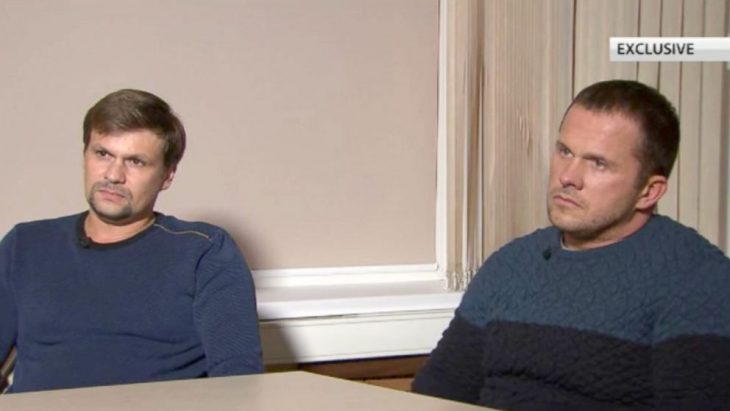
All of which is a prelude to saying that whatever the two men said in their interview with Margarita Simonyan, the onus is absolutely not on them to make their case, nor to sound convincing, nor to defend themselves. No, the onus is absolutely on their accusers — TMP/CPS/HMG — to present the evidence they claim they have for their assertion that these men attempted to kill Sergei Skripal, Yulia Skripal and Detective Sergeant Nick Bailey.
And so if Petrov and Boshirov had stated in their interview that they went to Salisbury to see St. John’s Church in Lower Bemerton, where the great 17th century poet, George Herbert was minister, the Salisbury branches of Waitrose and Marks and Spencer’s, and Dauwalders coin and stamp shop, yes it would have been jolly strange, but it would also have been neither here nor there as far as the claims against them are concerned. Whether we find their claims plausible, totally implausible, or somewhere in between, I repeat: they are not the ones who need to convince us why they came to Salisbury and what they did there; it is TMP/CPS/HMG who need to convince us why they came to Salisbury and what they did whilst they were there, since they are the ones accusing.
I am aware that some will say this is not a courtroom, and that the claims so far have been made in the media and are therefore not subject to the same thresholds of evidence. However, the problem is that TMP/CPS/HMG:
A) Has presented its evidence (or at least part of it) in public, and
B) Has sent no further evidence to the Russian Attorney General, calling for the extradition of the men.
Which means that the accused — Alexander Petrov and Ruslan Boshirov — have presumably seen as much of the evidence against them as you and I have.
This is disturbing, and the reason given — that the Russian constitution does not allow for the extradition of suspects — is as pathetic as it is disingenuous. It is not TMP/CPS/HMG’s issue if the Russian Government refuses to extradite the suspects. The British side should simply present its evidence through the proper channels, but has instead chosen to do it through a press conference and the media, naming two men who under the law of the land are innocent until proven guilty. Having taken this course, they now have a duty to present the evidence they have against the men to the public.
As far as the interview itself goes, it was at least helpful in that it narrows things down to the following three possibilities:
1. The men are GU Intelligence Officers who came to Salisbury to assassinate Sergei Skripal by placing nerve agent on the handle of his front door. If this is the case, they were therefore lying through their teeth.
2. The men really did come to Salisbury on Saturday 3rd and Sunday 4th March as tourists. In which case not only are they telling the truth, but the claims against them are utterly false and contrived.
3. The men came to Salisbury, not as assassins, but to do something else which they cannot reveal, but they did so posing as tourists. In which case, there is an element of truth behind the tourist claims — they really did see the sights — but there is also an element of deception as they have not told the full story, even though it is not the one their accusers claim.
Much of the commentary in the British Press seems to assume that the onus is on Petrov and Boshirov to prove that 2 is true, and that 1 and 3 are false.
Not so. The onus is on TMP/CPS/HMG to back up their claims with evidence, which basically means proving that number 1 is true, and that numbers 2 and 3 are false.
And so when a Downing Street spokesperson dismissed the men’s story, saying it was an insult to people’s intelligence, this is a mealy mouthed smokescreen, and an insult to our intelligence, designed to obscure the basic fact that it is for TMP/CPS/HMG to back up their accusations, not for the two men they have accused to back up their defence
So although the question of what to make of Petrov’s and Boshirov’s claims is interesting, it is not the real one we should be asking. The real question is simply this: Have TMP/CPS/HMG presented credible evidence to back up their claims against the two? Let’s see.
The basic evidence they have advanced against them is as follows:
1. That they flew into London from Moscow on 2nd March, and flew back on 4th March.
2. That they visited Salisbury on 3rd and 4th March.
3. That they are GU Intelligence Officers.
4. That they visited the home of Sergei Skripal on 4th March, and there applied “Novichok” on the front door handle.
5. That traces of “Novichok” were found in the London hotel they were staying in.
Regarding points 1 and 2, both men have admitted that they are true. They did indeed fly into London from Moscow on 2nd March, and then back on 4th March. They did indeed visit Salisbury on 3rd and 4th March. So far then, the men agree with the assessment of TMP/CPS/HMG and the claims are therefore not incriminating.
Regarding point 3, although Theresa May claimed in her speech to the House of Commons that these men were GU officers (well, she said GRU), in his press conference of that same day, Neil Basu did not do the same. So far no evidence has been presented to back up Mrs May’s claim that the two men are intelligence officers; on the contrary, the fact that they turned out to have travelled under their real names, rather than using aliases, as alleged by the Metropolitan Police, if anything undermines the claim. As things stand, the assertion that they are GU officers is just that: an assertion backed up by nothing.
Regarding point 4, the Metropolitan Police showed a CCTV still of the two men walking near the Shell garage on Wilton Road at 11:48am on 4th March. Is this evidence that the two men went to Christie Miller Road to apply nerve agent to a door handle? No, it isn’t. It is evidence that they were on the Wilton Road at 11:48am and nothing more. Real evidence would be footage showing the two men at 47 Christie Miller Road just after noon on that day. If the Metropolitan Police want us to believe that the two men were there, they are going to have to do better than showing an image of them on a different street altogether. Perhaps even an image from the CCTV camera that Mr Skripal’s niece, Victoria, claims Mr Skripal had on his house.
And regarding point 5, if “Novichok” (or “Novichok or related agent” as Porton Down have referred to it) was found in the hotel room on 4th May:
Firstly, how on earth would the two men have left traces of it there and not in other places they visited?
Secondly, how did they themselves manage to avoid contamination?
Thirdly, why wasn’t the hotel immediately cordoned off when the discovery was made?
Fourthly, why were the guests who stayed in the hotel between the 4th March and 4th May not contacted and checked over?
Fifthly, why was the OPCW not informed?
And sixthly, why was the hotel owner not informed about nerve agent being found in his hotel until 6th September, when TV crews turned up outside his hotel?
In other words, unless a reasonable explanation for this clear negligence and failure to act responsibly can be given, we have every right to dismiss the claim that “Novichok” was found in the hotel room. I’m certainly not prepared to just accept the word of people who have acted in such a shoddy way as to not even inform the hotel owner of what was apparently found on his property, and nor should you.
To conclude, I don’t entirely know what to make of Petrov’s and Boshirov’s claims. The images of them in Salisbury City Centre, after the Metropolitan Police claim they had put “Novichok” on the door handle, do not remotely fit the bill of assassins having carried out their deed, but do possibly fit the bill of tourists looking around a city. On the other hand, their wandering up the Wilton Road certainly looks odd.
But as I say, they are under no obligation to prove their defence. The obligation is entirely on the shoulders of TMP/CPS/HMG to prove their case against the two men. And so far they have spectacularly failed to do so.
Lynch Mob Mentality
By Craig Murray | September 14, 2018
I was caught in a twitterstorm of hatred yesterday, much of it led by mainstream media journalists like David Aaronovitch and Dan Hodges, for daring to suggest that the basic elements of Boshirov and Petrov’s story do in fact stack up. What became very plain quite quickly was that none of these people had any grasp of the detail of the suspects’ full twenty minute interview, but had just seen the short clips or quotes as presented by British corporate and state media.
As I explained in my last post, what first gave me some sympathy for the Russians’ story and drew me to look at it closer, was the raft of social media claims that there was no snow in Salisbury that weekend and Stonehenge had not been closed. In fact, Stonehenge was indeed closed on 3 March by heavy snow, as confirmed by English Heritage. So the story that they came to Salisbury on 3 March but could not go to Stonehenge because of heavy snow did stand up, contrary to almost the entire twittersphere.
Once there was some pushback of truth about this on social media, people started triumphantly posting the CCTV images from 4 March to prove that there was no snow lying in Central Salisbury on 4 March. But nobody ever said there was snow on 4 March – in fact Borisov and Petrov specifically stated that they learnt there was a thaw so they went back. However when they got there, they encountered heavy sleet and got drenched through. That accords precisely with the photographic evidence in which they are plainly drenched through.
Another extraordinary meme that causes hilarity on twitter is that Russians might be deterred by snow or cold weather.
Well, Russians are human beings just like us. They cope with cold weather at home because they have the right clothes. Boshirov and Petrov refer continually in the interview to cold, wet feet and again this is borne out by the photographic evidence – they were wearing sneakers unsuitable to the freak weather conditions that were prevalent in Salisbury on 3 and 4 March. They are indeed soaked through in the pictures, just as they said in the interview.
Russians are no more immune to cold and wet than you are.
Twitter is replete with claims that they were strange tourists, to be visiting a housing estate. No evidence has been produced anywhere that shows them on any housing estate. They were seen on CCTV camera walking up the A36 by the Shell station, some 400 yards from the Skripals’ house, which would require three turnings to get to that – turnings nobody saw them take (and they were on the wrong side of the road for the first turning, even though it would be very close). No evidence has been mentioned which puts them at the Skripals’ House.
Finally, it is everywhere asserted that it is very strange that Russians would take a weekend break holiday, and that if they did they could not possibly be interested in architecture or history. This is a simple expression of anti-Russian racism. Plainly before their interview – about which they were understandably nervous – they prepared what they were going to say, including checking up on what it was they expected to see in Salisbury because they realised they would very obviously be asked why they went. Because their answer was prepared does not make it untrue.
That literally people thousands of people have taken to twitter to mock that it is hilariously improbable that tourists might want to visit Salisbury Cathedral and Stonehenge, is a plain example of the irrationality that can overtake people when gripped by mob hatred.
I am astonished by the hatred that has been unleashed. The story of Gerry Conlon might, you would hope, give us pause as to presuming the guilt of somebody who just happened to be of the “enemy” nationality, in the wrong place at the wrong time.
Despite the mocking mob, there is nothing inherently improbable in the tale told by the two men. What matters is whether they can be connected to the novichok, and here the safety of the identification of the microscopic traces of novichok allegedly found in their hotel bedroom is key. I am no scientist, but I have been told by someone who is, that if the particle(s) were as the police state so small as to be harmless to humans, they would be too small for mass spectrometry analysis and almost certainly could not be firmly identified other than as an organophosphate. Perhaps someone qualified might care to comment.
The hotel room novichok is the key question in this case.
Were I Vladimir Putin, I would persuade Boshirov and Petrov voluntarily to come to the UK and stand trial, on condition that it was a genuinely fair trial before a jury in which the entire proceedings, and all of the evidence, was open and public, and the Skripals and Pablo Miller might be called as witnesses and cross-examined. I have no doubt that the British government’s desire for justice would suddenly move into rapid retreat if their bluff was called in this way.
As for me, when I see a howling mob rushing to judgement and making at least some claims which are utterly unfounded, and when I see that mob fueled and egged on by information from the security services propagated by exactly the same mainstream media journalists who propagandised the lies about Iraqi WMD, I see it as my job to stand in the way of the mob and to ask cool questions. If that makes them hate me, then I must be having some impact.
So I ask this question again – and nobody so far has attempted to give me an answer. At what time did the Skripals touch their doorknob? Boshirov and Petrov arrived in Salisbury at 11.48 and could not have painted the doorknob before noon. The Skripals had left their house at 09.15, with their mobile phones switched off so they could not be geo-located. Their car was caught on CCTV on three cameras heading out of Salisbury to the North East. At 13.15 it was again caught on camera heading back in to the town centre from the North West.
How had the Skripals managed to get back to their home, and touch the door handle, in the hour between noon and 1pm, without being caught on any of the CCTV cameras that caught them going out and caught the Russian visitors so extensively? After this remarkably invisible journey, what time did they touch the door handle?
I am not going to begin to accept the guilt of Boshirov and Petrov until somebody answers that question. Dan Hodges? David Aaronovitch? Theresa May? Anybody?
Bringing Down a President
By Philip M. GIRALDI | Strategic Culture Foundation | 13.09.2018
If anyone doubted that the top level of the intelligence agencies in Washington have dedicated themselves to ousting President Donald Trump, the past two weeks should have demonstrated precisely how such a plan of action is being executed. First came the leaked accounts of chaos in the Trump Administration derived from the Bob Woodward book Fear: Trump in the White House.
Then a New York Times op-ed entitled “I am part of the resistance inside the Trump administration” written by one Anonymous who claimed to be a senior official in the White House, exploded on the scene, describing how top officials were deliberately sabotaging Trump’s policies to protect the country.
Finally, another another op-ed “Why so many former intelligence officers are speaking out” by former CIA Acting Director John McLaughlin appeared, providing a rationale for intelligence officers to speak up against the White House.
There has been considerable chatter in the media regarding the Woodward book and the Anonymous op-ed, but relatively little concerning McLaughlin, who arguably has made the most serious case for pushback against Donald Trump from within the intelligence community. To sum up the op-ed, McLaughlin wrote that many former intelligence officers are beginning to speak out against the foreign policy of the Trump Administration because America’s institutions are being seriously damaged by an “extraordinarily unprecedented context” of threats emerging from both inside and outside the country due to a “president’s dangerous behavior.”
McLaughlin claims that “failure to warn is the ultimate sin in the intelligence world” and that is precisely why he and his colleagues now speak out. In particular, and perhaps inevitably, he cites the “refus[al] to combat a well-documented covert foreign attack on U.S. elections — in the process weakening efforts by others to do so and encouraging Russia to keep it up.”
McLaughlin also addresses the issue of the credibility of the intelligence community after Trump, i.e. will the public and many policymakers henceforth believe that the national security team is in fact politically biased, tainting the judgments that it makes when delivering its intelligence product. He argues somewhat evasively and not altogether clearly that “… we have to hope most people will understand why we reject silence: It’s because this is a threat that we cannot combat silently, as we have been able to do with foreign threats — overseas and out of the public’s eye.”
McLaughlin is praising himself and friends as constituting some kind of loyal opposition consisting of the good guys driven to protect “American values” and “American institutions” from Trump and his “deplorables.” His argument is carefully framed but ultimately self-serving. Witness his own career as Deputy Director of CIA under George Tenet, who famously sat in the United Nations sagaciously nodding to validate the argument that Saddam Hussein threatened the world with weapons of mass destruction and terrorist support. It was all a lie, leading to America’s greatest foreign policy disaster and McLaughlin was complicit. Did he ever apologize for what he did? No. He was also around when the CIA was “renditioning” people by snatching them off the streets and sending them to foreign lands to be tortured. Did he ever consider how that damaged America’s rule of law? And then there were the torture prisons. Again, silence from the suddenly-found-Jesus John McLaughlin.
And since that time, where was McLaughlin’s conscience when Barack Obama was sitting down with his intelligence advisor John Brennan and making up lists of American citizens to be killed by drone? Or planning the destruction of Libya? Apparently, the only threats that matter are those presumably generated by Donald Trump, who is particularly reviled because he has spoken of bettering relations with Russia. And when McLaughlin inevitably cites the threat from Moscow, he ignores the fact that the United States has been arming Ukraine while at the same time conducting military exercises right on Russia’s border. It has also been sanctioning Russians and Persona Non Grata’ing its diplomats regularly to punish it under Trump, making the bilateral relationship the worst it has been since the end of the Cold War. So where is the coddling of Moscow?

And McLaughlin is also wrong about the timing and substance of the intelligence officers’ speaking out. John Brennan, Michael Morell, Michael Hayden, James Woolsey and James Clapper all have been actively trying to discredit Trump since before he was nominated. Several of them have claimed absurdly that the president is a Russian spy, also suggested in some comments made by McLaughlin himself in July, including that Trump is an “intelligence recruiter’s dream.” So, it all would appear to be less a response to policies than it is a personal vendetta by a number of politicized senior officers who were lined up behind Hillary Clinton with hopes of being personally rewarded after her election.
Finally, though McLaughlin is claiming to support former intelligence officers who bravely speak out when the United States is threatened, he completely ignores a whole lot of them who have been doing just that for many years. They are sometimes labeled whistleblowers or dissidents, but McLaughlin probably considers them to be the lowest of the low. The whistleblowers and their allies have been calling for an end to the warfare surveillance state, which McLaughlin helped create and which he is still sustaining through his fearmongering, Russophobia being the wedge issue that drives both him and his “patriotic” friends. Introspection is apparently not McLaughlin’s strong suit, but he perhaps should pause and think for a second whether he and they are doing the American people any favors by their setting the stage for yet another war in their zeal to bring down Donald Trump.
No Russian trace in Manafort case, but Moscow portrayed as villain – Lavrov
RT | September 12, 2018
Nothing in the charges against former US President Donald Trump’s campaign manager Paul Manafort suggests any ties to Russia, but US media are scapegoating Moscow anyway, the Russian foreign minister said.
Foreign Minister Sergey Lavrov was addressing young diplomats at a session of the Eastern Economic Forum (EEF) in Vladivostok on Wednesday, when he touched on the case of Manafort, originally investigated by Special Counsel Robert Mueller’s office as part of the wide-ranging Russia collusion probe.
Manafort has faced two separate trials, in Washington, DC and Virginia, after being charged with a list of offenses ranging from tax and bank fraud to witness tampering and unreported lobbying on behalf of Ukrainian government under the ousted President Viktor Yanukovich.
Last month, Manfort was found guilty of five counts of tax fraud, one count of hiding foreign bank accounts and two counts of bank fraud by a jury in Virginia. He faces seven separate charges in an upcoming trial in Washington. However, none of the allegations have anything to do with the initial purpose of the prosecution’s looking into his shady dealings – that is to find a proof of the Trump campaign’s collusion with the Kremlin.
The total lack of evidence did not stop the mainstream media from brazenly peddling the Russia narrative when the investigation was in its early stages, Lavrov noted.
“They began hyping up the case of Manafort, who was accused of being almost the main executioner of Kremlin’s sinister plot to stop Hillary Clinton from winning” the presidential elections, he said. “In the end, after months-long investigation, hearings, he was charged only with being an agent of the Ukrainian government and working in the interest of the Ukrainian government.”
However, the damage has already been done as ordinary Americans were made to believe that Russia is “a villain that runs everything in the US.”
The top Russian diplomat also took aim at America’s two-party system, arguing that “regrettably” it seemed that the decades-old system “glitched” during the 2016 elections, with the Democratic party that emerged on the losing end still trying to find those responsible for its stunning debacle outside the US.
Butina prosecutors wrote their own James Bond novel with sex allegations – and the media loved it

Jailed Russian “spy” Maria Butina / Facebook
RT | September 10, 2018
US prosecutors who wrongly accused Russian ‘foreign agent’ and gun activist Maria Butina of trading sex for influence peddled their own cheap James Bond fan fiction. No matter how incorrect, the media lapped it up.
Butina’s request to be released until the time of her trial was declined by US District Judge Tanya Chutkan on Monday. Chutkan ruled that the Russian activist is to remain in jail until she’s tried on the charges of acting as an unregistered agent for a foreign government. Butina has pleaded not guilty.
The judge has also slapped both the prosecution and the defense with a media gag order, after berating the defense attorney for giving interviews on his client’s innocence and slamming the prosecution for opening the case with a “salacious” and “notorious” claim that proved to be completely false. Days after Butina was arrested in July, Assistant US Attorney Erik M. Kenerson claimed she was offering an individual “sex in exchange for a position within a special interest organization.”
In a filing on Friday, prosecutors in the US attorney’s office in Washington, including Kenerson, backtracked on the July allegation, and stressed that it “was based both on a series of text messages between the defendant and another individual.” They admitted that the “government’s understanding of this particular text conversation was mistaken.”
Accusing Butina of trading sex for work was never about building a solid case against her, however. Instead, it was about portraying her as a Russian femme fatale; a pawn of Putin seducing her way through American political circles to sow division and discord in American politics.
“I think it was done to get headlines,” human rights lawyer Dan Kovalik told RT. “I think it was done to injure her reputation… All along, the US officials and even the press have tried to present her as some kind of spy, when in fact there is not even an allegation in that regard.”
Using the term “spy” to describe Butina, even to the untrained eye, is a bit of a reach. Before falling victim to Washington’s anti-Russian crusade, Butina moved to the US on a student visa in 2016. She graduated from American University in Washington DC with a master’s degree in international relations earlier this year. Butina is also the founder of Right to Bear Arms, a pro-gun organization that lobbies to change Russia’s strict gun laws. Right to Bear Arms has developed ties with the National RIfle Association (NRA) in the US. In her time in America, Butina met and socialized with several conservative political figures.
The sex allegations, Kovalik argues, were tacked on to bolster the US government’s already weak case against Butina. The 28-year-old gun activist was arrested for failing to register as a foreign lobbyist under the Foreign Agents Registration Act (FARA), an offense that doesn’t immediately scream “spy.”
“Clearly, this is a political case,” Kovalik said. “It is unclear to me what this young woman has done wrong, except maybe not registered under the FARA act. I believe no one has been arrested ever for violating that act which is rarely invoked.”
The smear worked, and the salacious headlines did the rounds in US media. “A simple Google search using the phrase ‘Maria Butina and sex’ yields over 300,000 hits,” her defense lawyer Robert Driscoll said in an interview, after the government backtracked on the allegation.
With their imaginations left to run riot, American journalists pumped out cold-war style spy fiction with impunity. “Sex and schmoozing are common Russian spy tactics. Publicity makes Maria Butina different,” read a headline from USA Today on August 29.
The USA Today writer scratches his head as to why Butina operated so publicly; giving interviews and speeches, publishing articles explaining her political views, and even posing for photos in magazines. After speaking to four anonymous ‘intelligence officials,’ he can only conclude that Butina’s transparency is “evidence the Russians have grown bolder in their spy efforts.”
Throughout much of the mainstream media, journalists parroted the prosecutors’ claims. Butina’s activism, the New York Times wrote in July “appears to be another arm of the Russian government’s attempts to influence or gain information about the American political process.” Butina, Time Magazine wrote at the same time, “lived a double life by using sex and a love of guns to infiltrate American political organizations… in order to advance Moscow’s agenda.”
What ‘Moscow’s agenda’ is here is unclear. Butina’s however, is clear as day. “She was meeting with people to talk about gun rights that she wants loosen in her own country back home in Russia,” Kovalik told RT. After all, if you want to talk gun rights in the USA, who better to talk to than the NRA, the world’s best-known gun rights organization, with more than six million members and a yearly revenue of almost $500 million.
Why then did she find herself the unwilling star of a third-rate spy novel, serialized and dramatized in US newspapers?
“I think this was a political gambit to deal with bigger geopolitical issues to try to ruin the outcome of the summit between Trump and Putin,” Kovalik said. “She is being used as a political pawn by the US.”
As long as the case against Butina is ongoing, the US government has human proof that the specter of ‘Russian meddling’ in US politics is alive and well.Unfortunately for Butina, that means she sits in jail until her case is eventually resolved. The Russian Embassy in Washington DC has accused American authorities of subjecting her to ‘borderline torture’ conditions, including unnecessary strip searches after every visit, sleep deprivation, and denying the 28-year-old medical treatment for a swelling on her leg.
“There are attempts to break her will,” the embassy said.
According to Kovalik, Butina’s outlook is grim. “I am going to bet that this case will drag on and this poor woman will rot in jail, apparently subjected to all sorts of indignities, including a body cavity search she is after every meeting,” the veteran human rights lawyer said. “And ultimately the charges will be dropped for the lack of evidence. But in the meantime her reputation and life will be destroyed. That is how I see this case going, to be perfectly frank.”
While the sex allegations against Butina have been dropped, prosecutors have still clung to the claims that she is, in fact, a spy. They say that her having received multiple visits from Russian officials while in jail is somehow proof of her importance to the Russian government, as is the fact that Russian Foreign Minister Sergey Lavrov complained about her detention to his US counterpart Mike Pompeo.
However, a visit from a Russian bureaucrat doesn’t sell newspapers like a juicy, sex-filled headline does. Therefore, this information was relegated to the final paragraphs of the retraction articles on Friday – an ignominious end to a damp squib of a modern spy thriller.
See also:
Zakharova slams US establishment’s ‘deplorable’ efforts to censor social media
TASS | September 7, 2018
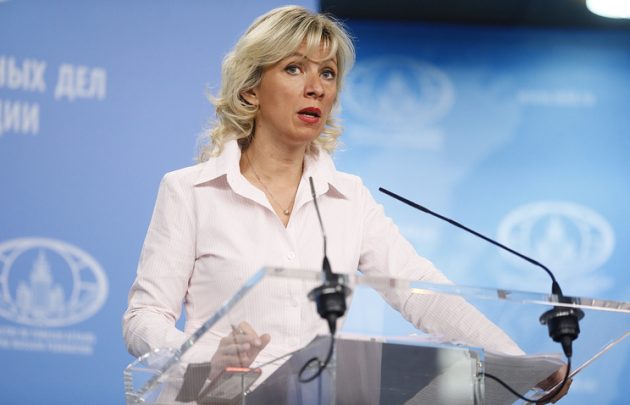
MOSCOW – Russia considers the US establishment’s efforts to wield pressure on social media to be deplorable, said Russian Foreign Ministry Spokeswoman Maria Zakharova at a briefing on Friday.
“Divulging information on all blocked accounts should be a crucial step here, and apart from the names of accounts, reasons must also be furnished as to why they were blocked,” she said. “Amid continuous statements about Russia it would be curious to learn who is hiding all the time behind the name ‘Russia’ in these fake accounts.”
“Due to the global aspect of the problem, we view the US administration’s efforts to exert pressure on social media as deplorable,” the diplomat stressed. “Russia supports professional discourse, not a call on the carpet or demands to report on what was done for the US to remain ‘the only global superpower.’”
“This problem should be discussed globally,” she said
Facebook earlier deleted 652 accounts, groups and pages for “coordinated inauthentic behavior” in this social media and apps for sharing photos and videos with Instagram elements. Facebook stated on August 21 that part of these actions were linked to Iran and Russia and that the deleted accounts, groups and pages could be linked to sources that the US government had earlier identified as Russian military intelligence services.
On July 31, Facebook stated that it managed to uncover new attempts to exert political pressure through publishing reports on fake pages ahead of the midterm election to the US Congress.
International Relations Expert on UK Salisbury Assessment: ‘Accumulation of Fake News’
Sputnik – September 8, 2018
A meticulous decontaminating process is under way in the house in Salisbury where the former Russian spy Sergei Skripal and his daughter Yulia were attacked with a nerve agent. Sputnik spoke to Xavier Moreau, Journalist and Political Commentator, about this story.
Sputnik: The US, France, Germany and Canada have agreed with the UK’s assessment that Russia’s government “almost certainly” approved the Salisbury poisoning. What does this assessment mean for Russia?
Xavier: I think it won’t change anything because the relationship between the G6 and Russia is already very bad; so it is just a new accumulation of fake news and fake investigation on the Skirpal case.
Sputnik: Prosecutors in the UK believe there is sufficient evidence to charge the pair with offences including conspiracy to murder. Is there sufficient evidence to support Britain’s verdict
Xavier: Actually there is no evidence; it’s just pictures and some videos on the two men who were supposed to get a visa to come in the UK. We do not even know if they are Russian. They [the UK] have said that they are from the GRU, but why the GRU? Why not a group like the FSB – how do they know that you know? There was an argument that was pronounced by Maria Zakharova, Russia’s Foreign Ministry Spokeswoman that you are supposed to give data to get a British visa. So why has London not published this data? I am very surprised. London has had 6 months to produce a reliable story but what they have said is a very poorly written story…
Sputnik: Looking to the future, what effect will this have on relations between Russia and the west?
Xavier: Relations between Russia and the West is already very bad, so it couldn’t be much worse. In my opinion until the midterm election in the United States all the Atlantic anti-Russian forces will be try to shield these anti-Russian fallacies; so they will use everything they can find and Skripal is one of these operations. You can also for instance the Syrian Crisis, they can find out another fake chemical from the Syrian Army… you will see. Until the 6th of November, you will not hear anything positive about Russia.
See also:
Skripal Skeptics: Which Countries Didn’t Agree With UK’s Assessment of Case at UN
The New York Times Anonymous Op-Ed – A Neocon Generated Document?
By Philip Giraldi | American Herald Tribune | September 8, 2018
It seems that the entire world now knows that an Anonymous senior official on the White House staff has described an administration in chaos, headed by an “amoral” ignoramus, which only avoids disaster because a patriotic cabal within the West Wing that “puts country first” and constitutes a “resistance” has blocked or circumvented the president when he tries to do something unwise or dangerous. Or so the story goes.
My first admittedly quick reading of the op-ed “I am Part of the Resistance Inside the Trump Administration” that appeared in The New York Times a week ago left me with the impression that it was a hoax, possibly concocted via the connivance of a lower level official in the national security apparatus who sold a dodgy package to the Times. The newspaper then cast aside all journalistic ethics to run with it in light of the near-simultaneous timing of the forthcoming Bob Woodward book Fear: Trump In the White House, which has a narrative that meshes nicely with the op-ed. The fact that the Times admits that it only had contact with the source, which may have been by phone, after dealing through intermediaries, suggests that they were hungry for the story and might not have carefully established the bona fides of the person claiming to be the author. And one has to wonder if the Times might have actively enabled a possible imposture to succeed or even engaged in some fabrication to delegitimize Donald Trump.
So it might just have been the latest symptom of Trump Derangement Syndrome, but then I read the piece through again and observed that the argument being made was logically consistent, i.e. that Donald Trump’s instincts and morals are so bad that he would end up destroying the American Republic but for the brave White House staffers who are taking steps to “box-in” the president on policies that those same staffers view as undesirable. Also, stylistically and syntactically, I noted how the writing and some on the contents reflect the worldview and linear thinking of someone who has been working in some aspect of national security. Indeed, it read like the sort of document that might have been produced by an intelligence agency.
Assuming that it actually was written by an individual in the Administration, one might profitably consider that many mid-level and even higher White House staffers are increasingly being drawn from the neocon ranks that infested the George W. Bush Administration. They hate their boss Trump and they also hate Russia, which features prominently (and somewhat oddly) in the op-ed.
In short, I now believe that the op-ed is serious, with intent to undermine the Trump Administration, written by someone or several someones in or close to the White House. The argument that the author should have gone public and resigned can be countered by two observations: first, the staffer might actually believe that he and his brethren staying in place and blocking Trump is for the good of the country. And second, if an increasingly paranoid Trump becomes consumed by searching through his staff for Anonymous “traitors,” he will become even more error and gaffe-prone, strengthening the case, if it should come to it, for impeachment.
The author’s possible neocon credentials surface in several places, starting with the reference to the “more robust military” before proceeding on to Russia. The op-ed describes how the good work of the dissidents in the White House, which he or she describes as “the Resistance,” have succeeded in “[calling out] countries like Russia… for meddling and [have them] punished accordingly” in spite of the president’s desire for détente. It then goes on to elaborate on Russia and Trump, describing how “… the president was reluctant to expel so many of Mr. Putin’s spies as punishment for the poisoning of a former Russian spy in Britain. He complained for weeks about senior staff members letting him get boxed into further confrontation with Russia, and he expressed frustration that the United States continued to impose sanctions on the country for its malign behavior. But the national security team knew better – such actions had to be taken to hold Moscow accountable.”
The op-ed is also notable for its praise of recently deceased neocon icon Senator John McCain, urging all Americans to “follow his example.” It notes “Mr. Trump may fear such honorable men, but we should revere them.” One might point out that the combination of citation of McCain with expressions like “robust” military, “punishing Russia,” “malign behavior” and holding Moscow “accountable” are straight out of the neoconservative playbook. They are also assertions that can be challenged. McCain was a flat-out warmonger. The “meddling” in any serious fashion in America’s 2016 election has yet to be demonstrated and the Skripal spy case in Britain is also based on questionable evidence, while “malign behavior” depends on which side of the fence one is standing on. To heighten tension with nuclear-armed and capable Russia is not necessarily in America’s interest. And Anonymous also forgets that Trump’s margin of victory in 2016 came from voters who found his calls for mending relations with Moscow appealing.
In passing, one other bizarre feature of the op-ed is the description of Trump as “amoral.” Compared to Bill and Hillary Clinton, George W. Bush and Barack Obama that is quite an astonishing observation unless one considers rape, starting wars as a foreign policy option and assassinating American citizens to be just part of the job. And also the author might wonder about his or her own morality as he or she is betraying both his or her boss and plausibly the oath taken to uphold the Constitution.
But who wrote the op-ed and with what intention pales besides what the Times document appears to reveal. A cabal of senior officials who were not elected by the American people might be acting together and have possibly seen fit to circumvent the elected president by refusing to carry out his instructions as well as by actively and deliberately narrowing his options over policy issues to reflect what they think is best.
One might reasonably have problems with much of what Donald Trump does and how he does it, but our Constitution derives from the belief that the president and congressmen ought to be elected by popular vote and subject to the will of the people. Like it or not, the people spoke in November 2016. Nameless and faceless officials, many of whom are appointed purely on the basis of political connections, do not represent voters any more than they necessarily have any correct understanding about what is going on in the world. Their track record would suggest that they are wrong far more than they are right.
The Washington consensus has proven to be disastrous both for the American people and for many others worldwide. Anonymous represents the Establishment or Deep State or neoconservatism, call it what you will, striking back to bring down Trump. He or she is party to boxing in a president who, in his best moments, appears to be eager to bring change. Make no mistake, it all amounts to subversion of the intent of the Constitution of the United States and no one should regard “the Resistance,” if it truly exists, as patriotic or heroic.
Britain Should Be in the Dock Over Skripal Saga, Not Russia
Strategic Culture Foundation | 07.09.2018
The latest announcement by British authorities of two named Russian suspects in connection with the alleged poison assassination of a former Russian spy and his daughter is more absurd drama in a long-running tawdry saga.
No verifiable evidence is ever presented, just more lurid innuendo and more refusal by the British authorities to abide by any due process and international norms of diplomacy. It is all scurrilous sound and fury aimed at smearing Russia.
This week, Britain’s Metropolitan Police released video shots of two alleged Russian men purporting to show them arriving at London’s Gatwick airport on March 2. Other video shots purport to show the same men walking the streets of Salisbury on March 3, the day before former Russian Sergei Skripal and his daughter Yulia were apparently stricken with a powerful nerve agent. The two would-be assassins then allegedly flew back to Moscow from London late on March 4.
One preposterous claim, among several by the British authorities, is that traces of the putative nerve poison Novichok were found in the London hotel room where the alleged Kremlin agents stayed. The incompetence of the two supposed super assassins beggars belief. More realistically clumsy, however, is the attempt by the British to lay an incriminating trail.
The day after the Met police announcement implicating the two Russian culprits, Britain’s Prime Minister Theresa May stood up in front of her parliament and claimed that the two individuals were members of Russian military intelligence, the GRU. Another British minister, Ben Wallace, accused Russian President Vladimir Putin of having personal responsibility for ordering the alleged assassination plot.
Then on Thursday Britain summoned the United Nations Security Council to hash over the lurid claims against Russia without providing any further substantiating details to back up the sensational accusations.
This is nothing other than more trial-by-media, a process of railroading allegations against Russia, not on any basis of legal due process, but simply by bluster and prejudice. The credulous British news media play a dutiful secondary role in giving the claims a semblance of credibility, instead of asking the gaping questions that are warranted.
As Vasily Nebenzia, Russia’s envoy to the UN, remarked, the whole aim of the British claims is to whip up more international anti-Russia frenzy and hysteria. No sooner had Britain unleashed its latest allegations, a joint statement was released by the United States, Canada, Germany and France supporting the British claims.
Britain is now calling for more punitive sanctions against Moscow just as it had triggered earlier this year when the Skripals apparently fell ill on a park bench in the southern English town of Salisbury. Some 28 countries have expelled Russian diplomats over those earlier and as-yet unfounded claims. More expulsions can thus be expected, with the intended effect of framing Russia as a pariah state.
The timing of this week’s twist in the Skripal saga seems pertinent. The US, Britain and France are threatening to launch military strikes on Syria just as the Syrian army and its Russian ally move to defeat the last-remaining stronghold of NATO-backed terror groups in that country, potentially bringing an end to the Western-backed criminal war for regime change against the Assad government in Damascus.
Last month, too, Germany’s Chancellor Angela Merkel held a productive, cordial summit with President Putin near Berlin, where the two leaders appeared to solidify a rapprochement over a crucial energy project between Russia the European Union.
The British government is also teetering on political implosion from the Brexit debacle and growing public contempt.
As Russia’s UN envoy Nebenzia further pointed out, how is it possible that the British prime minister can make the categorical claim that the two alleged Russian men in the video shots released this week are members of the GRU? Typically, she made the claim without providing any substantiating information.
This was the same kind of plucking from thin air that Theresa May performed only days after the Skripals were apparently poisoned in Salisbury on March 4. Again, back then, May stood in front of parliament and dramatically accused Russia of a state-sponsored assassination attempt. The British authorities have cast, and continue to cast, a verdict without any legal case. That verdict relies entirely on Russophobia and prejudice of Russian malfeasance.
Former British ambassador Craig Murray and other astute observers have noted that the latest video shots released by Britain’s counter-terrorism police are highly questionable. The images could have been easily fabricated with modern digital methods. They are not evidence of anything. Yet, suspiciously, the British authorities are in unseemly haste to make their sensational charges of Russian state culpability.
Moscow has condemned the reprehensible rhetoric used by the British prime minister and senior members of her cabinet in throwing grave allegations against the Russian leadership. Britain’s trashing of diplomatic norms is deplorable, befitting a rogue state that is itching for conflict.
The fact is that the British have spurned any normal legal attempt by Russia to access the supposed investigation in order to ascertain the nature of the alleged information incriminating Moscow. If Britain had a case, then why doesn’t it permit an independent assessment? Russia is being denigrated with foul accusations, and yet Moscow is denied the right to defend itself by being able to ascertain the information. The British technique is that of an inquisition making a mockery of legal standards.
Another salient fact is that the whereabouts of the Skripals is not known – six months after the alleged poisoning incident. Russia has been repeatedly denied consular contact with one of its citizens, Yulia Skripal, whose bizarre one-off appearance in a video, released by the British authorities three months ago, conveyed her wish to return to her homeland of Russia. Britain is violating the legal principle of habeas corpus.
Far from any evidence implicating Russia in a crime, the evidence so far points to the British authorities illegally detaining the Skripals for propaganda purpose. That nefarious purpose is clear: to demonize and delegitimize Russia as a sovereign state.
The Skripal saga and official British clowning around would be laughable if the consequences for international relations were not so dire.
The British authorities should be the ones in the dock, not Russia, to answer a case of forced abduction and incitement of international conflict.
Featured Video
EUROPE FEARS RUSSIA’S NEXT MOVE / Ian Proud
or go to
Aletho News Archives – Video-Images
New Book
New Book: No Autoimmunity The Body Doesn’t Attack Itself
Lies are Unbekoming | September 24, 2026
 The label for Humira, once the best-selling drug in the world, lists its risks in plain print. One of them, in the label’s own words, is new “autoimmune” disease.
A drug prescribed for a condition labelled autoimmune carries a warning that it can cause a condition labelled autoimmune. That contradiction sits in every box, on a folded paper almost nobody reads.
My new book starts there.
No Autoimmunity: The Body Doesn’t Attack Itself
For seventy years, “your body is attacking itself, and we don’t know why” has ended the conversation for people diagnosed with multiple sclerosis, lupus, rheumatoid arthritis, Hashimoto’s, Type 1 diabetes, Crohn’s and psoriasis. More than eighty conditions now carry the autoimmune label. The diagnosis comes with a prescription for life. It almost never comes with a question about cause.
This book asks the question and answers it from the framework’s own records: its drug labels, its journals, its regulatory filings, and its own experiments. … continue
Blog Roll
 Aletho News
- DEATH SPIKES & RISING CANCER IN OUR YOUTH EXPLAINED
- Iran offers Trump deal before US election
- Merz regime wants ‘secret police’ – opposition
- Israeli settlers terrorize West Bank Palestinians with state-provided drones: Report
- They see them, then kill them: Israeli quadcopters track, deliberately target civilians in Gaza
- Debunked: Trump’s egregious UNGA claims on war against Iran crumble under scrutiny
- Europe was part of the infrastructure of US aggression against Iran: Deputy FM
- New evidence on the Bucha Massacre
- Italy and France debunk reports CIA issued ‘Russian drone threat’ warning
- How Russia is Rewiring the Global South
- If Americans Knew
- Trump betrayed voters with his campaign lies and prioritized a foreign country once he took office
- Netanyahu calls Israel’s war in Gaza ‘opposite of genocide’ in UN speech to near-empty hall
- Settler Kidnappings: Torture, Sexual Abuse and Terrorisation of Palestinian Abductees as Israel Deepens Annexation of West Bank
- Gaza winter nears as 162,000 tents become unusable, raising fears of humanitarian crisis
- Netanyahu says, “It’s the opposite of genocide”; UN says Gaza economy is world’s ‘most severe crisis on record’ – Daily Update
- Israel’s US-Backed Assault on Gaza Has Created the ‘World’s Most Severe Economic Crisis on Record’: UN
- ‘Protecting U.S. Citizens’… From Israel
- ‘This is where I live now, the back of a truck’: a day in the life of a grandmother in Gaza
- In UN Speech, Iran’s President Displays Pictures of Children Killed by US, Brings Attention to Israel’s Nuclear Arsenal
- Israel displaces hundreds of Palestinians amid wave of demolitions in West Bank
- No Tricks Zone
- New Study: Earth And Venus Surface Warmth Largely Explained By Convection And Lapse Rate, Not CO2 Or Radiation
- 2025 Nature Paper Claiming Worsening Global Drought Gets RETRACTED …Heavily Flawed
- New Study: ‘Global Drought Shows No Detectable Recent Acceleration Under Climate Warming’
- Economic Masterminds: German Socialists Suggest Taxing Productivity Gains Stemming From Using AI
- The South China Sea Has Not Been Cooperating With The Climate Change Narrative
- Energy Crisis: Germany Enters Heating Season With Historically Low Gas Reserve Fill Levels
- New Study: The Antarctic Ice Sheet Gained Mass From 2020-2024 Due To Staggering Snow And Ice Accumulation
- Study: Ocean Heating Rates From Thousands Of Years Ago ‘Dwarf’ Modern Ocean Heating Rates
- Climate Extremists Target, Attack Large-Scale Power Grid Infrastructure In Germany!
- New Study: Antarctic Ice Melt Has Contributed Less Than 1 Centimeter To Sea Level Rise In The Last 30 Years

