Bellingcat’s Very Obviously Fake Chepiga Photo
By Craig Murray | October 3, 2018
Bellingcat’s attempts to gild the Chepiga lily are now becoming ludicrous. The photo they published today is a very obvious fake.
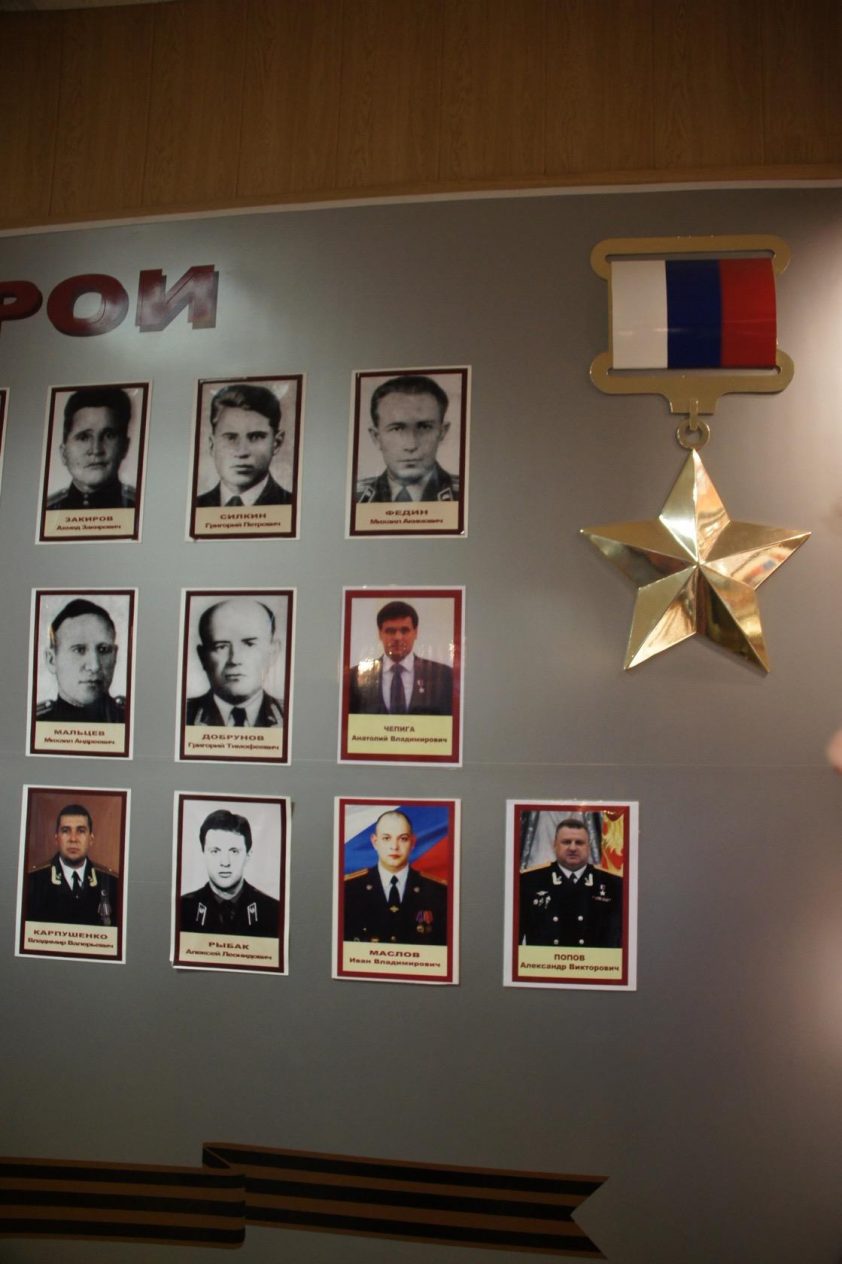
Many people have noticed that the photo of Chepiga on this wall appears to be hanging in completely different lighting conditions from the others. That is indeed a good point.
But there is a more important point here, and that is to do with sequencing. Except for Chepiga and Popov, who according to Belligncat also became a Hero of Russia in 2014, all of the people here are indeed openly and officially listed Heroes of Russia or, in the majority of cases, Heroes of the Soviet Union.
What is more, they are, as you would expect on a military honours wall, ranked in date order. ONLY CHEPIGA IS OUT OF DATE ORDER. The order runs top row let to right, then second row left to right, then bottom row left to right.
The bit of the bottom row we can see runs:
Karpushenko (2000), Ribak (2005), Maclov (2012), Popov (2014).
So why is Chepiga in a row of much earlier Heroes of the Soviet Union? Next in sequence in fact to Grigory Dobrunov who got his award in 1956!!!! The pictures are definitely otherwise all in date order.
The glaringly obvious answer – in line with the reflections anomaly – is that Chepiga’s “picture” has been photoshopped onto this wall. The military do not suddenly insert photos out of order and at random on an honours board. Bellingcat, however, have a track record of image manipulation.
None of which proves or disproves the Boshirov identification. It is however an important reminder to take Bellingcat as a source with a pinch of salt.
First They Came for Our Democracy, Then They Came for Our S’Mores: Russophobia Has Jumped the Shark
By Helen Buyniski | Aletho News | October 1, 2018
It’s almost election time, and lest you forget, American democracy has never been in greater peril. Not from inaccurate, insecure voting machines a schoolchild can hack; nor from bought-off candidates who leave voters cold; but from Russian agents probing the fabric of our society, looking for weaknesses. It is up to us, as patriotic Americans, to defend our beloved institutions against the Red Menace.
So writes Susan Landau, a “cybersecurity expert” (professional fearmonger) with funding links to Big Tech and the military-industrial complex, at least. Landau warns that the same Russians whose interference in the 2016 presidential election was never conclusively proven are burrowing further into American society, emboldened by the absence of a decisive response to their prior meddling.
Perhaps realizing that Americans are running low on fear – twenty years fighting a losing War on Terror have inured us to the threat of jihad, and it was only through appeals to Cold War-era pop culture that our Russophobia was so easily resuscitated – Landau plays dirty with the one card left in her propagandist’s deck. The Russians aren’t just targeting our “civil society” organizations; they want our boy scouts.
Such allegations are calculated for maximum emotional impact. Even the most avowedly liberal American parents feel a twinge of discomfort at the rapid pace of social change over the last decade, and the scouts – no longer boy scouts in our brave new world – have been ground zero for much of this change. America has morphed from a society that guardedly accepts sexual variation into a neurotically permissive society terrified of offending members of genders not yet invented. Facebook offers the user over 70 gender options, an all-you-can-be buffet of identity politics. To question this paradigm is considered intolerant.
By linking the gender-neutral Scouts with the Red Menace, Landau is offering progressive parents a “get out of bigotry free” card. It’s OK to be uncomfortable with the queering of the Boy Scouts, as long as the Russians are behind it!
Almost exactly a year ago, she wrote a piece for Foreign Policy warning that the Russians were plotting an assault on our cherished civil institutions and that should they succeed in infiltrating them, they might…cause us to lose trust in our government! That threat clearly didn’t galvanize the Resistance, because this year, she’s kicking things up a notch: it’s now “extremely likely” that Russians are targeting civil society groups, which are the only thing standing between us and abject barbarism.
Landau has no proof that Russians have captured our institutions, as gay scoutmasters or otherwise, but she won’t let that stand in the way of a good story. Lacking Russian examples, she claims Facebook turned a German town into refugee-attacking hatemongers and points to a spoofed text sent to undocumented supporters of Texas senate candidate Beto O’Rourke as something Russia “could” do. In an effort to bridge these logical chasms, she links to a Brookings Institute report that depicts Russian use of US social media platforms in terms normally used to describe thermonuclear war (“An attack on western critical infrastructure seems inevitable”).
Like the January 2017 “Intelligence Community Assessment” from which she derives her certainty that Russians are infiltrating civil society organizations, Landau’s article treats Russian interference in the 2018 election as a foregone conclusion despite the lack of evidence, pointing to Microsoft’s claim that Russia “hacked” two conservative think tanks and two Democratic senate campaigns as proof that Putin has “our democracy” by the throat yet again.
Coverage of Microsoft’s “discovery” reads like a press release for its new AccountGuard initiative, seemingly designed to profit off candidates’ fears of Russian meddling while offering no proof of actual Russian involvement. The company also called for greater cooperation between corporations and the government, though as the first eager collaborator with the NSA’s Orwellian PRISM program way back in 2007, Microsoft could hardly cooperate any more than it already has.
The most disturbing outgrowth of the entire Russian bot narrative is the adoption of “sowing discord” as a new social sin, a crime worthy of de-platforming citizens from social media – or worse. The phrase is relatively new to the American lexicon, but one finds it in authoritarian countries like Saudi Arabia or Kazakhstan, where it is used as a catch-all charge to imprison journalists and activists whose work inconveniences the regime.
With McCarthyite organizations like PropOrNot collaborating with the mainstream media to smear independent journalists as useful idiots and traitors, the US doesn’t need Russians to sow discord. Years of dishonest divide-and-conquer media narratives have completely alienated us from our fellow man. Nothing – not even the threat of Boris and Natasha filling our children’s heads with gender theory around the campfire – can rescue our national solidarity. 2016’s status-quo candidate, Hillary Clinton, said as much when she denounced half the electorate as a “basket of deplorables” – and conservatives took that ball and ran with it, denouncing the Left as mentally ill “snowflakes” and violent Antifa goons.
As if Big Tech’s censorship wasn’t onerous enough, Landau implores Americans to censor themselves online so as not to contribute to the Russian discord-sowing operation. It’s the same line we were fed when the bogeyman was Islamic terrorism: They hate us for our freedom! So we’re going to take away your freedom in the hope they’ll go away! Or, in her words, “It’s time for Americans to change their behavior.” We’re supposed to keep our politics to ourselves, lest it get back to Putin that American civilization has its discontents.
Landau is right about one thing. It reflects poorly on American society that all that is needed to bring the whole house of cards down is for a few well-placed “wrongthink” social media posts to go viral. But this is less the fault of Russia than of America’s homegrown oligarchs, who have exploited the people so thoroughly that even the robust psychological defense mechanisms we’re taught as children to combat cognitive dissonance can only keep reality at bay for so long. Everyone has their breaking point, and America’s is fast approaching. Blame-the-Russians propaganda is the last gasp of an empire in decline, and even propagandists like Landau don’t believe it anymore. A propagandist with no audience is just a liar.
Helen Buyniski blogs at Helen of desTroy.
British Media Regurgitates Blogger’s Unverified Claims
Proof that the Bottom of the Barrel Hadn’t Previously Been Reached
By Rob Slane | The Blog Mire | September 29, 2018
The regurgitation by most of the British media of claims made by Bellingcat, that Ruslan Boshirov is in reality a decorated Colonel of the GU, marks a new low in the already low standards of journalism in this country.
I don’t want to spend my time going through Bellingcat’s claim. I have no idea whether it is true or not. However, I will say that if the purpose of the report was intended to prove to discerning people that Colonel Anatoliy Chepiga and Ruslan Boshirov are one and the same person, it failed miserably. If, on the other hand, the intention was to hoodwink less discerning people into thinking that the connection had been proved, then it was a fine job. Regardless of whether or not Boshirov turns out to be Chepiga, all Bellingcat essentially did was make an inconclusive photographic connection, and then proceed to treat readers to a biography of Chepiga, as if it had just been proven conclusively that he is Boshirov. Which it hadn’t.
Another point to note is that even if it turns out that Boshirov is really Chepiga, although this would prove that he didn’t tell the truth in his interview with RT, and that Vladimir Putin misled when he said that the two accused men are civilians, would it actually prove the central claim against him? As a reminder, this is that between 12:10pm and 13:30 on 4th March, he walked up to the house of Sergei Skripal at 47 Christie Miller Road, Salisbury, and applied a high purity, military grade nerve agent to the door handle of the front door in an attempt to assassinate Mr Skripal. In this Post-Truth society we find ourselves in, many apparently believe it would. But this is not so.
Footage of Boshirov or even Boshirov/Chepiga walking up to Mr Skripal’s house, and applying a substance to the door handle, filmed by the CCTV camera that Mr Skripal, as an active MI6 asset and potential assassination target, would almost certainly have had installed somewhere on his house might do it. But an image of a prostitute-cavorting, dope-smoking, coin-shopping Boshirov, or even a prostitute-cavorting, dope-smoking, coin-shopping Boshirov/Chepiga, 600 yards away from Mr Skripal’s house, walking constantly together with his chum, under cover of daylight, and looking like he’s auditioning for the “World’s Worst Impersonation of a Spetsnaz Colonel on a Mission to Kill with a Deadly Nerve Agent,” is unlikely to convince the impartial and enquiring mind.
But I digress. The real point I want to make is that the media ran with this story as if it were proven fact. What is more, they don’t even seem to have checked with The Metropolitan Police to see whether they think it’s credible. You know, that’s the guys who have spent thousands of man hours and millions of pounds on the case and who made the initial claims about Boshirov and Petrov.
To my knowledge, although the media seem to have treated the Bellingcat claims with the same importance as they might do official claims, The Met itself has maintained a conspicuous silence. So too has the Government, although in a fit of squiffy, boyish excitement, Gavin Williamson got a bit ahead of himself and Tweeted the claim as if it were proven fact, only to delete it a few minutes later, presumably when someone in his school tuck shop pointed out to him that Bellingcat is not officially in charge of the investigation and their claims had not been corroborated. Detention task for Gavin: Write out 100 times, “Must engage brain before endorsing unverified assertions and treating them as fact.”
Not for the first time in this case, I am — as the King James Version would put it — astonied. Not only has Her Majesty’s Government ridden roughshod over the rule of law in this case by recklessly rushing to judgement before the investigation had properly begun; not only has The Met put out clearly suspect, inconsistent and incomplete timelines; and not only has the media consistently refused to ask even the most basic and obvious questions on this case, but it now seems that the unverified and utterly uncorroborated claims made by a blogger are to be treated as if they were official statements of fact.
We really are reaching a new and dangerous phase in the disintegration of the country formerly known as Great Britain. Having seemingly forgotten basic concepts of justice, logic and reason, we now appear to be losing our collective marbles. We are run by a collection of pettifogging middle managers, whose hero seems to be Governor Gumpas from the Voyage of the Dawn Treader, and who mix extreme levels of incompetence with an inability to either ask or answer basic questions in plain English, and whose role it seems is to obfuscate, confuse, and muddy waters, rather than clarify and seek the truth. And now we have a subservient media, who have steadfastly refused to ask the questions that have urgently needed to be put to The Met and the Government from day one of this case, taking a blogger’s unproven claims and regurgitating them without question.
It’s the road to totalitarianism folks, and we’re careering down the fast lane.
But let’s see if another blogger writing about this case can get the media to show some interest. Here’s something that should be of interest to them, since it involves their integrity being called into question not by the likes of me, but by The Met itself.
Every single one of the early media reports that looked into the movements of the Skripals on the afternoon of 4th March stated that they went to Zizzis first, then the Mill. The reason they said this was because the journalists that were sent to Salisbury interviewed a number of people who had been in those venues, and their testimony agreed. You can read more on that here. Yet the Metropolitan Police, in their timelines of 13th and 17th March, reversed this order.
There really are only two possible explanations for that: either all those reports and witnesses were wrong, or The Met is wrong. Which is it? Won’t someone who wrote one of those early pieces ask The Met why they have ignored their report and the testimony of numerous witnesses?
Just supposing there’s a journalist out there who is willing to stop scraping the bottom of the barrel to ask this, allow me to arm you with ten more that you may as well ask The Met while you’re at it:
1. Do you have footage of Boshirov and Petrov any closer to the Skripal house than Wilton Road, especially that taken by a CCTV camera at Mr Skripal’s house?
2. Why was one of the images of the two men coming into Gatwick doctored (as shown convincingly here) and how does this instill confidence that the other images have not been doctored and that the times that have been added to them are correct?
3. What were the two men doing between 13:08 on 4th March, when they were at Summerlock Approach, and 13:50:56, when according to The Met timeline, they were at Salisbury train station — a distance of less than five minutes?
4. Does The Met endorse Bellingcat’s claims about the real identity of Boshirov, and if so, why did The Met, with all its resources, not make this discovery?
5. Why did it take two weeks to get in touch with the families of the three boys who received bread from Mr Skripal’s allegedly contaminated hands on 4th March?
6. Why was the duck-feeding incident left out of the timeline presented on 17th March?
7. Can you now update the timeline of 17th March to include the movements of the Skripals on the morning of 4th March?
8. Can you confirm whether Mr Skripal and Yulia were out of his house at 12:10pm on 4th March, and if so, do you have evidence showing that they returned prior to 13:30?
9. When will Detective Sergeant Nick Bailey appear in public to speak about his part in the events of 4th March?
10. Assuming Sergei Skripal is not dead, can it be confirmed that he endorses The Met’s claims as to what happened to him and his daughter on 4th March, and if so, will he shortly be making a public statement, with members of the media able to question him?
Living in wacko-land
By Paul Robinson | Irrussianality | September 25, 2018
A chance encounter with a Twitter post got me following links on the internet today as I filled in time between classes. I know that there’s a lot of truly rotten stuff out there, and every now and again I write some piece denouncing some example or other. But on the whole, I try and stay clear of it. Still, immersing myself in all this was rather interesting, so I thought that I would share the results.
The Tweet which got me started was this one from Toronto-based Ukrainian-Canadian ‘political analyst’ Ariana Gic, who writes occasional columns for outlets like the Atlantic Council. I’m always rather sceptical of ‘independent analysts’ who seem to lack an institutional base, and am frankly amazed that one can making a living that way, but apparently one can. Anyway, this is what Ms Gic had to tell us yesterday.

I don’t think that I need to discuss this, as I’m sure you can all see the point without further commentary, but it’s perhaps useful to add the fact that the officer commanding Soviet forces in Kiev until his death in combat on 20 September 1941 wasn’t an evil ‘Moskal’ but a Ukrainian, General Mikhail Kirponos. But that’s by the by. Not knowing anything about Ms Gic, I decided to see what else she has written. And then, following the links from what I found, I ended up discovering what a bunch of others have written recently too. Here’s some of the results:
1) The World Cup ‘revealed Russian chauvinism.’ According to a piece by Ariana Gic in the EUObserver, the World Cup displayed the nasty nationalism prevalent in the Russian population. This is a favourite theme of Ms Gic, who is keen that we should all know that Ukraine’s (and the West’s) real enemy is not Putin or his ‘regime’ but the Russian people. ‘Kremlin propaganda tapped into existing Russian exceptionalism, imperialism, chauvinism, & hatred of Ukrainians,’ she tells us on Twitter, adding that we must fight the ‘lie of the good Russians’.
2) Ms Gic’s Twitter account connected me to that of another Canadian activist, Marcus Kolga. A man of, I think, Latvian descent, Kolga played a prominent role in the lobbying which produced the Canadian Magnitsky Act. According one of his latest Tweets:
Interference in Canada’s 2015 election confirmed & there are constant attempts by Kremlin to undermine Canadian democracy, alliances + policy. Not simply a 2019 election interference problem but attack on democracy.
I read the Canadian newspapers every day and have yet to see any indication of Russian interference in our 2015 election. But never mind. Kolga tells us it’s ‘confirmed’! Pursuing him a bit further, I discovered a bunch of articles he’s written for publications like the Toronto Sun. In one of these he informs us that the Russian annexation of Crimea was just like the Soviet annexations of the Baltic States in 1940 and that Vladimir Putin is involved in ‘relentless attempts to deny the Soviet occupation and repression of these nations.’ This is odd, as I’ve never seen any such attempt. But I’m just an academic who’s written a couple of peer-reviewed articles about Putin’s speeches. What do I know?
Kolga will be one of the panelists at a seminar held by the MacDonald-Laurier Institute here on Ottawa on Thursday. The blurb for the seminar tells us:
Russia uses hybrid or asymmetric tactics to advance its goals in Eastern Europe and beyond. … An important element is its use of disinformation and offensive cyber activities. Russian websites have already tried to spread vicious rumours about NATO troops in the Baltics. Closer to home they have spread rumours about the family history of Canada’s foreign minister and have worked to manipulate aspects of Baltic history in an effort to marginalize their security concerns. Kremlin meddling was clearly a factor in the US, French and German elections and Canada can expect the same in future elections. … To shed light on this issue, MLI is hosting a panel event that will bring together some of the leading thinkers on the strategic threat posed by Russia.
It’s nice to see that this well-balanced seminar hasn’t predetermined the issue of the Russian ‘threat’. I have better things to do than spend a couple of hours listening to how terrible it is to ‘spread rumours [sic] about the family history of Canada’s foreign minister.’ I won’t be attending.
3) After a diversion into the territory of Mr Kolga, Ms Gic next directed me to something by Paul Goble, whose work I generally avoid. In a recent article for Euromaidan Press, Goble claims that in Donbass, ‘Moscow is replacing local people with Russians.’ Citing ‘US-based Russian journalist Ksenia Kirillova,’ Goble tells us that locals are being arrested and ‘replaced by new arrivals’ from Russia. ‘Most of them are coming from Vorkuta and Irkutsk’, says Goble, adding that
Kirillova does not say, but it is clear from her interviews that the “DNR” officials backed by Moscow are interested in promoting the departure of the older residents and their replacement with more malleable and thus reliable Russians from distant regions of the Russian Federation.
Ariana Gic comments that Goble’s story tells us that Russia is trying to ‘forcibly change the demographics of the local population in occupied Ukraine’. This amounts to ‘ethnic cleansing, and a war crime under Art 49 of the Fourth Geneva Convention,’ she says. Think about this for a moment. Just how many Russians would you have to import from Vorkuta and Irkutsk in order to reconfigure the demographics of Donbass? And just how how many Russians do you imagine are going to want to move to a war zone with an almost non-existent economy? To quote John McEnroe, ‘You cannot be serious.’
4) After pursuing these links a bit more, I finally, and I know not how, ended up on a page full of Twitter postings by Andreas Umland, which in turn directed me to a gem of an article by Paul Knott in the New European, entitled ‘Meet the Most Dangerous Man in the World.’ And who is the ‘most dangerous man in the world’? Alexander Dugin, of course. Knott notes that those who have studied Dugin, like Marlene Laruelle of The George Washington University, consider his influence exaggerated. But facts and scholarly analysis be damned! Knott knows better. ‘Dugin is heavily promoted by the Kremlin-controlled Russian media and has strong ties to the military,’ he tells us, adding that Vladimir Putin ‘is in thrall to him.’ ‘The substantial influence Dugin exerts over ultra-powerful people like Putin and, indirectly, Trump, makes him a frightening figure,’ says Knott. Dugin as the puppet master of Donald Trump? Is that what we’ve come to now? Knott was a British diplomat for 20 years. It makes you wonder about how they do their recruiting in the Foreign and Commonwealth Office.
Reading all this, one feels like one is living in wacko-land. And it’s just the tip of the tip of the iceberg. One of the organizations Ms Gic writes for is ‘Stop Fake’. If only!
The Incredible Case of Boshirov and Petrov’s Visas
By Craig Murray | September 24, 2018
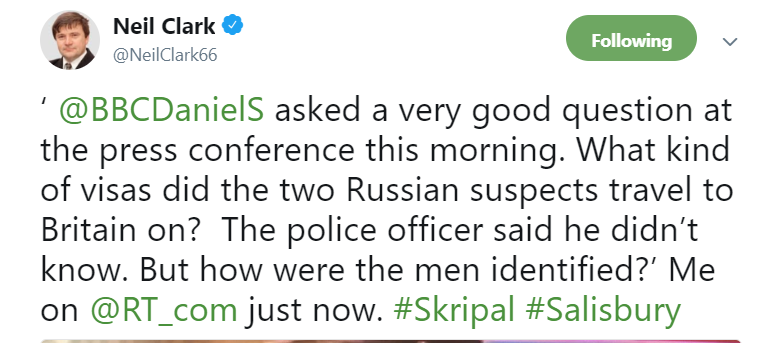
The Metropolitan Police made one statement in the Skripal case which is plainly untrue; they claimed not to know on what kind of visa Boshirov and Petrov were travelling. As they knew the passports they used, and had footage of them coming through the airport, that is impossible. The Border Force could tell them in 30 seconds flat.
To get a UK visa Boshirov and Petrov would have had to attend the UK Visa Application Centre in Moscow. There not only would their photographs be taken, but their fingerprints would have been taken and, if in the last few years, their irises scanned. The Metropolitan Police would naturally have obtained their fingerprints from the Visa Application.
One thing of which we can be certain is that their fingerprints are not on the perfume bottle or packaging found in Charlie Rowley’s home. We can be certain of that because no charges have been brought against the two in relation to the death of Dawn Sturgess, and we know the police have their fingerprints. The fact of there being no credible evidence, according to either the Metropolitan Police or the Crown Prosecution Service, to link them to the Amesbury poisoning, has profound implications.
Why the Metropolitan Police were so coy about telling us what kind of visa the pair held, points to a wider mystery. Why were they given the visas in the first place, and what story did they tell to get them? It is not easy for a Russian citizen, particularly an economically active male, to get past the UK Border Agency. The visa application process is very intrusive. They have to produce evidence of family and professional circumstances, including employment and address, evidence of funds, including at least three months of bank statements, and evidence of the purpose of the visit. These details are then actively checked out by the Visa Department.
If they had told the story to the visa section they told to Russia Today, that they were freelance traders in fitness products wanting to visit Salisbury Cathedral, they would have been refused a visa as being candidates for overstaying. They would have been judged not to have sufficiently stable employment in Russia to ensure they would return. So what story did Petrov and Boshirov give on their visa application, why were they given a visa, and what kind of visa? And why do the British authorities not want us to know the answer to these questions?
Which brings us to the claims of neo-conservative propaganda website Bellingcat. They claim together with the Russian Insider website to have obtained documentary evidence that Petrov and Boshirov’s passports were of a series issued only to Russian spies, and that their applications listed GRU headquarters as their address.
There are some problems with Bellingcat’s analysis. The first is that they also quote Russian website fontanka.ru as a source, but fontanka.ru actually say the precise opposite of what Bellingcat claim – that the passport number series is indeed a civilian one and civilians do have passports in that series.
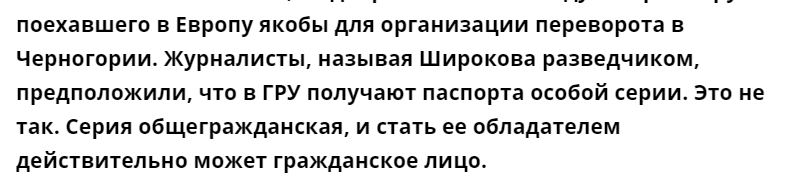
Fontanka also state it is not unusual for the two to have close passport numbers – it merely means they applied together. On other points, fontanka.ru do confirm Bellingcat’s account of another suspected GRU officer having serial numbers close to those of Boshirov and Petrov.
But there is a bigger question of the authenticity of the documents themselves. Fontanka.ru is a blind alley – they are not the source of the documents, just commenting on them, and Bellingcat are just attempting the old trick of setting up a circular “confirmation”. Russian Insider is neither Russian nor an Insider. Its name is a false claim and it consists of a combination of western “experts” writing on Russia, and reprints from the Russian media. It has no track record of inside access to Russian government secrets or documents, and nor does Bellingcat.
What Bellingcat does have is a track record of shilling for the security services. Bellingcat claims its purpose is to clear up fake news, yet has been entirely opaque about the real source of its so-called documents.
MI6 have almost 40 officers in Russia, running hundreds of agents. The CIA has a multiple of that. They pool their information. Both the UK and US have large visa sections whose major function is the analysis of Russian passports, their types and numbers and what they tell about the individual.
We are to believe that Boshirov and Petrov were GRU agents whose identity was plainly obvious from their passports, who had no believable cover identities, but that neither the visa department nor MI6 (which two cooperate closely and all the time) knew they were giving visas to GRU agents. Yet this information was readily available to Bellingcat ?
I do not know if the two are agents or just tourists. But the claimed evidence they were agents is, if genuine, so obvious that the two would have been under close surveillance throughout their stay in the UK. If the official story is true, then the failures of the UK visa department and MI6 are abject and shameful. As is the failure to take simple precautions for the Skripals’ security, like the inexplicable absence of CCTV covering the house of Sergei Skripal, an important ex-agent and defector supposedly under British protection.
A further thought. We are informed that Boshirov and Petrov left a trace of novichok in their hotel bedroom. How likely is it, really, that, the day before the professional assassination attempt, which involved handling an agent with which any contact could kill you, Boshirov and Petrov would prepare, not by resting, but by an all night drugs and sex session? Would you really not want the steadiest possible hand the next day? Would you really invite a prostitute into the room with the novichok perfume in it, and behave in a way that led to complaints and could have brought you to official notice?
Is it not astonishing that nobody in the corporate and state media has written that this behaviour is at all unlikely, while scores of “journalists” have written that visiting Salisbury as a tourist, and returning the next day because the visit was ruined by snow, would be highly unlikely?
To me, even more conclusively, we were informed by cold war propagandists like ex White House staffer Dan Kaszeta that the reason the Skripals were not killed is that novichok is degraded by water. To quote Kaszeta “Soap and water is quite good at decontaminating nerve agents”.
In which case it is extremely improbable that the agents handling the novichok, who allegedly had the novichok in their bedroom, would choose a hotel room which did not have an en suite bathroom. If I spilt some novichok on myself I would not want to be queuing in the corridor for the shower. The GRU may not be big on health and safety, but the idea that their agents chose not to have basic washing facilities available while handling the novichok is wildly improbable.
The only link of Boshirov and Petrov to the novichok is the trace in the hotel room. The identification there of a microscopic trace of novichok came from a single swab, all other swabs were negative, and the test could not be repeated even on the original positive sample. For other reasons given above, I absolutely doubt these two had novichok in that bedroom. Who they really are, and how much the security services knew about them, remain open questions.
Extraordinary and Deliberate Lies from the Guardian
By Craig Murray | September 23, 2018
I am just back from a family funeral – one of a succession – and a combination of circumstances had left me feeling pretty down lately, and not blogging much. But I have to drag myself to the keyboard to denounce a quite extraordinary set of deliberate lies published in the Guardian about a Russian plot to spring Julian Assange last December.
I was closely involved with Julian and with Fidel Narvaez of the Ecuadorean Embassy at the end of last year in discussing possible future destinations for Julian. It is not only the case that Russia did not figure in those plans, it is a fact that Julian directly ruled out the possibility of going to Russia as undesirable. Fidel Narvaez told the Guardian that there was no truth in their story, but the Guardian has instead chosen to run with “four anonymous sources” – about which sources it tells you no more than that.
I have no idea who the Guardian’s “anonymous sources” are, but I know 100% for certain that the entire story of a Russian plot to extract Julian from the Embassy last Christmas Eve is a complete and utter fabrication. I strongly suspect that, as usual, MI6 tool Luke Harding’s “anonymous sources” are in fact the UK security services, and this piece is entirely black propaganda produced by MI6.
It is very serious indeed when a newspaper like the Guardian prints a tissue of deliberate lies in order to spread fake news on behalf of the security services. I cannot find words eloquent enough to express the depth of my contempt for Harding and Katherine Viner, who have betrayed completely the values of journalism. The aim of the piece is evidently to add a further layer to the fake news of Wikileaks’ (non-existent) relationship to Russia as part of the “Hillary didn’t really lose” narrative. I am, frankly, rather shocked.
The New York Times as Judge and Jury
By Joe Lauria • Consortium News • September 21, 2018
We’ve seen it before: a newspaper and individual reporters get a story horribly wrong but instead of correcting it they double down to protect their reputations and credibility—which is all journalists have to go on—and the public suffers.
Sometimes this maneuver can contribute to a massive loss of life. The most egregious example was the reporting in the lead-up to the invasion of Iraq. Like nearly all Establishment media, The New York Times got the story of Iraq’s weapons of mass destruction—the major casus belli for the invasion—dead wrong. But the Times, like the others, continued publishing stories without challenging their sources in authority, mostly unnamed, who were pushing for war.
The result was a disastrous intervention that led to hundreds of thousands of civilian deaths and continued instability in Iraq, including the formation of the Islamic State.
In a massive Times‘ article published on Thursday, entitled, “‘A Plot to Subvert an Election: Unravelling the Russia Story So Far,” it seems that reporters Scott Shane and Mark Mazzetti have succumbed to the same thinking that doubled down on Iraq.
They claim to have a “mountain of evidence” but what they offer would be invisible on the Great Plains.
With the mid-terms looming and Special Counsel Robert Mueller unable to so far come up with any proof of collusion between Russia and the Trump campaign to steal the 2016 election—the central Russia-gate charge—the Times does it for him, regurgitating a Russia-gate Round-Up of every unsubstantiated allegation that has been made—deceptively presented as though it’s all been proven.
This is a reaffirmation of the faith, a recitation of what the Russia-gate faithful want to believe is true. But mere repetition will not make it so.
The Times’ unsteady conviction is summed up in this paragraph, which the paper itself then undermines only a few paragraphs later:
“What we now know with certainty: The Russians carried out a landmark intervention that will be examined for decades to come. Acting on the personal animus of Mr. Putin, public and private instruments of Russian power moved with daring and skill to harness the currents of American politics. Well-connected Russians worked aggressively to recruit or influence people inside the Trump campaign.”
But this schizoid approach leads to the admission that “no public evidence has emerged showing that [Trump’s] campaign conspired with Russia.”
The Times also adds: “There is a plausible case that Mr. Putin succeeded in delivering the presidency to his admirer, Mr. Trump, though it cannot be proved or disproved.”
This is an extraordinary statement. If it cannot be “proved or disproved” what is the point of this entire exercise: of the Mueller probe, the House and Senate investigations and even of this very New York Times article?
Probing to prove this constructed story without proof is the very point of this piece.
A Banner Day
The 10,000-word article opens with a story of a pro-Russian banner that was hung from the Manhattan Bridge on Putin’s birthday, and an anti-Obama banner hung a month later from the Memorial Bridge in Washington just after the 2016 election.
On public property these are constitutionally-protected acts of free speech. But for the Times, “The Kremlin, it appeared, had reached onto United States soil in New York and Washington. The banners may well have been intended as visual victory laps for the most effective foreign interference in an American election in history.”
Why? Because the Times tells us that the “earliest promoters” of images of the banners were from social media accounts linked to a St. Petersburg-based click-bait farm, a company called the Internet Research Agency. The company is not legally connected to the Kremlin and any political coordination is pure speculation. IRA has been explained convincingly as a commercial and not political operation. Its aim is get and sell “eyeballs.”
For instance the company conducted pro and anti-Trump rallies and social media messages, as well as pro and anti-Clinton. But the Times, in classic omission mode, only reports on “the anti-Clinton, pro-Trump messages shared with millions of voters by Russia.” Sharing with “millions” of people on social media does not mean that millions of people have actually seen those messages. And if they had there is little way to determine whether it affected how they voted, especially as the messages attacked and praised both candidates.
The Times reporters take much at face value, which they then themselves undermine. Most prominently, they willfully mistake a an indictment for a conviction, as if they do not know the difference.
This is in the category of Journalism 101. An indictment need not include evidence and under U.S. law an indictment is not evidence. Juries are instructed that an indictment is merely an accusation. That the Times commits this cardinal sin of journalism to purposely confuse allegations with a conviction is not only inexcusable but strikes a fatal blow to credibility of the entire article.
It actually reports that “Today there is no doubt who hacked the D.N.C. and the Clinton campaign. A detailed indictment of 12 officers of Russia’s military intelligence agency, filed in July by Mr. Mueller, documents their every move, including their break-in techniques, their tricks to hide inside the Democrats’ networks and even their Google searches.”
Who needs courts when suspects can be tried and convicted in the press?
What the Times is not taking into account is that Mueller knows his indictment will never be tested in court because the GRU agents will never be arrested, there is no extradition treaty between the U.S. and Russia and even if it were miraculously to see the inside of a courtroom Mueller can invoke states secrets privilege to show the “evidence” to a judge with clearance in his chambers who can then emerge to pronounce “Guilty!” without a jury having seen that evidence.
This is what makes Mueller’s indictment more a political than a legal document, giving him wide leeway to put whatever he wants into it. He knew it would never be tested and that once it was released, a supine press would do the rest to cement it in the public consciousness as a conviction, just as this Times piece tries to do.
Errors of Commission and Omission
There are a series of erroneous assertions and omissions in the Times piece:
–Not mentioning that the FBI was never given access to the DNC server but instead gullibly believing the assertion of the anti-Russian private company CrowdStrike, paid for by the DNC, that the name of the first Soviet intelligence chief found in metadata proves Russia was behind the hack. Only someone wanting to be caught would leave such a clue.
–Incredibly believing that Trump would have launched a covert intelligence operation on live national television by asking Russia to get 30,000 missing emails.
–Ignoring the possible role of the MI6, the CIA and the FBI setting up Trump campaign members George Papadopoulos and Carter Page as “colluders” with Russia.
–Repeating misleading statements about the infamous Trump Tower meeting, in which Trump’s son did not seek dirt on Clinton but was offered it by a music promoter, not the Russian government. None was apparently produced. It’s never been established that a campaign receiving opposition research from foreigners is illegal (though the Times has decided that it is) and only the Clinton campaign was known to have obtained any.
–Making no mention at all of the now discredited opposition research dossier paid for by the Clinton campaign and the DNC from foreign sources and used by the FBI to get a warrant to spy on Carter Page and potentially other campaign members.
–Dismissing the importance of politicized text messages between FBI agents Peter Strzok and Lisa Page because the pair were “skewered regularly on Mr. (Sean) Hannity’s show as the ‘Trump-hating F.B.I. lovebirds.’”
–Putting down to “hyped news stories” the legitimate fear of a new McCarthyism against anyone who questions the “official” story being peddled here by the Times.
–Seeking to get inside Putin’s head to portray him as a petulant child seeking personal revenge against Hillary Clinton, a tale long peddled by Clinton and accepted without reservation by the Times.
–Pretending to get into Julian Assange’s head as well, saying he “shared Mr. Putin’s hatred of Mrs. Clinton and had a soft spot for Russia.” And that Assange “also obscured the Russian role by fueling a right-wing conspiracy theory he knew to be false.”
–Ignoring findings backed by the Veteran’s Intelligence Professionals for Sanity that the DNC emails were leaked and not hacked.
–Erroneously linking the timing of WikiLeaks’ Podesta emails to deflect attention from the “Access Hollywood” tape, as debunked in Consortium News by Italian journalist Stefania Maurizi, who worked with WikiLeaks on those emails.
Distorts Geo-Politics
The piece swallows whole the Establishment’s geo-strategic Russia narrative, as all corporate media do. It buys without hesitation the story that the U.S. seeks to spread democracy around the world, and not pursue its economic and geo-strategic interests as do all imperial powers.
The Times reports that, “The United States had backed democratic, anti-Russian forces in the so-called color revolutions on Russia’s borders, in Georgia in 2003 and Ukraine in 2004.” The Times has also spread the erroneous story of a democratic revolution in Ukraine in 2014, omitting crucial evidence of a U.S.-backed coup.
The Times disapprovingly dismisses Trump having said on the campaign trail that “Russia was not an existential threat, but a potential ally in beating back terrorist groups,” when an objective view of the world would come to this very conclusion.
The story also dismisses American voters’ real concerns that led to Trump’s election. For the Times, economic grievances and rejection of perpetual war played no role in the election of Trump. Instead it was Russian influence that led Americans to vote for him, an absurd proposition defied by a Gallup poll in July that showed Americans’ greatest concerns being economic. Their concerns about Russia were statistically insignificant at less than one percent.
Dismissing Americans’ real concerns exposes the class interests of Times staffers and editors who are evidently above Americans’ economic and social suffering.
Establishment reporters insulate themselves from criticism by retreating into the exclusive Establishment club they think they inhabit. It is from there that they vicariously draw their strength from powerful people they cover, which they should instead be scrutinizing. Validated by being close to power, Establishment reporters don’t take seriously anyone outside of the club, such as a website like Consortium News.
But on rare occasions they are forced to take note of what outsiders are saying. Because of the role The New York Times played in the catastrophe of Iraq its editors took the highly unusual move of apologizing to its readers. Will we one day read a similar apology about the paper’s coverage of Russia-gate?
Joe Lauria is editor-in-chief of Consortium News and a former correspondent for The Wall Street Journal, Boston Globe, Sunday Times of London and numerous other newspapers. He can be reached at joelauria@consortiumnews.com and followed on Twitter @unjoe .
UK to Create 2,000-Strong Cyberforce to Counter ‘Russia Threat’ – Reports
Sputnik – 21.09.2018
The United Kingdom will set up a cybersecurity force, comprising up to 2,000 members, to tackle the “threat from Russia” and other actors, local media reported on Friday.
The authorities planned to invest some 250 million pounds (over $330 million) in creating the cyberforce, the Sky News broadcaster reported, citing sources.
The force would be tasked with carrying out offensive cyberoperations and would be composed of the officials of the Government Communications Headquarters (GCHQ), military personnel and contractors, the outlet added.
The plan to create the unit was reportedly drafted by the Ministry of Defence and the GCHQ amid London’s claims about the alleged growing cyberthreat from Moscow and the United Kingdom’s recent successful use of cyberweapons against the Islamic State terror group.
Over the recent years, Russia has repeatedly been accused of carrying out cyberattacks against other countries, including the United States, France, the United Kingdom and Germany, and attempting, in particular, to influence the results of elections. Moscow refuted all such claims, calling them unfounded.
The Skripal Affair – Another False Flag in NATO Litany to Criminalize Russia
By Finian CUNNINGHAM | Strategic Culture Foundation | 20.09.2018
If we start from a premise which understands that Britain and its NATO allies are capable of mounting false flag events in Syria with chemical weapons, then it is entirely possible that British secret services carried out a similar propaganda stunt in England with regard to former Russian double agent Sergei Skripal.
We also need to bear in mind that British state intelligence agencies are plausibly running a covert assassination program targeting Russian exiles living in Britain – for the purpose of incriminating Moscow.
Over the past two decades, more than a dozen Russian dissidents have met untimely deaths while residing in England, including Alexander Litvinenko and Boris Berezovsky. Their deaths provide propaganda fodder for the British to accuse Moscow of carrying out “revenge killings”.
However, the suspicious circumstances surrounding each death could more conceivably point to the British liquidating the Russian exiles as propaganda assets.
In the case of Sergei Skripal, the disgraced former Russian military intelligence officer was convicted in Russia of being a spy working for Britain’s MI6. He was exiled to England more than a decade ago as part of an espionage swap deal.
When Skripal was apparently poisoned in his resident town of Salisbury in southwest England on March 4, along with his adult daughter, Yulia, the British authorities immediately pointed the finger of blame at Russian President Vladimir Putin for allegedly ordering an assassination. The Kremlin was accused of dispatching agents who supposedly poisoned the Skripals with a deadly nerve agent.
The publication last week by Scotland Yard police of CCTV images showing two Russian men, Alexander Petrov and Ruslan Boshirov, walking the streets of Salisbury on the weekend of the alleged attack was reported in the British media as “proof” of the supposed Kremlin assassination plot. The Skripal affair is conveniently portrayed as “one more” example of Putin’s “Kremlin killing machine”.
But let’s look at the whole affair from a different perspective. The following scenario draws on observations and evidence cited by sources such as former British ambassador Craig Murray, the informed analytical website Moon of Alabama, and US-based political analyst Randy Martin (in personal correspondence).
Let’s ask the following question: was Sergei Skripal’s propaganda usefulness to the British as an exiled spy at some later point seen by the British as being better served as a victim of an apparent poison-assassination. That is, as a victim of a false flag attack that was actually carried out covertly by the British state agents in order to give the Western-led anti-Russia media campaign a significant boost?
Recall the Salisbury incident occurred at the time when Putin won re-election as Russian president, and it was during the build-up to the 2018 World Cup tournament hosted by Russia.
There is evidence that Sergei Skripal may have been a drug addict. His movements on the Sunday of March 4 when he was found incapacitated on a public park bench in Salisbury along with daughter Yulia suggest he may have been fixing a drug habit. That day he and his daughter both reportedly switched off their cell phones as they visited parks in Salisbury and nearby Amesbury. The latter venue was also a haunt for the two heroin junkies Charlie Rowley and Dawn Sturgess who later became embroiled in the affair when both apparently were also poisoned with the same nerve agent. Sturgess died days later from her ailment in early July.
Was Skripal visiting venues on March 4 known for scoring drugs? The switching off of phones would indicate some kind of illicit behavior. Recall, too, that earlier on that day, Skripal was reportedly acting in a hurry and very agitated while lunching in a restaurant with his daughter, both of them leaving abruptly. Did he have a monkey on his back, pushing him to get his drug fix?
We can be sure that Skripal was being kept under surveillance by Britain’s MI5 and MI6 all during his decade-long exile in Britain. The postulated drug habit would have been known to his “handlers”.
Moving to cash in their espionage asset for propaganda value, it is possible that British state agents surreptitiously spiked Skripal’s drug fix with some incapacitating substance, such as fentanyl. Indeed, the distressed symptoms of the father and daughter later found in a park on the afternoon of March 4 by members of the public were initially reported as signs of drug overdose.
From that point on, it is contended here, the British secret services intervened as they had anticipated to take control of the “Skripal affair”.
While Sergei and Yulia were comatose in a secured hospital wing, it could have been possible for their blood samples to be doctored with a chemical weapon, the notorious Novichok, which was subsequently and hastily attributed to Russia. That attribution in the British media is wildly overplayed. The British chemical weapons facility at Porton Down is only a few miles away from Salisbury where the Skripals were hospitalized. Without doubt, Porton Down would have its own supply of organophosphate nerve agents, if not samples of Novichok. It is not a uniquely Russian chemical, as British politicians and media falsely imply.
There are gaping anomalies in the official British narrative of a Kremlin-directed “hit job” on Skripal with a deadly nerve agent, a claim which Moscow has vehemently denied.
For a start, Sergei and his daughter have, according to the British government, recovered from their ordeal. Yet, the British authorities were claiming that the alleged nerve poison, Novichok, was a super lethal toxin, multiple times more deadly than related organophosphate chemical weapons Sarin or Tabun. A single drop of Novichok on the skin would be enough to kill almost instantly, so it is claimed.
The official British narrative claims that the killer chemical was applied to the front door handle at the Skripal home. The two Russian men caught on CCTV and accused last week by the British of being Kremlin assassins were not in Salisbury until just before midday on March 4, according to the published CCTV time data. By that time, the Skripals had left the home and were not seen returning. That means the pair were stricken while away from the home, perhaps, as speculated here, while they were in the public park scoring a drug deal.
Plausibly, they were not assaulted with a chemical weapon, but with a spiked drug sample, which British state agents had arranged for the purpose of incapacitating them. In an incapacitated state, the Skripals could then be used as guinea pigs, whose bodily fluids could be contaminated to frame up Russia with a story of “assassination by Novichok”.
Here are some challenging questions: why have the Skripals seemingly gone into hiding since the alleged poison incident over six months ago?
Why did Yulia make only one public statement to the Reuters news agency – three months after the poison incident and apparently having recovered from her “lethal ordeal” – in which she expressed a desire to return to her native Russia? Yet since that one-off public statement nearly three months ago, Yulia or her father have not been seen since. Would she really express such a wish to go back to Russia if she believed the British claim that Russian state agents had just tried to assassinate her and her father?
Why have all official Russian requests for consular contact with Yulia been repeatedly denied by the British side, in flagrant violation of international law and diplomatic norms?
The implication is that the Skripals are being detained under duress by the British authorities who realize that the official version of a Kremlin assassination plot with Novichok might be fatally contradicted by the Skripals’ version of events. Hence the pair are being denied access to public communication.
What about the junkies Charlie Rowley and the late Dawn Sturgess? It is plausible that they were also set up in a covert poison attack by British intelligence using spiked drugs in order to “refresh” the anti-Russia propaganda stunt. Then the story about a perfume bottle containing Novichok was thrown in to the mix to conjure up a murder weapon discarded by alleged Kremlin assassins.
What about the two Russian men caught on CCTV in Salisbury on the weekend that the Skripals were apparently poisoned? Petrov and Boshirov upset the official British narrative by coming forward last week to give a media interview. They said they were ordinary civilians traveling under their own names, not aliases, as the British claimed. They said they are not Russian military intelligence, that they had no perfume bottle with Novichok nor any other substance on their possession in England, and that they were in Salisbury as weekend tourists.
Salisbury and its world-famous 13th century cathedral – reputed to be the most ornate in England – as well as nearby neolithic-age Stonehenge, attract millions of tourists from around the world each year, including many Russian nationals. It is not a stretch that British authorities scanned through reams of CCTV footage on the weekend of March 4, and got a lucky break to find Petrov and Boshirov walking the streets of Salisbury. The two men say they are caught up in a “fantastical coincidence”. More to the point, it seems, they are caught up in a British false flag to incriminate, demonize and delegitimize Russia.
The Skripal false flag is only one in a whole series of propaganda campaigns conducted by Western governments, their state intelligence and their ever-obliging news media in recent years. The alleged “annexation of Crimea”, the “covert invasion of Ukraine”, shooting down a Malaysian airliner, illicit doping of Olympic athletes, meddling in US and European elections, launching cyberattacks on Western power-grids, supporting “brutal dictator Assad” in Syria, among other malicious memes.
The litany of false flags to demonize Russia as a “pariah state” is itself indicative of relentless media orchestration by NATO governments.
The Skripal affair fits into this phenomenal propaganda effort.
Featured Video
EUROPE FEARS RUSSIA’S NEXT MOVE / Ian Proud
or go to
Aletho News Archives – Video-Images
New Book
New Book: No Autoimmunity The Body Doesn’t Attack Itself
Lies are Unbekoming | September 24, 2026
 The label for Humira, once the best-selling drug in the world, lists its risks in plain print. One of them, in the label’s own words, is new “autoimmune” disease.
A drug prescribed for a condition labelled autoimmune carries a warning that it can cause a condition labelled autoimmune. That contradiction sits in every box, on a folded paper almost nobody reads.
My new book starts there.
No Autoimmunity: The Body Doesn’t Attack Itself
For seventy years, “your body is attacking itself, and we don’t know why” has ended the conversation for people diagnosed with multiple sclerosis, lupus, rheumatoid arthritis, Hashimoto’s, Type 1 diabetes, Crohn’s and psoriasis. More than eighty conditions now carry the autoimmune label. The diagnosis comes with a prescription for life. It almost never comes with a question about cause.
This book asks the question and answers it from the framework’s own records: its drug labels, its journals, its regulatory filings, and its own experiments. … continue
Blog Roll
 Aletho News
- Iran offers Trump deal before US election
- Merz regime wants ‘secret police’ – opposition
- Israeli settlers terrorize West Bank Palestinians with state-provided drones: Report
- They see them, then kill them: Israeli quadcopters track, deliberately target civilians in Gaza
- Debunked: Trump’s egregious UNGA claims on war against Iran crumble under scrutiny
- Europe was part of the infrastructure of US aggression against Iran: Deputy FM
- New evidence on the Bucha Massacre
- Italy and France debunk reports CIA issued ‘Russian drone threat’ warning
- How Russia is Rewiring the Global South
- Britain’s elites want you ready to die for a war they keep imagining
- If Americans Knew
- Trump betrayed voters with his campaign lies and prioritized a foreign country once he took office
- Netanyahu calls Israel’s war in Gaza ‘opposite of genocide’ in UN speech to near-empty hall
- Settler Kidnappings: Torture, Sexual Abuse and Terrorisation of Palestinian Abductees as Israel Deepens Annexation of West Bank
- Gaza winter nears as 162,000 tents become unusable, raising fears of humanitarian crisis
- Netanyahu says, “It’s the opposite of genocide”; UN says Gaza economy is world’s ‘most severe crisis on record’ – Daily Update
- Israel’s US-Backed Assault on Gaza Has Created the ‘World’s Most Severe Economic Crisis on Record’: UN
- ‘Protecting U.S. Citizens’… From Israel
- ‘This is where I live now, the back of a truck’: a day in the life of a grandmother in Gaza
- In UN Speech, Iran’s President Displays Pictures of Children Killed by US, Brings Attention to Israel’s Nuclear Arsenal
- Israel displaces hundreds of Palestinians amid wave of demolitions in West Bank
- No Tricks Zone
- New Study: Earth And Venus Surface Warmth Largely Explained By Convection And Lapse Rate, Not CO2 Or Radiation
- 2025 Nature Paper Claiming Worsening Global Drought Gets RETRACTED …Heavily Flawed
- New Study: ‘Global Drought Shows No Detectable Recent Acceleration Under Climate Warming’
- Economic Masterminds: German Socialists Suggest Taxing Productivity Gains Stemming From Using AI
- The South China Sea Has Not Been Cooperating With The Climate Change Narrative
- Energy Crisis: Germany Enters Heating Season With Historically Low Gas Reserve Fill Levels
- New Study: The Antarctic Ice Sheet Gained Mass From 2020-2024 Due To Staggering Snow And Ice Accumulation
- Study: Ocean Heating Rates From Thousands Of Years Ago ‘Dwarf’ Modern Ocean Heating Rates
- Climate Extremists Target, Attack Large-Scale Power Grid Infrastructure In Germany!
- New Study: Antarctic Ice Melt Has Contributed Less Than 1 Centimeter To Sea Level Rise In The Last 30 Years

