Has Russia Had Enough?
By Paul Craig Roberts | Institute For Political Economy | March 21, 2018
This morning I watched a briefing the Russian Foreign Ministry provided for the diplomatic community where international toxic substances experts presented information concerning the alleged nerve agent used in the alleged attack on Skripal and his daughter. This information has been known for some time, and none of it has been reported in the Western presstitute media.
In the briefing the Russians once again relied on facts and existing agreements that govern the investigation of such events and asked why the British were demanding explanations from Russia when the British refuse to comply with established procedures and refuse to produce any evidence of what the British allege to have occurred.
The response from the US and French embassy representatives was simply to state that they needed no evidence to stand in solidarity with their British friends, that Russia was guilty by accusation alone, and that they would hold Russia accountable.
The benefit of this absurd response, which the Russians declared to be shameful, is to make clear to the Russian government that it is a waste of time to try, yet again, to confront unsupported accusations from the West with facts and appeals to follow the specified legal processes. The West simply does not care. The issue is not the facts of the case. The agenda is to add another layer to the ongoing demonization of Russia.
Sooner or later the Russian government will realize that its dream of “working with its Western partners” is not to be and that the hostile actions and false accusations from the West indicate that the West is set on a course of conflict with Russia and is preparing the insouciant Western peoples to accept the consequences.
The Russian official hosting the briefing compared the Skirpal accusation with the Malaysian Airliner accusation and the many others that resulted in instant accusations against Russia and refusal to cooperate in investigations.
The Russian official also drew the parallel of the accusations against Russia with the US and UK false accusations against Serbia, which led to the bombing of Serbia, and to the false accusations against Iraq, for which Colin Powell and Tony Blair had to apologize, that resulted in the destruction of Iraq and the death and displacement of millions of Iraqis.
The Russian official also said, pointedly, that the days were gone when no one challenged statements by the US government. The world, he said, is no longer unipolar. Russia, he said, does not respond to unsupported allegations. He also said that the way the Americans, British, and French are proceeding suggests that the Skirpal affair is an orchestration created for the purpose of accusing Russia.
This conclusion is supported by the history of US and UK interventions. In recent times we have seen the West’s orchestrated interventions based on obvious and blatant lies in Serbia, Iraq, Libya, Somalia, Syria, Ukraine, Yemen, and the attempts to destabilize Iran and Venezuela. History provides almost endless examples of the lies used by the US and UK to implement their agendas.
Nothing Washington and London say can ever be believed. Is it possible for Russia or any country to work with “partners” who are shameless, short on integrity and honesty, and have proven themselves unworthy of trust?
Face it: Cambridge Analytica story proves Facebook doesn’t give a toss about privacy or democracy
By Danielle Ryan | RT | March 20, 2018
Mainstream media have obsessed over Russia’s alleged use of Facebook to swing the 2016 US election. In reality, it was actually a shady British data-mining firm that was running pro-Trump Facebook propaganda campaigns
Irony doesn’t feel like strong enough a word.
Which is worse: Russia allegedly buying a few hundred Facebook ads, with the goal of ‘sowing unrest’ in the United States, by exploiting already emotional and divisive issues like gun control and race relations, or Facebook allowing a dodgy British company to mine the data of millions of its users, without the users’ explicit knowledge or consent, and then using that data for political purposes?
If you need a recap: British firm Cambridge Analytica (CA), working with the Trump campaign, harvested private information from 50 million Facebook users without their knowledge — and then used that information in an attempt to influence the election in Trump’s favor. CA was reportedly paid $5 million by the Trump campaign for their efforts. Oh, and former Trump White House chief strategist Steve Bannon used to head the company.
So now we find out, after all the hand-wringing about how Russia elected Trump through its evil social media manipulations, that there were, in fact, other, perhaps for more influential, forces at play.
“We exploited Facebook to harvest millions of people’s profiles. And built models to exploit what we knew about them and target their inner demons. That was the basis the entire company was built on,” said CA whistleblower Christopher Wylie.
There are so many levels of irony to this story, it’s hard to know where to begin.
But let’s start with this: At the same time that Cambridge Analytica was mining Facebook data to help Trump, top executives at Facebook were actively working to help Trump opponent Hillary Clinton. Leaked emails between Facebook Chief Operating Officer Sheryl Sandberg and Clinton campaign chairman John Podesta revealed that Facebook provided research to Clinton in 2015. According to the emails, Sandberg “badly” wanted Clinton to win and she met privately with the candidate on multiple occasions.
Here’s where it gets really interesting, though. Cambridge Analytica doesn’t discriminate. After Trump’s election, the data firm’s parent company SCL Group won a contract from the US State Department to — wait for it — help combat propaganda on Facebook.
You know, it’s almost like Cambridge Analytica and Facebook each are companies primarily interested in money and which act with no moral qualms whatsoever. One can even imagine, if they try hard enough, that while Facebook executives personally seem to prefer Democrats, the company would help anyone, so long as a big fat check was involved.
Since the Cambridge Analytica scandal broke, thanks to Wylie, Facebook has tried to play the victim — and quite successfully, too, given that most of the focus has been on CA and its dirty tricks and not the fact that it is a giant data company like Facebook that allows it to happen in the first place.
Facebook claims that it was misled by CA and acted to suspend the firm from its platform. But Facebook is no victim. The social media giant still insists CA’s use of the data from 50 million of its users’ accounts was not a data breach because, somewhere within the tangle of Facebook’s intentionally complicated privacy settings, users had technically consented to having their data mined.
Don’t let Facebook’s faux outrage at CA’s behavior fool you. In the midst of all this drama, a former high-level staffer on Barack Obama’s 2012 presidential campaign has come out and admitted that Facebook allowed the Obama campaign to do much the same thing to help him, that Cambridge Analytica did to help Trump four years later.
Carol Davidsen wrote on Twitter that Facebook staff were very open and candid with the Obama campaign, writing that “they allowed us to do things they wouldn’t have allowed someone else to do because they were on our side”.
Those activities included “suck[ing] out the entire social graph” — in other words an individual user’s entire network of Facebook friends — in an effort to target more potential voters through friends lists.
“The privacy policies at that time on Facebook were – if they opted in, they could tell us who all their friends were. So, they told us who all their friends were. We were actually able to ingest the entire social network of the US that’s on Facebook, which is most people,” Davidsen wrote.
So who is really more to blame here? A company like Cambridge Analytica, that uses political bribes and honey traps to discredit people — or a social media giant that sells the personal data of its users to the highest bidder? Or… Russia?
I’m inclined to agree with NSA whistleblower Edward Snowden, who wrote on Twitter: “Facebook makes their money by exploiting and selling intimate details about the private lives of millions, far beyond the scant details you voluntarily post. They are not victims. They are accomplices.”
Speaking of whistleblowers, it’s been interesting to see how the media has treated the Cambridge Analytica whistleblower vs. how they treat whistleblowers like Julian Assange, Chelsea Manning — and Snowden himself. When the whistleblower reveals information that suits the prevailing narrative, they are lauded as brave heroes and truth seekers. When they reveal something that doesn’t quite fit the story they are promoting, whistleblowers suddenly become abominable traitors deserving of no mercy.
Now comes the question of what should be done about all this sneaky business on Facebook. Luckily, I have a couple of suggestions.
First and foremost, Washington should immediately sanction the UK over the now-blatant attempts of a British company to meddle in and influence the American presidential election. I mean, it only seems fair. All sorts of accusations should be immediately levelled at the British government. Most importantly, absolutely no effort should be made to separate Cambridge Analytica from either Downing Street or the British public in general.
Second, the media should spend weeks, if not months, analyzing the motives of dodgy British political operatives and their efforts to secure a Trump victory. Journalists should get to work whipping up massive anti-British fervor and use any opportunity they can to get “the British” into their headlines about evil online influence campaigns.
In all honesty, there really is not much difference between Cambridge Analytica and Facebook. They both use our data for political and financial purposes — Facebook just seems to do it all on a far wider and more consistent basis.
It was only in January that Facebook admitted in a series of official blog posts, that it had a “moral duty” to understand how its technology was being used and to figure out “what can be done to make communities like Facebook as representative, civil and trustworthy as possible.” In response to allegations of Russian meddling and ‘fake news’ on the platform, Facebook said it was taking “steps in partnership with third-party fact checkers to rank these stories lower”.
That’s right: Employing unidentified “fact checkers” was supposed to help solve the fake news problem, while companies like Cambridge Analytica were out there hoovering up data from millions of users without their knowledge and using it for political propaganda purposes. But Facebook, we’re supposed to believe, knew nothing about that.
Facebook doesn’t really care a toss about your privacy or your democracy — and if this Cambridge Analytica scandal doesn’t make that clear, nothing will.
Danielle Ryan is an Irish freelance journalist. Having lived and worked in the US, Germany and Russia, she is currently based in Budapest, Hungary. Her work has been featured by Salon, The Nation, Rethinking Russia, Russia Direct, teleSUR, The BRICS Post and others. Follow her on Twitter @DanielleRyanJ, check out her Facebook page, or visit her website: danielle-ryan.com
Read more:
Moscow: UK is Either Unable to Protect From Attack or Staged Skripal Attack
Sputnik – 21.03.2018
The Russian Foreign Ministry and Russian Defense Ministry jointly delivered a statement after a meeting with foreign envoys amid the scandal surrounding the poisoning of ex-spy Sergei Skripal.
According to the official, “either the British authorities are unable to protect from a terrorist attack on its territory or staged the attack themselves.”
“Russia owes nothing and can bear no responsibility for the actions or lack of actions on the British soil,” Ermakov added.
Moscow is surprised that UK authorities deny consular access to Skripal’s daughter in violation of international norms, Vladimir Ermakov stressed.
The attack on the Skripals is a “gross folly,” which is not beneficial to Russia, he stated.
“Moscow’s list of questions for London regarding the Skripal case is growing,” Vladimir Ermakov added.
Russia isn’t satisfied by the UK’s answers about the Skripal case, and the British have left the most important questions unanswered.
“If the subject of the investigation has not been determined reliably, and all facts are being intentionally hidden, and real evidence may have already disappeared, which has happened in the United Kingdom many times, then it is not clear what issue the UK side has,” Ermakov told a briefing.
“We took one more step forward. We suggested that the British conduct a joint investigation to identify the perpetrators of the Salisbury incident. For this, naturally, we requested access to all the case materials being investigated by Scotland Yard. Without this, it is simply impossible to get a clear picture of what is really happening,” Vladimir Ermakov said.
Earlier, OPCW confirmed that Russia had preliminarily destroyed all chemical weapons in its arsenal, the official said.
“The West is ready to use any means it can to discredit Russia, incidents in Khan Sheikhoun show that,” Vladimir Ermakov said.
The closest UK ally is the only state having the biggest chemical weapons’ arsenal in the world, he added.
Russia is interested that there are no questions between Moscow and the West regarding Skripal; from the British side there is no such approach, Ermakov said, adding that Russia is “shocked by statements made by UK politicians.”
According to a British Embassy’s representative, London wants explanations whether Russia produced a substance dubbed ‘Novichok.’
In his turn, the Russian Foreign Ministry’s official has emphasized that Moscow had repeatedly asked for a joint probe into the Skripal case and access to its materials, including the poisonous substance.
“In conclusion I would like to stress that we are closely following the developments of the Skripal case… I am sure that in time the authors and the participants of this provocation will be punished… I would like to additionally stress that Russia does not accuse anyone of anything,” Ermakov told a briefing.
As Russia did not produce any unrepresented chemical substances under the OPCW convention, there are no such reserves in Russia.
Russia gave the Czech Republic evidence proving statements on the country’s possibility to develop poisoning substances.
When asked by deputy Slovak Ambassador to Moscow about the statement made by Russian Foreign Ministry spokeswoman Maria Zakharova, the ministry’s official stated that “Slovakia was mentioned as [former] part Czechoslovakia.”
Russian MoD Comments on Skripal Case
The Russian Defense Ministry has commented on allegations of Damascus’ use of chemical weapons.
According to a ministry’s official, the Syrian Foreign Ministry had informed Moscow that tons of poisonous substances had been found after liberation of territories from militants.
Busted chemical provocations in Syria ‘destroyed coalition’s plans to launch strike’ against Damascus, according to Russian Defense Ministry.
“It seems that Britain is afraid to conduct an unbiased investigation” into the Skripal case, Russian Defense Ministry representative added.
The UK presented no proof that gas allegedly used to poison Skripal was made in Russia, he added.
The United Kingdom first synthesized the VX nerve agent in 1962, according to the Russian Defense Ministry.
The formula of the substance dubbed ‘Novichok’ was published by the scientist Mirzayanov, who is working under the US government, according to Russian Defense Ministry.
The ministry has suggested that Mirzayanov under US influence could have written in his book the formula of the poisonous substance, allegedly used to poison Skripal.
“It is a gross violation of the Convention on the Prohibition of Chemical Weapons,” Russian official said.
According to the ministry, Britain “was and is one of the states that have been implementing a program on the development of new chemical weapons since 1970s.”
He added that the Porton Down lab in Britain is used to conduct experiments, involving use of chemical weapons.
The patent for the British-developed toxic substance was later sold the US, the Russian Defense Ministry representative stressed.
Russia has questions about the UK sending about 50mln pounds to Porton Down laboratory, and whether they are trying to destroy Novichok there, Russian Defense Ministry representative added.
Russian Foreign Ministry spokeswoman Maria Zakharova said that all foreign ambassadors to Russia have been invited to attend a meeting on Wednesday. While EU ambassadors, except Britain, have agreed to attend the meeting, the US envoy hasn’t taken part in the talks.
Earlier, UK Prime Minister Theresa May said that it was “highly likely” that Russia was responsible for the Salisbury incident.
Yesterday, Russian diplomats had to leave the UK as British Prime Minister Theresa May announced a batch of anti-Russia measures in the wake of the poisoning of the ex-Russian intelligence officer Sergei Skripal, the incident which was blamed on Moscow.
The Russian Foreign Ministry denied all the allegations and requested the UK to allow a joint investigation into the case.
Attack Against Nord Stream 2 Renewed with Vigor: Whose Interests Does It Meet?
By Alex GORKA | Strategic Culture Foundation | 20.03.2018
Economics dictate national interests. Foreign policy is the tool used to advance it. Moscow has to fight back on all fronts, but the truth is that Washington does not care much about chemical attacks in Eastern Ghouta, the Salisbury poisoning, election meddling, or so many other fairy tales used to justify its anti-Russia policy. These are just pretexts to promote US economic interests abroad.
Gas exports to Europe present exciting opportunities but supplies from Russia are cheaper and more reliable. So the US needs to get rid of the obstacle in its way — the Nord Stream 2 (NS2) pipeline, which will carry natural gas from Russia to Germany. Washington will do anything to achieve this cherished goal.
On March 15, a bipartisan group of 39 senators led by John Barrasso (R-WY) sent a letter to the Treasury Department. They oppose NS2 and are calling on the administration to bury it. Why? They don’t want Russia to be in a position to influence Europe, which would be “detrimental,” as they put it. Their preferred tool to implement this obstructionist policy is the use of sanctions. Thirty-nine out of 100 is a number no president can ignore. Powerful pressure is being put on the administration. Even before the senators wrote their letter, Kurt Volker, the US envoy to Ukraine, had claimed that NS2 was a purely political, not commercial, project. No doubt other steps to ratchet up the pressure will follow.
Their loyal friends in Europe chimed in almost simultaneously with the US lawmakers. Polish Foreign Minister Mateusz Morawiecki has proven himself to be a master at telling horror stories about the scariest things that might happen once the pipeline is up and running. On March 2, the speakers of parliament in Ukraine and Moldova signed a letter addressed to the chairs of the parliaments of the EU countries, warning about the repercussions. This is “a destabilizing factor” that will weaken Europe, they exclaim. Of course it is. Paying more for gas brought in on ships that can change course to head for a new destination if the price of gas elsewhere becomes more alluring will naturally make Europe stronger. Good reasoning!
On March 11, the leaders of the parliaments of Poland, Latvia, and Lithuania signed another open letter to the parliaments of the EU states to warn them against the construction of NS2. It’s not a commercial project, they say, it’ll make you dependent on Russia. “Gazprom … is not a gas company but a platform for Russian coercion“, affirms Anders Fogh Rasmussen, a former head of NATO who now works as a consultant for Ukraine. Estonia has also joined the choir as one of the strongest critics of Nord Stream. The European Commission opposes the project too, but lacks the legal grounds to prevent private investment from flowing in.
Europe needs this commodity and Russia sells it. What makes this “not a commercial deal”? Dependence? From this perspective, any customer who makes a choice then becomes “dependent” on the vendor. Who is keeping them from getting gas from other sources? The sea lanes are all open, if they need to use them. Poland and Lithuania have already built terminals for liquefied gas. But it’s more expensive and the prices in the Asia Pacific region make that market more attractive. To woo US shale-gas exporters Europeans will have to pay more. Don’t they have the right to choose what suits them best?
As practice shows, writing letters is not enough. There are “stubborn” leaders at the helms of some European states who dare to put their national interests first. Just think about it! If “America First” is fine as a slogan, then what’s wrong with an “Austria First” policy? One daring young man who is protecting the interests of his country is Austrian Chancellor Sebastian Kurz. He openly supports the Nord Stream 2 project. And he is not alone. Germany continues to back it despite the pressure. Chancellor Angela Merkel believes that the NS2 project “poses no danger to diversification.” The German-based think tank ewi Energy Research & Scenarios has estimated that the project “has a price decreasing and welfare enhancing effect in the EU-28 overall.”
But Washington could not care less about its allies, which is clear from its opposition to this project. Its interests are self-centered. The US is not only promoting its liquefied gas supplies in Europe but is also trying to make it easier to pay for its plan to keep Ukraine in its orbit to use as a springboard right on the Russian border. Nord Stream 2 will make the gas-transit route via Ukraine redundant, depriving that country of much of the €1.8 billion (nearly 2% of its GDP) it earns annually in transit fees. The blow to the Ukrainian economy would undercut the US and EU’s financial support for Kiev. In addition, the revenue from NS2 would mean profits for Russia, thus softening the impact of the West’s sanctions. The European countries that vehemently oppose NS2 also want the US military based on their soil. And even if that presence is already there, they want more of it.
Europe is split over a lot of issues, but in the EU, NATO, and the Council of Europe there is a pro-American camp ready to dance to the US tune. And Poland and the Baltic States are happy campers. Whatever happens, they’ll snap to attention, click their heels, salute, and do as they’re told by Washington. As a result, their taxpayers will pay for US weapons although less costly and more efficient systems could be acquired elsewhere. And it is the ordinary people who’ll have to shell out for US shale gas shipped by sea instead of the much cheaper supplies coming from Russia. It’s just as simple as that. European taxpayers will have to pay for this “America First” policy unless the governments of such European states as Germany and Austria stand tall and refuse to bow to pressure.
Who Are These Mysterious ‘Activists’ Calling for Boycott of World Cup in Russia?
Sputnik – March 20, 2018
A campaign encouraging the boycott of the upcoming FIFA World Cup 2018 in Russia is gaining steam. Avaaz, a US-based ‘cyber-activist’ civic organization is behind it. However, as Sputnik has discovered, the group has not-so-open links to financial speculator George Soros and his Open Society Foundations.
Last week, using the hashtag #CupOfShame, Avaaz launched a campaign aimed at governments and players around the world to boycott the World Cup in Russia, unless it immediately halts its anti-terrorism campaign in Syria.
Accusing the Syrian president of the “extermination of his own people,” the group’s petition claims that Russian support is the “one reason why Assad’s been able to continue with this destruction.” Arguing that the World Cup may be the only thing Moscow cares about more than Syria, Avaaz urges users to join its pressure campaign. As of this writing, close to 790,000 people have already signed.
Commenting on the campaign, Sputnik Mundo journalist David Armas Paz wrote that it was “curious that a group calling themselves ‘citizens from around the world’ has its headquarters in the US, which, following its defeat in a game with Trinidad & Tobago, didn’t qualify for this year’s World Cup. The absence of its team and, subsequently of American fans, seems to have left them free to call on the global community to share in their absence.”
But more seriously, and possible sour grapes aside, the journalist noted that it was worth investigating the kinds of manipulation used by Avaaz and whose interests the group truly represents.
Good Intentions
Avaaz, meaning ‘voice’ in several languages, describes itself as a movement with a “simple democratic mission” aimed at “organiz[ing] citizens of all nations to close the gap between the world we have and the world most people everywhere want.” Making use of new information technology and social media, the group’s initiatives include ostensibly noble causes, including protection of the environment, the fight against poverty and the defense of human rights.
However, not all the group’s efforts have proved so noble; in 2011, for example, at the start of the Libyan civil war, the group campaigned in favor of a NATO no-fly zone over the country, encouraging the citizens of Western countries to support alliance intervention. In the end, NATO intervened, overthrew Libya’s government and turned the country into a collection of militia-controlled statelets serving as a source of instability and of hundreds of thousands of illegal migrants to southern Europe.
Another not-so-humane campaign included a 2016 effort to collect donations for the White Helmets, a group characterized by independent journalist Vanessa Beeley as ‘al-Qaeda Civil Defense’ in Syria for its documented ties with Islamist militants, and its propensity to create fake footage of government crimes.
Post-Truth
Commenting on the phenomenon represented by groups like Avaaz, Paz explains that “in an era of ‘post-truth’ and media wars, the techniques of mass manipulation take on a level never before seen. It’s no longer just about fake news or tendentious Hollywood films designed to create a specific image of the ‘good guy’, who can be forgiven anything, and ‘the bad guy’, who must be punished at every turn. Now, this game has been joined by NGOs like Avaaz, whose self-declared purpose is to ‘fight for everything good against everything bad’, but always in a very selective way.”
The journalist noted, for example, that among Avaaz’s array of projects, one will not find a campaign to condemn events like the US bombing of a Doctors Without Borders hospital in Afghanistan, or a campaign to stop torture at the Guantanamo Bay naval base.
Furthermore, some causes, including the latest anti-Russian/anti-Syrian #CupOfShame campaign, are simple cases of manipulation, Paz pointed out.
“In four paragraphs of text, Avaaz makes use of a stream of allegations and claims which are easy to dismantle, at least for a critical and well-informed mind.” Instead, seeking to evoke human empathy, the NGO makes use of the suffering of children, which everyone universally agrees has no place in the world.
Avaaz openly accuses Russia of “dropping bombs on children,” and charges the Syrian government with “surgical” crimes against its people. Meanwhile, the group remains silent about the ‘peaceful armed rebels’ holding these same civilians hostage and using them as human shields. Nor does it mention the Syrian and Russian-led distribution of aid to the civilian population, the provision of medical care, or the humanitarian corridors created to allow people to flee the fighting.
Furthermore, the Sputnik Mundo journalist wrote, “you will not see a campaign on Avaaz’s website against the embargo on the delivery of medicine to Syria instituted by the US and its allies, which has been strongly condemned by the World Health Organization.”With these facts in mind, it becomes clear that Avaaz’s primary goal is to push people into thinking through emotions, rather than using arguments and evidence. And this all leads to questions: Who is behind this campaign and, more importantly, whose interests they are promoting?
Man Behind the Curtain
According to its About Us and FAQ pages, Avaaz was launched in 2007. The site was co-founded by Res Publica, a global lobbying group based in New York, and MoveOn.org, a US-based policy advocacy group and political action committee.
Res Publica’s key figures included Ricken Patel, a British national now serving as Avaaz’s executive director. Advisors also included Anthony Barnett, co-founder of openDemocracy, a UK-based website receiving funding from George Soros’ Open Society Initiative for Europe.
MoveOn.org is open about its links to the Democratic Party, and was created in 1998 to defend then-President Bill Clinton during the effort to impeach him. That group’s key figures included former Congressman Tom Perriello, who went on to become one of Avaaz’s cofounders. Like openDemocracy, Perriello and MoveOn.org have also received money from Soros’ foundations.
Leaked internal Open Society Foundations documents published in 2016 have shed light on the true objectives of Soros’ ‘investments’ – including the formation of global public opinion favorable to the US and unfavorable attitudes towards its adversaries, along with interference in political processes around the globe.
With these facts in mind, Paz stressed that knowingly or unknowingly, Avaaz’s supporters and contributors are just another instrument in this game — a tool for transforming genuine and honest human impulses for positive change in the world and channeling them in favor of the interests of the powers that be.
READ MORE:
EXCLUSIVE: The Violent Reality of ‘Western Propaganda Construct’ White Helmets
Russiagate Comes to England
Who poisoned the Russian spy?
By Philip Giraldi • Unz Review • March 20, 2018
I don’t know what happened in Salisbury England on March 4th, but it appears that the British government doesn’t know either. Prime Minister Theresa May’s speech before Parliament last Monday was essentially political, reflecting demands that she should “do something” in response to the mounting hysteria over the poisoning of former Russian double agent Sergei Skripal and his daughter Yulia. After May’s presentation there were demands from Parliamentarians for harsh measures against Russia, reminiscent of the calls for action emanating from the U.S. Congress over the allegations relating to what has been called Russiagate.
This demand to take action led to a second Parliamentary address by May on Wednesday in which she detailed the British response to the incident, which included cutting off all high-level contacts between Moscow and London and the “persona non grata” (PNG) expulsion of 23 “spies” and intelligence officers working out of the Russian Federation Embassy. The expulsions will no doubt produce a tit-for-tat PNG from Moscow, ironically crippling or even eliminating the MI-6 presence and considerably reducing Britain’s own ability to understand what it going on in the Kremlin.
May, who referred to a “Russian mafia state,” has blamed Moscow for the attack even though she made plain in her first speech that the investigation was still underway. In both her presentations, she addressed the issue of motive by citing her belief that the attempted assassination conforms with an established pattern of Russian behavior. She did not consider that Vladimir Putin’s government would have no good reason to carry out an assassination that surely would be attributed to it, particularly as it was on the verge of national elections and also, more important, because it will be hosting the World Cup later this year and will be highly sensitive to threats of boycott. And it must be observed that Skripal posed no active threat to the Russian government. He has been living quietly in Britain for eight years, leading to wild tabloid press speculation that the Kremlin’s motive must have been to warn potential traitors that there are always consequences, even years later and in a far-off land.
To provide additional buttressing of what is a questionable thesis, the case of the assassination of Alexander Litvinenko in London in 2006 has been repeatedly cited by the media on both sides of the Atlantic as evidence of Russian turpitude, but the backstory is not the same. Litvinenko was an FSB officer who fled to the United Kingdom to avoid prosecution in Russia. In Britain, he became a whistleblower and author, exposing numerous alleged Russian government misdeeds. Would the Kremlin have been motivated to kill him? He was seen as a traitor and a continuing threat through his books and speeches, so it is certainly possible. The story of Skripal was, however, completely different. He was a double agent working for Britain who was arrested and imprisoned in 2006. He was released and traveled to the UK after a 2010 spy swap was arranged by Washington and his daughter has been able to travel freely from Moscow to visit him. If the Russian government had wanted to kill him, they could have easily done so while he was in prison, or they could have punished him by taking steps against his daughter.
There are a number of problems with the accepted narrative as presented by May and the media. Merriam-Webster dictionary defines a nerve agent as “usually odorless organophosphate (such as sarin, tabun, or VX) that disrupts the transmission of nerve impulses by inhibiting cholinesterase and especially acetylcholinesterase and is used as a chemical weapon in gaseous or liquid form,” while Wikipedia explains that it is “a class of organic chemicals that disrupt the mechanisms by which nerves transfer messages to organs.” A little more research online reveals that most so-called nerve agents are chemically related. So when Theresa May says that the alleged agent used against the Skripals as being “of a type” associated with a reported Russian-developed chemical weapon called Novichok that was produced in the 1970s and 1980s, she is actually conceding that her own chemical weapons laboratories at Porton Down are, to a certain, extent, guessing at the provenance and characteristics of the actual agent that might or might not have been used in Salisbury.
Beyond that, a military strength nerve agent is, by definition, a highly concentrated and easily dispersed form of a chemical weapon. It is intended to kill or incapacitate hundreds or even thousands of soldiers. If it truly had been used in Salisbury, even in a small dose, it would have killed Skripal and his daughter as well as others nearby. First responders who showed up without protective clothing, clearly seen in the initial videos and photos taken near the site, would also be dead. After her first speech, May summoned the Russian Ambassador and demanded that he address the allegations, but Moscow reasonably enough demanded a sample of the alleged nerve agent for testing by relevant international bodies like the Organization for the Prohibition of Chemical Weapons before it could even respond to the British accusations. It was a valid point even supported in Parliament questioning by opposition Labour leader Jeremy Corbyn, but May and her government decided to act anyway.
May’s language also conveys uncertainty. She used “it appears” and also said it was “highly likely” that Moscow was behind the poisoning of Skripal but provided no actual evidence that that was the case, presumably only assuming that it had to be Russia. And her government has told the public that there is “little risk” remaining over the incident and that those who were possibly exposed merely have to wash themselves and their clothes, hardly likely if it were a military grade toxin, which gains its lethality from being persistent on and around a target. She made clear her lack of corroboration for her claim by offering an “either-or” analysis: either Russia’s government did it or it had “lost control” of its nerve agent.
As noted above, May’s argument is, to a certain extent, based on character assassination of Russians – she even offered up the alleged “annexation” of Crimea as corroboration of her view that Moscow is not inclined to play by the rules that others observe. It is a narrative that is based on the presumption that “this is the sort of thing the Russian government headed by Vladimir Putin does.” The British media has responded enthusiastically, running stories about numerous assassinations and poisonings that ought to be attributed to Russia, while ignoring the fact that the world leaders in political assassinations are actually the United States and Israel.
There are a number of other considerations that the May government has ignored in its rush to expand the crisis. She mentioned that Russia might be somewhat exonerated if it has lost control of its chemical weapons, but did not fully explain what that might mean. It could be plausible to consider that states hostile to Russia like Ukraine and Georgia that were once part of the Soviet Union could have had, and might still retain, stocks of the Novichok nerve agent. That in turn suggests a false flag, with someone having an interest in promoting a crisis between Russia and Britain. If that someone were a country having a sophisticated arms industry possessing its own chemical weapons capability, like the United States or Israel, it would be quite easy to copy the characteristics of the Russian nerve agent, particularly as its formula has been known since it was published in 1992. The agent could then be used to create an incident that would inevitably be blamed on Moscow. Why would Israel and the United States want to do that? To put pressure on Russia to embarrass it and put it on the defensive so I would be forced eventually to abandon its support for President Bashar al-Assad in Syria. Removing al-Assad is the often-expressed agenda of the Israeli and American governments, both of which have pledged to take “independent action” in Syria no matter what the United Nations or any other international body says. The redoubtable Nikki Haley is already using the incident to fearmonger over Moscow’s intentions at the U.N., warning that a Russian chemical attack on New York City could be coming.
And to throw out a really wild possibility, one might observe that no one in Britain had a stronger motive to generate a major confrontation with a well-defined enemy than Theresa May, who has been under fire by the media and pressured to resign by many in her own Conservative Party. Once upon a time suggesting that a democratically elected government might assassinate someone for political reasons would have been unthinkable, but the 2016 election in the United States has demonstrated that nothing is impossible, particularly if one is considering the possibility that a secret intelligence service might be collaborating with a government to help it stay in power. An incident in which no one was actually killed that can be used to spark an international crisis mandating “strong leadership” would be just the ticket.
Philip M. Giraldi, Ph.D., is Executive Director of the Council for the National Interest, a 501(c)3 tax deductible educational foundation that seeks a more interests-based U.S. foreign policy in the Middle East. Website is http://www.councilforthenationalinterest.org, address is P.O. Box 2157, Purcellville VA 20134 and its email is inform@cnionline.org.
Portonblimp Down – A Tale By Boris Johnson
By Craig Murray | March 19, 2018
“Comrade Putin, we have successfully stockpiled novichoks in secret for ten years, and kept them hidden from the OPCW inspectors. We have also trained our agents in secret novichok assassination techniques. The programme has cost hundreds of millions of dollars, but now we are ready. Naturally, the first time we use it we will expose our secret and suffer massive international blowback. So who should be our first target? The head of a foreign intelligence agency? A leading jihadist rebel in Syria? A key nuclear scientist? Even a Head of State?”
“No, Tovarich. There is this old retired guy I know living in Salisbury. We released him from jail years ago…”
WARNING If you harbour any doubts at all about the plausibility of Mr Johnson’s story, you are a crazed conspiracy theorist and a traitor. Plus you will never, ever get employed in the BBC or corporate media.
Boris Johnson Issues Completely New Story on “Russian Novichoks”
By Craig Murray | March 18, 2018
Boris Johnson has attempted to renew the faltering case for blaming Russia ahead of the investigation into the Skripal attack, by issuing a fundamentally new story that completely changes – and very radically strengthens – the government line on what it knows. You can see the long Foreign and Commonwealth Office Statement here.
This is the sensational new claim which all the propaganda sheets are running with:
The Foreign Secretary revealed this morning that we have information indicating that within the last decade, Russia has investigated ways of delivering nerve agents likely for assassination. And part of this programme has involved producing and stockpiling quantities of novichok. This is a violation of the Chemical Weapons Convention.
This is an astonishing claim and requires close investigation. If this information comes from MI5 or MI6, there is a process of inter-departmental clearance that has to be gone through before it can be put in the public domain – even by a Minister – which is known as “Action-on”. I have been through the process personally many times when working as head of the FCO Section of the Embargo Surveillance Centre, monitoring Iraqi arms acquisitions. It is not, unless actually at war, a Saturday night process – it would have had to have been done on Friday.
So why is this essential information being released not to Parliament on Friday, but on Andrew Marr’s sofa early on a Sunday morning, backed up with a Sunday morning official statement? This is very unusual. Furthermore, it is absolutely incompatible with what I was told last week by FCO sources – they did not know this information, and one of them certainly would have if it was based on MI6 or GCHQ reporting.
I can see only two possible explanations. One – and the most likely – depends on looking yet again extremely carefully at what the statement says. It says “we have information indicating that within the last decade”. It does not say how long we have held that information. And “within the last decade” can mean any period of time between a second and ten years ago. Very tellingly it says “within the last decade”, it does not say “for the last decade”.
“Within the last decade” is in fact the exact same semantic trick as “sale price – up to 50% off”. That can mean no more than 0.1% off and its only actual meaning is “never better than half price”.
The most likely explanation of this sentence is therefore that they have – since last week when they didn’t know this – just been given this alleged information. And not from a regular ally with whom we have an intelligence sharing agreement. It could have come from another state, or from a private source of dodgy intelligence – Orbis, for example.
The FCO are again deliberately twisting words to convey the impression that we have known for a decade, whereas in fact the statement does not say this at all.
There is a second possible explanation. MI6 officers in the field get intelligence from agents who, by and large, they pay for it. In my experience of seeing thousands of MI6 intelligence reports, a fair proportion of this “Humint” is unreliable. Graham Greene, a former MI6 officer, was writing a true picture in the brilliant “our Man in Havana”, which I cannot strongly recommend enough to you.
The intelligence received arrives in Vauxhall Cross and there is a filter. A country desk officer will assess the intelligence and see if it is worth issuing as a Report; they judge accuracy against how good access the source has and how trustworthy they are deemed to be, and whether the content squares with known facts. If passed, the intelligence then becomes a Report and is given a serial number. This is not a very good filter, because it still lets through a lot of rubbish, but it does eliminate the complete dregs. One possible source of new information that has suddenly changed the government’s state of knowledge this weekend is a search of these dregs for anything that can be cobbled together. As I have written in Murder in Samarkand, it was the deliberate removal of filters which twisted the Iraqi WMD intelligence.
In short, we should be extremely sceptical of this sudden new information that Boris Johnson has produced out of a hat. If the UK was in possession of intelligence about a secret Russian chemical weapons programme, it was not under a legal obligation to tell Andrew Marr, but it was under a legal obligation to tell the OPCW. Not only did the UK fail to do that, the UK Ambassador Sir Geoffrey Adams was last year fulsomely congratulating the OPCW on the completion of the destruction of Russia’s chemical weapons stocks, without a single hint or reservation entered that Russia may have undeclared or secret stocks.
On the Andrew Marr programme, Boris Johnson appeared to say for the first time that the nerve agent in Salisbury was actually made in Russia. But this is a major divergence from the published FCO statement, which very markedly does not say this. Boris Johnson was therefore almost certainly reverting to his reflex lying. In fact the FCO statement gives an extremely strong hint the FCO is not at all confident it was made in Russia and is seeking to widen its bases. Look at this paragraph:
Russia is the official successor state to the USSR. As such, Russia legally took responsibility for ensuring the CWC applies to all former Soviet Chemical Weapons stocks and facilities.
It does not need me to point out, that if Porton Down had identified the nerve agent as made in Russia, the FCO would not have added that paragraph. Plainly they cannot say it was made in Russia.
The Soviet Chemical Weapons programme was based in Nukus in Uzbekistan. It was the Americans who dismantled and studied it and destroyed and removed the equipment. I visited it as Ambassador to Uzbekistan shortly after they had finished – I recall it as desolate, tiled and very cold, nothing to look at really. The above paragraph seeks to hold the Russians responsible for anything that came out of Nukus, when it was the Americans who actually took it.
‘Dictator’ Putin wins ‘fraud-tainted’ vote: Western media sticks to narrative on Russian election
RT | March 18, 2018
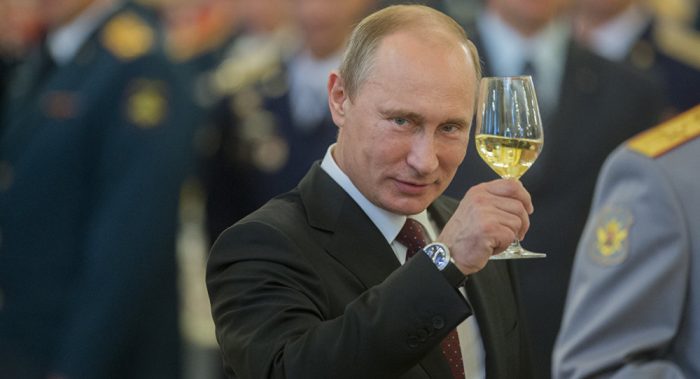
From Soviet comparisons to accusations of authoritarianism, mainstream coverage of Russia’s presidential election has barely changed since 2004, though mentions of the UK spy poisoning scandal did add a fresh layer of insinuation.
As Putin was thanking his supporters for a landslide victory from the stage in Red Square, Western outlets rolled out long, pre-written news stories, liberally mixing reporting and opinion.
“The vote was tainted by widespread reports of ballot-box stuffing and forced voting, but the complaints will likely do little to undermine Putin,” wrote AP’s lead report. “The Russian leader’s popularity remains high despite his suppression of dissent and reproach from the West over Russia’s increasingly aggressive stance in world affairs and alleged interference in the 2016 U.S. election.”
The Washington Post called Sunday’s vote an “elaborate presidential-election-day spectacle” that sought “to legitimize the election,” which “critics described as a charade,” by boosting the turnout as “a lack of suspense or popular opposition candidates threatened to keep people home.”
Calling the election a “hollow exercise,” the New York Times reached for the most predictable of parallels.
“Gone were the Soviet days when there was just one name on the ballot and the winner habitually harvested 99 percent of the vote. The spirit was similar, however, with pictures of Mr. Putin and his campaign slogan, ‘Strong president, strong Russia,’ blanketing the country,” it wrote.
In its top report. CNN said that Putin “seeks tighter grip on power,” while also reminding its readers that “he is already the country’s longest-serving leader since the Soviet dictator Joseph Stalin” (which is not actually true – that would be Leonid Brezhnev). CNN added that Putin is “banking on confrontation with international players this election.”
Rupert Murdoch’s News Corp Australia didn’t even bother with such nuances, calling Putin a straight-up “dictator,” though the article was later amended to merely describe the vote as “inevitable.”
For the Guardian, “paradoxically, the first order of business now… is for Putin to set up an escape plan.”
“Kremlin politics have become a bloodsport,” wrote Andrew Roth, the Guardian’s correspondent for Moscow. “With a shrinking economy [also untrue] and elites manoeuvring before a possible succession battle, the knives are out.”
This year, the usual analysis was also sprinkled with allegations that a Moscow agent poisoned Sergei Skripal with the toxin “Novichok, a gruesome calling card” to provoke a British response, according to the Guardian.
“A row with London can do Putin no harm, especially among voters who share his uncompromising nationalist worldview and his smouldering sense of victimhood,” an article in the Guardian said this week.
“The diplomatic crisis this poisoning case has caused may help him get more people into polling booths,” echoed Australia’s ABC.
Jane Mayer, the New Yorker, and the Art of the Big Russia Lie
David Remnick’s New Yorker, where Masha Gessen is always welcome, is Exhibit A in the Jewish media’s relentless lying about and demonizing of Russia, Putin, and Russiagate.
By Philip Giraldi | Russia Insider | March 15, 2018
The latest salvo in the Russiagate saga is a 15,000 word New Yorker article entitled “Christopher Steele the man behind the Trump dossier: how the ex-spy tried to warn the world about Trump’s ties to Russia” by veteran journalist Jane Mayer. The premise of the piece is clear from the tediously long title, namely that the Steele dossier, which implicated Donald Trump and his associates in a number of high crimes and misdemeanors, is basically accurate in exposing an existential threat posed to our nation by Russia. How does it come to that conclusion? By citing sources that it does not identify whose credibility is alleged to be unimpeachable as well as by including testimony from Steele friends and supporters.
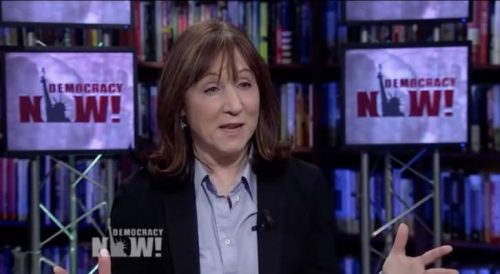
In other words, the Mayer piece is an elaboration of the same “trust me” narrative that has driven the hounding of Russia and Trump from day one. Inevitably, the Trump haters both from the left and the right have jumped on the Mayer piece as confirmation of their own presumptions regarding what has allegedly occurred, when, in reality, Trump might just be more right than wrong when he claims that he has been the victim of a conspiracy by the Establishment to discredit and remove him.
Mayer is a progressive and a long-time critic of Donald Trump. She has written a book denouncing “the Koch brothers’ deep influence on American politics” and co-authored another book with Jill Abramson, formerly Executive Editor of the New York Times. Abramson reportedly carries a small plastic replica of Barack Obama in her purse which she can take out “to take comfort” whenever she is confronted by Donald Trump’s America. Mayer’s New Yorker bio-blurb describes her as a journalist who covers national security, together with politics and culture.
The problem with the type of neo-journalism as practiced by Mayer is that it first comes to a conclusion and then selects the necessary “facts” to support that narrative. When the government does that sort of thing to support, one might suggest, a war against Iraq or even hypothetically speaking Iran, it is called cherry picking. After the facts have been cherry picked they are “stovepiped” up to the policy maker, avoiding along the way any analysts who might demur regarding the product’s veracity. In journalistic terms, the equivalent would perhaps be sending the garbage up directly to a friendly editor, avoiding any fact check.
Mayer tries to take the high road by asserting that the Republicans are “trying to take down the intelligence community.” It is an odd assertion coming from her as she has written a book called “The Dark Side: The Inside Story of How the War on Terror Turned into a War on American Ideals,” a development which was pretty much implemented by the intelligence community working hand-in-hand with Congress and the White House. But she is not the first liberal who has now become a friend of CIA, the FBI and the NSA as a response to the greater threat allegedly posed by Donald Trump.A Steele friend describes the man as a virtual Second Coming of Jesus, for whom “fairness, integrity and truth… trump any ideology.” Former head of MI-6 and Steele boss Sir John Dearlove, who once reported how the intelligence on Iraq had been “sexed-up” and “fixed around the policy” to make the false case for war, describes Steele as “superb.” Other commentary from former American CIA officers is similar in nature. Former CIA Deputy Director John McLaughlin, who himself was involved in lying to support America’s journey into Iraq, similarly sees Steele as honest and credible in his claims, while a former CIA Station Chief in Moscow is called upon to cast aspersions on the “Russian character” that impels them to engage in lies and deception.
My review of the Mayer rebuttal of criticism of Steele revealed a number of instances where she comes to certain conclusions without presenting any real supporting evidence or accepts “proof” that is essentially hearsay because it supports her overall narrative. She asserts that Russia and WikiLeaks were working together on the release of the Democratic National Committee/Hillary Clinton emails without providing any substantiation whatsoever. She surely came to that judgement based on something she was told, but by whom and when?
Another major blooper in the Mayer story relates to how one unnamed “senior Russian official” reported that the Kremlin had blocked the appointment of Mitt Romney, a noted critic of Russia, as secretary of state. How exactly that was implemented is not clear from the Steele reporting and there has been no other independent confirmation of the allegation, but Mayer finds it credible, asserting that “subsequent events could be said to support it.” What events? one might ask, though the national media did not hesitate and instead reported Mayer’s assertion as if it were itself a credible source in a forty-eight hour news cycle frenzy relating to Romney and Trump.
Steele’s work history also raises some questions. He served in Moscow as a first tour officer for MI-6 under diplomatic cover from 1990 to 1993. Russia was in tumult and Mayer describes how “Boris Yeltsin gained ultimate power, and a moment of democratic promise faded as the KGB -now called the FSB-reasserted its influence, oligarchs snapped up state assets, and nationalist political forces began to emerge.” Not to go into too much detail, but Mayer’s description of Russia at that time is dead wrong. Yeltsin was a drunkard and a tool of American and European intervention and manipulation. He was no agent of “democratic promise” and only grew more corrupt as his time in office continued into the completely manipulated election of 1996, when the IMF and U.S. conspired to get him reelected so the looting, a.k.a. “democratization,” could go on. Mayer goes on to depict in negative terms a “shadowy” former “KGB operative” Vladimir Putin who emerged from the chaos.
Mayer also cites a Steele report of April 2016, a “secret investigation [that] involved a survey of Russian interference in the politics of four members of the European Union,” but she neither produces the report itself or the sources used to put it together. The report allegedly concluded that the “Kremlin’s long-term aim …was to boost extremist groups and politicians at the expense of Europe’s liberal democracies. The more immediate goal was to destroy the E.U…” The precis provided by Mayer is a bit of fantasy, it would seem, and is perhaps a reflection of an unhealthy obsession on the part of Steele, if he actually came to that conclusion. As it stands it is hearsay, possibly provided by Steele himself or a friend to Mayer to defend his reputation.Mayer also reports and calls potentially treasonous Steele’s claims that “Kremlin and Trump were politically colluding in the 2016 campaign…’to sow discord and disunity both with the U.S.’ and within the transatlantic alliance.” And also, “[Trump] and his top associates had repeatedly accepted intelligence from the Kremlin on Hillary Clinton and other political rivals.” As Robert Mueller apparently has not developed any information to support such wild claims, it would be interesting to know why Jane Mayer considers them to be credible.
Sweeping judgements by Mayer also include “[Steele’s] allegation that the Kremlin favored Trump in 2016 and was offering his campaign dirt on Hillary has been borne out. So has his claim that the Kremlin and WikiLeaks were working together…” As noted above, the WikiLeaks/Kremlin allegations have not been demonstrated, nor have the claims about Kremlin provision of information to discredit Hillary, who was doing a find job at the time discrediting herself.
The account of Donald Trump performing “perverted sexual acts” in a Moscow hotel is likewise a good example of what is wrong with the article. Four sources are cited as providing details of what took place, but it is conceded that none of them was actually a witness to it. It would be necessary to learn who the sources were beyond vague descriptions, what their actual access to the information was and what their motives were for coming forward might be. One was allegedly a “top-level Russian intelligence officer,” but the others were hotel employees and a Trump associate who had arranged for the travel.
Finally, from an ex-intelligence officer point of view I have some questions about Steele’s sources in Russia. Who are they? If they were MI-6 sources he would not be able to touch them once he left the service and would face severe sanctions under the Official Secrets Act should he even try to do so. There are in addition claims in the Mayer story that Steele did not pay his sources because it would encourage them to fabricate, an argument that could also be made about Steele who was being paid to produce dirt on Trump. So what was the quid pro quo? Intelligence agents work for money, particularly when dealing with a private security firm, and Steele’s claim, if he truly made it, that he has sources that gave him closely held, highly sensitive information in exchange for an occasional lunch in Mayfair rings hollow.
Jane Mayer’s account of the Steele dossier seems to accept quite a lot on faith. It would be interesting to know the extent to which Steele himself or his proxies were the source of much of what she has written. Until we know more about the actual Russian sources and also about Mayer’s own contacts interviewed for the article, her “man behind the Trump dossier” will continue to be something of a mystery and the entire Russiagate saga assumption that Moscow interfered in the 2016 U.S. election must be regarded as still to be demonstrated.
Philip M. Giraldi, Ph.D., is Executive Director of the Council for the National Interest, a 501(c)3 tax deductible educational foundation that seeks a more interests-based U.S. foreign policy in the Middle East. Website is http://www.councilforthenationalinterest.org, address is P.O. Box 2157, Purcellville VA 20134 and its email is inform@cnionline.org.
Featured Video

Death Spikes & Rising Cancer In Our Youth Explained
or go to
Aletho News Archives – Video-Images
From the Archives
Politicians lie
By Mazin Qumsiyeh | Popular Resistance | August 18, 2013
There is no way to say this truth nicely: Politicians lie. That includes Japanese, American, Egyptian, Israeli, and Palestinian politicians! Is there something more common sense than that? Yet, so many citizens around the world believe their own politicians or wistfully acknowledge lies but think it is part of the job needed to run things. They believe even when politicians contradict themselves blatantly. This phenomenon is rather remarkable. It is a dissonance and disconnect from reality that many seem oblivious to. It is very dangerous because it can lead to accepting rationales for going to war. These can be deadly wars that lead to millions of lives lost as happened in what was called World War 1 and WW2. Even when incredible and declassified evidence abound, politicians continue to lie and old mythologies refuse to die. Here are just a few of the countless lies told to us over the past few decades… continue
Blog Roll
 Aletho News
- RSF military group defects, joins Sudanese army: State media
- Ireland goalkeeper refuses to play ‘Israel’ as squad weighs boycott
- China pushes back against US on Cuba, Iran
- Ukrainian Soldiers, Potential Mercenaries: Have Gun, Will Travel!
- Burnham’s UN debut… A masterclass in British disinformation
- Iran flights continue despite US aviation sanctions
- Global Tipping Points Lead the World Into a State of Entropy
- The day-after at the White House: USA and Xi Jinping
- The Geopolitical Balance in the Red Sea: The UAE Being Displaced by New Players
- Iraqi resistance group vows to stage airport sit-ins over Iran aerial blockade
- If Americans Knew
- Deconstructing Netanyahu’s pants-on-fire UN rant – Daily Update
- Trump betrayed voters with his campaign lies and prioritized a foreign country once he took office
- Netanyahu calls Israel’s war in Gaza ‘opposite of genocide’ in UN speech to near-empty hall
- Settler Kidnappings: Torture, Sexual Abuse and Terrorisation of Palestinian Abductees as Israel Deepens Annexation of West Bank
- Gaza winter nears as 162,000 tents become unusable, raising fears of humanitarian crisis
- Netanyahu says, “It’s the opposite of genocide”; UN says Gaza economy is world’s ‘most severe crisis on record’ – Daily Update
- Israel’s US-Backed Assault on Gaza Has Created the ‘World’s Most Severe Economic Crisis on Record’: UN
- ‘Protecting U.S. Citizens’… From Israel
- ‘This is where I live now, the back of a truck’: a day in the life of a grandmother in Gaza
- In UN Speech, Iran’s President Displays Pictures of Children Killed by US, Brings Attention to Israel’s Nuclear Arsenal
- No Tricks Zone
- New Study: Earth And Venus Surface Warmth Largely Explained By Convection And Lapse Rate, Not CO2 Or Radiation
- 2025 Nature Paper Claiming Worsening Global Drought Gets RETRACTED …Heavily Flawed
- New Study: ‘Global Drought Shows No Detectable Recent Acceleration Under Climate Warming’
- Economic Masterminds: German Socialists Suggest Taxing Productivity Gains Stemming From Using AI
- The South China Sea Has Not Been Cooperating With The Climate Change Narrative
- Energy Crisis: Germany Enters Heating Season With Historically Low Gas Reserve Fill Levels
- New Study: The Antarctic Ice Sheet Gained Mass From 2020-2024 Due To Staggering Snow And Ice Accumulation
- Study: Ocean Heating Rates From Thousands Of Years Ago ‘Dwarf’ Modern Ocean Heating Rates
- Climate Extremists Target, Attack Large-Scale Power Grid Infrastructure In Germany!
- New Study: Antarctic Ice Melt Has Contributed Less Than 1 Centimeter To Sea Level Rise In The Last 30 Years

