A collection of essays on Russian-American relations 2015 – 2017 by one of the US’s top Russia experts
Review by Alexander Mercouris | The Duran | November 19, 2017
 One of the most deeply frustrating things for anyone with any knowledge of Russia who has been following the Russiagate saga is the staggering ignorance of basic facts about Russia which is so prevalent amongst elites in the US.
What makes this especially frustrating is that there is actually no shortage of knowledgeable and erudite experts about Russia who could be called upon if any true desire for knowledge about Russia actually existed.
Of those one who who stands out is Gilbert Doctorow, who has been a professional Russia watcher since 1965.
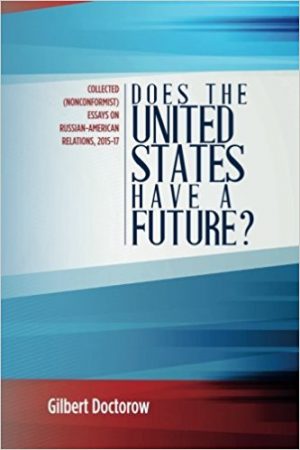
Gilbert Doctorow has now offered us a new book – “Does the United States have a Future” – which brings together his splendid collection of essays about Russia and about Russian-American relations which he has been writing since 2015.
This is of course the same period when in the aftermath of the Ukrainian crisis and because of Russia’s intervention in Syria Russian-American relations entered upon their present catastrophic downward spiral, with the US rolling out successive sanctions against Russia, and deploying ever greater numbers of its troops ever closer to Russia’s border.
In this heavy atmosphere of heightened Russian-US tensions, and amidst a shrill media campaign, the Russian side of the story rarely gets told. What we get instead is an exaggerated focus on the largely misunderstood doings of one man – Vladimir Putin – who is not just routinely blamed for everything that goes wrong – be it Trump’s election, the Brexit vote, the 2015 European refugee crisis, the secessionist outbreak in Catalonia and the rise in Germany of the AfD – but who has become dangerously conflated with Russia itself.
The huge achievement of Gilbert Doctorow’s essays is that they put entirely behind them this disastrous paradigm.
For someone fixated on psychoanalysing Putin’s personality and on learning the gossip about the internal squabbles of the Kremlin this collection of essays has little to offer. Doctorow has as little patience for this sort of thing as do I. Suffice to say that one of the essays, which goes by the dismissive title “Kremlinology is alive and well in Russia”, turns out to be focused not on mythical Kremlin power struggles but on the impact on the people of St. Petersburg of a visit by Putin to their city.
For anyone interested in Putin what anyone reading these essays will get instead is detailed and erudite analyses of his speeches, of his massive and truly astonishing Q&A sessions, of his media interviews, and of the effect of all these doings on Russian public opinion and what they tell us about Russian policy.
Not by chance, the only reference to me in the whole collection is when Doctorow disagrees with me about an interview Putin gave to the German newspaper Bild-Zeitung. I gave the German interviewers high marks for their conduct of the interview. Doctorow politely expresses his incredulity.
Ultimately far more interesting to anyone genuinely interested in understanding the rapidly recovering Great Power which is Russia, and who wants to get a genuine grasp of the sort of things that move its people, are those essays which touch on topics other Western reporters of Russia tend to ignore.
Here Doctorow’s immense knowledge of Russia and of Russian history is essential, and it shines through every essay.
Thus we find masterful discussions of works about tsarist history by the historian Dominic Lieven, and an outstanding discussion – the best I have come across – of Henry Kissinger’s insights and limitations as they concern Russia. There is even a remarkable essay which takes Tolstoy’s novel Anna Karenina as a starting point to discuss war.
However the single thing which sets the essays which are specifically about Russia apart is the extraordinary rapport Gilbert Doctorow has with Russia’s ‘everyman’. Take a comment like this one from the very first page of the very first essay in the book, which is dated 30th May 2015. Against a background of a deepening recession Gilbert Doctorow tells us this
I say assuredly that the mood across the social spectrum of my “sources” is uniformly patriotic and uncomplaining. These sources range from the usually outspoken taxi drivers; through the traditionally critical journalists, academics, artists and other intelligentsia who are family friends going back many years, to former business contacts and other elites.
How many of those who report from Russia are able to speak to a wide range of contacts like this? How many of them pay heed to the opinions of Russia’s “usually outspoken taxi drivers”, reliable purveyors of the public mood though those people are? How many of those who report from Russia even know how to talk to such people? (confession here: I don’t).
Or take Gilbert Doctorow’s deeply moving account from 10th May 2016 of the March of the Immortal Regiment, held now every year on 9th May to commemorate Russia’s sacrifice in the Second World War. What other Western reporter of Russia has both the erudition and the common touch necessary to write a passage like this?
Given the manifestly patriotic nature of Victory in Europe Day celebrations, which open in Moscow and cities across Russia with military parades, precise marching columns, displays of military hardware on the ground and in the air, I was uncertain how possibly strident the Immortal Regiment component might be. As it turned out, the crowd was uniformly good humoured and focused on its private obligations to be met: the celebration of parents, grandparents, even great grandparents’ role in the war and reconfirmation of their status as family heroes whatever their military or civil defence rank, whether they survived or were among the countless fatalities.
Elsewhere Gilbert Doctorow is able to talk knowledgeably in two different essays about the state of the Russian shopping basket – a matter of fundamental importance to Russians and therefore given Russia’s power and importance to everyone – of Russian responses to the Trump-Clinton debate, of the Russian public’s response to one of Putin’s mammoth annual Q&A sessions, and of the steely response – utterly free of sentimentality and hysteria – of the people of St. Petersburg and of Russia generally to a terrorist attack on the city.
Of the essays specifically about Russia it is however what Doctorow writes about the Russian media which Western readers may find most surprising.
It is now generally conceded even in the West that Russia does have a public opinion, something which tended not to be admitted in Soviet times, though there still seems to be little genuine interest in finding out what it is.
The lazy assumption is anyway that in Russia public opinion is effectively manipulated by the government through its supposedly all-encompassing control of the news media.
Though it is sometimes grudgingly admitted that the print media does have some independent voices, and that the Russian media now has a degree of sophistication unknown in Soviet times, the prevailing opinion in the West is that it remains every bit as propagandistic and mendacious as it was in Soviet times. The classic statement of this view is Peter Pomorantsev’s “Nothing is True and Everything is Possible: Adventures in Modern Russia”.
Doctorow’s essays are an important corrective to this bleak and distorted picture.
Doctorow does not sugarcoat the reality. He concedes that the television media has a bias favouring the Kremlin and that ‘non-system’ politicians whose parties are not represented in the Duma like Kasyanov and Navalny have difficulty gaining access to it.
I would say in passing that Russia’s television media is not exceptional in this. In my opinion Russian television today is much less controlled by the government than was French television during Charles De Gaulle’s and Georges Pompidou’s time in France, when I was in Paris as a child.
In any event, as a regular participant in Russia’s extraordinarily extended and elaborate political talk-shows – a vital and massively popular information tool for the Russian population – Doctorow shows that the common Western view that Russian television viewers get no exposure to the Western view-point and hear only the Kremlin’s view is simply wrong. Here is one passage where Doctorow describes them
The regulars of these talk shows are a mix of Russians and foreigners, pro-Kremlin and anti-Kremlin voices. There inevitably is at least one American who can be counted on to purvey the Washington Narrative. A reliable regular in this category has been Michael Bohm, who was for a long-time op-ed manager at The Moscow Times and now is said to be teaching journalism in Moscow….
From among Russians, the talk show hosts bring in one or more representative of opposition parties. On the 11th it happened to be a personality from the Yabloko Party (Liberals). But at other times there will be the leader of the Communist Party, Gennady Zyuganov, the founder of the right nationalist LDPR, Vladimir Zhirinovsky, or the leader of the social democratic party, Just Russia, Sergei Mironov. They all get their time on air in these shows.
Elsewhere Doctorow gives vivid accounts of these sprawling and at times chaotic talk shows, which have no precise analogue anywhere else that I know of.
Doctorow’s book, as its title shows, is not only about Russia. Rather it is about the collapse of any sort of dialogue based on mutual respect and understanding between the US and Russia.
In essay after essay Doctorow pinpoints the cause: at a time when the Russian mind is becoming increasingly open, the American mind is becoming increasingly closed.
The title of the book – “Does the United States have a future?” – is in fact an intentional exercise in reverse imaging.
At its simplest it refers back to Doctorow’s previous book: “Does Russia have a future?” published in 2015.
However the title of both books must also be seen as a comment on the ‘disaster literature’ about Russia which has become so prevalent in the West, and which continues unabated to this day even as it is repeatedly proved wrong.
Basically what Doctorow is saying is that it is in the US not Russia that the suppression of debate and independent voices is putting the future in jeopardy.
It is in these essays that look at the situation in the US where Doctorow dissects the evolution or rather regression of US policy towards an increasingly strident Russophobia, and where one senses Doctorow’s growing exasperation and alarm.
Take for example what Doctorow has to say about one of the most outspoken Americans calling for ever more confrontation with Russia: NATO’s former military chief General Breedlove
Most everything is wrong with what Breedlove tells us in his article. It is a perfect illustration of the consequences of the monopoly control of our media and both Houses of Congress by the ideologists of the Neoconservative and Liberal Interventionist school: we see a stunning lack of rigour in argumentation in Breedlove’s article coming from the absence of debate and his talking only to yes men.
Perhaps the biggest mistakes are conceptual: urging military means to resolve what are fundamentally political issues over the proper place of Russia in the European and global security architecture. Whereas for Clausewitz war was ‘a continuation of politics by other means’, for Breedlove politics, or diplomacy, do not exist, only war.
The alarm in the last paragraph finds still greater emphasis in the essay which immediately precedes it. This has the ominous title “The Nuclear Clock is at Two Minutes to Midnight”.
It is however in the closing of the American mind where Doctorow pinpoints the danger
My point is not to ridicule the very earnest and well-intentioned anti-war campaigners whose ranks I joined that day. It is to demonstrate how and why the highly tendentious reporting of what we are doing in the world and what others are doing to us, combined with the selective news blackouts altogether by major media has left even activists unaware of real threats to peace and to our very survival that American foreign policy has created over the past 20 years and is projected to create into the indefinite future if the public does not awaken from its slumber and demand to be informed by experts of countervailing views. We are living through a situation unparalleled in our history as a nation where the issues of war and peace are not being debated in public.
Along with the alarm and frustration there is also very real disappointment.
Like most people who lived through the later stages of the Cold War Doctorow remembers a world where the US’s European allies acted as a force of restraint on the US.
Based now in Brussels at the very epicentre of the European Union Doctorow is shocked at the extent to which this is no longer the case, and at the degree to which the same attitudes of hubris, belligerence and hysteria which have gained such a hold in the US have now also managed to gain a hold in Europe.
Like many others Doctorow is totally unimpressed by the current crop of European politicians, and as someone able to remember the likes of Charles De Gaulle and Helmut Schmidt Doctorow does not balk from expressing his scorn in withering terms. A good example is to be found in the title of one of his essays: “News flash: Europe is brain dead and on the drip”.
It is in his discussions of Europe that Doctorow allows himself his brief flashes of anger. Take these comments he makes about Elmar Brok, the truly dreadful chairman of the European Parliament’s Committee on Foreign Affairs
I remember with a shudder an exchange I had with Elmar Brok on 5 March 2015 on The Network, a debate program of Euronews. Brok, a German, is the chairman of the European Parliament’s Committee on Foreign Affairs. He comes from Angela Merkel’s CDU party and within the Parliament is in the European People’s Party bloc, on the center right, the bloc which really calls the shots in the EP.
Brok is big, brash and does not hesitate to throw his weight around, especially when talking with someone outside the Establishment whom he has no reason to fear. We were discussing the shooting of Boris Nemtsov, which occurred just days before. Brok insisted the murder was the responsibility of Vladimir Putin. Not that Putin pulled the trigger, but he created the atmosphere where such things could happen, etc., etc. One way or another the talk shifted to the allegedly autocratic nature of the Putin ‘regime,’ with its crackdown on freedoms, and in particular ever tightening control of media.
At that point, I objected that the Russia media were very diverse editorially, with many different points of view expressed freely. Brok shot back that this was patently untrue, and he did not hesitate to cross all red lines and indulge in libel on air by asking how much the Kremlin paid me to say that.
Apart from the obvious truth that an authoritarian like MEP Brok would not know freedom of speech if he tripped on it, I think back to that exchange every week whenever I turn on Russian state television and watch one or another of the main political talk shows.
Doctorow’s strongest feelings of disappointment however remain firmly focused on the US.
Doctorow’s essays show that like many people he entertained very cautiously worded hopes about Donald Trump.
Hillary Clinton after all was the self-styled ‘war candidate’ and the preferred choice of the Neocons, whilst Trump at least spoke of the need for better relations with Russia.
Not for nothing is one of Doctorow’s essays entitled “War or Peace: the essential question before American voters on November 8th”.
Doctorow’s hopes were never very high and like many others he was appalled by the conduct of the 2016 election, which he calls disgraceful. His essays which follow Trump’s election victory show the speed of his disillusionment. Not only has Trump proved completely incapable of fulfilling any of Doctorow’s hopes; he seems to have no idea of how to conduct foreign relations, and is rapidly reverting to the aggressive belligerence which is now the default position of all US Presidents.
In the meantime his election has heightened partisan tensions within the US to unheard of levels.
In his final chapter, which has the same title – “Does the United States have a future?” – as the whole book, Doctorow sets out the consequences.
A US which twenty years ago bestrode the world is now incapable of governing itself, whilst its increasingly reckless conduct is spreading conflict and alarm around the world.
Not only has trust in “American leadership” as a result all but collapsed but the two other Great Powers – Russia and China – have been completely alienated, and are busy forging an alliance whose combined resources will soon dwarf those of the US.
About all that the US however remains in denial, as it is about the world crisis its actions are generating. In a political system where all dissenting opinions are excluded it cannot by definition be otherwise. Thus the US looks set to continue on its present ruinous course, with no ability to change direction
…. a still greater threat to our democracy and to the sustainability of our great power status has come from the inverse phenomenon, namely the truly bipartisan management of foreign policy in Congress. The Republican and Democratic Party leaderships have maintained strict discipline in promotion of what are Neoconservative and Liberal Interventionist positions on every issue placed before Congress. Committees on security and foreign affairs invite to testify before them only those experts who can be counted upon to support the official Washington narrative. Debate on the floor of the houses is nonexistent. And the votes are so lopsided as to be shocking, none more so than the votes in August on the “Countering America’s Adversaries through Sanctions Act”….
It would be comforting if the problems of our political culture began and ended with the elites operating in Washington DC. However that is patently not the case. The problem exists across the country in the form of a stifling conformism, or groupthink that is destroying the open marketplace for ideas essential for any vital democracy.
I recognise the accuracy of this picture and am prey to no illusion. However in my opinion it is still too early to give up hope.
Trump’s victory, if it shows nothing else, shows that there is more resistance to the ‘groupthink’ in the US than Doctorow in these passages perhaps allows. What is the Russiagate hysteria after all if not the expression of a collective nervous breakdown on the part of the US elite at the discovery that the American people as a whole do not share their obsessions?
A state of hysteria of the sort we are going through now cannot be sustained indefinitely. Eventually a reaction will set in, at which point those at the forefront in spreading the hysteria will be exposed as the charlatans that they are, whilst many of those they fooled will feel ashamed.
When that point comes it is good to know from this outstanding collection of essays that there are still genuine experts available that the US can call upon to guide its policies like Gilbert Doctorow.
The Ghost of Hillary
By Nick Pemberton | CounterPunch | March 23, 2018
The Ghost of Hillary Clinton still haunts the minds of many Americans. She is paraded around America like a fallen angel. A Washington Post article as recent as March 14th stated: “America Needs Hillary More Than Ever”. The investigation into Russia collusion drags on a year and a half after Donald Trump’s victory. Earlier this month Hillary was still making excuses for why she lost. The latest one: she had two-thirds of the GDP on her side: “But what the map doesn’t show you is that I won the places that represent two-thirds of America’s gross domestic product. So I won the places that are optimistic, diverse, dynamic, moving forward”. Even Hillary is usually more skilled at hiding her class bias.
This was one of Hillary’s more telling quotes. She believes the rich are dynamic and forward thinking and that the poor are not. She believes that to be poor is to be backward and ignorant. She believes that only angry white dudes are poor and she doesn’t even give a thought to anyone else. She believes that the smart and worthy people are for her and that the losers are not. And of course she believes that there is something inherently wrong with an election that is decided by poor people. The rich are also according to Hillary, more “optimistic.” No shit. Who could possibly be “optimistic” about the state of America right now besides the rich?
To be fair, Hillary is not the only one obsessed with Hillary. Trump and Fox News spread mad and sexist conspiracies about her. And who could blame Hillary for being obsessed with herself? Imagine waking up tomorrow as Hillary Clinton. Could anything be stranger?!
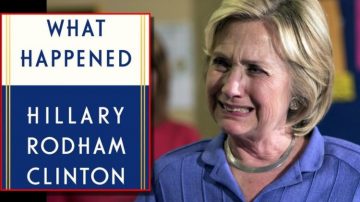 I told myself that I wasn’t going to read What Happened. Despite my obsession with Hillary Clinton, even I had my fair share by the end of the 2016 election. Yet I almost tripped over it in the library, laying out on a cart, castaway, begging to be read. My first response was, as always with Hillary, “won’t you just go away?” But there was something that beckoned me back into her arms. Hillary, as captivating as she is awkward, wooed me back.
I am far from the only man obsessed with Hillary. But what kind of man am I? Am I the bitter Bernie Bro who pours minutely over each detail of the DNC’s corruption? Am I the deplorable Trumper who sees Hillary lurking behind every conspiracy of liberalism on Fox News? Or am I the sanctimonious liberal man who bends over backwards to prove that he is a feminist through his Hillary fetish? This kind of man is so acutely portrayed in Get Out. The liberal suburban Dad proudly tells the black man he is about to slice up that he “would have voted for Obama a third time.”
Yet I wonder if there is a fourth type of man obsessed with Hillary. Someone who finds the entire political scene so farcical that he can’t help but be drawn in by somebody who is so uniquely dishonest, entitled, and oblivious.
There was always a certain bond that I felt with Hillary’s mangled soul. She is just so out of touch with most people. She needed translators to relate to the everyday American, and her translators weren’t that good either. She couldn’t walk into a room, as her husband did, and adapt to the sheer absurdity of the human mind, let alone the American mind. If she did not find her own mind to be so far above what she couldn’t understand maybe she would have won. With that thought, I jumped in.
The book felt hectic, but not in the Virginia Woolf stream-of-consciousness sense. There is something quite dulling about all of Hillary’s anecdotes. She has been in the political machine for far too long. She seems to be frozen in platitudes of what should be. Her mind is not free, it is trapped inside someone who works too hard and feels too little. She feels the need to attack all dissenters. In the first few pages she gushes over her phone call from “George” (yes, George W. Bush). She seems to be just fine with anyone more rightwing than her, for it leaves her room to shimmy to their side, always the willing (and superior) partner in crimes against humanity. Anyone more left than Hillary must be crazy, for that side has already been taken up by Hers truly.
Before every chapter there is some sort of self-help quote from a famous person. Hillary has the blasphemy to begin the book with a quote from “super-predator” Harriet Tubman (she goes on to celebrate Harriet’s face on the 20$ bill. If Hillary ever had to touch a 20 she might not have been so complementary). Hillary’s book fits in with the therapy driven, pill popping self-love narratives that has ascendancy over liberal circles. Compassion for mental illness is important (although not for the mental illness that brings slavery to Haiti and Libya). But the overall craze with self-loving fits with the capitalist notion that mental health is indeed a problem to be blamed on the individual, and if only they could be a little more selfish they would be happier. This self-love narrative doesn’t acknowledge that the happiest regions in the world are the ones with the strongest communities and the least inequality.
About every self-help quote has something to do with “it doesn’t matter if you lose, it matters that you keep going.” The first assumption here is that because Hillary lost, we all lost. Why again should we feel that Hillary Clinton’s loss was our loss? Wasn’t she the second most unpopular candidate ever? There is an assumption throughout the book that Hillary represented all that is good about the new liberal order. How many people is this order helping? And to the extent that it does work, can you name one way in which the Clintons have helped, rather than betrayed the very principles of a liberal society? The second assumption that Hillary makes is that nobody should look at the outcomes of an event that surprised them. Instead they should just double down on what they already thought. Hillary’s world is the entire world and no event—not even losing a Presidential election to Donald Trump?!!! should result in any sort of curiosity or reflection. The answer to all problems in America and in HillaryLand is work harder and don’t look anywhere you aren’t supposed to.
The other problem for the Clintons in this book is how much their brand is stuck in the 90s. They are a show about nothing without the humor or self-awareness. The 60s brought idealism through thriving social movements. Following their defeat it was cynicism and Nixon that rose from the ashes. Cynicism was then institutionalized through Reagan and the 80s with a full on embrace of individualism and neoliberalism. What followed was the Clintons, who rebranded the Democratic Party as a place for liberal individuals rather than collective society. Follow this with a win for the common man George W., a celebration of individual simpleness as collective identity. Hope for a smarter (but not a more collective) world came through Barack Obama, and predictably hope fell flat on its face despite Obama’s popularity. Hillary Clinton then tried to make a cheery reboot of her 90s family sitcom, but talking about nothing no longer was appealing. Talking about something, some doom for us all, was the pulse of the times and Donald Trump fit perfectly. Proud of lying, bullying and destruction, the end times had come for us. Born again Christians rejoice and free market liberals rebuke. Hillary still can’t believe Trump won but it was ultimately her ideology that won out. Rich individuals matter, society does not.
The Clintons are as sloppy as they are shameless. The fact that they thought they deserved another chance showed how much they took the American people, especially the left, for granted. To write a tale of victimhood assumes that none of us remembered the Clintons or if we did, that they deserved to get away with it. It is true that women and men are held to different standards in our society. But the complaint by Hillary is that she couldn’t get away with criminality, corruption and cruelty. How bold a claim it is to act like you deserve to get away with such things! Imagine even if a less prolific gangster, such as Al Capone, was half as indignant about his crimes! This is why What Happened, once you get past the ridiculousness of it, is a potentially engrossing read.
There was something strangely satisfying about Hillary bashing Bernie Sanders in this book. I am not sure which side of the Left brain it appealed to—that of masochism or that of martyrdom. There was just something so false and small about that old man. He at the end of the day got what he was looking for—a seat at the table of the Democratic Party.
As for Russia, everything got really personal in this book. it was like all of us were at the mercy of grudges between royal figures. Putin hates me, I hate Putin, let’s go to war and you can cheer for me! The media too has taken Putin’s “attack on American democracy” quite personally. It is after all, their democracy that Putin messed with. Only the American corporate media can decide what we think, no outside propaganda allowed! Hillary also throws in that America was doing better than any other major country.
Another favorite moment of the book was when an older woman dragged her younger daughter over to Hillary to confess that she didn’t vote. The younger woman bowed her head before the pulpit and apologized for her sin. Hillary complained about forgiving this woman, acting as if one “lazy millennial” had more to do with her own loss than she did. Want to know why younger people aren’t voting? This is why.
The first couple of chapters are rather slow as Hillary tries to pretend like she has a personal life and a soul. Hillary informs us that she asked her father if he would still love her even if she murdered someone. Maybe he should have said no…. It gets even more tiresome when she raves about the Clinton Foundation. Then there are the details of her campaign staff and their analytics. I must admit that I skipped this part. Maybe Trump had spoiled me, but I wanted the dirt!
It takes a while to get going. The book is filled with pop culture references and cute anecdotes that are dated, overused and uninspiring. Hillary desperately shoves her humanity on top of us and it is hard to believe it. There are so many quaint stories that happen to “ordinary” people in this book. Including to Hillary herself. What she ate, what she wore, who she went on a walk with. Lots of “jokes” and “moments” that helped to get her through the day. Aren’t these things that come naturally to human beings? Do they have to be so forced?
I came to the next chapter: “A Day In The Life”. Get me out of here! Finally, the section on “Sisterhood”. I can’t believe I am saying this, but I miss Elitist Hillary! Everyday Hillary is way too folksy. There are three chapters devoted to “Sisterhood”. In Hillary’s world there are two sides: those who are with men and those who are with Her. Hillary, Establishment Democrats and even Establishment Republicans are on the side of women. Anyone outside of this establishment—whether they be Trump voters (in Hillary’s mind, poor people, evil men and acquiescent women) or Bernie voters (idealistic privileged men) are the enemy of Hillary, and therefore the enemy of women.
What is truly odd about Hillary is that she sees feminism in the establishment and sexism as an outside force that come from the unenlightened masses. This is consistent with her aggressive use of the police state and military-industrial complex. She views these patriarchal forms of control as civilizing forces for predatory men and their victims. What war does to women is irrelevant. What prison does to women is irrelevant. What cutting welfare does to women is irrelevant. What widening inequality does to women is irrelevant. Distrust the masses and trust the powerful is Hillary’s mantra.
There may also be truth in that Hillary’s strategy of lying, stealing, and yes, even marrying, to the top of our capitalist patriarchal society produced better results for her. As sad as this may be, such a strategy of global pillage should be denounced as not worth whatever Hillary thinks she symbolizes. Hillary’s book did feature some nice statements on women’s leadership, and hopefully it encourages more women to get involved in politics. Having no beliefs other than narcissism though, Hillary again stuck to empty and vague maxims in this section.
I had to stop. I was going mad. This was such a long road and it meant nothing. The lies weren’t even interesting anymore. She wasn’t trying to convince me, she was trying to fatigue me. I knew slightly more fruitful ground was ahead. I wanted to see her rail against Russia and Bernie. The index indicated her “Grievances” would go on for several hundred pages. I wanted to see the “real” Hillary. I wanted to see her express her real believes and real emotions. But I had to skim, and soon after I had to close the book. I saw my life ticking away as I became increasingly engrossed by the petty grievances of one of the most sinister people in the world. I was, if anything, more confused now than I had ever been. But far too worn down to keep going. I anticipated reading the whole book but I could barely get through the first couple chapters. This was a painful, painful read. Don’t try it. If you think you want to read this book, just run away.
This book is awful. Not especially because of the politics it embraces, which are obviously horrendous. Rather it is the attitude of a politician so distant from reality, so distant from what it means to be alive, that she has to construct it entirely from her partner’s notes. She says she doesn’t want to be like Ms. Havisham from Great Expectations but this is exactly who she is. She is a ghost, stuck in a moment in time, unable to make any sense of it. 70 years of denying the existence of a world with struggle and dignity has left her incapable of accepting reality. She hires advisors to give excuses, she hires writers to construct a life, and she hires think tanks to run the government.
For Hillary the world will go on through the ever improving free market, where all victories are natural and all losses are inexplicable. It is from America, the most rude and selfish place in the world, where democracy shines. As for the people, they just haven’t quite caught up to this hip lady with the pantsuits and techies. Have these Trump people even been to Chipotle, she wonders.
What is this world? Who are you, Hillary Clinton? Even the way she explained yoga was so exhausting. She acted like it was some slick American innovation that was best applied for the overbooked. I don’t know, gosh, who cares. But there was just something so frustrating about Hillary’s zombie-like quest in this book. Eat the enemy. Learn human. Using google translate.
Where was I? Where had Hillary taken me? Life began slipping away, I was trapped within a white picket fence. I would be driving a mini van to see small children play soccer games. I would engage in humanitarian projects to remind myself the world was there. I would be happily married—somehow both owning and respecting my wife and 3 children. I would be endlessly busy, stressed, and exhausted. Occasionally I would take a moment to say “isn’t life just great.” I would have a few cute quirks that we could all laugh about, as I was a character in this act too. I would be the uncivilized man needing to be civilized, and no matter how far I might stray, they would assure me “you’ll come back” and indeed, I would. I saw each benchmark of a successful life pass by, and each time, I would tell myself “life was not wasted.” I would lose touch with all those but the most persistent, not really liking any of my friends, but liking to gossip about them. I would turn on CNN, listen to the experts, vote for a centrist Democrat who talked about getting along, donate to the charity of my choice, scold somebody, but no one in particular, feel good about myself, become utterly bored, pick up another hobby that did nothing for anybody, I would become stressed, I would go to Starbucks, I would figure out the best ways to “manage” such a balanced life between work and family and projects, and I would do my best to civilize the world in my image. I would grow more conservative with age, more cross with those younger than me, more trusting in authority, and more cynical about government. I would one day get cancer, be covered by ObamaCare, thank God for the Democrats, beat it once, have a small thought that my whole life was a sham, but soon go back to routine. I would then one day die, in the middle of the night, and those of my creed would regard me as a “good man” and a “happy man” and I would be buried next to my loving wife, who was really the pillar of the family, and the mystery would remain, how on earth did Donald Trump beat Hillary Clinton?
By the end of the book I scratched my head and concluded that none of it really mattered. The whole event of the 2016 election and its dramatic reveal through this book seemed to just be based in petty details, meanness and elitism. Naturally, Donald Trump, the most petty, the most mean and the most elite of the crop won the cake. Actually, Hillary Clinton, losing the 2016 election is the most decent thing you have ever done.
What began a couple hours ago as intrigue ended in a woozy haze. I wasn’t asking What Happened I was asking What Just Happened? This was a tedious expedition. I was hoping for Desperate Housewives but I got Gone Girl meets Gilmore Girls. This was a brutal cocktail of sensationalized victimhood and mind numbing anecdotes. There were some slightly more wild sucker punches in the later chapters but I couldn’t appreciate many of them. As bad as Hillary is at being a politician, she is much worse at being a human being.
Naturally I had to turn to Russian born singer Regina Spektor and her song “Ghost Of Corporate Future” to get my sanity back. She sings over an overflowing piano rhythm:
And people make you nervous
You’d think the world was ending
And everybody’s features have somehow started blending
And everything is plastic
And everyone’s sarcastic
And all your food is frozen
It needs to be defrosted
You’d think the world was ending
You’d think the world was ending
You’d think the world was ending right now
Hillary is indeed the ghost of a corporate future. When she was running for President it was very reasonable to ask: is she alive? She is so cynical, so fake, and so out of touch. She has built her fences and her causes and has hid behind them.
Now she is a different sort of ghost. She remains stuck in a moment in time. We are reminded of her far too often. When she lost we lost “democracy” and gained “fascism.” Hillary’s death was the death of America. The greatest country on earth had fallen. Hillary haunts our imaginations. She deludes our memory. What would have happened if she had won?
Look no further than this quote about nuclear weapons during the Presidential debate: “The bottom line on nuclear weapons is: when the President gives the order it must be followed… that’s why ten people who have had that awesome responsibility have come out and said they would not trust Donald Trump with the nuclear codes.”
A person so distant from reality naturally lives in deep paranoia. Hillary is deeply fearful of the poor, blacks, young women, and foreign foes. When she said that a nuclear order “must be obeyed” she was implying that she was entitled to give such an order. She was right to criticize Donald Trump’s judgement but may I ask when is the right time to blow up the entire world? One who is level headed about such a possibility is much more frightening than a madman like Trump.
As Secretary of State Hillary was reckless. Given the current climate in Syria (no thanks to her nemesis Vladimir), what would a no-fly zone have meant? What would it have mattered to Hillary? If she didn’t understand Wisconsin, what makes us think she would have understood Syria? A hot nuclear war would have been one way to defrost Hillary’s frozen food and warm her cold hands. We all may have been ghosts of Hillary’s corporate future if the White Pantsuit had descended upon us. Now that she can’t take our bodies, she settles for our souls.
Nick Pemberton is a student at Gustavus Adolphus College. He is currently employed by Gustavus Dining Services. Nick was born and raised in St. Paul, Minnesota. He can be reached at pemberton.nick@gmail.com
Why Berezovsky’s Death in Britain Leaves More Questions Than Answers

© Sputnik/ Sergey Subbotin
Sputnik – March 23, 2108
Exactly five years ago, fugitive Russian oligarch Boris Berezovsky was found hanged in his ex-wife Galina’s house in Ascot, Great Britain. Although it is widely believed that the tycoon committed suicide, a British coroner recorded an open verdict in March 2014, saying he could not be absolutely sure that Berezovsky killed himself.
Berezovsky’s apparent suicide became yet another case in a chain of “inexplicable” deaths on British soil that the country’s authorities are not rushing to re-investigate, keeping them top secret.
“You keep everything classified, we [Russia] still do not have access to these materials,” Russian Ambassador to the UK Alexander Yakovenko said, addressing a press-conference, March 22, in London. “My question is why does it happen? Apparently, someone is trying to hide some data not only from us but also from the British public.”
Referring to deaths of ex-intelligence agent Alexander Litvinenko, businessman Alexander Perepelichny and ex-deputy director of Aeroflot Nikolay Glushkov, Yakovenko emphasized that all inquiries in these cases were classified, while Moscow’s questions pertaining to the investigations still remain unanswered.”In this country [the UK], the people who were linked to secret services — and we know that Litvinenko worked for the British intelligence services, Berezovsky also cooperated with secret services, I do not know whether Perepelichny was an agent, and we still have to understand the situation around Glushkov — they all died, and investigations, information, and documents [related to the cases] remain classified,” the Russian ambassador stressed.
On March 23, 2013 Berezovsky, 67, was found dead on the floor of a locked bathroom with a piece of his black scarf around his neck.
It was reported that the tycoon suffered from depression after being defeated in a court battle over the Sibneft oil group by Russian billionaire Roman Abramovich in 2012. Besides losing the multi-billion dollar claim, the fugitive oligarch had to pay Abramovich’s legal costs, which amounted to 35 million pounds ($49,452,900).
Berezovsky’s bodyguard Avi Navama, an Israeli former special forces soldier, recalled that following the resounding defeat, his boss was completely broken and called himself “the poorest man in the world.”A post mortem examination of the body indicated that Berezovsky’s death was consistent with hanging, while no signs of violent struggle were found.
However, in 2014, German forensic scientist Professor Bern Brinkmann, who was hired by members of the tycoon’s family, concluded that Boris Berezovsky had been strangled to death after carrying out thorough examination of the autopsy data.
Having assessed conflicting evidence on the oligarch’s death, UK Coroner Peter Bedford stated on March 28, 2014 that it was “unclear” how Berezovsky died.
“I am not saying that he took his own life, I’m not saying he was unlawfully killed, the burden of proof sets such a high standard that it is impossible for me to say. The evidence I have before me does not fully disclose the means by which Mr. Berezovsky’s death arose,” Bedford said, as quoted by The Telegraph.
Meanwhile, in March 2013 Kremlin spokesperson Dmitry Peskov revealed that two months before his death, the oligarch sent a letter to Russian President Vladimir Putin in which Berezovsky asked for forgiveness for his gross mistakes and sought Putin’s permission to return to Russia.However, some Western mainstream media outlets jumped at the opportunity to point the finger of blame at Russia, claiming that the Kremlin had initiated the murder of the magnate, who was known for his support for anti-Russia’s forces in the post-Soviet space in the early 2000s.
Berezovsky’s projects were funded through the International Foundation for Civil Liberties, which he founded in 2000 in New York City. However, after his 2012 defeat in British court, the oligarch halted all his “humanitarian” initiatives.
Speaking to Sputnik, the tycoon’s lawyer Anatoly Borovikov denied the claim that Moscow could have had a hand in Berezovsky’s death. Although Borovikov doubts that his former client was killed, he pointed out that nothing indicated that the magnate would commit suicide.
“When Boris Abramovich [Berezovsky] talked to me, he did not seem to be in a suicidal mood. It was impossible to imagine that he would take his own life,” the lawyer recalled.
Berezovsky had been living in Great Britain since 2000 in a self-imposed exile due to charges of fraud, and abuse of office against him in Russia. It is believed that he left his estate more than 300 million pounds ($424,491,000) in debt when he died.
Facebook Scandal Blows Away ‘Russiagate’
By Finian CUNNINGHAM | Startegic Culture Foundation | 23.03.2018
Now, at last, a real “election influence” scandal – and, laughably, it’s got nothing to do with Russia. The protagonists are none other than the “all-American” US social media giant Facebook and a British data consultancy firm with the academic-sounding name Cambridge Analytica.
Facebook’s chief executive Mark Zuckerberg is being called upon by British and European parliamentarians to explain his company’s role in a data-mining scandal in which up to 50 million users of the social media platform appear to have had their private information exploited for electioneering purposes.
Exploited, that is, without their consent or knowledge. Facebook is being investigated by US federal authorities for alleged breach of privacy and, possibly, electoral laws. Meanwhile, Cambridge Analytica looks less an academic outfit and more like a cheap marketing scam.
Zuckerberg has professed “shock” that his company may have unwittingly been involved in betraying the privacy of its users. Some two billion people worldwide are estimated to use the social media networking site to share personal data, photos, family news and so on, with “friends”.
Now it transpires that at least one firm, London-based Cambridge Analytica, ran a profitable business by harvesting the publicly available data on Facebook for electioneering purposes for which it was contracted to do. The harvested information was then used to help target election campaigning.
Cambridge Analytica was reportedly contracted by the Trump campaign for the 2016 presidential election. It was also used during the Brexit referendum campaign in 2016 when Britons voted to leave the European Union.
This week the British news outlet Channel 4 broadcast a stunning investigation in which chief executives at Cambridge Analytica were filmed secretly boasting about how their firm helped win the US presidential election for Donald Trump.
More criminally, the data company boss, Alexander Nix, also revealed that they were prepared to gather information which could be used for blackmailing and bribing politicians, including with the use of online sex traps.
The repercussions from the scandal have been torrid. Following the Channel 4 broadcast, Cambridge Analytica has suspended its chief executive pending further investigation. British authorities have sought a warrant to search the company’s computer servers.
Moreover, Zuckerberg’s Facebook has seen $50 billion wiped of its stock value in a matter of days. What is at issue is the loss of confidence among its ordinary citizen-users about how their personal data is vulnerable to third party exploitation without their consent.
Cambridge Analytica is just the tip of an iceberg. The issue has raised concerns that other third parties, including criminal identity-theft gangs, are also mining Facebook as a mammoth marketing resource. A resource that is free to exploit because of the way that ordinary users willingly publish their personal profiles.
The open, seemingly innocent nature of Facebook connecting millions of people – a “place where friends meet” as its advertising jingle goes – could turn out to be an ethical nightmare over privacy abuse.
Other social media companies like Amazon, Google, WhatsApp and Twitter are reportedly apprehensive about the consequences of widespread loss of confidence among consumers in privacy security. One of the biggest economic growth areas over the past decade – social media – could turn out to be another digital bubble that bursts spectacularly due to the latest Facebook scandal.
But one other, perhaps more, significant fallout from the scandal is the realistic perspective it provides on the so-called “Russiagate” debacle.
For well over a year now, the US and European corporate news media have been peddling claims about how Russian state agents allegedly “interfered” in several national elections.
The Russian authorities have consistently rejected the alleged “influence campaigns” as nothing but a fabrication to slander Russia. Moscow has repeatedly asked for evidence to verify the relentless claims – and none has been presented.
The US congress has carried out two probes into “Russiagate” without much to show for their laborious endeavors. A special counsel headed up by former FBI chief Robert Mueller has spent millions of taxpayer dollars to produce a flimsy indictment list of 19 Russian individuals who are said to have run influence campaigns out of a nondescript “troll farm” in St Petersburg.
It still remains unclear and unconvincing how, or if, the supposed Russian hackers were linked to the Russian state, and how they had any impact on the voting intentions of millions of Americans.
Alternatively, there is plausible reason to believe that the so-called Russian troll farm in St Petersburg, the Internet Research Agency, may have been nothing other than a dingy marketing vehicle, trying to use the internet like thousands of other firms around the world hustling for advertising business. Firms like Cambridge Analytica.
The whole Russiagate affair has been a storm in a teacup, and Mueller seems to be desperate to produce some, indeed any, result for his inquisitorial extravaganza.
The amazing thing to behold is how the alleged Russian “influence campaign” narrative has become an accepted truth, propagated and repeated by Western governments and media without question.
Pentagon defense strategy papers, European Union policy documents, NATO military planning, among others, have all cited alleged “Russian interference” in American and European elections as “evidence” of Moscow’s “malign” geopolitical agenda.
The purported Russiagate allegations have led to a grave deepening of Cold War tensions between Western states and Russia to the point where an all-out war is at risk of breaking out.
Last week, the Trump administration slapped more sanctions on Russian individuals and state security services for “election meddling”.
No proof or plausible explanation has ever been provided to substantiate the allegations of a Russian state “influence campaign’. The concept largely revolves around innuendo and a deplorable prejudice against Russia based on irrational Cold War-style Russophobia.
However, one possible beneficial outcome from the latest revelations of an actual worldwide Facebook election-influence campaign, driven by an ever-so British data consultancy, is that the scandal puts the claims against Russia into stark, corrective perspective.
A perspective which shows that the heap of official Western claims against Russia of “influencing elections” is in actual fact negligible if not wholly ridiculous.
It’s a mountain versus a hill of beans. A tornado versus a storm in a teacup. Time to get real on how Western citizens are being really manipulated by their own consumer-capitalist cultures.
European Union Wages Cold War Against Russia – Marine Le Pen

© Sputnik/ Ramil Sitdikov
Sputnik – 23.03.2018
President of the National Front French political party Marine Le Pen has commented on the development of the situation around the poisoning of ex-Russia spy Sergei Skripal during a speech on the Franceinfo radio station.
“I think that something bigger is behind these actions — a strategy aimed at building a wall between the EU and Russia. Judging by my experience of working in the European Parliament, I know that the EU is waging a cold war against Russia, Le Pen, president of the National Front party, said.
Le Pen’s statement comes after a source told Sputnik that a number of European countries were considering expelling Russian diplomats or recalling their ambassadors from Moscow.
The move was prompted by UK Prime Minister Theresa May’s accusations against Russia of poisoning former intelligence officer Sergei Skripal and the expulsion of 23 Russian diplomats as a punitive measure.
Russia has strongly rejected the accusations and offered assistance in the investigation. However, Moscow’s request for samples of the chemical substance used to poison Skripal was denied. Moscow has also expelled UK diplomats and ordered the British Council to stop its activities in Russia in response to the UK expulsion of Russian diplomats.
Skripal and his daughter have been in hospital in a critical condition since March 4 and are being treated for exposure to what the UK experts believe to be the A234 nerve agent. The UK side claimed that this substance was related to the Novichok class nerve agents developed in the Soviet Union.
Boris Johnson A Categorical Liar
By Craig Murray | March 22, 2018
Evidence submitted by the British government in court today proves, beyond any doubt, that Boris Johnson has been point blank lying about the degree of certainty Porton Down scientists have about the Skripals being poisoned with a Russian “novichok” agent.
Yesterday in an interview with Deutsche Welle Boris Johnson claimed directly Porton Down had told him they positively identified the nerve agent as Russian:
You argue that the source of this nerve agent, Novichok, is Russia. How did you manage to find it out so quickly? Does Britain possess samples of it?
Let me be clear with you … When I look at the evidence, I mean the people from Porton Down, the laboratory …
So they have the samples …
They do. And they were absolutely categorical and I asked the guy myself, I said, “Are you sure?” And he said there’s no doubt.
I knew and had published from my own whistleblowers that this is a lie. Until now I could not prove it. But today I can absolutely prove it, due to the judgement at the High Court case which gave permission for new blood samples to be taken from the Skripals for use by the OPCW. Justice Williams included in his judgement a summary of the evidence which tells us, directly for the first time, what Porton Down have actually said:
The Evidence
16. The evidence in support of the application is contained within the applications
themselves (in particular the Forms COP 3) and the witness statements.
17. I consider the following to be the relevant parts of the evidence. I shall identify the
witnesses only by their role and shall summarise the essential elements of their
evidence.
i) CC: Porton Down Chemical and Biological Analyst
Blood samples from Sergei Skripal and Yulia Skripal were analysed and the
findings indicated exposure to a nerve agent or related compound. The samples
tested positive for the presence of a Novichok class nerve agent OR CLOSELY RELATED AGENT.
The emphasis is mine. This sworn Court evidence direct from Porton Down is utterly incompatible with what Boris Johnson has been saying. The truth is that Porton Down have not even positively identified this as a “Novichok”, as opposed to “a closely related agent”. Even if it were a “Novichok” that would not prove manufacture in Russia, and a “closely related agent” could be manufactured by literally scores of state and non-state actors.
This constitutes irrefutable evidence that the government have been straight out lying – to Parliament, to the EU, to NATO, to the United Nations, and above all to the people – about their degree of certainty of the origin of the attack. It might well be an attack originating in Russia, but there are indeed other possibilities and investigation is needed. As the government has sought to whip up jingoistic hysteria in advance of forthcoming local elections, the scale of the lie has daily increased.
On a sombre note, I am very much afraid the High Court evidence seems to indicate there is very little chance the Skripals will ever recover; one of the reasons the judge gave for his decision is that samples taken now will be better for analysis than samples taken post mortem.
The state and corporate media now have evidence of the vast discrepancy between what May and Johnson are saying, and the truth about the Porton Down scientists’ position. I am afraid to say I expect this to make no difference whatsoever to the propaganda output of the BBC.
Trump’s Call to Putin… A Gesture Amid Ominous Signs
Strategic Culture Foundation | 23.03.2018
It is to be welcomed that US President Donald Trump got on the phone this week to congratulate Russian leader Vladimir Putin over the latter’s presidential election victory last weekend.
Trump said it was “a good call” and that both leaders discussed cooperation on a range of international issues, including avoiding an arms race, North Korea, and Syria. They have reportedly agreed to hold a bilateral meeting soon.
It is deplorable that the leaders of the two most powerful nuclear states have not yet held a full bilateral meeting either in Washington DC or in Moscow. The inertia stems from the American side, despite Trump’s avowed desire to restore friendly relations with Russia.
Trump and Putin have met only briefly on two occasions over the past 14 months since Trump’s inauguration in January 2016. But those meetings were rather passing encounters while both were attending multilateral forums. A summit-style meeting held over several days between the two leaders is long overdue.
But of course, the anti-Russia politics holding sway in the US and among certain American NATO allies have made any such proper meeting a toxic prospect.
Trump is accused of being somehow beholden to Putin due to far-fetched allegations of Russian electoral collusion or interference. Russia on the other hand is assailed for all sorts of imagined transgressions, including alleged aggression in Ukraine.
The polarized geopolitical situation is lamentable. Especially given the apparent willingness on the part of Trump and Putin to make progress towards normalizing relations. The leaders are being held hostage by an agenda of Russophobia pushed by certain political circles in Washington and other Western capitals.
Trump was immediately attacked this week by Republicans and Democrats following his phone call to Putin. He was rebuked for not challenging Putin over allegations of Russian meddling in US elections and over the apparent poisoning of a former British double agent in England earlier this month.
These charges against Russia, like so many others, are ridiculously overblown. Unsubstantiated and unproven, the charges are repeated and multiplied in a climate of hysteria. The British alleged poison case is but the latest classic example from the mold of presumption of Russian guilt without evidence.
Trump was right to make the call to Putin. It is customary diplomatic protocol for world leaders to exchange good wishes over elections. It is only the hyped-up anti-Russia claims over the past few years and in particular the latest episode regarding Britain that have instilled an unwarranted toxicity into what should be normal international relations.
But it is disturbing that the American president was obliged to defend himself from his political detractors over what should have been a normal courtesy call.
The furore over Trump’s call to Putin demonstrates how destructive the bilateral relation between the US and Russia has become.
Trump deserves credit for not caving into the irrational hostility towards Russia shown by too many in Washington and among the US news media.
Nevertheless one phone call and vague pledges of cooperation are far from satisfactory given the ominous geopolitical climate. President Trump may have a reasonable personal view towards Russia, but he appears to be surrounded by a milieu of inveterate hostility towards Moscow.
There are several ominous scenarios for potential catastrophic conflict. American threats to militarily strike Syria over contrived pretexts concerning chemical weapons; the US supplying lethal weapons to the fascistic Kiev regime in Ukraine; and Washington’s threats of sanctions disrupting Russia’s gas exports to Europe via the Nord Stream pipeline – are all urgent risks to global peace. Fears of a world war breaking out are not at all misplaced.
American animosity towards Russia, as well as towards China, is strategic and structural in nature. It has to do with American loss of hegemonic power in the context of an emerging multipolar world order. The epochal problem can hardly be resolved through the aegis of individual political leaders working in isolation from systemic causes.
Given the climate of tensions and ominous dangers of confrontation, the American and Russian leaderships must at the very least engage in earnest dialogue to try to transcend systemic contradictions.
The occasional cordial phone call from an American president to the Russian leader is far from satisfactory in the face of global challenges to world peace.
The Russian leadership under President Vladimir Putin has grasped the vital importance of an earnest engagement for world peace. Lamentably, there appears to be no reciprocal American leadership under Donald Trump. That is a foreboding failure of American politics.
Forty Hospitalized, Nobody Intoxicated: Who Has Access to A-234 Nerve Agent
Sputnik | March 23, 2018
Britain’s Skripal case evokes strong memories of Colin Powell’s narrative of Saddam Hussein’s developing weapons of mass destruction, Sputnik contributor Daniele Pozzati writes, stressing that in contrast to the US and the UK, Russia completely destroyed its chemical arms stockpiles.
No one among dozens of patients who went to a Salisbury hospital after the poisoning of former spy Sergei Skripal and his daughter Yulia has experienced similar symptoms, independent journalist Daniele Pozzati highlighted in his op-ed for Sputnik, citing Consultant in Emergency Medicine, Salisbury NHS Foundation Trust Stephen Davies’ letter.
On March 14, The Sun reported that “nearly 40 people [had] experienced symptoms related to the Salisbury nerve agent poisoning.” The doctor rushed to deny the claim, stressing in his open letter that there have been only three patients with significant poisoning, namely Sergei and Yulia Skripal and Detective Sergeant Nick Bailey.
“Several people have attended the emergency department concerned that they may have been exposed. None had symptoms of poisoning and none has needed treatment. Any blood tests performed have shown no abnormality. No member of the public has been contaminated by the agent involved,” Davies’ letter reads.
On March 22, news emerged that a second policeman involved in the Skripal probe has shown potential signs of poisoning. However, it was reported that the signs are not on the same scale as those of the Skripals and Bailey, who is now stable. For their part, the Skripals remain in critical condition in hospital.Last week British Prime Minister Theresa May accused Russia of using the A-234 nerve agent in an attempt to kill former spy Sergei Skripal and his daughter Yulia. However, London refused to present samples of the poisonous substance to Russia as well as evidence found during the investigation.
Pozzati pointed out that according to the Convention on the Prohibition of Chemical Weapons, the UK ought to provide Russia with the nerve agent used to poison Skripal and give Russia 10 days to respond. Nevertheless, May didn’t provide any evidence to Moscow and gave it just 24 hours to react to London’s ultimatum.
The independent journalist cited Hamish de Bretton-Gordon, who claimed in an interview to The Guardian that the Russian city of Shikhany “was the sole location for development and production” of the A-234 nerve agent.
Pozzati highlighted that although Bretton-Gordon dismissed the assumption that the poisonous substance could be produced in other states of the post-Soviet space, a 1999 report by The New York Times revealed that the US took part in an effort to decontaminate the Chemical Research Institute in Nukus, Uzbekistan.The media outlet noted, citing Soviet defectors and American officials, that “the Nukus plant was a major research and testing site for a new class of secret, highly lethal chemical weapons,” A-234.
Thus, since 1999 the US has had access to gas, Pozzati stressed, adding that for its part Russia completed the destruction of its arsenal of chemical weapons on September 27, 2017.
Commenting on Russia’s move, head of the Organization for the Prohibition of Chemical Weapons (OPCW), Ahmet Uzumcu, stated: “The completion of the verified destruction of Russia’s chemical weapons program is a major milestone in the achievement of the goals of the Chemical Weapons Convention.”
“In contrast, both the United States and the United Kingdom still have a chemical weapons program,” Pozzati highlighted. “The American [chemical weapons] project will be dismantled only in the next five years. In the light of Dr. Davis’s statements, we can face yet another fake a-la Colin Powell’s narrative about the chemical weapons of Saddam Hussein.”
On March 4, the British police found former intelligence agent Sergei Skripal, 66, and his daughter Yulia, 33, unconscious near a shopping center in Salisbury. Following the alleged nerve gas attack, the British government pointed the finger of blame at Moscow despite the investigation into the Skripal case having not been completed. British PM May initiated the expulsion of 23 Russian diplomats which triggered a mirror response by Russia.
On March 19, experts from the Organization for the Prohibition of Chemical Weapons (OPCW) got the samples of the poisonous substance used in a supposed attack against the Skripals. According to the OPCW, it will take at least three weeks to study the nerve agent provided by the British authorities.
Skripal case: DS Bailey leaves hospital; MSM still spinning casualty figures
OffGuardian | March 23, 2018
DS Nick Bailey was allegedly released from hospital today, but questions about his story remain unanswered. Meanwhile the MSM continue claims of 30+ casualties in Salisbury despite unambiguous refutation of these figures from a senior physician on the case.
It was announced today that Detective Sergeant Nick Bailey – allegedly the third victim of the alleged “nerve agent” poisoning in Salisbury, UK – has been released from hospital.
Bailey did not speak to the press, and no photographs or film of him leaving the premises and going home have yet emerged. However Keir Pritchard, Chief Constable for Wiltshire, did appear to the press to read out statements allegedly made by Bailey and his alleged wife, Sarah. You can read Bailey’s statement at the end of this piece.
As things stand Bailey appears to have not only survived contamination with what has been described as a “military grade nerve agent”, but is, 18 days later, allegedly fit enough to return home.
Where Bailey was poisoned, and how he was poisoned is still not clear – which is puzzling of itself. Why have the authorities listed such contradictory statements about this very easy-to-verify fact, and why, 18 days later, do we still have no definitive statement about it?
Bailey must know where and how he became contaminated. He must know whether he was attending the Skripals at the bench, or was investigating their home. And Bailey is alert enough as of March 22, to compose a long statement, so he could also be clarifying this surely non-classified question, as of this date, if not before.
Why has he not done so? Or, if he has clarified it, why has his clarification not been made public?
Indeed why does his statement say absolutely nothing about his experience on March 4, his symptoms, his recovery process and prognosis or anything beyond impersonal statements of thanks and pleas to be left alone by the media?
News reports continue to be inconsistent beyond a level plausibly explained by government secrecy or the natural confusion that happens in any dramatic event. Even the numbers of casualties still can’t be agreed upon. The claim of “nearly 40” needing treatment that were made by Neil Basu, the national head of counterterrorism, and repeated in the Times and other outlets, were subsequently debunked by a senior physician at Salisbury hospital, who, in a letter to the Times, said unambiguously that only three people (presumably the two Skripals and Bailey) had ever needed treatment. A correction the Times itself published ATL the same day.
This would seem to be an end of the confusion over this particular question. A senior medic says only three people experienced symptoms of poisoning in Salisbury. News outlets can be expected take that as the final word until otherwise informed.
But no, that debunked number “40”, or variants of it, continues to show up in news stories (see the Independent March 22), as do other anomalies. For example today the BBC referred to ”another policeman who responded to the attack on 4 March [who] is being treated as an outpatient by Salisbury District Hospital, the BBC understands”.
We need to ask why the BBC “understands” this, and where they got their information from, since no such “other policeman” has, to the best of our knowledge, been mentioned by anyone before today.
Who is this newly-discovered mystery man? How do the BBC know about him but a doctor on the scene doesn’t? Are the Independent & the BBC unaware of Mr Davies’s statement? Do they believe he’s lying? Or are the UK press more interested in spraying dramatic claims around than in trying to do accurate reporting?
Alleged statement of DS Nick Bailey, as read to the press by Keir Pritchard, Chief Constable of Wiltshire
“People ask me how I am feeling – but there are really no words to explain how I feel right now. Surreal is the word that keeps cropping up – and it really has been completely surreal.
“I have been so very overwhelmed by the support, cards and messages I have received – everyone has been so incredible.
“Some days we’ve had about 300 messages from officers, the wider police family and the public. The level of support has been unbelievable and I’ve tried to respond to what I can, but I want to say I have really appreciated every single message.
“One thing that has lifted me throughout the last few weeks has been the public support the police service has received during this incident. All the stories of community spirit – from the local businesses providing food and hot drinks to the officers standing for endless hours on the cordons, to the members of the public just showing their support for our work – have been quite simply overwhelming to hear about.
“I want to pay tribute and give my absolute and heartfelt thanks to the staff of Salisbury District Hospital. The care I have received from the medical staff has been simply outstanding from day one – from the man that cleans the floor to the doctors giving the treatment – they have all been absolutely phenomenal. Thank you just doesn’t seem enough and just doesn’t convey the gratitude I feel for what they have done for me.
“I have spent all my time since the incident really focusing on trying to get better and trying not to think about anything else. But as I have begun to feel better, I have become aware of the widespread and enormous attention this whole incident has attracted. I find this really overwhelming – I am just a normal person with a normal life, and I don’t want my wife, children, family or I to be part of that attention. I do hope the public can understand that.
“I want people to focus on the investigation – not the police officer who was unfortunate enough to be caught up in it. I understand why there is attention on me, but all I have done is represent every police officer who goes out there every day and puts their life at risk.
“As for what happens now – we are just taking each day as it comes at the moment.
“I recognise that ‘normal’ life for me will probably never be the same – and Sarah and I now need to focus on finding a new normal for us and for our children.
“What I need now is time to re-group, recover and most importantly spend time with my loved ones. I do understand and appreciate the attention on this incident, but I would ask people to put themselves in my shoes. I want to respectfully ask the media for privacy for me and my family at this time and for no intrusion into my private life, so that my family and I can try to come to terms with what has happened.
“Thank you so much for all of your support.”
Trump assailed for phoning Putin, but feting blood-soaked Saudi dictator is OK
By Finian Cunningham | RT | March 22, 2018
Donald Trump sparked outrage this week in the US over his congratulatory phone call to Russian leader Vladimir Putin on his re-election. But his obscene indulgence of a Saudi despot in the White House hardly ruffled any concern.
How disconnected from reality can you get?
There was furious reaction across US media to news that Trump phoned Russia’s President Putin to congratulate him on his landslide election victory last weekend. Republicans and Democrats were up in arms about what is just basic protocol of one leader calling another to express customary election compliments.
After all, former president Barack Obama did the same when Putin won the previous 2012 presidential election.
This time, however, US-Russian relations have become toxic after a raft of unproven allegations against Moscow, including alleged meddling in the American presidential vote in November 2016 in which Trump was elected, and the latest row over the poisoning of a former Russian double agent in England.
All these anti-Russian claims are unsubstantiated, if not outlandish, but they are repeated often enough to cast a permanent cloud over international relations. Republican Senator John McCain was widely quoted by way of expressing the bipartisan outrage over Trump’s phone call. “An American president does not lead the free world by congratulating dictators,” he said.
American critics of Russia’s Putin can quibble all they like about the merits of his re-election. They contend the vote was a foregone conclusion, rigged in his favor. But such sniping seems churlish against the overwhelming fact that Putin was supported by a huge majority of voters – nearly 77 percent.
In any case, another way of looking at this outpouring of American bile is to enquire just how credible are the detractors?
Their consternation with regard to Putin and Trump’s customary phone call seems way out of proportion, and strangely at odds with their relative silence over the visit in the same week to the White House by Saudi Crown Prince Mohammad bin Salman (MBS).
Bin Salman is the de facto leader of the desert kingdom in place of his ailing father, King Salman. The 32-year-old crown prince consolidated his autocratic power last year in a purge against other members of the House of Saud, in which hundreds of rivals where rounded up, detained, reportedly tortured, and shaken down for billions of dollars.
MBS was feted by Trump in the White House mainly because of the giant weapons purchases he has made since the American president visited the oil kingdom last year – which was Trump’s first official overseas visit.
In a bizarre photo-op, Trump held up gaudy cardboard posters proclaiming various multi-million-dollar arms sales to the Saudi regime. One such deal was depicted as being worth $525 million, to which the president quipped to his Saudi guest, “That’s peanuts to you.”
It was a grubby spectacle of just how sordid the decades-old relationship is between the US and its Arab client regime. All in the seeming salubrious setting of the Oval Office.
If the outrage over Trump’s perfunctory call to Putin had any principle over the matter of elections and autocratic rule, then the critics in Washington would have more than ample cause to fulminate against the Saudi Crown Prince being greeted in the White House. But there was barely any protest.
Admittedly, there was an attempt this week by some senators to pass a resolution limiting American military support for the Saudi war in Yemen. In the end though, the resolution was rejected by a majority of lawmakers.
However, aside from that minor show of dissent, in the scale of things the disconnect with reality in Washington and the US corporate media shows a grotesque distortion of moral priorities.
MBS was visiting Washington in the same week, marking three relentless years of US-backed Saudi slaughter in Yemen. Crown Prince Mohammad bin Salman, who also holds the position of defense minister, is the architect of the Saudi war in Yemen.
The United Nations has called the conflict in the Arab region’s poorest country “the worst humanitarian crisis in decades.”
Some eight million people – a third of the population – are facing starvation, largely because the Saudi-led war has blockaded the country from receiving food imports, medicines, and other humanitarian aid.
Thousands of civilians have been killed in airstrikes by Saudi warplanes that are supplied and refueled by the Americans, British and French. The Americans also share intelligence to direct the Saudi bombing campaign, which even pro-Western human rights groups have reported as being indiscriminate in striking civilian centers. In other words, the US and its NATO allies are fully complicit in this ongoing barbarity.
Saudi claims of fighting against Houthi rebels because the latter are orchestrated by Iran to destabilize the region are not credible. The war is all about trying to re-install a puppet leader, Abdrabbuh Mansour Hadi, who was kicked out by rebel fighters in January 2015. The Saudis launched their war with Washington’s approval in March 2015, partly out of spite over the international nuclear accord that was being negotiated at the time. The Iran nuclear deal was finalized in July 2015. Trump wants to axe it to further placate his Saudi clients.
What is going on in Yemen is nothing short of a bloodbath. Arguably, it is a genocide, given the collective punishment imposed on the entire nation by the Saudi military coalition supported by Washington.
Trump’s hosting of the Saudi crown prince this week in the White House is an obscenity. Celebrating the sale of warplanes, tanks, missiles and other munitions was a macabre drooling over the slaughter of thousands of innocents.
Of course, Trump participated in the charade that the war in Yemen is a “just cause” to counter Iranian malign influence. Iran denies any involvement, as do the Yemeni rebels. There is no evidence to support the US-Saudi claim. Besides, how could Iran supply weapons to a country that is blockaded by land, air and sea?
What is truly disturbing is how little concern the US-enabled carnage in Yemen provokes in official Washington circles and among the corporate media. Millions of Yemeni children are dying from bombardments, hunger, and diseases. The horror is real and unalloyed, unlike the situation in Syria, where the Western media have distorted Syrian Army and Russian liberation of towns besieged by NATO-backed terrorists.
For Yemen, the official silence in Washington is astounding. The very personification of the Yemeni horror – a blood-soaked Saudi despot – is welcomed and cheered, with barely a murmur of protest in Washington or the mainstream news media.
Such people have no moral compass or integrity when all they seem concerned about is their president making a phone call to an elected Russian leader.
Thus, anything they have to say regarding Putin, Russia, its elections and foreign policy is best ignored. People with such a glaring disconnect from reality are impossible to reason with. They are beneath contempt.
Read more:
Featured Video
Death Spikes & Rising Cancer In Our Youth Explained
or go to
Aletho News Archives – Video-Images
From the Archives
Politicians lie
By Mazin Qumsiyeh | Popular Resistance | August 18, 2013
There is no way to say this truth nicely: Politicians lie. That includes Japanese, American, Egyptian, Israeli, and Palestinian politicians! Is there something more common sense than that? Yet, so many citizens around the world believe their own politicians or wistfully acknowledge lies but think it is part of the job needed to run things. They believe even when politicians contradict themselves blatantly. This phenomenon is rather remarkable. It is a dissonance and disconnect from reality that many seem oblivious to. It is very dangerous because it can lead to accepting rationales for going to war. These can be deadly wars that lead to millions of lives lost as happened in what was called World War 1 and WW2. Even when incredible and declassified evidence abound, politicians continue to lie and old mythologies refuse to die. Here are just a few of the countless lies told to us over the past few decades… continue
Blog Roll
 Aletho News
- RSF military group defects, joins Sudanese army: State media
- Ireland goalkeeper refuses to play ‘Israel’ as squad weighs boycott
- China pushes back against US on Cuba, Iran
- Ukrainian Soldiers, Potential Mercenaries: Have Gun, Will Travel!
- Burnham’s UN debut… A masterclass in British disinformation
- Iran flights continue despite US aviation sanctions
- Global Tipping Points Lead the World Into a State of Entropy
- The day-after at the White House: USA and Xi Jinping
- The Geopolitical Balance in the Red Sea: The UAE Being Displaced by New Players
- Iraqi resistance group vows to stage airport sit-ins over Iran aerial blockade
- If Americans Knew
- Deconstructing Netanyahu’s pants-on-fire UN rant – Daily Update
- Trump betrayed voters with his campaign lies and prioritized a foreign country once he took office
- Netanyahu calls Israel’s war in Gaza ‘opposite of genocide’ in UN speech to near-empty hall
- Settler Kidnappings: Torture, Sexual Abuse and Terrorisation of Palestinian Abductees as Israel Deepens Annexation of West Bank
- Gaza winter nears as 162,000 tents become unusable, raising fears of humanitarian crisis
- Netanyahu says, “It’s the opposite of genocide”; UN says Gaza economy is world’s ‘most severe crisis on record’ – Daily Update
- Israel’s US-Backed Assault on Gaza Has Created the ‘World’s Most Severe Economic Crisis on Record’: UN
- ‘Protecting U.S. Citizens’… From Israel
- ‘This is where I live now, the back of a truck’: a day in the life of a grandmother in Gaza
- In UN Speech, Iran’s President Displays Pictures of Children Killed by US, Brings Attention to Israel’s Nuclear Arsenal
- No Tricks Zone
- New Study: Earth And Venus Surface Warmth Largely Explained By Convection And Lapse Rate, Not CO2 Or Radiation
- 2025 Nature Paper Claiming Worsening Global Drought Gets RETRACTED …Heavily Flawed
- New Study: ‘Global Drought Shows No Detectable Recent Acceleration Under Climate Warming’
- Economic Masterminds: German Socialists Suggest Taxing Productivity Gains Stemming From Using AI
- The South China Sea Has Not Been Cooperating With The Climate Change Narrative
- Energy Crisis: Germany Enters Heating Season With Historically Low Gas Reserve Fill Levels
- New Study: The Antarctic Ice Sheet Gained Mass From 2020-2024 Due To Staggering Snow And Ice Accumulation
- Study: Ocean Heating Rates From Thousands Of Years Ago ‘Dwarf’ Modern Ocean Heating Rates
- Climate Extremists Target, Attack Large-Scale Power Grid Infrastructure In Germany!
- New Study: Antarctic Ice Melt Has Contributed Less Than 1 Centimeter To Sea Level Rise In The Last 30 Years

