UK to launch anti-Russian propaganda war as ‘Fusion Doctrine’ defense plan unveiled
RT | March 28, 2018
Britain is preparing for a counter-propaganda war against Russia amid allegations that the Kremlin is spreading fake news regarding the poisoning of Sergei Skripal.
Intelligence services will now be tasked with identifying trolling social media platforms in a bid to clamp down on what is deemed by the UK government as ‘misinformation.’ The new instructions are included in the Fusion Doctrine, unveiled as part of the National Security Capability Review, to be published on Wednesday. It seeks to tackle the perceived threat from Islamic State (IS, formerly ISIS), Russia and North Korea.
Increased efforts to tackle fake news come amid security experts alleging, in the Telegraph, that Russia put out more than 20 stories “trying to confuse the picture and the charge sheet” over the poisoning of ex-double agent Sergei Skripal and his daughter, Yulia, in Salisbury earlier this month.
It follows reports of Britain sharing “unprecedented levels of intelligence” with countries in a bid to persuade them of Russia’s involvement in the Skripal attack. The material provided includes evidence from the chemical weapons facility at Porton Down, just outside the Wiltshire town. The information was cited as being key to 23 states and NATO expelling dozens of Russian diplomats. The UK usually only shares highly classified documents with fellow ‘Five Eyes’ countries, namely the US, Australia, New Zealand and Canada.
Labour leader Jeremy Corbyn received widespread criticism after failing to squarely point the finger at Russia over the Skripal case in the aftermath of the poisoning. He requested that more evidence be made available and that the channels of international law be utilized before people make allegations against the Kremlin.
While expelling three diplomats from the Czech Republic, President Milos Zeman echoed such calls, saying: “I want to see the facts. I will certainly welcome if the United Kingdom presents some evidence that the Russians wanted to kill the double agent Skripal,” Blesk news outlet reported on Tuesday. Zeman has also ordered the Czech counter-intelligence services to investigate whether the A-234 nerve agent, also known as Novichok, could have been produced in his country.
Russia has vehemently denied any wrongdoing and has hit out at the UK’s refusal to allow it to assess the agent. It has also criticized Britain for failing to disclose information relating to the case.
Russian Foreign Ministry spokeswoman Maria Zakharova responded to the diplomatic expulsions, saying: “An adequate response will be given to all steps of the United States and the European Union, which we see. This refers to the expulsion of Russian diplomats and the closure of the consulate-general [in Seattle].”
“We demand that the UK provide all available information on this case,” Zakharova added. “To date, Russia has received zero information on what happened. Perhaps this data is not being made public because it includes nothing but political slogans.”
West Wants Total Partition and Defeat of Russia – Analyst
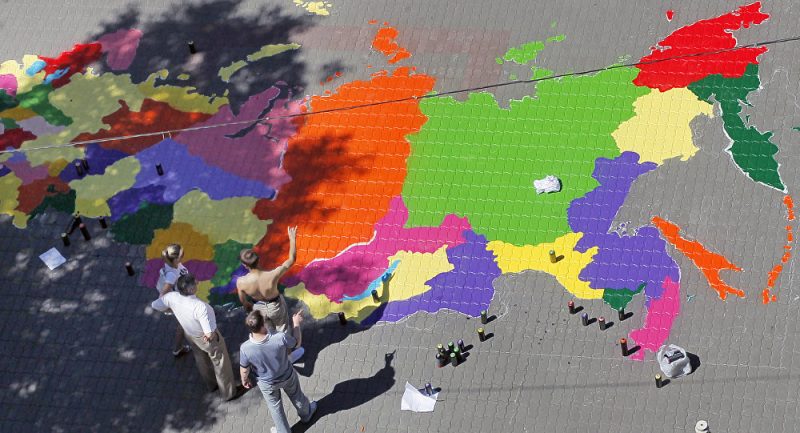
© Sputnik/ Vitaliy Belousov
Sputnik – March 27, 2018
On Monday, a number of European countries, as well as the United States and Canada, announced they were expelling Russian diplomats over the Skripal case. Radio Sputnik discussed the significance of the diplomatic response by the Western powers with Srdja Trifkovic, a US journalist and writer on international affairs.
Sputnik: What is your overall assessment about what has happened with this diplomatic response by so many countries? How significant is it?
Srdja Trifkovic: The overall impression is that rational discourse has given way to collective hysteria and that it is indeed remarkable. The extent to which the bandwagon has successfully started rolling while we don’t even have elementary answers to the questions concerning the case itself.
The second important and discouraging aspect is that continental European countries have followed the Anglo-American lead in Russophobia and this represents a further trial of the Atlanticist domination over Europe. It is indeed remarkable when both Germany and France, the putative leaders of independent European foreign policy, have been reduced to the status of automatic followers of the lead supported by Washington especially when we bear in mind that the initial round of sanctions in 2014 against Russia was dictated by the United States which had nothing to lose in the proceedings and to the detriments of Europeans’ interests.
So overall I think that, one we have the hysterical phase of Russophobic discourse in the West which is not amenable to any rational arguments and two, we have a successful degradation of European diplomacy to the status of pliant satellites comparable to East Germany and Bulgaria vis-à-vis Brezhnev.
Sputnik: Do you think there was some classified evidence that was presented that proves beyond a shadow of doubt that Russia was involved or do you think that the fact that there are 11 countries who have not joined in the protest perhaps hints at the fact that this was not the case?
Srdja Trifkovic: Well, first of all, I would say that President Putin, Foreign Minister Lavrov and others would not have made such categorical denials of Russian involvement if there was any possibility of a smoking gun which could effectively show to the world that they were not telling the truth.
And secondly, it is always possible to present some equivocal evidence in the form that even if that indicates the modus operandi of intelligence agencies nevertheless does not disclose outright state secrets. In fact, we’ve seen that in the past and I don’t think that it would be possible for such confidential information to be disclosed to the diplomats and foreign ministers of EU countries as divergent as the 27 are, without risking these very sources.
So I really believe that if you look at the countries which have taken measures against Russia, they almost read like who is who of those who are prepared to follow the US lead and if you look at those reluctant to do so, including Austria, Hungary, Cyprus, Greece, we are looking at those who actually have a more independent foreign policy. So I don’t think it’s a reflection of the quality of possible intelligence, it is simply a reflection of the determination of decision-makers of those countries to preserve a modicum of independence.
Sputnik: What would you say about the level to which the actions that were actually taken by individual countries? What can you say about the numbers game that’s being played? What do you think determined the number of diplomats?
Srdja Trifkovic: Some of these countries are absolutely insignificant countries like the Former Yugoslav Republic of Macedonia, which also expelled one Russian and it’s just a pathetic non country. On the other hand in the United States obviously it is a matter of regret that President Trump’s initially stated intention to have detente with Russia has been subverted by the deep state, it is a long story but now we have really reached the end of the road with the appointment of Pompeo to State Department and Bolton as the national security adviser.
So we can really look at Trump as the would-be drainer of the swamp who has been swallowed by the swamp. And I think that we are in for a long haul. I was in Moscow two weeks ago and coming again next week and sometimes I am surprised that some of my Russian interlocutors are insufficiently aware of the animosity or end of the rule Russophobic sentiment that currently prevails among the Western elites, both political and academic and media. It’s almost pathetic when some Russians still use the term “our Western partners,” because for partnership you need to have a modicum of mutual respect and trust and these people really seriously want to destroy Russia.
They want to delegitimize the Russian political system and process as we have seen with the public commentary on President Putin’s re-election and they want nothing short of regime change, which would then lead to a permanent and irreversible change of Russia’s national character and possibly the country’s partition along the lines allocated by Zbigniew Brzezinski. With these people partnership is impossible and Russia needs to be prepared for a long and sustained period of confrontation.
Expulsion of Russian diplomats portends troubled times
By M K Bhadrakumar | Indian Punchline | March 27, 2018
The mass expulsion of Russian diplomats by some countries of the European Union and North America on Monday is an unprecedented and intriguing development. First, the US alone accounts for some two-thirds of the expulsion – 60 diplomats. Curiously, even Britain, which is apparently the aggrieved party in the Skripal affair, expelled less than half that number – 23. Broadly, however, this is an Anglo-American move with which a number of EU countries and Canada display solidarity.
Second, President Trump is apparently more loyal to Her Majesty in the Buckingham Palace than Prime Minister Theresa May. This gives an intriguing twist to the tale. Why is there such an excessive interest on the part of Washington, especially at a time when the fervor of the Anglo-American kinship has significantly dampened during the Trump era? (President Trump is yet to visit the UK.)
Is it a massive diversionary tactic by the White House the day after porn star Stormy Daniels took Trump’s pants off in her TV interview on ’60 Minutes’? Or, is this yet another attempt by Trump to flaunt that he isn’t ‘soft’ on Russia? Or, is it the Deep State in action – as the closure of the Russian consulate in Seattle might well suggest? There are no easy answers.
Third, only less than half the 28 member countries of the EU have signaled support for the Anglo-American campaign over the spy incident. There is much reluctance or skepticism within the EU about what is going on. Surprisingly, though, Germany, which had voiced skepticism at an early stage, has now joined the pack. Which probably shows that there has been immense pressure from Washington and London.
Nonetheless, curiously, the EU countries by and large made only ‘token’ expulsions. As many as 7 EU countries simply moved on by expelling one Russian diplomat each. Having said that, the pressure campaign is continuing and the likelihood of more EU countries joining the expulsion cannot be ruled out. Austria has point-blank refused to join. (So has Turkey, which virtually rules out a NATO stance, which requires unanimous support from all member countries.)
What is truly extraordinary is that the circumstances surrounding the alleged poisoning of an MI6 double agent of Russian extraction are still shrouded in mystery. The British Labour Party leader Jeremy Corbyn openly cautioned against rushed judgment in a piece in the Guardian. By the way, even PM May claims only that it is “highly likely” that there was Russian involvement (not excluding rogue elements.) Yet, a cardinal principle in Anglo-Saxon jurisprudence is that no one is deemed guilty unless proven guilty.
Indeed, a range of explanations is possible as to what really might have happened in Salisbury. Read an excellent analysis by the respected British scholar on Russia Richard Sakwa, Professor of Russian and European Politics at the University of Kent and Associate Fellow of Chatham House, titled THE SKRIPAL AFFAIR.
Even in America, there are voices of scepticism. An enterprising columnist drew up 30 questions that beg an answer. (See the column by Bob Slane featured on the website of the Ron Paul Institute for Peace and Prosperity, titled 30 Questions That Journalists Should Be Asking About the Skripal Case.)
To my mind, this entire controversy snowballed into a litmus test of the Euro-Atlantic partnership – in particular, the US’ trans-Atlantic leadership – at a defining moment when Britain is giving up EU membership. This is one thing. But, more importantly, does the build-up portend something far more sinister than one would anticipate? One particular passage from Prof. Sakwa’s essay becomes a chilling reminder about what may be lying in the womb of time:
“The only question is whether the confrontation will dissipate, as it did over Agadir in 1911, or whether this is the Sarajevo slow-burning crisis that could explode into flame at some later point… Will it be another case of the sinking of the Maine in 1898, where the subsequent public hysteria provoked war against Spain only to be discovered later that the ship’s ammunition stores had accidentally exploded; or a Gulf of Tonkin incident in 1964, which was also a false flag operation but provoked the escalation of the Vietnam War. The West may be ‘uniting’ against Russia, as The Times put it on 16 March, but to what purpose.”
Bolton the Doors, Mind That Johnson, the Neocons Are Coming
By Robert BRIDGE | Strategic Culture Foundation | 27.03.2018
The designation of John Bolton as US National Security Advisor, in addition to the State Department being taken over by the CIA, sends an unmistakable signal that the Trump administration is gearing up for some serious mischief in the Middle East.
In an ongoing administrative shakeup that has witnessed a number of controversial Trump appointees of late, including former CIA chief Mike Pompeo as the new Secretary of State, and Gina Haspel, who ran a CIA ‘black site’ prison in Thailand that used ‘enhanced interrogation techniques’ (torture), as the new CIA chief, the most ominous is undoubtedly the decision to replace HR McMaster with John Bolton as the National Security Adviser.
At a time of high dudgeon in international affairs, Bolton is not the fire extinguisher the world so desperately needs, but rather an incendiary. Indeed, the former UN ambassador has had a direct hand in some of the most egregious US foreign policy moves in recent history, including appeals for regime change in Iraq, Libya, Iran and Syria. According to the warped worldview of Mr. Bolton, the best form of diplomacy is to be found at the sharp end of a missile strike, and to hell with the atomic fallout.
In a March 2015 opinion piece in the New York Times, with a headline that says it all (“To Stop Iran’s Bomb, Bomb Iran”), Bolton rebuked former US President Barack Obama for his “frantic efforts to reach agreement with Iran.” One need not read between the lines in what comes next to understand that Bolton is diametrically opposed to any sort of diplomacy with Tehran.
“The inescapable conclusion is that Iran will not negotiate away its nuclear program. Nor will sanctions block its building a broad and deep weapons infrastructure. The inconvenient truth is that only military action … can accomplish what is required,” Bolton wrote.
Then, speaking about “rendering inoperable” the Natanz and Fordow uranium-enrichment centers, he boasted that the US military “could do a thorough job of destruction, but Israel alone can do what’s necessary.”
Incidentally, that comment is frightfully similar to how Mike Pompeo, the new secretary of state, blithely spoke about an attack on Iran in 2014.
“In an unclassified setting, it is under 2,000 sorties to destroy the Iranian nuclear capacity,” Pompeo, then serving as House member, told a group of reporters. “This is not an insurmountable task for the coalition forces.”
Destroying Iran’s nuclear facilities, according to Dr. John Strangelove Bolton is just the first step of a program that would include “vigorous American support for Iran’s opposition, aimed at regime change in Tehran.”
Bolton also paid lip service to a conspiracy theory, based on a “leaked” UN document (which has yet to see the light of day, by the way), which promotes the idea that North Korea is sending chemical weapon material to Syria in a program that is being financed by Iran. Thus, in one fell swoop, three of the West’s newest candidates for regime change Syria, North Korea and Iran, are scooped up in a net stitched out of the yarn that Syria has an addiction to chemical weapons. If the charges sound preposterous, that’s because they are.
To believe for an atomic nanosecond that Syrian President Bashar Assad, who oversees a relatively respectable military complex, would have anything to do with chemical weapons at this crucial juncture in his political career – especially with the Russian military on his side – is patently absurd. Moreover, why does the West rush to blame Damascus for every chemical attack that happens in Syria (with the White Helmets conveniently on-site to film the aftermath) when it is the rag-tag rebels and terrorists who, bereft of any modern military arsenal, would be the ones most expected to resort to such barbaric, desperate tactics, and not least of all for the purpose of drawing the Western powers into the fray on their side? As some famous Greek once said, ‘To ask the question is to answer it.’
Meanwhile, even before the unholy triumvirate of Pompeo, Haspel and Bolton have been formally embedded into Team Trump, the world must endure the pitiful spectacle of US Ambassador to the UN, Nikki Haley, regularly screeching about obliterating anything that bears the slightest resemblance to a sovereign state.
She even had the supreme audacity to speak about Washington’s readiness to “bomb Damascus and even the presidential palace of Bashar Assad, regardless [of the] presence of the Russian representatives there.”
But these fiercely aggressive birds known as hawks are not just native to the febrile climate of Washington, D.C. This arrogant bird of prey can also be found as far east as the United Kingdom where it has perched in the House of Commons ever since Tony Blair made a hellacious pact with George W. Bush to join the jolly little fight known as the ‘war on terror.’
Just this month, Sergei Skripal, a former Russian double agent, was the target of a suspected assassination attempt in Salisbury, UK the military town where he moved following a spy-swap in 2010. After a brief investigation, UK British PM Theresa May swiftly blamed Russia for Skripal’s illness. Her argument was that since Mr. Skripal had been targeted by a nerve agent called ‘novichok,’ a chemical that had been produced in the Soviet Union, specifically in Uzbekistan, then it stood to reason that Russia was the culprit. Such an argument would be laughed out of any court of law.
Moreover, when Moscow requested samples of the agent from London, which, as a member of the Organization for the Prohibition of Chemical Weapons (OPCW) it was required to do, London balked. At the same time, no good motive can be found to explain why Russia would want to remove a has-been spy – with a traceable nerve agent, of all things – just a few weeks before presidential elections and the opening of the World Cup.
“He was handed in to Britain as a result of an exchange, said Dmitry Peskov, President Putin’s press-secretary, in an exclusive interview with RT. “So, why should Russia hand in a man that is of any importance or that is of any value? It’s unimaginable. If he’s handed in – so Russia quits with him. He’s of zero value or zero importance.”
Amid this outright mockery of the justice system, the buffoonery of Boris Johnson, the UK Foreign Secretary looked right at home. Instead of producing something the West no longer defers to in criminal cases known as ‘evidence,’ the best Johnson could do was conjure up warmed over clichés and compare Russia with Nazi Germany.
“I think the comparison with 1936 is certainly right. It is an emetic prospect to think of Putin glorifying in this sporting event,” he told the Foreign Affairs Committee.
After he was done with his Hitler rant, Johnson speculated as to why Russia would do such a thing.
“The timing (of the Salisbury attack) is probably more closely connected with the recent election in Russia,” he said. “And as many non-democratic figures do when facing an election or facing some critical political moment, it is often attractive to conjure up in the public imagination the notion of an enemy.”
With Putin’s popularity higher than any Western leader, Johnson’s explanation was wide of the mark.
One last word in closing with regards to the Skripal case that many observers seem to have overlooked. Around the time Mr. Skripal was targeted for assassination, purportedly by the Russians, back in the United States the House Intelligence Committee was announcing there had been no collusion between the Trump administration and Russia. Such an announcement was anticipated as early as February. Aside from this being an unacceptable embarrassment for the Democratic Party, not to mention the establishment, which some have taken to calling the ‘deep state,’ it also meant that Russia, as well as Donald Trump, would be cleared of the egregious charges. Clearly some kind of diversionary tactic would have been welcomed.
Was the attack on Sergei Skripal in fact an effort to deflect attention away from the faltering ‘RussiaGate’ case, as well as to keep the anti-Russia propaganda ball bouncing? As for a motivating factor, one need look no further than Russia’s gas contracts with European countries, a lucrative business that at least one global superpower would like more than anything to control. If there is one thing the Neocons like more than war it’s money. Follow the money.
British accusations against Russia for Skripal poisoning not only unproven, but absurd!
By Tom Stanford | The Duran | March 24, 2018
The British government claims to have overwhelming evidence of Russia’s responsibility in the Salisbury poison attack on Sergei Skripal and his daughter. In his Washington Post article of March 14, Foreign Secretary Boris Johnson went so far as to claim that there was “only [one] plausible conclusion: that the Russian state attempted murder in a British city, employing a lethal nerve agent banned under the Chemical Weapons Convention”. He even connected this with Russia “covering up” the alleged use of “the nerve agent sarin against the town of Khan Sheikhoun in April 2017” by Syrian forces. In a separate statement, the Foreign Secretary tells us it is “overwhelmingly likely” that Vladimir Putin personally ordered the attack. What evidence is there to support such serious accusations?
According to the British government (see e.g. Boris Johnson’s article) and the mainstream media, the following elements are sufficient to incriminate the Russian state with near certainty: the weapon used, the motive, Russia’s past record, the lack of another explanation.
Use of novichok is no proof of Russian involvement
The nerve agent reportedly used in the attack, named novichok, was developed by the Soviet Union in the 1970s and 1980s. The fact that Russian stockpiles of novichok were destroyed under supervision of UN bodies after the collapse of the Soviet Union and that the OPCW (Organisation for the Prohibition of Chemical Weapons) has seen no reason for suspecting any country of continuing to store this deadly agent does not seem to bother the incriminators. Of course, it can be speculated that Russia may have kept the weapon secretly, as does Vil Mirzayanov, the Russian scientist who revealed the existence of the project in 1992 and has lived in the US since 1995.
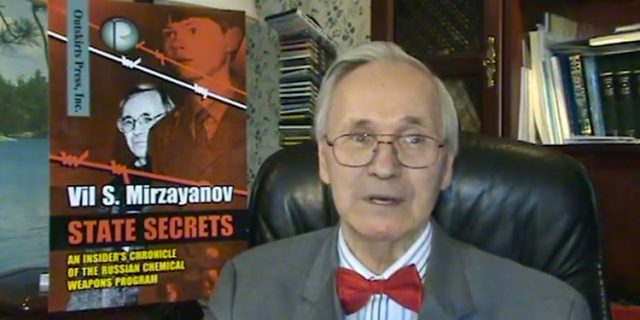
Russian ex-counter intelligence officer Vil Mirzayanov defected to the United States. Now 83 years old, he comments on the Skripal affair from Boston. (Photo credit: Business Insider)
Boris Johnson has announced that over the last ten year Britain has gathered evidence of Russia creating and storing novichok. We are given no detail of what kind of evidence this may be. It could turn out to be nothing more than isolated, unsubstantiated claims made by Mirzayanov and other opponents of the Russian government.
Not only Russia, but other former members of the Soviet Union, or the US, could have secretly stored or recreated the poison. In 1999 US defence officials helped Uzbekistan dismantle a former Soviet facility which had tested chemical weapons such as novichok. Samples, as well as the knowledge required to produce the nerve agent, are highly likely to have become available to countries other than Russia.
Did Russia have a motive?
Russia supposedly had an obvious motive. The argument goes as follows: Sergei Skripal, while still officially working for the Russian military intelligence service, the GRU, had been secretly recruited by the British MI6, and handed over to his new paymasters the names of all Russian agents he knew to be working in the West. Even after serving a few years in a Russian prison and being allowed to emigrate to the UK as part of a spy swap, he would have remained on an official Russian hit list for his act of treason. His murder would serve as a deterrent towards any other Russian agent who may consider switching sides. And to make things even clearer to would-be defectors, the attack would leave some kind of signature pointing to the Russian state as the perpetrator.
On the face of it, the argument sounds reasonable. However, it makes no sense to consider motives as evidence for doing something if we ignore counter-motives, i.e. reasons for refraining from doing it. Suppose you are in your doctor’s waiting room and have been sitting there for quite some time when suddenly an elderly lady, who arrived there just before you, collapses and is rushed to hospital. You had never seen her before. Now imagine the police later suspect some foul play and discover that the incident allowed you to have your own waiting time shortened by ten or fifteen minutes. You had a clear motive for harming the poor lady. Luckily for you, it then occurs to the investigators that your motive for doing so (saving a few minutes of your time) pales into insignificance compared with the reasons that would have held you back, such as the idea of spending years in jail, not to mention your moral conscience or feelings of human compassion.
In other words, motivation is the result of weighing out costs and benefits.
Putin had a clear motive… for NOT doing it
In the case of the Salisbury attack, the foreseeable costs to Russia, and more specifically to President Putin, are enormous. The Russian government spends considerable effort trying to convince the world that it firmly abides by the rule of law, especially international law and agreements between states. Its own statements, as well as the foreign-policy analyses appearing in the Russian state-owned media, all go towards highlighting Russia’s perceived superiority to the US in terms of respect for international law. Such efforts have greatly intensified in the context of the renewed tensions with the West over the last few years.
Russia’s current leaders believe in ending the current US-dominated unipolar world and are striving to recover some of the influence over world affairs that was lost with the collapse of the Soviet Union. This requires having allies, not only state allies, but also Russia-friendly organizations and individuals within states. Any damage to Russia’s international reputation does considerable harm to such prospects.
President Putin himself cultivates the image of a highly principled, responsible and law-abiding person – not that anyone would guess by reading the Western mainstream media! Whatever Russia’s state representatives and media may argue, the Salisbury attack has put many weapons in the hands of Putin’s detractors. In this light, it is absolutely inconceivable that Russia’s president ordered the attack himself. Boris Johnson’s personal accusation not only shows his total misunderstanding of the Russian leadership, but is also utterly irresponsible on the part of Britain’s top diplomat.
Russia had long been hoping that the EU may gradually put to an end its sanctions policy. It is still very dependent on trade with the block. It would be insane for Russia to do anything that could threaten the current Nord Stream 2 gas pipeline project, especially given that the US, with the support of a number of EU countries mainly from Eastern Europe, has been putting pressure on the EU to abandon the project. But Germany, determined to ensure its supply of cheap gas, has so far resisted such calls.
Predictably, the EU has sided with the UK and is officially demanding explanations from Russia concerning its novichok programme – which only makes any sense if Russia was in some way involved in the Salisbury attack, definitely not if it genuinely ceased the production and storage of the nerve agent in the 1990s, as documented by the OPCW!
Could other agents of the Russian state be responsible?
It is also entirely unrealistic to imagine that leading members of the Russian secret service agencies may have acted autonomously and ordered the Salisbury attack without consulting their superiors and not realizing how much damage it would have on Russia’s and Putin’s international reputation. They live in the world of the Russian state elite, continually exposed to its way of thinking, and not cocooned in some fantasy world of their own – unlike many Western politicians and journalists who apparently still live with the image of James Bond-like characters fighting against evil Russian agents!
Any significant agent of the Russian state would be fully aware of the displeasure that a Salisbury-type attack would trigger among the leadership. Supposing players within the Russian state did carry out the attack, it could only be construed as a hostile act towards President Putin and his team.
No sense for Russia to kill Skripal abroad rather than in Russia
This is not a simple case of a former spy-turned-traitor being “executed”. The attack leaves a deliberate Russian “signature” (there is no other reason for using novichok rather than a more discreet or classical weapon) and was carried out on the soil of a foreign country, the United Kingdom, which in spite of the Brexit process remains a highly significant player on the international stage. Whoever the perpetrators may be, they would have foreseen that any improvement in relations between Russia and its Western neighbours would be seriously jeopardized as a consequence.
But what makes Russian involvement even more absurd is the fact that Alexander Skripal was officially released and allowed to emigrate as part of a spy swap. Why would the Russians have waited another eight years before killing him in another country, with the terrible diplomatic consequences that would ensue, when he could have been much more easily liquidated while still in Russia, in a manner that would give would-be defectors an even clearer warning that there is “no way out for traitors”.
Would Russia give up the chance of other spy swaps?
Furthermore, a spy-swap deal implies that the parties involved agree to give up all claims pertaining to the released individuals. In other words they will not try to recapture or kill them, which would amount to a breach of the agreement. A country reneging on such a deal would no longer be trusted for any similar arrangements in the future. Is it reasonable to believe that the Russian government, or any top secret service official in Russia, would be prepared to sacrifice Russia’s chances of making any new spy-swap deals with its Western partners in the future? This is not just unlikely, it is the pinnacle of absurdity! Sadly, Western political leaders and mainstream media are quite happy to believe and propagate such nonsense.
Goal of attack: outrage against Russia
The attack itself does not seem to bear the mark of professional Russian agents. The daughter of the former double agent suffered the same fate as her father. It is only a matter of circumstances that many others were not seriously injured. It is like using a sledgehammer to crack a nut! And the main target, Sergei Skripal, is – weeks later – still reported to be alive! Either it was some very sloppy attack carried out by non-professionals, or the attack was deliberately not confined to Mr Skripal in order to provoke even greater outrage against Russia.
Boris Johnson has apparently recently adapted his interpretation of Russian intentions to take account of these facts. He now claims it was probably specially timed just before the presidential election, “to conjure up in the public imagination the notion of an enemy”. So the Russian president supposedly deliberately provoked British outrage to help him win the election! The Foreign Secretary seems to be completely out of touch with reality. It has long been common knowledge that Vladimir Putin would win with a landslide anyway. Would he wish to cause himself and his country enormous trouble for absolutely no gain at all?
What is Russia’s past record?
We are told there is “a pattern” of state-sponsored assassinations or deaths in unusual circumstances of political opponents, critical journalists and secret service defectors. Deaths attributed to President Putin have included the journalist Politskaya, the political opponent Nemtsov, the accountant and lawyer Magnitsky, the former agent Litvinenko and even the oligarch Berezovsky. In all these cases, the incrimination of the Russian state is based on rather flimsy evidence. The argumentation here is circular: in each case the belief in the Russian government’s responsibility is strengthened by the existence of the other stories. But if none of the stories are true, then the whole argument collapses.
The Litvinenko case does bear a similarity to the current one. Instead of the nerve agent novichok, Litvinenko was poisoned by radioactive polonium, a substance very difficult to obtain and produced only by a few countries – such as Russia – with a nuclear weapons industry. In both cases, it is highly unlikely that the Russian state would choose to leave a “made in Russia” signature on the poison used, with only one major outcome – the poisoning of Britain’s relationship with Russia.
If not Russia, then who did it?
Russia’s accusers claim there are no alternative explanations for the attack: nobody, apart from the Russian state, is understood to have had a motive for the attempted murder. This argument can only make sense to those who believe in the world of an evil, criminal Russia whose only opponents are pure, honest, angelic fighters for freedom and justice.
The main consequence of the Salisbury attack – undoubtedly one that would have been predicted by whoever planned it – is to further damage relations between Russia and the West, or at least prevent their improvement. A long list of countries (Ukraine, Poland, the US and many others) or organizations may believe they have an interest in this – at least they have been doing their best to spoil Western Europe’s relationship with Russia. Of course, the existence of a possible motive does not constitute sufficient ground to suspect anyone in particular. However, on the basis the motives involved, to quote British former Member of Parliament George Galloway, “Russia must be near the bottom of the list of suspects.”
How to get away with murder: blame Russia!
It can also not be excluded that the attack was the work of some rogue “ultra-patriotic” group within Russia (whether within or outside Russia’s state institutions) wishing to undermine Putin’s attempts to mend relations with the West by killing a “traitor” on British soil. In this case, the Salisbury attack would clearly be an act of aggression against the Russian government more than against the UK. And Britain’s refusal to cooperate with Russia would make the UK unwittingly guilty of helping the perpetrators avoid the course of justice.
Another aspect is that we do not know what personal enemies Aleksander Skripal may have had. There may be motives involved that nobody suspects. If, for whatever reason a person or organization with sufficient power wished to have him killed, there was a simple way to get away with the crime: a highly effective cover-up the crime would involve using a weapon that points towards Russia, with the knowledge the British authorities would be unlikely to seriously explore other avenues, especially in the current international climate. The same can be argued in the case of Litvinenko’s murder in 2006.
There is something particularly disturbing about the Western international community rushing to accuse Russia for any crime showing the slightest hint of a Russian connection: it provides criminal organizations and terrorists with assurances that they can avoid being held accountable. All they need to do is to leave some kind of “Russian signature”.
UK reckless attitude is dangerous
The words of Theresa May and Boris Johnson, accusing Russia for crimes it did not commit with astoundingly aggressive and hostile language, will naturally lead the Russian population and their decision makers to believe their country is the victim of an orchestrated attack. Hostility towards the West will increase dramatically as a result. British, European and North-American leaders may have convinced themselves of Russia’s guilt, but have they reflected on the possible consequences of their reckless attitude?
It is urgent to stop the escalation in the Russia blame game, which has taken a momentum of its own. It may be of benefit for the media, who can publish stories that make a good read, with an evil bogey man that everyone loves to hate, or for politicians who, when confronted with problems at home – such as the UK government with its current Brexit troubles – can take the opportunity to look strong in the face of an enemy. However, it is an extremely dangerous game which could have disastrous consequences for the entire world.
‘Against common sense and intl law’: Russia to retaliate over diplomats’ expulsion by UK allies
RT | March 26, 2018
Moscow won’t leave the provocative acts against Russian diplomats unanswered, the Foreign Ministry said, adding that several countries blindly copied the UK’s “hypocritical” stance on the Skripal case in the absence of evidence.
The decision of a number of NATO and other European countries to expel Russian diplomats over the poisoning of the former double-agent Sergei Skripal amounts to a “provocative act” and only harms international relations and the investigation of the incident, the Ministry said in a statement.
The countries which expelled Russian diplomats have only played into the hands of London, which “de-facto took a prejudiced, biased and hypocritical stance, producing indiscriminate accusations against the Russian Federation in the absence of explanations of what happened and refusing to engage in substantive cooperation,” the statement reads.
The “solidarity” expressed by the Western countries harmed the investigation of the Skripal incident and contradicted international law, the Ministry said. Russia is interested in finding the truth about the poisoning of Russian citizens on British soil, it stressed.
“The Russian side, despite our repeated requests to London, has no information over the case. There’s no objective and exhaustive data on it at the disposal of the Britain’s allies, who blindly follow the principles of the Euro-Atlantic unity harming common sense, principles of civilized dialogue between states and international law. Naturally, such a hostile move on part of this group of countries won’t go unanswered,” the Ministry said.
Moscow will expel at least 60 US diplomats in response to Washington’s move which it linked to double agent Skripal’s poisoning, Senator Vladimir Dzhabarov said. He called the move to expel 12 of the Russian UN staff illegal.
“It is clear that the measures will be tit-for-tat, they will affect the same number of employees, since the numbers of our diplomatic missions are equal,” Dzhabarov said. He also condemned the additional expulsion of 12 Russian UN staff as “contradicting international law.”
“The UN is an international organization, which does not fall under American jurisdiction,” the senator pointed out.
President Vladimir Putin will be the one to make a final decision on retaliatory measures against the US and European countries that are expelling Russian diplomats. For now, the Russian Foreign Ministry is studying the situation and drafting a list of possible actions, Kremlin spokesman Dmitry Peskov said. Moscow has nothing to do with the Skripal case, he added.
Washington’s actions will only serve to ruin the remaining US-Russian ties, Russian Ambassador to the US Anatoly Antonov said. The US understands nothing but force, the diplomat stated while commenting on the possible response measures.
Moscow expected such a move on part of the US, but still hoped that Washington would use common sense to help stop the UK’s hysteria, Antonov added.
On Monday, the US expelled 60 Russian diplomats over the double-agent Skripal’s poisoning in the UK. The move was coordinated with several European countries, which also expelled a number of Russian diplomats.
Trump orders expulsion of 60 Russian diplomats, closure of Seattle consulate
RT | March 26, 2018
President Donald Trump has ordered the expulsion of 60 Russian diplomats and the closure of the Russian consulate in Seattle. It comes in response to the poisoning of Sergei Skripal in Salisbury, which the UK has blamed on Russia.
The move follows major diplomatic pressure by the UK on its allies to follow their lead in expelling Russian diplomats. The Russian embassy in Washington had previously urged Trump not to heed the “fake news” on Skripal’s poisoning.
British Prime Minister Theresa May has accused Moscow of being behind the poisoning of the former spy Skripal and his daughter in the town of Salisbury in early March.
Of the 60 diplomats expelled, 12 formed part of the Russian mission to the United Nations. In a statement, US ambassador to the UN Nikki Haley said the 12 Russians in question had “abused their privilege of residence” in the US and had “engaged in espionage activities that are adverse to our national security.”
Haley said that the Russian diplomats had used the UN as “a safe haven for dangerous activities within our own borders.”
During a summit in Brussels last week, the 28 EU leaders agreed with Britain’s assertion that it is “highly likely” that Russia was responsible for the attack on Skripal.
Members of the EU numbering 14 have also decided to expel Russian diplomats following Britain’s lead.
Canada has also jumped on the bandwagon, announcing that it will expel four Russian diplomats “in solidarity” with the UK.
The timing of the expulsions by the US, EU and Canada appears to have been coordinated between Washington and Brussels. Eight EU countries confirmed within 15 minutes of each other on Monday afternoon that they would expel a number of Russian diplomats. Canada’s announcement followed shortly after.
Moscow has always denied playing any role in the attack, and offered to cooperate with the investigation into the incident. Britain has declined, however, to send samples of the chemical agent used on Skripal and his daughter to Moscow.
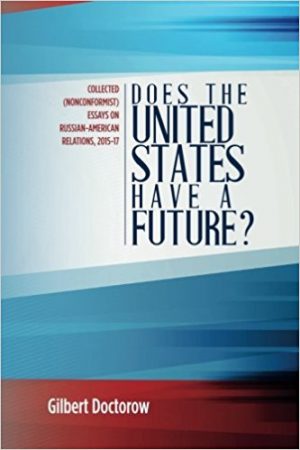
A collection of essays on Russian-American relations 2015 – 2017 by one of the US’s top Russia experts
Review by Alexander Mercouris | The Duran | November 19, 2017
 One of the most deeply frustrating things for anyone with any knowledge of Russia who has been following the Russiagate saga is the staggering ignorance of basic facts about Russia which is so prevalent amongst elites in the US.
What makes this especially frustrating is that there is actually no shortage of knowledgeable and erudite experts about Russia who could be called upon if any true desire for knowledge about Russia actually existed.
Of those one who who stands out is Gilbert Doctorow, who has been a professional Russia watcher since 1965.
Gilbert Doctorow has now offered us a new book – “Does the United States have a Future” – which brings together his splendid collection of essays about Russia and about Russian-American relations which he has been writing since 2015.
This is of course the same period when in the aftermath of the Ukrainian crisis and because of Russia’s intervention in Syria Russian-American relations entered upon their present catastrophic downward spiral, with the US rolling out successive sanctions against Russia, and deploying ever greater numbers of its troops ever closer to Russia’s border.
In this heavy atmosphere of heightened Russian-US tensions, and amidst a shrill media campaign, the Russian side of the story rarely gets told. What we get instead is an exaggerated focus on the largely misunderstood doings of one man – Vladimir Putin – who is not just routinely blamed for everything that goes wrong – be it Trump’s election, the Brexit vote, the 2015 European refugee crisis, the secessionist outbreak in Catalonia and the rise in Germany of the AfD – but who has become dangerously conflated with Russia itself.
The huge achievement of Gilbert Doctorow’s essays is that they put entirely behind them this disastrous paradigm.
For someone fixated on psychoanalysing Putin’s personality and on learning the gossip about the internal squabbles of the Kremlin this collection of essays has little to offer. Doctorow has as little patience for this sort of thing as do I. Suffice to say that one of the essays, which goes by the dismissive title “Kremlinology is alive and well in Russia”, turns out to be focused not on mythical Kremlin power struggles but on the impact on the people of St. Petersburg of a visit by Putin to their city.
For anyone interested in Putin what anyone reading these essays will get instead is detailed and erudite analyses of his speeches, of his massive and truly astonishing Q&A sessions, of his media interviews, and of the effect of all these doings on Russian public opinion and what they tell us about Russian policy.
Not by chance, the only reference to me in the whole collection is when Doctorow disagrees with me about an interview Putin gave to the German newspaper Bild-Zeitung. I gave the German interviewers high marks for their conduct of the interview. Doctorow politely expresses his incredulity.
Ultimately far more interesting to anyone genuinely interested in understanding the rapidly recovering Great Power which is Russia, and who wants to get a genuine grasp of the sort of things that move its people, are those essays which touch on topics other Western reporters of Russia tend to ignore.
Here Doctorow’s immense knowledge of Russia and of Russian history is essential, and it shines through every essay.
Thus we find masterful discussions of works about tsarist history by the historian Dominic Lieven, and an outstanding discussion – the best I have come across – of Henry Kissinger’s insights and limitations as they concern Russia. There is even a remarkable essay which takes Tolstoy’s novel Anna Karenina as a starting point to discuss war.
However the single thing which sets the essays which are specifically about Russia apart is the extraordinary rapport Gilbert Doctorow has with Russia’s ‘everyman’. Take a comment like this one from the very first page of the very first essay in the book, which is dated 30th May 2015. Against a background of a deepening recession Gilbert Doctorow tells us this
I say assuredly that the mood across the social spectrum of my “sources” is uniformly patriotic and uncomplaining. These sources range from the usually outspoken taxi drivers; through the traditionally critical journalists, academics, artists and other intelligentsia who are family friends going back many years, to former business contacts and other elites.
How many of those who report from Russia are able to speak to a wide range of contacts like this? How many of them pay heed to the opinions of Russia’s “usually outspoken taxi drivers”, reliable purveyors of the public mood though those people are? How many of those who report from Russia even know how to talk to such people? (confession here: I don’t).
Or take Gilbert Doctorow’s deeply moving account from 10th May 2016 of the March of the Immortal Regiment, held now every year on 9th May to commemorate Russia’s sacrifice in the Second World War. What other Western reporter of Russia has both the erudition and the common touch necessary to write a passage like this?
Given the manifestly patriotic nature of Victory in Europe Day celebrations, which open in Moscow and cities across Russia with military parades, precise marching columns, displays of military hardware on the ground and in the air, I was uncertain how possibly strident the Immortal Regiment component might be. As it turned out, the crowd was uniformly good humoured and focused on its private obligations to be met: the celebration of parents, grandparents, even great grandparents’ role in the war and reconfirmation of their status as family heroes whatever their military or civil defence rank, whether they survived or were among the countless fatalities.
Elsewhere Gilbert Doctorow is able to talk knowledgeably in two different essays about the state of the Russian shopping basket – a matter of fundamental importance to Russians and therefore given Russia’s power and importance to everyone – of Russian responses to the Trump-Clinton debate, of the Russian public’s response to one of Putin’s mammoth annual Q&A sessions, and of the steely response – utterly free of sentimentality and hysteria – of the people of St. Petersburg and of Russia generally to a terrorist attack on the city.
Of the essays specifically about Russia it is however what Doctorow writes about the Russian media which Western readers may find most surprising.
It is now generally conceded even in the West that Russia does have a public opinion, something which tended not to be admitted in Soviet times, though there still seems to be little genuine interest in finding out what it is.
The lazy assumption is anyway that in Russia public opinion is effectively manipulated by the government through its supposedly all-encompassing control of the news media.
Though it is sometimes grudgingly admitted that the print media does have some independent voices, and that the Russian media now has a degree of sophistication unknown in Soviet times, the prevailing opinion in the West is that it remains every bit as propagandistic and mendacious as it was in Soviet times. The classic statement of this view is Peter Pomorantsev’s “Nothing is True and Everything is Possible: Adventures in Modern Russia”.
Doctorow’s essays are an important corrective to this bleak and distorted picture.
Doctorow does not sugarcoat the reality. He concedes that the television media has a bias favouring the Kremlin and that ‘non-system’ politicians whose parties are not represented in the Duma like Kasyanov and Navalny have difficulty gaining access to it.
I would say in passing that Russia’s television media is not exceptional in this. In my opinion Russian television today is much less controlled by the government than was French television during Charles De Gaulle’s and Georges Pompidou’s time in France, when I was in Paris as a child.
In any event, as a regular participant in Russia’s extraordinarily extended and elaborate political talk-shows – a vital and massively popular information tool for the Russian population – Doctorow shows that the common Western view that Russian television viewers get no exposure to the Western view-point and hear only the Kremlin’s view is simply wrong. Here is one passage where Doctorow describes them
The regulars of these talk shows are a mix of Russians and foreigners, pro-Kremlin and anti-Kremlin voices. There inevitably is at least one American who can be counted on to purvey the Washington Narrative. A reliable regular in this category has been Michael Bohm, who was for a long-time op-ed manager at The Moscow Times and now is said to be teaching journalism in Moscow….
From among Russians, the talk show hosts bring in one or more representative of opposition parties. On the 11th it happened to be a personality from the Yabloko Party (Liberals). But at other times there will be the leader of the Communist Party, Gennady Zyuganov, the founder of the right nationalist LDPR, Vladimir Zhirinovsky, or the leader of the social democratic party, Just Russia, Sergei Mironov. They all get their time on air in these shows.
Elsewhere Doctorow gives vivid accounts of these sprawling and at times chaotic talk shows, which have no precise analogue anywhere else that I know of.
Doctorow’s book, as its title shows, is not only about Russia. Rather it is about the collapse of any sort of dialogue based on mutual respect and understanding between the US and Russia.
In essay after essay Doctorow pinpoints the cause: at a time when the Russian mind is becoming increasingly open, the American mind is becoming increasingly closed.
The title of the book – “Does the United States have a future?” – is in fact an intentional exercise in reverse imaging.
At its simplest it refers back to Doctorow’s previous book: “Does Russia have a future?” published in 2015.
However the title of both books must also be seen as a comment on the ‘disaster literature’ about Russia which has become so prevalent in the West, and which continues unabated to this day even as it is repeatedly proved wrong.
Basically what Doctorow is saying is that it is in the US not Russia that the suppression of debate and independent voices is putting the future in jeopardy.
It is in these essays that look at the situation in the US where Doctorow dissects the evolution or rather regression of US policy towards an increasingly strident Russophobia, and where one senses Doctorow’s growing exasperation and alarm.
Take for example what Doctorow has to say about one of the most outspoken Americans calling for ever more confrontation with Russia: NATO’s former military chief General Breedlove
Most everything is wrong with what Breedlove tells us in his article. It is a perfect illustration of the consequences of the monopoly control of our media and both Houses of Congress by the ideologists of the Neoconservative and Liberal Interventionist school: we see a stunning lack of rigour in argumentation in Breedlove’s article coming from the absence of debate and his talking only to yes men.
Perhaps the biggest mistakes are conceptual: urging military means to resolve what are fundamentally political issues over the proper place of Russia in the European and global security architecture. Whereas for Clausewitz war was ‘a continuation of politics by other means’, for Breedlove politics, or diplomacy, do not exist, only war.
The alarm in the last paragraph finds still greater emphasis in the essay which immediately precedes it. This has the ominous title “The Nuclear Clock is at Two Minutes to Midnight”.
It is however in the closing of the American mind where Doctorow pinpoints the danger
My point is not to ridicule the very earnest and well-intentioned anti-war campaigners whose ranks I joined that day. It is to demonstrate how and why the highly tendentious reporting of what we are doing in the world and what others are doing to us, combined with the selective news blackouts altogether by major media has left even activists unaware of real threats to peace and to our very survival that American foreign policy has created over the past 20 years and is projected to create into the indefinite future if the public does not awaken from its slumber and demand to be informed by experts of countervailing views. We are living through a situation unparalleled in our history as a nation where the issues of war and peace are not being debated in public.
Along with the alarm and frustration there is also very real disappointment.
Like most people who lived through the later stages of the Cold War Doctorow remembers a world where the US’s European allies acted as a force of restraint on the US.
Based now in Brussels at the very epicentre of the European Union Doctorow is shocked at the extent to which this is no longer the case, and at the degree to which the same attitudes of hubris, belligerence and hysteria which have gained such a hold in the US have now also managed to gain a hold in Europe.
Like many others Doctorow is totally unimpressed by the current crop of European politicians, and as someone able to remember the likes of Charles De Gaulle and Helmut Schmidt Doctorow does not balk from expressing his scorn in withering terms. A good example is to be found in the title of one of his essays: “News flash: Europe is brain dead and on the drip”.
It is in his discussions of Europe that Doctorow allows himself his brief flashes of anger. Take these comments he makes about Elmar Brok, the truly dreadful chairman of the European Parliament’s Committee on Foreign Affairs
I remember with a shudder an exchange I had with Elmar Brok on 5 March 2015 on The Network, a debate program of Euronews. Brok, a German, is the chairman of the European Parliament’s Committee on Foreign Affairs. He comes from Angela Merkel’s CDU party and within the Parliament is in the European People’s Party bloc, on the center right, the bloc which really calls the shots in the EP.
Brok is big, brash and does not hesitate to throw his weight around, especially when talking with someone outside the Establishment whom he has no reason to fear. We were discussing the shooting of Boris Nemtsov, which occurred just days before. Brok insisted the murder was the responsibility of Vladimir Putin. Not that Putin pulled the trigger, but he created the atmosphere where such things could happen, etc., etc. One way or another the talk shifted to the allegedly autocratic nature of the Putin ‘regime,’ with its crackdown on freedoms, and in particular ever tightening control of media.
At that point, I objected that the Russia media were very diverse editorially, with many different points of view expressed freely. Brok shot back that this was patently untrue, and he did not hesitate to cross all red lines and indulge in libel on air by asking how much the Kremlin paid me to say that.
Apart from the obvious truth that an authoritarian like MEP Brok would not know freedom of speech if he tripped on it, I think back to that exchange every week whenever I turn on Russian state television and watch one or another of the main political talk shows.
Doctorow’s strongest feelings of disappointment however remain firmly focused on the US.
Doctorow’s essays show that like many people he entertained very cautiously worded hopes about Donald Trump.
Hillary Clinton after all was the self-styled ‘war candidate’ and the preferred choice of the Neocons, whilst Trump at least spoke of the need for better relations with Russia.
Not for nothing is one of Doctorow’s essays entitled “War or Peace: the essential question before American voters on November 8th”.
Doctorow’s hopes were never very high and like many others he was appalled by the conduct of the 2016 election, which he calls disgraceful. His essays which follow Trump’s election victory show the speed of his disillusionment. Not only has Trump proved completely incapable of fulfilling any of Doctorow’s hopes; he seems to have no idea of how to conduct foreign relations, and is rapidly reverting to the aggressive belligerence which is now the default position of all US Presidents.
In the meantime his election has heightened partisan tensions within the US to unheard of levels.
In his final chapter, which has the same title – “Does the United States have a future?” – as the whole book, Doctorow sets out the consequences.
A US which twenty years ago bestrode the world is now incapable of governing itself, whilst its increasingly reckless conduct is spreading conflict and alarm around the world.
Not only has trust in “American leadership” as a result all but collapsed but the two other Great Powers – Russia and China – have been completely alienated, and are busy forging an alliance whose combined resources will soon dwarf those of the US.
About all that the US however remains in denial, as it is about the world crisis its actions are generating. In a political system where all dissenting opinions are excluded it cannot by definition be otherwise. Thus the US looks set to continue on its present ruinous course, with no ability to change direction
…. a still greater threat to our democracy and to the sustainability of our great power status has come from the inverse phenomenon, namely the truly bipartisan management of foreign policy in Congress. The Republican and Democratic Party leaderships have maintained strict discipline in promotion of what are Neoconservative and Liberal Interventionist positions on every issue placed before Congress. Committees on security and foreign affairs invite to testify before them only those experts who can be counted upon to support the official Washington narrative. Debate on the floor of the houses is nonexistent. And the votes are so lopsided as to be shocking, none more so than the votes in August on the “Countering America’s Adversaries through Sanctions Act”….
It would be comforting if the problems of our political culture began and ended with the elites operating in Washington DC. However that is patently not the case. The problem exists across the country in the form of a stifling conformism, or groupthink that is destroying the open marketplace for ideas essential for any vital democracy.
I recognise the accuracy of this picture and am prey to no illusion. However in my opinion it is still too early to give up hope.
Trump’s victory, if it shows nothing else, shows that there is more resistance to the ‘groupthink’ in the US than Doctorow in these passages perhaps allows. What is the Russiagate hysteria after all if not the expression of a collective nervous breakdown on the part of the US elite at the discovery that the American people as a whole do not share their obsessions?
A state of hysteria of the sort we are going through now cannot be sustained indefinitely. Eventually a reaction will set in, at which point those at the forefront in spreading the hysteria will be exposed as the charlatans that they are, whilst many of those they fooled will feel ashamed.
When that point comes it is good to know from this outstanding collection of essays that there are still genuine experts available that the US can call upon to guide its policies like Gilbert Doctorow.
Featured Video

Broke Princes: Saudi Arabia’s Powder Keg
or go to
Aletho News Archives – Video-Images
From the Archives
Registered Israeli foreign agent driving contrived campus antisemitism crisis
By Wyatt Reed | The Grayzone | December 17, 2023
Lawsuits accusing top US universities of harboring antisemitism all originate from one source: a corporate law firm that fielded the pro-settler ex-US ambassador to Israel, and which was registered as a foreign agent of an Israeli principal as recently as 2021.
The firm now represents professional Israel lobby activists posing as victimized “Jewish students” and seeking to crush the free speech rights of Palestine solidarity activists. … continue
Blog Roll
 Aletho News
- US Elections Offer Choice Between ‘Bad and Worse’ as Both Parties Serve War Lobby – ex-UN Expert
- Ghalibaf warns US government not to betray voters who rejected war
- Broke Princes: Saudi Arabia’s Powder Keg
- Albania’s Crisis: Rama, Israeli Investments and the Demand for Accountability
- Hezbollah Categorically Denies Syrian Accusations: We Aim at Confronting Israeli Enemy, Not Undermining Syria’s Stability
- Trump claims funding to Israel ending in 2026 as merger of Israeli–US armies looms
- Iran Weathering The Storm, But Saudi Arabia Is Sinking
- Sunk Ships Don’t Sail Home: Why Peace Won’t Save the Oil Market and War Will Wreck It
- No Cossacks at the gates, fix Italy instead – opposition leader to Meloni
- The Pits: Zelensky’s torture chamber network in the public eye
- If Americans Knew
- An error has occurred; the feed is probably down. Try again later.
- No Tricks Zone
- New Study: The Net Fossil Fuel Contribution To Rising Atmospheric CO2 Has Been Zero For 500 Years
- Germany’s Green Energy Transition Becoming Increasingly Expensive…Another 6 Trillion Euros!
- Sudden Stratospheric Warming, Powerful El Niño Combination May Lead To Extreme Europe Cold, Energy Crisis!
- Two New Studies Find Thwaites Glacier Melt Cannot Be Driven By Human Activity Or A Warming Ocean
- E-Cars Reduce CO2 Emissions By Only 41% Compared To Internal Combustion Engine Vehicles
- Predictions Made By Renowned Climate Professor Over Past Decades Have Been Proven To Be Poor
- New Study Suggests Large Regions Of The Pacific Ocean Have Been Cooling For The Last 80 Years
- Germany’s Green Energy Debacle: High Energy Costs Force Kahla Porzellan to Close After 182 Years!
- New Study: 50 Years Of The Most Aggressive ‘Net Zero’ Policies Can Only Affect The Global Climate By 0.03°C
- US September “Heat” Was No Record…Many Records Set Decades Ago

