The Democrats Used to Love Russian Oligarchs

By Glen Ford | Black Agenda Report | November 15, 2017
The massive leaking of the so-called “Paradise Papers” detailing the myriad ways corporations and individual billionaires hide their money in tax havens around the world, provided news organizations a chance to make the case for reining in global capital. Unlike the 2015 leak of the so-called “Panama Papers ,” which detailed the offshore tax evasions of a sleazier class of capitalists, the “Paradise” disclosures reveal how the world’s public sectors are starved for funding by billionaires and corporations from “the high end of town” — the Lords of Capital that make up the “international oligarchy” whose spreading influence is “the major issue of our time,” in the words of Sen. Bernie Sanders.
Nearly 100 news media groups agreed to join with the International Consortium of Investigative Journalists to expose how the oligarchs avoid their responsibility to share in the cost of civilization, while simultaneously dictating the terms of life for most of the planet’s people. The New York Times is part of this network, but instead of following the money wherever it leads, the paper chose, in the bulk of its own reporting, to make the Paradise Papers an extension of its Russiagate obsession.
To kick off the project, the Times highlighted Twitter and Facebook investments by Yuri Milner , an alleged recipient of “hundreds of millions of dollars in Kremlin funding” who has ties to Trump son-in-law Jared Kushner; and dealings by Wilbur Ross , Trump’s commerce secretary whose money is invested in a shipping company “with business ties to a Russian oligarch facing sanctions and [with] President Vladimir V. Putin’s son-in-law.”
The Wilbur Ross story has been at the center of the Times coverage of the Paradise Papers ever since, solidifying the public’s impression that the Russian oligarch connection to the U.S. is mainly a Republican affair — or, more specifically, the result of relatively recent machinations within Donald Trump’s circles. The truth is quite the opposite. It is the Democrats that have been in “collusion” with Russian oligarchs since the birth of that class out of the rubble of the Soviet collapse. And it was during the brief “reset” of U.S.-Russian relations, between 2009 and 2012 under President Obama and Secretary of State Hillary Clinton, that the most recent deals between American and Russian capitalists were consummated.
Donald Trump and his crowd arrived very late on the Russian scene, after relations between Moscow and Washington had been poisoned, and never got a chance to wheel and deal with ruling oligarchic circles — which is why the Trump team’s Russian interlocutors turned out to be so marginal, sleazy and ultimately useless. The party was over when Trump’s people arrived on the Moscow scene; they met with hustlers, self-dealers and wannabes.
Hillary Clinton and other Democrats, on the other hand, took advantage of the “reset” that she and Barack Obama had initiated. In 2015, the New York Times headlined “Cash Flowed to Clinton Foundation Amid Russian Uranium Deal ,” detailing how Clinton’s State Department and other U.S. and Canadian agencies had signed off on a 2012 deal that gave a Russian company control of one-fifth of all uranium production capacity in the United States. During that same period, the chairman of the Russian company kicked in $2.5 million to the Clinton Foundation, and former president Bill Clinton “received $500,000 for a Moscow speech from a Russian investment bank with links to the Kremlin that was promoting” the uranium company’s stock, according to the Times.
During the thaw in U.S.-Russian relations Tony Podesta, the lobbyist brother of former Clinton campaign chairman John Podesta, won the contract to represent the then president of Ukraine, Viktor F. Yanukovych, who would later flee to Russia after U.S.-backed Nazi’s ran him out of office. Podesta is now one of the rare Democratic targets of Robert Mueller’s Russiagate investigation. However, it was logical that a “pro-Russian” politician hire a Democratic lobbyist to represent his interests in Washington under a Democratic president. Indeed, Democratic-identified lobbyists got most of the Russian contracts during the “reset” period, and Democratic businesses had the inside track on whatever deals were available. Had the reset occurred under President George W. Bush, Republican lobbyists and firms would have had the advantage — as is well understood in Washington.
Is it any wonder that Trump turns an even redder shade of orange when he demands an investigation into Clinton’s “Uranium to Russia deal”? The Donald was totally outclassed by a Democratic apparatus with far more experience in navigating the Kremlin.
The Democrats were there at the birth of the Russian mafia-oligarchy, clucking and cooing like godmothers. Bill Clinton and platoons of Wall Street advisors guided the dissolution of the Russian state and redistribution of public assets among the new class of gangster-owners. They openly backed the drunken quisling Boris Yeltsin for president in 1996, and were assured by the nouveau gangster capitalist class of continued subservience to Washington. To this day, the U.S. government (and the New York Times ) treats fallen Russian oligarchs like political prisoners, and exiled mafia as allies, and has installed an oligarch-run regime in Ukraine. They hate Putin because he “tamed” the most unpatriotic elements of Russian oligarchy, and put his country on an independent international path.
The Democrats don’t hate oligarchs. How could they, when the United States is a world-strangling oligarchy, home to six of the planet’s eight wealthiest men, three of whom — Jeff Bezos, Bill Gates and Warren Buffett — own more wealth than the bottom half of the entire U.S. population: 160 million people. Russia’s oligarchs are bums compared to the Lords of Capital of the United States.
But Washington does deeply resent the loss of their special relationship with the Russian oligarchy. Putin’s success in domesticating his country’s mafia allowed Russia to reassert its national interests and, in the process, to resist Barack Obama’s (Democratic) global military offensive, centered in Syria, beginning in 2015, and to forge a working partnership with China, which has reclaimed its ancient status as the center of the world economy. These are the events that will shape our world for the rest of this century.
Glen Ford can be contacted at Glen.Ford@BlackAgendaReport.com
America’s Righteous Russia-gate Censorship
By Robert Parry | Consortium News | November 14, 2107
A stark difference between today’s Washington and when I was here as a young Associated Press correspondent in the late 1970s and the early 1980s is that then – even as the old Cold War was heating up around the election of Ronald Reagan – there were prominent mainstream journalists who looked askance at the excessive demonization of the Soviet Union and doubted wild claims about the dire threats to U.S. national security from Nicaragua and Grenada.
Perhaps the Vietnam War was still fresh enough in people’s minds that senior editors and national reporters understood the dangers of mindless groupthink inside Official Washington, as well as the importance of healthy skepticism toward official pronouncements from the U.S. intelligence community.
Today, however, I cannot think of a single prominent figure in the mainstream news media who questions any claim – no matter how unlikely or absurd – that vilifies Russian President Vladimir Putin and his country. It is all Russia-bashing all the time.
And, behind this disturbing anti-Russian uniformity are increasing assaults against independent and dissident journalists and news outlets outside the mainstream. We’re not just entering a New Cold War and a New McCarthyism; we’re also getting a heavy dose of old-style Orwellianism.
Sometimes you see this in individual acts like HuffingtonPost taking down a well-reported story by journalist Joe Lauria because he dared to point out that Democratic money financed the two initial elements of what’s now known as Russia-gate: the forensic examination of computers at the Democratic National Committee and the opposition research on Donald Trump conducted by ex-British spy Christopher Steele.
HuffingtonPost never contacted Lauria before or after its decision to retract the story, despite a request from him for the reasons why. HuffPost editors told a BuzzFeed reporter that they were responding to reader complaints that the article was filled with factual errors but none have ever been spelled out, leaving little doubt that Lauria’s real “error” was in defying the Russia-gate groupthink of the anti-Trump Resistance. [A version of Lauria’s story appeared at Consortiumnews.com before Lauria posted it at HuffPost. If you want to sign a petition calling on HuffPost to restore Lauria’s article, click here.]
Muzzling RT
Other times, the expanding American censorship is driven by U.S. government agencies, such as the Justice Department’s demand that the Russian news outlet, RT, register under the restrictive Foreign Agent Registration Act, which requires such prompt, frequent and detailed disclosures of supposed “propaganda” that it could make it impossible for RT to continue to function in the United States.
This attack on RT was rationalized by the Jan. 6 “Intelligence Community Assessment” that was, in reality, prepared by a handful of “hand-picked” analysts from the CIA, FBI and National Security Agency. Their report included a seven-page addendum from 2012 accusing RT of spreading Russian propaganda – and apparently this Jan. 6 report must now be accepted as gospel truth, no questions permitted.
However, if any real journalist actually read the Jan. 6 report, he or she would have discovered that RT’s sinister assault on American democracy included such offenses as holding a debate among third-party candidates who were excluded from the Republican-Democratic debates in 2012. Yes, allowing Libertarians and Greens to express their points of view is a grave danger to American democracy.
Other RT “propaganda” included reporting on the Occupy Wall Street protests and examining the environmental dangers from “fracking,” issues that also have been widely covered by the domestic American media. Apparently, whenever RT covers a newsworthy event – even if others have too – that constitutes “propaganda,” which must be throttled to protect the American people from the danger of seeing it.
If you bother to study the Jan. 6 report’s addendum, it is hard not to conclude that these “hand-picked” analysts were either stark-raving mad or madly anti-Russian. Yet, this “Intelligence Community Assessment” is now beyond questioning unless you want to be labeled a “Kremlin stooge” or “Putin’s useful idiot.” [An earlier State Department attack on RT was equally ridiculous or demonstrably false.]
And, by the way, it was President Obama’s Director of National Intelligence James Clapper who testified under oath that the analysts from the three agencies were “hand-picked.” That means that they were analysts personally selected by Obama’s intelligence chiefs from three agencies – not “all 17” as the American public was told over and over again – and thus were not even a full representation of analysts from those three agencies. Yet, this subset of a subset is routinely described as “the U.S. intelligence community,” even after major news outlets finally had to retract their “all 17” canard.
So, the myth of the intelligence community’s consensus lives on. For instance, in an upbeat article on Tuesday about the U.S. government’s coercing RT into registering as a foreign agent, Washington Post reporters Devlin Barrett and David Filipov wrote, “U.S. intelligence agencies have concluded that the network and website push relentlessly anti-American propaganda at the behest of the Russian government.”
In the old days, even during the old Cold War and President Reagan’s ranting about “the Evil Empire,” some of us would have actually examined the Jan. 6 report’s case against RT and noted the absurdity of these claims about “relentlessly anti-American propaganda.” Whether you want to hear the views of the Greens and Libertarians or not – or whether you like “fracking” and hate Occupy Wall Street – the opportunity to hear this information doesn’t constitute “relentlessly anti-American propaganda.”
The U.S. government’s real beef with RT seems to be that it allows on air some Americans who have been blacklisted from the mainstream media – including highly credentialed former U.S. intelligence analysts and well-informed American journalists – because they have challenged various Official Narratives.
In other words, Americans are not supposed to hear the other side of the story on important international conflicts, such as the proxy war in Syria or the civil war in Ukraine or Israel’s mistreatment of Palestinians. Only the State Department’s versions of those events are permitted even when those versions are themselves propagandistic if not outright false.
For example, you’re not supposed to hear about the huge holes in the Syria-sarin cases, nor about Ukraine’s post-coup regime arming neo-Nazis to kill ethnic-Russian Ukrainians, nor about Israel’s evolution into an apartheid state. All right-thinking Americans are to get only a steady diet of how righteous the U.S. government and its allies always are. Anything else is “propaganda.”
Also off limits is any thoughtful critique of that Jan. 6 report – or apparently even Clapper’s characterization of it as a product of “hand-picked” analysts from only three agencies. You’re not supposed to ask why other U.S. intelligence agencies with deep knowledge about Russia were excluded and why even other analysts from the three involved agencies were shut out.
No, you must always think of the Jan. 6 report as the “consensus” assessment from the entire “U.S. intelligence community.” And you must accept it as flat fact – as it now is treated by The New York Times, The Washington Post, CNN and other mainstream news outlets. You shouldn’t even notice that the Jan. 6 report itself doesn’t claim that Russian election meddling was a fact. The report explains, that “Judgments are not intended to imply that we have proof that shows something to be a fact.”
But even quoting from the Jan. 6 report might make an American reporter some kind of traitorous “Russian mole” whose journalism must be purged from “responsible” media and who should be forced to wear the journalistic equivalent of a yellow star.
The Anti-Trump/Russia Hysteria
Of course, much of this anti-Russian hysteria comes from the year-long fury about the shocking election of Donald Trump. From the first moments of stunned disbelief over Hillary Clinton’s defeat, the narrative was put in motion to blame Trump’s victory not on Clinton and her wretched campaign but on Russia. That also was viewed as a possible way of reversing the election’s outcome and removing Trump from office.
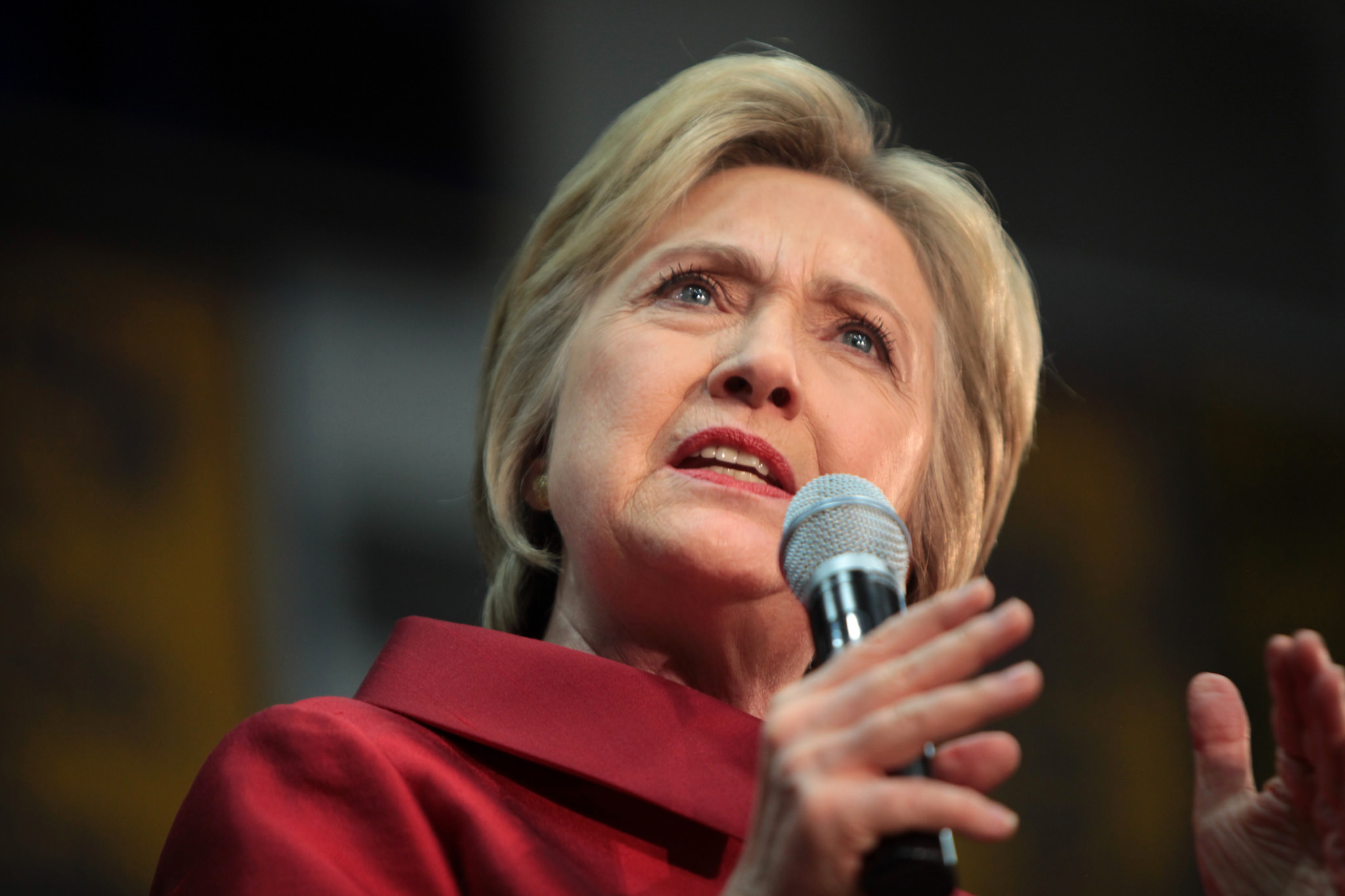
Hillary Clinton (Photo by Gage Skidmore)
The major U.S. news media quite openly moved to the forefront of the Resistance. The Washington Post adopted the melodramatic and hypocritical slogan, “Democracy Dies in Darkness,” as it unleashed its journalists to trumpet the narrative of some disloyal Americans spreading Russian propaganda. Darkness presumably was a fine place to stick people who questioned the Resistance’s Russia-gate narrative.
An early shot in this war against dissenting information was fired last Thanksgiving Day when the Post published a front-page article citing an anonymous group called PropOrNot smearing 200 Internet news sites for allegedly disseminating Russian propaganda. The list included some of the most important sources of independent journalism, including Consortiumnews.com, apparently for the crime of questioning some of the State Department’s narratives on international conflicts, particularly Syria and Ukraine.
Then, with the anti-Russia hysteria building and the censorship ball rolling, Congress last December approved $160 million for think tanks and other non-governmental organizations to combat Russian propaganda. Soon, reports and studies were flying off the shelves detecting a Russian behind every article, tweet and posting that didn’t toe the State Department’s line.
The New York Times and other leading news organizations have even cheered plans for Google, Facebook and other technology companies to deploy algorithms that can hunt down, marginalize or eliminate information that establishment media deems “fake” or “propaganda.” Already Google has put together a First Draft coalition, consisting of mainstream media and establishment-approved Web sites to decide what information makes the cut and what doesn’t.
Among these arbiters of truth is the fact-check organization PolitiFact, which judged the falsehood about “all 17 intelligence agencies” signing off on the Russian “hacking” claim to be “true.” Even though the claim was never true and is now clearly established as false, PolitiFact continues to assert that this lie is the truth, apparently filled with the hubris that comes with its power over determining what is true and what is false.
But what is perhaps most troubling to me about these developments is the silence of many civil liberties advocates, liberal politicians and defenders of press freedom who might have been counted on in earlier days to object to this censorship and blackballing.
It appears that the ends of taking down Donald Trump and demonizing Vladimir Putin justify whatever means, no matter the existential danger of nuclear war with Russia or the McCarthyistic (even Orwellian) threats to freedom of speech, press and thought.
Investigative reporter Robert Parry broke many of the Iran-Contra stories for The Associated Press and Newsweek in the 1980s.
Theresa May does Russophobia
By Neil Clark | RT | November 14, 2017
It was Dr Samuel Johnson who famously declared in 1775 that patriotism was the last refuge of the scoundrel. The 2017 variant is to make unsubstantiated claims about the ‘Russian threat’ to Western democracies.
In her speech at the Lord Mayor’s Banquet in the City of London on Monday evening, British Prime Minister Theresa May escalated the anti-Russian rhetoric still further with a deeply paranoid address that sounded as if it had been penned in 1953 by the late Senator Joe McCarthy during one of his drunken binges.
Any psychologists watching Mrs May would have had a field day identifying plenty of examples of what mind doctors call ‘projection’ – i.e. attributing to others what you are guilty of yourself. In fact every one of May’s claims against Russia can be more accurately applied to the UK and its closest allies.
The prime minister stated, “It is Russia’s actions which threaten the international order on which we all depend.”
Really, Mrs May? Was it Russia who illegally invaded Iraq in 2003, causing the deaths of up to 1 million people and the rise of Islamic State (IS, formerly ISIS/ISIL)? Was it Russia who destroyed Libya in 2011, turning the country with the highest HDI in Africa into a failed state and jihadist playground on the shores of the Mediterranean? Was it Russia who illegally bombed Yugoslavia, without UN approval, in 1999? Or Russia who backed radical jihadists – many of them linked to Al-Qaeda – to overthrow the Syrian government? In fact it was the US, the UK and its allies who did all these things. But let’s not mention them, shall we, prime minister?
May says her aim is “to defend the rules-based international order against irresponsible states that seek to erode it.” That’s just like the American gangster John Dillinger saying his aim in 1933 was “to defend banks against individuals who seek to rob them.”
The truth is that it’s been British governments – acting in tandem with the US – who have done most to erode international law in recent decades – and not Russia.
The prime minister boldly declared that “Russia has fomented conflict in the Donbass,” but it was the Americans and their NATO/EU allies who fomented conflict in Ukraine in 2014 by supporting and bankrolling an uprising against the democratically-elected government of Viktor Yanukovich – in which neo-Nazis and virulently anti-Russian ultra-Nationalists provided the cutting edge.
Concern over these developments among the Russian population of Ukraine led to a referendum, in which the people of Crimea overwhelmingly – and quite understandably – voted to return to Russia. The Maybot – who “consistently voted” for the illegal invasion of Iraq in 2002/3 – characterizes this exercise in democracy as “Russia’s illegal annexation of Ukraine.” If you’re going down this line, you may as well talk about “Britain’s illegal annexation of Gibraltar,” or the “UK invasion of the Isle of Wight.”
May declared that “Russia’s illegal annexation of Crimea was the first time since the Second World War that one sovereign nation has forcibly taken territory from another in Europe”. Well, that’ll be news to the people of Serbia who saw resource-rich Kosovo – the cradle of their civilization – forcibly taken away from them following a NATO bombing campaign.
May – like the good neocon she is – accuses Russian “state-run media” of planting “fake stories,” but interestingly fails to come up with a single example.
Well, I’m a kind soul, so let me help her. Here are some examples of ‘fake news’ – all of which have appeared in the Western media.
The fake news that Iraq possessed WMDs in 2003 – which led to the illegal invasion of that country and catastrophic consequences for the whole world. The fake news that Muammar Gaddafi was about to massacre the civilians of Benghazi in 2011 – which again led to another bloody Western military intervention. The fake news in 2010 and other times too that Iran was on the brink of developing a nuclear bomb. The fake news that Russians had hacked into the Vermont electricity grid. Or (no sniggering at the back, please) the news that Russia used ‘Pokemon GO’ to try to “sow division” in the run-up to the US election.
Is that enough examples of fake news for you Theresa, or would you like some more? Yes, fake news is threatening democracy, but its Western Establishment-approved and Establishment-disseminated fake news – the sort you read in neocon-approved ‘sensible newspapers’ and media outlets – which has caused the most damage. Where did those Iraqi WMDs get to, I wonder?
As for unsubstantiated accusations of Russian meddling in Western elections, again the chutzpah of Mrs May is off the scale. Britain and the US have seen it as their right to meddle in elections around the globe for decades. Political scientist Dov H. Levin calculated that the US attempted to influence foreign elections 81 times in the period 1946-2000, and that figure does not include support for military coups and other ‘regime change’ ops.
The UK has often been heavily involved in these nefarious anti-democratic schemes too – for example, in Iran in 1953 when Mohammed Mossadeq was toppled and in Yugoslavia in 2000. In his biography of Slobodan Milosevic, the ousted Yugoslav leader, Adam LeBor notes that over $70 million was paid to the anti-Socialist Serbian opposition – with the ‘Otpor‘ youth movement receiving much of the funding. “And who was behind Otpor?” LeBor writes, quoting a “high-level Serbian source.” The answer: “The US and Britain.” What a surprise.
Again, being accused by a prominent member of the UK Establishment of interfering in other countries’ elections is like being accused of tax evasion by Al Capone or being told to sit up straight by the Hunchback of Notre Dame. The hypocrisy is truly mind-boggling.
The prime minister, having accused the Kremlin of trying to “sow discord” in the West then came over all Churchillian, by declaring she had a “very simple message for Russia.”
“We know what you are doing. And you will not succeed. Because you underestimate the resilience of our democracies, the enduring attraction of free and open societies, and the commitment of Western nations to the alliances that bind us.”
Well, I and millions of Britons have a very simple message for Theresa May. We know what you are doing too. You are not ‘strong and stable’ but a weak and wobbly prime minister who is trying to distract us from the domestic failings of your own government by trying to scare us witless over a non-existent Russian threat. You are hoping that by raising the specter of the Big Bad Russian Bear we will forget about your promise to cap household energy bills, the scandal of rip-off train fares and the impact of cruel and heartless austerity policies on millions of people across the country. And ignore the fact that you’re giving the country absolutely no leadership or direction on the issue of Brexit.
The safety and security of Britain is indeed threatened, prime minister, not by the bogeyman Putin but by the disastrous policies that yours and other British governments have followed in recent years. Policies such as illegally invading Middle Eastern countries and backing violent jihadist groups to topple secular governments as in Libya and Syria. Or lifting control orders on terrorist organizations like the Libyan Islamic Fighting Group and allowing them to travel unhindered in and out of the country. Who was the British home secretary when that happened? Why, one Theresa May!
Ironically on the day that May was trying to give us sleepless nights about the Russian ‘threat,’ the BBC – the national state broadcaster – had revealed details of something truly nightmarish. Namely a secret deal which allowed some 250 fanatical IS fighters to safely leave the city of Raqqa – under the gaze of US and British-led forces.
We know too that the British authorities have said that Britons returning from formerly IS-held territories in Syria and Iraq should not be prosecuted. The security implications of these policies are very clear. Once again, who is it that’s putting British citizens’ lives at risk?
Follow Neil Clark @NeilClark66
Read more:
Russia’s Alleged Meddling in Catalan Vote: Playing the Blame Game

By Alex GORKA | Strategic Culture Foundation | 14.11.2017
Few people are able to recognize their own mistakes. Many prefer to deny the truth becoming willfully oblivious to obvious facts. Why assume responsibility if there is such a thing as blame shifting – a true-and-tried method to get away with it? Pointing a finger at someone else to divert attention serves the purpose. There is method to this madness and Western politicians have been resorting to the blame-shifting tactic increasingly often. Each and everything going awry in the world is the fault of Russia. The drive of peoples for independence is a good example. Take Catalonia to illustrate the point.
The Spanish government said on Nov.10 that it had noted news manipulation about the Catalan crisis on social media originating from Russia’s territory. Spain’s government spokesman Inigo Mendez de Vigo said disinformation on social networks was a “serious issue.” According to Spanish Defence Minister Maria Dolores de Cospedal, the government had established that “many messages and interventions via social networks come from Russian territory.” She did not offer any specific examples to confirm the affirmation. Foreign Minister Alfonso Dastis said there was evidence of activity by Russian networks and hackers. The trolls are said to be spreading misinformation across social media to further “destabilize” Spain and the EU.
The issue was even raised at the EU foreign and defense ministers meeting on Nov.13-14, where Spain briefed the EU on the alleged interference. The debate comes after eight member states urged EU foreign service chief Federica Mogherini to build up the counter-propaganda cell in her service.
Spanish media have many times attacked Russia Today (RT) and Sputnik Spanish language services for instigating tensions in Catalonia, supporting the separatist movement. El Pais daily wrote an editorial on Nov. 10 denouncing “the intense campaign by Russian media that are close to the Kremlin,” whose “propaganda machine” it accused of siding with the pro-independence movement.
NATO leadership chimed in. On Nov.9, US General Curtis Scaparrotti, the commander of NATO forces in Europe, called on Russia to stop “meddling” into European elections. He was concerned over Russia’s “malign influence” in other countries. The Atlantic Council, a US-based think-tank close to NATO, has published a report suggesting that Russia was seeking to meddle in support of Catalan independence and to discredit the Spanish central government’s position that the referendum on independence held on Oct. 1 was illegal. El Pais, the Washington Times and Politico all issued publications alleging that an army of Russian bots had perfected their techniques of online influence and thus ensured the October 1 vote went down the path of separation.
If the accusations were true, it would mean that Russia-backed media networks operate to undermine Russia’s official position on the issue made clear in a Foreign Ministry’s statement. Russia has consistently voiced its respect for Spain’s territorial integrity.
Can anyone of sane mind believe that Russia’s “meddling” is the real reason to make over 40 percent of Catalans support independence? Has Russia been behind the 95-year-old independence movement in Catalonia? Has Russia made the Catalans’ language and culture distinct? Did Russia make Francisco Franco oppress the Catalan people? Has Russia provoked the economic crisis in Spain, which has served to magnify calls for Catalan independence? Has Russia made Catalans believe that the current tax structure is unfair? Has Russia made Madrid unwilling to renegotiate Catalonia’s autonomy agreement? Has Russia written Spain’s constitution, which expressly prohibits a region from breaking away unilaterally? Did Moscow order Spanish police to use brutal force, while preventing the unconstitutional vote? If it didn’t count, why take such pains to stop it?
Several world leaders and political figures condemned the violence specifically. Did Russia make them do it? Did Russia make the EU abstain from mediation effort? And, finally, does Russia stand to gain from an independent Catalonia?
With many publications on the issue, no evidence has been produced to demonstrate a link between the Russian government and Catalonia vote. Obviously, the use of the “Russian meddling” narrative seems to work as a distraction from the wrongdoing of the Spanish government. The fantasy provides a convenient scapegoat to avoid responsibility of the Spanish government for missing opportunities to launch meaningful political dialogue with Catalonia and mishandling of the vote. Spain is by far not the only country to use the narrative to its own advantage. As Karl Sharro, a well-known British architect and satirist, commented on the results of UK elections, “The most disappointing thing about the UK election is there wasn’t even a hint of Russian interference. It’s like we don’t matter at all.”
Spanish Government Blames Russian “Dezinformatsiya” Campaign For Catalan Uprising
No, not The Onion…
By Tyler Durden | Zero Hedge | November 11, 2017
In what is perhaps the least surprising tactic from the Spanish establishment, a government-backed research institute in Madrid has stated that Spain’s struggle to quash separatism in its Catalonia region was disrupted by Russian hackers agitating for a break-up, in a hallmark propaganda effort to fracture Europe.
As Bloomberg reports, the unidentified Russians spread both true and false messages on Facebook and Twitter during the illegal separatist referendum on Oct. 1, according to Mira Milosevich, a senior analyst at the Elcano Royal Institute.
The “dezinformatsiya” campaign deployed trolls, bots and fake accounts, and was backed by intense coverage from Russia’s state-supported television, she said.
“Russia has a nationalist agenda, and it supports nationalist, populist movements in Europe because that serves to divide Europe,” Milosevich said Wednesday in an interview.
The researcher had just published an article building on a Sept. 25 El Pais newspaper report that linked fake news on Catalonia with allegations of Russian influence in the Brexit campaign.
Elcano is part-funded by the Spanish government and its board’s honorary chairman is King Felipe VI.
Milosevich further claims that the most significant comments spread on Twitter and Facebook came from WikiLeaks editor Julian Assange and government-secrets leaker Edward Snowden, Milosevich said, particularly that the “banana republic” of Spain used violence to suffocate a democratic vote.
For his Twitter profile photo, Assange is using a shot of Spanish riot police, clad in black protective gear, with one of them swinging his baton.
“What is happening in Catalonia is the most significant Western conflict between people and state since the fall of the Berlin Wall — but its methods are 2017, from VPNs, proxies, mirrors and encrypted chat to internet surveillance and censorship, bot propaganda and body armor,” Assange tweeted the day before the Oct. 1 separatist vote.
And os there it is – the Catalans – who have been fighting for independence for centuries, were tricked by Russian trolls (thanks to enemies of the state Snowden and Assange) into voting for secession… we have no words.
Ominous Russophobia in America
By Stephen Lendman | November 12, 2107
It infests America like a malignant tumor, exceeding the worst of the post-WW I “Red Scare” and its repeat following WW II.
Beginning in 1938, House Un-American Activities Committee witch-hunt hearings into alleged disloyalty and subversive activities became headline news.
Starting in the late 1960s, more of the same followed by the renamed House Committee on Internal Security.
Notorious McCarthyism in the 1950s was a demagogic smear campaign against prominent figures, slandering them, ruining careers, even accusing General George Marshall of being “soft on communism.”
Notable Hollywood figures were blacklisted. McCarthyism was baseless slander, unscrupulous fear-mongering, and political lynchings.
Harvard Law School dean Ervin Griswold once called McCarthy “judge, jury, prosecutor, castigator, and press agent, all in one.”
Modern-day Russophobia includes a second Cold War, Russia under Vladimir Putin again considered the “evil empire,” relentless Washington and media Russian bashing, along with endless congressional and special counsel witch-hunt investigations suggesting the worst, revealing nothing.
Russia expert Stephen Cohen said “(w)e’re in the most dangerous confrontation with Russia since the Cuban missile crisis.”
He underestimated the threat. It’s much worse now than then. Jack Kennedy explained he “never had the slightest intention of” attacking or invading Cuba.”
Obama was no Jack Kennedy. Nor is Trump, his administration and Congress infested with neocons, Democrats as ruthlessly dangerous as Republicans.
The late political theorist Sheldon Wolin once called undemocratic Dems the “inauthentic opposition,” as infested with neoliberal Russophobic neocons as the Republican party.
Virtually everyone in Washington is part of the anti-Russia crowd, Bernie Sanders among them, a progressive in name only.
Sanders sounded like a modern-day Joe McCarthy, shamefully claiming “the evidence is overwhelming” that Russia “help(ed) elect the candidate of their choice, Mr. Trump, to undermine in a significant way American democracy.”
In a YouTube video, he repeated the Big Lie, saying “the US intelligence community has concluded that Russia played an active role in the 2016 election with the goals of electing Donald Trump as president.”
“The Trump campaign had repeated contacts with the senior Russian intelligence officials in the year before the election.”
The phony “dossier” showed Russian agents able to “blackmail” the White House. Like most others in Congress, Sanders is a cold and hot warrior, a self-serving con man, supporting wealth, power and privilege like the rest of Washington’s political establishment, pretending otherwise.
Feelthebern.org states:
“Bernie supports enforcing economic sanctions and international pressure as an alternative to any direct military confrontation when dealing with Russia.”
“To temper Russian aggression, we must freeze Russian government assets all over the world, and encourage international corporations with huge investments in Russia to divest from that nation’s increasingly hostile political aims.”
“The United States must collaborate to create a unified stance with our international allies in order to effectively address Russian aggression.”
“(T)he United States should isolate Putin politically and economically…The entire world has got to stand up to Putin.”
Shocking stuff, exposing the real Bernie Sanders, not the persona he publicly displays!
Former CIA counterintelligence official/whistleblower John Kiriakou was invited to participate in a European Parliament panel – then removed at the last moment because panelist Winnie Wong, co-founder of People for Bernie, refused to appear with him, Kiriakou saying:
“(S)he didn’t want the appearance of Bernie Sanders appearing to endorse the Russian media.”
Kiriakou hosts a Sputnik News radio show called Loud & Clear, why she objected, supporting Sanders’ Russophobia.
Kiriakou remarked saying “American politics rear(ed) its ugly head in Brussels.” No problems arose when he appeared on another panel with Cuba’s EU ambassador.
It’s the “red scare all over again,” Kiriakou explained. Anything remotely connected to Russia is toxic. Failing to be Russophobic in Washington is a likely career-ender, much like what happens to Israeli critics.
Intense anti-Russian sentiment in America risks the unthinkable – possible catastrophic nuclear war, humanity’s survival at stake.
Mocking Trump Doesn’t Prove Russia’s Guilt
By Ray McGovern | Consortium News | November 13, 2107
If the bloody debacle in Iraq should have taught Americans anything, it is that endorsements by lots of important people who think something is true don’t amount to evidence that it actually is true. If endorsements were the same as evidence, U.S. troops would have found tons of WMD in Iraq, rather than come up empty.
So, when it comes to whether or not Russia “hacked” Democratic emails last year and slipped them to WikiLeaks, just because a bunch of people with fancy titles think the Russians are guilty doesn’t compensate for the lack of evidence so far evinced to support this core charge.
But the reaction of Official Washington and the U.S. mainstream media to President Trump saying that Russian President Vladimir Putin seemed sincere in denying Russian “meddling” was sputtering outrage: How could Trump doubt what so many important people think is true?
Yet, if the case were all that strong that Russia did “hack” the emails, you would have expected a straightforward explication of the evidence rather than a demonstration of a full-blown groupthink, but what we got this weekend was all groupthink and no evidence.
For instance, on Saturday, CNN responded to Trump’s comment that Putin seems to “mean it” when he denied meddling by running a list of important Americans who had endorsed the Russian-guilt verdict. Other U.S. news outlets and politicians followed the same pattern.
Rep. Adam Schiff of California, the ranking Democrat on the House Intelligence Committee and a big promoter of the Russia-gate allegations, scoffed at what Trump said: “You believe a foreign adversary over your own intelligence agencies?”
The Washington Post’s headline sitting atop Sunday’s lede article read: “Trump says Putin sincere in denial of Russian meddling: Critics call that ‘unconscionable.’”
Sen. Mark Warner of Virginia, the ranking Democrat on the Senate Intelligence Committee and another Russia-gate sparkplug, said he was left “completely speechless” by Trump’s willingness to take Putin’s word “over the conclusions of our own combined intelligence community.”
Which gets us back to the Jan. 6 “Intelligence Community Assessment” and its stunning lack of evidence in support of its Russian guilty verdict. The ICA even admitted as much, that it wasn’t asserting Russian guilt as fact but rather as opinion:
“Judgments are not intended to imply that we have proof that shows something to be a fact. Assessments are based on collected information, which is often incomplete or fragmentary, as well as logic, argumentation, and precedents.”
Even The New York Times, which has led the media groupthink on Russian guilt, initially published the surprised reaction from correspondent Scott Shane who wrote: “What is missing from the public report is what many Americans most eagerly anticipated: hard evidence to back up the agencies’ claims that the Russian government engineered the election attack. … Instead, the message from the agencies essentially amounts to ‘trust us.’”
In other words, the ICA was not a disposition of fact; it was guesswork, possibly understandable guesswork, but guesswork nonetheless. And guesswork should be open to debate.
Shutting Down Debate
But the debate was shut down earlier this year by the oft-repeated claim that all 17 U.S. intelligence agencies concurred in the assessment and how could anyone question what all 17 intelligence agencies concluded!
However, that canard was finally knocked down by President Obama’s own Director of National Intelligence James Clapper who acknowledged in sworn congressional testimony that the ICA was the product of “handpicked” analysts from only three agencies – the CIA, FBI and National Security Agency.
In other words, not only did the full intelligence community not participate in the ICA but only analysts “handpicked” by Obama’s intelligence chiefs conducted the analysis – and as we intelligence veterans know well, if you handpick the analysts, you are handpicking the conclusions.
For instance, put a group of analysts known for their hardline views on Russia in a room for a few weeks, prevent analysts with dissenting viewpoints from weighing in, don’t require any actual evidence, and you are pretty sure to get the Russia-bashing result that you wanted.
So why do you think Clapper and Obama’s CIA Director John Brennan put up the no-entry sign that kept out analysts from the State Department and Defense Intelligence Agency, two entities that might have significant insights into Russian intentions? By all rights, they should have been included. But, clearly, no dissenting footnotes or wider-perspective views were desired.
If you remember back to the Iraq WMD intelligence estimate, analysts from the State Department’s intelligence bureau, known as INR, offered unwelcome dissenting views about the pace of Iraq’s supposed nuclear program, inserting a footnote saying they found it too difficult to predict the fruition of a program when there was no reliable evidence as to when – not to mention if – it had started.
DIA also was demonstrating an unusually independent streak, displaying a willingness to give due consideration to Russia’s perspective. Here’s the heterodox line DIA took in a major report published in December 2015:
“The Kremlin is convinced the United States is laying the groundwork for regime change in Russia, a conviction further reinforced by the events in Ukraine. Moscow views the United States as the critical driver behind the crisis in Ukraine and the Arab Spring and believes that the overthrow of former Ukrainian President Yanukovych is the latest move in a long-established pattern of U.S.-orchestrated regime change efforts.”
So, not only did the Jan. 6 report exclude input from INR and DIA and the other dozen or so intelligence agencies but it even avoided a fully diverse set of opinions from inside the CIA, FBI and NSA. The assessment – or guesswork – came only from those “hand-picked” analysts.
It’s also worth noting that not only does Putin deny that Russia was behind the publication of the Democratic emails but so too does WikiLeaks editor Julian Assange who has insisted repeatedly that the material did not come from the Russians. He and others around WikiLeaks have strongly suggested that the emails came as leaks from Democratic insiders.
Seeking Real Answers
In the face of Official Washington’s evidence-free groupthink, what some of us former U.S. intelligence analysts have been trying to do is provide both a fuller understanding of Russian behavior and whatever scientific analysis can be applied to the alleged “hacks.”
Forensic investigations and testing of relevant download speeds, reported by members of Veteran Intelligence Professionals for Sanity (VIPS), have undermined the Russia-did-it groupthink. But this attempt to engage in actual evaluation of evidence has been either ignored or mocked by mainstream news outlets.
Still, the suggestion in our July 24 VIPS memo that President Trump ask current CIA Director Mike Pompeo to take a fresh look at the issue recently had some consequence when Pompeo contacted VIPS member William Binney, a former NSA Technical Director, and invited him to explain his latest research on the impossibility of the Russians extracting the Democratic emails via an Internet hack based on known download speeds.
In typically candid terms, Binney explained to Pompeo why VIPS had concluded that the intelligence analysts behind the Jan. 6 report had been making stuff up about Russian “hacking.”
When news of the Binney-Pompeo meeting broke last week, the U.S. mainstream media again rejected the opportunity to rethink the Russia-did-it groupthink and instead treated Binney as some sort of “conspiracy theorist” with a “disputed” theory, while attacking Pompeo’s willingness to discuss Binney’s findings as “politicizing intelligence.”
Despite the smearing of Binney, President Trump appears to have taken some of this new evidence to heart, explaining his dispute with open-mouthed White House reporters on Air Force One who baited Trump with various forms of the same question: “Do you believe Putin?” amid the new jeering about Trump “getting played” by Putin.
Trump’s demeanor, however, suggested increased confidence that the Russian “hacking” allegations were the “witch hunt” that he has decried for months.
Trump also jabbed the press over its earlier false claims that “all 17 intelligence agencies” concurred on the Russian “hack.” And Trump introduced the idea of a different kind of “hack,” i.e., Obama’s political appointees at the heads of the agencies behind the Jan. 6 report.
Trump said, “You hear it’s 17 agencies. Well it’s three. And one is Brennan … give me a break. They’re political hacks. … I mean, you have Brennan, you have Clapper, you have [FBI Director James] Comey. Comey is proven to be a liar and he’s proven to be a leaker.”
Later, in deference to those still at work in intelligence, Trump said, “I’m with our [intelligence] agencies as currently constituted.”
While Trump surely has a dismal record of his own regarding truth-telling, he’s not wrong about the checkered record of the triumvirate of Clapper, Brennan and Comey.
Clapper played a key role in the bogus Iraq-WMD intelligence when he was head of the National Geo-spatial Agency and hid the fact that there was zero evidence in satellite imagery of any weapons of mass destruction before the Iraq invasion. When no WMDs were found, Clapper told the media that he thought they were shipped off to Syria.
In 2013, Clapper perjured himself before Congress by denying NSA’s unconstitutional blanket surveillance of Americans. After evidence emerged revealing the falsity of Clapper’s testimony, he wrote a letter to Congress admitting, “My response was clearly erroneous – for which I apologize.” Despite the deception, he was allowed to stay as Obama’s most senior intelligence officer for almost four more years.
Clapper also has demonstrated an ugly bias about Russians. On May 28, as a former DNI, Clapper explained Russian “interference” in the U.S. election to NBC’s Chuck Todd on May 28 with a tutorial on what everyone should know about “the historical practices of the Russians.” Clapper said, “the Russians, typically, are almost genetically driven to co-opt, penetrate, gain favor, whatever, which is a typical Russian technique.”
Brennan, who had previously defended torture as having been an effective way to gain intelligence, was CIA director when agency operatives broke into the computers of the Senate Intelligence Committee when it was investigating CIA torture.
Former FBI Director Comey is infamous for letting the Democratic National Committee arrange its own investigation of the “hacking” that was then blamed on Russia, a development that led some members of Congress to call the supposed “hack” an “act of war.” Despite the risk of nuclear conflagration, the FBI didn’t bother to do its own forensics.
And, by his own admission, Comey arranged a leak to The New York Times that was specifically designed to get a Special Prosecutor appointed to investigate Russia-gate, a job that fell to his old friend Robert Mueller, who has had his own mixed record as the previous FBI director in mishandling the 9/11 investigation.
There are plenty of reasons to want Trump out of the White House, but there also should be respect for facts and due process. So far, the powers-that-be in Washington – in politics, the media and other dominant institutions, what some call the Deep State – have shown little regard for fairness in the Russia-gate “scandal.”
The goal seems to be to remove the President or at least emasculate him on a bum rap, giving him the bum’s rush, so to speak, while also further demonizing Russia and exacerbating an already dangerous New Cold War.
The truth should still count for something. No one’s character should be assassinated, as Bill Binney’s is being now, for running afoul of the conventional wisdom that Trump – like bête noire Putin – never tells the truth, and that to believe either is, well, “unconscionable,” as The Washington Post warns.
Ray McGovern was a CIA intelligence analyst for 27 years and is co-founder of Veteran Intelligence Professionals for Sanity.
Putin says claims of Russian intervention in US presidential election mere ‘fantasies’
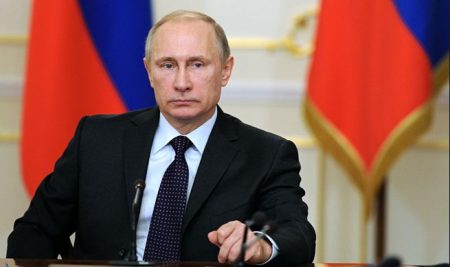
Press TV – November 11, 2017
Russian President Vladimir Putin has once again strongly rejected claims that Moscow interfered in the 2016 US presidential election in favor of Donald Trump, saying these allegations are mere “fantasies.”
The Russian leader made the remarks at a news briefing on the sidelines of the annual summit of the Asia-Pacific Economic Cooperation (APEC) in the Vietnamese city of Da Nang on Saturday, less than a year after US intelligence agencies made the allegations against the Kremlin, which has since vehemently denied the charges.
“Everything about the so-called Russian dossier in the US is a manifestation of continuing domestic political struggle,” Putin told reporters at the Asia-Pacific summit in the Southeast Asian country, adding that he was well “aware” of the increasing probe regarding contacts between Trump’s team members and Russians, including a woman who has claimed to be Putin’s niece.
“Regarding some sort of connections of my relatives with members of the administration or some officials, I only found out about that yesterday from (spokesman Dmitry) Peskov,” the Russian president further said, asserting that he does not know anything about it. “I think these are some sort of fantasies,” Putin added.
Back in January, American intelligence agencies claimed that Russia interfered in the 2016 election to try to help Trump, the current president of the United States, defeat Democratic nominee Hillary Clinton. They alleged at the time that Moscow’s interference included a campaign of hacking and releasing embarrassing emails, and disseminating propaganda via social media to discredit Clinton’s campaign.
Special counsel Robert Mueller, appointed by the US Justice Department, is tasked with investigating Russia’s alleged meddling in the election.
Trump, for his part, has long denied any collusion between his campaign and Russian operatives during last year’s White House race, which led to his rival Hillary Clinton’s loss.
On Saturday, after briefly meeting with Putin at the summit, Trump said that the Russian leader felt insulted by persisting allegations of Moscow’s meddling in the US vote.
“You can only ask so many times… he (Putin) said he absolutely did not meddle in our election,” the US president said, adding that Putin was “very insulted by it, which is not a good thing for our country.”
As he was heading to the Vietnamese capital, Hanoi, Trump also told reporters that President Putin had personally told him that “he didn’t meddle.”
“He said he didn’t meddle. I asked him again,” Trump said.
Elsewhere in his remarks, the Russian president vowed that Moscow would adopt “reciprocal” measures in response to US steps against RT America, which he called an “attack on freedom of speech.”
His comments came a day after the US Department of Justice ordered that by Monday, the company that provides all services for RT America in the US has to register under the Foreign Agents Registration Act (FARA), adding that in case of any disobedience, the news channel’s head may be held in police custody and its accounts could be frozen.
The so-called US legislation was passed in 1938 to counter Nazi propaganda on the American soil. More than 400 entities, but no media outlet, are currently registered under the act.
“I want to draw your attention to the fact that there wasn’t and could not be any confirmation of our media’s meddling in the [US] election campaign,” Putin said, adding that the latest probe in US Congress showed that the Russian ads amounted merely to “some tenths or hundredths of a percent” in comparison to those carried by the US media in the course of the 2016 election.
The annual APEC summit is one of the largest gatherings on the annual diplomatic calendar, bringing together scores of world leaders and more than 2,000 CEOs. APEC represents 21 Pacific Rim economies, the equivalent of 60 percent of global GDP and covering nearly three billion people, and has pushed for freer trade since its inception in 1989.
‘Coup d’Etat’: As RussiaGate Probe Staggers On, Legal Fees Drown Trump Advisers
Sputnik – November 10, 2017
Many key figures in Donald Trump’s presidential campaign have incurred sizeable legal fees as a result of ongoing investigations into allegations of Russian meddling in the 2016 US election. Adviser Roger Stone has gone so far as to email supporters asking for financial assistance.
Roger Stone, longtime adviser to US President Donald Trump, is allegedly facing almost US$460,000 in legal fees incurred, since landing in the cross hairs of federal and congressional investigations into alleged Russian interference in the 2016 US election.
In a 1,600 word statement emailed to press and supporters, Stone called special counsel Robert Mueller a “deep state vigilante” and “executioner” who was “busy casting about for anything he can latch onto.”
He is “certain” Mueller intends to “remove” the president from office, in collusion with Democrats, “many of whom are openly plotting a literal coup d’etat against the President of the United States.”
”I am not a wealthy man, by any means. Such crushing expense, with nothing to show for it except my vindication against a juggernaut of political dirty tricks and lies, threatens to destroy me and my family financially — all because I fought to elect Donald Trump. All because the deep state partisans know I will continue fighting for his agenda,” Stone wrote.
Stone, whose contact with hacker Guccifer 2.0 and WikiLeaks founder Julian Assange before the election has come under scrutiny in the investigations, said it cost him U$400,000 in legal fees to prepare for his September testimony before the House Intelligence Committee — a probe he called at the time a “political exercise.”
Stone admitted to speaking to both, but argued his communications were entirely proper and legal, and not part of any effort to collude with a foreign power. While he refused to name the person who connected him with Assange, he said it was a journalist, who he couldn’t name a their conversation was “off record.”
Stone is also a “person of interest” to Senate Intelligence Committee investigators, but they are yet to formally invite Stone to testify.
“I’ve yet to testify before the US Senate Intelligence Committee and anticipate the legal representation I require for that exchange will easily put my legal bills even closer to the million dollar mark. I hope you will consider contributing anything you can. If you can do so, your contribution of $25, $50, $100, $250, $500, $1000 or more would be a Godsend,” Stone added.
Wide Net
Stone is not the only individual in the president’s circle of trustees facing sky-high legal fees as a result of the investigation.
JD Gordon, national security official on the Trump campaign, told Business Insider while Trump’s reelection campaign and the Republican National Committee were “taking care” of the president and his son Donald Trump Jr., “the rest of us who aren’t billionaires must fend for ourselves.” Federal Election Commission filings showed the Trump campaign spent over US$1.1 million on legal fees July — October.
“In my case, representing the campaign to speak to a group of over 50 foreign ambassadors during the RNC in Cleveland, combined with ensuring our campaign’s national security policies were reflected in the GOP platform the week prior, have led to nearly five-figure personal legal bills,” he said.
Gordon in particular has been quizzed about the watering down of an amendment to Republican policy on Ukraine in July 2016 — originally, it proposed the GOP commit to sending “lethal weapons” to the Ukrainian army, but the wording was altered to “appropriate assistance” in the party’s official platform.
Another Trump campaign adviser, Michael Caputo, has been forced to take US$30,000 out of his children’s college fund to pay for lawyers — he is a person of interest apparently due to his Ukrainian wife, and previous work as a media consultant in Russia during the 1990s.
The family of former national security adviser Michael Flynn has also set up a defense fund in September, to pay legal fees that may exceed US$1 million.
Coup D’etat
Republican Matt Gaetz of Florida has introduced legislation pressuring Mueller to resign — and in a speech on the House floor November 8, he suggested the US was “at risk of a coup d’etat.”
“We are at risk of a coup d’etat in this country if we allow an unaccountable person [Mueller] with no oversight to undermine the duly-elected president of the United States. That is precisely what is happening right now with the indisputable conflicts of interest that are present with Mueller and others at the Department of Justice,” he said
Gaetz has also called for a special prosecutor to investigate the Uranium One scandal, the Clinton Foundation, and research firm Fusion GPS, which produced the “dodgy dossier” alleging Trump-Russia collusion, which was paid for by Obama for America’s law firm, the Democratic National Committee (DNC), and the Hillary Clinton presidential campaign.
Back to the future… NATO self-fulfilling war plans for Russia
By Finian Cunningham | RT | November 10, 2017
Defense ministers of the US-led NATO alliance this week endorsed proposals to set up two new military commands – and it is clear Russia is the target of what are, in effect, war plans.
The setting up of an Atlantic command and a logistical hub in Europe to facilitate the transfer of troops and weapons was openly discussed by NATO officials as being aimed at Russia during their two-day summit in Brussels this week.
The two new commands being proposed are the first expansion of NATO’s command structure since the end of the Cold War more than 25 years ago. It’s a retrograde move that is not only an unnecessary, dangerous provocation to Russia, risking self-fulfilling war threats. Moreover, NATO’s renewed organizational cranking is openly calling for the integration of European societies and economies into its madcap military escalation.
European citizens, whether they like it or not, are effectively being dragooned into a state of war, with attendant social burdens to pay for that state of war, let alone being made to live with the risk of ultimate catastrophe, from all-out hostilities erupting.
Alexander Grushko, Russia’s official on NATO matters, said: “It is evident now that, by making such decisions, NATO members are apparently inspired by Cold War-era strategies.” He added: “It is evident that the task of confrontation with Russia lies at the core of those efforts.”
Grushko also put the new NATO organizational expansion in the context of an ongoing aggressive buildup over several years carried out by the US-led military alliance along Russia’s borders.
In typical fashion, however, Western news media readily turned reality on its head by echoing NATO officials in their justification for the planned military expansion as being (allegedly) necessitated by “Russian aggression.”
Reuters called the new command posts a “deterrent factor against Russia.” While US government-run Radio Free Europe said, the expansion was “to counter the growing threat from Russia.”
Western media gave NATO Secretary-General Jens Stoltenberg free rein to accuse Russia of “attacking” Ukraine, “annexing” Crimea, and recently holding threatening war maneuvers on “NATO’s eastern flank.” The latter was a reference to the Zapad military defense exercises carried out by Russia every four years – held on its own territory or that of an ally. Idiotic “NATO’s eastern flank” made apparently intelligible by Western media.
As befitting a propaganda service, rather than news services, the Western media uniformly omit any mention of how NATO states were instrumental in staging a coup d’état in Ukraine in February 2014, overthrowing an elected government back then with neo-Nazis who had designs on viciously suppressing ethnic Russians in Crimea and eastern Ukraine.
RFE reported: “Russia occupied and seized Ukraine’s Crimean Peninsula in March 2014 and backs separatists whose war against Kiev’s forces has killed more than 10,000 people in eastern Ukraine since April of that year.”
Note how Russia and separatists are subtly blamed for killing 10,000 people.
RFE added: “A series of potentially dangerous close encounters between Russian and NATO warplanes and navy ships in recent months has added to the tension, with the alliance accusing Moscow of aggressive maneuvers in the air and at sea.
Well, perhaps “close encounters” would not happen if the NATO alliance could refrain from its escalation of warplanes and navy patrols in the Baltic and Black Seas.
Stoltenberg “explained” the purpose of NATO’s two new command structures. “It is about how to move [American] forces across the Atlantic and how to move forces across Europe,” he said.
He added: “We have been very focused on out-of-area expeditionary military operations, now we have to… increase the focus on collective defense in Europe, and that’s the reason why we are adapting the command structure.”
You have to admire the former Norwegian prime minister’s verbal skills for euphemism. By “out-of-area expeditionary military operations,” he was referring to US-led NATO wars in Afghanistan, Iraq, and Libya, among other overseas operations, which have resulted in the destruction of nation-states, over a million civilian deaths, the spread of terrorism and the chaos of mass human displacement and refugees.
Now by “increasing focus on the defense of Europe,” the 29-member NATO club – officially charged with maintaining security – will be further ratcheting up tensions with Russia to the point where an outbreak of war is a grave risk.
Earlier, Stoltenberg claimed that the world was more dangerous than ever since the end of the Cold War. Provocatively, and recklessly, he cited “Russian aggression” alongside North Korea’s nuclear program and international terrorism as the three reasons for his morbid outlook.
“We have proliferation of weapons of mass destruction in North Korea, we have terrorists, instability, and we have a more assertive Russia. It is a more dangerous world,” said Stoltenberg in an interview with Britain’s Guardian newspaper, which, of course, did not challenge any of his assertions.
Perhaps if US President Donald Trump were to hold a full summit with Russian counterpart Vladimir Putin, the de facto leader of NATO might get Russia’s perspective and assurance that it has no such malicious plans for “invading Europe.”
But such is the relentless Russophobia and media hysteria over “Russian aggression” that Trump and Putin – the leaders of the two most powerful nuclear states – are confined to only having a glancing conversation on the sidelines of international summits, such as the APEC conference in Vietnam this week.
Last month, German publication Der Spiegel reported on a secret NATO document which showed the alliance “is preparing for a possible war with Russia.” Such is the irremediable propaganda spouted by NATO officials and regurgitated by Western media that these war plans are becoming self-fulfilling.
What is even more sinister is that NATO is militarizing the entire European society and civilian infrastructure to accommodate its ludicrous war mania. At the summit this week in Brussels, NATO officials said European governments and the private sector must coordinate policies, infrastructure, and laws to be able to facilitate the new transmission belt of military operations from the Atlantic to Russia’s borders.
Jens Stoltenberg said “any new command must ensure that legislation easing the transportation of troops and equipment across various national borders is fully implemented.”
He added: “And we need to improve infrastructure, such as roads, bridges, railways, runways, and ports. So NATO is now updating the military requirements for civilian infrastructure.”
So, let’s get this straight: in an era of economic austerity when the European public is being clobbered with cutbacks and hardships, the NATO military machine wants governments to orient society and infrastructure to serve its war objectives against Russia.
The irrational, insatiable NATO wants to turn Europe into an entire garrison for war with Russia – a war which the majority of European citizens do not want or believe is in any way based on credible reasons.
NATO is not just going back to the future by revamping old Cold War strategies and Russophobia. It is destroying the future for European democratic and social development. Even more dastardly, it could obliterate the future by driving recklessly toward a wholly unnecessary war with Russia.
Finian Cunningham (born 1963) has written extensively on international affairs, with articles published in several languages. Originally from Belfast, Ireland, he is a Master’s graduate in Agricultural Chemistry and worked as a scientific editor for the Royal Society of Chemistry, Cambridge, England, before pursuing a career in newspaper journalism. For over 20 years he worked as an editor and writer in major news media organizations, including The Mirror, Irish Times and Independent. Now a freelance journalist based in East Africa, his columns appear on RT, Sputnik, Strategic Culture Foundation and Press TV.
British Journalist’s Press Pass Could Be Revoked Over Comments for Russian Media
Sputnik – November 10, 2017
The Chief Editor of the UK magazine Politics First Marcus Papadopoulos told Sputnik on Thursday that he was affronted by the proposal to revoke his press pass to the UK parliament because of his regular appearance as an expert and analyst in Russian media.
On Thursday, The Times newspaper published an article in which two members of parliament from the Labour Party, Alison McGovern and John Woodcock, proposed that “Russian propagandist” Papadopoulos should be deprived of his press pass to the UK parliament. The politicians accused Papadopoulos of “spending much of his time on Russian and Iranian state broadcasters espousing ‘propaganda from a foreign power'”.
“This is an appalling and reprehensible attempt by British politicians and journalists to silence debate. At stake is here is freedom of speech in Britain… The allegations against me are utterly untrue and are politically motivated,” Papadopoulos said.
Papadopoulos noted that the Labour Party politicians who criticized him were “vehemently anti-Russian” and made such accusations because he had an opposite view on the UK and the US policy on Russia and Syria.
“The two Labour MPs in question, who made this baseless accusation, are on the right of the Labour Party — being heavily involved in the right-wing pressure group, Progress — and are vehemently anti-Russian and staunch supporters of the terrorist groups in Syria. That is the real reason for their complaint about me. Because I hold a diametrically opposed view of British and American foreign policy concerning Russia and Syria,” Papadopoulos said.
Papadopoulos added that McGovern and Woodcock were fierce critics of Jeremy Corbyn, the Labour Party leader, and are unpopular among the party’s members.
Featured Video

Death Spikes & Rising Cancer In Our Youth Explained
or go to
Aletho News Archives – Video-Images
From the Archives
Politicians lie
By Mazin Qumsiyeh | Popular Resistance | August 18, 2013
There is no way to say this truth nicely: Politicians lie. That includes Japanese, American, Egyptian, Israeli, and Palestinian politicians! Is there something more common sense than that? Yet, so many citizens around the world believe their own politicians or wistfully acknowledge lies but think it is part of the job needed to run things. They believe even when politicians contradict themselves blatantly. This phenomenon is rather remarkable. It is a dissonance and disconnect from reality that many seem oblivious to. It is very dangerous because it can lead to accepting rationales for going to war. These can be deadly wars that lead to millions of lives lost as happened in what was called World War 1 and WW2. Even when incredible and declassified evidence abound, politicians continue to lie and old mythologies refuse to die. Here are just a few of the countless lies told to us over the past few decades… continue
Blog Roll
 Aletho News
- From Unipolar Universalism to Multipolar Civilizational Distinctiveness
- RSF military group defects, joins Sudanese army: State media
- Ireland goalkeeper refuses to play ‘Israel’ as squad weighs boycott
- China pushes back against US on Cuba, Iran
- Ukrainian Soldiers, Potential Mercenaries: Have Gun, Will Travel!
- Burnham’s UN debut… A masterclass in British disinformation
- Iran flights continue despite US aviation sanctions
- Global Tipping Points Lead the World Into a State of Entropy
- The day-after at the White House: USA and Xi Jinping
- The Geopolitical Balance in the Red Sea: The UAE Being Displaced by New Players
- If Americans Knew
- Deconstructing Netanyahu’s pants-on-fire UN rant – Daily Update
- Trump betrayed voters with his campaign lies and prioritized a foreign country once he took office
- Netanyahu calls Israel’s war in Gaza ‘opposite of genocide’ in UN speech to near-empty hall
- Settler Kidnappings: Torture, Sexual Abuse and Terrorisation of Palestinian Abductees as Israel Deepens Annexation of West Bank
- Gaza winter nears as 162,000 tents become unusable, raising fears of humanitarian crisis
- Netanyahu says, “It’s the opposite of genocide”; UN says Gaza economy is world’s ‘most severe crisis on record’ – Daily Update
- Israel’s US-Backed Assault on Gaza Has Created the ‘World’s Most Severe Economic Crisis on Record’: UN
- ‘Protecting U.S. Citizens’… From Israel
- ‘This is where I live now, the back of a truck’: a day in the life of a grandmother in Gaza
- In UN Speech, Iran’s President Displays Pictures of Children Killed by US, Brings Attention to Israel’s Nuclear Arsenal
- No Tricks Zone
- New Study: Earth And Venus Surface Warmth Largely Explained By Convection And Lapse Rate, Not CO2 Or Radiation
- 2025 Nature Paper Claiming Worsening Global Drought Gets RETRACTED …Heavily Flawed
- New Study: ‘Global Drought Shows No Detectable Recent Acceleration Under Climate Warming’
- Economic Masterminds: German Socialists Suggest Taxing Productivity Gains Stemming From Using AI
- The South China Sea Has Not Been Cooperating With The Climate Change Narrative
- Energy Crisis: Germany Enters Heating Season With Historically Low Gas Reserve Fill Levels
- New Study: The Antarctic Ice Sheet Gained Mass From 2020-2024 Due To Staggering Snow And Ice Accumulation
- Study: Ocean Heating Rates From Thousands Of Years Ago ‘Dwarf’ Modern Ocean Heating Rates
- Climate Extremists Target, Attack Large-Scale Power Grid Infrastructure In Germany!
- New Study: Antarctic Ice Melt Has Contributed Less Than 1 Centimeter To Sea Level Rise In The Last 30 Years

