Russia’s UN Peacekeeper Plan Anticipates US-Backed Kiev Offensive
By Finian CUNNINGHAM | Strategic Culture Foundation | 10.09.2017
Russia’s proposed deployment of a UN peacekeeping force in eastern Ukraine makes sense in the light of recent reports that the US is stepping up its supply of lethal weaponry to the Kiev regime. The war is set to explode.
It is therefore prudent to deploy international monitors to try to restrain the violence, or at least offset the undoubted propaganda war which will ensue. The move to involve the UN is also a damning reflection of how ineffective the already-in-place monitors from the OSCE have been.
The Organization for Security and Cooperation in Europe has stationed hundreds of international members in eastern Ukraine since March 2014, yet the OSCE has done little to restrain the offensive actions by the Kiev-controlled Ukrainian Armed Forces against the breakaway regions of Donetsk and Luhansk. The lack of restraint stems from the OSCE being evidently biased towards the Kiev regime and its reluctance to issue public criticism of Kiev’s daily violations of the Minsk Accord. In other words, despite claims of impartiality, the OSCE serves as a propaganda tool for the US-backed regime.
Earlier, Russian President Vladimir Putin warned that increased American military support to the Kiev regime will result in an escalation of violence. When US defense secretary James Mattis was in Kiev last month, he said Washington was «considering» sending lethal weapons to the regime’s forces. As part of the public relations exercise, Mattis called the weapons «defensive» lethal weapons. Those «defensive» arms include Javelin anti-tank missiles.
Reliable reports say that lethal US weaponry has already begun arriving, including grenade launchers and the high-powered Barrett M-82 sniper rifles with a range of 1.8 kilometers. According to sources in the self-proclaimed Donetsk People’s Republic (DPR), the American military supplies are being delivered through private US firms, which obscures Washington’s official involvement.
Over the past week, DPR military chief Eduard Basurin has cited as many as 200 violations of the ceasefire supposedly in place under the 2015 Minsk Accord. Those violations were carried with heavy artillery and mortars, hitting 25 locations in the Donetsk province. The DPR also claims that Kiev forces are moving up heavy weapons, including Howitzers, to the Contact Line, in another breach of Minsk.
Meanwhile, a check on the OSCE Special Monitoring Mission’s latest reporting on the ground indicates «fewer ceasefire violations». Typical of the OSCE reporting, those violations that are noted are worded in vague fashion in such a way that it is not clear which party is committing the attacks. The OSCE reports cite explosions and artillery fire, but rarely assign blame or details that might allow readers to ascertain who is firing at who. The lack of details strongly suggests a deliberate effort by the OSCE authorities to obfuscate. Yet, it claims to be a frontline source for journalists to file reports on what is happening in Ukraine. No wonder Western media in particular are so vacant about the conflict, if this is their source.
Given the Pentagon’s move to openly step up lethal weapons to the Kiev regime, the implications for worsening violence in eastern Ukraine are ominous. Kiev’s forces, which include Neo-Nazi battalions, have been waging an «Anti-Terror Operation» (ATO) on the ethnic Russian population of Donetsk and Luhansk since April 2014. Up to 10,000 have died in the conflict. The ATO was originally launched at the same time that then CIA chief John Brennan visited the Kiev regime – two months after the CIA backed the coup that brought the regime to power.
The violence has continued despite the signing by Kiev and the separatists of the two-year-old Minsk Accord – brokered by Russia, France and Germany. The Kiev regime headed up by President Petro Poroshenko claims that the separatists are «terrorists» supported by Russian «aggression». The separatists view the Kiev regime as illegitimate having violently and illegally seized power from an elected government in February 2014.
Washington backs the illogical position of Kiev and its evident repudiation of the Minsk Accord in spite of its signature. Yet, perversely, the US imposes sanctions on Russia for allegedly not implementing the Minsk deal.
This week, Germany’s Foreign Minister Sigmar Gabriel gave his support to the proposal announced by Vladimir Putin for a UN peacekeeping force. The Donetsk and Luhansk separatists have also voiced their support for the initiative. Russia is putting the matter before the United Nations Security Council. But it is not clear if the US will scupper the proposal.
The Kiev regime and US government-owned Radio Free Europe quickly poured scorn on Russia’s proposal. Cynically, it is claimed that the deployment of UN peacekeepers on the Contact Line would bolster the separatists’ territorial claims. Instead, Kiev wants UN troops to be deployed all across the breakaway republics and on the border with Russia.
But this is the point. The Kiev regime cannot be trusted to uphold any ceasefire agreement or commitments to recognize autonomy in Donetsk and Luhansk, as it is obligated to do under Minsk. Having UN blue helmets stationed all over the breakaway republics would most likely give Kiev a cover to infiltrate its forces. Just a quick indicator of bad faith was the routine breaching of the so-called «schools truce» called on August 25 by Poroshenko. That truce was called at the same time that Pentagon chief James Mattis was visiting Kiev, suggesting it was a public relations stunt to ease the announced supply of «defensive» lethal weapons by Washington.
Thus, the Russian proposal for UN monitors at the interface between Kiev troops and the separatists is a reasonable move. It may not be effective in stemming the violence especially in light of US stepping up weapons supplies. But, at least, it is worth giving a chance. The other potentially positive effect is that the UN peacekeepers might be able to account more accurately on which side is stoking the violence. This is all the more important since the OSCE has shown itself to be totally ineffectual, or worse, complicit in giving the Kiev regime a cover for its depredations.
The OSCE comprises 57 participating nations, including the US, Russia and European states. But its membership is dominated by 29 countries belonging to the US-led NATO military alliance. Russia has long complained that the OSCE needs reforming to allow for more balanced representation.
In his 2007 landmark speech to the Munich Security Conference, Putin warned, among many global issues, that Washington and its NATO allies were «trying to transform the OSCE into a vulgar instrument to promote Western foreign policy interests».
Like many other multilateral institutions, including the UN, the European Union and the Parliamentary Assembly of the Council of Europe (PACE), the OSCE has demonstrated a subservience to Washington’s geopolitical dominance.
This is clearly the case in Ukraine. The OSCE has never issued an unequivocal condemnation of Kiev forces, even though the latter have carried out countless violations and are the main obstacle to implementing a peaceful settlement.
In a must-read revealing interview, one former American member of the OSCE said that the organization routinely distorts the nature of the conflict in Ukraine and is «highly biased in favor of the Kiev regime». He said that field reports from rank-and-file OSCE officers were often suppressed by their superiors based in Kiev.
Alexander Hug, the ex-Swiss army chief of the OSCE operation in Ukraine, has in the past written opinion articles for the Kyiv Post, a news outlet that is stridently pro-regime and openly anti-Russian. In one of Hug’s articles, it bore the tagline «Russia’s war against Ukraine». Ironically, the OSCE chief introduced that article with the words: «The first casualty of war is the truth». For the OSCE chief to show such flagrant bias is contemptible and brings the so-called monitor into disrepute.
All the signs indicate that the war in Ukraine is set to escalate – especially given the increased supply of American weaponry to Kiev regime forces. Washington is acting recklessly. It is tacitly declaring war in Ukraine, with grave implications for US-Russia relations.
The deployment of UN peacekeepers to the conflict zone may not be sufficient to prevent the US-backed regime going on the offensive. But at least the presence of more international monitors might allow for more critical information on which side is pushing the violence.
Certainly, the OSCE monitors already in place are totally unreliable despite their claims of impartiality. Indeed, the OSCE as presently formulated and deployed is part of the problem for why a peaceful settlement in Ukraine is continually confounded.
Russia’s proposal for UN peacekeepers is being viewed cynically in the West as a hollow gesture. Such Western views are contorted and laced with their usual Russophobia instead of being objective.
The Russian proposal is simply due to the fact of the OSCE being hopelessly derelict in its duties, and in need of being sidelined by some other more effective monitoring mechanism. The war-footing of the US-backed Kiev regime amid OSCE silence is testament to its dereliction.
The New York Times solves Russia collusion case: Russia spent $100,000 in Facebook Ads to defeat Hillary
By Alex Christforou | The Duran | September 7, 2017
Who would have known that all it takes to beat Hillary Clinton, subvert “exceptional” US democracy, and send the entire western mainstream media into “red scare” panic mode was $100,000 in Facebook ads.
The New York Times has uncovered the smoking gun that lead to the rise of Trump, and the fall of “Crooked” Hillary Clinton.
According to the “groundbreaking” reporting of the New York Times…
Providing new evidence of Russian interference in the 2016 election, Facebook disclosed on Wednesday that it had identified more than $100,000 worth of divisive ads on hot-button issues purchased by a shadowy Russian company linked to the Kremlin.
Most of the 3,000 ads did not refer to particular candidates but instead focused on divisive social issues such as race, gay rights, gun control and immigration, according to a post on Facebook by Alex Stamos, that company’s chief security officer. The ads, which ran between June 2015 and May 2017, were linked to some 470 fake accounts and pages the company said it had shut down.
Mr. Stamos wrote that while some of the ads specifically mentioned the two candidates, most focused instead on issues that were polarizing the electorate: “divisive social and political messages across the ideological spectrum — touching on topics from LGBT matters to race issues to immigration to gun rights.”
Buried deep inside the NYT article, is an admission that there is zero evidence that Trump colluded with the Russians…
To date, while news reports have uncovered many meetings and contacts between Trump associates and Russians, there has been no evidence proving collusion in the hacking or other Russian activities.
According to The Gateway Pundit, Special Counsel Robert Mueller’s probe into Russian interference in the 2016 election has taken yet another strange turn. This time, Facebook CEO Mark Zuckerberg has transferred data on ads “likely” purchased by Russian entities.
Those dastardly “Russian entities” always out to destroy American democracy, and using Zuckerberg’s neo-liberal Facebook to accomplish their evil desires… and doing it on a shoestring budget.
If Hillary Clinton only knew about the power of Facebook ads, she might have directed $101,000 to FB, outspend Russia, and be the Madame President that she so richly deserved.
CNBC adds…
An internal Facebook investigation has found it is “likely” Russian operatives spent $100,000 on ads with “divisive messages” between June 2015 and May 2017.
A blog post on the issue, which was published on Wednesday, said the operation involved 3,000 separate ads over a two-year period and was likely to have been run out of Russia. In addition, Facebook found 470 affiliated fake accounts and pages.
The social media giant has turned over all information about those ads to special counsel Robert Mueller, a source familiar with the matter said told Reuters on Wednesday. That includes copies of the ads and the identity of the buyers, the source said.
Former FBI Director Mueller is investigating Russian efforts to influence the 2016 election and whether the Trump campaign colluded with the Kremlin.
Newsweek Claims Russia Orchestrated Boston Marathon Bombing
Sputnik | September 6, 2017
Online publication Newsweek upped the ante in explosive rhetoric Sunday by suggesting the Tsarnaev brothers, responsible for the 2013 Boston Marathon terror attack, were operating on behalf of Moscow – even though Russian security agencies tipped off the FBI and CIA that Tamerlan Tsarnaev and his mother presented imminent security risks.
Since evidence is apparently optional for arguments published by Newsweek, this time, an author featured in the publication seems to have looked out onto the world, found it bloody and complicated, and decided to pin any old recent disaster on Russia.
The United Kingdom’s Brexit vote, the Syrian refugee crisis in Europe and the rise of right-leaning politicians can all be traced back to one single, remarkably effective cause: Moscow. “Russia must accept a share of responsibility” in all of these events, Andrei Kovalev wrote in a September 3 op-ed for Newsweek.
As for the Boston bombing, he asks, “Did the emigrants, the brothers Tsarnaev, of Chechen nationality, responsible for the Boston attack, act on their own initiative? It seems most unlikely.”
Kovalev worked as a diplomat in the Soviet Union under Mikhail Gorbachev as well as for Russian presidents Boris Yeltsin and Vladimir Putin. “Sometimes I am reproached for attributing to the Kremlin too much influence in the world,” he confessed in the article.
In reality, Russian security services sent warnings to multiple US agencies explaining that Chechen-American Tamerlan Tsarnaev had “changed drastically since 2010” and that he and his mother were adherents to “radical Islam” long before the Boston attack occurred. “The Russians were concerned that mother and son were very religious and strong believers, and they could be militants if they returned to Russia,” a US official told the New York Times in 2013.
“You have Russian intelligence services contacting two agencies without our federal government responsible for our national security, the FBI and CIA … they tell us, ‘We believe you have a radical Islamist in your midst,'” South Carolina Senator Lindsey Graham explained at the time.
Newsweek’s readers quickly pointed out that the claim that Russia had orchestrated the Boston Marathon terror attack originated with Louise Mensch, a former UK member of Parliament who shot to fame as a darling of the Russia-bashing wing of the Trump resistance, but, given her penchant for calling literally any critic a Russian spy, has somewhat fallen from favor. Mensch was recently embarrassed by the Guardian for broadcasting information around the internet that was made up by a hoaxer but supported her “Russians are behind it all” agenda. As Radio Sputnik’s Fault Lines host Garland Nixon joked, “pretty much everybody that dies, the death was related to Vladimir Putin,” in Mensch’s world.
When faced with accusations of spreading deleterious and false information, Mensch doubled down and said the Guardian was being operated by Russian security agency spies, too. The former MP alleged that one of her collaborators, Claude Taylor, had been duped, but that her reporting remained free of falsehoods.
Mensch has nevertheless been published by the New York Times, the Guardian and the Sun in addition to making TV appearances on MSNBC and Bill Maher’s “Real Time” show. A running list of her baseless conspiracies includes Facebook CEO Mark Zuckerberg acting as a mole and Putin ordering the assassination of Breitbart News founder Andrew Breitbart to pave the way for Steve Bannon to take the reins of the organization.
Newsweek, too, has gotten quite good at getting things wrong. It previously deleted two slanderous articles attacking a former Sputnik News editor following a defamation lawsuit settlement levied by now-attorney and former Sputnik weekend editor William Moran. During the scandal, in which the young lawyer represented himself in legal proceedings alleging slander against himself and Sputnik as a whole, Newsweek Editor-in-Chief Jim Impoco was fired. The February ouster was first reported by Politico.
Newsweek was forced to settle with Moran in July. “I brought this case before I was admitted to the bar and was up against the talented attorneys at mega law firm Pepper Hamilton,” Moran said in a statement that month after a settlement was reached between the publication and recent Georgetown Law graduate for an undisclosed sum.
Shortly after, Editor-in-Chief Matt McAllester was forced to take a leave of absence for “personal reasons” in the beginning of August following an age and sex discrimination suit filed against Time Inc. by its former European editor, Catherine Mayer, in which McAllester is featured as the main offender. By August 25, McAllester had been dismissed from his position, the New York Post reported, citing internal company memos.
See Also:
Newsweek Seems to Fire Disgraced Writer Eichenwald After Humiliating Settlement
Newsweek Takes Down Fabricated Sputnik-Trump Collusion Stories After Humiliating Settlement
Newsweek Shamefully Silent as Twitter Demands Retraction From Implicated Writer
‘Violation of international law’: Russia to sue over diplomatic property row, Lavrov tells Tillerson
RT | September 5, 2017
Russian Foreign Minister Sergey Lavrov has told his American counterpart, Rex Tillerson, that Moscow has initiated legal proceedings over the “seizure” of Moscow’s diplomatic properties in the country at the behest of the current White House administration.
The Foreign Ministry in Moscow said that Lavrov and Tillerson spoke by phone on Tuesday.
“When discussing international relations, Lavrov pointed out that the seizure of Russian diplomatic property on US soil was a flagrant violation of international norms,” the ministry said in a statement. “The minister drew the secretary of state’s attention to the words of Vladimir Putin during the BRICS summit in Xiamen, China about Russia’s intention to use legal means to fight back against Washington’s illegal actions.”
On August 31, Russia was given 72 hours to clear out its consulate in San Francisco, and the diplomatic annexes in Washington DC and New York. Russia says that the buildings were subsequently searched, in violation of the Vienna Convention on Diplomatic Relations, and that it has been denied access to them, despite their status as “inviolable” diplomatic properties.
“The American decision to deprive Russia of the use of its property is an obvious violation of Russia’s property rights,” Putin said in China earlier on Tuesday. “Let’s see how well the much-praised American legal system works in practice.”
Meanwhile, Putin’s press secretary Dmitry Peskov said that Russia was open to filing its lawsuit with whichever court best gave it a chance of defending its interests.
In its written motivation for the closures, the US said that it was restoring “parity” after Russia’s order to close several consulates, and cut the numbers of American diplomatic staff in July, and hoped to halt the spiral of tit-for-tat sanctions between Moscow and Washington.
In a statement given out to the media on Tuesday, the Russian diplomatic service said that it took an “extraordinary” amount of work to vacate properties at such short notice, and noted that it has received “tens” of letters of support, expressing bemusement at the US decision.
Russia-gate’s Totalitarian Style
By Robert Parry | Consortium News | September 2, 2017
It is a basic rule from Journalism 101 that when an allegation is in serious doubt – or hasn’t been established as fact – you should convey that uncertainty to your reader by using words like “alleged” or “purportedly.” But The New York Times and pretty much the entire U.S. news media have abandoned that principle in their avid pursuit of Russia-gate.
When Russia is the target of an article, the Times typically casts aside all uncertainty about Russia’s guilt, a pattern that we’ve seen in the Times in earlier sloppy reporting about other “enemy” countries, such as Iraq or Syria, as well Russia’s involvement in Ukraine’s civil war. Again and again, the Times regurgitates highly tendentious claims by the U.S. government as undeniable truth.
So, despite the lack of publicly provided evidence that the Russian government did “hack” Democratic emails and slip them to WikiLeaks to damage Hillary Clinton and help Donald Trump, the Times continues to treat those allegations as flat fact.
For a while, the Times also repeated the false claim that “all 17 U.S. intelligence agencies” concurred in the Russia-did-it conclusion, a lie that was used to intimidate and silence skeptics of the thinly sourced Russia-gate reports issued by President Obama’s intelligence chiefs.
Only after two of those chiefs – Director of National Intelligence James Clapper and CIA Director John Brennan – admitted that the key Jan. 6 report was produced by what Clapper called “hand-picked” analysts from just three agencies, the Times was forced to run an embarrassing correction retracting the “17 agencies” canard.
But the Times then switched its phrasing to a claim that Russian guilt was a “consensus” of the U.S. intelligence community, a misleading formulation that still suggests that all 17 agencies were onboard without actually saying so – all the better to fool the Times readers.
The Times seems to have forgotten what one of its own journalists observed immediately after reading the Jan. 6 report. Scott Shane wrote: “What is missing from the public report is what many Americans most eagerly anticipated: hard evidence to back up the agencies’ claims that the Russian government engineered the election attack. … Instead, the message from the agencies essentially amounts to ‘trust us.’”
However, if that was the calculation of Obama’s intelligence chiefs – that proof would not be required – they got that right, since the Times and pretty much every other major U.S. news outlet has chosen to trust, not verify, on Russia-gate.
Dropping the Attribution
In story after story, the Times doesn’t even bother to attribute the claims of Russian guilt. That guilt is just presented as flat fact even though the Russian government denies it and WikiLeaks founder Julian Assange says he did not get the emails from Russia or any other government.
Of course, it is possible the Russian government is lying and that some cut-outs were used to hide from Assange the real source of the emails. But the point is that we don’t know the truth and neither does The New York Times – and likely neither does the U.S. government (although it talks boldly about its “high confidence” in the evidence-lite conclusions of those “hand-picked” analysts).
And, the Times continues with this pattern of asserting as certain what is both in dispute and lacking in verifiable evidence. In a front-page Russia-gate story on Saturday, the Times treats Russian guilt as flat fact again. The online version of the story carried the headline: “Russian Election Hacking Efforts, Wider Than Previously Known, Draw Little Scrutiny.”
The Times’ article opens with an alarmist lede about voters in heavily Democratic Durham, North Carolina, encountering problems with computer rolls:
“Susan Greenhalgh, a troubleshooter at a nonpartisan election monitoring group, knew that the company that provided Durham’s software, VR Systems, had been penetrated by Russian hackers months before. ‘It felt like tampering, or some kind of cyberattack,’ Ms. Greenhalgh said about the voting troubles in Durham.”
The Times reported that Greenhalgh “knew” this supposed fact because she heard it on “a CNN report.”
If you read deeper into the story, you learn that “local officials blamed human error and software malfunctions — and no clear-cut evidence of digital sabotage has emerged, much less a Russian role in it.” But the Times clearly doesn’t buy that explanation, adding:
“After a presidential campaign scarred by Russian meddling, local, state and federal agencies have conducted little of the type of digital forensic investigation required to assess the impact, if any, on voting in at least 21 states whose election systems were targeted by Russian hackers, according to interviews with nearly two dozen national security and state officials and election technology specialists.”
But was the 2016 campaign really “scarred by Russian meddling”? For instance, the “fake news” hysteria of last fall was actually traced to young entrepreneurs who were exploiting the gullibility of Donald Trump’s supporters to get lots of “clicks” and thus make more ad revenue. The stories didn’t trace back to the Russian government. (Even the Times discovered that reality although it apparently has since been forgotten.)
‘Undermining’ American Democracy
The Jan. 6 report by those “hand-picked” analysts from CIA, FBI and the National Security Agency did tack on a seven-page appendix from 2012 that accused Russia’s RT network of seeking to undermine U.S. democracy. But the complaints were bizarre if not laughable, including the charge that RT covered the Occupy Wall Street protests, reported on the dangers of “fracking,” and allowed third-party presidential candidates to state their views after they were excluded from the two-party debate between Republican Mitt Romney and Democrat Barack Obama.
That such silly examples of “undermining” American democracy were even cited in the Jan. 6 report should have been an alarm bell to any professional journalist that the report was a classic case of biased analysis if not outright propaganda. But the report was issued amid the frenzy over the incoming Trump presidency when Democrats – and much of the mainstream media – were enlisting in the #Resistance. The Jan. 6 report was viewed as a crucial weapon to take out Trump, so skepticism was suppressed.
Because of that – and with Trump continuing to alarm many Americans with his erratic temperament and his coy encouragement of white nationalism – the flimsy Russian “hacking” case has firmed up into a not-to-be-questioned groupthink, as the Times story on Saturday makes clear:
“The assaults on the vast back-end election apparatus [i.e. voting rolls] … have received far less attention than other aspects of the Russian interference, such as the hacking of Democratic emails and spreading of false or damaging information about Mrs. Clinton. Yet the hacking of electoral systems was more extensive than previously disclosed, The New York Times found.”
In other words, even though there has been no solid proof of this “Russian interference” – either the “hacking of Democratic emails” or the “spreading of false or damaging information about Mrs. Clinton” – the Times reports those allegations as flat fact before extending the suspicions into the supposed “hacking of electoral systems” despite the lack of supporting evidence and in the face of counter-explanations from local officials. As far as the Times is concerned, the problem couldn’t be that some volunteer poll worker screwed up the software. No, it must be the dirty work of Russia! Russia! Russia!
The Times asserts that “Russian efforts to compromise American election systems … include combing through voter databases, scanning for vulnerabilities or seeking to alter data, which have been identified in multiple states.” Again, the Times does not apply words like “alleged”; it is just flat fact.
Uncertainty Acknowledged
Yet, oddly, the quote used to back up this key accusation acknowledges how little is actually known. The Times cites Michael Daniel, the cybersecurity coordinator in the Obama White House, as saying:
“We don’t know if any of the [computer] problems were an accident, or the random problems you get with computer systems, or whether it was a local hacker, or actual malfeasance by a sovereign nation-state. … If you really want to know what happened, you’d have to do a lot of forensics, a lot of research and investigation, and you may not find out even then.’”
Which is exactly the point: as far as we know from the public record, no U.S. government forensics have been done on the Russian “hacking” allegations, period. Regarding the “hack” of the Democratic National Committee’s emails, the FBI did not secure the computers for examination but instead relied on the checkered reputation of a private outfit called Crowdstrike, which based much of its conclusion on the fact that Russian lettering and a reference to a famous Russian spy were inserted into the metadata. Why the supposedly crack Russian government hackers would be so sloppy has never been explained. It also could not be excluded that these insertions were done deliberately to incriminate the Russians.
Without skepticism, the Times accepts that there is some secret U.S. government information that should bolster the public’s confidence about Russian guilt, but none of that evidence is spelled out, other than ironically to say what the Russians weren’t doing.
The Times cited the Jan. 6 report’s determination that “The Russians shied away from measures that might alter the ‘tallying’ of votes, … a conclusion drawn from American spying and intercepts of Russian officials’ communications and an analysis by the Department of Homeland Security, according to the current and former government officials.”
But this seems to be the one U.S. government conclusion that the Times doubts, i.e., a finding of Russian innocence on the question of altering the vote count.
Again accepting as flat fact all the other U.S. government claims about Russia, the Times writes: “Apart from the Russian influence campaign intended to undermine Mrs. Clinton and other Democratic officials, the impact of the quieter Russian hacking efforts at the state and county level has not been widely studied.”
There’s, of course, another rule from Journalism 101: that when there is a serious accusation, the accused is afforded a meaningful chance to dispute the allegation, but the Times lengthy article ignores that principle, too. The Russian government and WikiLeaks do not get a shot at knocking down the various allegations and suspicions.
Deep-seated Bias
The reality is that the Times has engaged in a long pattern of anti-Russia prejudice going back a number of years but escalating dramatically since 2013 when prominent neoconservatives began to target Russia as an obstacle to their agendas of “regime change” in Syria and “bomb-bomb-bombing” Iran.
By September 2013, the neocons were targeting Ukraine as what neocon National Endowment for Democracy president Carl Gershman deemed the “biggest prize” and an important step toward an even bigger prize, neutralizing or ousting Russian President Vladimir Putin.
When neocon U.S. officials, such as Assistant Secretary of State Victoria Nuland and Sen. John McCain, encouraged a coup that overthrew Ukraine’s elected President Viktor Yanukovych, the Times served as a cheerleader for the coup-makers even though the violence was spearheaded by neo-Nazis and extreme Ukrainian nationalists.
When ethnic Russians in eastern Ukraine and Crimea resisted the Feb. 22, 2014 coup, the Times collaborated with the State Department in presenting this rejection of an unconstitutional transfer of power as a “Russian invasion.”
For instance, on April 21, 2014, the Times led its print editions with an investigative story using photos provided by the coup regime and the State Department to supposedly show that fighters inside Ukraine had previously been photographed inside Russia, except that the two key photographs were both taken inside Ukraine, forcing the Times to run a half-hearted retraction two days later.
Here is the tortured way the Times treated that embarrassing lapse in its journalistic standards: “A packet of American briefing materials … asserts that the photograph was taken in Russia. The same men are also shown in photographs taken in Ukraine. Their appearance in both photographs was presented as evidence of Russian involvement in eastern Ukraine.
“The packet was later provided by American officials to The New York Times, which included that description of the group photograph in an article and caption that was published on Monday. The dispute over the group photograph cast a cloud over one particularly vivid and highly publicized piece of evidence.”
In other words, U.S. officials hand-fed the Times this “scoop” on a Russian “invasion” and the Times swallowed it whole. But the Times never seems to learn any lessons from its credulous approach to whatever the U.S. government provides. You might have thought that the Times’ disgraceful performance in pushing the Iraq-WMD story in 2002 would have given the newspaper pause, but its ideological biases apparently win out every time.
Two Birds, One Stone
In the case of the Russian “hacking” stories, the anti-Russia bias is compounded by an anti-Trump bias, a two-fer that has overwhelmed all notions of journalistic principles not only at the Times but at other mainstream news outlets and many liberal/progressive ones which want desperately to see Trump impeached and view Russia-gate as the pathway to that outcome.
So, while there was almost no skepticism about the Jan. 6 report by those “hand-picked” analysts – even though the report amounts only to a series of “we assess” this and “we assess” that, i.e,, their opinions, not facts – there has been a bubbling media campaign to discredit a July 24 memo by the Veteran Intelligence Professionals for Sanity.
The memo, signed by 17 members of the group including former NSA technical director for world geopolitical and military analysis William Binney, challenged the technological possibility of Russian hackers extracting data over the Internet at the speed reflected in one of the posted documents.
After The Nation published an article by Patrick Lawrence about the VIPS memo (a story that we re-posted at Consortiumnews.com ), editor Katrina vanden Heuvel came under intense pressure inside the liberal magazine to somehow repudiate its findings and restore the Russia-gate groupthink.
Outside pressure also came from a number of mainstream sources, including Washington Post blogger Eric Wemple, who interviewed Nation columnist Katha Pollitt about the inside anger over Lawrence’s story and its citation by Trump defenders, a development which upset Pollitt: “These are our friends now? The Washington Times, Breitbart, Seth Rich truthers and Donald Trump Jr.? Give me a break. It’s very upsetting to me. It’s embarrassing.”
However, in old-fashioned journalism, our reporting was intended to inform the American people and indeed the world as fully and fairly as possible. We had no control over how the information would play out in the public domain. If our information was seized upon by one group or another, so be it. It was the truthfulness of the information that was important, not who cited it.
A Strange Attack
But clearly inside The Nation, Pollitt and others were upset that the VIPS memo had undercut the Russia-gate groupthink. So, in response to this pressure, vanden Heuvel solicited an attack on the VIPS memo by several dissident members of VIPS and she topped Lawrence’s article with a lengthy editor’s note.
Strangely, this solicited attack on the VIPS memo cites as its “first” point that the Jan. 6 intelligence report did not explicitly use the word “hack,” but rather “cyber operation,” adding: “This could mean via the network, the cloud, computers, remote hacking, or direct data removal.”
That uncertainty about how the emails were extracted supposedly undercut the VIPS argument that the download speeds prohibited the possibility of a “hack,” but this pretense that the phrase “cyber operation” isn’t referring to a “hack” amounts to a disingenuous word game. After all, senior U.S. intelligence officials, including former FBI Director James Comey, have stated under oath and in interviews with major news outlets that they were referring to a “hack.”
These officials also have cited the Crowdstrike analysis of the DNC “hack” as support for their analysis, and Clinton campaign chairman John Podesta has described how he was the victim of a “spear-phishing” scam that allowed his emails to be hacked.
After all these months of articles about the Russian “hack,” it seems a bit late to suddenly pretend no one was referring to a “hack” – only after some seasoned experts concluded that a “hack” was not feasible. Despite the latest attacks, the authors of the VIPS memo, including former NSA technology official Binney, stand by their findings.
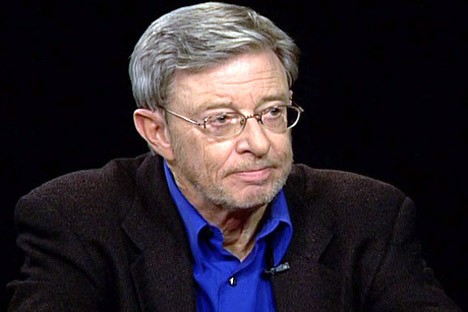
Russia scholar Stephen Cohen.
However, when the cause is to demonize Russia and/or to unseat Trump, apparently any sleight of hand or McCarthyistic smear is permissible.
In Post blogger Wemple’s article about The Nation’s decision to undercut the VIPS memo, he includes some nasty asides against Russia scholar Stephen Cohen, who happens to be Katrina vanden Heuvel’s husband.
In a snide tone, Wemple describes Cohen as providing “The soft-glove treatment of Russian President Vladimir Putin,” calling it Cohen’s “specialty.”
Wemple also repeats the canard about “a consensus finding of the U.S. intelligence community” when we have known for some time that the Jan. 6 report was the work of those “hand-picked” analysts from three agencies, not a National Intelligence Estimate that would reflect the consensus view of all 17 agencies and include dissents.
What is playing out here – both at The New York Times and across the American media landscape – is a totalitarian-style approach toward any challenge to the groupthink on Russia-gate.
Even though the Obama administration’s intelligence chiefs presented no public evidence to support their “assessments,” anyone who questions their certainty can expect to be smeared and ridiculed. We must all treat unverified opinions as flat fact.
Investigative reporter Robert Parry broke many of the Iran-Contra stories for The Associated Press and Newsweek in the 1980s. You can buy his latest book, America’s Stolen Narrative, either in print here or as an e-book (from Amazon and barnesandnoble.com).
Russia vs US Economic War: Who’s Going to be the Ultimate Loser?
By Phil Butler – New Eastern Outlook – 02.09.2017
Full scale economic war in between America and Russia is underway. Russian Prime Minister Dmitry Medvedev said so, and the US administration and the American congress voted it in with new sanctions. The only question that remains is “who will win?” Here’s a look at the future of US-Russia relations and the ultimate loser in this new type of Cold War.
A fact most people are not aware of is that the United States is at risk of repaying its debt if anything major happens. The $20 trillion that America owes is by far the largest of any single country, and about as much as the 28 members of the European Union owe altogether. The sum is greater than what America produces in one year, or twice the debt to DGP ratio of 1988. But now let’s look at the makeup of this staggering debt.
This debt-to-GDP ratio tells investors that the country might have problems repaying the loans. And Baby Boomers are by far the biggest domestic investors via social security and other trust funds. In short, recent administrations have mortgaged the legacy of a generation. President Barack Obama holds the record for piling up the biggest US debt, just so the reader knows. The Bush administration comes in second where piling up debt is concerned, and tax cuts piled on top of the expensive “War on Terror” emptied American coffers at a staggering rate after 2001 and the 9/11 event. Social Security, which will have to pay Baby Boomer retirees their pensions soon, was gutted by Bush and Obama. If these funds are not propped up, 75 million Americans will be robbed of their hard-won retirement. But Social Security and the trusts are only used to cover other US government departments. But what about foreign debtors?
Countries like China, Japan, and Great Britain buy treasuries as investments and in order to guarantee American trade (especially in China’s case). Buying “treasuries” also helps China and other countries keep their currencies strong versus the US dollar. But in 2016 the pattern of purchasing huge US debts altered when China lowered its holdings of U.S. debt. Furthermore, as the debt-to-GDP ratio increases, the nations that hold US debt might demand higher interest payments to compensate for the increased risk. After this happens diminished demand will cause interest rates to rise further. This situation will create a downward spiral that puts pressure on the dollar, and that will eventually increase interest payments to unsustainable levels. Once the US government can no longer sustain social security and other programs, it’s fair to assume the whole house of cards will fall. Currently, Social Security costs more than $1 trillion per year, and payroll taxes no longer cover the fund. So, Congress can no longer “borrow” from the Social Security Trust Fund to pay for other federal programs.
For fiscal year 2018 the interest on the debt is $315 billion, and this will double by the year 2027. But there’s no need for an economics lesson here, so I’ll proceed to Russia’s situation by comparison.
Debt Free by Comparison – Russia
Russia’s national debt is by far the lowest in Europe and the lowest in the former G8 countries. In fact, before the Ukraine crisis took shape Russia’s growth was astounding compared to the US, Germany, France, Japan, and the other G8 nations. Reuters reported Russia’s growth rate of 2.5 times that of the US in quarter 4 of 2011. Russian President Vladmir Putin’s repaying almost all of the country’s foreign debt, high energy prices combined with Russia’s exports to Europe were creating a Russia powerhouse economy. If the truth is ever told of the new “Red Scare” it will reveal fear as the motivator for a new Cold War waged by western powers.
When US President Donald Trump was elected many of his supporters believed there would be a “reset” to normal in US-Russia relations. These hopes were quickly dashed when the technocracy and the globalist control mechanism attacked Trump with a vengeance over his Russia narrative. Allegations of some form of collusion between the new American president and Putin’s Russia became the flavor of the day for corporate and government controlled media. When Trump and Putin met in Hamburg there was renewed hope, but this was quickly dashed when the US Congress hurriedly pushed through a new sanctions law that rolled Russia in with Iran and North Korea. The Israel lobby (AIPAC) put the squeeze on its constituency in congress and on Trump, and a new economic war was waged. Russian Prime Minister Dmitry Medvedev said “the US had declared full-scale economic war”.
Putin’s Russia having already made the “shift” eastward to Asia, the only logical reaction to the Trump reversal was to head full steam in the direction of Beijing. For a couple of years both Russia and China have been hoarding gold and taking steps to separate from the dollar currency. Where Russia’s natural gas is concerned, the blockages thru Ukraine and Syria to Europe created by the NATO nations have been circumvented. The Turkish South Stream project is back in full swing and Russia’s armed forces have helped signal the end of ISIL in Syria. Trump signing this new sanctions bill will end up costing Americans and Europeans the future if I am right.
Further evidence that America has big trouble come from China‘s inviting Guinea, Mexico, Tajikistan and Thailand to the upcoming BRICS summit. Meanwhile Putin is creating a Ministry of the Future headed by economic whiz kid Maxim Oreshkin, who was recruited from the ranks of VTB Capital. According to Bloomberg Oreshkin is creating an informal group known as the “office of changes” bent on improving the structure of the ministry. The ministry will be staffed by renowned gurus like; “Ekaterina Vlasova, poached from Citigroup Inc, Pricewaterhouse Coopers’ Zoya Viktorova and Yulia Urozhaeva from McKinsey & Co.”
The Real Bear Market
An interesting aspect of Oreshkin’s emergence is his role in bringing about a pet project of Putin, in ramping up Russia’s place in the so-called “digital economy”. To this end the Russian president already demanded a final version of this “digital economy development program” be set in place by October. According to the Kremlin the new initiative should create a support mechanism for the development of key end-to-end digital technologies, including artificial intelligence, robotics, quantum computing, development of information and telecommunications and computing infrastructure, and financial incentives.
In conclusion, it’s abundantly clear that Dmitry Medvedev was right in finally giving up the ghost of hope for US-Russia reconciliation. One reason for this is the clear desperation western leaders and business exhibit in their all-out war on Putin. In fact, the only logical reason for trashing west-east relations has to be fear the system of banking and business in the US and Europe will fail. As for Russia’s play I am reminded of a report I made some months back on Putin’s “Third Way” for society. It’s been obvious for some years now the Putin administration has been battling to change Russia’s business and government ecosystem. But economic and geo-strategy assault from western powers has interrupted this plan. I believe Putin had intended to meld Russia’s new initiative into the existing G20 economic structure. But Trump’s turnabout forced a new direction. In the long view we can only watch and see if the staggering giant of American globalist capitalism can overcome a new power structure in world economics. If the Eurasian Union separates from the dollar, the world will certainly enter a time of dire crisis. We may soon witness a real bear in the world marketplace, one unwelcomed by Wall Street.
Phil Butler, is a policy investigator and analyst, a political scientist and expert on Eastern Europe.
US actions against Russian diplomatic and consular property are illegal–here’s why
By Adam Garrie | The Duran | September 2, 2107
The United States has once again seized diplomatic and consular properties belonging to the Russia Federation and is in the process of conducting raid style searches of the properties which are set to formally begin on the 4th of September.
These actions which first took place in the final full month of Barack Obama’s Presidency and are now taking place at additional Russian diplomatic and consular facilities in the United States under Donald Trump’s Presidency, violate clearly codified international laws which are contained in documents known as the Vienna Conventions.
The following are the provisions of the Vienna Conventions that are presently being violated by the United States.
From the Vienna Convention on Diplomatic Relations
Article 22
1. The premises of the mission shall be inviolable. The agents
of the receiving State may not enter them, except with the consent of
the head of the mission.2. The receiving State is under a special duty to take all
appropriate steps to protect the premises of the mission against any
intrusion or damage and to prevent any disturbance of the peace of the
mission or impairment of its dignity.3. The premises of the mission, their furnishings and other
property thereon and the means of transport of the mission shall be
immune from search, requisition, attachment or execution.
From the Vienna Convention on Consular Relations
Article 31
Inviolability of the consular premises
1.Consular premises shall be inviolable to the extent provided in this article.
2.The authorities of the receiving State shall not enter that part of the consular premises which is
used exclusively for the purpose of the work of the consular post except with the consent of the head of the consular post or of his designee or of the head of the diplomatic mission of the sending State. The consent of the head of the consular post may, however, be assumed in case of fire or other disaster requiring prompt protective action.3.Subject to the provisions of paragraph 2 of this article, the receiving State is under a special
duty to take all appropriate steps to protect the consular premises against any intrusion or damage and to prevent any disturbance of the peace of the consular post or impairment of its dignity.4.The consular premises, their furnishings, the property of the consular post and its means of
transport shall be immune from any form of requisition for purposes of national defence or public utility.If expropriation is necessary for such purposes, all possible steps shall be taken to avoid impeding the performance of consular functions, and prompt, adequate and effective compensation shall be paid to the sending State.
In summary, these statues of international law codified by the United Nations in 1961 (Diplomatic) and 1963 (Consular) mean that irrespective of the condition of relations between the sending state (in this case Russia) and the receiving state (in this case the US), the diplomatic and consular properties in question must remain free from any kind of molestation including searches, raids, property seizures and the infringement of normal and dignified working practices.
Each of these items of law has been clearly violated by the United States. The US has prohibited diplomatic and consular workers from pursuing their work under normal circumstances. The US molested the peace and freedom of such workers and their families on a personal level and the US is in the process of preparing to raid the diplomatic and consular properties which the law states are clearly inviolable.
Even in times of conflict that run much deeper than the current political disputes between Washington and Moscow, the Vienna Conventions have a precedent of being adhered to.
In 1984, an individual inside the Libyan Embassy in London shot and killed a UK police officer. The shots were fired from inside the embassy onto the street below.
Although many called for the suspect to be brought to trail in an English court, the UK government at the time, a government that had generally poor relations Libya in any case, observed the Vienna Conventions and allowed the embassy workers to return to Libya safely after being named persona-non-grata, something which is sanctioned by the Vienna Conventions.
The US itself raised a claim in the International Court of Justice against the Islamic Republic of Iran over an incident involving the taking of US hostages at the US Embassy in Tehran in 1980.
In 2005, during the second term of George W. Bush, the United States withdrew from an optional provision of the Vienna Conventions allowing for disputes arising between states on matters involving diplomatic and consular facilities and individuals to be dealt with by the International Court of Justice.
This means that if Russia wanted to take legal action against the US for violating its protections under the Vienna Conventions, Russia would have to file the complaint in a US court which is subject to accusations of bias vis-a-vis an international court dealing with a dispute between sovereign states.
The aggregate effect of this means that the US is breaking international law with impunity while giving the victim of this anti-diplomatic aggression few realistic options to deal with the issue, other than to attempt some sort of equivalent retaliation.
Instead of scrutinising the United States for a flagrant violation of international law, the mainstream media is instead pontificating on why smoke is coming out of the chimney at the soon to be closed Russian Consulate in San Francisco, even though such a matter has no real legal implications. Until the premises is involuntarily vacated, the Russian consular staff have the right to use their facilities as they fit.
Russian Foreign Ministry Spokeswoman Maria Zakharova issued the following statement to the conspiracy theorists who have taken an interest in the smoke,
“Now in San Francisco, another circus begins – a new round of baiting called ‘What are you doing there?’.
After giving 2 days for the emergency conservation of the building and deciding to conduct a search in the premises, which had for many years had diplomatic immunity, a search involving FBI employees, the “host party” in the afternoon of September 1 “accidentally noticed” smoke above the building. The truth is that they also did not happen to notice that the [smoke] was coming from a pipe.
Immediately there were prepared photo reports about the “emergency situation”, and, as the top of sadism, fire protection was called. Just in case. Suddenly, Russians need help: they still had a couple of hours left to clear the premises.
And then the questions of American journalists poured down about what kind of trickle of smoke rose over the Russian consulate general.
I answer: measures are being taken to preserve the building. In this regard, the windows can be closed, the curtains can be lowered, the light may turn off, water may come down, the doors may be locked, garbage can be disposed of, heating devices must be switched off, life support systems switched on, and much more.
It is unbearably embarrassing to monitor the actions of the US authorities and the entire information campaign. Later everything will be like it always happens in the USA: there will be those who stood behind all this Russophobic hysteria, another mistake will be recognized, perhaps we will hear miserable apologies. But all this will be, as always, later. And now, at this very minute, instead of the celebrations on the occasion of September 1 and the labor routine for issuing passports and visas, the employees of the Consulate General professionally oriented towards the development of bilateral relations are engaged in the conservation of the building…
The wider truth of the matter is that the only thing up in flames is the American government’s respect for international law.
US-Russia ties are heading south
By M K Bhadrakumar | Indian Punchline | September 1, 2017
The US-Russia diplomatic tit-for-tat escalated with the announcement in Washington on Thursday ordering the Russians to shut down their consulate in San Francisco as well as two trade annexes. Moscow has regretted “the escalation of tensions” and promised a reaction after careful review of the “new measures”. The state department press release is titled “Achieving Parity in Diplomatic Missions”, implying that the US has merely followed up the “Russian desire for parity in the diplomatic relationship”, which was how Moscow had rationalised its order to cut down the total strength of the US diplomats and staff in Russia by September 1.
A senior state department official explained in a special media briefing that “it is our hope that the Russians will recognize that since they were the ones who started the discussion on parity and we’re responding and complying with what they required of us… Regarding previous actions, the actions that this government took in December – I think you all know the reasons why we took those steps. It had to do with harassment of our diplomats and interference in our domestic affairs, in our elections. So I think those actions spoke for themselves.” (Transcript) Interestingly, White House has since added that President Donald Trump took Thursday’s decision. (President Vladimir Putin had said in July that he personally took the decision to achieve “parity” in the diplomatic relations.)
The state department has warned that Washington is “prepared to take further action as necessary and as warranted.” In sum, if Russia makes further moves, US threatens to retaliate. Lavrov reacted cautiously today: “The president (Putin) has said it many times — we do not wish to quarrel with this country. We have always maintained a friendly attitude towards the American people, and now we are open for meaningful cooperation in the areas of our interests. Our sincere wish is for the political atmosphere between the two countries to return to normal. But, as you know, it takes two to tango. It seems to me, our US counterparts have been performing solo break-dance moves recently.”
It appears that the Trump administration lulled the Russians to complacency through recent weeks. On Wednesday, in fact, Russia’s Ambassador-designate to the US Anatoly Antonov gave an interview to Kommersant newspaper highlighting the “great potential for the mutually beneficial cooperation in various spheres” between Russia and the US. Indeed, ambassadors are obliged to present a hopeful landscape even when the skyline is thick with dark clouds, but the interview sounded hopeful that the Trump administration would adopt a constructive approach.
Quite obviously, the US-Russia diplomatic feud seems only widening and it is a reflection of the state of play in the overall relations. There is growing talk of the US supplying lethal weapons to Ukraine. In Syria, the race for Dier Ezzor city and for control of Syrian-Iraqi border is still open. On Afghanistan, Trump announced a new strategy in a 30-minute speech ten days ago without mentioning Russia even once. Over the North Korean situation, Putin said in an interview with the Chinese media on Thursday, “Russia believes that the (US) policy of putting pressure on Pyongyang to stop its nuclear missile programme is misguided and futile… Provocations, pressure and militarist and insulting rhetoric are a dead-end road.”
Meanwhile, provocative US deployments to Russia’s western borders continue. On the pretext of reinforcing the NATO allies in the Baltics against the backdrop of “Zapad 2017″ (forthcoming Russian military exercise), US deployed to Lithuania another seven US F-15 fighter jets.
Tillerson Approves Nearly $60Mln in Funding to Fight Propaganda – State Dept
Sputnik – 01.09.2017
WASHINGTON – US Secretary of State Rex Tillerson has approved spending nearly $60 million on countering terrorist propaganda and state-sponsored disinformation, a State Department official has confirmed to Sputnik.
A US news outlet, Politico, reported in August that Tillerson was resisting the Department’s officials who wanted to spend $80 million on anti-propaganda efforts, including on countering Russia’s alleged disinformation campaign.
“Last week, after significant consultations within the State Department… Secretary Tillerson approved the release of one source of funding, and approved the request for another,” the official said, referring to $19.8 million in extra funding to target Islamist propaganda and another request for a transfer of $40 million from the Pentagon.
The official stressed that Tillerson’s decisions came after a realignment of programs by the Global Engagement Center (GEC) to match national security priorities and make sure that this funding would be used effectively “to counter the messaging of international terrorist groups and state-sponsored disinformation.”
The Global Engagement Center is an interagency entity, housed at the State Department, tasked with coordinating US counterterrorism messaging to foreign audiences. It was created in March 2016 to counter messaging from the Islamic State terrorist group (banned in Russia).
But former President Barack Obama last December signed the fiscal year 2017 National Defense Authorization Act, which expanded the center’s mandate, allowing it to counter messages from state actors like Russia and China.
Russia has denied meddling in last year’s election in the United States, and the Kremlin insists that it does not interfere in the internal affairs of other countries.
More Misleading Russia-gate Propaganda
By Robert Parry | Consortium News | August 29, 2017
There is an inherent danger of news organizations getting infected by “confirmation bias” when they want something to be true so badly that even if the evidence goes in the opposite direction they twist the revelation to fit their narrative. Such is how The Washington Post, The New York Times and their followers in the mainstream media are reacting to newly released emails that actually show Donald Trump’s team having little or no influence in Moscow.
On Tuesday, for instance, the Times published a front-page article designed to advance the Russia-gate narrative, stating: “A business associate of President Trump promised in 2015 to engineer a real estate deal with the aid of the president of Russia, Vladimir V. Putin, that he said would help Mr. Trump win the presidency.”
Wow, that sounds pretty devastating! The Times is finally tying together the loose and scattered threads of the Russia-influencing-the-U.S.-election story. Here you have a supposed business deal in which Putin was to help Trump both make money and get elected. That is surely how a casual reader or a Russia-gate true believer would read it – and was meant to read it. But the lede is misleading.
The reality, as you would find out if you read further into the story, is that the boast from Felix Sater that somehow the construction of a Trump Tower in Moscow would demonstrate Trump’s international business prowess and thus help his election was meaningless. What the incident really shows is that the Trump organization had little or no pull in Russia as Putin’s government apparently didn’t lift a finger to salvage this stillborn building project.
But highlighting that reality would not serve the Times’ endless promotion of Russia-gate. So, this counter-evidence gets buried deep in the story, after a reprise of the “scandal” and the Times hyping the significance of Sater’s emails from 2015 and early 2016. For good measure, the Times includes a brief and dishonest summary of the Ukraine crisis.
The Times reported: “Mr. Sater, a Russian immigrant, said he had lined up financing for the Trump Tower deal with VTB Bank, a Russian bank that was under American sanctions for involvement in Moscow’s efforts to undermine democracy in Ukraine. In another email, Mr. Sater envisioned a ribbon-cutting ceremony in Moscow. ‘I will get Putin on this program and we will get Donald elected,’ Mr. Sater wrote.”
But the idea that Russia acted “to undermine democracy in Ukraine” is another example of the Times’ descent into outright propaganda. The reality is that the U.S. government supported – and indeed encouraged – a coup on Feb. 22, 2014, that overthrew the democratically elected Ukrainian President Viktor Yanukovych even after he offered to move up scheduled elections so he could be voted out of office through a democratic process.
After Yanukovych’s violent ouster and after the coup regime dispatched military forces to crush resistance among anti-coup, mostly ethnic Russian Ukrainians in the east, Russia provided help to prevent their destruction from an assault spearheaded by neo-Nazis and other extreme Ukrainian nationalists. But that reality would not fit the Times’ preferred Ukraine narrative, so it gets summarized as Moscow trying “to undermine democracy in Ukraine.”
Empty Boasts
However, leaving aside the Times’ propagandistic approach to Ukraine, there is this more immediate point about Russia-gate: none of Sater’s boastful claims proved true and this incident really underscored the lack of useful connections between Trump’s people and the Kremlin. One of Trump’s lawyers, Michael Cohen, even used a general press email address in a plea for assistance from Putin’s personal spokesman.
Deeper in the story, the Times admits these inconvenient facts: “There is no evidence in the emails that Mr. Sater delivered on his promises, and one email suggests that Mr. Sater overstated his Russian ties. In January 2016, Mr. Cohen wrote to Mr. Putin’s spokesman, Dmitri S. Peskov, asking for help restarting the Trump Tower project, which had stalled. But Mr. Sater did not appear to have Mr. Peskov’s direct email, and instead wrote to a general inbox for press inquiries.”
The Times added: “The project never got government permits or financing, and died weeks later. … The emails obtained by The Times make no mention of Russian efforts to damage Hillary Clinton’s campaign or the hacking of Democrats’ emails.”
In other words, the Russia-gate narrative – that somehow Putin foresaw Trump’s election (although almost no one else did) and sought to curry favor with the future U.S. president by lining Trump’s pockets with lucrative real estate deals while doing whatever he could to help Trump win – is knocked down by these new disclosures, not supported by them.
Instead of clearing the way for Trump to construct the building and thus – in Sater’s view – boost Trump’s election chances, Putin and his government wouldn’t even approve permits or assist in the financing.
And, this failed building project was not the first Trump proposal in Russia to fall apart. A couple of years earlier, a Moscow hotel plan died apparently because Trump would not – or could not – put up adequate financing for his share, overvaluing the magic of the Trump brand. But one would think that if the Kremlin were grooming Trump to be its Manchurian candidate and take over the U.S. government, money would have been no obstacle.
Along the same lines, there’s the relative pittance that RT paid Gen. Michael Flynn to speak at the TV network’s tenth anniversary in Moscow in December 2015. The amount totaled $45,386 with Flynn netting $33,750 after his speakers’ bureau took its cut. Democrats and the U.S. mainstream media treated this fact as important evidence of Russia buying influence in the Trump campaign and White House, since Flynn was both a campaign adviser and briefly national security adviser.
But the actual evidence suggests something quite different. Besides Flynn’s relatively modest speaking fee, it turned out that RT negotiated Flynn’s rate downward, a fact that The Washington Post buried deep inside an article on Flynn’s Russia-connected payments. The Post wrote, “RT balked at paying Flynn’s original asking price. ‘Sorry it took us longer to get back to you but the problem is that the speaking fee is a bit too high and exceeds our budget at the moment,’ Alina Mikhaleva, RT’s head of marketing, wrote a Flynn associate about a month before the event.”
Yet, if Putin were splurging to induce Americans near Trump to betray their country, it makes no sense that Putin’s supposed flunkies at RT would be quibbling with Flynn over a relatively modest speaking fee; they’d be falling over themselves to pay him more.
So, what the evidence really indicates is that Putin, like almost everybody else in the world, didn’t anticipate Trump’s ascendance to the White House, at least not in the time frame of these events – and thus was doing nothing to buy influence with his entourage or boost his election chances by helping him construct a glittering Trump Tower in Moscow.
But that recognition of reality would undermine the much beloved story of Putin-Trump collusion, so the key facts and the clear logic are downplayed or ignored – all the better to deceive Americans who are dependent on the Times, the Post and the mainstream media.
Investigative reporter Robert Parry broke many of the Iran-Contra stories for The Associated Press and Newsweek in the 1980s.
Featured Video

Death Spikes & Rising Cancer In Our Youth Explained
or go to
Aletho News Archives – Video-Images
From the Archives
Politicians lie
By Mazin Qumsiyeh | Popular Resistance | August 18, 2013
There is no way to say this truth nicely: Politicians lie. That includes Japanese, American, Egyptian, Israeli, and Palestinian politicians! Is there something more common sense than that? Yet, so many citizens around the world believe their own politicians or wistfully acknowledge lies but think it is part of the job needed to run things. They believe even when politicians contradict themselves blatantly. This phenomenon is rather remarkable. It is a dissonance and disconnect from reality that many seem oblivious to. It is very dangerous because it can lead to accepting rationales for going to war. These can be deadly wars that lead to millions of lives lost as happened in what was called World War 1 and WW2. Even when incredible and declassified evidence abound, politicians continue to lie and old mythologies refuse to die. Here are just a few of the countless lies told to us over the past few decades… continue
Blog Roll
 Aletho News
- From Unipolar Universalism to Multipolar Civilizational Distinctiveness
- RSF military group defects, joins Sudanese army: State media
- Ireland goalkeeper refuses to play ‘Israel’ as squad weighs boycott
- China pushes back against US on Cuba, Iran
- Ukrainian Soldiers, Potential Mercenaries: Have Gun, Will Travel!
- Burnham’s UN debut… A masterclass in British disinformation
- Iran flights continue despite US aviation sanctions
- Global Tipping Points Lead the World Into a State of Entropy
- The day-after at the White House: USA and Xi Jinping
- The Geopolitical Balance in the Red Sea: The UAE Being Displaced by New Players
- If Americans Knew
- Deconstructing Netanyahu’s pants-on-fire UN rant – Daily Update
- Trump betrayed voters with his campaign lies and prioritized a foreign country once he took office
- Netanyahu calls Israel’s war in Gaza ‘opposite of genocide’ in UN speech to near-empty hall
- Settler Kidnappings: Torture, Sexual Abuse and Terrorisation of Palestinian Abductees as Israel Deepens Annexation of West Bank
- Gaza winter nears as 162,000 tents become unusable, raising fears of humanitarian crisis
- Netanyahu says, “It’s the opposite of genocide”; UN says Gaza economy is world’s ‘most severe crisis on record’ – Daily Update
- Israel’s US-Backed Assault on Gaza Has Created the ‘World’s Most Severe Economic Crisis on Record’: UN
- ‘Protecting U.S. Citizens’… From Israel
- ‘This is where I live now, the back of a truck’: a day in the life of a grandmother in Gaza
- In UN Speech, Iran’s President Displays Pictures of Children Killed by US, Brings Attention to Israel’s Nuclear Arsenal
- No Tricks Zone
- New Study: Earth And Venus Surface Warmth Largely Explained By Convection And Lapse Rate, Not CO2 Or Radiation
- 2025 Nature Paper Claiming Worsening Global Drought Gets RETRACTED …Heavily Flawed
- New Study: ‘Global Drought Shows No Detectable Recent Acceleration Under Climate Warming’
- Economic Masterminds: German Socialists Suggest Taxing Productivity Gains Stemming From Using AI
- The South China Sea Has Not Been Cooperating With The Climate Change Narrative
- Energy Crisis: Germany Enters Heating Season With Historically Low Gas Reserve Fill Levels
- New Study: The Antarctic Ice Sheet Gained Mass From 2020-2024 Due To Staggering Snow And Ice Accumulation
- Study: Ocean Heating Rates From Thousands Of Years Ago ‘Dwarf’ Modern Ocean Heating Rates
- Climate Extremists Target, Attack Large-Scale Power Grid Infrastructure In Germany!
- New Study: Antarctic Ice Melt Has Contributed Less Than 1 Centimeter To Sea Level Rise In The Last 30 Years

