What Is Joe Biden’s Legacy?

By Oleg Burunov – Sputnik – 22.07.2024
Biden announced he is dropping out of the 2024 presidential race on July 21. It came amid calls by prominent Democrats and donors to withdraw following his performance in last month’s debate against former President Donald Trump.
In a statement on his decision to withdraw from the 2024 presidential race, President Joe Biden also reflected on the results of his four years in office, claiming that the US has built the “strongest economy in the world.”
He touted efforts to expand what he described as “affordable healthcare to a record number of Americans,” also arguing that his administration allegedly provided “critically needed care to a million veterans exposed to toxic substances.”
Is It So, Joe?
First and foremost, the US economic meltdown shows no signs of abating, with 36% of Americans recently surveyed by Pew Research rating the national economy as “poor”. Add to this the fact that America’s state debt, which now stands at nearly $34.4 trillion, is rising by $1 trillion about every 100 days.
Also, the US migration crisis persists as new data by the Customs and Border Protection (CBP) reveals a significant surge in illegal border crossings, with more than 205,000 apprehensions in June alone, pushing the total for fiscal year 2024 to 2.5 million.
Drug overdose, meanwhile, remains one of the leading causes of injury death in adults in the US and has risen over the past several years. Overdoses specifically pertain to synthetic opioids (fentanyl) and stimulants (cocaine and methamphetamine), according to Centers for Disease Control and Prevention data.
Biden’s Foreign Policy Track Record
The Ukraine crisis is in full swing, as the Biden administration continues to add fuel to the fire by providing the Kiev regime with military supplies despite Russia’s repeated warnings that such assistance would only prolong the standoff.
Separately, the Gaza war is still in place despite Biden’s much-hyped plan to help clinch a ceasefire between Israel and Hamas. The US president last month said that the Gaza war must end now and Israel must not occupy the Palestinian enclave after the end of hostilities – another statement that apparently fell on the Jewish state’s deaf ears.
As a cherry on the top, Biden failed to deliver on his promise to restore the 2015 Iran nuclear deal, with the Vienna talks on the matter finally coming to a standstill.
From Clinton Fraud to Trump-Zelensky Call: Recalling CrowdStrike’s Shady Politics Amid IT Outage
By Ilya Tsukanov – Sputnik – 20.07.2024
A sloppy update to software made by US cybersecurity giant CrowdStrike has taken PCs and servers used by airlines, railways, banks, broadcasters and even medical facilities around the world offline. For anyone following US politics over the past decade or so, the company’s name should be eerily familiar.
CrowdStrike is making global headlines (and causing global headaches) this week after an update released Friday morning afflicted thousands of corporate machines running Microsoft products with the infamous blue screen of death error.
While the company has already put out a fix, the buggy update is expected to cause billions of dollars and hours in lost productivity, and experts say it may take “weeks” for businesses and governments worldwide to fully recover.
But behind the company’s reputation as a major provider of endpoint security products is the odd routineness of its name popping up in US politics.
During the 2016 US presidential election, the Clinton campaign asked none other than CrowdStrike for help investigating the hack attack against the Democratic National Committee – which had revealed embarrassing info about the party’s efforts to rig the nomination process in Mrs. Clinton’s favor.
CrowdStrike’s probe gave rise to the very first claims that Russia was behind the DNC hack, and the company provided its “forensic evidence and analysis” to the FBI, starting the ball rolling on the Russiagate conspiracy theory that Donald Trump was colluding with Russia to “steal” the election.
CrowdStrike executive Shawn Henry admitted under oath in congressional testimony in 2017 that the company had no “concrete evidence” to back up its “Russian hackers” story, but by that point it was too late, and Trump would spend virtually the entirety of his term in office dogged by the “collusion” claims.
CrowdStrike’s name also came up in the infamous 2019 phone call between Trump and Volodymyr Zelensky, with the then-US president asking Zelensky to “do us a favor” and “find out what happened” with CrowdStrike’s server, which Trump said was in Ukraine. The Trump team was convinced that CrowdStrike planted evidence on the DNC server to frame Russia while covering up Ukraine’s own efforts to “weaken the Trump bandwagon” during the 2016 race. Democratic politicians and anti-Trump media dismissed the president’s suspicions as groundless.
The Trump-Zelensky phone call, in which he also asked Kiev to look into then former vice president Joe Biden’s role in firing of a prosecutor probing his son Hunter Biden’s alleged corrupt activities while working for Ukrainian energy company Burisma, wound up sparking the first Trump impeachment in 2019.
CrowdStrike was also one a handful of firms tapped by the US Cybersecurity and Infrastructure Security Agency in 2021 to work out a ‘whole-of-nation’ cyber defense plan. The initiative has been criticized as an attempt to strengthen the US intelligence and Big Tech’s surveillance powers using cybersecurity as a cover.
The same year, CrowdStrike CEO George Kurtz blamed Russian hackers for the 2020 SolarWinds hack attack on the US Federal Government, but curiously admitted the company had no information of its own “to corroborate that finding.”
‘PR Nightmare’
“The PR aspect is of course a nightmare for CrowdStrike,” veteran independent cybersecurity expert Lars Hilse told Sputnik, commenting on Friday’s outage and the impact it’s had on the company’s image and stock price.
CrowdStrike’s market cap plunged by $12.5 billion, and its CEO George Kurtz saw over $320 million shaved from his personal fortune. The company stock’s price fell from about $343 to $302 per share, signaling that about 12 percent of the company’s market value has been wiped out.
Interestingly, not everyone in the company came out of the outage in the red, with Chief Security Officer Shawn Henry selling off 4,000 shares of CrowdStrike Holdings’ common stock on July 15 for $371.32 per share, or $1.49 million total, according to Security and Exchange Commission data.
Hilse says the main “lesson” from the CrowdStrike mess will be the demand that cybersecurity companies improve testing before rolling out critical updates – something especially important if they’re done as “a single update being pushed to a plethora of customers running cloud-based solutions, including those responsible for the flawless operation of critical infrastructure like airports, banks, etc.”
“With increasing reliance on technology comes exponentially increasing impact on society if these technologies fail, whether through a deliberate/targeted attack, or a faulty piece of software, like in this case,” Hilse emphasized.
Russian cybersecurity specialist Alexei Lukatskiy told Sputnik Russia has been able to dodge the CrowdStrike bullet thanks to strong homegrown cybersecurity companies. Friday’s outages thus serve as another important “lesson” for Russia, which has been “gradually switching away from products by foreign vendors to Russian ones,” that it’s on the right track, he said.
Another important takeaway, according to Lukatskiy, is the modern world’s increasingly critical level of dependence on computers. “IT has penetrated into a wide array of different areas, and the owners of companies working in critical industries must understand all the consequences and evaluate the unacceptable events that may occur due to the seeming failure of an ordinary computer…,” he said.
Recall that CrowdStrike Lied About DNC Server “Hack” in 2016
By John Leake | Courageous Discourse™ | July 20, 2024
second I saw the news yesterday that computers all over the world had been taken down—causing widespread disruptions to travel, medical care and an array of businesses—I couldn’t help wondering if it was an implicit reminder of how dependent we are on global computer systems, and therefore how vulnerable we are.
Then I saw the outage was purportedly traced to CrowdStrike—the same Austin-based cybersecurity hired by the DNC in 2016 to investigate the alleged “hack” of its server. The security breach resulted in the leak of incredibly embarrassing e-mails revealing John Podesta, Hillary Clinton, and DNC leadership performing all manner of Machiavellian machinations.
Back then, when I read the Wikileaks e-mails, I immediately wondered, “How are these villains going to change the subject from the content of their e-mails to something else? What misdirection trick are they going to pull?”
Enter CrowdStrike, which the DNC hired to do a forensic cybersecurity analysis of the DNC server. Shortly thereafter, CrowdStrike claimed that Russian agents had hacked it.
It didn’t matter that there was no evidence of this, as CrowdStrike President Shawn Henry admitted under oath in a declassified December 2017 interview before the House Intelligence Committee. The lying mainstream media still ran with the story that became Russian Collusion HOAX—the biggest fraud of the decade.
Even though former NSA Technical Director, William Binney, tried to tell anyone who would listen that the leak must have resulted from a DNC insider who downloaded the e-mails onto a storage device, no major mainstream media outlet would listen to him.
I wondered about Binney’s concept on a DNC insider when I researched the mysterious death of DNC insider Seth Rich (An Extraordinary Unsolved Murder in Washington D.C.) shortly before the accusation of Russian hacking was made.
Did Rich—who was apparently disaffected with the DNC because of its shabby treatment of Bernie Sanders—reveal to someone that he knew that the leak was not the result of an external hack, thereby prompting the perception that he could easily debunk the Russian-Collusion Hoax if he weren’t silenced forever?
Now, less than one week after whoever is running this country allowed a would-be assassin to climb onto a roof and take a shot at Donald Trump on a stage 400 feet away, we are told that CrowdStrike’s defective update to its security software knocked out global IT systems.
It seems to me that CrowdStrike should be viewed with grave suspicion and that businesses should be asking if it is prudent to have CrowdStrike software running on their computer systems.
Ukrainian language rejected by children in Russian-majority regions
By Lucas Leiroz | July 18, 2024
The forced imposition of the Ukrainian language in regions with a non-Ukrainian ethnic majority appears to be failing. There has been a decline in the use of the Ukrainian language in the country’s schools, according to a report recently published by the Kiev media. The case clearly shows how, despite the use of force and violence, the neo-Nazi regime will have great difficulty in imposing its cultural agenda in the country’s remote regions.
Since 2014, the official use of Russian and other non-Ukrainian languages has been sharply reduced. The de-Russification measures were further intensified after the start of the special military operation, when the Kiev regime received a “carte blanche” by Western sponsors to commit all sorts of crimes, including ethnic and cultural genocide, an almost total ban on the Russian language and literature having happened since then.
However, despite efforts to eradicate the cultural and linguistic identity of ethnic Russians, the rejection of the Ukrainian language has been increasing throughout the country. A recent survey by the State Service for the Quality of Education showed that in the 2023/2024 academic year, only 74% of students stated that Ukrainian was their mother language. The previous year, the figure was 91%, which shows that there has been a significant drop in the number of children who identify as native speakers of Ukrainian.
Moreover, the drop is not limited to children. Similar data were also revealed in surveys of parents (93% to 82%) and teachers (94% to 86%). In practice, it is possible to say that there is a massive decline in the use of the Ukrainian language, with all the efforts of the neo-Nazi government to assimilate other ethnic groups having failed.
New statistics indicate that currently less than 40% of children in the country use Ukrainian exclusively in their informal activities. The figures naturally vary according to Ukraine’s geography, with more Ukrainian speakers in the western regions, where there are fewer ethnic Russians. Around 17% of children speak Ukrainian in the east of the country, while around 74% speak this language in the west.
It is important to remember that, in addition to Russian, other non-Ukrainian languages are used in the country by ethnic minorities, who are also suffering the impacts of cultural genocide policies. This is the case of the Hungarian language, for example, which is used in the Transcarpathian region, where Hungarians currently live in a situation similar to that of Russians in Donbass, being victims of apartheid-like measures. Despite all the persecution, however, these ethnic minorities refuse to abandon their cultural identity and continue to speak their languages.
This scenario in Ukraine was already expected by some experts. Implementing measures of ethnic and cultural cleansing is not easy. People affected by the measures tend to react by using their language even more intensely, as an act of political activism to preserve their cultural heritage. Amid the current conflict situation, some Russian families in Ukraine see the use of their native language as the last chance to preserve their identity amid the Russophobic madness that the authorities want to impose on all citizens.
In addition, there are basic sociological issues that explain the continued use of the Russian language. The authorities have no way of monitoring which language is being used in informal and family activities. Ethnic Russian citizens use their native language to engage in unofficial sociability, rejecting the Ukrainian language during casual conversations in shopping malls, in churches and other places.
With the survey data revealed, it is possible that Kiev will increase its repressive measures against Russian speakers even further from now on. The total banning of this language throughout the country remains one of the main goals of the neo-Nazi regime. Knowing the failure of the efforts so far, it is very likely that the violence will be intensified in an act of desperation to make the cultural genocide successful.
However, any action in this direction is likely to fail. Kiev will only further expand social and ethnic tensions, polarizing Russians and Ukrainians within the country and generating a crisis of instability that could seriously affect the regime’s mobilization plans during this war. Destroying an ethnic and cultural identity is not easy and Kiev will certainly not succeed, given the current Ukrainian state’s inability to maintain full control over what happens in the country.
Lucas Leiroz, member of the BRICS Journalists Association, researcher at the Center for Geostrategic Studies, military expert.
You can follow Lucas on X (formerly Twitter) and Telegram.
Scholz orders closure of one of the opposition’s largest media networks after interview with Zakharova
By Ricardo Nuno Costa – New Eastern Outlook – 17.07.2024
On 16 July, Jürgen Elsässer (67) woke up startled at 6 a.m., opened the door of his house while still in his dressing gown, and in front of him were dozens of police officers, some with their faces covered, heavily armed, in a surreal image befitting any authoritarian state. However, it was in Brandenburg, on the outskirts of Berlin, in the Germany of the tragicomic Scholz government, aka the ‘Traffic Light’ coalition.
The police were about to raid his house, while more than 200 federal and Brandenburg state agents were deployed to carry out further searches in eight other houses and offices in the region. Other raids were carried out in the states of Saxony, Hesse and Saxony-Anhalt, ordered by Interior Minister Nancy Faeser (SPD), who had ordered Compact to be closed by decree as an ‘association’, when it was legally a publishing house. She also banned any activity by the audiovisual company that produced Compact’s content, such as its YouTube, Facebook and Instagram accounts.
The minister later explained that Compact ‘incites hatred against Jews, against people with a history of migration and against our parliamentary democracy in an indescribable way’. According to the Ministry, the legal basis is the Law on Associations, according to which organisations that are directed against the free and democratic basic order can also be banned.
‘The ban shows that we are also taking action against intellectual arsonists who are fuelling a climate of hatred and violence against refugees and migrants and who want to bypass our democratic state,’ the minister explained. “Our message is very clear: we will not allow ethnicity to define who belongs in Germany and who does not. Our rule of law protects all those who are harassed because of their faith, their origin, the colour of their skin or even their democratic position.”
As early as 2022, the German intelligence services (BND) considered that Compact, ‘as a multimedia company, conveys anti-democratic positions in society and against human dignity’, and since then, it has been classified as far-right by the Office for the Protection of the Constitution and under suspicion.
Interviewed by journalists during the police search of the house where he lives with his wife and partner in the company, Elsässer said that ‘in 14 years of existence there has not been a single criminal charge against his magazine’, which is why he was surprised by the minister’s announcement. He also said that he was in contact with his lawyer to defend his rights and jokingly imitated Donald Trump with his fist raised saying that he was ‘ready for a fight’.
Mixed reactions in the press
While journalists from the mainstream media are refusing to give this episode its due importance, others have seen the government’s unusual decision as a clear warning sign. Opinions were divided between the established media and the few journalists still struggling to report, and the internet was abuzz with the event. The tag #Compact was the main topic on German Twitter throughout the day, and Germans and foreigners alike made the Scholz government’s persecution of the media viral. Germany is under the scrutiny of international public opinion for the worst reasons.
Elsässer complains that this is ‘the biggest attack on press freedom in Germany since the 1962 Spiegel Magazine scandal’. At that time, it was discovered that the Adenauer government wanted to silence several journalists by illegal means for political reasons. When this was discovered, Defence Minister Franz Josef Strauß and two state secretaries had to resign. However, not even then was a troublesome media outlet banned, as it is now with his case. Elsässer says that only in the GDR and during National Socialism were things like this scene.
The metamorphosis of Elsässer, the current standard-holder of Germany’s ‘new right’
Jürgen Elsässer is a long-time political activist. With a degree in history and a short career as a teacher, he started out in the far-left anti-German movement in the 1970s, wrote books with a strong anti-national slant, worked on the editorial boards of various left-wing publications such as Junge Welt, Neues Deutschland, he collaborated with Der Freitag and the Jüdische Allgemeine and was editor-in-chief of Konkret magazine, until after disagreements with other elements, he founded Compact magazine in 2010, with the idea of bringing together the best of the left and the right in a transversal front (‘Querfront’), based on national sovereignty, the multipolar world and the rejection of the EU and NATO.
In 2017, with the demonstrations against Merkel’s open-door immigration policy, he joined forces with the leader of the AfD in Thuringia, Björn Höcke, considered a quasi-neo-Nazi, and Martin Sellner, leader of Austria’s Identity Movement. Since then, the magazine has become a major reference point for the so-called ‘new right’ and Elsässer has become one of the central figures in the German nationalist spectrum.
His political proposal and trajectory are controversial and very heterodox. He clearly calls for the ‘remigration’ of non-European foreigners, makes claims to Polish territories, likes to provoke his opponents, has aligned himself with openly Islamophobic elements such as Michael Stürzenberger or the PEGIDA movement, has played on the edge, but always within the rules of the game. At least until today.
Elsässer is an experienced figure, with a huge culture and a large archive of articles and books written, where he has changed his mind, or at least his appearance. He says that he hasn’t changed at all, that he remains in the same political position as he was 40 years ago.
He worked for the Die Linke parliamentary group as a member of the BND enquiry committee in the Bundestag. He is an insightful expert on geopolitical issues. In 2012, he was received by then president Mahmoud Ahmedinejad in Tehran, together with a German entourage. About that trip to Iran, he said he enjoyed everything, only missing a good cold beer, like the good German he claims to be. He recently teamed up with Maximilian Krah, the AfD’s European frontrunner, who advocates a Germany that guarantees its status as a pole in the multipolar world that has already been born and is taking its first steps.
A quality magazine
Compact magazine was the centrepiece of the network that included audiovisual channels, the organisation of events, conferences, the publishing and sale of books and Compact TV, with its YouTube channel, which recently reached one million views a day.
Over the years, you could say that the magazine has moved to the right. In 2014, it dedicated a cover to Netanyahu, in which it accused him of perpetrating a ‘Genocide in Gaza’, then shifted its focus to criticising immigration, especially of Islamic origin. Later articles were also read against Hamas. With the pandemic, it took a clear stance against the government, the pharmaceutical industry and the accusation of a biological warfare conspiracy by the great powers of the West.
With Russia’s entry into Ukraine, it advocated dialogue with Moscow and the resumption of Russian energy. It was one of the few media outlets to do an exhaustive report on the Nord Stream attacks, to which it devoted almost an entire issue. In its December 2023 issue, it details how an extremely powerful Zionist sect with global reach, currently in the Israeli government, is planning an eschatological end-of-times war with catastrophic consequences for the whole world.
The absence of the Compact has already been felt since the arrival of the ‘Traffic Light’ government. Heavy pressure on distributors led to the magazine disappearing from petrol stations, supermarkets, newsagents and bookshops. Little by little, it was confined to subscribers. It was one of the few magazines where you could read good geopolitical articles.
The German typhoon
The magazine ban is just one more of the government’s decisions that threaten to divide German society, but it doesn’t seem to bother the establishment, either in the government or in the opposition on the traditional right.
Brandenburg’s Interior Minister Michael Stübgen (CDU) welcomed the federal government’s move. Stübgen accused the magazine of spreading ‘Russian war propaganda and conspiracy theories against the democratic order’. He also said that ‘this platform of enemies of democracy has only one goal, which is the destruction of our liberal society’.
In a comment on social media, historian Hermann Ploppa, identified with the left wing and linked to the famous alternative politics portal Apolut, confesses that ‘the Compact is not to my liking. A lot of it is simply disgusting. But there is no violation of the law. It’s also clear that the Compact ban is the opening fanfare to suppress the inconvenient media. That’s why we shouldn’t stand idly by. WE ARE NEXT.”
Across the party spectrum, only the AfD criticised the magazine ban. The party’s leaders, Tino Chrupalla and Alice Weidel, jointly announced on Tuesday that it was a ‘serious blow to press freedom’. ‘The banning of a media organisation means the denial of discourse and diversity of opinion.’ According to the far-right party, the interior minister is abusing her powers to ‘suppress critical information’.
Sahra Wagenknecht’s BSW had not commented on the Compact ban at the time of writing. Wagenknecht has been on the cover of the magazine on more than one occasion. In its December 2022 issue, she was described as ‘The best chancellor: A candidate for left and right’. The relationship between Elsässer and Wagenknecht goes back to the 90s. In 1996, a still communist Elsässer interviewed his comrade Wagenknecht, long before he became one of the main ideologues of the new ‘Querfront’ between the ‘left of labour and the right of values’, an enterprise for which he has called on Wagenknecht to participate on several occasions in recent times.
The Zakharova interview
If the move against Compact magazine didn’t come without warning, it did coincide with the interview with Russian Foreign Ministry spokeswoman Maria Zakharova, conducted two days earlier by Compact’s Moscow correspondent Hansjörg Müller and broadcast on the magazine’s website and YouTube channel.
With hundreds of thousands of hits on the first day on the website and more than 250,000 on YouTube, Zakharova ridiculed the “traffic light” government in the one-and-a-half hour interview. She sharply criticised the policies of Scholz, Baerbock and the sanctions, which not only destroy relations between Berlin and Moscow, but also harm Germany’s own interests, all at the behest of “third-party interests”.
The Russian spokeswoman also alluded to the problem of immigration in Germany, which she said had geopolitical origins, with Berlin playing a subservient role to “US and British operations in the Middle East and Southern Africa”, which are causing the migratory chaos that is burdening Europe.
She also spoke about Germany’s obligations under the 1999 2+4 Treaty, the murky role of the German authorities in the case of Navalny’s alleged poisoning in 2020, the pandemic, vaccines and the announced abolition of paper money in Europe, the Federal Reserve, the destruction of Nord Stream, and much more. All in all, a fascinating interview, highly recommended, and very uncomfortable for Western liberal elites, especially Germans.
It’s clear that, once again, the German government is acting in accordance with the Washington Consensus, because the magazine in question was clearly in favour of peace between Germany and Russia, was gaining public influence and threatening several pillars on which Germany’s structure has rested since 1945. The fact that this doesn’t please many people is understandable, but it doesn’t make it an illegal outlet. Mrs Faeser’s decision sets a serious precedent, foreshadowing difficult days ahead for free information in Germany and Europe. Having found no illegality, the German government had to use two paragraphs of a law on associations to ban a publishing house because it was inconvenient. It’s all food for thought.
Ricardo Nuno Costa ‒ geopolitical expert, writer, columnist, and editor-in-chief of geopol.pt.
MEPs want Hungary stripped of voting rights
RT | July 16, 2024
Scores of European Parliament members have called on Brussels to punish Hungary after its prime minister, Viktor Orban, allegedly abused the bloc’s rotating presidency by launching his Ukraine “peace mission,” Politico reported on Tuesday.
The outlet published a letter signed by 93 MEPs and addressed to European Commission President Ursula von der Leyen, European Council President Charles Michel, and European Parliament chief Roberta Metsola.
The signatories accused Orban of causing “significant damage by exploiting and abusing the role of the [EU] Council Presidency,” which Hungary assumed earlier this month. The focus of their ire was Orban’s “peace mission” which involved recent visits to Ukraine, Russia, China, and the US.
“Orban deliberately left the impression that he was acting on behalf of the entire European Union,” the letter claimed, despite the leader stressing that he was acting in his capacity as head of the Hungarian government before flying to Moscow earlier this month. MEPs said their assertion was “clearly evidenced” by the fact that senior EU officials had stressed that Orban did not represent the bloc “in any form” during his trips.
The Hungarian leader “is actively pursuing a policy agenda which is contrary to common EU positions,” and “this cannot be allowed to continue,” the MEPs said. They have urged the EU leadership to launch so-called Article 7 proceedings against Hungary.
Widely considered a “nuclear option,” the article allows suspension of voting rights of a member state. The punishment is necessary “since practice has shown that mere verbal condemnations of this situation have no effect,” the letter said.
Hungary has criticized EU policy since hostilities between Ukraine and Russia broke out in February 2022. According to Budapest, Western economic sanctions imposed against Moscow have seriously damaged European economies, while the supply of weapons to Kiev has led to the continuation of hostilities instead of their end. Orban has urged a ceasefire and a negotiated resolution of the crisis, which his critics call a pro-Russian stance.
Orban has detailed his vision of resolving the conflict in a letter to Michel, the European Council president, his office confirmed on Monday. His plan reportedly includes making concessions to Russia in terms of NATO’s expansion in Europe, which Moscow has called one of the key triggers of the confrontation.
Michel has said Brussels should “be smart” about its reaction to Orban’s diplomatic activities, claiming that EU unity could otherwise be seriously damaged.
JFK Jr. and the Jewish Curse on the Kennedys

BY LAURENT GUYÉNOT • UNZ REVIEW • JULY 12, 2024
John Fitzgerald Kennedy, Jr. died 25 years ago, with his wife and his sister-in-law.
He was assassinated. I’ll summarize the evidence below.
He was assassinated because he was JFK’s son, and had political ambitions driven by a strong filial piety. He had to die for the same reason his uncle RFK had to die in 1968: no Kennedy should ever approach the White House again — unless, Rabbi Jeffrey Salkin suggests, he is also a Schlossberg. And JFK Jr. could have reached the White House in eight years (he would have been 48 in November 2008; his father became president at 43).
“The Kennedy family is a clan, a tribe, a sovereignty, and a dynasty,” once wrote Arthur Krock, who knew them well.[1] None of the Kennedys can be understood as mere individuals. And so, in a deeper sense, the reason JFK Jr. had to die is that he was the grandson of the founding patriarch, Joe Kennedy. The point was candidly made by John Podhoretz in an op-ed piece for the New York Post, published on the very day when JFK Jr.’s body was recovered from the ocean floor, together with the bodies of his wife and sister-in-law. In that most disgusting piece of fiction, Podhoretz imagines that the Devil is telling Joe in Hell: “every time you think your family is on its way back to glory, I just have to do something. Like I did this weekend, with your grandson John.” According to Podhoretz, speaking in the name of the Devil to Joe, JFK Jr. died in retribution for what his grandfather did to the Jews, “when you were America’s ambassador to England, saying all those nice things about Hitler, doing everything you could to prevent Jewish emigration from Nazi Germany. Thousands of Jews died because of you.”
Note that, logically, the Jewish god Yahweh, not the Devil, should want to punish Joe by killing his grandson. Unless, of course, Yahweh is the Devil. Podhoretz took no time to ponder this question; he could not wait one day to voice his delight, while all Americans were mourning the prince of Camelot.
John Podhoretz is the son of Norman Podhoretz (his colleagues at the Washington Times used to call him “John P. Normanson” because he had been introduced to them as “John Podhoretz, Norman’s son”). Norman will be remembered as the man who wanted so much to launch World War IV. The Podhoretz love world wars because world wars are always good for Israel. Which is also why they have an eternal hatred for Joe Kennedy, the man who almost succeeded in averting World War II. As I explained in “Joseph P. Kennedy, the Cursed Peacemaker,” Joe Kennedy was not a friend of Hitler, but a friend of peace, just like Neville Chamberlain. “I am pro-peace, I pray, hope, and work for peace,” he declared on his first return from London in December 1938.[2]
For trying to prevent the Jews from drawing America into the war, Joe Kennedy was deemed a holocaustic arch-anti-Semite. It is quite astonishing, actually, that his sons could do so well in American politics, despite their father’s reputation as a Hitler-appeaser. It is, in part, a tribute to Joe’s political shrewdness. Here is a funny story told by John Hughes-Wilson:
Joseph Kennedy solved the problem in 1956 by secretly asking a prominent media and entertainment business mogul called Joe Hooker to orchestrate a right-wing press campaign against his son, by accusing the then Senator Jack Kennedy of being a “Jewish puppet”, secretly in hock to Jewish interests and influences. Hooker and his neo-Fascist contacts duly smeared JFK in the Press. “Kikes for Kennedy” ran one headline. The American Nazi party denounced him as a “Jew lover”. The Jewish lobby was impressed and so, when the request for campaign funds duly appeared, Jewish political financiers decided to back Kennedy.[3]
I doubt if the trick impressed the group of financiers gathered by Abraham Feinberg after the 1960s primaries. “Jack,” they said to JFK, “everybody knows the reputation of your father concerning Jews and Hitler. And everybody knows that the apple doesn’t fall far from the tree.” They gave him $500,000 as campaign fund nonetheless, according to Seymour Hersh[4].
They thought they had bought Kennedy’s foreign policy, but they would soon feel cheated: as promised, Kennedy did name Mike Feldman as his advisor on the Middle East, but he treated him as the Israeli agent that he was, and went on befriending Nasser.
The Zionists thought Joe Kennedy’s background could provide them with some leverage on his son. Their preferred Democratic candidate had been Lyndon Johnson, who during the primaries had attacked John as being the son of a “Chamberlain umbrella man” who “thought Hitler was right” (the black umbrella had become a symbol of Chamberlain and the 1938 Munich Conference).[5] When LBJ lost to JFK, JFK was blackmailed, through Philip Graham and Joseph Alsop of the Washington Post, into picking Johnson as vice-president. No one knows for sure what the blackmail was about. Kennedy’s long-time secretary Evelyn Lincoln thought it was “about womanizing, and things in Joe Kennedy’s background.”[6] Since the sex life of politicians was not the type of things that the press reported back then — and the Washington Post was no exception — my guess is that it was more about “Joe Kennedy’s background”. Like Feinberg’s Jewish friends, Graham and Alsop must have reminded JFK of “the reputation of your father concerning Jews and Hitler.”
President Kennedy became a huge problem for Israel, not only for wanting to deprive Israel of the holy nuke, but also for trying to end the Cold War: a rapprochement between Kennedy and Khrushchev, both supporting Nasser’s secular nationalism and pan-Arabism, was Ben-Gurion’s worst nightmare. The Soviet minister of Foreign Affairs Andrei Gromyko recalled in his memoirs a revealing conversation he had with President Kennedy in the White House, October 3, 1963 — a conversation which, he writes, “left a deep impression in my mind.”
As I entered his study, I found him smiling and as usual in a good mood. He said, ‘Why don’t we go out on to the terrace and talk one to one without interpreters?’
Naturally I agreed, and we left the room.
He immediately began to talk about the internal situation in the USA: ‘The fact is, there are two groups of the American population which are not always pleased when relations between our two countries are eased. One group consists of people who are always opposed to improvement for ideological reasons. They are quite a stable contingent. The other group are people “of a particular nationality’” — he meant the Jewish lobby — who think that always and under all circumstances, the Kremlin will support the Arabs and be an enemy of Israel. This group has effective means for making improvement between our countries very difficult.’ He ended briefly: ‘That is the reality. But I think it is still possible to improve relations, and I want Moscow to know that.’
… At the end of our conversation, Kennedy said, ‘I just wanted you to know some of the difficulties the President of the United States has to face when dealing with questions of Soviet-US relations.’
… I don’t know why, but when I first heard the Tass report of Kennedy’s murder it was that talk on the White House terrace that came into my mind — what he had said about there being opponents to his policy.[7]
From Israel’s point of view, JFK was definitely an appeaser like his father. Israel had needed WWII, and Israel now needed WWIII (as neocon Norman Podhoretz insists on calling the Cold War). “What’s wrong with the Kennedys? Why do they always want to prevent or end the wars that Israel needs? A curse on their house!”
The Kennedy curse is a kabbalistic concept that has been thrown to the public in such books as The Sins of the Father (Ronald Kessler) and The Kennedy Curse (Edward Klein). The title of the first book, written in 1997, is a reference to Exodus 20:5: “I, Yahweh, am a jealous God, punishing the children for the sin of the fathers to the third and fourth generation of those who hate me.” The second book, published in 2004, includes in its introduction a story “told in mystical Jewish circles”, of a rabbi who was “fleeing the Nazis” “shortly before the outbreak of World War II, and “put a curse on Kennedy, damning him and all his male offspring to tragic fates.”[8] It easy to see what the “Kennedy curse” has in common with John Podhoretz’s op-ed: blame it on Satan, but know it’s about messing with the Jews.
Implicit in Klein’s story is that the curse entered into action with the death of Joe Kennedy Jr., the eldest of the brothers, who was killed in action on August 12, 1944, as a patrol bomber pilot. He would have been President Kennedy. The destiny passed to the second son.
The Kennedy Curse fell again on November 22, 1963. In my article “The Umbrella Man, the Sins of the Father, and the Kennedy Curse,” I highlighted the significance of the 39-year-old man named Louie Steven Witt who had decided to open a black umbrella at the precise spot and time of President Kennedy’s execution. In 1978, he explained to the House Select Committee on Assassinations that he intended to “kind of do a little heckling” to JFK about his father’s support for Chamberlain’s appeasement policy. But the coincidence between the heckling and the killing was … well, pure coincidence, he said, and the HSCA asked him no more questions.
I had failed to pay attention to the fact that Witt was not alone in doing his “little heckling”. On the Zapruder film and on several photos, we can see, on his front right, a man saluting JFK. This “dark complected man,” as he is sometimes referred to by JFK researchers, has never been identified. This is odd, because he was obviously with Witt. Minutes after the shots that killed Kennedy, they were sitting beside each other. This suggests that their actions were a coordinated symbolic act. And this in turn suggests that the salute of Witt’s fellow was meant as a Nazi salute. The black umbrella by itself might not have been a clear enough message, so the nazi salute made the message much clearer.
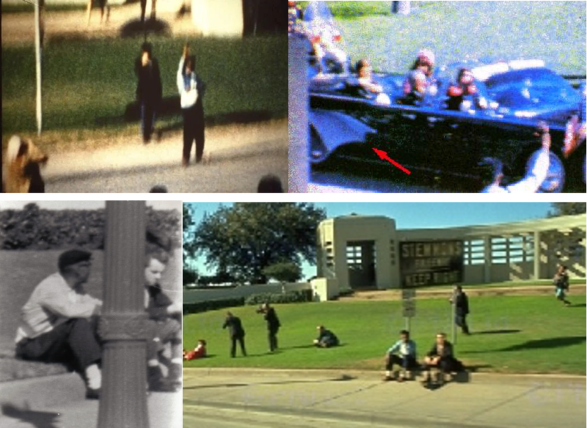
Were they cognizant Zionist agents? I don’t think so. Their sitting together after seeing JFK’s head blown before their eyes suggests that they were stunned and wondering what the hell they had been doing. I suppose they had been sent to do their “little heckling” without being told that it would spice up the killing. Who would be so crazy as to put himself in that position knowingly, standing almost in the line of the Grassy Knoll sniper? Perhaps they had been convinced to do it for money, or as a wager, or as a service to Witt’s Jewish boss at the Rio Grande National Life insurance Co where he worked.
Whatever the case may be, if there was still any doubt that Israel was the prime mover in the assassination of John Kennedy (the evidence is in my book The Unspoken Kennedy Truth), Umbrella Man and Nazi-Salute Man are the ultimate signature. But to see this, you need some spiritual insight into Jewishness and Kennedyness.
Jewishness is the evil soul of the U.S., best embodied today by the neocons (of whom Norman Podhoretz, editor-in-chief of Commentary for 35 years, is the founding father). Kennedyness was the good soul of America. Above anything else, the Kennedys stood for strong family values and service to country to the point of sacrifice. “Joseph P. Kennedy,” writes Laurence Leamer, “created one great thing in his life, and that was his family. . . . Joe taught that blood ruled and that they must trust each other and venture out into a dangerous world full of betrayals and uncertainty, always returning to the sanctuary of family.”[9] Joe also taught his children that they had to pay back to America what America had given them. The Kennedy family symbolized the America that Americans and the world loved.
This is why John F. Kennedy, Jr. was the “charismatic crown prince of America’s royal family,” as the New York Daily News wrote the day after his death.[10] He was Prince Hamlet haunted by the ghost of his murdered father, destined to avenge him and save the kingdom from the usurpers. The Kennedy tragedy is the most Shakespearian, the most paradigmatic, the most archetypal story in all American history. And America has not a worthy monument in their honor. So many Holocaust museums to honor the Jews’ dead, and not one chapel to pray for the Kennedys!
As a matter of fact, only Israel has a Kennedy memorial of any significance. It was explicitly designed to look like “the stump of a felled tree,” and it does. Do you get the idea? It symbolizes Israel’s plan for the Kennedy dynasty. You can trust Jews to choose their symbols carefully. And don’t imagine people can see any statue or even a single photo of Kennedy inside; it is as hollow as a dead stump. It is a memorial to erase the memory of Kennedy. It reminds me of the paradoxical command: “remember to erase Amalek’s memory” (Deuteronomy 25:19 and Exodus 17:14).

The Zionists’ hatred for the Kennedys runs deep, despite their histrionic “crocodile tears” after JFK’s death. When meeting the new president on May 30, 1961 in New York, Ben-Gurion could not help but see in him the son of a Hitler-appeaser. Abraham Feinberg (who arranged the meeting) recalls that “Ben-Gurion could be vicious, and he had such a hatred of the old man [Joe Kennedy].”[11] Ben-Gurion had no illusion about the fact that John was very much his father’s son. Had he not, in his 1956 Pulitzer-Prize-winning book Profiles in Courage, vindicated Senator Robert Taft for denouncing the Nuremberg Trials as a parody of justice, and the hanging of German officials as “a blot on the American record which we shall long regret”?[12] It certainly didn’t escape the Zionists that, on May 11, 1962, President Kennedy invited Charles Lindbergh and his wife at a grand reception at the White House, sitting them at the presidential table and hosting them overnight. Lindbergh had been the most prominent voice for the America First Committee in 1940, publicly accusing the Jews of pushing America into the war. Since then, he had been living in reclusion.
Moreover, Ben-Gurion believed that JFK was paving the way for a new Holocaust by preventing Israel from acquiring the indispensable nuclear deterrence against the Arabs. This is what Ben-Gurion meant when describing Nasser as a new Hitler and the Arabs as the new Nazis, in one of his last letters to Kennedy, May 12, 1963, in response to Kennedy’s demand for immediate inspections of Dimona: “Knowing them I am convinced that they are capable of following the Nazi example. … Mr. President, my people have a right to exist … and this existence is in danger.” Monika Wiesak has noted that, in that very letter, the father of the Jewish State made a cryptic digression about Jordanian King Hussein, writing: “there is always a danger that one single bullet might put an end to his life and regime.”[13]
Salvator Astucia has, I think, well captured the essence of the Kennedy problem for Israel:
The Israelis distrusted President Kennedy because of his father. It is widely known that Joseph Kennedy Sr. developed a strong loathing of Jews from his business dealings with them in finance, Hollywood, and politics. And the elder Kennedy had groomed four sons for the White House, but his oldest — Joe, Jr — had been killed in World War II. President Kennedy’s inauguration in January 1961 marked the beginning of a dynasty that would likely continue until 1985 (after the three surviving sons had each completed two terms). With this background information, it becomes clear that there was one primary motive for the assassination: to destroy the Kennedy Dynasty.[14]
Under a Kennedy presidency, there would be no Six-Day War, the Palestinian refugees would recover their land, AIPAC would be registered as a foreign agent, and the Holocaust would certainly not become a State cult enforced by ADL inquisition. And of course, Israel would never have become a nuclear State.
Destroying the Kennedy dynasty was probably a sacred oath taken by all B’nai B’rith top officials (Dallas was full of them). JFK Jr. was a marked man, if not from the moment he saluted his father’s coffin on his third birthday, at least from the moment it became clear that he had the ambition and the potential to reach the White House. Killing his political future was not enough, and probably not possible.
I wrote a long article in January 2019, titled “The Broken Presidential Destiny of JFK, Jr.”, reviewing the evidence that JFK Jr. was assassinated. I will now summarize it.
Evidence of assassination
It was Friday July 16, 1999, at 9:39 pm, when JFK Jr.’s voice was last heard by Martha’s Vineyard air traffic controller Buddy Wyatt, asking, in a calm voice, instruction for landing. (This was reported the next day by U.S. Coast Guard Petty Officer Todd Burgun in a live phone interview with anchor Susan Wornick of Boston WCVB-TV.)
About two minutes later, John’s plane suddenly plummeted into the ocean at the radar-recorded speed of 4,700 feet per minute. Victor Pribanic, an attorney from Pennsylvania who was fishing for striped bass that night and had noticed the aircraft flying toward the island, reported to the The Martha’s Vineyard Times (cited in the New York Daily News, July 21, 1999): “I heard an explosion over my right shoulder. It sounded like an explosion. There was no shock wave, but it was a large bang.”
Based on these facts, the only rational explanation is that the plane suffered a sudden structural damage by explosive, making it impossible to maintain in the air; blowing off a part of a wing or the tail would have been enough, and would have required only a very small device magnetically affixed to the plane.
These facts, however, were quickly removed from public awareness. Pribanic’s testimony never made it to the national news. And Kennedy’s 9:39 call to Martha’s Vineyard airport was quickly denied and erased from the narrative. Instead, on July 18, the Federal Aviation Administration (FAA) produced some “newly found” radar “evidence” which supposedly showed Kennedy’s flight exhibiting signs of difficulties and irregularities long before it disappeared from the radar.
The official narrative was a mix of two ingredients, bad weather and pilot recklessness, coated by a heavy layer of “the Kennedy curse”. Not a word of the possibility of foul play.
When the National Transportation Safety Board (NTSB) concluded its investigation eleven months later, it issued a news release that attributed the plane crash to “the pilot’s failure to maintain control of the airplane during a descent over water at night, which was a result of spatial disorientation. Factors in the accident were haze and the dark night.” That is all the corporate news retained. However, a close reading of the full report reveals many unanswered questions and even contradictions with its conclusion. For example, the NTSB final report quotes Martha’s Vineyard air traffic controller Buddy Wyatt as stating that the visibility was good: “I remember aircraft on visual approaches saying they had the airport in sight between 10 and 12 miles out. I do recall being able to see those aircraft and I do remember seeing the stars out that night.”
Also, the sudden drop of altitude from 2,200 feet to 1,100 feet in 14 seconds, stated in the full report, is hard to reconcile with the news release statement. Disorientation implies that the pilot was not aware that he was flying straight into the ocean. But that is impossible, as the NTSB Investigator-in-Charge, Robert Pearce, had admitted as early as July 20, 1999: “They were aware they were going down. With that kind of descent rate, it is going to be noisier than hell in the cockpit.”
In contrast to what the news media kept hammering, the NTSB report reckoned that JFK Jr. had a flight experience of “about 310 hours, of which 55 hours were at night.” During the last fifteen months, he had made 35 flights between Fairfield airport, N.J., and Martha’s Vineyard, including five at night. Three certified flight instructors (CFI) quoted in the report describe John as an “excellent”, “methodical” and “very cautious” pilot.
No matter how we twist or downplay all other data, the very conditions of the plane’s sudden dive, which is an undisputed fact, should raise a strong suspicion of a major and sudden mechanical failure. As Anthony Hilder put it:
A finely-tuned, well-kept first-class airplane doesn’t just drop out of the sky and head straight down into the ocean unless it’s blown out of the sky or the pilot deliberately sends it into a dive to kill himself and his passengers.
Evidence of cover-up
Some testimonies used in support of the theory of JFK Jr.’s incompetence and recklessness are highly suspicious. A case in point is Kyle Bailey, “the last man to see Kennedy alive at the Fairfield airport,” who claimed to have had bad a premonition on seeing him take off: “I told my family, ‘I can’t believe he’s going up in this weather’,” he said on July 18. Bailey went on becoming an aviation analyst specialized in plane crashes, and regularly working for major network such as Fox News, CBS, ABC, NBC, and BBC. Bailey appeared in the documentary Curse on the Kennedys? and then in the ABC documentary The Last Days of JFK Jr., aired in January 2019, in which he repeated his story. Kyle Bailey is to JFK Jr.’s death what Mark Walsh is to 9/11.
The search for the plane and the bodies was entirely controlled by the military, although JFK Jr. had never been in the army. A 17-nautical mile no-fly zone and no-entry zone was established around the crash site. No civilians or media crew were allowed in this area. On July 20, 1999, as we read in the NTSB report, “the airplane wreckage was located by U.S. Navy divers from the recovery ship, USS Grasp.” Why was the Navy, rather than civilian rescue craft, tasked with the retrieval of JFK Jr.’s crashed airplane? More disturbing still, why did the Pentagon take exclusive control of news reporting from July 18?
There are issues also with the botched autopsies, as Joanna Weiss and Matthew Brelis of the Boston Globe wrote on July 23, 1999 in an article titled “JFK Autopsy Rushed.”
But the most suspicious thing of all is the way the bodies were disposed of: they were cremated, then their ashes were taken aboard a Navy destroyer, and scattered into the sea, near the place where they had met their death. “The burial for the 35th president’s son was reportedly carried out in keeping with his expressed wishes,” noted journalist Paula Maxwell. What? At age 39, JFK Jr. had expressed his will not to be buried with his father and mother at Arlington cemetery and instead to be cremated and his ashes spread above the ocean? Who can believe such a thing? The Boston Globe reported on July 22 , “Kennedy’s family requested a burial at sea, and the Pentagon granted that request.” But, the next day, the same newspaper expressed surprise:
The cremated remains of John F. Kennedy Jr., his wife, and her sister were cast from a warship to the ocean currents in a manner not favored by the Catholic Church and in a ceremony that occurred only after the intercession of Pentagon brass. The Roman Catholic Church prefers the presence of a body at its funeral rites. And the Defense Department rarely accords the honor of burial at sea to civilians.
No other Kennedy had ever been cremated. The reasons given for cremating JFK Jr. body do not make any sense and are contradictory. The New York Times wrote:
“Kennedy family members, citing his wishes and hoping to avoid having a spectacle made of Mr. Kennedy’s final resting place, have decided to have his body cremated and his ashes scattered at sea in a Navy ceremony, a family adviser said.”
That is utterly unbelievable. The bodies must have been cremated and scattered for another reason: to prevent any possibility of ever finding traces of explosives in the bodies.
But the idea of wanting to deprive JFK Jr. of a final resting place that could possibly encourage a popular Kennedy cult has also a strong biblical and B’nai B’rith smell. Who, among “Kennedy family members”, could possibly have wanted this? It happens that, according to information found in RFK Jr.’s diary, published by the New York Post, Ann Freeman, Carolyn and Lauren Bessette’s mother, “began asking that her two daughters be buried near her home in Greenwich, Connecticut.” It was Edwin Schlossberg, Caroline Kennedy’s Jewish husband, who convinced her to have her two daughters cremated and their ashes spread in the ocean. “He bullied, bullied, bullied the shattered grieving mother,” writes RFK Jr.
The heir and the Avenger
JFK Jr. had grown up with a sense of destiny. According to biographer Christopher Andersen (The Good Son): “Jackie made sure that John was constantly exposed to the people who knew John [President Kennedy] best.” In her last letter to her son before dying to lymphoma in 1994, she wrote: “You, especially, have a place in history.” John told Lloyd Howard in 1997: “She expected me to follow in my father’s footsteps, and of course I will. But I don’t think the time is right just yet.” Just like his father before him, John Jr. first pursued a career in journalism: in 1995, he founded the magazine George, which engaged in controversial issues of deep politics. His longtime friend Robert Littell wrote, in The Men We Became: My Friendship with John F. Kennedy Jr. (St. Martin’s Press, 2004): “George was also an opportunity for John to build a platform from which he might possibly move into political life.” George was also a means for John to interact with political actors and thinkers.
Brought up in the worship of his father, John had taken a keen interest in “conspiracy theories” about his death at least since his late teens. His knowledge deepened in his thirties, and motivated him to publish in a special “conspiracy issue” of his magazine George, eight months before his death, a cover article by Oliver Stone, director of the groundbreaking film JFK, titled “Our Counterfeit History”.
At age 39, John had made up his mind to launch his political career by seeking an electoral mandate in New York State, and he was about to announce it publicly. According to his friend Billy Noonan (Forever Young: My Friendship with John F. Kennedy, Jr., Viking Press, 2006), he was about to enter the race for the New York Senate seat left vacant by Daniel Patrick Moynihan, which Hillary Clinton also coveted (and ultimately got). John was a New Yorker, and Clinton would have stood no chance against him.
JFK Jr. had also voiced privately his ambition to ultimately reach for the presidency. Given his personality and his popularity, he had high chances to make it in less than 20 years. Pierre Salinger, one of the men Jackie had asked to educate John about his father, had become very close to him, and declared on French radio Europe 1, on July 19, 1999: “I felt that in the coming year John Junior would also become a politician. It’s my point of view. And with other people, we thought he was going to be a Democratic candidate for the next presidential election.” Others, such as John’s assistant at George, RoseMarie Terenzio, thought “he would’ve run for president … in 2008.”
In 1968, John Kennedy’s brother ran for President with the intention, not just to save the Kennedy legacy, but to reopen the investigation on his brother’s death (as David Talbot has demonstrated in his book Brothers). He was assassinated. In 1999, Robert Kennedy’s nephew was about to announce his entry into politics, with the clear intention to go all the way to the White House. There is no question that one of his goals in life was to expose the murderers of his father. His old high school girlfriend Meg Azzoni, in her self-published book, 11 Letters and a Poem (2007), writes that as a teenager, “his heartfelt quest was to expose and bring to trial who killed his father, and covered it up.”
I rephrase my conclusion from my longer 2019 article:
So, was JFK Jr. himself assassinated? Here is man whose road to the presidency seemed traced. No other man of his age had better chances to reach the White House one day. And no other man in the world had more reasons to want the 1963 Kennedy assassination reinvestigated. He was already trying to educate the public through his magazine, at the risk of exposing his own beliefs, something no other Kennedy had ever done (even RFK had kept his doubt on the Warren report private, and his plan to reopen the case secret). And this man, his friend Billy Noonan believes, was just about to announce his candidacy for a New York Senate seat, which everyone would have understood as the first step toward the White House. Pierre Salinger and others even believe he would have run for president in 2000. What are the odds that he would die at this precise moment by accident? … If it was an accident, then the Devil caused it. Or was it Yahweh?
One more thing: JFK Jr. died two years before 9/11. Who knows what influence he would have had on the American public, either as a senator or as the editor of a magazine with a strong interest in conspiracies? He may very well have stood in the way of the War on Terror, the WWIV that Norman Podhoretz was calling for. You never know, with those Kennedy peacemakers!
Israel believes in preemptive assassinations, as demonstrated by Ronen Bergman in Rise and Kill First: The Secret History of Israel’s Targeted Assassinations.
Israel killed JFK Jr.
A curse on Israel!

Notes

[1] Arthur Krock, Memoirs: Sixty Years on the Firing Line, Funk & Wagnalls, 1968, p. 328.
[2] Michael R. Beschloss, Kennedy and Roosevelt: The Uneasy Alliance, Open Road, 1979, p.187.
[3] John Hughes-Wilson, JFK: an American coup d’état, John Blake, 2013, pp. 88-89.
[4] Seymour Hersh, The Samson Option: Israel’s Nuclear Arsenal and American Foreign Policy, Random House, 1991 , p. 96.
[5] Robert Caro, The Years of Lyndon Johnson, vol. IV: The Passage of Power, Alfred Knopf, 2012, p. 104. Also in Krock, Memoirs, op. cit., p. 362.
[6] Seymour Hersh, The Dark Side of Camelot, Little, Brown & CO, 1997, p. 129.
[7] Andrei Gromyko, Memoirs, Doubleday, 1989, pp. 181-182.
[8] Edward Klein, The Kennedy Curse: Why Tragedy Has Haunted America’s First Family for 150 Years, Saint Martin’s Press, 2004.
[9] Laurence Leamer, Sons of Camelot: The Fate of an American Dynasty, HarperCollins, 2005, kindle l. 262-267.
[10] Dave Saltonstall, Austin Fenner, Helen Kennedy and Greg B. Smith, “John F. Kennedy Jr. went missing after taking a flight with his wife and her sister in 1999,” New York Daily News, July 18, 1999, on nydailynews.com
[11] Hersh, The Samson Option, op. cit., p. 103.
[12] Robert Taft, October 6, 1946, quoted in John F. Kennedy, Profiles in Courage, 1956, Harper Perennial, 2003 , p. 199.
[13] Monika Wiesak, America’s Last President, 2022, p. 214.
[14] Salvador Astucia, Opium Lords: Israel, the Golden Triangle, and the Kennedy Assassination, 2002, p. 5, on www.whale.to/b/astucia.pdf.
Ukrainian children still speaking Russian – regulator
RT | July 12, 2024
Ukrainian children don’t know their official state language well enough because they’re still using Russian in their daily lives, Kiev’s Commissioner for the Protection of the State Language Taras Kremin has complained, urging citizens to report violations of language restrictions.
The commissioner said there are also many violations being recorded in the sphere of education, as well as on the internet and in the service industry. He cited a recent study that suggested one-third of children in some Ukrainian regions prefer to speak Russian.
“A child outside of school uses services, visits shopping and catering establishments, sees external advertising and signboards in non-state language, hears non-state at home,” Kremin wrote on Facebook on Thursday.
He suggested that many schoolchildren were therefore prone to bilingualism and do not have sufficient knowledge of the Ukrainian language.
Kremin said Kiev should strengthen control over compliance with the law on state language, which defines Ukrainian as the only language approved for education, and called on citizens to be more involved in recording and reporting violations of the law.
Since gaining its independence in 1991, Ukraine has largely been a bilingual nation, with most citizens able to speak or understand both Russian and Ukrainian, particularly in the eastern half of the country. After the 2014 US-backed coup in Kiev, however, Ukraine’s new authorities abolished Russian as an official regional language and have adopted policies aimed at suppressing and outlawing it, arguing that it represents a threat to national unity and security.
In 2019, the Ukrainian parliament passed a law requiring Ukrainian to be used exclusively in nearly all aspects of public life, including education, entertainment, politics, business and the service industry, obliging all Ukrainian citizens to know the language. It also requires that 90% of TV and film content produced in the country be made in Ukrainian. From July 17, the use of the Russian language in Ukrainian media will be virtually outlawed, Kremen has said.
This forced Ukrainization was one of the reasons why Russian-speaking residents living in the east of the country rejected the post-coup authorities in Kiev in 2014. Many of these regions, namely the Donetsk and Lugansk People’s Republics, as well as Kherson and Zaporozhye regions, have since joined Russia after overwhelmingly voting to do so in public referendums in 2022.
Kremin, however, has denied that the term ‘Russian-speaking’ could be applied to any Ukrainian citizens, stating in an interview last year that the word is a “marker introduced by Russian ideology,” and declaring that “everyone in the country must have command of the Ukrainian language.”
EU suspends accession process of ex-Soviet republic
RT | July 8, 2024
The European Union has suspended the process of Georgia’s accession to the bloc, the EU’s ambassador to the former Soviet republic, Pavel Gerchinsky, told the Russian media on Tuesday. A €30 million ($32.5 million) payment allocated to the Georgian Defense Ministry has also reportedly been frozen.
The envoy cited Tbilisi’s controversial ‘foreign agent’ law as the reason behind the move. After the legislation was adopted last month, EU foreign policy chief Josep Borrell warned Georgia that its potential accession to the bloc was in jeopardy.
Formally titled the Transparency of Foreign Influence Act, the new law requires NGOs, media outlets, and individuals who receive more than 20% of their funding from abroad to register as entities “promoting the interests of a foreign power” and to disclose their donors. Those who fail to comply will face fines of up to $9,500. The bill came into force despite opposition protests and a veto by Georgian President Salome Zourabichvili.
“The intentions of the current Georgian government are unclear to EU leaders. The Transparency of Foreign Influence Act is clearly a step backwards. […] Also, the anti-Western, anti-European rhetoric is completely incompatible with the declared goal of joining the European Union. Unfortunately, as of now Georgia’s accession to the European Union has been suspended,” Gerchinsky said, as quoted by RIA Novosti.
While opponents of the law have described it as at attack on democracy and “Russian” because Moscow has similar legislation, its supporters have noted it is similar to what numerous Western nations, including the US, have in place.
Borrell said last month that Georgia will not progress with its EU accession unless its government changes its policies.
Georgia will hold parliamentary elections in October, and Gerchinsky expressed hope that a new government in Tbilisi, “whatever it may be,” will again “begin serious work” toward EU integration.
The former Soviet republic applied for EU membership in March 2022, shortly after the start of the Ukraine conflict. In May of last year, the European Council agreed to allocate €30 million to boost Georgia’s defense sector. The European Council granted Tbilisi candidate status last December.
US Provides $2 Billion Military Aid Package to Warsaw
By Connor Freeman | The Libertarian Institute | July 8, 2024
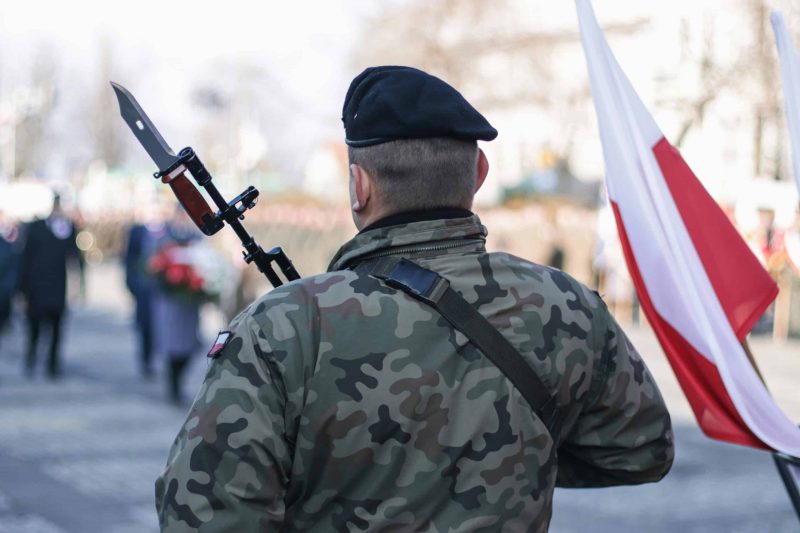
Washington is providing its NATO ally Poland with a second $2 billion foreign military financing (FMF) package in less than a year, Breaking Defense reports. In recent weeks, Warsaw has given Kiev a green light to use Polish-provided weapons to strike the Russian mainland as well as signed a bilateral military pact with Ukraine, agreeing to shoot down some Russian missiles.
A State Department official boasted to the outlet of how the two FMF loans are benefiting the US arms industry as well as strengthening the Washington-led bloc embroiled in its Ukraine proxy war with Moscow. “It’s impressive that it hasn’t even been a year and they [Poland] are moving out pretty quickly… We’re happy with the process. We see it as a success. We’re happy that they’ve been able to move out quickly — not only does it help NATO, it helps the US defense industry as well, the US economy. So, we’re definitely happy with the process.”
As with typical FMF loans, the funds furnished by the State Department to a foreign government must be spent on American-made weaponry and equipment. What makes this loan unique, however, is instead of a grant to purchase arms, this loan includes interest which Warsaw must repay. The US is putting up $60 million to guarantee the loan and cover initial fees. The official said details regarding how the funds will be spent, on what kinds of weapons, will not be shared during this week’s NATO summit. Instead, he insisted the Poles “[have] a list of things they want to achieve” and said to expect future announcements.
The official noted the previous FMF loan, issued last September, has either been totally spent or is earmarked for purchases including four aerostat-based early warning systems which accounts for approximately half the first loan. The unusual loan-based structure allows “the interagency to get FMF funding to foreign allies without needing to wait on the appropriations process,” the outlet notes, adding Congress extended the authority to issue these loans through the end of the 2025 fiscal year.
Asked if other countries will receive such loans, the official answered “We are looking at it, and there are other countries that remain competitive… The reason you’re seeing Poland is, of course, the situation with the ongoing war in Ukraine. They’re ready to move out.” The official emphasized that talks with multiple countries are ongoing, while repeatedly praising Warsaw’s high military spending and deeming Poland “the tip of the spear on this for us right now.”
The State Department stated “Poland is a leader in NATO, currently spending four percent of GDP on defense, the highest in the Alliance. Poland hosts thousands of U.S. and Allied forces, including U.S. V Corps Headquarters (Forward) in Poznan.” The US has roughly 10,000 troops stationed in Poland. Since Russian forces invaded Ukraine, Warsaw has announced plans to buy a myriad of American arms including Abrams tanks, Black Hawk and Apache helicopters, HIMARS rocket launchers. Poland is seeking more Patriot air defense batteries as well.
This latest financial and military infusion comes after Ukraine and Poland signed a bilateral military pact this week which includes a mechanism for Warsaw to shoot down Russian missiles and drones. This provision entails the potential to provoke a NATO-Russia war, something Ukrainian President Volodymyr Zelensky has long sought.
During a joint presser with Polish Prime Minister Donald Tusk on Monday, Zelensky declared “We are especially grateful for the special arrangements, and this is reflected in the security agreement. It provides for the development of a mechanism to shoot down [by Poland] Russian missiles and drones fired in the airspace of Ukraine in the direction of Poland.”
In November 2022, after a Ukrainian air defense missile killed two people in Poland, Zelensky and his top advisors said it was a Russian strike and demanded NATO take action. “Hitting NATO territory with missiles. … This is a Russian missile attack on collective security! This is a really significant escalation. Action is needed,” Zelensky railed in a video address.
This assessment was completely at odds with those made by the US, Poland, and NATO which determined the Polish casualties were not the result of a Russian missile strike. At the time, a diplomat from a NATO member state told Financial Times “The Ukrainians are destroying [our] confidence in them. Nobody is blaming Ukraine and they are openly lying. This is more destructive than the missile.”
Hungary to fight ‘pro-war propaganda’ – official
RT | July 8, 2024
Hungary is set to introduce a new “anti-war action plan” which will include measures aimed at countering “war propaganda,” Gergely Gulyas, the head of the Hungarian Prime Minister’s Office, announced at a press conference on Monday.
Under the plan, any political forces or media outlets accused of promoting belligerent policies would be required to reveal their funding sources. The goal is “full transparency,” Gulyas said. The measure is primarily aimed at the media, the nation’s news outlets reported, noting that political parties in Hungary are already legally barred from receiving funds from abroad.
The government would also reserve the right to block any foreign funding and send the money back to whoever provided it, if it is used to bankroll “war propaganda,” Gulyas said.
The official provided few details as to how the government would decide what exactly constitutes “war propaganda.” He said that the Justice Ministry would develop a mechanism to determine whether a media outlet is involved in the practice.
When asked if “foreign funding” included money coming from within the EU, Gulyas said that the measure would be focused on financing coming from outside the bloc. He argued, however, that the EU itself is dominated by “war propaganda” focused on the ongoing conflict between Kiev and Moscow.
Gulyas said Budapest is facing “political, legal and financial blackmail” which aims to force it to join the ranks of Kiev’s Western war backers, but that it has so far resisted the pressure. “There is no blackmail that [can force] Hungary to change its conviction that every political step must serve the end of war,” he said.
His words came as Hungarian Prime Minister Viktor Orban embarked on what he called a peace mission that included visits to Kiev and Moscow within the span of several days. In the Ukrainian capital, he called for a ceasefire, describing it as a first step towards conflict resolution. The idea was rejected by Ukraine’s Vladimir Zelensky.
Orban called his Moscow trip the first step to restoring dialogue. The move drew criticism from the EU, which said the Hungarian prime minister, whose nation currently holds the bloc’s rotating presidency, had no mandate to speak on behalf of Brussels.
On Monday, Gulyas addressed the issue by saying that peace cannot be achieved without direct dialogue with all the warring parties. “Hungary would like to be in contact with any country that can contribute to peace,” he added.
Russia halts participation in OSCE Parliamentary Assembly
RT | July 3, 2024
Russian lawmakers on Wednesday voted to suspend Moscow’s participation in the Parliamentary Assembly of the Organization for Security and Co-operation in Europe (OSCE PA), citing its “discriminatory approaches, double standards and total Russophobia.”
Both chambers of Russia’s parliament – the State Duma and Federation Council – voted unanimously during sessions on Wednesday to suspend the country’s participation and stop paying fees to the organization.
Moscow already stopped its payments to the OSCE itself after its delegation was denied access to the organization’s meetings on several occasions.
“We should not pay for something we did not participate in,” the State Duma Speaker Vyacheslav Volodin said at the time.
OSCE leaders have ignored Russia’s repeated appeals for an equal dialogue, the lawmakers said in a statement, adding that the body is being used as a “politicized tool to deliberately implement an anti-Russian course, and also to intentionally distort” events in Ukraine.
The lawmakers accused the assembly of “biased, discriminatory approaches, double standards, total Russophobia, unpreparedness for meaningful discussions, including on relevant issues of ensuring equal and indivisible security.”
Since the start of the Ukraine conflict, Russian MPs have been repeatedly blocked from taking part in a number of the organization’s events.
In November 2022, Poland denied visas to Russian officials scheduled to attend an OSCE meeting in Warsaw. And in June 2022, Russian MPs were barred from traveling to the UK to participate in the OSCE Parliamentary Assembly session in Birmingham.
The latest case was a “demonstrative” refusal by Romanian authorities to issue visas in June to a Russian delegation to attend the annual session of the body in Bucharest.
Russia has been a participant in the OSCE since the Soviet Union signed the Helsinki Accords in 1975. The organization’s monitoring mission in eastern Ukraine began in 2014, but was terminated just prior to the start of the conflict between Moscow and Kiev in February 2022. Russia had previously repeatedly accused the group of ignoring violations by Ukraine.
Having held its first session back in 1992, the OSCE Parliamentary Assembly incorporates 57 member states, and declares as its primary mission the facilitation of “inter-parliamentary dialogue to advance the OSCE’s goals of comprehensive security.”
Featured Video

Macgregor: We Haven’t Seen the Worst of the Iran War Yet
or go to
Aletho News Archives – Video-Images
New Book
Breast Cancer: Before You Consent
A new Unbekoming paperback
Lies are Unbekoming | September 18, 2026
Peter Gøtzsche reviewed every randomised mammography screening trial ever conducted for the Cochrane Collaboration. Cochrane’s headline is that, assuming a 15% mortality reduction, one woman in 2000 avoids dying of breast cancer over ten years. Ten are overdiagnosed and treated. Two hundred experience false alarms.
But that headline assumes the reduction. When Gøtzsche looked only at the trials with adequate randomisation — the higher-quality ones — the reduction disappeared. No effect on breast cancer mortality. No effect on all-cause mortality.
This is the Cochrane finding, published in the establishment’s own database of systematic reviews.
No woman being asked to consent to a mammogram this week knows it.
That is why the new Unbekoming paperback exists. … continue
Blog Roll
 Aletho News
- US lawmaker blocks $2.8 billion weapons sale to Israel: Report
- Yemeni army claims responsibility for strikes on sensitive sites in Saudi capital, Aramco facilities in Yanbu
- Iran Judiciary issues indictments against 159 US, Israeli officials for assassination of Leader, commanders
- Turkiye revokes Iranian bank license under US sanctions campaign
- US-Denmark Agreement on Greenland Is ‘PR Stunt’ Ahead of Midterms
- Araghchi: Military intervention cannot create security; coercion cannot bring peace
- Fraud Squared
- Breast Cancer: Before You Consent
- Iran’s Plan to Shut Down AI in the Persian Gulf
- Israel seeks ‘compensation’ from Washington over Saudi F-35 sale
- If Americans Knew
- Inside Gaza’s death trap of collapsing, bombed-out buildings
- The everyday items Israel bans from Gaza every day
- Inside the siege, the ruined buildings of Gaza – Daily Update
- Debunking The Claim That Macklemore Has A “History Of Antisemitism”
- CPJ demands release of arrested Palestinian-US journalist near Bethlehem
- Robert Kraft: The Billionaire Friend of Netanyahu Pulling The Strings Behind the Macklemore/Ed Sheeran Blow Up
- Columbia Administered Fund Gives Big Money to Pro-Israel Groups
- Deportation Case of Palestinian Activist Salah Sarsour Tests First Amendment
- ‘We Will Not Forget’: Palestinians Mark 44 Years since Sabra and Shatila
- Why do we let Zionists decide what we can and can’t say?
- No Tricks Zone
- New Study: ‘Global Drought Shows No Detectable Recent Acceleration Under Climate Warming’
- Economic Masterminds: German Socialists Suggest Taxing Productivity Gains Stemming From Using AI
- The South China Sea Has Not Been Cooperating With The Climate Change Narrative
- Energy Crisis: Germany Enters Heating Season With Historically Low Gas Reserve Fill Levels
- New Study: The Antarctic Ice Sheet Gained Mass From 2020-2024 Due To Staggering Snow And Ice Accumulation
- Study: Ocean Heating Rates From Thousands Of Years Ago ‘Dwarf’ Modern Ocean Heating Rates
- Climate Extremists Target, Attack Large-Scale Power Grid Infrastructure In Germany!
- New Study: Antarctic Ice Melt Has Contributed Less Than 1 Centimeter To Sea Level Rise In The Last 30 Years
- Fear Of Debate: Alarmist German Climate Scientist Calls On Mainstream Media To Discredit Skeptic Voices
- End-Of-August Arctic Sea Ice Extent Hasn’t Fallen In 20 Years, Official Data Show!
 Aletho News