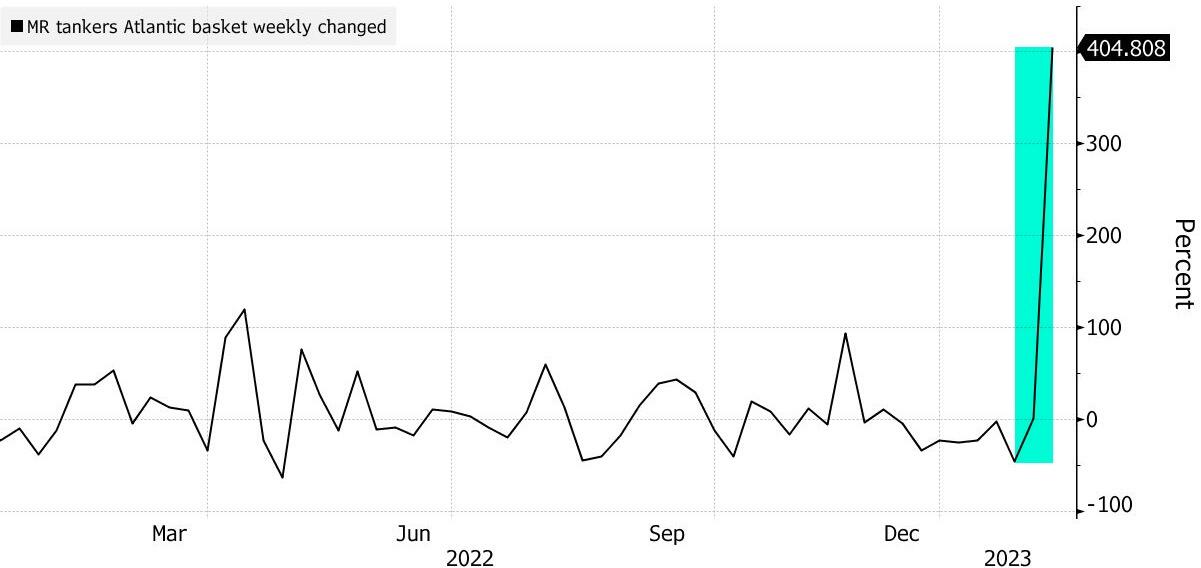
Clean product tanker rates soared last week after the European Union and G-7 nations targeted Russia’s petroleum sales. Restrictions on Russian crude exports began in early December. The sanctions have been a ploy by Western countries to limit Russian crude and crude product exports, though it’s definitely not working.
Sanctions have redirected Russian energy flows from Europe to Asia. The rejiggering of supply chains means Russia has to rely more on tankers. According to Bloomberg, this has led to a 400% surge in the daily rates for clean product tankers.
The latest data from the Baltic Exchange in London shows clean product tankers rates have reached $55,857 per day, surging 58% just last Thursday.
According to trading giant Trafigura, Russia relies on a “shadow fleet” of tankers to move crude and crude products. The trading firm said the fleet is about 600 ships.
Bloomberg said the surge in tanker rates has been “spurred in part by a bifurcation of the fleet with some tankers serving Moscow’s interests and others the international market. It highlights a possible flipside of aggressive measures aimed at limiting Russia’s petroleum revenues.”
“Russian volumes continue to flow at more or less the same rate and that takes up a lot of ships.”
“Ultimately, the spike shows demand is pretty good, and the fundamentals are strong,” Lars Bastian Ostereng, an analyst at Arctic Securities.
About 400 tankers, or 20% of the global fleet, recently “switched” from hauling fuels for traditional countries to carrying Russian petroleum products, Trafigura’s co-head of oil trading Ben Luckock said in a recent Bloomberg interview. That has reduced the number of tankers for traditional routes and is leading to the skyrocketing cost of freight.
Bloomberg pointed out that surging rates aren’t entirely because of the tanker “switch.” It’s also due to more crude flowing by water following Western sanctions on Russia. Much of those energy exports are now being sent to Asia.
“We see no indication that Russia will have to cut back its exports of crude or refined products,” said David Wech, chief economist of Vortexa, during a presentation late last week.
Furthermore, crude prices have edged over $86 a barrel following last Friday’s announcement that Russia will reduce crude oil production by 500,000 barrels per day. This is in response to Western price caps on purchasing Russian fuel.
In future, it will no longer be enough for the EU to censor and silence undesirable alternative media only in its own area of responsibility. The EU also wants to fight unwelcome opinions and competing media in the rest of the world.
To this end, EU foreign policy chief Josep Borrell has announced that he intends to use alleged “disinformation experts” in EU offices around the world. Their task would be fighting Russian and Chinese spreaders of alleged “fake news”.
Borrell announced the deployment of official censors to this end: “All our delegations will be equipped with experts in countering disinformation in many parts of the world so that our voice is better heard.”
A particular thorn in the side of the EU is the Russian and Chinese media and their multipliers, for example on platforms such as Telegram.
More international solidarity with allies is also required here, said Borrell. “We need to address this issue politically at the highest level.” The EU and like-minded partners should create their own way of sharing data and analysis of foreign disinformation campaigns, but also work more with authorities around the world to ban competing voices.
Borrell did not give any specific information about what this should look like in the future and how the EU broadcasters should act against “fake news”. So far, the EU has not come up with anything other than censorship when it comes to unwanted competition but that could be difficult in foreign countries.
From the point of view of Borrell and the EU authorities there is no reason whatsoever to doubt the official narrative, and every expressed doubt will now be given a new label: “Foreign Information Manipulation and Interference”, abbreviated FIMI.
The unelected preach ‘democracy’
The EU Commission is not a democratic structure, its members are appointed, not elected, and most of them lack any understanding of democracy. EU Foreign Affairs Commissioner Josep Borrell could virtually serve as Exhibit A.
Not long ago, Ursula von der Leyen deleted her mobile phone communication with Pfizer about the purchase of millions of doses of a pharmaceutical preparation and while it raises the suspicion of corruption, this could be presented as FIMI simply because it was also reported by a Russian broadcaster.
Borrell’s grasp of the English language is at least as bad as that of Ursula von der Leyen’s. Yet both insist on proposing these far-reaching measures in English, no longer an EU language. Do they understand the subtleties of their proposal?
Ignoring facts
The Chinese state media, according to the EU report, “have reinforced selected pro-Kremlin conspiracy narratives, for example about alleged US military biorepositories in Ukraine”.
This is a clear example of how to dispose of truth or factual information as a criterion. These labs are not only found as budget items listed in the US defence budget (a document over which the Kremlin presumably exercises no control), but individual collaborations, such as the research projects of the Bernhard Nocht Institute or the Friedrich Löffler Institute with these Ukrainian labs, can also be found on their websites, as well as the financier of these projects, the German Ministry of Defence.
It must therefore be stated that these laboratories existed, that they were financed from the military budget and that the research was carried out on behalf of the military, and not only on behalf of the US. Nevertheless, the EU has declared the very existence of the labs to be a “conspiracy narrative”.
In connection with protests under the title #StopKillingDonbass, the EU report stated that it was “falsely claimed that the Armed Forces of Ukraine and ‘paramilitary units of neo-Nazis’ were committing atrocities against civilians, including children” while the Soros NGO Human Rights Watch recently actually admitted that Ukraine had distributed butterfly mines in Donetsk, an outlawed munition in residential areas.
According to their rationale, any “disinformation” accusation by FIMI does not have to take into account whether the statement is true, but only that it contradicts the EU narrative.
Therefore, the report noted: “The information disseminated by these networks does not have to be provably false or misleading to constitute a FIMI incident, which FIMI applies more broadly than the classic definition of disinformation.”
National Security Adviser to President Biden Jake Sullivan played a prominent role in plotting the September 26, 2022, sabotage against the Russo-European Nord Stream pipelines, Pulitzer-prize winning journalist Seymour Hersh has revealed. So, who is Jake Sullivan: “the cat’s meow,” “once-in-a-generation intellect,” or a reckless hawk?
“I have great respect for Hersh and his reporting and believe that Sullivan could certainly have been instrumental in pushing for and carrying out this deceitful campaign that likely has inflicted monumental damage on citizens worldwide while also sapping America’s remaining national prestige,” Wall Street analyst and investigative journalist Charles Ortel told Sputnik.
In December 2021, Jake Sullivan, acting with Joe Biden’s blessing, convened men and women from the Joint Chiefs of Staff, the CIA, and the State and Treasury Departments to come up with a plan on how to destruct Nord Stream 1 and 2 designed to pump Russian natural gas to Europe, according to Seymour Hersh’s recent bombshell.
In early 2022, the CIA told Sullivan that they knew how to blow up the pipelines. The group decided to keep the risky plot on a hush. The US Congress wasn’t informed. The US military and intelligence operatives did their best to conceal Washington’s role in the sabotage. As per the investigative journalist, the team had concerns about the legality of the plot and was well aware that it could quickly morph into a foreign policy nightmare.
After the pipelines had been destroyed, Secretary of State Antony Blinken and, later, Undersecretary for Political Affairs Victoria Nuland openly praised the development.
“When any crime is committed, the immediate question to ask when seeking suspects is ‘to whose benefit?’ Not only did it benefit the US, US officials made comments before and after the pipeline’s destruction virtually confirming their role and the benefits derived,” Brian Berletic, geopolitical analyst and former US marine, told Sputnik.
For his part, Jake Sullivan stated laconically on September 27, 2022, that the US was supporting efforts to investigate the “apparent sabotage” and “will continue [it’s] work to safeguard Europe’s energy security.”
“Hersh’s reporting on the Nord Stream bombing is completely convincing and I know for a fact that he has reliable sources, mostly in the intelligence community, but I would rather regard Sullivan as the implementer of the attack on the pipeline by virtue of his position rather than the driving force behind it,” Philip Giraldi, former CIA station chief, now an executive director of the Council for the National Interest, told Sputnik. “To be sure, Joe Biden would have had to promote and endorse the project.”
Clinton’s Golden Boy
Jake Sullivan, 46, has long been praised as a “golden boy” by the US mainstream media. Having graduated from Yale in 1998 Sullivan became an advisor to then-presidential candidate Hillary Clinton in 2008 and later, after Hillary dropped out from the race, he advised Barack Obama during his general election campaign.
Sullivan was just 32 when he was sworn in as Hillary Clinton’s deputy chief of staff for policy at the US State Department. When Clinton left the State Department in early 2013, Obama promoted Sullivan to the position of national security adviser to then-Vice President Joe Biden.
In 2015, Sullivan married Margaret Goodlander, onetime advisor to well-known hawks Senators Joe Lieberman and John McCain, who used to previously work for the Council on Foreign Relations and the Center for a New American Security. (Goodlander is currently Counsel to Attorney General Merrick Garland).
Sullivan is known for being a quiet but prominent member of the Clinton-Obama team. According to the press, he was part of the “exclusive” team working on resuming relations with Cuba and striking the 2015 Joint Comprehensive Plan of Action (JCPOA) commonly known as the Iran nuclear deal. He is also said to be Hillary’s close confidante in the Libya plan, which was developed months before the 2011 NATO invasion of the North African state and brutal killing of its leader Muammar Gaddafi.
Sullivan and his boss, Clinton, adhered to the concept of “smart power,” which encompasses the use of military threat, force, and sanctions and the soft-power levers favored by foreign policy doves, which includes humanitarian aid and negotiations.
The aide was reportedly called “the cat’s meow” and a “potential future president” by Hillary, while Biden lauded him as a “once-in-a-generation intellect.”
In 2015, the sandy-haired Minnesotan joined Hillary on her 2015/2016 election cycle as a foreign policy adviser and eventually returned to the US administration as Joe Biden’s national security adviser in 2021.
Sullivan Lacks True Sense of Right Versus Wrong
However, there’s another side to Sullivan’s stellar career. “Sullivan is clearly drunk on power and lacking a true sense of right versus wrong,” according to Ortel.
“Sullivan is a fiercely partisan globalist who achieved numerous high honors in academic life so he is supremely self-confident and, sadly, often grievously wrong,” Ortel told Sputnik. “One way to get a sense of the way he operates is to look through the State Department and Podesta WikiLeaks files and the FBI Vault files on Hillary Clinton where Sullivan is frequently involved. Like the Clintons, Sullivan thrust himself into contact with powerful Democrats and operated well above his experience level early on. But unlike the Clintons, Obama, and Biden, Sullivan has yet to hold elected office.”
One might wonder why Sullivan rose to prominence so fast even though he had relatively little experience in government affairs. Hillary herself admitted that Jake wasn’t the most experienced diplomat when it came to foreign policy.
“Jake was not the most experienced diplomat at the State Department I could have chosen, but he was discreet and had my absolute confidence,” Clinton wrote in her memoir Hard Choices while describing her decision to tap Sullivan to kick off negotiations with Iran in 2012. “His presence would send a powerful message that I was personally invested in this process.”
According to US media observers, Sullivan’s primary secret is that he mastered himself in delivering on his boss’s wants and needs even when it went contrary to rules and ethics. The US press quoted a senior Obama aide as saying that Sullivan was ready to do “everything” for then-Secretary Clinton.
Unsurprisingly, Sullivan had no scruples about Hillary’s unsecured email server use for classified and top secret government correspondence. He was bullish on Washington’s Libyan and Syrian interventions which spiraled out of control, completely ruining the North Africa state and leaving the Syrian Arab Republic in tatters.
“Under Obama and Biden, Sullivan is connected to train wreck after train wreck, from the Arab “spring”, to Benghazi, ISIS, the Iran ‘deal’ and more. He seems to be a huge fan of secret negotiations that are never subject to oversight,” Ortel noted.
Sullivan got mired in Hillary Clinton’s Benghazi scandal revolving around the former secretary of state’s failure to prevent a brutal slaughter of US Ambassador Christopher Stevens and three other US nationals in Libya on September 11, 2012. During the investigation into the matter, the House committee stumbled upon Sullivan’s letter in which the official emphasized that “we need to live in a world of risks,” while touting Washington’s decision to oust Gaddafi which opened the door to chaos in Libya.
Trump-Russia “Collusion” Hoax
“In the 2016 campaign, he had every motive to hide the misdeeds of the Clintons, including corruption and tax fraud involving The Clinton Foundation and many other charities,” said Ortel, who has been conducting a private investigation into the Clinton Foundation’s alleged fraud for several years. “Here it will prove interesting to see what [Special Councel] John Durham has to say about Sullivan, including his likely role pushing the Russian Hoax, for Trump’s impeachment and for electing Joe Biden.”
Sullivan appeared to have no scruples about actively spreading the Trump-Russia collusion narrative and keeping the myth alive even after the allegations about Trump were proven null and void. Later, Durham’s investigation shed light on Clinton campaign operatives’ role in peddling a fake Trump-Alfa Bank story and uncorroborated “dirty dossier” by ex-MI6 agent Christopher Steele.
However, when testifying under oath before the US House Permanent Select Committee on Intelligence in December 2017, the Clinton confidante denied any knowledge of the plot or people involved in it.
US investigative journalist Paul Sperry alleged that Sullivan was well-aware that the Trump-Alfa Bank story was “cooked-up” and personally spearheaded a “confidential project” to link Trump to the Kremlin.
Sullivan was also the one who personally promoted the Trump-Russia collusion story prior to the 2016 elections. Thus, during the July 2016 Democratic National Convention (DNC) in Philadelphia, Sullivan met with a number of mainstream media producers and anchors to tell a story “that Trump was conspiring with Putin to steal the election.”
Around that time, the CIA intercepted Russian intelligence’s “chatter” about a Clinton “foreign policy adviser” who allegedly proposed a plan to vilify Donald Trump by linking him to the Kremlin in order to distract public opinion from Hillary’s emailgate scandal. Some US observers believe that the foreign policy adviser in question was Jake Sullivan.
According to Ortel, Sullivan could well be aware of many other “dirty” secrets of the US Democratic establishment, including the Clinton’s alleged pay-to-play schemes, Joe and Hunter Biden influence peddling and Team Obama’s efforts to undermine then-sitting President Donald Trump through a string of dodgy investigations and leaks.
“Simply put, Sullivan has no choice but to cover up the disasters connected to Biden, Obama and Clinton and likely cannot accept the grave errors (and high crimes) that seem to have been committed. In this effort, he will believe he is secure because his wife is a close advisor and friend of Attorney General Merrick Garland,” the Wall Street analyst remarked.
Nord Stream Reporting Not Done
When it comes to the Nord Stream sabotage, “in a just process, Sullivan and his co-conspirators would swiftly be charged, convicted and incarcerated if it is proven that he orchestrated an undeclared war against Russia,” argued Ortel.
According to Ortel, by fanning the flames of proxy war against Russia, Team Biden both pursues vested interests and seeks to cover up and obscure political misdeeds involving Biden, Clinton and Obama in Ukraine and other nations from 2009 to date.
Still, it appears that one could soon hear more about the Biden administration’s secretive and risky plot. Hersh indicated to Sputnik that more investigative pieces about the Nord Stream explosion were forthcoming, but declined to provide further details.
Many foreign brands and businesses are leaving Russia not of their own volition but because they are feeling pressured to do so, and suffer financially as a result, Russian President Vladimir Putin said on Thursday at a meeting of the supervisory board of the Agency for Strategic Initiatives.
Moscow, however, will not force anyone to stay, according to the president.
“Many of them, as you know, under pressure from their governments, are leaving our market. Well, all the best to them. However, because of the loss of our market they incur huge losses. It’s their choice, it’s their decision,” Putin said, noting that many of those companies “do it without any pleasure.”
“Who wants to lose a well-established business in which they invested effort, money? It’s not even about the money sometimes – many have invested their hearts – but under pressure from their governments are forced to leave.”
According to Putin, Russia will not allow the varied assets and infrastructure these companies leave behind to go to waste, and domestic industries may even benefit from the situation.
“They leave behind a good legacy, so to speak, they leave behind production infrastructure, well-trained personnel. Perhaps someone thinks that all of this will immediately crumble and fall apart – nothing of the sort is happening. Our companies, our entrepreneurs are picking up these enterprises and businesses and continuing this work. And quite successfully,” the Russian president assured.
After Moscow’s military operation in Ukraine began, many major Western brands announced their withdrawal from the Russian market and the suspension of investment. According to economists from Switzerland’s University of St. Gallen, more than 1,400 companies decided to quit Russia over the past year, including electronics manufacturers, automakers, hotels, banks and restaurant chains.
However, Russia managed to secure supplies of goods through alternate routes – via the so-called ‘parallel imports’ – where products continue to be delivered to Russia through third countries without a brand license from the rights holder.
In addition to this, the Russian government has launched a number of programs and initiatives to support domestic manufacturers, which fall within the framework of ‘import substitution’. According to Putin, the country produces a lot of quality products, which until recently had a hard time making their way to the domestic market due to competition from global players.
However, the departure of Western brands means “our domestic manufacturers received unique opportunities for development and we must take advantage of them,” Putin stated.
The Nord Stream pipelines were destroyed last September by the US in a covert operation, Pulitzer Prize-winning investigative journalist Seymour Hersh has claimed. The legendary reporter made the bombshell revelation in an article posted to his newly launched blog on Substack on Wednesday.
The explosives were planted at the pipelines back in June 2022 by US Navy divers under the guise of BALTOPS 22 NATO exercise, Hersh reported, citing a source with direct knowledge of the operational planning.
The journalist noted he had reached the White House and the CIA for comment, with both firmly rejecting the claim as“utterly false.”
The bombs were detonated three months later on September 26 with a remote signal sent by a sonar buoy. The buoy was dropped near the Nord Stream pipelines by a Norwegian Navy P8 surveillance plane, according to the report.
The operation came to fruition following months of back-and-forth between the White House, the CIA and the military, with the officials focusing on how to leave no trace of the US involvement in the attack. The planning process began back in December 2021, when a special task force was created with the direct participation of US National Security Advisor Jake Sullivan.
“The Navy proposed using a newly commissioned submarine to assault the pipeline directly. The Air Force discussed dropping bombs with delayed fuses that could be set off remotely. The CIA argued that whatever was done, it would have to be covert. Everyone involved understood the stakes,” the report read.
The source told Hersh that everybody involved understood the operation was not some “kiddie stuff” and was actually an “an act of war.” Throughout “all of this scheming” certain officials urged the White House to drop the idea entirely. “Some working guys in the CIA and the State Department were saying, ‘Don’t do this. It’s stupid and will be a political nightmare if it comes out,’” according to the source.
Originally, the explosives were to have a 48-hour-timer and were set to be planted by the end of BALTOPS22, Hersh reported citing the same source. The two-day window, however, was ultimately deemed to be too close to the end of the exercise by the White House, which ordered the task force to come up with an on-demand method of detonating them. The latter ultimately turned out to be the sonar buoy idea.
The Joe Biden’s administration has been “focused” on jeopardizing the Nord Stream pipelines – initially through sanctions, and, ultimately, with direct sabotage – seeing it as a key to swaying Europe under its cause amid then-looming conflict in Ukraine, Hersh noted.
“As long as Europe remained dependent on the pipelines for cheap natural gas, Washington was afraid that countries like Germany would be reluctant to supply Ukraine with the money and weapons it needed to defeat Russia,” he wrote.
Moscow has provided a similar take on the incident shortly after the blasts, branding them a “terrorist attack” and stating that the US was the nation that benefited most from it, by speeding up Europe’s attempts to wean itself off the Russian gas.
Ukraine has removed millions of copies of Russian-language books from its public libraries, Yevgeniya Kravchuk, a senior member of the country’s parliament, the Verkhovna Rada, said on Monday.
She stated that the Culture Ministry had provided recommendations on what titles should be taken off the shelves.
This comes amid an initiative declared by the Ukrainian government to “overcome the consequences of Russification,” which in practice means purging schools of certain literature, renaming streets, and dismantling monuments to Russian historical figures.
According to Kravchuk, the deputy chair of the Committee on Humanitarian and Information Policy, 19 million copies of books had been removed as of November, including 11 million in Russian.
“Some Ukrainian-language books from the Soviet times are being removed as well,” Kravchuk said. The MP noted that there was not enough literature available in the Ukrainian language.
“The ratio of books in the Russian and Ukrainian languages in our libraries is very disheartening. We are talking about the need to update the stocks more quickly and procure books in the Ukrainian language.”
Ukraine has a sizable Russian-speaking minority, and many Ukrainian speakers are fluent in Russian as well.
In June, the Ukrainian Education Ministry proposed removing more than 40 books by Russian and Soviet authors from the curriculum. The list included the works of such renowned classical writers as Leo Tolstoy, Fyodor Dostoevsky, and Alexander Pushkin, as well as Boris Pasternak and Mikhail Sholokhov, both of whom won the Nobel Prize for literature. Ukrainian Culture Minister Aleksander Tkachenko urged the world in December to “boycott” Russian culture, arguing that Moscow has been using it for propaganda.
Since 2014, Kiev has adopted several laws aimed at restricting the use of the Russian language in the public sphere. Moscow, meanwhile, has described these moves as discriminatory. Last year, Russian Foreign Minister Sergey Lavrov condemned “Kiev’s policy of aggressive de-Russification and forced assimilation.”
Moscow launched its military operation in Ukraine nearly a year ago, citing the need to protect the people of Donbass, a predominately Russian-speaking region, and Kiev’s failure to implement the Minsk 2014-2015 peace accords.
The EU’s crusade against Russian media does not seek to curb free speech but in fact pursues the opposite goal, the bloc’s top diplomat, Josep Borrell, said on Tuesday. His remarks triggered criticism from Moscow, with Foreign Ministry spokeswoman Maria Zakharova saying that Russia has viewed the media crackdown as a sign of a dictatorship.
Speaking at a conference dedicated to the EU’s response to foreign disinformation, Borrell said that the sanctions on Russian media “effectively banned them from operating” within the bloc.
“In doing that, we are not attacking the freedom of expression, we are just protecting the freedom of expression,” he argued.
Borrell also noted that the EU is trying to support those media organizations that Russia has classified as ‘foreign agents’, a designation meaning that an entity is either funded from abroad or is under “foreign influence.”
“What I’m saying is not just rhetoric. I cannot go into detail, but believe me, we try to support them in practical terms,” he said, adding that he would not say how in order not to do them “a bad favor.”
In an attempt to defend the EU’s media policies, Borrell claimed that Russia is using “manipulation and interference as a crucial instrument” in the Ukraine conflict. In light of this, the diplomat said that the EU would launch a platform called the Information Sharing and Analysis Center to combat falsehoods.
“We need to understand how these disinformation campaigns are organized … to identify the actors of the manipulation,” he stressed.
Commenting on Borrell’s remarks, Zakharova stated that in the past Moscow regarded the media crackdown as “a manifestation of liberal dictatorship.” But the way the diplomat described these policies in his latest speech made them “sparkle with fresh colors with a shade of delusion,” she added.
In recent years, the EU has unleashed a campaign against Russian media which only intensified when Moscow launched its military operation in Ukraine in February 2022. In March, the EU suspended the broadcasting activities of Sputnik and RT, with the number of blacklisted channels only growing in the following months as the bloc introduced new sanctions against Russia.
Musk’s comments came after the latest release of the Twitter Files which focused on GEC’s attempts to get Twitter to censor accounts and content.
“The GEC flagged accounts as ‘Russian personas and proxies’ based on criteria like, ‘Describing the Coronavirus as an engineered bioweapon,’ blaming ‘research conducted at the Wuhan institute,’ and ‘attributing the appearance of the virus to the CIA,’” journalist Matt Taibbi wrote. “State also flagged accounts that retweeted news that Twitter banned [such as] the popular U.S. ZeroHedge, claiming the episode ‘led to another flurry of disinformation narratives.’ ZH had done reports speculating that the virus had lab origin.”
According to its website, the GEC’s role is to direct and coordinate the US government’s efforts to combat foreign state and non-state misinformation and propaganda.
Then-head of trust and safety Yoel Roth pushed back against GEC’s analysis based on data from Homeland Security that showed “nearly 250,000” Chinese accounts that were spreading propaganda about COVID-19.
Without much fanfare, earlier this week Jeff Gerth, a Pulitzer-Prize winning former New York Times investigative reporter, dropped a thorough and damning four-part article dissecting the media’s obsessive reporting on Donald Trump’s alleged collusion with Russia. Even more surprising, Gerth’s report, “The press versus the president,” appeared at the in-house organ of America’s most prestigious journalism school, Columbia Journalism Review, which has long been regarded as something of an unofficial ombudsman for the media industry.
If CJR is finally comfortable admitting that the media’s Russiagate reporting was so scandalously bad that it damns the entire industry, that seems like a remarkable admission.
On Twitter, Glenn Greenwald, a left-leaning reporter who made some significant career sacrifices for calling out the media’s bogus reporting on this topic, declared Gerth’s reporting “absolutely devastating on how casually, frequently, recklessly and eagerly the press lied on Russiagate.” Gerth lays out what happened so clearly that it’s hard to imagine fair-minded readers who make it through all 24,000 words of Gerth’s report would conclude any differently. Personally, I’m proud to say that the work of RealClearInvestigations – and my colleagues there, Tom Kuntz, Aaron Mate, and Paul Sperry – are all cited favorably by Gerth as one of the few media outlets that consistently got the story right.
However, as someone who spent much of his time during the Trump years engaged in substantive reporting that questioned and debunked the Russia collusion narrative, my reaction was, well, anger. It’s an emotion not directed at Gerth, who has done courageous work. But the fact that this piece is appearing two years after Trump left office and nearly five years after special prosecutor Robert Mueller failed to substantiate years of anonymously sourced speculation about Russia collusion is a searing indictment in itself.
To start, Gerth demonstrates the media still won’t grapple with the truth. His piece is peppered with big-name reporters and major publications refusing to comment on basic errors or dubious or unethical judgments. Gerth did manage to get Bob Woodward, the dashboard saint of journalism, on the record condemning the media’s failures here. While that’s a notable concession, if respected figures such as Woodward harbored doubts about the media’s conduct, they should have been a lot more vocal – and much earlier.
It’s also understandable why Gerth would want to keep his report narrowly focused on the facts of what transpired. But without any substantive discussion of the media’s motives it’s hard to draw any important lessons from this sorry saga. Gerth does point out that Russiagate has led to an erosion of trust in the media and offers a pallid warning that the media’s “failure will almost certainly shape the coverage of what lies ahead.”
But this is inadequate. Devoid of any broader context about the long history manipulations of America’s national security state or the corporate media’s evolution into ham-fisted left-wing ideologues, one can read Gerth’s dry reporting as a comedy of errors: A bunch of well-intentioned reporters, faced with the challenge of covering a problematic president – and disingenuous Democrats and partisan law enforcement officials – kept bungling the reporting, by getting key facts wrong and committing serious sins of omission.
However, the missing motive suggests something far more sinister. The media’s Russiagate coverage hinged on being extremely trusting of officials in national security and law enforcement agencies that have historically undermined the press and been hostile to civil rights. There’s a saying in traditional journalism – “If your mother says she loves you, check it out.” Yet, when “deep state” actors with an obvious animus for Donald Trump pushed the narrative that a sitting U.S. president was compromised by a foreign power, a story so explosive it demanded to be thoroughly vetted every step of the way, the mainstream media instead decided to become stenographers.
The blizzard of details necessary to explain the Russia collusion story might also make it seem like discerning the truth was more difficult than it was. If your willingness to believe that Trump was compromised by Russia started out as a political Rorschach test, it quickly became an IQ exam.
Starting before Trump was even inaugurated in January 2017, it was reported that the Logan Act was being used as a predicate to investigate Trump’s incoming national security adviser, Michael Flynn. The Logan Act is to national security laws what phrenology is to medical science – it’s a never-enforced 1799 statute that says it’s illegal for private citizens to negotiate with foreign governments. Laughed at by constitutional scholars, it’s routinely violated and invariably ignored.
Except that several major media outlets credulously reported on Flynn’s alleged Logan Act violations as if they were a potentially serious transgressions, when it should have been obvious that invoking this ancient and discredited statute was a desperate attempt to justify a politically motivated investigation. What happened to Flynn is just one example out of many where the press inexcusably disregarded glaring truths.
Gerth, to his credit, does a fine job unpacking the story of how Flynn was railroaded by the Justice Department, as well as the absurd credulity of the press regarding the so-called “dossier” on Trump, an obviously untrustworthy document produced by partisan political enemies of the president. Nonetheless, most of Gerth’s examples of questionable interactions between the press and government sources require reading between the lines to assess just how willfully blind the press was to the possibility of law enforcement officials abusing their power.
And given that the key players of the story were Democratic partisans, current and former spies, and shady opposition researchers, it’s also worth asking to what extent the press was being overtly manipulated and deliberately fed bad information. Although Gerth’s reporting suggests a conscious conspiracy, he doesn’t really go there.
Finally, no accounting of the media’s faulty Russia reporting would be complete without seriously evaluating the consequences. Once again, much of this discussion is outside Gerth’s narrower focus on how the sausage was being made in newsrooms. However, he gets close to identifying the gravity of the problem when he notes a fateful coincidence. The FBI’s dubious White House briefing to Trump and Obama on the dossier’s absurd allegations involving Trump and Moscow prostitutes – a made-up event that was promptly leaked to CNN, catalyzing the Russiagate hysteria – occurred on Jan. 6, 2017, four years to the day before the infamous riot at the U.S. Capitol.
These two events aren’t unrelated. Obsessively gaslighting tens of millions of Trump voters with a transparently false narrative that the president was a traitor who pundits openly agitated to remove from office didn’t just badly erode trust in the media. It also made it impossible for the media to summon the institutional trust necessary to persuade Trump supporters – and Trump himself – that Joe Biden’s narrow 2020 election victory was legitimate.
The result is that the shoddy reporting during Trump’s presidency contributed heavily to the frenzied and distrustful atmosphere that undermined Americans’ faith in elections, shook the very foundations of the Republic, and has left us all worried about political stability in the future.
So while Gerth’s careful reporting is noted and appreciated, it is unlikely to produce the kind of self-examination and reckoning necessary to restore trust in the media and the vital role they play in the democratic process. By getting away with it, the media learned all the wrong lessons. My fear is that when asked about the media’s colossal failures in the Trump years, Gerth’s article will be used an excuse instead of an indictment. The members of the press still seeking to dodge accountability will simply be able to point to his article and say, “It’s old news.”
As the trans-Atlantic world is pulled into the vortex of a McCarthyite nightmare with a renewed wave of anti-Russian and now anti-China hysterics, a wave of new “Asia Pacific” doctrines have emerged across captured states… I mean “member” states throughout NATO.
Starting with the February 2022 American ‘Indo-Pacific Strategy’, similar anti-China programs have popped up left and right with one principled target in mind: eliminate the threat of China through every tool available.
By early June 2022, the UK announced its own branding of the Asia Pivot remixed into the oddly named ‘Indo-Pacific Tilt’ which focuses less on the liberal eco-friendly language of the EU and devotes itself entirely to vastly increasing its military presence in China’s backyard.
After NATO’s June 2022 Madrid Summit officially designated China as ‘a systemic rival’, Canada’s foreign ministry announced its own Indo-Pacific Strategy in November 2022 followed by an absurd 26 page program published in January 10, 2023 outlining the details of Canada’s new role in the Pacific (which will be the subject of a subsequent report).
On January 25, 2023 NATO’s ironically named ‘Science for Peace and Security Program’ launched a new ‘cooperative initiative on the Indo-Pacific, followed by a January 30, 2023 Atlantic Council Indo-Pacific Security Initiative focused on dealing with “China’s growing threat to the international order”. The same day the Atlantic Council unveiled this new doctrine, an American intelligence spook named Markus Garlauskas was named the program’s new director.
While efforts have been made to avoid using an explicitly militaristic language within the majority of the seemingly unconnected reports outlined above, the fact is that what is emerging is a mutation of Obama’s toxic ‘Asia Pivot’. Unlike the small kinetic wars against non-nuclear states like Iraq or Libya, this new war plan against China is a diverse hodgepodge of every single tool of asymmetrical war launched all at once and targeting not only China, but more importantly China’s weaker neighbors. Besides the obvious conventional military and color revolutionary techniques which I’ve written about extensively in other locations, this new era of Indo-Pacific Strategies rely upon:
1- Seducing Asian neighbors into trade deals, economic partnerships, and military partnerships with the Trans Atlantic community which pull them out of China’s orbit
2- Coerce China’s neighbors into military agreements with the U.S., Canada, the EU and especially the absurd ‘Global NATO’ advocated by Jens Stoltenberg and his think tank clones in Brussels and Washington.
3- Promote an anti-Chinese human rights consensus to justify endless sanctions on Beijing for imagined abuses of Tibetans, forced labor of Uyghurs and tyrannized Hong Kongers.
4- Induce as many nations in the Anglo-American sphere of influence to cut themselves off of business with China or Chinese state firms in order to defend the rules based order
5- Build an anti-development cage around China and its neighboring regions under the guise of ‘ecosystems management’, ‘green finance’, ‘decarbonization’ and ‘ocean conservation’
6- Construct new trade alliances in the Pacific to counteract both China’s maritime Silk Road and also the China-led Regional Comprehensive Economic Partnership (RCEP) with an ambiguously titled U.S.-led Indo-Pacific Economic Framework for Prosperity (IPEF)
Since the architects of this agenda are not known for their commitment to reality, the objectives also include a fair amount of tools that aren’t available but are imagined to be so.
Chief among the list of imaginary tools to subdue China, we find the incredible economic power of the mighty U.S. dollar whose business everyone in the world is believed to desperately desire.
Take the example of some champions of the anti-China program writing at The Hill who criticized IPEF not for being delusional- but rather not for being delusional enough saying: “The IPEF neglects one of the secrets of U.S. success in Asia- access to U.S. markets. It was this lure and a U.S. regional security umbrella that fostered the economic miracles of Japan and South Korea after World War II and later Hong Kong, Singapore, Taiwan and China itself”.
Ignoring the fact that the once viable U.S. economy of the post-WWII decades has become a hollowed out shell of de-industrialized rot replaced with a cancerous speculative bubble economy, the authors of the article cited above exhibit a complete ignorance to the reality that the only insecurity shaking the foundations of the Asia Pacific is caused by the belligerent antagonisms of an insecure dumb giant overcompensating for its own mediocrity and impending collapse.
Even if one disregards my remarks about China’s program as “romantic idealism” and instead consider only the basic self-interest of anyone doing business with China, the basic economic facts of China’s trade relationship with its neighbors should cause anyone with half a brain to recognize where Asian-Pacific nations see as the principled force of their present and future prosperity.
Take the case of the U.S. military colony of Japan, which saw China consume over 20% of her trade exports in 2020, surpassing the USA and which increased from $146 billion to $206 billion in 2021. Despite being run by synthetic puppets clamoring for antagonism with China, Japan much more dependent on China economically than any other nation, including the USA.
Or take South Korea – another candidate for the Pacific NATO and second largest military colony of the Pacific behind Japan, whose largest trading partner is China running up to the tune of $240 billion between 2016-2021 (contrasted with a mere $131 billion with the USA over that same period). Without China, South Korea’s economy literally falls to pieces.
Despite the fact that the USA is desperately trying to intimidate nations of Asia to partner up with itself in opposition to China, Beijing’s trade with all 10 ASEAN nations rose by an incredible 71% over last year and grew 41% with India – both of whom share common interests with Russia, Iran, Africa and the broader multipolar alliance.
The European Union has conducted its fair share of blood-letting under Anglo American pressure over the past year.
First by slashing access to cheap and abundant Russian oil and natural gas, but then by freezing a long-awaited EU-China Comprehensive Agreement on Investments in May 2021 after China counter sanctioned five European parliamentarians for using CIA-propaganda to justify a sanction regime onto China over alleged abuses of Uyghurs. The freezing of this deal was followed Brussel’s decision to begin imposing tariffs onto Chinese aluminum and by Germany’s cancelling of a Chinese purchase of a chip manufacturer and blocking of China’s purchase of an un-named construction firm. As of January 30, Thierry Breton, European Commissioner for International Markets attested to the EU’s devotion “to the goal of choking China’s semiconductor industry” and went on to say “We fully agree with the objective of depriving China of the most advanced chips. We cannot allow China to access the most advanced technologies”.
Despite these ugly facts, the fact remains that the EU is still (and will continue to be) completely reliant upon trade with Beijing which is still by far the EU’s #1 trade partner. Not only is China the biggest source of exports to the EU (making up 22% of exports in 2021 and whose bilateral trade amounted to $711 billion during the first 10 months of 2022), but the EU is also dependent upon rare earth metals controlled by China (which controls nearly 90% of global supplies). It should be noted that before the USA announced its Indo-Pacific Strategy in February 2022, the EU had already made its own intentions clear to launch its ‘EU Strategy for Cooperation in the Indo-Pacific’ in September 2021 except with the important difference that China was not targeted as a rival or ‘systemic disrupter’ but rather as a partner in cooperation. This spirit of cooperation was obviously intolerable to an oligarchy seeking to set the stage for a new dark age.
Not that this obvious fact should need to be stated, trade with Russia, the Russian-led EAEU, the African Union, Southwest Asia, Central Asia, Gulf States and CELAC nations has also increased in leaps and bounds this year showing no signs of reversal.
I’ve stated this before, and I’ll say it again: China, Russia and every other nation sitting on the other side of the trans-Atlantic gated community are extremely aware of the precarious time bomb that is the Wall Street-City of London bubble banking system.
While synthetic shells might currently be sitting in positions of management within the capitals of Germany, France, Japan, Taiwan and other abused sacrificial states, the vast majority of the people, business class and intelligentsia knows that the script that celebrated a new world order and ‘end of history’ in 1992 no longer applies to the Eurasian-led world.
Barring a mindlessly desperate unleashing of nuclear warheads in the short term, the very fact of the real centers of gravity caused by the pro-growth, human-centric priorities of Eurasia led by China’s evolving Belt and Road initiative ensure that the storms which WILL befall the western world will not be everlasting nor will the dark abyss caused by the meltdown of the banking system be something which cannot be replaced by a viable economic and security architecture more befitting the human species.
Throughout January, a deluge of previously concealed evidence exposing how journalists, spies and social media platforms perpetuated and maintained the RussiaGate fraud has entered the public domain at long last, via the Elon Musk-approved “#TwitterFiles” series.
While Twitter’s Pentagon-connected owner evidently has a partisan agenda in releasing this material, the at-times explosive disclosures amply confirm what many independent journalists and researchers had long argued. Namely, false claims of Kremlin-directed bot and troll operations online were duplicitously weaponized by an alphabet soup of U.S. intelligence agencies to bring major social networks to heel, and enduringly enshrine their status as subservient wings of the national security state.
Yet, while RussiaGate only becomes ever-more dead and buried over time, and the true purposes it served becomes increasingly stark, a central component of the conspiracy theory stubbornly clings to life. In June 2017, The Interceptpublished a leaked N.S.A. document, which it claimed revealed “a months-long Russian hacking effort against the U.S. election infrastructure.”
Ever since, it has been an article of faith in the mainstream media and among Democratic politicians that Russian G.R.U. cyberwarriors “hacked” the 2016 election, if not others too, by malevolently attempting to alter vote tallies to skew results. Moreover, Reality Winner, the N.S.A. analyst who leaked the document and ended up in jail as a result, has been elevated to the status of a heroic whistleblower on a par with Edward Snowden.
These outcomes, or at least something like them, may well have been the specific objectives of the individual and/or entity that furnished the N.S.A. with the information contained in the leaked report. For as we shall see, there are strong grounds to believe Winner unwittingly walked into a trap laid by the C.I.A.
G.R.U. “HACKING OPERATIONS”
Before The Intercept had even published its scoop on the leaked file, Reality Winner was in jail, pending trial for breaches of the Espionage Act. Her arrest, announced by the Department of Justice on the same day the story was published, only added to the mainstream frenzy that erupted in the wake of its publication.
Overnight, the hitherto unknown Winner, a United States Air Force Intelligence Squadron veteran who’d received a medal for aiding the identification, capture, and assassination of hundreds of “high-value targets,” became a major cause célèbre for Western liberals, and campaigns calling for her release backed by major press freedom and digital rights groups sprouted in profusion.
Winner’s incarceration, and the failure of the N.S.A. to take action on the report’s findings publicly or privately, also furthered suspicions that proof of Donald Trump’s ties to the Kremlin being subject to a politicized coverup at the highest levels, in which the ostensibly independent U.S. intelligence community itself was implicated.
It is perhaps due to Winner becoming the main focal point of the scandal, combined with desperation among liberal politicians and journalists to substantiate the RussiaGate narrative, that the leaked report’s details were never subject to serious mainstream scrutiny.
While The Intercept declared the document “displays no doubt” that a wide-ranging cyberattack in which spear-phishing emails were dispatched to over 100 local election officials mere days before the 2016 election “was carried out by the G.R.U.,” its contents suggest nothing of the kind.
The report, authored by an N.S.A. intelligence analyst, does attribute this activity to the G.R.U. But the underlying “raw intelligence” – evidence upon which that conclusion is based – is not contained in the file. It is abundantly clear, though, the finding was far from concrete anyway.
For one, the report states, “it is unknown if the G.R.U. was able to compromise any of the entities targeted successfully.” Still, more significantly, the agency is said only to be “probably” responsible – an “analyst judgment” based on the purported hacking campaign having “utilized some techniques that were similar to other G.R.U. operations.” The analyst is nonetheless forced to concede “this activity demonstrated several characteristics that distinguish it [emphasis added]” from known prior G.R.U. hacking operations.
Yet further cause for doubt about the report’s clearly unsupported headline claim is provided by the extremely unsophisticated methods employed by who or what was behind the spear-phishing efforts, which included the use of a blatantly fraudulent Gmail account. Evidently, this was not a professional operation and had very little chance of succeeding. Why would an elite intelligence agency stoop to such rudimentary tactics, particularly if its operatives were seriously determined to compromise U.S. election integrity?
Even more dubiously, among the named recipients of a purported G.R.U. spear-phishing email is the election office of American Samoa, an unincorporated U.S. territory located in the South Pacific, southeast of Samoa itself. Its population is just 56,000, and they cannot vote in mainland elections.
While a criminal hacker might have an interest in personal data held by such an entity, it is difficult to conceive what possible grounds a military intelligence agency would have for seeking access to such a trove. This interpretation is furthered by a chart in the N.S.A. report referring to how the same hacker also attempted spear-phishing campaigns targeting other email addresses, including those registered with Mail.ru, a Russian company.
These shortcomings, rather than a concerted coverup, may account for why the report was not publicized or acted upon by the N.S.A. The Intercept, however, bombastically dubbed the document “the most detailed U.S. government account of Russian interference in the election that has yet come to light.”
“SPEED AND RECKLESSNESS”
When asked by journalist Aaron Maté in a September 2018 interview about “the possibility that the significance of this document has been inflated,” Jim Risen, senior national security correspondent at The Intercept and director of First Look Media’s Press Freedom Defense Fund (which supported Winner’s legal defense) was at a total loss.
Audibly flustered and irritated by this repeated line of questioning, Risen then terminated the interview abruptly when Maté sought to probe him over “criticism” of how The Intercept handled the document, which all but ensured Winner’s identification and imprisonment.
Now departed co-founder of The Intercept Glenn Greenwald rightly branded Winner’s exposure “deeply embarrassing,” claiming it resulted from “speed and recklessness.” A New York Timespost-mortem of the debacle confirmed the two reporters who took the lead on the story, Matthew Cole and Richard Esposito – whose sloppiness and dishonesty landed C.I.A. whistleblower John Kiriakou in jail in 2012 for disclosing secrets about the Agency’s torture program – were “pushed to rush the story to publication.”
It would be entirely unsurprising if this pressure emanated from Betsy Reed, then editor-in-chief of The Intercept, a committed RussiaGate advocate who in 2018 slammed left-wing skeptics of the narrative as “pale imitations” of Glenn Greenwald, lacking his “intelligence [and] nuance.” When former FBI director Robert Mueller’s special counsel investigation conclusively found no indication of a secret relationship between Trump and the Kremlin the next year, she claimed the failed probe, in fact, identified “plenty” of “soft loose” collusion.
The outlet’s haste to publicize the leaked N.S.A. report meant in-house digital security specialists at The Intercept were not consulted, leading Cole and Esposito to make a number of shocking blunders in attempting to verify the document pre-publication. First, they contacted a U.S. government contractor via unsecured text message, informing them they had received a printed copy of the document in the mail, postmarked Augusta, Georgia, where Winner then lived. This contractor subsequently informed the N.S.A.
Then, The Intercept approached the N.S.A. directly with a copy of the report. As Winner’s arrest warrant attests, examination of the material showed pages within it were creased, “suggesting they had been printed and hand-carried out of a secured space.”
While all color printers embed borderline invisible patterns on each page, allowing for individual devices to be identified via serial number, the N.S.A. simply checked which of its staffers had printed the document. Six had, and Winner was among them. Further checks of the sextet’s desk computers showed she, and only she had used hers to contact The Intercept.
The outlet’s failure to undertake even the most basic measures to protect their source terminally damaged its reputation and remains a stain upon it and its senior staff to this day. Nonetheless, there has never been any acknowledgment of how inept and incautious Winner’s own actions were.
Even if The Intercept had not readily handed over distinguishing clues to the N.S.A, her highly self-incriminating use of a work computer to email the outlet, along with identifying the specific area where she resided, were in themselves smoking guns that almost inevitably would have led to her exposure.
“IGNORE DISSENTING DATA”
Winner has always claimed she acted alone, and there is no reason to doubt that she felt it was her patriotic duty to release the document. But her clumsiness, naivety and incompetence suggest she may well be easily manipulable, and a great many individuals and organizations had an interest in the dud intelligence report’s release. Foremost among them, elements of the C.I.A. loyal to John Brennan, Agency director between 2013 and January 2017.
Two weeks before Donald Trump took office, Brennan presented an Intelligence Community Assessment (I.C.A.) on “Russian Activities and Intentions in Recent US Elections.” It declared American spooks had “high confidence” that Moscow interfered in the 2016 election to help the upstart outsider seize power. While the document contained nothing to substantiate that charge, its dubious assertions were eagerly seized upon by the media.
It was not revealed until four years later that this “confidence” wasn’t shared by the U.S. intelligence community. Instead, Brennan personally authored the report’s incendiary conclusions, then selected a clique of his own confidantes to sign off on them. This subterfuge irked many analysts within and without the C.I.A. who assessed Russia, in fact, favored a Hillary Clinton victory, given Trump was an unpredictable “wild card” calling for much-increased U.S. military spending.
“Brennan took a thesis and decided he was going to ignore dissenting data and exaggerate the importance of that conclusion, even though they said it didn’t have any real substance behind it,” stated a senior U.S. intelligence official.
The only trace of dissent to be found in the I.C.A. is a reference to the N.S.A. not sharing the “confidence” of the C.I.A. in its findings. While wholly overlooked at the time, this deviation was massively consequential, given the N.S.A. closely monitors the communications of Russian officials. Its operatives would therefore be well-placed to know if high-level figures in Moscow had discussed plans to assist Trump’s campaign or even viewed him positively.
Brennan fudged the I.C.A. findings to keep the F.B.I. Trump-Russia “collusion” investigation alive. Launched by the Bureau in 2016, it found no evidence Trump or members of his campaign were conspiring with Moscow. The N.S.A. publicly breaking ranks would have inevitably been poorly received by Brennan and his allies in Langley, given it undermined their malign objectives.
As such, it is an obvious question whether Winner’s leak – in addition to furthering the RussiaGate fiction and damaging Trump – also served to discredit the N.S.A. by creating the illusion it had been asleep at the wheel over Kremlin meddling, if not actively suppressing evidence of this activity from the public.
Winner need not have been a willing or conscious collaborator in this scenario; the introduction of the report she leaked notes opaquely that information about the purported G.R.U. hacking effort became available in April 2017. The nature of this information and its source is unstated; could it have been the C.I.A. or operatives thereof?
“EXPOSING A WHITE HOUSE COVERUP”
Winner was convicted in August 2018 and jailed for 63 months, the longest sentence ever imposed for the unauthorized release of classified information to the media in U.S. history. Her appallingly harsh sentence was accordingly framed as politically motivated, yet further proof then-President Donald Trump had been compromised by and/or owed his upset election victory to the Kremlin and was desperate for this to be swept under the rug.
Released in June 2021, Winner remains under probation until November 2024, is not allowed to leave southern Texas, has to obey a strict curfew, and must report any interaction with the media in advance, a shocking coda to her time behind bars. Still, while allegedly facing imprisonment for discussing the document she leaked publicly, a documentary on her case is in production, and she has conducted multiple interviews with both mainstream and independent journalists.
In Winner’s most prominent media appearance to date, in July 2022, CBS aired a highly sympathetic, lengthy sit-down discussion with her, likely watched by millions. Apparently unconcerned about legal ramifications, she made a number of bold claims and statements throughout, at total odds with comments at her sentencing, when she told the judge, “my actions were a cruel betrayal of my nation’s trust in me.”
For its part, CBS rather unbelievably declared, based on the word of “two former officials,” that her leak “helped secure the 2018 midterm election,” as it revealed the “top secret emails” used by the hackers. Quite what threat those addresses could have posed, or why they would continue to be used a year-and-a-half after the report became publicly available, is not clear.
The program’s framing of Winner, in her own words, “exposing a White House coverup” as “the public was being lied to” was even more curious. A clip of Trump being interviewed by John Dickerson – “typical of the time,” according to CBS – was inserted, in which the President stated, “if you don’t catch a hacker in the act, it’s very hard to say who did the hacking.”
“I’ll go along with Russia, could’ve been China, could’ve been a lot of different groups,” he added before a CBS narrator stated dramatically, “but it was Russia, and the NSA knew it,” as Winner “had seen proof in a top-secret report on an in-house newsfeed.” The program then cut back to the former N.S.A. analyst: “I just kept thinking, ‘My God, somebody needs to step forward and put this right. Somebody.’”
In that clip, Trump was, in fact, discussing which party was responsible for purported cyberattacks on the Democratic National Committee servers (D.N.C.), not the spear-phishing attack on election officials detailed in the leaked N.S.A. report. This dishonest sleight of hand by the program’s producers is nonetheless illuminating, for it highlights another potential utility of that report’s leak from the perspective of the C.I.A. – obfuscating its own role in the hack-and-leak of Democratic Party emails.
That the D.N.C. servers were hacked by Russian intelligence is widely accepted, a conclusion based primarily on the findings of D.N.C. contractor CrowdStrike. Yet, when grilled under oath by the Senate Intelligence Committee on the matter in December 2017, the company’s chief, Shawn Henry, revealed he, in fact, possessed no “concrete evidence” the files were “actually exfiltrated” by anyone – dynamite testimony that was hidden from public view for over two years.
CrowdStrike’s case for Russian culpability was predicated on a number of seemingly injudicious errors on the part of the hackers, such as their computer username referencing the founder of the Soviet Union’s secret police, Russian text in their malware’s source code, and ham-fisted attempts to use the Romanian language. However, WikiLeaks’ Vault 7 disclosures show the CIA’s “Marble Framework” deliberately inserts these apparent failings precisely into a cyberattack’s digital footprint to falsely attribute its own hacking to other countries.
The Agency would have had good reason for falsely attributing the emails’ source. For one, at this time, the C.I.A. was tearing its proverbial hair out attempting to link WikiLeaks – the organization that published them – and its founder Julian Assange with a foreign actor, preferably Russia, to secure legal justification for engaging in hostile counterintelligence operations against the organization and its members.
By framing the emails as Russian-hacked, media and public attention were also diverted from the communications’ contents, which revealed corruption by the Clinton Foundation and meddling in the Democratic Party primaries to prevent Bernie Sanders from securing the Presidential nomination. Meanwhile, concerns about whether D.N.C. staffer Seth Rich’s still-unsolved July 2016 murder was in any way related to his potential role in leaking the material were very effectively silenced.
The fate of Assange (and perhaps Rich, too) is a palpable demonstration of what can so often befall those who publish damaging information powerful people and organizations do not want in the public domain. Winner’s veneration by the U.S. liberal establishment, and post-release promotion by the mainstream media, should, at the very least, raise serious questions about who or what ultimately benefited from her well-meaning, personally destructive actions.
Kit Klarenberg is an investigative journalist and MintPresss News contributor exploring the role of intelligence services in shaping politics and perceptions. His work has previously appeared in The Cradle, Declassified UK, and Grayzone. Follow him on Twitter @KitKlarenberg.
US Attorney General Merrick Garland announced on Friday the first transfer of assets, confiscated as part of anti-Russia sanctions, to Ukraine to pay for the country’s reconstruction.
The measure affects $5.4 million expropriated from Russian businessman Konstantin Malofeyev on charges of sanctions evasion, according to the top official.
“With my authorization today, forfeited funds will next be transferred to the State Department to support the people of Ukraine,” Garland said, adding that the funds were confiscated following an indictment against Malofeyev, issued last April.
Earlier this week, a federal court in New York allowed prosecutors to confiscate $5.4 million belonging to Malofeyev, paving the way for the funds to be used to help rebuild Ukraine.
In June, millions were seized from a US bank account belonging to Malofeyev, against whom the US Treasury Department announced sanctions in April “for having acted or purported to act for or on behalf of, directly or indirectly” the Russian government.
The businessman, who owns Russian Orthodox Christian channel Tsargrad TV, has been on the US sanctions list since 2014. Malofeyev previously claimed that he had no holdings in the West since then.
In December, US President Joe Biden signed legislation allowing the Department of Justice to transfer some forfeited assets to the State Department to aid Ukraine. US law restricts how the government can use such assets.
The drug-induced nipple secretions of trans women are as good as mothers’ breast milk for babies, the University of Sussex Hospitals NHS Trust claimed in a letter to campaigners made public in a report by British think tank the Policy Exchange on Sunday.
The healthcare trust’s medical director, Rachel James, argued that the off-label prescription drug cocktail men transitioning to female take in order to produce milk was “similar to the natural hormones which encourage lactation to develop when the baby is newly born.”
“The evidence which is available demonstrates that the milk is comparable to that produced following the birth of a baby,” James wrote in the letter, sent to Children of Transitioners last August.
Biological men who wish to lactate must first take hormones to grow milk glands and then take high doses of either domperidone or metoclopramide to stimulate milk production. Neither drug is approved for this use, though they are occasionally prescribed off-label to biological women who have trouble lactating.
However, domperidone’s own manufacturer, Janssen, warns patients the drug “may cause unwanted side effects affecting the heart in a breastfed baby” and “should be used during breastfeeding only if your physician considers this clearly necessary.” … continue
This site is provided as a research and reference tool. Although we make every reasonable effort to ensure that the information and data provided at this site are useful, accurate, and current, we cannot guarantee that the information and data provided here will be error-free. By using this site, you assume all responsibility for and risk arising from your use of and reliance upon the contents of this site.
This site and the information available through it do not, and are not intended to constitute legal advice. Should you require legal advice, you should consult your own attorney.
Nothing within this site or linked to by this site constitutes investment advice or medical advice.
Materials accessible from or added to this site by third parties, such as comments posted, are strictly the responsibility of the third party who added such materials or made them accessible and we neither endorse nor undertake to control, monitor, edit or assume responsibility for any such third-party material.
The posting of stories, commentaries, reports, documents and links (embedded or otherwise) on this site does not in any way, shape or form, implied or otherwise, necessarily express or suggest endorsement or support of any of such posted material or parts therein.
The word “alleged” is deemed to occur before the word “fraud.” Since the rule of law still applies. To peasants, at least.
Fair Use
This site contains copyrighted material the use of which has not always been specifically authorized by the copyright owner. We are making such material available in our efforts to advance understanding of environmental, political, human rights, economic, democracy, scientific, and social justice issues, etc. We believe this constitutes a ‘fair use’ of any such copyrighted material as provided for in section 107 of the US Copyright Law. In accordance with Title 17 U.S.C. Section 107, the material on this site is distributed without profit to those who have expressed a prior interest in receiving the included information for research and educational purposes. For more info go to: http://www.law.cornell.edu/uscode/17/107.shtml. If you wish to use copyrighted material from this site for purposes of your own that go beyond ‘fair use’, you must obtain permission from the copyright owner.
DMCA Contact
This is information for anyone that wishes to challenge our “fair use” of copyrighted material.
If you are a legal copyright holder or a designated agent for such and you believe that content residing on or accessible through our website infringes a copyright and falls outside the boundaries of “Fair Use”, please send a notice of infringement by contacting atheonews@gmail.com.
We will respond and take necessary action immediately.
If notice is given of an alleged copyright violation we will act expeditiously to remove or disable access to the material(s) in question.
All 3rd party material posted on this website is copyright the respective owners / authors. Aletho News makes no claim of copyright on such material.

 Jake Sullivan, 46, has long been praised as a “golden boy” by the US mainstream media. Having graduated from Yale in 1998 Sullivan became an advisor to then-presidential candidate Hillary Clinton in 2008 and later, after Hillary dropped out from the race, he advised Barack Obama during his general election campaign.


 Aletho News