Scott Ritter calls Hersh’s Nord Stream article “his most important work ever”
By Scott Ritter | February 17, 2023
In the Christian faith, God comes in the form of three persons: the Father, Son, and Holy Spirit.
Together, these three beings form the Trinity.
In a recent interview with the German writer Fabian Scheidler, Pulitzer Prize-winning investigative journalist Seymour Hersh discussed his bombshell article that appeared in his inaugural posting on Substack, “How America Took Out the Nord Stream Pipeline”.
When Scheidler thanked Hersh for his courageous reporting, the veteran reporter shot back, “What’s so courageous about telling the truth? We’re supposed to tell the truth!”
I’ve known Sy Hersh for coming on a quarter century. While I was too young to experience first-hand the impact of his reporting on the My Lai massacre in Vietnam, I had a front row seat to the masterful job he did in bringing to light the horrible facts about what the United States was doing in the Abu Ghraib prison, in Iraq.
Legendary status isn’t given—it is earned. And Sy Hersh has earned the absolute right to be called the GOAT when it comes to investigative journalism. He is, simply put, the best.
I’ve read nearly everything Sy Hersh has written, and am able to put his considerable journalistic output in its proper historical perspective. It is therefore that I feel very comfortable in concluding that, in terms of its potential for bringing about tectonic geopolitical change, Sy’s Nord Stream reporting is his most important work ever.
The GOAT has produced what I call the Trinity of Truth.
Truth One: The President of the United States, Joe Biden, by conspiring with members of his national security team to deliberately bypass constitutionally-mandated reporting requirements to Congress regarding acts of war undertaken by the United States, has committed an impeachable offense unmatched by any other president in the history of the United States.
Truth Two: The blow-back that will occur inside Germany to the revelations put forward by Seymour Hersh that the United States carried out an economic Pearl Harbor by destroying energy infrastructure critical to the well-being of the German nation has the potential of breaking up the North Atlantic Treaty Organization (NATO) and the European Union (EU), upending more than eighty years of post-war European security and stability, and resulting in the diminishment of the United States on the world stage as it becomes isolated from long-time European allies that served as the foundation of the global acceptance of the so-called “rules based international order” that has served as the means by which the United States exerted global hegemony.
Truth Three: The decision to attack the Nord Stream pipeline puts a lie to the US contention that Russia’s invasion of Ukraine was an unprovoked act of aggression, instead underscoring the harsh truth that the United States had a strategic plan which hinged on provoking a conflict with Russia in Ukraine to provide the geopolitical cover for ending Europe’s reliance upon cheap Russian natural gas by demonstrating that every time Russia sought a negotiated end to the crisis, whether before the invasion through implementation of the Minsk Accords, or after in the Istanbul round of talks scheduled for April 1, the United States sabotaged the effort, keeping the conflict alive long enough to implement its major objective—the destruction of Nord Stream.
In short, Sy Hersh, through his reporting, has exposed truths which have the potential of bringing down a presidency, destroying NATO, and proving Russia right in the eyes of the world.
Name one other piece of journalism in the past half-century that packs such a punch.
You can’t.
Sy Hersh is a national—no, an international—treasure, something this Trinity of Truth underscores.
Be sure to treat him as such.
Jewish Corruption in Ukraine

By Andrew Joyce, Ph.D. | The Occidental Observer | February 17, 2023
“At the same time, fifty Jewish families own 80% of all wealth. Where do you see the Ukrainian oligarch? I don’t know any. They are all Jews. Their wealth betrays their own bragging rights: Rolls-Royces, planes, castles, hotels, casinos owned in Monte Carlo. Aircraft and yachts under foreign flags. And, of course, they don’t pay taxes. And plants and factories were bought by them not at a real price, but stolen from the entire Ukrainian people.”
Serhiy Ratushniak, Former Mayor of Uzhhorod
With Russia now slowly escalating its ‘special military operation’ against Ukraine on the eve of its first anniversary, I find myself drawn once again to the complex but stark phenomenon of extreme Jewish corruption in the latter nation. While it’s become commonplace to note Volodymyr Zelensky’s Jewishness, and perhaps also that of Volodymyr Groysman, the first Prime Minister to serve under Zelensky, I have yet to read a detailed discussion of the major Jewish players in the ongoing saga of Ukrainian oligarchy and its political affiliates. If anything, the present conflict is a huge distraction from the fact that, for decades, the biggest threat to Ukraine hasn’t been Russia, but financiers and speculators operating with impunity within Ukraine’s borders to exploit ethnic Ukrainians and plunder their resources.
Speaking in general terms, of course, Ukraine is an extremely corrupt country, with the culture of fraud and graft stemming in large part from the Soviet legacy and saturating all levels of society. Crooks of all ethnic backgrounds are ubiquitous in the nation. Bribery is systematic, where it’s accepted as a basic fact of life by ordinary citizens and extends even to such mundane tasks as vehicle inspection. As well as infesting politics, bribery and other forms of corruption remain endemic in the police force, higher education, health care, and the justice system, with the result that Ukraine ranks alongside some of the worst African nations in Transparency International’s assessment of corruption perception. According to 2015 data, politically connected businesses accounting for less than 1 per cent of companies in Ukraine owned more than 25 per cent of all assets and accessed over 20 per cent of debt financing. In the capital-intensive mining, energy and transport sectors, politically connected businesses accounted for over 40 per cent of turnover and 50 per cent of assets.
Far from being the beacon of freedom presented to us now by the mass media, Ukraine is a nation bankrupt in social trust and well-accustomed to the yoke of exploitation. There has been little internal outcry over the massive trafficking of its women for sex, both inside and outside the country, with coastal cities such as Odessa becoming sex tourism hubs for the worst of the Turkish and Israeli middle classes. Ukraine now has the highest adult HIV prevalence outside Africa, with sexual contact outpacing injection drug use as the primary form of transmission since 2008. The National Institute on Drug Abuse points out that substance abuse in Ukraine has been at epidemic proportions for the last 15 years.
Ukraine is on multiple levels a deeply flawed and troubled state, and like any bloody carcass it has attracted its share of hyenas. I believe, however, that Jewish corruption in Ukraine, despite Jews only comprising around 0.5% of the Ukrainian population, is of a character significant enough to merit special attention. In the following essay I want to explore some of the key players and their interconnections, as well as to offer some thoughts on the reasons why anti-Jewish attitudes have not taken hold in Ukraine, and why they are unlikely to do so in the future.
How ‘Anti-Corruption’ Is Zelensky?
Now overshadowed by his reinvention as a kind of Second Coming of Winston Churchill, Zelensky’s first great transformation was that of a close associate of the worst of Ukraine’s oligarchs (Ihor Kolomoisky, discussed below) into an “anti-corruption” populist. Zelensky’s relationship with Kolomoisky goes back to around 2012, when Zelensky and the Jewish brothers Serhiy and Boris Shefir, began making content for Kolomoisky’s TV stations through their production company, Kvartal 95. As is now well-known, Zelensky’s political ascent began after his starring role in the political satire ‘Servant of the People,’ which began airing on Kolomoisky’s 1+1 network in 2015. The 1+1 channel had been founded by another Jew, Alexander Rodnyansky. Servant of the People starred Zelensky as a school teacher whose anti-corruption rant in class is filmed by a student, goes viral, and wins him the presidency. Zelensky turned to real-world politics, capitalized on widespread public anger at corruption, and ended up winning the Presidency with ease just three-and-a-half years after the show’s launch.
Zelensky is entirely a media creation, a blank canvas upon which anything can be projected. Before the war, the German Council on Foreign Relations pointed out that “Zelensky has so far been very vague about his policies and vision for the future. So it has been extremely difficult to tell what he stands for or fact-check his largely policy-free statements in the way the experts have for other candidates. He rarely mentions facts.”
Zelensky’s 2019 campaign was dogged by doubts over his authenticity given his close association with Kolomoisky. Britain’s Royal Institute of International Affairs astutely observed that, even if Zelensky was earnest in his claims to oppose the corrupt, “he cannot govern without systema [the oligarchic structure] and will bow to its interests.” In the heat of the campaign, an ally of incumbent Petro Poroshenko (rumored to have a Jewish father), journalist Volodymyr Ariev (who also claims Jewish ancestry), published a chart on Facebook purporting to show that Zelensky and his television production partners were beneficiaries of a web of offshore firms, which they had set up beginning in 2012, that received $41M in funds from Kolomoisky’s Privatbank. Many of these allegations were proven correct after the leaking of the Pandora Papers, millions of files from 14 offshore service providers, to the International Consortium of Investigative Journalists.
The documents show that Zelensky and his Jewish partners in Kvartal 95 set up a network of offshore firms dating back to at least 2012, the same year the company began making regular content for Ihor Kolomoisky. The offshores, which filtered Kolomoisky’s money through the British Virgin Islands (BVI), Belize, and Cyprus in order to avoid paying tax in Ukraine, were also used by Zelensky associates to purchase and own three prime properties in the center of London. The documents also show that just before he was elected, Zelensky gifted his stake in a key offshore company, the British Virgin Islands-registered Maltex Multicapital Corp., to Serhiy Shefir — soon to be his top presidential aide. And in spite of “giving up his shares,” the documents show that an arrangement was soon made that would allow the offshore to keep paying dividends to a company that now belongs to Zelensky’s wife.

Zelensky and Serhiy Shefir
Besides providing financial support during Ukraine’s 2019 election, Kolomoisky supplied Zelensky with cars, and the bulletproof Mercedes Zelensky used on the campaign trail was owned by Kolomoisky associate Timur Mindich — who is on the board of trustees of the Jewish Community of Dnipropetrovsk, a body of which Kolomoisky was president. Although Zelensky continued to deny that his relationship to Kolomoisky was anything but professional, the Kyiv Post reported in April 2019 that Zelenskiy traveled a total of 11 times to Geneva and an additional two times to Tel-Aviv, during precise periods when Kolomoisky was in these locations. Zelensky’s travel companions during these trips included Jewish oligarch and close Kolomoisky associate Gennadiy (Zvi Hirsch) Bogolyubov, and the brothers Hryhoriy and Ihor Surkis both whom have been accused of serious corruption. They are among the wealthiest people in Ukraine and are Jewish through their mother Rima Gorinshtein. The very Jewish character of these trips should come as no surprise given that, where possible, Zelensky likes to surround himself with Jewish aides. In the aftermath of the outbreak of war, for example, it emerged that he sought advice on public relations from two Likud-backing Israelis, Srulik Einhorn and Jonatan Urich.
Zelensky hasn’t exactly turned on the hand that fed him, and his rise coincided with the downfall of several of Kolomoisky’s opponents. After Zelensky became President, Kolomoisky’s nemesis at Ukraine’s central bank, Valeria Gontareva, was subjected to a sustained campaign of intimidation. Criminal proceedings were brought against her for alleged abuse of office during her time at the central bank, her Kiev flat was raided by the police, a car belonging to her daughter-in-law, also called Valeria Gontareva, was torched, and her house outside the Ukrainian capital was set ablaze and destroyed. Under Zelensky, Ukraine’s parliament passed a measure that prevented Kolomoisky from having to pay higher taxes on his mining operations, and prior to the start of the war with Russia all indications pointed to the renewed influence of interest groups opposed to reform. First, in March 2020, was the dismissal of the government of prime minister Oleksiy Honcharuk (who didn’t help his case by attending a concert headlined by an anti-Jewish heavy metal band), followed, a day later, by the removal from office of the reformist prosecutor-general, Ruslan Ryaboshapka. Then, in April, came the Constitutional Court’s blocking of judicial reforms, and a ruling by the same court, in October, that effectively paralyzed the work of the National Agency for Corruption Prevention. In July 2020 Zelensky forced the resignation of Yakov Smolii as National Bank of Ukraine (NBU) governor. After leaving his position, Smolii referred to “systematic political pressure” on the bank, and did not rule out a coincidence of interest between the President’s Office and Kolomoisky. He said that the President’s Office wanted to replace the NBU’s leadership with people it could control. Smolii’s resignation came shortly after Ukraine had received the first tranche of a new $5 billion IMF stand-by arrangement. A key condition for continued IMF support was the independence of the NBU, and the IMF had made it clear that it held Smolii and his team in high regard.
Seeking international assistance in the aftermath of Russia’s “special military operation,” Zelensky has done much to give the appearance of fighting corruption while actually doing very little. Western media and politicians in the last few weeks have lavished praise on Zelensky for a series of raids and dismissals tackling corruption in the country, but few charges have been brought and the raids have been perfectly timed with EU accession talks and attempts to obtain European financial and military assistance. Political commentator Yuriy Vishnevskyi pointed out the uselessness of the raid against Kolomoisky, stressing that “detectives knew perfectly well that they would most likely not find anything there, since Kolomoisky was not an official at [government bodies suspected of tax evasion]. It is doubtful that he compiled documents at home that would prove his involvement in criminal schemes.” Rumors that Zelensky has stripped Kolomoisky of his Ukrainian citizenship, along with the Ukrainian citizenship of Jewish oligarchs Hennadiy Korban and Vadim Rabinovich, have prompted counter-rumors that this is nothing more than a clever sleight of hand designed to free these figures from already weak anti-oligarch laws passed in 2022.
Ihor Kolomoisky – Supreme Parasite
Kolomoisky, who also holds Israeli and Cypriot citizenship, is probably one of the worst thieves to ever walk the earth, and there has been no greater parasite feeding on Ukrainians. Once named by the Center for Corruption and Organized Crime Research (OCCRP) as being in the top four most corrupt individuals on the planet, Kolomoisky used his ownership of PrivatBank to defraud customers of around $5.5 billion in deposits, which amounted to 40% of all private deposits in Ukraine. Although now banned from entering the United States, where he has numerous assets, Kolomoisky has never been arrested in Ukraine and Zelensky shows no indications of ever bringing him to justice. Regarded as criminal by almost anyone with a brain, Kolomoisky is a hero of the international Jewish community. In 2008 Kolomsoisky was elected President of the United Jewish Community of Ukraine, and in 2010 he was elected president of the European Jewish Council.
In keeping with centuries of the same historical pattern, large-scale Jewish financial crime perpetrated by small numbers of key actors continues to benefit the general Jewish population. Jews internationally have benefited for years from Kolomoisky’s plundering of the Ukrainian people. In March 2021 it emerged that two Miami-based Jews, Mordechai Korf, 48, and Uri Laber, 49, were acting as Kolomoisky’s middlemen in the United States. As well as laundering his money in various assets, the pair donated more than $11 million to nearly 70 yeshivas and religious charities (Jewish Educational Media, Colel Chabad, among others) in Brooklyn and across the state of New York. Kolomoisky is also a listed donor for Yad Vashem. Both Korf and Laber also held shares in PrivatBank, and are reported by The Forward as having pumped “about $25 million into Jewish nonprofits between 2006 and 2018.” Kolomoisky is of course the patron of “Menorah,” the largest Jewish center in the world. Entirely appropriate given its existence is owed to international robber barons, the center is home to travel agencies and banks. The official website says that the building is something “every Dnipro resident can be proud of,” to which I can only reply that I’d hope so given that, willingly or not, some of the savings and deposits of every Dnipro resident went into its construction.

Menorah – Largest Jewish Community Center in the World
One of the best examples of how Kolomoisky conducts business is his ownership of Dnipro Airport. In 2009 Kolomoisky bought 99.45% of shares in the airport through his company Galtera. Under the terms of the investment agreement, Galtera was to invest UAH 882.1 million in the development of the airport, and had to hand over the runway, radio beacon system, and land plots to the state. By 2015, Galtera had invested only UAH 142,145, and failed to turn over any real estate to the government. A sequence of litigations began, but with Ukraine’s justice system fully in thrall to the oligarchy, no resolution was ever reached. Kolomoisky, meanwhile, made flying from the airport so expensive (one commentator explained that even short flights carried fees that would elsewhere take one to space) that the citizens of Dnipro unanimously opted to drive three hours to Kharkiv rather than pay the airport’s extortionate and inflated prices. On the bright side, they have an absolutely gargantuan Jewish center they can be proud of.
Jewish Invisibility in Ukraine
The lack of outcry over Ukrainian money going into Jewish pockets might seem surprising to Western observers but is perfectly explainable. There have certainly been no shortage of Jews acting parasitically in Ukraine. In addition to Kolomoisky and others named above, Hennadiy Kernes, Pavel Fuks, Andriy Yermak (now Head of the Office of the President of Ukraine), Hennadiy Korban, Vadim Rabinovich, Alexander Feldman, and Victor Pinchuk have engaged in fraud, corruption, and the amassing of vast amounts of wealth and power at the expense of the Ukrainian people. In Ukraine, however, pronounced examples of corruption and oligarchy are also found among other ethnic minority groups like Muslim Tatars (e.g. Rinat Akhmetov) and among ethnic Ukrainians themselves. The country is so corrupt that even clear examples of ethnic cohesion, such as the overlapping Jewish circles of Zelensky and Kolomoisky, fade into a broader picture of socio-political decay.
Discussion of the particularities of Jewish corruption in Ukraine became more difficult in September 2021 when Zelensky signed a new law defining the concept of anti-Semitism and establishing punishment for transgressions including imprisonment up to five years. The new laws mean that outbursts such as that by Vasily Vovk and Nadiya Savchenko will become a thing of the past. Vovk, a retired general who held a senior reserve rank with the Security Service of Ukraine wrote in a 2017 Facebook post that Jews “aren’t Ukrainians and I will destroy you along with Rabinovich. I’m telling you one more time — go to hell, zhidi [kikes], the Ukrainian people have had it to here with you. Ukraine must be governed by Ukrainians.” In the same year, Savchenko, a fighter jet pilot who was elected to parliament in 2014 while she was still being held as a prisoner of Russia, said during an interview “I have nothing against Jews. I do not like ‘kikes.’” She later said Jews possess “80 percent of the power in Ukraine when they only account for 2 percent of the population.”
Investigations into Jewish criminality are also being hampered by accusations of anti-Semitism, as witnessed in the May 2020 case involving Mykhailo Bank, a senior police official in the Ivano-Frankivsk region of Ukraine. As part of an investigation into “transnational and ethnic organized groups and criminal organizations,” Bank wrote to Yakov Zalischiker, the head of the Jewish community in the city of Kolomyia, demanding the names all Jewish community members as well as those of foreign Jewish students staying in the city. Reading between the lines, one assumes that Bank had good reason to believe that these “transnational and ethnic organized groups and criminal organizations” were Jewish. Unfortunately for Bank, he was singled out by Eduard Dolinsky, Ukraine’s incarnation of the ADL’s Jonathan Greenblatt, who portrayed the demand as implying an impending Holocaust. “This is called stigmatization,” complained Dolinsky. “They [the National Police] did not send such a letter to the Greek Catholics or the Orthodox to compile lists in connection with the fight against organized crime. They turned to the Jews. This shows deep xenophobia.” The case was further amplified by the involvement of Jewish politician Igor Fris, who personally lobbied Zelensky about the matter. The head of the Department of Strategic Investigations of the National Police of Ukraine, Andriy Rubel, and the head of the National Police, Ihor Klymenko, were both forced into groveling apologies. Within weeks Bank was spontaneously “discovered” to have been involved in corruption and was quickly fired.
Finally, since Kolomoisky was one of the main funders of Ukrainian ultra-nationalist groups like Right Sector, was linked with the Svoboda party, and was involved with the Azov Battalion, Ukrainian ultra-nationalism has a strangely non-ethnic quality; or rather, it is concerned more with defining itself as being against Russia than in pushing for any kind of “Ukraine for Ukrainians” platform. As such, Ukrainian ultra-nationalism has become a kind of aggressive civic nationalism, harmless to Jews and other minorities but incendiary enough to play a part in provoking the massive conflict currently absorbing the attention of the world.
What kind of Ukraine will emerge from the ruins remains to be seen. What seems certain is that luxury homes in Florida, London, Geneva, and Tel Aviv will long continue to host those who’ve fattened themselves on Ukrainian money, and who continue to hoard their stolen profits while tens of thousands of body bags continue their somber transit to the graveyards of Kiev and Moscow.
Moscow Summons Dutch Ambassador Over Attempts to Hold Russia Responsible for MH17 Case
Sputnik – 17.02.2023
MOSCOW – Dutch Ambassador to Russia Gilles Beschoor Plug was summoned to the Russian Foreign Ministry on Friday over the attempts of the Dutch authorities to hold Russia responsible for the MH17 crash.
In November, the Hague District Court ruled that two Russian citizens were guilty of the MH17 plane crash in eastern Ukraine in 2014, and of killing 298 of its passengers. Earlier in February, the Joint Investigation Team (JIT) said that the investigation into the crash of the MH17 failed to gather sufficient evidence to initiate new trials, so the investigation was halted. Later, the Dutch Foreign Minister, Wopke Hoekstra, said that the Netherlands and Australia will continue to hold Russia accountable for the MH17 crash.
“On February 16, Dutch Ambassador in Moscow Gilles Beschoor Plug was summoned to the Russian Foreign Ministry. It was demanded that the intrusive attempts of the Dutch authorities stop groundlessly holding Russia responsible for the crash of Malaysian Airlines flight MH17 over Donbass on July 17, 2014,” the statement said.
The ministry underscored that Russia does not recognize the results of JIT’s investigation, in which it did not take part.
In addition, the Dutch ambassador was told about the unacceptability of obstructing the work of the Russian embassy and the performance of its direct functions, including those related to work with public and historical memorial organizations, as well as political science platforms.
Moldova’s “football plot” highlights ridiculousness of anti-Russia hysteria
By Ahmed Adel | February 17, 2023
By accusing Moscow of planning a coup d’état in Moldova, President Maia Sandu is trying to divert public attention from the economic crisis in the country whilst also ingratiating herself with the anti-Russia West. In fact, her accusations reached such ridiculous levels that supporters of football club Partizan Belgrade were implicated in the supposed plot to overthrow the current government and install a pro-Russian regime.
Sandu said that Russia is allegedly planning to use foreign saboteurs to topple her country’s leadership, stop its accession to the European Union and use it in the conflict against Ukraine.
“The plan included sabotage and militarily trained people disguised as civilians to carry out violent actions, attacks on government buildings and taking hostages,” she told reporters on February 13.
She added, without providing the evidence, that citizens of Russia, Montenegro, Belarus and Serbia would be among those entering Moldova to try to spark protests in an attempt to “change the legitimate government to an illegitimate government, controlled by the Russian Federation to stop the EU integration process.”
Fans of Serbian football club Partizan Belgrade were banned from travelling to watch their team play Sheriff Tiraspol on February 16 in the first leg of their Europa Conference League knockout play-off tie. In fact, the game was played behind closed doors due to the supposed fears of the coup.
The match had been relocated to the Moldovan capital of Chisinau from Tiraspol, the capital of the self-declared independent country of Transnistria, which is internationally recognised as part of Moldova but is overwhelmingly Russian and Ukrainian in its ethnic makeup. It is more than likely that Sandu reached ridiculous levels of accusations, even to the point of banning football fans, because the supporters of Partizan Belgrade and Sheriff Tiraspol were likely to make pro-Russian statements – something she did not want to be broadcasted to international audiences.
Sandu’s statement is also connected with the economic crisis in Moldova. The country is not experiencing economic growth and is not receiving cheap gas and oil from Russia. Effectively, Sandu is scaring the Moldovan people by making them believe that war is on their doorstep. This serves to distract them from their economic hardships.
It is recalled that at the beginning of her political career, Sandu talked about economic growth, fighting crime, and reducing corruption. However, the level of corruption has increased, inflation is hovering at about 30% and the country is on the verge of bankruptcy.
Rather than deal with these issues, the Moldovan president is trying to please the West by implicating Russia in another scheme. This will not only further deteriorate Chisinau’s relations with Russia, but justify a tightening of domestic and foreign policy against dissidents. Sandu in this way demonstrates that she is useful for Washington and Brussels as she is stamping out pro-Russian sentiment in an authoritarian manner.
Moldova has long lost its constitutionally “ensured” neutral status and now depends on the Americans and Europeans as she sees the future of her country in NATO. Moldova’s parliament approved pro-Western Prime Minister Dorin Recean and his proposed Cabinet in a confidence vote on February 16.
Sixty-two MPs, all from the Sandu-founded Action and Solidarity Party (PAS), voted in favour of appointing the new Cabinet. PAS holds 63 out of 101 seats in the Moldovan parliament, and therefore comfortably passed the new cabinet, especially as the parliamentary opposition did not vote. In this way, Moldova is now firmly in the Western bloc despite constitutionally being neutral and not even being a member of NATO or the EU.
It is recalled that Sandu previously stated that attacks are being prepared in Moldova with the aim of overthrowing the constitutional order of the country. At the time, she called on the parliament to expand the powers of the security services.
Previously, Ukrainian President Volodymyr Zelensky, when addressing the European Council, said that the Ukrainian intelligence services had intercepted Russia’s plan to overthrow the democratic order in Moldova and that the Ukrainian side informed the Moldovan leadership about it. In this light, Sandu asked Moldova’s parliament to adopt draconian draft laws to equip its Intelligence and Security Service, and the prosecutor’s office, “with the necessary tools to combat more effectively the risks” to the country’s security.
Russia’s Foreign Ministry spokeswoman Maria Zakharova dismissed Sandu’s claims on February 14 as “absolutely unfounded and unsubstantiated.”
“They are built in the spirit of classical techniques that are often used by the United States, other Western countries and Ukraine,” Zakharova said. “First, accusations are made with reference to purportedly classified intelligence information that cannot be verified, and then they are used to justify their own illegal actions.”
In this way, Sandu is making extremely desperate, but also humiliating justifications to introduce authoritarian laws to stamp out Russophilia in Moldova. To achieve this, she is also bulldozing Moldova’s neutral status, and it is all coming at a major economic cost.
Ahmed Adel is a Cairo-based geopolitics and political economy researcher.
US State Department funds UK think tank that aids in censorship of Americans
By Cindy Harper | Reclaim The Net | February 16, 2023
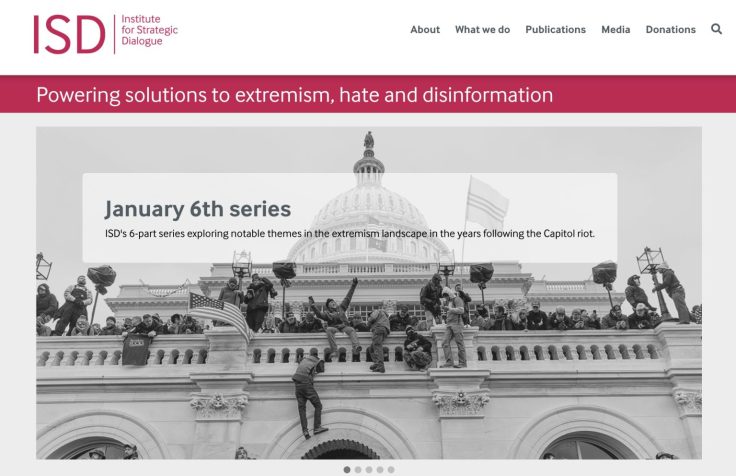
The US State Department funds UK-based Institute for Strategic Dialogue (ISD), an organization that partners with platforms to flag misinformation and disinformation. The organization has been accused of classifying conservative viewpoints as hate and disinformation.
In September 2021, the State Department awarded ISD a grant to “advance the development of promising and innovative technologies against disinformation and propaganda” in the UK and Europe after it won the US-Paris Tech Challenge. The challenge was also won by the Global Disinformation Index (GDI), an organization that has been accused of demonetizing conservative news websites by putting them on a blacklist used by advertisers, the Daily Caller reported.
The State Department’s Global Engagement Center (GEC) funded the ISD to research Russian disinformation tactics on Wikipedia. However, the department insisted that it does not engage in content moderation on social media.
ISD has several partnerships with social media platforms on content moderation decisions. The organization is a member of Spotify’s Safety Advisory Council, which advises the platform on how to respond to misinformation.
ISD is also part of YouTube’s Trusted Flagger program, whose members are tasked with improving the platform’s enforcement of its guidelines and can flag more content than other users. Google said that it “prioritizes flags from Trusted Flaggers.”
The organization also has partnerships with Google to counter hate and extremism in the UK and Europe. It also partners with Amazon’s Audible, Facebook, and Microsoft.
ISD is mostly focused on extremism and terrorism. However, it has also been targeting what it deems misinformation and hate.
New anti-Russian resolutions may be discussed at the UN
By Lucas Leiroz | February 16, 2023
It is possible that new anti-Russian resolutions will be voted on in the near future. According to a recent official communiqué, the activities of the eleventh special emergency session of the UN General Assembly will resume on February 22nd. With that, new attempts to implement measures against Moscow at the international level are expected – and the most likely thing is that the new efforts fail as well as the previous ones.
The information about the resumption of the session on the 22nd was formally issued by the official representative of General Assembly President Polina Kubiak. According to her, the call request was received on February 10, having been demanded by the delegation of the European Union, in partnership with other pro-Western states.
“The eleventh extraordinary special session of the General Assembly will be held on February 22 at 15.00 (23.00 Moscow time). The head of the EU delegation on behalf of the Republic of Korea, the Republic of Korea, Turkey, Ukraine, the United Kingdom and the United States and the 27 members of the European Union”, she said.
Started last year, the eleventh session aims to discuss possible recommendations on the topic of Russian special military operation in Ukraine. Originally, the session opened on February 28, 2022, at United Nations Headquarters in New York. It was temporarily postponed to March 2 following the adoption of Resolution ES-11/1, where the first recommendation to “condemn” Russia was made. The representatives of the General Assembly met again later, on March 23, 24 and April 7, when resolutions ES-11/2 and ES-11/3 were adopted, proposing, among other measures, the suspension of the Russian Federation from the Council of Human Rights of the United Nations.
In this sense, considering the precedents, it is possible that there will be new attempts to “isolate” Russia in the international scenario through the adoption of resolutions condemning the special operation in Ukraine. Most likely, the proposed new resolutions will focus on the most recent phases of the operation, as according to several reports Moscow is preparing for a final offensive against Kiev soon.
Procedurally, special sessions are convened within 24 hours after the receiving of a request by the UN Secretary General. To validate the arranging, it is only necessary to have the application supported by the vote of a member of the Security Council, which is why these sessions are frequently organized, even if few states agree with the resolutions proposed during them. Furthermore, a session can be convened even at the mere request of a majority of UN members, which makes them even more common and trivial.
In other words, the fact that countries will meet on the 22nd to discuss again the topic of Russia’s special military operation is not at all worrying for Moscow. The Russian government has already demonstrated that it receives broad international support from its direct allies in the BRICS as well as from several emerging countries. At previous Assembly meetings, many countries have declined to support anti-Russian resolutions, choosing to reject, abstain or even not attend the events. A similar situation is expected for the next summit, considering that since last February the process of geopolitical decentralization has intensified more and more.
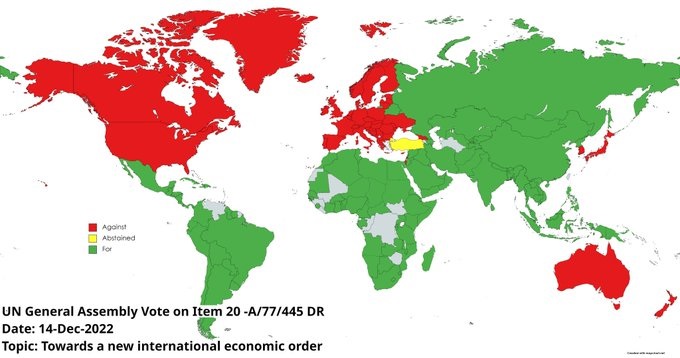
However, this shows the West’s insistence on maintaining an anti-Russian policy and trying to impose it at the international level. NATO and its allied countries are not satisfied with Moscow’s decision to react to the constant aggressions suffered by the Russian people in Donbass over the last nine years. In addition to backing the neo-Nazi regime and sending weapons and mercenaries so that the conflict continues indefinitely, the West continues to demand from international society that it promotes an “isolation” of Russia, trying to make it a “pariah” through sanctions and resolutions which are rejected by most states.
It is already clear that the isolation of Moscow is not feasible. As the world’s largest country, producer of many important commodities and a key partner of many states, Russia simply cannot be “isolated”, and all attempts to make this possible are meant to fail. In the specific case of the UN, the only thing that the West can achieve by calling sessions to discuss the operation in Ukraine is to propose some resolutions without any practical effect, which will work as mere “recommendations” to which only the Western countries themselves and their allies will comply.
Instead, the best course of action would be to discuss a reformulation of the UN in order to make the organization appropriate for the current geopolitical context. Extending the Security Council, changing some procedures and preventing Western hegemony in the organization are important steps to be taken to prevent the UN from becoming obsolete and failing in its objective of guaranteeing world peace.
Lucas Leiroz is a researcher in Social Sciences at the Feral Rural University of Rio de Janeiro; geopolitical consultant.
GOP Hawks to Exploit Child Victims of War, In Bid to Boost Spending on Kiev’s Military Aid
By Kyle Anzalone | The Libertarian Institute | February 14, 2023
Representative Michael McCaul plans to hold a series of hearings showing alleged atrocities committed by Russia. The Texas Republican hopes the testimony will push some of his GOP colleagues to commit to sending Kiev more military aid.
In an interview with the AP, the high-ranking Republican discussed how the images of atrocities committed against children is a powerful political tool. “I find that moves the dial, when they see these horrific killings of children,” McCaul said. He controls the influential House Foreign Affairs Committee.
Democrats in Congress have fully committed to providing military aid to Kiev. However, a growing number of Republicans have called for curtailing security assistance to Ukraine. McCaul said the hearings will be used to get his GOP colleagues on board with sending additional aid.
“I’m very much focused on the dissension within my own party on this,” the Congressman added.
Last week, Matt Gaetz (R-FL) introduced The Ukraine Fatigue Resolution. If passed, it would express that it is the sense of the House that “the US must end its military and financial aid to Ukraine” and urges “all combatants to reach a peace agreement.” The legislation has ten cosponsors, all Republicans.
Congress has already authorized over $100 billion in spending to aid Ukraine’s war effort. In December, President Joe Biden signed the Omnibus bill, which included $45 billion in aid to Kiev.
After Republicans captured control of the House in November, McCaul said he would push more aid for Ukraine through. At the time, he criticized Biden for not sending more advanced weapons to Kiev.
Gaetz says he introduced the resolution because America cannot send so much tax money to Kiev and escalating the military support for Ukraine risks starting WWIII. “President Joe Biden must have forgotten his prediction from March 2022, suggesting that arming Ukraine with military equipment will escalate the conflict to ‘World War III,’” He continued, “America is in a state of managed decline, and it will exacerbate if we continue to hemorrhage taxpayer dollars toward a foreign war.”
McCaul also favors providing Ukrainian forces with Army Tactical Missile System artillery munitions, which have a range of nearly 200 miles. He has expressed that he wants these weapons to be used in future assaults on Crimea, which Russia annexed in 2014. Such an escalation could swiftly lead to a nuclear exchange.
Using alleged atrocities against children to fuel hatred is not a new political stunt. In 1990, Nayirah al-Ṣabaḥ, the daughter of then-Kuwaiti Ambassador Saud Al-Sabah, claimed to have witnessed Iraqi soldiers killing babies. However, the testimony was fake but was used to rally Americans to support the Gulf War.
Russia makes claim over West’s ‘hybrid war’
RT | February 15, 2023
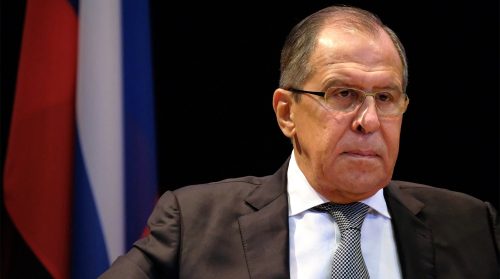
The West is attempting to use the Ukraine conflict to portray Russia as a “rogue state” in the eyes of the world, Foreign Minister Sergey Lavrov said on Wednesday. He stressed that the strategy has not been successful.
“The US and its satellite states are waging an all-encompassing hybrid war that they have long been preparing for, and are using Ukrainian radical nationalists as a battering ram against us,” Lavrov said in a speech in the lower house of the Russian parliament, the State Duma.
“They are not even trying to hide the goal of this war: it is not only to defeat our country on the battlefield and destroy our economy, but also to surround us with a ‘sanitary cordon’ and turn us into a type of a rogue state.”
The statement came the same day that European Commission President Ursula von der Leyen unveiled proposals for a new sanctions package against Russia, including additional export bans and measures to prevent the bypassing of restrictions.
Lavrov said that the West’s efforts to isolate Russia have failed because Moscow continues to develop relations with partners in other areas of the globe. He added that nations that have refused to back the “unprecedented” sanctions make up the majority of the world’s population.
The countries of the Asia-Pacific, the Middle East, Africa, and South America “don’t want to live in accordance with the West-centric order,” the Russian minister stated. “So it makes perfect sense why three-quarters of the world’s countries have not joined the anti-Russian sanctions and have a reasonable view regarding the situation in Ukraine.”
China and India are among the major economies that have refused to impose restrictions on Moscow. Denis Alipov, Russia’s ambassador to New Delhi, said on Tuesday that sanctions “had an opposite effect” and facilitated more trade and closer cooperation between Russia and India.
Beijing, meanwhile, has accused the US of fueling the Ukraine conflict and trying to weaponize the world economy for its own benefit.
Western countries urge citizens to leave Russia and Belarus
By Lucas Leiroz | February 15, 2023
Recently, the US Embassy in Moscow urged Russia-based Americans to leave the country as soon as possible. In the same vein, US residents outside of Russia were discouraged from traveling to the country. Washington’s close allies, such as Canada and France, also joined the measure and issued notes recommending that their citizens leave Russia and Belarus.
The US diplomatic delegation in Moscow published a document on Feb. 12 advising Americans to leave Russia or avoid arriving there. According to diplomats, it is possible that Americans will suffer some kind of hostility in Russian territory due to the escalation of the conflict in Ukraine – and Washington’s support for Kiev’s side. The Embassy stated that the ability of the American government to help citizens in Russian territory is extremely limited, which is why their stay in the Eurasian country would not be safe.
“Do not travel to Russia due to… the potential for harassment and the singling out of US citizens for detention by Russian government security officials, the arbitrary enforcement of local law, limited flights into and out of Russia, the embassy’s limited ability to assist US citizens in Russia, and the possibility of terrorism”, the Embassy’s document says, adding that “The US government’s ability to provide routine or emergency services to US citizens in Russia is severely limited, particularly in areas far from the US Embassy in Moscow, due to Russian government limitations on travel for embassy personnel and staffing, and the ongoing suspension of operations, including consular services, at US consulates”.
Following the decision of American diplomats, the Ministry of Foreign Affairs of Canada also joined the provocation. In a declaration, the country’s authorities said that Canadians should leave Russia while commercial flights are “still available”, suggesting that transport blockade measures will begin to be implemented soon. In the same sense, referring to Canadians unable to leave Russia, it was advised that they maintain a “low profile”, avoiding exposure.
“If you are in Russia, you should leave while commercial means are still available (…) [But] If you remain in Russia, maintain a low profile”, the statement says.
On the 13th, France also adopted similar guidelines, emphasizing, however, the need for its natives to leave Belarus. According to the French authorities, the geographical proximity of Belarus to the conflict zone and the close political partnership between Minsk and Moscow pose dangers to the stay of French people in the country. Therefore, they are encouraged to leave as quickly as possible, preferably via the routes of Lithuania, Latvia, and Poland – which are considered “safe” territories due to their ties to NATO.
“Amid the Russian army offensive in Ukraine and the closure of Belarus’ airspace, we strongly advise you to refrain from visiting Belarus (…) [If you are in Belarus now, we advise you] to leave the country immediately by motor transport across the borders with Lithuania, Latvia, and Poland”, the statement says.
In fact, this is not the first time this has happened. Western countries have repeatedly encouraged their natives to leave Russia and Belarus since the beginning of the special military operation. The last occasion on which the American Embassy in Moscow issued this type of alert was on September 28, 2022. As far as Belarus is concerned, on October 4, Washington’s State Department published an alert for Americans to leave the country. In practice, advising nationals of western states to leave Russia and Belarus has become commonplace.
The main arguments for these guidelines have been the alleged “dangers” of harassment, arbitrary detention, terrorism and other types of violence by Russians and Belarusians against foreigners, but there have also been rumors of forced mobilization of non-Russians with permanent residence in the country. Both arguments are absolutely unsubstantiated, considering that there is no report of violence against foreigners in Russia or Belarus, and that troops’ mobilization is obviously restricted to Russian nationals – in addition to taking place voluntarily, not by force.
However, it should be noted that this type of measure also sounds like a threat and blackmail for the residents of the countries in which the alerts are being issued. By discovering that foreigners are being evacuated, some Russians, Belarussians may believe that their country is really threatened, about to be bombed, which tends to generate collective panic.
In this sense, there seems to be a psychological operation that works in two directions: 1- against Western citizens, who begin to believe that they are actually threatened by Russia and Belarus and start to support NATO’s actions; 2- against Russians and Belarusians themselves, who see this type of action as a suggestion that an open war can start at any moment, with the enemy side trying to save their nationals from possible attacks.
The evident reality, however, contradicts any provocative narrative from the West. There is no danger for western people in Russia or Belarus. And the risks of escalation to an open conflict, although they exist, are not so high, depending exclusively on Western goodwill for them to cease to exist, considering that NATO is the provoking side. The best thing for the West to do is stop trying to generate collective panic among ordinary people and engage in effective proposals to reach a peaceful resolution to the conflict.
Lucas Leiroz is a researcher in Social Sciences at the Rural Federal University of Rio de Janeiro; geopolitical consultant.
Hungary wants apology for ‘outrageous’ claims by US official

RT | February 14, 2023
Hungary blasted the US over what it says are “outrageous” and “false” accusations of anti-Semitism, leveled by a senior diplomat against Budapest. Foreign Ministry spokesman Mate Paczolay added that while Washington later admitted the mistake, it has not issued a public apology.
On Tuesday, speaking to the Index news site, Paczolay slammed Linda Thomas-Greenfield, the US ambassador to the UN.
During a UN event on Thursday, Thomas-Greenfield cited Hungary as an example of a place where anti-Semitism is on the rise, noting that “a Holocaust memorial was vandalized” there. In a transcript later released by Washington’s mission to the UN, this phrase was crossed out.
An explanatory note said that Thomas-Greenfield was referring to a statue in Sweden of diplomat Raoul Wallenberg, who saved thousands of Jews from the Nazis in Hungary during WWII.
“It is quite outrageous that the US ambassador made baseless and false claims about Hungary in front of the… public,” the spokesman said, adding that the Hungarian delegation was not given an opportunity to speak, and was able to complain only after the event had ended.
Paczolay noted that “the American side admitted behind closed doors that it made a mistake.” However, it never issued “a clarifying or an apologetic statement,” which he said is the “minimum expectation in diplomacy” in this type of situation.
If the mistake was indeed unintentional and resulted from a “lack of preparation,” then it is “incomprehensible why the representation does not issue a statement in order to resolve the situation,” he said.
Earlier this month, Hungarian-US relations were marred by another diplomatic spat. Hungarian Foreign Minister Peter Szijjarto called out David Pressman, Washington’s ambassador to Budapest, over alleged “interference” in the nation’s internal affairs.
Pressman had commented that local decision-makers “continue to push policies endorsed by [Russian President Vladimir] Putin,” referring in particular to Hungary’s opposition to the Western sanctions on Moscow over the Ukraine conflict.
Featured Video

ARE PATIENTS BEING PROPERLY INFORMED ABOUT OZEMPIC?
or go to
Aletho News Archives – Video-Images
From the Archives
Trans ‘milk’ as good as the real thing – NHS
RT | February 18, 2024
The drug-induced nipple secretions of trans women are as good as mothers’ breast milk for babies, the University of Sussex Hospitals NHS Trust claimed in a letter to campaigners made public in a report by British think tank the Policy Exchange on Sunday.
The healthcare trust’s medical director, Rachel James, argued that the off-label prescription drug cocktail men transitioning to female take in order to produce milk was “similar to the natural hormones which encourage lactation to develop when the baby is newly born.”
“The evidence which is available demonstrates that the milk is comparable to that produced following the birth of a baby,” James wrote in the letter, sent to Children of Transitioners last August.
Biological men who wish to lactate must first take hormones to grow milk glands and then take high doses of either domperidone or metoclopramide to stimulate milk production. Neither drug is approved for this use, though they are occasionally prescribed off-label to biological women who have trouble lactating.
However, domperidone’s own manufacturer, Janssen, warns patients the drug “may cause unwanted side effects affecting the heart in a breastfed baby” and “should be used during breastfeeding only if your physician considers this clearly necessary.” … continue
Blog Roll
 Aletho News
- 2025 Nature Paper Claiming Worsening Global Drought Gets RETRACTED …Heavily Flawed
- Your Milk Is Not the Problem
- The Truth About the Trump Shootings with Ken Silva
- ARE PATIENTS BEING PROPERLY INFORMED ABOUT OZEMPIC?
- US lawmaker blocks $2.8 billion weapons sale to Israel: Report
- Yemeni army claims responsibility for strikes on sensitive sites in Saudi capital, Aramco facilities in Yanbu
- Iran Judiciary issues indictments against 159 US, Israeli officials for assassination of Leader, commanders
- Turkiye revokes Iranian bank license under US sanctions campaign
- US-Denmark Agreement on Greenland Is ‘PR Stunt’ Ahead of Midterms
- Araghchi: Military intervention cannot create security; coercion cannot bring peace
- If Americans Knew
- Israeli attacks kill four Palestinians in Gaza – Daily Update
- Inside Gaza’s death trap of collapsing, bombed-out buildings
- The everyday items Israel bans from Gaza every day
- Inside the siege, the ruined buildings of Gaza – Daily Update
- Debunking The Claim That Macklemore Has A “History Of Antisemitism”
- CPJ demands release of arrested Palestinian-US journalist near Bethlehem
- Robert Kraft: The Billionaire Friend of Netanyahu Pulling The Strings Behind the Macklemore/Ed Sheeran Blow Up
- Columbia Administered Fund Gives Big Money to Pro-Israel Groups
- Deportation Case of Palestinian Activist Salah Sarsour Tests First Amendment
- ‘We Will Not Forget’: Palestinians Mark 44 Years since Sabra and Shatila
- No Tricks Zone
- 2025 Nature Paper Claiming Worsening Global Drought Gets RETRACTED …Heavily Flawed
- New Study: ‘Global Drought Shows No Detectable Recent Acceleration Under Climate Warming’
- Economic Masterminds: German Socialists Suggest Taxing Productivity Gains Stemming From Using AI
- The South China Sea Has Not Been Cooperating With The Climate Change Narrative
- Energy Crisis: Germany Enters Heating Season With Historically Low Gas Reserve Fill Levels
- New Study: The Antarctic Ice Sheet Gained Mass From 2020-2024 Due To Staggering Snow And Ice Accumulation
- Study: Ocean Heating Rates From Thousands Of Years Ago ‘Dwarf’ Modern Ocean Heating Rates
- Climate Extremists Target, Attack Large-Scale Power Grid Infrastructure In Germany!
- New Study: Antarctic Ice Melt Has Contributed Less Than 1 Centimeter To Sea Level Rise In The Last 30 Years
- Fear Of Debate: Alarmist German Climate Scientist Calls On Mainstream Media To Discredit Skeptic Voices
 Aletho News