Who Blew Up Nord Stream Pipelines? | A Mystery!
Matt Orfalea | October 23, 2022
By Maria Konokhova – Sputnik – 27.02.2023
Following the onset of Russia’s special military operation in Ukraine, the US-led West embarked on a crusade aimed at isolating the country by sanctioning its economy and political establishment. Among other things, Western sanctions have targeted Russian hydrocarbons.
In recent months, North African countries have ratcheted up imports of diesel and other refined petroleum products from Russia, as the latter is now cut off from the European market, the Wall Street Journal has reported.
The European Union bloc has imposed a ban on the purchase and import of seaborne Russian crude oil starting from December. Moreover, EU member states, which accounted for about 60% of Russian exports of refined petroleum products before the start of the hostilities in Ukraine, have recently reduced these flows.
This month, a EU ban on imports of refined petroleum products from Russia, including diesel and jet fuel, came into effect.
African Countries Step Up to the Plate
According to the newspaper, the barrage of sanctions has forced Moscow to pursue new partnerships and redirect exports away from Europe to alternative markets. It was noted that against this backdrop, North African countries “picked up the slack,” increasing imports from Russia.
The report drew several examples that advocate this notion, citing data from Kpler, a data and analytics company.
First, Tunisia, which had imported almost no Russian petroleum products in 2021, has recently started to receive supplies of diesel, gasoil, gasoline and naphtha from Russia. In January, the country acquired 2.8 million barrels of Russian oil products. This month, it was emphasized that Tunisia was going to import another 3.1 million barrels from Russia.
Along with Tunisia, another North African country, mentioned by the newspaper, significantly enhanced cooperation with Moscow in this field. In 2021, Moroccan imports of Russian diesel stood at around 600,000 barrels. However, this figure swelled to 2 million barrels last month. In February, Morocco is expected to import 1.2 million barrels. It was also noted with no specific details that Algeria and Egypt boosted their imports of Russian oil products as well.
Frustrating Western Efforts to Shun Russian Oil
The newspaper noted that the increase in Tunisia’s and Morocco’s imports from Russia coincided with that of their own exports of refined products to the global market. Therefore, it was assumed, Russian hydrocarbons could be mixed with other petroleum products and re-exported to other countries, including European ones.
The US-based paper stated that this process disguises the ultimate origin of the products and, therefore, undermines Western efforts aimed at cutting off Russian fossil fuels from their economies, and frustrates efforts to end their energy dependence on Russia and limit Moscow’s sources of funds. The newspaper concluded, citing analysts, that if this trend continues, depriving Moscow of revenue would be difficult.
According to the International Energy Agency, Russian oil exports increased to 8.2 mb/d last month ahead of the EU embargo and the G7 price cap on refined products taking effect. The refined-product exports “held steady.” Meanwhile, Moscow’s export revenues were estimated at $13 billiion.

RT February 24, 2023
Senior officials at the US State Department are attempting to get the country “involved in another world war” with Russia, Arizona Congressman Paul Gosar tweeted on Friday. Gosar, Twitter CEO Elon Musk, and former president Donald Trump, have all named Victoria Nuland as the most dangerous among this group in recent days.
Responding to an RT article on Musk accusing Nuland of “pushing this war” in Ukraine, Gosar declared that the billionaire “is correct.”
“Both Nuland and Blinken have a deeply rooted irrational hatred of Russia, and they seek to get the US involved in another world war,” he continued. “These are dangerous fools who can get us all killed.”
In a follow-up tweet, Gosar wrote that “as a non-soldier, Nuland is quite willing to endorse violence and war.” The Republican lawmaker then quoted the article, which stated that Nuland had “endorsed regime change in Russia, celebrated the US’ destruction of the Nord Stream pipelines, and called for the indefinite flow of arms into Ukraine.”
As assistant secretary of state for European and Eurasian Affairs in 2014, Nuland was largely responsible for orchestrating the pro-Western coup that unseated democratically elected president Viktor Yanukovich. Nuland traveled to Kiev and promised military aid to the rioters, and was recorded plotting to install a successor to Yanukovich.
As Biden’s secretary of state, Blinken has promised to keep weapons flowing into Ukraine “for as long as it takes,” and advised Kiev in December not to seek the kind of negotiated settlement that would liken to a “phony peace.”
Gosar has been a persistent critic of the Biden administration’s Ukraine policy since Russia’s military operation began a year ago on Friday. However, although the Republican Party now controls the House of Representatives, there is little the Arizona congressman can do to change the administration’s course. A significant bipartisan majority supports continued military aid to Ukraine, with only 11 Republicans, Gosar included, sponsoring legislation that would cut funding for Kiev.
These Republicans are all allies of former president Donald Trump. In a campaign video released on Tuesday, Trump blamed the situation in Ukraine on Nuland and “others like her” in the Biden administration. Nuland, he said, was “obsessed with pushing Ukraine towards NATO,” adding that the conflict would have “never happened if I was your president.”
RT | February 23, 2023
The policies of the administration of US President Joe Biden have become a key factor in Europe’s decline amid the Ukraine conflict, Hungarian Prime Minister Viktor Orban has claimed, as reported by local media.
According to the newspaper Magyar Nemzet, Orban made the remarks at a closed meeting with members of the ruling right-wing Fidesz-KDNP coalition on Wednesday. During the session, he reportedly identified the main opponents of the alliance, which include “pro-war international interest groups, which consist of the Biden administration, pro-war Brussels bureaucrats, and pro-war politicians.”
The report says Orban claimed that “Europe has weakened over the past year because the Biden administration is asserting its interests in Brussels without limits at the expense of European interests.”
The Hungarian prime minister is said to have added that the response to the Ukraine conflict and “the tsunami of sanctions” have taken a toll on Europe’s economy, while the US, which has enough cheap energy, has steered clear of these challenges.
Orban went on to say that Europe has lost its independence, and economic and military power in just one year, insisting that Hungary must protect its own interests to weather the storm, as quoted by the newspaper.
To achieve this, Budapest must “defend the pro-peace position against the Biden administration and Brussels,” protect the Hungarian economy by fighting inflation, and strengthen its military, he reportedly said.
The prime minister is also said to have stated that Budapest does not support anyone in the Ukraine conflict, because “there can be no winner in this war.” Moscow cannot win because of the assistance the West is providing to Kiev, while Russia is a nuclear power, and “a nuclear power cannot be cornered,” he reportedly explained.
Hungary has on numerous occasions urged Russia and Ukraine to immediately agree to a ceasefire, while repeatedly expressing opposition to the sanctions the West has imposed on Moscow. On Sunday, Orban claimed that the restrictions have failed to end the hostilities, but have instead damaged Europe’s economy.
RT | February 22, 2023
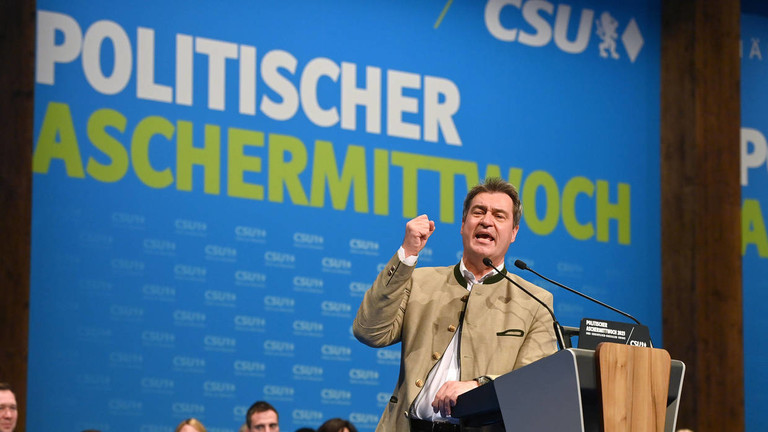
German Chancellor Olaf Scholz must “stop” Foreign Minister Annalena Baerbock before she becomes a “security risk” and pushes Berlin towards a conflict with Moscow with her “thoughtless statements,” Bavaria’s Prime Minister Markus Soeder said on Wednesday during a German political festival.
The foreign minister and her party – Alliance 90/The Greens – are talking themselves into a “war frenzy” amid the ongoing conflict between Russia and Ukraine, Soeder told a crowd of cheering supporters during what is known in Germany as Political Ash Wednesday. Having originated in Bavaria, the 100-year old event allows German politicians to vent and pull no punches about the perceived shortcomings of their political rivals.
Soeder referred in particular to when Baerbock told the European Council back in January that the EU was “fighting a war against Russia,” words that sparked uproar at the time. In mid-February, Baerbock herself conceded that the remark was a mistake.
“A foreign minister has to be careful what she says,” Soeder warned during the event in Bavaria’s Passau, adding that “an escalation of words can quickly lead to the escalation of violence.” Germany is helping Ukraine but is not at war with Russia, he maintained.
“Mr. Scholz, finally stop Ms. Baerbock,” Soeder said, adding the foreign minister’s “thoughtless statements” are often “to the detriment of our country.”
Baerbock has emerged as one of the most hardline supporters of Kiev in the German government, repeatedly arguing for increased military aid to Ukraine and criticizing Chancellor Olaf Scholz for supposedly not doing enough. She has also supported tougher sanctions against Russia and opposed any compromises with Moscow.
In October 2022, she said that any concessions to Russia in the ongoing conflict would be “naïve.” The minister also maintained that the West should not settle for any peace agreement that would result in Ukraine losing to Russia any territory that it recognizes as Kiev’s.
Soeder, who has been a prominent figure in the German opposition, previously criticized Berlin for prioritizing military aid to Ukraine over the nation’s own security. In particular, he argued that Germany should not have sent IRIS-T air defense systems to Ukraine and should have instead used them to enhance its own national defense.
In This Together | January 27, 2019
Skripal Salisbury Chemical Weapons Attack 2018. An Investigation (2019 Update.) This video explores the nonsense that passes as the official narrative of 2018 Salisbury chemical weapons attack. T has been updated to include recent revelations about Colonel Alison McCourt. Using stock news footage of the Skripal poisoning and mainstream media reports about the supposed Salisbury attack, we consider, with tongue firmly in cheek, if what we are told about the UK chemical weapons attack is remotely plausible.
On March 4th 2018 Sergei Skripal and his daughter Yulia Skripal were allegedly poisoned with the nerve agent Novichok by two suggested Russian GRU agents. Both Sergei and Yulia thankfully recovered, as did PC Nick Bailey who was also contaminated. However, the British government maintained that Novichok was the most deadly nerve agent ever created. 5 times more Deadly than VX and 8 times more deadly than Sarin. Scientists at Porton Down stated that there was no known antidote. The Skripal’s recovery is therefore just one of the many aspects of the official government narrative that makes no sense whatsoever.
The lack of evidence about the Skripal’s movements in Salisbury, the bizaar tale of how the two GRU agents discarded the Novichok and its later discovery by Charlie Rowley. The sad demise of Rowley’s partner Dawn Sturgess following first response that did not identify the presence of Novichok. The odd route taken by the alleged assassins and their seeming willingness both to leave evidence at the scene of the crime and remain at the crime scene for unfathomable and totally unnecessary reasons.
Hopefully amusing at times but based upon the available evidence I hope you find Skripal – An Investigation a worthwhile watch.
Take it easy.
RT | February 21, 2023
Former US president Donald Trump has blamed “warmongers and ‘America Last’ globalists” at the State Department for pushing Ukraine toward conflict. Trump, who is running for office in 2024, promised to rid Washington of “warmongers, frauds and failures” if elected again.
In a campaign video released on Tuesday, Trump warned that “World War III has never been closer than it is right now,” and laid the blame on “all the warmongers and ‘America Last’ globalists in the Deep State, the Pentagon, the State Department and the national security industrial complex.”
The former president singled out Victoria Nuland, the US Deputy Secretary of State for Political Affairs, whom he said was “obsessed with pushing Ukraine towards NATO.”
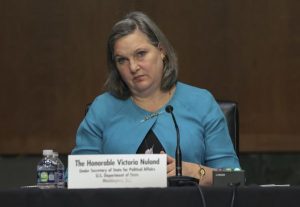 Trump declared that Nuland and “others just like her” at the State Department supported the 2014 “uprisings” in Ukraine that saw democratically-elected former president Viktor Yanukovych replaced with the pro-Western Petro Poroshenko, who then began a campaign of military repression against the people of Donetsk and Lugansk.
Nuland met with rioters in Kiev in 2014, where she promised pro-Western politicians a billion dollar loan guarantee program and military assistance. In an infamous leaked call between Nuland and the US’s then-ambassador to Ukraine, Geoffrey Pyatt, the pair discussed selecting a leader to replace Yanukovych from a list of opposition politicians.
Trump claimed, as he has on several occasions over the last year, that the conflict in Ukraine would have “never happened if I was your president.”
“I was the only president who rejected the catastrophic advice of many of Washington’s generals, bureaucrats and so-called diplomats who only know how to get us into conflicts,” he continued, adding that “we need to get rid of the corrupt globalist establishment that has botched every major foreign policy decision for decades.”
“The State Department, Pentagon, and national security establishment will be a very different place by the end of my administration,” Trump said, claiming that “the warmongers, frauds and failures in the senior ranks of our government will all be gone.”
Opposition to America’s “forever wars” was a core component of Trump’s 2016 platform. Although Trump was the first president in decades not to involve the US in a new foreign conflict, he was criticized by his base for briefly hiring noted war-hawk John Bolton as his national security adviser, and for authorizing missile strikes on Syria.
While President Joe Biden has pledged to indefinitely supply Kiev with weapons, Trump has claimed that he would call Ukrainian President Vladimir Zelensky and Russian President Vladimir Putin if elected and “have a deal made in 24 hours.”
RT | February 21, 2023
The party of former president Viktor Yanukovich, once Ukraine’s largest, was banned on Tuesday by a Kiev court acting on a government request. Ukraine’s security services had accused the Party of Regions of illegally signing a 2010 treaty with Russia and “crimes” against the 2014 US-backed coup that ousted Yanukovich.
Ukraine’s State Bureau of Investigation (SBI) announced the ban to state media, saying it followed a motion by the Ministry of Justice based on accusations leveled by the SBI and the Security Service of Ukraine (SBU) against the party.
“In particular, the SBI provided materials regarding the illegal actions of the leadership of the Party of Regions during the signing and ratification of the so-called Kharkov Agreements, as well as crimes committed by them during the events of the Revolution of Dignity,” the agency said.
The 2010 agreement, signed in Kharkov, extended the Russian lease of naval facilities in Crimea through 2042 and gave Ukraine a discount on Russian natural gas supplies. The “Revolution of Dignity” is the name the new Ukrainian government gave the Maidan coup of 2014, which triggered the conflict over Crimea and the Donbass.
The Ukrainian government is “currently determining” the value of the party’s assets, which will be seized under a law enacted in May 2022. It enables President Vladimir Zelensky’s government to ban any party that challenges its official position, in particular when it comes to the conflict with Russia. A court’s decisions are final and cannot be appealed.
The law has been used to ban a dozen parties so far. The largest parliamentary opposition bloc, Opposition Platform – For Life, was outlawed last June.
The Party of Regions was established in 1997 and had grown into Ukraine’s biggest political party by 2006, in response to the 2004 ‘Orange Revolution’ that installed a pro-American government. It practically ceased to operate after the 2014 coup, as Yanukovich and Prime Minister Nikolai Azarov sought asylum in Russia.
The latest ban comes just a day after US President Joe Biden visited Kiev and compared Ukraine’s government to democracy itself. “Ukraine stands. Democracy stands. America – and the world – stands with Ukraine,” Biden declared after a photo-op with Zelensky.
By Scott Ritter – Sputnik – 20.02.2023
Delegates from around the world assembled in Munich, Germany on February 17, 2023, to convene an eponymously named security conference that has, since its inception in 1963, operated under the motto “Peace through Dialogue.”
For three days, world leaders participated in what has become known as “the Davos of Defense” (a reference to the World Economic Forum held in Davos, Switzerland), discussing critical security issues of the day.
This year, not surprisingly, the Russian-Ukrainian conflict dominated the agenda. What was a surprise, however, was the emphasis that western participants placed on action over discussion when it came to formulating a collective strategy for achieving some sort of conflict termination. Indeed, the dominant theme at Munich was not simply how to provide more material to Ukraine’s military, but how to do so in a manner that escalates the conflict by challenging Russia’s so-called “red lines” – regarding western support to Ukraine.
For the first time since the 1990’s, Russia was not invited to attend the conference. Instead, prominent Russian opposition figures, including exiled oil tycoon Mikhail Khodorkovsky, chess champion Gary Kasparov, and Yulia Navalnaya, the wife of the imprisoned opposition leader Alexei Navalny, were invited. The chairman of the conference, Christoph Heusgen, explained this pointed deviation from the principle of promoting dialogue by declaring that he did not want to be seen as providing a platform for Russian propaganda.
Instead, it turned out, Heusgen turned the floor over to western propagandists.
The underlying theme in Munich went beyond an escalation of support for Ukraine, and instead embraced the outright provocation of Russia. Lithuanian President Gitanas Nauseda served as the pace-setter for this trend when, prior to the Munich Security Conference, he urged western leaders to consider providing Ukraine with “essential military aid” such as tanks, fighter aircraft, and long-range missiles, despite long-standing concerns by the west that the provision of such aid would be seen by Russia as evidence of direct participation by the providing parties in the conflict. “These red lines,” Nauseda declared, “must be crossed.”
On cue, Ukraine’s President Volodymyr Zelensky opened the conference with an appeal, delivered via video and designed to underscore a sense of urgency.
“We need to hurry up,” Zelensky declared. “We need speed—speed of our agreements, speed of our delivery, speed of decisions to limit Russian potential. There is no alternative to speed because it is the speed that the life depends on,” Zelensky said, concluding that there was “no alternative to a Ukrainian victory.”
But Zelensky’s exhortations for speed appeared to fall upon deaf ears when it came to two of Europe’s most important leaders. Both Germany’s Olaf Scholz and France’s Emmanuel Macron underscored that, from their perspective, the conflict in Ukraine would not be ending anytime soon. “I think it’s wise to prepare for a long war,” Scholz noted in his remarks to the conference, a sentiment Macron echoed by saying that Europe should prepare for a “prolonged conflict in Ukraine.”
Declaring that now was “not the time for dialogue,” Macron urged his fellow conference attendees to action. “We absolutely need to intensify our support and our effort to the resistance of the Ukrainian people and its army,” Macron said, and “help them to launch a counter-offensive which alone can allow credible negotiations, determined by Ukraine, its authorities and its people.”
There is a fundamental disconnect between the frenetic urgings of President Zelensky and the long-term approaches taken by Scholz and Macron that point to an overall atmosphere of self-delusion that seemed to dominate the Munich Security Conference.
While US Vice President Kamala Harris spoke of bringing Russian leaders “to justice” for alleged war crimes in Ukraine, the Ukrainian military is being systemically ground down on the battlefields of eastern Ukraine, soil that Russia now claims for its own. Current NATO military commander, Lieutenant General Christopher Cavoli, has described these battles as being “out of proportion” to NATO plans and capabilities in terms of the “scope and scale” of the violence being perpetrated on the ground by both parties to the conflict.
Rather than accept the inevitability of a Ukrainian military defeat, however, Cavoli briefed US lawmakers on the sidelines of the Munich Conference that, in his opinion, Ukraine should be provided with modern jet aircraft, including F-16 fighters, and long-range missiles capable of striking targets deep inside Russian territory. These weapons, Cavoli said, would enable Ukraine to fight what he termed “the deep fight”, shifting the emphasis from the deadly fighting at the point of direct engagement to a new war where Ukraine would disrupt the Russian war effort by striking headquarters and supply lines deep behind the frontlines.
In short, Cavoli was outlining an escalatory strategy brought to life by Lithuanian President Gitanas Nauseda’s earlier exhortations to cross all “red lines” when it came to supporting Ukraine.
But simple rhetoric cannot bridge the yawning gap that exists with reality. Words, especially in an environment like this year’s Munich Security Conference, where all pretense at dialogue has been forsaken in favor of the construction of a pro-western echo, resonate in a manner which promotes an artificial sense of substance. But unless these words are backed by concerted action, they carry no weight and will soon dissipate into nothingness.
This, in short, is the reality of the Munich Security Council—an exercise in self-delusion, similar in construct to the discussions around the conference table in the last days of the Battle of Berlin in 1945, in which Adolf Hitler moved imaginary armies around in a vain effort to seize victory from the inevitability of defeat.
The fact is, there are no tanks, no long-range missiles, no fighter aircraft available in any realistic time-frame that can help Ukraine reverse the deterioration of its military posture vis-à-vis Russia. Zelensky’s demands for urgency reflect a growing recognition on his part that, if left on the current trajectory, the war with Russia will be over soon—perhaps as early as August 2023. The inability and/or unwillingness on the part of the western military and civilian leadership to match their declarations of support with Zelensky’s timeline demonstrates an absolute divorce from reality on the part of those who were gathered in Munich, or else the cynicism of those who know the tragic fate that awaits those they claim to support only too well.
The harsh truth that the participants of the Munich Security Conference know, but cannot speak, is that there is no hope for a Ukrainian victory over Russia.
By Drago Bosnic | February 20, 2023
Although it has been only 16 years since President Putin’s historical speech at the 2007 Munich Conference, that event now seems like a distant past of a long-lost world. Back then, Russia was warning the political West that further NATO aggression would inevitably lead to the revival of the Cold War.
However, Washington DC and Brussels seem to have wanted exactly that. The political West has tried to present the 2023 Munich Security Conference as some sort of a groundbreaking global event that “sent a strong signal” and showed “just how isolated” Russia is. However, nothing could be further from the truth, given the comments of some of the most prominent participants, including NATO and EU member states.
For instance, during a Saturday meeting with US State Secretary Anthony Blinken, China’s Foreign Minister Wang Yi stated that Beijing finds Washington DC’s attempts to threaten Sino-Russian relations completely unacceptable, emphasizing that the relationship between the two superpowers is their sovereign right and that it is not aimed against any third party.
“We will never accept the instructions of the United States and even threats to put pressure on Russian-Chinese relations,” Wang was quoted as saying in a statement published on Sunday by the Chinese Foreign Ministry. “The Sino-Russian relations of comprehensive partnership and strategic cooperation are based on non-alignment, non-confrontation and non-targeting against third parties. They are within the framework of the sovereignty of two independent states,” he added.
The comments were made in response to US accusations that China will “increase its support for Russia”. Wang also warned his American counterpart against the continued melodramatic reaction to the “balloon controversy”, which the US has been (ab)using lately to ensure detente between the two countries is virtually impossible. Beijing said that American high-altitude balloons have illegally entered China’s airspace many times over the last several decades, but the government chose not to cause panic and simply used existing diplomatic channels to communicate with their US counterparts.
“If the US continues to use this as an excuse, to promote further escalation and aggravate the situation, then China will definitely go to the very end. All the consequences of this will be borne by the American side,” Wang said.
China also called on the US to stop escalating the Ukrainian crisis and start promoting a peaceful settlement. Wang said that “Washington DC should stop adding fuel to the fire”. He noted that China’s position is constructive and called for the negotiation process to continue.
“Being a great power, the United States should contribute to the political settlement of the crisis, and not add fuel to the fire and look for opportunities to extract its own benefits,” Wang was quoted as saying.
Hungary also called for the de-escalation of the crisis and insisted on maintaining economic relations with Russia. During the traditional annual address to his fellow citizens, Prime Minister Viktor Orban stated that “the only way for Hungary to live peacefully is to stay out of the conflict, as it is not our war”.
“We will maintain our economic relations with Russia, and we advise the entire Western world to do the same, because without relations there will be no ceasefire or peace talks,” Orban said.
On the other hand, the European Union is doing exactly the opposite. The bloc’s top diplomat Josep Borrel called Russia “an existential threat” and urged all member states not to continue supporting the Kiev regime, but “help more”. He also insisted that “the EU should start an industrial techno-blitzkrieg to produce more weapons“, effectively nullifying the claim that the bloc was an economic union. Borrel added that member states will spend an additional €70 billion on defense by 2025.
“In the next two years, the EU countries intend to spend an additional €70 billion on defense. France will increase defense spending by 40%, while Poland will double it,” he stated.
Interestingly, India was also targeted. George Soros, a controversial oligarch infamous for providing financial backing for various groups responsible for destabilization and undermining of countries the political West sees as “uncooperative”, stated the following:
“India is an interesting case. It’s a democracy, but its leader Narendra Modi is no democrat. Inciting violence against Muslims was an important factor in his meteoric rise. Modi maintains close relations with both open and closed societies. India is a member of the Quad (which also includes Australia, the US, and Japan), but it buys a lot of Russian oil at a steep discount and makes a lot of money on it. […]
Modi and business tycoon Adani are close allies; their fate is intertwined. Adani Enterprises tried to raise funds in the stock market, but he failed. Adani is accused of stock manipulation and his stock collapsed like a house of cards. Modi is silent on the subject, but he will have to answer questions from foreign investors and in parliament. This will significantly weaken Modi’s stranglehold on India’s federal government and open the door to push for much-needed institutional reforms. I may be naive, but I expect a democratic revival in India.”
In response to the accusations, India’s Foreign Minister Subrahmanyam Jaishankar brushed Soros off and (quite accurately) described him as “old, rich, opinionated and dangerous”. Considering Soros has a history of Nazi collaboration, it can be argued that his attack could even be considered a compliment of sorts for Prime Minister Modi and India as a whole.
In essence, the Munich Conference not only failed to produce the desired results (Russia supposedly isolated), but it even strengthened the multipolar world, as neither India nor China proved malleable in any way, showing their sovereignty is untouched by the political West’s pressure. On the other hand, many Europeans are extremely unhappy by the EU’s militarization. According to varying estimates, the huge crowd of protesters in Munich numbered up to 50,000 people. In conclusion, while there are massive differences between Munich 2007 and Munich 2023, the latest conference is somewhat similar to the 1938 Munich Agreement between Nazi Germany and Western allies. Considering how that ended (along with any other invasion of Russia), the political West’s prospects against Moscow look rather grim, to say the least.
Drago Bosnic is an independent geopolitical and military analyst.
Press TV – February 19, 2023
Russian ambassador to the UN has accused the West of instigating “deep Russophobia” and having a determination to destroy his country, saying that, “We had no choice other than to defend our country — defend it from you, to defend our identity and our future.”
Vassily Nebenzia made the remarks at a meeting of the UN Security Council, saying that Russia had no other choice than war. “We had no choice other than to defend our country — defend it from you, to defend our identity and our future.”
Friday’s meeting in the council — the only international venue where Russia regularly faces Ukraine and its Western supporters — put a spotlight on the deep chasm between the warring parties as the conflict is moving into its second year with no end in sight.
In the meeting, US deputy ambassador, Richard Mills, accused Russia of failing to implement “a single commitment it made” in the Minsk agreements while the other signatories — France, Germany, Ukraine and the Organization for Security and Cooperation in Europe — “sought to implement them in good faith.”
France ambassador, De Riviere, claimed his country and Germany have worked “tirelessly” since 2015 to promote dialogue between parties, adding that the “difficulties encountered in implementing these agreements can never serve as justification or mitigating circumstances for Russia’s choice to end the dialogue with violence.”
In response, Nebenzia accused the Western nations, including France and Germany, of “holding back” on implementing the Minsk agreements brokered by the two countries to end the conflict between Ukraine and the separatists in Luhansk and Donetsk in the Ukraine’s mostly Russian-speaking industrial east that flared in April 2014 after Crimea joined Russia.
“You knew very well that the Minsk process for you is just a smoke screen, so as to rearm the Kiev regime and to prepare it for war against Russia in the name of your geopolitical interest,” Nebenzia said.
He further accused the West of “deep Russophobia,” and a “determination to destroy my country, using others if possible.”
The envoy added that the West has no desire to “build a European and Euro-Atlantic security system together with Russia [because] for you such a system can only be aimed against Russia.”
“We have no trust left in you and we are not capable of believing any promises you make – not as regards a non-expansion of NATO in the east, or your desire not to interfere in our internal affairs, or your determination to live in peace,” Nebenzia said.
“You have shown that it’s impossible to negotiate with you,” he said. “You’ve shown how treacherous you are by creating on our borders a neo-Nazi, neo-nationalist beehive and then stirring it up.”
The Minsk agreements were a complex series of measures negotiated by Russia, France, Germany and Ukraine in 2014-2015 in a bid to put an end to the armed conflict between the Kiev authorities and the breakaway region of Donbas.
Moscow repeatedly stated that Kiev was not fulfilling the deal by not granting self-government to the Russian-speaking region of Donbas. In February 2022, Russia began the “military operation” to defend the territory from Ukrainian troops.
Last week, Ukrainian President Volodymyr Zelensky admitted he never intended to implement the Minsk agreements. Former German Chancellor Angela Merkel also recently acknowledged that Minsk deal was simply “an attempt to give Ukraine time” so that its army could get stronger.
The revelation was confirmed by former French President Francois Hollande, and Former UK Prime Minister Boris Johnson who said the Minsk agreement had been nothing but a “diplomatic imitation.”

or go to
Aletho News Archives – Video-Images
RT | February 18, 2024
The drug-induced nipple secretions of trans women are as good as mothers’ breast milk for babies, the University of Sussex Hospitals NHS Trust claimed in a letter to campaigners made public in a report by British think tank the Policy Exchange on Sunday.
The healthcare trust’s medical director, Rachel James, argued that the off-label prescription drug cocktail men transitioning to female take in order to produce milk was “similar to the natural hormones which encourage lactation to develop when the baby is newly born.”
“The evidence which is available demonstrates that the milk is comparable to that produced following the birth of a baby,” James wrote in the letter, sent to Children of Transitioners last August.
Biological men who wish to lactate must first take hormones to grow milk glands and then take high doses of either domperidone or metoclopramide to stimulate milk production. Neither drug is approved for this use, though they are occasionally prescribed off-label to biological women who have trouble lactating.
However, domperidone’s own manufacturer, Janssen, warns patients the drug “may cause unwanted side effects affecting the heart in a breastfed baby” and “should be used during breastfeeding only if your physician considers this clearly necessary.” … continue
 Aletho News If Americans Knew No Tricks Zone
 Aletho News