Scholz Reportedly Takes Notice of Baerbock’s Mistakes
By Maxim Minaev – Sputnik – 30.01.2023
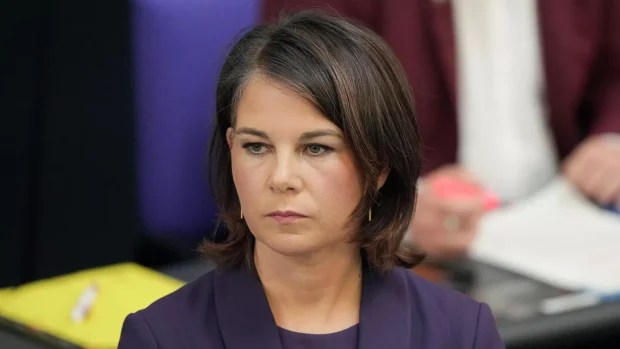
The German chancellor’s office thoroughly documents the missteps of Foreign Minister Annalena Baerbock, despite the lack of public criticism from Chancellor Olaf Scholz, German media reported, citing sources.
“At the chancellor’s office, Baerbock’s mistakes are carefully recorded,” an unnamed government source told German media.
According to the publication, Scholz allegedly adheres to a principle of not speaking ill of his ministers, regardless of the degree of his irritation. Reasons for Scholz’s being discontent with Baerbock have arisen several times recently, according to German media.
The newspaper notes that in September, the German foreign minister called for a quick solution to the issue of supplying tanks to Ukraine, which was followed by a “serious conversation” with the Chancellor’s Office. As a result, during the next interview, Baerbock was more restrained.
A week ago, in an interview with French TV, Baerbock said that Berlin was not going to block supplies of German tanks to Ukraine, the newspaper recalls. At the same time, according to the report, no final decision was made at that time and such a statement caused “stormy” dissatisfaction in the chancellor’s office.
In addition, Scholz and Baerbock allegedly had disagreements over the chancellor’s trip to China, as well as over the planned meeting of the Franco-German cabinet in October. At the time, Baerbock said she could not go to Paris because of a family vacation, although Scholz allegedly insisted on her visit. Nevertheless, Baerbock was adamant, saying that she was on vacation. Shortly thereafter, the event was canceled by the French side.
Baerbock had previously been criticized by a number of German politicians after her remarks about “war with Russia.” The minister said during the PACE session on January 24 that European countries “are waging a war against Russia” and called on them to do more for Ukraine together instead of looking for the guilty among themselves. At the same time, the German Foreign Ministry said in connection with her statement that support for Ukraine does not make Germany one of the parties to the conflict.
UK Parliament’s Defense Chair Calls for Direct Confrontation With Russia
Sputnik – 30.01.2023
The United Kingdom is involved in the Ukrainian conflict and should “face Russia directly,” Tobias Ellwood, head of the UK Defence Select Committee, said on Monday.
“We are now at war in Europe, we need to move to a war footing, we are involved in that, we have mobilized our procurement processes, we are gifting equipment [to Ukraine]. We need to face Russia directly rather than leaving Ukraine to do all the work,” he said in an interview with UK broadcaster.
Ellwood said the UK government must “recognize the world is changing” and provide appropriate funding to the military.
“If we see Russia wants to do more things in the Baltics, for example, there will be an expectation, indeed, anticipation that we would participate in that. That requires land forces, air as well, and maritime too,” he said.
The senior Conservative lawmaker also urged the government to revoke an earlier decision to reduce the size of the country’s armed forces by 10,000 troops and increase defense spending, in particular, to modernize ground units, at the same time recognizing that UK ground forces are in a “dire state.”
“You have three main components to land warfare — that’s your tank, your main battle tank, your armored fighting vehicle and your recon vehicle. And in our case, you have the Challenger 2, you have the Warrior and you have the Scimitar, and they are all over 20, 30 or 50 years old without any upgrades,” he said.
Ellwood said the UK provided “huge investments” over the years to develop its maritime capabilities, build aircraft carriers, supply more fighter jets, but the number of tanks had been greatly reduced — from 900 tanks several years ago to 148 now.
In this regard, the UK government should be “very concerned,” especially against the backdrop of the Ukrainian conflict. It is necessary not only to invest in emerging industries, such as cybersecurity and space, but also to do so without compromising the military’s ground forces, he added.
The head of the Committee noted that the UK’s defense spending exceeds that of any other European country, in particular, in connection with the maintenance of nuclear potential and the active modernization of the army. However, new models of equipment will go into service only in a few years, and at the moment the size of the army is too small, given that the armed forces are often used in times of crisis in the country.
Western countries ramped up their military support for Ukraine after Russia launched a special military operation there in late February 2022, responding to calls for help from the breakaway republics of Donetsk and Lugansk. In April 2022, Moscow sent a note to NATO member states condemning their military assistance to Kiev. Russian Foreign Minister Sergey Lavrov has warned that any arms shipments on Ukrainian territory would be “legitimate targets” for Russian forces.
Is NATO helping Ukraine to fight Russia or is it using Ukraine to fight Russia?
By Glenn Diesen | RT | January 30, 2023
The Western public, like others, are justly appalled by the human suffering and the horrors of the Ukrainian war. Empathy is one of the great virtues of humanity, which in this instance translates into the demand for helping Ukrainians. Yet, propaganda commonly weaponizes the best in human nature, such as compassion, to bring out the worst. As sympathy and the desire to assist the displaced are used to mobilize public support for confrontation and war with Russia, it is necessary to ask if the Western public and Ukrainians are being manipulated to support a proxy war.
Is NATO helping Ukraine to fight Russia or is NATO using Ukraine to fight Russia?
The organization as a passive actor?
The US-led military bloc commonly depicts itself as an innocent third party that merely responds to the overwhelming desire of the Ukrainian people to join its ranks. Yet, for years NATO has attempted to absorb a reluctant Ukraine into its orbit. A NATO publication from 2011 acknowledged that “The greatest challenge for Ukrainian-NATO relations lies in the perception of NATO among the Ukrainian people. NATO membership is not widely supported in the country, with some polls suggesting that popular support for it at is less than 20%”.
In 2014, this problem was resolved by supporting what Statfor’s George Friedman labelled “the most blatant coup in history” as there were no efforts to conceal Western meddling. Regime change was justified as helping Ukrainians with their “democratic revolution”. Yet, it involved the unconstitutional removal of the elected government as a result of an uprising that even the BBC acknowledged did not have majority support amongst the general public. The authorities elected by the Ukrainian people were replaced by individuals handpicked by Washington. An infamous leaked phone call between State Department apparatchik Victoria Nuland and Ambassador Geoffrey Pyatt revealed that Washington had chosen exactly who would be in the new government several weeks before they had even removed president Yanukovich from power.
Donbass predictably rejected and resisted the legitimacy of the new regime in Kiev with the support of Russia. Instead of calling for a “unity government”, a plan for which Western European states had signed as guarantors, NATO countries quietly supported an “anti-terrorist operation” against eastern Ukrainians, resulting in at least 14,000 deaths.
The Minsk-2 peace agreement of February 2015 produced a path for peace, yet the US and UK sabotaged it for the next 7 years. Furthermore, Germany’s Angela Merkel and France’s Francois Hollande recently admitted that both Germany and France considered the deal an opportunity to buy time for Ukraine to arm itself and prepare for war.
In the 2019 election, millions of Ukrainians were disenfranchised, including those living in Russia. Nevertheless, the result was a landslide with 73% of Ukrainians voting for Vladimir Zelensky’s peace platform based on implementing the Minsk-2 agreement, negotiating with Donbass, protecting the Russian language, and restoring peace with Moscow. However, the far-right militias that were armed and trained by the US effectively laid down a veto by threatening Zelensky and defying him on the front line when he demanded to pull back heavy weapons. Pressured also by the US, Zelensky eventually reversed the entire peace platform the Ukrainians had voted for. Instead, opposition media and political parties were purged, and the main opposition leader, Viktor Medvedchuk was arrested. Subverting the wishes of Ukrainians in order to steer the country towards confrontation with Russia was yet again referred to as “helping” Ukraine.
Towards proxy war
In 2019, the Rand Corporation published a 325-page report ordered by the US Army titled “Extending Russia: Competing from Advantageous Ground”. In the language of a proxy war, the report advocated arming Ukraine to bleed Moscow stating, “Providing more U.S. military equipment and advice could lead Russia to increase its direct involvement in the conflict and the price it pays for it”. The US Chair of the House Intelligence Committee, Adam Schiff, similarly explained in 2020 the strategy of arming Ukraine claiming, “The United States aids Ukraine and her people so that we can fight Russia over there and we don’t have to fight Russia here”.
In December 2021, the former head of Russia analysis at the CIA warned that the Kremlin was under growing pressure to invade to prevent Washington from further building up its military presence on its borders, which included modernising Ukrainian ports to fit US warships. “That relationship [US-Ukraine] will be far stronger and deeper, and the United States military will be more firmly entrenched inside Ukraine two to three years from now. So inaction on [the Kremlin’s] part is risky,” George Beebe explained. Yet, despite being convinced that Russia would invade, Washington refused to give any reasonable security guarantees to Moscow.
Kiev agreed to enter into negotiations merely three days into the Russian invasion, which resulted in a peace agreement outline a few weeks later. Former intelligence official Fiona Hill and Angela Stent later penned an article acknowledging that “Russian and Ukrainian negotiators appeared to have tentatively agreed on the outlines of a negotiated interim settlement: Russia would withdraw to its position on February 23, when it controlled part of the Donbass region and all of Crimea, and in exchange, Ukraine would promise not to seek NATO membership and instead receive security guarantees from a number of countries”.
However, after a visit by UK Prime Minister Boris Johnson, Kiev suddenly withdrew from the peace negotiations. Reports in the Ukrainian and American media have suggested that London and Washington had pressured Kiev to abandon negotiations and instead seek victory on the battlefield with NATO weapons.
Johnson gave multiple speeches warning against a “bad peace,” while German General Harald Kujat, a former chairman of the NATO Military Committee, confirmed that Johnson had sabotaged the peace negotiations in order to fight a proxy war with Russia: “His reasoning was that the West was not ready for an end to the war”.
The American objectives also had seemingly little to do with “helping” Ukraine. US Secretary of Defense Lloyd Austin stated US goals in Ukraine as the weakening of a strategic rival: “We want to see Russia weakened to the degree that it can’t do the kinds of things that it has done in invading Ukraine”. PresidentBiden argued for regime change in Moscow as Putin “cannot remain in power”, which was repeated by Boris Johnson’s op-ed stating that “The war in Ukraine can end only with Vladimir Putin’s defeat”.
US Congressman Dan Crenshaw advocated for a proxy war by supplying weapons to Ukraine as “investing in the destruction of our adversary’s military, without losing a single American troop, strikes me as a good idea”. Similarly, Senator Lindsey Graham argued the US should fight Russia to the last Ukrainian: “I like the structural path we’re on here. As long as we help Ukraine with the weapons they need and the economic support, they will fight to the last person”. The rhetoric is eerily similar to that of Hungarian billionaire George Soros, who argued that NATO could dominate if it could use Eastern European soldiers as they accept more deaths than their Western peers: “the combination of manpower from Eastern Europe with the technical capabilities of NATO would greatly enhance the military potential of the Partnership because it would reduce the risk of body bags for NATO countries, which is the main constraint on their willingness to act”.
Following NATO Secretary General Jens Stoltenberg’s recent Orwellian statement that “weapons are the way to peace”, it is worth assessing if NATO is helping Ukraine or using Ukraine. NATO powers have stated that they are supplying Ukraine with weapons to have a stronger position at the negotiating table, yet one year into the war, no major Western leaders have called for peace talks. NATO has a powerful bargaining chip that would actually help Ukraine, which would be an agreement to end NATO expansion toward Russian borders. However, whitewashing the bloc’s direct contribution to the war prevents a negotiated settlement.
Glenn Diesen is a Professor at the University of South-Eastern Norway and an editor at the Russia in Global Affairs journal.
Hamilton 68: Brief Addendum Comparing their response Friday to the site’s original mission statement
By Matt Taibbi | Racket | January 29, 2023
Hamilton 68 responded to a #TwitterFiles thread Friday with a series of claims, including that their site was always intended to be understood as “nuanced,” that they always maintained that “witting or unwitting” accounts could be on their list, and that “some accounts we track are automated bots, some are trolls, and some are real users.”
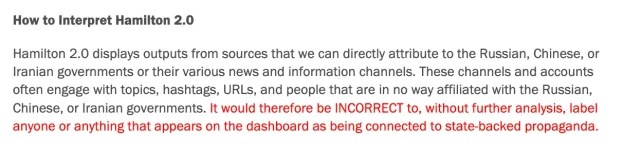
They could also have inserted the disclaimer added to the new Hamilton 2.0 page, which as a helpful reader noted this morning, includes in red font a blaring warning to all that it would INCORRECT to label anyone or anything that appears on their dashboard “as being connected to state-backed propaganda”:
Thank heaven for the Wayback Machine. Here’s what was written on the original Hamilton page:
These accounts were selected for their relationship to Russian-sponsored influence and disinformation campaigns, and not because of any domestic political content.
We have monitored these datasets for months in order to verify their relevance to Russian disinformation programs targeting the United States.
… this will provide a resource for journalists to appropriately identify Russian-sponsored information campaigns.
High on that original page, the Hamilton founders explained they monitored two types of accounts:
There are two components to the dashboard featured here.
The first section, “Overt Promotion of Content,” highlights trending content from Twitter accounts for media outlets known to be controlled by the Russian government.
The second section, “Content Tweeted by Bots and Trolls,” highlights themes being pushed by Twitter accounts linked to Russian influence campaigns.
The Hamilton list tracked overt Russian media on the one hand, and “bots and trolls” on the other. Note the difference between that language and the language Friday: “Some accounts we track are automated bots, some are trolls, and some are real users.” That Hamilton Friday was also trying to distance itself from headlines about “bots” is particularly grotesque, given that it was so overt in identifying the composition of its list this way at the start.
I encourage everyone to read language from the original site, then look at Friday’s ironically named “Fact sheet,” and compare for yourselves.
Finally I want to note a passage from the Friday “fact sheet” I somehow overlooked:
Individual accounts were algorithmically selected based on analytic techniques developed by J.M. Berger that were used to identify the most influential accounts within those networks. The Hamilton 68 team did not individually review or verify all accounts because the focus of the dashboard was to analyze behavior in aggregate networks, not specific accounts.
Translating: individual accounts were chosen through a method developed by J.M. Berger, a writer and think-tanker whose usual specialty is extremism (he’s written about ISIS and domestic white nationalism in the U.S.). Still, it wasn’t even Berger’s fault that ordinary Americans ended up in the list, since said people were chosen “algorithmically.” The Hamilton 68 team also “did not individually review or verify” all the names, because their “focus” was “aggregate networks,” not “specific accounts.”
So, nobody looked at the list.
The list that was “the fruit of more than three years of observation and monitoring.”’
Sounds solid.
Yes? No?
US to pressure partners into enforcing anti-Russia sanctions
RT | January 28, 2023
The US Treasury Department’s top sanctions official will visit Türkiye and the United Arab Emirates next week to warn officials and businesses there that Washington will punish them if they dodge its sanctions on Russia, Reuters reported on Saturday.
Brian Nelson, the department’s undersecretary for terrorism and financial intelligence, will travel to Oman, the UAE, and Türkiye between Sunday and Friday. Meeting with government officials, businesses and financial institutions, Nelson will caution them that they could lose access to US markets “on account of doing business with sanctioned entities,” a Treasury spokesperson told the news agency.
US officials have repeatedly highlighted Türkiye as a potential hub of sanctions evasion, and unnamed Western officials told the Financial Times in August that they were “deeply concerned” about allegations of trade between Turkish firms and sanctioned Russian entities.
Ankara responded that it “would not allow the breaching of sanctions by any institution or person,” following a phone call in which US Deputy Treasury Secretary Wally Adeyemo seemingly threatened the “success of the Turkish economy” and “the integrity of its banking sector.”
The UAE has also received warnings from Washington, with Adeyemo urging the Emirates’ financial institutions last summer to be “exceedingly cautious” about doing business with other institutions connected to “the Russian financial system.” The Treasury spokesperson told Reuters that Nelson will condemn the UAE’s “poor sanctions compliance” during his visit.
In the last month, the US has sanctioned a prominent Turkish businessman over allegedly laundering money for Iran’s Islamic Revolutionary Guard Corps, and a UAE-based aviation firm over alleged sales to Russia’s Wagner private military corporation. Multiple Emirati companies have also been penalized for evading US sanctions on Iran.
Both Türkiye and the UAE voted at the UN General Assembly last year to condemn Russia’s military operation in Ukraine, but neither has imposed sanctions of their own on Moscow. Turkish President Recep Tayyip Erdogan has maintained close contact with his colleagues in both Kiev and Moscow, and said from the outset that his diplomatic handling of the conflict would be “balanced.”
With Türkiye and the US also at loggerheads over Ankara’s refusal to sign off on Finland’s and Sweden’s bids for NATO membership, Erdogan and Russian President Vladimir Putin last week affirmed their intent to “develop comprehensive cooperation,” including by increasing the supply of Russian gas to Türkiye.
The 600 influential Russian Twitter bots narrative was pushed by mainstream media. Twitter executives knew it was false.
But kept quiet.
By Cindy Harper | Reclaim The Net | January 27, 2023
New Twitter Files revelations show that the Twitter accounts on a list from the Alliance for Securing Democracy (ASD) that were supposed to be of Russian bots were far from it. While Twitter had evidence to prove that the accounts weren’t Russian bots, employees kept quiet, afraid to go against mainstream media narrative.
The ASD describes itself as an organization that comes up with “strategies for government, private sector, and civil society to defend against, deter, and raise the costs on foreign state actors’ efforts to undermine democracy and democratic institutions.” Its advisors are the likes of Michael Chertoff, who worked in the George W. Bush administration as Secretary of Homeland Security, Mike McFaul (who worked in the Obama administration as US Ambassador to Russia,) commentator Bill Kristol, and Hillary Clinton advisers Jake Sullivan and John Podesta.
ASD said that Hamilton 68, the name of a dashboard that’s supposed to monitor Russian bots on Twitter, was monitoring 600 Russian bots on the platform.
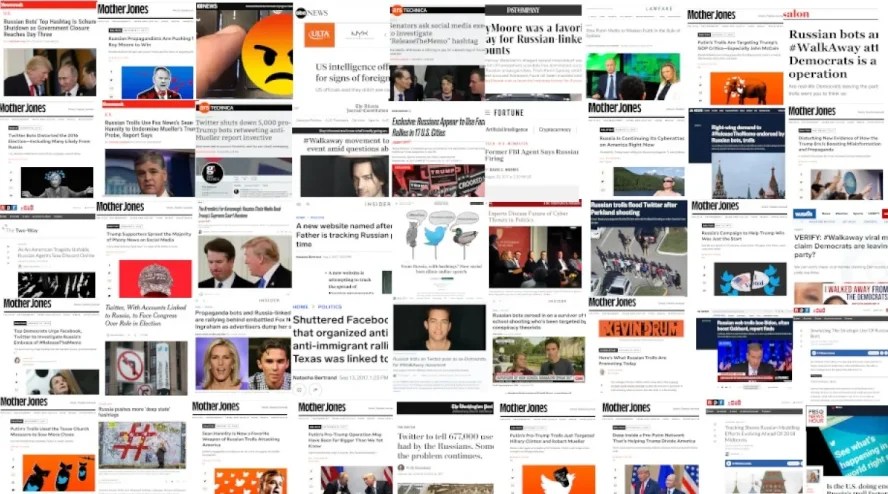
The idea of the 600 Russian bots listed on the dashboard was widespread throughout mainstream media.
“What makes this an important story is the sheer scale of the news footprint left by Hamilton 68’s digital McCarthyism. The quantity of headlines and TV segments dwarfs the impact of individual fabulists like Jayson Blair or Stephen Glass,” wrote journalist Matt Taibbi of Racket, who today released evidence about Twitter employees’ decision to keep quiet the fact that the information pushed by the mainstream media was false.
“Hamilton 68 was used as a source to assert Russian influence in an astonishing array of news stories: support for Brett Kavanaugh or the Devin Nunes memo, the Parkland shooting, manipulation of black voters, ‘attacks’ on the Mueller investigation…” Taibbi added.
“These stories raised fears in the population, and most insidious of all, were used to smear people like Tulsi Gabbard as foreign ‘assets,’ and drum up sympathy for political causes like Joe Biden’s campaign by describing critics as Russian-aligned.”
Taibbi highlighted how even “fact-checkers” used the dubious source for their own reports: “It was a lie. The illusion of Russian support was created by tracking people like Joe Lauria, Sonia Monsour, and Dave Shestokas. Virtually every major American news organization cited these fake tales— even fact-checking sites like Snopes and Politifact.”

The reports, widely pushed by the mainstream media, were untrue and Twitter executives, who had access to more information about what was going on behind the scenes with the Twitter accounts, didn’t want to disrupt the narrative for fear they would receive negative reporting.
“In layman’s terms, the Hamilton 68 barely had any Russians. In fact, apart from a few RT accounts, it’s mostly full of ordinary Americans, Canadians, and British,” Taibbi wrote.
Taibbi published email evidence that shows Twitter’s controversial former Trust and Safety chief, Yoel Roth, realizing the list was incorrect.
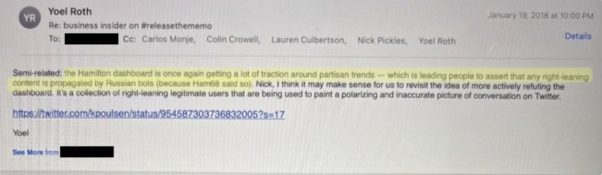
The dashboard “falsely accuses a bunch of legitimate right-leaning accounts of being Russian bots,” he wrote. “I think we need to just call this out on the bullshit it is…
“I think it may make sense for us to revisit the idea of more actively refuting the dashboard. It’s a collection of right-leaning legitimate users that are being used to paint a polarizing and inaccurate picture of conversation on Twitter.”
But despite Roth’s clear realization about the inaccuracy about one of the biggest narratives of the last few years, he ultimately stayed quiet, Taibbi notes.
“We have to be careful in how much we push back on ASD publicly,” said one company official.
Taibbi noted how the false narrative made its way into the heart of US politics: “Perhaps most embarrassingly, elected officials promoted the site, and invited Hamilton ‘experts’ to testify. Dianne Feinstein, James Lankford, Richard Blumenthal, Adam Schiff, and Mark Warner were among the offenders.”
Poland expands offer of tanks for Ukraine
RT | January 27, 2023
Poland is ready to send 60 more tanks to Ukraine to help fight Russia, besides the 14 German-made Leopard 2 vehicles already pledged, Polish Prime Minister Mateusz Morawiecki has said.
“If we don’t want Ukraine to be defeated, we have to be very much open and brave in supporting Ukraine,” Morawiecki told Canada’s CTV News broadcaster on Friday.
According to the prime minister, Poland is trying “to lead by example,” showing its allies what should be done to help Kiev.
“Right now, we are ready to send 60 of our modernized tanks, 30 of them PT-91. And on top of those tanks, 14 tanks, Leopard 2 tanks, from in our possession,” he said.
Morawiecki also noted that last year Warsaw provided about 250 of its modernized Soviet-era T-72 tanks to the Ukrainian military.
Mikhail Podolyak, an adviser to Ukraine’s President Vladimir Zelensky, confirmed on Telegram on Friday that 60 more Polish tanks will be heading Ukraine’s way. According to Podolyak, the shipment consists of PT-91 Twardys, upgraded Soviet T-72M1 main battle tanks. “Thanks to our allies,” he wrote.
Morawiecki did not specify when the additional tanks will be supplied.
On Thursday, Poland’s Deputy Defense Minister Wojciech Skurkiewicz said Warsaw plans to provide 14 Leopard 2s to Kiev after Ukrainian troops finish training with them, which could happen in “several weeks.”
The delivery of Leopard 2s by Poland to Ukraine became possible on Wednesday after Germany officially approved the supply of 14 tanks from its own stocks to Kiev, and allowed other countries to re-export the German-made weaponry to the Zelensky government.
On the same day, the US agreed to supply Kiev with 31 of its M1 Abrams main battle tanks. Earlier this month, the planned delivery of Challenger 2 tanks to Ukraine was announced by the UK.
Russia’s deputy envoy to the Organization for Security and Co-operation in Europe, Maksim Buyakevich, warned on Thursday that arming the Ukrainian military with Western tanks “is a straight path into a full-blown conflict in Europe.”
Earlier this month, Kremlin Press Secretary Dmitry Peskov insisted that German, US and British military hardware will not change the outcome of the conflict, and that the tanks will “burn” if they arrive on the battlefield.
The Pentagon’s Perpetual Crisis Machine

By Jacob G. Hornberger | FFF | January 26, 2023
Given President Biden’s decision to send 31 of its top-ranked M1 Abrams tanks to Ukraine, it is clear that the Pentagon has decided to escalate its war against Russia. Biden’s decision was followed by Germany’s decision to deliver 14 Leopard 2 A6 tanks to Ukraine. I’ll guarantee you there isn’t a Russian alive who doesn’t know about the time in the 1940s when Germany sent its tanks deep into Russia, killed millions of Russians, and almost succeeded in conquering the country.
If the increasing pressure that the Pentagon is putting on Russia does not result in a nuclear war between the United States and Russia, the advocates of this highly dangerous interventionist and escalatory strategy will later exclaim, “You see, we told you that there was never a risk of nuclear war.” But what’s interesting about the Pentagon’s strategy is that if it does result in nuclear war, there won’t be anyone around to point out how wrongheaded it was.
This is obviously no way to live. But this is what life is like under a national-security state form of governmental structure. The military-intelligence establishment needs a constant stream of crises to keep people agitated, hyped-up, afraid, anxious, and tense. In that way, they’ll look to the military-intelligence establishment to keep them “safe.” Without the constant stream of crises, people might be apt to ask, “Why do we need a national-security state? Why can’t we have our limited-government republic back?”
Moreover, a constant stream of crises ensures ever-increasing taxpayer-funded largess for the Pentagon, the CIA, and the NSA, which are the three principal components of the national-security establishment. That amount will soon reach $1 trillion per year. I’ll guarantee you that the manufacturers of tanks are uncorking the champagne bottles today. After all, those tanks being sent to Ukraine have to be replaced. Hard-pressed American taxpayers will pay for them, either directly through taxes or indirectly through more federal debt (now at $31.5 trillion and climbing every day) and inflation.
That’s what the entire Cold War racket was all about — keeping Americans agitated, hyped-up, afraid, anxious, and tense. Everyone was inculcated with the notion that the Russian Reds were coming to get us. Only the Pentagon, the CIA, and the NSA could save us from a communist takeover. The only president who has ever been willing to confront this scam was President Kennedy, and we all know what happened to him.
When the Cold War came to an end, unfortunately the Cold War racket didn’t. The national-security establishment kept their old Cold War dinosaur NATO in existence. Breaching their promise to Russia, the Pentagon began using NATO to absorb former members of the Warsaw Pact. The Pentagon knew precisely what it was doing — setting the stage for the continuation of its old Cold War racket, at least with respect to Russia.
When the Pentagon ultimately crossed what Russia had repeatedly emphasized was a “red line” by threatening to absorb Ukraine into NATO, the Pentagon achieved what it wanted — the continuation of its old Cold War racket, except for the part that the Reds were coming to get us.
But they’re still not willing to let go of the Red part of their Cold War racket. That’s why they’re now doing their best to gin up a crisis with China over Taiwan. That crisis will enable them to exclaim, “See, you need us to protect you from both Russia and the Chinese Reds.”
And don’t forget — they still have their perpetual war-on-terrorism racket. Sure, they’re not killing people en masse anymore in Afghanistan and Iraq, but they still are killing people in the Middle East and Africa. The potential terrorist retaliation from those continuous killings are enough to justify the continuation of their forever war-on-terrorism racket as well as the continuous destruction of our rights, liberties, and financial security here at home, as part of the process of keeping us “safe” from the terrorists who supposedly hate us for our “freedom and values.”
The important thing is that a life of permanent, perpetual crises is neither necessary nor inevitable. There is a way to restore normal life to America — one that isn’t based on a continuous stream of crises. That way is to dismantle the national-security state form of governmental structure and restore our founding governmental system of a limited-government republic. The only question is whether Americans have the will and the fortitude to do this. One thing is for sure: Our freedom, well-being, and possibly even our survival depend on it.
Did Germany just officially declare war on Russia?
By Drago Bosnic | January 26, 2023
During a debate at the Parliamentary Assembly of the Council of Europe (PACE), German Foreign Minister Annalena Baerbock bluntly stated that Germany and its allies are at war with Russia. The unexpected admission, although essentially true, is quite shocking given the fact that many Western officials have been insisting they aren’t directly involved in the conflict with Moscow. Baerbock made the statement during a discussion over sending “Leopard 2” heavy tanks to the Kiev regime. Most mainstream media conveniently ignored her words, but numerous experts were alarmed and warned that Berlin just essentially declared war on Russia.
This stands in stark contrast to claims of other German officials who have been extremely careful with their statements for nearly a year, insisting that their country is not directly involved in the Ukrainian conflict and citing uncontrollable escalation as their primary concern. However, this official stance is now in serious question, as one of the country’s top officials just effectively nullified all of their efforts. Annalena Baerbock started her statement at PACE with the following:
“And therefore I’ve said already in the last days – yes, we have to do more to defend Ukraine. Yes, we have to do more also on tanks. But the most important and the crucial part is that we do it together and that we do not do the blame game in Europe, because we are fighting a war against Russia and not against each other.”
Ironically, Chancellor Olaf Scholz and his now former defense minister Christine Lambrecht have been accused of being “weak” on arming the Neo-Nazi junta. They have frequently insisted that it would be dangerous to get more directly involved in NATO’s proxy war against Russia. However, it seems that the much more hawkish Baerbock is willing to say the quiet part out loud. Moscow immediately reacted to the comments, with Russian Foreign Ministry spokeswoman Maria Zakharova saying this is yet another proof that the political West was planning a war on Russia for quite some time now.
“If we add this to Merkel’s revelations that they were strengthening Ukraine and did not count on the Minsk agreements, then we are talking about a war against Russia that was planned in advance. Don’t say later that we didn’t warn you,” Zakharova said.
Baerbock’s comments come on the heels of nearly a year of direct Russophobic narrative, including openly declared plans for war with Russia. In mid-November, Der Spiegel published leaked German Defense Ministry documents, revealing that the Bundeswehr is preparing for war with Russia. The secret draft titled “Operational guidelines for the Armed Forces” was authored by none other than the German Chief of Staff, General Eberhard Zorn himself. He stressed the need for a “mega-reform” of the German military and clearly identified Russia as an “immediate threat”.
The claim makes little sense, as Germany is now over 1,500 km away from Russia, with Belarus, Poland and Ukraine standing between the two countries. While such assertions made some sense at the height of the (First) Cold War, when the Soviet Union had over half a million soldiers stationed in East Germany alone (in addition to other Warsaw Pact member states), the situation is effectively reversed nowadays. NATO is the one encroaching on Russia’s western borders, with the crawling expansion including coups and other interventions in various Eastern European and post-Soviet states. After decades of this creeping aggression and Moscow’s futile attempts to build a comprehensive partnership with the political West, Russia was forced to launch its counteroffensive.
Back in early March, the German government announced a dramatic increase in defense spending, including a €100 billion budget for the Bundeswehr, essentially double in comparison to 2021. Although this will inevitably put additional pressure on the already struggling German economy, ravaged by the sanctions boomerang from its failed economic siege of Russia, Berlin’s suicidal subservience to Washington DC seems to take precedence. Much of Germany’s prosperity was based on access to cheap Russian energy, now a thing of the past thanks to Berlin’s resurgent Russophobia.
In addition, Germany also uniquely holds historical responsibility on a scale virtually no other country in the world does, especially towards Russia. During the Second World War, it launched a brutal invasion of the Soviet Union, killing nearly 30 million people and destroying virtually everything in its path. Worse yet, after approximately 80 years of denazification in the aftermath of its WWII defeat, Berlin still decided to support the Neo-Nazi junta in Kiev, effectively renouncing its own official postwar political position. This also includes German weapons that are killing Russians, both soldiers and civilians.
Alarmed by the dramatic shift in rhetoric, many in Germany are already pointing out the fact that the country is repeating the same historical mistake by antagonizing Russia. Petr Bystron, an AfD (Alternative for Germany) member of the German Parliament, reminded his colleagues in the Bundestag of the consequences of sending German tanks to fight Russia in Ukraine:
“It’s an interesting approach you’re taking here. German tanks against Russia in Ukraine. By the way, your grandfathers have already tried to do it then with the Melnyks and Banderas [Ukrainian Nazi collaborators during WWII] and what was the result? Untold suffering, millions of deaths on both sides, and in the end, Russian tanks here in Berlin. And two of them are still here, in front of the Bundestag. You should pass by them every morning and remember it!”
Drago Bosnic is an independent geopolitical and military analyst.
Stop Whining & Turn Tap On: Why German Politicians Fear to Tell Truth About EU Energy Crunch
By Ekaterina Blinova – Sputnik – 25.01.2023
German Economy Minister Robert Habeck pinned the blame for the nation’s energy crunch and shift to dirty fuels on Russian President Vladimir Putin, who, according to the minister, “turned off the gas tap.” International observers dismissed Habeck’s remarks as utter nonsense while speaking to Sputnik.
“What else is left for Mr. Habeck to do? He cannot say that it were his actions that led to such unfortunate consequences for the German economy and for German consumers,” Alexey Grivach, deputy head of Russia’s National Energy Security Fund, told Sputnik.
“After all, it is precisely because of his rash actions that all German citizens are now suffering – and not only Germany, but the entire European Union. Therefore, Habeck has engaged in such a political, verbal balancing act, trying to convince someone that if there is no gas in the pipe, then Russia is to blame. But, fortunately, everyone knows perfectly well what really happened.”
Speaking to journalists last Friday, Habeck claimed that half of Germany’s entire gas supply had been stopped by Russia. He added that given that Nord Stream pipelines had been destroyed, Germany would not be able to get Russian fuel through them in the foreseeable future.
Done by Habeck’s Own Hands
Sputnik’s interlocutors have been perplexed by Habeck’s whining: it was Berlin that succumbed to Washington’s pressure last year and froze Gazprom’s Nord Stream 2 pipeline project that would have doubled the total capacity of the Nord Stream system from 55 billion cubic meters (bcm) to 110 bcm.
It was Robert Habeck, in propria persona, who on February 22, 2022, instructed the withdrawal of a security-of-supply assessment granted under former German Chancellor Angela Merkel’s tenure, which was required to authorize Nord Stream 2.
It was Habeck, again, who pledged in early May 2022 to replace all Russian energy imports, most notably natural gas, by as soon as mid-2024, following the beginning of Moscow’s special operation to demilitarize and de-Nazify Ukraine on February 24, 2022.
The minister gleefully announced at that time that Germany’s share of Russian gas had already dropped from 55% in 2021 to around 35% by mid-April 2022, adding that even faster progress was achieved for oil and coal where shares had dropped to 12% and 8%, respectively. To that end, Berlin leased four floating LNG terminals online to supply some 33 bcm/year, seeking to start operating the first of the Floating Storage Regasification Units (FSRU) in late 2022 and 2023.
Apparently, Germany did not resist the actions of Canada which slapped sanctions on Russia and had long refused to return a Gazprom turbine for Nord Stream’s gas equipment. Russia initially sent the turbine to Siemens Canada in Montreal for a scheduled overhaul.
However, in June 2022, Canada imposed restrictions on Russia’s energy companies, including Gazprom, and the turbine remained stuck in the North American country. That disrupted the Nord Stream system’s work and raised concerns about pre-planned maintenance service for the other five turbines. After back-and-forths, Ottawa agreed to issue a “time-limited and revocable permit” to exempt the return of the equipment.
“For some reason, this turbine was returned to Germany without the appropriate documents and guarantees that further maintenance of such turbines will be carried out in accordance with the obligations and not in some kind of sanctions mood,” Grivach noted.
Only in late August 2022, the Canadian authorities said that they would allow for the maintenance of the remaining five turbines used by the Nord Stream 1 pipeline, but the damage was done in terms of reducing the flow of natural gas from Russia to Germany.
A month later, a sabotage attack destroyed three out of Gazprom’s four Nord Stream pipelines. So far, neither Germany nor its European peers have lifted a finger to initiate repair works. This apparently indicates that they don’t need Russian gas, remarked Alexey Fenenko, associate professor of the Department of International Security, Faculty of World Politics of Moscow State University.
Furthermore, following the September 2022 sabotage, European leaders immediately pointed the finger of blame at Russia and did not allow Moscow’s specialists to participate in EU investigations into the blast.
However, in December 2022, the US mainstream press quoted European officials and investigators as saying that they had not found any evidence confirming Russia’s guilt. They admitted that Moscow would have nothing to gain from blasting its own pipelines and agreed that there had been plenty of international players interested in Nord Stream’s destruction. Nonetheless, western journalists and European officials have not made any step to name potential suspects.
“It is clear that if it were Russia, as some had the audacity to assert, then they would have proved it very quickly. But, apparently, the facts indicate some very unpleasant, and maybe even some taboo topics,” Grivach remarked.
Habeck’s gloomy sentiment with regard to Germany’s prospects of receiving Russia’s gas is sly, according to Sputnik’s interlocutors.
First, in October 2022, Russian President Vladimir Putin signaled his readiness to deliver gas to Germany through a Nord Stream pipeline not damaged by the blast. “It has a capacity of 27.5 billion cubic meters per year, which is about eight percent of all gas imports to Europe,” Putin stated on October 12, 2022, stressing that the ball is in Europe’s court. “Russia is ready for the start of these deliveries (…) If [European leaders] want it – they have to turn on the tap, and that’s it.”
Second, the same month, Moscow suggested creating a new gas hub in Turkey capable of delivering the fuel to the Old Continent.
Third, Russia is ready to restore gas supplies through other gas pipelines, as Vladislav Belov, deputy director of the Institute of Europe of the Russian Academy of Sciences and head of the Center for German Studies told Sputnik.
“Germany still has every opportunity to receive [Russian gas],” said Belov. “There is the Yamal-Europe gas pipeline, blocked by Poland, there is a gas pipeline through Ukraine, but it has reduced pumping through it by 40%. Germany has ample opportunity to put pressure on its allies. In addition, there is also the Turkish Stream, through which Russia fully fulfills all its obligations. In general, Russia is ready to supply gas to Germany, but the Germans themselves turned the tap off. It is up to them to be able to get as much gas as they need to keep their homes warm, to fill storage facilities and get gas at the prices that are currently on the spot market.”
It Was Europe’s Decision to Axe Russia’s Gas Supplies
The dramatic reduction of Russia’s gas supplies to Europe is the result of a political decision by EU member states, according to observers.
“The reasons are political. The European Union decided to stop the supply of all raw materials coming from Russia for political reasons.”
For his part, former Greek Energy Minister Panagiotis Lafazanis noted in an interview with Sputnik that he fully supports the position of former Austrian Vice-Chancellor Strache, who said that the German authorities are afraid to tell their own population the truth about the real reasons for rising gas and electricity prices and about a possible shortage of energy resources.
“Europe is paying a high price for the expensive natural gas it now has to buy,” said Lafazanis, adding that Europe itself is entirely responsible for the consequences of its energy policy and shift to LNG.
What’s more interesting, some European countries are continuing to buy Russia’s energy commodities nonetheless, Stepan noted.
“For example, Russian LNG is bought by France, the Netherlands, Belgium, Spain and, of course, the United States are continuing to buy Russian LNG,” Stepan said. “The same applies to Russian oil. The UK claims it does not import anything from Russia, and suddenly there is news in the newspapers that several tankers with Russian oil will arrive in Britain (…) It turns out that there’s a double standard approach: on the one hand, politicians issue statements, and on the other hand, in practice, governments pretend that they know nothing about their companies continuing to import Russian raw materials, or they themselves violate their regulations.”
The allegations that Russia “weaponized” its energy supplies repeatedly voiced by western politicians look ridiculous to say the least, according to Sputnik’s interlocutors.
Moreover, Europe’s energy crisis started long before the Russian special operation in Ukraine, which is routinely cited as one of the causes behind spiking gas prices, according to Mehmet Dogan, a Turkish energy expert and CEO of energy consulting agency GazDay.
“Even before the aggravation of the situation in Ukraine, everyone was talking about the threat of an energy crisis,” Dogan told Sputnik. “Gas prices skyrocketed even before the outbreak of hostilities.”
“The gas crisis in Europe began even before the escalation in Ukraine. It was based on a sharp rise in prices for blue fuel. But European countries have tried to make Russia and Putin responsible for this crisis,” echoed Turkish energy expert Volkan Aslanoglu, stressing that Habeck’s recent statement appears to be completely detached from reality.
Russia Supplying EU Despite Sanctions & Military Aid to Kiev
There is yet another aspect to the ongoing debate that is rarely touched upon, according to Alexey Fenenko. The Russian academic considers Habeck’s remark about the blocking of the “gas valve” by Russia strange, given the intention of the EU to defeat the Russian Federation in an economic war.
Moreover, German Chancellor Olaf Scholz made it clear at the latest World Economic Forum in Davos that to end the conflict in Ukraine Russia’s special military operation “must fail.” To that end, Germany and other western countries provide the Kiev regime with heavy weapons as long as needed, according to Scholz.
Indeed, the German media has reported that Berlin is now planning to send its Leopard 2 tanks to Kiev, something that the German leadership had been previously reluctant to do. Earlier this month, Berlin vowed to supply Ukraine with armored personnel carriers and a Patriot missile battery. In addition, on January 15, expanded combat training of Ukrainian forces kicked off in Germany, according to the US press.
European leaders have stepped up supplies of weapons to Kiev since the beginning of Russia’s special military operation with prominent leaders rubbishing the idea of a diplomatic solution to the conflict, rather claiming that it should be sorted out on the battlefield.
All this time, despite the EU’s bellicose rhetoric and their de facto participation in the Russo-Ukrainian conflict, Russia’s energy producers continued to observe their obligations and supply Europe with natural gas, oil and petroleum products.
Russia is still warming up the Old Continent, be it direct oil and gas exports or ensuring the flow of energy carriers through its territory, energy expert Milos Zdravkovic told Sputnik. Moscow is signaling openness and readiness to provide Europe with energy, even though Russia has enough lucrative opportunities in Asia.
European Gamble Doesn’t Bode Well
Meanwhile, EU economic prospects don’t look good, according to Zdravkovic. He noted that the EU does not know what energy prices will be in the foreseeable future both for heating and the needs of industry. European goods are set to become much more expensive than those produced by Asians and Americans due to turbulent gas costs. This will adversely affect the economy of Europe, Zdravkovic warned.
“Europe consumed at least 500 billion cubic meters (bcm) a year,” Zdravkovic explained. “Its consumption grew by about 10 bcm per year.”
In 2021, the EU imported 83% of its natural gas with Russia delivering over 40% of this volume. Given that, it’s impossible to swiftly replace Russia’s gas with LNG supplies, according to Zdravkovic.
“The capacity of the total fleet of LNG tankers and all terminals on our planet, on all continents, is 400 bcm,” the Serbian energy expert noted, adding that European leaders shouldn’t expect that these volumes will all go to the Old Continent.
Moreover, a complete shift to American LNG would require building the appropriate infrastructure, according to Alexey Fenenko. One should also add fuel costs for tankers which will carry LNG from the US to Europe when supplies become regular. All these costs will make energy pretty expensive for Europeans, the Russian scholar remarked.
Of course, European countries could also switch to coal and nuclear energy, but it will take at least ten years for them to reorient to these sources of energy, Fenenko added.
“Every cloud has its silver lining,” said Zdravkovic. “I am convinced that at the end of this crisis (…), no one will ever be able to force large European economies, EU civilians and inhabitants of [the Old Continent] to join such a gamble again. I think this will definitely never happen again and that in the future there will be much more cooperation.”
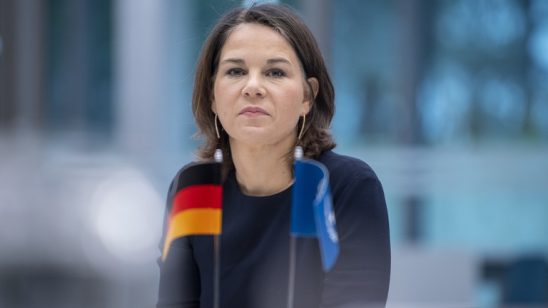
Germany ‘at war’ with Russia – FM
RT | January 25, 2023
Arguing in favor of sending tanks to Kiev, German Foreign Minister Annalena Baerbock said EU countries were fighting a war against Russia. US and EU officials have previously gone out of their way to claim they were not a party to the conflict in Ukraine.
“And therefore I’ve said already in the last days – yes, we have to do more to defend Ukraine. Yes, we have to do more also on tanks,” Baerbock said during a debate at the Parliamentary Assembly of the Council of Europe (PACE) on Tuesday. “But the most important and the crucial part is that we do it together and that we do not do the blame game in Europe, because we are fighting a war against Russia and not against each other.”
While Chancellor Olaf Scholz has insisted that Germany ought to support Ukraine but avoid direct confrontation with Russia, his coalition partner Baerbock has taken a more hawkish position. According to German media, her Green Party has been in favor of sending Leopard 2 tanks to Kiev, and eventually managed to pressure Scholz into agreeing. Defense Minister Christine Lambrecht, who was reluctant to send tanks to Ukraine, was pushed to resign.
This is not the first time Baerbock has made waves with her position on the conflict. She told an EU gathering in Prague last August that she intends to deliver on her promises to Ukraine “no matter what my German voters think.”
Quoting Baerbock’s words on Wednesday, Russian Foreign Ministry spokeswoman Maria Zakharova said the West just keeps admitting that they had been planning the current conflict for years.
“If we add this to Merkel’s revelations that they were strengthening Ukraine and did not count on the Minsk agreements, then we are talking about a war against Russia that was planned in advance. Don’t say later that we didn’t warn you,” Zakharova said.
Former German chancellor Angela Merkel told German media in early December that the 2014 ceasefire brokered by Berlin and Paris was actually a ploy to “give Ukraine valuable time” for a military build-up. Former French president Francois Hollande has confirmed this, while Ukraine’s leader at that time, Pyotr Poroshenko, openly admitted it as well.
Russia’s operation in Ukraine was a “forced and last-resort response to preparations for aggression by the US and its satellites,” former Russian president Dmitry Medvedev said on Monday.
EU’s financial support for Ukraine now just shy of €50bn
By Jerome Hughes | Press TV | January 24, 2023
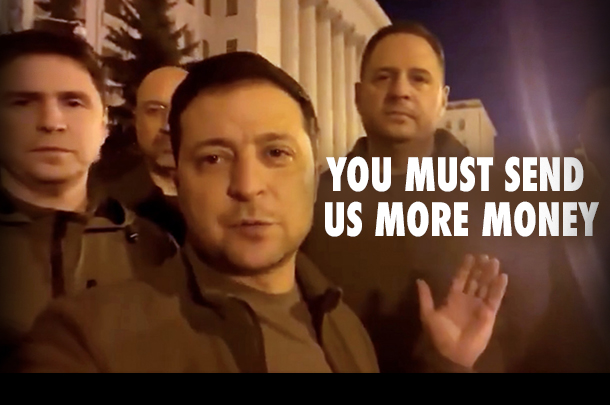
Brussels – Ukrainian officials took part in a meeting of EU foreign affairs ministers on Monday via video link. An additional €500m military aid package for Kiev was confirmed, but the EU is at pains to point out that’s just a drop in the ocean compared to what the bloc has already provided since last March.
Just a few days ago in the European Parliament, the strategy was condemned.
Workers have taken to the streets of Brussels to demand peace negotiations.
EU foreign ministers adopted a fresh round of sanctions against Iran on Monday over alleged human rights abuses. The grounds for such sanctions are vehemently rejected by Tehran. Critics say the West’s policy towards Russia and Iran is being driven by Washington.
Analysts say the EU’s access to markets in these countries is being hampered due to influence from the United States, and ultimately it is ordinary citizens who are paying the price.
Also on Monday, Palestinian Prime Minister Mohammad Shtayyeh updated EU foreign ministers on the appalling situation in the occupied territories. There was absolutely no discussion on the EU side regarding possible sanctions against Israel.
Featured Video

The Truth About the Trump Shootings with Ken Silva
or go to
Aletho News Archives – Video-Images
From the Archives
Trans ‘milk’ as good as the real thing – NHS
RT | February 18, 2024
The drug-induced nipple secretions of trans women are as good as mothers’ breast milk for babies, the University of Sussex Hospitals NHS Trust claimed in a letter to campaigners made public in a report by British think tank the Policy Exchange on Sunday.
The healthcare trust’s medical director, Rachel James, argued that the off-label prescription drug cocktail men transitioning to female take in order to produce milk was “similar to the natural hormones which encourage lactation to develop when the baby is newly born.”
“The evidence which is available demonstrates that the milk is comparable to that produced following the birth of a baby,” James wrote in the letter, sent to Children of Transitioners last August.
Biological men who wish to lactate must first take hormones to grow milk glands and then take high doses of either domperidone or metoclopramide to stimulate milk production. Neither drug is approved for this use, though they are occasionally prescribed off-label to biological women who have trouble lactating.
However, domperidone’s own manufacturer, Janssen, warns patients the drug “may cause unwanted side effects affecting the heart in a breastfed baby” and “should be used during breastfeeding only if your physician considers this clearly necessary.” … continue
Blog Roll
 Aletho News
- How Real Is the Impact of Western Sanctions on Israel?
- France, You Are Guilty: How Paris Turned Western Sahara into the Maghreb’s Powder Keg
- 2025 Nature Paper Claiming Worsening Global Drought Gets RETRACTED …Heavily Flawed
- Your Milk Is Not the Problem
- The Truth About the Trump Shootings with Ken Silva
- ARE PATIENTS BEING PROPERLY INFORMED ABOUT OZEMPIC?
- US lawmaker blocks $2.8 billion weapons sale to Israel: Report
- Yemeni army claims responsibility for strikes on sensitive sites in Saudi capital, Aramco facilities in Yanbu
- Iran Judiciary issues indictments against 159 US, Israeli officials for assassination of Leader, commanders
- Turkiye revokes Iranian bank license under US sanctions campaign
- If Americans Knew
- Salah Sarsour’s Legal Team Says DHS Has Not Met Its Burden to Prove He Is Deportable
- An analysis of tax forms by The Intercept show Kraft’s charity and LLC have donated to Friends of the IDF and AIPAC’s super PAC.
- Israeli attacks kill four Palestinians in Gaza – Daily Update
- Inside Gaza’s death trap of collapsing, bombed-out buildings
- The everyday items Israel bans from Gaza every day
- Inside the siege, the ruined buildings of Gaza – Daily Update
- Debunking The Claim That Macklemore Has A “History Of Antisemitism”
- CPJ demands release of arrested Palestinian-US journalist near Bethlehem
- Robert Kraft: The Billionaire Friend of Netanyahu Pulling The Strings Behind the Macklemore/Ed Sheeran Blow Up
- Columbia Administered Fund Gives Big Money to Pro-Israel Groups
- No Tricks Zone
- 2025 Nature Paper Claiming Worsening Global Drought Gets RETRACTED …Heavily Flawed
- New Study: ‘Global Drought Shows No Detectable Recent Acceleration Under Climate Warming’
- Economic Masterminds: German Socialists Suggest Taxing Productivity Gains Stemming From Using AI
- The South China Sea Has Not Been Cooperating With The Climate Change Narrative
- Energy Crisis: Germany Enters Heating Season With Historically Low Gas Reserve Fill Levels
- New Study: The Antarctic Ice Sheet Gained Mass From 2020-2024 Due To Staggering Snow And Ice Accumulation
- Study: Ocean Heating Rates From Thousands Of Years Ago ‘Dwarf’ Modern Ocean Heating Rates
- Climate Extremists Target, Attack Large-Scale Power Grid Infrastructure In Germany!
- New Study: Antarctic Ice Melt Has Contributed Less Than 1 Centimeter To Sea Level Rise In The Last 30 Years
- Fear Of Debate: Alarmist German Climate Scientist Calls On Mainstream Media To Discredit Skeptic Voices
 Aletho News