RT sends request to UN over rape allegations
RT | November 15, 2022
RT has reached out to the UN special representative on sexual violence, Pramila Patten, to request a correction or retraction of a statement in which she accused the Russian Armed Forces of employing a deliberate “rape strategy” as part of its military campaign in Ukraine. Patten made the claim in October in an interview with the AFP only to admit she did not have any solid evidence to substantiate it a month later.
“The allegations Ms. Patten has brought forward are of a very serious nature, which have the power to shape public discourse around the events in Ukraine,” RT said in a statement, adding that her words were then “widely distributed amongst media outlets and social media, to create a misleading, if not entirely false, narrative.”
In October, Patten told the AFP that when “you hear women testify about Russian soldiers equipped with Viagra, it’s clearly a military strategy.” Less than a month later, the UN official admitted that her words were based solely on some unverified reports disclosed to her in the presence of two Ukrainian officials. Speaking to Russian prank artists Vladimir Kuznetsov and Alexey Stolyarov, also known as Vovan and Lexus, she recently said that it was “not her job” to conduct investigations anyway.
No evidence has since been provided to corroborate these claims. In its statement, RT asked Patten whether she “intends to issue a retraction – or at least a correction – of her original, misleading statement.”
“As a person holding such a public role with enormous responsibility, one would hope that Ms Patten seek to provide a true, verified testimony of her organization’s work,” the statement added.
RT also asked Patten’s office to provide some evidence to support her allegations in case the UN special representative believes a retraction would be “improper.” Neither Patten nor her office has commented on the request so far.
Moscow has previously denied the accusations made by Patten. Russian Foreign Ministry spokeswoman Maria Zakharova blasted the UN official’s claims as going “beyond the reach of reason.”
Washington Attempts To Bully India Into Cutting Ties With Russia
By Conor Gallagher | naked capitalism | November 13, 2022
For months the US has repeatedly tried to coerce India into cutting ties with Russia, thereby abandoning its national interests. New Delhi, however, continues to spurn American attempts to subject its economy to Washington’s dictates.
The latest fuss concerns the G7 price cap on Russian oil and EU and UK bans on shipping and related services for Russian crude. India continues to have no interest in joining the US-led initiative as it gets a steep discount on oil from Russia and wants to maintain the relationship with a long-time strategic partner. Indian Foreign Affairs Minister Subrahmanyam Jaishankar was just in Moscow on Nov. 8 to discuss continued sales of oil. From the South China Morning Post :
India’s foreign minister hailed New Delhi’s “strong and steady” relationship with Moscow on Tuesday, during his first visit there since Russia invaded Ukraine in February.
Subrahmanyam Jaishankar also declared India’s intention to continue to buy Russian oil, again disregarding the US appeal to allies and partners to isolate Russia from the global markets.
The G-7 plans are likely to send oil prices higher (despite US Treasury Secretary Janet Yellen claiming the opposite) and reduce tanker availability, both of which will threaten India’s energy security and hurt its economy as India is the third-largest consumer and importer of oil worldwide.
Russia has said it will not sell to any countries that participate in the price cap scheme, and Jaishankar has repeatedly stated that India cannot afford to buy oil at high prices – at least not without undermining its economic growth, which is forecast to be 6.1 percent in 2023, the fastest-growing major economy in the world. According to Energy Intelligence :
Russia emerged as India’s top crude supplier in October, shipping over 900,000 barrels per day or roughly a fifth of India’s demand. The two countries’ biggest concern is ensuring that Russian oil continues to flow after the Dec. 5 EU and UK bans and related G7 price cap.
But despite Jaishankar’s bullish stance in Moscow, India’s state refiners have not placed orders for crude lifting beyond Dec. 5 due to uncertainties about whether shipping and insurance will be available, Energy Intelligence understands. And a recent attempt by an Indian buyer to use the price cap in negotiations with a Russian seller prompted the latter to abandon the deal, market sources said.
The ongoing lack of clarity on the G-7 could be by design. Russian oil exports have already begun to dip, and Bruce Paulsen, a sanctions expert and partner at law firm Seward & Kissel, told American Shipper, “ If guidance on [price cap] compliance doesn’t come soon, some industry players may sit on the sidelines until they can determine that shipments under the price cap are safe.”
The US, in a neat sleight of hand, quit pressuring India to adhere to the price cap, and Yellen now says Washington is “happy” for New Delhi to continue buying as much Russian oil as it wants, including at prices above a G7-imposed price cap. But there are just a few caveats: India wouldn’t be able to use western insurance, finance, or maritime services to transport the oil.
“Russia is going to find it very difficult to continue shipping as much oil as they have done when the EU stops buying Russian oil,” Yellen told Reuters on Friday. “They’re going to be heavily in search of buyers, and many buyers are reliant on Western services.”
More from Energy Intelligence on why this amounts to a de facto price cap:
Indian refiners have the capacity to soak up another 600,000 b/d of Russian crude, provided it outcompetes the staple Mideast grades that are the lifeline of the country’s 5 million b/d refining base. But the availability of shipping and insurance — and payment channels — is key. From Dec. 5, tankers and shipping insurance linked to EU and G7 countries — which dominate oil shipping globally — will be barred from trading Russian crude unless those volumes are sold under the price cap, as yet undetermined.
About 90% of India’s liquids trade is shipped by foreign tankers, presenting challenges, independent energy analyst Narendra Taneja said. Insurance does not appear as problematic, and analysts say that Russian and Chinese firms can handle it.
This could leave Russia reliant on a shadow fleet of older tankers with opaque ownership that do not transact in dollars. According to Freight Waves :
Brokerage Braemar reported that 33 tankers previously handling Iranian or Venezuelan exports have carried Russian exports since April, mostly to China and secondarily to India.
Braemar defined the dark fleet as tankers that have carried Iranian or Venezuelan crude at least once in the past year. It put the current total at 240 tankers, mostly smaller and midsized, with 74% 19 years or older. Eighty of those vessels are very large crude carriers (VLCCs, tankers that carry 2 million barrels) that won’t fit in Russian ports but could be used for ship-to-ship transfers for Russian cargoes.
If the entire dark fleet switched to Russian service and were as efficient as the “mainstream fleet,” it would be more than enough to keep Russian exports flowing, but “vessels engaged in illicit trading are highly inefficient,” Braemar emphasized.
At the same time Washington is pressuring New Delhi to comply with the price cap, it is importing from India more vacuum gasoil, which is mostly used at refineries to produce other products such as gasoline and diesel. From Reuters :
Russia used to be a key VGO supplier to U.S. refiners before the Ukraine war broke out.
“Given that the U.S. is not buying Russian oil, they are looking for any and all alternatives,” said Roslan Khasawneh, senior fuel oil analyst at Vortexa…
U.S. and EU sanctions do not apply to refined products produced from Russian crude exported from a third country as they are not of Russian origin. In India, refiners boosted imports of discounted Russian oil to 793,000 barrels per day between April and October, up from just 38,000 bpd in the same period a year ago, trade data showed.
India joins a list of countries – including Saudi Arabia, Serbia, and Turkey – that are causing heads to explode in Washington for refusing to be bullied into submission.
This all must be coming as a shock in Washington as its Indo-Pacific strategy in recent years has always included a “like-minded” India helping to counter China and do the US’ bidding in southeast Asia. The possibility that India might pursue its own national interests didn’t seem to factor into the strategy.
The tension over the Russian price cap is just the latest in a series of disagreements between New Delhi and Washington. US sanctions on Iran’s oil exports deprive India of cheap Iranian oil, and force it to buy more expensive US energy exports. India is now the largest oil export destination for the US.
Similar to the way Washington is arming Greece and Cyprus in an effort to bully Turkey into breaking off its friendly ties with Russia, the US is doing the same in Pakistan to pressure India. The US has begun to accommodate Pakistan again after the ouster of former Pakistani prime minister Imran Khan, who blames his loss of power in a no-confidence vote on the US.
In September, the U.S. State Department enraged India when it approved a $450 million deal to upgrade Pakistan’s F-16 fleet. Shortly after, the US ambassador to Pakistan created more tension during a visit to the Pakistani-held part of Kashmir, which he called by its Pakistani name instead of the United Nations-approved name “Pakistan-administered Kashmir.”
On Nov. 8 US State Department spokesman Ned Price lectured India on what are in its best interests:
We’ve also been clear that now is not the time for business as usual with Russia, and it’s incumbent on countries around the world to do what they can to lessen those economic ties with Russia. That’s something that’s in the collective interest, but it’s also in the bilateral interest of countries around the world to end and certainly over the course of time to wean their dependence on Russian energy. There have been a number of countries that have learned the hard way of the fact that Russia is not a reliable source of energy. Russia is not a reliable supplier of security assistance. Russia is far from reliable in any realm. So it is not only in the interest of Ukraine, it is not only in the interest of the region, of the collective interests that India decrease its dependence on Russia over time, but it’s also in India’s own bilateral interest, given what we’ve seen from Russia.
We’ll have to wait and see if the Indian people get the message because as of now the opposite is true. India’s Observer Research Foundation released poll results on Nov. 2 that showed that 43 percent of Indians regarded Russia as their country’s most reliable partner, which was far ahead of the US at 27 percent.
Washington would be hard pressed to explain how New Delhi scaling back its economic ties with Russia would be a good thing for India.
Fuelled by a surge in import of oil and fertilizers, India’s bilateral trade with Russia has soared to an all-time high of $18.2 billion over the April-August period of this financial year, according to the latest data available with the Department of Commerce. That makes Russia India’s seventh biggest trading partner — up from its 25th position last year. The US, China, UAE, Saudi Arabia, Iraq, and Indonesia remain ahead of Russia.
India, Iran, and Russia have also spent the past twenty years developing the International North-South Transport Corridor to increase trade between the countries, and it took on increased importance with the western sanctions on Moscow. From The LoadStar :
RZD Logistics, a subsidiary of Russian railway monopoly RZD, has begun regular container train services from Moscow to Iran to serve growing trade with India by transloading.
This is aimed at maximizing use of the alternative International North South Transport Corridor (INSTC), a Central Asia cross-border multimodal freight network helping the two strategic partners work around supply chain challenges created by western sanctions on Russia.
The inland-ocean leg involves an estimated transit time of 35 days, compared with about 40 with previous traditional shipping, according to industry sources.

©Peter Hermes Furian
In much the same way that US heavy-handedness is backfiring elsewhere, the pressure applied on India seems to only be encouraging New Delhi to find a way around the dollar. The Loadstar adds that the Reserve Bank of India is also implementing new regulatory guidelines to help exporters settle shipments in rupees, instead of US dollars that had run into sanctions-related bottlenecks:
The Federation of Indian Export Organizations has also been pressing government leaders to extend the alternative currency method beyond Russian markets.
“While the Russia-Ukraine war is a setback to our exports in the short run, we are looking to increase our exports to Russia once the rupee payment mechanism gets operationalised,” FIEO noted.
While India has been benefitting from the discounted Russian crude, it also wants to maintain good ties with Moscow to avoid pushing Russia closer to China and potentially Pakistan, India’s biggest rivals in Asia.
Pakistan is also now asking the Russian Trade Ministry to introduce a currency swap arrangement to strengthen economic ties between the two countries.
Britain’s Liberal Technocratic Recession
BY NOAH CARL | THE DAILY SCEPTIC | NOVEMBER 13, 2022
On November 3rd, the Bank of England announced that Britain is facing its “longest recession since records began”, with unemployment forecast to nearly double by 2025.
How did we get here?
In most developed economies, recessions happen once or twice a decade (although Australia went without one for 30 years). So in some sense, they’re unavoidable. Yet the scale of the one we’re facing – the longest since records began – suggests some fundamental errors have been made.
The first was lockdown. For more than a year, we spent untold sums of money on daft furlough schemes and boondoggles like ‘Test and Trace’. Meanwhile, we allowed supply chains to break down through trade restrictions and lack of maintenance. We were spending more while producing less – which set us on course for inflation.
The second was letting dozens of oil refineries shut down without building any new ones. Such refineries became unprofitable during the pandemic, and firms didn’t bother to upgrade or replace them due to costly environmental regulations and the uncertainty surrounding ‘Net Zero’.
The third were the reckless sanctions against Russia. Rather than using the threat of sanctions as a bargaining chip, we immediately went pedal to the metal and tried to crush Russia’s economy. This backfired: while we have inflicted some long-term damage, we hamstrung our own economies in the process.
All three of these blunders stem from hubris on the part of liberal technocratic policymakers, who believe there are straightforward ‘solutions’ to problems like pandemics, climate change and interstate conflict. In reality, we’re always faced with trade-offs and unintended consequences.
The British economy is now grappling with general inflation (caused by lockdowns) and rising energy costs (caused by lack of refining capacity and sanctions against Russia).
The severity of these problems is laid bare in the ONS’s Business Insights and Conditions Survey – a fortnightly survey of around 10,000 businesses. Respondents were asked, “Which of the following, if any, will be the main concern for your business in November 2022?” Results are shown below.
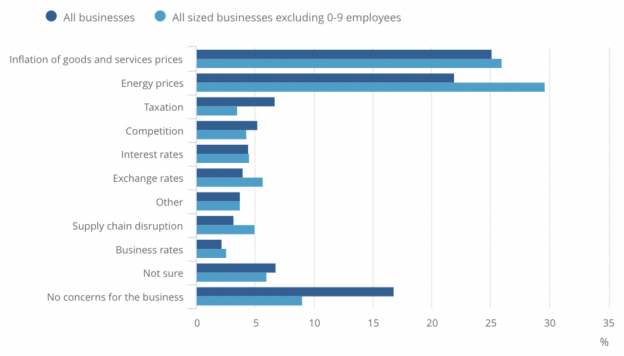
Results from the ONS’s Business Insights and Conditions Survey
As you can see, by far the most frequently mentioned concerns were “inflation” and “energy prices”. Only around 7% of businesses mentioned “taxation” as their main concern, demonstrating how ill-conceived was Liz Truss’s economic program. (She thought we could tax-cut our way out of an energy crisis).
Policymakers need to get grips with the fact that not every problem has a liberal technocratic ‘solution’. Paying people not to work, shutting down refineries, and sanctioning other countries may feel good. But that doesn’t mean it’s the right thing to do.
New Delhi may sue Berlin over undelivered LNG – Bloomberg
RT | November 12, 2022
A diplomatic dispute is brewing between India and Germany after Berlin took over a former Gazprom subsidiary and halted LNG shipments to New Delhi.
The Russian gas giant’s former local subsidiary Gazprom Germania, renamed SEFE (Securing Energy for Europe), cut LNG supplies to India’s Gail back in May, citing sanctions Moscow imposed after the company was taken over by the German state. Under the sanctions, Gazprom stopped supplying SEFE with gas.
Gail had a 20-year contract with Gazprom Germania’s Singaporean unit, GM&T Singapore, for the supply of 2.5 million tons of LNG per year. According to Bloomberg, citing the association of LNG importers GIIGNL, the contract remained valid after Berlin took over Gazprom Germania, meaning SEFE was still required to meet its obligations to Gail.
In September, SEFE’s Singaporean unit said it could no longer fulfill its long-term contract with Gail and offered to pay compensation of 20% of the contract price for the failed LNG deliveries. Gail CFO Rakesh Kumar Jain last week said that SEFE had canceled a total of 17 LNG shipments since May.
According to Bloomberg’s sources, India is now demanding that SEFE find alternative gas suppliers in order to meet its obligations to Gail, as the Indian company has been forced to spend much larger sums to buy gas on the spot market. It also had to cut supplies to customers and lower production at its petrochemicals plant due to the LNG deficit. The company has also turned down the compensation offer for undelivered LNG as it prefers to retain the right to the cancelled cargoes, Reuters reported on Friday.
Bloomberg’s sources said that both Indian and German diplomats have been engaged to solve the dispute. A diplomatic solution is preferable for the parties, according to the sources, although they noted that Gail was also consulting lawyers about arbitration over the contract with SEFE, which means the dispute could turn into a lawsuit. Gail is also reportedly negotiating with Gazprom to buy LNG directly from the Russian company.
Cargo of Russian fertilizers to leave EU port
RT | November 12, 2022
Russian fertilizers which have been blocked at an EU port, due to Ukraine-related sanctions, will be shipped next week, the UN announced on Friday.
The world’s largest country is a key producer of the materials and the uncertainty around supply has heightened fears about food insecurity, particuarly in poorer nations.
The 20,000 ton cargo has been held in the Dutch port, Rotterdam, and is destined for Malawi, under the UN World Food Program.
Following a meeting between senior UN officials and a Russian delegation led by Deputy Foreign Minister Sergey Vershinin on Friday a UN statement confirmed it has been “… briefed on recently issued General Licenses and shipments of fertilizer to developing countries’ destinations and its ongoing engagement with private sector and member states. It is anticipated that the first shipment of donated fertilizers will depart for Malawi in the coming week.”
The meeting centered on Russia’s continued dissatisfaction with UN efforts to lift Western sanctions that pose problems for Russia’s agricultural exports. The organization pledged to assist Russia back in July as part of a UN-brokered grain deal, which unblocked the export of food and fertilizers from several Black Sea ports. Russia said it may choose not to extend its participation in the deal, which is set to expire on November 19, if the UN does not follow through on its promises regarding Russian exports.
On Friday, the Dutch government confirmed that the Russian fertilizer cargo has been given permission to leave the port at the UN’s request.
“The decision to release the fertilizer was made on the understanding that the UN would ensure that it is delivered to the agreed location, Malawi, and that the Russian company and sanctioned individual will earn nothing from the transaction,” the Dutch Foreign Affairs Ministry said in a statement.
It did not disclose the name of the Russian company that owns the shipment. Earlier this month, however, TASS news agency reported that Russian fertilizer producer Uralchem-Uralkali was ready to donate 240,000 tons of its fertilizers stuck in EU warehouses for humanitarian purposes, with the first shipment destined for Malawi.
Prior to this, Russian President Vladimir Putin stated that a total of 300,000 tons of Russian fertilizers were stuck at EU ports due to Western sanctions. In September, he said that Russia was prepared to give these fertilizers to developing nations free of charge.
Up to 280,000 Tonnes of Russian Fertilizers Arrested in Europe, Deputy Foreign Minister Says
Samizdat – 12.11.2022
As many as 280,000 tonnes of Russian mineral fertilizers remain arrested in European ports, Russian Deputy Foreign Minister Sergey Vershinin said on Saturday.
“Up to 280,000 tonnes of Russian mineral fertilizers have been under arrest in a number of European countries over recent months,” Vershinin said adding that Russia supported gratuitous exports of these arrested fertilizers to countries in need, especially in Africa.
The deputy minister added that Moscow was not satisfied with the implementation of the Black Sea grain deal, as Russian food products and fertilizers should have a “real access” to international markets.
Russia, Ukraine and Turkey signed on July 22 the United Nations-brokered agreement to secure a humanitarian corridor via the Black Sea for grain and fertilizer exports. The parties agreed for the agreement to last 120 days and expire on November 19.
On October 29, Russia suspended its participation in the agreement after its military and civilian ships were attacked by Ukraine in the bay of Sevastopol. On November 2, the Russian Defense Ministry said that Moscow was returning to the agreement after receiving written guarantees from Ukraine that Kiev will refrain from using the humanitarian corridor for military purposes. Kiev has denied providing any additional guarantees.
Hungarian objections to EU aid for Kiev regime in line with what most Europeans think
By Drago Bosnic | November 9, 2022
The bureaucratic empire in Brussels seems to be pushing all the wrong buttons in regards to Budapest. The European Union’s failed attempts to force it into submission are effectively being laughed off in Hungary. The bloc’s suicidal anti-Russian sanctions and policies are creating numerous points of contention between Brussels and Budapest. Viktor Orban’s Hungary has run out of patience for this, especially as the EU is also threatening the Central European country with internal sanctions and other restrictions under various pretexts. There are very few things Brussels and Budapest agree on and the differences aren’t only limited to domestic EU policies, but foreign relations as well.
While Hungary prefers a realpolitik approach in regards to other countries and global powers, particularly Russia (and to a certain extent China), the EU’s foreign policy framework is ideological. This often results in accusations that Budapest is a “Russian puppet/asset” and that it’s “trying to ease” the bloc’s economic pressure on Moscow. However, the reality is much simpler – Hungary is trying to ease the pressure on its citizens, as the economic fallout of the failed siege of Russia is deeply affecting the regular people. In the meantime, the detached bureaucrats in Brussels are left unscathed and thus unmoved by the struggles of tens of millions of EU countries’ citizens.
Being fully aware of this for years and determined to prevent economic consequences of such policies, Budapest stated that it won’t support the bloc’s latest “aid” package for the Kiev regime. Hungarian Foreign Minister Peter Szijjarto openly stated that the country will not change its stance as long as it’s forced to fight for access to EU funds blocked by the “rule-of-law” dispute. Namely, Brussels is still holding up at least €7.5 billion in funds for Hungary under the pretext of “persisting corruption and fraud” in the country. In reality, the reason is Budapest’s refusal to follow anti-Russian sanctions and policies which would effectively destroy its economy.
The Western mainstream propaganda machine often portrays Hungary as a “rogue state” and the main obstacle to the futile attempts of isolating Russia, while its leader Viktor Orban is usually presented as a “dictator”, although his popularity in the country suggests otherwise. Hungary’s persistence in its demands for exemptions from anti-Russian energy sanctions is usually used to accuse it of being pro-Russian. However, the country accomplished retaining lower energy prices in comparison to the rest of the EU, which is going through economic and financial unraveling thanks to Brussels’ suicidal subservience to Washington DC.
As there is growing conviction among many EU member states that anti-Russian policies have not only failed to produce desired results, but have even backfired and are ravaging their economies, Hungary is hardly alone in this regard. In addition, the claim that Budapest is pro-Russian is genuinely laughable, as it has provided ample support for the Kiev regime and will continue to do so, as stated by the country’s foreign minister Szijjarto, who said so on November 7 during a conference in Sofia. However, “Budapest still opposes any arrangement that would see funding [for Kiev] jointly with other EU member states,” he added.
Today, November 9, the EU is set to propose a new €18 billion “aid” package for the Kiev regime, which would provide constant cash flow to the Neo-Nazi junta in 2023. The plan is to use the bloc’s joint budget as a guarantee to secure funding for the Kiev regime. The move also involves changes to the EU’s rules that require a unanimous vote to pass proposals. Hungary objects to this, as it would be a dangerous precedent which would force members who voted against certain policies to still follow them, regardless of the negative consequences for those who objected. What’s more, even if a member state voted for a certain decision, it could still be denied funds if it was under sanctions of the unelected bureaucrats in Brussels.
This paradox is precisely what’s happening to Hungary. Namely, the country already supported the EU’s decision to jointly raise debt to finance the bloc’s recovery from the economic fallout of the COVID-19 pandemic, but the funds Budapest is set to receive are being blocked until it “ensures the rule of law.” Brussels is planning to discuss the status of those funds on November 22, which is the deadline given to Hungary to meet the bloc’s “rule of law” requirements. EU bureaucrats are currently working on an assessment of Hungary’s compliance regarding 17 pieces of legislation the bloc insists on. Still, Budapest is not hiding its frustration with the way it’s being treated.
“They’re punishing us and openly blackmailing us with EU money,” Viktor Orban said in a statement for the Budapester Zeitung news outlet last month. “But there’s no legal basis for this — it’s blackmail, pure and simple,” he concluded.
Drago Bosnic is an independent geopolitical and military analyst.
EU ‘sucking gas away’ from poorer countries
RT | November 8, 2022
The EU energy crisis is inevitably leading to energy poverty in developing countries, Bloomberg reported on Tuesday citing an energy analyst at Credit Suisse.
“Europe is sucking gas away from other countries whatever the cost,” Saul Kavonic told the media.
Despite soaring energy bills, the EU is expected to survive the upcoming heating season, as the bloc members have purchased enough oil and natural gas. However, this comes with a high price tag for the world’s poorest nations that have been cut off from the gas market due to Europe’s ravenous demand.
Emerging market countries are reportedly at serious risk of being unable to meet their energy needs. Factory shutdowns, more frequent and longer-lasting power shortages, as well as social unrests are the most likely consequences due to the energy security challenges.
Exporters across Qatar and the US are accepting bids from European buyers seeking to purchase as much fuel as possible to fill their storages. That leaves developing countries like Pakistan, Bangladesh and Thailand unable to compete on price with Germany and other bigger economies.
“We are borrowing other people’s energy supplies,” Vitol Group Chief Executive Officer Russell Hardy told the media. “It’s not a great thing.”
According to traders cited by Bloomberg, soaring prices prompted some suppliers to South Asia to simply cancel long-scheduled deliveries in favor of better yields elsewhere.
“Suppliers don’t need to focus on securing their LNG to low affordability markets,” Raghav Mathur, an analyst at Wood Mackenzie said, adding that the higher prices they can get on the spot market more than make up for whatever penalties they might pay for shirking planned shipments.
“LNG will belong first to the ‘developed,’ with the leftovers for the ‘developing.’” the expert said, adding that this dynamic is likely to hold for years.
The European Union is struggling with an energy crisis as a result of the reduction of imports from Russia. Earlier, the President of the European Commission Ursula von der Leyen said that it took the bloc eight months to replace two-thirds of Russian gas supplies. She added that the EU had significantly diversified the range of foreign suppliers, but that had “been costly.”
The Anti-Russia Paranoia
By Jacob G. Hornberger | FFF | November 8, 2022
Given the mid-term elections, the anti-Russia paranoia of U.S. officials has been at a peak. The feds have been scouring the Internet to determine whether the Russians are improperly influencing American voters into supporting candidates who refuse to adopt the Pentagon’s and the CIA’s extreme anti-Russia animus. The idea is that American voters, given that they are mostly public-school graduates, have extremely pliant minds that are overly susceptible to being molded into being pro-communist or pro-Russia dupes.
For example, last July the Justice Department secured an indictment against a Russian citizen named Aleksandr Viktorovich Ionov who heads up an organization based in Moscow named Anti-Globalization Movement of Russia, which allegedly receives funds from the Russian government.
The charge? Assistant Attorney General Matthew G. Olsen declared, “Ionov allegedly orchestrated a brazen influence campaign, turning U.S. political groups and U.S. citizens into instruments of the Russian government.”
See what I mean? The minds of public-school educated Americans are so pliant and susceptible to propaganda that they have to be protected by their federal daddy from those evil Russkies who are trying to turn them to the dark side.
Assistant Attorney General Kenneth A. Polite, Jr. of the Justice Department’s Criminal Division, reinforced what Olsen stated: “Secret foreign government efforts to influence American elections and political groups threaten our democracy by spreading misinformation and breeding distrust.” U.S. Attorney Roger B. Handberg for the Middle District of Florida weighed in on the matter: “The prosecution of this criminal conduct is essential to protecting the American public when foreign governments seek to inject themselves into the American political process.”
When I read such nonsensical statements from what are supposed to be intelligent people, I can’t help but wonder about two things:
One, how U.S. officials justify their massive interventions into the political processes of other countries. Hey, just for starters, let’s not forget their knowing, intentional, and deliberate destruction of the democratic systems of Iran, Guatemala, and Chile, not to mention their programs of state-sponsored regime-change assassinations, coups, sanctions, and embargoes.
Two, when we are discussing the extreme anti-Russia animus that has long driven the federal government, I can’t help but think about President Kennedy. He was determined to move America in a direction that was opposite to that of the Pentagon and the CIA. He was determined to bring an end to the extreme anti-Russia animus that the Pentagon and the CIA had inculcated in the American people.
I can’t help but wonder what would have happened if Kennedy had survived the assassination attempt in Dallas and had run for reelection in 1964. Would the Pentagon and CIA have been targeting Russian citizens who were supporting Kennedy and opposing his GOP opponent, Barry Goldwater, whose mindset mirrored that of the Pentagon and the CIA?
I don’t think there is any doubt that they would have been doing that. They also would have been accusing Kennedy of having become a Russian dupe who was leading America to disaster. In fact, as I detail in my newest book, An Encounter with Evil: The Abraham Zapruder Story, that’s precisely what they were saying about him before they assassinated him. Also, see FFF’s book JFK’s War with the National Security Establishment: Why Kennedy Was Assassinated by Douglas Horne, who served on the Assassination Records Review Board.
The Pentagon’s and the CIA’s extreme anti-Russia animus that has held America in its grip for decades is a grave threat to the liberty and well-being of the American people, in part because it has, once again, brought us to the edge of life-destroying nuclear war. The sooner this paranoid nonsense is brought to an end, the better off the American people will be.
American voters don’t need Russian trolls to tell them how bad things are
By Robert Bridge | RT | November 8, 2022
As US voters head to the polls for the much-anticipated Midterms, talk of Russian trolls monkeying with US democracy is back in the news. But does the country really need Russia’s help in “stoking anger” among the electorate?
If the hyper-liberal New York Times can be taken at face value just two days before an epic election, Russia’s underground army of trolls is, once again, attempting to seed the minds of malleable US voters to the Kremlin’s advantage. If those charges sounded outlandish in 2016, when the Democrats accused Russian ‘influencers’ of denying Hillary Clinton the presidency, they seem doubly so today.
The Times reported that the goal of the reactivated Internet Research Agency in St. Petersburg is to “stoke anger among conservative voters and to undermine trust in the American electoral system.” Judging by the looks of things, the Russians are a bit late to the party. It would be hard to name another period in US politics when the level of anger and distrust has been so extreme, and that is something the Russian trolls, despite their supposed superhuman abilities, can’t take credit for.
Take inflation, for example, the single most pressing issue among US voters. It doesn’t require any sort of Russian mind-bending operation to inform Americans that the economic situation is deteriorating before their eyes, and has been ever since Biden entered office. They only need to look at their food and utility bills each month, and the price at the gas pump, to feel fury for what the Biden administration has done to the economy in a shockingly short period of time. Any effort to blame these negative sentiments on “the Russians” is just another way of the Democrats saying that soaring prices is “disinformation” and unworthy of your attention.
The Times mentions another point of contention among US voters, particularly the Republicans, and that is the blank-check powers that have been awarded to Ukrainian President Vladimir Zelensky. Citing the work of “cybersecurity researchers,” the article alleges that the Russian influence campaign “appears intended to undermine the Biden administration’s extensive military assistance to Ukraine.” Again, here is an issue that has already been undermined by the Republicans ever since the Democrats commenced with their proxy war in Ukraine against Russia, a massively hazardous venture where no expense is considered too great.
On this point, the Democrats are able to claim, much like in 2016, that the Russians and the Republicans are working in collusion, this time against Kiev. The Russians are anxious to see US military spending on Ukraine come to an end as all of those sophisticated weapons are only prolonging the conflict. Meanwhile, some of the Republicans campaigned on promises to terminate funding to the Zelensky regime and divert those billions of dollars to national security projects, like fortifying their own border and fighting crime.
It would be a mistake to think that Americans are not acutely aware of the issues now dividing the country. Every day, social media users can see for themselves everything they need to know about crime, inflation, transgender issues, and the border, to name just a few of the hot-button issues dividing the country. To suggest that Russian trolls are required to “stoke conservative anger” is to grossly underestimate the political intelligence of the average US voter, who appears better informed than ever before. The fact is, the Democrats are afraid of being wiped out in a landslide come Tuesday. Conjuring up the ghost of Russia interference at the 11th hour reveals their insecurity and will provide them some partial excuse in the event of a blowout.
With regards to these latest accusations of election interference, Moscow is understandably losing its patience. It requires either a certain lack of self-awareness, or an astonishing excess of arrogance, for the United States to lecture any country on the question of meddling. After all, in the case of Russia’s alleged interference in the 2016 election, we’re talking about a mere $150,000 spent on several thousand Facebook ads, many of which had no political message whatsoever. When it is considered that US presidential elections have turned into multi-billion-dollar pageants, with no expense spared on campaign attack ads, it is hard to imagine that Russia’s severely limited campaign had any effect whatsoever (it needs emphasis that not even Facebook is entirely sure where the posts originated from. Alex Stamos, Facebook’s chief security officer, would only say they “likely operated out of Russia”).
Now compare that to the way the United States “meddles” in the affairs of foreign countries, like Ukraine. In November 2013, after the government of President Viktor Yanukovich opted in favor of closer ties with Russia and the Eurasian Economic Union instead of the EU, protests broke out in the country. How did the United States respond? Not with internet trolls, that’s for sure. It dispatched high-ranking US officials to Kiev, like Senator John McCain and Assistant US Secretary of State Victoria Nuland, where they agitated the masses against the democratically elected government. On the question of who would ultimately govern the splintered country, Nuland was overheard in a phone call with the US ambassador to Ukraine handpicking the eligible candidates.
Once again, the United States proved that there are rules for itself and rules for the rest of the world, and increasingly it is the American people who must pay the price for that supreme arrogance.
Robert Bridge is an American writer and journalist. He is the author of ‘Midnight in the American Empire,’ How Corporations and Their Political Servants are Destroying the American Dream.
How sarcastic remarks became basis for resurrecting ‘Russiagate’
By Drago Bosnic | November 8, 2022
The so-called “Russiagate” conspiracy theory has been the main go-to scapegoat for the failures of the DNC, be it the 2016 presidential or 2018 midterm elections. For six years the mainstream propaganda machine has been parroting the supposed “Russian election meddling” narrative.
Despite the official investigation giving no proof to support the claims that Moscow secured the United States presidency for Donald Trump, “Russiagate” persisted even after he left office. Several major events, such as the humiliating US defeat in Afghanistan and the start of Russia’s special military operation in Ukraine, pushed the debunked conspiracy theory out of the spotlight for some time. Still, just when the world forgot about “Russiagate”, the propaganda machine decided to resurrect it as a scapegoat once again, this time for the 2022 midterms.
On November 7, The New York Times published a report claiming that the Russian businessman Yevgeny Prigozhin, the alleged “true founder and financial backer” of the “Wagner” PMC (private military company), made a “sardonic” statement about the supposed Russian meddling in 2022 US midterms. The Western mainstream media regularly accuse Prigozhin of “having close ties” with Russian President Vladimir Putin and they’ve even given him a rather cliché “supervillain” nickname – “Putin’s Chef”. Despite holding no official position in the Russian government, he is accused of conducting “clandestine operations” for the Kremlin, including alleged election interference.
“Gentlemen, we have interfered, we do interfere and we will [continue to] interfere,” Prigozhin said in a statement in response to a question from a Russian news outlet. “We will do it carefully, precisely, surgically as we are capable of doing it. During our targeted operations, we will remove both kidneys and liver at once,” he concluded in what was quite obviously a sarcastic remark. Russian news agency RIA Novosti described the comments as such as well, but the US mainstream propaganda machine is adamant that the statement is “clear proof” that Russia will supposedly affect the outcome of the 2022 midterm elections.
In 2018, Prigozhin was even indicted by the US that he funded and organized the so-called “troll factory” to affect the outcome of the 2016 presidential elections, which was one of the staples of the “Russiagate” conspiracy theory. Despite no clear evidence that he did any of this, in 2021 the FBI put Prigozhin on its most-wanted list, while the US Treasury imposed sanctions on him for allegedly “organizing disinformation campaigns” in elections in Asia, Europe and Africa. The Biden administration placed additional sanctions on Prigozhin in March, due to his supposed “crucial role” in Russia’s counteroffensive against NATO aggression in Europe.
The US State Department also commented on Prigozhin’s statement, with the spokesman Ned Price calling it “a bold confession”. She added that it was “clear that a person of Mr. Prigozhin’s stature would not be in a position to make such claims unless the Kremlin, at some level didn’t approve.”
According to The New York Times, the unnamed “researchers” have supposedly “detected a new, though more concentrated, campaign by Russia to try to influence Tuesday’s midterm elections.” The alleged goal is “to empower angry conservative voters with the aim of undermining faith in American democracy … at a time when soaring energy prices and inflation threaten to dent support for the war, the campaign also appears intent on undermining the Biden administration’s extensive financial and military support for Ukraine in the face of Russian aggression.”
The report further claims that “the campaign — using accounts that pose as enraged Americans — has specifically targeted Democratic candidates in the most heated races, including the Senate seats being contested in Ohio, Arizona and Pennsylvania.” The alleged “calculation appears to be that a Republican majority in the Senate and the House of Representatives could dent American support for the war in Ukraine.”
The claims are quite clearly yet another attempt to use foreign powers as scapegoats and an excuse between political opponents in the US. The New York Times is infamous for being one of the strongholds of the neoliberal portion of the US establishment. By accusing the “angry conservatives” of working with Russia, the outlet is obviously trying to discredit the GOP to help the Democrats and give them at least somewhat better chances in the midterms.
The Republicans themselves aren’t immune to this, as they also resort to it by accusing the DNC of working with China. However, in this particular case, the Democrats, terrified of the prospect of losing both the House of Representatives and the Senate, are trying everything in their power to sway public opinion toward supporting their policies, both domestic and foreign, the unpopularity of which has reached its peak in recent months.
Drago Bosnic is an independent geopolitical and military analyst.
Naughty Russians
BY PHILIP GIRALDI • UNZ REVIEW • NOVEMBER 6, 2022
According to the New York Times those naughty Russians are at it again.
Today’s online lead story entitled “Russia Reactivates Its Trolls and Bots Ahead of Tuesday’s Midterms” with the subtitle “Researchers have identified a series of Russian information operations to influence American elections and, perhaps, erode support for Ukraine” marks a new low in what the Gray Lady, self-designated as one of America’s “newspapers of record,” prefers to call “journalism.” The author of the piece, clearly somewhat biased over Russia and Putin, is one “Steven Lee Myers [who] covers misinformation for The Times. He is also the author of ‘The New Tsar: The Rise and Reign of Vladimir Putin.’”
Here is what it is all about: “The user on Gab who identifies as Nora Berka resurfaced in August after a yearlong silence on the social media platform, reposting a handful of messages with sharply conservative political themes before writing a stream of original vitriol. The posts mostly denigrated President Biden and other prominent Democrats, sometimes obscenely. They also lamented the use of taxpayer dollars to support Ukraine in its war against invading Russian forces, depicting Ukraine’s president as a caricature straight out of Russian propaganda.”
Per the Times, “The goal, as before, is to stoke anger among conservative voters and to undermine trust in the American electoral system. This time, it also appears intended to undermine the Biden administration’s extensive military assistance to Ukraine.”
Well, one might object that Ukraine’s president is indeed a figure tailor-made for ridicule as he used to play a piano with his penis, but that is perhaps a secondary issue. The more significant theme is that people who oppose the Ukraine war, for any number of reasons, and, particularly if they are conservatives, are becoming trolls for Russia in part due to the disinformation efforts and are being influenced by way of discussion fora like Gab. The targets “are generally US conservatives who are maybe more accepting of conspiratorial claims” according to one of the cybersecurity experts consulted by the author. The Times links Berka, who might indeed be a made-up identity “posing as an outraged American,” to the secretive Russian Internet Research Agency in St Petersburg which it claims was involved in interfering in both the 2016 and 2020 US elections.
The Times also names another site that it links to Russia, electiontruth.net “For its contact information, electiontruth.net lists a cafe inside a converted gas station in Cotter, Ark., a town of 900 people on a bend in the White River. The cafe has closed, however… No one at Election Truth responded to a request for comment submitted through the site.”
One might object that neither Berka nor electiontruth.net would appear to be a major disinformation threat sponsored by a foreign government intended to bring down the Republic. Nevertheless, the article clearly adheres to the view that anyone objecting to the continuing war in Ukraine is a Russian dupe. It cites Liz Cheney, who has called the few Republicans who want to cut funding for the war as “the Putin wing of the Republican Party,” and Myers observes that the disinformation unfortunately echoes “a theme that has gained some traction among Republican lawmakers and voters who have questioned the delivery of weapons and other military assistance.”
Another “expert” cited in the article, one Edward P. Perez, a board member with the OSET Institute, a self-described “nonpartisan election security organization,” called the Russian efforts “manufactured chaos” in the country’s body politic – in part because the divisions in American society are already such fertile soil for disinformation. “Since 2016, it appears that foreign states can afford to take some of the foot off the gas because they have already created such sufficient division that there are many domestic actors to carry the water of disinformation for them.”
Myers and his agenda driven quoted “experts” do not consider for a moment that there are a lot of good reasons for opposing US involvement in the fighting in Ukraine, many of which are rooted in a conservative view of what is America’s appropriate role in what is becoming a multipolar world. First, the United States has no national interest at stake that compels it to enter the fighting on behalf of Ukraine. Second, the war itself could have been averted if the United States and Europeans had been willing to address and negotiate Russian national security concerns in a serious way before the fighting broke out. Third, even now, a push by the US and its allies would likely bring the two sides to the negotiating table and a truce could be arranged. Fourth, the United States would in fact be playing a positive role if it would opt to do whatever it takes to end the slaughter taking place. Fifth and finally, expansion of a US direct role in the conflict could prove catastrophic if someone blinks and the war goes nuclear.
So, the compelling need for the continuation of an unnecessary war is the main point being made by Mr. Myers’ featured article, which clearly reflects the views of the New York Times editorial staff. And the enemy characteristically comes from within – Americans who oppose the involvement of the United States in the war against Russia and are accused of being little more than “domestic actors” who are peddling disinformation provided by the Kremlin. Given that this article has appeared two days before national elections, the intent is clear. The Russians are, per the Times, generating disinformation about Ukraine and Americans who go along with the lies are being manipulated. Moscow is again interfering in a US national election! Vote for the Democratic candidates as they will be the ones that can be relied upon to keep the war going! Three cheers for Joe Biden!
Featured Video

The Truth About the Trump Shootings with Ken Silva
or go to
Aletho News Archives – Video-Images
From the Archives
Trans ‘milk’ as good as the real thing – NHS
RT | February 18, 2024
The drug-induced nipple secretions of trans women are as good as mothers’ breast milk for babies, the University of Sussex Hospitals NHS Trust claimed in a letter to campaigners made public in a report by British think tank the Policy Exchange on Sunday.
The healthcare trust’s medical director, Rachel James, argued that the off-label prescription drug cocktail men transitioning to female take in order to produce milk was “similar to the natural hormones which encourage lactation to develop when the baby is newly born.”
“The evidence which is available demonstrates that the milk is comparable to that produced following the birth of a baby,” James wrote in the letter, sent to Children of Transitioners last August.
Biological men who wish to lactate must first take hormones to grow milk glands and then take high doses of either domperidone or metoclopramide to stimulate milk production. Neither drug is approved for this use, though they are occasionally prescribed off-label to biological women who have trouble lactating.
However, domperidone’s own manufacturer, Janssen, warns patients the drug “may cause unwanted side effects affecting the heart in a breastfed baby” and “should be used during breastfeeding only if your physician considers this clearly necessary.” … continue
Blog Roll
 Aletho News
- Russia Voted Under Fire. Washington Is Loading the Tankers.
- 12 Things Your Oncologist Was Trained Not to Tell You
- Anthrax Attacks Paved Way for COVID-Era ‘Junk Drugs and Vaccines’
- How Real Is the Impact of Western Sanctions on Israel?
- France, You Are Guilty: How Paris Turned Western Sahara into the Maghreb’s Powder Keg
- 2025 Nature Paper Claiming Worsening Global Drought Gets RETRACTED …Heavily Flawed
- Your Milk Is Not the Problem
- The Truth About the Trump Shootings with Ken Silva
- ARE PATIENTS BEING PROPERLY INFORMED ABOUT OZEMPIC?
- US lawmaker blocks $2.8 billion weapons sale to Israel: Report
- If Americans Knew
- Salah Sarsour’s Legal Team Says DHS Has Not Met Its Burden to Prove He Is Deportable
- An analysis of tax forms by The Intercept show Kraft’s charity and LLC have donated to Friends of the IDF and AIPAC’s super PAC.
- Israeli attacks kill four Palestinians in Gaza – Daily Update
- Inside Gaza’s death trap of collapsing, bombed-out buildings
- The everyday items Israel bans from Gaza every day
- Inside the siege, the ruined buildings of Gaza – Daily Update
- Debunking The Claim That Macklemore Has A “History Of Antisemitism”
- CPJ demands release of arrested Palestinian-US journalist near Bethlehem
- Robert Kraft: The Billionaire Friend of Netanyahu Pulling The Strings Behind the Macklemore/Ed Sheeran Blow Up
- Columbia Administered Fund Gives Big Money to Pro-Israel Groups
- No Tricks Zone
- 2025 Nature Paper Claiming Worsening Global Drought Gets RETRACTED …Heavily Flawed
- New Study: ‘Global Drought Shows No Detectable Recent Acceleration Under Climate Warming’
- Economic Masterminds: German Socialists Suggest Taxing Productivity Gains Stemming From Using AI
- The South China Sea Has Not Been Cooperating With The Climate Change Narrative
- Energy Crisis: Germany Enters Heating Season With Historically Low Gas Reserve Fill Levels
- New Study: The Antarctic Ice Sheet Gained Mass From 2020-2024 Due To Staggering Snow And Ice Accumulation
- Study: Ocean Heating Rates From Thousands Of Years Ago ‘Dwarf’ Modern Ocean Heating Rates
- Climate Extremists Target, Attack Large-Scale Power Grid Infrastructure In Germany!
- New Study: Antarctic Ice Melt Has Contributed Less Than 1 Centimeter To Sea Level Rise In The Last 30 Years
- Fear Of Debate: Alarmist German Climate Scientist Calls On Mainstream Media To Discredit Skeptic Voices
 Aletho News