Orbán: ‘Sanctions were not decided democratically’
Free West Media | October 5, 2022
Hungarian President Orbán has once again positioned himself as a committed advocate of genuine European interests and persists in his criticism of the EU’s sanctions policy against Russia.
At least in Hungary, citizens will be able to vote on the sanctions that are causing massive damage to Europe, after Orbán confirmed that there would soon be a referendum on this.
“The sanctions were not decided in a democratic way, but decided by Brussels bureaucrats and European elites,” he said in the Budapest parliament. “Although Europe’s citizens are paying the price, they have not been asked,” he added, underlining that “the sanctions imposed are causing enormous damage to Europe.”
Orbán recalled that since the war began, Russia has earned 158 billion euros over the last six months from energy exports at increased prices. That is more than Russia’s total annual export earnings for 2021 in half a year. Half of this, 85 billion euros, was paid for by the EU countries.
Orbán considers this situation to be intolerable: “European companies are unable, or only with difficulty, to pay the sanctioned energy prices. We are waiting for an answer, the whole of Europe is waiting for an answer from Brussels on the question of how much longer we have to go through with this. If this continues, all of Europe will be ruined. It’s time to talk openly about this with our American friends while it’s not too late.”
Perfidious Putin!
BY PHILIP GIRALDI • UNZ REVIEW • OCTOBER 4, 2022
Russian President Vladimir Putin has certainly been a naughty boy! The always unreliable and unofficial government-originating disinformation source The Hill is reporting that Moscow has spent the equivalent of $300,000,000 in an effort to “influence” world politics in its favor. The story relies on and follows a New York Times special report which again seeks to revive the claim that the Kremlin has been interfering effectively in American elections. Is it a coincidence that all the Russian bashing is surfacing right now before US elections at a time when the President Joe Biden Administration is agonizing over what it describes as sometimes “foreign supported” domestic extremists? I don’t think so.
The Hill report establishes the framework, claiming that “Russia has provided at least $300 million to political parties and political leaders since 2014 in a covert attempt to influence foreign politics, the US State Department alleges. Multiple news outlets reported that a cable released by the State Department reveals that Russia has likely spent at least hundreds of millions more on parties and officials who are sympathetic to Russia… According to the Associated Press… Russia used front organizations to send money to preferred causes or politicians. The organizations include think tanks in Europe and state-owned entities in Central America, Asia, the Middle East and North Africa. State Department spokesman Ned Price said in a press briefing on Tuesday that Russia’s election meddling is an ‘assault on sovereignty… It is an effort to chip away at the ability of people around the world to choose the government that they see best fit to represent them, to represent their interests, to represent their values.’”
And why is Russia behaving as it allegedly does? According to another State Department source who spoke to The Hill the Joe Biden Administration’s concern is not regarding any single country but the entire world as “we continue to face challenges against democratic societies.” Oddly enough, that Russia should be disinclined to waste its money and other resources on such a quixotic objective never appears to have occurred to the Department of State or to the editors at The Hill.
Typically, the State Department has shared information with select media but has refused to publicly release any parts of the cable which allegedly provide the intelligence-based evidence supporting the claims of Russian meddling. The Hill, perhaps inadvertently, reveals what the whole story really is about when it concludes its piece with “Intelligence assessments have determined that Russia interfered in the 2016 presidential election in spreading disinformation online that was designed to help then-candidate Donald Trump over his opponent, Hillary Clinton. Russia also tried to help Trump in his reelection battle against President Biden in 2020.” So yes, it’s all about Moscow helping Trump against the Democratic candidates. Interestingly, however, most non-Democratic Party aligned sources have come to agree that it was the Democrats who were trying to damage Trump in 2016 through use of a fabricated dossier that sought to impugn his character and portray him as a Russian stooge. Far worse, they also used the national security apparatus to “get Trump.”
The Times adds more detail and serves inter alia as a puff piece for the Biden Administration’s foreign policy vis-à-vis Russia. It is based clearly on information provided by unnamed government sources and is largely devoid of any actual evidence, though it does cite some names of Russians to provide authenticity. This is a common trick used in the media and government, particularly by intelligence agencies, to make fabricated material look genuine. One giveaway that the reporting should be considered suspect occurs in the very first paragraph where it states that “Russia has covertly given at least $300 million to political parties, officials and politicians in more than two dozen countries since 2014, and plans to transfer hundreds of millions more, with the goal of exerting political influence and swaying elections.” If the New York Times is privy to Russian top-level planning, even via leaked information from the Central Intelligence Agency (CIA) and other government sources, it would be surprising to learn that the US has that capability. If the National Security Agency (NSA) has secretly broken Russian secure communications to obtain such information, it would be a major security breach and a violation of the Espionage Act of 1918 for any American news outlet to suggest that, indicating pari passu that the report is bogus.
And then there is the question of context. The United States has been routinely doing what is now being blamed on Russia ever since the conclusion of the Second World War. And it does it on a scale much larger than a paltry $300 million. The effort to bring about regime change in Ukraine alone cost something like $5 billion. Meddling in foreign elections and politics is, in fact, a major function of the CIA. It is called “covert action” or referred to in the trade as “CA.” Covert action is defined in the National Security Act of 1947 as “[a]n activity or activities of the United States Government to influence political, economic or military conditions abroad, where it is intended that the role of the United States Government will not be apparent or acknowledged publicly. 50 U.S.C. § 3093(e).”
Most CIA Stations and even the larger Bases overseas have covert action capabilities and their activity is frequently governed by the operating directives that are applied to every country where the Agency operates. In practice, covert action most often consists of recruiting, paying and directing journalists and other opinion-shapers to write stories and support narratives favorable to US interests. In some cases, depending on circumstances, the CA officers will either directly or indirectly fund groups and individuals who are opponents of the established government. If there is a major operation, like Ukraine, success comes when there is regime change.
And what is the value for money with CA operations? It is hard to say but the official intelligence budget for the US government is $84.1 billion with additional sums hidden in other government funding, to include the Pentagon and Homeland Security. The CIA gets a large chunk of that, and, as covert operations are costly, much of the money goes in support of those activities. So, we are talking about the US spending multiple billions of dollars in support of “actions” analogous to those that Putin is being accused of carrying out over the course of a decade in more than two dozen countries worldwide with $300 million! Good luck Vlad!
I might reasonably conclude by observing that the United States government effort to hoodwink the American public into believing a lot of nonsense about what is going on in the world might itself be described as a covert action. And it is particularly interesting in that it is self-funded by the US taxpayer. Never before in history has a free or at least somewhat free people funded its own destruction, but there is always a first for everything.
Pakistan’s Energy Crisis Worsens as Gov’t Fails to Finds Bidder to Supply Natural Gas Before 2028
Samizdat – 04.10.2022
Pakistan Prime Minister Shehbaz Sharif has said that the European countries are purchasing most of the gas supplies available on the market, leaving Pakistan with no source of energy. Similar concerns about difficulties experienced by the ‘Global South’ in meeting their energy demands have been voiced by Indian Foreign Minister S. Jaishankar.
Islamabad has failed to find even a single bidder in response to a tender floated by Pakistan LNG Limited (PLL) for supplying liquefied natural gas (LNG) between 2023 and 2028, as per an official document.
As per tender documents, the PLL had in August invited bids for the supply of 72 units of LNG cargo starting in January next year. Under the terms of the tender, the government agency said it wanted to import 140,000 cubic meters of LNG every month for six years. The results of the bid were published on Monday.
A tender for procuring 10 cargoes of LNG floated by the Pakistani government in July had also failed to attract even a single bidder.
The latest development comes against the backdrop of an ongoing energy and economic crisis in the South Asian country, which is grappling with power shortages owing to a shortfall in energy supplies spurred by high prices and a surge in demand in the European countries.
Pakistan has also been facing the problem of depleting forex reserves and is awaiting the disbursement of $1.17 billion from the International Monetary Fund (IMF) after reaching a staff level agreement (SLA) in July.
Billions of dollars in aid are also awaited from other countries such as Qatar, Saudi Arabia and the UAE, the authorities have said.
S&P Global said last month that power shortages have been exacerbated by unprecedented flooding, as major grid stations have been endangered due to the climate disaster and connectivity options have been disrupted.
Before the floods struck in June-July, Pakistan was already reeling under high energy import bills, which had surged 91 percent to $4.98 billion on a year-on-year basis as of the end of the financial year in June, as per the Pakistan Bureau of Statistics.
A report by Institute of Energy Economics and Financial Analysis (IEEFA) has said that energy import bills could increase to more than $32 billion by 2030.
The global surge in energy prices has largely been blamed on Western sanctions against Russia in the wake of the eruption of Ukraine crisis, with many European countries looking for alternatives to Russian energy.
As the EU seeks to draw down its reliance on Russia, which has been EU’s primary supplier of gas, many EU countries have ramped up their imports from other countries such as Qatar, another major producer of natural gas.
In many cases, the richer EU nations have been offering better rates for sourcing energy than the developing countries.
US lawmakers call for sanctions against Algeria
Ties between Moscow and Algiers have been stronger lately, with Algeria gearing up to join the BRICS group in the near future
The Cradle | October 1, 2022
Twenty-seven members of Congress sent a letter addressed to US Secretary of State Anthony Blinken on 30 September calling for sanctions to be imposed against Algeria over its arms deals with Russia.
In the letter, the 27 US lawmakers, led by Republican Congresswoman Lisa McClain, showed concern over what they referred to as a growing relationship between Moscow and Algiers.
The arms agreements in question, which were signed last year, were reportedly worth around $7 billion and included the sale of Russia’s Su-57 warplanes to Algeria, which Moscow has not provided to any other state.
According to the concerns highlighted in the letter, the deal makes Algeria the third largest recipient of Russian weapons in the world.
The lawmakers have called for the sanctions to be imposed under the Countering America’s Adversaries Through Sanctions Act (CAATSA), passed by Congress in 2017.
Under this act, sanctions are imposed on any country to engage in transactions with either the intelligence or defense departments of the Russian government.
“This recent Algeria-Russia arms purchase would clearly be categorized as “a significant transaction” under CAATSA. Yet, no sanctions available to you have been crafted by the State Department,” the letter to Blinken states.
“Therefore, we ask that you immediately begin implementing sanctions against those in the Algerian government who are involved in the purchase of Russian weapons,” it concludes.
Some have speculated that Israel may be behind this targeting of Algeria from within the US Congress, for the reason that Tel Aviv would not want a bolstered Algerian military south of the Mediterranean, especially given the North African country’s stance against the occupation and support for the Palestinians.
Algeria and Russia have historically enjoyed a smooth relationship. The Soviet Union was the first country to establish diplomatic relations with Algeria following its independence from French colonial occupation in 1962.
Relations have been stronger between the two countries recently, with both working for Algeria to eventually become a member of the Brazil, Russia, India, China, and South Africa (BRICS) group of emerging economies.
The BRICS group of emerging economies represents a beneficial alternative to the dominant US and western-led economic system, especially for countries negatively affected by western sanctions.
Nord Stream explosions are a ‘tremendous opportunity’ – US

Samizdat | October 1, 2022
The US views the sabotage of the Nord Stream gas pipelines as a “tremendous opportunity” to wean the continent off of Russian energy, Secretary of State Antony Blinken told reporters on Friday. With winter approaching, Blinken said that the US wants Europe to decrease its fuel use.
Speaking to reporters in Washington, Blinken boasted that the US is now “the leading supplier of [liquefied natural gas] to Europe.” In addition to shipping its own fuel to Europe, Blinken said that the US is working with European leaders to find ways to “decrease demand” and “speed up the transition to renewables.”
“It’s a tremendous opportunity to once and for all remove the dependence on Russian energy and thus to take away from [Russian President] Vladimir Putin the weaponization of energy as a means of advancing his imperial designs,” Blinken declared.
The US likely stands to gain the most from the destruction of the Nord Stream 1 and Nord Stream 2 gas pipelines, which were damaged by a series of explosions off the Danish island of Bornholm earlier this week. Washington has for years been trying to convince European leaders to swap Russian gas for its LNG, and the severity of the damage to the undersea conduits now means that Europe is “indefinitely deprived” of Russian gas via this route, Russian energy operator Gazprom stated on Friday.
In a speech on Friday, President Vladimir Putin blamed the explosions on “the Anglo-Saxons,” a Russian colloquialism for the US-UK transatlantic alliance.
“It’s obvious to everyone who benefits from it,” Putin explained. “Those who benefit are the ones who have done it.”
While the way is now open for the US to sell its more expensive LNG to Europe, the shortfall cannot be covered overnight. US exporters warned throughout the summer that they will not be able to ship enough gas to meet demand on the continent, and many of Europe’s import terminals are still under construction or in planning.
Meanwhile, energy bills are skyrocketing across Europe. In Germany, which faces the prospect of rapid “deindustrialization,” protesters took to the streets to demand the re-opening of Nord Stream 2, just days before the explosions. Food shortages have been predicted in Germany and firewood is in hot demand across the continent as citizens struggle to heat their homes.
“There’s a lot of hard work to do to make sure that countries and partners get through the winter,” Blinken said, suggesting, as EU leaders have also done, that Europe work to “reduce demand” for gas.
Dismantling Nord Stream Means Cutting Putin’s “Arteries of Power”: Agitator Manifesto
eugyppius – September 30, 2022
 Back in August, before the Nord Stream attacks, it was possible even for dim Green journalists to see that destroying the pipelines would be to Russia’s disadvantage.
Felix is a 31 year-old reporter for Welt with Green tendencies and very little intelligence or knowledge. He’s responsible for a string of ridiculous articles about how the German “gas panic” is exaggerated and why he should be allowed to donate money to arm Ukraine. Back in August, this ridiculous man wrote a long editorial about why Germany should “Dismantle the pipelines” because “That would be the ultimate sign of strength against Putin.” Reading this today, after the very pipelines Eick deplores have been destroyed, is instructive indeed:
The energy crisis hurts … But we must not lose sight of the big picture. Shifting away from Russian fossil fuels remains the most important thing. … The West should … turn the tables … with an ultimate sign of strength – and start pipeline demolition wherever it can. Every kilometre less pipeline means more freedom. …
Basically, with greater or lesser reduction in prosperity, we will succeed in destroying the greater part of this autocrat’s business model, and in freeing ourselves from the grip of his blackmail. As for Putin, he has fallen into a trap of his own making: Russian soil is full of oil and gas, but the leader of the self-declared energy superpower will be able to do less and less with it. Already, gas pipeline exports to Europe are at a 40-year low.
Above all, however, the gas emperor Putin must no longer be able to use gas as a political weapon. That is why we must take the decisive step. Too often, the sweet smell of the Kremlin has lured Germans in particular back again and again, despite all their political and ideological reservations. We should decide today to protect ourselves more strongly from Russia, also at an economic level. It is not enough to conclude treaties with other states and replace Russian oil and gas. Nor is it enough to rely more on renewable energies, even if energy sovereignty is still the best means against despots and madmen.
Germany and Europe should send a tougher signal to the Kremlin – one that hits Putin’s system at the root. We should decide today to dismantle the pipelines as far as possible, and we should start as soon as possible. Even if it’s only the few kilometres of pipeline on German soil. …
The two Nord Stream pipelines run through areas that cannot be assigned to any territory, but but rather belong to the so-called “exclusive economic zones” of Finland, Sweden and Denmark. These countries would presumably be in favour of dismantling at least Nord Stream 2, if only because the ailing Nord Stream 2 AG is unlikely to be able to pay enough for maintenance. …
The exit from the pipeline system would be worthwhile, because without pipelines, Putin’s system is nothing. In 2021, 45 per cent of Russia’s state budget was financed by revenues from oil and gas, and about 80 per cent of their exports flow through pipelines. About three quarters of natural gas exports go to the EU, as well as about half of oil exports, according to the US Energy Information Administration (EIA). Gazprom has also failed to invest in LNG technology and instead has always relied only on pipelines. Without these arteries of power, the system faces extinction. Even a declaration of intent would make Putin shudder, much as his threat of a nuclear strike made us shudder. …
“Away with the pipelines” does not mean “Never again Russia.” Russia, however, would have to accommodate the West as a consumer of its primary economic product. Reduced pipeline capacity simply means more independence. Gazprom would have to invest in liquid natural gas and build appropriate terminals. Sourcing gas and oil from Russia would become one possibility among many – without anyone being able to turn off the tap overnight.
Two months ago, even arrant fools like Felix Eick could see that destroying Nord Stream would hurt Russia. Now that somebody has actually destroyed Nord Stream (or the better part of it), we have to read harebrained theory upon harebrained theory about why Russia is actually responsible and how the end of these pipelines confers an overwrought twelve-dimensional chess advantage to Putin or helps Gazprom escape hypothetical lawsuits or permits Russia to escape sanctions. I wonder what Felix Eick thinks about all these theories. Perhaps he’d like to thank Putin for bringing about the reforms he has long demanded?
Western economic warfare backfired, new depression likely to come
What awaits Europe with Nord Stream pipelines possibly gone forever?
By Uriel Araujo | September 30, 2022
Now that the Nord Stream pipeline might have been sabotaged by Washington, as promised by US President Joe Biden on January 7, and is possibly gone forever (according to German authorities), it is time to consider the possible impacts.
The energy crisis in the EU has always been pushed by American interests. Moreover, the US has been engaging in economic warfare and even weaponizing the dollar for too long, but it has been clear for months now that its current economic and financial war against Russia has backfired – and once again, mostly upon Europe. Such economic wars in fact may dangerously spiral out of control, and are considered to be one of the causes of the 1929 crisis in the post-Versailles world.
Philip Pilkington, an Irish economist who works in investment finance, famous for his contributions on the empirical estimate of general equilibrium and other fields, has made quite interesting observations about the possible deindustrialization of Europe as a consequence of economic warfare. He remarks on how in the post-pandemic world debts in the West have been accumulating and, on top of that, the current conflict in Ukraine has brought extra energy costs.
After the conflict ends – or becomes a “frozen conflict” – or after good diplomacy is reestablished, Russia could start to once again supply gas to Europe as usual – this is how many analysts reasoned. However, now that the pipelines are gone, the price of energy in the continent is to remain tremendously high for years to come. With permanent high energy prices making manufacturing not economically viable anymore (thus decreasing European purchasing power), one should expect to see the bloc shutting out exports to revive an uncompetitive industry while increasing energy investments. These are Pilkington’s main points and it might be worth delving into them.
Pilkington argues that high energy costs will make the European industry largely uncompetitive because manufacturers will have no choice but to also raise the price of goods, which in turn, will not be able to compete with cheaper foreign goods. The economist goes on to argue that, in this scenario, with many manufacturers out of business, the result will be the loss of key jobs, with less employed people spending money and a new economic depression.
Thus, Pilkington reasons, the United States will not be able to “reshore” European manufacturing for too long because there simply won’t be anyone in the continent to buy the products the US ships to European shores. This crisis will thus affect Americans too, because as exports to Europe fall, US workers also lose their jobs. What could EU states do in such a scenario? The Irish economist writes quite convincingly that a tariff solution would be the most obvious one: by raising tariffs, these countries will be able to “render international products as expensive as the domestic products suffering from energy cost inflation.”
The result of that can only be more economic chaos for the West, while Europe “shuts itself off” and becomes a kind of a “black hole”, in a repetition of the 1920 events which resulted in the Great Depression, writes Philip Pilkington.
However, the global situation today has changed much, with the BRICS+ alliance, apparently aimed at “decoupling from the Western economy.” For a while, the rise in commodity prices has been perceived as a result of Western sanction policies, and this has forced the global south to look for parallel mechanisms and alternatives. Therefore, these emerging powers have the potential to build a “separate economic bloc”, which means the West would suffer the most from the economic chaos, as BRICS+ “has a relatively clean bill of economic health”.
All of this is a quite likely scenario and one should also consider the political implications. The economic crisis will in all likelihood bring back protectionism, and it might come accompanied by a 1930-like political climate. This in turn can only strengthen the populist camp in Europe. Populist and so-called “far-right” tendencies have been growing in the continent for years and the time seems to be just right for speeding up this phenomenon.
One remembers defeated French Presidential candidate Marine Le Pen promised to pull France out of NATO during this years’ elections. Meanwhile, in August, Hungary had once again the lowest energy prices in the EU. Over 8,700 sanctions have been imposed on Moscow, and yet they have hurt Europe more than Russia as Hungary’s Prime Minister Viktor Orban has been a strong critic of such sanctions. In fact, whether one likes the man or not, he has oftentimes been the voice of reason in the bloc. Now, the German eurosceptic Alternative für Deutschland (AfD) political party is heavily focusing on attacking European elites and opposing the German government’s sanctions against Russia. This trend is everywhere across the EU.
It is about time Europe assert its sovereignty, however such a political stance is largely marginalized in the continent. Thus, although a European populist wave should increase skepticism about NATO and the EU itself, it will also increase political instability and turmoil. To sum it up, in the worst post-Nord Stream scenario, one can then expect a deindustrialized and isolated Europe going through a serious political and economic crisis.
Uriel Araujo is a researcher with a focus on international and ethnic conflicts.
Who wins from demolishing the EU’s gas lifelines?
By Rachel Marsden | Samizdat | September 29, 2022
Speculation abounds since both Nord Stream 1 and 2 pipelines, designed to carry cheap Russian gas to Europe, were damaged this week in what officials widely describe as deliberate acts of sabotage. Who could be responsible? Incidents buried in the past may provide a clue.
Speculation abounds, and typically in a direction colored by the preexisting biases of the person speculating – which is hardly helpful.
Let’s start with the end result and work backwards. The outcome ultimately means that Europe’s economic impetus for ever seeking peace with Russia has been seriously undermined, if not literally destroyed. Someone has taken it upon themselves to demolish the remaining bridges between the two. Until now, there was always a chance of reconciliation. Russian President Vladimir Putin said himself recently that all the EU needed to do to pull itself out of its self-imposed energy crisis was to push the button on its gas supply from Russia and drop the anti-Russian sanctions that prevent it from doing so.
People in the streets of German cities protesting against Berlin’s blind following of Brussels’ anti-Russia sanctions also knew that was the answer. But now that option has been taken off the table. The EU is now adrift amid a deepening energy crisis and someone burned its last sails. It’s clear that Europe itself wouldn’t benefit from that. Nor does it benefit at all from any of its own anti-Russian sanctions. But who gave Brussels that idea, to harm its own economy in the first place?
At the onset of the Ukrainian conflict, it was Washington that egged on the EU to mirror measures that Washington itself had adopted in an effort to deprive Moscow of revenues to fuel its interests and objectives in Ukraine. The problem is that the EU’s economy was far more entwined with Russia’s than America’s. Any sense that US President Joe Biden and his administration may have given EU leaders, that they’d be there to help the bloc soften the blow of its self-sacrificial sanctions, has since been replaced by a harsh, pragmatic reality. US shale executives have explained to Western media that they simply lack the capacity to ramp up production for Europe’s winter crunch, even amid the growing rationing, deindustrialization, and risk of blackouts.
So, pressure has recently been increasing on EU member states to achieve a rapid diplomatic, peaceful resolution. But any reconnection of Nord Stream gas would have been a blow to US economic ambitions, which eventually include turning the EU into a dependent liquefied natural gas client. To that end, US officials have even tried to market their natural gas in the past as “freedom molecules,” in contrast to the “authoritarian” Russian gas.
Biden himself said of Nord Stream 2 during a press conference on February 7, before the Ukraine conflict had even popped off, that “we will bring an end to it,” despite it being out of American control. But even long before that, the US was sanctioning and bullying European companies into halting construction on Nord Stream 2 under the pretext of saving Europe from Russia. It’s worth noting that Europe didn’t really have problems with Russia this century until the US decided to make Ukraine an outpost for the State Department.
Not only did Gazprom, Russia’s state-owned operator of the pipeline, persist against all odds to finish it, but it’s really the only leverage that Moscow has in Europe. Attributing to Moscow the recent sabotage of their own economic interests in Europe seems absurd. The damage done to the pipelines now means that to prevent them from being completely filled with sea water and destroyed, Russia is forced to keep pumping gas through them and into the sea at their own expense. What exactly does Moscow gain from any of this? Conversely, what does Washington gain? Nothing less than Brussels’ full dependence, which proved elusive when Europe could split its interests between the east and west.
As for who possesses the technical ability to execute underwater pipeline sabotage, both Russia and the US do. Much has been made in the past of the potential for cutting undersea cables – defined as an act of war by UK defense chief Admiral Sir Tony Radakin. The US actually has a history in such operations, having tapped into undersea cables to spy on the Soviet Union in the 1970s Operation Ivy Bells, according to public records about Operation Ivy Bells. Washington also has sabotaged Soviet gas pipelines before, albeit indirectly – according to Thomas C. Reed, a former Air Force secretary who served on the National Security Council in 1982, when then-US President Ronald Reagan allegedly approved a plan for the CIA to sabotage components of a pipeline operated by the Soviet Union. The objective was to prevent Western Europe from importing natural gas from the Soviets. Sound familiar?
Time and inquiry will uncover the culprit eventually – if we’re lucky. EU officials are vowing to get to the bottom of it. “All available information indicates leaks are the result of a deliberate act. Deliberate disruption of European energy infrastructure is utterly unacceptable and will be met with a robust and united response,” Tweeted the bloc’s chief diplomat, Josep Borrell. Perhaps investigators could pay a visit to Radoslaw Sikorski, European Parliament member and former Polish foreign minister, who tweeted a photo of the disaster aftermath along with the note, “Thank you, USA.”
But if it indeed turns out that Washington committed what some consider to be an act of war against Europe’s economy, will Brussels have the heart to really confront it? Or will Brussels continue to find justifications to remain complicit in its own demise?
Rachel Marsden is a columnist, political strategist, and host of independently produced talk-shows in French and English. rachelmarsden.com
Western withdrawal of citizens from Russia may be a provocation
This act looks like a threat of attack and could generate responses.
By Lucas Leiroz | September 29, 2022
The US and some other Western countries announced the evacuation of their citizens from the Russian territory. In a context of tensions between Moscow and NATO, this type of attitude sounds like a threat, further worsening the scenario of global security crisis.
The US State Department has asked Russia-based American citizens to leave the country immediately. The appeal was posted on the website of the US Embassy in Russia. The justification for the advice was that Moscow could mobilize citizens who have dual nationality, which is why foreigners based in Russia should flee as quickly as possible, before they are mobilized for combat on Ukrainian soil. The statement also highlights that there are currently a limited number of flights from Russia to other countries, and tickets for the next dates may not be available, so US citizens residing in Russia should hurry to leave.
It is interesting to analyze the communiqué issued by the Embassy when the reality of the mobilization promoted by Russia is not only partial but also absolutely moderate. The call-up of combatants has been promoted in a balanced way, with no urgency for foreign citizens to flee in a hurry to avoid being mobilized. Moscow has shown no interest in forcing foreign nationals with Russian passports to serve in the special military operation, which makes the American narrative weak and unsubstantiated.
However, some other countries also took measures similar to the one of the US. Poland and Bulgaria, for example, called on their citizens to leave Russia immediately. Commenting on the matter, spokespersons for the Polish Foreign Ministry released a note stating: “In case of a drastic deterioration of the security situation, the closure of borders or other unforeseen circumstances, evacuation may prove significantly impeded or even impossible (…) We recommend that the citizens of the Republic of Poland who remain on the territory of the Russian Federation leave its territory using the available commercial and private means”.
Also, Poland’s foreign minister Zbigniew Rau was more explicit in his words and stated that if Russia uses nuclear weapons against Ukraine, NATO’s response will be “devastating”, which is why Polish citizens should leave Russian territory as soon as possible. In fact, his words were just an endorsement of what had already been previously announced by the US National Security Advisor Jake Sullivan, who threatened Moscow by stating that “if Russia crosses this line (the use of nuclear weapons], there will be catastrophic consequences for Russia”, adding that “the United States will respond decisively”.
In fact, evacuating citizens is an elementary measure usually taken by states that are planning some kind of attack or invasion. It is the most direct and simplest way to prevent putting the lives of innocent citizens on enemy soil at risk when a war is breaking out. In this sense, any attempt at a massive withdrawal of Western citizens from Russia sounds like a threat to the Eurasian country at this point, as the Western military alliance has constantly warned of “consequences” against Moscow in the event of an escalation in Ukraine.
The problem is that the situation in Ukraine only tends to escalate because of the attitudes of the western countries themselves, which continue with their provocative military programs against Russia, supporting the neo-Nazi regime in Kiev with lethal weapons and large amounts of money. Moscow has already issued communiqués warning of what it considers a “red line” in the Ukrainian conflict, which is Russia’s sovereign territory. Russian forces are unwilling to tolerate attacks on the Federation’s territory and make it clear that they will respond harshly if such attacks occur.
With the positive result for the integration of the liberated territories into Russia, the new oblasts will become part of the Federation and thus will be under direct protection of Moscow, not being tolerable Ukrainian attacks in these regions. The West, however, insists on not recognizing the referendums and encourages Kiev to attack these regions. This is precisely where an eventual nuclear escalation could happen. Russian military doctrine establishes that nuclear weapons should only be used as a last resort in the event of an existential threat to the Russian state. Moscow may consider Western-funded attacks an existential threat if the targets are within the Federation – including the new territories – which is why there is currently a nuclear danger.
So, it is the West itself that fosters the conditions for a nuclear escalation. And it is also the West that threatens to react to such an escalation by directly attacking Russia and starting a third world war. By evacuating its citizens, the US and its allies are once again provoking and threatening Russia, sending “red alerts” that something is “about to happen”. The objective is to act preemptively and justify a Western response.
In fact, the West seems to be acting in an anti-strategic manner. There no longer seems to be any military realism in the thinking of NATO leaders, who are willing to escalate tensions more and more, even though there are no winners in a possible scenario of world war.
Lucas Leiroz is a researcher in Social Sciences at the Rural Federal University of Rio de Janeiro; geopolitical consultant.
Second energy protest roils Czechia
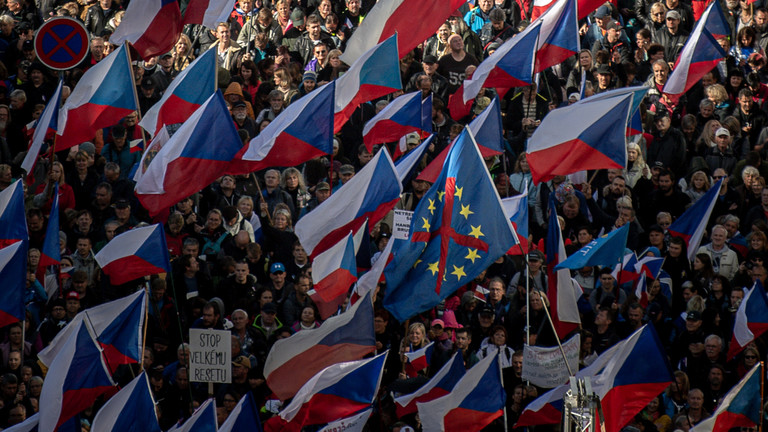
Protest against the Czech government at Wenceslas Square in Prague, Czechia, September 28, 2022. © Lukas Kabon / Anadolu Agency via Getty Images
Samizdat | September 28, 2022
A crowd numbered in the tens of thousands gathered in Prague on Wednesday to protest against the Czech government, NATO, and the European Union. Demonstrators called for Czechia’s neutrality and protested Prime Minister Petr Fiala’s policy of sanctioning Russia, which has driven up energy prices.
Meeting on St. Wenceslas’ Day – a public holiday celebrating Czech statehood – the crowd took to Prague’s main square, named after the medieval saint, and chanted slogans against the EU, NATO and Fiala’s cabinet. Prague police would not give a specific figure of the estimated crowd size, calling it only “tens of thousands.”
The protest was organized by a group called ‘Czech Republic First,’ which Reuters described as a coalition of “far-right and fringe groups and parties including the Communists.” CRF opposes the EU and NATO and has called for Czechia’s military neutrality.
“A government has two duties: to ensure our security and economic prosperity. This government does not fulfill either of these duties,” said one unidentified speaker at the rally, according to Reuters.
A demonstrator named Pavel Nebel accused the government of being “absolutely anti-Czech” and serving only the EU, NATO, and “American power” at the expense of Czech interests.
The organizers called for another protest on October 28 and said they intend to ask President Milos Zeman to disband the government and call for early elections, according to Lidove Noviny. It was the second such rally this month, after some 70,000 people took part in the September 3 protest, according to police. Similar rallies in other Czech cities drew hundreds of participants.
“People should not be taken advantage of by manipulators who offer simple but unrealistic solutions in the squares,” Interior Minister Vit Rakusan told Lidove in response to the protest.
Fiala had dismissed the September 3 demonstrations as “pro-Russian,” accusing their organizers of listening to “Russian propaganda and disinformation campaigns.” His government has diligently followed the lead of Brussels in imposing trade embargoes against Moscow over the conflict in Ukraine, which has translated into skyrocketing prices of energy normally imported from Russia.
Czechia had joined NATO in March 1999, just days before the US-led bloc attacked Yugoslavia. It became a member of the EU in May 2004.
Germany secures just one tanker of LNG from UAE
Samizdat | September 27, 2022
German utility RWE has inked a deal with Abu Dhabi National Oil Company (ADNOC) for delivery of liquefied natural gas (LNG), the company announced on Sunday.
The deal so far covers only one tanker: a shipment amounting to 137,000 cubic meters of LNG to be delivered by Abu Dhabi National Oil company to RWE in late December or by early 2023, Bloomberg reported, citing the company’s announcement. Separately, RWE also announced it will partner with UAE-based company Masdar to explore offshore wind energy projects and supply 250,000 tons of diesel per month in 2023 to Germany’s fuel distributor Wilhelm Hoyer.
The deal also includes a memorandum of understanding for more LNG deliveries next year, but the document is non-binding and it is unclear how many more LNG deliveries Germany may expect.
The agreement was signed during German Chancellor Olaf Scholz’s trip to Abu Dhabi during a tour of the Gulf countries.
“We need to make sure that the production of LNG in the world is advanced to the point where the high demand that exists can be met without having to resort to the production capacity that exists in Russia,” Scholz told reporters prior to the deal’s announcement.
After the UAE, Scholz visited Qatar. However, according to Scholz’s statement issued after the meeting with the Qatari emir, no agreements on LNG supplies have been made there. The two countries have been in talks over LNG supplies for several months now, so far to no avail, as Berlin is reluctant to enter into long-term contracts with Doha.
Featured Video

The Truth About the Trump Shootings with Ken Silva
or go to
Aletho News Archives – Video-Images
From the Archives
Trans ‘milk’ as good as the real thing – NHS
RT | February 18, 2024
The drug-induced nipple secretions of trans women are as good as mothers’ breast milk for babies, the University of Sussex Hospitals NHS Trust claimed in a letter to campaigners made public in a report by British think tank the Policy Exchange on Sunday.
The healthcare trust’s medical director, Rachel James, argued that the off-label prescription drug cocktail men transitioning to female take in order to produce milk was “similar to the natural hormones which encourage lactation to develop when the baby is newly born.”
“The evidence which is available demonstrates that the milk is comparable to that produced following the birth of a baby,” James wrote in the letter, sent to Children of Transitioners last August.
Biological men who wish to lactate must first take hormones to grow milk glands and then take high doses of either domperidone or metoclopramide to stimulate milk production. Neither drug is approved for this use, though they are occasionally prescribed off-label to biological women who have trouble lactating.
However, domperidone’s own manufacturer, Janssen, warns patients the drug “may cause unwanted side effects affecting the heart in a breastfed baby” and “should be used during breastfeeding only if your physician considers this clearly necessary.” … continue
Blog Roll
 Aletho News
- Seyed M. Marandi: U.S. Strike Imminent – Toward Total War in the Middle East
- Russia Voted Under Fire. Washington Is Loading the Tankers.
- 12 Things Your Oncologist Was Trained Not to Tell You
- Anthrax Attacks Paved Way for COVID-Era ‘Junk Drugs and Vaccines’
- How Real Is the Impact of Western Sanctions on Israel?
- France, You Are Guilty: How Paris Turned Western Sahara into the Maghreb’s Powder Keg
- 2025 Nature Paper Claiming Worsening Global Drought Gets RETRACTED …Heavily Flawed
- Your Milk Is Not the Problem
- The Truth About the Trump Shootings with Ken Silva
- ARE PATIENTS BEING PROPERLY INFORMED ABOUT OZEMPIC?
- If Americans Knew
- Salah Sarsour’s Legal Team Says DHS Has Not Met Its Burden to Prove He Is Deportable
- An analysis of tax forms by The Intercept show Kraft’s charity and LLC have donated to Friends of the IDF and AIPAC’s super PAC.
- Israeli attacks kill four Palestinians in Gaza – Daily Update
- Inside Gaza’s death trap of collapsing, bombed-out buildings
- The everyday items Israel bans from Gaza every day
- Inside the siege, the ruined buildings of Gaza – Daily Update
- Debunking The Claim That Macklemore Has A “History Of Antisemitism”
- CPJ demands release of arrested Palestinian-US journalist near Bethlehem
- Robert Kraft: The Billionaire Friend of Netanyahu Pulling The Strings Behind the Macklemore/Ed Sheeran Blow Up
- Columbia Administered Fund Gives Big Money to Pro-Israel Groups
- No Tricks Zone
- 2025 Nature Paper Claiming Worsening Global Drought Gets RETRACTED …Heavily Flawed
- New Study: ‘Global Drought Shows No Detectable Recent Acceleration Under Climate Warming’
- Economic Masterminds: German Socialists Suggest Taxing Productivity Gains Stemming From Using AI
- The South China Sea Has Not Been Cooperating With The Climate Change Narrative
- Energy Crisis: Germany Enters Heating Season With Historically Low Gas Reserve Fill Levels
- New Study: The Antarctic Ice Sheet Gained Mass From 2020-2024 Due To Staggering Snow And Ice Accumulation
- Study: Ocean Heating Rates From Thousands Of Years Ago ‘Dwarf’ Modern Ocean Heating Rates
- Climate Extremists Target, Attack Large-Scale Power Grid Infrastructure In Germany!
- New Study: Antarctic Ice Melt Has Contributed Less Than 1 Centimeter To Sea Level Rise In The Last 30 Years
- Fear Of Debate: Alarmist German Climate Scientist Calls On Mainstream Media To Discredit Skeptic Voices
 Aletho News