Occurrence of Convulsions and Death After DTP Childhood Vaccination
Data Published Over 20 Years Ago Signaled Concern
By Peter A. McCullough, MD, MPH | Courageous Discourse | May 27, 2023
When the CDC ACIP Panel added the unsafe, ineffective, mRNA COVID-19 vaccines to the routine pediatric childhood schedule without full FDA licensure and with no assurances on long-term safety, the entire schedule was called into question from the perspectives of clinical indication, medical necessity, safety, and efficacy. Is it possible since the release of older vaccines that the medical community and CDC ACIP panel ignored solid data and safety concerns with established vaccines? I was participating in the Novel Coronavirus Southwestern Intergovernmental Committee deliberations in the Arizona Senate building, when a paper published over 20 years ago was presented on the diphtheria, tetanus, and pertussis vaccines. The results were astonishing.
Geier and Geier published a massive study and one of the first of its kind at the time using the CDC Vaccine Adverse Events Reporting System. The hypothesis was that febrile convulsions were more likely to occur with combined vaccine products that in some cases it would lead to death. Here is what they did: “The incidence rates calculated in this study are based on the estimates by the CDC of the number of doses administered during the study period: 121,954,137 doses of whole-cell DTP; 54,611,651 doses of acellular DTP (DTaP); and 9,335,142 doses of DT were administered. The background rate of development of convulsions by children is based on the estimates of the 1991 report by the Institute of Medicine of 0.2 per million children per day.”
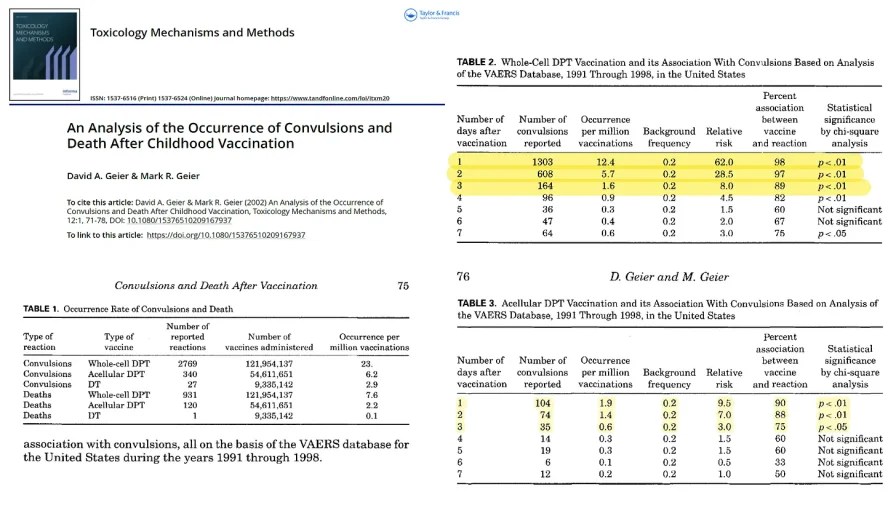
Geier DA, Geier MR. An analysis of the occurrence of convulsions and death after childhood vaccination. Toxicol Mech Methods. 2002;12(1):71-8. doi: 10.1080/15376510209167937. PMID: 20597817.
They found more cases (occurrence/million) of febrile seizures and death after whole-cell DTP, DTaP, DT alone, in a descending, nonlinear graded fashion, and the risks were in a tight temporal relationship. This is concerning because of the associations between post-vaccine febrile seizures and childhood/adult epilepsy requiring medications and with the development of neuropsychiatric conditions including autism.
In summary, no vaccine is perfectly safe. Combining multiple products into single shots increases the reactogenicity and the risk of a catastrophic outcome. As parents and doctors begin to make more discerning choices they may consider going to less complex products, spreading them out, and giving them at later ages.
Alternatively, some parents and doctors may choose for a child to “go natural” or completely unvaccinated, which has the best overall outcomes in contemporary studies at this time. Diphtheria and pertussis are easily treated with antibiotics, so prompt recognition and treatment if such a rare infection occurs is always an option for parents. Tetanus is avoided with good wound care and antibiotics for deep tissue lacerations and puncture wounds.
The bureaucrats & science retards responsible for the last three years of destruction and mass medical experimentation are unrepentant and eager to do the same thing all over again
eugyppius: a plague chronicle | June 3, 2023
While I travel and work on a longer piece, I thought you might enjoy some outtakes from this recent article in Welt, about the complete lack of self-reflection exhibited by German pandemic Science-Followers even after the failure of their policies:
Helge Braun … the former head of Angela Merkel’s Chancellery, was invited to Berlin’s Futurium to discuss science and politics. Behind the scenes, Braun was a key figure in the German Corona response. Time for a few awkward questions? The CDU politician need not fear them – despite his vehement advocacy of school closures and lockdowns …
He was joined by three members of the Leopoldina [that is, the German National Academy of Sciences] – climate researcher Gerald Haug, its president; paediatrician and adolescent physician Jutta Gärtner and sociologist Armin Nassehi. The Academy became known during the pandemic not for its balanced scientific advice, but primarily for its politicised demands for tougher measures. And as often as its members emphasised institutional independence from the government that evening, you could tell their intellectual independence was notably lacking.
“Team Caution,” as members of the Leopoldina members still like to call themselves, was full of praise for their own work … “The pandemic was a good example of science-based policy advice,” Haug explains – and by “good” he really does mean that the Academy advised well … “Team Caution” always did everything right … The sensible majority followed the recommendations of the government, the Leopoldina and the RKI. Everything else is nasty fake news from the internet.
Yet Haug himself is a good example of the Leopoldina’s convoluted self-perception. On the one hand, he insisted repeatedly that science only represents “the facts”; that is, he claims objectivity for his profession. On the other hand, Haug freely admits that the Leopoldina aimed to “really hit it out of the park” and “make a splash” with their recommendations. “We’re often too soft…”
A real problem with the technocrats, is that they only have relevance in one direction. As soon as the National Academy of Sciences issues an opinion that the virus isn’t much to worry about and people should continue to live their lives as before, their political relevance is finished. For this reason alone, technocratic systems will be biased towards intervention, even in harmless situations, and nothing they tell you to do can ever be trusted.
The damage inflicted by lockdowns, the vaccines, social exclusion and attendant social conflicts – nobody wanted to talk about that. Nor did anyone want to discuss Braun’s role as one of the main instigators of the German pandemic response, distinguished internationally especially by the long school closures. As is well known, Braun’s promise that all measures would end “as soon as we have made an offer of vaccination to everyone in Germany” turned out to be empty talk. His threat that the vaccinated should receive “more freedom” than the unvaccinated, on the other hand, became brutal reality. No matter. For Braun, the Corona era represents a positive interaction between politics and science, which serves as an important example for the future.
Braun claimed that “Citizens don’t like arguments in politics. The strange democratic understandings of this unassuming Merkel confident could be summed up as “Dare to demand more expertocracy …
At the end, they moved on from Corona to discuss climate change. A scientist in the audience suggested that the Leopoldina should … take to the streets. The opinionated moderator suggested that, when it comes to climate, fear is rational; and that, in consequence, the rational mandate of science would be to spread fear …
Apparently, the politicians and academics who set the tone in the Corona crisis now feel encouraged to extend the Corona model to future grand programmes …
Mark my words: Should they ever be allowed to get the public panic juggernaut up and running again, what they do next will make Corona seem like a mildly rough case of cultural and political indigestion. They’ve learned that the hard limits on their power are far weaker than they ever imagined. Their dark ambitions will hang over us like a Sword of Damocles for decades now.
The UK’s “Chilling” Secret Unit That Monitored Lockdown Dissent
More revelations about the secretive Counter Disinformation Unit
By Cindy Harper | Reclaim The Net | June 3, 2023
A clandestine UK Government unit dubbed the Counter-Disinformation Unit (CDU) has been implicated in a troubling endeavor to curb and control online discussions about the controversial Covid-19 lockdown policies. The covert operation allegedly involved the collaboration of social media companies in a strategic bid to quell supposed domestic “threats.”
According to revelations from Freedom of Information requests and data protection requests from The Telegraph, posts critical of Covid-19 restrictions, including those questioning mass vaccination of children, were systematically removed.
Social media companies are now under scrutiny following allegations that their technologies were deployed to thwart the wide circulation or promotion of posts tagged as potentially problematic by the CDU or its Cabinet Office equivalent.
The files revealed the surreptitious monitoring of critics of the Government’s Covid plans. Artificial intelligence firms were reportedly enlisted by the government to search social media platforms, flagging any discussions opposing vaccine passports.
In a startling revelation, the BBC was implicated in clandestine government policy discussions regarding this alleged misinformation.
The CDU, hosted by the Department for Culture, Media, and Sport (DCMS), operated a “trusted flagger” system with major social media companies. This mechanism expedited requests for content removal. The CDU, still operational, was formed in 2019, initially focusing on the European elections, later shifting its attention to the pandemic.
Critics, including MPs and freedom of speech campaigners, have labeled the revelations as “truly chilling” and a strategy tantamount to “censoring British citizens” — a tactic likened to those of the Chinese Communist Party.
“Any attempt by governments to shut down legitimate debate is hugely concerning, but to discover that DCMS actively sought to censor the views of those who were speaking up for children’s welfare is truly chilling,” said Miriam Cates, a Conservative MP to The Telegraph.
A government spokesman refuted the allegations, stating that the unit was designed to track narratives and trends using publicly available information to safeguard public health and national security. The spokesman insisted that the unit never monitored individuals and had a strict policy against referring journalists and MPs to social media platforms.
Like the Curious Bride in “Bluebeard”
By John Leake | Courageous Discourse | May 31, 2023
Recently I’ve been thinking about the old French folktale, Bluebeard. For readers who are unfamiliar with the story, Bluebeard is a nobleman who has been married six previous times to young women who have all mysteriously vanished. Wikipedia provides a succinct account of what happens when he marries a seventh time.
[A neighbor’s youngest daughter who decides to marry him] goes to live with him in his rich and luxurious palace in the countryside, away from her family.
Bluebeard announces that he must leave for the country and gives the palace keys to his wife. She is able to open any room with them, each of which contain some of his riches, except for an underground chamber that he strictly forbids her to enter lest she suffer his wrath. He then goes away, leaves the palace, and the keys in her hands. She invites her sister, Anne, and her friends and cousins over for a party. However, she is eventually overcome with the desire to see what the secret room holds, and she sneaks away from the party and ventures into it.
She immediately discovers that the room is flooded with blood and the murdered corpses of Bluebeard’s previous six wives hanging on hooks from the walls. Horrified, she drops the key in the blood and flees the room.
I’ve long been intrigued by Bluebeard as an archetypal expression of the horror we may experience when we become curious to know what is going on behind the closed doors of power. Bluebeard is a powerful nobleman who is apparently beyond the law. His young bride is an ordinary girl who becomes implacably curious to see all of the rooms of his castle, which seem to symbolize the rooms of his soul.
I spent this evening carefully reviewing declassified e-mails authored by the eminent Scripps Institute virologist, Kristian Andersen. The first one was dated January 31, 2020 and addressed to Anthony Fauci:
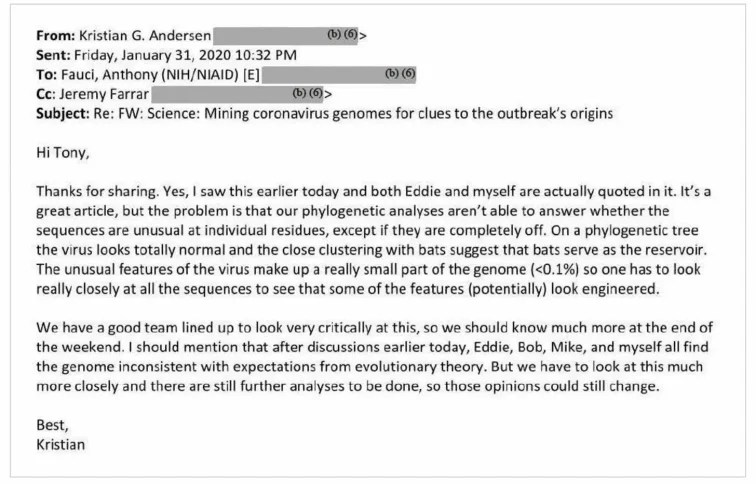
The most noteworthy sentences in the email are:
The unusual features of the virus make up a really small part of the genome [0.1%] so one has to look really closely at all the sequences to see that some of the features (potentially look engineered. … I should mention that after discussions earlier today, Eddie, Bob, Mike [Edward Holmes, Robert Garry, Michael Farzan] and myself all find the genome [of SARS-CoV-2] inconsistent with expectations from evolutionary theory.
3.5 days later—shortly after a phone conference with Dr. Fauci and others—Dr. Andersen completely changed his tune. By then, the decision had been to submit a letter to the National Academies of Sciences, Engineering and Medicine regarding the origin of SARS-CoV-2.
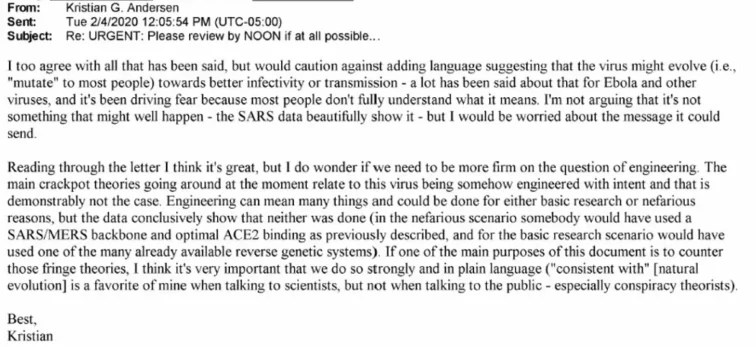
Please note the final sentence:
If one of the main purposes of this document is to counter those fringe theories [about the virus being engineered] I think it’s very important that we do so strongly and in plain language (“consistent with” [natural evolution] is a favorite of mine when talking to scientists, but not when talking to the public—especially conspiracy theorists).
After these e-mails were released to the public in response to a FOIA request, Dr. Andersen claimed that he learned revelatory things about the novel virus in the 3.5 days following his initial e-mail to Fauci, and that these revelations caused his perfect volte-face. However, it seems to me that his explanation doesn’t really account for his strident, unequivocal assertions in his second e-mail.
Many of the recipients’ names in his February 4, 2020 have been redacted, but there [are] many apart from the two men who received his January 31 e-mail (Dr. Fauci and Jeremy Farrar). His first e-mail was a matter of strictly confidential counsel. His second pertains to an open letter—about to be sent to a large institution with many members—declaring that anyone who even suspects the novel virus to have emerged from a lab is a crackpot conspiracy theorist.
What on earth could inspire a virologist to adopt a posture of such Machiavellian duplicity about an infectious agent that—as he well knew—was about to inflict a catastrophe on all of mankind? He had to have known that such pronouncements—coming from a virologist of his eminence—would likely retard a thorough and impartial investigation of the virus’s origin.
Contemplating this question this evening, I thought Bluebeard’s young bride when she discovers the chamber of horrors in her husband’s castle. I suspect that Tess Lawrie felt the same way in her encounter with Dr. Andrew Hill, which she recounted in the short documentary film Dear Andy.
The EU Plans To Test Twitter To See How Fast It Responds To Censorship Demands
By Cindy Harper | Reclaim The Net | June 3, 2023
The European Union will stress test Twitter and other platforms to see how well they comply with the upcoming censorship law, the Digital Services Act (DSA), whose enforcement will begin in August. In a similar style program to that created by the Chinese Communist Party, where government enforcers visit tech companies directly, a team of 10 digital specialists will visit the companies later this month, said Thierry Breton, the EU Commissioner for Internal Market.
The test will help companies learn how the DSA will be enforced. Breton, who will also visit the companies, said the team will review how platforms respond to what is problematic content under the law including content that has been flagged by the EU and content that has not been flagged.
The team will also review why some content is not flagged, citing an example of “fake news that caused disturbances but was promoted because it generated virality and advertising.”
“Did you have enough moderators beforehand? Was it promoted by the algorithm?” Breton said. “We want to do this for real, in the real world, so they see how it happens, and above all so they prepare,” Breton said.
Some of the findings from the test will be made public while some will only be communicated to the companies.
In an interview where he talked about the visits to the social media companies, Breton said: “I’m not threatening anyone. We are here to help companies comply with our new law.”
Last week, after Twitter withdrew from the voluntary Code of Conduct on Disinformation, Breton warned: “You can run but you can’t hide,” adding that “fighting disinformation will be legal obligation under #DSA as of August 25.”
Exposed: The UK Company Subjecting Your Social Media Posts To State Surveillance
By Ken Macon | Reclaim The Net | June 3, 2023
A UK government-funded artificial intelligence (AI) firm based in an unassuming industrial estate in Yorkshire, England, has been engaged in state surveillance, monitoring the social media posts of citizens, a recent revelation suggests.
Logically, the firm in question, has earned over £1.2 million (1.49 million USD) from government contracts to identify and analyze “disinformation” and “misinformation” spread across social media.
The AI company was started by Lyric Jain, a 27-year-old Cambridge engineering graduate, who launched the technology first during Indian elections. With one of the largest dedicated fact-checking teams globally, the company sifts through material from hundreds of thousands of media sources and all public posts on major social media platforms.
Logically has bagged lucrative deals, including a £1.2 million (1.49 million USD) contract with the Department for Culture, Media and Sport (DCMS) and another worth up to £1.4 million (1.7 million uSD) with the Department of Health and Social Care to monitor threats to high-profile vaccine service individuals, The Telegraph reported. Its client list includes US federal agencies, the Indian electoral commission, TikTok, and Facebook.
While Logically asserts that it does not share evidence collected for the UK Government with Facebook, this partnership has ignited concerns among freedom of speech campaigners.
The company’s responsibilities grew over time, aiding in building a comprehensive picture of potentially harmful misinformation and disinformation. Documents revealed that it produced regular “Covid-19 Mis/Disinformation Platform Terms of Service Reports” for the Counter-disinformation Unit – a secretive operation within the DCMS.
A public document titled “Covid-19 Disinformation in the UK” disclosed Logically’s perspective, referring to “anti-lockdown” and “anti-Covid-19 vaccine sentiment”, along with hashtags “#sackvallance” and “#sackwhitty” as evidence of “a strong disdain for expert advice.”
Logically defended its actions, stating that it is possible for content not specifically mis- or disinformation to be included in a report if there is a potential for a narrative to be weaponized.
The firm denied limiting freedom of speech, stating: “We do not specifically monitor individuals and their behavior, nor do we make any recommendations that limit their right to free speech… We monitor content, including narratives and trends across public information environments online, to help tackle the proliferation of online harms, mis- and disinformation, and prevent real-world harms.”
The company’s practices have raised questions about freedom of speech and privacy rights. Critics argue that this case illuminates the ethical and regulatory challenges posed by the powerful convergence of artificial intelligence and big data.
World-Renowned Physician Receives Public Acknowledgement from Accuser Admitting Allegations of Academic Fraud Were Incorrect
FLCCC | May 25, 2023
Washington, D.C. – The source of the false complaint that triggered the nearly year-long investigation into research supporting the use of intravenous Vitamin C to treat medical sepsis has publicly acknowledged his error and expressed regret for questioning the integrity of the study’s lead author, Paul E. Marik, M.D., FCCM, FCCP, founding member of the Front Line COVID-19 Critical Care Alliance (FLCCC) and former Chief, Pulmonary and Critical Care Medicine at Eastern Virginia Medical School.
In March of 2022, Kyle Sheldrick, a physician and Ph.D. candidate in Australia, made a series of unsubstantiated allegations of fraud on social media and to the CHEST Journal, claiming that he was able to determine that study data had been fabricated by applying baseless statistical methods to the 2017 peer-reviewed study led by Dr. Marik titled “Hydrocortisone, Vitamin C, and Thiamine for the Treatment of Severe Sepsis and Septic Shock: A Retrospective Before-After Study.” After receiving the complaint, the CHEST Journal launched a thorough review of the study that lasted almost a year. In April of this year, Dr. Marik received a letter from the journal stating that the investigation found no methodological errors as cited by the allegations.
Today Dr. Sheldrick issued the following statement acknowledging his mistake and accepting the outcome of the investigation:
“On 22 March 2022, I posted a blog post called ‘This scattrd corn.’ This post was a copy of a complaint I filed with the journal CHEST identifying features of a study led by Paul Marik titled ‘Hydrocortisone, Vitamin C, and Thiamine for the Treatment of Severe Sepsis and Septic Shock’ published on 3 February 2017 in CHEST, identifying that I believed them to be signs of fraud, and linked to this on twitter.
Those complaints have since been formally rejected by the journal CHEST, which I consider to be the definitive conclusion to the matter. I realise that this letter was used to imply that Dr. Marik personally acted deceptively, and falsely reported study data, which was not my intention, and this caused him significant hurt and distress. I regret this hurt to Dr Marik. I will inform those who have reported on this complaint that it has been rejected by the journal.
Dr Marik has also indicated to me that some subsequent controlled studies have found some positive outcomes for vitamin C in Sepsis, and I accept this.
This statement is not an endorsement of the use of Vitamin C in sepsis.”
“It was highly unprofessional that Kyle went to such lengths to accuse my colleagues and me publicly of academic fraud,” said Paul E. Marik, M.D., FCCM, FCCP, founding member of the Front Line COVID-19 Critical Care Alliance (FLCCC) and former Chief, Pulmonary and Critical Care Medicine at Eastern Virginia Medical School. “I hope that as he gains more experience as a researcher, he will understand that there are protocols in place for questioning the results of research that prevent harming reputations by making baseless accusations in public.”
The journal’s response to Dr. Marik did cite two minor revisions that do not change the final outcome of the original published study, but simply make it clear that some of the patients selected for the control group were “nonconsecutive” given the nature of hospital logistics and that the 1.5 g every 6 h for 4 days was a “target” dose that might not have been reached in all patients due to clinical considerations.
In a previous statement, Dr. Marik said the following about the revisions from CHEST : “I welcome the two words changed by the journal as they make the description of our methodology clearer and have no impact on the research results. However, this whole process was unnecessary as it raised unneeded concern about a life-saving treatment that we know is effective and used worldwide. I hope patients were not deprived of this vital treatment because of these false allegations.”
The World Health Organization estimates that in 2017 there were 11 million sepsis deaths worldwide, half of these deaths occurred among children.
A link to Dr. Sheldrick’s statement can be found here: https://kylesheldrick.blogspot.com/2023/05/update.html
A copy of the CHEST Journal’s findings can be found here: https://covid19criticalcare.com/wp-content/uploads/2023/04/Marik-Vitamin-C_Editors-Note-and-Ltr-to-Marik-2023-04-03.pdf
The published study can be found here: https://pubmed.ncbi.nlm.nih.gov/27940189/
About the Front Line COVID-19 Critical Care Alliance
The FLCCC Alliance was organized in March 2020 by a group of highly published, world renowned critical care physicians and scholars with the academic support of allied physicians from around the world. FLCCC’s goal is to research and develop lifesaving protocols for the prevention and treatment of COVID-19 in all stages of illness including the I-RECOVER protocols for “Long COVID” and Post Vaccine Syndrome. For more information: www.FLCCC.net
WHO Initiative Would ‘Promote Desired Behaviors’ by Surveilling Social Media
By Michael Nevradakis, Ph.D. | The Defender | May 30, 2023
The World Health Organization (WHO) is proposing a set of recommendations for “social listening surveillance systems” designed to address what it describes as a “health threat” posed by online “misinformation.”
The WHO’s Preparedness and Resilience for Emerging Threats (PRET) initiative claims “misinformation” has resulted in an “infodemic” that poses a threat — even in instances where the information is “accurate.”
PRET has raised eyebrows, at a time when the WHO’s member states are engaged in negotiations on two controversial instruments: the “pandemic treaty” and amendments to the International Health Regulations (IHR).
The latest draft of the pandemic treaty contains language on how WHO member states would commit to “social listening.” Under article 18(b), WHO member states would commit to:
“Conduct regular community outreach, social listening, and periodic analysis and consultations with civil society organization and media outlets to identify the prevalence and profiles of misinformation, which contribute to design communications and messaging strategies for the public to counteract misinformation, disinformation and false news, thereby strengthening public trust and promoting adherence to public health and social measures.”
Remarking on PRET’s “social listening” proposals, Michael Rectenwald, Ph.D., author of “Google Archipelago: The Digital Gulag and the Simulation of Freedom” and a former New York University liberal studies professor, told The Defender :
“The WHO’s PRET initiative is part of the UN’s attempt to institute global ‘medical’ tyranny using surveillance, ‘social listening’ and censorship. PRET is the technocratic arm of the WHO’s proposed pandemic treaty, which, if accepted by nation-states, would amount to the surrendering of national and individual sovereignty to this ‘global governance’ body.
“What better way to establish a one-world government than by using so-called global crises that must be addressed by nothing short of ‘global governance’? I remind readers that you cannot comply your way out of tyranny.”
WHO could use artificial intelligence to monitor social media conversations
A WHO document outlining the PRET initiative — “Module 1: Planning for respiratory pathogen pandemics, Version 1.0” — contains a definition of infodemic:
“Infodemic is the overabundance of information — accurate or not — which makes it difficult for individuals to adopt behaviors that will protect their health and the health of their families and communities.
“The infodemic can directly impact health, hamper the implementation of public health countermeasures and undermine trust and social cohesiveness.”
The document recommends that in response to the “infodemic,” countries should “incorporate the latest tools and approaches for shared learning and collective action established during the COVID-19 pandemic.”
According to the WHO document, this can be done if governments “establish and invest in resources for social listening surveillance systems and capacities to identify concerns as well as rumors and misinformation.”
Such resources include “new tools and approaches for social listening … using new technologies such as artificial intelligence to listen to population concerns on social media.”
According to the document:
“To build trust, it’s important to be responsive to needs and concerns, to relay timely information, and to train leaders and HCWs [healthcare workers] in risk communications principles and encourage their application.”
Risk communications “should be tailored to the community of interest, focusing on and prioritizing vulnerable groups,” the WHO said.
“Tailored” communication was a hallmark of public health efforts during the COVID-19 pandemic.
For instance, in November 2021, the Rockefeller Foundation, the National Science Foundation and the Social Science Research Council launched the Mercury Project, which aimed “to increase uptake of COVID-19 vaccines and other recommended public health measures by countering mis- and disinformation” — in part by studying “differential impacts across socio-demographic groups.”
Similarly, PRET states that it will “incorporate the latest tools and approaches for shared learning and collective action established during the COVID-19 pandemic.”
These “tools and approaches” could be deployed during “acute respiratory events,” according to the document, which recommends that governments:
“Develop and implement communication and behavior change strategies based on infodemic insights, and test them during acute respiratory events including seasonal influenza.
“This includes implementing infodemic management across sectors, and having a coordinated approach with other actors, including academia, civil society, and international agencies.”
This is not the first time the WHO has addressed the so-called “infodemic.”
A WHO review published Sept. 1, 2022, titled “Infodemics and health misinformation: a systematic review of reviews,” found that “infodemics and misinformation … often negatively impact people’s mental health and increase vaccine hesitancy, and can delay the provision of health care.”
In the review, the WHO concluded that “infodemics” can be addressed by “developing legal policies, creating and promoting awareness campaigns, improving health-related content in mass media and increasing people’s digital and health literacy.”
And a separate, undated WHO document advises the public on how we can “flatten the infodemic curve.”
WHO, Google announce collaboration targeting ‘medical misinformation’
The WHO’s PRET proposals coincided with a new multi-year collaboration agreement with Google for the provision of “credible health-related information to help billions of people around the world respond to emerging and future public health issues.”
The agreement was announced on May 23 by Dr. Karen DeSalvo, Google’s chief health officer, on the company’s blog. She wrote:
“Information is a critical determinant of health. Getting the right information, at the right time can lead to better health outcomes for all. We saw this firsthand with the COVID-19 pandemic when it was difficult for people worldwide to find useful information online.
“We worked with the World Health Organization (WHO) on a range of efforts to help people make informed decisions about their health — from an SOS alert to surfacing locally relevant content about COVID-19 to YouTube policies on medical misinformation.”
One way Google will collaborate with the WHO is through the creation of more “knowledge panels” that will prominently appear in search results for health-related questions on the platform.
“Each day people come to Google Search looking for trustworthy information on various health conditions and symptoms,” DeSalvo wrote. “To help them access trustworthy information our Knowledge Panels cite content from reliable sources covering hundreds of conditions from the common cold to anxiety.”
“Working closely with WHO, we’ll soon expand to cover more conditions such as COPD [chronic obstructive pulmonary disease], hypertension, type 2 diabetes, Mpox, Ebola, depressive disorder, malaria and more,” she added.
Google will make these Knowledge Panels available in several languages, including English, Arabic, Chinese, French, Russian and Spanish.
DeSalvo’s May 23 post also addressed an ongoing collaboration between Google and the WHO, Open Health Stack (OHS), which “help[s] accelerate the digital transformation of health systems around the world” and “lower[s] the barrier to equitable healthcare.”
Google also awarded the WHO with more than $320 million “in donated Google Search advertising via ad grants” allowing the agency “to publish health topics beyond COVID-19, such as Mpox, mental health, flu, Ebola, and natural disasters.”
Google is slated to provide an additional $50 million in ad grants to the WHO this year.
According to Google, the ad grants to the WHO represent the company’s largest such donation to a single organization.
Separately, the U.S. Food and Drug Administration (FDA) tweeted on May 22 about the agency’s own efforts at combating purported “misinformation” and “disinformation.”
The tweet contains a 35-second video, which claims “misinformation” travels “six times faster than the facts,” while promoting the FDA’s “Rumor Control” initiative.
A top priority of FDA Commissioner Dr. Robert Califf, “Rumor Control” was launched in August 2022 and joins other agency initiatives to fight “misinformation” and “disinformation.”
“The growing spread of rumors, misinformation and disinformation about science, medicine, and the FDA, is putting patients and consumers at risk,” according to the FDA’s Rumor Control webpage. “We’re here to provide the facts.”
The initiative asks the public to do “three easy things” to “stop rumors from spreading”: “don’t believe the rumors,” “don’t pass them along” and “get health information from trusted sources like the FDA and our government partners.”
“Rumor Control” appears to have been inspired by an initiative developed by the Virality Project, “a coalition of research entities” from six institutions “focused on supporting real-time information exchange between the research community, public health officials, government agencies, civil society organizations, and social media platforms.”
Documents released as part of the “Twitter files” in March revealed that the Virality Project, based out of the Stanford Internet Observatory, also called for the creation of a disinformation board just one day before Biden announced plans to launch his government-run Disinformation Governance Board.
Similar to PRET’s recommendations to target “accurate” information that nevertheless contradicts establishment public health narratives, the Virality Project worked with Twitter and other social media platforms, recommending they “take action even against ‘stories of true vaccine side effects’ and ‘true posts which could fuel hesitancy.’”
These censorship efforts included at least one tweet by Robert F. Kennedy Jr., chairman on leave of Children’s Health Defense.
Michael Nevradakis, Ph.D., based in Athens, Greece, is a senior reporter for The Defender and part of the rotation of hosts for CHD.TV’s “Good Morning CHD.”
This article was originally published by The Defender — Children’s Health Defense’s News & Views Website under Creative Commons license CC BY-NC-ND 4.0. Please consider subscribing to The Defender or donating to Children’s Health Defense.
Featured Video

The Truth About the Trump Shootings with Ken Silva
or go to
Aletho News Archives – Video-Images
From the Archives
The Geopolitics behind the War in Yemen (I)
By Mahdi Darius NAZEMROAYA | Strategic Culture Foundation | 30.03.2015
The United States and the Kingdom of Saudi Arabia became very uneasy when the Yemenese or Yemenite movement of the Houthi or Ansarallah (meaning the supporters of God in Arabic) gained control of Yemen’s capital, Sanaa/Sana, in September 2014. The US-supported Yemenite President Abd-Rabbuh Manṣour Al-Hadi was humiliatingly forced to share power with the Houthis and the coalition of northern Yemenese tribes that had helped them enter Sana. Al-Hadi declared that negotiations for a Yemeni national unity government would take place and his allies the US and Saudi Arabia tried to use a new national dialogue and mediated talks to co-opt and pacify the Houthis.
The truth has been turned on its head about the war in Yemen. The war and ousting of President Abd-Rabbuh Manṣour Al-Hadi in Yemen are not the results of «Houthi coup» in Yemen. It is the opposite. Al-Hadi was ousted, because with Saudi and US support he tried to backtrack on the power sharing agreements he had made and return Yemen to authoritarian rule. The ousting of President Al-Hadi by the Houthis and their political allies was an unexpected reaction to the takeover Al-Hadi was planning with Washington and the House of Saudi. … continue
Blog Roll
 Aletho News
- Leaked: Britain’s Sham Conviction Of Hashim Thaci
- Seyed M. Marandi: U.S. Strike Imminent – Toward Total War in the Middle East
- Russia Voted Under Fire. Washington Is Loading the Tankers.
- 12 Things Your Oncologist Was Trained Not to Tell You
- Anthrax Attacks Paved Way for COVID-Era ‘Junk Drugs and Vaccines’
- How Real Is the Impact of Western Sanctions on Israel?
- France, You Are Guilty: How Paris Turned Western Sahara into the Maghreb’s Powder Keg
- 2025 Nature Paper Claiming Worsening Global Drought Gets RETRACTED …Heavily Flawed
- Your Milk Is Not the Problem
- The Truth About the Trump Shootings with Ken Silva
- If Americans Knew
- An error has occurred; the feed is probably down. Try again later.
- No Tricks Zone
- 2025 Nature Paper Claiming Worsening Global Drought Gets RETRACTED …Heavily Flawed
- New Study: ‘Global Drought Shows No Detectable Recent Acceleration Under Climate Warming’
- Economic Masterminds: German Socialists Suggest Taxing Productivity Gains Stemming From Using AI
- The South China Sea Has Not Been Cooperating With The Climate Change Narrative
- Energy Crisis: Germany Enters Heating Season With Historically Low Gas Reserve Fill Levels
- New Study: The Antarctic Ice Sheet Gained Mass From 2020-2024 Due To Staggering Snow And Ice Accumulation
- Study: Ocean Heating Rates From Thousands Of Years Ago ‘Dwarf’ Modern Ocean Heating Rates
- Climate Extremists Target, Attack Large-Scale Power Grid Infrastructure In Germany!
- New Study: Antarctic Ice Melt Has Contributed Less Than 1 Centimeter To Sea Level Rise In The Last 30 Years
- Fear Of Debate: Alarmist German Climate Scientist Calls On Mainstream Media To Discredit Skeptic Voices
 Aletho News