The Five Big Lies of Vaccinology
By Clayton J. Baker, MD | Brownstne Institute | December 11, 2025
People will believe a big lie sooner than a little one, and if you repeat it frequently enough, people will sooner or later believe it.
On November 19, 2025, the New England Journal of Medicine published an article entitled “Efficacy, Immunogenicity, and Safety of Modified mRNA Influenza Vaccine.” This article purportedly reviewed the results of Pfizer’s Phase 3 clinical trials testing its experimental, mRNA-based, gene therapy injections for Influenza, which Pfizer presents as an alternative to traditional Influenza vaccines.
Two weeks later, on December 5, 2025, the Centers for Disease Control’s Advisory Committee on Immunization Practices (ACIP) voted 8-3 to end the recommendation in the CDC’s pediatric vaccine schedule that all American children receive the Hepatitis B Virus (HBV) vaccine at birth. This recommendation would bring the CDC’s HBV vaccine recommendations closer to those in numerous other developed nations, countries that have both better overall pediatric health than the United States and no surplus pediatric HBV deaths.
To the casual observer, neither of these events may seem very noteworthy. However, in the post-Covid world of medicine, vaccinology, and politics, both fueled controversy that shows no sign of ending soon. Why?
The New England Journal of Medicine article of Pfizer’s self-conducted study of its own product has been extensively analyzed by independent reviewers. It has been identified as an object lesson in the scientific fraud that is endemic in vaccine research, development, and marketing. Detailed review of the study has revealed multiple systematic techniques of deceptive research methods, omission and concealment of unfavorable data, and outright misrepresentation of results.
The ACIP panel’s decision, which represents a minor change in the previously sacrosanct – if ever-expanding – CDC pediatric vaccine schedule, has been met with an onslaught of hair-on-fire, alarmist proclamations by the vaccine industry and its minions of impending disease and death in American children. These claims are unsupported by the existing scientific data and bear little relationship to objective reality as a whole.
The reasons these two events have sparked such controversy are:
- The New England Journal of Medicine article – now thoroughly deconstructed – exposes the brazen, systematic dishonesty of both vaccine development and the clinical trial process as a whole.
- Meanwhile, the results of the study, once fully uncovered and comprehensively reviewed, shatter the viability of the mRNA gene therapy platform as a substitute for conventional vaccines.
- The unhinged response to the ACIP decision reveals the entire pediatric vaccine schedule to be a house of cards, built on falsehoods, that cannot withstand any criticism, reform, or revision whatsoever.
The awful truth (and it is both awful and the truth) is that vaccinology is overwhelmingly a façade, constructed on a shaky foundation of lies. In the wake of these two recent controversies, it is instructive to enumerate the five great lies propping up vaccinology (plus two Honorable Mentions). I shall outline them here, and provide a more detailed discussion of each in forthcoming essays.
The Five Big Lies of Vaccinology
Big Lie #1: Equating Antibody Production with Immunity to Disease
Big Lie #2: Using Fake Placebos
Big Lie #3: Insisting My Immunity is Dependent on Your Vaccination
Big Lie #4: Declaring Multiple Simultaneous Injections to be Safe
Big Lie #5: Declaring Vaccines Fundamentally “Safe and Effective” as a Class
Honorable Mention 1: Declaring mRNA Gene Therapies to be “Vaccines”
Honorable Mention 2: Allowing Criminal Corporations to Conduct their own Clinical Studies
In upcoming essays, we will analyze each of these Big Lies of Vaccinology. In the process, we shall see how each Big Lie is interdependent upon others, and how the entire vaccine narrative depends upon this web of falsehoods. We shall see why vaccine zealots such as Peter Hotez and Paul Offit would refuse to attend the ACIP meeting – which they were invited to do – and in fact why they refuse to debate these points.
The reckoning that is taking place regarding the vaccine industry is overdue, but it is hardly unique.
There was a time within living memory when pre-frontal lobotomy was considered cutting edge medicine (pun intended). Its founder won the Nobel Prize for Medicine.
There was a time within living memory when physicians accepted corporate payment to convince the public that cigarette smoking was safe.
There was a time – very recently – when mainstream medicine actively promoted OxyContin and other deadly narcotics as safe and minimally addictive. Hundreds of thousands died as a result.
The bloom is off the rose for the vaccine industry. It is long past time for its accounting. May we all open our minds, use our heads, and face the reality of this subject.
C.J. Baker, M.D., 2025 Brownstone Fellow, is an internal medicine physician with a quarter century in clinical practice. He has held numerous academic medical appointments, and his work has appeared in many journals, including the Journal of the American Medical Association and the New England Journal of Medicine. From 2012 to 2018 he was Clinical Associate Professor of Medical Humanities and Bioethics at the University of Rochester.
Flawed Study Downplays Children’s Risk of Myocarditis From COVID Vaccine
By Josh Mitteldorf, Ph.D. | The Defender | December 3, 2025
Readers of The Defender are familiar with the fact that the COVID-19 mRNA shots pose a risk of myocarditis, especially in children. But they may not know that myocarditis is usually permanently disabling, and in adults, it is often fatal within five years.
Tragically, we are now also learning what the trajectory of myocarditis in vaccinated children actually looks like.
This has been a public relations setback for industry and governments that have been advocating, and sometimes mandating, that children as young as 6 months get the vaccines — even though COVID-19 is almost always mild or symptom-free in young people.
This month, 22 British scientists from prestigious universities published a study intended to ease parents’ minds about risks of the vaccine, and simultaneously scare them about the dangers of getting COVID-19.
The message is that yes, there are rare cases — they always use the word “rare” — in which children get myocarditis after vaccination, but hey, no product can be perfect. And it’s better to risk the vaccine than risk getting COVID-19. Also, they claim, kids are more likely to get myocarditis if they get the virus than they are to get myocarditis from the vaccine.
That’s the message — and the authors and publisher have the clout to widely broadcast that message in a press release and in news headlines in Britain and America.
But what does the study actually say? In short, it asks the wrong question — and even so, the answer they get must be buried in the appendix, because it’s inconsistent with the message they want to promote.
Article summary omitted evidence of vaccine risk
The study design is deeply compromised because the 22 authors constructed a complicated model to avoid doing a straightforward comparison (vaccine only versus disease only).
And even after they cooked the books, even after they took data from almost 14 million children and teens under age 18 in England, they got a result that is barely statistically significant, with overlapping error bars for the risk from COVID-19 and the risk from vaccination.
It gets worse.
The results, which marginally favored the vaccination, were trumpeted in a summary at the top of the paper and announced to the press.
But buried in the appendix, published separately online, is a table that shows a more relevant version of the comparison.
The version in the summary is from an early time frame when the vaccine was not available. The appendix shows comparable data for the time frame in which the vaccine was available, limited to the ages for which the vaccine was offered.
In the appendix, the risk of myocarditis from the disease is half that of the risk from the vaccine. This blatantly contradicts the summary and the headlines generated by the article — and this was a response to the deceptive version of the question, not the more straightforward one that the researchers chose not to answer.
Study authors asked the wrong question
The most pertinent question is the simple one: Did vaccinated children have a higher incidence of myocarditis than unvaccinated children?
This is an easy question to answer, given the data that these authors (but not the public) had access to. In a few minutes, they could have calculated a rate of myocarditis among vaccinated and unvaccinated children.
However, if they did the calculation, they didn’t report the results. My guess is that they did the calculation, didn’t like what they saw, so they didn’t include it in the published article.
As I stated above, I believe the study authors “asked the wrong question.” What I mean is that the article compares the risk of myocarditis from COVID to the risk from vaccination.
But this is not the most relevant question. Why?
Because many people got the vaccine and then got COVID anyway, so they were unnecessarily exposed to both risks.
Conversely, many children who didn’t get the vaccine, didn’t get COVID. Or, they get such a mild case that they don’t even notice it. These children avoided both risks.
This is why comparing the risk of myocarditis from COVID to the risk from the COVID vaccine is not really the pertinent question. It’s not a question of “either or.”
Authors ‘muddied the waters’ by analyzing myocarditis in kids who got vaccine and the virus
The message the authors wanted to imply was that, even though the vaccine increased the risk of myocarditis, it decreased the risk of COVID — and since COVID itself can cause myocarditis, the total risk is actually lower with vaccination than without.
If that is their claim, it’s easy to determine if it is true. The simplest calculation they could have done with the data available to them was also the calculation most pertinent to what parents want to know: Is my child better off with or without the vaccine?
The authors chose not to offer us the simple answer to that straightforward question.
But — given that they asked the wrong question — they might have derived a clean answer just by comparing the subset of children who were vaccinated but never got COVID to the subset who got COVID but were never vaccinated.
Because the study included data spanning two years from all over the U.K., there were hundreds of thousands of children in these subcategories — more than enough to do a clean statistical comparison.
But again, the authors chose not to do this. Or, my guess, they did the comparison and didn’t like the result, so they didn’t include it in the publication.
Instead, the authors analyzed myocarditis in the large group of children who got both the vaccine and the disease. This muddied the waters because there is no clear way to determine whether it was the disease or the vaccine that damaged the child’s heart.
Hence, the complicated model, based on timing.
The possibility that seems likely is that children who got COVID after the vaccination had the highest heart risk of all. Of course, there is the logical possibility that children who got COVID after vaccination had a milder case, with a lower risk of myocarditis.
However, if that had been the result, I would think the authors would not only have included that result, but also headlined it.
One more thing — the study looked only at the Pfizer vaccine. Myocarditis risk from the Moderna vaccine is estimated to be three times higher than Pfizer. They had the Moderna data and chose not to look at it.
Or they looked at it, decided they didn’t like what they saw, and decided not to report it.
‘This is public relations masquerading as science’
So, to summarize:
- The authors asked a complicated question when a simple one was more relevant.
- Given this wrong question, they did not do the most straightforward analysis to answer it.
- Even so, they found that the vaccine held almost twice the risk of myocarditis compared to the disease. This result was only in Table S16 of the Supplementary Appendix — but mentioned nowhere in the body of the paper, let alone in the summary at the top.
- And still they made prominent announcements to the public, claiming that their study confirms that children are better off with the vaccine than without.
This is public relations masquerading as science. For an article like this to be peer reviewed and featured prominently in Britain’s most prestigious medical journal tells us just how deeply the ecosystem of medical research has been corrupted.
And this is the “science” that our U.S. Food and Drug Administration relies on when they approve dangerous vaccines for healthy children who are at almost no risk from the disease itself.
In most statistical articles, the raw data used for a study are published online and linked in an appendix to the article. However, in this case, the U.K. National Health Service (NHS) granted access to the data exclusively to this prestigious group of scientists.
Personally, I would like to see the raw data and perform the analysis that the 22 scientists should have done from the beginning. Children’s Health Defense is in the process of requesting access from the NHS. Stay tuned …
This article was originally published by The Defender — Children’s Health Defense’s News & Views Website under Creative Commons license CC BY-NC-ND 4.0. Please consider subscribing to The Defender or donating to Children’s Health Defense.
Vaccine injury lawyer delivers scathing rebuke of childhood vaccine schedule — Offit, Hotez decline to debate
By Michael Nevradakis, Ph.D. | The Defender | December 5, 2025
The Centers for Disease Control and Prevention’s (CDC) vaccine advisory committee today heard from a vaccine injury lawyer who proposed the committee revisit the childhood vaccine schedule.
Attorney Aaron Siri told members of the Advisory Committee on Immunization Practices (ACIP) that the vaccines were recommended without sufficient data and that the expansion of the schedule coincided with a rise in chronic illness among U.S. children.
Siri, a vaccine critic and author of “Vaccines, Amen: The Religion of Vaccines,” called for a reexamination of the childhood immunization schedule based on “robust” safety data.
Siri challenged claims that the childhood vaccination schedule has been tested in its entirety, that the vaccines are safe and that routine childhood vaccines have been proven to prevent transmission.
He also questioned claims that scientists have conducted the testing necessary to assert definitively that there is no possible link between vaccines and autism.
Siri recommended ACIP revisit childhood vaccine recommendations based on “robust” clinical trial and post-licensure safety data and called on the committee to respect the “right of informed consent.”
“Mandates make vaccines political” and also “impact those who most need to avoid” certain vaccines, he said. When people report vaccine injuries, members of the medical community “pretend that they don’t exist.”
Siri represents plaintiffs in vaccine-related lawsuits against federal agencies and pharmaceutical companies.
Children’s Health Defense CEO Mary Holland said Siri “accurately compared the pre-1986 Act vaccine schedule with the post-1986 schedule, when doctors and vaccine manufacturers have been absolved from all real responsibility for the vast vaccine injuries they have caused,” Holland said.
The National Childhood Vaccine Injury Act of 1986 granted vaccine makers immunity from liability for most injuries caused by their products.
ACIP didn’t vote on any aspect of the childhood vaccine schedule today. In June, ACIP formed a committee to study the cumulative effect of all vaccines given during childhood.
Key vaccine advocates declined ACIP’s invitation to deliver presentations
Siri’s presentation came shortly after ACIP voted to end the recommendation that all infants born in the U.S. receive the hepatitis B (Hep B) vaccine within 12-24 hours of birth.
The committee also voted to recommend that families determine whether to give their child the Hep B shot at birth through individual decision-making and consultation with their physician.
Siri cited the licensing of Hep B vaccines as an example of flawed studies leading to the licensing of a vaccine. He called those studies “underpowered” and “industry-funded.”
Siri’s presentation stirred controversy even before it began. In a post on X yesterday, Sen. Bill Cassidy (R-La.), chairman of the U.S. Senate Health, Education, Labor & Pensions (HELP) Committee, dismissed Siri’s qualifications and said ACIP “is totally discredited.”
Siri responded that Cassidy’s post was “deeply ironic,” given that vaccine manufacturers are legally protected from lawsuits.
“Childhood vaccines are the only product in America where you cannot ever sue the company that killed or injured your child on the basis the company could’ve made the product safer. If vaccines are so safe, why do they need this protection?” Siri wrote on X.
ACIP member Dr. Cody Meissner called Siri’s presentation a “terrible distortion of all the facts” and said Siri shouldn’t have been invited. Earlier, Meissner voted against the proposal to end the universal Hep B vaccine recommendation for newborns.
ACIP also addressed controversy over Siri’s presentation and the lack of a pro-vaccine counterweight. Mina Zadeh, Ph.D., ACIP’s executive secretary, said the committee “invited several people to give us a broad perspective” on the childhood vaccination schedule.
Those invitees included two prominent and outspoken promoters of vaccines — Dr. Paul Offit and Peter Hotez, M.D., Ph.D. Both declined. Hotez told STAT that Siri “shouldn’t be there in the first place.”
Siri responded that the U.S. has “the worst health outcomes of all developed countries.”
Liability shield disincentivizes vaccine makers from performing proper safety testing
Siri used the opportunity today to criticize the National Childhood Vaccine Injury Act of 1986. He said the liability shield provided by that law disincentivized vaccine manufacturers from focusing on the safety of their products.
“Companies, including pharmaceutical companies, are driven by economic self-interest,” Siri said. “With drugs and non-routine vaccines, they … remain liable for the injuries caused by those products after they come to market and hence, they have an economic self-interest in doing robust clinical trials beforehand.”
“When it comes to routine childhood vaccines … they don’t have those same concerns,” Siri said.
He said the number of vaccines on the childhood schedule skyrocketed — from three to 72 — after Congress passed the 1986 act. Those initial three vaccines “were causing so much harm, all the manufacturers stopped making them or went out of business,” prompting the passage of the act.
“For every other product I’m aware of, the solution is to make a better, safer product. But when it came to these vaccines, Congress went a different way” by giving these companies “unprecedented broad immunity,” Siri said.
‘You can’t find what you’re not studying’
Siri also criticized the shortened clinical trial process for childhood vaccines, which results in recommendations being made on the basis of insufficient data and the inability to detect any long-term health impacts from the vaccines.
“Most recommendations for routine use by ACIP of a particular vaccine happened very shortly after its licensure, and hence the primary data often available for a specific vaccine would have been its clinical trial data,” Siri said.
He also criticized the lack of post-licensure safety monitoring.
“You can’t find what you’re not studying,” Siri said. “When you give a product to a baby or an infant in particular, you often won’t know what neurological, immunological or developmental issues that product can cause until you’ve tracked that child for at least a few years.”
Citing autism as the “injury claimed to be the most thoroughly studied,” Siri said the medical community has not conducted studies that would definitively eliminate a vaccine-autism link, even though the 1986 act listed autism as one of 11 conditions that warrant further study to determine a possible link with vaccination.
“It was a commonly claimed enough injury back in 1986 … to make it on this list of 11 conditions,” Siri said.
U.S. ‘an international outlier’ on childhood vaccination
Today’s meeting also included a presentation by Tracy Beth Høeg, M.D., Ph.D., who earlier this week was named the next leader of the FDA’s Center for Drug Evaluation and Research.
Høeg compared U.S. childhood vaccine requirements and health outcomes with those of her native Denmark. There are “eye-opening differences in the recommendations” between the two countries, she said.
While the U.S. requires 72 core childhood vaccine doses, Denmark requires 11 — in line with most other high-income countries. Høeg said this makes the U.S. “an international outlier” on childhood vaccination.
The higher vaccine load “results in an increased exposure to aluminum,” Høeg said, with U.S. children exposed to 5.9 milligrams (mg) of aluminum by age 2 and 8.0 mg by age 18. In Denmark, the corresponding figures are 1.4 and 2.9 mg, similar to other high-income countries.
While there isn’t “robust enough” data indicating “specific health concerns” resulting from this level of aluminum exposure, Høeg said there also is insufficient data to establish a safe level of exposure.
“We need to admit that we may not know what the side effects of doing this, especially all at once, could be,” she said.
Increased vaccination also hasn’t delivered better health outcomes for U.S. children, according to Høeg. She cited the examples of the Hep B and meningococcal vaccines, which Denmark does not recommend for children, unlike the U.S. Yet, levels of hepatitis B and meningitis among children in the two countries are similar.
Høeg said U.S. health agencies should “avoid overmedicalizing childhood” and owe American children recommendations that are “based on data and not politics.”
Potential risks of post-vaccine aluminum accumulation ‘a warranted concern’
Dr. Evelyn Griffin, an OB/GYN and member of three ACIP work groups called for more research into the safety of aluminum-based adjuvants used in vaccines.
Griffin said aluminum salts are the most widely used adjuvant. Yet, the mechanisms underlying the use of aluminum salts in vaccines “are not fully understood.” She said only one peer-reviewed study has examined the effects of aluminum in infants’ blood following vaccination — but that study used a small sample and didn’t collect long-term data.
According to Griffin, current FDA aluminum exposure limits are increasingly questioned, as “appropriate testing was not performed.” She said recent studies have suggested that aluminum accumulation is “a warranted concern” and called for studies on the long-term impact of aluminum exposure and who is most at risk.
Griffin called on ACIP to determine how it can assess the safety and effectiveness of adjuvants in currently recommended vaccines for all ages, including studies regarding whether multiple aluminum-containing vaccines should be administered on the same day during early infancy.
In October, ACIP announced the creation of a new work group that will study the safety of aluminum adjuvants. ACIP did not hold a vote relating to the aluminum content of vaccines at today’s meeting.
Watch the ACIP meeting here.
This article was originally published by The Defender — Children’s Health Defense’s News & Views Website under Creative Commons license CC BY-NC-ND 4.0. Please consider subscribing to The Defender or donating to Children’s Health Defense.
DR BOB SEARS DISCUSSES ‘VACCINES AND THE DISEASES THEY TARGET’
The HighWire with Del Bigtree | December 4, 2025
Pediatrician Dr. Bob Sears joins Del to unpack ACIP’s hepatitis B vaccine debate, the near-total absence of long-term safety data for newborn vaccination, and why the U.S. is an outlier in giving this shot on day one of life. He discusses the Physicians for Informed Consent’s new Silver Book “Vaccines and the Diseases They Target”, designed to give doctors and parents clear, side-by-side numbers on disease risk and vaccine risk so real informed consent can finally happen.
How the Covid Inquiry Protected the Establishment
By Trish Dennis | Brownstone Institute | November 28, 2025
After four years, hundreds of witnesses, and nearly £200 million in costs, the UK Covid Inquiry has reached the one conclusion many expected: a carefully footnoted act of self-exoneration. It assiduously avoids asking the only question that truly matters: were lockdowns ever justified, did they even work, and at what overall cost to society?
The Inquiry outlines failure in the abstract but never in the human. It catalogues errors, weak decision-making structures, muddled communications, and damaged trust, but only permits examination of those failings that do not disturb the central orthodoxy.
It repeats the familiar refrain of “Too little, too late,” yet anyone paying attention knows the opposite was true. It was too much, too soon, and with no concern for the collateral damage. The government liked to speak of an “abundance of caution,” but no such caution was exercised to prevent catastrophic societal harm. There was no attempt to undertake even a basic assessment of proportionality or foreseeable impact.
Even those who approached the Inquiry with modest expectations have been startled by how far it fell below them. As former Leader of the UK House of Commons, Jacob Rees-Mogg recently observed, “I never had very high hopes for the Covid Inquiry… but I didn’t think it would be this bad.” Nearly £192 million has already been spent, largely enriching lawyers and consultants, to produce 17 recommendations that amount, in his words, to “statements of the obvious or utter banality.”
Two of those recommendations relate to Northern Ireland: one proposing the appointment of a Chief Medical Officer, the other an amendment to the ministerial code to “ensure confidentiality.” Neither insight required hundreds of witnesses or years of hearings. Another recommendation, that devolved administrations should have a seat at COBRA, reveals, he argues, “a naiveté of the judiciary that doesn’t understand how this country is governed.”
Rees-Mogg’s wider criticism goes to the heart of the Inquiry’s failures, as it confuses activity with accountability. Its hundreds of pages record bureaucratic process while ignoring substance. The same modeling errors that drove early panic are recycled without reflection; the Swedish experience is dismissed, and the Great Barrington Declaration receives a single passing mention, as if it were an eccentric sideshow. The report’s underlying message never wavers: lockdowns were right, dissent was wrong, and next time the government should act faster and with fewer restraints.
He also highlights its constitutional incoherence. It laments the lack of “democratic oversight,” yet condemns political hesitation as weakness. It complains that ministers acted too slowly, while elsewhere chastising them for bowing to public pressure. The result, he says, is “schizophrenic in its approach to accountability.” Behind the legal polish lies an authoritarian instinct, the belief that bureaucrats and scientists know best, and that ordinary citizens cannot be trusted with their own judgment.
The conclusions could have been drafted before the first witness entered the room:
- Lockdowns were necessary.
- Modelling was solid.
- Critics misunderstood.
- The establishment acted wisely.
It is the kind of verdict that only the British establishment could deliver about the British establishment.
The Inquiry treats the question of whether lockdowns worked as if the very question were indecent. It leans heavily on modeling to claim that thousands of deaths could have been avoided with earlier restrictions, modeling that is now widely recognised as inflated, brittle, and detached from real-world outcomes. It repeats that easing restrictions happened “despite high risk,” yet fails to note that infection curves were already bending before the first lockdown began.
Here Baroness Hallett makes her headline claim that “23,000 lives could have been saved” if lockdowns had been imposed earlier. That number does not come from a broad evidence base, but from a single modelling paper written by the same scientist who, days later, broke lockdown to visit his mistress because he did not believe his own advice or modeling figures. Treating Neil Ferguson’s paper as gospel truth is not fact-finding. It is narrative protection.
Even Dominic Cummings, Boris Johnson’s most influential adviser in early 2020, has accused the Inquiry of constructing what he calls a “fake history.” In a detailed post on X, he claimed it suppressed key evidence, ignored junior staff who were present at pivotal meetings, and omitted internal discussions about a proposed “chickenpox-party” infection strategy. He argued that the Inquiry avoided witnesses whose evidence would contradict its preferred story, and he dismissed the “23,000 lives” figure as politically spun rather than empirically credible. Whatever one thinks of Cummings, these are serious allegations from the heart of government, and the Inquiry shows little interest in addressing them.
It quietly concedes that surveillance was limited, urgency lacking, and spread poorly understood. These admissions undermine the very certainty with which it endorses lockdowns. Yet instead of re-examining its assumptions, the Inquiry sidesteps them. To avoid reconsidering lockdowns is to avoid the very heart of the matter, and that is exactly what it does.
During 2020 and 2021, fear was deployed and amplified to secure compliance. Masks were maintained “as a reminder.” Official documents advised that face coverings could serve not only as source control but as a “visible signal” and “reminder of COVID-19 risks,” a behavioural cue of constant danger.
The harms of lockdown are too numerous for a single list, but they include:
- an explosion in mental health and anxiety disorders, especially in children and young adults
- a surge in cancers, heart disease, and deaths of despair
- developmental regressions in children
- the collapse of small businesses and family livelihoods
- profound social atomisation and damage to relationships
- the erosion of trust in public institutions
The Inquiry brushes over these truths. Its recommendations focus on “impact assessments for vulnerable groups” and “clearer communication of rules,” bureaucratic language utterly inadequate to address the scale of the damage.
It also avoids the economic reckoning. Pandemic policy added 20 percent of GDP to the national debt in just two years, a cost already passed to children not yet old enough to read. That debt will impoverish their lives and shorten life expectancy, since wealth and longevity are closely linked.
Whenever Sweden is mentioned, a predictable chorus appears to explain away its success: better healthcare, smaller households, lower population density. Yet it is also true that Sweden resisted panic, trusted its citizens, kept schools open, and achieved outcomes better than or comparable to ours. The Inquiry refers vaguely to “international differences” but avoids the one comparison that most threatens its narrative. If Sweden shows that a lighter-touch approach could work, the entire moral architecture of Britain’s pandemic response collapses, and that is a question the Inquiry dares not ask.
The establishment will never conclude that the establishment failed, so the Inquiry performs a delicate dance:
- Coordination was poor, but no one is responsible.
- Communications were confusing, but the policies were sound.
- Governance was weak, but the decisions were right.
- Inequalities worsened, but that tells us nothing about strategy.
It acknowledges everything except the possibility that the strategy itself was wrong. Its logic is circular: lockdowns worked because the Inquiry says they worked; modeling was reliable because those who relied on it insist it was; fear was justified because it was used; Sweden must be dismissed because it challenges the story.
At times, reading the report feels like wandering into the Humpty Dumpty chapter of Through the Looking-Glass, where words mean whatever authority decides they mean. Evidence becomes “established” because the establishment declares it so.
A serious, intellectually honest Inquiry would have asked:
- Did lockdowns save more lives than they harmed?
- Why was worst-case modeling treated as fact?
- Why were dissenting voices sidelined?
- How did fear become a tool of governance?
- Why did children bear so much of the cost?
- Why was Sweden’s success dismissed?
- How will future generations bear the debt?
- How can trust in institutions be rebuilt?
Instead, the Inquiry offers administrative tweaks, clearer rules, broader committees, and better coordination that studiously avoid the moral and scientific questions. An Inquiry that evades its central task is not an inquiry at all, but an act of institutional self-preservation.
Perhaps we should not be surprised. Institutions rarely indict themselves. But the cost of this evasion will be paid for decades, not by those who designed the strategy, but by those who must live with its consequences: higher debt, diminished trust, educational loss, social fracture, and a political culture that has learned all the wrong lessons.
The Covid Inquiry calls itself a search for truth, but the British establishment will never allow something as inconvenient as truth to interfere with its instinct for self-preservation.
Trish Dennis is a lawyer, writer, and mother of five based in Northern Ireland. Her work explores how lockdowns, institutional failures, and social divides during Covid reshaped her worldview, faith, and understanding of freedom. On her Substack, Trish writes to record the real costs of pandemic policies, honour the courage of those who spoke out, and search for meaning in a changed world. You can find her at trishdennis.substack.com.
BOMBSHELL: The CDC Has Updated Its “Autism and Vaccines” Page
This is a start to what honest science looks like
By Aaron Siri | Injecting Freedom | November 20, 2025
The new “Autism and Vaccines” page starts telling the truth, including:
“The claim ‘vaccines do not cause autism’ is not an evidence-based claim because studies have not ruled out the possibility that infant vaccines cause autism.”
“Studies supporting a link have been ignored by health authorities.”
“Scientific studies have not ruled out the possibility that infant vaccines contribute to the development of autism. However, this statement has historically been disseminated by the CDC and other federal health agencies within HHS to prevent vaccine hesitancy.”
Meaning, the CDC has simply been lying to you. The CDC’s website then continues its mea culpa stating:
“[M]ultiple reports from HHS and the National Academy of Sciences …. have consistently concluded that there are still no studies that support the specific claim that the infant vaccines, DTaP, HepB, Hib, IPV, and PCV, do not cause autism and hence the CDC was in violation of the DQA [Data Quality Act] when it claimed, ‘vaccines do not cause autism.’ CDC is now correcting the statement, and HHS is providing appropriate funding and support for studies related to infant vaccines and autism.”
“Of note, the 2014 AHRQ [Agency for Healthcare Research and Quality] review also addressed the HepB vaccine and autism. One cross-sectional study met criteria for reliability; it found a threefold risk of parental report of autism among newborns receiving a HepB vaccine in the first month of life compared to those who did not receive this vaccine or did so after the first month.”
“In fact, there are still no studies that support the claim that any of the 20 doses of the seven infant vaccines recommended for American children before the first year of life do not cause autism. These vaccines include DTaP, HepB, Hib, IPV, PCV, rotavirus, and influenza.”
As for the MMR vaccine, CDC’s website now says:
“[I]n 2012, the IOM reviewed the published MMR-autism studies and found that all but four of them had ‘serious methodological limitations,’ and the IOM gave them no weight. The remaining four studies and a few similar studies published since also have all been criticized for serious methodological flaws. Furthermore, they are all retrospective epidemiological studies which cannot prove causation, fail to account for potential vulnerable subgroups, and fail to account for mechanistic and other evidence linking vaccines with autism.”
5 yrs later: The Largest Vaccine Experiment and Weakest Ever Safety Monitoring
By Sharyl Attkisson | November 19, 2025
The largest vaccination campaign in history has been accompanied by the weakest safety monitoring ever attempted.
The world conducted the largest medical intervention in history when billions of people received Covid-19 vaccines beginning in late 2020. Yet, five years later, no comprehensive, mandatory system exists in the U.S. or anywhere else to track down adverse events the vaccine may be causing on a massive scale.
No government health agency, medical association, or hospital system has required doctors, clinics, or hospitals to routinely ask every patient about new symptoms, cross-reference their Covid and vaccination history, and systematically report that information to a central database capable of detecting possible patterns.
Today, untold millions of patients with mysterious or debilitating new conditions are said to be routinely told their symptoms are due to anxiety, depression, unexplained “long Covid,” or simply treated without regard to what could be the cause, without any effort to collect the data that could prove or disprove a vaccine connection.
The federal Vaccine Adverse Event Reporting System (VAERS), co-managed by the CDC and FDA since 1990, remains the primary U.S. tool for identifying previously unknown adverse events from vaccines, and their frequency.
By law, healthcare providers must report certain serious events after any vaccination, including hospitalization, permanent disability, or death, to the VAERS database. But during the Covid-19 vaccine rollout, compliance was extremely low, and — shockingly — neither the government nor medical organizations enforced the requirement at perhaps the most critical time in our history in terms of sheer number being exposed to experiments both in terms of the specific vaccines and novel form of delivery.
A major reason for underreporting to VAERS: many physicians believe — incorrectly — that they should only submit a report if they are personally convinced the vaccine caused the problem. This misunderstanding defeats the entire purpose of a passive reporting system, which is to collect reports of all health issues following vaccination, regardless of suspected cause, so that unexpected patterns can emerge over time.
This is exactly how previously unrecognized serious side effects were discovered with other medications. In the late 1990s, as a CBS News investigative correspondent, I reported on Rezulin (troglitazone), a diabetes drug withdrawn in 2000 after reports of liver failure began appearing in the FDA adverse event reporting system.
What started as a small number of reported liver deaths after Rezulin signaled a much larger problem once standard underreporting multipliers are understood: experts say for each adverse event reported, there are likely 10,000 to 100,000 more that don’t get reported. That’s why a handful of fatalities was so alarming and prompted the FDA to pull the drug from the market.
Similarly, as I also broke news on at CBS, the erectile dysfunction drug Viagra was linked to a form of sudden blindness (non-arteritic anterior ischemic optic neuropathy) years after approval. But it was only because clusters of blindness cases happened to get reported to the FDA’s adverse-event system, and a few intrepid eye doctors noticed a pattern in their patients. The actual doctors prescribing Viagra failed to recognize and report the blindness as a possible adverse event. The side effect was originally denied by the drugmaker, but is now added into warnings on the label.
A third example among many I investigated is cholesterol lowering statins. At first, statin makers denied that potentially fatal muscle problems and brain issues could be related to their medicine. But after enough reports made it into the federal database, it became undeniable— and those adverse events were ultimately added to the label.
VAERS data for Covid vaccines now exceed 1.6 million reports in the U.S. alone, including more than 36,000 deaths and 200,000 hospitalizations reported after vaccination. Experts across the spectrum agree these figures represent massive underreporting because most physicians are not filing reports or even asking their sick patients about their vaccine status, and many adverse events are never recognized as possibly vaccine-related.
What should have happened from day one — and still has not — is a simple, mandatory protocol: at every medical encounter (office visit, ER, hospital admission, or routine checkup), patients should be asked a few standardized questions about new or worsening conditions since their last Covid vaccination or infection, and the answers should be forwarded to a central analytical database. In an era of electronic health records and artificial intelligence, this could be inexpensive and straightforward.
Yet no such program exists.
The National Institutes of Health spent more than $1.15 billion tax dollars on the RECOVER (Researching COVID to Enhance Recovery) initiative to study “long Covid.”
RECOVER has collected detailed longitudinal data on tens of thousands of patients. This includes data that could be valuable, if not vital, to the pursuit of finding out about and helping treat Covid vaccine injuries.
Yet the study’s public protocols and publications to date lump all patients together as Covid injuries— even though the majority of studied patients were also vaccinated.
When I contacted RECOVER representatives in 2024 to ask how they distinguished potential vaccine-related injury from post-viral “long Covid,” they refused to answer and then ceased communications with me.
It begins to look like RECOVER is more about finding and promoting money making pharmaceutical treatments for “long Covid” without really getting at the heart of what Covid vaccines might be doing to our population on a massive scale.
Confirmed serious adverse events now acknowledged by the FDA and CDC to be caused by Covid-19 vaccines include myocarditis and pericarditis (especially in young men after mRNA doses), anaphylaxis, and immune thrombocytopenia.
Other conditions under continuing investigation include tinnitus, Guillain-Barré paralysis syndrome, and various serious neurological disorders.
Rates of certain cancers in people under 50 have risen sharply since 2021, as have reports of aggressive “turbo cancers” and unusual neurological diagnoses.
Without systematic, mandatory post-vaccination surveillance that includes everyone — vaccinated or not — it is impossible to determine whether any of these increases are related to the vaccines, to the virus, to both, or to unrelated factors.
Untold millions of patients are suffering mysterious or debilitating new conditions with doctors potentially misunderstanding or misinterpreting causes, which impacts success of treatment plans. Physicians are rarely if ever asking sick patients about Covid vaccine status. Often, patients report doctors are treating them without even bothering to identify potential causes of their maladies at all, let alone collecting data that could prove or disprove a Covid vaccine connection.
The largest vaccination campaign in history was accompanied by the weakest long-term safety monitoring ever attempted. Five years in, that failure has still not been corrected.
SHOCK POLL: 36% of Americans Believe They Experienced a Covid Shot Side Effect
By Jefferey Jaxen | November 22, 2025
The latest Rasmussen poll speaks volumes. A major flashing warning light for public health officials and political leadership. Are they paying attention? And more importantly, will they act?
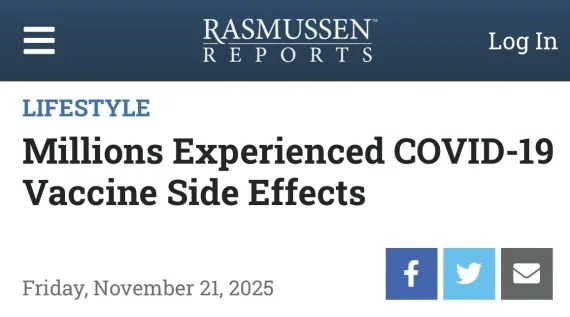
Rasmussen polls are pulse checks – real-time snapshots of public sentiment and mood on key topics.
The recent Rasmussen report reveals:
- 26% say they had minor side effects from the Covid shot
- 10% reported major side effects from the vaccine
- 46% believe it is likely that side effects of COVID-19 vaccines have caused a significant number of unexplained deaths
Under Kennedy’s leadership at HHS, once authoritarian Covid shot mandates have been backed off to ‘individual-based decision-making’ but is that enough. It’s clear the current public health apparatus wants out of all aspects of the Biden administration’s Covid train wreck.
Given the mounting data and science pointing to harms, many believe the government should be doing more – namely removing the Covid shot from the market.
At the same time, The Telegraph is reporting the following:
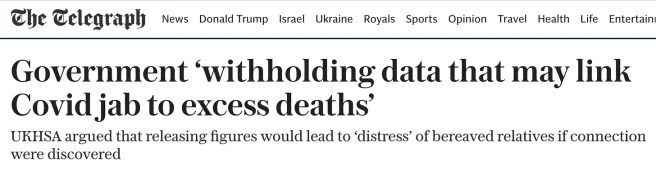
The story was created thanks to the legal action of the independent, non-profit, non-affiliated group UsForThemUK, along with diagnostic pathologist Dr. Clare Craig, who engaged in a 2-year battle to get public transparency of the general Covid vaccine and mortality data… data that was freely shared with pharmaceutical companies but withheld from the public.
The group lost its legal fight but a key admission was revealed to the public as the Telegraph writes:
The UK Health Security Agency (UKHSA) argued that releasing the data would lead to the “distress or anger” of bereaved relatives if a link were to be discovered.
Public health officials also argued that publishing the data risked damaging the well-being and mental health of the families and friends of people who died.
The Telegraph then describes a behind-the-veil moment writing:
UsForThem, a campaign group, requested that UKHSA release the data under freedom of information laws. But the agency refused, making a number of different arguments including that publishing the data “could lead to misinformation” that would “have an adverse impact on vaccine uptake” in the public.
In America, the CDC has just updated its “Vaccine Safety’ page creating massive public buzz showing an evolution in both science and a willingness to be truthful towards the public.
Among the new admissions the CDC website now states:
Scientific studies have not ruled out the possibility that infant vaccines contribute to the development of autism. However, this statement has historically been disseminated by the CDC and other federal health agencies within HHS to prevent vaccine hesitancy.
Together, both the UKHSA and CDC’s new statements show there has been, and still is, a lockstep coordination to purposely censor information from the public when it comes to injectable pharmaceutical product lines.
Governments are desperate to avoid the Covid vaccine injury conversation eager to avoid full-blown public health revolt on unknown consequences (already happening in large sections of the population)
The American Covid vaccine space is still a dismal public relations nightmare. The PREP Act, keeping the pandemic’s unnecessary actions in effect, blocks any hope of proper compensation for the critical mass of Americans who have experienced injuries from the mandated, failed shot.
Meanwhile, the ‘science is not political’ crowd spawned an East and West Coast Alliance coalition of all blue Democrat-run states representing the high water mark of hypocrisy and groupthink. Banding together for the purpose of ignoring the facts and evidence to push the Covid shot on infants and healthy people sans pandemic emergency.
The bizarre and self-defeatist move refusing to acknowledge any new science since 2020 on the mounting dangers of the Covid shot – the alliances are not only a danger to public health but to the credibility of the very institutional trust they claim to be standing for – perfect inversion.
The harms of the Covid shot are still a real concern of the American public. Ignoring these concerns or attempting to soft-sell solutions bypassing real help for the injured will not make this flashing red light any dimmer.
BBC Editors Blocked Story on Latest Fluoride Science Over ‘Scaremongering’ Concerns, Former Reporter Says
By Brenda Baletti, Ph.D. | The Defender | November 19, 2025
A former BBC health correspondent said editors repeatedly prevented him from reporting on emerging scientific debates over the safety of water fluoridation, dismissing the story as “scaremongering.”
Michele Paduano spent three decades reporting for the BBC from the West Midlands, the first region in the U.K. to fluoridate its water supply, in 1964.
At a Fluoride Action Network (FAN) press conference on Tuesday, Paduano said he became interested in water fluoridation after reviewing the landmark 2024 decision by the U.S. District Court for the Northern District of California.
The court found that the U.S. fluoridation level of 0.7 milligrams per liter (mg/L) posed an “unreasonable risk” to children’s health. The West Midlands fluoridates its water at 1 mg/L, about 30% higher than the recommended U.S. level.
Paduano said professor Vyvyan Howard, a pathologist specializing in toxicology and a long-time collaborator, alerted him to several major cohort studies in top academic journals linking water fluoridation to lower IQ in children.
Paduano said mainstream media rebuttals were “so strong and absolute” that he knew publishing a story on the findings would be difficult.
He said he pursued the story only after reading the September 2024 court decision, which cited new evidence pointing to potential neurodevelopmental risks at lower fluoride concentrations.
“At that point, it felt like my public duty to tell people in the West Midlands that there was potentially a problem,” he said.
BBC editors rejected story as ‘scaremongering’
Paduano said he pitched the fluoride story through the BBC’s planning process and arranged an interview with West Midlands anti-fluoridation campaigner Joy Warren. Senior online and television editors abruptly cancelled the interview.
“They told me the story was scaremongering,” he said. Internal BBC scientists and public-health staff insisted there was no credible new evidence. Paduano said he challenged the decision and urged editors to read the U.S. court judgment, but they instead accused him of bias.
“As a BBC journalist, impartiality is fundamental. But impartiality also means reporting new evidence when it emerges,” he said.
Paduano continued investigating the issue and spoke with professor John Fawell, a leading U.K. pro-fluoridation expert and adviser to the World Health Organization (WHO).
As a result of their conversation, Paduano said Fawell acknowledged that recent research should prompt the U.K. to consider lowering fluoridation levels to match U.S. and Canadian guidance. Fawell, who co-authored a book on fluoridation’s oral health benefits, urged U.K. officials to reexamine the country’s dosage and consider aligning it with the U.S.
“If somebody who is a leading pro-fluoride proponent adjusts their position, that is a story,” Paduano said. But he said BBC editors still refused to let him cover it.
Paduano said he then emailed CEO of BBC News and Current Affairs Deborah Turness and BBC Director-General Tim Davie, but the response was “radio silence.” He then took his concerns to Nicholas Serota, a BBC board member responsible for editorial standards.
In the meantime, Paduano said he learned of planned BBC coverage in the North East about proposed fluoridation expansion, and he told Serota that failing to mention the U.S. court decision would constitute “significant censorship.”
Paduano said the article on the North East fluoridation expansion that eventually appeared briefly mentioned the U.S. judgment. He continued arguing that the West Midlands — which has fluoridated its water for decades — should also have reported on the new developments.
The editorial board refused to cover the story. “Concern was that we would be scaremongering, we would frighten people and that the science wasn’t there,” Paduano said.
Paduano said frustrations over fluoride reporting, along with broader concerns about the broadcaster’s impartiality and its close relationship with government, ultimately pushed him to leave the BBC.
Soon after, the BBC published an article about a recommendation by Worcestershire public health officials to expand fluoridation countywide. In what Paduano described as “the ultimate bias,” the article didn’t refer to the U.S. judgment or related research.
After leaving the BBC, Paduano contacted The Independent, which published his story on Fawell’s changing position on water fluoridation.
Paduano said he again approached the BBC, arguing that national coverage proved the issue’s newsworthiness, but editors held their ground and directed him to the complaints process — which he says has resulted in little progress.
‘We should avoid worrying our audiences unduly,’ BBC says
The BBC has not responded publicly to Paduano’s allegations, and it did not respond to The Defender’s request for comment.
The organization did reply to complaint letters from Howard and FAN’s science adviser Paul Connett, Ph.D., author of “The Case Against Fluoride: How Hazardous Waste Ended Up in Our Drinking Water and the Bad Science and Powerful Politics That Keep It There.” The letters urged the BBC to show “objectivity and professionalism on the latest research into the risks of water fluoridation” and to investigate Paduano’s claims.
In its initial response, the BBC complaints team said it had “provided a fair and appropriate view” of the water fluoridation issue.
In a follow-up response to Connett and Howard, the BBC defended its decision not to mention recent science linking fluoride exposure to neurodevelopmental issues in children.
The BBC said its reporting reflects “the majority view — from the World Health Organisation, US Centre for Disease Control, the American Dental Society [sic] and others,” and argued that it maintains a “higher bar for publishing stories around health risk.”
The BBC cited its editorial guidelines:
“The reporting of risk can have an impact on the public’s perception of that risk, particularly with health or crime stories. We should avoid worrying our audiences unduly and contextualise our reports to be clear about the likelihood of the risk occurring. This is particularly true in reporting health stories that may cause individuals to alter their behaviour in ways that could be harmful.”
Kevin Silverton, who signed the letter, said the complaints team could not continue corresponding and that further concerns should be taken to the BBC’s Executive Complaints Unit.
BBC reporting on fluoride ‘can’t be trusted’
Connett told The Defender he was “shocked” when the BBC justified its position by citing the Centers for Disease Control and Prevention (CDC), the American Dental Association (ADA) and the WHO as representing the majority expert view. He said:
“As you well know, the CDC oral health division’s mission was to promote fluoridation, and the ADA has avidly promoted it for years — so much so that any study that found any harm was immediately dismissed as being bad science, and the WHO has not looked at fluoride’s neurotoxicity for many years, if ever. It is incredible to me that this very large government-funded body should rely on such one-sided, essentially partisan.”
Connett said the public and local officials rely on the BBC for accurate information, but on fluoride, “it can’t be trusted.” He said:
“When a major media entity gets involved, you would hope that they would do their homework and review the science when it is available for them. In this case the issue should have been easy because it did not entail slogging through all the studies themselves. They had a major review by a government entity, the National Toxicology Program, and they also had the judgment of a judge in a seven-year lawsuit.
“In short, the BBC is abusing the public’s trust on this important health issue, and that is shocking. Scientists like myself have an obligation to speak out. In our case, we were lucky to have a journalist to give us an inside view of the censorship that went on. We are often not that lucky.”
Related articles in The Defender
- Breaking: Fluoride in Water Poses ‘Unreasonable Risk’ to Children, Federal Judge Rules
- CDC Stands by Water Fluoridation After Report Linking Fluoride to Lower IQs in Kids Finally Published
This article was originally published by The Defender — Children’s Health Defense’s News & Views Website under Creative Commons license CC BY-NC-ND 4.0. Please consider subscribing to The Defender or donating to Children’s Health Defense.
Why Are CARDIOLOGISTS So DAMN IGNORANT? [about THIS]
Dr. Suneel Dhand | October 27, 2025
This is actually unacceptable.
Dr. Dhand’s Website: https://www.drsuneeldhand.com
 • You Probably Have INSULIN RESISTANCE: How … • Prediabetes is TERRIBLE: Here’s EXACTLY Ho…
 Featured Video

Racist Seinfeld Dances for Joy as Bibi Unveils His New Map
or go to
Aletho News Archives – Video-Images
TV Drama Review
Japanese drama projects Japan’s wartime atrocities onto Chinese characters

Global Times | October 25, 2026
By portraying Chinese characters as perpetrators of ruthless violence while casting Japanese Self-Defense Forces (SDF) intelligence operatives as defenders, the season 2 of the Japanese drama Vivant has recently drawn criticism from Chinese netizens, who argue that its depiction turns historical reality on its head while ignoring Japan’s wartime atrocities.
The TBS drama series – a spy suspense story in which an alleged unofficial intelligence unit of the SDF operates across the globe — has attracted a passionate fanbase. Its currently airing season 2 opened with a household rating of 18.8 percent, the highest for a TV drama this year, according toa commentary article by Japanese media Toyo Keizai.
What draws attention is the portrayal of the enemies in the series, the article noted. Scenes in which the Chinese organization subjects kidnapped members of the SDF unit to brutal torture are repeated with unrelenting intensity.
It is rare for Japanese TV dramas to explicitly portray a real-life country as the enemy, the article noted.
Japanese Prime Minister Sanae Takaichi also made a reference to the drama, saying that she has been recording Vivant and hopes to binge-watch it over the year-end and New Year holidays, according to Japanese media outlets.
China’s CCTV News report on Sunday revealed that the drama features scenes in which Chinese personnel cut off the fingers of and stab Japanese intelligence operatives in the abdomen. Such acts bear striking similarities to the torture inflicted on Chinese nationals by invading Japanese troops during the World War II.
The drama distorts the truth by attributing these atrocities to modern Chinese characters. Beneath the surface, it subtly glorifies Japan’s cross-border overseas operations, blurs the functional boundaries of the SDF and implicitly promotes an expansionist narrative, per CCTV News. … continue
Blog Roll
 Aletho News
- EU facing trillion-euro debt hole while seeking more cash for Kiev
- How US, Europe, Persian Gulf states exhausted missile stockpiles, splurged billions to defend Israel
- Up in arms… Koreans reject U.S. empire’s plan to make South Korea the next Ukraine
- Iran, Turkey, Pakistan, Saudi Arabia could advance region-led security framework in Tehran: FM spox
- Netizens condemn Japanese drama for projecting Japan’s wartime atrocities onto Chinese characters
- Racist Seinfeld Dances for Joy as Bibi Unveils His New Map
- A West Bank War for Netanyahu’s Election Campaign, Could It Backfire?
- Yemen denounces European Parliament’s ‘hypocritical’ push to blacklist Ansarullah
- Qalibaf: UAE’s UN bid aims to ‘clear the runway’ for ‘Greater Israel’, whitewash genocide
- Pakistan reopens Iran border after boosting security: Report
- If Americans Knew
- An error has occurred; the feed is probably down. Try again later.
- No Tricks Zone
- Sudden Stratospheric Warming, Powerful El Niño Combination May Lead To Extreme Europe Cold, Energy Crisis!
- Two New Studies Find Thwaites Glacier Melt Cannot Be Driven By Human Activity Or A Warming Ocean
- E-Cars Reduce CO2 Emissions By Only 41% Compared To Internal Combustion Engine Vehicles
- Predictions Made By Renowned Climate Professor Over Past Decades Have Been Proven To Be Poor
- New Study Suggests Large Regions Of The Pacific Ocean Have Been Cooling For The Last 80 Years
- Germany’s Green Energy Debacle: High Energy Costs Force Kahla Porzellan to Close After 182 Years!
- New Study: 50 Years Of The Most Aggressive ‘Net Zero’ Policies Can Only Affect The Global Climate By 0.03°C
- US September “Heat” Was No Record…Many Records Set Decades Ago
- Latest European Green Energy Debacle; Portugal’s Largest Flagship Solar Park Insolvent!
- Green Energy Debacle: German Expert Professor Fritz Vahrenholt Warns Of Severe Economic And Social Consequences

