Should the patient really get the drug?
By Sebastian Rushworth, M.D. | June 14, 2022
I recently gave a lecture to 70 primary care physicians here in Stockholm, titled “should the patient really get the drug?”. The lecture seemed to generate quite a bit of cognitive dissonance among some in the audience, based on the somewhat aggressive discussion that followed the lecture, which suggests to me that much of what I was saying was stuff they had literally never been exposed to before – not at any point in medical school, and not at any point during their careers after medical school either. Cognitive dissonance is good. It’s the first step towards change.
I thought it would be interesting to re-write the lecture as an article, so that more people can hopefully achieve similar levels of cognitive dissonance. Please feel free to share it with any doctors you know that you think might benefit from an expanded perspective. Anyway, here we go.
Let’s imagine a common patient. Every primary care physician meets this patient, or someone much like her, on an almost daily basis. She’s 75 years old, and overweight. She experienced a wrist fracture two years ago, and was subsequently diagnosed with osteoporosis. She has high cholesterol levels, but she’s never had a heart attack or other “cardiovascular event”. On top of that, she has type 2 diabetes, chronic knee pain due to osteoarthritis, and high blood pressure. She was diagnosed with depression a few years ago, after her husband died.
Our patient takes seven drugs every day:
- Alendronate, because of her weak bones.
- Atorvastatin, because of her high cholesterol levels.
- Sertraline, because of her depression.
- Metformin, because of her type 2 diabetes.
- Insulin, also because of her type 2 diabetes.
- Paracetamol (a.k.a. acetaminophen), because of her knee pain.
- Enalapril, because of her high blood pressure.
So, the question is, are these drugs doing her any good?
Well, to answer that question, we need to consider NNT (Number Needed to Treat). NNT is the number of patients who need to take a drug for one patient to achieve a noticeable benefit.
For alendronate, the NNT is 20, i.e. if you treat 20 people for a couple of years, you prevent one fracture. For atorvastatin the NNT is 200, i.e. you need to treat 200 people for five years or so in order to prevent one heart attack. For sertraline, the NNT is 7, which means that you need to treat seven people in order to have a noticeable effect on depression in one patient. Note that this doesn’t mean that one out of seven gets cured of their depression, it just means that there is a noticeable difference on a rating scale for depression.
For metformin, the NNT is 14 – If you treat 14 type 2 diabetics with metformin for ten years, you prevent one death. For enalapril, the NNT is 70 – If you treat 70 people with high blood pressure with enalapril for five years or so, you prevent one stroke.
For insulin, however, there is no NNT, because insulin has not been shown to result in any benefit on any clinically relevant outcome, even though big studies have been carried out that have included thousands of patients and followed them for five or ten years. Note here that we’re talking about insulin for type 2 diabetics. When it comes to type 1 diabetes, insulin is pretty much magical – you don’t even need to do a randomised trial in order to show benefit. People with type 1 diabetes virtually return from the dead when treated with insulin. But when it comes to type 2 diabetes, there is no benefit, at least not to any hard outcomes. All insulin has been shown to do is reduce blood sugar, but it’s never been shown to result in any meaningful patient oriented benefit for type 2 diabetics.
The same is true for paracetamol/acetaminophen. When it comes to patients with knee pain due to osteoarthritis, the drug doesn’t provide any benefit whatsoever.
Ok, so we have seven drugs, and we know what their NNT’s are. If we plus the probabilities of benefit together, then we get the probability that our 75-year old woman will benefit in some way from at least one of the drugs she’s taking. So, what probability of benefit do we get?
We get 30%. Only 30%.
What that means is that there is a 70% probability that this woman doesn’t benefit at all from any of the seven drugs that she takes every day for years on end!
If you told her, I’d say there are pretty good odds she’d decide to stop taking her pills. Seven drugs a day, every day, and two to one odds of zero benefit.
And we haven’t even talked about harms yet. Because none of these pills are inert. All have widespread biological effects. And all can cause harms. So any rational treatment decision must include not just the potential benefits, but also the potential harms.
For figuring out harms, we have NNH (Number Needed to Harm), which is the counterpoint to NNT. NNH is the number of patients who need to get a drug for one to be harmed. Like I said, the drugs all have widespread biological effects, so there isn’t just one NNH – there is an NNH for each possible harm. That means that there are multiple NNH’s for each drug.
With our 75-year old woman and her seven drugs, we don’t have time to go through the NNH for every possible side effect, so we’re just going to look at a few, and put them side by side with the NNT, to get a somewhat more complete picture of benefits vs harms. I’ve tried to make sure that the NNH numbers apply to the same time period as the NNT numbers, since otherwise it’s an apples to oranges comparison.
If we do that, we get something like this:
Alendronate
NNT: 20 (fractures)
NNH: 200 (esophagitis), 260 (atrial fibrillation), 4,000 (osteonecrosis)
Atorvastatin
NNT: 200 (cardiac infarction)
NNH: 20 (myalgia), 20 (type 2 diabetes)
Sertraline
NNT: 7 (depression)
NNH: 2 (sexual disturbance), 10 (hyponatremia)
Metformin
NNT: 14 (death)
NNH: 2 (stomach upset), 5 (B12 deficiency), 1,000 (lactic acidosis)
Enalapril
NNT: 70 (stroke), 125 (death)
NNH: hyperkalemia (10), acute kidney failure (100)
Insulin
NNT: 0 (no benefit to clinically relevant outcomes)
NNH: severe hypoglycemia (5), weight gain (1)
Paracetamol/acetaminophen
NNT: 0 (no benefit to clinically relevant outcomes)
NNH: Hypertension (30), liver damage (?)
It’s possible to quibble here about specific NNT and NNH numbers. Different studies show different things. And many of the numbers come from studies carried out by pharmaceutical companies, which generally means that the risk of a certain side effect is massively underestimated (as we will discuss shortly). The point here isn’t to get hung up on any of the specific numbers. It’s to illustrate that we quickly end up with a very complex equation, where it in many cases isn’t clear at all whether the benefits outweigh the harms.
Take alendronate, as an example. We know that it decreases fractures in elderly osteoporotic women. But it doesn’t decrease hospitalisations. The only reasonable conclusion is that the reduction in hospitalisations that is seen due to the reduction in fractures is made up for by an increase in hospitalisations due to the many and varied side effects. So at the end of the day the only way to decide whether or not to take the drug is to have a detailed discussion with the patient and get them to decide which set of risks they’d rather be taking.
Hippocrates is supposed to have said “primum non nocere”, which is latin for “first, do no harm”. Actually he didn’t say that, and couldn’t have even if he wanted to. Hippocrates was greek, and didn’t speak latin. The quote comes from a 19th century American physician, Worthington Hooker.
Of course, as doctors, we all know that “first, do no harm” is completely unrealistic. Every intervention we do carries some measure of risk. If our primary guiding principle was to never do harm, we literally would never be able to do anything. A more reasonable principle is “only do something if the benefits clearly outweigh the risks”. If it isn’t clear to you that the benefits of a drug outweigh the harms, then don’t give it to the patient.
That’s a good general rule to stick by. However, it probably isn’t enough, for a few reasons we’re now going to discuss.
A study was published in JAMA Internal Medicine in 2021 that sought to establish how good physicians are at estimating the likelihood that a patient has a certain disease. 500 primary care physicians in the US were asked to consider various hypothetical scenarios, and then answer what they thought the probability of disease was. Here’s an example of a scenario that they were asked to consider:
Ms. Smith, a previously healthy 35-year-old woman who smokes tobacco presents with five days of fatigue, productive cough, worsening shortness of breath, fevers to 102 degrees Fahrenheit (38.9 degrees centigrade) and decreased breath sounds in the lower right field. She has a heart rate of 105 but otherwise vital signs are normal. She has no particular preference for testing and wants your advice.
How likely is it that Ms. Smith has pneumonia based on this information? ___%
Ms. Smith’s chest X-ray is consistent with pneumonia. How likely is she to have pneumonia? ___%
Ms. Smith’s chest X-ray is negative. How likely is she to have pneumonia? ___%
Go ahead and make your own guesses in relation to each of the three questions.
Once you’ve done that, you can take a look at the table below, and the answers will be revealed.

So, for our pneumonia example above, we see that the actual initial risk of disease based on the presented information was around 35%. If we then move along and look at what the doctors answered, they thought the risk was 80-85%. In other words, they thought pneumonia was more than twice as likely as it actually was!
The same phenomenon was seen in all clinical scenarios tested. The doctors consistently overestimated the initial risk, and they continued to overestimate the risk after both a positive and a negative test result. In some cases the difference between reality and what the doctors thought was huge, with the doctors overestimating risk by a factor of ten or more.
What can we conclude from this?
Doctors consistently overestimate disease risk.
Hold that thought, as we move on to take a quick look at another study, which was published in BMJ Open in 2015. This study sought to do something about a problem inherent in statin trials (and for that matter, all trials in medicine), which is that the results they produce, in the form of percent absolute risk, percent relative risk, and NNT, are so abstract that they’re completely meaningless to patients (and for that matter, to doctors as well). We know that statins have an NNT of 200 when used for primary prevention (to prevent a heart attack in someone who has risk factors but hasn’t already has a heart attack), and 40 when used for secondary prevention (to prevent additional heart attacks in someone who has already experienced a heart attack). But what do those numbers actually mean? Are they good or bad?
What the patient really wants to know is “how much longer will I live if I take this drug?”
So, what the researchers did was gather together data from all the big randomised trials of statins, and use the survival curves provided to estimate how much longer the patients actually lived. Here’s what they came up with:

All the big statin trials are included here. What’s interesting to do is look at the NNT provided, and then compare that with the number to the right of it, which is how much longer the patients actually lived, on average. So, for the ALLHAT trial, to take the topmost example, we have an NNT (for primary prevention) of 250, which comes down to a postponement of death of 4.96… well, 4.96 what?
Is it years? No.
Is it months? No
The patients in the statin group lived 4.96 days longer than the patients in the placebo group. That is what the NNT of 250 means in real terms.
Let’s look instead at 4S, which was published in 1994 and is the statin trial that has produced the best results of any statin trial ever. It’s the trial that initiated the massive boom in statin prescribing that we still see today. In 4S, the NNT (for secondary prevention) is 27.8. So, in other words, one in 27.8 patients benefited from the treatment.
But what does that actually mean in terms of life extension?
It means 27 days.
Not as impressive as you would have thought, right?
When the researchers put all the data together, from all the trials, in order to get an overall average, what they found was that when statins are used for primary prevention they prolong life by 3 days. When they are used for secondary prevention, they prolong life by 4 days.
I can imagine quite a few patients turning down the offer of a statin if they knew that it will on average only prolong their life by days.
The purpose of bringing up this study was to illustrate the following general point:
Doctors consistently overestimate the benefit of the drugs they prescribe.
Hold that thought in your mind as we move on and look at a third study.
This one was published in The Lancet Healthy Longevity in 2021. It compared the rate of serious side effects seen in randomised trials with that seen in the real world. If randomised trials give us good information about what to expect in reality, then the rate of serious side effects in the trials should be the same as that seen in reality.
But that isn’t what the researchers found. What they found was that serious side effects were three to four times more common in reality than they are in the randomised trials! Three to four times!
How is this possible?
Well it’s important to remember that the randomised trials are funded and run by the drug companies, and the drug companies want to sell their drugs, so they will do what they can to make side effects appear as rare as possible.
Why is this a problem? Because it’s the randomised trials that doctors mostly use as a basis for determining whether a drug is safe to give to a patient or not.
So, what can we conclude from the study?
Doctors consistently underestimate side effects of drugs.
Ok, so we have three conclusions, that are all pointing us in the same direction:
- Doctors consistently overestimate disease risk.
- Doctors consistently overestimate drug benefit.
- Doctors consistently underestimate drug harm.
What does this lead to?
Massive overprescribing of drugs.
Peter Gotzche, a founding member of the Cochrane Collaboration and former director of the Nordic Cochrane Center, has estimated that prescription drugs are now the third biggest cause of death in the western world, after heart disease and cancer.
That on its own should lead to massive humility among all doctors about our drug prescribing. It should make us much more careful every time we think about prescribing a drug to a patient.
Ok, so we’ve identified the problem. The causes of this problem are many and complex, so I’m just going to bring up one that each of us as doctors can actually do something about – industry sponsored meals.
A study was published in JAMA Internal Medicine in August 2016 that sought to estimate the extent to which physicians are influenced by partaking in industry sponsored meals, which often take the form of a lecture about a specific drug given by an drug company salesperson, which the physician is supposed to sit and listen to in return for getting a free meal. Industry sponsored meals are very common. Most physicians probably take part in at least a couple of these per year, and many take part in far more than that.
As the saying goes, “there’s no such thing as a free lunch”. The drug companies are not charities whose goal it is to keep starving doctors alive. If they spend vast sums of money of sponsored meals, it’s because they’re pretty damn sure that it increases sales of their drugs, and thereby their profits.
So, anyway, the study sought to estimate the extent to which industry sponsored meals influence physician prescribing patterns, by comparing participation in such meals with later prescribing behaviour. Here’s what they found:

They looked at four different drugs. As I think is clear from the tables, participation in industry sponsored meals increased prescribing of the drug the meal was about, and the more such meals a doctor participated in, the more often he or she prescribed that drug.
The purpose of these meals is not to educate us, or make us better doctors. It’s the opposite – the purpose is to make us do a specific profit-driven company’s bidding. And it works.
If you’re a doctor, and you think you don’t get influenced by participating in industry sponsored meals, then you are very naive. The more industry sponsored meals we participate in, the worse doctors we become.
Doctors in general massively underestimate the extent to which their thoughts, beliefs, and opinions are influenced by the pharmaceutical industry. We like to think that we are evidence based. But the truth is that much of what we think we know is not based on sound scientific knowledge, but on pharmaceutical industry propaganda, which quickly becomes clear to anyone who starts going through the studies in detail themselves.
On that note, I strongly recommend reading these three books, all written by physicians, to help get some perspective on the scale of the problem we face in relation to the pharmaceutical industry.
- Bad Pharma by Dr. Ben Goldacre
- Doctoring data by Dr. Malcolm Kendrick
- Deadly medicines and organised crime by Dr. Peter Gotzsche
There is one very simple thing every doctor can do, to at least partially free themselves from the onslaught of drug company propaganda, and that is to refuse to take part in industry sponsored lunches, and all other forms of industry sponsored “education”. Just say No.
Ok, so, that’s number one: refuse to take part in industry sponsored lunches.
What else can you do as a doctor?
Well, something that was once considered standard, but has fallen by the wayside in recent decades, is to never have a patient on more than five drugs at the same time. With drugs, as with everything else, there is a state of diminishing returns – the more you add, the less benefit (and more harm) each additional drug confers. So try to keep a patient on at most five simultaneous drugs. If you want to add a sixth, then rank them all, and get rid of the one that you think is least important. Most likely, the sixth least important drug in a list of six is not going to do anything useful for the patient anyway, just increase their risk of harm.
Ok, so that’s number two: try to avoid having your patients on more than five drugs simultaneously.
Number three: go through the patient’s drug list with them once a year, and get rid of anything that isn’t clearly conferring a benefit. As any doctor will know, it’s common for patients to stay on drugs for years, even though the original reason they were put on the drug resolved itself a long time ago. The patient often doesn’t remember why they were put on the drug in the first place, but they keep taking it dutifully. Drug lists require regular pruning or they will become increasingly bloated as the years go by, which is one reason why so many elderly people are on 15 simultaneous drugs or more.
Number four: only prescribe a drug if the benefits clearly outweigh the harms. This should be obvious, but it requires a deep knowledge of the size of both potential benefit and potential harm, which unfortunately most doctors lack. And what they think they know is often incorrect because it’s based more on pharma propaganda than real science.
As a doctor, the only way to get around this is to start doing your due diligence and getting in to the weeds of the scientific studies. Do that for the ten drugs you prescribe most commonly, so that you’re an expert on those ten drugs, and you’ve already done a lot. If a patient asks you about the probability of benefit and the probability of harm, you should be able to answer that question correctly, at least for the ten drugs you use most frequently. It requires an up-front investment of time, but it will pay massive dividends to your patients over the remainder of your career.
Ok, so that was number four: only prescribe a drug if the benefit clearly outweighs the harm.
Here’s number five: prioritise lifestyle changes. Most of the diseases that doctors spend most of their time dealing with are caused by poor lifestyle choices. And most can be rectified by switching to good lifestyle choices, which invariably produce greater benefits than any drug can, with less risk of harm.
Doctors can accomplish a lot with their patients with simple lifestyle coaching. To take one example, a primary care clinic in the UK decided to try putting their type 2 diabetic patients on a ketogenic diet, since the drugs they were using clearly weren’t making the patients better. They published their six year follow up results in BMJ Nutrition, Prevention, and Health in 2020.
Over six years, the patients following the ketogenic diet decreased their median HbA1c (a measure of average blood sugar over the preceding few months) from 66 to 48. Normally, that would be unheard of. HbA1c doesn’t decrease over time in a type 2 diabetic. It increases. Yet here it was far better at the end of the six years than at the beginning. The same goes for body weight. Normally it goes up over time. But here the median decreased from 99 kg to 91 kg. And on top of that, median systolic blood pressure dropped from 152 to 141.
All this just with a simple diet intervention. Thanks to the improvements in all health markers, the patients were able to get off a lot of their drugs. This meant that after six years, the clinic was spending less than half as much money on anti-diabetic drugs as the other primary care clinics in the region.
To take another example of a simple lifestyle intervention, a randomised trial published in BMJ in 2021 that was carried out in nursing homes in Australia found that a diet high in protein has an effect on fracture risk that is equivalent to that seen with bisphosphonates.
There is a massive amount that can be accomplished with simple lifestyle interventions, and since they are much less risky than drugs, and actually treat the underlying problem rather than just putting a patch on top of it, they should be the primary intervention we use whenever possible. Drugs should be viewed as a complement to lifestyle interventions. It shouldn’t be the other way around.
Ok, so that was my fifth and final point. I’ll repeat the five points here again. These are five things that you as a doctor can do about the situation we currently find ourselves in, where prescription drugs are the third biggest killer in the western world:
- Refuse to participate in industry sponsored lunches and other industry sponsored “education”.
- Try to avoid having your patients on more than five drugs simultaneously.
- Go through the patient’s drug list with them once a year, and get rid of anything that isn’t clearly conferring a benefit.
- Only prescribe a drug if the benefits clearly outweigh the harms.
- Prioritise lifestyle changes.
Developmental Disorders in Babies born to Vaccinated Mothers?
Pfizer wants Babies to be Exposed to SIX Vaccine Shots!
By Igor Chudov | June 10, 2022
I will explain that
- Children of Covid vaccinated mothers were never tested for developmental disorders
- CDC recently revised and lowered developmental milestones, and removed some entirely
- Newly born babies will be exposed to SIX doses of mRNA vaccines if the FDA’ approves the Pfizer vaccine.
An interesting article came out:
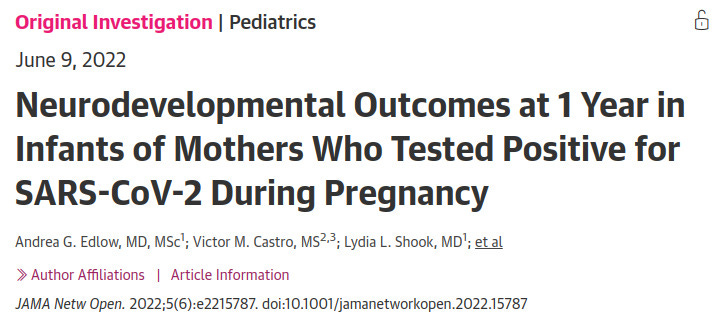
This article found that at one year of age, babies born to mothers who had COVID (not vaccine), had a roughly twice-higher rate of neurodevelopmental disorders:
those born to the 222 mothers with a positive SARS-CoV-2 polymerase chain reaction test during pregnancy were more likely to receive a neurodevelopmental diagnosis in the first 12 months after delivery, even after accounting for preterm delivery.
Considering that COVID is a bad disease for a sizable minority of people, there is no surprise. Covid is bad and gives people all sorts of problems. Then I started thinking: a lot of adverse effects of Covid vaccines mimic the adverse effects of Covid. The younger is the vaccine recipient, the worse some effects of vaccination (such as myocarditis) are.
A great number of expectant mothers received up to three Covid vaccine shots during pregnancy. Did anyone bother testing one-year-old children of vaccinated and boosted (during pregnancy) women for neurodevelopmental disorders, before approving this vaccine for all pregnant women?
The question is, obviously, rhetorical, since “mRNA Babies” of triple-vaxed-during-pregnancy mothers are only beginning to get born right now and are at most a few months old. Not one such baby reached a year of age. So nobody tested them for developmental disorders at one year of age, before approving the three vaccine shots for expectant mothers.
The usual argument of vaccinators that “since Covid does it too, you should take the vaccine” does not hold water. To a woman who decided to take the vaccine, the probability of getting a vaccine is 100%. The probability of her getting Covid is much less. In the above study, out of 7,772 births, only 222 (2.8%) were exposed to Covid during pregnancy. So while vaccination is 100% guaranteed for those who elect to vaccinate, the chance of Covid is over 30 times less likely. And the “vaccine” does not prevent Covid anyway and does not even reduce the viral load.
There is literally zero data on one-year-old children of triple-vaccinated mothers because the oldest ones are 3-4 months old as of today.
However, there are disturbing developments regarding newborns. Vaccination does seem to have an effect on births and pregnancies.
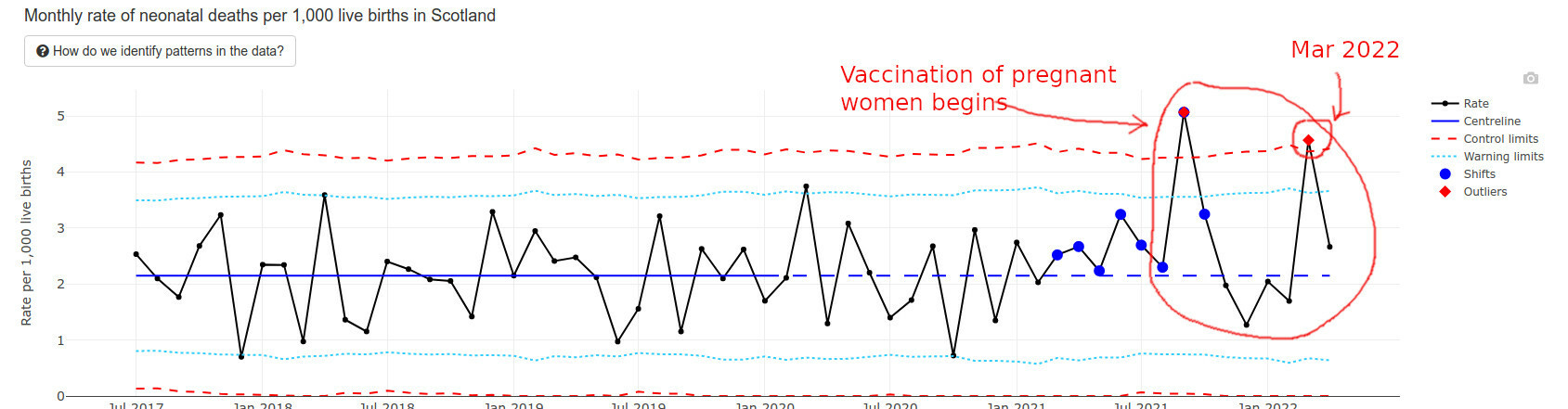
The best data I found regarding recently born newborns happens to come from Scotland. They have an interesting “wider impacts” page that I am quoting below.
Infant deaths are way above average and exceeded “Alert Limits” twice.
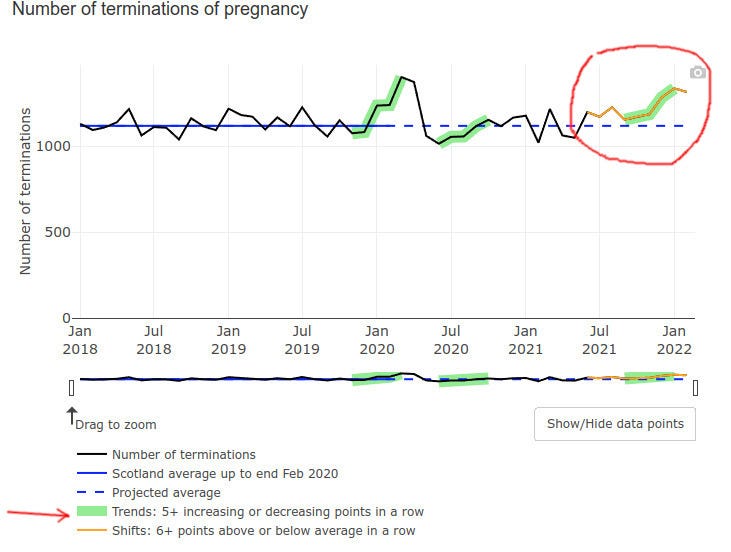
Even pregnancy terminations went up at the end of 2021, possibly but not certainly explained by prenatal vax problems:
Low Apgar score births (for those readers who do not have kids, Apgar score is how healthy is the baby at birth, the best being a score of 10) triggered a green alarm signal:
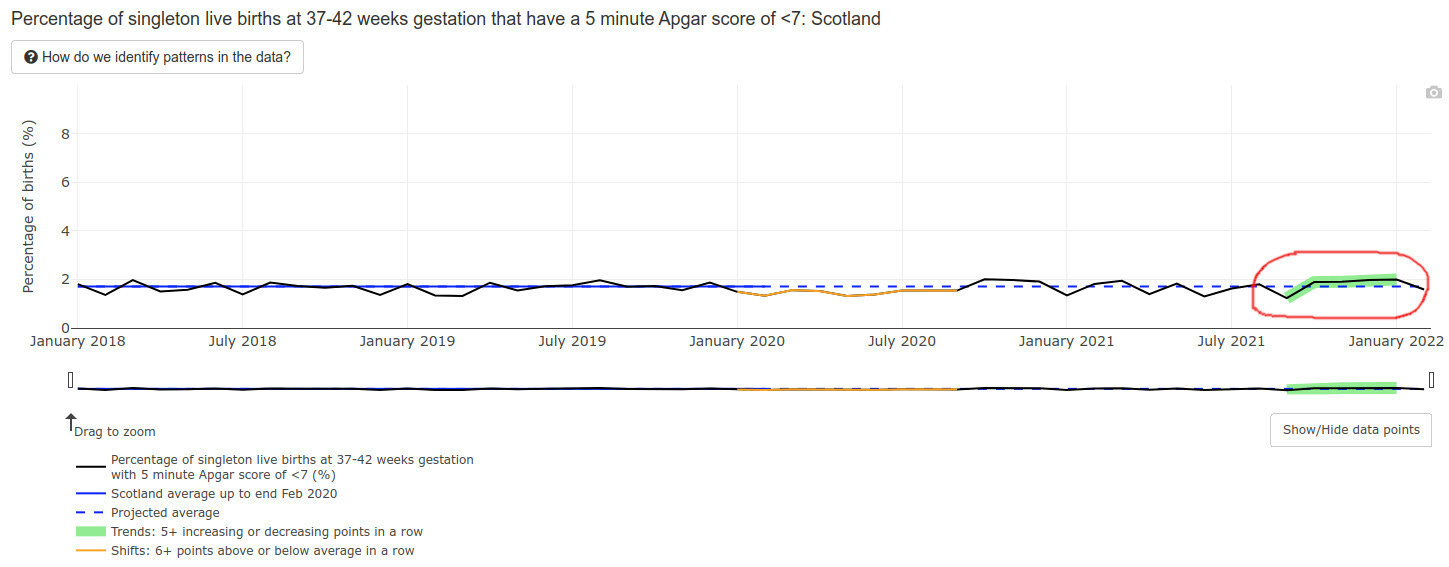
Mind you, an Apgar score is also a developmental evaluation of sorts — at 5 minutes after birth. What will happen to the developmental milestones of those lucky babies of vaccinated mothers, who survived the pregnancies, did not die postnatally, and lived to one year of age? I literally have no idea and nobody else in the world does — the time has not passed yet.
The data we have is NOT encouraging.
CDC Solution: Remove and Lower Milestones
The CDC possibly caught a whiff of this, because in February of 2022 they literally removed half the developmental milestones, bumped some others to higher ages, and lowered standards for yet more of them. (Hat tip @CLesterwood)
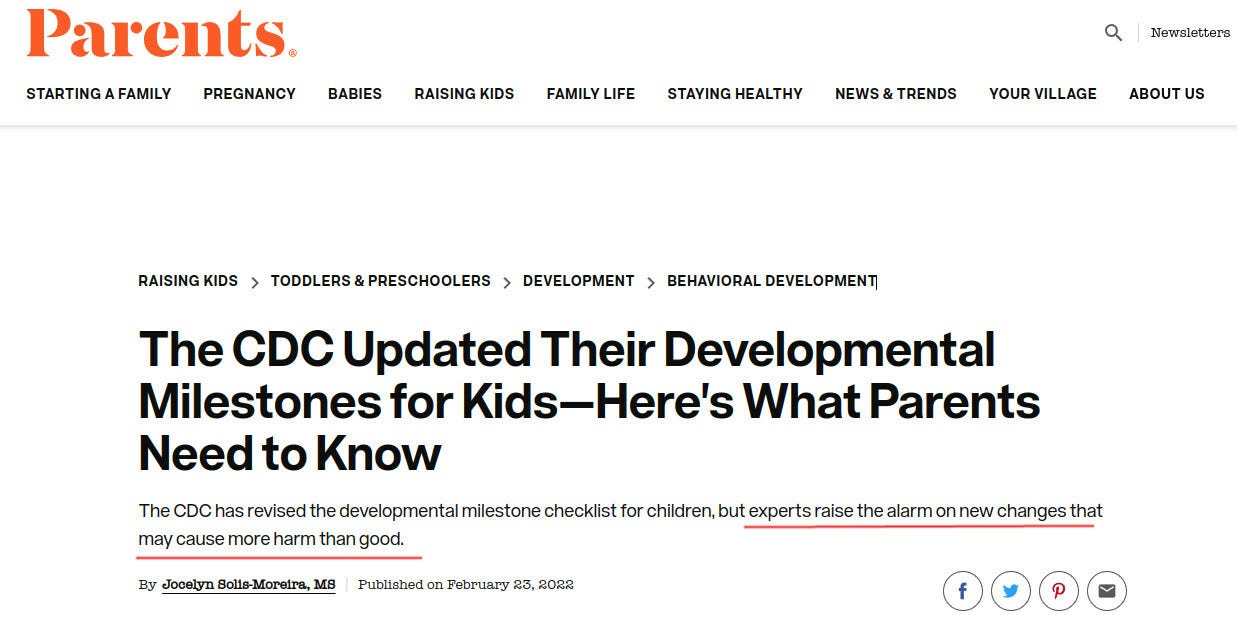
About one-third of milestones like fine motor skills have been bumped up to older ages. Because of the setback, children may worsen their developmental delay, making it harder to provide early intervention, explains Jessica Hatfield, MS, OTR/L, a pediatric occupational therapist for TheraTree Pediatric Therapy.
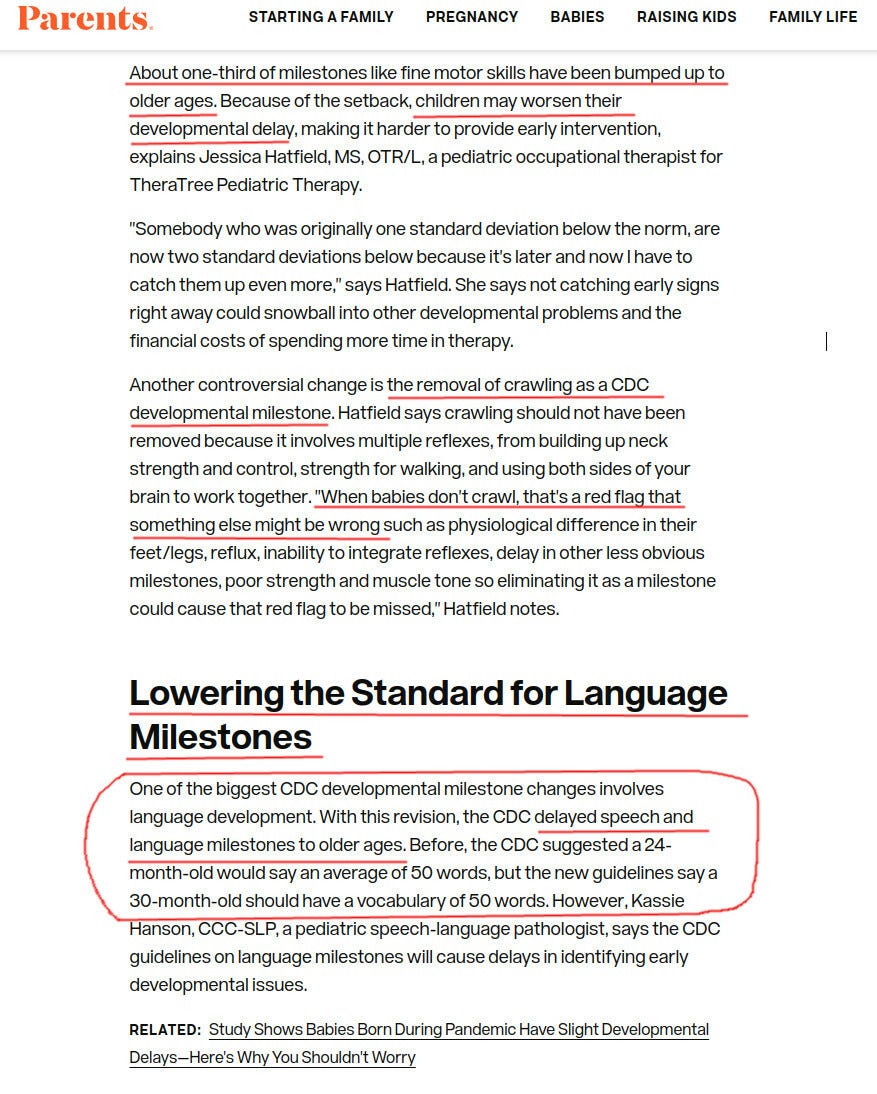
Removing crawling as a milestone??? Are you kidding us? For those of my readers who are parents, do you think that crawling is unimportant as a milestone?
Vaccinated Infants Exposed to SIX Doses of Covid Vaxx in a Year!
Imagine a vaccine enthusiast mother, who gets three doses during her pregnancy. Say, two doses during month 4 and one during the last week of pregnancy. The unborn baby is, obviously, exposed to all that.
Then the baby is born.
If the June 14-15 FDA meeting goes as planned, FDA will approve a three-dose Pfizer vaccine for infants and toddlers. So shortly after being exposed to THREE doses of mRNA vaccines prenatally, the recently born 6 months old baby will get THREE MORE Pfizer mRNA shots.
That’s a total of, drumroll, six spike protein, and nanoparticle exposures. For a tiny newborn, all during one first year of her life.
And what if the mom has several Covids while being pregnant and vaccinated?
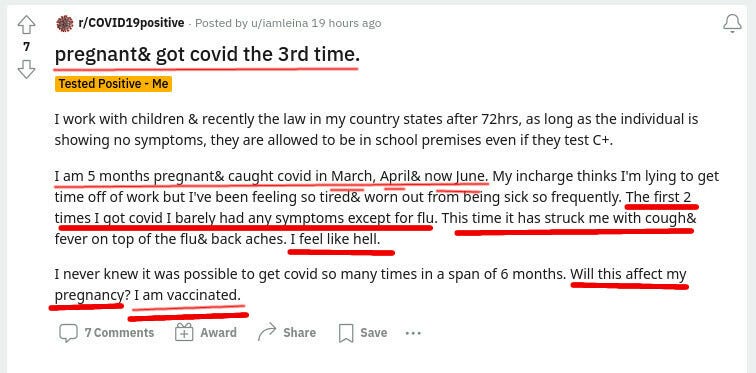
They will ask the mom to vaccinate the baby regardless of those covid infections. This literally amounts to six doses within a year or close to, without even counting actual covids that the vaxed moms have. Pfizer will make $132 from these six shots. Not sure if the baby will eventually need much more expensive treatments.
Do you think that it is a little bit too much? Do you think Pfizer or the FDA care?
‘Health misinformation’: the latest addition to the Online Safety Bill
Labour and the SNP are planning on a new amendment
By Mark Johnson | UnHerd | June 14, 2022
Civil libertarians often talk about a phenomenon known as the “ratcheting effect”. This is the idea that when it comes to the erosion of our liberties, the trajectory tends to head in one direction; in favour of state power at the expense of our rights and freedoms.
It is the reason why we draw red lines that should not be crossed. If you breach the principle of non-interference in people’s rights with a relatively minor incursion, what is to stop that minor incursion from escalating to something more significant in the future?
Yet with the Online Safety Bill, a censor’s charter, which has been so long in the making, the ratcheting effect is happening in real time. Last week, SNP and Labour politicians on the Committee currently scrutinising the Bill laid an amendment to include “health-related misinformation and disinformation’ as a recognised form of lawful but ‘harmful’” speech. This threatens to open a Pandora’s box of censorship.
The terms ‘misinformation’ and ‘disinformation’ have grown to become part of the political lexicon in recent years. The concepts of being incorrect or misleading have been left behind for alternative terms, with loaded connotations. Yet they are malleable terms, often deployed in ways to discredit or silence another individual’s argument in the course of public debate.
Stoked by these fears, we have seen Big Tech increasingly taking on the role of online speech police in recent years. During the coronavirus era, this reached new extremes. At the beginning of the pandemic, Facebook took the step of removing content which promoted face masks as a tool to combat the spread of Covid-19.
Yet within a short space of time, the medical consensus on masks changed. But rather than acknowledge that it was wrong, Facebook flipped its position and censored in the other direction. A high-profile example saw Facebook label, discredit and suppress an article in The Spectator, written by the Oxford academic Carl Heneghan, disputing the efficacy of masks. What grounds or competency Silicon Valley’s fact-checkers had to overrule reasoned arguments by a Professor of Evidence-Based Medicine remains to be seen.
This approach is a direct threat to the epistemic process, so central to the free and open development of knowledge and ideas in liberal democracies. The fact that not even academics can escape this kind of truth arbitration speaks volumes.
Proponents of the Online Safety Bill perform mental gymnastics in trying to defend the legislation by arguing that hard and soft censorship is already happening online. They fail to provide how an approach which sees the state support these systems and even designate some categories of free speech as ‘harmful’, will do anything but compound this issue.
All of this highlights a problem that the Government are yet to acknowledge; this Bill could end up strangling our rights and freedoms online. The misinformation amendment is unlikely to carry much traction for now, but it is a sign of things to come. We should all be concerned.
Four Scare Stories designed to (literally) put you off your food
Suddenly perfectly ordinary foods are set to give you cancer, why? And who stands to gain?
By Kit Knightly | OffGuardian | June 14, 2022
We’ve been covering the emerging food crisis for months now. Detailing how the economy was deliberately sabotaged to drive up the cost of living, especially food, via lockdowns and sanctions.
But propaganda wars are like regular wars: They have theatres, fronts and overt for covert campaigns.
Yes, the big noise on food is that we need to change to “save the planet”, but there’s more going on in smaller spheres. A constant drip-feed of stories, articles and studies designed to undermine public faith in the food we eat.
Here are four examples, all from just the last ten days.
1. BEEF CAUSES CANCER
On June 3rd MedicalXpress reported on a new study which – allegedly – (we’ll be using that word a lot) found red meat increased cancer risk in certain people.
The “study”, carried out at the Boston University School of Medicine and originally published in the Journal of Nutrition, claims to have found that “unprocessed” red meat increased the risk of colorectal cancer {CRC} – in black women:
Unprocessed red meat intake was associated with an increased CRC risk in the present study, the first positive evidence that red meat plays a role in the etiology of CRC in Black women.
2. SO DOES FISH
Then, on June 9th, Sky News reported another study which found eating fish on a regular basis also increases your risk – this time of skin cancer.
This “study”, done out of Brown University and published in the journal Cancers Causes and Control, alleges those who eat over 40g of fish per day had a 22% increased risk of skin cancer:
We found that higher total fish intake, tuna intake, and non-fried fish intake were positively associated with risk of both malignant melanoma and melanoma in situ. Future studies are needed to investigate the potential biological mechanisms underlying these associations.
3. … EVEN MORE CANCER, THIS TIME FROM DAIRY
A third study, again in MedicalXpress and this time from June 9th, found an increased risk of prostate cancer in men who drink a lot of milk.
The “study”, done at Loma Linda University Health and published in the American Journal of Clinical Nutrition, concludes:
Men with higher intake of dairy foods, but not nondairy calcium, had a higher risk of prostate cancer compared with men having lower intakes. Associations were nonlinear, suggesting greatest increases in risk at relatively low doses.
This parallels a study from last year, done by the same researchers, which found drinking milk increased the risk of breast cancer.
4. OH, AND KEEPING YOUR OWN CHICKENS GIVES YOU FOOD POISONING
Not a study this time – and technically not just about food either – but on June 10th CBSNews reported that the US CDC was launching a “probe” into an increase in food poisoning cases allegedly linked to people keeping their own chickens:
Federal health officials are probing several multi-state outbreaks of salmonella infections linked to backyard poultry, saying more than 200 Americans have been stricken so far this year, with one death reported.
Already in vogue in parts of the U.S., the earthy hobby of raising backyard flocks grew even more popular during the pandemic, as Americans stuck at home set up coops with an eye on fresh eggs and animal companionship. But such efforts at small-time farming can come at a cost.
Of course, this is coming straight off the back of a “bird flu outbreak” which has seen 10s of millions of poultry culled, and price of eggs and chicken skyrocket.
Interestingly, organic and free-range chickens are already said to be the most impacted by bird flu, leading some to ask if bird flu could spell “the end of free-range chicken”.
No free-range chickens, no keeping your own chickens…hmmm…seems like some time soon the only way to get chicken (and eggs) will be through Big Food corporate giants.
THE SOLUTION
So, according to The ScienceTM – all natural food humans (and most other animals) have been eating for literally thousands upon thousands of generations is somehow suddenly contriving to give us all cancer.
Personally, I’m freaking out.
But don’t worry, because there’s a few ready made solutions to this problem: If you want to save yourself from all that nasty chicken, eggs and milk, try “alternate forms of protein”.
That’s media-speak for eating insects.
The push on that front started years ago, with articles like this one from March 2021: “If we want to save the planet, the future of food is insects”
There was a lot of pushback, with “Eat Ze Bugs” becoming an ironic slogan for those resisting the new normal. That reaction effectively bullied the “let’s eat insects” stories out of the news for a while. But now they’re back.
On May 22nd, Forbes reported yet another a new “study” which apparently found “Eating Insects Could Cut Your Environmental Impact By More Than 80%”.
On May 28th, The Sun claimed that eating insects (among other things) could “solve food shortages”.
On June 6th the BBC’s kid-focused Newsround prompted children to ask the (rather leading) questions “Eating insects: Should we be eating more? Why are they so good?
And then on June 11th, the Toronto Star simply asked
Why aren’t we all eating insects yet?”
So, yes, there’s a renewed energy behind the pro-bug-eating media. But the big move being touted is undoubtedly the pivot to lab-grown meat and dairy. The propaganda is flowing thick and fast on that.
In late May, science magazine FreeThink reported a new company called Formo is researching lab-grown dairy products – “real cheese without the cow”. While TechCrunch was talking up YoEgg’s plant-based egg substitutes.
On June 6th Forbes reported that “Cell-Cultured Seafood Isn’t just An Idea; It’s A Reality”.
Just three days ago it was announced the Israeli company ReMilk was approved to begin selling its “precision fermented cow-less dairy products” across the US.
So, while the news cycle floods with stories that beef and fish and milk are causing cancer or food poisoning, the mainstream media is packed with stories on the benefits of cultured proteins.
Medical journals are publishing articles like this one, suggesting lab-grown meat is “healthier” than natural meat.
A Schmidt Foundation-sponsored article in the Guardian, on June 4th, tells us that lab-grown meat could save the planet if people can be “convinced to make rational food choices”.
On June 6th, CNN headlined:
How ‘lab-grown’ meat could help the planet and our health
… and goes on to suggest fake meat would prevent “future pandemics” by removing the risk of zoonotic viral transmission.
The messaging could not be clearer.
CUI BONO?
So, let’s say that over the next year or so more and more natural meat/fish/dairy products are replaced on the market by lab-grown or vegetable-based alternatives. Who stands to benefit?
The answer to that is unfortunately predictable: It’s the same people that always benefit.
The problems are manifold, the reactions diverse, but the solution is always pretty much the same – giving the elite more money and more power.
Bill Gates has heavily invested in lab-grown meat companies, as well as companies that make vegetable-based “eggs”. Jeff Bezos has been doing likewise.
It’s interesting to note that, just yesterday, the CEO of one of the biggest poultry suppliers in the world has called on the EU to allow the sale of cultured meat.
Why?
Because, just as big oil companies have responded to climate change hysteria by heavily investing in renewables, corporate meat producers are busily buying up alternate “meat” companies.
As “market forces” and “climate friendly policies” come into play, governments will institute measures such as the proposed “meat taxes”, making it cheaper to buy fake meat than real meat.
In the end the same people benefit no matter where you get your electricity, and – as the war on food continues – the same people will benefit whether you get real meat, lab-grown meat or “alternate forms of protein”.
The people most hurt by this will be family farms, small local companies, and any producers of organic and ethically sourced meat and dairy. Many of whom will be driven out of business.
Meanwhile the public will be left with a “choice” between extortionately expensive mass-produced actual meat clogged with hormones and antibiotics, or fake lab-grown meat made of god-knows-what.
And since the same corporate giants will be making both options, you’ll line the same pockets either way.
Bon appetit.
They Attempt to Justify Approval for Use in Infants and Toddlers
They want the COVID-19 vaccine approval for children so bad, Peter Marks himself and his cronies published the very study he has to use to evaluate for approval.
By James Lyons-Weiler | Popular Rationalism | June 11, 2022
As promised, the FDA has ginned up a report that ostensibly will be used to try to justify “approval” (whatever they mean by that now) of COVID-19 vaccines for infants and toddlers (children < 5 years old). Here’s the report for your reference.
This report comes after a torrent of massive reports from Moderna and Pfizer that claim to review studies of the safety and efficacy of COVID-19 vaccines in children. It is not hard to see what shenanigans the FDA has been up to to try to bolster a vaccine that fewer and fewer adults want. It’s more of the same: exaggerate the apparent risk of the virus and minimizing the perception of risk. In other words, lies.
- There is no evidence of clinical urgency. Infants and toddlers (and children in general) do not get COVID-19; they do not (yet) die from COVID-19. All that can change when antibody dependent enhancement kicks in for the vaccinated. FDA’s own reports cites 1,086 deaths “from COVID-19” and 10,700,000 “cases” of COVID-19 in children aged 0-17. There have been 832 days since April 1, 2020 when diagnoses started for COVID-19. For the entire population of children in the US (73,000,000), the risk of COVID-19 infection since the onset of COVID is 10,700,000/73,000,000 = 0.14657. The risk of a child dying if they have a diagnosis is 1,086/10,700,00 or 1086/10700000 = 0.00010149532. The risk of any child dying of COVID-19 over this time period is 1,086/73000000 = 0.00001487671. The per-day risk is on the order of 1.78806611e-8 (0.000000001788). There is no real unmet clinical need and the FDA needs to go back to college to understand how to use RT-PCR correctly. Children do not get COVID-19, and they do not die.
- Inconsistent use of the idea “vaccinated”. This has been the pattern from the very first study. FDA, CDC, Moderna, Pfizer, and others pull out whatever definition of “vaccinated” they want. Examples: “Vaccinated” is defined in the original trials as people who received both doses and who did not develop COVID-19 before two weeks passed after the second exposure to the vaccine. In fact, that means that people who developed COVID-19 due to disease enhancement were dropped from the study calculations. First, this is the first time people were dropped from a vaccine trial for getting infected with the pathogen targeted by the vaccine up to 13 or 14 days after being vaccinated. Second, it’s actually five entire weeks – one month and one week – 44 days – after the first exposure. ALL of the vaccine efficacy being cited by FDA is suspect. Moderna’s and Pfizer’s vaccines never achieved >90% true vaccine efficacy; the best estimate is more like 75%.
- Inconsistent use of the idea “vaccine efficacy”. Over the time period since the first COVID-19 vaccine trials, various definitions of “vaccine efficacy” have been used. Decreased transmission. Reduction in infection rates. Reduced hospitalization. Presence of neutralizing antibodies. Presence of antibodies. All are used and cited in FDA’s report whenever convenient, all in an ad-hoc manner. It’s more than irritating. It’s moving the goal post and represents reckless (and ineffective) attempts to manipulate public perception. This practice continues in the reports and studies that are cited by FDA. I do not trust the efficacy data FDA cites in their report (why would we given Point 1?).Further evidence of the futility of the evidence used to claim efficacy comes from Moderna’s Sponsor Briefing report to the FDA:“3.3 Regulatory Considerations for Clinical Development of COVID-19 Vaccines in Children
Effectiveness
Regulatory precedent with other preventive vaccines provides a basis for inference of vaccine effectiveness in pediatric populations based on immunobridging to a young adult population in which clinical disease endpoint vaccine efficacy has been demonstrated for the same prototype vaccine. The immune marker(s) used for immunobridging do not need to be scientifically established to predict protection but should be clinically relevant to the disease. Based on available data in humans and animal models, FDA considers neutralizing antibody titers (a functional measure of the vaccine immune response against SARS-CoV-2) to be clinically relevant for immunobridging to infer effectiveness of COVID-19 vaccines in pediatric age groups. Because no specific neutralizing antibody titer has been established to predict protection against COVID-19, two immunogenicity endpoints (GMT and SRR) are considered appropriate for comparing the range of neutralizing antibody responses elicited by the vaccine in pediatric versus young adult populations.
Also embedded in this piece of work is the fact that FDA does not need evidence of long-term immunity; they are settling for something called “immunobridging” – guessing at the efficacy of a vaccine in one clinical population from measurements made from other clinical populaton.
They also are making people dependent on vaccines… expecting patients to have antibodies from one vaccine to the next. This makes no sense immunologically. We don’t need continuously high antibody levels against any pathogen. We have memory B-cells and T-cells. In accepting this paradigm, FDA is completely off its rocker and will cause immune exhaustion with constant vaccinations every 3-4 months.
- Incomplete consideration of the scientific data (Barnstable County, Israel, Ontario). We know that months after vaccination, those who are vaccinated are at higher risk of infection and now of hospitalizations. Data actually show negative vaccine efficacy in children (per Jeremy Hammond). See: “Evidence for Negative COVID-19 Vaccine Effectiveness in Children”. From that article:“vaccine effectiveness (VE) in children becomes(sic) negative within several months since receipt of the second dose.Researchers from the New York State Department of Health published a study on the preprint server medRxiv on February 28 noting that the evidence for vaccine effectiveness in children, particularly those aged five to eleven, was “limited”. So, they aimed to provide data to inform policymaking.“During Omicraon variant predominance,” the authors concluded, “VE against infection declined rapidly” for young children in the state of New York, “with low protection by one month following full-vaccination.”Comparing COVID-19 cases during January between unvaccinated and vaccinated children, they estimated initial vaccine effectiveness for children aged twelve to seventeen to be 76 percent, but this dropped to below 50 percent after just five weeks since receipt of the second dose.Moreover, for young children (aged five to eleven), they observed a drop from 65 percent to just 12 percent after only one month.Thereafter, their estimate indicated significantly negative effectiveness for this age group, as shown in Figure 2 of their paper: by 35 to 41 days, VE reached negative 10 percent, and by 42 to 48 days, it reached negative 41 percent.
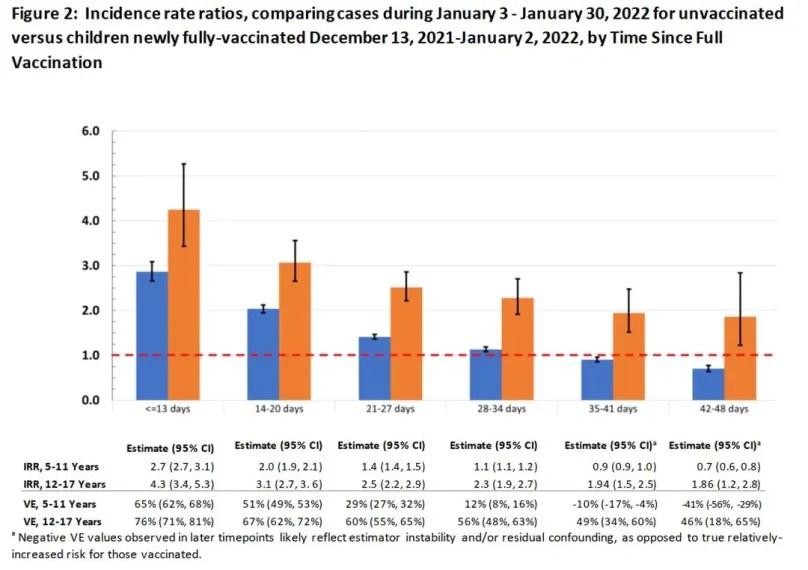
Jeremy goes on to report (correctly) that the authors of the article misinterpreted their own data. History will remember Jeremy as a reporter with great integrity.
- Moderna and Pfizer reports fail to study long-term risks. Like I said, more of the same shenanigans. In this report, for example, Moderna offers data on myocarditis only up to Day 28 after the vaccine. Why Day 28? Why not “since the vaccine has been administered” to more accurately reflect the real-world clinical situation? They also state that myocarditis in a large concern in people infected with SARS-CoV-2 – but the comparison is to the uninfected, not the vaccinated, and we know that the spike protein is the cause (syncytia among heart muscles caused by the spike protein). The spike protein, of course, is the basis of their mRNA vaccines.
- Incestuous COIs/Unjustified Influence by Regulators. Peter Marks is charged with setting the decisions at FDA whether to consider vaccines for specific populations. Why the hell is he involved in a study conducted to bolster the vaccines he is going to have to decide upon? See “Benefit-risk assessment of COVID-19 vaccine, mRNA (Comirnaty) for age 16–29 years”. That “study” is also guilty of all of the same loose logic as above; it is noteworthy that the study assumes as “worst case scenario” of zero deaths from myocarditis following COVID-19 vaccination (Credit: Toby McDonald, who wrote this to me:“I’m reading the Moderna “Sponsor Briefing Document” and they built their benefit-risk assessment off of Funk et al. (2022). So I looked up Funk and it’s a recent paper by six staffers at the FDA including Peter Marks, Richard Forshee, and Hong Yang (who wrote the dreadful benefit-risk assessment for kids 5 to 11 back in October). Quite literally in their “worst-case scenario” they predict 0 deaths from myocarditis in the vaccine group. It’s a stunning work of fiction.”
- I’m on an email thread with Steve Kirsch (he considers me part of his “debate team”. Last week, Steve challenged Peter Marks to a debate:“Hi Peter,You are right about the vaccine uptake problem. According to independent survey we just commissioned, only 33% of Americans opted to go further than the first 2 doses.You were quoted in that CNN article:“We do have a problem with vaccine uptake that is very serious in the United States and anything we can do to get people more comfortable to be able to accept these potentially life-saving medical products is something that we feel we are compelled to do,” said Dr. Peter Marks, director of the Center for Biologics Evaluation and Research.Isn’t it time for you to end the misinformation problem by debating us in a public forum?My colleagues and I look forward to hearing from you.
The only way to end the misinformation is to debate the top misinformation spreaders. You will never win by trying to censor us.
We would be HAPPY to debate to you to end the misinformation problem. As you can see from this slide deck, all the evidence we’ve been able to find shows there was clinical trial fraud and that the vaccines are very dangerous. We would love to know how we got it wrong
I look forward to hearing from you.
-steve
To my knowledge, Marks has not replied. I replied to Steve and the entire email thread, including Marks, though:
“Steve,
History is going to remember one person on this email thread in a manner in which I would not ever care to be seen associating with.
I would therefore decline to participate in such a debate.
Sincerely,
James Lyons-Weiler, PhD

I could continue and debate dozens more points in the report dump by the FDA. I don’t have to. Marks himself provides evidence of being way off-target immunologically and lying about the “need” for COVID-19 vaccines for children.
Here’s an old video of Prevaricating Peter lying about the need for “high antibody titres” for immunity, and that children’s immune response is “not enough for some of these variants” (no data on that, just words):
The comments in that video have not aged well. Call your Senator and Congressional Reps and demand that Peter Marks resign. Email them this article. Marks and the FDA are NOT basing their considerations on independent fact, science and logic. He and his cronies are either incompetent or working for the industry. Either way, he and his cronies have to go.
Nursing reports from the front lines of the COVID vaccine crisis – A stark reality is finally creeping in
The massive propaganda campaign which led doctors to disassociate from the reality of widespread vaccine injuries is slowly weakening in impact
By Pierre Kory, MD, MPA | Medical Musings | June 13, 2022
I recently posted a deeply referenced compilation of evidence detailing the historic humanitarian catastrophe that has slowly unfolded within most advanced health economies across the world. Caused by a global mass vaccination campaign led by the Pharma masters of BMGF/WHO/CDC that illogically (but profitably) targeted a rapidly mutating coronavirus. They did it with what turned out to be the most toxic protein used therapeutically in the history of medicine. In vials mixed with lipid nano-particles, polyethylene glycol and who knows what else.
I cited studies and reports showing massive increases in cardiovascular deaths and neurologic (and other) disabilities amongst working age adults, beginning in 2021 only. A disturbing signal screaming from the original clinical trials data , VAERS data, life insurance data, disability data, reports of cardiac arrests of professional athletes, rises in ambulance calls for cardiac arrests in pre-heart attack age young people, and the massive increases in illnesses and data manipulations in Department of Defense databases.
As these events become more and more recognized by the average citizen (and occasional journalist), a new pathetic “Disinformation Campaign” was launched in response trying to blame all the young people dying as simply a need for increased awareness of the rare condition called Sudden Adult Death Syndrome (SADS), rather than examples of the legions dying from the vaccines. The fact checkers also came out in support of this narrative, branding anyone who thinks the vaccines are the cause of SADS as a conspiracy theorist. Like this self-appointed social media watchdog. Mentions of SADS are popping up from many countries… all in the last few weeks. Here, here, here, here and.. oh whatever. This article even listed a dozen such publicized deaths in the past few weeks from all over the world… but blamed them all on SADS. You get it. What is nauseating is the tone of purported good intention within these articles, informing folks that if you are related to someone young who died suddenly you should go see a cardiologist to make sure you don’t have an abnormal EKG. After it turns out normal, they will assuredly tell you to get vaccinated, an absurdity atop a mountain of absurdities caused by our bio-medical-media industrial complex over the past 2+ years.
Ugh, lets move on. In this post, I will move away from numbers and data and studies to give a more qualitative view of how the vaccines’ impacts are manifesting in the “belly of the beast,” (i.e. on the inside of a major academic medical center).
I want to first share a comment made in response to another recent post of mine, by my new partner in our COVID/Long Haul/Vax Injury specialty tele-health practice. Scott Marsland is both a COVID-expert and a Nurse Practitioner Extraordinaire (you should see the reviews he gets by his patients – they are over-the-top). Anyway, Scott wrote:
The most profound reflection of this last week came from a patient who is a physician and therapist. She was hospitalized recently for non-COVID reasons and observed: “I think many of the physicians are exhibiting dissociation. It takes an enormous amount of energy to maintain their narrative and hold off the reality hitting them in the face every day.” I thought of this reading the recent piece you referenced from The Annals of Emergency Medicine.
Wikipedia:“The major characteristic of all dissociative phenomena involves a detachment from reality, rather than a loss of reality as in psychosis. Research has suggested that dissociation is inversely related to mindfulness, which is a potential treatment.“
TY PK for this dose of mindfulness.
I thought his comment was the perfect introduction to this post, where I will share disturbing “insider info,” compiled largely from recent correspondences with a senior ICU and ER Nurse, both via email and phone. Although she is not working full-time in ICU’s or ER’s anymore, she still does shifts on occasion, particularly night shifts. Night shifts, although brutal, are WAY more fun and relaxed than day shifts. That is, most of the time, unless you get slammed due to less staff being around. Although the worst shifts of my career were night ones, thankfully they were rare.
What is great about night shifts is the camaraderie and closeness that develops among staff that choose to primarily work nights. The pool of such folks is small, and they choose night shifts for various but often similar reasons (preference, child care responsibilities, other jobs, hatred of day shifts etc). The general atmosphere is more “intimate,” as you end up having conversations, longer and deeper than you would or could in the middle of a hospital day. This is because at night there are no families around, no administrators, most patients are sleeping (sort of), no masses of swirling ancillary specialists like dietitians, physical therapists, occupational therapists, speech therapists, physician sub-specialists, transporters, social workers, food service workers, maintenance folks etc.
Anyway, this was the first email I received from her (editorial note: I wrote out or translated all her abbreviations but made no other edits to substance – I had to do it as her writing style clearly reflected someone who has been writing myriad nursing notes her whole career :).
On May 12, 2022, at 7:47 PM, L. <XXXX> wrote:
I wish I could have you as my doc. Nurse of 20 yrs + ICU – cardiac, neuroICU/ neurosurgical ICU mostly, and ED at Level 1. Vax injured from 2 Pfizer doses mandated by my major University hospital system. Clotting issues, open bleeding, spontaneous with no ability to stop, weeping down arms and legs. Severe leg clot post-surgery in March. Had to get D-Dimer ordered by force at little ED I was in, and use my own portable doppler I brought in from work, b/c they had no Ultrasound techs or equipment access – TPA (clot buster med) finally. Cervical lymph nodes enlarged since vax especially, for over 1.5 yrs. Cannot biopsy at least one as it sits on my Left carotid, now wrapped around it, . Got Covid originally while working ED in March 2020. “N antibody” still high as of Nov 2021. Hit neuro, never respiratory. Had same issues with H1N1 vaccine which was also mandated and then I got Guillain Barre Syndrome and neurological weakness – out of work 5 months. Will not get any boosters or vaccines this year, but have no exemption as all docs took to the “deer in headlight” look and said nothing. I will lose my career this winter if I refuse. Functional med/family practitioner – she has a long wait list and I have no idea how she sits with this data on vaccine injured. My VAERS report – it was deleted. Pharmacist never entered as required so I did. It has vanished. My batch numbers – significant for bad neurologic responses, clotting. I lost my Hematologist-Oncologist doctor to vaccine injury – he is out and never to practice again – in his early 40s. He was a “true believer” and in denial until it was him who was the injured patient. Our cancer hospital – know most of the case managers and many doctors since they were residents. They now have case loads in the 1000s rather than 250-400 over any given quarter. Not enough bed or infusion space for the cancer patients as outpatients. Radiation treatment backlog. All at a huge cancer hospital monstrosity itself. All kinds – brain, lymph, stomach, pancreas, blood, AND EYE CANCERS – orbital especially in younger people recently vaxxed. Microvascular ischemia on rise in vaxxed younger people. Strokes way up in no-risk, no co-morbidities, young to younger-ish. Ask me anything. I’ll tell you inside scoop from the floors and suites. This has to stop. They need to admit the fraud and crime and STOP. The liability must be lifted, mandates ended. They KNOW NOW and many KNEW THEN. Don’t know if you’ll even read this, but I follow all of you on substack and Twitter – those not banned yet! – and read ALL the data. I’ve been a lab rat myself from an issue from a car accident yrs back – I know the process. So much fraud. Keep going. Never give up. Never, never, never give up. Thank you for all you do, hope that you inspire and the confirmation of that little voice in me, that said NO way back, everything was off. I did not have an option or data then. I have data now, and it will keep coming. The option is NO.
Follow up:
Lost 4 practitioners to serious side effects of “strongly encouraged” boosters. 2 hospitalized, one in MICU. The irony is, for most staff, completely lost … All in early 30s to mid 40s. They had no need for boosters while BEING OUTSIDE ALL WEEKEND even if they truly believed in efficacy of them. All had Covid previous, N antibodies fully measurable. One female, one male, both inpatient. Female still nursing newborn.
On Fri, May 13, 2022 at 11:27 AM Pierre Kory <> wrote:
I am stunned by your email. Stunned. We know it’s bad, like real bad but this is the worst inside look I have heard yet. I am on the outside and don’t talk to most former colleagues so don’t have a feel. We should talk. Would you be interviewed on a VSRF (Kirsch’s organization) webinar? I assume not, but who knows, maybe anonymously like with altered voice and blurry screen? This needs to get out. Send me contact… and name? First name is fine… Thanks for this – Pierre
She wrote again before we talked, it was this email below that prompted me to ask her number so we could discuss in more depth:
It’s the inside folks who talk to each other, and you have to speak another language depending on who’s listening. That has been a skill set unto itself. It’s texting, the phone calls from area to area with back stories on patient issues. I was getting texts from my old stat team covering cardiac catheterization lab – the clots. The clots stunned everyone…it continues. My cardiac units – where I spent the bulk of my nursing years – lung and heart transplant included – have so many anomalies presented with patients that never existed before. Re-writing the script for each new problem never encountered. The constant codes (cardiac arrests). Can’t keep up.
Lost quite a few coworkers to either VAX injury itself – took them out of the work force, OR they resigned/accepted firing or retired once mandates were settled. It’s the phone calls I have with my cohorts in the other areas of the system. The real story is in those conversations. The doctors now admitting to injury is growing, but they can’t tell their patients why they are no longer practicing. Losing specialists is big problem not easily solved.
The signaling coming from management MD/PhD administrators has not been towards what winter will bring, but is focused on congratulating everyone on clinical excellence during the last 2 yrs. I think there is great trepidation in their approach because they see the data, they know the inside info on injury, disability/death of faculty and staff not from Covid itself, but the forced vax. We lost only a few to original Covid, with underlying co-morbidities that made outcomes a given in many cases.
I can’t come on a public show, but I can share info. My name is Linda (not her real name). In my current position, I read many charts and see in depth info – so much boosting and reboosting and not following other protocols – it’s a given now that the explosions in diagnosis of the cancers and cardiac issues especially come from these decisions. In some cases, the first thing you see on a chart is huge letters stating VAXXED alongside the pt’s diagnosis, treatments thus far, which is usually at odds with normal disease course, age and projected outcome, etc. They’re pushing the vax status, in bright letters, to the top of the list so it can be considered – not for every patient, but the “challenging cases” … That may be for research purposes.
I will explain the above – what Linda is saying is that practitioners are starting to call out the patient’s vaccination status more clearly on the first screen of the medical record in those cases where they know or suspect the vaccine is related to the patients’s new “mysterious” or “complex” problem. Let’s be clear though, the doctor’s don’t necessarily or explicitly include vaccines as a possible cause in their reasoning/impression/plan section of the patient note. But it seems the nurses and junior docs are now calling it out in some small/large way. Disassociation breaking, ever so slowly?
It makes me just stop, and by end of the week, take into account cases of say, ocular orbital cancer in 20-somethings. Have had 6 in last 2 weeks with no Family History or other indicators. Out of the blue, some with brain mets now. All vaxxed unwillingly, all had Covid and recovered fine prior to employer forced vax. The employers, the areas the patients reside in….nothing in common other than the previous. The actuaries are correct. Excess mortality, let along whatever-life-left disability. Stunning numbers.
I ended up talking to Linda.. about lots of things. She is clearly a fellow spirit, highly experienced in ICU and Emergency medicine, and she told me even more disturbing developments, like the fact that on some night shifts, nurse teams are seeing more cardiac arrests in a single shift than ever before and in unprecedented younger age patients. On some shifts, they have had so many that the “crash carts” are rolled straight from one arrest to another because Pharmacy, especially on night shifts, are not able to re-stock fast enough. This situation has happened maybe once in my whole career… when two arrests happened on the same floor or unit within a short time period.
She also told me that night nurses are more openly discussing the vaccine as the cause of what they are seeing (much more than during day shifts apparently). However, they do this largely in text, and they use “code”. Their code word for a vaccination injury or cause is “that issue,” i.e. in reference to a 22 year old who suddenly arrested on the hospital ward, “he is having that issue.” Note these are nurses.. not the docs.. but some of the docs are talking to her, like the one above who performed 6 enucleations (eyeball removals) this year already in young people (very rare to have to do this, especially in this age group). She also told me about how her interventional cardiologist nurse friends related that some patients are coming in with massive heart attacks, and during the angiogram the interventional cardiologists are seeing such extensive thrombi filling the entire artery (as documented by some embalmers), that they say “I can’t stent or remove this, this guy needs surgery, like now.”
In that conversation with Linda, I was also finally able to confirm a fraud that I had suspected was occurring within U.S hospitals regarding the accuracy (or willful inaccuracy) of the vaccination status listed in the medical record of a patient newly admitted to the hospital. It has long been my strong belief that this fraud drove the U.S data used to support some of the last remaining false narratives (i.e narratives #6 and $7 below) . Note these ever-shifting narratives were all directed at combatting vaccine hesitancy, which as some of you may know, was the primary military objective of the vaccinators.

BMGF/WHO/NIH et al. had clearly identified vaccine hesitancy as the main enemy in the battle plans they drew up and distributed after their viral pandemic simulation exercises over the past decade. In this prominent medical journal publication on addressing viral pandemics, they state “the World Health Organization has listed vaccine hesitancy among the greatest threats to global health, calling for research to identify the factors associated with this phenomenon.” Vaccine hesitancy is why the HHS gave $1 Billion to U.S media to support a relentlessly positive public relations campaign supporting the uptake of vaccines.
Now let’s get back to this fraud. First, note that during all of 2021, (well, up until late November when I was let go from my last pandemic ICU job on a completely fabricated accusation), I had only taken care of one ICU patient that was officially documented in their medical record as “fully vaccinated.” I knew that it could simply not be true that only one patient that I took care of the entire year was fully vaccinated. I knew this was false based on data from countries that more transparently (mistakenly?) reported vaccination status and hospital outcomes. In multiple reports starting in February 2021, the majority of hospitalizations and deaths (even when adjusted to rates per 100,000) had long been the vaccinated.
One of the more ridiculous attempts to cover this fraud up in the U.S was a media narrative launched in June/July of 2021, created from statements by Fauci and Wollensky, that 99% of patients in hospital and dying were the unvaccinated. They literally did this with a straight face, knowing that they were including in their numerator all the deaths that occurred prior to the start of the vaccination campaign. Yup, if you died in 2020, you were reported as dying in an unvaccinated status. Not subtle. But that was not the only lie. We must never forget the famous slip by the NY times.. when they suddenly and surprisingly called out the CDC for “withholding large amounts of COVID data” throughout the pandemic. Umm.. their actual job is to collect and disseminate data. Not subtle. Even crazier is that at the time of that narrative launch, during a lecture, a CDC slide deck mistakenly showed a slide which revealed that 26% of patients in U.S hospitals were vaccinated. But this number was falsely and fraudulently lower than the actual number. By a long shot.
Here is how I think they falsely suppressed the real rate of vaccinated patients entering U.S hospitals and dying:
In the most popular electronic medical record system in the U.S (EPIC), on the sidebar of every page in the chart are the name, demographics, room number, provider team, and COVID vaccination status of the patient. What I found weird from the outset was that, in EPIC, there were only two categories under the COVID-19 vaccine status section, “Vaccinated” or “Unknown.” There was no “Unvaccinated” status. Also realize that “Unknown” was interpreted by all providers and official data as akin to being “Unvaccinated”. Everyone I took care of in the ICU in 2021, except one, had an “Unknown” vaccination status. How could that be? How come only one ICU patient of mine in the entire year was reported as being “fully vaccinated?” Even if the vaccines worked really well (which I knew they didn’t), something was off, like really off.
There was only one hypothesis I could come up with to reconcile these observations. I suspected that during the admission process to the hospital, there must have been some sort of barrier to deeming someone “vaccinated.” I hypothesized that in order to be documented as vaccinated on admission, you had to have received the vaccine from a primary care physician’s clinic who worked for that same hospital system in a system office, and that they had already documented in the electronic medical record. If you got a vaccine from anywhere else outside that hospital system’s clinic, you were assigned an “Unknown”, i.e. “Unvaccinated” status in the electronic medical record.
And lo and behold, Linda confirmed this was the case in one major health system she worked at. What I found most striking is that she worked in two different hospital systems, in one (the smaller one) it was very easy to document a patient in the record as vaccinated. The admitting nurse could accept any documentation, from a Walgreen’s card to even a verbal report from the patient or family and they could put it in the record on admission and the patient would show up as “vaccinated” on the main screen sidebar.
In the other, larger, major (and I mean major) health system she worked in, if the patient received the vaccine from anywhere but an employed provider’s clinic within the health system (even if the patient had a vaccine card on them), she was forced to put it in an “open field” buried on page 2 of the initial nursing assessment not where nobody, and certainly no physician looked for it. All these patients were automatically documented on the main screen as “Unknown”, i.e “Unvaccinated”, even if the dates of each shot were entered into that nursing note field.
This process is what led the vast majority of U.S doctors to become convinced that the only people dying in hospitals were the unvaccinated. Which made perfect sense, I mean, the vaccinators did not want anyone to know the vaccines were not preventing hospital or death, so it would be helpful to their mission if they could make everyone think that all hospital patients were unvaccinated. This way, all the health care workers would get vaccinated out of fear of dying and would also aggressively insist that all their patients and family members get vaccinated. Which is what happened. It is also why a large percentage of the population (at least the ones I meet at lectures, conferences, and symposia) no longer want to see a “system doctor” or go to a “system hospital,” no matter how grand their brand/reputation once was. Fun fact: a long-time donor of large annual gifts to the Mayo clinic.. decided to direct their donation to the FLCCC this year because they felt the Mayo Clinic had departed from their founding principles and mission. Go FLCCC.
The system docs behaved this way because they saw with their own eyes, “the (false) reality” of what would happen if you were unvaccinated. This, combined with the medical journal propaganda publishing only favorable and selective analyses of vaccine efficacy and safety drove nearly all the nation’s doctors to go completely mad.
Their fervor to vaccinate everyone and everything, even in patients who just recovered from COVID, was something to behold. I saw overt hectoring, harassment and even rage. Twitter was one of the most terrifying places to watch doctors arrogantly propagate the need to be vaccinated.. even for folks who had (often hard-earned) natural immunity. I almost feel bad for some of those docs as history will not judge them kindly. Forgive them for they know not what they do. They were literally screaming across Social Media, Media, and Medical Journal editorials, that you will be OK if you just get vaccinated. The high profile docs were the worst, except I have little sympathy for them as some/many/most were likely complicit in the deception rather than just fooled like the rest. Folks like Eric Topol, Peter Hotez, Alastair McAlpine, Tom Friedan (who I used to deeply admire as NYC Health Department Commissioner), Eric Feigl-Ding-(bat), Jeremy Faust (probably the biggest ignoramus on Twitter, having taken an early lead in that competition since the pandemic broke in 2020), and Monica Gandhi. Leana Wen deserves particular ire as she is the most active prostitute for the Pharma-captured federal health agencies on mass media. A media darling as it were.
Then you started to see doctor walk-outs protesting the unvaccinated, increasing numbers of doctors publicly stating they would start refusing to see unvaccinated patients, heck, the Pharma controlled outlet called Medscape even got an ethicist to argue that it was OK to refuse to treat the unvaccinated. Yup. Crazy town. Clown World. One of my patients who is a hospital pharmacist even told me that at her hospital, the hospitalists were vaccinating patients admitted for COVID..as they were being discharged from the hospital. That’s right, as the patients were being discharged after having recovered from COVID, they were recommending and administering vaccines for the same illness. I even heard of one case where a team of clinicians decided to vaccinate a severely ill COVID patient in the ICU.
I also witnessed aggressive attacks in one of the nation’s largest medical-centers staff physician email forum. Doctors “screaming” that everything would be fine if everyone just got the damn vaccine. Deriding anyone bringing forth arguments about untested safety, suspicious efficacy data, and concerns about mandates violating patient autonomy and medical ethics. Anyone who brought forth “adverse data” towards the vaccines were treated with dismissal and a retaliatory posting of selectively favorable data with the imprimatur of the Pharma captured agencies and Pharma captured journals. I will never forget this time in the history of medicine. Ever.
Some other “insights” into the medical system I haver come across, from another ER nurse:
I have no research to offer but first hand experience from working as an RN
in an ER.Ringing in ears and hallucinations have followed vaccinations in 3 of my
patients. Family members at a loss. I mention the vaccine but most don’t
even hear it…The gentleman with the ringing in the ears (just had his 4th booster the day
before) I suggested he didn’t get any more boosters as ringing in the ears
is an adverse reaction to the vaccine. His wife looked at me and yelled
“his doctor told him he won’t survive the anti-virals for COViD” I was
speechless. The patient continued on and told me about his experience with
the vaccines 1st shot-he had a seizure, doctor recommended 2nd shot. After
2nd shot he was very sick, doctor recommended 3rd shot and he was
hospitalized 4th shot ringing in ears, abdominal bloating and months away
from dialysis. Wife added that she also had seizure after first vaccine and
she had that attitude that it was no big deal.I have said this before, it’s criminal what is happening. I have cried on
my way home from shifts, I tell whoever will listen. The information I have
collected over the last 7 months (time of vaccine/booster in relation to
chief complaint) is jaw dropping.I took a break from working for the summer but continue to keep in touch
with the nurses…My friend told me about an 80yr old man, 4 strokes in the last year and
they all line up with his 4 shots but the doctors response is “he’s 80,
he’s going to have strokes”Has anyone come across research in regards to GI bleeds and low hgb? I have
a lot of this patients, GI bleeds out of the blue… and they are young!I had 28yr old black obese young woman… new diagnosis of enlarged heart
and CHF. Vaccine was roughly 1 month prior to ER admit and I suggested no
more vaccines for COViD and her response was “my doctor told me this
happened because I got the vaccine and a tattoo on the same day”60ish lady…….just got over COViD (after have 3 COViD vaccines) and she told
me she was going in for second booster next week!!!!!!Kids are having random seizures and are put on anti-seizure medication for
2 years…when I ask parents what caused the seizure, the neurologist has no
idea. All these children vaccinated for COViD-100%. NO ONE CONNECTS THE
DOTS.The screenshot below is of 3 days I worked and I’m in the ER for 12 hours
and don’t see all admits. I’m also super busy so it’s hard to check status
of all admit patients… of course this is very limited information but a lot
of the patients have some issue 2-3 months post vaccine/booster.
I’m still shocked we don’t have a “vaccine team” monitoring all the
patients as they come into the ER but no one cares. Not the ER medical
director, not the doctors, not the COViD response team…..no one. Nurses see
it and they are talking but many are fearful of getting fired.Thank you for all that you are doing! Although I can’t read all the emails,
I am just happy to know that there are others out there that are in the
same boat as I am.I’m disgusted with the AMA and AAP. I don’t trust a thing they say. I don’t
trust them with my four children as they have not protected our children
over the past 2 years.Thank you!
And another:
May 26 05:28PM -0400
Katie (not her real name),
Thank you for sharing your story! This is what I live every day and I tell my husband how hard it is to see so much damage. I have had more patients diagnosed with aggressive cancers than I have seen in the last two decades.
… I’ve been so especially concerned about the clotting effects with Total joints treated with Tranexamic Acid. I’ve been keeping track of my patients (that I would consider) have had mild/moderate vax injury. i.e. – reactivation of latent viruses, (oral herpes (not just one or two lesions, but their whole mouth broke out – something that had never happened before) shingles – affecting their eyes, that took more treatment than normal) – Histoplasmosis; *blood clots/Cardiac problems – Stroke from new onset Atrial fib in a patient on blood thinners within 12 hr post injection, Atrial fibrillation in a healthy, athletic 34 yr old male, new onset hypertension without prior history; * Persistent cough, months of diarrhea, migraine, neuropathy of upper extremity to the extent she could not write/type – all extensively checked out without cause. But, all within a few days/weeks/couple months of injection. All my practitioners are still advocating the Vax!!! What do you think we should do??? I’ve got to get the guts to gently visit with our Chief of Staff. CRNA, Colorado
Last one, from a colleague:
Just had dinner with my friend, a colleague friend of his here, Dr XXX renowned YY Physician . PRO Vaccine. Was adamant all physicians should get the vaccine and should not be able to practice without it. Was a trailblazer for the vaccine here. He got boosted around Christmas time, had a stroke less than a week after, lost his eyesight in one eye, lost his practice, cannot be a doctor any longer, and said undoubtedly it was from the Pfizer vaccine and encouraged all of his doctor friends to max out their disability insurance to protect themselves. I know not surprising to you, but this guy was so pro vaccine and clearly admits his stroke and his loss of eyesight from the vaccine!!
And then there is this doozy – another nurse sent me a case history below of an elderly woman whose blood thinner was highly “supra-therapeutic” (i.e. very thin blood at risk of major bleeding), yet she had a massive stroke caused by a blood clot. This simply does not happen.
El Fin.
The UK changed the definition of “case” to INCREASE Covid numbers. Again.
By Kit Knightly | OffGuardian | June 11, 2022
Yesterday Sky News and the Huffington Post and several other outlets all flared up near-identical headlines warning that …
Covid Infections Increase For First Time In Two Months
The HuffPo goes on to explain in more detail…
The jump is thought to have been caused by increases in cases compatible with the original Omicron variant BA.1 and the newer variants BA.4 and BA.5, according to the Office for National Statistics.
All the articles cite the Office of National Statistics (ONS) talking about Omicron and seem to consider this an explanation.
None of them mentions the fact the UK’s Health Security Agency (UKHSA) literally changed the definition of a Covid “case” back in February, making it almost inevitable cases would go up.
It’s all detailed in this post from the UKHSA site, helpfully titled “Changing the COVID-19 Case Definition”.
The article explains that the UKHSA will be moving on from the traditional meaning of “cases”, and instead counting what they call “case episodes”.
Meaning that, up until now, one person repeatedly testing positive for “Covid” throughout the pandemic was considered one “case”:
Until now, COVID-19 cases have been reported at the individual level: every positive test taken and reported by one person has been considered part of a single case record, initiated by their first positive test.
But from now on different positive tests of the same person will be considered separate “cases” as long as they are 90 days apart:
Positive test results that are 90 days apart (regardless of negative tests in between) will be considered as a separate episode of infection, and therefore the person is counted as a case more than once.
The supposed justification for this decision is “waning immunity” and the Omicron variant causing spikes in “reinfections”:
Although reinfections were initially very rare, we have seen the number rising slowly over the last two years, as immunity from prior infection wanes and new variants emerge. During the Omicron variant wave, the number and proportion of people being reinfected with SARS-CoV-2 has increased.
However, the inevitable consequence of this decision will be to make the case numbers go up. The press not including this in their story about the rising case numbers is – at best – astonishing incompetence.
In fact, making case numbers go up is literally the only impact it will have.
The UKHSA goes out of its way to point this out, highlighting that the change will have no effect at all on how they monitor infections, since they already treat new positive tests as new cases for the purpose of contract tracing, and have been doing so all along:
contact tracing has undertaken a very safe practice of following all positive cases, regardless of whether they were possible reinfections or cases of prolonged infection.
So, in short, whether or not the change is scientifically justified, it is a purely aesthetic one that will have no impact on anything, except to make case numbers look bigger.
And, of course, it’s not scientifically justified.
They have already stretched the meaning of “cases” well past its breaking point by defining anyone who tests positive as a “Covid case” whether or not they have any symptoms.
Now every single person who, over the past two years, tested positive on the useless PCR tests and was declared a “case”, can test positive again on the same useless PCR and be declared a new case.
Of course, messing with language to inflate statistics has been the modus operandi since the beginning of the “pandemic”. “Fully vaccinated”, “herd immunity”, “cause of death”, “vaccine”, “case” all have been subject to “updated” definition.
Clearly, this further torturing of statistics is about maintaining the flagging “pandemic” narrative.
Allowing people to become more than one “case” means the ever-increasing numbers of people rejecting the vaccines, masks and hysteria can be countered by the steadily dwindling number of NPCs who still religiously take Covid at face value.
It’s a desperation move. One that, hopefully, people will see right through.
Featured Video

Trita Parsi: Middle East Unraveling — Are We on the Path to World War?
or go to
Aletho News Archives – Video-Images
New Book
Trans agenda is ‘normalization of sadism’ – US author
RT | September 23, 2026
The US Democratic Party has embraced a transgender agenda that amounts to “the normalization of sadism,” author A.J. Rice has said, warning that radical trans policies would return if the party is allowed to regain power.
Speaking to RT’s America First host Scotty Nell Hughes about his new book, ‘The Curse of the Bearded Lady: How the Trans Mafia Whacked American Sanity’, Rice argued that activists have gained significant influence in schools, medicine, and corporate America while people who questioned the agenda have faced pressure to stay silent.
The author described the “trans mafia” as the sprawling network of people and institutions that have helped the movement gain influence. He singled out parts of academia, wealthy backers, and corporations, and stated that providers of transition-related treatment also have a financial incentive to keep young people in their care indefinitely.
Rice argued that the consequences of these policies ultimately fall on children who are being drawn toward gender-affirming medical treatments and on girls who are expected to share locker rooms or compete in sports with biological males.
He noted that while voters rejected the Democrats’ approach to gender in 2024, the party, which has been “captured by madness,” has since only doubled down and is seeking what is effectively “the normalization of sadism.” … Full report
Blog Roll
 Aletho News
- Refaat Al-Areer Was The Canary In The Coal Mine In Israel’s War On The Truth
- Israeli election committee bars candidate from Knesset race over Gaza war opposition
- French-Lebanese man files war crimes complaint over Israeli attacks
- Mahan Air Flight Lands in China Despite US Threat against Iranian Airlines
- US eyes $10bn fund to rebuild war-battered Gulf infrastructure
- Trump meets Rodríguez near Maduro’s prison as Venezuela’s oil flows to US
- Trita Parsi: Middle East Unraveling — Are We on the Path to World War?
- Iran FM meets with US envoy on UN meeting’s sidelines at American side’s insistence: Report
- Qatar PM calls for Gulf security framework with Iran, says war must be ‘wake-up call’
- China condemns US extortion of Iranian airlines, rejects Washington’s ‘illegal’ sanctions threats
- If Americans Knew
- An error has occurred; the feed is probably down. Try again later.
- No Tricks Zone
- New Study: Earth And Venus Surface Warmth Largely Explained By Convection And Lapse Rate, Not CO2 Or Radiation
- 2025 Nature Paper Claiming Worsening Global Drought Gets RETRACTED …Heavily Flawed
- New Study: ‘Global Drought Shows No Detectable Recent Acceleration Under Climate Warming’
- Economic Masterminds: German Socialists Suggest Taxing Productivity Gains Stemming From Using AI
- The South China Sea Has Not Been Cooperating With The Climate Change Narrative
- Energy Crisis: Germany Enters Heating Season With Historically Low Gas Reserve Fill Levels
- New Study: The Antarctic Ice Sheet Gained Mass From 2020-2024 Due To Staggering Snow And Ice Accumulation
- Study: Ocean Heating Rates From Thousands Of Years Ago ‘Dwarf’ Modern Ocean Heating Rates
- Climate Extremists Target, Attack Large-Scale Power Grid Infrastructure In Germany!
- New Study: Antarctic Ice Melt Has Contributed Less Than 1 Centimeter To Sea Level Rise In The Last 30 Years

