The Research Is Clear: Ivermectin Is a Safe, Effective Treatment for COVID. So Why Isn’t It Being Used?
By Elizabeth Mumper, M.D., FAAP | The Defender | October 4, 2021
A patient with Type 1 diabetes called to tell me the pharmacist at our local Walgreens refused to fill the prescription I had written for ivermectin, so I called to ask why.
The young pharmacist, a few years out of pharmacy school, informed me he did not understand why I was using ivermectin for early treatment of COVID because “SARS-CoV-2 does not have an exoskeleton.”
I explained I was not using ivermectin as an anti-parasitic medication, but that it had impressive data as an anti-inflammatory and anti-viral.
Furthermore, as a pediatrician, I have more than 40 years of experience managing multiple viral illnesses. There is value in treating viruses early, often with inexpensive natural remedies, rather than “staying at home until you have problems breathing then go to the hospital” as U.S. public officials have advised for COVID.
The pharmacist was not buying my initial explanation. “I am not going to fill prescriptions for ivermectin that are used in pseudo vaccine doses,” he told me.
I was surprised a young pharmacist was able to override an experienced physician’s prescription, effectively removing an inexpensive prevention and treatment option for selected patients in the middle of a pandemic.
The medical educator in me kicked in. “I would be happy to send you some references about the use of ivermectin for treatment and prevention. There are impressive studies from Argentina, Peru, Africa and India that suggest much better outcomes than we are achieving here in the U.S. with our single-minded focus on vaccines.”
He told me the U.S. Food and Drug Administration (FDA) did not recommend ivermectin for COVID. I asked to see the documentation and he agreed to fax it to me.
I hand-delivered 93 references and a great review article to the Walgreens.
The pharmacist faxed back a post from March 5, on the FDA website entitled “Why You Should Not Use Ivermectin to Treat or Prevent COVID-19.”
The next day, I received notice that a pharmacy in Northern Virginia would not fill any prescriptions for ivermectin if the diagnosis code mentioned COVID.
I had written an ivermectin prescription for a patient who has a history of bad reactions to vaccines and significant autoimmune illness. His adolescent age means that he is at very low risk of death from COVID itself.
Based on my experience as his doctor for over a decade, I was worried about potential adverse events if he got the COVID vaccine. I dug into the data about ivermectin, and it seemed like a great option for him to have on hand for early treatment of COVID if he got sick.
A pharmacist in a drug store, who never examined my patient or learned his extensive medical history, got to trump my best medical judgment by refusing to fill the prescription.
The same day, in a conversation with a compounding pharmacy, we learned of a case in which a patient’s family had to take a hospital to court to obtain treatment with ivermectin.
Bear in mind that the safety profile for ivermectin is excellent and the drug is spectacularly less expensive than the vast majority of hospital interventions.
Three days later, on a zoom call with a colleague whose parents live in Colorado, I learned that a pharmacist at a major drugstore was not only refusing to fill ivermectin for 86- and 87-year-old patients who held valid prescriptions, but the pharmacist was taking the initiative to remind the other King Soopers pharmacies in the state not to fill those prescriptions either.
My analysis of the medical literature is that ivermectin has an impressive safety record and there are multiple studies from around the globe suggesting it can decrease morbidity and mortality from COVID 19.
Two doctors who were actually in the ICU treating real patients, Dr. Paul Marik and Dr. Pierre Kory, looked at their prior experience with similarly sick patients and reviewed treatment strategies to determine what could be helpful.
As Dr. Anthony Fauci advised us to “stay home and wait for the vaccine,” frontline doctors took care of the patients before them, learning valuable lessons about what worked and what did not.
Let’s hit the highlights, quoting directly from the review paper by Kory et al, Jan 2021:
- Since 2012, multiple in vitro studies have demonstrated that ivermectin inhibits the replication of many viruses, including influenza, Zika, Dengue and others (Mastrangelo et al., 2012; Wagstaff et al., 2012; Tay et al., 2013; Götz et al., 2016; Varghese et al., 2016; Atkinson et al., 2018; Lv et al., 2018; King et al., 2020; Yang et al., 2020).
- ivermectin inhibits SARS-CoV-2 replication and binding to host tissue via several observed and proposed mechanisms (Caly et al., 2020a).
- ivermectin has potent anti-inflammatory properties with in vitro data demonstrating profound inhibition of both cytokine production and transcription of nuclear factor-κB (NF-κB), the most potent mediator of inflammation (Zhang et al., 2008; Ci et al., 2009; Zhang et al., 2009).
- ivermectin significantly diminishes viral load and protects against organ damage in multiple animal models when infected with SARS-CoV-2 or similar coronaviruses (Arevalo et al., 2020; de Melo et al., 2020).
- ivermectin prevents transmission and development of COVID-19 disease in those exposed to infected patients (Behera et al., 2020; Bernigaud et al., 2020; Carvallo et al., 2020b; Elgazzar et al., 2020; Hellwig and Maia, 2020; Shouman, 2020).
- ivermectin hastens recovery and prevents deterioration in patients with mild to moderate disease treated early after symptoms (Carvallo et al., 2020a; Elgazzar et al., 2020; Gorial et al., 2020; Khan et al., 2020; Mahmud, 2020; Morgenstern et al., 2020; Robin et al., 2020).
- ivermectin hastens recovery and avoidance of ICU admission and death in hospitalized patients (Elgazzar et al., 2020; Hashim et al., 2020; Khan et al., 2020; Niaee et al., 2020; Portmann-Baracco et al., 2020; Rajter et al., 2020; Spoorthi V, 2020).
- ivermectin reduces mortality in critically ill patients with COVID-19 (Elgazzar et al., 2020; Hashim et al., 2020; Rajter et al., 2020).
- ivermectin leads to striking reductions in case-fatality rates in regions with widespread use (Chamie, Juan, 2020).
- The safety, availability, and cost of ivermectin is nearly unparalleled given its near nil drug interactions along with only mild and rare side effects observed over almost 40 years of use and billions of doses administered (Kircik et al., 2016).
- ivermectin was successful at controlling several diseases which blighted the lives of billions living in poverty in the tropics.
- ivermectin’s discoverers were awarded the Nobel Prize in Medicine in 2015.
- ivermectin is included in the World Health Organization’s “List of Essential Medicines.” It has been widely distributed in countries like India for pennies a day. The out-of-pocket cost of ivermectin at my Walgreen’s is more than$1,000.
Kory and Marik compiled eight studies (three randomized controlled studies and five observational controlled studies) demonstrating efficacy in prevention of COVID-19 with significant decreased transmission.
They found 19 controlled studies that showed significant impacts on time to recovery, hospital stay, decrease in viral loads, reductions in duration of cough and decreased mortality.
In medical history pre-COVID, this body of research about ivermectin would be applauded for bringing value in the midst of a pandemic. In the medical era pre-COVID, the judgment and experience of clinicians at the patient’s bedside counted for something.
Pre-COVID, we taught medical students to use keen observational skills and keep accurate records of whether the patient improved or deteriorated after the treatment strategies used.
In the Age of COVID, pharmacists who chide doctors that “COVID does not have an exoskeleton” deny patients ivermectin — a safe, cheap, effective and potentially life-saving early treatment.
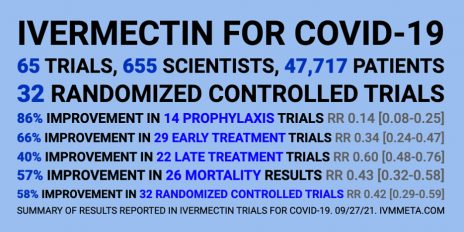
If you or your patients are having trouble getting ivermectin prescriptions filled for COVID 19 prevention or treatment, see this excellent resource from the Front Line COVID 19 Critical Care Alliance.
© 2021 Children’s Health Defense, Inc. This work is reproduced and distributed with the permission of Children’s Health Defense, Inc. Want to learn more from Children’s Health Defense? Sign up for free news and updates from Robert F. Kennedy, Jr. and the Children’s Health Defense. Your donation will help to support us in our efforts.
Winter is coming, and so are the nudges.
The UK government’s Winter Plan is rife with nudges
By Laura Dodsworth | October 4, 2021
There’s a chill in the air. Not from the changing seasons, it’s still beautifully balmy, but because the behavioural scientists’ fingertips have traced a hoar frost of psychocratic nudge on the government’s “Autumn and Winter Plan”.
The UK government’s Winter Plan plan contained some welcome news. The most draconian schedules of the Coronavirus Act will be revoked, including the powers to close schools, allow potentially infectious people to be detained, and restrictions on gatherings and events. The language around the plan’s launch was thankfully more cool-headed. The times are “challenging” but it is no longer claimed that Covid is the “biggest threat this country has faced in peacetime history”.
But the plan is also rife with “nudges” – sneaky ways to prime, prepare and prod you into the desired mindset and course of action.
The contents are freighted with the sunk cost fallacy; we’ve come so far, we mustn’t allow our good work to be undone. This also taps into people’s innate sensitivity to loss.
The trigger from Plan A to Plan B will be “unsustainable pressure” on the NHS rather than deaths. It’s under serious pressure every winter so consider yourselves to be put on notice.
There are other indications of the inevitability of Plan B. I spoke to behavioural scientist Patrick Fagan, who observed that:
“the Plan A / Plan B approach is a classic example of the foot-in-the-door technique. Firstly it makes us accept Plan A because, compared to Plan B, it looks more reasonable; then, once we have accepted and acclimatised to Plan A, we are more likely to then accept Plan B, because it is just one extra step on top of the commitment we’ve already made. The announcement of Plan B may also be an example of the mere exposure effect: simply by talking about the measures (even if, ironically, saying they won’t be implemented), the government makes them more familiar and therefore more psychologically acceptable.”
Bizarrely, after 18 months we’re trapped in a Groundhog Day of modelling and worst case scenarios. Almost a year ago, on the 21st September, Chris Whitty and Patrick Vallance warned of infections hitting 50,000 per day by mid-October in their “Shock and Awe” presentation. When the day arrived, the moving average was 16,228.
According to the doom-mongers at SAGE, up to 7,000 people could be hospitalised per day within the month. And this September the modellers were wrong once again – hospitalisations peaked at about a 1,000 a day and are now falling.
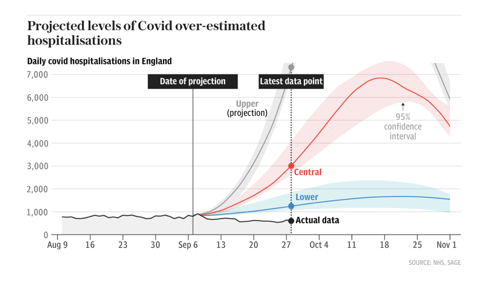
Source: The Telegraph
The big numbers both fuel the policies and justify them. It doesn’t matter that there are more optimistic scenarios, or that the modelling has limitations, because the first supine headline sticks in the brain. The behavioural psychology principle of “salience” draws your attention to what is novel and risky.
Dr Alex De Figueiredo, who conducts mathematical and statistical analyses for the Vaccine Confidence Project, told me that:
“Since the beginning of the pandemic it seems many modelling assumptions, such as the infection fatality rate, have been quite pessimistic. I think this has been why many of the predictions — such as hospitalisations and deaths — have been overstated. It also appears there has been little effort to validate forecasts out-of-sample, such as applying the models to Sweden or Florida, who have had far fewer restrictions.”
There are no quantifiable measures for what justifies each step from Plan A to Plan B. The parameters are fluid, unspecified. This creates confusion and stress, which infantilises people and makes them look to the government for direction. Essentially, confusion increases compliance.
The threat of lockdown hangs like a Sword of Damocles. Will we, or won’t we? It seems unlikely that the public and businesses could be persuaded again. Regardless, the threat of lockdown might be leveraged to justify the introduction of Covid Passports, in what is known as a “reciprocation nudge” – we appear to be given a concession in return for reduced resistance to another option.
Covid Passports have been vigorously opposed by MPs and civil liberties groups, and there hasn’t been a vote in Parliament yet. Despite this, they squat in Plan B as a fait accompli, in the denouement of the “door in the face” technique. This is when a huge request is made, then refused, to be followed by a second smaller request, in this case relegation to Plan B and for limited venues only. Boris Johnson said that it’s “not sensible to rule out this kind of option now when it might still make the difference between keeping businesses open or not.” But why would it be sensible when the Public Administration and Constitutional Affairs Committee produced a damning report against them and found the government could make no scientific case in their favour?
Covid Passports appear to be a behavioural science tool, used to increase vaccine uptake. This may backfire. ‘A Cross-Sectional Study in the UK and Israel on Willingness to Get Vaccinated against COVID-19’ found that vaccine passports deter a significant minority of people who want autonomy over their bodies. This also chimes with the research conducted by De Figueiredo and colleagues at The Vaccine Confidence Project. The bullying and resultant mistrust may impact Covid-19 vaccine uptake as well as other public health initiatives.
When my book A State of Fear: how the UK government weaponised fear during the Covid-19 pandemic was published some people believed, quite quaintly, that public health measures and messaging were unrelated to behavioural science. I think that the book and the writings of other academics and journalists have moved the dial. Once nudge is seen it can’t be unseen. The public increasingly see the nudge. If the behavioural scientists have been dazzling people with card tricks they have over-played their hand.
As such, there is more honesty about the purpose Covid Passports serve. Nicola Sturgeon, Scotland’s First Minister, said that the passport scheme
“will not eradicate transmission completely but it will help reduce it in some higher risk settings, and it will maximise protection against serious illness. And we believe – as we have seen already in some other countries – it will help encourage take-up of the vaccine.”
Similarly, Linda Bauld, Professor of Public Health and Interim Social Policy Adviser to the Scottish Government, also admitted that Covid Passports are “to increase uptake in vaccination” and the “rationale” is that it particularly boosts vaccination in 18 to 29 year olds.
While Covid Passports are in Plan B, Ministers say different things about them each day. Within the space of a week, Sajid Javid scrapped them but also didn’t rule them out for pubs. Javid admitted there’s “no evidence” for them but Boris Johnson called them “sensible”. Does the left hand not know what the right hand is doing? Or maybe a big behavioural science brain lurks in between. The epidemic management is reminiscent of the uncertainty created by Vladislav Surkov in the Soviet Union to deliberately turn politics into a performance of confusion – you don’t know what’s real anymore.
There are never-ending question marks over travel, although double-vaccinated travellers will no longer need expensive and inconvenient PCR tests. The double-jabbed will delight in the news, and it sounds sensible on the surface. However, this is not about “following the science”, since the previously infected do not benefit from the exemption. This is an incentive, a classic nudge, to encourage jabs. The vaccinated are rewarded and the unvaccinated are punished. Bearing in mind that negative tests and prior infection could suffice, this decision reeks of disdain for personal autonomy.
Vaccines for 12 to 15 year olds have been authorised. Politicians have stirred up debate amongst all corners regarding whether children should be jabbed with their parents’ consent or not. This utilises what Patrick Fagan calls “the leapfrog effect”. He says,
“it leapfrogs one stage of the debate and in doing so, sets the baseline assumptions which become accepted implicitly. Specifically, by having people debate whether or not parents’ consent should be sought, they are establishing the unspoken assumption that children should receive the jab in the first place. Those who think they are debating the government, arguing that parents’ consent is needed, are actually accepting its true goal, to jab kids.”
The government might be more in control of the narrative than many people like to believe. (Of course, chaos and confusion are alternatives…)
Worryingly, can teens truly provide informed consent? Throughout 2020 they were exhorted not to “kill granny”, which would provoke fear, shame and stress. Ads on Tiktok tell youngsters that the way to get back to normal is to take the vaccine. The vaccine will be rolled out in schools which will create peer pressure, in a particularly egregious use of “norms”. Finally, if the JCVI found the decision difficult, how is a 12 year old supposed to weigh up the evidence? (Nudging teens is the subject matter of my next article.)
Since the Cabinet reshuffle, Michael Gove has been informally dubbed the ‘Minister for Christmas’. Boris Johnson joked that he “didn’t want to have to cancel Christmas again”. Did you know Christmas might be cancelled and needs saving? You do now, the idea has been “seeded”.
Although it is ostensibly supply chains which threaten Christmas, the joke draws a comparison with last year’s Covid reasons. Again, you are put on notice. The nudges are still focussed on increasing vaccination, for now, but the threat to Christmas might hint at the beginning of a behavioural science approach to meet green targets.
We must be good boys and girls if we want Santa to come. And be aware, the nudgers are drafting our collective New Year’s Resolutions.
U.K. Suffers High Death Toll Despite Massive Spending to Combat Covid
The Daily Sceptic | October 4, 2021
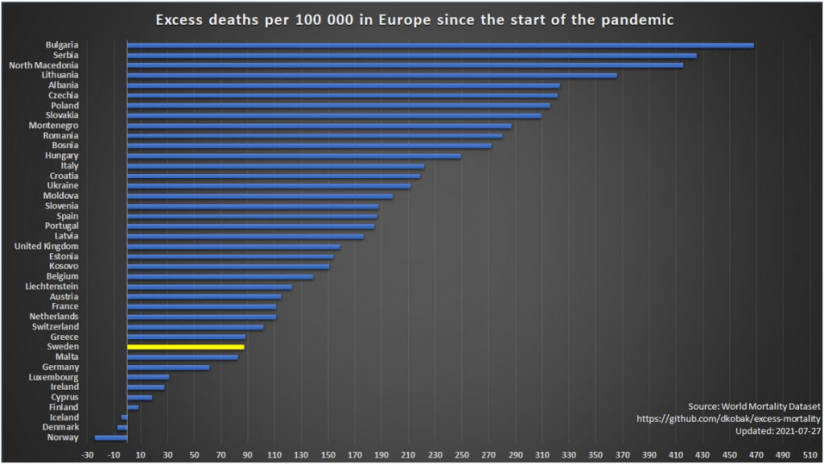
There follows a guest post by a subeditor and long-time Daily Sceptic reader who is keeping his identity anonymous. He has spotted that spectacular healthcare spending and impressive vaccination rates have not brought the U.K. obvious rewards against Covid. (Sweden is highlighted in the graph above because, by imposing the fewest restrictions, it is the closest Europe has to a control.)
Recent figures for European countries from the World Mortality Dataset, depicted in the graph above, reveal that island nations have fared particularly well during the pandemic: Iceland, Cyprus, Ireland and Malta have all recorded low levels of excess deaths. However, there is one noteworthy exception – the U.K.
In fact, even the third poorest country in Europe, Kosovo, riven by war in the late 1990s, and only an independent state since 2008, has performed better. This is despite the Balkan country having, per capita, a fraction of our health service facilities, staff and expertise.
The double-vaccination rate in Kosovo, currently 30% of the population, is a long way behind the U.K. on 66%.
Excess mortality is widely regarded as the best measure of a country’s success in coping with a prolonged health crisis, such as a bad flu season, as it allows for differing evaluations of the causes of death, notably whether they have been ‘with’ or ‘of’ Covid, and disregards arbitrary time limits, such as within 28 days of a positive PCR test. All other deaths, such as those brought on by lockdown measures, are also, of course, included in these statistics.
This evidence shows that spending billions of pounds above normal on health services and staff, and enticing a large proportion of a population to get vaccinated, do not necessarily correlate with a lower number of deaths.
436 Randomly Generated ‘Peer Reviewed’ Papers Published by Springer Nature
By Mike Hearn • The Daily Sceptic • October 3, 2021
The publisher Springer Nature has released an “expression of concern” for more than four hundred papers they published in the Arabian Journal of Geosciences. All these papers supposedly passed through both peer review and editorial control, yet no expertise in geoscience is required to notice the problem:
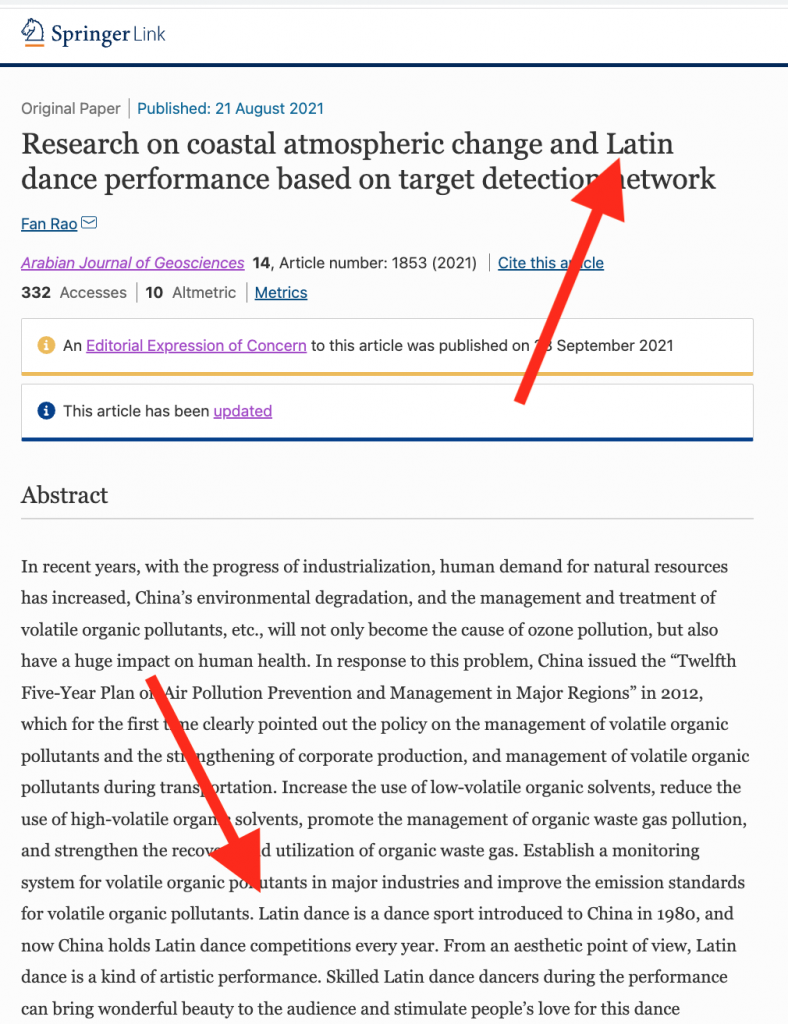
The paper can’t decide if it’s about organic pollutants or the beauty of Latin dancing, and switches instantly from one to the other half way through the abstract.
The publisher claims this went through about two months of review, during which time the editors proved their value by assigning it helpful keywords:

If you’re intrigued by this fusion of environmental science and fun hobbies, you’ll be overjoyed to learn that the full article will only cost you about £30 and there are many more available if that one doesn’t take your fancy, e.g.
- Distribution of earthquake activity in mountain area based on embedded system and physical fitness detection of basketball
- Detection of rare earth elements in groundwater based on SAR imaging algorithm and fatigue intervention of dance training
- Detection of PM2.5 in mountain air based on fuzzy multi-attribute and construction of folk sports activities
- Characteristics of heavy metal pollutants in groundwater based on fuzzy decision making and the effect of aerobic exercise on teenagers
Background
Peer-reviewed science is the type of evidence policymakers respect most. Nonetheless, a frequent topic on this site is scientific reports containing errors so basic that any layman can spot them immediately, leading to the question of whether anyone actually read the papers before publication. An example is the recent article by Imperial College London, published in Nature Scientific Reports, in which the first sentence was a factually false claim about public statistics.
Evidence is now accruing that it’s indeed possible for “peer reviewed” scientific papers to be published which have not only never been reviewed by anybody at all, but might not have even been written by anybody, and that these papers can be published by well known firms like Springer Nature and Elsevier. In August we wrote about the phenomenon of nonsensical “tortured phrases” that indicate the usage of thesaurus-driven paper rewriting programs, probably the work of professional science forging operations called “paper mills”. Thousands of papers have been spotted using this technique; the true extent of the problem is unknown. In July, I reported on the prevalence of Photoshopped images and Chinese paper-forging efforts in the medical literature. Papers are often found that are entirely unintelligible, for example this paper, or this one whose abstract ends by saying, “Clean the information for the preparation set for finding valuable highlights to speak to the information by relying upon the objective of the undertaking.” – a random stream of words that means nothing.
Where does this kind of text come from?
The most plausible explanation is that these papers are being auto-generated using something called a context-free grammar. The goal is probably to create the appearance of interest in the authors they cite. In academia promotions are linked to publications and citations, creating a financial incentive to engage in this sort of metric gaming. The signs are all there: inexplicable topic switches half way through sentences or paragraphs, rampant grammatical errors, the repetitive title structure, citations of real papers and so on. Another sign is the explanation the journal supplied for how it occurred: the editor claims that his email address was hacked.
In this case, something probably went wrong during the production process that caused different databases of pre-canned phrases to be mixed together incorrectly. The people generating these papers are doing it on an industrial scale, so they didn’t notice because they don’t bother reading their own output. The buyers didn’t notice – perhaps they can’t actually read English, or don’t exist. Then the journal didn’t notice because, apparently, it’s enough for just one person to get “hacked” for the journal to publish entire editions filled with nonsense. And finally none of the journal’s readers noticed either, leading to the suspicion that maybe there aren’t any.
The volunteers spotting these papers are uncovering an entire science-laundering ecosystem, hiding in plain sight.
We know randomly generated papers can get published because it’s happened hundreds of times before. Perhaps the most famous example is SCIgen, “a program that generates random Computer Science research papers, including graphs, figures, and citations” using context-free grammars. It was created in 2005 by MIT grad students as a joke, with the aim to “maximize amusement, rather than coherence“. SCIgen papers are buzzword salads that might be convincing to someone unfamiliar with computer science, albeit only if they aren’t paying attention.
Despite this origin, in 2014 over 120 SCIgen papers were withdrawn by leading publishers like the IEEE after outsiders noticed them. In 2020 two professors of computer science observed that the problem was still occurring and wrote an automatic SCIgen detector. Although it’s only about 80% reliable, it nonetheless spotted hundreds more. Their detector is now being run across a subset of new publications and finds new papers on a regular basis.
Root cause analysis
On its face, this phenomenon is extraordinary. Why can’t journals stop themselves publishing machine-generated gibberish? It’s impossible to imagine any normal newspaper or magazine publishing thousands of pages of literally random text and then blaming IT problems for it, yet this is happening repeatedly in the world of academic publishing.
The surface level problem is that many scientific journals appear to be almost or entirely automated, including journals that have been around for decades. Once papers are submitted, the reviewing, editorial and publishing process becomes handled by computers. If the system stops working properly editors can seem oblivious – they routinely discover they published nonsense only because people who don’t even subscribe to their journal complained about it.
Strong evidence for this comes from the “fixes” journals present when put under pressure. As an explanation for why the 436 “expressions of concern” wouldn’t be repeated the publisher said:
The dedicated Research Integrity team at Springer Nature is constantly searching for any irregularities in the publication process, supported by a range of tools, including an in-house-developed detection tool.
The same firm also proudly trumpeted in a press release that:
Springer announces the release of SciDetect, a new software program that automatically checks for fake scientific papers. The open source software discovers text that has been generated with the SCIgen computer program and other fake-paper generators like Mathgen and Physgen. Springer uses the software in its production workflow to provide additional, fail-safe checking.
A different journal proposed an even more ridiculous solution: ban people from submitting papers from webmail accounts. The more obvious solution of paying people to read the articles before they get published is apparently unthinkable – the problem of fake auto-generated papers is so prevalent, and the scientific peer review process so useless, that they are resorting to these feeble attempts to automate the editing process.
Diving below the surface, the problem may be that journals face functional irrelevance in the era of search engines. Clearly nobody can be reading the Arabian Journal of Geosciences, including its own editors, yet according to an interesting essay by Prof Igor Pak “publisher’s contracts with [university] libraries require them to deliver a certain number of pages each year“. What’s in those pages? The editors don’t care because the libraries pay regardless. The librarians don’t care because the universities pay. The universities don’t care because the students and granting bodies pay. The students and granting bodies don’t care because the government pays. The government doesn’t care because the citizens pay, and the citizens DO care – when they find out about this stuff – but generally can’t do anything about it because they’re forced to pay through taxes, student loan laws and a (socially engineered) culture in which people are told they must have a degree or else they won’t be able to get a professional job.
This seems to be zombie-fying scientific publishing. Non-top tier journals live on as third party proof that some work was done, which in a centrally planned economy has value for justifying funding requests to committees. But in any sort of actual market-based economy many of them would have disappeared a long time ago.
“My name is Bill Gates, King of Kings”
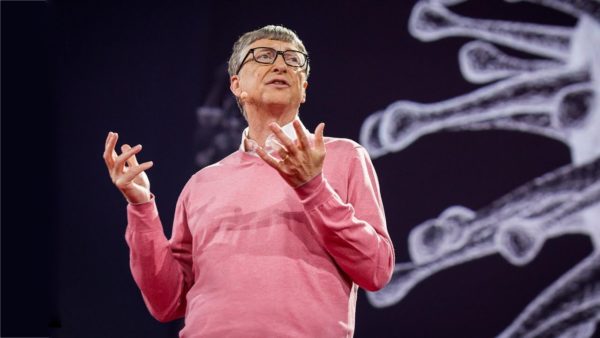
Source: The next outbreak? We’re not ready | Bill Gates | INTIDOMAIN
By Richard Hugus | October 4, 2021
My name is Ozymandias, King of Kings,
Look on my Works, ye Mighty, and despair!
— Percy Bysshe Shelley, Ozymandias
The evidence is in. Gene-manipulating injections advertised as a “vaccine for covid 19” have killed and injured many thousands of people. Instead of providing immunity to an alleged virus, the shots actually harm the immune system and turn it against us. The spike proteins created by the shots spread out to attack major organs in the body, leading to a thousand and one different health problems, including heart attacks, myocarditis, pericarditis, strokes, blood clots, spontaneous abortions, neurological disorders, depression, and death. Yet the medical establishment is urging everyone, including pregnant women and children, to get the jab. The ghost standing in as US President recently decreed that if people refuse the shot they will lose their job. This is coercion to accept a medical intervention known to be a danger to human health — a crime against humanity. Half the population of the country is now facing this coercion.
This only makes sense if we reason that the authorities want to harm us, or that there is something so important in the injection that they don’t mind harming us, as long as we get the injection. Bill Gates said early in 2020 that everyone on the planet should be “vaccinated.” Perhaps his dream was that when that is accomplished there will be no one left who will not be genetically modified (to Gates’s secret specifications) and thus no one left to hold him to account.
One of the most insidious arguments put forward by the authorities is that we are facing a health crisis so serious that individual freedom must be sacrificed for the common good, and therefore no one has a moral right to refuse the Frankenshot. This argument quickly comes down to whether human beings have inalienable rights — rights given to us by God, which the state does not have the power to take away or overrule. To accept or reject any substance being given to us is obviously such a right. And after this we can discuss the details — that the purpose of the “vaccine” is unclear, that its contents are unknown, that it has proven harmful to thousands of people, that we were not informed of adverse effects, that natural immunity should be recognized, that tests establishing the alleged disease were fraudulent, that there is no emergency, that there are safe alternative treatments, et cetera. But if we understand that the state is a lesser power, then we understand that it does not have the authority to order substances injected into our bodies.
We hold these truths to be self-evident, that all men are created equal, that they are endowed by their Creator with certain unalienable Rights, that among these are Life, Liberty and the pursuit of Happiness.
-U.S. Declaration of Independence
The cabal behind the medical tyranny we are facing doesn’t believe we have God-given rights because they don’t believe there’s a God in the first place. They apparently think that since they are billionaires, and billionaires have a lot of weight to throw around, that they can be gods. They also seem to believe there is nothing they are forbidden to do to other people because other people do not have souls — they are just biological entities evolved through random nature which the rich, by virtue of their power, are free to manipulate and improve upon. To technocrats, nothing is sacred. So it makes sense to them to risk injuring pregnant women and children and even experiment on the whole human race (beside their chosen few). Those who resist are now being segregated and punished, like Palestinians in their own land. Perhaps occupied Palestine is the oligarchs’ model for our future.
The ultimate goal may be the power that previous master-slave relationships were not able to achieve — a “read/write” capability in which the master has full surveillance power over the slaves and gives the orders for them to follow. Subtracted from the slave population, of course, will be those few billion dissidents and “useless eaters” who don’t fit in with the plan. They will be terminated. From this point of view it also follows that the genetic makeup of any living thing is just software which today’s sophisticated scientists can splice, delete, modify, or re-create as the masters see fit. From this point of view humans are no different than GM corn, soy, or cotton. GM humans can be used to bring in a nice profit as well because the masters will own their patents. Perhaps Monsanto agribusiness is another model for our future.
Taken to its logical extreme, reality itself is in the hands of our would-be masters. With proper control of the media, people can be made to believe anything, like that an illness similar to the flu is a “pandemic,” or that someone who has no symptoms of illness is actually sick, or that the unvaccinated are selfishly threatening everyone else with death, or that anyone who strays from the narrative is spreading “misinformation,” or that if someone goes into convulsions directly after getting jabbed it is not due to the poison that was just injected into them, or that a serum that injures and kills is “safe and effective.” In this world, the truth is what the powerful say it is, regardless of the facts. The powerful are a locomotive big enough to just run past any anomalies and contradictions, leaving us bewildered.
However, the ambitiousness of this insane program foretells its failure. History is full of great tyrants with grand plans who came in with spectacular fame but suddenly fell in disgrace, erased by time. The oligarchs’ main weakness is their lack of any sense of limits. Gaining some power, they then want it all. They reach too far, too soon, and expose themselves in the process. And then common humanity — always patient to a fault — finally decides to stand up and become a locomotive itself, running back over the entire plan and returning us to sanity.
If the world is going to see a great reset, it will not be the one Klaus Schwab and his Davos gangsters had in mind.
We should take heart. So much has been revealed! It’s as if the world’s worst criminals burst into the courtroom and offered up a horrendous public confession.
Another Study Links Low Vitamin D to Risk of COVID
By Dr. Joseph Mercola | October 4, 2021
Another preprint study, published September 25, 2021, shows the correlation between low vitamin D levels and the risk of getting COVID-19.
In this retrospective examination of one population study and seven clinical studies where vitamin D3 levels were measured on the day of hospitalization, researchers said, “The two datasets provide strong evidence that low D3 is a predictor rather than a side effect of the infection.”
They suggested that it may be possible to “prevent or mitigate” new COVID outbreaks by simply raising people’s vitamin D3 levels to 50 ng/ml or above. Even though they said they believe vaccination is part of the fight against COVID, they added that the ongoing evidence of the part vitamin D plays in the risk for contracting the infection is especially important because the virus continues to mutate, which challenges the effectiveness of the vaccines.
New Zealand Abandons Controversial ‘Zero COVID’ Policy
But lockdowns will remain until 90% of population is vaxxed
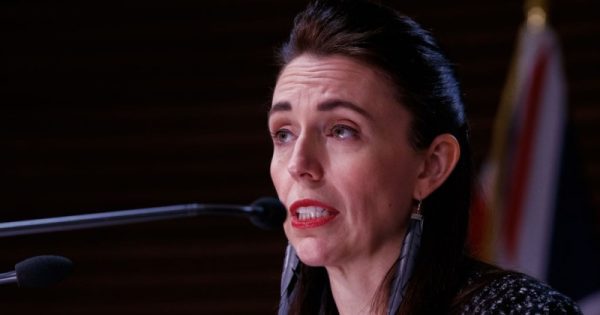
By Paul Joseph Watson | Summit News | October 4, 2021
New Zealand has announced it is dropping its controversial ‘zero COVID’ policy after numerous critics pointed out that such an approach to eliminating the virus was impossible.
Prime Minister Jacinda Ardern made the announcement earlier today during a press conference in which she acknowledged, “The return to zero has been extremely difficult.”
“What we have called a long tail has been more like a tentacle that has been difficult to shake,” she added, noting that the delta variant of the virus forced a change in policy.
Critics had repeatedly asked how the country expected to maintain a ‘zero COVID’ policy given the emergence of new variants of the virus and decreasing efficacy of the initial round of vaccinations.
However, with 48% of the population fully vaccinated, no return to normal is expected anytime soon given that Ardern has said 90% will need to be fully vaxxed before the lockdowns will end.
Kiwis have faced continuous lockdown measures almost as brutal as their Aussie neighbors since the beginning of the pandemic.
As we highlighted in August, Ardern mimicked Australia’s top public health official by telling citizens, “Don’t talk to your neighbors,” after the country went into full lockdown as a result of just a single COVID case being detected.
Authorities also previously announced that they would put all coronavirus infectees and their close family members in “quarantine facilities” even if they refuse.
“Natural Immunity” Is a Political Problem for the Regime
By Ryan McMaken – Mises Wire – 09/21/2021
Since 2020, public health technocrats and their allies among elected officials have clung to the position that absolutely every person who can possibly get a covid vaccine should get one.
Both the Mayo Clinic website and the Centers for Disease Control and Prevention website, for example, insist that “research has not yet shown” that people who have recovered from covid have any sort of reliable protection. Moreover, the CDC page points to a single study from Kentucky claiming that people with natural immunity are more than twice as likely to contract covid again, compared to people who have been vaccinated.
This narrative is reflected in the fact that the Biden administration’s vaccine mandates are a one-size-fits-all policy insisting that virtually all adults, regardless of whether or not they’ve already had the disease, receive a covid vaccine. The official position is apparently this: nothing except the vaccine can provide any sort of resistance or immunity. So get a vaccine. No exceptions!
Health technocrats have repeatedly insisted that “the science” points unambiguously toward everyone receiving a vaccine, even to the point of pushing vaccines for children. All this in spite of the fact the risk to children from covid is far less than a dozen common daily risks, such as riding in an automobile.
The regime has attached itself closely to a vaccinate-everybody-no-matter-what policy, and a sudden u-turn would be politically problematic. So it’s no wonder there’s so little interest in the topic.
Indeed, in a September 10 interview, senior covid technocrat Anthony Fauci claimed that the matter of natural immunity was not even being discussed at government health agencies. Fauci’s response suggested that the facts of natural immunity warranted discussion at some point in the future. But the comment certainly fit the dominant regime narrative nonetheless: the facts of natural immunity don’t matter for now. Everyone should just get vaccinated:
CNN’s Sanjay Gupta asked if people who have already recovered from COVID-19 should still be required to get the vaccine.
“I don’t have a really firm answer for you on that,” [Fauci] said Thursday on CNN. “I think that is something that we need to sit down and discuss seriously.”
Maybe someday they’ll get to talking about it.
But some physicians aren’t as obsessed with pushing vaccine mandates as Anthony Fauci, and the evidence in favor of natural immunity is becoming so undeniable that even mainstream publications are starting to admit it.
In an op-ed for the Washington Post last week, Marty Makary of the Johns Hopkins School of Medicine argues that the medical profession has hurt its credibility in pretending that natural immunity is virtually irrelevant to the covid equation. Moreover, the dogmatic “get vaccinated” position constitutes a lack of honesty about the data. Rather, Makary concludes:
[W]e can encourage all Americans to get vaccinated while still being honest about the data. In my clinical experience, I have found patients to be extremely forgiving with evolving data if you are honest and transparent with them. Yet, when asked the common question, “I’ve recovered from covid, is it absolutely essential that I get vaccinated?” many public health officials have put aside the data and responded with a synchronized “yes,” even as studies have shown that reinfections are rare and often asymptomatic or mild when they do occur.
And what are these studies? Makary continues:
More than 15 studies have demonstrated the power of immunity acquired by previously having the virus. A 700,000-person study from Israel two weeks ago found that those who had experienced prior infections were 27 times less likely to get a second symptomatic covid infection than those who were vaccinated. This affirmed a June Cleveland Clinic study of health-care workers (who are often exposed to the virus), in which none who had previously tested positive for the coronavirus got reinfected. The study authors concluded that “individuals who have had SARS-CoV-2 infection are unlikely to benefit from covid-19 vaccination.” And in May, a Washington University study found that even a mild covid infection resulted in long-lasting immunity.
The policy bias in favor of vaccines ignores many other facts as well, such as the relative risks of vaccines, especially for the young:
The current Centers for Disease Control and Prevention position about vaccinating children also dismisses the benefits of natural immunity. The Los Angeles County School District recently mandated vaccines for students ages 12 and up who want to learn in person. But young people are less likely to suffer severe or long-lasting symptoms from covid-19 than adults, and have experienced rare heart complications from the vaccines. In Israel, heart inflammation has been observed in between 1 in 3,000 and 1 in 6,000 males age 16 to 24; the CDC has confirmed 854 reports nationally in people age 30 and younger who got the vaccine.
A second dose of the two-shot mRNA vaccine like that produced by Pfizer and Moderna may not even be necessary in children who had covid. Since February, Israel’s Health Ministry has been recommending that anyone, adult or adolescent, who has recovered from covid-19 receive a only single mRNA vaccine dose, instead of two. Even though the risk of severe illness during a reinfection is exceedingly low, some data has demonstrated a slight benefit to one dose in this situation. Other countries use a similar approach. The United States could adopt this strategy now as a reasonable next step in transitioning from an overly rigid to a more flexible vaccine requirement policy. For comparison, the CDC has long recommended that kids do not get the chickenpox vaccine if they had chickenpox infection in the past.
The nonscientific, ideology-induced blind spot for natural immunity also prompted The BMJ (the journal of the British Medical Association) to note that “[w]hen the vaccine rollout began in mid-December 2020, more than one quarter of Americans—91 million—had been infected with SARS-CoV-2…. As of this May, that proportion had risen to more than a third of the population, including 44% of adults aged 18–59.”
And yet, the authors note this fact doesn’t appear to be a part of any policy discussion at all:
The substantial number of infections, coupled with the increasing scientific evidence that natural immunity was durable, led some medical observers to ask why natural immunity didn’t seem to be factored into decisions about prioritising vaccination.
This problem is reflected in the Biden administration’s drive for booster shots—announced in mid-August—even before there was any clinical research on booster shots at all. Even by mid-September, as one hospital’s chief medical officer put it, “the data is not compelling one way or another.”
But those sorts of details don’t trouble federal “public health” officials, and the Biden administration quickly moved toward pushing booster shots for everyone.
This Is Why There Should Be No Mandatory Medical Treatment
Of course, mandating vaccines—like mandating any medical treatment—would still be immoral even if we could list a dozen studies suggesting boosters are a boon and that natural immunity is no good.
What if there were twenty-five studies “proving” vaccines are better than natural immunity, but only twenty studies “proving” natural immunity is better? Would coercive vaccine mandates then suddenly be justified? Unfortunately, that’s exactly how many advocates for repressive covid policies think the world should work. For these people, policy is just a matter of adding up the number of studies “proving” their side is right, and then claiming this justifies forcing mandatory medications on millions of human beings.
(It never works in reverse, of course. The fact that there’s a lot of evidence—as Makary points out—against vaccines for those who have natural immunity, the dominant narrative is nonetheless that vaccines are “necessary” and “worth it” for everybody, always and everywhere.)
In the real world, however, many medications—including these new vaccines—come with risks that must be weighed against potential benefits. These decisions can only be made at the individual level, where patients must make their own decisions about what substances to put into their own bodies. In other words, blanket policies proclaiming “everyone must receive this medical treatment immediately, or else” contradicts the realities of the uncertainties and varying risk levels that affect individuals. The facts of uncertainty and informed consent were once considered a mainstay of medical ethics—and of any political ideology that actually respects self-determination and basic human rights. Unfortunately, the philosophy of “public health” appears to be uninterested in such trivialities.
At this point, it would be embarrassing for the regime to admit what actual scientific inquiry has shown: that natural immunity is generally superior to receiving the vaccine. The regime doesn’t like to be embarrassed, and neither do the countless doctors and nurses who have long toed the regime’s political line. So expect more of the same.
Covid in Sweden: Everything on the table
Sebastian Rushworth, M.D. | October 2, 2021
A group of German celebrities have started the campaign “alles auf den tisch”, which literally means “everything on the table”. It’s a reaction to the shocking lack of indepence and critical oversight that has been exhibited by journalists ever since the pandemic began. The purpose of the campaign is to break through the blinkered media narrative that exists in relation to covid, and allow a wider range of thoughts and opinions to get out.
In order to accomplish this, the celebrities have interviewed a large number of doctors and scientists who have thus far been sidelined by the mainstream media, and put the interviews up on their site allesaufdentisch.tv. The campaign appears to have been pretty effective so far, since the site crashed on launch due to the massive amount of traffic it was getting. Luckily it’s up and running again now. As a part of the campaign, I was interviewed by violinist Linus Roth. We talked about happenings in Sweden, the covid death rate, and lockdowns. The interview is short but sweet, only around twenty minutes long.
Vaccine Effectiveness Hits as Low as Minus-66% in the Over 40s, New PHE Data Shows
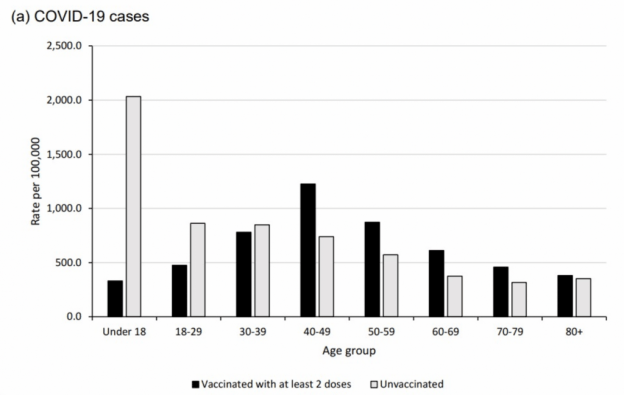
By Will Jones • The Daily Sceptic • October 3, 2021
The new Public Health England (PHE) Vaccine Surveillance report was released on Thursday, allowing us to update our estimates of unadjusted vaccine effectiveness from real-world data.
Oddly, the report appeared on a new webpage this week, but the old page didn’t include a note to let you know, so it took me a while to discover it had appeared and where it was.
Following last week’s ‘fact check‘ from Full Fatuous – ostensibly of my piece but with some words of admonition for PHE as well, particularly over the accuracy of the population data – a new note appeared in the report: “Interpretation of the case rates in vaccinated and unvaccinated population is particularly susceptible to changes in denominators and should be interpreted with extra caution.” So there you go. All estimates in this post are based on the data PHE uses and are valid insofar as that data is accurate.
As before, the data is just for a four-week period, which, given that the early part of the Delta surge was dominated by the unvaccinated and the latter part has seen infections rise in the vaccinated, seems to me a mistake. A fairer view would cover the whole Delta surge (as with the estimates I make from the data in the Technical Briefings), but in any case the report gives a snapshot of current relative infection rates.
As Full Fatuous pointed out, PHE don’t recommend using this data to estimate vaccine effectiveness, saying it’s “not the most appropriate method” because it’s unadjusted for risk factors (and, inevitably, they don’t provide the data you’d need to adjust it). However, even if not recommended by PHE, it is certainly a valid method of calculating vaccine effectiveness, which is just a figure which states the relative risk reduction in the vaccinated group, as long as you bear in mind its limitations. All vaccine effectiveness estimates have limitations, and while adjusting for confounding factors is in principle important, it is helpful only if done well, and many studies do not do it well. Unadjusted estimates from raw data are a necessary starting point.
Perhaps the key confounder for the estimates of vaccine effectiveness against infection given here is whether people have been previously infected, with a common assumption being that a higher proportion of the unvaccinated will be previously infected, due to it being a potential factor in people’s decision not to be vaccinated. This may well artificially lower the vaccine effectiveness estimates, but since no one has yet produced data showing how antibodies-from-infection split between vaccinated and unvaccinated it is hard to know how far this is the case.
Unvaccinated here means actually unvaccinated, not partially vaccinated or post-jab. Hospitalisation means “cases presenting to emergency care (within 28 days of a positive specimen) resulting in an overnight inpatient admission”.
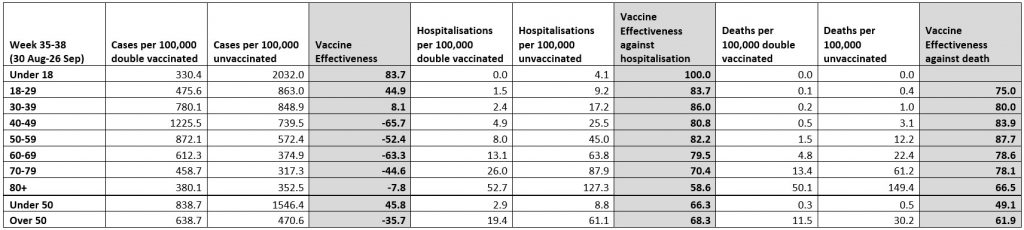
As England’s drawn-out Delta outbreak drags on, the infection rates in the vaccinated continue to outpace those in the unvaccinated, reducing (unadjusted) vaccine effectiveness further. For the 60s age group, infection rates are 63% higher in the vaccinated than in the unvaccinated, up from 53% last week, giving an (unadjusted) vaccine effectiveness of minus-63%. But that has been topped this week by the 40s age group, the vaccinated among whom now have an infection rate no less than 66% higher than the unvaccinated, up from 46% in last week’s report and 27% in the report for the month ending September 5th. Vaccine effectiveness has been heading downward in the 30s age group as well, now just 8%, though interestingly it has actually been increasing in the under 18s. On this data, vaccine protection against serious illness and death appears to be holding up. I have included the two previous tables below for comparison.
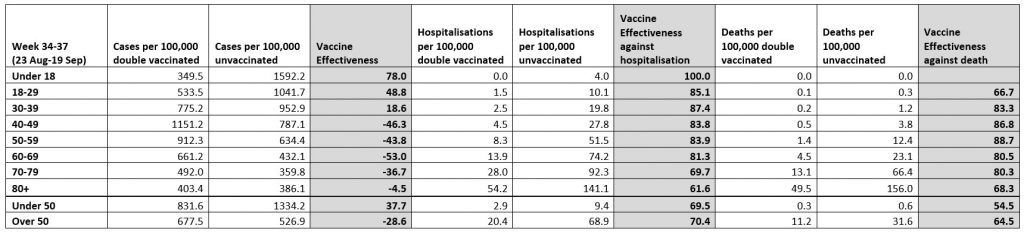
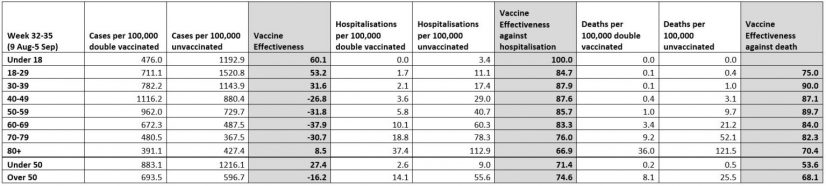
With infection rates now, on this data, much higher in the vaccinated than the unvaccinated, what remaining justification can there be for vaccine passports, vaccine mandates, and any other policy based on the assumption that vaccines protect other people? When will the Government face up to the reality that vaccines provide poor protection against infection, poor protection against transmission, and thus poor protection of others, and so there is no justification for continuing to build-up the infrastructure of a two-tier, discriminatory state?
This Week in the New Normal #7
OffGuardian | October 3, 2021
This Week in the New Normal is our weekly chart of the progress of autocracy, authoritarianism and economic restructuring around the world.
1.THE WORST ARTICLE I’VE EVER READ.
The demonisation campaign against those who decline to partake in the untested gene therapy is pervasive and seemingly limitless. Article’s pop up claiming unvaxxed people should be banned from flying, banned from healthcare, banned from state benefits, and even fired from their jobs.
But this article in The Mirror is the worst of the worst. Quite honestly the worst, most hate-filled and insidious article I have ever read, and it is literally my job to search out and read hate-filled and insidious articles.
It’s titled:
Anti-vaxxers want to kill your babies, stage a coup and cause another lockdown!”
… and you don’t really need any more information than that. Read at your own risk.
2. THE RETURN OF LAB-GROWN MEAT
… well, not “the return” exactly, because it never went away. I guess “resurgence” is the better word. There’s certainly a sudden bump in the coverage.
The Guardian “asks the expert” if lab-grown meat will replace the real thing. The “expert” in question makes and sells lab-grown meat and, rather unsurprisingly, they say “yes!”.
And then the Times, with a tone of reluctant surrender, tells us we “must embrace lab-grown meat” whether “we like it or not”.
At the same time, Sky hosts a “climate debate” on lab-grown meat. One of those fake “debates” which serves a pre-determined agenda by basing a staged disagreement on fundamental assumptions which neither side questions.
In this case, it’s just assumed that LGM is good for the planet, and that actual meat is bad for it. Neither of those things are proven to be true.
But good news everyone! Your genetically synthesised meat-like protein paste is one step closer…whether you like it not.
3. “TREAT VIOLENCE AGAINST WOMEN AS SERIOUSLY AS TERRORISM”
The result of the Sarah Everard trial in the UK has kicked off a wave of fear-based propaganda concerning just how much violence against women goes on, and what we need to do about it. Over and over again a list of very predictable names in very predictable publications talk up the idea that women are “still not safe”, or never “feel safe” (which is not the same thing).
Clearly, any murder is a tragedy for the victim and their family, but to present our country, or society, as inherently violent or dangerous is completely disengenuous.
Let’s just check the stats, for the sake of reality.
In the UK, and most of the Western world, violent crime has been generally on the decline for decades. In 2019, EU statistics found a 32% drop in homicides since 2008. In 2020, the UK suffered ~750 murders in a population of 68 million people, meaning a crude murder rate of 0.001% (or 1 per 100,000). Less than one-third of those killed were women, and only 20% of them were attacked on the street.
Our society is not perfect, but violent crime (against either gender) has literally never been less of a danger in the history of the country. In terms of violent crime, the streets are as safe for women as they have ever been. If they don’t feel safe, well that’s probably because the media keep telling them how much “danger” they’re in.
But why? Why the massive exaggeration of the danger? And why the clarion calls for “action” on violence against women?
Well, the same exact reasons behind the “pandemic” narrative. Because hysteria is always useful. Because the people in charge need us to be afraid all the time. Because they want to make sure different genders, races and orientations are constantly mistrustful of one another. And, obviously, because it can be manipulated into increased powers for the state.
Social media companies are already being pressured to “do more to protect women”. After Everard’s murder first in the news in March, people were suggesting male-only curfews so women feel safe on the streets. If Covid has taught us anything, it’s that well-stoked public panic can be parlayed into exactly that kind of insane policy.
The title of this section is taken from a tweet by British Labour MP David Lammy:
It’s not clear what (if anything) David means by this. It’s entirely possible he’s just an idiot playing to the gallery, but anyone familiar with the real purpose, and disastrous societal fallout, of the “War on Terror” should probably be concerned about just how far those in charge could go to (allegedly) “make women feel safe.”
BONUS: THE TOTALLY-NOT-A-CULT OF THE WEEK
Just want to point out that the vaccine-pushers of the New Normal are totally not in a cult.
Whether it’s dressing up dancers like syringes to prance around with glassy-eyed soul-dead TV hosts:
Or literally citing God as the source of the vaccine:
This is all very normal behaviour, and if you perceive it as creepy or cultlike, it’s only because you are a heretic…sorry, I mean a science denier.
BONUS II: PROJECTION OF THE WEEK
For those of you who don’t know who Keith Olbermann is, well I envy you..and apologise for introducing you to his existence. He’s a petty, ill-informed, opinionated loudmouth who takes up irrational and bigoted positions on pretty much everything, and trumpets those views loudly to anyone who’ll listen.
And yesterday, he tweeted this…
It takes a serious lack of self-awareness to get your third untested vaccination against a disease you have a 99.5% chance of surviving, and then lambast everyone not worried about the disease for being scaredy cats.
IT’S NOT ALL BAD…
The world of sport, especially American sports, is somewhat of a hotbed of “vaccine hesitancy”. This is down to several factors, most probably to do with many US athletes coming from working-class demographics with longstanding (and entirely justified) suspicions of both the media and big pharma.
By way of contrast with Olbermann’s spittle-spraying diatribe, we present the calm and rational position of NBA star Jonathan Isaac, speaking at a press conference on September 27th:
The NBA has already said they will dock the pay of unvaxxed players who refuse to comply with local mandates. And both the NBA and NFL have put in place massive restrictions on unvaccinated players to pressure them into getting the shot. The media, likewise, is piling on the pressure to conform.
All the players resisting in the face of such a powerful campaign deserve respect. And they serve as a reminder that Covid sceptics, or even just those people who want nothing to do with the vaccine, are not anything like the tiny minority the media tries to pretend we are. And our arguments are rational and informed, not based on the insults and mindless frothing outrage of those trying to pressure us into conforming.
All told a pretty hectic week for the new normal crowd, and we didn’t even mention the “mysterious rise in heart attacks” or the UK’s entirely manufactured “fuel crisis”.
A Robust Balance
By Willis Eschenbach | Watts Up With That? | October 3, 2021
Albedo is the percentage of incident light that is reflected by an object. For years, I’ve read claims that the loss of Arctic sea ice is a positive feedback. It is logical—warming leads to less ice, less ice reduces the surface albedo; reduced surface albedo means more sunlight is absorbed; more sunlight absorbed leads to increased warming. Positive feedback. What’s not to like?
For example, in 2019 the IPCC said:
Feedbacks from the loss of summer sea ice and spring snow cover on land have contributed to amplified warming in the Arctic (high confidence).
Wim Rost pointed me to an interesting 2007 NASA article about Arctic albedo which says:
Although sea ice and snow cover had noticeably declined in the Arctic from 2000 to 2004, there had been no detectable change in the albedo measured at the top of the atmosphere: the proportion of light the Arctic reflected hadn’t changed. In other words, the ice albedo feedback that most climate models predict will ultimately amplify global warming apparently hadn’t yet kicked in.
Kato quickly understood why: not only is the Arctic’s average cloud fraction on summer days large enough—on average 0.8, or 80 percent—to mask sea ice changes, but an increase in cloudiness between 2000 and 2004 further hid any impact that sea ice and snow losses might have had on the Arctic’s ability to reflect incoming light. According to the MODIS observations, cloud fraction had increased at a rate of 0.65 percent per year between 2000 and 2004. If the trend continues, it will amount to a relative increase of about 6.5 percent per decade. At least during this short time period, says Kato, increased cloudiness in the Arctic appears to have offset the expected decline in albedo from melting sea ice and snow.
Wim suggested that I take a look to see if this process, of the changes in cloud albedo counteracting the changes in surface albedo, had continued up to the present.
Fortunately, the CERES data allows us to calculate the trends in both the surface albedo and the top-of-atmosphere (TOA) albedo. First, here’s the trend in surface albedo in percent per year, on a 1° latitude by 1° longitude basis.


Figure 1. Atlantic and Pacific centered views of the trend in surface albedo, in percent per year. Seasonal variations removed.
As expected, due to the reduction in Arctic sea ice, the albedo in the Arctic has indeed decreased significantly over the 21-year period. It’s decreased at a rate of 0.28% per year, a total of almost 6% over the 21 year period. Note also that the poles are the only part of the surface with a significant trend.
Next, here’s the top-of-atmosphere (TOA) albedo trend.


Figure 2. Atlantic and Pacific centered views of the trend in TOA albedo, in percent per year. Seasonal variations removed.
Amazing. The increase in cloud albedo has almost totally counteracted the decrease in Arctic surface albedo. The change is only six-hundredths of a percent per year, basically lost in the noise. The effect of the clouds has brought the polar regions back into line with the rest of the planet.
This inspired me to look at the correlation of the surface albedo and the cloud albedo over the period. Positive correlation of two variables means generally that when one increases, so does the other. Negative correlation means that they move in opposite directions. Figure 3 shows that result.


Figure 3. Correlation, surface albedo and cloud albedo.
This is also most interesting. It shows that the cloud albedo not only counteracts the sea ice albedo changes. It also counteracts the changes in surface albedo from snow and land ice. Not only that, but in the area of the sea ice, the correlation is around -1, meaning that surface albedo and cloud albedo move in nearly total opposition..
Examining Figure 3, it is obvious that over the land the correlation is negative almost everywhere. However, over the ocean, the correlation is clearly related to the temperature. As the Figure 4 scatterplot below shows, wherever the ocean is below about 22°C, the clouds tend to oppose any change in surface albedo.

Figure 4. Scatterplot showing the correlation of cloud and surface albedo trends versus surface temperature. Data is the gridcell-by-gridcell 21-year average values. Yellow/black line is a LOWESS smooth of the data.
Again, in the sea ice area where 21-year average temperatures are around zero, the negative correlation is almost perfect.
Discussion
With those results in mind, let me return to the 2019 IPCC claim:
Feedbacks from the loss of summer sea ice and spring snow cover on land have contributed to amplified warming in the Arctic (high confidence).
Note that despite the IPCC claim of “high confidence”, the 2007 findings of Kato and the more recent CERES data shown above demonstrate that feedback from changes in sea ice and snow cover have NOT contributed in any significant way to amplified warming in the Arctic. Cloud changes offset these sea ice and snow changes almost entirely. In short, the IPCC claim is overstated.
This highlights the problem with the claim that we should all listen to the “97% consensus” … it’s meaningless. Science is the process of overthrowing the consensus.
Featured Video
Death Spikes & Rising Cancer In Our Youth Explained
or go to
Aletho News Archives – Video-Images
From the Archives
Politicians lie
By Mazin Qumsiyeh | Popular Resistance | August 18, 2013
There is no way to say this truth nicely: Politicians lie. That includes Japanese, American, Egyptian, Israeli, and Palestinian politicians! Is there something more common sense than that? Yet, so many citizens around the world believe their own politicians or wistfully acknowledge lies but think it is part of the job needed to run things. They believe even when politicians contradict themselves blatantly. This phenomenon is rather remarkable. It is a dissonance and disconnect from reality that many seem oblivious to. It is very dangerous because it can lead to accepting rationales for going to war. These can be deadly wars that lead to millions of lives lost as happened in what was called World War 1 and WW2. Even when incredible and declassified evidence abound, politicians continue to lie and old mythologies refuse to die. Here are just a few of the countless lies told to us over the past few decades… continue
Blog Roll
 Aletho News
- RSF military group defects, joins Sudanese army: State media
- Ireland goalkeeper refuses to play ‘Israel’ as squad weighs boycott
- China pushes back against US on Cuba, Iran
- Ukrainian Soldiers, Potential Mercenaries: Have Gun, Will Travel!
- Burnham’s UN debut… A masterclass in British disinformation
- Iran flights continue despite US aviation sanctions
- Global Tipping Points Lead the World Into a State of Entropy
- The day-after at the White House: USA and Xi Jinping
- The Geopolitical Balance in the Red Sea: The UAE Being Displaced by New Players
- Iraqi resistance group vows to stage airport sit-ins over Iran aerial blockade
- If Americans Knew
- Deconstructing Netanyahu’s pants-on-fire UN rant – Daily Update
- Trump betrayed voters with his campaign lies and prioritized a foreign country once he took office
- Netanyahu calls Israel’s war in Gaza ‘opposite of genocide’ in UN speech to near-empty hall
- Settler Kidnappings: Torture, Sexual Abuse and Terrorisation of Palestinian Abductees as Israel Deepens Annexation of West Bank
- Gaza winter nears as 162,000 tents become unusable, raising fears of humanitarian crisis
- Netanyahu says, “It’s the opposite of genocide”; UN says Gaza economy is world’s ‘most severe crisis on record’ – Daily Update
- Israel’s US-Backed Assault on Gaza Has Created the ‘World’s Most Severe Economic Crisis on Record’: UN
- ‘Protecting U.S. Citizens’… From Israel
- ‘This is where I live now, the back of a truck’: a day in the life of a grandmother in Gaza
- In UN Speech, Iran’s President Displays Pictures of Children Killed by US, Brings Attention to Israel’s Nuclear Arsenal
- No Tricks Zone
- New Study: Earth And Venus Surface Warmth Largely Explained By Convection And Lapse Rate, Not CO2 Or Radiation
- 2025 Nature Paper Claiming Worsening Global Drought Gets RETRACTED …Heavily Flawed
- New Study: ‘Global Drought Shows No Detectable Recent Acceleration Under Climate Warming’
- Economic Masterminds: German Socialists Suggest Taxing Productivity Gains Stemming From Using AI
- The South China Sea Has Not Been Cooperating With The Climate Change Narrative
- Energy Crisis: Germany Enters Heating Season With Historically Low Gas Reserve Fill Levels
- New Study: The Antarctic Ice Sheet Gained Mass From 2020-2024 Due To Staggering Snow And Ice Accumulation
- Study: Ocean Heating Rates From Thousands Of Years Ago ‘Dwarf’ Modern Ocean Heating Rates
- Climate Extremists Target, Attack Large-Scale Power Grid Infrastructure In Germany!
- New Study: Antarctic Ice Melt Has Contributed Less Than 1 Centimeter To Sea Level Rise In The Last 30 Years

