If ever there was a man there when you needed him in time of Covid, it is the wonderful Ivor Cummins.
When we are all being driven mad by the spurious scaremongering ‘variant’ claptrap that the increasingly deranged Boris Johnson (you have to be mad or evil to write this mendacious nonsense) and his SAGE-backing band keep spouting, there, thank goodness, is Ivor – cool, calm and collected, cutting through the waffle to the facts.
In his latest online update, the biochemical engineer tells us that the Indian Variant (if you have caught up with the latest terminology) is in fact the Delta Variant that’s been around for a while. It was just re-badged, and it has had zero impact on hospitalisations.
And where else does Ivor go but to Government data to demonstrate this. It actually makes you laugh (though it’s no laughing matter) to see that the hospitalisation graph runs in exactly the opposite direction to the ‘cases’ graph. While the so-called variants climb, the hospitalisations decline. You couldn’t make it up. Look for yourselves here.
So, no, Messrs Johnson and Hancock et al, there is no real-world impact of these variants (variant in fact) at all.
Ivor leaves it pretty much there, except for a reprimand to the sensationalising, scaremongering Press. And his conclusion is that what we are being subjected to is a political scariant, not a deadly variant.
Which is pretty much the verdict of TCW’s recent investigation into the Government’s manufactured ‘case-demic,’ based on the flawed and faulty (Test and Trace) Lateral Flow Test scandal.
A briefing from Public Health England (PHE) shows that as a hospital patient, you are six times more likely to die of the COVID Delta variant if you are fully vaccinated, than if you are not vaccinated at all.
The information shows up in Table 6 of the 77-page document, which the attendance to emergency care and deaths by vaccination status and confirmed Delta cases from February 1, 2021, to June 7, 2021.
Of 33,206 Delta variant cases admitted to the hospital, 19,573 were not vaccinated. Of those, 23 (or 0.1175%) died.
But, of the 13,633 patients who were vaccinated with either one or two doses, 19 (or 0.1393%) died, which is an 18.6% higher death rate than for the unvaccinated patients. Seven of the 5,393 patients who were partially vaccine with one dose died, or 0.1297%.
Of the 1,785 patients who had both vaccine doses 14 days or more before admission, 12 (or 0.6722%) died. This death rate is 5.72 times higher than that for unvaccinated patients. Put another way, if all 33,206 patients had been fully vaccinated, there would have been 223 deaths.
From Wikipedia: ‘During the 2020 COVID-19 pandemic, misinformation was widely spread claiming that ivermectin was beneficial for treating and preventing COVID-19. Such claims are not backed by good evidence.’
WHEN encountering an inexplicable anomaly in human behaviour, common rules of thumb can often give an insight. Oddly, though, these differ from country to country. For Americans it is ‘follow the money’. For Italians it is ‘cui bono?’ – who benefits? The nearest French rule is perhaps ‘cherchez la femme’.
Sometimes none of these help. Sometimes a perverse piece of human nature cannot be explained in terms of money, perquisites or feminine influence. The ivermectin mystery is one such.
Ivermectin is a generic prescription drug, discovered in 1975, developed by Merck and released in 1981. It is used to treat many types of parasite infestations in humans and animals. The researchers who created it were awarded the Nobel Prize for medicine in 2015. It is on the World Health Organisation’s List of Essential Medicines and is approved by the Federal Drug Administration (FDA) as an antiparasitic agent.
It can have very rare serious side effects. By 2020 four billion doses had been administered and 16 deaths are believed to have occurred as a consequence, or one in 250million doses. Although the figures are not directly comparable, the annual increased risk of death for a middle-aged man taking a standard (325 mg) aspirin every day to prevent heart disease and stroke is about one in ten thousand. This is about as risky as driving a car.
Ivermectin is therefore a very safe drug. However, the drug oversight establishment does not think so.
‘EMA has reviewed the latest evidence on the use of ivermectin for the prevention and treatment of COVID-19 and concluded that the available data do not support its use for COVID-19 outside well-designed clinical trials.
‘In the EU, ivermectin tablets are approved for treating some parasitic worm infestations while ivermectin skin preparations are approved for treating skin conditions such as rosacea. Ivermectin is also authorised for veterinary use for a wide range of animal species for internal and external parasites.
‘Ivermectin medicines are not authorised for use in COVID-19 in the EU, and EMA has not received any application for such use.’
‘There seems to be a growing interest in a drug called ivermectin to treat humans with COVID-19. Ivermectin is often used in the U.S. to treat or prevent parasites in animals. The FDA has received multiple reports of patients who have required medical support and beenhospitalized after self-medicating with ivermectin intended for horses.
‘FDA has not approved ivermectin for use in treating or preventing COVID-19 in humans. Ivermectin tablets are approved at very specific doses for some parasitic worms, and there are topical (on the skin) formulations for head lice and skin conditions like rosacea. Ivermectin is not an anti-viral (a drug for treating viruses).
‘The FDA has not reviewed data to support use of ivermectin in COVID-19 patients to treat or to prevent COVID-19; however, some initial research is underway. Taking a drug for an unapproved use can be very dangerous. This is true of ivermectin, too.’
The lack of official support for trials of the efficacy of ivermectin has meant that the typical number of subjects being tested (the ‘cohort’) is fairly small, usually about a hundred. To overcome this a meta-analysis can be undertaken, when the results of many trials are combined and assessed to determine if a trend can be seen. This has been done, most notably by @CovidAnalysis. A paper most recently updated yesterday surveyed 60 properly conducted studies, most with double-blind testing against placebos, with neither the participants nor the researcher knowing who had been given the drug until the trial was over. This report is a preprint, so it has not been peer-reviewed, but the results are conclusive: 93 per cent of the studies show a positive outcome from the administration of ivermectin, with deaths reduced by over 80 per cent.
So why have what might be called ‘Drug Central’ refused to acknowledge this mammoth body of evidence arising from without their bailiwicks? Perhaps because of human nature again. Here they are obeying another rule of thumb commonly seen when institutions encounter new external factors – ‘not invented here’. Perhaps this business school aphorism is also appropriate: ‘Hell hath no fury like a head-office scorned’.
In any event the virucidal properties of ivermectin and its safety have now been established beyond doubt, and we can expect it to be valuable in this role from henceforth. But unfortunately not, perhaps, against Covid-19.
The thesis is that lockdowns did not protect the vulnerable, but rather harmed the vulnerable and shifted the morbidity and mortality burden to the underprivileged. Devastatingly so! We instead locked down the ‘well’ and healthy in society, which is unscientific and nonsensical, while at the same time failing to properly protect the actual group that lockdowns were proposed to protect, the vulnerable and elderly. We actually did the opposite. We shifted the burden to the poor and caused catastrophic consequences for them. They were in the worst economic situation to afford the lockdowns and estimates are that it will be decades for them to recover from what we did. Wealth disparities placed those who were more vulnerable economically in a very difficult position in terms of sheltering from the pandemic. It was devastating for them for they could not shelter. It left them exposed! COVID-19 has emerged as a boon for the rich ‘laptop’ class and a disaster for the poor. The actions of our governments hurt the poor in societies terribly, and many could not hold on and committed suicide. Deaths of despair skyrocketed. Poor children, especially in richer western nations such as the US and Canada, self-harmed and ended their lives, not due to the pandemic virus, but due to the lockdowns and school closures. This is the legacy for our governments and their inept COVID advisors. Full of arrogance, hubris, and self-righteousness, in spite of their catastrophic failures. Their actions were detrimental and costed lives.
How did we get here? The reality is everything about the response to this pandemic, by the governments, bureaucrats, technocrats, their medical advisors, and the television medical experts have been catastrophically wrong! Even medical doctors have become politicized and biased in their reactions and how they have managed this. Doctors (not all) but a vast majority just decided that they would not treat COVID-positive high-risk patients and took a hands-off ‘therapeutic nihilism’ approach, while the high-risk infected worsened and declined. While empiricism traditionally underpins clinical practice and doctors even take eclectic approaches, with COVID, the approach was ‘do nothing’ until the patient cannot breathe anymore and requires oxygen. This while we had effective and cheap anti-virals and corticosteroids and anti-clotting drugs like hydroxychloroquine, ivermectin, colchicine, favipiravir, budesonide, dexamethasone, methylprednisolone, high-dose aspirin, heparin etc. as part of sequenced, multi-drugearly treatment ‘cocktail’ protocols devised by pioneers such as McCullough, Risch, Zelenko, Smith, Fareed, Kory, Oskoui, Urso, Ladapo, Lawrie etc.
They, these specious and inept Task Forces and medical advisors to these unreasoned government leaders have been flat wrong on all and have failed and costed tens of thousands if not millions of lives! These advisors and governments lied about equal risk to all of becoming ill if infected, and this damaged the response. They lied about asymptomatic spread and recurrent infection, for our detailed examinations have shown these to be very rare if at all. They lied that the RT-PCR test was a valid test and to be used. They set cycle count thresholds (Ct) for PCR positive of 40 and above knowing that 20 to 24 was the threshold for viable, culturable infectious virus. They knew that Ct of 30 and above was denoting viral dust and fragments and non-infectious, non-pathogenic virus. They also misled the public that COVID recovered persons are to be vaccinated, and that children are to be vaccinated. They know the risk to children is so very negligible (even less than the seasonal flu) and that the vaccine has potential harms for children, yet they, combined with the CDC and Fauci, continue to provoke fear into parents to vaccinate their children. They have lied on everything COVID and all of these duplicitous statements and policies carry deep consequences. Nothing they have ever said turned out to be accurate and they have done this with reckless abandonment.
Our focus is on the devastating burden shifted to the poor in our society by the lockdowns and we begin by arguing vehemently that any epidemic or pandemic steps to mitigate severe outcomes cannot only focus on the harms from the pathogen, but must also focus on the harms from the policy steps such as lockdowns and school closures. Why? Because lockdowns (also known as non-pharmaceutical interventions) have crushing effects and function to exacerbate inequalities. Women and children and especially the poorer among them, have fared worst of all due to the effects of lockdowns! Look at the devastation visited upon women in our societies. She has lost most! We have learned a terrible lesson now that these specious, unsound, restrictive lockdown and school closure policies carry costs that may well be life-long, and especially on the backs of the poorer among us, who are least able to afford. We have argued with governments since spring 2020 against these draconian and unscientific policies, and that the approach must be nuanced and finessed, tailored and ‘focused’ with an age-targeted, risk-based approach. We had learned very early on that COVID-19 was amenable to risk stratification, and age (and obesity) were the principal risk factors, along with diabetes, renal disease, cardiovascular disease etc. We pleaded for an age-risk stratified approach to the pandemic response yet were dismissed and sidelined.
We argued about strongly protecting the vulnerable first (e.g. elderly and especially those with underlying medical conditions) as they were the key target group for the SARS-CoV-2 pathogen, and allow the rest of the low-risk ‘well’ healthy population to live reasonably normal lives, taking sensible common-sense precautions. We knew that simple hand-washing and isolation of the ill/symptomatic persons was the key step. No isolation of asymptomatic persons, no testing of asymptomatic persons. Contact tracing after the pathogen had breached the borders and had spread was useless. These harmed people and populations and did not help in any manner. We knew this, we told the illogical and irrational, often hysterical and inept Task Forces and COVID advisors and governments this, but they did not listen.
Early data was showing us that people over 75 to 80 years old were over 10,000 times more likely to die of COVID-19 if infected than someone under 10 years old. Thus, why would we have a blanket carte blanche lockdown when there is so much risk differential? We could look at the situation in the rest of the low-risk ‘open’ population and monitor, and only if we saw infections and hospitalization increase markedly then we would move to impose restrictions etc. on them. As needed. No mass testing of asymptomatic persons and no quarantine of asymptomatic persons.
We knew that once the high-risk and elderly were properly protected, that we could reduce hospitalization and death. We also knew that if we used early drug treatment in these groups, that we would dramatically cut hospitalizations by 85% and save thousands of lives. But these maladroit and inept, unscientific Task Forces and television experts did not listen. We did not think that we were any smarter than the Task Force and lunatic television medical experts, by any means, but we knew that they were seemingly averse to the science and that we were literally studying the data and basing our decisions on balancing the benefits versus the harms to any decision. They had to be averse to the data for how else could you explain the often idiotic and nonsensical tripe they would spew 24/7 to the public? Consider Dr. Anthony Fauci as an example, for near 16 months now, we cannot think of or locate one statement that he has made publicly that made any sense whatsoever, and could be backed up by any data or science. None! Not one. We continue to look and ask if anyone can locate such, if they can bring it to our attention urgently for us to correct this record.
We felt strongly that if we indeed secured the high-risk elderly and vulnerable, then lockdowns would not have to be applied across the board. We were always confident in this, the question really being would those in decision-making positions understand this. Would they, the bureaucrats and technocrats and their illogical advisors be able to understand that the key is to drive a risk differential between the high and low-risk in a population whereby the low-risk of severe illness be allowed harmlessly and naturally to live lives normally and if exposed, become infected and to clear the virus with full, broad, and robust resulting natural immunity?
In other words, we do not impede the low risk of severe outcome of becoming infected and we leave them largely unrestricted with common sense safety precautions. We knew they would have no symptoms or very minimal and recover quite well. The evidence was clear in this. We heighten their risk of transmission (we increase the probability of infection among the younger and low-risk persons, low-risk adults etc.), so to speak. And that at the same time, we secure the high-risk of illness persons so that infection risk is reduced for them. We mitigate the chance of infection in the high-risk of illness. We create a risk differential of contracting the virus that is skewed towards the young and healthy. And we do this harmlessly and naturally. We do this so that the low-risk who become infected can become immune, and they can then help protect the high-risk vulnerable persons in a society.
Would they, these lockdown lunatic advisors understand that you do not lock down the well and healthy so that you effectively cause the low-risk of severe illness to have low risk of becoming infected and that this only works to delay moving toward population immunity? That this is the worst step you can take? That you also put selection pressure on the virus when you lockdown, that drives mutations? Akin to the mutations driven by vaccinating during a pandemic, this itself being a terrible step. That with lockdowns, the pathogen does not go away and waits for the restrictions to be loosened and infections will always go up once restrictions are loosened. That this also denies them, the low-risk persons, the opportunity to clear the virus and become naturally immune? That this mistake actually harms the elderly who are then not protected by the population immunity that was not gained by the low-risk? We use the low-risk in the population to protect the high-risk as the full strategy, or in combination with a properly developed and safety tested vaccine. Everything these lockdown lunatics in charge did, was wrong! Did they not think these things through?
The stark reality is that our lockdowns badly harmed the elderly for it left them confined in their nursing homes and extended the window of exposure to the virus for them. And they were subject to repeated exposure from staff who brought pathogen into the confined settings and drove the hospitalizations and deaths. Lockdowns worked to kill the elderly! Lockdowns thus reduced the movement of the younger low-risk persons to the same level of movement and mobility as the elderly higher-risk persons (basically none) and thus equalized the chance of infection between the low-risk and high-risk (young and old). This was devastating.
While we knew this and spoke of this repeatedly to inform the policy makers, they, the media, and the inept television medical experts attacked us and smeared us. Pilloried us. They, the governments and their utterly bogus scientific advisors ‘knew best’. They were so inept and academically sloppy, and refused to do the work and abreast themselves of the science and to think this through. They were lazy and either did not understand the science, did not read it, did not ‘get’ it, or were blinded to it by their cognitive dissonance of any information that did not align with their politicized views. This led to catastrophic decisions that continue even today. Again, just look at Ontario in mid-June 2021, it is as if it were February 2020.
Now look at what they have done to the globe by their hubris and arrogance and ineptness. Look around you. We were always right for we took the time and thought this through and understood the catastrophic mess the lockdowns would cause. We knew that a finessed, nuanced ‘targeted’ approach was needed here. We studied the policy implications and considered the harms from the lockdown policies. In the end, still to this day, they have failed to properly protect the elderly while damaging the well in the society with crushing lockdowns and closures. Thousands of Americans, including children, died due to suicides and deaths of despair, needlessly. The effects will be felt in some models for the rest of the 21st century. In no country, no setting, is there any evidence that lockdowns, school closures, shelter-in-place, social distancing, mass asymptomatic testing, and mask mandates worked. None! Zero! This is why the father of epidemiology and eradicator of small-pox, Dr. Donald Henderson, argued in 2006 against these devastating measures even for more lethal pathogens, for he knew of the disastrous outcomes. He did not advocate for them for he knew of the devastating consequences.
What have we found out about the illogical and unscientific societal restrictions since March 2020? This is not ‘new’ data or evidence as the CDC would tend to say, for this data began emerging soon after the catastrophic lockdowns and school closures began in spring of 2020. We learnt about the catastrophic harms (consequences) and failures of lockdowns (AIER lockdowns) and principally that they do not work and are ineffective and detrimental to societies rich or poor, whereby lockdowns decimates a society as it drives desperation especially among the disenfranchised and marginalized. We learnt that school closures (AIER school closures) was and remains a catastrophic failure whereby keeping children out of the school system harms them. Many children get their only meal in the school, get their eyes and hearing tested, and the school acts as a safety valve for possible physical and/or sexual abuse. These are normally noticed from the school initially. Many children killed themselves in the west due to the school closures, and the US Task Force led by Fauci et al. wears this. Moreover, we learnt about the catastrophic harms of mask use especially for children. In addition, we learnt of the ineffectiveness of masks (blue surgical as well as cloth face-masks) (AIER masks) as well as the failure of mask mandates (especially for children who are damaged socially, emotionally, and health-wise due to the masking).
We learnt that everything that the US Task Force and other medical advisors called for and implemented (especially the British and Canadian Task Forces), was destructive and caused devastating consequences to economies and lives. Just look at the insanity Canadians are living now, 16 months in, especially in the province of Ontario. Look at the economic destruction, lost businesses, jobs, and lives. What a catastrophic mess and every single step the provincial government takes is nonsensical and unscientific and completely irrational. None have worked. Who comprises the Ontario government’s Task Force? They should have all been fired 12 months ago and all their salaries recouped. What an inept, highly incompetent, senseless bunch, a clown car out of control! Hundreds of thousands of people died not due to COVID, but as a result of the damaging restriction policies by these absurd and reckless medical experts who should all have been fired after one month of their lunacy!
Acquired immunity due to exposure, some cross-reactivity cross-protection to other coronaviruses (common cold), as well as innate resistance to begin with was the pattern we were observing. How come we saw and knew this but these Task Forces could not? We were seeing that the vast majority of persons were at no risk for serious illness or death and only a small sliver of the population, was at risk. An approximate 99.98% risk of survival. In fact, the specific high-risk group e.g. elderly persons with underlying medical conditions, was more focused on by SARS-CoV-2 than for influenza since influenza cuts a wide swath including devastating to children. We knew COVID was clearly devastating for high-risk vulnerable people. But we knew quickly how to manage COVID and that the virus was treatable with existing cheap, safe, and effective therapeutics, when applied early in the disease sequelae. Yes, early outpatient treatment with existing repurposed therapeutics would have played a major role in closing off this pandemic much earlier. Yet, what did we do? We shut our societies down and moved massively toward vaccinating the nation(s). We refused to consider the potent role of natural immunity and COVID recovered immunity, as well as cross-protection immunity. It went counter to all of what we knew and were seeing.
Perhaps Dr. John Lee wrote it best by stating, “The moral debate is not lives vs money. It is lives vs lives. It will take months, perhaps years, if ever, before we can assess the wider implications of what we are doing. The damage to children’s education, the excess suicides, the increase in mental health problems, the taking away of resources from other health problems that we were dealing with effectively. Those who need medical help now but won’t seek it, or might not be offered it. And what about the effects on food production and global commerce, that will have unquantifiable consequences for people of all ages, perhaps especially in developing economies”?
Lockdowns did not protect the vulnerable and defenseless among us, no, it actually harmed and devastated the vulnerable people, for lockdowns work to expose vulnerable people. These lockdowns, these school closures, these mask mandates, these shelter-in-place edits and polices were all Fauci’s and Birx’s policies. These were their policies that the President implemented and the gross error he made was listening to these inept illogical so-called ‘experts’ and not firing them on day one! How could he be so misled? Their lockdown polices costed lives! What a clown car of disaster visited upon the United States for near 16 months now and it continues under the new administration. Even worse!
Gupta and Kulldorff write, “a key feature of COVID-19 is that there is more than a thousand-fold difference in the risk of death between the oldest and the youngest”. We agree fully and this is a core theme of this offering, in that the crushing burden of the forced societal lockdowns that time has shown us were very harmful, is shifted from the richer and middle class to the poor. For example, in Toronto, one can see graphically the shift in burden to the poorer in the society where the incidence rates were the same at the beginning of the pandemic, but after the March 23 lockdowns, detected infections/cases declined in affluent neighborhoods while they skyrocketed in less affluent, poorer areas. A similar effect was subsequently observed for mortality.
In a similar light, Chang published an informative paper in journal Nature that examined mobility network models of COVID-19 to explain inequities and inform reopening. They found that higher infection rates (and subsequent deaths) among disadvantaged racial and socioeconomic groups could be predicted “solely as the result of differences in mobility: we find that disadvantaged groups have not been able to reduce their mobility as sharply, and that the points of interest that they visit are more crowded and are therefore associated with higher risk”.
In both affluent first world nations and even lesser developed nations, the more wealthy in these societies have basically not been impacted by the lockdowns as did poorer persons, the underprivileged class. Their concerns were not pressing, they did not need worry about the children when the schools were closed, or the need for proper lap-tops and internet access and tutors etc. They had home offices they could remodel and make their accommodations more comfortable, as the poorer had to go out to ‘in-person’, often high-risk employment. Why? Because they were the ‘essential workers’ and had the front-facing, high-contact, high-risk jobs. Poorer persons suffered two pandemics, one due to the virus, and the other which operated in insidious ways, was due to the impact of the societal lockdowns. And their children fared worst of all!
The persons who made the decisions to lockdown and close schools had the type of jobs that could allow for remote working and this could continue forever if they could have it. The bureaucrats, technocrats, and COVID medical advisors were always far removed from the crushing impact of their policies. They did not ‘feel’ the lockdowns and for some, it was like an extended vacation where Amazon and UBER became staple names in their households. It’s actually fun and relaxation for many. You could walk your dogs at your own pace, and tend to your garden, fix up the house, do your chores, relax, shop online etc. Even vacate. The poor had no such avenues and were ravaged by the lockdowns and incurred losses that by some estimates, will never be recovered and to think that lockdowns worked to protect vulnerable persons is indeed a fallacy and terrible misconception. It is actually cruel and misguided and something very perverse really has happened here when you do take time to think about it.
So now, given we spent the last 15 to 16 months shielding the wealthier from the ravages of the lockdowns, we even have them, the more financially able, rumbling about why should we even lift the lockdowns. Why? Because they are now settled into a flow of things that does not cause them any substantial challenges. Just some re-arranging. The questions they pose are quite different to the dire ones by the poorer in societies. Do we do it now? How about we wait? Yeah, let’s wait, we do not need to rush this re-opening. Do we move to re-open schools? To this ‘lap-top’ class, the lockdowns are a mere small inconvenience and why lift them? Heck, keep it going if you have to. Remote schooling or in-person? Either way my child has no risk so, what’s the bother, what’s all this fuss, any format will do. Just tell us. No problem, we got pods and tutors etc. We do not need to re-open, what’s the rush?
We are so outraged about what was done to whole societies by these lunatic medical experts and Task Force advisors. We say ‘never again’ must we allow these absurd and reckless technocrats and bureaucrats with their failed medical COVID Task Force advisors do this to us! Never again! These unscientific ever preening Task Force advisors and medical experts, with their tripe! Their daily drivel. Their absurd drivel 24/7 that is never backed up with any science or when there is any ‘so called’ science, it is utter junk pseudoscience. Case in point, CDC. Not one proper cost-effectiveness analysis has been done by anyone regarding these lockdowns and restrictive policies. You would think this was would have been a basic step to inform decision-making and even calibrate it enroute. It was as if the decision-makers did not want to know the truth. Akin to how no proper mask or social distancing studies were ever done given what the findings would have shown.
Fire all the governments at the next polls for what they have done here! Fire these inept bureaucrats. All of them. The truth is that we delude ourselves, we lie to ourselves when we live in a fantasy that the forced societal lockdowns, school closures, and associated COVID-19 pandemic mandates and edicts work to protect the weak and vulnerable. It never did. It never worked to protect the vulnerable elderly and we failed to protect them. That is the biggest running joke among these Task Force morons, they lied to us telling us para ‘we are doing this to protect the vulnerable and elderly’.
What a load of nonsense and garbage and the tragedy is that people like Fauci by his emerging e-mails showed that he and they always knew the actual science. While we felt that they could not be that inept, we were right. They were actually corrupt and duplicitous too. They knew what they were doing was inaccurate and deceitful and said one thing behind the scenes and another on the podium (see Fauci’s trove of e-mails), lying to the people who only sought truth.
These corrupt inept advisors and government leaders shelved all of the important evidence they already had to guide them (e.g. see WHO’s non-pharmaceutical public health measures for mitigating the risk and impact of epidemic and pandemic influenza ISBN 978-92-4-151683-9). Something other than science was at play, and while at it, the poor suffered irreparably! The burden was shifted to them near entirely and they, near entirely, are left to pick up the pieces of the disaster visited upon them by all these so called ‘good people’ wanting to ‘do good’ by them.
Yesterday, UK Prime Minister Boris Johnson said that flu will come out of retirement this Winter. This morning the Health Secretary Matt Hancock said that plans are afoot for a “significant flu vaccination drive this Winter, to protect the NHS.”
Speaking to Times Radio Breakfast, Hancock said:
“We are worried about flu this winter because people’s natural immunity will be lower because we haven’t had any serious flu for 18 months now. We had a difficult winter in 2019, we didn’t have flu at all really this last winter because of the restrictions that were in place for Covid. So, it is something we are worried about.
We are are going to have a very significant flu vaccination drive this autumn – potentially at the same time you might get your Covid booster jab and your flu jab at the same time, we are testing whether that can be done.
We do need to make sure we protect the NHS this coming winter. We have got time to do the preparation for that now, though, and make sure we are as vaccinated as possible, because that is the way to keep people safe.”
Hancock may well go down as the greatest liar in all history. I wonder what do they have on him? Of course flu never disappeared. That’s a double whopper with cheese and bacon. Flu was simply rebranded Covid-19. That’s not to say that I am claiming that Covid-19 doesn’t exist. I’ve never said that. How could I know?
But flu doesn’t just disappear because of social distancing. A cough or a sneeze travels 25 feet remember. Masks are useless. Flu thrives when people stay inside for prolonged periods, in poorly ventilated homes. Those are facts. Flu never went away. People with flu were told that they had covid-19 after submitting themselves for a redundant PCR test.
Winter is going to be fun then. The pressure to take a flu jab and a covid booster will be immense. Will those who submit to the jabs have more freedom over the Winter months? Probably.
While appearing on SKY News this morning, Hancock repeated that vaccines are the only way back to freedom and the only way to protect the NHS. This morning, just as every other morning, the car park next to the vaccination centre in Salford is full.
I run past it every day. Each time I do, my heart sinks.
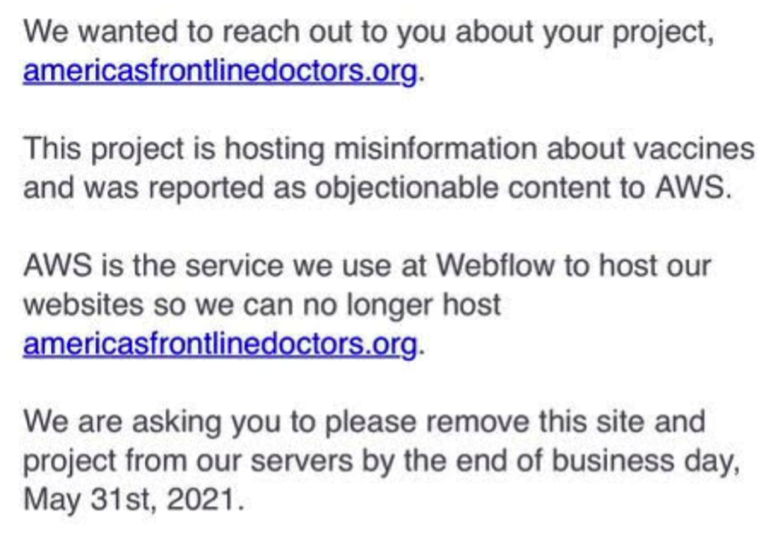
Amazon could have forced America’s Frontline Doctors (AFLDS) offline had the organization not acted quickly to look for an alternative. The Big Tech company seems to have taken issue with the organization for claiming COVID-19 vaccines may not be worth it in children.
America’s Frontline Doctors had its website built with WebFlow, which is ultimately hosted on Amazon Web Services (AWS).
Amazon, like other Big Tech, deemed the organization’s content to be “misinformation” and issued a notice last month that it should be removed from AWS.
“We wanted to reach out to you about your project, americasfrontlinedoctors.org. This project is hosting misinformation about vaccines and was reported as objectionable content to AWS,” the notice from WebFlow stated. “AWS is the service we use at Webflow to host our websites so we can no longer host americasfrontlinedoctors.org.”
Amazon gave the organization until May 31 to switch to a different host.
The notice forced AFLDS to rebuild its website from scratch using servers located around the globe.
“We were forced to take immediate action because we will never allow Jeff Bezos and Amazon to censor us from speaking freely about medical treatments, medical studies and individual liberty, or from challenging the government narrative surrounding COVID-19 vaccines,” the AFLDS said in a statement.
“Jeff Bezos and Amazon cannot argue with our scientific data and facts, so they would rather delete us entirely,” the statement added. “We have already been blacklisted on social media, and cannot host videos on YouTube. We must build our own internet servers that cannot be silenced by Big Tech, Big Pharma or Big Government.”
AFLDS is an organization that claims to be committed to “providing Americans with science-based facts about COVID-19 and fighting the politicization of medicine and media censorship.”
It first became popular when it held a censored press conference where some of its members promoted hydroxychloroquine, an FDA-approved medication that the WHO and CDC at the time insisted is not effective against COVID.
Amazon’s notice came a few days after AFLDS filed a motion seeking a temporary restraining order (TRO) at a federal court against the vaccination of children under the age of 16. The organization argued that the emergency use authorization (EUA) allowing the vaccination of kids should not have been granted.
DOCTORS, scientists, politicians, pharmaceutical companies and media promoting the experimental Covid vaccines as being safe and effective are rapidly being confronted with a stark choice: to save face or save lives.
As fresh evidence mounts supporting long-standing claims that the entire system of counting Covid ‘cases’ is bogus, grounds for repeatedly telling the public that the vaccines are safe are also collapsing.
The latest bombshell comes from Dr Robert Malone, an American vaccine specialist who invented the mRNA technology which is the basis of most Covid jabs, including Pfizer, Moderna, and Oxford AstraZeneca, allowing them to deliver the genetic code for the coronavirus spike protein.
The vaccine instructs body cells to produce small quantities of this toxic protein, so that the immune system can deal with it more effectively when it encounters the virus itself. Trials showed fewer patients who received the jab developed Covid-19 than those who received a placebo injection, though the numbers in both categories were very small.
But as reported here earlier this month, an unexpected and potentially lethal problem has arisen, in that the protein produced by the vaccine does not just act at the site of the jab. Animal studies using radioactive tracing have shown that it is carried through the blood to many other body sites, including the adrenal glands, heart, liver, kidneys, lungs, ovaries, pancreas, pituitary gland, prostate, salivary glands, intestines, spinal cord, spleen, stomach, testes, thymus and uterus.
Once in the blood, the protein is also now known to bind to cells that line blood vessels, causing both blood clot formation and abnormal bleeding. It seems that such cases are rare, though the crazy climate of government-driven fear surrounding Covid has made many doctors reluctant to report ill-effects.
The discoveries have led some researchers to say the risks arising from the jab may be greater than those from the actual virus, since a healthy immune system deals with the virus successfully. Young people, especially, are at minimal risk of Covid-19 disease regardless of their vaccinated status.
The jab, on the other hand, has a device which protects the spike protein mechanism against immediate destruction by the body, in order to promote the immune response. At present, no one knows how much toxin is produced, nor how long it lasts in the body.
In a social media tweet posted yesterday, Malone declared: ‘The SARS-CoV-2 spike protein is cytotoxic [it poisons body cells]. That is a fact. Who says so? Multiple peer-reviewed references. The Salk Institute. It is the responsibility of the vaccine developers to demonstrate that their expressed version is not toxic. Show us.’
And in a long interview with evolutionary biologist Dr Bret Weinstein, Malone says he warned US regulators many months ago that the vaccine could be dangerous. But proper evaluation of the risks is still not being carried out, he says, despite thousands of reports of deaths and disease associated with the vaccination drive.
Malone has issued a warning to public health experts, researchers and vaccine developers that if they fail to carry out rigorous, fact-based and transparent safety evaluations, ‘we play right into the hands of anti-vaxxer memes and validate many of their arguments. The suppression of information, discussion, and outright censorship concerning these current Covid vaccines which are based on gene therapy technologies cast a bad light on the entire vaccine enterprise.’
Writing in TrialSite News, an independent news and information platform dedicated to clinical research transparency and biomedical research, he says a Canadian primary-care physician told him recently of six cases of post-vaccination adverse events, all highly unusual in his own experience, after his patients received the Pfizer product.
‘What was most alarming to me was that each of these cases were reported as per the proper channels in Canada, and each was summarily determined to not be vaccine-related by the authorities, without significant investigation.
‘Furthermore, he reported to me that any practising physician in Canada who goes public with concerns about vaccine safety is subjected to a storm of derision from academic physicians, and potential termination of employment.’
Malone goes on: ‘What are official public health leaders afraid of? Why is it necessary to suppress discussion and full disclosure of information concerning safety risks?
‘Let’s analyse the vaccine-related adverse event data rigorously. Is there information or patterns that can be found, such as the recent finding of the cardiomyopathy [heart muscle damage] signals, or the latent virus reactivation signals? We should be enlisting the best biostatistics and machine-learning experts to examine these data, and the results should – no, must – be made available to the public promptly.’
Because of the experimental nature of the vaccines, the public receiving them are basically research subjects, and ‘fundamental bioethical principles for clinical research’ are being violated through the suppression of information and debate. ‘I believe that this must stop,’ Malone says.
He also has a warning – which should perhaps be heeded by UK Health Secretary Matt Hancock, who this week floated the idea of lifting Covid isolation rules for those who have had two jabs – against public health policies involving coercion in medical research. (Currently, anybody told by NHS Test and Trace that they are a contact of somebody who has tested positive for the virus must self-isolate for ten days.)
‘The Geneva Convention, the Helsinki Declaration, and the entire structure which supports ethical human subjects research requires that research subjects be fully informed of risks and must consent to participation without coercion. Has that bright line been crossed?’
In the same video featuring Malone, Bret Weinstein also interviews Steve Kirsch, an entrepreneur who recently published an article in TrialSite News describing how he has changed his mind over the Covid vaccines after researching their adverse effects. He and his three daughters all received two doses of the Moderna shot. He writes:
‘I recently learned that these vaccines have likely killed over 25,800 Americans (which I confirmed three different ways) and disabled at least 1,000,000 more. And we’re only halfway to the finish line. We need to PAUSE these vaccines NOW before more people are killed.
‘Based on what I now know about the minuscule vaccine benefits (approximately a 0.3 per cent reduction in absolute risk), side effects (including death), current Covid rates, and the success rate of early treatment protocols, the answer I would give today to anyone asking me for advice as to whether to take any of the current vaccines would be, Just say NO.
‘The current vaccines are particularly contraindicated if you have already been infected with Covid or are under age 20. For these people, I would say NO! NO! NO!’
In 2009, a whistleblower released emails showing how climate academia was manipulating/destroying data, and blocking publication of articles which didn’t support their anthropogenic global warming agenda.
“Our hopelessly compromised scientific establishment cannot be allowed to get away with the Climategate whitewash,” wrote reporter Christopher Booker for the Telegraph.co.ukback in November, 2009.
Even The Guardian’s George Monbiot expressed total shock and dismay at the picture revealed by the hacked emails, as their authors are not just any old bunch of academics.
“Their importance cannot be overestimated,” continued Brooker.
“What we are looking at here is the small group of scientists who have for years been more influential in driving the worldwide alarm over global warming than any others, not least through the role they play at the heart of the UN’s Intergovernmental Panel on Climate Change (IPCC).”
Professor Philip Jones was the director of the University of East Anglia’s Climatic Research Unit (CRU) from 1998 to 2016 — during this time, Jones was in charge of the two key sets of data used by the IPCC to draw up its reports.
Through its link to the Hadley Centre, part of the UK Met Office, which selects most of the IPCC’s key scientific contributors, Jones’ global temperature record was, and remains, the most important on which the IPCC and governments rely when making policy decisions — not least for their predictions that the world will warm to catastrophic levels unless trillions of dollars are spent to avert it.
Jones is also a key part of the closely knit group of American and British scientists responsible for promoting that picture of world temperatures conveyed by Michael Mann’s “hockey stick” graph, which turned climate history on its head by claiming that, after 1,000 years of decline, global temperatures recently shot up to their highest level in recorded history:
Michael Mann’s Hockey Stick graph.
Mann’s “hockey stick” was the basis for the IPCC’s conclusion that “there is discernible human impact on climate.” However, and in a first step toward restoring the rigor of science in the global climate debate, a committee of the National Academy of Sciences back in 2006 presented the results of its directed study of the science behind the infamous graph.
The Academy’s report identified the failure of the hockey stick to model climate beyond the past 400 years, as evidenced by its inability to reflect the medieval climate optimum (MCO).
The optimum has been extensively documented by recorded human history and proxies, but cannot be explained by computer models based on equations that assume that greenhouse gases dominate climate change. These same models predict massive increases in Earth’s atmospheric temperature because of the additions of a small percentage of human-derived carbon dioxide.
The IPCC needed to remove the MCO from the historical record books because the period blew apart their global warming theory: any forcing other than CO2 able to cause terrestrial warming is an inconvenient spanner in the works, and so, with the help of Mann, the panel completely erased every one of them from history in one clean swipe.
This was a brazen plan, particularly given the extensive data, records and proxies out there demonstrating that the MCO did indeed occur. These same natural records also prove the existence of the cyclic and preceding Roman-era warm event, and the very same data, records and proxies are on show again today during our modern warming event.
Climate, it turns out, is driven mainly by the Sun and the impact solar activity has on the oceans: ironically, it is the IPCC that are the true climate deniers.
Dr. Tim Ball’s temperature graph for the past 1,000 years is generally considered much closer to the actual reality
Below are a few of the ‘hacked’ exchanges between Philip Jones and Michael Mann between 1999 and 2008 (courtesy of The Guardian):
1) CONFLICT OF INTEREST
From: Phil Jones <p.jones@xxxxxxxxx.xxx>
To: “Michael E. Mann” <mann@xxxxxxxxx.xxx>
Date: Wed Mar 31 09:09:04 2004
Mike,
… Recently rejected two papers (one for JGR and for GRL) from people saying CRU has it wrong over Siberia. Went to town in both reviews, hopefully successfully. If either appears I will be very surprised, but you never know with GRL.
Cheers
Phil
Jones did not specify which papers he had rejected. But one appears to have been by Lars Kamel, which claimed to have found much less warming in Siberia than Jones.
It was a rare example of someone trying to replicate Jones’ analysis — one of the key ways in which science validates itself. So on the face of it, there was good reason to publish, even if flaws needed correcting. But the paper was rejected by Geophysical Research Letters, partly it seems because Jones “went to town”.
This raises important questions about conflict of interest in scientific peer review, and how Jones wielded his power as a reviewer.
2) BIASING THE IPCC ASSESSMENT
From: Phil Jones <p.jones@xxxxxxxxx.xxx> To: “Michael E. Mann” <mann@xxxxxxxxx.xxx> Subject: HIGHLY CONFIDENTIAL Date: Thu Jul 8 16:30:16 2004 Mike, … I can’t see either of these papers being in the next IPCC report. Kevin and I will keep them out somehow – even if we have to redefine what the peer-review literature is ! Cheers Phil
Jones is writing about two new papers. One, from two known skeptics Ross McKitrick and Pat Michaels, claimed to show a correlation between the geographical patterns of warming and of industrialization, suggesting that local urbanization rather than the global influence of greenhouse gases were often key in warming on land.
Jones evidently wanted to use his position as a lead author to keep the paper out of the IPCC report. In the event, the paper was not mentioned in early chapter drafts, but was added to a final version, where its findings were dismissed as “not statistically significant”.
Critics say that by keeping it out of early drafts, Jones prevented reviewers scrutinizing his conclusion.
3) REWRITING THE RULES OF FREEDOM OF INFORMATION
From: Phil Jones <p.jones@xxxxxxxxx.xxx> To: santer1@xxxxxxxxx.xxx, Tom Wigley <wigley@xxxxxxxxx.xxx> Date: Wed Dec 3 13:57:09 2008 Ben, When the FOI requests began here, the FOI person said we had to abide by the requests. It took a couple of half hour sessions – one at a screen, to convince them otherwise showing them what CA [ClimateAudit] was all about. Once they became aware of the types of people we were dealing with, everyone at UEA (in the registry and in the Environmental Sciences school – the head of school and a few others) became very supportive. I’ve got to know the FOI person quite well and the Chief Librarian – who deals with appeals… Cheers Phil
Climate Audit is the web site run by Steve McIntyre, a Canadian mathematician peppering Jones with requests for his data. There is no legal basis for rejecting FOI requests on the basis of the “types of people” they are.
The records show that the university turned down most FOI requests, from McIntyre and others, for CRU data. Of 105 requests concerning CRU submitted up to December 2009, the university had by late January 2010, acceded in full to only 10.
4) DELETING THE EVIDENCE
Phil Jones wrote to Mike Mann in 2008:
Mike,
Can you delete any emails you may have had with Keith re AR4? Keith will do likewise… Can you also email Gene and get him to do the same? I don’t have his new email address. We will be getting Caspar to do likewise…
Cheers
Phil
British skeptic David Holland had recently asked CRU for all emails sent and received by its tree-ring specialist Keith Briffa about the recently published IPCC report, of which Briffa was a lead author.
Briffa had been in correspondence with Mann and two American researchers, Gene Wahl and Caspar Ammann, who had a forthcoming paper defending Mann’s controversial “hockey stick” graph.
This secret correspondence was outside the IPCC’s formal review process and seemed to break its rules.
Clearly, CRU people wanted to hide this correspondence from FOI requests. This email persuaded the UK’s Information Commissioner’s Office that the university was “acting so as to prevent intentionally the disclosure of requested information”, and thus requests were “not dealt with as they should have been under the legislation”.
‘Climategate’ runs a lot deeper than the four emails and two scientists shown above.
The scale is actually jaw-dropping, and the email hack should have been enough to take the AGW scam down.
Here are two additional emails (images & highlighting courtesy of Tony Heller over at realclimatescience.com):
All this clearly reveals that fraud, lies and cover-ups are the backbone of the ‘global warming theory’.
The fact that the scam is still ongoing, and has actually gained further-traction in recent years, is testament to the agendas and powerful propagandizing at play.
The moronic masses have been duped into thinking the world is actually ending.
Our youth have been completely corrupted, transformed into a parroting mob devoid of ANY understanding of the topic at hand. The boredom of teendom has been given a phony purpose: to fight the threat posed by rising carbon dioxide emissions, and in future years, as these noisy, entitled pricks come of age –and win elected office– I can only imagine the devastating, economy wrecking and fuel poverty-inducing policies they will keenly implement.
Globalization, socialism, population control, and an overall redistribution of power appear to be the end goals here, with –as is always the case– “fear” being used as the driving force.
I can’t picture a better way to thumb-down the masses than making them think world is ending, and moreover, convincing them that it is their modern, comfortable way of life that is the root cause.
Will the Great Pandemic permanently unleash governments around the world? Covid-19 is enabling politicians to turn freedom from an individual right into a conditional bureaucratic dispensation. Defining down freedom was exemplified by the G-7 Summit that became a ludicrous and hypocritical Lockdowners Victory Lap.
The G-7 leaders, meeting in Cornwall, issued a communique pledging to “protect individuals from forced labour and to ensure that global supply chains are free from the use of forced labour.” But the political bosses had no concern about “forced non-labor” – their own decrees that destroyed tens of millions of jobs. That was no problem because, as the G-7 leaders boasted, “We have provided unprecedented support to citizens and businesses… totalling over $12 trillion including fiscal support and liquidity measures.”
But handouts are no substitute for freedom and self-reliance. Government aid is always only one decree away from mandating terms of submission. In 1942, the Supreme Court declared, “It is hardly lack of due process for the government to regulate that which it subsidizes.” The G-7 Summiteers proclaimed a boatload of environmental goals. Will future “stimulus payments” be restricted to people who reduce their “carbon footprint” or abandon their non-electric vehicles?
The Biden administration was thrilled that G-7 Summiteers adapted its slogan, “Build Back Better,” in the communique. That slogan will entitle politicians to snare more revenue and power to repair the damage from the shutdowns they inflicted. Biden-style rebuilding presumes that any government spending confers vast benefits, at least on politicians. Biden’s colleagues also seconded his call for placing at least 30% of all land and water under government restrictions in the name of conservation.
G-7 leaders enjoyed parties and plenty of backslapping – privileges denied to nearby British citizens whose lives continue semi-paralyzed by pervasive government restrictions. Brits were told that their lockdown misery would end on June 21, which became known as “Freedom Day.” But British politicians have invoked the fear of new variants to justify extending the lockdown at least another month and possibly far longer. Prime Minister Boris Johnson declared on Monday, “Now is the time to ease off the accelerator,” regardless of how many individual rights become roadkill. Spiked editor Brendan O’Neil declared that “this further suspension of liberty, is only possible in a society that has thoroughly devalued freedom” and derided the “creeping embrace of the lockdown lifestyle among significant sections of the Smart Set.”
In the U.S., President Joe Biden designated the Fourth of July as Americans’ shrink-wrapped “Freedom Day.” On March 11, Biden declared that, if people obey government decrees, “there’s a good chance you, your families and friends, will be [permitted] to get together in your backyard or in your neighborhood and have a cookout or a barbecue and celebrate Independence Day.” Biden repeated his declaration on April 21: “To celebrate our independence from this virus on July 4th with family and friends in small groups…. We all need to mask up… until everyone has a chance to get their shot.” Biden converted the Fourth of July into a benchmark of submission to presidential decrees. On May 4, Biden announced that he wanted 70% of American adults to have at least one Covid vaccine by July 4. On June 2, Biden declared that people should “exercise your freedom” to get vaccinated so Americans can enjoy a “summer of freedom.” Freedom to get politically-mandated injections was not one of the clauses included in the Bill of Rights. Regardless of the Biden administration’s alarmism, most states have already lifted lockdown orders.
Biden’s attempted expropriation of Independence Day had no impact on his honeymoon with the media. When the Pulitzer Prizes were bestowed last Friday, no awards were given for exposing the frauds and follies of repressive Covid-19 policies that ravaged prosperity and freedom. Instead, the Pulitzer for Public Service was awarded to a New York Times team that included Donald McNeil. As Jeffrey Tucker reported, early during the pandemic, McNeil fanned fear with a bizarre article headlined, “To Take On the Coronavirus, Go Medieval on It.” He urged American policymakers to rely on tactics “from the era of the Black Death… pen terrified citizens up inside their poisoned cities… Harsh measures horrify civil libertarians, but they often save lives, especially when they are imposed in the early days.” McNeil turbocharged his alarmism by overestimating the likely death toll by over 20-fold. Ironically, at a time when the American media has become far more critical of police power, pundits have consecrated bureaucratic power.
In the Covid era, destroying freedom is a negligible loss, akin to a government agency misplacing a few hundred filing cabinets. Los Angeles Mayor Eric Garcetti faced minimal criticism last December when he banned all unnecessary “travel, including, without limitation, travel on foot, bicycle, scooter, motorcycle, automobile, or public transit.” The mayor offered no evidence to justify placing four million residents under house arrest. Similar restrictions hit residents of Michigan, New York, Oregon, and other states. Federal judge William Stickman IV aptly declared last September, “Broad population-wide lockdowns are such a dramatic inversion of the concept of liberty in a free society as to be nearly presumptively unconstitutional.” But the scant controversy over lockdowns is a sign that many media outlets are happy to see liberty “inverted” into unquestioning obedience to any command issued by any government official.
Politicians could decimate freedom because their Covid-19 decrees almost instantly became hallowed with the aura of “science” – regardless of how often the official guidance changed. Since Biden became president, Covid vaccines have also become sacrosanct and casting any doubts on their safety or efficacy is portrayed as proof of idiocy or villainy. Politicians and their media allies now talk as if the only reliable gauge of health and safety is the percentage of Americans who have been injected (ignoring the natural immunity that the 115 million people who had Covid infections enjoy). The result is a long series of socialist-style victory proclamations, substituting the number of arms injected for bogus statistics on the wheat harvest from collective farms. And anyone who refuses to be vaccinated is the new Kulak, reviled and portrayed as a dire threat to the survival of everything decent. It would not be surprising if politicians limited future Covid handouts to individuals who could prove they were vaccinated.
Many Americans presume that the political travails of Covid are mostly in the rearview mirror. The small print of the G-7 Communique is hell on such optimism. “The COVID-19 pandemic is not under control anywhere until it is under control everywhere,” the Summiteers warned. And as long as the pandemic is out of control, rulers must remain unleashed. If anyone has the virus, then no one is free – or at least no one should be permitted to be free. The prerogatives and precedents that multiplied during the Covid pandemic are waiting to be exploited for the next viral outbreak – or maybe simply to make some really dramatic gestures on climate change.
The G-7 Communique endlessly promised “transparency” but only fools should expect official candor during pandemics or other politically-proclaimed emergencies. British scientists who shaped government Covid policies recently admitted using “unethical” and “dystopian” fearmongering to terrorize people into submission. One scientist declared that “using fear smacks of totalitarianism,” and another scientist admitted being “stunned by the weaponization of behavioral psychology” to enforce compliance with Covid dictates.
American politicians and government agencies relied on many of the same fear tactics in this country. Docile media helped sway people to viewother Americans’ freedom as the deadliest threat to their own health. Instead, the biggest danger citizens faced was that their rulers would not have sufficient power to force everyone else to stop working, stop worshipping, stay inside, and get injected.
No-fault Czars are no substitute for individual liberty. Politicians vindicated lockdowns by claiming that all the sacrifices are justified if they “save just one life.” But what about “just one freedom” – especially freedoms previously enjoyed by hundreds of millions of people? Instead of “Build Back Better” further empowering reckless rulers, we need to “Build Back Freer.”
James Bovard is the author of ten books, including Public Policy Hooligan, Attention Deficit Democracy, The Bush Betrayal, and Lost Rights: The Destruction of American Liberty. He has written for the New York Times, Wall Street Journal, Playboy, Washington Post, New Republic, Reader’s Digest, and many other publications. He is a member of the USA Today Board of Contributors, a frequent contributor to The Hill, and a contributing editor for American Conservative.
In a report published by CBC in Canada, government health officials are saying that they have not found a single case of seasonal flu this year.
Health officials in B.C. have not detected a single case of influenza circulating in the community since flu season began, continuing an “exceptional” nationwide trend even as the province sits in the thick of its regular flu season.
The B.C. Centre of Disease Control (BCCDC) confirmed the non-existent seasonal flu numbers to CBC News on Monday.
“It’s still a big goose egg in terms of influenza detection provincially. It’s really quite exceptional how low the influenza activity is,” said Dr. Danuta Skowronski, the lead for influenza and emerging respiratory virus monitoring at the BCCDC.
“I’ve been on the influenza beat for 20 years and I’ve never seen anything like this … and that’s not for lack of trying.”
But if you continue reading the article, you will see that they have actually tested some people positive for influenza via nasal swabs: those who were injected with the live-attenuated influenza vaccine.
The BCCDC has tested 30,000 samples for influenza this year. Only a dozen of those tests came back positive and all were linked to people who’d received a vaccine, which doesn’t count as community spread.
By comparison, the centre found 861 positive tests last year with roughly one-third of the testing.
B.C.’s experience is reflected across the country. A report from the Public Health Agency of Canada on Thursday said there hasn’t been enough influenza cases to even declare that the 2020-21 flu season has begun in Canada.
The 30,000 tests run for the flu this year is four times the average number of tests B.C. has done over the past five flu seasons. The dozen positive results were all connected to people who’d received the “live attenuated” flu vaccine, which is made from weakened influenza virus and delivered by nasal spray.
“It’s not unusual to pick up the vaccine virus in the nose swab,” Skowronski said. “What is unexpected is to find no influenza viruses otherwise at all in the province.” (Source.)
This is not a new phenomenon, of course. For years now there have been no cases of polio in most countries around the world, except among those who are vaccinated for polio. See:
I wondered if this phenomenon of zero flu cases was also being experienced in the U.S., so I did a search on the term “zero flu cases.” The result is in the graphic at the top of this article, which shows that many communities, hospitals, cities, and even states, are reporting the same thing as Canada.
The first 9 results found articles reporting zero cases of the flu this year, while the 10th result was a “fact checking” article stating that reports on Facebook stating that there were zero cases of flu this year were FALSE.
Of course the reason being given as to why the flu just all of a sudden disappeared is because of COVID-19 measures, which stopped the flu, but not COVID-19. Not even the experimental COVID-19 “vaccines” have stopped COVID-19, as the majority of people dying today with a COVID-19 diagnosis have been “fully vaccinated.”
And yet people in the public actually believe this explanation as to why the flu has suddenly disappeared??
Who are these people running these government health agencies and telling the public such bold-faced lies?
How often do we hear that the PCR (polymerase chain reaction) test is the “gold standard” for detecting COVID-19 infection and thus for controlling and containing a COVID-19 epidemic? To question the accuracy of this test is supposedly part of the “misinformation” sceptics spread, which Ofcom, being guided by biased, Big Tech-funded, activist organisation Full Fact, aims to suppress.
In reality, serious questions about the proper use of PCR tests, particularly in mass screening programmes, have been asked since the technique was invented in 1985 and predate the Covid pandemic.
Since early 2020, there have been concerns that defining a “case” of COVID-19 merely in terms of a positive PCR test – with no consideration of clinical symptoms or the cycle threshold (Ct) of the test, which indicates the viral load of the patient – debases the concept of a clinical case and exaggerates the prevalence of the disease, fuelling alarm.
The issue was raised by Harvard epidemiologist Michael Mina and colleagues in the Lancetin February 2021, where they concluded that the cycle thresholds in reported test data were such that only a quarter to a half of positive PCR tests were likely to indicate the presence of infectious COVID-19. The rest, they argued, were detecting post-infectious viral particles, meaning relying on PCR testing was overstating the number of infectious cases of COVID-19 by a factor of between two and four.
This conclusion has now been underlined in a research letter in the Journal of Infection by seven scientists from the Universities of Münster and Essen. After analysing the test results from a large laboratory in Münster that amounted to 80% of all Covid PCR tests in the Münster region during March to November 2020, they found that “more than half of individuals with positive PCR test results are unlikely to have been infectious”. They thus conclude: “RT-PCR test positivity should not be taken as an accurate measure of infectious SARS-CoV-2 incidence.”
They also note that asymptomatic positives have higher average Ct values than symptomatic positives, meaning lower viral load and so less likely to be infectious.
Asymptomatic individuals with positive RT-PCR test results have higher Ct values and a lower probability of being infectious than symptomatic individuals with positive results.
This isn’t to say that PCR tests are of no use in diagnosing COVID-19. PCR amplifies tiny amounts of genetic material until it can be detected, and can certainly be used to detect the presence of SARS-CoV-2. However, some doubt the validity of the PCR test protocols for COVID-19 and so question whether it is even detecting a real virus. However, since a large proportion of samples are currently being genetically sequenced to determine which variant they are, there can be no serious doubt that a real virus with known genetic structure is being detected in the tests.
When viral incidence is low or declining, that’s when the PCR test becomes much less reliable and tends greatly to overstate the prevalence of the disease (by two to four times, according to Michael Mina) and misdiagnoses people as being sick or infectious. When levels are surging and there is more infectious virus around it is much more likely to be accurate, at least in terms of indicating infectiousness, though questions about the proper use of the term “case” where no or mild symptoms are present remain.
Two weeks ago, I blogged about a magazine article titled The Drug that Cracked Covid. It describes the bizarre reaction, on the part of health bureaucrats and journalists, to the news that Ivermectin is a pandemic game-changer.
On the one hand we have ICU doctors who’ve been toiling in the trenches, battling COVID for over a year. Based on firsthand experience and a mountain of research, they know this cheap, generic drug is highly effective. On the other hand, we have health bureaucrats who’ve never treated a single COVID patient, who haven’t worked a single shift in ICU during this pandemic, insisting Ivermectin should not be used as a COVID medicine.
But there’s a further component to this madness: Big Tech censorship. Tom Nelson lives in Minnesota and has a Masters of Science degree in Electrical and Electronics Engineering. He’s been an independent blogger since 2005, when he began commenting on the extinction status of a particular species of woodpecker. These days, he’s an active participant in the online climate debate.
Having joined Twitter in 2008, Nelson is now followed by 28.7 thousand people. But two weeks ago, he did something that put his Twitter account at risk – he talked about my blog post. Twitter says that quoting my summary and linking to my post violates its rules concerning “misleading and potentially harmful information related to COVID-19.”
Twitter, he was further advised, requires “the removal of content that may pose a risk to people’s health, including content that goes directly against guidance from authoritative sources of global and local public health information.”
So an experienced journalist (moi, here in Canada), blogs about an article written by another experienced journalist (Michael Capuzzo, in the US). When Nelson tells the world about our work, Twitter locks his account – preventing him from tweeting, retweeting, or liking other people’s messages until he deletes the dangerous, forbidden, not-to-be-tolerated tweet.
But deletion wasn’t enough. Only after Nelson took this step, did a 12-hour countdown begin. In other words, Nelson spent 12+ hours in Twitter’s penalty box for tweeting about the work of professional journalists.
That resulted in a near immediate second suspension. In order to continue talking to his audience of more than 28 thousand people, Nelson was required to delete that tweet, as well – and to spend seven days in Twitter’s penalty box.
This is insane. Twitter has no business censoring journalists. It has no business taking sides in any debate about how best to treat any disease. But it is doing so. Ever more aggressively. And with absolute impunity.
In Nelson’s words: “I’m incredibly angry about this. I believe Twitter censorship of the Ivermectin discussion has already cost people their lives.”
By Jamal Kanj – Intifada-Palestine.com – January 14, 2011
Israel’s survival kit is: perpetuate conflict, insecurity to rationalize collective hate and finally playing victim.
Devoid of conflict, Israel implodes internally; without hate, Zionism loses its justification; and playing eternal victim to continue blackmailing the West. Absence of this holy trinity, Israel ceases to exist.
From its inception, the house of Zion has mastered exploiting adversarial powers to advance Israel’s cause. For instance, their influence over the Democratic Party in the US began with President Truman’s bid for 2nd term election in 1948.
Responding to strong opposition from Secretary of State General George Marshall and Department experts urging against recognition of Israel, President Truman replied: “I’m sorry gentlemen but I have to answer to hundreds of thousands [Jewish voters] who are anxious for the success of Zionism. I do not have hundreds of thousands of [voting] Arabs among my constituents”
Zionists influence over liberal American politics was matched with the doctrinal school of Conservative theoreticians aligning the Republican Party’s platform with Israel’s objectives. The Neoconservative Zionists, coined Zioncons, invented the “Clash of Civilization” concept to fight Israel’s wars. … continue
This site is provided as a research and reference tool. Although we make every reasonable effort to ensure that the information and data provided at this site are useful, accurate, and current, we cannot guarantee that the information and data provided here will be error-free. By using this site, you assume all responsibility for and risk arising from your use of and reliance upon the contents of this site.
This site and the information available through it do not, and are not intended to constitute legal advice. Should you require legal advice, you should consult your own attorney.
Nothing within this site or linked to by this site constitutes investment advice or medical advice.
Materials accessible from or added to this site by third parties, such as comments posted, are strictly the responsibility of the third party who added such materials or made them accessible and we neither endorse nor undertake to control, monitor, edit or assume responsibility for any such third-party material.
The posting of stories, commentaries, reports, documents and links (embedded or otherwise) on this site does not in any way, shape or form, implied or otherwise, necessarily express or suggest endorsement or support of any of such posted material or parts therein.
The word “alleged” is deemed to occur before the word “fraud.” Since the rule of law still applies. To peasants, at least.
Fair Use
This site contains copyrighted material the use of which has not always been specifically authorized by the copyright owner. We are making such material available in our efforts to advance understanding of environmental, political, human rights, economic, democracy, scientific, and social justice issues, etc. We believe this constitutes a ‘fair use’ of any such copyrighted material as provided for in section 107 of the US Copyright Law. In accordance with Title 17 U.S.C. Section 107, the material on this site is distributed without profit to those who have expressed a prior interest in receiving the included information for research and educational purposes. For more info go to: http://www.law.cornell.edu/uscode/17/107.shtml. If you wish to use copyrighted material from this site for purposes of your own that go beyond ‘fair use’, you must obtain permission from the copyright owner.
DMCA Contact
This is information for anyone that wishes to challenge our “fair use” of copyrighted material.
If you are a legal copyright holder or a designated agent for such and you believe that content residing on or accessible through our website infringes a copyright and falls outside the boundaries of “Fair Use”, please send a notice of infringement by contacting atheonews@gmail.com.
We will respond and take necessary action immediately.
If notice is given of an alleged copyright violation we will act expeditiously to remove or disable access to the material(s) in question.
All 3rd party material posted on this website is copyright the respective owners / authors. Aletho News makes no claim of copyright on such material.
 Michael Mann’s Hockey Stick graph.
 Dr. Tim Ball’s temperature graph for the past 1,000 years is generally considered much closer to the actual reality



 Aletho News
