I recently wrote about Susan Crockford, a world-renowned Canadian zoologist. After serving 15 years as an unpaid Adjunct Professor at the University of Victoria (UVic), her adjunct status has now been revoked. First she was banned from participating in UVic’s Speakers Bureau. Then she was excommunicated from UVic altogether.
In an era in which others bite their tongues and keep their heads down, Crockford courageously disputes the claim that polar bears are at risk from climate change. She has now paid a heavy price.
It’s time to remind ourselves that UVic is a public institution funded by tax dollars. According to its most recent budget document, it spends more than half a billion a year. 52% of its general operating revenue comes directly from provincial and federal government grants. An additional 37% of its revenue comes from student fees – which themselves rely heavily on government grants.
The UVic budget document says a great deal about government funding, but not once does it use the word taxpayer. This institution appears to have forgotten that it owes its very existence to ordinary Canadians. Money is taken away from ordinary people, in the form of taxes, and handed over to UVic to spend.
Publicly funded entities have a special obligation to be transparent. Under British Columbia law, for example, they must publish the salaries of everyone earning above $75,000 a year (see UVic’s annual Financial Information Act report, posted online here).
Crockford was purged even though she didn’t cost UVic one red cent. Compare that to the $188,510 in salary plus $14,583 in expensesAnn Stahl earned last year. While serving as chair of the Anthropology Department, Stahl stopped Crockford from giving free lectures via UVic’s Speakers Bureau.
Compare Crockford’s pricetag to the $145,532 plus $17,272 in expensesApril Nowell earned last year. Nowell was chair of the Anthropology Department when it excommunicated Crockford altogether.
We can also compare Crockford’s unpaid position to the $85,851 salary of Paul Marck, the UVic spokesperson I dealt with. He advised me that UVic department heads earning the salaries mentioned above aren’t allowed to speak to journalists working on stories for national newspapers. Everything has to go through Media Relations and Public Affairs, he said, inviting me to e-mail him written questions. That was on September 13th.
I submitted questions the same day. Two dozen of them. Do you know how many Marck answered? Zero. Zip.
I began by asking him to confirm that Crockford had been an adjunct professor for 15 years. He refused to say. After a ridiculous delay of 18 days, a man who’s paid $85,000 annually replied to my long list of questions with a single paragraph. Here’s his October 1st response, in its entirety:
Hello Donna;
Yes, you are correct that Dr. Susan Crockford held an appointment as a non-remunerated, adjunct assistant professor with the University of Victoria’s Department of Anthropology. Under the constraints of provincial privacy legislation, the university is unable to provide personal information relating to the status or renewal of adjunct appointments. For clarification, those who hold adjunct positions are neither faculty members nor employees of the university. As to your remaining questions, the university does not disclose identifying or personal information about our faculty members, staff or students including information about internal processes. We respect the privacy rights of all members of our campus community.
Sincerely,
Paul
My first group of questions merely attempted to verify dates and basic information. Double-checking facts with both sides of a story is important, but UVic made that impossible. If my understanding of events was inaccurate, this was UVic’s opportunity to let me know. Instead, it chose to stonewall, refusing to say if the Speakers Bureau had ever given Crockford negative feedback, or if anyone in the Anthropology Department had advised her she was at risk of losing her adjunct status.
My next six questions were emphatically not about identifiable individuals. I asked how many people had been on the committee that revoked Crockford’s adjunct status. How many had voted for her versus against her. How many were zoologists? How many adjuncts had the Anthropology Department severed ties with over the past decade? How many adjuncts had UVic as a whole severed ties with? I also asked about safeguards that would prevent adjuncts from being punished for politically incorrect views.
Answering those questions would have violated the privacy of absolutely no one. It’s hilarious that, when I then asked how many UVic professors had matched Crockford’s achievement by being recently published in a prestigious scientific journal, UVic declined even to answer that. University PR people spend their days boasting about this sort of thing. They normally send journalists press releases begging for celebratory coverage.
My final group of questions concerned Crockford’s banishment from the Speakers Bureau. The first one asked why Stahl had refused to endorse – and had therefore silenced – Crockford. This clearly involved identifiable individuals, but the eight questions that followed did not. Here are four of them, typo and all. I’ve inserted the italics here:
ii. Since 2017, how many other UVic adjunct professors (within and beyond the Anthropology Department) are no longer participating in the Speakers Bureau due to a similar refusal on the part of their department chair?
iii. Since 2017, what percentage of UVic graduate students participating in the Speaker’s Bureau have been similarly required to secure written endorsement from their department chair?
iv. How many of these graduate studetns have been refused? [sic]
ix. What mechanisms exist to vet the content of Speakers Bureau presentations, particularly regarding controversial topics such as climate justice, renewable energy, Israeli-Palestinian relations, restorative justice, and so forth?
That last issue is of particular importance. Either there’s a system to vet presentations or there isn’t. I was seeking basic information, trying hard to understand what’s normal, sincerely trying to sort out what had transpired. UVic felt absolutely no need to explain, to reassure Canadian taxpayers that it had behaved honourably and fairly.
Let me repeat. The University of Victoria was given ample opportunity – 18 bleeping days. Like an untouchable and unaccountable monarch, it chose not to answer a single question.
Some thoughts in response to a query from a reporter.
I received the following questions today from a reporter, related to climate change and ‘timelines.’ These questions are good topics for discussion.
My answers are provided below:
From your perspective, have the early warnings about how hot the Earth is getting turned out to be accurate? Have they been adjusted higher or lower than expected?
Early predictions of warming were 0.2 to 0.3 degrees Centigrade per decade are too high relative actual observations. Further, blaming all of the recent warming on carbon dioxide emissions is incorrect, in my opinion. Solar indirect effects and multi-decadal oscillations of large scale ocean circulations have been effectively ignored in interpreting the causes of the recent warming.
What is the best figure that explains how we will know when things are really irrevocably bad? Is it the 2ºC limit, as some have reported?
‘Bad’ is a value judgment, and regions are affected differently by climate variations and change. Most of the so-called ‘bad effects’ of climate change relate to the natural variability of weather, and there is little to no evidence that extreme weather events have been worsening, against the large variations of natural climate variability.
The single adverse impact that is unambiguously associated with warming (whatever the cause) is sea level rise. Since 1900, global sea level has risen about 8 inches. There is substantial temporal and spatial variations of sea level rise, associated with large scale ocean circulation patterns, glacial rebound, weather and tides. Projections of sea level rise by 2100 beyond several feet require: implausible scenarios of the amount of carbon dioxide in the atmosphere, climate models that have implausibly high warming sensitivity to the amount of CO2 in the atmosphere, and invocation of scenarios of collapse of the West Antarctic ice sheet associated with speculative and poorly understood processes.
The 2C limit relates to expectations for long-term (many many centuries) melting of the Greenland and Antarctic ice sheets. The issue of the 2C limit is better described as ‘planetary diabetes’ rather than extinction or other dire characterizations. Another way of thinking about the so-called 2C limit is by analogous to a high-way speed limit. If the speed limit is 65 mph, exceeding that by 10 or even 20 mph is not guaranteed to cause a crash, but if you exceed the limit by a lot, your risk of a fatal crash certainly increases.
How do the actions (or inactions) of the Trump administration, such as withdrawing from the Paris climate agreement, affect that timeline? If Democrats win the government in 2020, would implementing the Green New Deal (if it even passed) be too little, too late?
The political actions of President Trump have essentially made no difference to this timeline. Most of the signatories to the Paris Agreement are falling far behind in their commitments (the U.S. has been doing relatively well in terms of its emissions cuts.) Any future success of the Green New Deal relies on both politics and technology. Overwhelming Democratic control of the U.S. government wouldn’t necessary help with the needed technology developments.
Excerpts from the IPCC Special Report on 1.5C, Summary for Policy makers.
B1. Climate models project robust differences in regional climate characteristics between present-day and global warming of 1.5°C, and between 1.5°C and 2°C. …
B1.1. Evidence from attributed changes in some climate and weather extremes for a global warming of about 0.5°C supports the assessment that an additional 0.5°C of warming compared to present is associated with further detectable changes in these extremes (medium confidence). …
B1.3. Risks from droughts and precipitation deficits are projected to be higher at 2°C compared to 1.5°C global warming in some regions (medium confidence). …
B2. By 2100, global mean sea level rise is projected to be around 0.1 metre lower {4″} with global warming of 1.5°C compared to 2°C (medium confidence). …
B2.1. Model-based projections of global mean sea level rise (relative to 1986-2005) suggest an indicative range of 0.26 to 0.77 m by 2100 for 1.5°C global warming, 0.1 m (0.04-0.16 m) {4″} less than for a global warming of 2°C (medium confidence). …
B3. On land, impacts on biodiversity and ecosystems, including species loss and extinction, are projected to be lower at 1.5°C of global warming compared to 2°C. …
B3.1. Of 105,000 species studied,9 6% of insects, 8% of plants and 4% of vertebrates are projected to lose over half of their climatically determined geographic range for global warming of 1.5°C, compared with 18% of insects, 16% of plants and 8% of vertebrates for global warming of 2°C (medium confidence). …
B3.2. Approximately 4% (interquartile range 2–7%) of the global terrestrial land area is projected to undergo a transformation of ecosystems from one type to another at 1ºC of global warming, compared with 13% (interquartile range 8–20%) at 2°C (medium confidence). …
B4. Limiting global warming to 1.5°C compared to 2ºC is projected to reduce increases in ocean temperature as well as associated increases in ocean acidity and decreases in ocean oxygen levels (high confidence). …
B4.1. There is high confidence that the probability of a sea-ice-free Arctic Ocean during summer is substantially lower at global warming of 1.5°C when compared to 2°C. With 1.5°C of global warming, one sea ice-free Arctic summer is projected per century. This likelihood is increased to at least one per decade with 2°C global warming. Effects of a temperature overshoot are reversible for Arctic sea ice cover on decadal time scales (high confidence). …
B4.4. Impacts of climate change in the ocean are increasing risks to fisheries and aquaculture via impacts on the physiology, survivorship, habitat, reproduction, disease incidence, and risk of invasive species (medium confidence) but are projected to be less at 1.5ºC of global warming than at 2ºC.
Larry Kummer’s comments:
“Most of the findings in the SPM of this Special Report are of two kinds. First, stating that the effects of 1.5°C warming are less than those of 2.0°C warming. Pretty obvious, but it means little unless we know the effects of 2°C warming. It seldom quantifies the difference in effects from that extra 0.5°C warming, which is the key information necessary to know when assessing the cost-benefit of limiting the coming warming.
Second, there are more specific findings – bad but not disastrous – given at a “medium” level of confidence. The IPCC uses five levels of confidence: very low, low, medium, high, and very high. “Medium” is a weak basis for extreme measures to restructure society and the global economy. Especially since it is human nature to overestimate confidence more often than to underestimate it.”
“There is nothing in this Special Report justifying belief that the world will end, that the world will burn, or that humanity will go extinct. It has been misrepresented just as past reports have been (e.g., the 4th US National Climate Assessment). The disasters described the Climate Emergency and Extinction Rebellion activists are those of RCP8.5, the worst-case scenario in the IPCC’s Fifth Assessment report – or even beyond it. RCP8.5 is, as a worst-case scenario should be, a horrific but not apocalyptic future that is improbable or impossible.”
Bottom line is that these timelines are meaningless. While we have confidence in the sign of the temperature change, we have no idea what its magnitude will turn out to be. Apart from uncertainties in emissions and the Earth’s carbon cycle, we are still facing a factor of 3 or more uncertainty in the sensitivity of the Earth’s climate to CO2, and we have no idea how natural climate variability (solar, volcanoes, ocean oscillations) will play out in the 21st century. And even if we did have significant confidence in the amount of global warming, we still don’t have much of a handle on how this will change extreme weather events. With regards to species and ecosystems, land use and exploitation is a far bigger issue.
Cleaner sources of energy have several different threads of justification, but thinking that sending CO2 emissions to zero by 2050 or whenever is going to improve the weather and the environment by 2100 is a pipe dream. If such reductions come at the expense of economic development, then vulnerability to extreme weather events will increase.
There is a reason that the so-called climate change problem has been referred to as a ‘wicked mess.’
An accomplished scientist and role model for young women has been expelled from the academic community. Like geologist BobCarter before her, Susan Crockford has been stripped of her Adjunct Professor status by a university with which she has a long history. Why? Because she promotes facts and eschews climate activism.
In May, Canada’s University of Victoria (UVic) advised Crockford that an internal committee had voted to end her 15-year stint as an Adjunct Professor. Having undergone hip surgery in the interim, only now is she going public.
When the matter was last considered, the committee voted unanimously in her favour. What changed? Talks she was invited to give to schools apparently “generated concern among parents regarding balance.” That concern was “shared with various levels of the university,” according to an April 2017 e-mail from Ann Stahl, then chair of the Anthropology Department.
These vague accusations, leveled by an unknown number of unknown individuals who may or may not have been garden variety climate activists, were first used to expel Crockford from the UVic Speakers Bureau. They then became the impetus to expel her from the UVic academic community altogether.
I’ve written about this scandalous development in today’s Financial Post, the business section of Canada’s daily newspaper, the National Post.
On the subject of balanced presentations, please see my recent commentary, U of Victoria’s Speakers Bureau. Many of the talks it promotes are one-sided, activist, and controversial. Someone with no science background has, for years, been giving lectures about ocean chemistry. Yet the eminently qualified Crockford was purged.
While UVic has deprived its students of her expertise, this weekend Crockford begins a European speaking tour. Audiences in Oslo, London, Paris, Amsterdam, and Munich will have the opportunity to hear her firsthand.
This story was huge news worldwide. Fortune magazine quoted Laure Resplandy, the Princeton University oceanographer who was the research paper’s lead author. “The planet warmed more than we thought,” she said. “It was hidden from us just because we didn’t sample it right.”
In fact, the problem wasn’t hiding in the ocean, but in the paper’s own mathematical calculations. Within days Nic Lewis, a UK private citizen and math whiz, had published the first of four detailed critiques of the paper’s statistical methodology (see here, here, here, and here).
We’re told that research published in prestigious scientific journals is reliable, and that peer review is meaningful. Yet 19 days after those Halloween headlines, the journal announced the authors had acknowledged a number of errors.
Two weeks ago, presumably after months of attempting to rescue the paper, the journal threw in the towel and retracted it wholesale.
What happened in between? The Intergovernmental Panel on Climate Change (IPCC) released a 1,200-page report about oceans. Chapter 5 of that report cites this now-retracted research (see pages 5-27 and 5-183 here).
In fairness, this single citation may just be a typo. There’s a good chance the IPCC meant to cite a different 2018 paper, in which Resplandy was also the lead author.
But the matter doesn’t end there. The UK-based Global Warming Policy Foundation (GWPF) is now pointing out that a crucial conclusion of the IPCC’s report relies heavily on a second paper titled How fast are the oceans warming?
Written by Lijing Cheng and colleagues John Abraham, Zeke Hausfather, and Kevin Trenberth, it was published in January 2019 in Science. The journal calls it a ‘Perspective,’ because rather than being a research paper, it’s more of an argument.
In three places, the Halloween research is cited to support its conclusions. Nowhere do Cheng and his colleagues acknowledge that the statistical methodology of the Halloween research had already been torn to shreds, that the paper’s authors had already conceded it was flawed.
The bottom line? Chapters 4 and 5 of the IPCC’s ocean report rely on the 2019 Cheng ‘Perspective.’ The Cheng ‘Perspective’ relies on research that has now been officially retracted.
The even worse bottom line? Lijing Cheng – an academic who concealed vital information in an article published in Science this year – was intimately involved in the preparation of the IPCC’s ocean report. He was a lead author for Chapter 1. He was a contributing author for Chapters 3 and 5. And he helped draft the Summary for Policymakers.
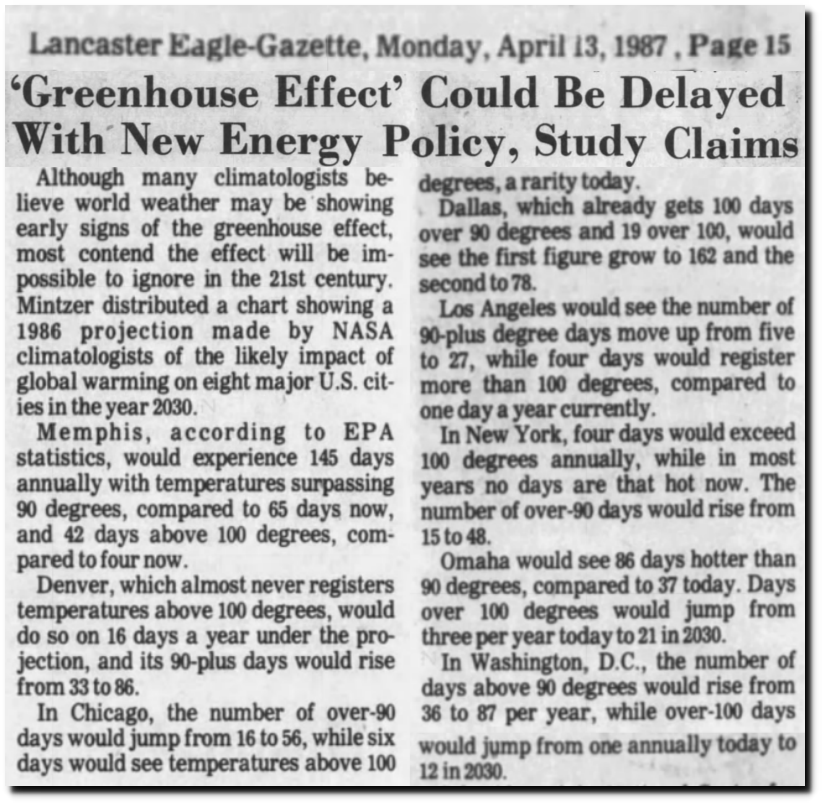
In 1986, NASA’s James Hansen made some projections about how global warming was going to affect eight cities.
Mintzer distributed a chart showing a 1986 projection made by NASA climatologists of the likely impact of global warming on eight major U.S. cities in the year 2030.
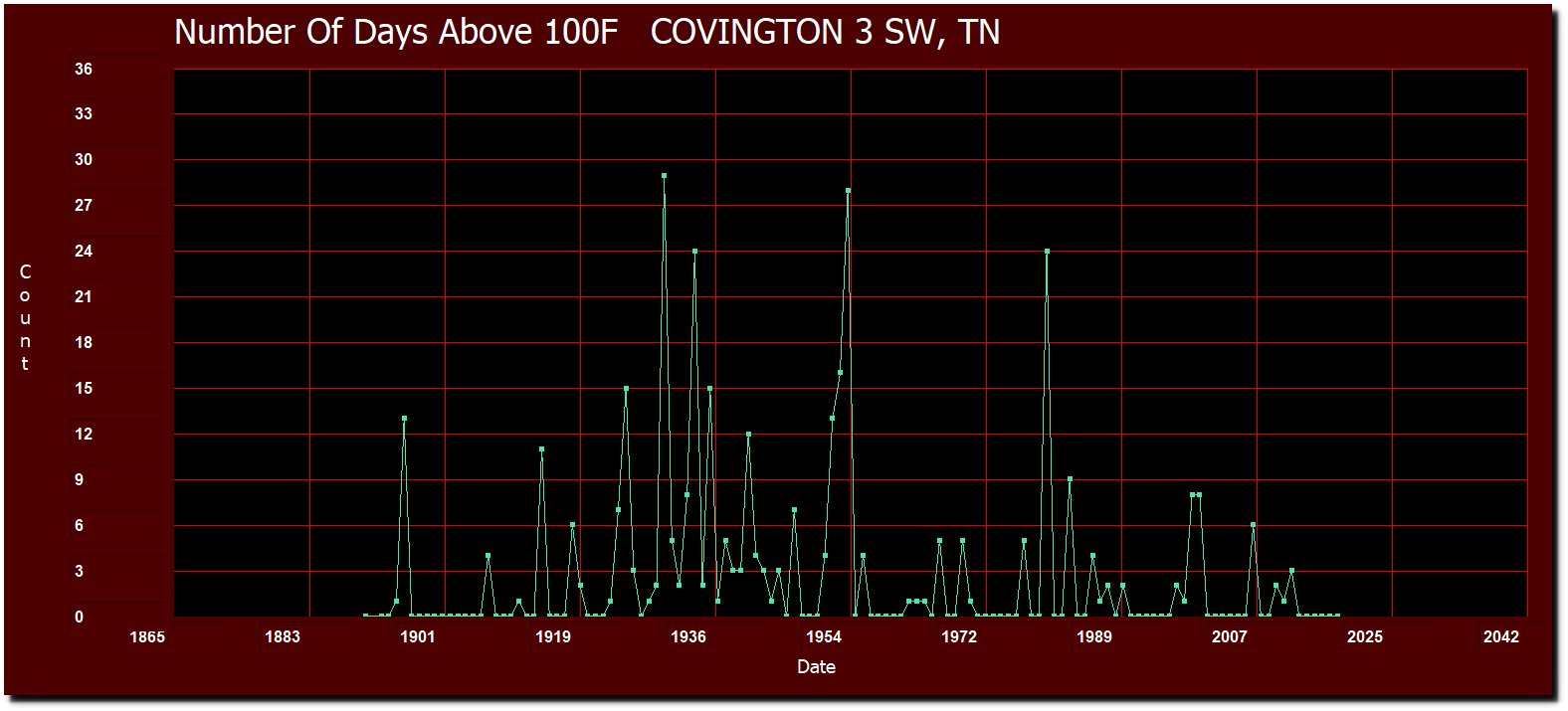
Memphis, according to EPA statistics, would experience 145 days annually with temperatures surpassing 90 degrees, compared to 65 days now, and 42 days above 100 degrees, com-pared to four now.
Covington is the closest Tennessee USHCN station to Memphis. The frequency of 90 and 100 degree days has plummeted.
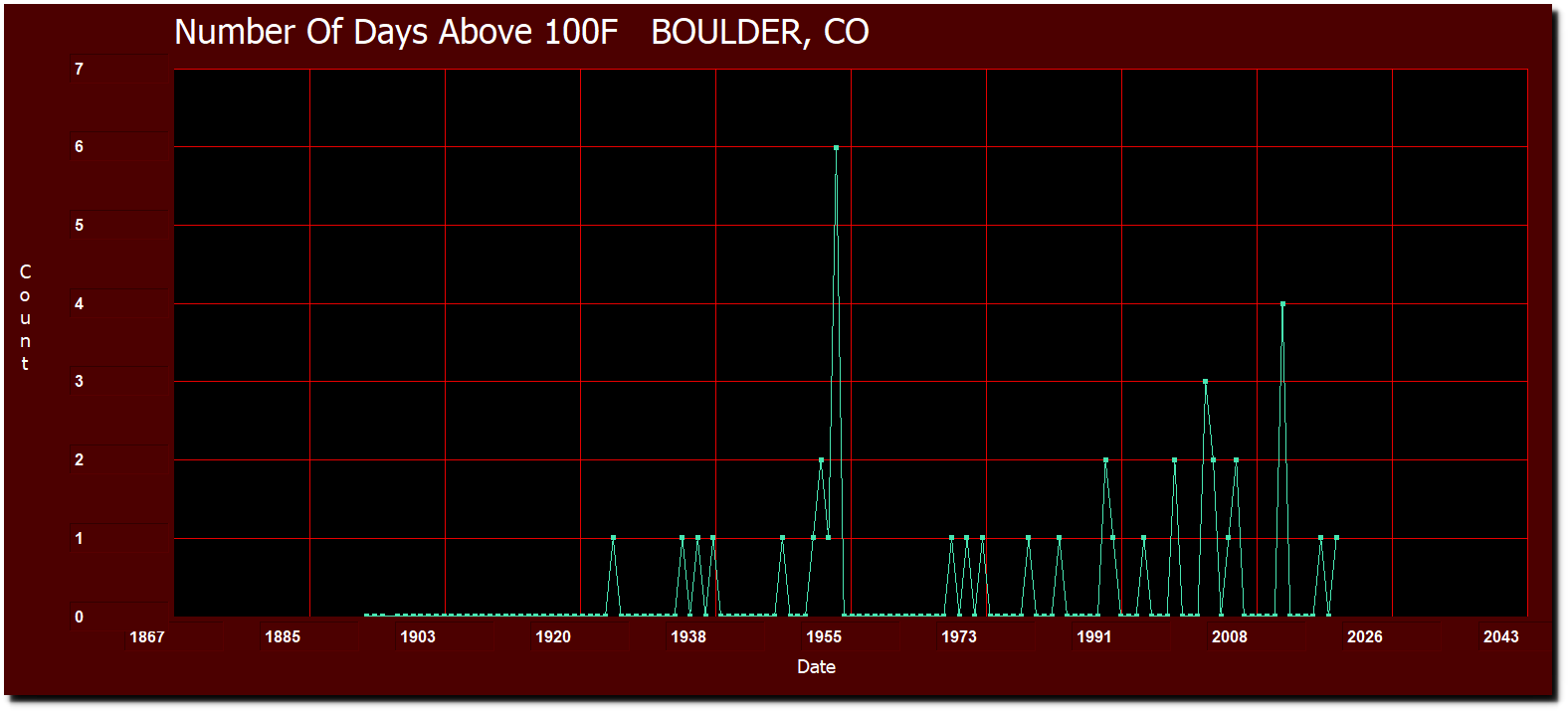
Denver, which almost never registers temperatures above 100 degrees, would do so on 16 days a year under the projection, and its 90-phis days would rise from 33 to 86.
Boulder is the closest USHCN station to Denver.There has been no trend over the past 65 years, and it almost never gets above 100 degrees.
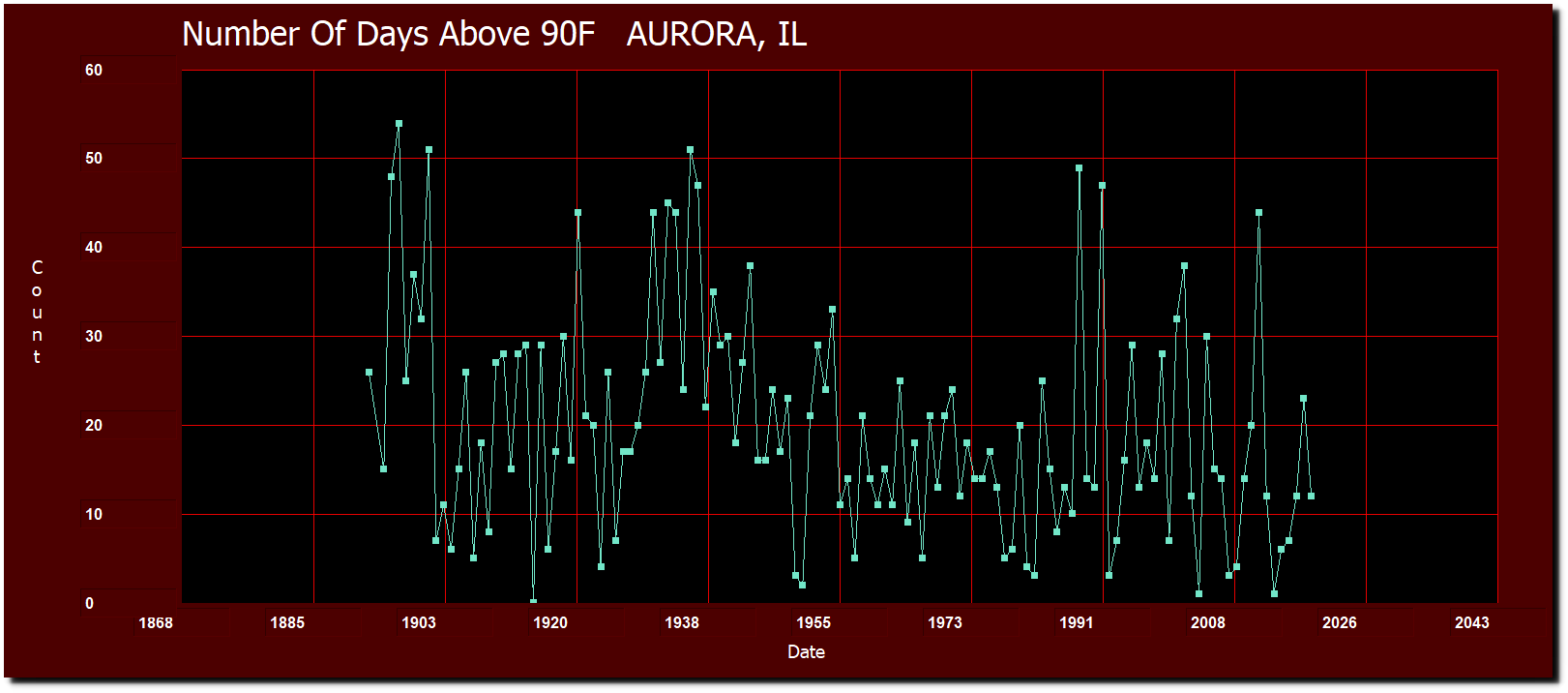
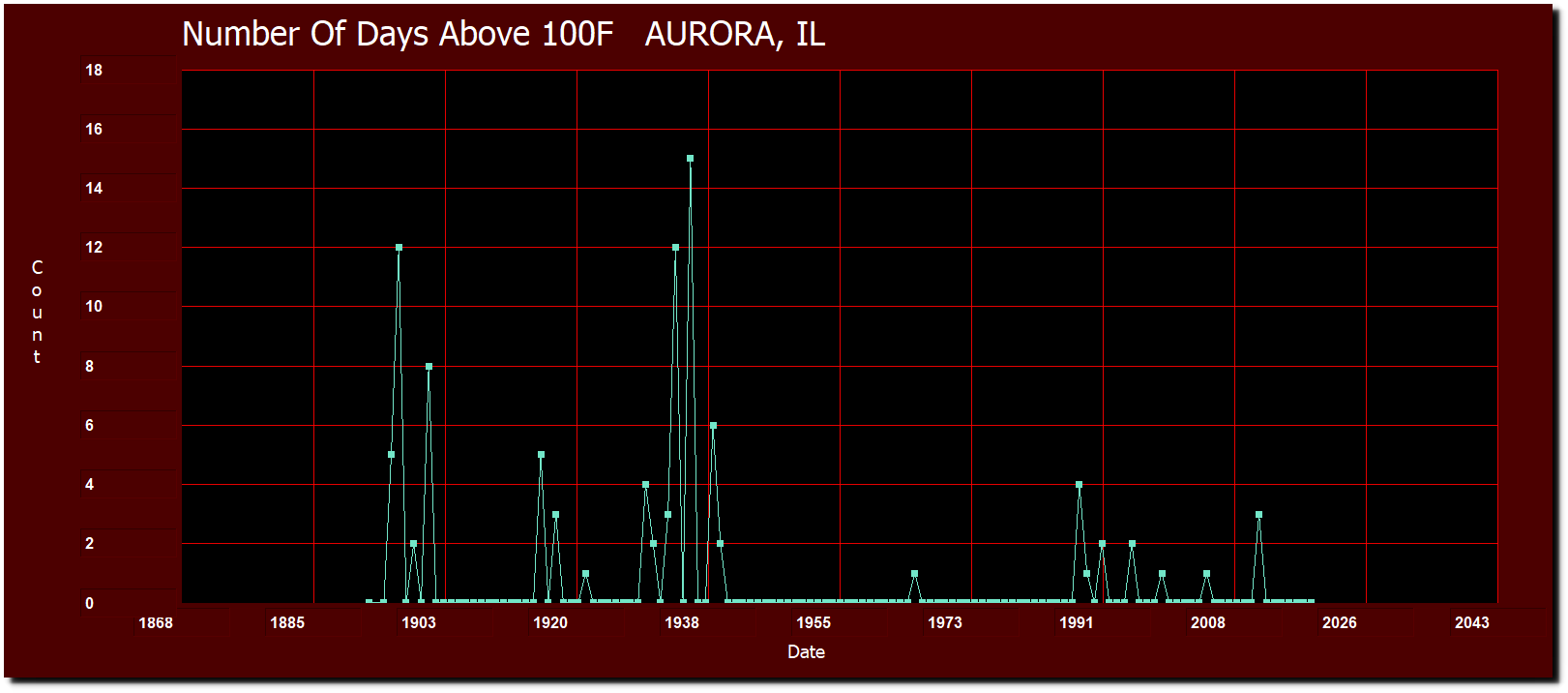
In Chicago, the number of over-90 days would jump from 16 to 56, while six days would see temperatures above 100 degrees, a rarity today.
Aurora is the closest USHCN station to Chicago, and the frequency of 90 and 100 degrees days has dropped sharply since the 1930s.
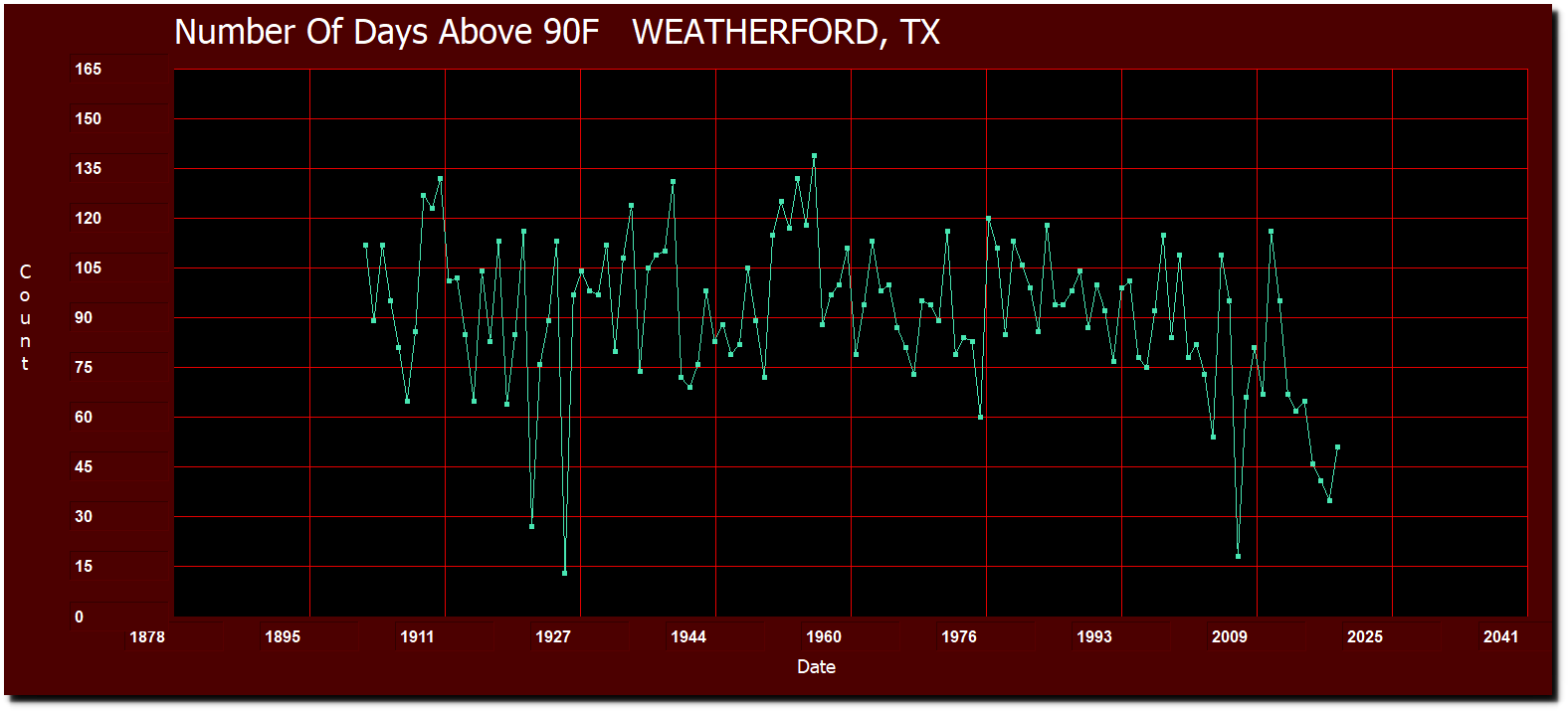
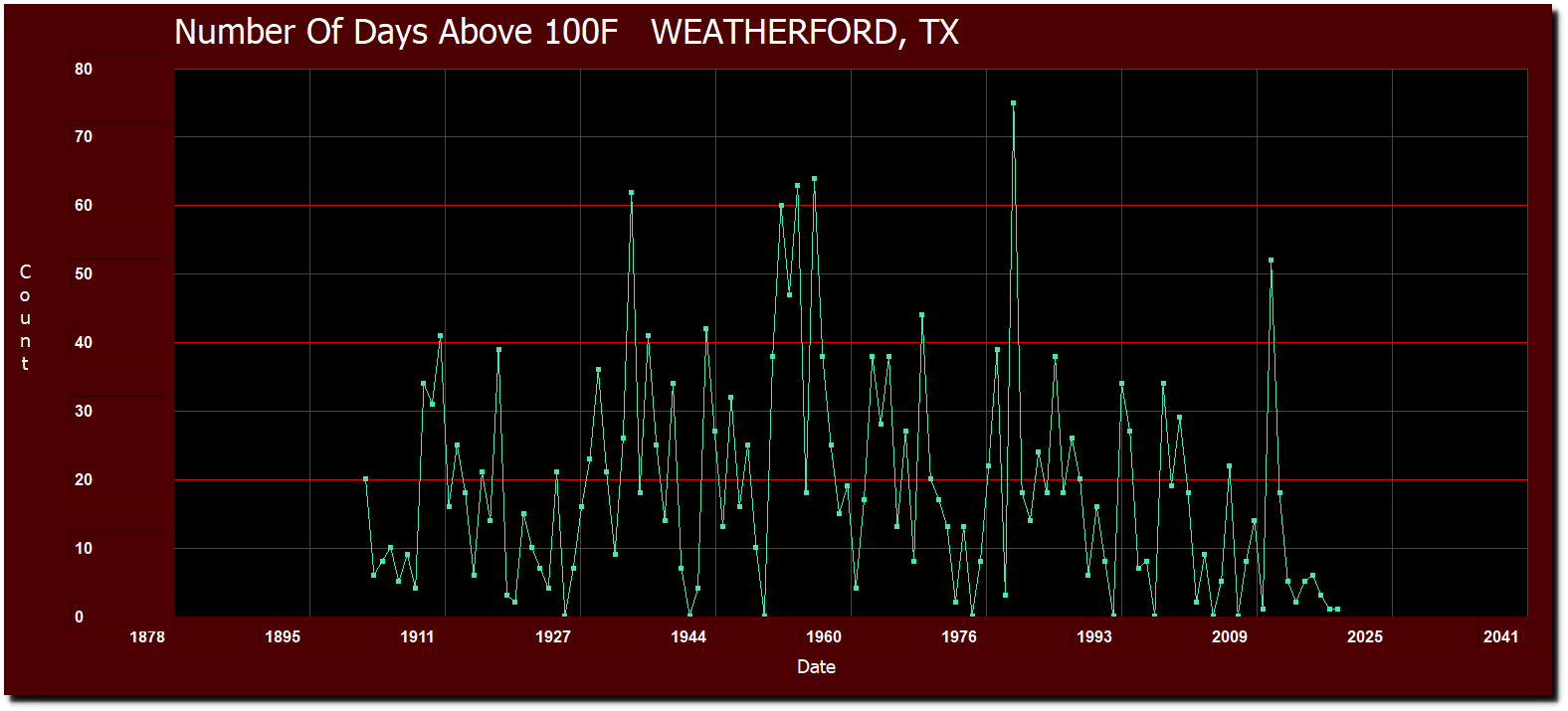
Dallas, which already gets 100 days over 90 degrees and 19 over 100, would see the first figure grow to 162 and the second to 78
Weatherford is the closest USHCN station to Dallas, and the number of 90 and 100 degree days has dropped sharply.
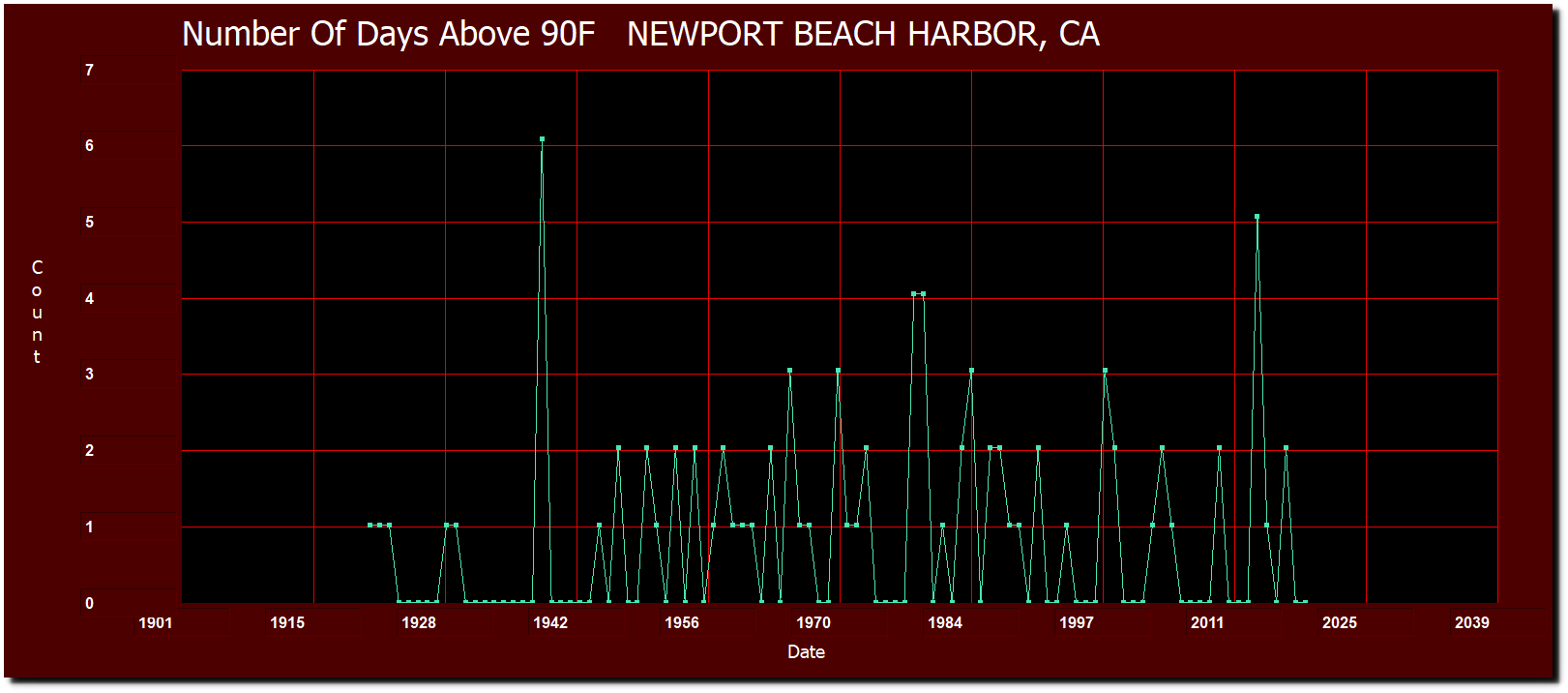
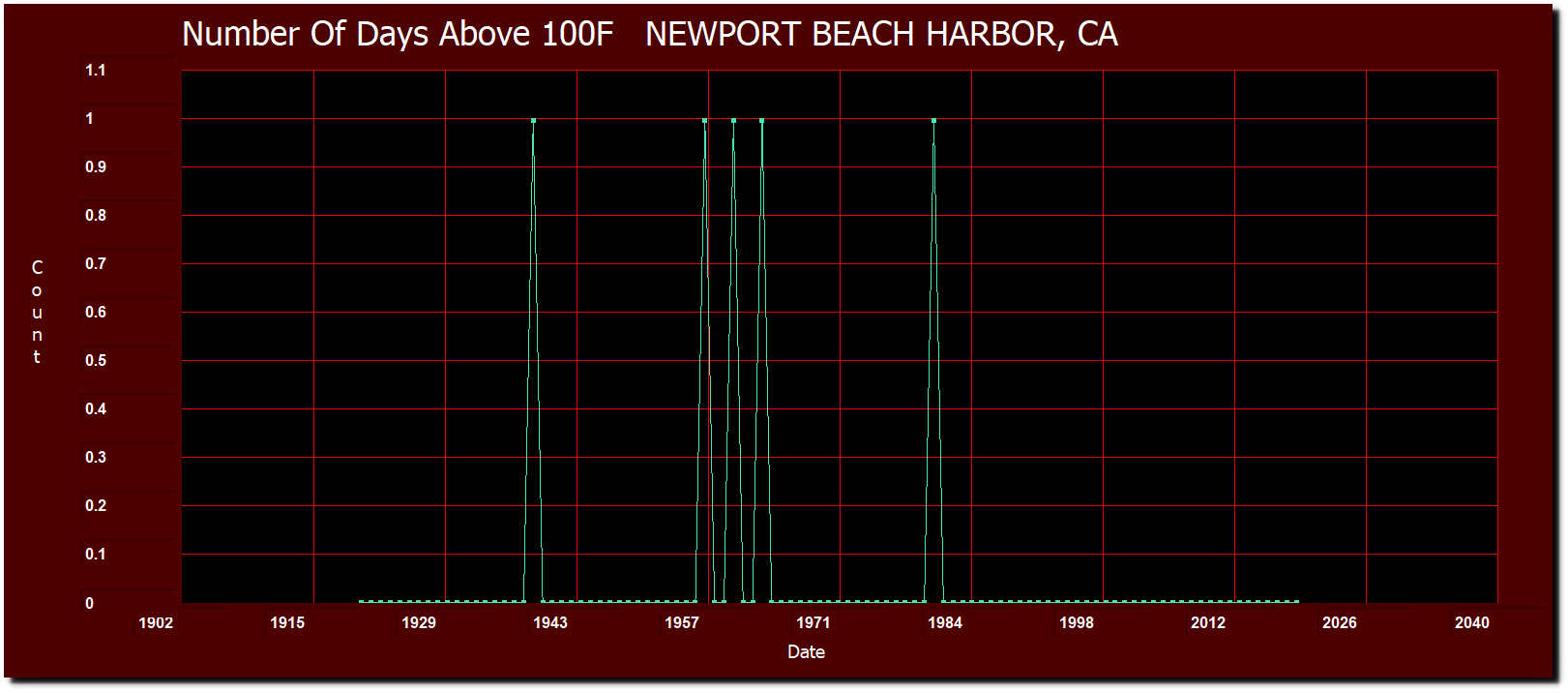
Los Angeles would see the number of 90-plus degree days move up from five to 27, while four days would register more than 100 degrees, compared to one day a year currently.
Downtown LA is much hotter than those numbers, so I assume he meant the airport. The closest USHCN station to LAX is Newport Beach, which shows no trend in hot days.
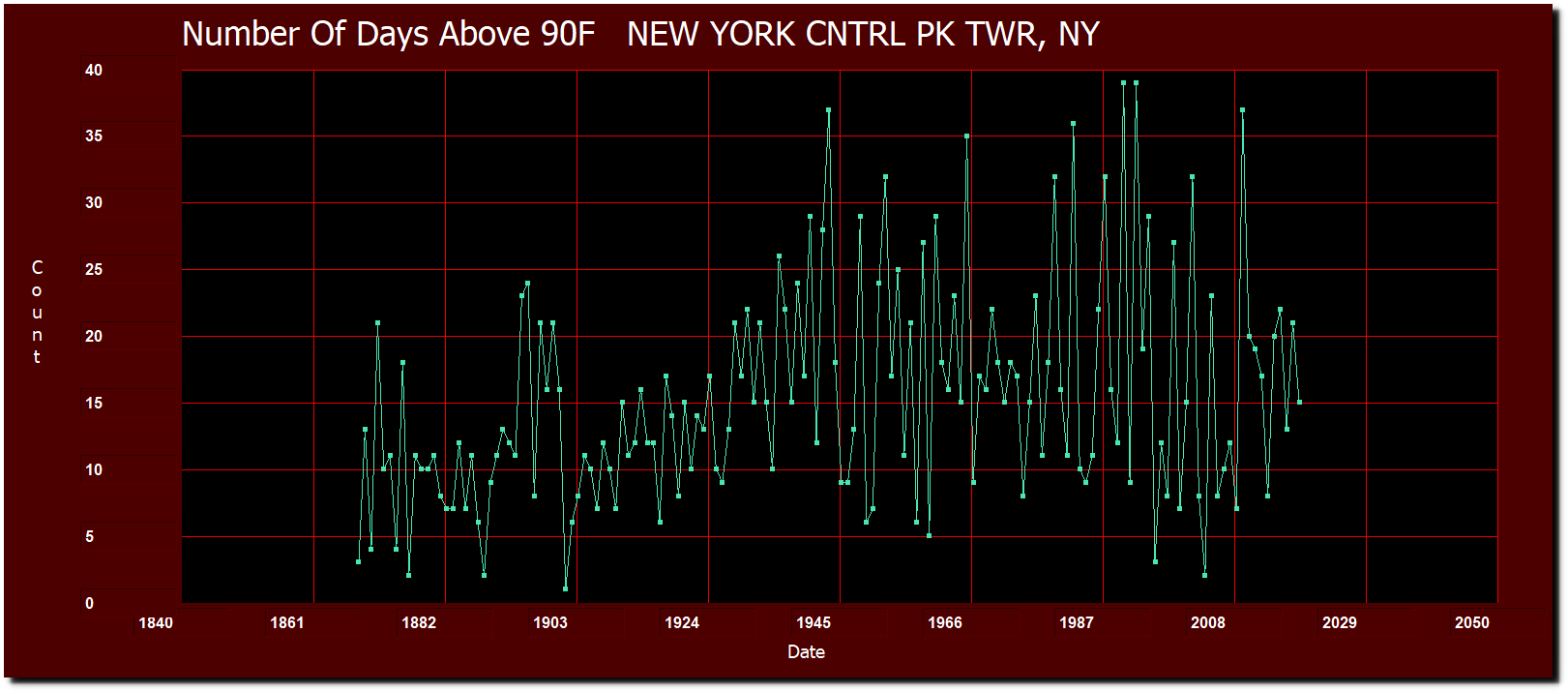
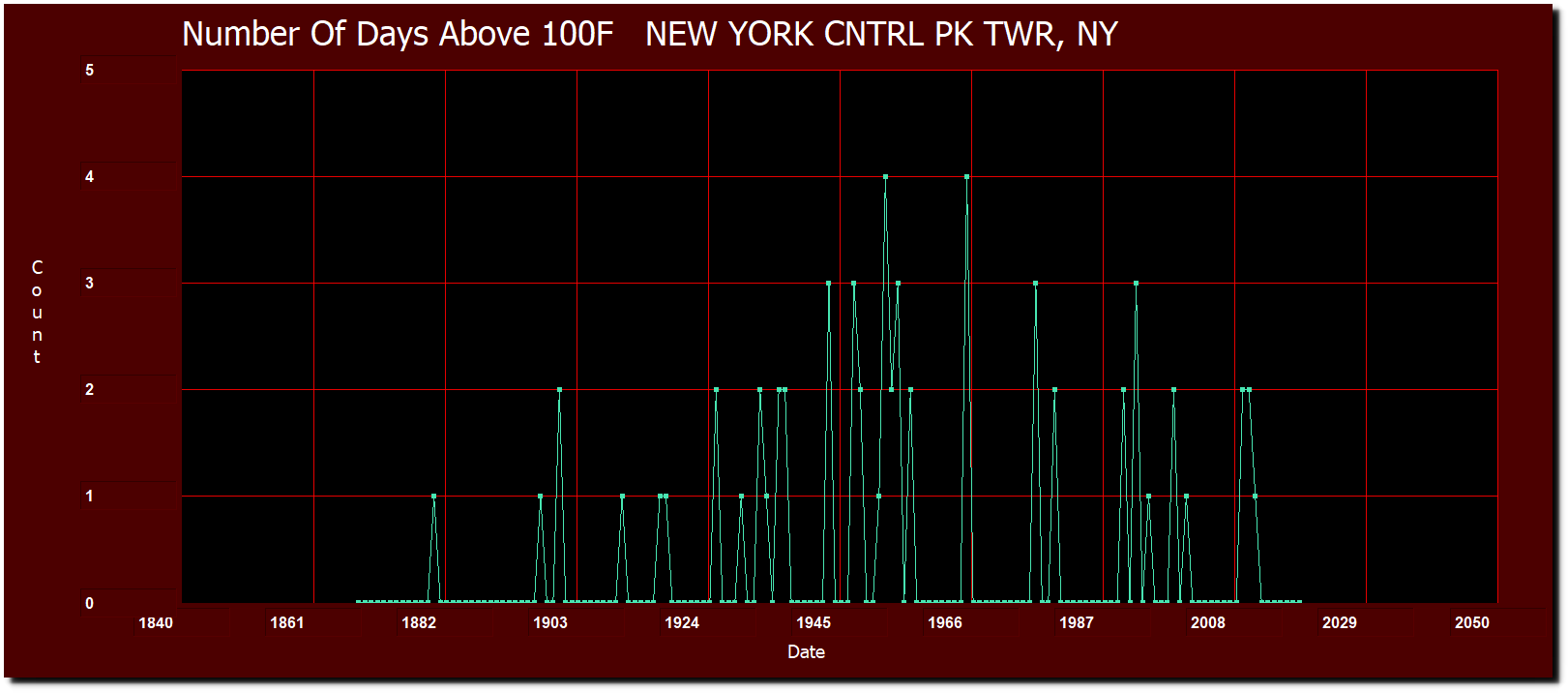
In New York, four days would exceed 100 degrees annually, while in most years no days are that hot now. The number of over-90 days would rise from 15 to 48.
The frequency of hot days at New York City has dropped sharply since Hansen made his forecasts in 1986.
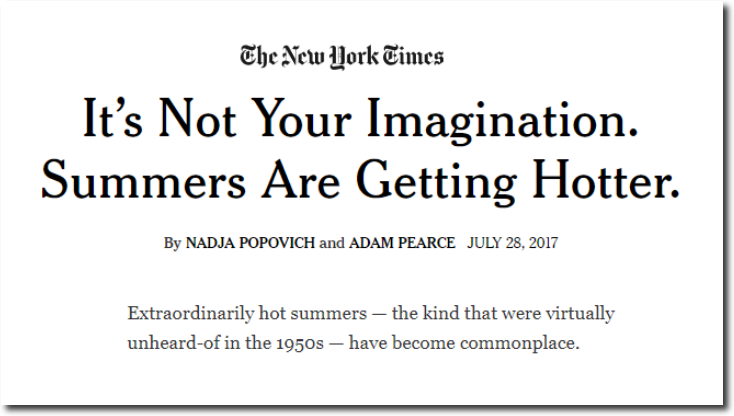
One hundred degree days in New York peaked in the 1950’s, so the Orwellian New York Times has tried to erase them.
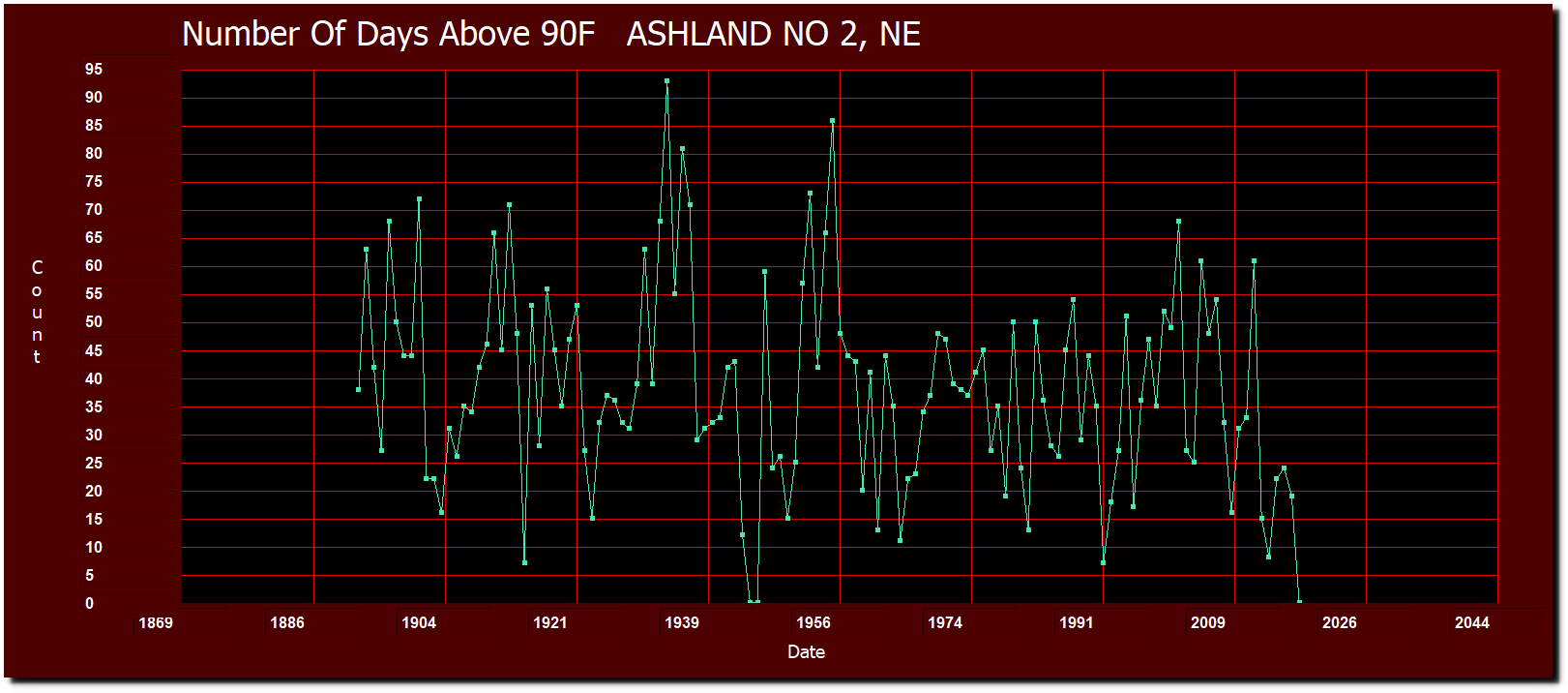
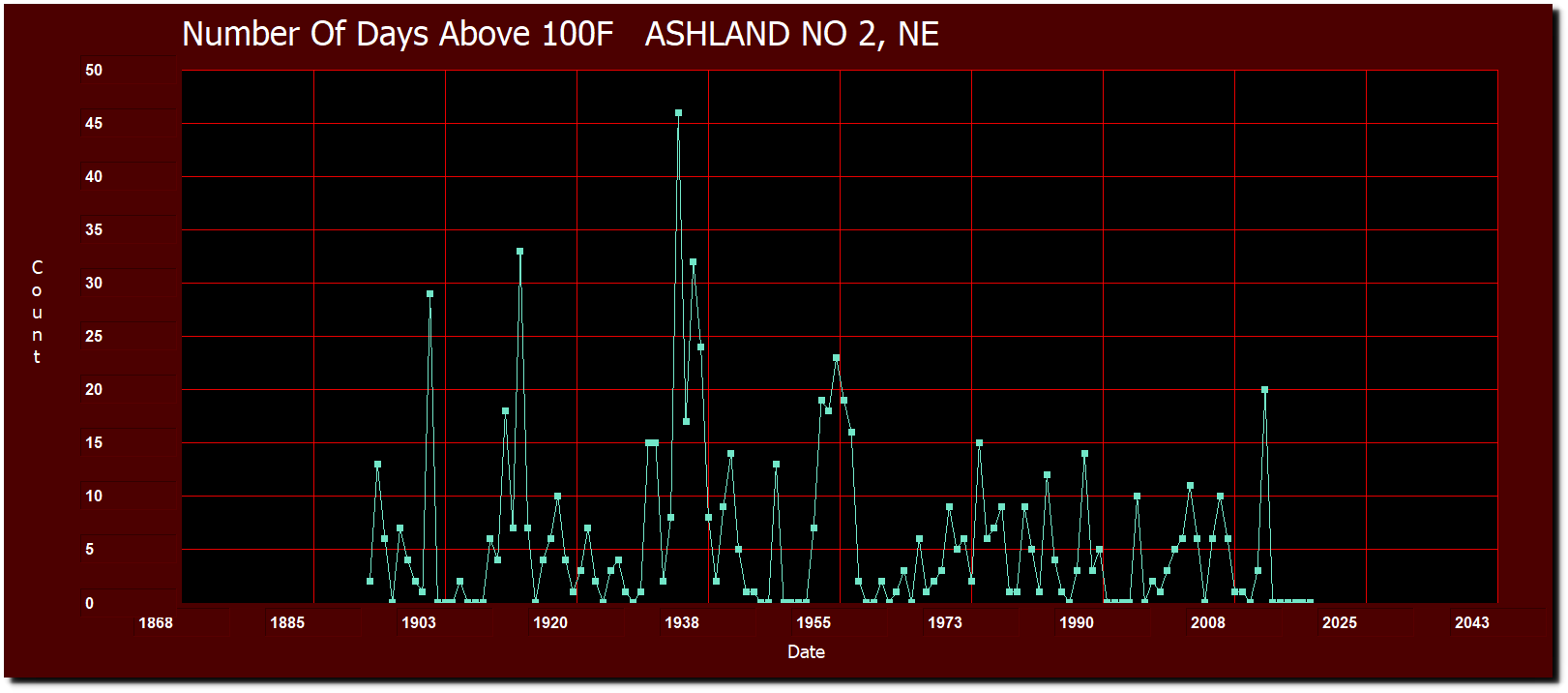
Omaha would see 86 days hotter than 90 degrees, compared to 37 today. Days over 100 degrees would jump from three per year today to 21 in 2030.
The closest USHCN station to Omaha is at Ashland, and the number of hot days has plummeted to record lows.
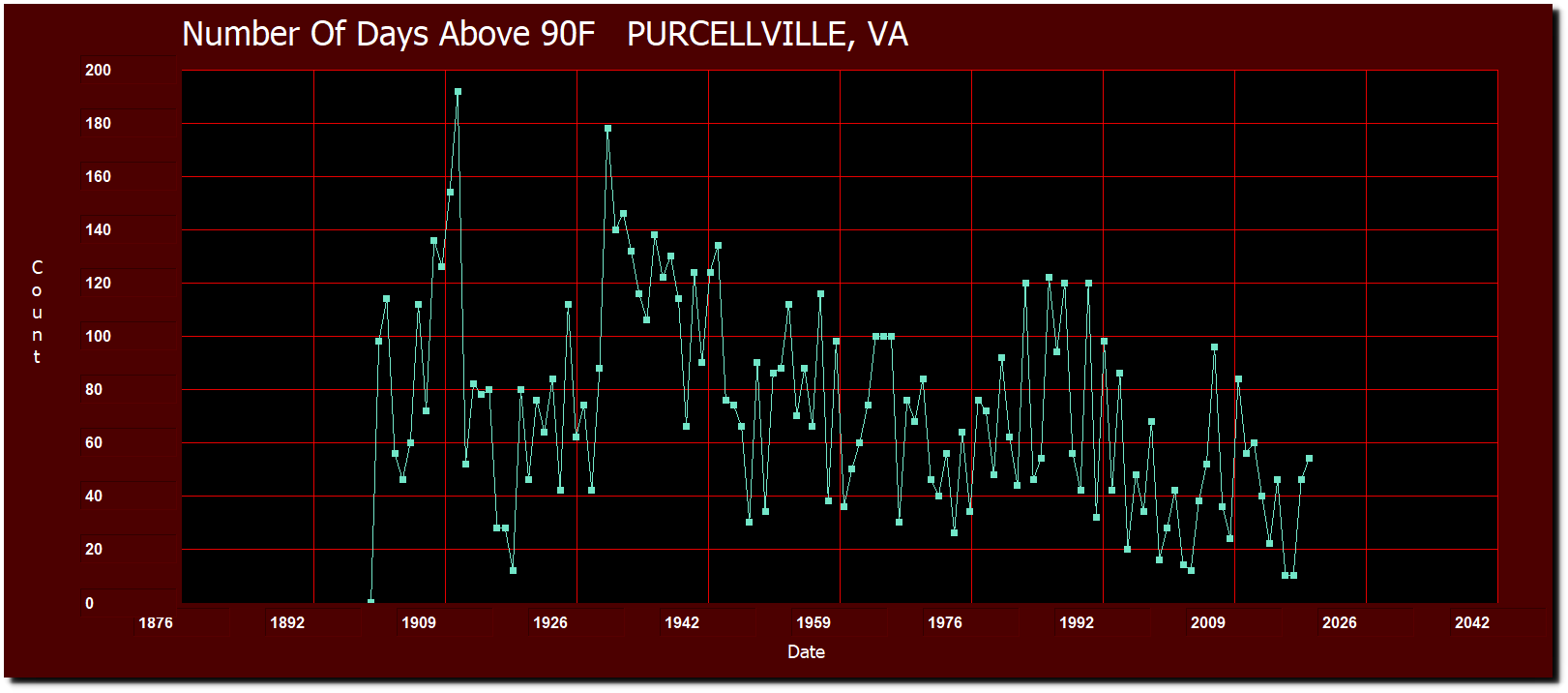
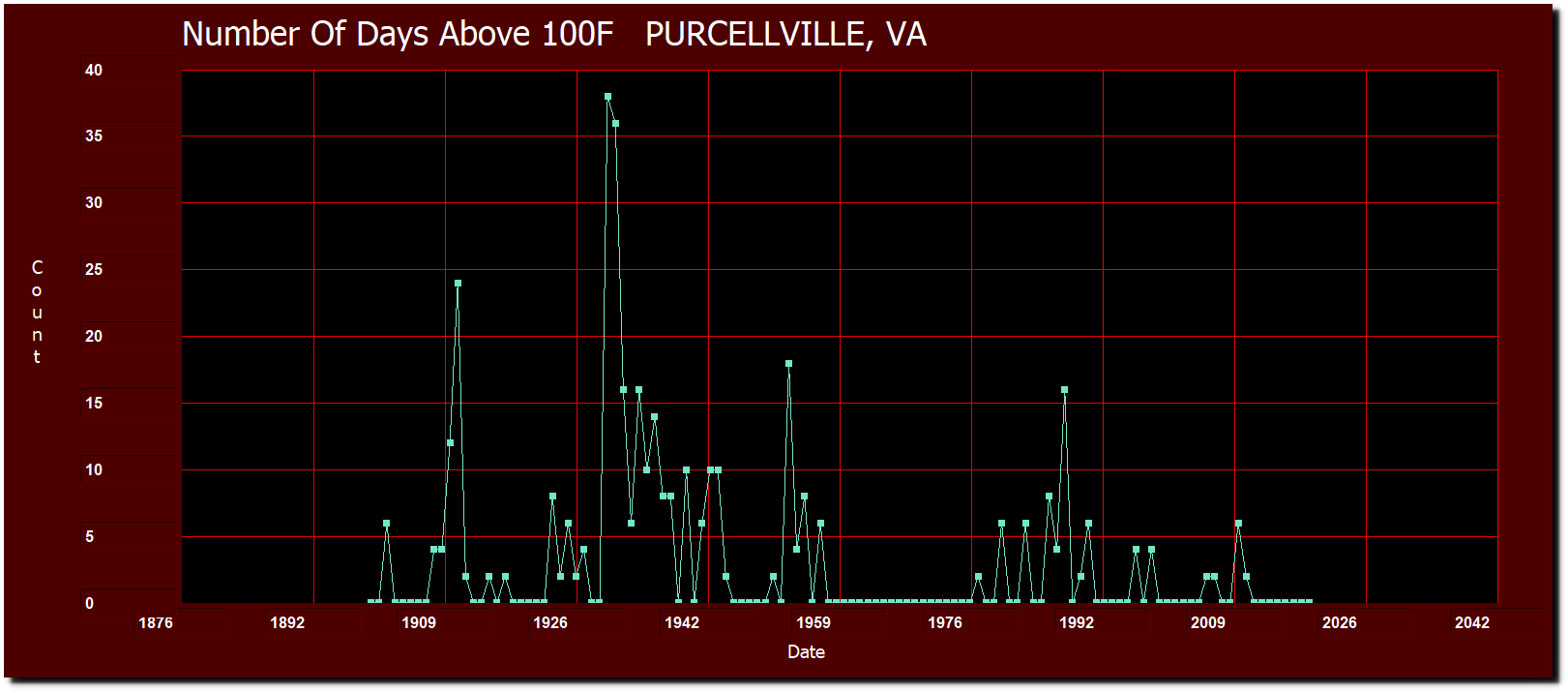
Washington. D C , the number of days above 90 degrees would rise from 36 to 87 per year, while over-100 days would jump from one annually today to 12 in 2030
Purcellville is the closest Virginia USHCN station to Washington D.C., and the number of hot days there has plummeted. I used to live across the river in Maryland, and never needed air conditioning.
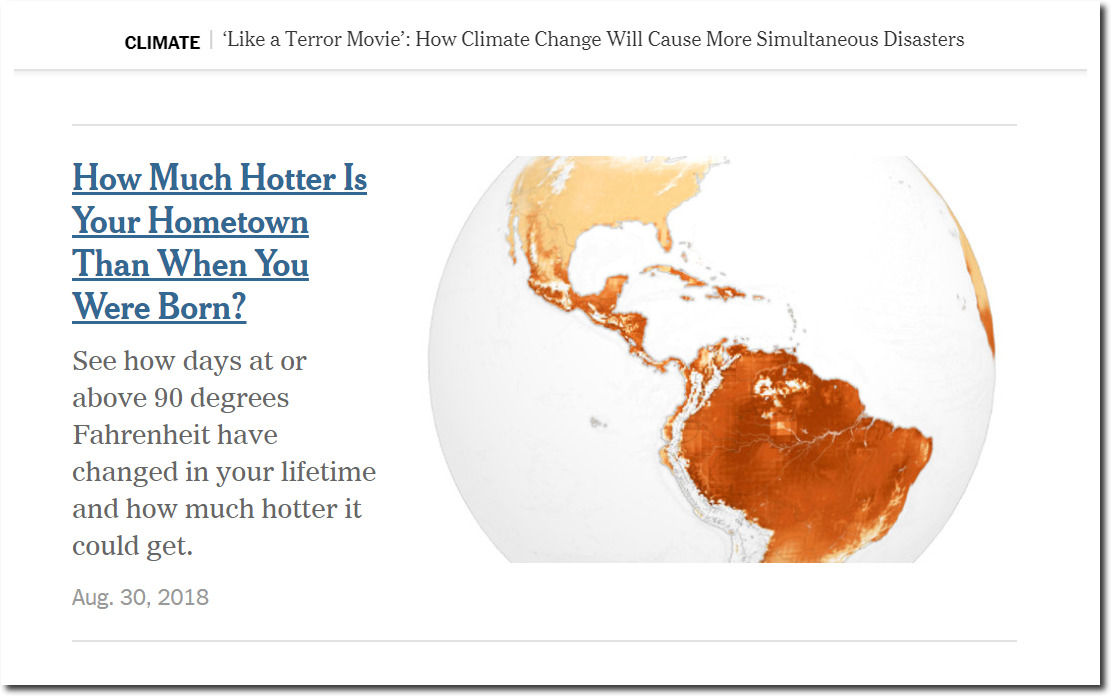
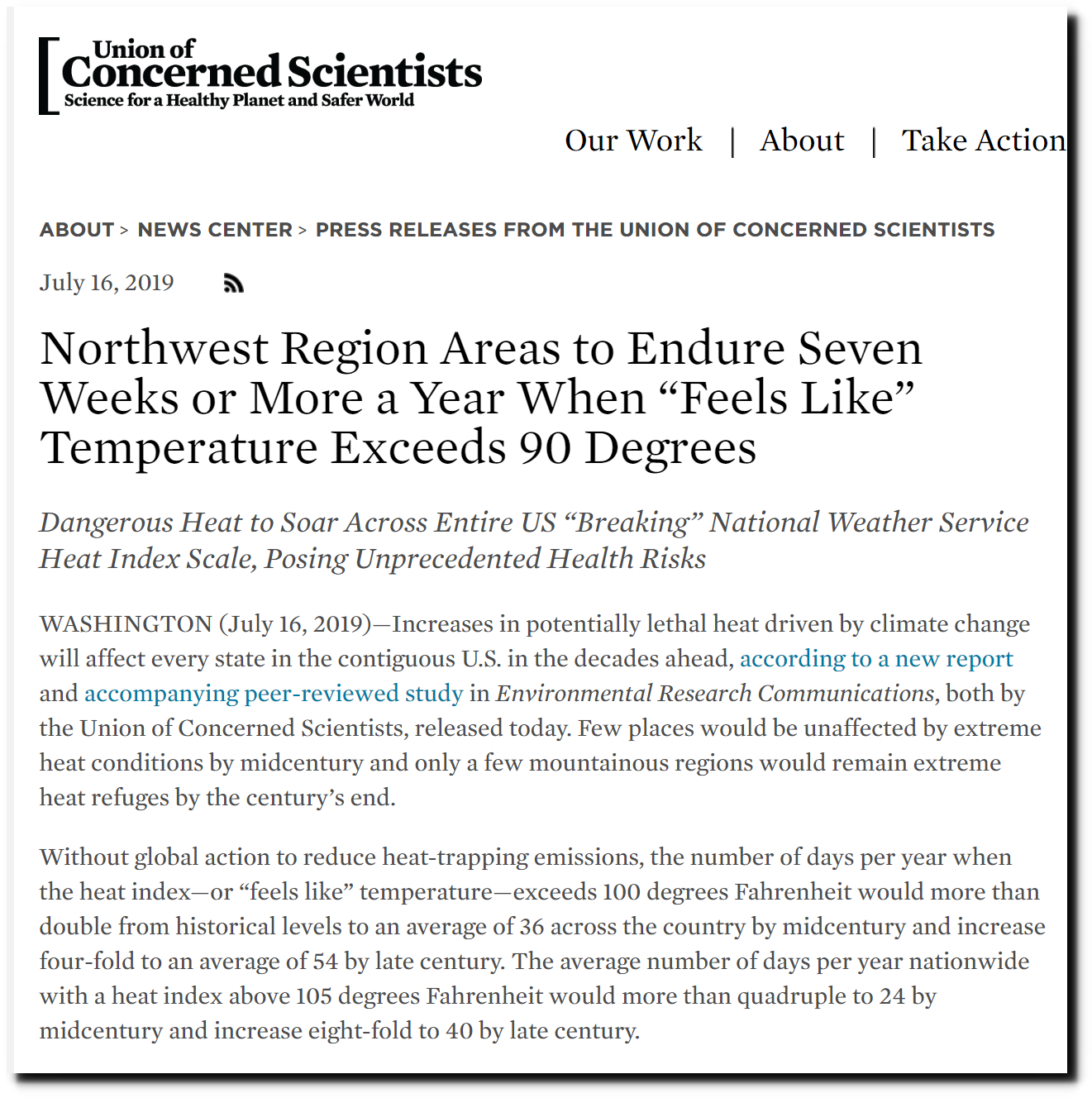
Hansen was wrong, because his CO2 climate model was based on superstition rather than science. But undaunted by their past failures, the New York Times continues to push the same nonsense.
In most professions there are consequences for being wrong, but not if you are employed by the climate religion – where facts simply don’t matter. There is no possible way for you to be wrong.
Throughout recorded history dooms day cults attract thousands of gullible people. Charismatic cult leaders of the Order of the Solar Temple or Heaven’s Gate convinced their followers to commit suicide due to a coming “environmental apocalypse”. To prevent environmental collapse, a recent mass shooter justified his killings as reducing over-population, while a Swedish scientist has suggested cannibalism. Thus, it’s worrisome that charismatic congresswoman Ocasio-Cortez similarly warns our world is doomed in 12 years. Equally disturbing is the carefully orchestrated fear-mongering, such that the United Nations gave ill-informed, 16-year old Greta Thunberg center stage to rage that CO2 is causing ecosystem collapse. Terrifying children with ‘the sky is falling’ fears will only bring about dire, unintended consequences.
Who is filling our children’s heads with stories of ecosystem collapse?
For one Al Gore wrote in 2012, “The fate of the Adelie Penguins, A message from Al Gore”: “As temperatures rise along the West Antarctic Peninsula and the winter sea ice blankets the ocean three months fewer per year than 30 years ago, the local ecosystem is in danger. Everything from the base of the food chain – the phytoplankton (microscopic plants and bacteria) and krill (shrimp like creatures), to one of the continent’s most iconic inhabitants, the Adelie penguins, are under threat… There is an important lesson for us in the story of the Adelie penguins.”
Indeed, Adelie penguins provide an “important lesson”. Don’t trust apocalyptic hype!
Adelie penguins may be the best studied bird on earth. In 2009, the International Union for the Conservation of Nature (IUCN) estimated between 4 and 5 million adults, happily listing them as a species of “Least Concern”. However, using dubious IPCC climate models, scientists led by ornithologist David Ainley predicted the most northerly Adelie colonies would soon disappear as ice-melting warmth crept southward. They predicted between the years 2025 and 2052, 70% of the total Adelie population would be lost. Bullied by that virtual death count, the IUCN downgraded Adelies from “Least Concern” to “Near Threatened”.
Ice Age glaciers had forced Adelies to abandon most of Antarctica’s coast. With warming, glaciers retreated and Adelies rapidly returned to breed and multiply. However, there was one exception. For over 5,400 years Adelies avoided ice free coastlines along Antarctica’s northwestern peninsula. Scientists dubbed this the “northern enigma”. Due to the region’s unfavorable weather, breeding Adelies still avoid much of that region, currently labeled the “Adelie Gap”. As might be expected, breeding colonies adjacent to the “Adelie Gap” are the least stable with some colonies experiencing population declines, and those declining colonies were enough to confirm some scientists’ climate fears.
In the 1990s, the northwestern sector of the Antarctic peninsula coincidentally experienced rising temperatures and declining sea ice. Although Antarctica sea ice was not decreasing elsewhere, researchers believed the melting ice and warmer temperatures were just what CO2-driven climate models predicted. But then the peninsula’s winds shifted. The peninsula’s sea ice has now been growing and temperatures have been cooling for over a decade. Furthermore in contrast to Ainley’s models, colonies at the most northerly limits of the Adelies’ range are not disappearing. Those colonies are thriving and increasing such as the Sandwich Island colonies, and northerly colonies on the Antarctic peninsula’s east side.
Media headlines are guided by the maxim ‘if it bleeds it leads.’ Likewise, scientific journals. Good news about thriving colonies, or no change, fail to capture headlines. But the addiction to eye-catching catastrophes misleads the public and scientists alike. Despite no warming trend at an Emperor penguin colony, David Ainley was so inebriated by global warming fears, he fabricated a warming temperature graph to falsely explain the colony’s decline! Similarly, extreme researchers of polar bear populations wrongly argued, “we’re projecting that, by the middle of this century, two-thirds of the polar bears will be gone from their current populations”. Again, in reality polar bear abundance has increased.
By perpetuating bogus claims of a world ending in 12 years, the Chicken Littles are doing far more harm than blinding children to scientific evidence that many species, from polar bears to Adelie penguins, are thriving. Our children miss the “important lesson” that a “climate crisis” is only a theory supported by scary narratives, not facts. So how do we protect our children from Chicken Littles who seek to enroll vulnerable minds into their doomsday cults? How do we motivate our children to be good critical thinkers, and not blind group thinkers mesmerized by fear and ‘end of the earth’ scenarios?
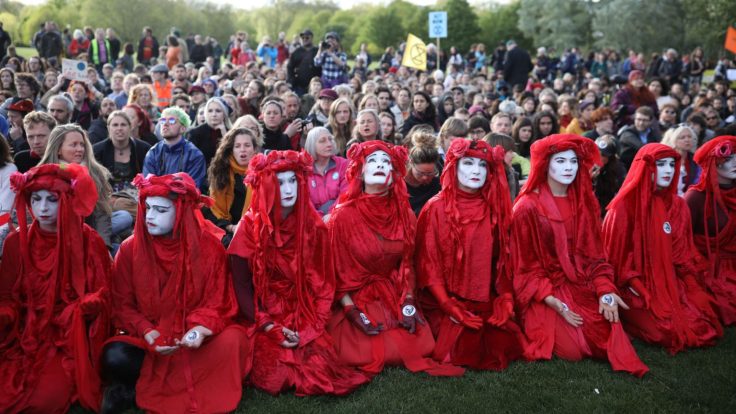
Yesterday, in London, I witnessed an eerie, chilling sight: I saw a death cult holding a ceremony in public.
The men and women gathered outside King’s Cross station and formed a circle. They swayed and chanted. They preached about End Times. ‘What will you do when the world gets hot, what, what?’, they intoned, conjuring up images of the hellfire they believe will shortly consume mankind. They sang hymns to their god – science. ‘We’ve got all the science / All that we need / To change the world / Hallelujah’, they sang, rocking side to side as they did so.
They demanded repentance. ‘Buy less, fly less, fry less’, said one placard. Catholics only demand the non-consumption of meat on Fridays, as an act of penance to mark the day of Christ’s death. This new religion demands an end to meat-consumption entirely, as penance for mankind’s sins of growth and progress.
And like all death cultists, they handed out leaflets that contained within them ‘THE TRUTH’. The leaflets foretell floods and fire: ‘We are in trouble. Sea levels are rising… Africa and the Amazon are on fire.’ The only word that was missing was locusts. They can’t be far behind these other ghastly visitations to sinful mankind.
And if you question their TRUTH? Then, like those heretics who were hauled before The Inquisition 500 years ago, you will be denounced as a denier. A denier of their revelations, a denier of their visions. ‘Denial is not a policy’, their placards decreed. Spotting me filming their spooky, apocalyptic ceremony, one of the attendees waved that placard in my face. A warning from the cult to a corrupted outsider.
This was, of course, Extinction Rebellion. Let us no longer beat around the bush about these people. This is an upper-middle-class death cult.
This is a millenarian movement that might speak of science, but which is driven by sheer irrationalism. By fear, moral exhaustion and misanthropy. This is the deflated, self-loathing bourgeoisie coming together to project their own psycho-social hang-ups on to society at large. They must be criticised and ridiculed out of existence.
Yesterday’s gathering, like so many other Extinction Rebellion gatherings, was middle-aged and middle-class. The commuters heading in and out of King’s Cross looked upon them with bemusement. ‘Oh, it’s those Extinction freaks’, I heard one young man say. It had the feel of Hampstead and the Home Counties descending on a busy London spot to proselytise the cult of eco-alarmism to the brainwashed, commuting plebs.
It was a gathering to mark Extinction Rebellion’s week of disruption. The group is asking people in London and other cities around the world to ‘take two weeks off work’ and join the revolt against the ‘climate and ecological crisis’. You can tell who they’re trying to appeal to. Working-class people and the poor of New Delhi, Mumbai and Cape Town – some of the cities in which Extinction Rebellion will be causing disruption – of course cannot afford to take two weeks off work. But then, these protests aren’t for those people. In fact, they’re against those people.
Extinction Rebellion is a reactionary, regressive and elitist movement whose aim is to impose the most disturbing form of austerity imaginable on people across the world. One of the great ironies of ‘progressive’ politics today is that people of a leftist persuasion will say it is borderline fascism if the Tory government closes down a library in Wolverhampton, but then they will cheer this eco-death cult when it demands a virtual halt to economic growth with not a single thought for the devastating, immiserating and outright lethal impact such a course of action would have on the working and struggling peoples of the world.
Extinction Rebellion says mankind is doomed if we do not cut carbon emissions to Net Zero by 2025. That’s six years’ time. Think about it: they want us to halt a vast array of human activity that produces carbon. All that Australian digging for coal; all those Chinese factories employing millions of people and producing billions of things used by people around the world; all those jobs in the UK in the fossil-fuel industries; all those coal-fired power stations; all that flying; all that driving… cut it all back, rein it in, stop it. And the people who rely on these things for their work and their food and their warmth? Screw them. They’re only humans. Horrible, destructive, stupid humans. … continue
No one like to be on the losing side of a political battle. Until recently the emotional reaction of a loser was expressed through frustration or anger. Now we’re told that the experience of political defeat can make you ill!
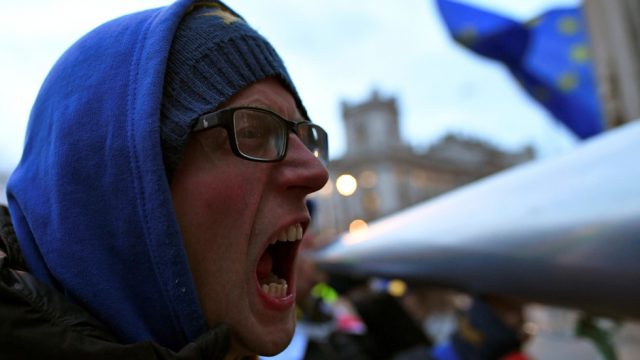
According to sections of the medical profession, people do not simply get angry at political outcomes they don’t like. They claim that events like the Brexit referendum can make you anxious and ill.
Last week the British Medical Journal reported that anxiety about Brexit may have triggered a patient’s psychotic episode. The author of the report, “Acute transient psychotic disorder precipitated by Brexit vote,” claims that “political events can be a source of significant psychological stress.” According to this report, the mental health of a 40-year old man deteriorated rapidly following the announcement of the result of Brexit.
A closer inspection of this report raises questions about the legitimacy of the claim of a Brexit induced psychosis. Apparently, the man has previous history of a similar episode, related to stress at work. So it is likely that the main connection between the man’s psychotic disorder and the Brexit vote is that they occurred at the same time.
What’s important about the BMJ report is that it legitimizes the pre-existing campaign to blame Brexit for people’s mental health problems. It has been evident for some time that sections of the hard-core Remain community have decided to play the illness card.
During the past two years I have encountered numerous acquaintances who reported that their mental health has been severely compromised by the outcome of the Referendum. This sentiment is continually communicated through the media. “Brexit has triggered my anxiety and depressions – and I am not the only one” – declared a journalist in the pro-Remain Metro.
And the numbers of Brexit sufferers never ceases to grow. In case you did not known it: one in three of us is now suffering from Brexit anxiety, according to a recent study by the British Association of Counselling and Psychotherapy.
Predictably, numerous so-called experts and therapists have jumped on the ‘Brexit makes-me-sick’ bandwagon. It is difficult not to feel ill after reading Elle’s “9 Ways to Beat Brexit Anxiety: According To two Psychologists.” With headlines like, “Brexit Anxiety: How To Look After Your Mental Health During Political Chaos,” it is not surprising that some of their readers will reinterpret their political disappointment as a mental health condition.
Advice directed at mentally disturbed millennials is far from neutral. It communicates the idea that if you have not been made ill by Brexit then there is something really wrong with you. So what we have here is a case of political messaging masquerading as helpful advice. Elle’s “9 Ways to Beat Brexit Anxiety” assumes that if you are a millennial then you are likely to have been messed up by Brexit. Either wittingly or unwittingly, publications raising concern about Brexit induced mental illness are actually inciting people to become ill.
Confusing political problems with medical ones has a corrosive impact on public life. It assumes that people lack the intellectual and psychological resources to deal with setbacks and defeats.
A mature democracy should help its citizens to deal with the difficult challenges that they will encounter in the course of their political life. Unfortunately, sections of British society have opted to medicalize it instead, turning citizens into potential patients.
Professor Frank Furedi is a sociologist and author. His ‘How Fear Works: The Culture of Fear In the 21st Century’ is published by Bloomsbury.
Climate alarmists Michael Mann and Katharine Hayhoe have been caught using dubious, revisionist temperature data in their attempt, as one Climategate email author put it, to “deal a mortal blow” to the extensively documented Medieval Warm Period.
Before climate change became a political issue, it was scientifically well-established that a significant global warming event occurred between approximately 900 AD and 1200 AD. For example, the United Nations Intergovernmental Panel on Climate Change (IPCC) First Assessment Report presented a temperature history and visual graph documenting that the Medieval Warm Period existed and that it brought temperatures at least as warm as today (at pg. 7). Multiple peer-reviewed studies provided additional confirmation of the Medieval Warm Period.
The warming climate of the Medieval Warm Period spurred abundant crop production, fewer extreme droughts and floods, growing human population, and improving living standards. The Little Ice Age terminated the Medieval Warm Period and brought devastating weather extremes, widespread crop failures, famines, plagues like the Black Death, and a contracting human population. (For a good summary of the extensive benefits of the Medieval Warm Period and the devastating harms of the Little Ice Age, see the excellent book, “In the Wake of the Plage: The Black Death and the World It Created.”)
The existence of large historical temperature fluctuations, warmer temperatures than today, and many documented benefits of those warmer temperatures presented a powerful obstacle in alarmists’ attempts to brand our current modest warming an unprecedented climate crisis. One of the many embarrassing emails leaked in the Climategate scandal showed how alarmists deliberately set a goal of eliminating the historical existence of the Medieval Warm Period. Alarmist climate scientist Jonathan Overpeck wrote in an email to fellow alarmist Keith Briffa, “I get the sense that I’m not the only one who would like to deal a mortal blow to the misuse of supposed warm period terms and myths in the literature.”
Also, scientist David Deming testified to Congress that a prominent figure working in the field of climate change asserted to him, “We have to get rid of the Medieval Warm Period.”
We have often been told that the science is settled. Apparently, that doesn’t apply to scientific data and evidence invalidating climate alarmism. Mann last month favorably retweeted an assertion that present temperatures are the warmest they have been for at least the past 5,000 years. Hayhoe earlier this year gave a presentation in which she presented a graph (without any scientific citation) asserting temperatures steadily and consistently declined for 4,000 years – without any significant variation – prior to the warming of the past 120 years that finally and mercifully brought an end to the Little Ice Age (at 7:41).
As documented above, the existence of substantial historical climate variations such as the Medieval Warm Period and the Little Ice Age were scientifically well-documented and not in dispute before climate activism politicized the issue. Alarmist scientists were on record searching for justifications to eliminate these inconvenient climate variations that blew gaping holes in their alarmist theories. Now, conveniently, alarmists like Mann and Hayhoe claim the Medieval Warm Period, the Little Ice Age, and other well-documented warm and cold periods simply did not exist.
An old sarcastic saying goes, “When the facts doesn’t fit the theory, change the facts.” Mann and Hayhoe provide perfect real-world examples of such perniciousness. Powerful scientific evidence supported near-universal agreement about the existence of the Medieval Warm Period. Then Mann and Hayhoe, supported by little or no compelling evidence, waved a magic wand and made the Medieval Warm Period conveniently disappear.
Climate realists, however, will stick with the powerful scientific evidence, the long-established scientific “consensus,” the peer-reviewed scientific literature, and the findings of the IPCC. Sorry, Mann and Hayhoe, but you have been caught red-handed.
I know a protest when I see one. Walking around in London today it is evident that the tens of thousands of adults playing at being children are not so much protesting but putting on a performance of protest.
Unlike normal protest the men and women wearing uniforms in London today, are not there to police but to be helpful and assist this very noisy and very colorful performance.
For their part the chanters of apocalyptic slogans and the boisterous participants declaring that they know what’s best for everyone, have rehearsed their role for this mass expensive street theatre. Queuing up to get arrested is all part of this drama. There are even celebrities lurking about to provide a sense of the occasion.
When I encounter a group of middle aged distinguished-looking activists tucking into their lunch, while sitting on the pavement by the Embankment, I am reminded of the kind of street parties that occurred during the Queen’s Jubilee. Talking to these chaps and chapettes, it becomes evident that not only are they having the time of their life, they are also under the impression that their picnic contributes to the saving of the planet. When I put to them my view that ‘this is a self-indulgent carnival of reaction’, they don’t argue back. One of them tells me to go to hell. An elderly lady sneers at me and simply states that ‘I will not have a bad word said against these young people’. As far as she and her companions are concerned, Extinction Rebellion now possesses the kind of moral authority previously associated with the Church and the institutions of the state.
The ease with which Extinction Rebellion has succeeded in occupying the moral high ground has little to do with the quality of their arguments and the strength of their case. In all but name, the political establishments of the western world have given up the attempt to exercise moral authority. The elite no longer upholds the values of their ancestors and is all too aware of its loss of legitimacy. It no longer believes in itself and is evidently prepared to be flagellated by its environmentalist critics. In turn Extinction Rebellion knows that when it instructs its posh friends to jump, their answer is likely to be ‘How High’!
A lot of people on the streets of London and elsewhere are of course really miffed and angry about the way this carnival of reaction has disrupted to their life. In private conversations they murmur and swear at ‘these wastrels’. But as long as the performers enjoy backing of the media, the cultural elites, a significant section of the political establishment, and of course the all-important celebrities, their voice can be safely ignored by the protesters.
Until now participating in a Climate Extinction performance has been a risk-free activity. Unlike real protests which always incur serious risks, this week’s performance is unlikely to cost the performers very much. The cost will be borne by an increasingly fed-up public who was never asked whether or not they wanted their life to be turned upside-down.
Professor Frank Furedi is a sociologist and author. His, ‘How Fear Works: The Culture Of Fear In The Twentieth Century’ is published by Bloomsbury.
Experts say don’t believe news headlines that start with “Experts say.” And, in this case, the expert is me. Find out more in this week’s edition of #PropagandaWatch with James Corbett.
Beirut – During his visit with US Secretary of State, Mike Pompeo, Lebanese President Michael Aoun reportedly received a US-Israeli document detailing plans for creating a civil war in Lebanon with covert false flag operations and possible Israeli invasion.
Although the source of the document is Israeli and created in partnership with Washington, no one knows who presented it to Aoun. The Lebanese TV station, Al-Jadeed, initially reported the document on Lebanese TV and a video on its website. Geopolitics Alert translated the report for this article. … continue
This site is provided as a research and reference tool. Although we make every reasonable effort to ensure that the information and data provided at this site are useful, accurate, and current, we cannot guarantee that the information and data provided here will be error-free. By using this site, you assume all responsibility for and risk arising from your use of and reliance upon the contents of this site.
This site and the information available through it do not, and are not intended to constitute legal advice. Should you require legal advice, you should consult your own attorney.
Nothing within this site or linked to by this site constitutes investment advice or medical advice.
Materials accessible from or added to this site by third parties, such as comments posted, are strictly the responsibility of the third party who added such materials or made them accessible and we neither endorse nor undertake to control, monitor, edit or assume responsibility for any such third-party material.
The posting of stories, commentaries, reports, documents and links (embedded or otherwise) on this site does not in any way, shape or form, implied or otherwise, necessarily express or suggest endorsement or support of any of such posted material or parts therein.
The word “alleged” is deemed to occur before the word “fraud.” Since the rule of law still applies. To peasants, at least.
Fair Use
This site contains copyrighted material the use of which has not always been specifically authorized by the copyright owner. We are making such material available in our efforts to advance understanding of environmental, political, human rights, economic, democracy, scientific, and social justice issues, etc. We believe this constitutes a ‘fair use’ of any such copyrighted material as provided for in section 107 of the US Copyright Law. In accordance with Title 17 U.S.C. Section 107, the material on this site is distributed without profit to those who have expressed a prior interest in receiving the included information for research and educational purposes. For more info go to: http://www.law.cornell.edu/uscode/17/107.shtml. If you wish to use copyrighted material from this site for purposes of your own that go beyond ‘fair use’, you must obtain permission from the copyright owner.
DMCA Contact
This is information for anyone that wishes to challenge our “fair use” of copyrighted material.
If you are a legal copyright holder or a designated agent for such and you believe that content residing on or accessible through our website infringes a copyright and falls outside the boundaries of “Fair Use”, please send a notice of infringement by contacting atheonews@gmail.com.
We will respond and take necessary action immediately.
If notice is given of an alleged copyright violation we will act expeditiously to remove or disable access to the material(s) in question.
All 3rd party material posted on this website is copyright the respective owners / authors. Aletho News makes no claim of copyright on such material.