An Open Letter to ‘Science and Global Security’
Do Not Succumb to Political Censorship on Syria
By Rick Sterling | Dissident Voice | October 6, 2019
Dear Editors at Science and Global Security
Science and Global Security (SGS) has been publishing technical articles on arms control and related issues since 1989. I urge you not to succumb to political censorship.
Recently it was announced you are withholding publication of an article titled “Computational Forensic Analysis for the Chemical Weapons Attack at Khan Sheikhoun on 4 April 2017.” The article presents evidence that a crater in the road in the town of Khan Sheikhoun (Syria) could have been caused by an “improvised rocket-propelled artillery round with a high explosive warhead” rather than an aerial bomb dropped by a Syrian plane. The paper was authored by seven scientists from prominent universities and laboratories in the USA and China and based on advanced modelling techniques and computer simulations.
According to the article “Scientists clash over paper that questions Syrian government’s role in sarin attack” a campaign to stop you from publishing the analysis was launched by Gregory Koblentz. He is a political scientist not an engineer or physical scientist. His criticism of the article is because of the conclusion.
The political bias of Koblentz is clear from his article titled “Syria’s Chemical Weapons Kill Chain.” It accuses the Syrian government of using chemical weapons and speculates on the chain of command. It distorts the findings of the UN report on the attack of August 21, 2013. Actually, the UN lead investigator, Ake Sellstrom, suggested that it was a “fair guess” that the rockets carrying the sarin travelled 2 kilometers. This would have put the launch firmly in opposition held territory, directly contradicting Koblentz’s assertions that the Syrian government was to blame.
Facts and Investigations
You may not be aware of the following facts:
* The report of the Joint Investigative Mechanism was definitive about the crater. On page 7/33 it says, “the Mechanism assessed that the crater was most probably caused by a heavy object travelling at a high rate of velocity, such as an aerial bomb with a small explosive charge… The Mechanism also examined whether an IED could have caused the crater. While this possibility could not be completed ruled out, the experts assessed that that scenario was less likely….. ” (emphasis added).
* Some of the most proven investigative journalists have concluded that the incident was staged by the opposition. For example, the late Robert Parry wrote an article titled “Did Al Qaeda Dupe Trump on Syrian Attack.” He noted that “Buried deep inside a new U.N. report is evidence that could exonerate the Syrian government in the April 4 sarin atrocity.” As Parry wrote, “More than 100 patients would appear to have been exposed to sarin before the alleged warplane could have dropped the alleged bomb and the victims could be evacuated, a finding that alone would have destroyed the JIM’s case against the Syrian government. But the JIM seemed more interested in burying this evidence of Al Qaeda staging the incident …”
* Seymour Hersh is another proven journalist. His research confirmed that no chemical bomb was used at Khan Sheikhoun. The Russians had even informed the US military ahead of time that they would be bombing an important meeting of groups that even the US defined as “terrorist”. Hersh’s conclusions are outlined in the article “Hersh’s New Syria Revelations Buried from View.”
* Yet another proven journalist, Gareth Porter, did a detailed investigation including confidential interviews with scientists with close ties to the OPCW. His in depth report is titled “Have We Been Deceived Over Syrian Sarin Attack? Scrutinizing the Evidence ….” Among many points he debunks the notion that the crater could have been caused by a chemical weapons bomb which is designed to release chemicals and NOT burn them in a large explosion.
* Finally, yet another proven journalist, Robert Fisk, has written about bias at the Organization for the Prohibition of Chemical Weapons (OPCW) in an article titled “The evidence we were never meant to see about the Douma ‘gas’ attack.“
Global security is being threatened by claims and counter-claims about weapons of mass destruction. The 2003 invasion of Iraq was based on such claims. The “intelligence community” was certain but wrong. Now, in Syria there are similar claims and counter-claims. Two nuclear armed countries, the US and Russia, are involved.
The US has already attacked Syria on the basis of media reports to the approval of people like Gregory Koblentz. The pattern of aggression on the basis of dubious or false evidence is very dangerous and could lead to much greater conflict.
Political censorship does not serve science or global security. Publish the article.
Rick Sterling is an investigative journalist who grew up in Canada but currently lives in the San Francisco Bay Area of California. He can be reached at rsterling1@gmail.com.
Faster than expected except where slower
Climate Discussion Nexus | September 18, 2019
When you get a news story about climate change, it inevitably tells you scientists have looked at something going on in the world, discovered it’s worse than we thought, and concluded that greenhouse gases are to blame. Which at least saves you the trouble of reading further. Except that if you do, you sometimes learn that scientists did not find what journalists claimed up front. For instance we learn from Eurekalert that the Thwaites Glacier ice shelf in Antarctica is being “thawed by a warming ocean more quickly than previously thought.” So why does the lead scientist mention something being more stable than previously thought?
The story in question results from a creative experiment involving “newly digitized vintage film” dating all the way back to the 1970s when, over eight years, scientists flew over the Antarctic recording ice-penetrating radar readings on 35 mm film. Subsequent radar soundings were sporadic until after 2009. So the scientists found a way to digitize the 1970s records to make them comparable to the modern ones.
The result? Glaciers melting and washing away Manhattan? Not exactly. One part of the Antarctic, the Thwaites ice shelf, thinned between 10 and 33 percent over the 40 years of records. Another part, the Filchner-Ronne Ice Shelf basal channel, didn’t change at all. And part of the Thwaites ice shelf regrounded and became stable. And maybe it’s all due to a warming ocean. Except the rate of submarine melting slowed between the 1978-2004 and 2004-2009 segments.
The conclusion? In the underlying article the authors don’t say it’s “worse then we thought”, more like “we didn’t know what to expect and we saw lots of interesting patterns.” The Eurekalert article quotes the lead author that “[We] were able to have one ice shelf where we can say, ‘Look, it’s pretty much stable. And here, there’s significant change’.” The headline rephrases that as “Thwaites Glacier ice shelf melting faster than previously observed.” Well yes, because it wasn’t previously observed so any data would be new; it could also be phrased as “melting slower than previously observed”. And what about the other parts? From there the journalist spins out the money phrase “thawed by a warming ocean more quickly than previously thought” in the first sentence of the article. Maybe hoping you wouldn’t read any further.
If urgent climate action is needed, then let’s #BanPrivateJets

By Mark Jeftovik | Guerrilla Capitalism | October 4, 2019
As the din of climate hysteria grows ever louder, the eco-pious and super-rich call for urgent and drastic action on climate change. Justin Trudeau, still licking his wounds from being outed for his multiple episodes of blackface and brownface, took more heat today as he’s criss-crossing the country ahead of the forthcoming federal election with not one, but two private jets.
As these calls for immediate climate action are accelerating, in fact we’ve seen numerous trial balloons floated from a complicit mainsteam media (or as Canada’a reigning Liberals call it “Approved Media”).
These trial balloons / admonitions include:
- Eating less meat, or no meat, or perhaps eat maggots or eat people, to reduce carbon output.
- Driving less, fewer cars on the road, ban on gas powered vehicles, to reduce carbon output.
- Have less children, or no children, to reduce carbon output.
And of course:
- Fly less. Let’s have fewer planes in the air, to reduce carbon output.
These guidelines are understandably hard sells for Joe Public, as many common people like to eat meat, or need a car to get to-and-from work, and children, as demanding as they can be, eventually grow up and can mow our lawns and do chores around the house.
So if we’re serious about drastic climate action, right now, before the world ends, we need to do something that has maximum bang for the buck, while disrupting as few lives as possible. This way, the rabble masses will see that our leaders and elites are serious and they have the will to take whatever action necessary to make this happen.
#BanPrivateJets
The top 50 countries in the world in terms of private jet ownership have a total fleet of nearly 18,000 jets. According to Statista, private jet ownership is soaring in most developed countries (as wealth inequality accelerates thanks to central bank interventions and 10 years of Cantillon Effects).
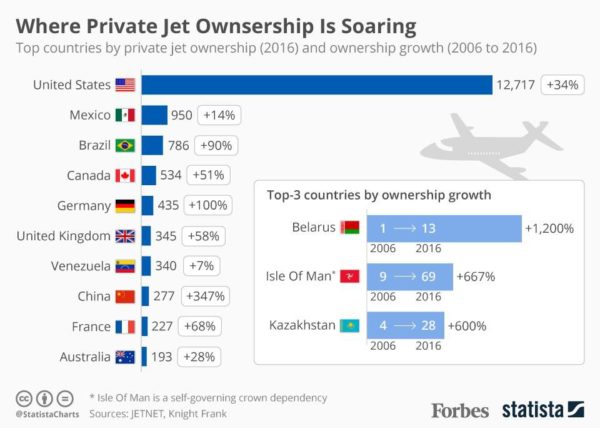
According to The Independent, the most popular private jet is the Cessna Citation XLS, which I believe climate alarmist Leonardo Di Caprio may be boarding in the picture below, having been shunted to the runway via a private helicopter…

A Cessna Citation XLS burns approximately 6,030kg of CO2 per three hour flight.
It’s back-of-the-napkin, but let’s say a typical jet does 4 legs per week, at 3 hour legs. We get:
17,947 jets X 6,030 kg CO2/flight X 4 flights/week X 52 weeks = 22,509,845,280 kilograms of Co2.
Over 22 billion kilos of C02. Per year.
Of course, that estimate of 4 legs per week could be low. Elon Musk has a private jet that logged 150,000 miles in 2018. Enough to circle the globe 6 times.

But if we banned private jets, with immediate effect, no exceptions, very few working class and middle class people would be affected. In fact even upper class, lower-tier wealthy would be relatively unscathed. It would only affect the tiny sliver at the top of the wealth pyramid, the same ones who seem most vociferously adamant on drastic climate action now and who could best afford to make alternate arrangements for attending climate summits or other important events. The annual Davos summit could be held via Skype, for example.
Taking the important step now will set the tone for the coming, rapid and drastic restructuring of every aspect of our lives, and it will be an easier pill to swallow when the elitists driving this change are leading the charge by example. Be the change you wish to see! #BanPrivateJets
My forthcoming book, Unassailable: Defend Your Content Against Deplatform Attacks, Cancel-Culture and Other Online Disasters will be out soon. If you want to be notified when it’s ready, sign up for my mailing list and I’ll let you know (I may even give a copy away for free to everybody on my list).
New study finds slim evidence for apocalyptic warnings about red meat
RT | October 4, 2019
A new study has found slim to nonexistent evidence for apocalyptic warnings about red meat consumption causing cancer, and the scientific establishment hell-bent on turning humanity vegan for environment’s sake is now outraged.
A team of 14 researchers from seven countries looked at over 130 articles and a dozen randomized trials, concluding that evidence linking the consumption of red and processed meat to cancer, heart disease, and mortality was of low quality and unreliable. Their findings were published in the Annals of Internal Medicine, a publication of the American College of Physicians, last week – to howls of protest from the scientific and nutritional establishment.
“This report has layers of flaws and is the most egregious abuse of evidence that I have ever seen,” declared Walter Willett, professor of epidemiology and nutrition at the Harvard School of Public Health.
Harsh words, to be sure, especially since one of the study’s authors is Gordon Guyatt, a professor of medicine at McMaster University in Canada and one of the creators of GRADE, a strict methodology for assessing the certainty of scientific evidence.
Guyatt said the reactions to the study are approaching levels of what he would call “hysteria.”
“If you’re the emperor, and somebody points out that you haven’t any clothes, this is not going to be a very appealing situation,” he said. “It’s very threatening, and people are defending their territory.”
Indeed, Willett is a leading member of the EAT-Lancet Commission, which advocates for a plant-based diet for the sake of the environment – and Harvard is the institution behind the infamous “food pyramid,” used for decades by the US government to advise its citizens to eat less meat and fat in favor of grains and carbohydrates.
Those guidelines have been a smashing success – in driving up the rates of obesity and diabetes, that is. If you want to see a real “hockey stick” graph, look at the percentage of overweight Americans skyrocket since 1980, when the US government began promoting the Harvard food pyramid.
The study also comes at the worst possible time for the scientific establishment, right amid its global crusade against farming and ranching in the name of saving the planet. One after another, scientists have argued that raising cattle destroys forests and releases carbon, so humanity must change its way of eating to focus on vegetables and insects – by force, if need be.
Some governments have already imposed a “meat tax” on behalf of the environment, and there has even been talk of outlawing meat for promoting “ecocide” and being as dangerous to public health as smoking.
No surprise, then, that Harvard has attacked the study as ignoring the environmental impact of meat, because “climate change and environmental degradation have serious effects on human health” and are therefore “important to consider when making recommendations.”
One California public health official echoed the same line of reasoning in a comment to the Annals of Internal Medicine, arguing the research shouldn’t have been written, let alone published, “without concern for the environmental effects of food choices.”
“Please let us, as physicians, wake up to the fact, that our climate crisis poses the most profound risk to individuals and public health and that we have a responsibility in guiding the public on how to confront this threat: in part, with food choices,” wrote Henning Ansor of Santa Barbara.
In other words, it doesn’t matter if the science is solid, the higher moral calling demands that the scientists lie – or stay silent – in the name of Mother Earth? That’s not how science works. That’s not how any of this works.
Poroshenko fails to appear for polygraph

Credit Image: © Pavlo_bagmut/Ukrinform via ZUMA Wire
By Padraig McGrath | October 3, 2019
Former Ukrainian president Petro Poroshenko failed to appear at the Kiev Research Institute of Forensic Expertise for a polygraph test on October 1st. The test was scheduled to be conducted by Ukraine’s National Bureau of Investigations, having been authorized by a Kiev court on August 13th. The polygraph test was scheduled to be conducted in connection with a tax-evasion investigation being carried out by NBI. Poroshenko is currently the focus of over a dozen criminal investigations which have been opened by multiple Ukrainian law-enforcement bodies since he lost the presidential election to Volodymyr Zelensky on a landslide in April. These investigations are in connection with indictments for tax-evasion, embezzlement, illegal abuse of authority, interference in judicial proceedings, forgery of documents and of lawmakers’ signatures, money-laundering, and other corruption-schemes.
The criminal exploits of the Yanukovich family seem quite modest by comparison.
On August 1st, the Vesti Ukraine newspaper reported that Poroshenko had made appeals to American lobbyists for protection from prosecution, including to the BGR Group, where former US Special Representative for Ukraine Kurt Volker acts as a senior advisor. This is a shrewd move on Poroshenko’s part. Over the past 70 years, between the United States government and its myriad puppets, there has been an unspoken agreement.
If you do our dirty work for us, impunity is guaranteed.
And indeed Poroshenko did a lot of dirty work. As president, he was an extremely loyal servant of US foreign policy. Even if President Trump has consistently indicated that he has little interest in Ukraine, there will doubtlessly be voices in the State Department advising him that it sets an extremely unhelpful precedent for the future if the US fails to protect Poroshenko now.
This latest controversy involving Poroshenko is just one instance of a pattern which has emerged steadily in Ukraine, in particular over the past 5 years – the country has developed a love-affair with the polygraph. In January, Ukraine’s most senior military prosecutor, Anatoly Matios, announced that he planned to develop a “polygraph program” in order to identify Russian collaborators and “separatists.”
Used in this way, the technology’s express purpose will be to identify thought-criminals.
As it currently stands, polygraph tests have already been made standard components within job-interviews for many positions in banking, the tax-service, anti-corruption agencies and the military. In addition, polygraph-results are admissible as evidence in Ukrainian courts, despite the fact that the overwhelming majority of doctors, psychologists, psychiatrists and criminologists worldwide who are familiar with the methodology and theory behind polygraphy regard it as a pseudo-science. There is very little evidence that polygraph-results are reliable, and lots of empirical evidence to the contrary.
The legal codes of the Sumerian king Ur-Nammu and the Babylonian Hammurabi stipulated the practice of “trial by ordeal,” a practice which survived well into the medieval period in Europe. Polygraphy, which involves monitoring physiological reactions during a line of questioning, is obviously a less physically dangerous method of establishing a person’s innocence or guilt than trial by ordeal, but no less superstitious. Honestly, you may as well be attempting to determine a person’s truthfulness or deception by entrails-divination.
The Ukrainian psychotherapist Irina Muzychuk, a vocal critic of polygraphy, has argued that the proliferation of this pseudo-scientific fad has partially ideological and emotional roots. She argues that in what she calls “highly unstable societies” such as Ukraine, the polygraph offers “hope that the truth will be found.” In a society which has been mired in oligarchism and corruption since it untethered itself from the Soviet Union in 1991, with the result that trust has completely broken down not only on the societal level but also on the interpersonal level, the polygraph operates as a fetishistic, pseudo-scientific substitute for trust.
However, if we were to analyze the phenomenon genealogically, we might also admit that it had deeper roots. Every society, every distinct ideological order, has its own ideologically driven, privileged pseudo-sciences. For example, in the United States, the most privileged pseudo-sciences are psychology and macro-economics. In the post-Soviet space, many privileged or legally mandated pseudo-sciences are hangovers from the “scientism” (in Russian “naukoobrazye”) which inhered in “scientific communism.”
For example, the disciplines which we call “political science” (in Russian “politologia”) and “geo-politics” are pseudo-sciences, insofar as they do not have methodologies which essentially distinguish them from the study of history. Their methodologies essentially centre on making historically-grounded comparisons. Nothing essentially wrong with that in itself – this would make “politologia” essentially a sub-discipline within the venerable study of history. The problem is that most political scientists don’t think as deeply or as long-term as historians. They compensate for this by maintaining scientific pretensions.
In the post-Soviet world, most high-profile purveyors of “politologia” are people who managed to crawl from the epistemological wreckage of “scientific communism” 30 years ago.
I would contend that the widespread use of the polygraph in Ukraine’s juridical process is another clear example of a particular type of “scientism,” this naïve trust in methodologies which purport to be “scientific.” As previously stated, almost every ideological order has its own privileged pseudo-sciences. “Scientism” is certainly not unique to the post-communist world. In the case of Ukraine’s contemporary polygraphy-craze, rather than “scientific communism,” it would count as an example of “pseudo-scientific post-communism.” For those under criminal investigation in Ukraine today, this is a somewhat brutal irony, when we consider the spate of “anti-communization” statutes which have been signed into law in Ukraine since the 2014 coup d’etat. Ukrainian society is just the flip-side of everything it thinks it’s reacting against.
You see, just like religions, secular ideologies cannot simply be erased or surgically removed. They can only morph or mutate. In spite of “secularization,” religion never really culturally disappears – it simply morphs into some post-religious form.
Precisely the same point holds for ostensibly secular ideologies such as communism or liberalism.
Childish Fantasies vs Real World Energy Needs
By Donna Laframboise | Big Picture News | October 2, 2019
Certain politicians are making promises about carbon dioxide emissions and the year 2050 – three full decades from now. Certain adults are telling elementary school children that transforming the world’s energy system is easy peasy.
But that’s not the case. In an article titled Net-Zero Carbon Dioxide Emissions By 2050 Requires A New Nuclear Power Plant Every Day, Roger Pielke Jr. delivers the harsh, mathematical truth. Even if every person in the world thought abandoning fossil fuels made sense, even if every last government was committed to such a plan, the sheer size of the task would remain. In Pielke’s words: “The scale…is absolutely, mind-bogglingly huge.”
In an entire year, a nuclear power plant is capable of producing 1 “million tons of oil equivalent” of energy – or 1 mtoe for short. Says Pielke:
In 2018 the world consumed 11,743 mtoe in the form of coal, natural gas and petroleum… there are 11,051 days left until January 1, 2050. To achieve net-zero carbon dioxide emissions globally by 2050 thus requires the deployment of >1 mtoe of carbon-free energy…every day, starting tomorrow and continuing for the next 30+ years. Achieving net-zero also requires the corresponding equivalent decommissioning of more than 1 mtoe of energy consumption from fossil fuels every single day.
Let us be honest and grownup here. The chances of this happening are remote.
Now let’s remember that many people insist nuclear power is off the table. We’re supposedly in the midst of a climate crisis caused by CO2 emissions, yet low-emissions nuclear power is forbidden.
Such people think we should rely on wind power, instead. According to Pielke’s calculations, that would require the construction of 1,500 wind turbines every single day from now until 2050.
Currently, the US consumes approximately 20% of the energy used across the globe. Its share of the 1,500 new wind turbines required daily would therefore be 300.
Despite years of massive subsidies designed to encourage wind energy investment, fewer than 10 turbines are currently installed in the US each day. Surely even a child understands that ramping up from 10 turbines a day to 300 is a massive challenge that couldn’t possibly happen overnight. Even in an affluent country with a booming economy.
And please, let us also put aside fairy tales about wind power being environmentally friendly. As Mark P. Mills explained recently in the Wall Street Journal :
Building one wind turbine requires 900 tons of steel, 2,500 tons of concrete and 45 tons of nonrecyclable plastic. Solar power requires even more cement, steel and glass…
Those who “dream of powering society entirely with wind and solar farms” says Mills, are actually demanding “the biggest expansion in mining the world has seen.”
How to Evaluate the Evidence of Contrarians – Scientifically
By Jennifer Marohasy | September 21, 2019
FUNDAMENTAL to the scientific method is the assumption that reality exists independently of our belief systems; that there is such a thing as evidence, and that it matters.
There seems to be general agreement on this point from both the left and right sides of Australian politics.
Indeed, in an article in The Weekend Australian newspaper (page 18) written by Graham Lloyd entitled ‘No place in debate for contrarian hijackers’, Misha Ketchell who is the editor of the influential academic publication The Conversation is quoted claiming to care so much about the evidence that the opinions of ‘sceptics’ must be excluded.
But this begs the question: how do we define scepticism, and on what basis do we discount the opinion of a so-called sceptic?
If their opinions are at complete odds with the evidence: then wouldn’t it be more useful to show this? To use them, and their wrong claims, to explain the truth within the theory of human-caused global warming?
It is claimed that sceptics like myself have an undue and powerful political influence, repeatedly successfully thwarting attempts to implement necessary public policy change.
Indeed, if my arguments are so devoid of evidence, this should be easily proven. Except that the skills scores from my rainfall forecasts, when compared with reality, are far superior to anything forecast by the Australian Bureau of Meteorology.
There has always been a role in science for models and predictions — that can be objectively tested against reality/the evidence —- so the predictions of sceptics could be juxtaposed against predictions from the consensus.
 Another way of finding universal truths is through simple observation. If we have catastrophic sea level rise, for example, then this should be evident when we visit the beach, or somewhere like Sydney Harbour. It should be evident in our coastal landscapes. I explained some of this in a recent talk I gave at the Maroochydore Surf Life Saving Club that the Institute of Public Affairs had filmed and that is now available on YouTube.
Given science is about real world phenomena, it should not be that difficult for Misha Ketchell to test the evidence repeatedly being put forward by particular individuals, like myself, against what comes to pass in the real world — what is observed.
But instead of relying on such simple tests of the truth — in my rainfall forecasts or in a coastal landscape or at a coral reef — those in authority, and who edit important journals and websites, have decided that I should be banned.
As Graham Lloyd explains on page 18 of today’s Weekend Australian, I’m listed, in, of all places, the journal Nature as a dangerous dissident who must be shunned, and denied, because, it is claimed, that I misrepresent the evidence. That so many of us are actively de-platformed is only just now being acknowledged, and I am grateful that it has today been explained in The Weekend Australian.
The conspiracy against me dates to at least 2008 when Bryant MacFie gifted $350,000 to the University of Queensland (UQ) in a donation facilitated by the Institute of Public Affairs to pay for environmental research scholarships. After I set all of this up, the Federation of Australian Scientific and Technological Societies (FASTS) intervened and told the Law and Agricultural facilities that if the program was to go ahead it must be without me … because as someone sceptical of global warming I lacked integrity.
I was replaced by Richard Burns, as the team leader. And more recently, in January just this year, after another strategic intervention perhaps involving the Bureau this time, I was removed as team leader from a project with the Queensland University of Technology (QUT).
The University of Queensland program did go ahead without me back in 2008.
I moved to Katoomba in the Blue Mountains, west of Sydney. The Blue Mountains is, of course, a great place for bush walking, which is a great way to reconnect with the natural world. It is in nature that we find evidence for the universal truths that exist independently of any and everything Misha Ketchell, and other such Australian opinion leaders, choose to publish — or not.
So, while I have repeatedly tried to escape to nature, it draws me back to science … as a method for transcending the chatter now everywhere in our scientific institutions and their publications.
I have kept showing that David Jones and Blair Trewin at the Bureau of Meteorology keep changing the temperature record, and more recently that the journal Nature publishes incorrect information from David Wachenfeld, the chief scientist at the Great Barrier Reef Marine Park Authority, as detailed in the article that follows.
Science is a method, science is never settled. We must therefore always be open-minded, tolerant and ready to be proven wrong. But history will eventually show that it is Misha Ketchell who is wrong and that this editor is not using a reasonable, or in any way evidence-based, criteria for deciding what should be published. This is so very wrong and so very harmful to science, democracy and the capacity of other opinion leaders and academics to evaluate the evidence which is so necessary if they are to get to the truth in such matters as climate change.
****************
The following article was published in The Weekend Australian on 7th September 2019.
Coral death knell exaggerated, says rebel quality assurance survey
The death of inshore corals near Bowen had been greatly exaggerated, according to the findings of a rebel quality assurance survey by reef-science outsiders Peter Ridd and Jennifer Marohasy.
The shallow reef flats of Stone Island have played a key role in divisions over the health of the – inshore Great Barrier Reef and the impact of run-off from agriculture.
Dr Ridd was disciplined for attempting to blow the whistle on the widespread use of before and after pictures taken a century apart near Stone Island that suggested coral cover had disappeared.
A follow-up paper by Queensland University reef scientist Tara Clark, co-authored by Great Barrier Reef Marine Park Authority chief scientist David Wachenfeld, confirmed the coral loss.
Despite winning his unfair dismissal case against JCU and being yesterday awarded more than $1.2m by the Federal Court, Dr Ridd effectively has been dismissed as a crank by other scientists.
An expert scientific panel last month accused him of spreading scientific misinformation like pro- tobacco lobbyists and anti-vaccination campaigners.
But Dr Ridd and Dr Marohasy have spent the past two weeks documenting the corals around Stone Island, which they found were still very much alive. … continue
Because Greenland really needs more ice
Climate Discussion Nexus | September 25, 2019
“SPECIAL REPORT: As their home melts, Greenlanders confront the fallout of climate change” shrieks NBC in a Sept. 17 email teaser (not available online) that warns that “Greenland is ‘ground zero’ for global warming, a place where the effects of rising temperatures and melting ice could have the most dire consequences. The shorter winters and longer summers have opened new waterways for fishing and tourism — but they’ve also endangered hunting, dogsledding and other traditional ways of life for the island’s 55,000 residents.” Oh really? Then why do long-term temperature records for Greenland show almost no warming in the last 60 years, or the last hundred?
There’s a famous story in Plutarch about Philip of Macedon the Great sending an ultimatum to the Spartans to surrender because “If I bring my army into your land, I will destroy your farms, slay your people, and raze your city” to which the Spartans replied simply “If”. And NBC’s casual use of “As” in the phrase “As their home melts,” not even as a premise to be explored but as an assumption to be swallowed untasted, we reply that if their home is not melting, nothing you say about what happens as it does tells us anything except that you are either gullible or zealots.
The NBC story to which the teaser links of course draws on the wisdom of the ancestors about the dramatic unpleasant changes, including one elder who said a thunderstorm was scary because in the good old days “We maybe hear some thunder one time in 30 years.” NBC did not delve into the question of whether in fact Greenland gets a thunderstorm every three decades.
Instead reporter Denise Chow breathlessly recounted being stuck near a glacier when the helicopter didn’t arrive and recalling with relief that fellow scientist David Holland had brought “a shotgun – just in case he needed to fend off polar bears.” Hmmm. Not so much threatened as threatening, are they?
As it happens, the bears stayed away and Chow ended up having a lovely night camping in exotic Arctic scenery before a chopper whisked them away the next day and “I found myself missing the peace, solitude and absolute splendor of Helheim Glacier.” But it was still terrifying because the Helheim glacier is melting rapidly and “Holland’s team is trying to understand what’s driving the staggering ice melt. This summer alone, an estimated 440 billion tons of ice has been lost from Greenland’s ice sheet — and some scientists say it could be more.”
We know what’s driving the main melt. It’s called summer. It happens every year and then the ice sheet grows again in winter. As for the glacier, well, many are retreating, including in Alaska, due to the natural temperature rebound from the Little Ice Age that saw them shrink dramatically before 1900.
Perhaps these journalists are seeing what they expect to see and their editors want them to see not what is actually there. NBC also sent star anchor Lester Holt “to Alaska – where he spent part of his childhood — to get a personal perspective of a climate in crisis. Scientists are warning that rising temperatures are having a significant impact on the state – including melting glaciers – which contributes to rising sea levels and warming oceans.” And Al Roker to Greenland to study… wait for it… “its record melt and heat wave.” Which he duly found, even though the data suggest that the widespread post-Victorian temperature rebound seems largely to have passed Greenland by. As we noted in August, its ice cap is about the same size today it was in 1850, and Greenland as a whole appears to have been cooling gently since the 1920s. Awkward.
Chow also failed for some reason to camp by Greenland’s Jakobshavn glacier that has recently baffled scientists by growing instead of shrinking. Instead she had an excellent adventure and filed the usual story.
Girls, Groupies, and Grim Reapers: The Religious Politics of Mass Response

By Maximilian C. Forte | Zero Anthropology | September 29, 2019
Following a week at the UN and ensuing climate change “protests” (state-sanctioned, party-approved, media-praised, university-endorsed, “protests”), in which we were yet again treated to another spectacle of a tearful child lecturing adults, Murad Gazdiev presented the excellent critical analysis of climate change eschatology. We are even called by the media to “confess our climate sins.” Playing a special role in faith-based movements that are meant to keep rational debate, skepticism, and questions at bay, girls have been chosen to occupy the spotlight. Children are representative of all that is pure, innocent, and truthful, and girl children add that extra element of vulnerability and need: the need for urgent rescue. Lighting a candle on the path toward mass hysteria, with the intention of stimulating a mass response, we have had young girls play in similar roles. There have been at least nine since 1990:
(1) The notorious Nayirah al-Ṣaba who lectured at the UN about the infamous and entirely made up “incubator babies” murdered by Iraqi forces in Kuwait in 1990;

Nayirah al-Ṣaba
(2) Severn Cullis-Suzuki, another young girl lecturing at the UN’s Rio Summit on the Environment, in what appears to be the template that has been copied almost to the letter by Greta Thunberg;

Severn Cullis-Suzuki
(3) Malala Yousafzai, who became the figurehead that somehow justified US occupation in Afghanistan and intervention in Pakistan, celebrated by the US State Department;

Malala Yousafzai
(4) Bana Alabed, the Syrian sock puppet of Twitter fame, a darling of imperialists who served as the angel of regime change on the side of foreign terrorists—see Eva Bartlett for more analysis;

Bana Alabed
(5) Now Greta Thunberg, promoted to the world stage declaring that mass extinction is already here, a prophet of doom who will profit certain well positioned investors;

Greta Thunberg

Sharbat Gula

Aisha
And, don’t forget a whole array of other iconic girls featured on TIME and National Geographic magazine covers, such as (6) the famous “Afghan Girl,” Sharbat Gula, whose image was used to champion US support for the Afghan anti-Soviet resistance (an investment with proven blowback value), or more recently (7) Aisha, used as a motif to support continued US occupation of Afghanistan. One girl to oppose occupation of Afghanistan, another girl to promote occupation of Afghanistan.

Neda Agha-Soltan
Not young girls, but rather young women have also been erected to icon status in the Iranian street protests of 2009, and the Libyan war of 2011. In Iran, I refer to (8) Neda Agha-Soltan, whose image was held aloft by anti-government activists. In Libya, we were presented with an iconic woman protester against Gaddafi’s government, (9) Eman al-Obaidi, a woman whose claims have not only been roundly debunked by myself and others, she has since abundantly disgraced herself living in the US, where she landed in jail.

Eman al-Obaidi
At a time when the West is priding itself for its advancements in allegedly fighting sexism, what we see is a return to an antiquated chivalry that gallops to the rescue of these damsels in distress. As a favourite tool of neo-colonialism, US imperialists routinely depicted countries in Latin America as women—women in distress, needing to be “saved” by Uncle Sam. As I have said before, we work with a finite number of cultural materials, and our only “innovations” are in finding new applications and new media for recycling past tropes.

Uncle Sam rescues “Cuba” from the flames of anarchy
It is no surprise that “women and girls” have been a special focus of US foreign policy, particularly from the time of George W. Bush straight to, and including, even Donald Trump. One reason has to do with the relentless puritanical moralism into which American politics have been displaced for over two centuries. Yet in deploying women and girls as props, using them as human shields, what that usually signals is the approach of either an egregious assault on the rights of others, whether individuals or nations, or a politically bankrupt policy that can find no other means of attracting sympathy other than to remind us, “it’s all about the little children”. Children are meant to be pacified, but in such instances they are themselves used as tools of pacification. Inserting a little girl into the middle of a debate, stops the debate. If anyone continues the debate, they are then smeared for “attacking children“.
By now those who are aware of this pattern should be on alert whenever a new incarnation appears, because it is a signal that certain powerful political, economic, and cultural entrepreneurs are trying to provoke an instantaneous mass reaction that might not otherwise be possible with reasoned, calm debate where all of the facts are presented, analyzed and discussed. Typically, this pattern appears when actions are being entertained that might otherwise shock ordinary individuals and make them balk at such drastic measures. Women, and particularly young girls, are meant to stimulate panic, a sense of emergency, requiring urgent and always exceptional action. As the Mayor of Montreal said about the climate march and Thunberg’s appearance, she hopes everyone will remember that day when the time comes to make some “hard decisions”. This is how one goes about creating the psychological basis for a state of siege, and ensuring that the siege mentality is instilled in a manner that makes it seep down to the furthest reaches of the social fabric.
It was Karl Marx who wrote the following about the state of siege as it,
“enmeshes, controls, regulates, superintends and tutors civil society from its most comprehensive manifestations of life down to its most insignificant stirrings, from its most general modes of being to the private existence of individuals; where through the most extraordinary centralization this parasitic body acquires a ubiquity, an omniscience, a capacity for accelerated mobility and an elasticity which finds a counterpart only in the helpless dependence [of the people on the state], in the loose shapelessness of the body politic” (The Eighteenth Brumaire of Louis Bonaparte. New York: International Publishers, 2004, p. 62).
One of the landmark developments of what was announced as the “New World Order” by former US president George H.W. Bush on September 11, 1990, which joined the “globalization” babble, has been this recurrent series of “crises” that have been used to train masses into globalized mass reaction. One was the now laughable Y2K bug, a fraud of epic proportions that few mention any longer just out of sheer embarrassment (or possibly due to the kind of amnesia induced by mass culture); another was the SARS emergency, which resulted in few deaths and ended up amounting to nothing. Then we were supposed to be struck by Ebola at one point, and then a Middle Eastern version of SARS…and in the 1970s all the talk was about African Killer Bees making their way toward the US. Nothing regiments a society like fear, and once fear is unleashed it can be harnessed to any ends.
This is humanitarian abduction on a grand scale.
On the topic of climate change, Larry Kummer at Fabius Maximus has been diligently compiling a series of extremely useful analytical reports that should make any reasonable, intelligent person pause and take note. In particular, among the most recent, I recommend:
-
“Enlisting peer-reviewed science in the climate crusade,” Larry Kummer, Fabius Maximus, August 15, 2019.
-
“How fast is the world warming? Is it burning?” Larry Kummer, Fabius Maximus, August 17, 2019.
-
“See how climate science becomes alarmist propaganda,” Larry Kummer, Fabius Maximus, August 18, 2019.
-
“Prepare to retreat before climate change!” Larry Kummer, Fabius Maximus, August 26, 2019.
-
“How journalists helped wreck the climate debate,” Roy Spencer, Fabius Maximus, August 26, 2019.
Until recently I was quite open to accepting most of the propositions put forth by climate change scientists (I have no time for activists). However, when I started to see that the authorities who marshalled this science were now actually presuming to speak to us through a little girl, that gave me reason for pause. Why are they resorting to such a crass, infantilizing tactic? It strongly suggested that perhaps their arguments were not so iron-clad after all, not as well founded on solid bedrock as some believed, and that even though they control all the media of communication and have effectively “won” the argument by closing off all channels of dissent and institutionalizing echo chambers, they still had to resort to this silly little trick. Now that means there is something really wrong in their camp, something definitely stinks over there. Nobody with a solid argument needs to resort to moral blackmail, character assassination, insults, and threats–that is not what a winning side does. This trope of using a little girl was the final straw, and those who are sincere in their research and advocacy around climate change are being done no favours by her stage-managed activism.
Finally, let me close with another Caribbean anecdote. In Trinidad this past June, I was surprised to find how little the heat was affecting me, especially as I just came out of a winter which stretched late into spring. I marched at a funeral, in a wool suit (it’s all I have), under a blazing sun, and even that was bearable. Yet I am a person who feels hot in winter snow. Something was indeed wrong. What really took me by surprise however was Trinidadians complaining about the heat. These were the same Trinidadians I knew who would sleep with no fan at night, covered by a blanket; who would wear a jacket in the morning because it was “making cold” (cold meaning 22° Celsius); in air conditioned libraries they would wear sweaters, making for a Canadian scene in the tropics. They were the same people who used to mock my incessant sweating. Now I was dry, and they were complaining about the heat, and it was only 29° Celsius, not the usual 32-34° which I associate with Trinidad’s daytime temperatures. What happened? They asserted it was “climate change” that had them feeling hot. What they did not explain is why they had all made a mass transition to air conditioning their homes, places of work, and public transport vehicles–the famous Maxi Taxis of the Eastern Main Road, throbbing with music blaring from their speakers, bouncing hot boxes…were all now firmly sealed, dark and quiet as they sped by carrying their air conditioned passengers. So was it in fact climate change that had them feeling hot, or was it first the cultural change of switching to an air conditioned mode of existence? To me it appears they have been acclimatized to a new artificial climate, while becoming alien to their natural environment. Then I returned to Canada a few weeks ago, flying around Hurricane Dorian–when I mentioned this fact to friends, their reaction to Dorian was “look at all this damn climate change“–referring just to a single hurricane, in a region and during a season when hurricanes are normal. Now just regular climate is becoming climate change, and that is a sign of the work of inculcating mass hysteria and irrationality.
But by all means ignore this—surely somewhere there is a little girl beckoning your attention.
Another Climate Scientist with Impeccable Credentials Breaks Ranks
“Our models are Mickey-Mouse Mockeries of the Real World”
ELECTROVERSE | September 26, 2019
Dr. Mototaka Nakamura received a Doctorate of Science from the Massachusetts Institute of Technology (MIT), and for nearly 25 years specialized in abnormal weather and climate change at prestigious institutions that included MIT, Georgia Institute of Technology, NASA, Jet Propulsion Laboratory, California Institute of Technology, JAMSTEC and Duke University.
In his book The Global Warming Hypothesis is an Unproven Hypothesis, Dr. Nakamura explains why the data foundation underpinning global warming science is “untrustworthy” and cannot be relied on:
“Global mean temperatures before 1980 are based on untrustworthy data,” writes Nakamura. “Before full planet surface observation by satellite began in 1980, only a small part of the Earth had been observed for temperatures with only a certain amount of accuracy and frequency. Across the globe, only North America and Western Europe have trustworthy temperature data dating back to the 19th century.”
From 1990 to 2014, Nakamura worked on cloud dynamics and forces mixing atmospheric and ocean flows on medium to planetary scales. His bases were MIT (for a Doctor of Science in meteorology), Georgia Institute of Technology, Goddard Space Flight Center, Jet Propulsion Laboratory, Duke and Hawaii Universities and the Japan Agency for Marine-Earth Science and Technology.
He’s published 20+ climate papers on fluid dynamics.
There is no questioning his credibility or knowledge.
Today’s ‘global warming science’ is akin to an upside down pyramid which is built on the work of a few climate modelers. These AGW pioneers claim to have demonstrated human-derived CO2 emissions as the cause of recently rising temperatures and have then simply projected that warming forward. Every climate researcher thereafter has taken the results of these original models as a given, and we’re even at the stage now where merely testing their validity is regarded as heresy.
Here in Nakamura, we have a highly qualified and experienced climate modeler with impeccable credentials rejecting the unscientific bases of the climate crisis claims. But he’s up against it — activists are winning at the moment, and they’re fronted by scared, crying children; an unstoppable combination, one that’s tricky to discredit without looking like a heartless bastard (I’ve tried).

Climate scientist Dr. Mototaka Nakamura’s recent book blasts global warming data as “untrustworthy” and “falsified”.
Data Falsification
When arguing against global warming, the hardest thing I find is convincing people of data falsification, namely temperature fudging. If you don’t pick your words carefully, forget some of the facts, or get your tone wrong then it’s very easy to sound like a conspiracy crank (I’ve been there, too).
But now we have Nakamura.
The good doctor has accused the orthodox scientists of “data falsification” in the form adjusting historical temperature data down to inflate today’s subtle warming trend — something Tony Heller has been proving for years on his website realclimatescience.com.
Nakamura writes: “The global surface mean temperature-change data no longer have any scientific value and are nothing except a propaganda tool to the public.”
The climate models are useful tools for academic studies, he admits. However: “The models just become useless pieces of junk or worse (as they can produce gravely misleading output) when they are used for climate forecasting.”
Climate forecasting is simply not possible, Nakamura concludes, and the impacts of human-caused CO2 can’t be judged with the knowledge and technology we currently possess.
The models grossly simplify the way the climate works.
As well as ignoring the sun, they also drastically simplify large and small-scale ocean dynamics, aerosol changes that generate clouds (cloud cover is one of the key factors determining whether we have global warming or global cooling), the drivers of ice-albedo: “Without a reasonably accurate representation, it is impossible to make any meaningful predictions of climate variations and changes in the middle and high latitudes and thus the entire planet,” and water vapor.
The climate forecasts also suffer from arbitrary “tunings” of key parameters that are simply not understood.
Nakamura on CO2
He writes:
“The real or realistically-simulated climate system is far more complex than an absurdly simple system simulated by the toys that have been used for climate predictions to date, and will be insurmountably difficult for those naive climate researchers who have zero or very limited understanding of geophysical fluid dynamics. The dynamics of the atmosphere and oceans are absolutely critical facets of the climate system if one hopes to ever make any meaningful prediction of climate variation.”
Solar input is modeled as a “never changing quantity,” which is absurd.
“It has only been several decades since we acquired an ability to accurately monitor the incoming solar energy. In these several decades only, it has varied by one to two watts per square meter. Is it reasonable to assume that it will not vary any more than that in the next hundred years or longer for forecasting purposes? I would say, No.”
Read Mototaka Nakamura’s book for free on Kindle — arm yourself with the facts, and spread them.
Facts such as these little nuggets (all lifted/paraphrased from the book):
“[The models have] no understanding of cloud formation/forcing.”
“Assumptions are made, then adjustments are made to support a narrative.”
“Our models are mickey-mouse mockeries of the real world.”
Solar Forcing
Solar output isn’t constant, IPCC. And the modulation of cloud nucleation is a key consequence. During solar minima, like the one we’re entering now, the sun’s magnetic field weakens and the outward pressure of the solar wind decreases. This allows more Cosmic Rays from deep space to penetrate our planet’s atmosphere. These CRs have been found to nucleate clouds (Svensmark et al). And clouds are a crucial player earth’s climate.
As Roy Spencer, PhD. eloquently writes:
“Clouds are the Earth’s sunshade, and if cloud cover changes for any reason, you have global warming — or global cooling.”
For more on that:
The cold times appear to be returning, in line with historically low solar activity.
NASA has warned that this next solar cycle (25) will be “the weakest of the past 200 years”:

Featured Video

Dan Dicks with James Corbett on Solutions Watch
or go to
Aletho News Archives – Video-Images
From the Archives
Secret document reveals plans for civil war in Lebanon, Israeli false flags, and invasion
By Randi Nord | Geopolitics Alert | April 5, 2019
Beirut – During his visit with US Secretary of State, Mike Pompeo, Lebanese President Michael Aoun reportedly received a US-Israeli document detailing plans for creating a civil war in Lebanon with covert false flag operations and possible Israeli invasion.
Although the source of the document is Israeli and created in partnership with Washington, no one knows who presented it to Aoun. The Lebanese TV station, Al-Jadeed, initially reported the document on Lebanese TV and a video on its website. Geopolitics Alert translated the report for this article. … continue
Blog Roll
 Aletho News
- There’s a drought in academia: A drought in honest research on the subject of drought and other weather extremes
- Department of War Awards $20.7 Billion Contract to Raytheon for Air-to-Air Missiles
- ‘Distance yourselves from Israel’: IRGC urges US population to question govt policies
- America’s Greenland deal has a radioactive backstory
- The RAF Fairford ‘terror plot’: Unpacking escalation in the UK echo-chamber
- EU Council Advances Chat Control 2.0 Scanning Proposal
- Ex-Greek MEP files complaint against Israeli spyware firm over alleged Pegasus surveillance
- Troubling ideas throughout the Torah, Talmud, Mishneh Torah and Tanya
- ‘Grave, alarming’: Iran mission on Trump’s UNGA ‘annihilation’ threats
- Najaf airport to reopen to Iranian flights within 24 hours: Ambassador
- If Americans Knew
- New Report: “Scholasticide and Genocide in Gaza: Assessment, Testimonies and Legal Analysis”
- Ex-Biden officials are desperate for a Gaza scapegoat
- Israeli “settlers” Invade Al-Aqsa; Pour Boiling Water on 75-Year-Old
- Israel Has Kidnapped Another American Teenager
- US arms sales to Israel worth $21.6 billion in 20 months
- Three Palestinians Killed in Israeli Attacks on Gaza
- Revealed: German “Anti-Semitism Expert” Driving Crackdown on Palestine Solidarity is Former Israeli Spy
- Egypt’s Warning to Israel Before Oct 7
- Israel’s siege signals another cruel winter for 1.8 million Gazans – Daily Update
- Netanyahu Asked UAE Leader to Deny Report on Oct. 7 Warning in Secret Visit, Sources Say
- No Tricks Zone
- New Study: Earth And Venus Surface Warmth Largely Explained By Convection And Lapse Rate, Not CO2 Or Radiation
- 2025 Nature Paper Claiming Worsening Global Drought Gets RETRACTED …Heavily Flawed
- New Study: ‘Global Drought Shows No Detectable Recent Acceleration Under Climate Warming’
- Economic Masterminds: German Socialists Suggest Taxing Productivity Gains Stemming From Using AI
- The South China Sea Has Not Been Cooperating With The Climate Change Narrative
- Energy Crisis: Germany Enters Heating Season With Historically Low Gas Reserve Fill Levels
- New Study: The Antarctic Ice Sheet Gained Mass From 2020-2024 Due To Staggering Snow And Ice Accumulation
- Study: Ocean Heating Rates From Thousands Of Years Ago ‘Dwarf’ Modern Ocean Heating Rates
- Climate Extremists Target, Attack Large-Scale Power Grid Infrastructure In Germany!
- New Study: Antarctic Ice Melt Has Contributed Less Than 1 Centimeter To Sea Level Rise In The Last 30 Years

