Aletho News

ΑΛΗΘΩΣ

Water Shortage? Blame Climate Change!

By Paul Homewood | Not A Lot Of People Know That | March 19, 2019

Water shortage? Why not blame it on global warming!

Within 25 years England will not have enough water to meet demand, the head of the Environment Agency is warning.

The impact of climate change, combined with population growth, means the country is facing an “existential threat”, Sir James Bevan told the Waterwise Conference in London.

He wants to see wasting water become “as socially unacceptable as blowing smoke in the face of a baby”.

“We all need to use less water and use it more efficiently,” he said.

Sir James Bevan was appointed chief executive of the Environment Agency – the public body responsible for protecting the environment and wildlife in England – in 2015 after a career as a diplomat.

He told his audience that, in around 20 to 25 years, England would reach the “jaws of death – the point at which, unless we take action to change things, we will not have enough water to supply our needs”.

https://www.bbc.co.uk/news/uk-47620228

Only one slight snag with Sir James’ little theory, there has been no reduction in rainfall levels in England, and droughts used to be much more severe and prevalent in the past:

https://www.metoffice.gov.uk/climate/uk/summaries/actualmonthly


Even commonly made claims that summers are getting drier do not stand up to scrutiny:

https://www.metoffice.gov.uk/climate/uk/summaries/actualmonthly

And just for good measure, the area of the country which is most vulnerable to water stress is also not becoming drier:


https://www.metoffice.gov.uk/climate/uk/summaries/datasets

And finally, summers in England are not getting hotter. The hottest summer still remains that of 1976. Indeed, last summer was the only one other than 1976 which was actually hotter than 1911!

https://www.metoffice.gov.uk/climate/uk/summaries/actualmonthly

There may be many reasons for water shortages, such as increased demand and leaks, but “climate change” certainly is not one of them.

But it is much easier for Sir James Bevan to blame global warming and ask us all to take less baths, than have to provide solutions to problems he can address.

March 20, 2019 Posted by | Deception, Fake News, Mainstream Media, Warmongering, Science and Pseudo-Science | , | Leave a comment

BBC’s Age of Denial

By Paul Homewood | Not A Lot Of People Know That | March 16, 2019

I doubt if a day goes past now without a blast of global warming propaganda from the BBC.

Isabel Hardman has a new five part series on Radio 4, called the Age of Denial.

Although it covers all forms of denial, it is clearly aimed at climate sceptics, as this opening episode makes obvious:

https://www.bbc.co.uk/programmes/m000357k

Hardman interviews Kari Marie Norgaard, a social scientist from Oregon, who has written a book about climate change denial.

You can listen to the first five minutes, but to give the gist, Norgaard visited a small town in western Norway in the winter of 2000/01, to do research for a book she was writing.  She found that the winter that year was a mild one, with the snow arriving late.

But what really stunned Norgaard was that none of the locals wanted to talk about “climate change”, which she was convinced was to blame.

Hardman and Norgaard then discuss various reasons why this should be so, which amounted to no more than a load of psychobabble.

For some reason, it did not occur to either to ask what the locals knew already. That it was just the sort of weather event that they, or their forefathers, had seen in the past.

Indeed, when we check the actual data at Bergen, the longest running site in the region, we find that those winter temperatures in 2000/01, far from being unusual, were the norm in the 1930s and 40s, and not infrequent at other times either:

https://data.giss.nasa.gov/cgi-bin/gistemp/stdata_show.cgi?id=634013170000&dt=1&ds=5

In the remainder of the episode, Hardman discusses various theories from other psychoanalysts. But it is all just a spurious intellectual attempt to create a condition called ‘Denialism’. No doubt so that climate sceptics can be conveniently labelled and then ignored.

In reality, you don’t need to be a psychologist to understand why so many people are suspicious of what they are told about climate change.

The answer lies in the fact that they see no evidence on the ground to support the barrage of apocalyptic warnings showered on them.

People who live near the coast can see with their own eyes that they are not about to be inundated by the sea.

Temperature rise has been so small in the last century that most people would not even be aware of it if they were not told about it.

As for extreme weather, older people know that there have always been floods, droughts, heatwaves and storms. Sadly it is the younger generation, who have no such experience, that is vulnerable to propaganda.

In short, people are far more knowledgeable than the sneering Isabel Hardman gives them credit for. And they know when they are being sold a pup.

Moreover, these ordinary people have far more pressing concerns in their daily lives than to be paranoid about climate change. Perhaps if Hardman came out of her metropolitan BBC bubble and talked to ordinary people, she might find this out for herself.

Rather than trying to package sceptics as people with psychological problems, she might ask why others have become totally paranoid about climate change. When I see school kids questioning the point of going to school when “their future could be ruined by climate change”, I truly despair.

What on earth are we doing to these youngsters? Do we really want them growing up so indoctrinated and unable to use their own faculties that they cannot even check the facts for themselves? Do we really want them to grow up so neurotic that they are scared of the weather?

Are we happy to see them marching around like a bunch of zombies, full of meaningless slogans about topics that they don’t have the slightest understanding about?

It is a sort of mass hysteria that has unfortunately been all too common during human history. It used to be a matter of burning witches, or human sacrifices by the Aztecs. Now it is demonising CO2.

Perhaps Isabel might like to devote her next series to this.

March 16, 2019 Posted by | Mainstream Media, Warmongering, Science and Pseudo-Science | , | Leave a comment

BBC’s Climate Lies Becoming A Habit

By Paul Homewood | Not A Lot Of People Know That | March 15, 2019

They say once is an accident, twice is a conspiracy. I wonder what eight times is?

As I revealed yesterday, the BBC has formally upheld my complaint about their African penguin story. I am pleased to see then that The Times has now picked it up.

This complaint is now the eighth climate-related one I have been involved with which has been upheld against the BBC in the last two years. There may of course be others that I am not aware of.

  • In March 2017, World at One made the ridiculous claim that sea levels at Miami were rising at ten times the global mean.

The BBC were subsequently forced to admit that sea levels there showed “little divergence from the global mean”

  • Then in October 2017, the BBC broadcast an episode of “Russia with Simon Reeve”, which linked the deaths of “tens of thousands of reindeer” to climate change.

After a complaint was submitted, the BBC accepted that reindeer populations were in fact stable or increasing.

Written by Chris Fawkes, the BBC meteorologist, it categorically stated  that “A warmer world is bringing us a greater number of hurricanes and a greater risk of a hurricane becoming the most powerful category 5”

The actual data shows this is simply not true, as the IPCC themselves have made perfectly clear.

Eventually, the BBC printed a correction that their claim was based on “modelling and not historical data”

Harrabin claimed that investment in clean energy had slumped following a fusillade of policy changes, including a ban on new onshore wind farms.

There has been no such ban, only the removal of subsidies.

The BBC Executive Complaints Unit accepted that the article was materially misleading, and that there had been a serious lapse of editorial standards.

  • In June 2018, John Humphrys interviewed Lord Deben, allowing him to get away with wildly inaccurate claims about wind power unchallenged. In particular, Deben stated that “even where a community wants to have an onshore wind farm, it can’t have it.”

In fact there is no such ban, and the Government has actually devolved the decision to approve onshore wind turbines to local councils.

As a result, the BBC Executive Complaints Unit found that Deben should have been challenged on this point to ensure listeners were not left with a materially misleading impression.

  • December 2018 saw an episode of the BBC Weather World programme, which was little more than a free puff for onshore wind farms.

At one stage, the presenter casually commented that “Already about 30% of the UK’s power is produced by wind energy”. The actual figure is 15%.

Following a complaint, the BBC accepted their claim was wrong, and have now withdrawn that segment of the programme from their website.

Central to the IPPR’s case was this statement:

Since 2005, the number of floods across the world has increased by 15 times, extreme temperature events by 20 times, and wildfires seven-fold. “ [“Since 2005”, was subsequently amended to “since 1950”.]

Harrabin made absolutely no attempt to challenge or query this statement, or some of the other contentious claims in the IPPR report, despite the fact that it was patently absurd.  Instead his article was effectively just a cheerleading exercise.

The IPPR claim is in reality a totally fake one, as they misinterpreted the International Disasters Database used for their analysis. As the organisation which maintains the database makes totally clear, many disasters occurred in past decades but were never officially recorded in the database, purely because of better methods of reporting nowadays.

After considerable controversy, the IPPR made substantial changes to that section of their report, accepting that the original claims were false. The BBC then withdrew the fake claims and issued a correction.

Introducing a video report from South Africa, the presenter baldly stated that:

The next report is about the African penguin population and how it’s rapidly declining. Conservationists are saying their habitat is being hit by rising tides caused by climate change.

And it’s interesting that since that report by the UN last week on climate change, so many different organisations have been coming forward to emphasise the importance it has on their work.

Amazingly the video which followed made no mention of climate change or rising tides at all. Zilch! Nada! Instead, the local ranger, who was interviewed, categorically blamed the decline on overfishing.

This is actually very well understood by experts, such as those from the Organization for the Conservation of Penguins.

Despite the efforts of the BBC to fob off my complaint, the Executive Complaints Unit agreed that there was no evidence for the presenter’s claim and criticised their journalists’ failure to check claims.

I have no doubt that these eight cases relating to climate change are just the tip of the iceberg. Many other such fake reports are broadcast and go unnoticed.

It is also true that the BBC regularly try to fob off complainants with spurious replies, leading many to simply give in. This is even the case when their inaccurate claims are obvious, easily proven and factual.

Indeed, one of the things which continue to astound me is how the BBC continues to broadcast so many claims about climate change which are so utterly preposterous that even my dog would find them suspicious. Are their reporters and presenters so absorbed by global groupthink that they believe every bit of tripe and junk science put before them?

Are they more interested in propaganda than facts?

Are they just lazy?

Or are they simply following orders from higher up?

Unfortunately it is a fact that the BBC’s coverage of climate change has been unreliable for many years, and has long since abandoned any pretence of impartiality. It has got so bad that Fran Unsworth, the BBC’s director of news and current affairs, sent out a missive to all of her staff last year, which itself was full of factual errors, directing staff how they should report climate change and how they should marginalise sceptical scientists.

As a result of this one sided, blinkered approach to climate issues, the BBC frequently finds itself accused of misinformation, lack of objectivity and promulgating downright falsehoods.

But no matter how many times they have complaints upheld against them, one problem remains. The original fake news has gone around the world and back before the real truth emerges. By this time, nobody actually gets to see the “corrections” hidden away in the online news reports originally published months before.

Something has to change.

March 16, 2019 Posted by | Fake News, Mainstream Media, Warmongering, Science and Pseudo-Science, Timeless or most popular | , | Leave a comment

Open letter to anyone marching for ‘the climate’ today

By Brian Dingwall | Whale Oil | March 15, 2019

Hi kids,

Many of you will be marching today, demonstrating for an issue you believe to be very important.

Many years ago, I was young, well informed, and absolutely convinced I knew enough to make good decisions for the future of the world, and couldn’t understand just how obtuse all the oldies were, how they just didn’t know the stuff I had just learned.

Malthusian economics drove most of us, the Club of Rome had reported, and to my subsequent shame, I confess that in 1975 I voted for the Values Party…. I wanted a better world, I knew resources were on the verge of running out, the population was out of control, and we were polluting our one and only planet. It was, I thought, time for the change that was so desperately required.

The Values party did not get in, to our surprise the resources did not run out, Simon won his bet with catastrophist Erhlich, as countries became more wealthy they cleaned up their environments, particularly water, farmlands, and air.

China is now wealthy enough to be doing exactly that right now, following in the footsteps of Japan, Taiwan, and Korea. We certainly never see the famous foaming rivers of industrial Japan anymore.

Economists now understand that the ultimate resource, the human imagination, never runs out.

So is it likely to be with climate change. I urge you to never abandon your scepticism, for a critical mind is your most important asset.

Be able to articulate exactly what evidence has persuaded you to your opinion. Opinions though, are not evidence. Consensus is not evidence.

The world has many historic consensuses that have turned out to not be so. So far, I don’t mind sharing with you, I have yet to be persuaded.

My background is in science, with a smattering of economics, and statistics and I well understand the case for catastrophic climate change. I find it unconvincing.

As do a raft of well qualified experts in many fields, even Nobel prize winners, and I urge you to find out who they are, and why they have reservations.

There are two sides to this debate, but only one is well resourced, so you have to work a bit harder to find the arguments of the sceptical scientists.

One of the very great tragedies of the whole issue is that since 1990, it has been very difficult for scientists to garner resources from governments to research natural climate change, but we can be certain that the forces that wreaked great climate changes in the past are still active, and may be a much greater magnitude than those wreaked by CO2.

For today please reflect on these things:

All the CO2 being released today is simply being returned to the atmosphere whence it came, and is now available to the biosphere, which we can see is already flourishing as a result. Global temperatures have increased (about 0.7C degrees in last 100 years) ever since the little ice age, and continue to but at nothing like the rate predicted by climate models.

We live from the equator to (nearly) the poles, and hence are particularly adaptable, and will adapt to minor temperature changes and have in the past through climate optima, and little ice ages.

Much of the land surface of the earth is too cold for habitation or agriculture, some warming of the northern latitudes of Canada and Russia for example will be welcomed.

Here in New Zealand, we produce food for the world, with one of, if not the lowest “carbon footprints” of any country. Should you actually succeed in killing this industry, that production will be conducted elsewhere, at a higher carbon cost….. so the improvement as you see it, in New Zealand’s emissions will be more than offset by extra emissions elsewhere…. we will be adding to the problem, not mitigating it.

It is also very important that each of you understands that for any complex problem, there are a range of decisions, trade-offs, to be considered. Do we understand all the benefits that follow from the use of fossil fuels? How many of these are we prepared to sacrifice? What would a fossil fuel-less world look like for you (hint: I don’t think you would like it very much).

Have you read or even heard of the “moral case for fossil fuels”, and do you understand the extent to which they feed and clothe the world, provide us with our tools, and our leisure, empower our devices, and enable our travel at present? House us and clean us?

You are not informed if you only read one side of the case. I happen to believe in free markets, the economics of von Mises, Hayek, Friedman, Simon, McCloskey, and many of the moderns but I have also read Marx, and various of the collectivist economists, you must know what all the opinion leaders are saying and why.

So do seek out “lukewarmers” like Curry, Lewis, Christy, Soon, Balunias, they will lead you to a raft of others “the counter-consensus” that you, like me, may find rather more convincing than the orthodox climate church.

Personally I have learned that what I knew at your age (vastly more than my parents knew, of course) was not always right….now captured in the expression “it’s not what we don’t know, it’s what we know for sure that just ain’t so”.

We once believed in leeches, blood-letting, that washing our hands was not important, that continents didn’t drift, that stress causes ulcers, a daily aspirin is good, and that there is always an imminent catastrophe on the horizon that never materialises.

The question is whether what we know for sure that the specific climate change you worry about is human caused, will have a measurable and substantial impact, and is real. What climate change would have been quite natural? Will we look back in years to come and think “we believed what?”

Have we included accurately in our models the impacts of short and long term natural oceanic cycles, cosmic rays impact on cloud nucleation, clouds, the sun and sunspots, what, if anything, is there still that we don’t know that we don’t know? Can we get initial conditions right?

Always examine closely the logic of the case… we have only one world so all we can do is create computer models of the climate, and wait to see if nature tells us the models are a good approximation of the real world suitable for projecting future climates….. and if climate is a 30 year average of all our global “weather” then we probably have to wait at least two preferably more periods of 30 years simply to validate the models so 100 years or so.

So far the projections and predictions have been wildly wrong, the polar ice is healthy, the Manhattan freeway is not underwater, sea-level rise is not accelerating, and snow is far from “a thing of the past”. As climate scientist and keeper of one of the satellite records ironically observes “the models all agree the observations are wrong”.

And the economics don’t work, as Nobel prize winner Nordhaus teaches the cost of mitigation is an order of magnitude greater than the cost of the problem, so the cure is worse than the disease.

Don’t take my word for it, or anyone’s. Read for yourselves, go to source. Do not trust any scientist who calls a peer scientist a “denier”. Understand peer review, and that a peer reviewed paper is more often than not just the opening salvo in a chain of events that may or may not ultimately expose a scientific truth.

Be very careful of any theory where the accepted facts (historic temperatures, and the location and number of the thermometers)) change regularly to suit the narrative.

And finally, enjoy your day, be yourselves, trust your own judgment, read widely, and look behind the data to the motives of the players.

There is a (slim) chance you are right, but even if you are, trust in human ingenuity, that fabulous engine of change, to ensure survival not of the world as we know it, but of an even better world than previous generations enjoyed…. we will not revert to sleeping with our food animals on dirt floors with unpainted walls! As humans have done for most of our time on earth….

March 15, 2019 Posted by | Economics, Malthusian Ideology, Phony Scarcity, Science and Pseudo-Science | Leave a comment

Carbon Eugenics

Genocide in the name of the environment is still genocide

By James Corbett | The Corbett Report | December 11, 2009

TRANSCRIPT: The first person to stand up to any great evil is always the most courageous. To be the first one to call out any great injustice is to invite ridicule, scorn, even persecution. It is difficult to imagine today just how brave were the first slave owners to call for the abolition of slavery, the first men and women to advocate women’s suffrage, the first activists to call for the end of Apartheid. In the end, their cause is recognized as just and these brave souls are lauded, often posthumously, as heroes. But in the beginning, no one wants to admit that they are a party, even unwittingly, to a great evil. The wildest injustices can be legitimized simply because they are popular.

Today, just such a popular injustice exists. It has been infused into our culture and taken up as a cause. It is fervently believed in and advocated with great passion and force, and to speak out against it is to risk persecution and scorn. But speak out against it we must.

The terrible injustice of our age has its roots in a most unlikely place: in the quaint villages and manicured gardens of the 19th century British gentry. Amongst that set lived one Francis Galton, a gentleman scientist who had investigated everything from meterorology to statistics. Shortly after his cousin, Charles Darwin, published his Origin of Species, Galton became fascinated with the idea that the “survival of the fittest” did not just take place between species, but within them. This idea became a pseudo-science, a study of the presumed racial characteristics of this group or that group with an aim to explaining why the various peoples of the world occupy the positions they do.

In order to confirm their pre-conceived notions of their own self-worth, Galton and his friends started a new field of inquiry called eugenics. Unsurprisingly, it concluded that the rich and powerful were rich and powerful because they were genetically superior, and it offered a simple solution for improving the lot of humanity: make sure that the affluent upper classes breed as much as possible (preferably within their own families, in order to preserve their superior stock), and make sure the lower classes breed as little as possible.

This junk science, pandering as it did to the most rabid the most racist the most elitist interests of the moneyed class, became universally accepted in the Western world within a generation. Soon, country after country had implemented laws to allow the government to sterilize those citizens it deemed to be “unfit.”

The true horrors of this strain of thought came to light when the German eugenicists, based at the Rockefeller-funded Kaiser Wilhelm Institute , gave the Nazi regime an ideological excuse to take the idea to its logical conclusion. Many of the Germans who went along with the holocaust did so because they genuinely believed the scientists who were telling them that the Jews and Gypsies, the communists and homosexuals were genetically inferior and needed to be eliminated from the gene pool.

After World War II, when the full magnitude of the slaughter that had taken place in the name of eugenics began to become apparent, the eugenicist pseudoscientists scrambled to find a way to re-legitimize their racist and classist drivel. They wrote openly in the journals of their once-esteemed eugenics societies that they would now have to continue their studies and practices in a more covert fashion. Eugenics had to become crypto-eugenics.

This was accomplished in a number of ways. The British Eugenics Society, for one, merely changed its name to The Galton Institute. The American Eugenics Society morphed into the Population Council, a group set up by John D. Rockefeller III, where members continued to advocate the same policies for reducing the population of third world countries as they always had, only now they did so in the name of fighting “overpopulation” rather than fighting “bad genes.”

Julian Huxley, brother of the famous writer, helped organize UNESCO in 1945. In the founding document of UNESCO entitled UNESCO: its philosophy and its purpose, he argues that one of the key aims of the United Nations Educational, Scientific and Cultural Organization would be the re-legitimization of eugenics so the idea would once again become thinkable. He also went on to co-found the World Wildlife Fund with Nazi SS officer Prince Bernhard of the Netherlands.

Within a generation, science was once again ready to tell us why the only way to save humanity was to stop people from breeding: this time, the public was whipped into a furor not about Jews and Gypsies, but about carbon dioxide and environmental sustainability. The cover had changed, but the racist eugenicist text remained the same.

In the logic of the eugenicists, the meaning of human life is itself transformed. Instead of something valuable, something precious, something to be desired and nurtured, fought for and celebrated, humanity is re-imagined as a cancer, something inherently evil, the mere existence of which is a burden on the world. This, unsurprisingly, encapsulates the modern environmental movement’s position almost perfectly: human life is no longer something to be treasured, but something to be measured in carbon and then reduced.

In the manmade global warming myth, humans are merely an obstacle to the proper functioning of nature. In the eugenicist fantasy, the earth is saved when people die. In both ideologies (if they really are separate) the ultimate genocide becomes thinkable.

Now the “leaders of the world” are meeting in Copenhagen to decide on the future of your world, of my world, of the world of our children and grandchildren. They are proposing a reorganization of the world economy. Punishing austerity is being urged in all corners. Groups of population control eugenicists are now arguing for carbon offsets to be used to stop the developing world from having children. The choir of madness is growing by the day and everything seems set to reach an intolerable crescendo.

And then, in the darkest hour, just as it seems the eugenicists are about to take over, along comes an insider—a hero—at the University of East Anglia to leak the emails and documents with which the entire manmade global warming myth is exposed and the carbon reduction agenda is deligitimized.

It is not always popular to stand against great injustice, but it is always right.

March 15, 2019 Posted by | Ethnic Cleansing, Racism, Zionism, Malthusian Ideology, Phony Scarcity, Science and Pseudo-Science, Timeless or most popular, Video | , | Leave a comment

Mother Nature Demands Child Sacrifice – #PropagandaWatch

Corbett Report | March 13, 2019

Watch this video on BitChute / DTube

The propagandists are in overdrive shoving “climate grief” down our collective throats. And the next step in that indoctrination, the acceptance of climate eugenics to atone for our climate sins, is almost here. Join James for this week’s important edition of #PropagandaWatch dissecting the dangerous lies that are being pushed in the name of the environment.

SHOW NOTES:

Don’t Fear the Green Reaper, the Department of Energy’s Creepy Recycling Mascot

‘Climate grief’: The growing emotional toll of climate change

A (Not Quite) Complete List Of Things Supposedly Caused By Global Warming

Rising popcorn prices = global warming

Killer cornflakes = global warming

Hitler = global warming

APA Guide to Mental Health and Climate

No need to make horror films anymore. Look what is being done to our children

The Manufacturing of Greta Thunberg

Exploding Skeptics

The Socialists Always Come For the Kids, Eventually

‘I won’t have children due to climate change’ – BirthStrike

Women Go On BirthStrike Because Of Climate Change

Carbon Eugenics

Why Big Oil Conquered The World

Overcoming Learned Helplessness

March 13, 2019 Posted by | Malthusian Ideology, Phony Scarcity, Science and Pseudo-Science, Timeless or most popular, Video | Leave a comment

My Daughter’s New Agenda 21 Eco-Friendly Bedroom

Truthstream Media | August 14, 2014

I thought I should get my daughter prepared for her downsized future…

Website: TruthstreamMedia.com

March 10, 2019 Posted by | Malthusian Ideology, Phony Scarcity, Science and Pseudo-Science, Timeless or most popular, Video | Leave a comment

Bernie Sanders blames climate change for Alabama tornado death toll

Climate Depot – March 7, 2019

“The science is clear, climate change is making extreme weather events, including tornadoes, worse,” the independent Vermont senator said in a Facebook post linking to an EcoWatch article on the tornado.

“We must prepare for the impacts of climate change that we know are coming. The full resources of the federal government must be provided to these families. Our thoughts are with the people of Alabama and their families.”

Climate Depot Reality Check:

2018 sees record low death toll & no violent (EF4 or EF5) tornadoes for first time since records began in 1950 – With five days left in the year, The Weather Channel reported that the United States will finish with the fewest tornado deaths on record, should no tornadoes touch down and create fatalities before January 1.

March 7, 2019 Posted by | Science and Pseudo-Science | | Leave a comment

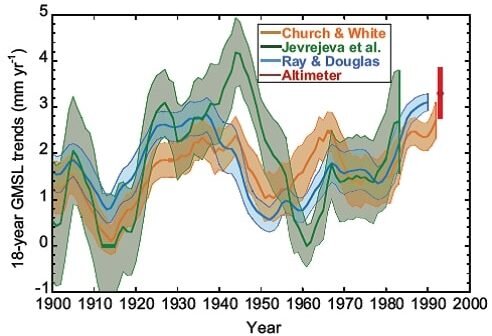
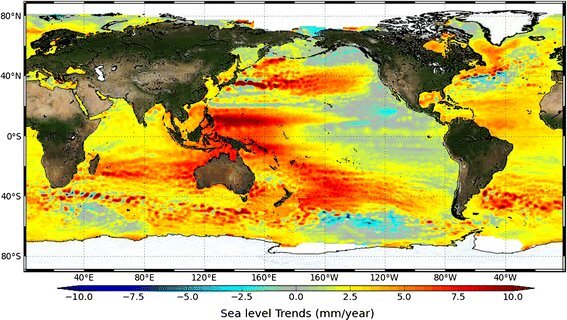
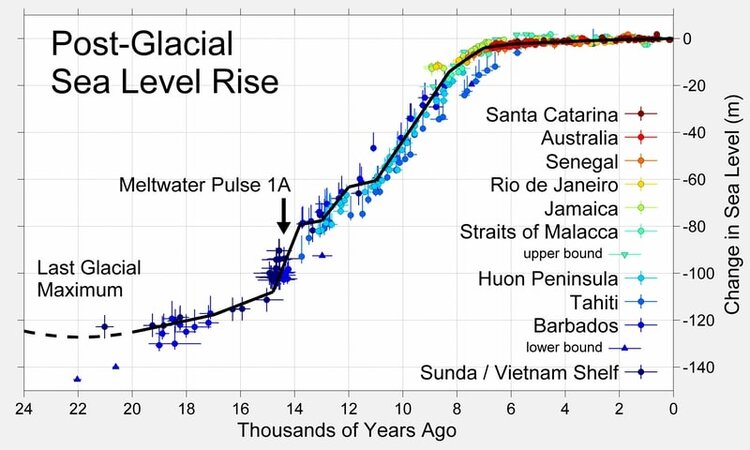
30 years of NOAA tide gauge data debunk 1988 Senate hearing climate alarmist claims

By Larry Hamlin | Watts Up With That? | March 5, 2019

NOAA has updated its coastal tide gauge measurement data through year 2018 with this update now providing 30 years of actual data since the infamous 1988 Senate hearings that launched the U.S. climate alarmist political propaganda campaign.

In June of 1988 testimony was provided before Congress by various scientists, including NASA’s Dr. James Hansen, claiming that man made greenhouse gas emissions were responsible for increasing global temperatures with the New York Times reporting, “Global Warming Has Begun, Experts Tells Senate”.

The Times article noted that “The rise in global temperature is predicted to cause a thermal expansion of the oceans and to melt glaciers and polar ice, thus causing sea levels to rise by one to four feet by the middle of the next century. Scientists have already detected a slight rise in sea levels.”

NOAA has updated its extensive U.S. coastal tide gauge data measurement records to include data through year 2018. These measurements include tide gauge data coastal locations for 25 West Coast, Gulf Coast and East Coast states along the Pacific Ocean, Gulf of Mexico and Atlantic Ocean. In addition 7 Pacific island groups and 6 Atlantic island groups also have coastal location tide gauge data measurements updated as well.

In all more than 200 coastal locations are included in these measurements with more than 100 of these coastal locations with recorded data periods in excess of 50 years in duration. None of these updated NOAA tide gauge measurement data records show coastal location sea level rise acceleration occurring anywhere on the U.S. coasts or Pacific or Atlantic island groups.

Three decades after the politically driven speculation and conjecture offered at these 1988 Senate hearings NOAA tide gauge data fails to confirm or otherwise support these alarmist claims.

The latest updated NOAA coastal tide gauge measurement data shows locations likely to experience only inches of sea level rise by mid century (not one to four feet as climate alarmists speculated to Congress in 1998) with that increase consistent with long standing and unchanging rates of sea level rise measured at these coastal locations.

The longest NOAA tide gauge data record is at the Battery, New York with a 162 year long measurement period. This location along with all other NOAA U.S. coastal locations show no sea level rise acceleration occurring over the past 30 years despite scientifically flawed assertions otherwise by climate alarmists.

Dr. Judith Curry recently conducted an interview presented here at WUWT where she addressed the political drivers behind the climate alarmism campaign which distinguish it from being a genuine scientific endeavor. She offered the following comments:

“Sea level is rising, but this has been gradually happening since the 1860s; we don’t yet observe any significant acceleration of this process in our time.” Here again, one must consider the possibility that the causes for rising sea levels are partly or mostly natural, which isn’t surprising, says Curry, for “climate change is a complex and poorly understood phenomenon, with so many processes involved.”

“Climatology is becoming an increasingly dubious science, serving a political project,” she complains. In other words, “the policy cart is leading the scientific horse”

NOAA’s coastal tide gauge measurement data are systematically ignored by climate alarmist propaganda campaign activists and media. That action represents a clear condemnation of any scientific validity regarding their efforts.

March 6, 2019 Posted by | Science and Pseudo-Science, Timeless or most popular | | Leave a comment

The Truth About Greenhouse Gases

The dubious science of the climate crusaders

By William Happer | First Things | June 2011

Excerpt:

… The message is clear that several factors must influence the earth’s temperature, and that while CO2 is one of these factors, it is seldom the dominant one. The other factors are not well understood. Plausible candidates are spontaneous variations of the complicated fluid flow patterns in the oceans and atmosphere of the earth—perhaps influenced by continental drift, volcanoes, variations of the earth’s orbital parameters (ellipticity, spin-axis orientation, etc.), asteroid and comet impacts, variations in the sun’s output (not only the visible radiation but the amount of ultraviolet light, and the solar wind with its magnetic field), variations in cosmic rays leading to variations in cloud cover, and other causes.

Let me summarize how the key issues appear to me, a working scientist with a better background than most in the physics of climate. CO2 really is a greenhouse gas and other things being equal, adding the gas to the atmosphere by burning coal, oil, and natural gas will modestly increase the surface temperature of the earth. Other things being equal, doubling the CO2 concentration, from our current 390 ppm to 780 ppm will directly cause about 1 degree Celsius in warming. At the current rate of CO2 increase in the atmosphere—about 2 ppm per year—it would take about 195 years to achieve this doubling. The combination of a slightly warmer earth and more CO2 will greatly increase the production of food, wood, fiber, and other products by green plants, so the increase will be good for the planet, and will easily outweigh any negative effects. Supposed calamities like the accelerated rise of sea level, ocean acidification, more extreme climate, tropical diseases near the poles, and so on are greatly exaggerated.

’Mitigation’ and control efforts that have been proposed will enrich a favored few with good political ties—at the expense of the great majority of mankind, including especially the poor and the citizens of developing nations. These efforts will make almost no change in earth’s temperature. Spain’s recent experiment with green energy destroyed several pre-existing jobs for every green job it created, and it nearly brought the country to bankruptcy.

“The frightening warnings that alarmists offer about the effects of doubling CO2 are based on computer models that assume that the direct warming effect of CO2 is multiplied by a large “feedback factor” from CO2-induced changes in water vapor and clouds, which supposedly contribute much more to the greenhouse warming of the earth than CO2. But there is observational evidence that the feedback factor is small and may even be negative. The models are not in good agreement with observations—even if they appear to fit the temperature rise over the last 150 years very well.

Indeed, the computer programs that produce climate change models have been “tuned” to get the desired answer. The values of various parameters like clouds and the concentrations of anthropogenic aerosols are adjusted to get the best fit to observations. And—perhaps partly because of that—they have been unsuccessful in predicting future climate, even over periods as short as fifteen years. In fact, the real values of most parameters, and the physics of how they affect the earth’s climate, are in most cases only roughly known, too roughly to supply accurate enough data for computer predictions. In my judgment, and in that of many other scientists familiar with the issues, the main problem with models has been their treatment of clouds, changes of which probably have a much bigger effect on the temperature of the earth than changing levels of CO2.

What, besides the bias toward a particular result, is wrong with the science? Scientific progress proceeds by the interplay of theory and observation. Theory explains observations and makes predictions about what will be observed in the future. Observations anchor our understanding and weed out the theories that don’t work. This has been the scientific method for more than three hundred years. Recently, the advent of the computer has made possible another branch of inquiry: computer simulation models. Properly used, computer models can enhance and speed up scientific progress. But they are not meant to replace theory and observation and to serve as an authority of their own. We know they fail in economics. All of the proposed controls that would have such a significant impact on the world’s economic future are based on computer models that are so complex and chaotic that many runs are needed before we can get an “average” answer. Yet the models have failed the simple scientific test of prediction. We don’t even have a theory for how accurate the models should be. …

Full article

March 4, 2019 Posted by | Science and Pseudo-Science, Timeless or most popular | Leave a comment

Another climate panic collapses: Recent harsh winters have killed off invasive pine beetles thought to be linked to global warming

By Dr. Roger Roots, Lysander Spooner University | February 27, 2019

A decade ago, folks in northern states such as Minnesota, South and North Dakota, Montana, Wyoming and Idaho were watching large swaths of their pine forests die off due to invasive pine beetles. The pine beetles bored beneath the bark of pine trees and introduced a fungus and larvae which weakened and then killed the trees.

Millions of pine trees were killed, prompting environmentalists and state and federal government agencies to link the invasive beetles to catastrophic-manmade-global-warming-by-carbon dioxide. Science Magazine warned that “Climate Change Sends Beetles Into Overdrive” (Mar. 16, 2012). The U.S. Forest Service launched numerous web pages under a “Bark Beetles and Climate Change in the United States” designation.

State and federal agencies collected and spent millions of dollars to mitigate the effects of the beetles. Several states amassed funds in designated ‘beetle epidemic’ accounts.

But colder weather accomplished what the agencies could not. Five years of harsh winters have mostly killed off the beetles in the north woods. Most foresters declared the end of the beetle epidemic around 2017. Almost no one seemed to link the END of the epidemic to earlier claims regarding a link to the CO2 apocalypse.

Now the State of South Dakota has $700,000 remaining in a ‘pine beetle fund’ which was never used. Last week the South Dakota legislature debated about what to do with the excess money. The debate was the topic of Tuesday’s top front page in the Rapid City Journal.

February 27, 2019 Posted by | Science and Pseudo-Science, Timeless or most popular | | Leave a comment

The Crisis of Science

The Corbett Report • 02/23/2019

In recent years, the public has gradually discovered that there is a crisis in science. But what is the problem? And how bad is it, really? Today on The Corbett Report we shine a spotlight on the series of interrelated crises that are exposing the way institutional science is practiced today, and what it means for an increasingly science-dependent society.

Watch this video on BitChute / DTube / YouTube or Download the mp4

For those with limited bandwidth, CLICK HERE to download a smaller, lower file size version of this episode.

For those interested in audio quality, CLICK HERE for the highest-quality version of this episode (WARNING: very large download).

TRANSCRIPT

In 2015 a study from the Institute of Diet and Health with some surprising results launched a slew of click bait articles with explosive headlines:

“Chocolate accelerates weight loss” insisted one such headline.

“Scientists say eating chocolate can help you lose weight” declared another.

“Lose 10% More Weight By Eating A Chocolate Bar Every Day… No Joke!” promised yet another.

There was just one problem: This was a joke.

The head researcher of the study, “Johannes Bohannon,” took to io9 in May of that year to reveal that his name was actually John Bohannon, the “Institute of Diet and Health” was in fact nothing more than a website, and the study showing the magical weight loss effects of chocolate consumption was bogus. The hoax was the brainchild of a German television reporter who wanted to “demonstrate just how easy it is to turn bad science into the big headlines behind diet fads.”

Given how widely the study’s surprising conclusion was publicized—from the pages of Bild, Europe’s largest daily newspaper to the TV sets of viewers in Texas and Australia—that demonstration was remarkably successful. But although it’s tempting to write this story off as a demonstration about gullible journalists and the scientific illiteracy of the press, the hoax serves as a window into a much larger, much more troubling story.

That story is The Crisis of Science.

This is The Corbett Report.

What makes the chocolate weight loss study so revealing isn’t that it was completely fake; it’s that in an important sense it wasn’t fake. Bohannes really did conduct a weight loss study and the data really does support the conclusion that subjects who ate chocolate on a low-carb diet lose weight faster than those on a non-chocolate diet. In fact, the chocolate dieters even had better cholesterol readings. The trick was all in how the data was interpreted and reported.

As Bohannes explained in his post-hoax confession:

“Here’s a dirty little science secret: If you measure a large number of things about a small number of people, you are almost guaranteed to get a ‘statistically significant’ result. Our study included 18 different measurements—weight, cholesterol, sodium, blood protein levels, sleep quality, well-being, etc.—from 15 people. (One subject was dropped.) That study design is a recipe for false positives.”

You see, finding a “statistically significant result” sounds impressive and helps scientists to get their paper published in high-impact journals, but “statistical significance” is in fact easy to fake. If, like Bohannes, you use a small sample size and measure for 18 different variables, it’s almost impossible not to find some “statistically significant” result. Scientists know this, and the process of sifting through data to find “statistically significant” (but ultimately meaningless) results is so common that it has its own name: “p-hacking” or “data dredging.”

But p-hacking only scrapes the surface of the problem. From confounding factors to normalcy bias to publication pressures to outright fraud, the once-pristine image of science and scientists as an impartial font of knowledge about the world has been seriously undermined over the past decade.

Although these types of problems are by no means new, they came into vogue when John Ioannidis, a physician, researcher and writer at the Stanford Prevention Research Center, rocked the scientific community with his landmark paper “Why Most Published Research Findings Are False.” The 2005 paper addresses head on the concern that “most current published research findings are false,” asserting that “for many current scientific fields, claimed research findings may often be simply accurate measures of the prevailing bias.” The paper has achieved iconic status, becoming the most downloaded paper in the Public Library of Science and launching a conversation about false results, fake data, bias, manipulation and fraud in science that continues to this day.

JOHN IOANNIDIS: This is a paper that is practically presenting a mathematical modeling of what are the chances that a research finding that is published in the literature would be true. And it uses different parameters, different aspects, in terms of: What we know before; how likely it is for something to be true in a field; how much bias are maybe in the field; what kind of results we get; and what are the statistics that are presented for the specific result.

I have been humbled that this work has drawn so much attention and people from very different scientific fields—ranging not just bio-medicine, but also psychological science, social science, even astrophysics and the other more remote disciplines—have been attracted to what that paper was trying to do.

SOURCE: John Ioannidis on Moving Toward Truth in Scientific Research

Since Ioannidis’ paper took off, the “crisis of science” has become a mainstream concern, generating headlines in the mainstream press like The Washington Post, The Economist and The Times Higher Education Supplement. It has even been picked up by mainstream science publications like Scientific American, Nature and phys.org.

So what is the problem? And how bad is it, really? And what does it mean for an increasingly tech-dependent society that something is rotten in the state of science?

To get a handle on the scope of this dilemma, we have to realize that the “crisis” of science isn’t a crisis at all, but a series of interrelated crises that get to the heart of the way institutional science is practiced today.

First, there is the Replication Crisis.

This is the canary in the coalmine of the scientific crisis in general because it tells us that a surprising percentage of scientific studies, even ones published in top-tier academic journals that are often thought of as the gold standard for experimental research, cannot be reliably reproduced. This is a symptom of a larger crisis because reproducibility is considered to be a bedrock of the scientific process.

In a nutshell, an experiment is reproducible if independent researchers can run the same experiment and get the same results at a later date. It doesn’t take a rocket scientist to understand why this is important. If an experiment is truly revealing some fundamental truth about the world then that experiment should yield the same results under the same conditions anywhere and at any time (all other things being equal).

Well, not all things are equal.

In the opening years of this decade, the Center for Open Science led a team of 240 volunteer researchers in a quest to reproduce the results of 100 psychological experiments. These experiments had all been published in three of the most prestigious psychology journals. The results of this attempt to replicate these experiments, published in 2015 in a paper on “Estimating the Reproducibility of Psychological Science,” were abysmal. Only 39 of the experimental results could be reproduced.

Worse yet for those who would defend institutional science from its critics, these results are not confined to the realm of psychology. In 2011, Nature published a paper showing that researchers were only able to reproduce between 20 and 25 per cent of 67 published preclinical drug studies. They published another paper the next year with an even worse result: researchers could only reproduce six of a total of 53 “landmark” cancer studies. That’s a reproducibility rate of 11%.

These studies alone are persuasive, but the cherry on top came in May 2016 when Nature published the results of a survey of over 1,500 scientists finding fully 70% of them had tried and failed to reproduce published experimental results at some point. The poll covered researchers from a range of disciplines, from physicists and chemists to earth and environmental scientists to medical researchers and assorted others.

So why is there such a widespread inability to reproduce experimental results? There are a number of reasons, each of which give us another window into the greater crisis of science.

The simplest answer is the one that most fundamentally shakes the widespread belief that scientists are disinterested truthseekers who would never dream of publishing a false result or deliberately mislead others.

JAMES EVAN PILATO: Survey sheds light on the ‘crisis’ rocking research.

More than 70% of researchers have tried and failed to reproduce another scientist’s experiments, and more than half have failed to reproduce their own experiments. Those are some of the telling figures that emerged from Nature’s survey of 1,576 researchers who took a brief online questionnaire on reproducibility in research.

The data reveal sometimes-contradictory attitudes towards reproducibility. Although 52% of those surveyed agree that there is a significant ‘crisis’ of reproducibility, less than 31% think that failure to reproduce published results means that the result is probably wrong, and most say that they still trust the published literature.

Data on how much of the scientific literature is reproducible are rare and generally bleak. The best-known analyses, from psychology1 and cancer biology2, found rates of around 40% and 10%, respectively.

So the headline of this article, James, that we grabbed from our buddy Doug at BlackListed News: “40 percent of scientists admit that fraud is always or often a factor that contributes to irreproducible research.”

SOURCE: Scientists Say Fraud Causing Crisis of Science – #NewWorldNextWeek

In fact, the data shows that the Crisis of Fraud in scientific circles is even worse than scientists will admit. A study published in 2012 found that fraud or suspected fraud was responsible for 43% of scientific paper retractions, by far the single leading cause of retraction. The study demonstrated a 1000% increase in (reported) scientific fraud since 1975. Together with “duplicate publication” and “plagiarism,” misconduct of one form or another accounted for two-thirds of all retractions.

So much for scientists as disinterested truth-tellers.

Indeed, instances of scientific fraud are cropping up more and more in the headlines these days.

Last year, Kohei Yamamizu of the Center for iPS Cell Research and Application was found to have completely fabricated the data for his 2017 paper in the journal Stem Cell Reports, and earlier this year it was found that Yamamizu’s data fabrication was more extensive than previously thought, with a paper from 2012 also being retracted due to doubtful data.

Another Japanese researcher, Haruko Obokata, was found to have manipulated images to get her landmark study on stem cell creation published in Nature. The study was retracted and one of Obokata’s co-authors committed suicide when the fraud was discovered.

Similar stories of fraud behind retracted stem cell papers, molecular-scale transistor breakthroughs, psychological studies and a host of other research calls into question the very foundations of the modern system of peer-reviewed, reproducible science, which is supposed to mitigate fraudulent activity by carefully checking and, where appropriate, repeating important research.

There are a number of reasons why fraud and misconduct is on the rise, and these relate to more structural problems that unveil yet more crises in science.

Like the Crisis of Publication.

We’ve all heard of “publish or perish” by now. It means that only researchers who have a steady flow of published papers to their name are considered for the plush positions in modern-day academia.

This pressure isn’t some abstract or unstated force; it is direct and explicit. Until recently the medical department at London’s Imperial College told researchers that their target was to “publish three papers per annum including one in a prestigious journal with an impact factor of at least five.” Similar guidelines and quotas are enacted in departments throughout academia.

And so, like any quota-based system, people will find a way to cheat their way to the goal. Some attach their names to work they have little to do with. Others publish in pay-to-play journals that will publish anything for a small fee. And others simply fudge their data until they get a result that will grab headlines and earn a spot in a high-profile journal.

It’s easy to see how fraudulent or irreproducible data results from this pressure. The pressure to publish in turn puts pressure on researchers to produce data that will be “new” and “unexpected.” A study finding that drinking 5 cups of coffee a day increases your chance of urinary tract cancer (or decreases your chance of stroke) is infinitely more interesting (and thus publishable) than a study finding mixed results, or no discernible effect. So studies finding a surprising result (or ones that can be manipulated into showing surprising results) will be published and those with negative results will not. This makes it much harder for future scientists to get an accurate assessment of the state of research in any given field, since untold numbers of experiments with negative results never get published, and thus never see the light of day.

But the pressure to publish in high-impact, peer-reviewed journals itself raises the specter of another crisis: The Crisis of Peer Review.

The peer review process is designed as a check against fraud, sloppy research and other problems that arise when journal editors are determining whether to publish a paper. In theory, the editor of the journal passes the paper to another researcher in the same field who can then check that the research is factual, relevant, novel and sufficient for publication.

In practice, the process is never quite so straightforward.

The peer review system is in fact rife with abuse, but few cases are as flagrant as that of Hyung-In Moon. Moon was a medicinal-plant researcher at Dongguk University in Gyeongju, South Korea, who aroused suspicions by the ease with which his papers were reviewed. Most researchers are too busy to review other papers at all, but the editor of The Journal of Enzyme Inhibition and Medicinal Chemistry noticed that the reviewers for Moon’s papers were not only always available, but that they usually submitted their review notes within 24 hours. When confronted by the editor about this suspiciously quick work, Moon admitted that he had written most of the reviews himself. He had simply gamed the system, where most journals ask researchers to submit names of potential reviewers for their papers, by creating fake names and email addresses and then submitting “reviews” of his own work.

Beyond the incentivization of fraud and opportunities for gaming the system, however, the peer review process has other, more structural problems. In certain specialized fields there are only a handful of scientists qualified to review new research in the discipline, meaning that this clique effectively forms a team of gatekeepers over an entire branch of science. They often know each other personally, meaning any new research they conduct is certain to be reviewed by one of their close associates (or their direct rivals). This “pal review” system also helps to solidify dogma in echo chambers where the same few people who go to the same conferences and pursue research along the same lines can prevent outsiders with novel approaches from entering the field of study.

In the most egregious cases, as with researchers in the orbit of the Climate Research Unit at the University of East Anglia, groups of scientists have been caught conspiring to oust an editor from a journal that published papers that challenged their own research and even conspiring to “redefine what the peer-review literature is” in order to stop rival researchers from being published at all.

So, in short: Yes, there is a Replication Crisis in science. And yes, it is caused by a Crisis of Fraud. And yes, the fraud is motivated by a Crisis of Publication. And yes, those crises are further compounded by a Crisis of Peer Review.

But what creates this environment in the first place? What is the driving factor that keeps this whole system going in the face of all these crises? The answer isn’t difficult to understand. It’s the same thing that puts pressure on every other aspect of the economy: funding.

Modern laboratories investigating cutting edge questions involve expensive technology and large teams of researchers. The types of labs producing truly breakthrough results in today’s environment are the ones that are well funded. And there are only two ways for scientists to get big grants in our current system: big business or big government. So it should be no surprise that “scientific” results, so suspectible to the biases, frauds and manipulations that constitute the crises of science, are up for sale by scientists who are willing to provide dodgy data for dirty dollars to large corporations and politically-motivated government agencies.

RFK JR.: “Simpsonwood” was the transcripts of a secret meeting that was held between CDC and 75 representatives of the vaccine industry in which they reviewed a report that CDC had ordered—the Verstraeten study—of a hundred thousand children in the United States vaccine safety database. And when they looked at it themselves, they said, quote: “It is impossible to massage this data to make the signal go away. There is no denying that there is a connection between autism and thimerosal in the vaccines.” And this is what they said. I didn’t say this. This is what their own scientists [said] and their own conclusion of the best doctors, the top people at CDC, the top people at the pharmaceutical injury industry.

And you know, when they had this meeting they had it not in Atlanta—which was the headquarters of the CDC—but in Simpsonwood at a private conference center, because they believed that that would make them able to insulate themselves from a court request under the Freedom of Information Law and they would not have to disclose the transcripts of these meetings to the public. Somebody transcribed the meetings and we were able to get a hold of it. You have them talking about the Verstraeten study and saying there’s a clear link, not just with autism but with the whole range of neurological disorders—speech delay, language delay, all kinds of learning disorders, ADD, hyperactivity disorder—and the injection of these vaccines.

[. . .]and at the end of that meeting they make a few decisions. One is Verstraeten, the man who designed who conducted the study, is hired the next day by GlaxoSmithKline and shipped off to switzerland, and six months later he sends in a redesigned study that includes cohorts who are too young to have been diagnosed as autistic. So he loads the study down, the data down, and they tell the public that they’ve lost all the original data. This is what CDC says till this day: That it does not know what happened to the original data in the Verstraeten study. And they published this other study that is a corrupt and crooked—what we call tobacco science done by a bunch of bio-stitutes, crooked scientists who are trying to fool the American public.

Then Kathleen Stratton from CDC and IOM says “What we need is we need some studies that will disprove the
link.” So they work with the vaccine industry to gin up these four phony European studies that are done by vaccine industry employees, funded by the vaccine industry and published in the American Academy of Pediatrics magazine, which receives 80% of its revenue from the vaccine industry. And none of these scientists disclose any of their myriad conflicts which conventional ethics rules require them to do. It’s not disclosed.

SOURCE: RFK JR. Vaccine Cover Up SIMPSONWOOD MEMO

TOM CLARKE: 64,000 people dead. Tens of thousands hospitalized. A country crippled by a virus.

The predictions of the impact of swine flu on Britain were grim. The government’s response: Spending hundreds of millions of pounds on antiviral drugs and vaccines adverts and leaflets. But ten months into the pandemic, only 355 Britons have died and globally the virus hasn’t lived up to our fears.

Were government’s misled into preparing for the worst? Politicians in Brussels are now asking for an investigation into the role pharmaceutical companies played in influencing political decisions that led to a swine flu spending spree.

WOLFGANG WODARG: There must be a process to to get more transparency [about] how the decisions in the WHO function and who is influencing the decisions of the WHO and what is the role of pharmaceutical industry there. I’m very suspicious about the processes which are behind this pandemic.

TOM CLARKE: The Council of Europe Committee want the investigation to focus on the World Health Organization’s decision to lower the threshold required for a pandemic to be formally declared.

MARGARET CHAN: The world is now at the start of the 2009 influenza pandemic.

REPORTER: When this happened in June last year, government’s had to activate huge, pre-prepared contracts for drugs and vaccines with manufacturers. They also want to probe ties between key WHO advisors and drug companies.

PAUL FLYNN: Who is deciding what the risk is? Is it the pharmaceutical companies who want to sell drugs, or is it someone making a decision based on the perceived danger? In this case it appears that the danger was vastly exaggerated. And was it exaggerated by the pharmaceutical companies in order to make money?

SOURCE: Channel 4 News Exposes Swine Flu Scandal

JAMES CORBETT: And a perfect example of that came out just in the past month where it was discovered, revealed—”Oh my God! Who would have thought it?”—people who consume artificial sweeteners like aspartame are three times more likely to suffer from a common form of stroke than others. Who would have thought it (except everyone who’s been worming warning about aspartame for decades and decades)?

And if you want to know more about aspartame and how it got approved in the first place you can go back and listen to my earlier podcast on “Meet Donald Rumsfeld” where we talked about his role in getting aspartame approved for human consumption in the first place. But yes, now decades later they come out with a study that shows “Well guys, we had no idea, but guess what? It does apparently cause strokes!”

And this is particularly galling, I suppose, because if you go back even a couple of years ago the paper of record, the “Old Gray Lady,” the New York Times (and every other publication, to be fair) that ever tried to address this would always talk about sweeteners as being better than sugar for you. And they would point to a handful of studies. The same studies every time, including—I mean, just as one example this 2007 study which was a peer review study [that went] through various different studies that had been published, and this was done by a “panel of experts” as it was said at the time. And it was cited in all of these different reports by the New York Times and others as showing that aspartame was even safer than sugar and blah blah blah. And when you actually looked at the study itself you found that—lo and behold!—the “panel of experts” was put together by something called “the burdock group” which was a consulting firm that worked for the food industry amongst others and was in that particular instance hired by ajinomoto, who people might know as a producer of aspartame.

So, yes, you have the aspartame manufacturers hiring consultants to put together panels of scientific scientific experts that then come out with the conclusion that, “Yes! Aspartame is sweet as honey and good for you like breathing oxygen. It’s just so wonderful! Oh, it’s like manna from heaven!” And lo and behold they were lying. Who would have thought it? Who would have imagined that the scientific process could be so thoroughly corrupted?

SOURCE: The Weaponization of “Science”

Sadly, there is no lack of examples of how commercial interests have skewed research in a range of disciplines.

In some cases, inconvenient data is simply hidden from the public. This was what happened with “Project 259,” a feeding experiment in which lab rats were separated into two groups: One was given a high-sugar diet and the other was given a so-called “basic PRM diet” of cereal meals, soybean meals, whitefish meal, and dried yeast. The results were astounding. Not only did the study provide the first experimental evidence that sugar and starch are actually metabolized differently, but it also found that “sucrose [. . .] may have a role in the pathogenesis of bladder cancer.” But Project 259 was being funded by something called the “Sugar Research Foundation,” which has organizational ties to the trade association of the US sugar industry. As a result, the study was shelved, the results were kept from the public and it took 51 years for the experiment to be dug up by researchers and published.  But this was too late for the generation of victims that The Sugar Conspiracy created, raised on a low-fat, high sugar diet that is now known to be toxic.

In other cases, industry secretly sponsors and even covertly promotes questionable research that bolsters claims to their product’s safety. This is the case of Johnson & Johnson, which was facing a potential scandal over revelations that its baby powder contained asbestos.  They hired an Italian physician to conduct a study on the health of talc miners in the Italian Alps, and even told him what the study should find: data that “would show that the incidence of cancer in these subjects is no different from that of the Italian population or the rural control group.” When the physician came back with the data as instructed, J&J were unhappy with the form and style of the study’s write up, so they handed it to a scientific ghostwriter to prepare it for publication.  The ghostwritten paper was then published in the Journal of Occupational and Environmental Medicine, and the research was cited by a review article in the British Journal of Industrial Medicine later that year, which concluded that there is no evidence suggesting that the “normal use” of cosmetic talc poses a health hazard. That review article was written by Gavin Hildick-Smith, the Johnson & Johnson physician executive who had commissioned the Italian study, dictated its findings and sent it out for ghostwriting. Dr. Hildick-Smith failed to disclose this conflict in his review article, however.

The list of such egregious abuses of “scientific” institutions and processes is seemingly endless, with more stories surfacing on a weekly basis. Websites like Retraction Watch attempt to document fraud and misconduct in science as it is revealed, but stories about the corporate hand behind key research studies or conspiracies to cover up inconvenient research are reported in a haphazard fashion and generally receive little traction with the public.

But these are not new issues. There have been those warning us about the dangerous confluence of money, government power and science since the birth of the modern era.

DWIGHT D. EISENHOWER: Today, the solitary inventor, tinkering in his shop, has been overshadowed by task forces of scientists in laboratories and testing fields. In the same fashion, the free university, historically the fountainhead of free ideas and scientific discovery, has experienced a revolution in the conduct of research. Partly because of the huge costs involved, a government contract becomes virtually a substitute for intellectual curiosity. For every old blackboard there are now hundreds of new electronic computers.

The prospect of domination of the nation’s scholars by Federal employment, project allocations, and the power of money is ever present – and is gravely to be regarded.

Yet, in holding scientific research and discovery in respect, as we should, we must also be alert to the equal and opposite danger that public policy could itself become the captive of a scientific-technological elite.

SOURCE: Eisenhower Farewell Address

In his prescient warning, Eisenhower not only gave a name to the “military-industrial complex” that has been working to steer American foreign policy since the end of the second World War, but he also warned how the government can shape the course of scientific research with its funding. Is it any wonder, then, that military contractors like Raytheon, Lockheed Martin and Northrop Grumman are among the leading funders in cutting edge research in nanotechnology, quantum computing, “human systems optimization” and other important scientific endeavors? Or that the Pentagon’s own Defense Advanced Research Projects Agency provides billions of dollars per year to help find military applications for breakthroughs in computer science, molecular biology, robotics and other high-cost scientific research?

And what does this mean for researchers who are looking to innovate in areas that do not have military or commercial use?

Yes, there is not just one crisis of science, but multiple crises. And, like many other crises, they find a common root in the pressures that come from funding large-scale, capital-intensive, industrial research.

But this is not simply a problem of money, and it will not be solved by money. There are deeper social, political and structural roots of this crisis that will need to be addressed before we understand how to truly mitigate these problems and harness the transformative power of scientific research to improve our lives. In the next edition of The Corbett Report, we will examine and dissect the various proposals for solving the crisis of science.

Solving this crisis—these crises—is important. The scientific method is valuable. We should not throw out the baby of scientific knowledge with the bathwater of scientific  corruption. But we need to stop treating science as a magic 8-ball that can solve all of our societal and political problems. And we need to stop venerating scientists as a quasi-priest class whose dictates are beyond question by the unwashed masses.

After all, when an Ipsos MORI poll found that nine out of ten British people would trust scientists to “follow the rules,” even Nature‘s editorial board was compelled to ask: “How many scientists would say the same?”

February 22, 2019 Posted by | Corruption, Deception, Science and Pseudo-Science, Timeless or most popular, Video | , | Leave a comment