Is Vaccine Safety Too Dangerous for Us to Discuss?
By Bretigne Shaffer | Lew Rockwell | September 3, 2019
Recently, the news and opinion site HuffPost removed an article that had been up for more than six years. The piece, titled “Government Concedes Vaccine-Autism Case in Federal Court – Now What?” was published in January of 2013, and dealt with a case in which the US government’s Court of Federal Claims conceded that routine vaccination had aggravated a child’s underlying condition and led to that child developing “features of autism spectrum disorder.”
Now, the following statement appears in place of that article:
A previous blog post published on this site has been removed in the interest of public health. The article expressed the sole opinion of its author, who retains the rights to publish it elsewhere. Multiple studies have demonstrated that vaccines are safe and effective. Our letter from the editor has more on this decision.
This retraction did not occur in a vacuum. The first half of 2019 has seen a coordinated effort to scrub the Internet of any information that is critical of the claim that “vaccines are safe and effective.” The push began last fall, but gained momentum in January when the World Health Organization declared “vaccine hesitancy” to be a “global health threat,” placing it alongside Ebola, cancer, war zones, and drug-resistant pathogens.
On March 1st, US Congressman Adam Schiff wrote to Amazon CEO Jeff Bezos and, after stating that “there is no evidence to suggest that vaccines cause life-threatening or disabling diseases,” expressed his concern that Amazon might be allowing content with “medically inaccurate information.” He asked what action Amazon was taking to address “misinformation about vaccines.”
Later that day, Amazon pulled from its streaming service the documentary “Vaxxed: From Cover-Up to Catastrophe,” along with other “anti-vaccine” documentaries including “Man Made Epidemic“ and “The Greater Good,” a film that “…weaves together the stories of families whose lives have been forever changed by vaccination.”
Schiff had written similar letters to Facebook CEO Mark Zuckerberg, and Google CEO Sundar Pichai. Not long after Amazon pulled the documentaries from its streaming service, other platforms began to follow suit. On March 7, Facebook announced that it would reduce the visibility of groups and pages that “spread misinformation about vaccinations,” and would no longer accept advertisements containing what it deemed to be “misinformation” about vaccines.
Back in August of 2018, Pinterest had already begun removing content (later accounts, and then search results) that it said contained “medical misinformation,” and in February, YouTube demonetized all videos that “promoted anti-vaccination content.” Etsy, Vimeo, MailChimp, and GoFundMe have all joined these other platforms in pledging to either prohibit or demote content deemed to contain “misinformation” about vaccines.
“MISINFORMATION”
So what is the “misinformation” that the WHO, Congressman Schiff, and these social-media giants are so determined to remove from public view? Let’s start with the article mentioned above that was pulled from HuffPost :
The piece—which you can now read here—deals with the case of Hannah Poling, whose family was awarded more than $1.5 million by the US Court of Federal Claims after it acknowledged that her “regressive encephalopathy with features of autism spectrum disorder…” was the result of vaccinations she received at 18 months that aggravated an underlying mitochondrial condition. The article is a fairly straightforward accounting of the case, followed by questions it raises about such issues as research, public health, and the vaccine-autism debate.
HuffPost’s letter from the editor, explaining its reasoning for removing articles like this one, states:
HuffPost has decided to remove dozens of blogs that perpetuate the unfounded opinion that vaccines pose a health risk to the public. Allowing these blogs to remain on our platform does a disservice to our readers that outweighs any ostensible value as part of the public record.
HuffPost’s editors also chose to remove the Federal Claims Court document itself, which had been posted separately. Where that document was once found, there is now the same statement that replaced the above article, along with the assertion that it “… expressed the sole opinion of its author.”
But that is complete nonsense. There is no “author” of this piece (other than for the very brief introduction to the document), and it does not represent anyone’s “opinion.” It is an official record of a concession made by the Secretary of Health and Human Services, submitted to a Federal court. It is indeed a part of the public record—a part that HuffPost’s editorial team doesn’t believe its readers should be able to see.
Other “misinformation” that has been removed from major platforms include this fully referenced article by Anne Mason, on the scare tactics being used to incite fear of measles, taken down by Medium in February, and the Pinterest accounts of both GreenMedInfo and the National Vaccine Information Center, both of which provide well-referenced information on vaccine safety and efficacy.
In June, the email marketing service provider MailChimp announced that it would prohibit “anti-vaccination content.” However, even before announcing this policy change, it had already removed several accounts without warning, according to their owners. Some of these included organizations simply opposed to vaccine mandates, such as Health Choice Vermont, and Colorado Health Choice Alliance, both of which had their accounts closed suddenly in June.
And in May, GoFundMe took down the fundraising campaign for Dr. Kenneth Stoller. Dr. Stoller had been raising money for his legal defense fund after having been served with a subpoena to turn over patient health records by the San Francisco City Attorney as part of a public nuisance investigation regarding his writing of medical exemptions to vaccines.
As these last two examples reveal, this effort aims to suppress not only voices that question the official line on vaccines, but also those that are opposed simply to mandated vaccines, as well as a doctor raising money to defend himself from the threat of state action against himself and his patients.
AND MISINFORMATION
Given the deep concern felt by these media giants for accuracy in coverage of the controversy over vaccines, it is surprising to find that so much misinformation on the topic remains in place on their platforms.
Contrary to the oft-repeated mantra in the mainstream press, the science about vaccines is far from “settled.” There is much that is a fair topic for debate, and there is much research that simply has not been done. There are, however, some easily refuted falsehoods, several of which feature prominently in nearly every story on vaccines that appears in a major media outlet.
Here are a few samples:
- “Vaccines are safe and effective.”
How “safe”? How “effective”? Nothing is completely safe, and no medical treatment is completely effective all the time for every person. The only meaningful interpretation of “safe” in this context is that “vaccines are safer than the diseases they prevent.” But that has not been established.
To take just one example, the MMR vaccine, the Cochrane Review found, in its meta-analysis in 2012, that:
The design and reporting of safety outcomes in MMR vaccine studies, both pre- and post-marketing, are largely inadequate. The evidence of adverse events following immunisation with the MMR vaccine cannot be separated from its role in preventing the target diseases.
I have written elsewhere about the fact that there is no solid data available to tell us how many vaccinations result in serious injury or death, that vaccine injuries are badly under-reported, and that those who claim that the rate of vaccine injury is “one in a million” are referring only to severe anaphylactic shock, ignoring the multitude of other possible injuries. Without this information, there is no way to know whether the risk from vaccines (specific vaccines or all vaccines) is greater or lesser than the risks of contracting and being harmed by the diseases they are meant to prevent.
Likewise, “effective.” The fact that vaccines are not 100% effective is not even remotely controversial. And the degree of effectiveness can vary widely from one vaccine to another. The question is: Given the expected efficacy of a given vaccine, is the protection it offers worth the risk of the harm it may create. We simply do not have the information needed to make that assessment with any certainty.
- “Vaccines do not cause autism.”
No matter how many times major media outlets repeat this phrase, it has not been established that vaccines do not cause autism. Indeed, there is evidence that they can, including, but not limited to, the Federal Claims Court’s decision in the case of Hannah Poling that HuffPost is so determined that you not know about.
Those who insist that any connection between vaccines and autism has been discredited like to point to studies like this meta-analysis, or to this more recent Danish study looking at more than 600,000 children, both of which are used by defenders of vaccines to refute any association between vaccines and autism. However, a closer look reveals not only that these studies fail to do this, but that neither even addresses the question.
As with most studies purporting to refute an association with autism, those in the meta-analysis (all ten of them) look only at a single vaccine (the MMR and/or the monovalent measles vaccine) and/or specific ingredients (cumulative Hg dosage and/or thimerosal exposure), comparing those who have received it/them to those who are otherwise fully or partially vaccinated.
They are also observational studies, which means that they are subject to selection bias, including the risk of “healthy user bias,” which is especially relevant when looking at possible injury from vaccines. This is because families who have experienced a possible injury with one child might be less likely to give that vaccine to their other children. By thus excluding some of those who might be most at risk of vaccine injury, this can artificially skew the results of the vaccinated group toward better health outcomes.
As CDC researchers Dr. Paul Fine and Dr. Robert Chen wrote in their 1992 paper looking at confounding factors in studies of adverse reactions to vaccines:
… individuals predisposed to either SIDS or encephalopathy are relatively unlikely to receive DPT vaccination. Studies that do not control adequately for this form of “confounding by indication” will tend to underestimate any real risks associated with vaccination.
The Danish study by Hviid et al likewise only examines the possible impact of the MMR vaccine. It does also compare rates of autism diagnosis across sub groups, including those who have had some or all of their first-year vaccines and those who have not. However there is no true unvaccinated group (the closest being the group of those who had received no first-year vaccines—a whopping 0.7% of the total cohort). And the authors themselves acknowledge that the study suffers from the risk of healthy user bias.
Meanwhile, there are plenty of studies that do show a possible relationship between autism and vaccines. You just won’t see them splashed across the front pages of major newspapers and magazines.
Moreover, one of the world’s leading experts on vaccines, and former government witness in the National Vaccine Injury Compensation Program (NVIC)’s “vaccine court”, pediatric neurologist Dr. Andrew Zimmerman, has famously stated that:
… in a subset of children, vaccine-induced fever and immune stimulation did cause regressive brain disease with features of autism spectrum disorder.
Others, including former director of the National Institutes of Health Dr. Bernadine Healy and former CDC director Julie Gerberding, have also acknowledged that some children—particularly those with a mitochondrial disorder—can suffer damage from vaccines that leads to the symptoms associated with autism. In 2008, Gerberding told CNN’s Dr. Sanjay Gupta:
… if a child was immunized, got a fever, had other complications from the vaccines. And if you’re predisposed with the mitochondrial disorder, it can certainly set off some damage. Some of the symptoms can be symptoms that have characteristics of autism.
For the population as a whole, the bottom line is that there are no conclusive studies on either side of the autism-vaccine debate. Having media outlets endlessly repeat the claim that there are, and that the debate is “settled,” doesn’t make that claim any less false.
A DANGEROUS CONVERSATION
Let’s be absolutely clear: The position of the people who pressured Amazon, Facebook, Pinterest, GoFundMe, and other platforms to shut down content critical of vaccines is that ordinary people should not be free to discuss, debate, nor share information about, the safety of vaccines.
The question is: Why?
Those who make and promote vaccines are right to worry about a free and open conversation about the safety of their products. Their strategy to date has been to insist that “there is no debate” about vaccine safety, that “the science is settled.” And for a very long time they have gotten away with simply repeating these mantras. But the more they engage in what can only be described as Orwellian suppression of information, the more people start to wonder what they are afraid we might find out.
Once anyone starts looking closely, it becomes very clear just how mendacious both the industry and the media have been. It quickly becomes apparent that the WHO declaration is a truckload of nonsense; that vaccines have not, in fact, been proven to be “safe and effective”; that the science is not settled with regard to the vaccine-autism connection; and that the illnesses the vaccine proponents want us to be afraid of are in fact, not all that scary—certainly not as scary as a government with the power to force people to inject substances into their bodies against their will.
For those whose livelihoods are tied to an ever-increasing vaccine schedule, and ever-increasing sales of vaccines, this is a very dangerous conversation indeed.
Bretigne Shaffer [send her mail] was a journalist in Asia for many years. She is the author of Urban Yogini (A Superhero Who Can’t Use Violence) and Why Mommy Loves the State. She blogs at www.bretigne.com.
Science Goes Up In Rainforest Smoke
By Dr. David Whitehouse | August 29, 2019
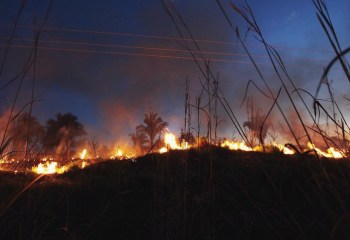 The idea that the Amazon rainforest is the lungs of the world is so embedded in our minds that few questioned its widespread use when news about fires in the Amazon was reported this summer.
The idea is everywhere—so it’s obviously true. Trees absorb carbon dioxide (bad), don’t they, and give off oxygen (good), and there are billions of trees in the Amazon, so surely it makes sense.
Responding to the fires in the Amazon the Pope has said that the “Lungs of the forest are vital for the planet.”
Emmanuel Macron tweeted, “The Amazon rainforest – the lungs which produce 20% of the planet’s oxygen – is on fire.”
Leonardo DiCaprio has almost 3 million likes for his Instagram posting saying, “The lungs of the Earth are in flames.”
Christiano Ronaldo tweeted that The Amazon Rainforest produces more than 20% of the world’s oxygen,” adding #prayforamazonia
Green Party MP Caroline Lucas says “It’s the lungs of the Earth…which provides 20% of our oxygen.”
Barry Gardiner Shadow Minister for International Climate Change tweeted he couldn’t agree with Macron more.
Lib Dem MEP’s say the lungs of our planet are literally burning.
Even Donald Tusk, the President of the European Commission tweeted about “…the destruction of the green lungs of Planet Earth.”
The Rainforest Alliance said, “The lungs of the world are in flames.”
Friends of the Earth want a deal to stop the fires adding: “They need to say ‘we won’t do a deal with you if you are effectively condoning burning the lungs of the world’.”
WWF says the Amazon is popularly known as the lungs of the world.
DiCaprio’s Earth Alliance has formed an emergency Amazon Forest Fund with an initial commitment of $5 million to focus critical resources on the key protections needed to maintain the ‘lungs of the planet.’
However, as the saying goes, it’s not that simple – things never are in science. Check where the figure comes from (and it’s actually not that straightforward to do) and you will find that it’s not that simple. It’s actually wrong.
Geology’s Gift
The Amazon rainforest is not the lungs of the world and they do not produce 20% of the world’s oxygen as is so often said.
The Amazon rainforest is a vast, vital wonder, full of biodiversity and photosynthesizing plants producing 9% of the world’s photosynthetic output but, here is the key figure, 0% of its net output.
You could destroy all of the world’s forests and it would hardly affect our oxygen supply.
In fact, you could destroy every living thing on Earth and still not dent it because our atmosphere of 20.9% oxygen is the gift of geologic time, slow to build up and we have enough to last millions of years.
Yet this idea about the world’s lungs and of atmospheric oxygen needing to be refreshed and replenished—ideas unsupported by science—is everywhere.
Surely journalists would act differently from advocacy groups, celebrities, and politicians and check this fact before writing and broadcasting about it.
After all, journalists, especially science and environment journalists who are experts in their field, always check figures and statistics? Oh no, they don’t.
Just Google the phrase to see how many time it is repeated, by the BBC, the New York Times, CNN, The Australian, to name a few.
ITN, in particular, has risen above much of the other coverage with its over-the-top reporting. They say the Amazon is burning on a scale never seen before (nonsense). That the Amazon can never be replaced (nonsense), and that Nature is being killed (Oh come off it)!
Who Spoke Up?
If journalists, as well as politicians, celebrities, presidents and the Pope, can so easily slip into such scientific myth and get the facts so wrong, what credibility do they have on other issues of climate science?
Where are their science advisors? Surely they should make this mistake only once before being given proper advice.
Or is it that if any of them goes against the trend they fear the condemnation? This is not the way to tackle the important environmental issues we face.
Look how much we had to go through for science to wrench our minds free of what is “obviously true” and seek proof. Is climate science, or at least the public side of it, immune from normal scientific standards?
And where are the high-profile “public” scientists setting the record straight, highlighting that the Amazon rainforests are not the lungs of the world?
Blowing smoke over the Amazon – a strange story
or how to flip an average into a record without changing the data

By Catte Black – OffGuardian – August 28, 2019
My original article about the media presentation of the 2019 Amazon Rain Forest burning season produced a good deal more controversy than any of us anticipated. I don’t know how many times in the past four days OffG admins and editors have had to say “no, we aren’t claiming deforestation is a good idea”, but it’s been a few.
We also received our first DDoS attack in a couple of months the day after it was published. So, even the hackers were pissed off at us.
Surprising as it may be to those who favor knee jerk spontaneity over reading and reflection, I don’t think deforestation is a non-issue.
Which is why I said so in my previous article. And why OffG has repeated it numerous times since on our Twitter feed.
But let’s expand.
And put it in emphasis.
I, along with most other non-crazy people, believe the total or almost total destruction of the Amazon rain forest in order to build mahogany end tables or provide McDonald’s with cheap beef would be a crime of unprecedented dimensions.
(Maybe someone would like to cut and paste this as an automated tweet in response to anyone else who says “oh wow dude, so if you were on the Titanic you’d be like “what, there’s no problem?”)
I just also happen to think the importance of the subject doesn’t make buying into media memes about it, or lying about the data, somehow ok.
I don’t think it justifies hysteria, or uninformed rants from people who think indignation is a legitimate substitute for research data (“look how ANGRY I am, if this doesn’t fix things, nothing will!”).
I think that is –
a) often colonialist and patronizing, assuming the issue is so simple your massive western brain can grasp it simply by semi-digesting a couple of headlines over your cornflakes (“oh my God Janice, the Amazon is burning down, send that charity the Guardian are recommending some money and pass the milk”)
b) counter-productive, if not devastatingly destructive.
I’m not sure when the notion gained currency that exaggeration, lies and distortion were somehow appropriate if the event being lied about/exaggerated was “urgent” or “serious” enough, but it’s an idea antithetical to reason and truth.
The corollary also expressed, that demanding factual accuracy about such events is equivalent to denying their importance is equally, if not more disturbing.
It’s a mindset that invites manipulation and uncritical acceptance of authoritarian-inspired panic memes
But I’ll talk more about that another time. This is a follow up to the original article from August 23. There have been some interesting developments in the last few days and I think we should note them.
Firstly, as has been observed BTL on the original article, the three sources we cited underwent quite extensive revisions very shortly after our article was published.
Science20.com is the most noteworthy of these. On August 24, the day after we published our piece, the article we cited was completely re-written, presumably by its original author, identified as Robert Walker. In fact the changes implemented are so bizarre I want to look at them in some detail.
Here’s the original version we cited, now preserved only as an archive. This is the first part of the text:
NASA Say The Amazon Is Burning At Below Average Rates – Yet Many News Stories Say Record Rates???
Short summary: we have had wild fires for many years now in the Amazon, even in the tropical rainforest – mainly started by humans for forest clearing and ranching. It is not enough to impact significantly on the Paris agreement pledges yet though it is important in the long term if this continues for decades.
This image is beign shared with captions such as “The Amazon is burning at record rates – and deforestation is to blame”. NASA’s caption is that it is burning at less than average rates. Bit of a big difference there.
It shows smoke from fires in the Amazon region on 13th August 2019. These are not necessarily all forest fires. Some of these will be fires in pasture to stimulate new growth for the cattle.
So, go to the Global Fire Emissions Database. and this is what you see:
The green line for 2019 there is a bit hard to make out, so here is a zoom in, as you can see it is way below the top line which is for 2005, with only a few data points, and is also below the 2003 line.
The BBC is misreporting it as a “record”
Big difference between (sic) “record” and “Less than average”. By “record” all they mean is that there are more than for 2018. It’s also greater than for 2017, but less than for 2016. That is not how the word “record” is normally understood. (OffG emphasis)
The ranchers use fire for forest clearing, “slash and burn agriculture” as it is called. That is because it is much easier to convert forest into grassland by burning it than to do it by felling the trees. Once it is cut, the way they manage the pastures is to re-burn them every few years to clear out the brush and to get the grass to re-sprout.
So not all the fires you see are virgin forest. Many are controlled grassland fires, to get the grass to re-sprout. We do something similar in the UK where they do controlled burning of heather (muir burn) for grouse, sheep and deer. However, some of those fires get out of control (same sometimes happens for our moor fires) and burn the nearby forest at the forest edges.
So, not all the forest fires are deliberate clearing.
Also we do not risk losing the Amazon as a whole. That is something they used to think a few years back, but the research has moved on. A large part of the Amazon rainforest will remain through to 2100 even with high emissions – they survived the previous glacial minimum when it was warmer.
We do not need them for oxygen. This is just an urban myth. We have enough oxygen in the atmosphere already for thousands of years even if all the plants magically stopped producing oxygen.
The burnt areas do not become desert, but rather, regrow quickly as lower mass drier forests which given enough time over many decades and perhaps centuries would restore to tropical rainforest again – but in a warmer world some of them will turn to savannah with scattered trees, a habitat known as the Cerrada.
This is another article I’m writing to support people we help in the Facebook Doomsday Debunked group, that find us because they get scared, sometimes to the point of feeling suicidal about it, by such stories.
Do share this with your friends if you find it useful, as they may be panicking too.


This original version of the article is at pains to make certain things clear:
- it calls the media to task for describing the burning as “record”
- it says the Amazon as a whole is not under threat
- it says the Amazon is not needed for oxygen, and this is just an ‘urban myth’
- it says the burned areas do not become desert
- it asks readers to share the article with friends who may be panicking unnecessarily
But then, on August 24, Walker apparently had a complete change of heart, decided panicking might be a good idea after all, took down the above version, and replaced it with this one.
Is Amazon Rainforest Burning At Record Rates? What Is The Way Forward?
Short summary: we have had wild fires for many years now in the Amazon, even in the tropical rainforest – mainly started by humans for forest clearing and ranching. It is not enough to impact significantly on the Paris agreement pledges yet, though it is important in the long term if this continues for decades. It does of course have major and immediate impacts on forest residents, nature services and the biodiversity in Brazil.
This image is being shared widely, for instance in National Geographic’s “The Amazon is burning at record rates – and deforestation is to blame”. Similarly, the BBC is reporting it as ‘Record number of fires’ in Brazilian rainforest.
Yet, NASA’s own description for this photo says that it is burning at close to the average for the last 15 years. So, what is going on here?It turns out that the earlier 13th August [the date is an error, the article was from August 16, and updated August 22 – OffG] article gives the number of fires since 1st January but they use 1st May as the start date for the August 19 update.
There’s been a rapid increase of fires in the second half of August still continuing as of 24th August. it was at average levels or below average through to early August but had a huge uptick and is now close to the 2016 levels from 1st January and if it continues likely crosses them soon. But if you count from 1st May it is already way above recent previous years and close to rates last seen over a decade ago.
The new fires are more intense, near roads and show all the signs of being deliberate fires for deforestation. In addition, local farmers in Para district organized a “day of fire” on August 10th to show to Bolsonaro that they are ready to work and that they need to use fire to do so. So there is a clear link here. Bolsonaro however, in response to pressure internationally and also locally within Brazil has responded instead by sending in the army to stop the fires and he says that it is his duty to protect the Amazon. He also said clearly that these fires are illegal. There is also an investigation underway into the “day of fire”.
If they can stop the illegal fires this could make a big difference to deforestation figures for this year and indeed future years. There are more sustainable ways to increase the productivity of Brazil using existing land without impacting on the forest…
APOLOGIES – UPDATE FROM NASA FROM 19TH AUGUST – THEY NOW CONFIRM INPE INSTEAD OF SAYING IT IS BELOW AVERAGE
Previous version of this article was mistaken. I have made a copy on my website here (the comments on this article are based on that earlier version):
He then goes on to add some stuff about Trump and the G7, which isn’t in the first version. But then, after paragraphs of this interpolation, he reverts, way down the page, to many of his original non-panic points (scroll down and you will see what I mean).
This is very odd editing and the result is a car crash of clearly conflicting intentions. It’s not that the new text is revising the data or denying the claims it previously made. In fact it does not do this at all. Instead it uses a frenzied avalanche of words and non sequitur to give the impression it’s denying the claims, while it ends up actually re-affirming them elsewhere on the page.
In so doing, it replaces the cogent data points and arguments it previously used with the same vague claims of loosely-defined exceptionality you can read in the MSM, that imply a weight of ‘record’ significance but never say what that significance actually is. Such as:
It turns out that the earlier 13th August article gives the number of fires since 1st January but they use 1st May as the start date for the August 19 update.
This is presented as if it were an explanation of why NASA was claiming the fires were average at the same time the mass media were hyping “record” fires. But it’s obviously no such thing, as I go into further on.
And this:
The new fires are more intense, near roads and show all the signs of being deliberate fires for deforestation.
Maybe so, but since they are still well within the 15 year average, what difference does this make in any environmental sense? None is the obvious answer. Certainly neither Walker nor anyone else citing these points attempt to suggest any.
Further down the page it still has an approximation of the sections quoted above that attempt to debunk the alleged myths about the Amazon being essential for oxygen-production etc, though the wording has been toned down. It carries the same videos that try to put forest fires in a historical perspective (worth watching if you have the time).
On the question of the comparative amount of burning, the first version says:
By “record” all they mean is that there are more than for 2018. It’s also greater than for 2017, but less than for 2016. That is not how the word “record” is normally understood.
The new version says:
it was at average levels or below average through to early August but had a huge uptick and is now close to the 2016 levels from 1st January and if it continues likely crosses them soon
This is the same information, just the spin has been changed. And this is confirmed by the fact the same 17-year graphs that appear in the first version, showing 2019 to be an average burn year are re-posted in this version, just further down the page and with a rider added drawing attention to the ‘sudden’ rise in August.
Prominently displayed in the new version are four graphs from globalfiredata.org, the other website we referenced in our original piece. This website had also been updated August 24, and the graphs added.
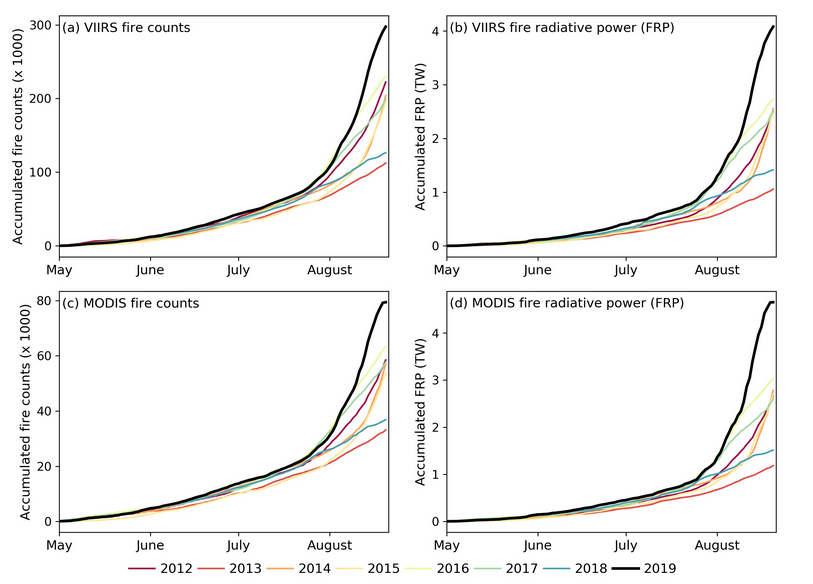
As we can see the thick black lines showing burning activity for 2019 are highly striking and certainly appear to support the media contention that 2019 is “record-breaking,” and eliminate all the doubts previously being expressed.
But on closer inspection, they have simply been constructed to make the 2019 burning look as “record” as the headlines were already claiming.
To achieve this two things have been done to the data.
1) the earlier years that are included in the other graphs from the same source, and which all had much higher burn rates than anything more recent, have been eliminated from these new graphs. The rather thin rationale for doing this is the VIIR/MODIS measure only goes back to 2012.
2) They start the sample in May rather than in January. No rationale is given for this at all, and it’s hard to see any beyond the fact that excluding the earlier months is the only way to make 2019 stand out as being “record” in line with media claims.
NASA’s website has made a similar journey over the same period.
This article, which we originally quoted, still says the burn activity in the Amazon is “close to average” and explains that a lot of farmers burn their land in the dry season.
As of August 16, 2019, an analysis of NASA satellite data indicated that total fire activity across the Amazon basin this year has been close to the average in comparison to the past 15 years. (The Amazon spreads across Brazil, Peru, Colombia, and parts of other countries.) Though activity appears to be above average in the states of Amazonas and Rondônia, it has so far appeared below average in Mato Grosso and Pará, according to estimates from the Global Fire Emissions Database, a research project that compiles and analyzes NASA data
This one, referenced by Walker and published just before his revised piece, might superficially appear to contradict the above claim, but – in a similar fashion to Walker’s piece – actually doesn’t if you look closely:
MODIS active fire detections in 2019 are higher across the Brazilian Amazon than in any year since 2010. The state of Amazonas is on track for record fire activity in 2019.
What NASA has done here in order to be able to claim a ‘record’ where previously there was an ‘average’ is simply switch from a fifteen-year analysis in the first article, to a nine-year one in the second. As I already pointed out above in relation to the revised graphs, this removes all the years of major burning this century and instantly shifts 2019 much further up toward the top of any comparative table.
Note also that NASA’s claim is not really true. Even within these somewhat distorted parameters 2019 is NOT higher than any year since 2010. As of today (August 27) 2016 is still just higher in total activity, and of course the earlier years of the 21st century were much higher again, but have been eliminated, apparently just for the purpose of making 2019 look a bit more “record-breaking”.
What we have here, in both the Sceince20.com article and in NASA’s ‘update’, is interpretation-manipulation being passed off as data-update. It’s hard to avoid the conclusion this is a direct attempt to make their pages fall in line with the current media hysteria.
Looking at the wider issue, it’s pretty clear an orchestrated campaign to create unique panic and fear about the Amazon forest fires was initiated, not because the 2019 fires were uniquely dangerous, but because public fear was perceived as useful for promoting an agenda.
What agenda? I think it’s too early to get a comprehensive answer there. Many straws blowing in the wind. It’s been suggested Bolsonaro, the new imperial puppet, may have been proving a little antsy and required pulling into line. Or that it’s a concealed attempt at strengthening his position while appearing to attack it.
There’s this little straw in the wind that shouldn’t be ignored:
#Brazil is clearly unable to be caretaker of the #Amazon rainforest as shown by the #AmazonFire. Given the ecological, medicinal and climate importance to our entire species, perhaps it’s time to place part of the Amazon rainforest under international treaty similar to Antarctica pic.twitter.com/OiLsw5hlkZ
— Matthew VanDyke (@Matt_VanDyke) August 26, 2019
An “international treaty” would certainly be a nice cover for exploitation of the Amazon’s riches. It can’t be discounted as one possible motive for fomenting a fake crisis where only an endemic problem exists.
Or this:
We have a crisis. We have a new tipping point. We have the UN climate action summit around the corner. We have a villain. Our heroine arrives in NYC soon. #NewDealForNature
The #BehaviouralEconomics of hatred. https://t.co/jleIN4m1ip
— Cory Morningstar (@elleprovocateur) August 27, 2019
Only the markets can save us.
Certification schemes. Green Bonds. A “New Deal For Nature”. We need momentum. We need that “Paris moment”. pic.twitter.com/2isJlyrFyP
— Cory Morningstar (@elleprovocateur) August 27, 2019
Or this:
The media focus on the burning #Amazon rather than Siberia’s boreal forest ‘aims to allow Europeans to control the Amazon, its minerals, its pharmaceutical treasures & its precious woods. Its purpose is to distort the problem b4 providing a false solution’https://t.co/T2OFtZgbsI
— Robin Monotti Graziadei (@robinmonotti) August 27, 2019
There are no shortage of possibilities once the question “cui bono?” is asked.
If that question isn’t asked, if it’s outlawed as “unhelpful” or “conspiratorial”, we can become trapped in a refusal to interrogate. And that can lead to disaster.
Too many of us become utterly trusting as soon as our hot button subjects are on the front pages. People who know the media is utterly corrupt can still switch off their critical thinking when it starts to venture any opinion they can agree with.
Commentators who deride the absurd media lies about the Skripals or Corbyn or Syria or Russia still share the Environment page of the BBC or the Guardian, as if somehow honesty and integrity are guaranteed there.
George Monbiot, serial liar and lunatic when it comes to Syria or western foreign policy, is trusted to be an honest broker when he talks about climate change or veganism, or saving the whales.
It’s too easy for any one of us to tell ourselves the mainstream journalist who is saying what we want to hear must have a good and honest reason for saying it.
It’s so comforting to just shut off the critical awareness and drift on the cloud of manufactured ‘popular opinion’. Seductive to be in the majority for once. Reassuring to have someone do the thinking for us so we can, just for a bit, ride easy in their wake.
But the problem is then we end up signing up for Avaaz. Or cheering on the invasion of Iraq – because of those scary WMDs, or thinking thank goodness the G7 are going to do something about those terrifying “record” Amazon fires.
Because we forgot that the mass media and the body politic serve the super-rich, the financial institutions, the intelligence agencies and no one else.
And they always lie, because they always need to hide that simple fact.
*PS – I STILL don’t support the destruction of the rain forests.
Catte Black, OffG co-founding editor. Writer. Opinionated polemicist.
Amazon Burning? – well maybe not so much
Statistics indicate this is an average year for wildfires, so why the above-average hysteria?
By Catte Black – OffGuardian – August 23, 2019
Today on Twitter OffG stepped into the current panic-inferno and thick forest of screaming hashtags that is the “Amazon Forest Fire Crisis.” The results were thought-provoking.
The mainstream media message is very simple. There are “record” numbers of forest fires currently in the Amazon basin. It’s mostly Bolsonaro’s fault. The G7 – soon to be assembling – needs to act. (Business Insider and The Guardian are also both very keen we send money to some rainforest charities)
Now, I’m not a fan of Bolsonaro personally, and that goes for all of us at OffG. I’m equally very supportive of preserving the rain forests and wild spaces of the earth. So, the broad sweep of the message is something I’m inclined to be sympathetic toward.
But something isn’t sitting right. This is the mainstream media in full and united chorus, flooding the news space with this one single message. This means there’s a fairly major agenda, and it’s unlikely to be saving the Amazon for all the little future babies.
So, we thought we’d take a deeper look and tweeted this:
How unusual/unnatural are these fires? What percentage burns naturally every year? Be nice to have data rather than hysteria. https://t.co/BDi95EXCiu
— OffGuardian (@OffGuardian0) August 23, 2019
Three people immediately unfollowed us. A couple of others responded. Here’s one:
“Hysteria?” You are being irresponsible and lazy. “Fires in the Amazon have surged 83% so far this year compared with the same period a year earlier, environmentalists blamed the sharp rise on farmers setting the forest alight to clear land for pasture” https://t.co/USit1oOL8p pic.twitter.com/pLPibygyp0
— Representative Press (@RepPress) August 23, 2019
We replied to RP with the following:
Yes, hysteria. What’s the annual variation? How do these fires compare with a 10 year average? A 50 year average? Asking for data is NEVER irresponsible. Demonising it as ‘lazy’ may well be however. Please note we aren’t claiming this isn’t a problem, just asking for context
— OffGuardian (@OffGuardian0) August 23, 2019
RP’s hostility only increased, and they retweeted the same basic claim again, apparently in the belief it was new and revelatory and an answer to our questions:
Are you incapable of doing research and of applying basic logic? You think the sharp rise in farmers setting fires is “made up?” I found this info in seconds: https://t.co/e11v2RH84r pic.twitter.com/o6RP5K83mL
— Representative Press (@RepPress) August 23, 2019
In fairness, we also got some positive response, most notably from the always rational Robin Monotti Graziadei. We recommend taking time to read the whole thread.
During the Medieval Climate Anomaly, the period most similar to recent decades, warm & dry climatic conditions resulted in peak forest burning, but severe fires favored less-flammable deciduous vegetation, such that fire frequency remained stationary:https://t.co/wTkIgCQm5h
— Robin Monotti Graziadei (@robinmonotti) August 23, 2019
Someone else then sent us a link to this article at Science20.com
In this article you can find a quote from the Earth Observatory , which up until August 22 read as follows:
As of August 16, 2019, satellite observations indicated that total fire activity in the Amazon basin was slightly below average in comparison to the past 15 years. Though activity has been above average in Amazonas and to a lesser extent in Rondônia, it has been below average in Mato Grosso and Pará, according to the Global Fire Emissions Database”
(SIDEBAR: this text was changed on Aug 22 and now reads, significantly “As of August 16, 2019, an analysis of NASA satellite data indicated that total fire activity across the Amazon basin this year has been close to the average in comparison to the past 15 years.”, although the data on which this conclusion is based has not apparently changed. You can check the archived version for proof of the edit.)
On the same site (science20.com) you can also find this graph of “cumulative monthly fire data” for the Amazon basin (the original is at from GlobalFireData.org):
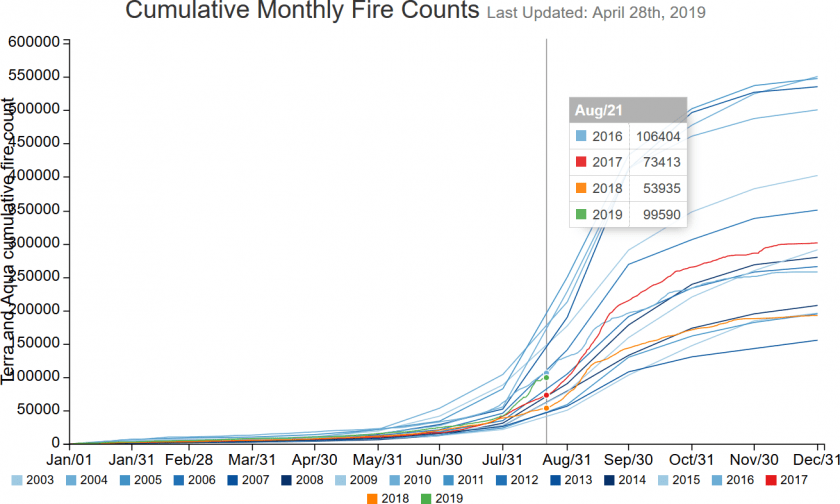
This clearly indicates that the current amount of burning in the Amazon basin in 2019 (the green line) is, as NASA originally said,somewhat below the average, and well below the previous extremes for the region.
This will be why, when you look close, the media articles are artfully talking about the number of fires, rather than the area of burning. There may well be more fires (or maybe that’s just been made up like so much else), but that’s a statistic without meaning if the total area covered is actually less than a fifteen-year average.
Now, we’re not about to take NASA as a final authority on this any more than any other single source. But given the amount of emphasis being put by the screaming media on how “unprecedented” the current burning is, and how deceptive this might turn out to be, it seemed important to us that this data was at least discussed. So we tweeted a ref to it.
Given the fact NASA has said the current total burning in the Amazon basin is slightly BELOW a 15 year average, we need to ask what the current media hysteria is aimed at achieving. https://t.co/BDi95EG1qW
— OffGuardian (@OffGuardian0) August 23, 2019
This was one response:
you can breath stats if you wish, I prefer oxygen!
Most stats are manipulated or self serving anyway!https://t.co/ZtH5IEXi2x— 💧truth-seeker (@very_grem) August 23, 2019
Here is another. Visit our timeline for more.
NASA = America = Trump = The far-right.
— Roy Underwood (@TannersCross) August 23, 2019
It turns out the messy truth behind the blaring headlines is – yes, the Amazon is burning but not as much as in many recent times, and while Bolsonaro is not a nice man accusing him of burning the world down is probably a bit premature.
To be fair a few people shared or retweeted this information. But they were very few. Most simply ignored it, intent, like Greenwald and Media Lens, Naomi Klein et al in joining chorus with the shrieking mainstream doom-sirens.
Bolsonaro is simultaneously denying the severity of the Amazon crisis and, worse, recklessly claiming environmental groups started them, because he knows the world recognizes he’s to blame. He can’t escape that responsibility, as @davidmirandario said today in Congress [English]: pic.twitter.com/CAiWKsUCEp
— Glenn Greenwald (@ggreenwald) August 23, 2019
‘The French and German leaders say the record number of fires in Brazil’s Amazon rainforest is an international crisis which must be discussed at this weekend’s G7 summit.’https://t.co/aiwzg8lJST
— Media Lens (@medialens) August 23, 2019
The world is on fire and in country after country the arsonists are ascending to the highest office. This is utter madness. We need a global #GreenNewDeal. We all need to ask ourselves: who do we trust to lead that and how will we help them? https://t.co/6gYXI1cwUG
— Naomi Klein (@NaomiAKlein) August 22, 2019
Make a note of that #GreenNewDeal hashtag. We’ll be seeing a lot of that in the next week or so.
Before the inevitable “oh so you don’t care if all the possums DIE” type comments BTL, let’s make it ultra-clear, this isn’t about disparaging environmentalism or claiming it’s fine for the Amazon to burn (though actually it is, up to a point, and is an important part of the forest’s life cycle).
It’s about the fact so many of us – even many who think of themselves as sophisticated analysts – are still as much in the grip of authoritarian story-telling as our ancestors were when they heard tales of heaven and hell and believed them.
Thank goodness for a few lone voices of sanity, like Robin again:
Media are ignoring data in order to sell the Green New Deal scam https://t.co/KJX767XS2C
— Robin Monotti Graziadei (@robinmonotti) August 23, 2019
Hmmm… is that Green New Deal the reason why this apparently fairly average year of burning has been morphed by the power of lies into the latest doomsday meme? Why exactly would so many corporate news outlets be so keen to sell us that?
Oh who cares, right? It’s hard. Memes are easy. Did you know that the Amazon produces 20% of our Oxygen? No, because it doesn’t. But that’s not stopping everyone repeating it.
A few cyberwarfare-generated hashtags, a few (sometimes misattributed) images and there is a mass belief-system unfolding before our eyes. Uncritical, rabid, rancid with fear, demanding solutions.
Just in time for the G7 summit – where I’m sure a Green New Deal “solution” will emerge right on cue, to universal cheers and a few more hashtags handed down to the proles to be spread about in the name of “standing up to the 1%”.
We have to do better, guys, or it’s over. We’re done.
Catte Black, OffG co-founding editor. Writer. Opinionated polemicist.
Fake News and Fires in the Amazon
Media outlets are supposed to be more reliable than your brother-in-law, but that seems less true every day.

By Donna Laframboise | Big Picture News | August 28, 2019
Politicians and government officials like to talk as though it’s possible to stamp out fake news. It isn’t.
Fake news is as old as humanity. After Aristotle incorrectly claimed women had fewer teeth than men, generations of highly educated people believed it.
Rajendra Pachauri was called “the UN’s top climate scientist” by the BBC – and a “Nobel laureate” by the New York Academy of Sciences magazine. Neither statement was true.
Pachauri’s doctorate wasn’t in climatology, but in industrial engineering and economics. And the fact that he accepted the 2007 Nobel Peace Prize on behalf of the UN organization he chaired doesn’t make him or any other person affiliated with that organization a Nobel laureate.
Published in 2008 and 2009, these inaccurate statements have never been corrected. In other words, we’re surrounded by fake news. And always will be. Humans are frequently mistaken. Organizations, as well as individuals, post things on the Internet before double-checking.
While media outlets are supposed to be more reliable than your brother-in-law, that seems less true every day. Over the past week, people have shared a CNN headline on Facebook that declares: “The Amazon rainforest is burning at a record rate” (see the screengrab from my own Facebook feed, at the top of this post).
If you click through to the CNN website, you’ll find a few extra words: “… research center says.” But the primary statement is misleading. Which means that millions have been alarmed unnecessarily – including a lovely, smart, young mother of my acquaintance.
Over at the website of National Geographic, a headline falsely declares: Brazil’s Amazon is burning at record rates – and deforestation is to blame. The second half of that assertion is vigorously disputed here.

On Twitter, the President of France used an image taken by a photographer who’s been dead for 16 years to represent the current situation. Let me just emphasize that point: the head of a G7 country is spreading fake news about events unfolding on another continent.

That doesn’t, for one minute, mean anyone should have the power to shut him down. Not Twitter, Facebook, the EU, the UN, or anyone in his own government.
Like it or not, we’re stuck with fake news. Our best defense is to read widely and maintain a high level of skepticism. On this question, here’s some counterbalance to the recent tsunami of alarmism:
Why Everything They Say About The Amazon, Including That It’s The ‘Lungs Of The World,’ Is Wrong
Amazon fires: how celebrities are spreading disinformation
Is Amazon Rainforest Burning At Record Rates? What Is The Way Forward?
Lies, Damn Lies, And Rainforest Fear-Mongering
Annual Amazon farmland burn sets records for international outrage
Amazon fires: What about Bolivia?
Stop Sharing Those Viral Photos of the Amazon Burning
The Three Most Viral Photos of the Amazon Fire Are Fake. Here Are Some Real Ones to Share.
What Satellite Imagery Tells Us About the Amazon Rain Forest Fires
Creator Of Global-Warming’s Infamous “Hockey Stick” Chart Loses ‘Climate-Science’ Lawsuit
By Tyler Durden – Zero Hedge – 08/27/2019
Update 1: Michael Mann disputes the notion that he lost (and more): “There have been some wildly untruthful claims about the recent dismissal of libel litigation against Tim Ball circulating on social media.”
There have been some wildly untruthful claims about the recent dismissal of libel litigation against Tim Ball circulating on social media. Here is our statement (https://t.co/8tGoBZnE3Y): pic.twitter.com/ySeJcOktX9
— Michael E. Mann (@MichaelEMann) August 23, 2019
* * *
Update 2: technology.news has a rather different take than Mann, noting that further legal steps are on their way.
Penn State climate scientist, Michael ‘hockey stick’ Mann commits contempt of court in the ‘climate science trial of the century.’ Prominent alarmist shockingly defies judge and refuses to surrender data for open court examination. Only possible outcome: Mann’s humiliation, defeat and likely criminal investigation in the U.S.
The defendant in the libel trial, the 79-year-old Canadian climatologist, Dr Tim Ball … is expected to instruct his British Columbia attorneys to trigger mandatory punitive court sanctions, including a ruling that Mann did act with criminal intent when using public funds to commit climate data fraud. Mann’s imminent defeat is set to send shock waves worldwide within the climate science community as the outcome will be both a legal and scientific vindication of U.S. President Donald Trump’s claims that climate scare stories are a “hoax.” (snip)
Michael Mann, who chose to file what many consider to be a cynical SLAPP (Strategic Lawsuit Against Public Participation) libel suit in the British Columbia Supreme Court, Vancouver six long years ago, has astonished legal experts by refusing to comply with the court direction to hand over all his disputed graph’s data. Mann’s iconic hockey stick has been relied upon by the UN’s IPCC and western governments as crucial evidence for the science of ‘man-made global warming.’ (snip)
The negative and unresponsive actions of Dr Mann and his lawyer, Roger McConchie, are expected to infuriate the judge and be the signal for the collapse of Mann’s multi-million dollar libel suit against Dr Ball. It will be music to the ears of so-called ‘climate deniers’ like President Donald Trump and his EPA Chief, Scott Pruitt.
As Dr Ball explains:
“Michael Mann moved for an adjournment of the trial scheduled for February 20, 2017. We had little choice because Canadian courts always grant adjournments before a trial in their belief that an out of court settlement is preferable. We agreed to an adjournment with conditions. The major one was that he [Mann] produce all documents including computer codes by February 20th, 2017. He failed to meet the deadline.”
Punishment for Civil Contempt
Mann’s now proven contempt of court means Ball is entitled to have the court serve upon Mann the fullest punishment. Contempt sanctions could reasonably include the judge ruling that Dr. Ball’s statement that Mann “belongs in the state pen, not Penn. State’ is a precise and true statement of fact. This is because under Canada’s unique ‘Truth Defense’, Mann is now proven to have wilfully hidden his data, so the court may rule he hid it because it is fake. As such, the court must then dismiss Mann’s entire libel suit with costs awarded to Ball and his team.
* * *
Authored by Thomas Lifson via AmericanThinker,
Michael Mann, a climatologist at Penn State University, is the creator of the “hockey stick graph” that appears to show global temperatures taking a noticeable swing upward in the era when humanity has been burning fossil fuels and dumping CO2 into the atmosphere.
The graph was first published in 1998, prominently featured in the 2001 UN Climate Report, and formed part of Al Gore’s 2006 movie, An Inconvenient Truth.

The graph’s methodology and accuracy have been and continue to be hotly contested, but Mann has taken the tack of suing two of his most prominent critics for defamation or libel.
One case, against Mark Steyn, is called by Steyn likely to end up in the Supreme Court. But another case, against Dr. Tim Ball was decided by the Supreme Court of British Columbia, with Mann’s case thrown out, and him ordered to pay the defendant’s legal costs, no doubt a tidy sum of money. News first broke in Wattsupwiththat, via an email Ball sent to Anthony Watt. Later, Principia-Scientific offered extensive details, including much background on the hockey stick.
The Canadian court issued it’s final ruling in favor of the Dismissal motion that was filed in May 2019 by Dr Tim Ball’s libel lawyers.
Not only did the court grant Ball’s application for dismissal of the nine-year, multi-million dollar lawsuit, it also took the additional step of awarding full legal costs to Ball. A detailed public statement from the world-renowned skeptical climatologist is expected in due course.
This extraordinary outcome is expected to trigger severe legal repercussions for Dr Mann in the U.S. and may prove fatal to climate science claims that modern temperatures are “unprecedented.” […]
Dr Mann lost his case because he refused to show in open court his R2 regression numbers (the ‘working out’) behind the world-famous ‘hockey stick’ graph (shown above).
Real science, not the phony “consensus” version, requires open access to data, so that skeptics (who play a key role in science) can see if results are reproducible. Of course, there are no falsifiable experimental data associated with the global warming predictions of doom, so it doesn’t really stand as science as Karl Popper defined it.
This is an important victory in the process of debunking the warmist scare.
You’ll Never Be Lonely Again
By Helen Buyniski | Helen of Destroy | August 26, 2019
The pathologization of emotion has been on the march for decades, especially in the US, where fully one sixth of the adult population takes an antidepressant or other psychiatric drug. But with depression “conquered” by medication – even as both diagnosis rates and suicides are at an all-time high – the mental-health industry has a new target: loneliness. With pharmaceutical and even technological “cures” in the pipeline for this “condition,” once considered part of the normal human emotional experience but now framed as a dire health risk on the level of obesity and smoking, our very ability to think for ourselves hangs in the balance, and if that sounds like hyperbole, read on.
Nearly half of Americans polled last year by health insurer Cigna said they lacked meaningful relationships or companionship, while a third of people in industrialized societies report they are lonely, and this state of mind appears to significantly shorten one’s lifespan. A solutions-based society might examine why so many people feel alienated from their peers despite the constant connectivity of smartphones and internet. A symptom-focused model, however, simply looks to stop them from feeling that way by any means necessary – never mind the cause, and never mind the consequences.
Loneliness is “worse than obesity,” according to a raft of studies that have emerged linking the emotion to increased risk of premature death – as much as 50 percent, says one meta-analysis by Brigham Young University professor Julianne Holt-Lunstad – and a dramatically lowered quality of life. And like obesity – big business not just for Big Pharma, but for gastric bypass surgeons, weight-loss gurus, and other parasitic professionals who have monetized the American public’s lack of self-control – anything that deadly requires medical intervention.
THERE’S A PILL FOR THAT
The University of Chicago’s Brain Dynamics Laboratory recently began an eight-week trial of the hormone pregnenolone, rounding up volunteers with “off-the-chart” scores on a psychological loneliness scale. Basing their treatment on animal studies suggesting the chemical can reduce the exaggerated threat reactions that they say characterize loneliness, they hope to normalize the lonely person’s self-centered hyper-vigilance, which drives them to both desire human connection and deal poorly with it.
Researchers insist the intention is not to cure loneliness with a pill, but the trial sets a precedent for doing just that. Oxytocin, the “love hormone,” is also being considered as a potential treatment based on promising animal studies. Enterprising psychiatrists have previously medicalized aspects of loneliness as “social anxiety” and prescribed tranquilizers or antidepressants, but loneliness itself has never been so directly in the pharmaceutical crosshairs.
And if the hormone trials flop, there’s always Prozac. Already, doctors have claimed antidepressants make patients more sociable, and these drugs have for years been used (and abused) for conditions aside from depression – off-label prescribing of the antidepressants Paxil and Wellbutrin was the basis of the largest pharmaceutical company lawsuit in history. If loneliness is not an emotion but a crisis to be resolved, in which the ends justify the means (however barbaric and harmful they may be), why not bring out the heavy artillery?
Mental health professionals writing about the loneliness epidemic discuss behavioral interventions, community programs, and counseling, but the introduction of a pharmaceutical solution may prove too tempting for a profession that has learned to love the quick fix a pill provides. Like depression, loneliness has myriad possible causes, some of which are natural and healthy reactions to life circumstances. Other, obviously situational, causes would (before the magic pill, at least) call for clear behavioral solutions. Would a psychiatrist reach for her prescription pad when confronted with a lonely person who only socializes through Facebook, even though social media use has been found to correlate strongly with loneliness and studies have shown that just a week away from the platform can bring “significant” improvements in well-being? In this case, at least, correlation equals causation. A solution to the patient’s loneliness seems obvious. But why force him to change his life when a pill will do the trick?
The loneliness plague is a real problem – the number of Americans who say they have no one to talk to has tripled since 1985, and the negative health effects are real. Alienation is epidemic. But medicalizing it will only make the situation worse, just as it has with depression. When the profit motive enters the equation and medicalization gives way to monetization, the incentive to get rid of the problem vanishes, replaced by the incentive to diagnose as many people as possible with the condition in order to “treat” them while the relevant drugs are still under patent. Nor is there any incentive to (or expectation of) cure – unlike most patients diagnosed with a treatable disease, individuals deemed mentally ill tend to remain on medication for years, if not for life. Each newly-diagnosed individual thus represents a sizable wad of cash on the table.
In a quick-fix society that prefers to treat the symptoms while ignoring the disease, a pill for loneliness will be embraced with all the fervor with which antidepressants were greeted before people began to realize that they cause suicidal and homicidal behavior, sexual dysfunction, weight gain, and a host of other problems – and that they don’t actually cure depression. Those drugs are still doled out like candy, even after the scientific explanation for their effect (and that effect itself) have been debunked, because it’s easier to take a pill than to come to terms with one’s reasons for being depressed in the first place, especially if they’re reasonable responses to environmental factors. Nearly half of Americans struggle just to cover their basic financial needs every month; expecting the chronically stressed to enjoy the feel of the system’s boot on their necks is unrealistic. With a similar array of thorny societal causes as depression, loneliness is just as likely to be pharmaceutically exploited.
A loneliness pill would not address Americans’ emotionally unhealthy digitally-addicted lifestyles, a society-wide sickness and source of significant stress. It would instead allow them to socialize exclusively in an online sphere whose boundaries are set by billionaires like Mark Zuckerberg and Jack Dorsey, without experiencing any of the discomfort they would naturally feel at having their gregarious impulses folded, spindled and mutilated to fit an increasingly stringent set of behavioral restrictions. Nor would it confront societal programming that equates solitude with loneliness, with abnormality, and teaches children that if they are not driven to socialize, they are defective. It’s no coincidence that fictional dystopias from 1984 to the Handmaid’s Tale minimize the amount of “alone time” their citizens are permitted – time alone with one’s thoughts is time the state cannot control. But the police state of today is working to change that.
As human contact, including real-life socializing, has become a luxury – so says the New York Times, explaining that humans are expensive, screens and robots are cheap, and expecting the unwashed masses to be able to afford access to living, breathing humans like themselves is simply unrealistic – the “digital pets” millennials had as children have matured to “digital friends,” even digital lovers as they themselves have grown up. And these digital companions double as the eyes and ears of a shockingly intrusive surveillance state.
BRIDGING THE UNCANNY VALLEY
If the “loneliness pill” doesn’t work out, AI is waiting in the wings. Already seen as the future of at-home healthcare for aging populations under the care of cash-strapped governments, friendly, helpful robots could find their way into the homes of the lonely. And everyone gets lonely sometimes! Certainly, the mass deployment of robo-buddies circumvents the surveillance hurdle faced by in-home AI snoops like Amazon’s Alexa, which many Americans find creepy (and not just for its tendency to burst into sinister laughter unprovoked). Frame the intruder as a medical benefit, however, and some of that opposition falls by the wayside. After all, loneliness kills, and no one wants to die.

As lonely humans become accustomed to conversing with their robot pals, their expectation for real human contact will diminish, and their sense of loneliness with it. After all, you can’t miss what you never had. Already, given the stunted level of discourse on social media, many of us have found ourselves tricked into talking to bots, sometimes exchanging several messages before realizing our interlocutor is not human. The Voight-Kampff Test used by Philip K Dick’s “blade runners” to determine whether a suspect was human or android can be graded on a curve.
As the bar for “meaningful relationships” is lowered to the point where chatting with an AI can qualify, the loneliness epidemic vanishes – on paper, at least, and in US public health policy, sometimes that’s all that matters.
LONELY OR JUST ALONE?
The pathologization of loneliness will inevitably elide the difference between being alone and being lonely, as the mental health industry runs out of lonely people to treat with whatever therapeutic weapon wins this particular arms race and is forced to look further afield for patients. “Loners” – those dangerous types who actually enjoy solitude – are stigmatized as unpredictable weirdos who need to be brought into the fold. The man who shot up a Walmart in El Paso earlier this month was an “extreme loner,” according to media reports. Would we be reading about it if he was an “extreme extrovert,” someone so addicted to the company of other humans he couldn’t stand to spend a second alone? Extroversion is a characteristic of the psychopathic personality, yet extroverts are not stigmatized for this, or treated as potential serial killers because they feel compelled to socialize – instead, the “introvert killer” trope is reliably trotted out after every tragedy, even though it has been repeatedly debunked.
With no loneliness pill on the market – yet – it is impossible to predict what’s next for the creeping medicalization of the human emotional experience. But the surveillance state is muscling into the “mental health” sphere as never before. The Trump administration has reportedly embraced a new Health Advanced Research Projects Agency, modeled after the Pentagon’s DARPA, that will develop a method for analyzing “neurobehavioral signs” to determine whether someone is “headed toward a violent explosive act.” HARPA’s proposal suggests a “multi-modality solution, along with real-time data analytics” to be garnered from technologies like Apple Watches, Fitbits, Amazon Echo, and Google Home. And Amazon’s Alexa has moved one step closer to the companion-robot model, rolling out a medical feature earlier this year which could conceivably be deployed to “check on” individuals at risk for loneliness. The devices that have been surveilling us for years may thus become empowered to have us committed – for our own good, of course, and the good of society.
In the aftermath of recent mass shootings, Trump declared open season on the “mentally ill,” floating the idea of involuntary confinement and institutionalization, while governors like New York’s Andrew Cuomo have proposed mental health databases that would affix an indelible scarlet letter to anyone seeking help with a psychological issue – effectively driving many of the people who actually need help away from the system out of fear of the repercussions for their personal and professional lives. The idea that “extreme loners” might find themselves medicated against their will, as a preemptive measure, is not far-fetched.

And Elon Musk’s Neuralink device proposes bringing the AI directly to your brain, “merging biological intelligence with machine intelligence,” so you never have to feel lonely again – or experience any inconvenient emotions. Musk envisions a future in which customers will have the devices installed in shopping mall kiosks, no more intrusive than an ear-piercing. Social scientists fear it’ll be “suicide for the human mind” – while no one knows for sure where consciousness resides, if it’s anywhere near our squishy grey matter, it doesn’t stand a chance against cold silicon precision. Even Musk acknowledges that Neuralink is an “if you can’t beat them, join them” approach to a future AI takeover.
Implantable AI hands the state the tools to control our thoughts. Indeed, we will no longer be able to tell which thoughts are “ours,” and which come from the device implanted in our skull. Transhumanists speak glowingly of “merging with the machines,” forgetting (or perhaps deliberately omitting) that the machines have programmers, and those programmers work hand in glove with the military-industrial complex. If they get their way, you’ll never be able to feel lonely again, because Big Brother will take up residence inside your skull. Solitude – like privacy before it – will be a distant memory, assuming you’re permitted to remember it at all. And like privacy, children born today may never know what it is like to experience loneliness – nor will they ever have the pleasure of being alone with their thoughts.
(originally published in much shorter form on RT)
Dr. Tim Ball wins @MichaelEMann lawsuit – Mann has to pay
By Anthony Watts | Watts Up With That? | August 22, 2019
Readers surely recall that the easily offended Dr. Michael Mann launched a court case for defamation against climate skeptic Dr. Tim Ball of Canada.
In Feburary 2018 there was a complete dismissal in the lawsuit brought against Dr. Ball by Andrew Weaver of Canada, also for “defamation”.
The Weaver defamation case involved an article Ball wrote saying that the IPCC had diverted almost all climate research funding and scientific investigation to anthropogenic global warming (AGW). This meant that there was virtually no advance in the wider understanding of climate and climate change. Ball referenced an interview with Weaver and attempts by a student to arrange a debate. Ball made some comments that were not fully substantiated, so they became the base of the defamation lawsuit.
That case was completely dismissed, you can read more here.
Now in the Mann case, which goes back to 2011, there’s also a complete dismissal. Ball wrote to me less than an hour ago, asking me to announce it here.
He writes:
Hi Anthony
Michael Mann’s case against me was dismissed this morning by the BC Supreme Court and they awarded me [court] costs.
Tim Ball
This is a developing story, I’ll add more as we know more.
Petitioning Against Climate Alarmism Goes Global
By Larry Bell ~ PA Pundits – International ~ August 21, 2019
A petition being submitted by hundreds of independent climate scientists and professionals from numerous countries to heads of the European Council, Commission and Parliament declares “There is No Climate Emergency.”
Briefly summarized, the request for consideration conveys five urgent messages:
- Climate change is real and has been occurring with nature-driven cold and warm cycles for as long as the planet has existed.
- There should be no surprise that the Earth has been warming through natural causes since the last Little Ice Age ended around 1870. Actual temperature increases, however, are far less than predicted by theoretical climate models.
- There is no real evidence that anthropogenic (human-caused) CO2 emissions are a major or dangerous warming influence. They instead offer great benefits to agriculture, forestry and photosynthesis that is the basis for life.
- There is also no scientific evidence that increasing CO2 levels are causing more natural disasters. However, CO2-reduction measures do have devastating impacts on wildlife (e.g. wind turbines), land use (e.g. forest clearance), and vital energy systems.
- Energy policies must be based on scientific and economic realities — not upon a harmful and unrealistic “2050-carbon-neutral policy” driven by unfounded climate alarm.
The petition concludes by recommending the recognition of clear difference in policies addressing the Earth’s environment through good stewardship versus Earth’s climate, the latter of which “is largely caused by a complex combination of natural phenomena we cannot control.”
This recent petition to EU leaders signed by approximately 100 Italian scientists from many prominent organizations urges recognition of the same basic realities.
The Italian petition calls attention to the fact that the planet has previously been warmer than the present period, despite lower atmospheric CO2 concentrations. Warming periods have been repeated about every thousand years, including “the well-known Medieval Warm Period, the Hot Roman Period, and generally warm periods during the Optimal Holocene period.”
Most recent climate warming observed since 1850 followed the Little Ice Age – the coldest period of the last 10,000 years. “Since then, solar activity, following its [previous cooling-influence] millennial cycle, has increased by heating the Earth’s surface.”
The notification advises that climate, “the most complex system on our planet,” needs to be addressed with scientific methods that are “adequate and consistent with its level of complexity.”
This system “is not sufficiently understood. And while CO2 is indisputably a greenhouse gas, “according to [UN Intergovernmental Panel on Climate Change] IPCC itself, the climate sensitivity to its increase in the atmosphere is still extremely uncertain.”
The petition states that “In any case, many recent studies based on experimental data estimate that the climate sensitivity to CO2 is considerably lower than estimated by the IPCC models.” Accordingly, all evidence suggests that such models “overestimate the anthropic [human] contribution and underestimate the natural climatic variability, especially that induced by the sun, the moon, and ocean oscillations.”
Likewise, alarmist media claims that extreme weather events, such as hurricanes and cyclones, are increasing in frequency are entirely inaccurate and typically far more directly tied to natural ocean oscillation cycles.
Again, the Italian signatories from numerous universities and research organizations take strong issue against “deplorable propaganda” claiming that carbon dioxide is a pollutant rather than a molecule that is indispensable to life on our planet.
Accordingly, given “the crucial importance that fossil fuels have for the energy supply of humanity,” the petitioners urge that the EU should not adopt economically burdensome and unwarranted CO2 reduction policies under “the illusory pretense of governing the climate.”
The petitioners also emphasize that while credible facts must be based upon scientific methods, not determined by numbers of supporting theorists, there is no alleged “consensus” among specialists in many and varied climate disciplines suggesting that human-influenced climate change presents an imminent danger. They point out that many thousands of scientists have previously expressed dissent with alarmist anti- fossil energy conjecture.
More than 31,000 American scientists from diverse climate-related disciplines signed a Global Warming Petition Project rejecting limits on greenhouse gas emissions attached to the 1977 Kyoto Protocol and similar proposals. The list of signatories included 9,021 Ph.D.s, 6,961 at the master’s level, 2,240 medical doctors, and 12,850 carrying a bachelor of science or equivalent academic degree.
A 12-page petition attachment was introduced with a cover letter issued by Fredrick Seitz, a past president of the National Academy of Sciences and former president of Rockefeller University. It read, in part:
“This treaty is, in our opinion, based upon flawed ideas. Research data on climate change do not show that human use of hydrocarbons is harmful. To the contrary, there is good evidence that increased atmospheric carbon dioxide is environmentally helpful.”
The letter added, “The proposed agreement would have very negative effects upon the technology of nations around the world, especially those that are currently attempting to lift from poverty and provide opportunities to over 4 billion people in technologically undeveloped countries.”
Gratefully, an American Congress at that time listened to that sage advice and unanimously agreed. We can only fervently hope that more current legislators will continue to be equally wise.
Larry Bell contributes posts at the CFACT site. He heads the graduate program in space architecture at the University of Houston. He founded and directs the Sasakawa International Center for Space Architecture. He is also the author of “Climate of Corruption: Politics and Power Behind the Global Warming Hoax.”
Greenland’s ‘Record Temperature’ denied – the data was wrong
Greenland’s all-time record temperature wasn’t a record at all, and it never got above freezing there.
By Anthony Watts | Watts Up With That? | August 12, 2019
First, the wailing from news media:
NYT : https://www.nytimes.com/2019/08/02/climate/european-heatwave-climate-change.html
Climate Progress : https://thinkprogress.org/greenland-hits-record-75-f-sets-melt-record-as-globe-aims-at-hottest-year-e34e534e533e/
Polar Portal : http://polarportal.dk/en/news/news/record-high-temperature-for-june-in-greenland/
Now from the Danish Meteorological Institute (DMI), via the news website The Local, the cooler reality:
Danish climate body wrongly reported Greenland heat record
The Danish Meteorological Institute, which has a key role in monitoring Greenland’s climate, last week reported a shocking August temperature of between 2.7C and 4.7C at the Summit weather station, which is located 3,202m above sea level at the the centre of the Greenland ice sheet, generating a spate of global headlines.
But on Wednesday it posted a tweet saying that a closer look had shown that monitoring equipment had been giving erroneous results.
“Was there record-level warmth on the inland ice on Friday?” it said. “No! A quality check has confirmed our suspicion that the measurement was too high.”
By combining measurements with observations from other weather stations, the DMI has now estimated that the temperature was closer to -2C.
The record temperature ever recorded at Summit is 2.2C, which was reached in both 2012 and 2017. But -2C is still unusual at the station.
Shoot out the headlines first, ask questions later.
Featured Video

Dan Dicks with James Corbett on Solutions Watch
or go to
Aletho News Archives – Video-Images
From the Archives
Secret document reveals plans for civil war in Lebanon, Israeli false flags, and invasion
By Randi Nord | Geopolitics Alert | April 5, 2019
Beirut – During his visit with US Secretary of State, Mike Pompeo, Lebanese President Michael Aoun reportedly received a US-Israeli document detailing plans for creating a civil war in Lebanon with covert false flag operations and possible Israeli invasion.
Although the source of the document is Israeli and created in partnership with Washington, no one knows who presented it to Aoun. The Lebanese TV station, Al-Jadeed, initially reported the document on Lebanese TV and a video on its website. Geopolitics Alert translated the report for this article. … continue
Blog Roll
 Aletho News
- Sheikh al-Asadi warns of Iraqi government compliance with US demands
- How to MAKE THE CONSPIRATORS PAY for their crimes! Dan Dicks with James Corbett on Solutions Watch
- There’s a drought in academia: A drought in honest research on the subject of drought and other weather extremes
- Department of War Awards $20.7 Billion Contract to Raytheon for Air-to-Air Missiles
- ‘Distance yourselves from Israel’: IRGC urges US population to question govt policies
- America’s Greenland deal has a radioactive backstory
- The RAF Fairford ‘terror plot’: Unpacking escalation in the UK echo-chamber
- EU Council Advances Chat Control 2.0 Scanning Proposal
- Ex-Greek MEP files complaint against Israeli spyware firm over alleged Pegasus surveillance
- Troubling ideas throughout the Torah, Talmud, Mishneh Torah and Tanya
- If Americans Knew
- New Report: “Scholasticide and Genocide in Gaza: Assessment, Testimonies and Legal Analysis”
- Ex-Biden officials are desperate for a Gaza scapegoat
- Israeli “settlers” Invade Al-Aqsa; Pour Boiling Water on 75-Year-Old
- Israel Has Kidnapped Another American Teenager
- US arms sales to Israel worth $21.6 billion in 20 months
- Three Palestinians Killed in Israeli Attacks on Gaza
- Revealed: German “Anti-Semitism Expert” Driving Crackdown on Palestine Solidarity is Former Israeli Spy
- Egypt’s Warning to Israel Before Oct 7
- Israel’s siege signals another cruel winter for 1.8 million Gazans – Daily Update
- Netanyahu Asked UAE Leader to Deny Report on Oct. 7 Warning in Secret Visit, Sources Say
- No Tricks Zone
- New Study: Earth And Venus Surface Warmth Largely Explained By Convection And Lapse Rate, Not CO2 Or Radiation
- 2025 Nature Paper Claiming Worsening Global Drought Gets RETRACTED …Heavily Flawed
- New Study: ‘Global Drought Shows No Detectable Recent Acceleration Under Climate Warming’
- Economic Masterminds: German Socialists Suggest Taxing Productivity Gains Stemming From Using AI
- The South China Sea Has Not Been Cooperating With The Climate Change Narrative
- Energy Crisis: Germany Enters Heating Season With Historically Low Gas Reserve Fill Levels
- New Study: The Antarctic Ice Sheet Gained Mass From 2020-2024 Due To Staggering Snow And Ice Accumulation
- Study: Ocean Heating Rates From Thousands Of Years Ago ‘Dwarf’ Modern Ocean Heating Rates
- Climate Extremists Target, Attack Large-Scale Power Grid Infrastructure In Germany!
- New Study: Antarctic Ice Melt Has Contributed Less Than 1 Centimeter To Sea Level Rise In The Last 30 Years

