Researchers found that ice conditions in the 19th century were remarkably similar to today’s, observations falling within normal variability. The study is Accounts from 19th-century Canadian Arctic Explorers’ Logs Reflect Present Climate Conditions (here) by James E. Overland, Pacific Marine Environmental Laboratory/NOAA, Seattle,Wash., and Kevin Wood, Arctic Research Office/NOAA, Silver Spring, Md. H/t GWPF
Overview
This article demonstrates the use of historical instrument and descriptive records to assess the hypothesis that environmental conditions observed by 19th-century explorers in the Canadian archipelago were consistent with a Little Ice Age as evident in proxy records. We find little evidence for extreme cold conditions.
It is clear that the first-hand observations of 19th-century explorers are not consistent with the hypothesized severe conditions of a multi-decadal Little Ice Age. Explorers encountered both warm and cool seasons, and generally typical ice conditions, in comparison to 20th-century norms.
Analysis
There were more than seventy expeditions or scientific enterprises of various types dispatched to the Canadian Arctic in the period between 1818 and 1910. From this number, we analyzed 44 original scientific reports and related narratives; many from expeditions spanning several years. The majority of the data come from large naval expeditions that wintered over in the Arctic and had the capacity to support an intensive scientific effort. A table listing the expeditions and data types is located at http://www.pmel.noaa.gov/arctic/history. The data cover about one-third of the possible number of years depending on data type, and every decade is represented.
Our analysis focuses on four indicators of climatic change: summer sea ice extent, annual sea ice thickness, monthly mean temperature, and the onset of melt and freeze as estimated from daily mean temperature. Historical observations in these four categories were compared with modern reference data; the reference period varied, depending on data availability. Both sea ice extent and the onset of melt and freeze were compared to the 30- year reference period 1971–2000; monthly means are compared to the 50-year period 1951–2000. Modern sea ice thickness records are less continuous, and some terminate in the 1980s; the reference period is therefore based on 19 to 26 years of homogeneous record.
Fig.1.
(a) Proxy record of standardized summer air temperature variation derived from ice cores taken on Devon Island. This proxy record suggests that a significantly colder climate prevailed in the 19th century. Shading indicates temperatures one standard deviation warmer or colder than average for the reference period 1901–1960 [Overpeck,1998].
(b) Historical monthly mean temperature observations compared to the 20th-century reference period 1951–2000. Sixty-three percent of 343 monthly mean temperatures recorded on 19th-century expeditions between 1819 and 1854 fall within one standard deviation of the reference mean at nearby stations (reference data from Meteorological Service of Canada,2002; and National Climatic Data Center,2002).
(c) Onset of melt observed by expeditions between 1820 and 1906 expressed as departures from the mean for the reference period 1971–2000. The period of melt transition observed by 19th century explorers is not inconsistent with modern values.
(d) Onset of freeze observed between 1819 and 1905 compared to the reference period 1971–2000. The onset of freeze transition is frequently consistent with modern values,but in some cases occurred earlier than usual. The incidence of an early onset of freeze represents the largest departure from present conditions evident in the historical records examined in this study. Melt and freeze transition dates for the reference period 1971–2000 were calculated from temperature data extracted from the Global Daily Climatology Network data base (National Climate Data Center, 2002).
Fig.2. The ship tracks and winter-over locations of Arctic discovery expeditions from 1818 to 1859 are surprisingly consistent with present sea ice climatology (contours represented by shades of blue). The climatology shown reflects percent frequency of sea ice presence on 10 September which is the usual date of annual ice minimum for the reference period 1971–2000 (Canadian Ice Service,2002). On a number of occasions, expeditions came within 150 km of completing the Northwest Passage, but even in years with unfavorable ice conditions, most ships were still able to reach comparatively advanced positions within the Canadian archipelago. By 1859, all possible routes comprising the Northwest Passage had been discovered.
Summary
As stated here before, Arctic ice is part of a self-oscillating system with extents expanding and retreating according to processes internal to the ocean-ice-atmosphere components. We don’t know exactly why 19th century ice extent was less than previously or less than the 1970s, but we can be sure it wasn’t due to fossil fuel emissions.
Explorers encountered both favorable and unfavorable ice conditions. This drawing from the vicinity of Beechey Island illustrates the situation of the H.M.S.Resolute and the steam-tender Pioneer on 5 September 1850 [from Facsimile of the Illustrated Arctic News, courtesy of Elmer E. Rasmuson Library, Univ. of Alaska Fairbanks].
No, weather is NOT climate… even when it’s warm outside. But in case there’s a climate cultist in your life that insists otherwise, here are some facts about global warming and vaguely-defined “extreme” weather that you can use to talk some sense into them.
Until the noise of a century of media hype and unscientific speculation about the Arctic has been removed from the public debate, science will be unable to explain what, if anything, the signal from the Arctic is telling us.
In the last days of the Northern hemisphere’s summer, the sea ice that covers part of the Arctic Ocean reaches its minimum extent.
The annual change, recorded by satellites, has come to be seen as evidence of anthropogenic global warming, and a warning of what is to come.
It features in the global news every Summer. One journalist has called it the planet’s ‘white flag of surrender’, others the ‘Arctic Death Spiral’.
The lowest sea ice extent ever recorded was in 2012, and previous to that in 2007.
In the 2000s, a new trend of decreasing sea ice minimums seemed to be emerging. Whereas computer models had predicted that Arctic summer sea ice wouldn’t disappear until the middle of the century, the rate of decline seemed to be much faster.
The story of rapid, unnatural change and the plight of the polar bear became powerful symbols of climate change happening in real time. Campaigners launched high profile, swimming, kayaking and evidence-gathering missions to the North Pole to draw the media’s attention to the issue.
In 2007, media stories featured the claims of Prof. Wieslaw Maslowski, who claimed that the ice would be gone by 2013.
The following year, Mark Serreze, of the US National Snow and Ice Data Center (NSIDC) predicted that 2008 could be “become ice free at the North Pole this year.”
And in 2009, Al Gore announced ‘there is a 75 per cent chance that the entire north polar ice cap, during the summer months, could be completely ice-free within the next five to seven years.’
But the missions to the Arctic were hampered by bad weather, not open sea. And the dates by which climate scientists and politicians said the ice would disappear have come and gone, while the ice has remained.
Undaunted, fresh predictions have been made in every subsequent year.
2016 was no exception. In June, one scientist claimed that his prediction of an ice-free Arctic ocean might finally come true. The story made headlines throughout the world. But rather than disappearing, the joint-second lowest sea ice extent since 1978 was recorded.
This has caused controversy within climate science. A decade of failed predictions has signalled that science does not yet understand what drives variation in the Arctic. Some scientists have urged more caution. But the story of the Arctic’s ‘death spiral’ featured in news reports, in spite of these warnings.
And the story has a very long history.
In the 1950s, newspapers report the findings of an international panel of scientists. They predicted that the Arctic could be ice-free by the end of the 1970s.
Even as far back as the early 1920s, newspapers carried stories of a ‘great thaw’. One journalist wrote that ‘the giant ice cap has retreated as though in a flash’, adding that ‘the man of science breathes in our ear that outside of what has been described in Genesis there has been nothing like it in all history’.
By the 1970s concerns returned to the possibility of a new ice age, that would see the Arctic sea ice grow, making the Northern hemisphere inhospitable to agriculture.
One problem that persists is that there is still only a relatively short series of direct measurements on which to base our understanding of the Arctic.
Satellite monitoring of the Arctic only began in 1978, giving us less than forty years of reliable data. This may not be enough to establish what is normal – or abnormal – for the region.
The beginning of the satellite data starts at the end of a 40-year cooling phase, which may mean that our record of Arctic sea ice begins from an unusually high point.
Recent analysis of sea ice area shows that, although the last decade may have seen the most dramatic minimum extents, the decade that shows the greatest rate of decline occurred between 1998 and 2008 and that data since then shows significantly less decline.
And other explanations may better account for these observed changes than global warming.
One explanation for the more stable sea ice conditions seen since 2007 might be the Atlantic Multi-decadal Oscillation, or AMO – a natural cycle of warming and cooling. AMO peaked in 2008, and has recently entered a negative phase. The decline of summer sea ice may at least in part be a response to this and other natural cycles.
Rather than being based on an understanding of the Arctic’s climate, estimates of rapid sea ice decline have been made by simply drawing a straight line through the data. This may not be a safe way of making predictions, or of attributing sea ice decline to anthropogenic global warming.
As soon as the 2016 Arctic sea ice minimum was reached, it began its recovery, as it does every year. Even if we were to see an ice free summer Arctic, the significance of this event might be only symbolic.
Until the noise of a century of media hype and unscientific speculation about the Arctic has been removed from the public debate, science will be unable to explain what, if anything, the signal from the Arctic is telling us.
We all know that people differ mentally in a great many ways: some are reflective, others impulsive; some are sympathetic, others are sociopathic; some are creative, others seem never to have a witty or imaginative thought; some are sensible, others are flighty, fanatical, or prone to panic; and some are smart, whereas others cannot do a simple arithmetical calculation in their head or solve an elementary logical puzzle.
So how do we measure the human intellect? Among educators and psychologists, the most common procedure is to conduct a test of reasoning ability that yields a result called an intelligence quotient, or IQ.
Some people think IQ’s are terrifically important and that people can be ranked from dumb to brilliant according to their IQ. Moreover, it is widely believed that one’s IQ is largely genetically determined at birth.
Thus to many, IQ is a mark of inherent social rank.
A problem with this idea is that IQ’s seem to vary according to experience and culture. Sub-Saharan Africans, for example, are widely said to have IQ’s averaging 20 to 30 points lower than the average of about 100, which is typical of most European populations. Trouble is, when Africans migrate to Europe, their IQ’s rise. Same with country folk versus city folk. The former seem to have lower IQ’s until they migrate to the city, then they, or their children, match the IQ’s of the city-born.
There’s also the effect known as test sophistication, which means that the more IQ tests you take the better you get at them. So IQ is not quite so firmly fixed by the genes as many people seem to believe. Moreover, there are generational differences in IQ, with IQ’s of most populations rising by five to as much as 30 points per generation since the beginning of the 20th Century, this phenomenon being known as the Flynn Effect.
But if people differ in intellect in ways other than reasoning capacity, what value is there in judging intellect by IQ?
For example, does IQ measure creativity, judgement, diligence, responsibility, or empathy?
Obviously not. Moreover, very little is knows about the effect of environment, diet, or culture on the many facets of human intelligence.
So why is so much attention given to the measurement of IQ?
Such a narrow view of human mentality seems not very intelligent, really.
Almost anyone with adequate schooling can learn to observe carefully, perform basic logical processes, make comparisons, draw more or less obvious logical inferences, and perform all the other operations that underlie appropriate responses to IQ test questions.
But not everyone is creative, sound in judgement, socially responsible, mentally vigorous, or possessed of the power of empathy.
And without those other qualities of mind, how useful is an abnormally high IQ?
In most circumstances, not very.
In fact, the idea of rating intellect on a single linear scale seems neither sensible nor useful, whereas it is almost certainly seriously misleading and, therefore, harmful.
CNN’s Christiane Amanpour has equated climate change skeptics with the purveyors of “ethnic cleansing and genocide in Bosnia” and “unspeakable crimes.” She also declared that the media should not give voice to those who reject the alleged “consensus” of man-made climate fears. Amanpour warned of a “Tsunami of fake news.”
Amanpour was honored with the Burton Benjamin Memorial Award by the Committee to Protect Journalists (CPJ), for her extraordinary and sustained achievement in the cause of press freedom on November 22, 2016. (Email: press@cpj.org) She is the Chief International Correspondent for CNN and host of CNN International’s nightly interview program Amanpour.
Amanpour said the following about “global warming” and “press freedom” at 4:35 into the video: Note: The transcript at the Real Clear Politics link (slightly different from what she actually says in the video) includes the following:
Key Excerpt of Christiane Amanpour speech:
“It appeared much of the media got itself into knots trying to differentiate between balance, objectivity, neutrality, and crucially, truth. We cannot continue the old paradigm–let’s say like over global warming, where 99.9 percent of the empirical scientific evidence is given equal play with the tiny minority of deniers.
I learned a long, long time ago, covering the ethnic cleansing and genocide in Bosnia, never to equate victim with aggressor, never to create a false moral or factual equivalence, because then if you do, particularly in situations like that, you are party and an accomplice to the most unspeakable crimes and consequences.
So I believe in being truthful, not neutral.”
End excerpt.
Wikipedia states that “The CPJ International Press Freedom Awards honor journalists or their publications around the world who show courage in defending press freedom despite facing attacks, threats, or imprisonment.”
As Climate Depot reader Tony Kondaks noted: Neither Amanpour or the CPJ “was aware of the irony that an award for ‘press freedom’ is going to an individual who feels that defending press freedom means that journalists must self-censor and RESTRICT their readers’ access to countering and opposing views.”
Amanpour also noted the oft repeated incorrect claim of a 97% consensus about “global warming” but she even juiced that number to 99.6%.
For the truth about the 97% “consensus” claims, see below.
97% Climate Consensus?
The claim that “97% of scientists agree” is in part based on 77 anonymous scientists who [participated] in a survey. The survey started by seeking opinions from 10,257 scientists. However, it was then whittled down to 77. So the 97% “consensus” claim is not based on thousands of scientists or even hundreds of scientists – but only on 77 scientists. Out of those 77 scientists, 75 answered the survey to form the mythical 97% ‘consensus.’
In 2013 and 2014, other claims of an alleged 97% climate ‘consensus’ emerged, prompting UN IPCC lead author Dr. Richard Tol to publish a critique and declare: “The 97% is essentially pulled from thin air, it is not based on any credible research whatsoever.” The new 97% claim by climate activist John Cook was so “so broad that it incorporates the views of most prominent climate skeptics.” Another researcher, Andrew Montford, commented: “The [97%] consensus as described by the survey is virtually meaningless and tells us nothing about the current state of scientific opinion beyond the trivial observation that carbon dioxide is a greenhouse gas and that human activities have warmed the planet to some unspecified extent.”
Lord Christopher Monckton’s analysis found that “only 41 papers – 0.3% of all 11,944 abstracts or 1.0% of the 4,014 expressing an opinion, and not 97.1%” actually endorsed the claim that “more than half of recent global warming was anthropogenic.”
Bjorn Lomborg wrote: “Do you remember the ‘97% consensus,’ which even Obama tweeted? Turns out the authors don’t want to reveal their data. It has always been a dodgy paper. Virtually everyone I know in the debate would automatically be included in the 97%.”
UN IPCC Lead Author Dr. Richard Tol: The 97‰ ‘consensus’ is a ‘bogus number’ – Some of the mistakes in the study should be obvious to all. There are hundreds of papers on the causes of climate change, and thousands of papers on the impacts of climate change and climate policy. Cook focused on the latter. A paper on the impact of a carbon tax on emissions was taken as evidence that the world is warming. A paper on the impact of climate change on the Red Panda was taken as evidence that humans caused this warming. And even a paper on the television coverage of climate change was seen by Cook as proof that carbon dioxide is to blame.
Cook and Co. analysed somewhere between 11,944 and 12,876 papers – they can’t get their story straight on the sample size – but only 64 of these explicitly state that humans are the primary cause of recent global warming. A reexamination of their data brought that number down to 41. That is half a per cent or less of the total, rather than 97 percent.
MIT Climate Scientist Dr. Richard Lindzen Mocks 97% Consensus: ‘It is propaganda’ – 97 Consensus? Dr. Lindzen: ‘They never really tell you what they agree on. It is propaganda. So all scientists agree it’s probably warmer now than it was at the end of the Little Ice Age. Almost all Scientists agree that if you add CO2 you will have some warming. Maybe very little warming. But it is propaganda to translate that into it is dangerous and we must reduce co2 etc. If you can make an ambiguous remark and you have people who will amplify it ‘they said it not me’ and he response of the political system is to increase your funding, what’s not to like?’
The world is waiting to hear what President-elect Donald Trump has in mind for governing the U.S. Among the biggest questions is what will happen to the budget for climate and energy-related activities. […]
Here’s where a number of federal agencies stand with climate and energy funding, what they spend it on, and what could be under fire after Jan. 20 when Trump takes office. The budget numbers below are based on the 2017 fiscal year budget requests for each agency or department.
Energy Department
2017 climate-related budget: $8.5 billion
What it’s spent on: Energy efficiency and renewable and nuclear energy research and development as well as science and computing. […]
Interior Department
2017 climate-related budget: $1.1 billion
What it’s spent on: Supporting scientific research and managing landscapes for climate resilience as well as expanding public access to climate-related information. The Interior Department, through the U.S. Geological Survey, funds climate science centers […]
State Department
2017 climate-related budget: $984 million
What it’s spent on: Almost anything the U.S. does about climate change on the international stage comes via the State Department. That includes committing money to the Green Climate Fund […]
NASA
2017 climate-related budget: $1.9 billion
What it’s spent on: NASA funds a variety of climate research on earth and in space. […]
Environmental Protection Agency
2017 climate-related budget: $1.1 billion
What it’s spent on: Climate and air quality research and development as well as enforcing climate rules and regulations such as the Clean Power Plan […]
National Oceanic and Atmospheric Administration
2017 climate-related research and development: $190 million
What it’s spent on: NOAA’s climate science budget funds both in-house researchers and a number of programs at universities. … Full article
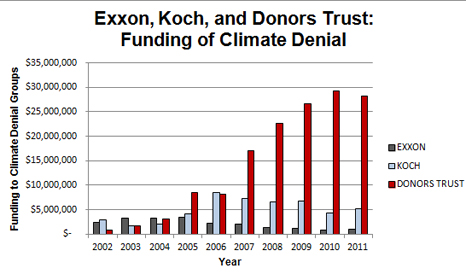
It will be difficult to bring the number down to anything approaching the amount of funding skeptics are said to get:
Trump’s climate science view that there is “some connectivity” between humans and climate is squarely a skeptical climate view. Trump explained, “There is some, something. It depends on how much.”
Trump’s views are shared by prominent skeptical scientists. University of London professor emeritus Philip Stott has said: “The fundamental point has always been this. Climate change is governed by hundreds of factors, or variables, and the very idea that we can manage climate change predictably by understanding and manipulating at the margins one politically selected factor (CO2) is as misguided as it gets.” “It’s scientific nonsense,” Stott added. Stott is featured in new skeptical climate change documentary Climate Hustle.
Trump cited his uncle, a skeptical MIT scientist: ‘My uncle was for 35 years a professor at M.I.T. He was a great engineer, scientist. He was a great guy. And he was … a long time ago, he had feelings — this was a long time ago — he had feelings on this subject.’ (Yes, other MIT scientists are very skeptical as well. See: MIT Climate Scientist Dr. Richard Lindzen Mocks 97% Consensus: ‘It is propaganda’
It is also worth noting that Trump’s often cited 2012 tweet about climate change stating “The concept of global warming was created by and for the Chinese in order to make U.S. manufacturing non-competitive,” was clearly a joke and he has said it was a joke. It is further worth noting that climate skeptics do not believe the concept of “climate change” was “created” by China.
And in what has been described as “fake news”, the publisher of NYT tried to sell CO2-induced storms to Trump; but Trump refused to accept the claim.<
NYT’s Arthur Sulzberger: ‘We saw what these storms are now doing, right? We’ve seen it personally. Straight up.’
Trump countered: ‘We’ve had storms always, Arthur.’
Trump is accurately citing the latest climate science by noting that extreme weather is not getting worse. See: 2016 ‘State of the Climate Report’
The U.S. has had no Category 3 or larger hurricane make landfall since 2005 – the longest spell since the Civil War.
Strong F3 or larger tornadoes have been in decline since the 1970s.
Sea level rise rates have been steady for over a century, with recent deceleration.
Droughts and floods are neither historically unusual nor caused by mankind, and there is no evidence we are currently having any unusual weather.
Trump’s claim to have an “open mind” on U.S. climate policy and his comment that “I’m going to take a look at” withdrawing from the UN Paris agreement are more nuanced than his previous blunt statements that the U.S. will cancel the UN agreement. But those comments in the context of the interview are hardly a flip-flop or major signal of changing views on the issue. … Full transcript
A University of Colorado professor who’s been criticized for his writings about climate change has been caught up in WikiLeaks’ dump of emails involving John Podesta, campaign chairman for Hillary Clinton.
The email was sent by Judd Legum, the editor of ThinkProgress, a site that’s part of the Center for American Progress Action Fund, the advocacy arm of the liberal think tank Center for American Progress, which was founded by Podesta in 2003.
In his email to billionaire environmentalist Tom Steyer, Legum described how he believed Climate Progress, the environmental arm of ThinkProgress, got Pielke to stop writing about climate change for FiveThirtyEight.
“I think it’s fair say that, without Climate Progress, Pielke would still be writing on climate change for 538,” Legum wrote.
Legum did not respond to interview requests on Wednesday.
The email was one of tens of thousands of messages from Podesta’s hacked Gmail account released by WikiLeaks this month.
The group took issue with Pielke’s piece titled “Disasters Cost More Than Ever —- But Not Because of Climate Change,” in which he questioned the link between rising natural disaster costs and climate change.
Pielke argued that the cost of disasters is increasing because the world is getting wealthier, not because there are more — or more intense — floods, droughts, hurricanes or tornadoes.
“We’re seeing ever-larger losses simply because we had more to lose — when an earthquake or flood occurs, more stuff gets damaged,” he wrote.
Pielke, who has written extensively about climate-change economics, is a polarizing figure among climate change scientists and activists.
Pielke refutes claims that he’s a climate-change skeptic or denier, pointing to his public support for a carbon tax. He says that many of the arguments he presents are supported by the Intergovernmental Panel on Climate Change.
The criticism of Pielke’s piece continued, with stories about Pielke and FiveThirtyEight founder Nate Silver appearing in Salon, Slateand the Huffington Post.
“Silver is still backing the wrong horse, and the sooner he dumps Pielke, the better,” David Auerbach wrote for Slate.
Shortly thereafter, Pielke stopped writing for FiveThirtyEight. In the email released by WikiLeaks, Legum gave ThinkProgress credit for that.
“I don’t think there is another site on the internet having this kind of impact on the climate debate,” Legum wrote of FiveThirtyEight.
In response, CU President Bruce Benson wrote that the university “did not discover any information indicating that Pielke’s funding sources influenced his research,” adding that Pielke confirmed that he received no funding from the oil and gas industry.
Pielke has more or less stopped writing about climate change. Since then, he’s focused his efforts on sports governance and is now the director of CU’s Sports Governance Center.
“They were ultimately successful in removing an academic from working on a topic,” Pielke said, adding that there’s “nothing like a political witch hunt to help you focus on career priorities.”
When he read the leaked email last week, Pielke said he wasn’t surprised by its contents.
“It spells out in black and white … that there was an organized, politically motivated campaign to damage my career and reputation, based on a perception that my academic research was thought to be inconvenient,” he said.
At a regular meeting in Denver, the regents passed a resolution 9-0 to send the message that “faculty and students must have complete freedom to study, to learn, to do research and to communicate the results of these pursuits to others.”
The principles of academic freedom are codified in regent laws, which govern the university. The board was restating its commitment to those principles on Thursday.
Though he was not mentioned in the resolution, Pielke was the motivating factor behind it, according to its author, Regent John Carson, a Republican from Highlands Ranch.
Pielke was the subject of a 2014 email sent by the editor of ThinkProgress, a website that’s part of the Center for American Progress Action Fund, the advocacy arm of the liberal think tank Center for American Progress.
In Judd Legum’s email to billionaire environmentalist Tom Steyer, Legum described how he believed the website got Pielke to stop writing about climate change for the data-focused news website FiveThirtyEight.
The email was part of an October WikiLeaks dump of emails involving John Podesta, the founder of the Center for American Progress and the chairman for Hillary Clinton’s presidential campaign.
Pielke and others described the email as evidence that there was a “politically motivated campaign” to damage his career and reputation. Ultimately, he stopped writing about climate change and now directs CU’s new Center for Sports Governance.
Carson said he felt that type of conduct was unacceptable and that he thought the board should show all CU faculty and researchers that it stands behind them.
“I want to go on record making clear that I don’t think this type of conduct is appropriate and we’re going to defend our faculty and we’re going to go on record, when we find out about these types of things, opposing it,” Carson said.
Pielke wrote for FiveThirtyEight that “human-caused climate change is both real and important,” but came under fire for an essay the website published in which he argued that rising natural disaster costs were not linked to climate change.
Reporters at ThinkProgress asked several climate scientists to weigh in on Pielke’s claims and published stories in which those scientists said Pielke’s claims were misleading. By Pielke’s count, the website has published more than 160 critical articles about him.
“There was inaccurate information being presented in his writing … We called a number of climate scientists and asked them about the claims he was making in this piece,” Legum told the Daily Camera last month. “They said that there were a lot of really inaccurate or misleading things, and we reported on that.”
In response, CU President Bruce Benson wrote that the university “did not discover any information indicating that Pielke’s funding sources influenced his research,” adding that Pielke confirmed that he received no funding from the oil and gas industry. […]
Though he did not attend the meeting, Pielke wrote in an email to the Daily Camera that he felt supported by the leaders of the university.
He said the bipartisan-backed resolution sent a strong message “to my faculty peers who may question whether it is worth participating in important debates of the day — that CU has their back.”
Chris Mooney is well known for biased and misleading reporting where climate change is concerned, but it is always sad to see otherwise respectable meteorologists such as Jason Samenow, one of the Capital Weather Gang, roped in as well, something that has become more frequent in recent years.
The simple reality, as Samenow should know, is that such departures above “normal” are not unusual during the colder months in the Arctic.
DMI have records back to 1954 for Arctic temperatures, and a quick trawl uncovers several similar instances, for instance 1972, 1974 and 1976:
The only difference was that these occurrences took place in January/February, rather than November. We should bear in mind that the 1970s were a time of expanding Arctic ice.
The Washington Post article actually explains what has been going on:
The Arctic is super-hot, even as a vast area of cold polar air has been displaced over Siberia…..
It’s about 20C [36 degrees Fahrenheit] warmer than normal over most of the Arctic Ocean, along with cold anomalies of about the same magnitude over north-central Asia,” Jennifer Francis, an Arctic specialist at Rutgers University, said by email Wednesday.
“The Arctic warmth is the result of a combination of record-low sea-ice extent for this time of year, probably very thin ice, and plenty of warm/moist air from lower latitudes being driven northward by a very wavy jet stream.”
The key is the comment about warm/moist air. Because of latent heat, when that moist air turns back to water, heat is given off, thus warming the atmosphere disproportionately.
Jennifer Francis has long claimed that the “wavy jetstream” is caused by melting Arctic ice. Yet HH Lamb found the same phenomenon in the 1960s and 70s, and believed it was caused by a colder Arctic!
Indeed, if we check out the GISS global temperature maps for the three years I have highlighted above, 1972, 1974 and 1976, we find very similar weather patterns, with very cold polar air displaced over Siberia and North America, along with warm air invading the Arctic.
TORONTO – Children who drink whole milk are leaner and have higher vitamin D levels than those who drink low-fat or skim milk, new research suggests.
Children who drank whole (3.25 per cent fat content) milk had a Body Mass Index score that was 0.72 units lower than those who drank 1 or 2 per cent milk in the study published today in the American Journal of Clinical Nutrition.
That’s comparable to the difference between having a healthy weight and being overweight, said lead author Dr. Jonathon Maguire, a pediatrician at St. Michael’s Hospital.
The study did not assess why consuming higher fat content milk was associated with lower BMI scores. But Dr. Maguire hypothesized that children who drank whole milk felt fuller than those who drank the same amount of low-fat or skim milk. If children don’t feel full from drinking milk, they are more likely to eat other foods that are less healthy or higher in calories, said Dr. Maguire. Therefore children who drink lower fat milk may actually consume more calories overall than those who drink whole milk.
The study also found that children who drank one cup of whole milk each day had comparable vitamin D levels to those who drank nearly 3 cups of one per cent milk. This could be because vitamin D is fat soluble, meaning it dissolves in fat rather than water. Milk with higher fat content therefore contains more vitamin D. There may also be an inverse relationship in children between body fat and vitamin D stores, according to the study; as children’s body fat increases, their vitamin D stores decrease.
“Children who drink lower fat milk don’t have less body fat, and they also don’t benefit from the higher vitamin D levels in whole milk,” said Dr. Maguire. “It’s a double negative with low fat milk.”
The study’s findings differ from Health Canada, National Institutes of Health and American Academy of Pediatrics guidelines recommending two servings of low fat (one per cent or two per cent) milk for children over the age of two to reduce the risk of childhood obesity.
Dr. Maguire said the findings indicated a need to closely examine existing nutritional guidelines around milk fat consumption to make sure they are having the desired effect. Childhood obesity has tripled in the past 30 years while consumption of whole milk has halved over the same period.
“What kind of milk our children should be consuming is something we need to seek the right answer for,” said Dr. Maguire.
For this study, researchers studied 2,745 children ages two to six years attending well-child visits. They surveyed parents, measured height and weight to calculate BMI and took blood samples to assess vitamin D levels. All were enrolled in the Applied Research Group for Kids (TARGet Kids!), collaboration between children’s doctors and researchers from St. Michael’s Hospital and The Hospital for Sick Children. The program follows children from birth with the aim of preventing common problems in the early years and understanding their impact on health and disease later in life.
Of those studied, 49 per cent drank whole milk, 35 per cent drank two per cent milk, 12 per cent drank one per cent milk and four per cent drank skim milk. Less than one per cent of children drank some combination of the four types of milk.
Back in March, I wrote that we need to wait until the data from Colombia are in. Well they are. Clearly there is some other cause of the reported fetal deformities. I don’t expect the “experts” to figure it out. Meanwhile, how many babies were needlessly aborted?
So . . . what can we expect from the Trump administration on environment/climate/energy?
There is much angst among the ‘greens’ about what to expect. This is typified by this morning’s headlines from the Huffington Post :
SET TO BOIL: Trump Racing to Scrap Landmark Climate Deal
China Calls Move Ludicrous… ‘GAME OVER’: Scientists Fear Disaster With Donald… ‘Election Of Donald Trump Could Be Devastating For Our Climate And Our Future’… ‘Trump Has A Profound Ignorance Of Science’… Donald Taps Climate-Change Skeptic To Dismantle EPA… Oil Exec Eyed For Sec. Of Interior… New Push For Keystone Pipeline Fires Up…
Lets take a closer look at what President-elect Trump has actually said in recent months, including his policy/issue statements.
Hoax
Whenever the issue of Trump and climate change comes up in the world of the ‘greens’, the first thing they mention is that he said climate change is a ‘hoax.’
Politifact has done a good job of summarizing this (January 2016):
The clearest example comes from a tweet sent by Trump on Nov. 6, 2012. “The concept of global warming was created by and for the Chinese in order to make U.S. manufacturing non-competitive.”
On Jan. 18, after Sanders had attacked Trump’s climate change views in the Democratic debate, Trump told Fox & Friends, “Well, I think the climate change is just a very, very expensive form of tax. A lot of people are making a lot of money. I know much about climate change. I’d be — received environmental awards. And I often joke that this is done for the benefit of China. Obviously, I joke. But this is done for the benefit of China, because China does not do anything to help climate change. They burn everything you could burn; they couldn’t care less. They have very — you know, their standards are nothing. But they — in the meantime, they can undercut us on price. So it’s very hard on our business.”
On Dec. 30, 2015, Trump told the crowd at a rally in Hilton Head, S.C., “Obama’s talking about all of this with the global warming and … a lot of it’s a hoax. It’s a hoax. I mean, it’s a money-making industry, OK? It’s a hoax, a lot of it.”
In August, he stated:
“I’m not a big believer in man-made climate change. Nobody knows for sure.”
Lets first look at the definition of ‘hoax’, here are a few I spotted by googling:
a humorous or malicious deception.
to trick into believing or accepting as genuine something false and often preposterous
a plan to deceive a large group of people
a deliberately fabricated falsehood made to masquerade as truth.
With these definitions in mind, here are two examples that qualify as hoaxes that I have previously written about:
The UNFCCC definition of ‘climate change’ arguably qualifies as a hoax: climate change is a change of climate which is attributed directly or indirectly to human activity that alters the composition of the global atmosphere and which is in addition to natural climate variability observed over comparable time periods. [link]. This perversion of the definition of ‘climate change’ was designed to mislead people into thinking that all climate change is caused by humans.
The propaganda from the UNFCCC that misleads people into thinking that the planned emissions reductions will have any discernible impact (that emerges from natural variability) on the 21st century climate [link], even if you believe the climate models.
So in terms of climate hoaxes, perhaps it is NOT Donald Trump’s whose pants are on fire.
Trump’s answers to ScienceDebate
ScienceDebate.org asked the Presidential candidates questions on a range of science-related issues. The answers to the climate change questions are [here]. Trump’s statement:
There is still much that needs to be investigated in the field of “climate change.” Perhaps the best use of our limited financial resources should be in dealing with making sure that every person in the world has clean water. Perhaps we should focus on eliminating lingering diseases around the world like malaria. Perhaps we should focus on efforts to increase food production to keep pace with an ever-growing world population. Perhaps we should be focused on developing energy sources and power production that alleviates the need for dependence on fossil fuels. We must decide on how best to proceed so that we can make lives better, safer and more prosperous.
Well, I find it difficult to argue with any of this. In fact, I like this statement quite a lot.
Paris
The big news over the weekend is that someone from Trump’s transition team has leaked that Trump plans to pull out of the Paris UNFCCC agreement [link].
Robert Stavins has a concise analysis of Trump’s road ahead re climate change [link]:
Trump, if we take him at his word, will try to pull the United States out of the Paris Agreement on tackling climate change. But it will take four years to do that, now that it has come into force. (It came into force quickly — with countries accounting for 55 percent of global emissions ratifying it — only because countries were afraid of Trump being elected, and wanted to lock the United States in.)
Despite the fact that the Obama administration has already submitted the instrument of ratification through executive agreement, Trump might submit the Paris Agreement to the Senate, where, of course, it would fail in a ratification vote. Or he might just announce that we will not comply with our already submitted nationally determined contributions, a 26 to 28 percent reduction below 2005 emissions by 2025. The big question is what effect all of this will have on the positions of China, India, Brazil, etc. It will surely not encourage greater action.
Domestically, he wants to “bring back the coal industry,” but the problems of the U.S. coal industry are competition from low-price natural gas for electricity generation, not environmental regulation. Also, that’s inconsistent with his pronouncements supporting fracking, because that increases gas supply and lowers gas prices, which hurts coal.
Could he try to amend the Clean Air Act itself? That would be unlikely to succeed, as Democrats in the Senate would filibuster, I assume. Would he eliminate the Environmental Protection Agency, as he also promised at one point? No, again that would require an act of Congress. But he could try to starve the agency through low funding. And he will be appointing people to hundreds of key positions.
Make America energy independent, create millions of new jobs, and protect clean air and clean water. We will conserve our natural habitats, reserves and resources. We will unleash an energy revolution that will bring vast new wealth to our country.
Declare American energy dominance a strategic economic and foreign policy goal of the United States.
Unleash America’s $50 trillion in untapped shale, oil, and natural gas reserves, plus hundreds of years in clean coal reserves. Become, and stay, totally independent of any need to import energy from the OPEC cartel or any nations hostile to our interests.
Open onshore and offshore leasing on federal lands, eliminate moratorium on coal leasing, and open shale energy deposits.
Encourage the use of natural gas and other American energy resources that will both reduce emissions but also reduce the price of energy and increase our economic output.
Rescind all job-destroying Obama executive actions. Mr. Trump will reduce and eliminate all barriers to responsible energy production, creating at least a half million jobs a year, $30 billion in higher wages, and cheaper energy.
Energy costs the average American household $5,000 per year. As a percentage of income, the cost is greater for lower-income families. [Fox News, Sept. 3, 2015]
Shale energy production could add 2 million jobs in 7 years.
The oil and natural gas industry supports 10 million high-paying Americans jobs and can create another 400,000 new jobs per year. [The New York Times, June 20, 2015]
EPA
Anyone interested in the environment is abuzz with the news that Myron Ebell is leading the transition re the Environmental Protection Agency (EPA). This Wikipedia article summarizes why the ‘greens’ would be alarmed at this appointment.
The Hill has an interesting article: Myron Ebell is Perfectly Suited to Lead the Transition. Excerpts:
Consequently, Ebell has expressed concern about EPA positions, including the Clean Power Plan. The EPA’s controversial power plan is based on an inadequate understanding of global warming and should not drive our middle class into energy poverty against congressional will.
It is critical to understand that while the federal government, through Congress, establishes the overall goals of environmental protection through laws like the Clean Air and Water acts, the implementation of those laws is by state governments.
State governments and their citizens have demonstrated the ability to implement programs that protect our environment without destroying the very thing that makes environmental protection possible: a strong economy.
Over the last eight years the Obama administration has abandoned this successful approach to environmental protection as envisioned by Congress. Instead, they have turned to special interest groups to drive centralized planning. Prime examples include the 2015 EPA Power Plan and the Waters of the United States (WOTUS) rule.
These rules contain illusory flexibility to states when in reality they represent a huge shift of control from states to the federal government. Even the current administration acknowledged that the power plan was symbolic and would do little to improve air quality.
The power plan would be expensive and shut down energy plants that have not yet been paid for, thereby stranding those costs with ratepayers. It would harm the industrial sector by significantly increasing electricity rates, which would throttle manufacturing industries that require low energy prices to compete.
Similarly, under WOTUS land use decisions would be federalized. Our nation’s agricultural industry would be hamstrung by costly and unnecessary land use restrictions, which would stifle growth opportunities. The expansion of manufacturing, commercial and residential development would be left to federal bureaucrats.
Fortunately, dozens of states and state agencies stood their ground against the federal government and won stays against these rules. We hope the Trump EPA will review existing rules and base its policy decisions on sound data and measurable results.
History has demonstrated time and again that just as “all politics is local,” so is environmental protection. State and local governments know best how to apply the many tools available to protect the environment and public health.We still need the EPA, but not the EPA of the past.
Returning control of our environment to the states also limits the dark money from self-serving lobbyists and deep-pocketed special interest groups masquerading as environmentalists.
Environment
I spotted this statement from Trump on the Wikipedia:
Everyone deserves clean air and safe drinking water regardless of race or Water infrastructure will be a big priority. We need to work to protect natural areas, but in a balanced way. End Obama EPA mandates that cost too many jobs, are opposed by most states, and too often have negligible benefit for the environment.
Sep 16, 2016
One of his tweets:
“Give me clean, beautiful and healthy air – not the same old climate change (global warming) bullshit! I am tired of hearing this nonsense.”
Don Jr. told reporters: “[W]e’ve broken away from a lot of traditional conservative dogma on the issue, in that we do want federal lands to remain federal.”
Trump himself put it like so to Field & Stream last January: “I mean, are they going to sell if they get into a little bit of trouble? And I don’t think it’s something that should be sold. We have to be great stewards of this land. This is magnificent land.”
The next month, however, Don Jr. gave a more nuanced reply to a reporter’s question about revised leasing requirements coming into place on some federal lands, to enhance protections. “We do have to preserve those lands, and what I’ve seen thus far has been pretty reasonable,” young Don asserted.
JC reflections
In my post Trumping the elites, I stated that Trump’s election provided an opportunity for a more rational energy and climate policy. Many in the blog comments and the twitosphere found this to be an incomprehensible statement.
Here is what I think needs to be done, and I do see opportunities for these in a Trump administration:
a review of climate science that includes a faithful and transparent representation of uncertainties in 21st century projections of global and regional climate change
reopening of the ‘endangerment’ issue, as to whether warming is ‘dangerous’
a do-over on assessing the social cost of carbon, that accounts for full uncertainty in the climate model simulations, the integrated assessment models and their inputs.
support funding for Earth observing systems (satellite, surface, ocean) and research on natural climate variability.
Even if politics are to ‘trump’ the conclusions of these analyses, it would be clear that the Trump administration has done its due diligence on this issue in terms of gathering and assessing information. If the Trump administration were to accomplish the first 3 items, they might have a scientifically and economically defensible basis for pulling out of the Paris agreement and canceling Obama’s Clean Power Plan.
Environmentalists and ‘greens’ should look for the promising avenues to work with Trump, e.g.:
Trump is clearly a supporter of clean water and clean air
Trump seems dedicated to being a good custodian of federal lands (don’t underestimate Don Jr’s influence on this one)
Trump wants the U.S. to be energy independent; this is easier without an over reliance on fossil fuels
Trump seems to support win-win energy solutions; e.g. solutions that reduce cost and increase energy security while at the same time reducing emissions.
Trump is a builder that wants to improve water infrastructure, which will help ameliorate the impacts of droughts and floods.
Working together on these issues would be a good start, if the ‘greens’ can get past the climate hoax thing. Donald Trump does not seem to be particularly beholden to the fossil fuel sector.
Is this end times for environmental progress or, more specifically, climate progress? No. The bad news about climate change is, in a way, the good news:
The main forces determining emission levels of heat-trapping carbon dioxide will be just as much out of President Trump’s hands as they were out of President Obama’s. The decline in the United States has mainly been due to market forces shifting electricity generation from coal to abundant and cheaper natural gas, along with environmental regulations built around the traditional basket of pollutants that even conservatives agreed were worth restricting. (Efficiency and gas-mileage standards and other factors have helped, too, of course.)
At the same time, the unrelenting rise in greenhouse-gas emissions in developing countries is propelled by an unbending reality identified way back in 2005 by British Prime Minister Tony Blair, when he said, “The blunt truth about the politics of climate change is that no country will want to sacrifice its economy in order to meet this challenge.”
At the same time, as well, other fundamental forces will continue to drive polluted China and smog-choked India to move away from unfettered coal combustion as a path to progress. An expanding middle class is already demanding cleaner air and sustainable transportation choices — just as similar forces enabled pollution cleanups in the United States in the last century.
That’s why the Paris Agreement on climate change will continue to register progress on emissions and investments in clean energy or climate resilience, but only within the limits of what nations already consider achievable .
So if you’re a working-class family, and dad has to drive 50 miles to get to his job, and he can’t afford to buy a Tesla or a Prius, and the most important thing to him economically to make sure he can pay the bills at the end of the month is the price of gas, and when gas prices are low that means an extra 100 bucks in his pocket, or 200 bucks in his pocket, and that may make the difference about whether or not he can buy enough food for his kids — if you just start lecturing him about climate change and what’s going to happen to the planet 50 years from now, it’s just not going to register.
According to American media, defense news outlets, and independent analysts, the 12-day Israeli military aggression against Iran significantly depleted the US stockpile of THAAD (Terminal High Altitude Area Defense) interceptor missiles.
Citing official sources, American magazine Newsweek reported on Friday that the US transferred a substantial portion of its advanced missile defense capabilities to support the Israeli regime, an effort with questionable results and a critical impact on US strategic reserves.
THAAD, developed by Lockheed Martin arms manufacturing company, is a key component of Israel’s multi-layered air defense architecture. It is designed to intercept medium-range ballistic missiles, including those launched from Iran and Yemen.
The US-made system is capable of targeting short-, medium-, and intermediate-range ballistic missiles during their terminal phase, whether inside or outside Earth’s atmosphere.
THAAD uses a “hit-to-kill” method, relying on kinetic energy rather than explosive warheads to destroy incoming threats, intercepting at altitudes of up to 150 km and ranges between 150-200 km.
Operated exclusively by American personnel, the US military maintains eight THAAD batteries with an estimated 350–400 interceptors in total. The eighth battery was activated during the June 20 Israeli aggression against Iran and is capable of intercepting hypersonic missiles. … continue
This site is provided as a research and reference tool. Although we make every reasonable effort to ensure that the information and data provided at this site are useful, accurate, and current, we cannot guarantee that the information and data provided here will be error-free. By using this site, you assume all responsibility for and risk arising from your use of and reliance upon the contents of this site.
This site and the information available through it do not, and are not intended to constitute legal advice. Should you require legal advice, you should consult your own attorney.
Nothing within this site or linked to by this site constitutes investment advice or medical advice.
Materials accessible from or added to this site by third parties, such as comments posted, are strictly the responsibility of the third party who added such materials or made them accessible and we neither endorse nor undertake to control, monitor, edit or assume responsibility for any such third-party material.
The posting of stories, commentaries, reports, documents and links (embedded or otherwise) on this site does not in any way, shape or form, implied or otherwise, necessarily express or suggest endorsement or support of any of such posted material or parts therein.
The word “alleged” is deemed to occur before the word “fraud.” Since the rule of law still applies. To peasants, at least.
Fair Use
This site contains copyrighted material the use of which has not always been specifically authorized by the copyright owner. We are making such material available in our efforts to advance understanding of environmental, political, human rights, economic, democracy, scientific, and social justice issues, etc. We believe this constitutes a ‘fair use’ of any such copyrighted material as provided for in section 107 of the US Copyright Law. In accordance with Title 17 U.S.C. Section 107, the material on this site is distributed without profit to those who have expressed a prior interest in receiving the included information for research and educational purposes. For more info go to: http://www.law.cornell.edu/uscode/17/107.shtml. If you wish to use copyrighted material from this site for purposes of your own that go beyond ‘fair use’, you must obtain permission from the copyright owner.
DMCA Contact
This is information for anyone that wishes to challenge our “fair use” of copyrighted material.
If you are a legal copyright holder or a designated agent for such and you believe that content residing on or accessible through our website infringes a copyright and falls outside the boundaries of “Fair Use”, please send a notice of infringement by contacting atheonews@gmail.com.
We will respond and take necessary action immediately.
If notice is given of an alleged copyright violation we will act expeditiously to remove or disable access to the material(s) in question.
All 3rd party material posted on this website is copyright the respective owners / authors. Aletho News makes no claim of copyright on such material.



 Aletho News
