Glyphosate and Atrazine: EPA posts, then retracts, reports on top herbicide chemicals
RT | May 6, 2016
The EPA recently posted online reports on two disputed herbicide chemicals, only to pull them offline shortly afterwards. The reports said glyphosate was not a human carcinogen and atrazine caused reproductive harm to mammals.
On April 29, the EPA’s cancer assessment review committee (CARC) posted an 86-page report on the agency’s regulations.gov website that stated glyphosate, the main ingredient in Monsanto’s Roundup weed killer that was deemed a “probable” human carcinogen by the World Health Organization last year, “was not likely to be carcinogenic to humans,” Reuters reported.
On May 2, the EPA pulled the report offline, saying the action was taken “because our assessment is not final,” and that the “preliminary” documents were “inadvertently” published.
“EPA has not completed our cancer review,” the EPA told Reuters. “We will look at the work of other governments as well as work by (the U.S. Department of Health and Human Services’) Agricultural Health Study as we move to make a decision on glyphosate.”
However, the cover page of the documents was titled “final Cancer Assessment Document,” Reuters reported, and the word “FINAL” was printed on each page of the report, dated October 1, 2015. The EPA said the assessment — part of the first comprehensive safety review of the chemical since 1993, which will determine glyphosate use in the US over the next 15 years — will be complete by the end of 2016.
Critics of glyphosate ridiculed the EPA for its short-lived assessment, while the chemical’s supporters, including agribusiness giant Monsanto, hailed the report for endorsing glyphosate’s safety. Monsanto even posted a copy of it on its website.
“Pulling the report indicates lack of confidence in the outcome,” tweeted Nathan Donley, a scientist for the Center for Biological Diversity. “Can’t blame them, the analysis is terrible.”
The glyphosate documents indicated that the EPA was “relying heavily on unpublished, industry funded studies” in its assessment that glyphosate is not a human carcinogen, the Center for Biological Diversity said. In contrast, the World Health Organization’s view that glyphosate is a “likely” human carcinogen included studies that were publicly available and that took into account consumer products.
“All they’re doing is reviewing studies that are funded by the industry,” Jennifer Sass, a senior scientist at Natural Resources Defense Council, told Reuters.
In 1974, Monsanto began selling the chemical in Roundup, which has become a top bioicide for farming, especially involving genetically-engineered crops, and home and garden uses.
“No pesticide regulator in the world considers glyphosate to be a carcinogen, and this conclusion by the U.S. EPA once again reinforces this important fact,” said Hugh Grant, Monsanto’s CEO.
The use of glyphosate in herbicides has increased by more than 250 times in the United States over the last 40 years, according to the New England Journal of Medicine. Long-term exposure to glyphosate has been linked to kidney and liver damage, as well as cellular and genetic diseases. Monsanto and defenders of glyphosate use called the World Health Organization’s carcinogen classification too “dramatic” and have pointed to assurances that the chemical is safe.
In April, the European Parliament approved the seven-year reauthorization of glyphosate, though it recommended the chemical should be used only by professionals and not in public places.
Atrazine
Around the same time it pulled the glyphosate assessment off its website, the EPA similarly published and retracted a less-flattering report on the herbicide atrazine, which was banned in Europe in 2004. Atrazine is legal in the US, where it is second only to glyphosate among most-used agricultural herbicides.
Atrazine is manufactured by agrochemical corporation Syngenta. At least 60 million pounds of the chemical is used in the US each year, mainly on corn fields, according to the Natural Resources Defense Council. US agencies and other researchers have found high levels of atrazine in groundwater and drinking water near agricultural and rural areas. Atrazine is known to be an endocrine disruptor and has been linked to hormonal defects and some types of cancer in humans.
On April 29, an EPA assessment on atrazine was posted on the agency’s website but subsequently taken down. The documents are available here. The assessment said atrazine was found to cause reproductive harm to birds and mammals, exceeding by 200 times the EPA’s “levels of concern.” Amphibians were found to be especially at-risk from atrazine exposure, echoing research by scientists at the University of California, Berkeley, who found that about three-quarters of male frogs are castrated by the chemical.
“When the amount of atrazine allowed in our drinking water is high enough to turn a male tadpole into a female frog, then our regulatory system has failed us,” said Donley, the Center for Biological Diversity scientist. “We’ve reached a point with atrazine where more scientific analysis is just unnecessary — atrazine needs to be banned now.”
Like glyphosate, atrazine is undergoing a 15-year safety review by the EPA. The previous of such assessments on atrazine occurred in 2003.
Syngenta, atrazine’s maker, touts the chemical’s safety on its website, claiming it is not “physically possible to dissolve enough atrazine in water to have any impact on hormones or human health.”
“No one has, ever will, or ever could be exposed to enough atrazine in the natural environment to affect their reproductive health,” the chemical giant says.
Read more:
Quaker Oats sued for use of glyphosate in ‘100% natural’ products
Climate Hustle, Are they trying to control the climate . . . or you?
By Judith Curry | Climate Etc. | May 2, 2016
Marc Morano has a new movie, Climate Hustle.
CLIMATE HUSTLE, hosted by award-winning investigative journalist Marc Morano, reveals the history of climate scares including global cooling; debunks outrageous claims about temperatures, extreme weather, and the so-called “consensus;” exposes the increasingly shrill calls to “act immediately before it’s too late,” and in perhaps the film’s most important section, profiles key scientists who used to believe in climate alarm but have since converted to skepticism.
The movie had a red carpet premiere last December in Paris, and was shown last week in a Congressional briefing.
The film will be aired in 500 theaters in the U.S. (and one in Canada) on May 2 in a one night theater event. Locations and showtimes can be found [here].
Video clips including trailers, interviews with Morano, and other clips are found on the Climate Hustle web page [link]. A list of scientists interviewed in film is found [here].
An interesting interview with Marc Morano about the film is found [here].
Let me start by discussing my take on Marc Morano, and why I agreed to be interviewed for his movie. I first heard of Marc Morano circa 2006, from Joe Romm. Romm’s take on Morano was basically that of the climate ‘anti-Christ.’ I then put ClimateDepot on my list of blogs to monitor, to check up on what the ‘evil’ side in the climate debate was up to. I slowly built up an understanding of what Morano was doing, and I didn’t regard all of it as negative.
At some point (probably around the time of Climategate) I found myself on the same email list as Marc Morano, and we exchanged a few emails on issues of common interest. Circa 2010 (if my memory serves) I referred to Marc Morano as a ‘demagogue’ (I can’t find this anywhere on the internet). Marc was offended, we discussed this on email, and I raised my concern about his attacks on individual climate scientists that included publishing their email addresses, etc. We declared sort of a truce on this, and we agreed to point out to each other if we spotted inappropriate behaviors.
Subsequently, I’ve met Marc several times, and I have to say I like the guy. He’s smart and he’s funny (he pokes fun at both sides), and as far as I can tell he is honest. When he asked to interview me for the movie, I agreed to do it. The interview itself was really fun. I have no complaints about how I was portrayed in the movie.
I saw an earlier version of the film in November, prior to the Paris premiere. I wasn’t quite sure what to expect, but my initial reaction was relief that there were no goofy or incredible statements about the science. I found the movie to be pretty entertaining and even interesting, especially the narratives developed around silly alarmist statements made by scientists and politicians.
I thought the selection of featured scientists was quite good. It included some new faces that were quite effective – Caleb Rossiter, Robert Giegengack, Richard Tol, Daniel Botkin were especially good.
The budget for this was shoestring, I think it was less than $500K (somewhere I recall seeing a $20M budget for Merchants of Doubt movie, this may not be correct). Financials for Merchants of Doubt movie: $192K at the box office, with an additional $114K from home video sales (JC note: Merchants of Doubt movie was discussed in this previous post). It will be interesting to see how Climate Hustle does at the box office (and in subsequent home video sales).
I’m sure people will criticize me for participating in this, but then these are the people that have pretty much already sent me to Coventry, so . . . so what.
The key issues surrounding the movie are reflected in these quotes from Randy Olson and Bill Nye:
“I also think [Morano]’s a danger to the efforts of the climate movement”
“I think it will expose your point of view as very much in the minority and very much not in our national interest and the world’s interest.”
Chip Knappenberger tweetrd re Nye’s ‘national interest’ statement: “Sounds like Nye should work for the State Department.”
Well, I will make no attempt to arbitrate what is in the national interest, but a reminder of minority rights in a constitutional democracy seems in order:
Thomas Jefferson, third President of the United States, expressed this concept of democracy in 1801 in his First Inaugural Address. He said,
All . . . will bear in mind this sacred principle, that though the will of the majority is in all cases to prevail, that will to be rightful must be reasonable; that the minority possess their equal rights, which equal law must protect and to violate would be oppression.
In every genuine democracy today, majority rule is both endorsed and limited by the supreme law of the constitution, which protects the rights of individuals. Tyranny by minority over the majority is barred, but so is tyranny of the majority against minorities.
The perspective in Climate Hustle is arguably a minority perspective, at least in terms of world governments and a select group of scientists. Randy Olson comments on this:
There is a need for opposition voices and questioning. If anyone feels threatened by this movie it would have to mean you’re conceding that the communication skills of the environmental side are really bad — which actually they are, so maybe there should be some cause for concern.
So, I hope some of you will be able to see the movie on May 2, I look forward to your reactions.
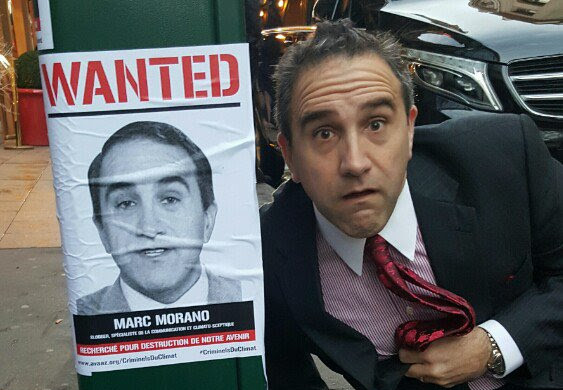
Marc Morano posing with his ‘Climate Criminal’ wanted poster in the streets of Paris
House committee holds hearing on modernizing US nuclear infrastructure
RT | April 30, 2016
The House Energy and Commerce Subcommittee held a hearing on a bill intended to streamline nuclear power regulatory rules, in order to allow safer and more efficient next-generation reactors to replace those being decommissioned.
The Advanced Nuclear Technology Development Act of 2016 (HR 4979), introduced by Representative Bob Latta (R-Ohio), was discussed during a Friday hearing of the House Energy and Commerce Subcommittee to reduce regulatory hurdles for building advanced reactors. “Advanced” being defined as having significant improvements over contemporary nuclear reactor, such as better “inherent safety features, lower waste yields, greater fuel utilization, superior reliability, resistance to proliferation, and increased thermal efficiency.”
Currently, the Nuclear Regulatory Commission (NRC) demands a complete and final design from potential nuclear developers. This, combined with expensive reviews that developers pay out of pocket, can deter potential startups with a multimillion dollar price tag with no assurance of ever being allowed to operate. The bipartisan panel’s tenor was that this needs to change.
“The future of the nuclear industry needs to start now, and the Nuclear Regulatory Commission needs to be able to provide the certainty the provide sector needs to invest in innovative technologies.” Goodlatte said at the hearing. “As the United States looks to the future, more energy will be needed, and Nuclear power provides reliable, clean baseload power option.
“Investment in new technology is already happening, with approximately 50 companies in this country working to develop the next generation of nuclear power. It’s time to insure that the NRC provides a framework so that innovators and investors can prepare to apply to licensing technologies.”
In order to create a conducive environment for investment in next-generation plants, HR 4979 would require the NRC to implement a new framework to streamline nuclear plant licensing, making it more efficient and cost-effective to investors by 2019. The commission would have to submit to an implementation plan for such a framework within 180 days of the enactment of the law.
The US’s 99 operational nuclear energy plants provide nearly 20 percent of the country’s power, but approximately 126,000 megawatts of nuclear power generation is set to be retired over the next 15 years. At the same time, the US Energy Information Administration forecasts a need for 287,000 megawatts of new electric capacity by 2040 – on top of replacing the electric capacity that is needed to replace the retired power plants.
This reality, combined with the fact that nuclear power produces no greenhouse gasses, has led to environmentally-conscious lawmakers on the committee making common cause with their innovation-minded colleagues worried about falling behind international competitors.
“Our nation will, by necessity, diminish its dependence on fossil fuels in order to fight climate change. And as we do so, we will need to turn more and more to nuclear power,” said Representative Jerry McNerney (D-Illinois), who co-signed the bill.
The hearing comes at a time of renewed anxiety about aging nuclear power infrastructure. Earlier this month, a Manhattan Project-era nuclear storage facility in Washington state had up to 3,500 gallons of waste leaking out. However, the Washington Department of Ecology said that there was no risk to the environment or nearby residents.
US Energy Envoy Flies to Kuwait, Qatar, Egypt and Israel for Discussions
Sputnik — 18.04.2016
WASHINGTON – The US government has sent Special Envoy Amos Hochstein to Kuwait, Qatar, Egypt and Israel to discuss falling oil prices after the failure of the Doha energy talks, the US Department of State announced in a media note on Monday.
“Special Envoy and Coordinator for International Energy Affairs Amos J. Hochstein will be travelling to the region to meet with key interlocutors in Jerusalem, Cairo, Kuwait City and Doha,” the note stated.
As global oil prices remain near record lows, and the United States emerges as a global exporter of liquefied natural gas, Hochstein will be seeking to strengthen US relationships with partners in the region as well as discuss strategies for addressing the market realities of the energy sector, the note explained.
Hochstein will discuss energy security issues in Israel, power generation issues in Egypt and plans to investment in developing new oil fields and build additional oil refineries in Kuwait, the State Department pointed out.
In Qatar, Hochstein will give a speech emphasizing US support for liquefied natural gas development and its role in reducing global carbon emissions, the note said.
At the Intersection of Zionism and Social Justice
By Michael Howard | Dissident Voice | March 25, 2016
In her oily, cringe-inducing and totally predictable speech to AIPAC on March 21, Hillary Clinton argued that, since (according to her) “anti-Semitism is on the rise across the world… we must repudiate all efforts to malign, isolate and undermine Israel and the Jewish people.” In other words, we must do what we can to shut down any legitimate criticism of Israeli policy. A reliable means of doing so is to conflate said criticism with anti-Semitism and thus vilify the critic in question. This particular strategy has been perfected and institutionalized for decades, and was perhaps best deconstructed by Norman Finkelstein in “The Holocaust Industry.”
By dismissing BDS advocates as irrational, Jew-hating troublemakers, Hillary Clinton, the great bastion of liberalism and progress, makes common cause with the jingoist far right (where she actually belongs). But she also makes common cause with a good chunk of US academia, where criticism of Israel and its atrocities is often met with censorship and intimidation. In a comprehensive report on the subject, Palestine Legal details the extent of the suppression: “From January 2014 through June 2015, Palestine Legal interviewed hundreds of students, academics and community activists who reported being censored, punished, subjected to disciplinary proceedings, questioned, threatened, or falsely accused of anti-Semitism or supporting terrorism for their speech in support of Palestinian rights or criticism of Israeli policies.”
Needless to say, this is a gross violation of First Amendment rights, and it needs to be challenged at every opportunity. The university system is based on the principles of free inquiry and unfettered discourse; absent the open exchange of conflicting ideas and opinions, academia is essentially worthless. When certain viewpoints are institutionally favored, colleges cease to be places of learning and instead become places of indoctrination. Who could desire such a circumstance? Well, apart from authoritarians, fascists, religious fanatics (including Zionists) and Hillary Clinton, it’s becoming more and more apparent that “liberal” student activists do.
On college campuses across the country, students are mobilizing and protesting against institutionalized discrimination. Few on the left would argue that this is a negative development. After all, if nothing else these students are contesting authority—a noble and worthy exercise in itself. However, what do we say when fundamental democratic values like free speech are subordinated to an ideology? This is the precarious situation in which many student activists currently find themselves. It’s bizarre: presumably, the students protesting at places like Yale and the University of Missouri (to take two high-profile examples from last year) would stand with the BDS activists who are targeted and censored by pro-Israel forces. And yet these same students—exhibiting a degree of schizophrenia—would have their own ideological opponents treated in the same fashion.
Take a recent incident. At Emory College in Atlanta, some students used chalk to write “Trump 2016”—and other similarly anodyne messages—throughout the campus. Curiously (or perhaps not at this point), controversy erupted when a number of students declared that they felt physically threatened by the chalk drawings, which were considered by some to be acts of violence. “I thought we were having a KKK rally on campus,” one student reportedly told the Daily Beast. She “legitimately feared for [her] life.” Another student said that “some of us were expecting shootings” and thus “feared walking alone.” They demanded that the Emory administration identify the perpetrators, presumably so some sort of disciplinary action could take place—perhaps a public flogging. When the administration responded with a tepid defense of the anonymous chalkers’ right to free speech, the offended shifted their ire onto the college itself, for failing to provide an adequate safe space. All of which is par for the course by now.
So here we have a conflation of Donald Trump supporters with homicidal white supremacists; of political campaigning with physical violence. This is not dissimilar to the conflation of BDS with anti-Semitism, which plagues Palestinian rights activists everywhere. In fact, it’s closer to the profoundly stupid idea that all Muslims endorse terrorism—a notion that the offended students at Emory surely find abhorrent. There is one obvious distinction that must be made: the censorship of BDS on college campuses comes from the top, while the attempted censorship of Donald Trump supporters comes from the comparatively impotent student body. The former case is a much graver threat to free speech, but that is not an excuse to ignore the latter. Soon enough the student body will hold positions of authority.
ESP seems to be a trait common to advocates of censorship. For example, in a recent pro-Israel memo from the Regents of the University of California, it is contended that “opposition to Zionism often is expressed in ways that are not simply statements of disagreement over politics and policy, but also assertions of prejudice and intolerance toward Jewish people and culture.” Translation: the mind readers at the Regents of the University of California can tell when critics of Israel are actually rabid Jew-haters, and they will adjudicate such cases accordingly. Similarly, the would-be student censors use their clairvoyance to judge when an opinion they don’t like is motivated by race hatred or some other form of bigotry. Support for Donald Trump, as we have already seen, implies a desire to kill minorities. It is therefore no different from real physical violence.
What would happen if an entire college was founded on this line of thinking? A recent petition drawn up by some student activists at Western Washington University spells it out for us. The group calls themselves the Student Assembly for Power and Liberation, which is more than a little ominous-sounding. In their own words: “We are a growing group of students from a multitude of communities and disciplines around campus combatting the systemic oppression embedded within our society that is inevitably upheld through this institution, as it was created to uphold white supremacy at its core.”
Note the aggressively bureaucratic language (the grammar of which unravels throughout the petition). Prolixity of this sort is often employed by postmodernist academics—in whose tradition these students are working—for reasons that aren’t entirely clear. Noam Chomsky once argued that, in general, postmodernism “allows people to take a radical stance—more radical than thou—but to be completely dissociated from anything that’s happening, for many reasons. One reason is nobody can understand a word they’re saying. So they’re already dissociated. It’s kind of like a private lingo.”
Obviously, Michel Foucault these kids are not, but the postmodernist influence is plain to see. It’s like that smug kid in your Creative Writing workshop whose stories are all cheap Bukowski imitations. They don’t really have any idea what they’re doing, but they’re busting with self-satisfaction nevertheless.
What these students want, and what their petition is meant to facilitate, is the creation of a brand new college: the College of Power and Liberation. The function of this hypothetical college would be the “development of academic programs that are committed to social justice.” The first step in realizing this goal is “a cluster hire of ten tenure-track faculty to teach at the college.” Fair enough. However, there is something of a catch: “the Student Assembly for Power and Liberation will have direct input and decision-making power over the hiring of faculty for the college.”
That’s right—the professors at the College of Power and Liberation are to be hired by the students attending that college. The “power,” then, is to reside entirely in the hands of the student body. Naturally, they also reserve the right to take “disciplinary action” against “everyone in a teaching position within the university.” And it gets weirder. Demanded in part three of the petition is “the creation and implementation of a 15 persxn [sic] paid student committee, The Office for Social Transformation.”
The misspelling of “person” here is deliberate, as is the discontinuous misspelling of “history” (hxstory) later on. The implication is that these nouns are gendered (person, history) and thus microaggressive residue of an outmoded patriarchal system of thought. Therefore they have been changed. This, I suppose, is an example of the “de-colonial work” for which the College of Power needs “an annually dedicated revenue of $45,000.”
The Office for Social Transformation doesn’t just sound Orwellian—it quite literally is. Here is its express purpose: “to monitor, document, and archive all racist, anti-black, transphobic, cissexist, misogynistic, ablest, homophobic, islamophobic, xenophobic, anti-semitism [sic], and otherwise oppressive behavior on campus.” This oppressive behavior, the petition continues, is regularly found “in faculty curriculum.” By that I assume they mean curriculum including books with controversial subject matter, for instance the novels of James Baldwin and Mark Twain. So much for the English professors who wish to teach the “Adventures of Huckleberry Finn”—a terribly oppressive book.
The petition does not explicitly propose thought crime legislation, but it doesn’t rule it out either. One inevitably wonders about the criteria by which a person’s behavior is judged oppressive (i.e., punishable). For example, what becomes of the student or faculty member who is caught reading Kipling? Surely owning a copy of The Cantos is grounds for disciplinary action—Ezra Pound was a bona fide fascist. Hemingway was anti-Semitic and homophobic: it follows that The Sun Also Rises is beyond the pale. Tolstoy abused his wife, and so reading War and Peace implies an endorsement of misogyny.
Simone de Beauvoir once appealed to the censors of her time: “Must we burn [the Marquis de] Sade?” Indeed we must—and most others, for that matter.
Never fear, though: the College of Power and Liberation has a “three-strike disciplinary system that corresponds to citations that are processed.” Thank heavens for the three-strike disciplinary system, without which people might be fired and expelled unreasonably.
You get the picture. The mini despots comprising the so-called Student Assembly for Power and Liberation are concerned very much with Power and very little with Liberation. Their ultimate goal is to establish a totalitarian microcosm of a state, very far removed from reality, in which power and wealth is concentrated in the hands of a few self-righteous 20-somethings with delusions of grandeur. Because the First Amendment is overrated anyway.
The Holocaust Industry would be proud. And that’s what makes all of this so distressing. If so-called liberal student activists believe in censorship (and many of them evidently do), who can we rely on to challenge the unconstitutional suppression of BDS activism on college campuses? It necessarily devolves into a battle of hypocrites: the right rationalizes their brand of censorship while condemning the left’s, and vice versa. The reality is that both need to be condemned, because both represent explicit attacks on basic democratic principles. The crucial difference, I suppose, is that the Zionists (who know exactly what they’re doing) must be fought, while the overzealous students (who don’t) need merely to be educated. We can and should do both at once.
Michael Howard is a freelance writer from Buffalo, NY. He can be reached at mwhowie@yahoo.com .
WaPo slams Trump on climate because nuke weapon explosion is ‘hypothetical’
Junk Science | March 23, 2016
“The problem with this response is that man-made climate change is real and happening now. The detonation of a nuclear bomb is a hypothetical.”
From the WaPo :

It’s Not Just Cancer! Radiation, Genomic Instability and Heritable Genetic Damage
By Chris Busby | CounterPunch | March 18, 2016
Those who fear the effects of radiation always focus on cancer. But the most frightening and serious consequences of radiation are genetic.
Cancer is just one small bleak reflection, a flash of cold light from a facet of the iceberg of genetic damage to life on Earth constructed from human folly, power-lust and stupidity.
Cancer is a genetic disease expressed at the cellular level. But genetic effects are transmitted across the generations.
It was Herman Joseph Muller, an American scientist, who discovered the most serious effects of ionizing radiation – hereditary defects in the descendants of exposed parents – in the 1920s. He exposed fruit flies – drosophila – to X-rays and found malformations and other disorders in the following generations.
He concluded from his investigations that low dose exposure, and therefore even natural background radiation, is mutagenic and there is no harmless dose range for heritable effects or for cancer induction. His work was honoured by the Nobel Prize for medicine in 1946.
In the 1950s Muller warned about the effects on the human genetic pool caused by the production of low level radioactive contamination from atmospheric tests. I have his original 1950 report, which is a rare item now.
Muller, as a famous expert in radiation, was designated as a speaker at the Conference, ‘Atoms for Peace’ in Geneva in 1955 where the large scale use of nuclear energy (too cheap to meter) was announced by President Eisenhower. But when the organisers became aware that Muller had warned about the deterioration of the human gene pool by the contamination of the planet from the weapon test fallout, his invitation was cancelled.
The Wonderful Wizard of Oz
The protective legislation of western governments does, of course, concede that radiation has such genetic effects. The laws regulating exposure are based on the risk model of the International Commission on Radiological Protection, the ICRP.
The rules say that no one is allowed to receive more than 1mSv of dose in a year from man-made activities. The ICRP’s scientific model for heritable effects is based on mice; this is because ICRP states that there is no evidence that radiation causes any heritable effects in humans.
The dose required to double the risk of heritable damage according to the ICRP is more than 1000mSv. This reliance on mice has followed from the studies of the offspring of those who were present in Hiroshima and Nagasaki by the Japanese/ US Atomic Bomb Casualty Commission (ABCC).
These studies were begun in 1952 and assembled groups of people in the bombed cities to compare cancer rates and also birth outcomes in those exposed at different levels according to their distance from the position of the bomb detonation, the hypocentre. The entire citadel of radiation risk is built upon this ABCC rock.
But the rock was constructed with smoke and mirrors and everything about the epidemiology is false. There have been a number of criticisms of the A-Bomb Lifespan Studies of cancer: it was a survivor population, doses were external, residual contamination was ignored, it began seven years after the event, the original zero dose control group was abandoned as being “too healthy”, and many others.
But we are concerned here with the heritable effects, the birth defects, the congenital malformations, the miscarriages and stillbirths. The problem here is that for heritable damage effects to show up, there have to be births. As you increase the exposures to radiation, you quickly obtain sterility and there are no pregnancies. We found this in the nuclear test veterans.
Then at lower doses, damaged sperm results in damaged foetuses and miscarriages. When both mother and father are exposed, there are miscarriages and stillbirths before you see any birth defects. So the dose response relation is not linear. At the higher doses there are no effects. The effects all appear at the lowest doses.
Bad epidemiology is easily manipulated
As far as the ABCC studies are concerned, there is another serious (and I would say dishonest) error in the epidemiology. Those people discarded their control population in favour of using the low dose group as a control.
This is such bad epidemiology that it should leave any honest reviewer breathless. But there were no reviewers. Or at least no-one seemed to care. Perhaps they didn’t dig deeply enough. In passing, the same method is now being used to assess risk in the huge INWORKS nuclear worker studies and no-one has raised this point there either.
Anyway, the ABCC scientists in charge of the genetic studies found the same levels of adverse birth outcomes in their exposed and their control groups, and concluded that there was no effect from the radiation.
Based on this nonsense, ICRP writes in their latest 2007 risk model, ICRP103, Appendix B.2.01, that “Radiation induced heritable disease has not been demonstrated in human populations.”
But it has. If we move away from this USA controlled, nuclear military complex controlled A-Bomb study and look in the real world we find that Muller was right to be worried. The radioactive contamination of the planet has killed tens of millions of babies, caused a huge increase in infertility, and increased the genetic burden of the human race and life on earth.
And now the truth is out!
In January of this year Prof. Inge Schmitz-Feuerhake, of the University of Bremen, Dr Sebastian Pflugbeil of the German Society for Radioprotection and I published a Special Topic paper in the prestigious peer-review journal Environmental Health and Toxicology. The title is: Genetic Radiation Risks – a neglected topic in the Low Dose debate.
In this paper we collected together all the evidence which has been published outside the single Japanese ABCC study in order to calculate the true genetic effects of radiation exposure. The outcome was sobering, but not unexpected.
Using evidence ranging from Chernobyl to the nuclear Test Veterans to the offspring of radiographers we showed clearly that a dose of 1mSv from internal contamination was able to cause a 50% increase in congenital malformations. This identifies an error in the ICRP model and in the current legislation of a factor of 1,000. And we write this down. The conclusion of the paper states:
Genetically induced malformations, cancers, and numerous other health effects in the children of populations who were exposed to low doses of ionizing radiation have been unequivocally demonstrated in scientific investigations.
Using data from Chernobyl effects we find a new Excess Relative Risk (ERR) for Congenital malformations of 0.5 per mSv at 1mSv falling to 0.1 per mSv at 10mSv exposure and thereafter remaining roughly constant. This is for mixed fission products as defined though external exposure to Cs-137.
Results show that current radiation risk models fail to predict or explain the many observations and should be abandoned. Further research and analysis of previous data is suggested, but prior assumptions of linear dose response, assumptions that internal exposures can be modelled using external risk factors, that chronic and acute exposures give comparable risks and finally dependence on interpretations of the high dose ABCC studies are all seen to be unsafe procedures.
Radiation causes genomic instability
Our paper is available on the web as a free download, so you can see what we wrote and follow up the 80 or so references we used to construct the case.
Most of the evidence is from effects reported in countries contaminated by the Chernobyl accident, not only in Belarus and Ukraine but in wider Europe where doses were less than 1mSv. Other evidence we referred to was from the offspring of the nuclear test veterans.
In a study I published in 2014 of the offspring of members of the British Nuclear Test Veterans Association (BNTVA) we saw a 9-fold excess of congenital disease in the children but also, and unexpectedly, an eight-fold excess in the grandchildren. This raises a new and frightening spectre not anticipated by Herman Muller.
In the last 15 years it has become clear that radiation causes genomic instability: experiments in the laboratory and animal studies show that radiation exposure throws some kind of genetic switch which causes a non-specific increase in general mutation rates.
Up until these genomic instability discoveries it was thought that genetic processes followed the laws of Gregor Mendel: there were specific dominant and recessive gene mutations that were passed down the generations and became diluted through a binomial process as offspring married away.
But radiation scientists and cancer researchers could not square the background mutation rate with the increased risks of cancer with age: the numbers didn’t fit. The discovery of the genomic instability process was the answer to the puzzle: it introduces enough random mutations to explain the observations.
It is this that supplies the horrifying explanation for the continuing high risk of birth defects in Fallujah and other areas where the exposures occurred ten to twenty years ago. Similar several generation effects have been seen in animals from Chernobyl.
Neonatal mortality in the nuclear bomb era
So where does that leave us? What can we do with this? What can we conclude? How can this change anything? Let’s start by looking at the effects of the biggest single injection of these radioactive contaminants, the atmospheric weapons tests of the period 1952 to 1963.
If these caused increases in birth defects and genetic damage we should see something in the data. We do. The results are chilling. If babies are damaged they die at or shortly before birth. This will show up in the vital statistics data of any country which collects and publishes it.

In Fig 1 (above right) I show a graph of the first day (neonatal) mortality rates in the USA from 1936 to 1985. You can see that as social conditions improved there was a fall in the rates between the beginning and end of the period, and we can obtain this by calculating what the background should have been using a statistical process called regression.
The expected backgound is shown as a thin blue line. Also superimposed is the concentration of Strontium-90 in milk (in red) and its concentration in the bones of dead infants (in blue). The graph shows first day neonatal mortality in the USA; it is taken from a paper by Canadian paediatrician Robin Whyte (woman) in the British Medical Journal in 1992. This paper shows the same effect in neonatal (1 month) mortality and stillbirths in the USA and also the United Kingdom. The doses from the Strontium-90 were less than 0.5mSv.
This is in line with what we found in our paper from Chernobyl and the other examples of human exposures. The issue was first raised by the late Prof Ernest Sternglass, one of the first of the radiation warrior-scientists and a friend of mine. The cover-ups and denials of these effects are part of the biggest public health scandal in human history.
It continues and has come to a venue near you: our study of Hinkley Point showed significant increased infant mortality downwind of the plant at Burnham on Sea as I wrote in The Ecologist.
It’s official – genetic damage in children is an indicator of harmful exposures to the father
As to what we can do with this new peer-reviewed evidence we can (and we shall) put it before the Nuclear Test Veterans case in the Pensions Appeals hearings in the Royal Courts of Justice which is tabled for three weeks from June 14th 2016 before a tribunal headed by high court judge Sir Nicholas Blake.
I represent two of the appellants in this hearing and will bring in the genetic damage in the children and grandchildren as evidence of genetic damage in the father.
We are calling Inge Schmitz-Feuerhake, the author of the genetic paper, as one expert witness; the judge has conceded that genetic damage in the children is an indicator of harmful exposures to the father. He has made a disclosure order to the University of Dundee to release the veteran questionnaires. They have.
Finally, I must share with you a window into the mind-set of the false scientists who work for the military and nuclear operation. As the fallout Strontium-90 built up in milk and in childrens’ bones and was being measured, they renamed the units of contamination, (picoCuries Sr-90 per gram of Calcium) ‘Sunshine Units’.
Can you imagine? I would ship them all to Nuremberg for that alone.
Dr Chris Busby is the Scientific Secretary of the European Committee on Radiation Riskand the author of Uranium and Health – The Health Effects of Exposure to Uranium and Uranium Weapons Fallout (Documents of the ECRR 2010 No 2, Brussels, 2010). For details and current CV see chrisbusbyexposed.org. For accounts of his work see greenaudit.org, llrc.org and nuclearjustice.org.
Featured Video

Dan Dicks with James Corbett on Solutions Watch
or go to
Aletho News Archives – Video-Images
From the Archives
$1.5bn up in smoke: US THAAD missile stockpile dries up defending Israel against Iran
By Ivan Kesic | Press TV | July 2, 2025
According to American media, defense news outlets, and independent analysts, the 12-day Israeli military aggression against Iran significantly depleted the US stockpile of THAAD (Terminal High Altitude Area Defense) interceptor missiles.
Citing official sources, American magazine Newsweek reported on Friday that the US transferred a substantial portion of its advanced missile defense capabilities to support the Israeli regime, an effort with questionable results and a critical impact on US strategic reserves.
THAAD, developed by Lockheed Martin arms manufacturing company, is a key component of Israel’s multi-layered air defense architecture. It is designed to intercept medium-range ballistic missiles, including those launched from Iran and Yemen.
The US-made system is capable of targeting short-, medium-, and intermediate-range ballistic missiles during their terminal phase, whether inside or outside Earth’s atmosphere.
THAAD uses a “hit-to-kill” method, relying on kinetic energy rather than explosive warheads to destroy incoming threats, intercepting at altitudes of up to 150 km and ranges between 150-200 km.
Operated exclusively by American personnel, the US military maintains eight THAAD batteries with an estimated 350–400 interceptors in total. The eighth battery was activated during the June 20 Israeli aggression against Iran and is capable of intercepting hypersonic missiles. … continue
Blog Roll
 Aletho News
- Zionist Bought Senate Blocks Information About American Citizens Killed By Israel
- While Gaza dominates the UN, these are the people keeping it alive
- New Report: “Scholasticide and Genocide in Gaza: Assessment, Testimonies and Legal Analysis”
- ‘THAAD Delusion’: Iran war exposes US missile shield limits – The Atlantic
- Moscow issues warning to NATO over Russian exclave
- Yes, the Iran war has destroyed Trump’s presidency
- The fallacy of US delusions about Iran’s economic collapse
- Hezbollah denies Syria cell link, warns of Israeli plan to sow discord
- The legacy of US sanctions, war, and occupation in Iraq
- Iraqi resistance group rejects disarmament, vows to maintain support for Lebanon
- If Americans Knew
- Mamdani releases plan to combat antisemitism and hate crimes in New York City
- Iran’s Revolutionary Guards Publish Letter to the American People
- DMFI launches $1 million ad campaign supporting Virginia’s Elaine Luria
- US Senate blocks resolution seeking report on Americans killed by Israel
- Israeli Attacks Kill Ten Palestinians in Gaza
- Massacre at Minab: The School That Became a Grave
- Israeli media: The IDF Shows It Doesn’t Turn a Blind Eye; It Actively Emboldens Settler Havoc
- As settlers ravage West Bank, Israeli forces kill 10 in Gaza – Daily Update
- New Report: “Scholasticide and Genocide in Gaza: Assessment, Testimonies and Legal Analysis”
- Ex-Biden officials are desperate for a Gaza scapegoat
- No Tricks Zone
- Green Energy Debacle: German Expert Professor Fritz Vahrenholt Warns Of Severe Economic And Social Consequences
- Two More Paleo Reconstructions Affirm Meters-Higher Sea Levels Across Ireland, Brazil 7000-6000 Years Ago
- New Study: Earth And Venus Surface Warmth Largely Explained By Convection And Lapse Rate, Not CO2 Or Radiation
- 2025 Nature Paper Claiming Worsening Global Drought Gets RETRACTED …Heavily Flawed
- New Study: ‘Global Drought Shows No Detectable Recent Acceleration Under Climate Warming’
- Economic Masterminds: German Socialists Suggest Taxing Productivity Gains Stemming From Using AI
- The South China Sea Has Not Been Cooperating With The Climate Change Narrative
- Energy Crisis: Germany Enters Heating Season With Historically Low Gas Reserve Fill Levels
- New Study: The Antarctic Ice Sheet Gained Mass From 2020-2024 Due To Staggering Snow And Ice Accumulation
- Study: Ocean Heating Rates From Thousands Of Years Ago ‘Dwarf’ Modern Ocean Heating Rates

