Is sea level rise accelerating?
By Judith Curry | Climate Etc. | February 23, 2016
Estimates of the rate of sea level rise are diverging.
For background on the topic of sea level rise, see these previous posts:
- Slowing sea level rise
- PDO, ENSO and sea level rise
- 20th century mean global sea level rise
- Sea level rise discussion thread
New PNAS papers
The current buzz surrounding sea level rise is associated with two papers just published in PNAS:
Temperature driven global sea level variability in the Common Era by Kopp et al. of Rutgers University, published in PNAS.
Future sea level rise constrained by observations and long-term commitment by Mengel et al., published in PNAS
From the phys.org summary:
Global sea level rose faster in the 20th century than in any of the 27 previous centuries, according to a Rutgers University-led study published today.
Moreover, without global warming, global sea level would have risen by less than half the observed 20th century increase and might even have fallen.Instead, global sea level rose by about 14 centimeters, or 5.5 inches, from 1900 to 2000. That’s a substantial increase, especially for vulnerable, low-lying coastal areas. “The 20th century rise was extraordinary in the context of the last three millennia – and the rise over the last two decades has been even faster,” said Robert Kopp, the lead author.
The study used a new statistical approach developed over the last two and a half years by Kopp, his postdoctoral associates Carling Hay and Eric Morrow, and Jerry Mitrovica, a professor at Harvard University.
Notably, the study found that global sea level declined by about 8 centimeters [3 inches] from 1000 to 1400, a period when the planet cooled by about 0.2 degrees Celsius [0.4 degrees Fahrenheit].
A statistical analysis can only be as good as the data it’s built upon. For this study, a team led by Andrew Kemp compiled a new database of geological sea-level indicators from marshes, coral atolls and archaeological sites that spanned the last 3,000 years.
The database included records from 24 locations around the world. The analysis also tapped 66 tide-gauge records from the last 300 years.
Kopp’s collaborators Klaus Bittermann and Stefan Rahmstorf at the Potsdam Institute for Climate Impact Research in Germany used the study’s global sea-level reconstruction to calculate how temperatures relate to the rate of sea-level change. Based on this relationship, the study found that, without global warming, 20th century global sea-level change would very likely have been between a decrease of 3 centimeters [1.2 inches] and a rise of 7 centimeters [2.8 inches].
A companion report finds that, without the global warming-induced component of sea-level rise, more than half of the 8,000 coastal nuisance floods observed at studied U.S. tide gauge sites since 1950 would not have occurred.
Stefan Rahmstorf has a RealClimate post discussing the new papers.
Additional media reports:
- NYTimes : Seas are rising at fastest rate in last 28 centuries
- SciAm : New data reveal stunning sea level rise
An interesting angle from the NYTimes article:
One of the authors of the new paper, Dr. Rahmstorf, had previously published estimates suggesting the sea could rise as much as five or six feet by 2100. But with the improved calculations from the new paper, his latest upper estimate is three to four feet.
That means Dr. Rahmstorf’s forecast is now more consistent with calculations issued in 2013 by the Intergovernmental Panel on Climate Change, a United Nations body that periodically reviews and summarizes climate research. That body found that continued high emissions might produce a rise in the sea of 1.7 to 3.2 feet over the 21st century.
Roger Pielke Jr tweets: Sans spin: Climate scientist known for being wrong admits error, reduces estimate of sea level rise by 50%. IPCC was right
NASA
Last August, NASA issued two new press releases: Warming Seas, Melting Ice Sheets and NASA Science Zeros in on Ocean Rise. How Much? How Soon? It seems that these press releases were triggered by a new interdisciplinary Sea Level Change Team. Excerpts:
For thousands of years, sea level has remained relatively stable and human communities have settled along the planet’s coastlines. But now Earth’s seas are rising. Globally, sea level has risen about eight inches since the beginning of the 20th century and more than two inches in the last 20 years alone.
All signs suggest that this rise is accelerating.
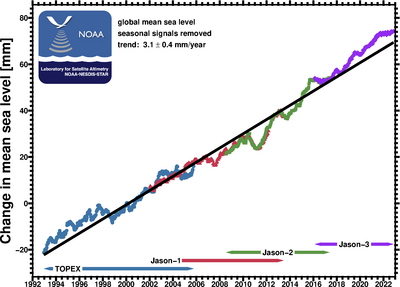
NASA has been recording the height of the ocean surface from space since 1992. That year, NASA and the French space agency, CNES, launched the first of a series of spaceborne altimeters that have been making continuous measurements ever since. The first instrument, Topex/Poseidon, and its successors, Jason-1 and -2, have recorded about 2.9 inches (7.4 centimeters) of rise in sea level averaged over the globe.
Ok, some simple arithmetic. 7.4 cm over a period of 23 years equals 3.2 mm/yr. No surprise – this is the number cited by the AR5 for satellite based sea level rise estimates.
“Given what we know now about how the ocean expands as it warms and how ice sheets and glaciers are adding water to the seas, it’s pretty certain we are locked into at least 3 feet of sea level rise, and probably more,” said Steve Nerem of the University of Colorado, Boulder, and lead of the Sea Level Change Team. “But we don’t know whether it will happen within a century or somewhat longer.”
Here is the last sea level rise plot from the NASA altimeters:
IPCC AR5
I don’t really see anything new here, but the new PNAS papers and the NASA press release serve to highlight an issue that has been nagging me.
The IPCC AR5 includes the following figure of sea level rise over the last century (Figure 3.14)

Figure 3.14 18-year trends of global mean sea level rise estimated at 1-year intervals. The time is the start date of the 18-year period, and the shading represents the 90% confidence. The estimate from satellite altimetry is also given, with the 90% confidence given as an error bar. [AR5 WGI Figure 3.14]
Global sea level has been rising for the past several thousand years, owing to the retreat of glaciers from the last ice age. The key issue is whether the rate of sea level rise is accelerating owing to anthropogenic global warming. It is seen from the figure above that the rate of sea level rise during 1930-1950 was comparable to, if not larger than, the value in recent years. The challenges to determining global sea level rise, particularly over the past 100 or 1000 years, are substantial.
Somehow, the IPCC AR5 drew this conclusion, in context of Figure 3.14:
“Since the early 1970’s, glacier mass loss and ocean thermal expansion from warming together explain about 75% of the observed global sea level rise (high confidence)”
Go figure.
Other recent papers
Other recent papers that I’ve collected on the topic:
Modeling sea-level change using errors-in-variable integrated Gaussian processes, by Cahill et al. (published in Journal of Applied Statistics )
“Our analysis of the global tide-gauge record shows that the rate of GMSL rise increased (accelerated) continuously from 1.13 mm/yr in 1880 AD to 1.92 mm/yr in 2009 AD.” While Cahill et all find an acceleration in sea level rise over the past century, their inferred rate of current sea level rise (< 2 mm/yr) is significantly lower than the value of 3.2 mm/yr derived from satellite altimetry measurements.
Robust reef growth in Indian Ocean kept up with sea level rise > 20X faster in past [link] …
New paper shows sea levels dropped along west coast of North & South America from 1993-2013 [link] …
Coastal planning should be based on proven sea level data, by Parker and Ollier
Highlights:
- The network of tide gauges provides the only information of value for costal planning.
- The worldwide naïve average of sea level is +0.24 mm/year with no acceleration.
- The climate models have crucial flaws making them useless.
- Planning schemes must only reflect the proven local and global historical data.
JC reflections
So, what to make of all this?
Sea level rise is the main ‘danger’ from human caused climate change (any increase in extreme weather events is hypothesized rather [than] demonstrated using historical data, with possible exception of heat waves in a few regions).
At a presentation that I made earlier this year to CEOs of small electric cooperatives, one participant was surprised by what I had to say about sea level rise – he hadn’t realized that there had been sea level rise prior to 1950. I.e., like ‘climate change’, all sea level rise has been sold as caused by humans.
Sea level has overall been rising for thousands of years; however, as the Kopp et al. paper points out, there have been century scale periods of lowering sea level in the recent millennia. It is not clear from my cursory reading as to whether meaningful decadal and multi-decadal variations in sea level can be discerned from their data.
The key issue is whether the sea level rise during the past 50 years reflect an acceleration in sea level rise. The IPCC figure 3.14 suggests that there is no acceleration, given the large rates of sea level rise in the first half of the 20th century. Until we have an understanding of variations in decadal and multi-decadal sea level rise, we can’t make a convincing argument as to acceleration.
With regards to coastal planning, I absolutely agree with the paper linked to above. Locations where sea level rise is a problem invariably have rates of sea level rise that are much greater than even the altimeter values of 3.2 mm/yr are caused by local geologic processes, land use, and or coastal/river engineering. Global values of sea level rise have essentially no use in coastal planning; rather they seem mainly relevant in terms of motivating ‘action’ on carbon mitigation policy.
Sea level will continue to rise, no matter what we do about CO2 emissions. We need creative solutions – one of my favorites remains the garbage solution.
Brazil Ends Monsanto Linked Pesticide Use to Fight Zika After It’s Exposed as Cause of Birth Defects
By Matt Agorist | Free Thought Project | February 16, 2016
On Sunday, the Free Thought Project reported on the recent information released by the Physicians in the Crop-Sprayed Towns (PCST), who revealed that the Brazilian government’s assertion that microcephaly was caused by the Zika virus was not substantial. PCST exposed a popular larvacide pyriproxyfen to be the actual suspect.
The chemical, pyriproxyfen, was added to the state of Pernambuco’s drinking-water reservoirs in 2014, by the Brazilian Ministry of Health, in an effort to stop the proliferation of the Zika-carrying Aedes aegypti mosquito.
The report by PCST revealed that the pesticide, sold under the commercial name SumiLarv, is manufactured by Sumitomo Chemical, a Japanese subsidiary of Monsanto.
“Pyriproxyfen is a growth inhibitor of mosquito larvae, which alters the development process from larva to pupa to adult, thus generating malformations in developing mosquitoes and killing or disabling them. It acts as an insect juvenile hormone or juvenoid, and has the effect of inhibiting the development of adult insect characteristics (for example, wings and mature external genitalia) and reproductive development. It is an endocrine disruptor and is teratogenic (causes birth defects).
“Malformations detected in thousands of children from pregnant women living in areas where the Brazilian state added pyriproxyfen to drinking water is not a coincidence, even though the Ministry of Health places a direct blame on Zika virus for this damage, while trying to ignore its responsibility and ruling out the hypothesis of direct and cumulative chemical damage caused by years of endocrine and immunological disruption of the affected population,” according to the report by Physicians in the Crop-Sprayed Towns.
In a move that would never happen in America, the Brazilian government actually listened to the group of doctors and suspended the use of pyriproxyfen, pending further study.
In a communique, the state government said that “the suspension was communicated to the 19 Regional Health Coordinating Authorities, which in turn will inform the respective Municipal Monitoring services” in all cities in the state, according to Fox News Latino.
Up until now, Brazilian scientists have been attributing the increase in microcephaly to the Zika virus. However, on Sunday, Rio Grande do Sul Health Secretary Joao Gabbardo said that, despite the fact that a relationship between the larvicide and microcephaly has not been proven, the “suspicion” that there may be a linkage had led the organizations to decide to “suspend” the use of the chemical.
“We cannot run that risk,” Gabbardo said.
Of course, this news is being met with backlash by those who have advocated adding this larvicide to the water supply.
“That is a rumor lacking logic and sense. It has no basis. (The larvicide) is approved by (the National Sanitary Monitoring Agency) and is used worldwide. Pyriproxyfen is recognized by all regulatory agencies in the whole world,” Health Minister Marcelo Castro told reporters Sunday.
Also, the Monsanto affiliate, Sumitomo Chemical also claimed that “there is no scientific basis for such a claim,” adding that the product has been approved by the World Health Organization since 2004 and the U.S. Environmental Protection Agency since 2001.
The fact the WHO has officially gone on record and stated that microcephaly is not linked directly to the Zika virus has been of little consequence to the Health Secretary. Also of little consequence to the Health Secretary, is that there haven’t been any cases of microcephaly attributed to the Zika virus in past outbreaks.
According to the report by PCST:
Previous Zika epidemics did not cause birth defects in newborns, despite infecting 75% of the population in those countries. Also, in other countries such as Colombia there are no records of microcephaly; however, there are plenty of Zika cases.
The caution and proactive response by the Brazilian government are noteworthy and should serve as an example to officials in the United States who continue to expose citizens to a myriad of toxic chemicals banned in countries across the planet.
Bitter truth: Sugar may be as harmful as stress – study
RT | February 16, 2016
A group of researchers from Australia and India released a study suggesting that sugar consumption may cause not only diabetes and obesity, but also brain defects comparable to those caused by stress or abuse.
The study published in the Frontiers in Molecular Neuroscience journal focused on whether and how the diet may influence the brain compared to to stress and other psychological loads during infancy.
The scientists paid special attention to the hippocampus, a brain region responsible for long-term memories, stress regulation and behavioral patterns.
The tests involved female Sprague-Dawley rats (“as females are more likely to experience adverse life events,” the scientists explained) from one litter with half of them being exposed to artificial stressful conditions such as limited nest material for the first days of their life. The other half lived normal rat lives free from stress and anxiety.
During the next stage there were four groups of rodents: a no-stress group drinking water, a no-stress group drinking sugar solution, a stress group drinking water and a stress group drinking sugar solution.
The experiment took 15 weeks and ended with a check of the rats’ brains. The autopsy showed similar anomalies in the hippocampus regions both in the rats that were stressed but drank water and the non-stressed rats that drank sugar. The receptor hindering the stress hormone cortisol was found impaired which means coping with stress for those rats wouldn’t be that easy.
“The novelty of this study lies in the finding that chronic consumption of sugar produced equivalent hippocampal molecular deficits as early life stress exposure,” the study said.
Both sugar and stress also messed with a gene, called Neurod1 that is accountable for the growth of nerves. Other similar genes were affected only by sugar, the study noted.
However, it’s still not clear whether similar processes take place in human bodies as well, and so further research is required, the scientists said.
The results raise a major issue since the diet of an average modern human often includes sugary soft drinks.
“If similar processes are at play in humans, manipulating the later environment of those exposed to early life adversity, and controlling the consumption of sugar-sweetened beverages across the community may be an effective way to curtail the burden of psychiatric disorders,” the study explained.
Read more:
Eugenics WMD: Zika Virus Prompts Disturbing New Call For ‘No Child Policy’
By J.R. Smith | 21st Century Wire | January 25, 2016
If you have been watching the news this week you will have seen one story which has been gaining traction in western media coverage, that of the mosquito-borne illness known as the Zika Virus, which authorities are saying will cause birth defects for expecting mothers.
While there are certainly many health risks apparent with this particular pathogen, media outlets and government agencies appear to be pushing one incredible talking point now – asking women ‘not to get pregnant until 2018.’
Latin American officials, led by El Salvador are now urging women not to get pregnant for “up to two years.”
Latin American governments, in conjunction with the UN’s World Health Organization (WHO), are claiming that over the past four months, they have ‘received reports’ of nearly 4,000 cases of microcephaly in newborns – and they are claiming these are all linked to the Zika Virus. This information has served as the chief catalyst for the current wave of fear.
The Washington Post stated this week that:
“The World Health Organization says at least 20 countries or territories in the region, including Barbados and Bolivia, Guadeloupe and Guatemala, Puerto Rico and Panama, have registered transmission of the virus.”
“Although the Zika virus has been documented since the 1940s, it began its assault on Latin America in the past several months. The hardest-hit country has been Brazil, where more than 1 million people have contracted the virus. In the past four months, authorities have received reports of nearly 4,000 cases in which Zika may have caused microcephaly in newborns. The condition results in an abnormally small head and is associated with incomplete brain development. Colombia, which shares an Amazonian border with Brazil, reacted to its own Zika outbreak, numbering more than 13,000 cases, by urging women not to get pregnant in the next several months. Other countries, including Jamaica and Honduras, also have urged women to delay having babies.”
Zika ‘Threat’ Goes Global
If contracted, the Zika Virus is said to have an incubation period of only 5 to 10 days, and authorities are claiming that it’s within this window that mothers are at risk. Some common symptoms include red spots on the skin, intermittent fever, spots on the eyes and later on with persistent pains in muscles, joints and head.
Clearly though, the alarm for a Zika epidemic is already being sounded internationally. This has tremendous potential implications on society.
In the US, the Center for Disease Control and Prevention (CDC), is warning that pregnant women not to travel to 14 countries in Latin America. We were also told that last week, the US recorded the first case of microcephaly “linked to Zika” virus in Hawaii. According to The New York Times, the baby’s mother “might have” been infected when she traveled to Brazil in May last year.
The World Health Organization (WHO) also warned today that the virus will spread to both North America and South America. Based on how easily the US population was whipped into a hysterical haze during the Ebola scare in 2014, it goes without saying that if Zika ‘reproductive’ fears hit the US in a big way it would be a political circus of fear and media manipulation.
It’s not clear exactly how they have come to the conclusion that this apparent epidemic is a result of the Zika Virus, and not through some other combination of factors. Neither journalists nor the world’s scientific community are questioning the current course of public policy on this issue. Why? No one is addressing that it is nearly impossible to make a scientific ruling on these issues in such a short space of time, much less institute government guidelines on reproduction.
Why is Latin America and El Salvador so significant? Social engineers appear to locking horns with the Catholic Church on this issue. The Post adds here:
“Morality says that people shouldn’t have that control” over procreation, Figueroa said. “But the church also isn’t going to say something that runs contrary to life and health.”
This is a first in human history – central government advocating for a universal ban on procreation, and probably the most significant development in social engineering since the outbreak of the AIDs virus in the early 1980’s.
‘No Child Policy’
The public should not underestimate the significance of this latest story. Again, while there are definitely real risks associated with Zika and other related viruses to health and women’s prenatal health, is it premature to call for what amounts to a ‘no child policy’?
It’s only a matter of time before globalists start to link the temperate climate mosquito-based Zika virus with ‘global warming’ aka ‘climate change’ – creating a new multi-faceted international social imperative and empowering the global government narrative necessary in order to “tackle” and “contain” this new multi-faceted threat. Likewise, we can expect the WHO, Bill Gates and the usual suspects to start clamoring for a new vaccine solution to a global Zika crisis.
How this story has escaped critical analysis in the mainstream media and discourse is a testament as to how well the establishment has done in conditioning the public to accept a range of modern eugenics-based ‘population reduction’ policies aimed at population reduction.
Claim: ‘With 2015, Earth Has Back-to-Back Hottest Years Ever Recorded’
MIT Climate Scientist Mocks ‘Hottest Year’ Claim: ‘Anyone who starts crowing about those numbers shows that they’re putting spin on nothing’
Climate Depot | January 20, 2016
NASA and NOAA today proclaimed that 2015 was the ‘hottest year’ on record.
Meanwhile, satellite data shows an 18 plus year standstill in global temperatures.
MIT climate scientist Dr. Richard Lindzen balked at claims of the ‘hottest year’ based on ground based temperature data.
“Frankly, I feel it is proof of dishonesty to argue about things like small fluctuations in temperature or the sign of a trend. Why lend credibility to this dishonesty?” Lindzen, an emeritus Alfred P. Sloan Professor of Meteorology at the Department of Earth, Atmospheric and Planetary Sciences at MIT, told Climate Depot shortly after the announcements.
“All that matters is that for almost 40 years, model projections have almost all exceeded observations. Even if all the observed warming were due to greenhouse emissions, it would still point to low sensitivity,” Lindzen continued.
“But, given the ‘pause.’ we know that natural internal variability has to be of the same order as any other process,” Lindzen wrote.
Lindzen has previously mocked ‘warmest’ or ‘hottest’ year proclamations.
“When someone says this is the warmest temperature on record. What are they talking about? It’s just nonsense. This is a very tiny change period,” Lindzen said in November 2015.
Lindzen cautioned: “The most important thing to keep in mind is – when you ask ‘is it warming, is it cooling’, etc. — is that we are talking about something tiny (temperature changes) and that is the crucial point.”
“And the proof that the uncertainty is tenths of a degree are the adjustments that are being made. If you can adjust temperatures to 2/10ths of a degree, it means it wasn’t certain to 2/10ths of a degree,” he added.
“70% of the earth is oceans, we can’t measure those temperatures very well. They can be off a half a degree, a quarter of a degree. Even two-10ths of a degree of change would be tiny but two-100ths is ludicrous. Anyone who starts crowing about those numbers shows that they’re putting spin on nothing.”
Related:
Great Lakes Nuclear Waste Dump: The Battle Continues
By Joyce Nelson | CounterPunch | January 15, 2016
Opposition to the proposed nuclear waste facility by Lake Huron continues to grow. By the end of 2015, at least 182 communities (representing more than 22 million people) on both sides of the U.S.-Canada border have adopted resolutions opposing the plan by Ontario Power Generation to build a deep geological repository (DGR) for storage of low- and intermediate-level radioactive nuclear waste.
A Canadian federal panel approved the nuclear waste dump in May 2015, accepting testimony that Lake Huron would be large enough to dilute any radioactive pollution that might leak from the DGR.
The immediate outcry on both sides of the border prompted the Conservative government of Stephen Harper to postpone any decision until Dec. 1, 2015, after the Oct. 19 federal election – in which they were booted out of office. The new government of Liberal Justin Trudeau then pushed that decision to March 1, 2016, after a dozen members of Michigan’s congressional delegation urged the new prime minister to deny the construction permits necessary for the storage facility to be built.
Meanwhile, American efforts to engage the International Joint Commision (IJC), which oversees boundary waters’ issues, have come to naught. As the IJC’s Public Information Officer Frank Bevacqua told me by email, both the Canadian and U.S. federal governments would have to ask the IJC to intervene on the issue. “The IJC does not review proposals for site-specific projects [like the DGR] unless asked to do so by both governments,” he said.
That means a final decision on the DGR may reside with a small First Nations community.
First Nation Decision
The proposed DGR would be located on the territory of the Saugeen First Nation, which is in the process of evaluating the proposal. The Saugeen First Nation has a promise from Ontario Power Generation to not proceed without their support. As Saugeen Chief Vernon Roote told Indian Country Today Media Network (ICTMN) in December, “Ontario Power Generation had given us their commitment that they will not proceed unless they have community support. That’s a letter that we have on file.” [1]
Saugeen First Nation negotiator (and former Chief) Randall Kahgee told ICTMN that “we are starting to build some momentum on the community engagement process.” The Saugeen leaders are determining how to gauge the community voice, whether by polling or by vote at public gatherings, and have already held some engagement sessions on the issue. [2]
Randall Kahgee told ICTMN, “For the communities, this is not just about the deep geological repository but also about the nuclear waste problem within our territory. We have always insisted that while this problem is not of our own design, we must be part of shaping the solution. Gone are the days when our people, communities and Nation are left on the outside looking in within our own territory. These are complex issues that will force us to really ask ourselves what does it mean to be stewards of the land. The opportunity to be able to shape the discourse on these matters is both exciting and frightening at the same time.” [3]
The Saugeen First Nation is especially concerned about simply moving the proposed facility into somebody else’s backyard. “We might not be the best of friends when we push nuclear waste on our brothers’ and sisters’ territory,” he told ICTMN.
Nuclear Expansion
The proposal by provincial Crown corporation Ontario Power Generation (OPG) is for at least 7 million cubic feet of nuclear wastes from Ontario nuclear power plants to be buried in chambers drilled into limestone 2,231 feet below the surface and under the Bruce nuclear site at Kincardine, Ontario. The waste to be entombed in the DGR would come from the Bruce, Pickering and Darlington nuclear sites in Ontario – currently home to 18 Candu reactors.
The eight nuclear reactors at the Bruce site (the world’s largest nuclear station) are leased from OPG by a private company called Bruce Power, whose major shareholders/partners include TransCanada Corp. – better known for its tarsands pipeline projects. (TransCanada earns more than one-third of its profits from power-generation.) Bruce Power pays OPG for storage of nuclear wastes, which are currently stored and monitored above-ground on site. [4]
In December, Bruce Power announced that it will invest $13 billion to refurbish the Bruce site, overhauling six of the eight reactors on Lake Huron beginning in 2020. [5] Just weeks later, OPG announced a $12.8 billion refurbishment of four nuclear reactors at Darlington, while extending the life of its ageing Pickering nuclear power plant on Lake Ontario. [6] The Pickering move requires public hearings and approval from the Canadian Nuclear Safety Commission, but Ontario’s Energy Minister Bob Chiarelli has voiced his approval and touted the nuclear industry as “emissions-free,” while ignoring the issue of nuclear wastes.
OPG, Bruce Power, and the Ontario government are obviously onside with the Canadian Nuclear Association lobby, whose president and CEO John Barrett is using the COP21 Paris Climate Agreement to push for nuclear expansion. In an op-ed for The Globe and Mail, Barrett declared that “it is time to recognize the contribution – current and potential – of nuclear power in curbing greenhouse gas (GHG) emissions worldwide,” and he stated that Canada, with its uranium mining and nuclear reactor technology, is “ready to play an international leadership role on climate change.” [7]
Barrett, in turn, is onside with the billionaires now pushing nuclear energy expansion worldwide: Richard Branson (Virgin Group), Peter Thiel (PayPal co-founder), Bill Gates and Paul Allen (Microsoft co-founders), and Jeff Bezos (Amazon) have all endorsed nuclear energy as the solution to climate change. [8] As well, scientists James Hansen, Kerry Emmanuel, Ken Caldeira and Tom Wigley have recently called for building 115 new reactors per year as “the only viable path forward”. [8] They dismiss nuclear waste as “trivial” and claim that there “are technical means to dispose of this small amount of waste safely.”
In that case, the resulting nuclear waste should be stored in their basements and under the billionaires’ mansions, rather than near bodies of water like the Great Lakes, which provide 40 million people with their drinking water.
Footnotes:
[1] Konnie Lemay, “Saugeen Nation May Be Final Word in Nuclear Waste Storage Next to Lake Huron,” Indian Country Today Media Network, December 11, 2015.
[2] Ibid.
[3] Ibid.
[4] Joyce Nelson, “Nuclear Dump Controversy,” Watershed Sentinel, Sept.-Oct., 2015.
[5] Robert Benzie, “Bruce Power to invest $13 billion to refurbish nuclear station on Lake Huron,” Toronto Star, December 3, 2015.
[6] Rob Ferguson, “Ontario Power Generation to spend $12.8 billion refurbishing four Darlington nuclear reactors,” Toronto Star, January 11, 2016.
[7] John Barrett, “Nuclear power is key to decarbonization, and Canada can lead the way,” The Globe and Mail, December 16, 2015.
[8] Emily Schwartz Greco, “A Big Fat Radioactive Lie,” Other words.org, December 4, 2015.
Joyce Nelson is an award-winning Canadian freelance writer/researcher working on her sixth book.
Featured Video

Dan Dicks with James Corbett on Solutions Watch
or go to
Aletho News Archives – Video-Images
From the Archives
$1.5bn up in smoke: US THAAD missile stockpile dries up defending Israel against Iran
By Ivan Kesic | Press TV | July 2, 2025
According to American media, defense news outlets, and independent analysts, the 12-day Israeli military aggression against Iran significantly depleted the US stockpile of THAAD (Terminal High Altitude Area Defense) interceptor missiles.
Citing official sources, American magazine Newsweek reported on Friday that the US transferred a substantial portion of its advanced missile defense capabilities to support the Israeli regime, an effort with questionable results and a critical impact on US strategic reserves.
THAAD, developed by Lockheed Martin arms manufacturing company, is a key component of Israel’s multi-layered air defense architecture. It is designed to intercept medium-range ballistic missiles, including those launched from Iran and Yemen.
The US-made system is capable of targeting short-, medium-, and intermediate-range ballistic missiles during their terminal phase, whether inside or outside Earth’s atmosphere.
THAAD uses a “hit-to-kill” method, relying on kinetic energy rather than explosive warheads to destroy incoming threats, intercepting at altitudes of up to 150 km and ranges between 150-200 km.
Operated exclusively by American personnel, the US military maintains eight THAAD batteries with an estimated 350–400 interceptors in total. The eighth battery was activated during the June 20 Israeli aggression against Iran and is capable of intercepting hypersonic missiles. … continue
Blog Roll
 Aletho News
- Zionist Bought Senate Blocks Information About American Citizens Killed By Israel
- While Gaza dominates the UN, these are the people keeping it alive
- New Report: “Scholasticide and Genocide in Gaza: Assessment, Testimonies and Legal Analysis”
- ‘THAAD Delusion’: Iran war exposes US missile shield limits – The Atlantic
- Moscow issues warning to NATO over Russian exclave
- Yes, the Iran war has destroyed Trump’s presidency
- The fallacy of US delusions about Iran’s economic collapse
- Hezbollah denies Syria cell link, warns of Israeli plan to sow discord
- The legacy of US sanctions, war, and occupation in Iraq
- Iraqi resistance group rejects disarmament, vows to maintain support for Lebanon
- If Americans Knew
- Mamdani releases plan to combat antisemitism and hate crimes in New York City
- Iran’s Revolutionary Guards Publish Letter to the American People
- DMFI launches $1 million ad campaign supporting Virginia’s Elaine Luria
- US Senate blocks resolution seeking report on Americans killed by Israel
- Israeli Attacks Kill Ten Palestinians in Gaza
- Massacre at Minab: The School That Became a Grave
- Israeli media: The IDF Shows It Doesn’t Turn a Blind Eye; It Actively Emboldens Settler Havoc
- As settlers ravage West Bank, Israeli forces kill 10 in Gaza – Daily Update
- New Report: “Scholasticide and Genocide in Gaza: Assessment, Testimonies and Legal Analysis”
- Ex-Biden officials are desperate for a Gaza scapegoat
- No Tricks Zone
- Green Energy Debacle: German Expert Professor Fritz Vahrenholt Warns Of Severe Economic And Social Consequences
- Two More Paleo Reconstructions Affirm Meters-Higher Sea Levels Across Ireland, Brazil 7000-6000 Years Ago
- New Study: Earth And Venus Surface Warmth Largely Explained By Convection And Lapse Rate, Not CO2 Or Radiation
- 2025 Nature Paper Claiming Worsening Global Drought Gets RETRACTED …Heavily Flawed
- New Study: ‘Global Drought Shows No Detectable Recent Acceleration Under Climate Warming’
- Economic Masterminds: German Socialists Suggest Taxing Productivity Gains Stemming From Using AI
- The South China Sea Has Not Been Cooperating With The Climate Change Narrative
- Energy Crisis: Germany Enters Heating Season With Historically Low Gas Reserve Fill Levels
- New Study: The Antarctic Ice Sheet Gained Mass From 2020-2024 Due To Staggering Snow And Ice Accumulation
- Study: Ocean Heating Rates From Thousands Of Years Ago ‘Dwarf’ Modern Ocean Heating Rates

